
Introduction
This almanac page for Monday, October 16, 1972, pulls together various records created by the federal government and links to additional resources which can provide context about the events of the day.
Previous Date: Sunday, October 15, 1972
Next Date: Tuesday, October 17, 1972
Schedule and Public Documents
The Daily Diary files represent a consolidated record of the President's activities. Visit the finding aid to learn more.
The President's day began at The White House - Washington, D. C.
The Weekly Compilation of Presidential Documents made available transcripts of the President's news conferences; messages to Congress; public speeches, remarks, and statements; and other Presidential materials released by the White House.
Digitized versions can be found at HathiTrust.
Each Public Papers of the Presidents volume contains the papers and speeches of the President of the United States that were issued by the White House Office of the Press Secretary during the time period specified by the volume. The material is presented in chronological order, and the dates shown in the headings are the dates of the documents or events. In instances when the release date differs from the date of the document itself, that fact is shown in the text note.
To ensure accuracy, remarks have been checked against audio recordings (when available) and signed documents have been checked against the original, unless otherwise noted. Editors have provided text notes and cross references for purposes of identification or clarity.
The Federal Register is the official daily publication for rules, proposed rules, and notices of federal agencies and organizations, as well as executive orders and other Presidential documents.
No Federal Register published on this date
The Congressional Record is the official daily record of the debates and proceedings of the U.S. Congress.
Archival Holdings
Any selection of archival documents will necessarily be partial. You should use the documents and folders identified below as a starting place, but consult the linked collection finding aids and folder title lists and the collections themselves for context. Many documents to be found this way do not lend themselves to association with specific dates, but are essential to a complete understanding of the material.
Selective document listing
President's Office Files
The President's Office Files consists of materials drawn together by the Special Files Unit from several administrative subdivisions within the White House Office. It is the handwriting and sensitive papers sent to the Staff Secretary that now comprise much of the President's Office Files. Visit the finding aid to learn more.
- News Summaries, Annotated News Summaries, Box 39, [Oct. 16-17, 1972] [1 of 2] [Note: Due to the way News Summary products were compiled, you should also consult nearby days for potentially relevant materials.]
- Political Media Analysis, October 16, 1972, 22 Days
- News Summary, October 16, 1972
- News Summaries, Annotated News Summaries, Box 39, [Oct. 16-17, 1972] [2 of 2]
- Print Coverage of the President's Visit to Atlanta, October 16, 1972
- President's Daily Schedule, Box 102, [President's Daily Schedule, Oct.-Dec. 1972] [1 of 2]
- The President's Schedule, Monday - October 16, 1972
President's Personal File
The President's Personal File is essentially a President's secretary's file, kept by Rose Mary Woods, personal secretary to the President, for two purposes: (1) preserving for posterity a collection of documents particularly close to the President, whether because he dictated or annotated them, or because of the importance of the correspondent or the event concerned and (2) giving appropriate attention–letters of gratitude, invitations to White House social events, and the like–to members and important friends and supporters of the Nixon administration. This generalization does not describe all the varied materials of a file group which is essentially a miscellany, but it does identify the reason for the existence of the file group's core. Visit the finding aid to learn more.
- President's Speech File
The H. R. Haldeman Diaries consists of seven handwritten diaries, 36 dictated diaries recorded as sound recordings, and two handwritten audio cassette tape subject logs. The diaries and logs reflect H. R. Haldeman’s candid personal record and reflections on events, issues, and people encountered during his service in the Nixon White House. As administrative assistant to the President and Chief of Staff, Haldeman attended and participated in public events and private meetings covering the entire scope of issues in which the Nixon White House engaged in during the years 1969-1973. Visit the finding aid to learn more.
- Transcript of diary entry (PDF)
Monday, October 16th. The main discussion this morning was on the Washington Post attack, of yesterday and today, on the Chapin story. The President makes the point that the main thing they're trying to do is tie in the President, and say he didn't tell the truth regarding the fact that no one in the White House was involved in Watergate. He feels there's no problem regarding the little games and stuff. The real question that concerns him is how Ziegler deals with the Kalmbach involvement. He thinks he ought to hit it with some sarcasm, saying he's surprised you haven't brought Pat Nixon in too, she's also a graduate of S.C. and so is O.J. Simpson. He thinks Ron should hit that the issue's being invaded, because the opposition press obviously feels that it doesn't have a good case on the issues. In the President view, he's spoken out against violence; he's given orders that are to be carried out, that there is to be no violence, or disruption of rallies, and if you've noted, there has been none. And McGovern is probably up, our opponent has not said anything about the hecklers and violence, and so on, on us. First, we cannot condone what was done. Second, we must separate it from Watergate. The whole purpose of this from their viewpoint, he thinks, is that it's the last burp of the Eastern establishment. The only thing he's basically concerned about is to be sure we don't lie and be sure we don't condone any bad activity. Make the point that we're running a high road campaign, no name calling, we're hitting hard on the issues; that the President is the victim of the dirtiest campaign ever conducted against a President of the United States. At least they should start using the line of the Eastern establishment press, make the point that they're strangely silent on all this stuff against us. Also the point that the Post and the Times praise spies when they're related to the Anderson papers, the Pentagon Papers, the India-Pakistan matter, but because of their double standard, they don't seem to be concerned with spying when it doesn't involve the security of the country.
He had Ehrlichman in later today, suggested that Segretti sue the Post for libel and give the Star a statement on it.
He made the interesting point that after the election we will have awesome power with no discipline, that is, there won't be another election coming up to discipline us, and we've got to do our planning on that basis.
He did the POW wives at the last minute this morning; we ran it in because we had no story to counter the Post espionage story, or sabotage story, so we, I went in and talked him into going over at the last minute to do the POW wives after just having talked Henry into doing likewise. The President went instead of Henry.
Henry left for Paris today. He had a great reception, gave one of the best talks he's given, got a chance to get in all of his key points, so it was a very worthwhile run.
Rogers had a number of problems today, he called and said there's an embarrassing thing about to happen.
-------------------------------------------------------------------------------------------------------------------
EXEMPTED IN FULL, E.O. 13526, Sect. 3.3B(1)B(6), June 12, 2013
Audio Cassette 25, Side B, Withdrawn Item Number 19 [AC-25(B) Sel 15]
Duration: 25 seconds
ISRAEL
-------------------------------------------------------------------------------------------------------------------
Then in the evening, he got into a flap with Haig about whether he could have the Vietnam papers to study. The President ordered that they be kept at the White House and not copied, but that Rogers could come over to the White House and look at them. He also had a problem on Korea, where...
-------------------------------------------------------------------------------------------------------------------
DECLASSIFIED - E.O. 13526, Sect. 3.4: by MS, NARA, June 12, 2013
Audio Cassette 25, Side B, Withdrawn Item Number 20 [AC-25(B) Sel 16]
Duration: 17 seconds
…their, President Park is going to declare martial law. Rogers wanted to send a strong cable to him to try to turn him off from blaming our China move and our Vietnam peace efforts for his doing this.
--------------------------------------------------------------------------------------------------------------------
He did send the cable with the President's approval.
End of October 16th. - Original audio recording (MP3)
The National Archives Catalog is the online portal to the records held at the National Archives, and information about those records. It is the main way of describing our holdings and also provides access to electronic records and digitized versions of our holdings.
The Catalog searches across multiple National Archives resources at once, including archival descriptions, digitized and electronic records, authority records, and web pages from Archives.gov and the Presidential Libraries. The Catalog also allows users to contribute to digitized historical records through tagging and transcription.
Nixon Library Holdings
All National Archives Units
National Security Documents
The President's Daily Brief is the primary vehicle for summarizing the day-to-day sensitive intelligence and analysis, as well as late-breaking reports, for the White House on current and future national security issues. Read "The President's Daily Brief: Delivering Intelligence to Nixon and Ford" to learn more.
The Foreign Relations of the United States series presents the official documentary historical record of major U.S. foreign policy decisions and significant diplomatic activity. Visit the State Department website for more information.
Vol. III, Foreign Economic Policy; International Monetary Policy, 1969-1972
Foreign Economic Policy
104. Action Memorandum From Helmut Sonnenfeldt and Robert Hormats of the National Security Council Staff to the President’s Assistant for National Security Affairs (Kissinger), Washington, October 16, 1972
Source: National Archives, Nixon Presidential Materials, NSC Files, Agency Files, Box 219, CIEP. Limited Official Use.
Vol. V, United Nations, 1969-1972
Special Meetings of the Security Council
137. Telegram From the Department of State to the Embassy in Panama, Washington, October 16, 1972, 2246Z
Source: National Archives, RG 59, Central Files 1970–73, UN 3 SC. Confidential; Immediate. Drafted by Bell; cleared by Herz, Armitage, Finn, Crimmins, Ward, and Hurwitch; and approved by Charles A. Meyer. Repeated to USUN.
Vol. IX, Vietnam, October 1972-January 1973
Breakthrough in Paris Blocked in Saigon, October 8-23, 1972
18. Message From the President’s Deputy Assistant for National Security Affairs (Haig) to the President’s Assistant for National Security Affairs (Kissinger) in Paris, Washington, October 16, 1972, 2058Z
Source: National Archives, Nixon Presidential Materials, NSC Files, Kissinger Office Files, Box 25, HAK Trip Files, HAK Paris/Saigon Trip Tohak, October 16–23, 1972 (2 of 2). Top Secret; Sensitive; Exclusively Eyes Only. Sent via Lord.
19. Message From the President’s Deputy Assistant for National Security Affairs (Haig) to the President’s Assistant for National Security Affairs (Kissinger), Washington, October 16, 1972
Source: National Archives, Nixon Presidential Materials, NSC Files, Kissinger Office Files, Box 25, HAK Trip Files, HAK Paris/Saigon Trip Tohak, October 16–23, 1972 (2 of 2). Top Secret; Sensitive; Exclusively Eyes Only. Sent via Guay and Lord.
20. Letter From President Nixon to South Vietnamese President Thieu, Washington, October 16, 1972
Source: National Archives, Nixon Presidential Materials, NSC Files, Box 857, For the President’s Files (Winston Lord)—China Trip/Vietnam, Sensitive Camp David, Vol. XX [1 of 2]. No classification marking. Kissinger was to personally hand the letter to Thieu when he met with him in Saigon. See footnote 2, Document 27.
21. Memorandum From Philip A. Odeen of the National Security Council Staff to the President’s Assistant for National Security Affairs (Kissinger), Washington, October 16, 1972
Source: National Archives, Nixon Presidential Materials, NSC Files, Box 514, Country Files, Far East, Cambodia, Vol. 16, Sep–Dec 72. Secret; Sensitive; Completely Outside the System. Sent for information. Kissinger initialed the memorandum.
Vol. XIX, Part 1, Korea, 1969-1972
Republic of Korea Troops in Vietnam and Force Modernization, April 1971-December 1972
160. Telegram From the Embassy in Korea to the Department of State, Seoul, October 16, 1972, 1349Z
Source: National Archives, Nixon Presidential Materials, NSC Files, Box 543, Country Files, Far East, Korea, Vol. V, 1 Jan–31 Dec 1972, Part 2. Confidential; Immediate; Exdis. Repeated to Tokyo.
Vol. XXI, Chile, 1969-1973
Cool and Correct: The U.S. Response to the Allende Administration, November 5, 1970-December 31, 1972
311. Memorandum From the Executive Secretary of the Department of State (Eliot) to the President’s Assistant for National Security Affairs (Kissinger), Washington, October 16, 1972
Source: National Archives, Nixon Presidential Materials, NSC Files, Box 776, Country Files, Latin America, Chile, Vol. VII. Secret.
Vol. XXIII, Arab-Israeli Dispute, 1969-1972
Proximity Talks and the Backchannel: Separate Department of State and White House Negotiating Tricks
314. Telegram From the Interests Section in Egypt to the Department of State, Cairo, October 16, 1972, 0940Z
Source: National Archives, Nixon Presidential Materials, NSC Files, Box 1169, Saunders Files, Middle East Negotiations Files, Middle East—Jarring Talks, October 1–31, 1972. Secret. Repeated to Amman, Jidda, London, Moscow, Paris, Tel Aviv, Tripoli, and USUN.
Vol. XXIV, Middle East Region and Arabian Peninsula, 1969-1972; Jordan, September 1970
Saudi Arabia
165. Memorandum of Conversation, Washington, October 16, 1972
Source: National Archives, RG 59, Central Files 1970–73, DEF 6–4 SAUD. Confidential. Drafted by Wrampelmeier.
Vol. E-7, Documents on South Asia, 1969-1972
Afghanistan, 1969-1972
370. Telegram 6029 From the Embassy in Afghanistan to the Department of State, Kabul, October 16, 1972
The Embassy recommended provision of 20,000 tons of wheat to Afghanistan in response to an emergency assistance request from the Afghan Government. The Embassy further suggested that the U.S. provide $400,000 to help offset the transportation costs of trucking food into areas affected by famine.
Source: National Archives, RG 59, Central Files 1970–73, SOC 10 AFG. Limited Official Use. Repeated to Islamabad, Tehran, and Rome for FODAG
Vol. E-10, Documents on American Republics, 1969-1972
Panama
560. Memorandum From Edward Ridley Finch, Jr. to the Deputy Secretary of State (Irwin), Washington, October 16, 1972., Washington, October 16, 1972
In this 5 page memorandum, Finch recounted his conversation with General Torrijos and President Lakas over topics in U.S.-Panamanian relations, including narcotics, the Pan American Highway, and the Panama Canal.
Source: National Archives, RG 59, Central Files 1970–73, POL PAN–US. TLE Sensitive; Personal and Confidential; Nodis. There was a handwritten note attached which stated, “JDI [Irwin] has asked ARA to redraft Finch’s report to make it less sensational. He will ask Finch to sign redrafted version and then send it to WH [White House] under Irwin/Pres memo. This version being given only to ARA and us. Ted - do you want a TLE sensitive for now?” The later version of the letter was sent to the President on November 13 and is ibid., POL 2 PAN. Nixon’s October 9 letter to Torrijos is ibid., Nixon Presidential Materials, NSC Files, Box 760, Presidential Correspondence, 1969–1974, Panama, President Demetrio B. Lakas. Nixon’s letter to Lakas has not been found.
Vol. E-13, Documents on China, 1969-1972
168. Memorandum for the Record, New York, October 16, 1972, 2:30-3:10 p.m., New York, October 16, 1972, 2:30-3:10 p.m.
Deputy Director of the White House Situation Room Fazio and Shih Yen-hua of the Chinese Mission to the UN discussed general matters. Fazio furnished Shih Yen-hua with a message concerning the question of restricting military supplies to North and South Vietnam by outside powers.
Source: National Archives, Nixon Presidential Materials, NSC Files, Box 850, President’s File-China Trip, China Exchanges, June 25, 1972-Oct 17, 1972. Top Secret; Sensitive. A handwritten notation on the attached message reads: “Handed to Mrs. Shih by J. Fazio, Oct 16, 1972, NYC.”
The Kissinger telephone conversation transcripts consist of approximately 20,000 pages of transcripts of Kissinger’s telephone conversations during his tenure as Assistant to the President for National Security Affairs (1969-1974) and Secretary of State (1973-1974) during the administration of President Richard Nixon. Visit the finding aid for more information.
Digitized versions can be found in the National Archives Catalog.
Audiovisual Holdings
Visit the White House Tapes finding aid to learn about the taping system's operation and archival processing.
Old Executive Office Building
- 367-1; Unknown between 1:26 p.m. & 2:21 p.m.; Nixon, Richard M. (President); Butterfield, Alexander P.
- 367-2; Unknown between 1:26 p.m. & 2:21 p.m.; Nixon, Richard M. (President); Sanchez, Manolo
- 367-3; Unknown between 1:28 p.m. & 2:21 p.m.; Nixon, Richard M. (President); White House operator
- 367-4; Unknown between 1:28 p.m. & 2:21 p.m.; Nixon, Richard M. (President); Haig, Alexander M., Jr.
- 367-5; 2:21 p.m. - 2:22 p.m.; Nixon, Richard M. (President); Tkach, Walter R.
- 367-6; 2:23 p.m. - 2:23 p.m.; Nixon, Richard M. (President); White House operator
- 367-7; Unknown between 2:23 p.m. & 2:25 p.m.; Nixon, Richard M. (President); Sanchez, Manolo
- 367-8; Unknown between 2:23 p.m. & 2:25 p.m.; Nixon, Richard M. (President); White House operator
- 367-9; Unknown between 2:23 p.m. & 2:25 p.m.; Nixon, Richard M. (President); White House operator
- 367-10; 2:25 p.m. - 3:29 p.m.; Nixon, Richard M. (President); Colson, Charles W.; White House operator; Christian, George E.; Haldeman, H. R. ("Bob"); Fitzsimmons, Frank E.
Oval Office
- 799-1; Unknown between 7:30 a.m. & 8:30 a.m.; Nixon, Richard M. (President); Sanchez, Manolo
- 799-2; Unknown between 8:30 a.m. & 8:34 a.m.; Nixon, Richard M. (President); Woods, Rose Mary
- 799-3; Unknown between 8:30 a.m. & 8:34 a.m.; Nixon, Richard M. (President); Woods, Rose Mary
- 799-4; Unknown between 8:34 a.m. & 8:50 a.m.; Nixon, Richard M. (President); Bull, Stephen B.
- 799-5; Unknown between 8:34 a.m. & 8:50 a.m.; Nixon, Richard M. (President); Bull, Stephen B.
- 799-6; 8:50 a.m. - 9:29 a.m.; Nixon, Richard M. (President); Haldeman, H. R. ("Bob")
- 799-7; Unknown between 9:29 a.m. & 9:32 a.m.; Nixon, Richard M. (President); Bull, Stephen B.
- 799-8; 9:32 a.m. - 9:32 a.m.; Nixon, Richard M. (President); White House operator
- 799-9; 9:33 a.m. - 10:12 a.m.; Nixon, Richard M. (President); Kissinger, Henry A.; White House operator; Abrams, Creighton W., Jr. (Gen.); Haldeman, H. R. ("Bob")
- 799-10; 10:13 a.m. - 10:19 a.m.; Nixon, Richard M. (President); Haldeman, H. R. ("Bob"); [Unknown person(s)]; Kissinger, Henry A.
- 799-11; 10:22 a.m. - 10:23 a.m.; Nixon, Richard M. (President); Kissinger, Henry A.
- 799-12; 10:24 a.m. - 10:25 a.m.; Nixon, Richard M. (President); Haldeman, H. R. ("Bob")
- 799-13; Unknown between 10:25 a.m. & 10:27 a.m.; Nixon, Richard M. (President); Bull, Stephen B.
- 799-14; 10:27 a.m. - 10:28 a.m.; Nixon, Richard M. (President); Haldeman, H. R. ("Bob")
- 799-15; Unknown between 10:28 a.m. & 10:47 a.m.; Nixon, Richard M. (President); Butterfield, Alexander P.
- 799-16; 10:47 a.m. - 10:48 a.m.; Nixon, Richard M. (President); Goldwater, Barry M.; Butterfield, Alexander P.
- 799-17; 11:24 a.m. - 11:40 a.m.; Nixon, Richard M. (President); Ziegler, Ronald L.
- 799-18; Unknown between 11:40 a.m. & 11:42 a.m.; Nixon, Richard M. (President); Bull, Stephen B.
- 799-19; 11:42 a.m. - 12:45 p.m.; Nixon, Richard M. (President); Haldeman, H. R. ("Bob"); Ehrlichman, John D.; [Unknown person(s)]; White House operator; Cox, Tricia Nixon
- 799-20; Unknown between 3:52 p.m. & 3:58 p.m.; Nixon, Richard M. (President); Bull, Stephen B.
- 799-21; 3:58 p.m. - 3:58 p.m.; Nixon, Richard M. (President); White House operator
- 799-22; Unknown between 3:58 p.m. & 3:59 p.m.; Nixon, Richard M. (President); Bull, Stephen B.; Butterfield, Alexander P.
- 799-23; 3:59 p.m. - 4:30 p.m.; Nixon, Richard M. (President); Abrams, Creighton W., Jr. (Gen.); Laird, Melvin R.; Haig, Alexander M., Jr.; Bull, Stephen B.
- 799-24; Unknown between 4:30 p.m. & 4:36 p.m.; Nixon, Richard M. (President); White House operator
- 799-25; Unknown between 4:30 p.m. & 4:36 p.m.; Nixon, Richard M. (President); Butterfield, Alexander P.
- 799-26; 4:36 p.m. - 4:37 p.m.; Nixon, Richard M. (President); Stone, W. Clement
- 799-27; Unknown between 4:37 p.m. & 4:45 p.m.; Nixon, Richard M. (President); Bull, Stephen B.
- 799-28; 4:45 p.m. - 4:45 p.m.; Nixon, Richard M. (President); White House operator
- 799-29; 4:45 p.m. - 4:45 p.m.; Nixon, Richard M. (President); Bull, Stephen B.
- 799-30; 4:45 p.m. - 4:46 p.m.; Nixon, Richard M. (President); Forst, Robert A.
- 799-31; Unknown between 4:46 p.m. & 4:49 p.m.; Nixon, Richard M. (President); Bull, Stephen B.
- 799-32; 4:49 p.m. - 4:51 p.m.; Nixon, Richard M. (President); Fast, William M.
- 799-33; 4:52 p.m. - 4:53 p.m.; Nixon, Richard M. (President); Townsley, Joseph
- 799-34; Unknown between 4:53 p.m. & 5:01 p.m.; Nixon, Richard M. (President); Bull, Stephen B.; White House operator
- 799-35; Unknown between 4:53 p.m. & 5:01 p.m.; Nixon, Richard M. (President); Bull, Stephen B.
- 799-36; 5:01 p.m. - 5:03 p.m.; Nixon, Richard M. (President); Miller, Paul
- 799-37; Unknown between 12:54 p.m. & 3:52 p.m.; United States Secret Service; [Unknown person(s)]
- 800-1; 5:01 p.m. - 5:03 p.m.; Nixon, Richard M. (President); Miller, Paul
- 800-2; 5:03 p.m. - 5:26 p.m.; Nixon, Richard M. (President); Haig, Alexander M., Jr.; Hearst, William R.; White House operator; [Unknown person(s)]; Galvin, Robert W.; Hayden, Martin S.
- 800-3; Unknown between 5:26 p.m. & 5:34 p.m.; Nixon, Richard M. (President); Bull, Stephen B.
- 800-4; Unknown between 5:26 p.m. & 5:34 p.m.; Nixon, Richard M. (President); Bull, Stephen B.
- 800-5; 5:34 p.m. - 6:16 p.m.; Nixon, Richard M. (President); Haldeman, H. R. ("Bob"); Staszak, Joseph J.; White House operator; Agnew, Spiro T. (Vice President)
- 800-6; Unknown between 6:16 p.m., 10/16 & 7:54 a.m., 9/25; United States Secret Service agents; [Unknown person(s)]
White House Telephone
- 31-48; 9:32 a.m. - 9:32 a.m.; Nixon, Richard M. (President); White House operator
- 31-49; Unknown between 9:33 a.m. & 10:12 a.m.; Nixon, Richard M. (President); White House operator
- 31-50; Unknown between 9:33 a.m. & 10:12 a.m.; Nixon, Richard M. (President); White House operator
- 31-51; Unknown between 9:33 a.m. & 10:47 a.m.; Kissinger, Henry A.; Abrams, Creighton W., Jr. (Gen.)
- 31-52; 10:47 a.m. - 10:48 a.m.; Nixon, Richard M. (President); Goldwater, Barry M.
- 31-53; Unknown between 11:44 a.m. & 12:45 p.m.; Nixon, Richard M. (President); White House operator
- 31-54; 12:45 p.m. - 12:47 p.m.; Nixon, Richard M. (President); Cox, Tricia Nixon
- 31-55; 12:47 p.m. - 2:21 p.m.; Nixon, Richard M. (President); White House operator
- 31-56; 2:21 p.m. - 2:22 p.m.; Nixon, Richard M. (President); Tkach, Walter R.
- 31-57; 2:23 p.m. - 2:23 p.m.; Nixon, Richard M. (President); Colson, Charles W.
- 31-58; Unknown between 2:23 p.m. & 2:27 p.m.; Nixon, Richard M. (President); White House operator
- 31-59; Unknown between 2:23 p.m. & 2:27 p.m.; Nixon, Richard M. (President); White House operator
- 31-60; Unknown between 2:25 p.m. & 2:27 p.m.; Nixon, Richard M. (President); White House operator
- 31-61; 2:27 p.m. - 2:30 p.m.; Nixon, Richard M. (President); Christian, George E.
- 31-62; 2:31 p.m. - 2:31 p.m.; Nixon, Richard M. (President); White House operator
- 31-63; 2:35 p.m. - 2:35 p.m.; Nixon, Richard M. (President); White House operator
- 31-64; Unknown between 2:35 p.m. & 3:25 p.m.; Nixon, Richard M. (President); White House operator
- 31-65; 3:25 p.m. - 3:28 p.m.; Nixon, Richard M. (President); Colson, Charles W.
- 31-66; 3:58 p.m. - 3:58 p.m.; Nixon, Richard M. (President); White House operator
- 31-67; Unknown between 4:30 p.m. & 4:36 p.m.; Nixon, Richard M. (President); White House operator
- 31-68; 4:36 p.m. - 4:37 p.m.; Nixon, Richard M. (President); Stone, W. Clement
- 31-69; 4:45 p.m. - 4:45 p.m.; Nixon, Richard M. (President); White House operator
- 31-70; 4:45 p.m. - 4:46 p.m.; Nixon, Richard M. (President); Forst, Robert A.
- 31-71; 4:49 p.m. - 4:51 p.m.; Nixon, Richard M. (President); Fast, William M.
- 31-72; 4:52 p.m. - 4:53 p.m.; Nixon, Richard M. (President); Townsley, Joseph
- 31-73; Unknown between 4:53 p.m. & 4:59 p.m.; Nixon, Richard M. (President); Bull, Stephen B.; White House operator
- 31-74; 5:01 p.m. - 5:03 p.m.; Nixon, Richard M. (President); Miller, Paul
- 31-75; 5:04 p.m. - 5:08 p.m.; Nixon, Richard M. (President); Hearst, William R.
- 31-76; Unknown between 5:08 p.m. & 5:14 p.m.; Nixon, Richard M. (President); White House operator; Haig, Alexander M., Jr.
- 31-77; 5:14 p.m. - 5:16 p.m.; Nixon, Richard M. (President); Galvin, Robert W.
- 31-78; 5:16 p.m. - 5:21 p.m.; Nixon, Richard M. (President); Hayden, Martin S.
- 31-79; 5:42 p.m. - 5:44 p.m.; Nixon, Richard M. (President); Staszak, Joseph J.
- 31-80; Unknown between 5:44 p.m. & 5:59 p.m.; Nixon, Richard M. (President); White House operator
- 31-81; 5:59 p.m. - 6:08 p.m.; Nixon, Richard M. (President); Agnew, Spiro T. (Vice President)
- 31-82; 7:19 p.m. - 7:19 p.m.; Nixon, Richard M. (President); White House operator
- 31-83; Unknown between 7:19 p.m. & 7:20 p.m.; Nixon, Richard M. (President); White House operator
- 31-84; 7:20 p.m. - 7:21 p.m.; Nixon, Richard M. (President); Cox, Tricia Nixon
- 31-85; 7:25 p.m. - 7:37 p.m.; Nixon, Richard M. (President); Graham, William F. ("Billy")
- 31-86; Unknown between 7:37 p.m. & 7:41 p.m.; Nixon, Richard M. (President); White House operator
- 31-87; 7:14 p.m. - 7:59 p.m.; Nixon, Richard M. (President); Colson, Charles W.
- 31-88; Unknown between 7:59 p.m. & 8:00 p.m.; Nixon, Richard M. (President); White House operator
- 31-89; Unknown between 7:59 p.m. & 8:00 p.m.; Nixon, Richard M. (President); White House operator
- 31-90; 8:00 p.m. - 8:01 p.m.; Nixon, Richard M. (President); Scumaci, Frank
- 31-91; 8:02 p.m. - 8:05 p.m.; Nixon, Richard M. (President); Briley, C. Beverly
- 31-92; 8:12 p.m. - 8:14 p.m.; Nixon, Richard M. (President); Williams, Theodore S. ("Ted")
- 31-93; 8:08 p.m. - 8:11 p.m.; Nixon, Richard M. (President); Scaife, Richard M.
- 31-94; 8:16 p.m. - 8:19 p.m.; Nixon, Richard M. (President); Connor, John T.
- 31-95; 8:24 p.m. - 8:30 p.m.; Nixon, Richard M. (President); Collins, John F.
- 31-96; 8:33 p.m. - 8:36 p.m.; Nixon, Richard M. (President); Mulcahy, John W., Jr.
- 31-97; Unknown between 8:36 p.m. & 9:42 p.m.; Nixon, Richard M. (President); White House operator
The White House Photo Office collection consists of photographic coverage of President Richard Nixon meeting with prominent social, political, and cultural personalities; speaking engagements and news conferences of the President and various high-ranking members of the White House staff and Cabinet; Presidential domestic and foreign travel, including Presidential vacations; social events and entertainment involving the First Family, including entertainers present; official portraits of the President, First Family, and high-ranking members of the Nixon administration; the 1969 and 1973 Inaugurals; the President’s 1972 Presidential election campaign appearances (including speeches) and other official activities of the White House staff and the President’s Cabinet from January 20, 1969 until August 9, 1974 at the White House and the Old Executive Office Building; other locations in Washington, DC, such as The Mall; and the Presidential retreats in Camp David, Maryland, Key Biscayne, Florida, and San Clemente, California. Visit the finding aid to learn more.
Roll WHPO-D0718 Photographer: Atkins, Oliver | Color or B&W: B&W
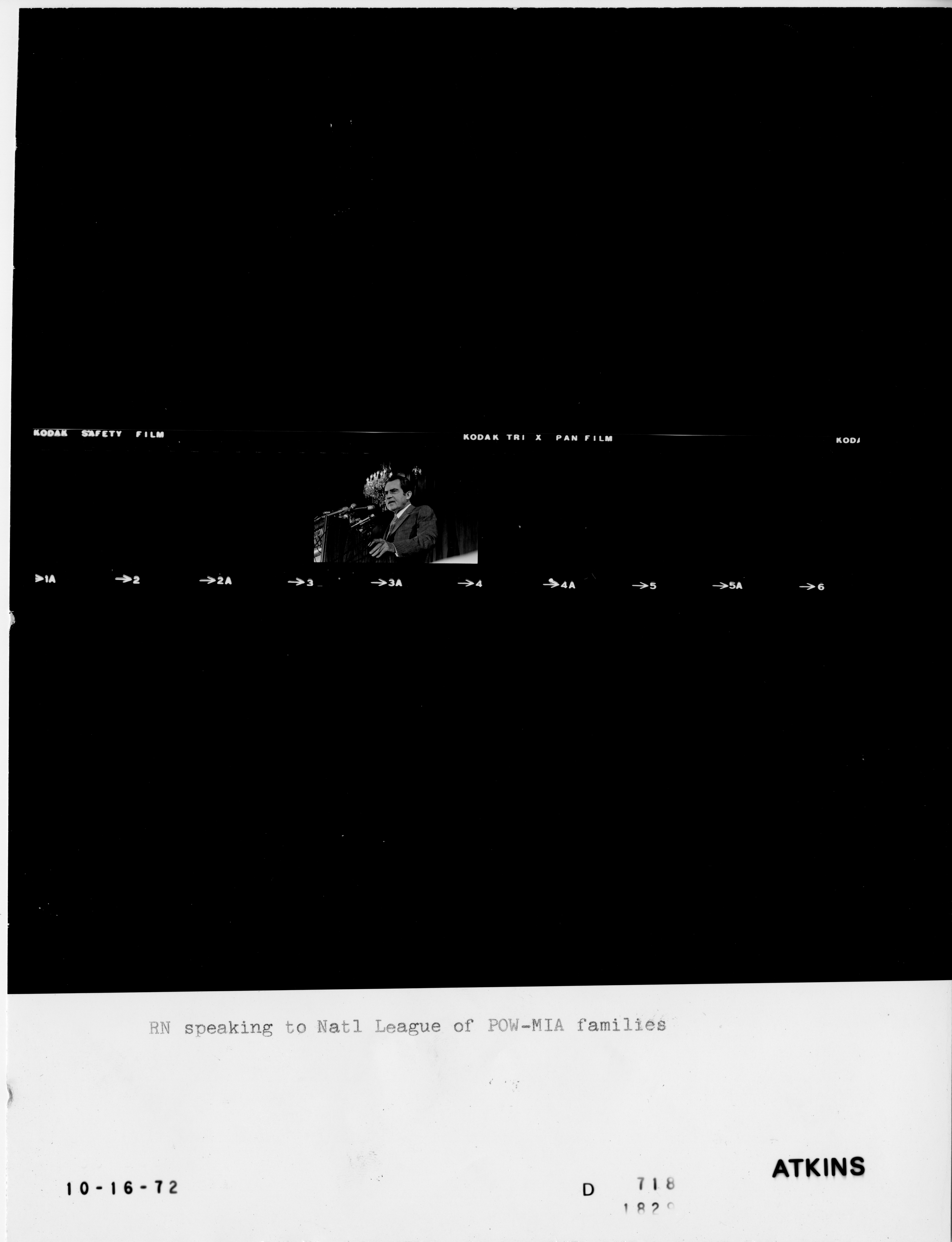
- Frame(s): WHPO-D0718-, Closeup of President Nixon at a podium addressing the National League of American Prisoners and Missing in Action in Southeast Asia (POW-MIA) convention delegates (Vietnam Prisoner of War and Missing in Action). 10/16/1972, Washington, D.C. Federal Room, Statler Hilton Hotel. President Nixon.
- Frame(s): WHPO-D0718-03A, Closeup of President Nixon at a podium addressing the National League of American Prisoners and Missing in Action in Southeast Asia (POW-MIA) convention delegates (Vietnam Prisoner of War and Missing in Action). 10/16/1972, Washington, D.C. Federal Room, Statler Hilton Hotel. President Nixon.
Roll WHPO-D0719 Photographer: Atkins, Oliver | Color or B&W: B&W
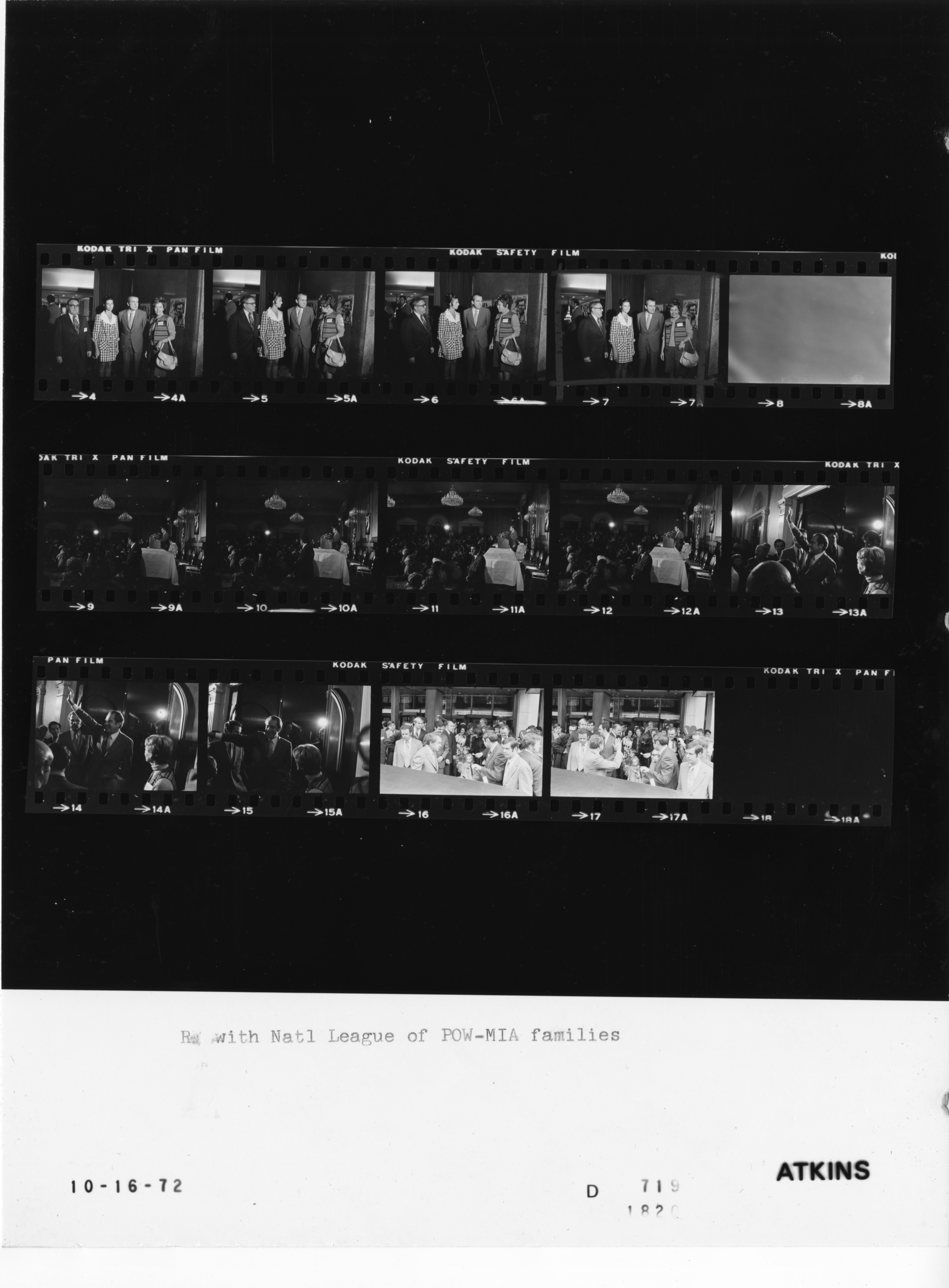
- Frame(s): WHPO-D0719-04-07, President Nixon standing with Red Cross and POW-MIA (Vietnam Prisoner of War-Missing in Action) officials. 10/16/1972, Washington, D.C. Statler Hilton Hotel, room. President Nixon, Robert Earl, Carole Hanson, Evelyn Grubb, delegates, crowd, Ziegler, Bull.
- Frame(s): WHPO-D0719-09-15, President Nixon addressing convention delegates and waving goodbye to them. 10/16/1972, Washington, D.C. Statler Hilton Hotel, Federal Room. President Nixon, Robert Earl, Carole Hanson, Evelyn Grubb, delegates, crowd, Ziegler, Bull.
- Frame(s): WHPO-D0719-16-17, President Nixon leaving the Statler Hilton Hotel in Washington, D.C. 10/16/1972, Washington, D.C. Statler Hilton Hotel, entrance. President Nixon, Robert Earl, Carole Hanson, Evelyn Grubb, delegates, crowd, Ziegler, Bull.
Roll WHPO-D0721 Photographer: Atkins, Oliver | Color or B&W: B&W
- Frame(s): WHPO-D0721-, President Nixon seated informally in the Oval Office during a meeting with Melvin Laird, General Creighton Abrams, and General Alexander Haig. 10/16/1972, Washington, D.C. White House, Oval Office. President Nixon, Alexander Haig, Melvin Laird, Creighton Abrams.
- Frame(s): WHPO-D0721-07A, President Nixon seated informally in the Oval Office during a meeting with Melvin Laird, General Creighton Abrams, and General Alexander Haig. 10/16/1972, Washington, D.C. White House, Oval Office. President Nixon, Alexander Haig, Melvin Laird, Creighton Abrams.
The White House Communications Agency Sound Recordings Collection contains public statements that took place between 1969 and 1974. Visit the finding aid to learn more.
B - Vice-Presidential (Agnew and Ford)
- WHCA-SR-B-234
Remarks to the Homebuilders Association Convention-Rm. 272, E.O.B. (10/16/1972)
Runtime: 5:20
Original Format: 1/4-inch reel-to-reel audiotape. Original source type: Original.
L - White House Press Office Briefings
- WHCA-SR-L-039
Press briefing by Ronald Ziegler. (10/16/1972, White House Press Lobby)
Runtime: 0:36:31
Keywords: Press conferences, news conferences, interviews, media, press secretary, briefings, public statements to the press, Watergate, testimony, testify, cover-ups, break-in, burglary, theft, plumbers, scandals, investigations, bugging, bugs wiretapping, wiretap
Production credits: Audio feed supplied by WHCA; Recorded by GET (initials of WHCA engineer)
Original Format: 1/4-inch reel-to-reel audiotape. Original source type: Original. Technical notes: 11 minutes and 57 seconds of silence at end of recording removed from access copies.
P - Formal Presidential Remarks
- WHCA-SR-P-721009
Remarks by President Nixon to POW families meeting. (10/16/1972, Statler Hilton Hotel, Washington DC)
Runtime: 0:10:02
Keywords: Vietnam War, Vietnam Prisoner of War
Production credits: Audio feed supplied by WHCA (mult feed by "mutual"); Recorded by WHCA
Original Format: 1/4-inch reel-to-reel audiotape. Original source type: Original.
The White House Communications Agency Videotape Collection contains “off-the-air” recordings of televised programs produced between 1968 and 1974. Visit the finding aid to learn more.
Context (External Sources)
The Vanderbilt Television News Archive is the world's most extensive and complete archive of television news. They have been recording, preserving and providing access to television news broadcasts of the national networks since August 5, 1968.
Wikipedia is a free encyclopedia that anyone can edit.