
Introduction
This almanac page for Saturday, October 14, 1972, pulls together various records created by the federal government and links to additional resources which can provide context about the events of the day.
Previous Date: Friday, October 13, 1972
Next Date: Sunday, October 15, 1972
Schedule and Public Documents
The Daily Diary files represent a consolidated record of the President's activities. Visit the finding aid to learn more.
The President's day began at The White House - Washington, D. C.
The Weekly Compilation of Presidential Documents made available transcripts of the President's news conferences; messages to Congress; public speeches, remarks, and statements; and other Presidential materials released by the White House.
Digitized versions can be found at HathiTrust.
Each Public Papers of the Presidents volume contains the papers and speeches of the President of the United States that were issued by the White House Office of the Press Secretary during the time period specified by the volume. The material is presented in chronological order, and the dates shown in the headings are the dates of the documents or events. In instances when the release date differs from the date of the document itself, that fact is shown in the text note.
To ensure accuracy, remarks have been checked against audio recordings (when available) and signed documents have been checked against the original, unless otherwise noted. Editors have provided text notes and cross references for purposes of identification or clarity.
The Federal Register is the official daily publication for rules, proposed rules, and notices of federal agencies and organizations, as well as executive orders and other Presidential documents.
The Congressional Record is the official daily record of the debates and proceedings of the U.S. Congress.
Archival Holdings
Any selection of archival documents will necessarily be partial. You should use the documents and folders identified below as a starting place, but consult the linked collection finding aids and folder title lists and the collections themselves for context. Many documents to be found this way do not lend themselves to association with specific dates, but are essential to a complete understanding of the material.
Selective document listing
President's Office Files
The President's Office Files consists of materials drawn together by the Special Files Unit from several administrative subdivisions within the White House Office. It is the handwriting and sensitive papers sent to the Staff Secretary that now comprise much of the President's Office Files. Visit the finding aid to learn more.
- News Summaries, Unmarked News Summaries, Box 51, News Summaries - October 1972 [6 of 7] [Note: Due to the way News Summary products were compiled, you should also consult nearby days for potentially relevant materials.]
- Political Media Analysis, October 14, 1972, 24 Days Left
- News Summary, Oct. 14, 1972, (Fri. nets, wires, columns)
- President's Daily Schedule, Box 102, [President's Daily Schedule, Oct.-Dec. 1972] [1 of 2]
- The President's Schedule, Saturday - October 14, 1972
The H. R. Haldeman Diaries consists of seven handwritten diaries, 36 dictated diaries recorded as sound recordings, and two handwritten audio cassette tape subject logs. The diaries and logs reflect H. R. Haldeman’s candid personal record and reflections on events, issues, and people encountered during his service in the Nixon White House. As administrative assistant to the President and Chief of Staff, Haldeman attended and participated in public events and private meetings covering the entire scope of issues in which the Nixon White House engaged in during the years 1969-1973. Visit the finding aid to learn more.
- Transcript of diary entry (PDF)
Saturday, October 14th. The President got into the question of the promotion plan for the Connally television, and then I went into it with Clark MacGregor. We're all very strong on getting the maximum push out of this. MacGregor is concerned about raising the money, because Stans is giving him a bad time, so I suggested that they should run the show for a group of Democrats, and then hit them afterwards. Maybe one group in New York and another one in Chicago on the basis that they've got to put up a million dollars immediately to get this on the air and properly promoted, etcetera. Clark's going to take a stab at that.
The President had Ray Price and John Ehrlichman in at noon to review the whole radio speech situation. They went through the various subjects, and he agreed to going ahead with the paternalism speech next week, and then developing a foreign policy speech for Sunday the 29th, the end of the campaign, making the point that we can't do it while Kissinger's traveling, although he didn't tell him Kissinger was traveling. We also agreed on tax reform this week and then possibly the education one, although he's not too happy with it. He is strong on the New Federalism thing, working in opportunity and the high ground, the kind of country we want. He doesn't like the idea of urban affairs, but does like reform, renewal, restoration, and so on. He made the point to Ray that these speeches should be more like the spending ceiling one and less like the crime one, in that they shouldn't be too hard-hitting; they need three or four quotable lines, but they are to philosophize a bit. They should be as non-partisan, non-political, and non-negative as possible. Uplifting, like the Atlanta line where we direct attention to the hopes and dreams, the hopes and dreams that unite us, rather than the hates and fears that divide us. He went through some specifics on the other things, making the point that the tone should not be defensive or campaigning; there should be no reference to the other side. Then he shifted into his regular spiel on the thing that people don't love each other and we're not all the same and we can't approach things on that basis. The whole secret and the philosophy we have is based on the fact that we live in an explosive world; there are differences between people. Then he went into his anti-college-education spiel and back to the point that people are different, so are nations; the secret of the American experience, experiment is that they learned to deal with, they learned that the things that unite us are more important than the things that divide us. He then got into his feeling for the South, that because of going to school there, he had a close feeling, and that they resent always being put down by the Northerners. That it's wrong to set the South as a region apart. He feels that the sweep of the South is the most important thing in this election, and getting Wallace out was the most important single event. He makes the point that union leaders are like the South, they want to abide by the law, and they respect the Presidency. He then said the theme to development is in regard to the heartland, the South, the ethnics, not as antagonistic groups. The FDR coalition was that they were brought together for power. Our New American Majority appeals across the board for the same reasons to all people; the basic American values: a strong United States, patriotism, moral and spiritual values, anti-permissiveness. They are turned off on welfare, because it's wrong and because they are anti-elitist, plus they have selfish motives; they are Americans to the core. The Southerners are more so than the rest of the United States, because they are not poisoned by the elite universities and the media. But we're also high in Polish, Italian, mountain areas, farm states; weak in the suburbia, big cities, because here the people are soft.
Our support from May 8 didn't come from businessmen, educators, and media, they all said it was horrible; the strength was from the areas that the elitists all look down their nose at, the South, farmers, ethnics, labor. Teeter's view of the suburbs overlooks this; our gains in voting don't come from there. We hold our own, but the turnaround is from different areas, and the analysts miss the point that the “Movement" has had it: the people that are for permissiveness, anti-US, and so forth. That square America is coming back, and that we didn't just gather a bunch of haters. The real issue is patriotism, morality, religion; not the material issues of taxes and prices. If those were the issue, the people would be for McGovern rather than for us.
Roy Ash called with a report...
-------------------------------------------------------------------------------------------------------------------
DECLASSIFIED - E.O. 13526, Sect. 3.4: by MS, NARA, June 12, 2013
Audio Cassette 25, Side B, Withdrawn Item Number 13 [AC-25(B) Sel 10]
Duration: 3 minutes 5 seconds
…that he had met with Franz Josef Strauss of Germany while he was over there at Strauss's request. And he asked Allen--, Ash to convey a message that he had met, he said he had met with Kissinger relatively recently, but this new matter had just arisen, and he has not talked to Kissinger about it. And he preferred a separate communication to the President, not through Kissinger, although he was very judicious about saying this. It’s regarding the November 19 Bundestag elections in Germany. Strauss has learned through an intelligence agency of another country directly to the south, that a representative of Willy Brandt's is in Moscow to enlist their support to allow West Berliners to elect members with full powers to vote in the Bundestag. This would shift the balance of power to Brandt. It's now fifty-fifty, Brandt versus Barzel. And Strauss, of course, is behind Barzel. The shift would arise because the West Berliners would support Brandt. That this is not done, the election could well go to the CDU and Barzel. The fact of Brandt's representative to the Soviet is not known in Germany. Approval for West German, or West Berlin's full voting power would require Four Power approval. And the argument that'll be billed is this is one more step toward rapprochement, and they believe the French will agree with this. And that they'll get together to try to present it to the US in a way to force us to okay it.
The alternatives are for us, if we don't want to do it, are: first, to say that it's very interesting and we'll consider it, but not to act until after the November 19 election; or second, to say it's a good idea, but let's complete it by making West Berlin a full state of West Germany. The Russians would then veto this, and we'd accomplish our purpose and put the onus on the Russians.
Ash sees the problem as first a trap going on now with the Soviets. And secondly, he doesn't know who we're for, maybe we’re not for Barzel, although he is more our direction, and, and a Conservative. Also, the fact that Strauss brought this up creates a trap. Our relations depend on the role we take: the traps cuts both ways and we can't win either way. Strauss gives Ash a lot of reasons why we should be for Barzel. Strauss wants communication back from the United States regarding what our position would be. He thinks the US and the CDU interests are mutual.
I asked Ash's evaluation of why he didn't put it through Kissinger and Roy says it's probably because he sees Henry as inscrutable and he's not sure what Henry's position is and thus the President might never hear of it. Strauss said to Ash that he does question our actions with the Soviet Union and wonders if they're not a result of the US trying to develop a counterforce to the resurgence of Western Europe. He said that he, we don't want Germany to become a Taiwan. Ash countered that he thought there was nothing to his worry.
Roy cautioned that I not get him in trouble on this and that we not embarrass Strauss regarding the way this was raised. But the last time Ash had a message from Strauss, he tried to pass it to Kissinger, and Kissinger refused to take it, saying Strauss knew him, and if he wanted to talk to him, he could call him.
--------------------------------------------------------------------------------------------------------------------
Ash said he's happy to be of any use on any basis, if we wish to instruct him. I reported this. Well, that's the end of that one.
We had problems with Congress today as they were struggling towards adjournment.
Weinberger called, all concerned about the spending ceiling details and wanting to talk to the President about it. I forced him off onto Ehrlichman who's handling the strategy on this, and the way it ended up Congress didn't adjourn. We didn't get what we wanted, but we did get a partial spending ceiling bill. HR 1 was killed, which we were glad for.
Henry called regarding the Vietnam negotiations. He's concerned about whether he's handling the settlement right and then he raised an alternate scenario, in which he would get the process dragged on a little with new demands, but he'd still go through the whole schedule, but not sign the final agreement until November 15th. The problem is, we'd have to stop bombing from the time of his trip until the election. I told him my concern there was trying to carry the period between the trip and the election, with all the speculation and so forth. He says if we get Thieu enthusiastically with this, then we, it's okay and we can go ahead...
-------------------------------------------------------------------------------------------------------------------
DECLASSIFIED - E.O. 13526, Sect. 3.4: by MS, NARA, June 12, 2013
Audio Cassette 25, Side B, Withdrawn Item Number 14 [AC-25(B) Sel 11]
Duration: 12 seconds
…but, if we have to brutalize them, it would be bad, and can't be done before the election, and we'd be in a shaky thing for a couple of weeks.
--------------------------------------------------------------------------------------------------------------------
If Thieu turns it down, he feels we would have been better to have been hung up on a North Vietnam negotiating point than on a, letting them know that we're hung up on trying to keep Thieu in. I said I didn't think any of this delay was possible if he went on to Hanoi, but he basically refuses to consider cancelling it; feels he's got to go through the whole route, in any event. On that basis, I felt it was impossible to make any change in the scenario as it's now laid out.
End of October 14th. - Original audio recording (MP3)
The National Archives Catalog is the online portal to the records held at the National Archives, and information about those records. It is the main way of describing our holdings and also provides access to electronic records and digitized versions of our holdings.
The Catalog searches across multiple National Archives resources at once, including archival descriptions, digitized and electronic records, authority records, and web pages from Archives.gov and the Presidential Libraries. The Catalog also allows users to contribute to digitized historical records through tagging and transcription.
Nixon Library Holdings
All National Archives Units
National Security Documents
The President's Daily Brief is the primary vehicle for summarizing the day-to-day sensitive intelligence and analysis, as well as late-breaking reports, for the White House on current and future national security issues. Read "The President's Daily Brief: Delivering Intelligence to Nixon and Ford" to learn more.
The Foreign Relations of the United States series presents the official documentary historical record of major U.S. foreign policy decisions and significant diplomatic activity. Visit the State Department website for more information.
Vol. XV, Soviet Union, June 1972-August 1974
Economic Normalization and Soviet Jewish Emigration, September-December 1972
61. Memorandum for the President’s File by the Executive Director of the Council for International Economic Policy (Flanigan), Washington, October 14, 1972, 11:30 a.m.
Source: National Archives, Nixon Presidential Materials, President’s Office Files, Memoranda for the President, Box 90, October 8, 1972. No classification marking. The meeting took place in the Oval Office from 11:33 to 11:53 a.m. (Ibid., White House Central Files, President’s Daily Diary)
Vol. E-5, Part 2, Documents on North Africa, 1969-1972
Algeria
34. Telegram 188030 From the Department of State to the Mission to the United Nations and the Interests Section in Algeria, Washington, October 14, 1972, 1933Z
The telegram transmitted an October 12 memorandum of conversation between Algerian Minister of Foreign Affairs Bouteflika and Secretary of State Rogers, who summarized the positions of their respective governments on matters of common interest, including the Middle East and hijacking.
Source: National Archives, RG 59, Central Files 1970–73, POL 7 ALG. Confidential; Priority. It was repeated to Paris. Drafted by Lane and approved by Newsom.
Vol. E-10, Documents on American Republics, 1969-1972
Cuba
264. Memorandum From William J. Jorden of the National Security Council Staff to the President’s Assistant for National Security Affairs (Kissinger), Washington, October 14, 1972., Washington, October 14, 1972
National Security Council member Jorden reported on the status of José Villa, captain of the Johnny Express, who had been held in jail in Cuba since December 1971 and whose family received a promise from the President that the U.S. Government would do all it could to secure his release.
Source: National Archives, Nixon Presidential Materials, NSC Files, Box 781, Country Files, Latin America, Cuba, Vol. IV, 1972. Secret; Sensitive. Sent for action; Outside the System. Under option 5, Kissinger wrote, “Bill do memo from me to Haldeman. Emphasize what we’ve done and how they state objections. Ask about Rebozo.” Attached but not published at Tab A is the September 25 letter to President Nixon from Isabel Villa, Isabel Cristina Villa, Mary Pily Villa, and José Antonio Villa. In a November 1 memorandum to Haig, Jorden reported that he had traveled to Miami to meet with José Villa’s wife, whom he told that “we were hopeful we could get her husband released from Cuba in the not-too-distant future, but of course could make no promises.” (Ibid.)
The Kissinger telephone conversation transcripts consist of approximately 20,000 pages of transcripts of Kissinger’s telephone conversations during his tenure as Assistant to the President for National Security Affairs (1969-1974) and Secretary of State (1973-1974) during the administration of President Richard Nixon. Visit the finding aid for more information.
Digitized versions can be found in the National Archives Catalog.
Audiovisual Holdings
Visit the White House Tapes finding aid to learn about the taping system's operation and archival processing.
Camp David Hard Wire
- 220-1; Unknown between 3:45 p.m. & 3:46 p.m.; Nixon, Richard M. (President); Camp David Operator
- 220-2; 3:46 p.m. - 3:49 p.m.; Nixon, Richard M. (President); Cox, Tricia Nixon
- 220-3; Unknown between 3:49 p.m. & 3:50 p.m.; Nixon, Richard M. (President); Camp David Operator
- 220-4; 3:50 p.m. - 3:53 p.m.; Nixon, Richard M. (President); Ehrlichman, John D.
- 220-5; 4:05 p.m. - 4:30 p.m.; Nixon, Richard M. (President); Haldeman, H. R. ("Bob"); [Unknown person(s)]
- 220-6; Unknown between 4:30 p.m. & 7:40 p.m.; Nixon, Richard M. (President); Sanchez, Manolo
- 220-7; Unknown between 5:06 p.m. & 7:40 p.m.; Nixon, Richard M. (President); Camp David Operator
- 220-8; Unknown between 7:17 p.m. & 7:40 p.m.; Nixon, Richard M. (President); Camp David Operator
- 220-9; Unknown between 7:17 p.m., 10/14 & 9:16 a.m., 8/19; Nixon, Richard M. (President); Sanchez, Manolo
Camp David Study Table
- 149-1; Unknown between 3:45 p.m. & 3:46 p.m.; Nixon, Richard M. (President); Camp David Operator
- 149-2; 3:46 p.m. - 3:49 p.m.; Nixon, Richard M. (President); Cox, Tricia Nixon
- 149-3; Unknown between 3:49 p.m. & 3:50 p.m.; Nixon, Richard M. (President); Camp David Operator
- 149-4; 3:50 p.m. - 3:53 p.m.; Nixon, Richard M. (President); Ehrlichman, John D.
- 149-5; Unknown between 5:06 p.m. & 7:40 p.m.; Nixon, Richard M. (President); Camp David Operator
- 149-6; Unknown between 7:17 p.m. & 7:40 p.m.; Nixon, Richard M. (President); Camp David Operator
Old Executive Office Building
- 366-7; Unknown between 1:30 p.m. & 1:40 p.m.; Nixon, Richard M. (President); Sanchez, Manolo
- 366-8; Unknown between 1:30 p.m. & 1:40 p.m.; Nixon, Richard M. (President); Sanchez, Manolo
- 366-9; 1:40 p.m. - 2:30 p.m.; Nixon, Richard M. (President); Colson, Charles W.; Sanchez, Manolo; Ehrlichman, John D.; [Unknown person(s)]
Oval Office
- 798-1; Unknown between 8:48 a.m. & 9:00 a.m.; Nixon, Richard M. (President); Bull, Stephen B.
- 798-2; Unknown between 8:48 a.m. & 9:00 a.m.; Nixon, Richard M. (President); Bull, Stephen B.
- 798-3; 9:00 a.m. - 10:01 a.m.; Nixon, Richard M. (President); Haldeman, H. R. ("Bob"); Bull, Stephen B.; [Unknown person(s)]; Ehrlichman, John D.
- 798-4; 10:03 a.m. - 10:39 a.m.; Nixon, Richard M. (President); [Unknown person(s)]; Kissinger, Henry A.; Bull, Stephen B.; Hogness, John (Dr.); Kernodle, John R. (Dr.); David, Edward E., Jr. (Dr.); Tkach, Walter R. (Dr.); Cavanaugh, James H.; Wei-jan, Wu (Dr.); Yi-chen, Fu (Dr.); Chiao-chih, Lin (Dr.); Hsueh-yu, Wu (Dr.); Yen-shan, Li (Dr.); Chuan-yen, Chu (Dr.); Shih-lien, Liu; Jui, Han (Dr.); Kuan-han, Chou (Dr.); Shu-shun, Chang (Dr.); Chia-yu, Hsu (Dr.); Lien-sheng, Wang; Tsung-ming, Lu; Tseng-yi, Tai; White House photographer
- 798-5; Unknown between 10:39 a.m. & 10:42 a.m.; Nixon, Richard M. (President); Bull, Stephen B.
- 798-6; Unknown between 10:39 a.m. & 10:42 a.m.; Nixon, Richard M. (President); Butterfield, Alexander P.
- 798-7; 10:42 a.m. - 10:56 a.m.; Nixon, Richard M. (President); Ehrlichman, John D.; Timmons, William E.
- 798-8; Unknown between 10:56 a.m. & 10:58 a.m.; Nixon, Richard M. (President); White House operator
- 798-9; Unknown between 10:56 a.m. & 10:58 a.m.; Nixon, Richard M. (President); Bull, Stephen B.
- 798-10; 10:58 a.m. - 11:01 a.m.; Nixon, Richard M. (President); Price, Raymond K., Jr.
- 798-11; Unknown between 11:01 a.m. & 11:17 a.m.; Nixon, Richard M. (President); Kissinger, Henry A.
- 798-12; 11:19 a.m. - 11:31 a.m.; Nixon, Richard M. (President); Kissinger, Henry A.; Haldeman, H. R. ("Bob"); Bull, Stephen B.
- 798-13; 11:33 a.m. - 11:53 a.m.; Nixon, Richard M. (President); Guzhenko, Timofey B.; Dobrynin, Anatoliy F.; Peterson, Peter G.; Flanigan, Peter M.; White House photographer
- 798-14; Unknown between 11:53 a.m. & 11:56 a.m.; Nixon, Richard M. (President); Bull, Stephen B.
- 798-15; 11:57 a.m. - 1:27 p.m.; Nixon, Richard M. (President); Bull, Stephen B.; Price, Raymond K., Jr.; Ehrlichman, John D.; Haldeman, H. R. ("Bob"); Sanchez, Manolo; Hoopes, David C.
- 798-16; Unknown between 1:27 p.m. & 1:30 p.m.; Nixon, Richard M. (President); Sanchez, Manolo
White House Telephone
The White House Photo Office collection consists of photographic coverage of President Richard Nixon meeting with prominent social, political, and cultural personalities; speaking engagements and news conferences of the President and various high-ranking members of the White House staff and Cabinet; Presidential domestic and foreign travel, including Presidential vacations; social events and entertainment involving the First Family, including entertainers present; official portraits of the President, First Family, and high-ranking members of the Nixon administration; the 1969 and 1973 Inaugurals; the President’s 1972 Presidential election campaign appearances (including speeches) and other official activities of the White House staff and the President’s Cabinet from January 20, 1969 until August 9, 1974 at the White House and the Old Executive Office Building; other locations in Washington, DC, such as The Mall; and the Presidential retreats in Camp David, Maryland, Key Biscayne, Florida, and San Clemente, California. Visit the finding aid to learn more.
Roll WHPO-D0708 Photographer: Atkins, Oliver | Color or B&W: B&W
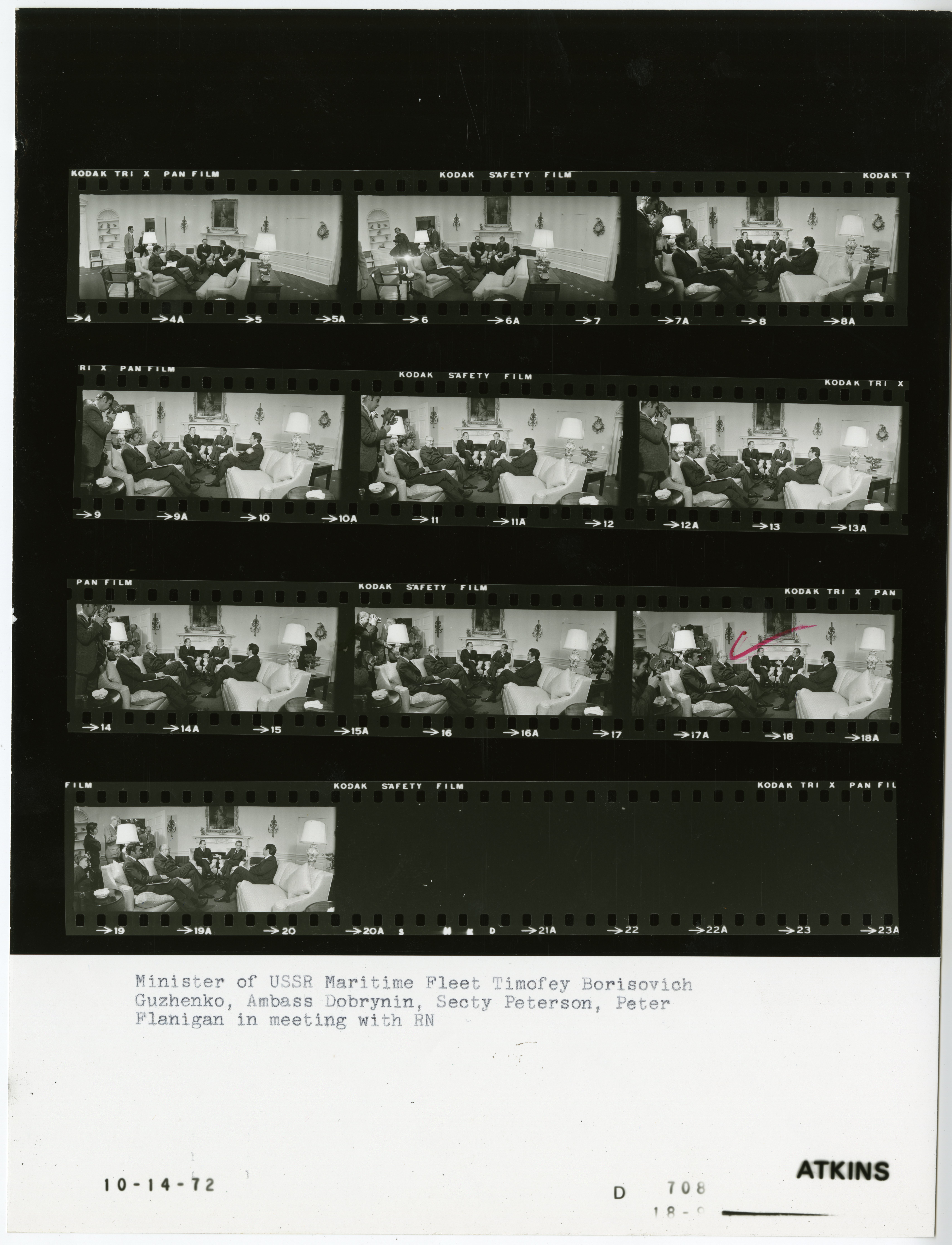
- Frame(s): WHPO-D0708-, President Nixon seated informally in the Oval Office during a meeting with Soviet Ambassador Anatoly Dobrynin, Commerce Secretary Peter Peterson, Minister of the USSR Maritime Fleet Timofey Guzhenko, Peter Flanigan, all participants of the signing ceremony for the US-USSR Maritime Agreement. 10/14/1972, Washington, D.C. White House, Oval Office. President Nixon, Soviet Ambassador Anatoly Dobrynin, Commerce Secretary Peter Peterson, Minister of the USSR Maritime Fleet Timofey Guzhenko, Peter Flanigan.
- Frame(s): WHPO-D0708-18, President Nixon seated informally in the Oval Office during a meeting with Soviet Ambassador Anatoly Dobrynin, Commerce Secretary Peter Peterson, Minister of the USSR Maritime Fleet Timofey Guzhenko, and Peter Flanigan, all participants of the signing ceremony for the US-USSR Maritime Agreement. 10/14/1972, Washington, D.C. White House, Oval Office. President Nixon, Soviet Ambassador Anatoly Dobrynin, Commerce Secretary Peter Peterson, Minister of the USSR Maritime Fleet Timofey Guzhenko, Peter Flanigan.
Roll WHPO-D0709 Photographer: Atkins, Oliver | Color or B&W: B&W
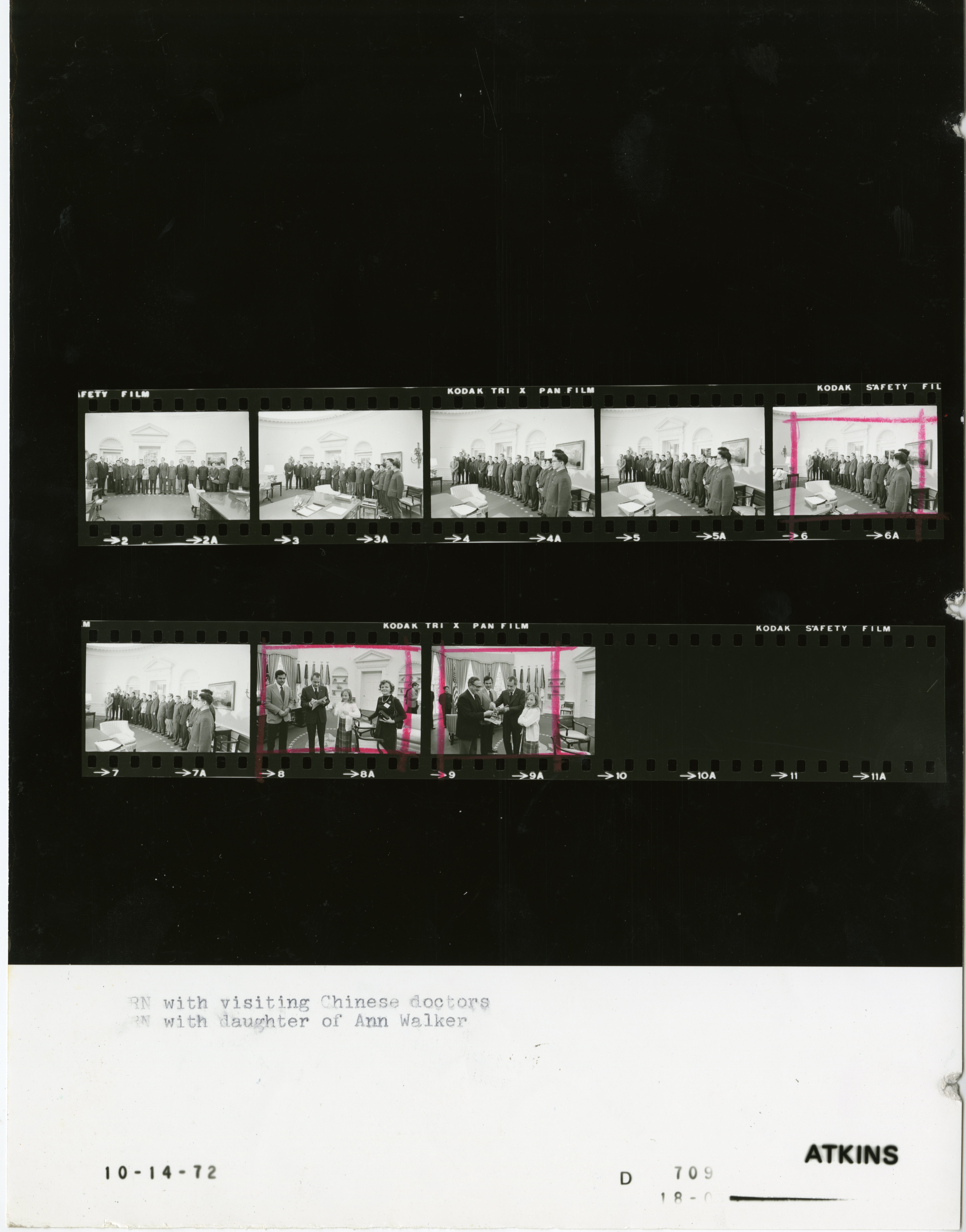
- Frame(s): WHPO-D0709-02-07, President Nixon standing with American officials. Dr. Walter Tkach, Dr. Edward David, and Henry Kissinger with a delegation of physicians, doctors, and medical Institute Directors from the People's Republic of China. 10/14/1972, Washington, D.C. White House, Oval Office. President Nixon, Dr. John Kernodle, American officials, Ann Walker and her daughter, Kissinger, Ziegler, Chinese physicians, Wu Wei-jan, Fu Yi-Chen, Lin Chiao-chih, Wu Hsueh-yu, Li Yen-shan, Chu elman-yan, Liu Shih-lien, Han Jui, Chou Kuan-han, Chang Shu-shun, Hsu Chia-yu and Cninese Interpreter Wang Lien-sheng, Chinese Interpreter, secretary Lu Tsung-ming, Tai Tseng-yi, Hsinhua Correspondent to United Nations.
- Frame(s): WHPO-D0709-08-09, President Nixon signing his autograph for the daughter of Ann Walker while Henry Kissinger looks on. 10/14/1972, Washington, D.C. White House, Oval Office. President Nixon, Chinese physicians, Dr. John Kernodle, American officials, Ann Walker and her daughter, Kissinger, Ziegler.
Roll WHPO-D0710 Photographer: Atkins, Oliver | Color or B&W: B&W
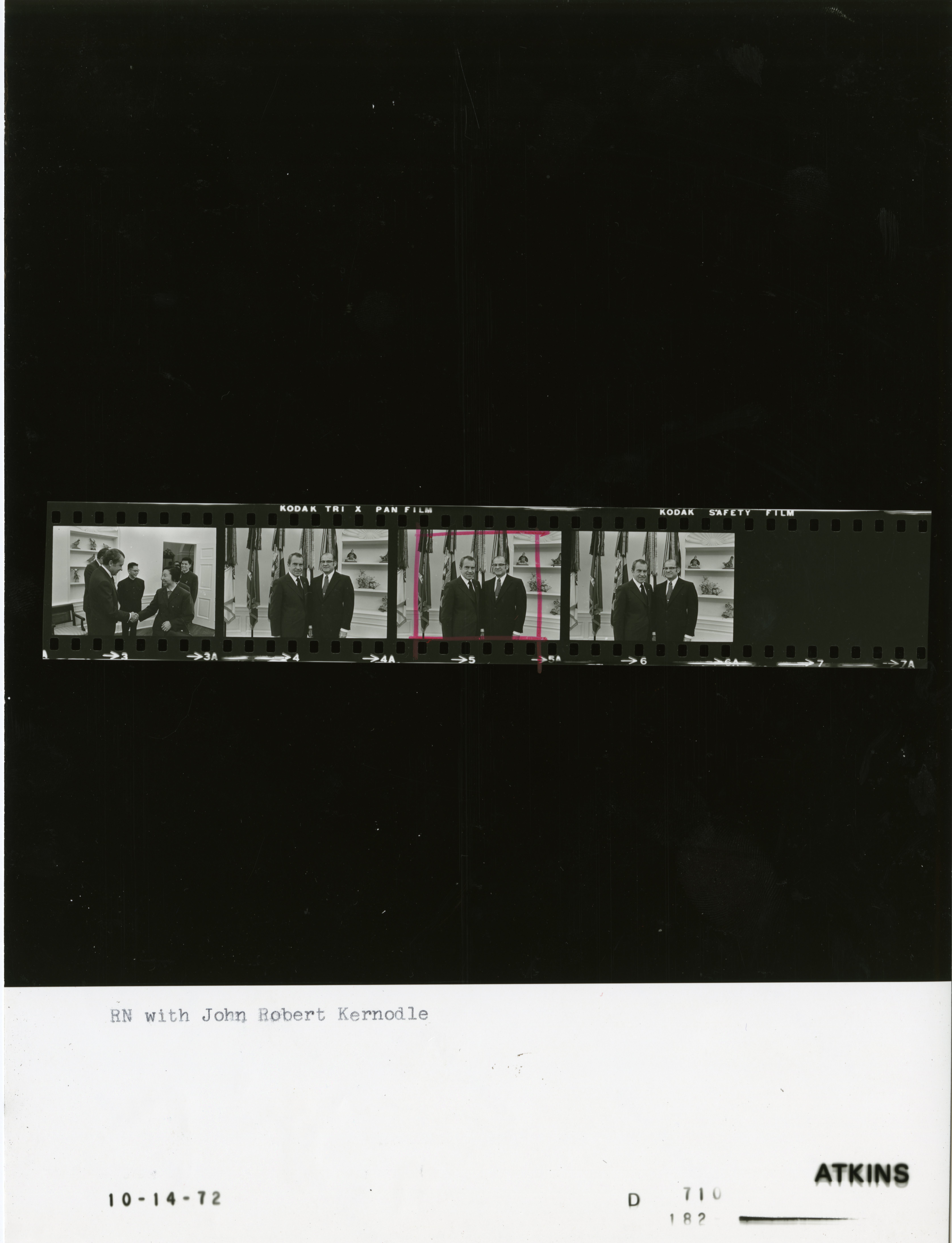
- Frame(s): WHPO-D0710-, President Nixon shaking hands with Chinese physician Dr. Wu Wei-jan - Head of Chinese Medical physicians Delegation or Mr. Fu Yi-Chen - Deputy Head of Delegation and standing with AMA Board of Trustees Chairman Dr. John Kernodle. 10/14/1972, Washington, D.C. White House, Oval Office. President Nixon, Chinese physician, Dr. John Kernodle.
The White House Communications Agency Sound Recordings Collection contains public statements that took place between 1969 and 1974. Visit the finding aid to learn more.
G - Cabinet Officer Briefings
- WHCA-SR-G-190
Press briefing by Secretary of Commerce Peter Peterson, with Andy Gibson and Ronald Ziegler. (10/14/1972, White House Press Lobby)
Runtime: 31:06:00
Production credits: Audio feed supplied by WHCA; Recorded by ACH (initials of WHCA engineer)
Original Format: 1/4-inch reel-to-reel audiotape. Original source type: Original.
The White House Communications Agency Videotape Collection contains “off-the-air” recordings of televised programs produced between 1968 and 1974. Visit the finding aid to learn more.
- WHCA-5824
"Agronsky & Company".
NPACT
Runtime: 00:29:46 - WHCA-5825
Re-Elect Nixon Special ["Film: Change Without Chaos"]. paid political broadcast Herbert Klein.
NBC
Runtime: 00:33:13 - WHCA-5831
Weekly News Summary, Tape I.
ALL NETWORKS
Runtime: 01:33:42
13. Utley/Valeriani: President Nixon and trade with USSR; McGovern money. Time Code Start: 38:22. Keywords: Presidents, Soviet Union, Russia, business, exchanges, agreements, contracts, profits, finance, sales, buying, selling. Network: NBC.
14. Utley/Duke: Congress. Time Code Start: 42:45. Keywords: House of Representatives. Network: NBC.
15. Utley/Mackin: McGovern in San Francisco, California. Time Code Start: 44:40. Keywords: Presidential elections, campaigns, campaigning, candidates. Network: NBC.
16. Mudd/Serafin: Congress. Time Code Start: 47:15. Keywords: House of Representatives. Network: CBS.
17. Mudd/Pierpoint: President Nixon and USSR trade. Time Code Start: 50:23. Keywords: Presidents, officials, Soviet Union, USSR, meetings, trade, agreements, contracts. Network: CBS.
18. Mudd/McLear: Hanoi, Vietnam. Time Code Start: 52:55. Keywords: Vietnam War. Network: CBS.
19. Mudd/Schieffer: McGovern in San Francisco, California. Time Code Start: 55:47. Keywords: Presidential elections, campaigns, campaigning, candidates. Network: CBS.
Context (External Sources)
The Vanderbilt Television News Archive is the world's most extensive and complete archive of television news. They have been recording, preserving and providing access to television news broadcasts of the national networks since August 5, 1968.
Wikipedia is a free encyclopedia that anyone can edit.