
Introduction
This almanac page for Friday, November 5, 1971, pulls together various records created by the federal government and links to additional resources which can provide context about the events of the day.
Previous Date: Thursday, November 4, 1971
Next Date: Saturday, November 6, 1971
Schedule and Public Documents
The Daily Diary files represent a consolidated record of the President's activities. Visit the finding aid to learn more.
The President's day began at The White House - Washington, D. C.
The Weekly Compilation of Presidential Documents made available transcripts of the President's news conferences; messages to Congress; public speeches, remarks, and statements; and other Presidential materials released by the White House.
Digitized versions can be found at HathiTrust.
Each Public Papers of the Presidents volume contains the papers and speeches of the President of the United States that were issued by the White House Office of the Press Secretary during the time period specified by the volume. The material is presented in chronological order, and the dates shown in the headings are the dates of the documents or events. In instances when the release date differs from the date of the document itself, that fact is shown in the text note.
To ensure accuracy, remarks have been checked against audio recordings (when available) and signed documents have been checked against the original, unless otherwise noted. Editors have provided text notes and cross references for purposes of identification or clarity.
The Federal Register is the official daily publication for rules, proposed rules, and notices of federal agencies and organizations, as well as executive orders and other Presidential documents.
The Congressional Record is the official daily record of the debates and proceedings of the U.S. Congress.
Archival Holdings
Any selection of archival documents will necessarily be partial. You should use the documents and folders identified below as a starting place, but consult the linked collection finding aids and folder title lists and the collections themselves for context. Many documents to be found this way do not lend themselves to association with specific dates, but are essential to a complete understanding of the material.
Selective document listing
President's Office Files
The President's Office Files consists of materials drawn together by the Special Files Unit from several administrative subdivisions within the White House Office. It is the handwriting and sensitive papers sent to the Staff Secretary that now comprise much of the President's Office Files. Visit the finding aid to learn more.
- News Summaries, Unmarked News Summaries, Box 46, News Summaries - Oct. & Nov. 1971 [5 of 5] [Note: Due to the way News Summary products were compiled, you should also consult nearby days for potentially relevant materials.]
- Friday, November 5, 1971
- News Summary, November 5, 1971, (Thurs. telecasts, wires, columns, and mags)
The H. R. Haldeman Diaries consists of seven handwritten diaries, 36 dictated diaries recorded as sound recordings, and two handwritten audio cassette tape subject logs. The diaries and logs reflect H. R. Haldeman’s candid personal record and reflections on events, issues, and people encountered during his service in the Nixon White House. As administrative assistant to the President and Chief of Staff, Haldeman attended and participated in public events and private meetings covering the entire scope of issues in which the Nixon White House engaged in during the years 1969-1973. Visit the finding aid to learn more.
- Transcript of diary entry (PDF)
Friday, November 5.
Called me in at 7:45 this morning, he was in the office early, even though he had the Gandhi State Dinner last night. He went over a number of odds-and-ends: was particularly interested in going into the plans for the series of State visits, and his own trips that he has coming up. The Willy Brandt meeting is now set for the weekend-- week of January 3, and the President wants to get it announced quickly and to do it in Chicago or Cincinnati with a State Dinner, motorcade, and everything else. He's also very cranked up about doing the Mexican President sometime next year in Houston, or maybe Miami—wherever it will work the best—but this would be after China and maybe after Russia. He's going ahead, in his own mind at least, with the plans for a trip to South America to meet with all the heads of state, and we're supposed to have Rogers in next Tuesday to work out the plans on that, and then also a plan for a meeting with Heath in Bermuda and Pompidou in British Guyana.
He got back again on the Gandhi arrival statement, which he had also raised yesterday. He feels that it was a real gem and that Ziegler and Scali should do something about getting out the nuances in it and the mileage-- should get some mileage out of it for the President. He particularly wants to get across the point that he does these arrival statements without any text or notes.
We had a long Cabinet meeting this morning. The President opened it to launch the subject of politics and said that this was the 25th anniversary of the day he was elected to Congress the first time, November 5, 1946. He made the point that the men around the table had worked for three years and contributed enormously to the Administration and the country, especially on the Democratic side-- especially on the domestic side, and they may wonder what recognition they've gotten. The foreign policy initiatives have gotten some acclaim. Some domestic initiatives also deserve it, but they don't get it. On the domestic front, generally, this Administration, as far as people are concerned, is dull, gray, unimaginative and status quo. This is not the fault of the people around the table; it's that everything is relative. We are responsible button-down people, we don't demagogue, and we're naive to think that we'll get credit for doing a good job. As we launch our foreign policy bombs, the opponents have to hack us up on the domestic front, both the press and the political opponents.
We now confront one year ahead of us where all eyes will be on the program of the-- programs of the Administration. More than on what we have done, but what we say we have done is what will count. So we have to get out on a deliberate basis and sell. Many great initiatives have been proposed and not acted upon by the Congress. More important than the economy, the-- because there what matters is what really happens. At issue is-- the issue is-- the economic issue is dead when things move right, but in all other fields we have many good things that have not seen the light of day. We should consider first how the Cabinet can take the offensive. Point up what we've accomplished. That is, their year-end reports have got to be better than before, not bibles, but terse, effective statements; and second, a major offensive on new initiatives, where Congress has not acted. Bang them hard from now until the election. Obviously the Democrats won't pass anything of ours that would be popular; so we've got to put it up and keep kicking them, so the country knows that they failed, not we.
So first, we need a summary of what we've done; second, an attack on the opponents; and third, we've got to program the Cabinet and sub-Cabinet to wage the battle. We should forget about getting along with Congress from now on. The line that can be effective: all members of the Cabinet should talk in addition to their own Departments' accomplishments; they should also cover the big issue, foreign policy. There is some need to change policy and attitude. The Cabinet is very positive, honest, responsible, but already the drumfire has begun. The Democrats don't have to be positive or responsible. We have to understand that, in order to make news, you have to hit somebody, not in an unfair or irresponsible way.
He then cited the example of Elliot Richardson in Massachusetts, who took on Teddy Kennedy the other night, and also George Bush, who did it on the TV question program on Sunday. He says it's not your nature to attack or be controversial, but when the press man tells you that what you covered was helpful, then you failed. When the enemy praises you, you haven't made your point. You've got to be exciting, take people on; don't let the Democrats get away with irresponsible attacks. The great irony is that history in 25 years will say this is a great Cabinet, but the people speak in one year and two days, and that's when we've got to do it. If you fail then, then all of you have failed. Now in the year ahead, it's not enough to do a good job, and so on. We have to mix in controversy, excitement, attack, become interesting, come alive. We can't win without money and organization, but with money and organization, we can lose. We have the responsibility to build on the base of money and organization, and add the extra part that gets it across.
The President then left the meeting, turning it over to the Vice President, who wandered off into the problem of-- that we're trying to distribute two loaves of bread to 100 people. That we can't adequately fund all our programs, and he feels we should turn to a few highly visible dramatic programs and fund those above the conventional limits. Also he thinks we have to use the gimmick of watching for our most visible critics and set them to cutting each other up. That is, help McGovern take a chunk out of Muskie. Then he made the point that the President's reelection is an absolute necessity, and to that degree everyone is expendable, including me. So don't worry about your image, worry about the President's. Political decisions in the Departments become doubly important this year. We can't let the bureaucracy get in the way. We need people who will go down the line with the President, regardless of what Evans and Novak say.
Regarding the media, the President is completely correct. We have to dramatize, but if the hook is too dramatic, we'll lose the positive part. So you need just enough stimulus to make the point, and it must be related to the point. So he summed up that first: we depend on people who will go down the line with the President; second, be sufficiently dramatic; third, look for things to emphasize that will challenge the opponents; and fourth, set one opponent against the other.
He then turned the meeting over to the Attorney General, who described briefly the political setup then had Jeb Magruder go through the structure of the Committee to Reelect the President, and Bob Dole to review the status at the National Committee. At that point, the President interrupted the meeting to bring Mrs. Gandhi in, introduce the Cabinet, stumbled on a few of the Under Secretaries that he didn't seem to know. There was then a little discussion, and the meeting was then turned over to Ehrlichman to discuss how to manage the Executive Branch during the political year, and then to John Scali, who did an absolutely superb job in wrapping it up.
He started by saying that he's an Independent, that he's only been on board seven months and he's a new man from the outside, but he's known a number of Presidents over the years and, as a matter of fact, has seen quite a few Cabinet officers come and go. He said Richard Nixon has done what no other American political leader could have equaled. He's restored calm to the country and a sense of purpose. If Richard Nixon had said in 1969 that: in less than three years, I'll reduce the troops in Vietnam by 350,000; I'll cut back air sorties by 35 percent; I'll reduce casualties from 350 a week to ten or less, and that one week you can get down to two; and we'll wind up with a greater political stability in Vietnam, plus the enemy on the run, plus an impressive outlook for peace in South East Asia. If Nixon had said that in '69, I would have said, "you can't do it." The enormity of the achievement is that Richard Nixon has done it despite all of the obstruction and the critics. Our troubles at home are accurately the legacy of another Administration, who spent the money in Vietnam, billions of dollars, not realizing what it would do to the domestic economy.
Your reputation among newsmen, as a Cabinet, is that you're very high-minded, very efficient, very low-key, very soft-spoken, and very dull. That's not necessarily all bad. There are two people, though, that have been consistently effective in articulating a point of view for the Administration. It's odd that both of them are Democrats, John Connally and Pat Moynihan. The most important thing you can do is become zealous defenders of Richard Nixon—articulate advocates making a part-- reacting to the partisan political attacks and recognizing the necessity of defending one man. Richard Nixon sits there day after day listening to the tirades against him, and he can't reply personally. You must respond automatically, without a signal from the White House, to these charges. Some of you think politics are crass and undignified, but the Democrats never worry about that. They organize to protect their President and to articulate his viewpoint.
He then read a quote of a blast at Rehnquist and then of a blast on the foreign aid thing. Each of which took—one 26 seconds, and the other, 29. He said, "I want to stress the important thing here, which is that each of those blasts made a very strong, clear, specific point and did it in less than 30 seconds." It's necessary that each of you learn how to wrap up the points that you want to make in 30 seconds or less. This can be done on any subject, but you have to decide what the--what is the key point, write it in simple language. The way to do it is to start with a subject, then a predicate, then end it and lower your voice, so you know it's the end. It's essential to a film editor to for you to do this, and on that basis, he'll give you the free time you're after.
Your primary target has to be television and radio. Regarding radio, that's a great neglected area. There are 20 million people that listen to the morning radio network news, and up to 100 million during the day. They now rely heavily on recorded actualities, and they has-- have an enormous unending appetite. Second priority is the wire services, mainly because they feed radio and television. Third, far down the list, are daily newspapers, and fourth, four notches below that, are the news magazines. What can you do better? First, you should have a 30-second section in every speech that wraps up with conviction, fire, and passion. Then you should broaden your scope. Include what the President's doing for the entire Administration, not just your Department. Wrap up your announcements and achievements around one man, Richard Nixon. Talk about Richard Nixon, the man. I've seen now the kind of leadership he exerts. I've heard you talking among yourselves after a meeting about what a great job he's done, but then you forget about it and you don't go out and tell people outside. I'm amazed at Richard Nixon: the man, the leader, the way he takes over a meeting, the way he leads with a sure sense of purpose. But none of this gets across to the people.
You've got to translate policy into "Richard Nixon the Leader." People aren't interested in policy. They're interested in the man, the leader. You've got to give people your insights. The Democrats are doing this better. The Departments that you have aren't geared to radio and television and the era of the '70's. They're still running the way things went in the '60's. There's no daily output of accomplishments. You can do this without being blatantly political. On your speeches, none should ever be given without a 6:00 pm EST release date, or earlier. You should forget about your live audiences and go for television coverage. He then made the point that the President expects you to take on an extra burden, and when Chuck Colson calls you with a suggestion, it's not an offhand idea. He’s relaying a serious consideration of a group that's trying to program and orchestrate to avoid conflict and competition, and we need to maintain a steady flow of this kind of thing. It's important to fit what you say into what the President's doing.
He made the point also that, from December 10 until the time of the new Congress, you have a unique opportunity to dominate the news, and we should have news conferences of Cabinet officers every day. He said he was impressed with the number of problems that end on the President's desk. You all have many problems that you solve alone in your Departments, but your tough ones all end up here, on the back of one man. He wanted to be President, he's not complaining. Then he told the story of the farmer whose cow went dry. He tried all the remedies and the veterinary couldn't cure her, so he got in a hornshrinker who went in and spent two hours with the cow alone in the barn. All of a sudden, there was a terrible roar and out came a tidal wave of milk. The farmer asked the head-- the hornshrinker how he had done it. The hornshrinker said, "How long have you had this cow?" He said, "Eight years, and giving a record crop of milk all those years." And the headshrinker said, "Well, during all that time that you were sitting there squeezing that cow's tits, did it ever occur to you to say I love you?" He then said to the Cabinet officers, "Keep in mind that farmer."
He says the single most important thing you can do is play an important role in the reelection. You must use your talents of your Departments better than you have. Advocate and defend this man. The history books will write Richard Nixon in large letters. Your name will be there with his, if you measure up to the challenge and make it possible to reelect this great President. They then got into something of a squabble, as Romney said I agree with Scali regarding the President. No one else is capable in the country of his leadership, but it's a frustrating experience in trying to get this across. We used to get through, but now we can't. We're confronted in the Cabinet with the idea in the press and the media that the Cabinet is not close to the President, so they disregard what Cabinet people say. Many articles indicate that the Cabinet is not really part of the Administration, and this affects their capacity to reach television. They pay no attention when Cabinet officers say things. Especially, this is attributed to White House Staff people. The VP said that point is only accurate to a degree, but it is apparently accurate, so we've got to be concerned with it. One help would be for the President to relate to the individuals and refer to the consultation he has with his Cabinet. Mention Cabinet officers in his speeches, and so forth.
Scali said there's one simple point, the habit of speaking from notes that you have is disastrous. There should be no speech without an advance. Take another look at your PI setup, and also remember Richard Nixon is the only name on the ballot. The VP said he'd like to close by saying that the country depends on our objective, which is reelection. We have a hard job. We can do it, if we put our minds to it, communicate and cooperate and remember: everyone here is expendable except the President.
Bill Rogers then jumped in and said I don't think we should downgrade ourselves. Truman's was the most colorful Cabinet, you can be colorful by being an idiot. You also need an efficient, loyal Cabinet that works well together. One reason we're dull is because we've made no mistakes. There's no stealing, etcetera. You need people to believe you and then you can do more as advocates of the President, but you can't downgrade the group. People have confidence that the government under the President is succeeding. There's no need for this Cabinet to apologize. Scali responded that you have to carry a greater role than just a Cabinet officer, and he said he hadn't meant to downgrade the Cabinet at all. And that, basically, wrapped up the meeting. President had me up in the cabin for a while on the way down to Key Biscayne, but didn't have anything particular to cover. He had had a meeting with Arthur Burns at the last minute before we left, and had sent Arthur an extremely potent three page letter telling him, in effect, to get off his tail and get the money supply flowing again. That's what caused Arthur to request the meeting, it jarred him a bit.
This evening, after we got to Key Biscayne, I had a call from Ehrlichman, saying that he had a problem on-- a question of understanding Administration strategy regarding the addition of discretionary quota authority to the Tax Bill by the Senate Finance Committee. Apparently, when Connally left, he told Walker to go ahead and do this; whereas the President doesn't want it done and has told Shultz to try to work out avoiding it. A little later, Walker called me and confirmed that Connally had told him to go ahead and get this discretionary authority, and that Shultz had then called him-- he had done so and then with the Committee and then Shultz had called him this morning and chewed him out strongly, so he, Walker, called Connally in Jakarta. Connally told him he backs Walker completely, so we have sort of an impasse. I talked to Shultz and gave him the dope on the Walker call, and George is going to have to figure it out from there.
[End] of November 5. - Original audio recording (MP3)
The National Archives Catalog is the online portal to the records held at the National Archives, and information about those records. It is the main way of describing our holdings and also provides access to electronic records and digitized versions of our holdings.
The Catalog searches across multiple National Archives resources at once, including archival descriptions, digitized and electronic records, authority records, and web pages from Archives.gov and the Presidential Libraries. The Catalog also allows users to contribute to digitized historical records through tagging and transcription.
Nixon Library Holdings
All National Archives Units
National Security Documents
The President's Daily Brief is the primary vehicle for summarizing the day-to-day sensitive intelligence and analysis, as well as late-breaking reports, for the White House on current and future national security issues. Read "The President's Daily Brief: Delivering Intelligence to Nixon and Ford" to learn more.
The Foreign Relations of the United States series presents the official documentary historical record of major U.S. foreign policy decisions and significant diplomatic activity. Visit the State Department website for more information.
Vol. II, Organization and Management of U.S. Foreign Policy, 1969-1972
The Intelligence Community and the White House
242. Memorandum by President Nixon, Washington, November 5, 1971
Source: Central Intelligence Agency, Executive Registry Files Job 80–B01086A, Box 9, ER Files—DCI, 1971. Top Secret; Byeman; Comint. Copies were sent to Shultz and Kissinger.
Vol. III, Foreign Economic Policy; International Monetary Policy, 1969-1972
International Monetary Policy, 1969-1972
190. Telegram From the Embassy in Germany to the Department of State, Bonn, November 5, 1971, 1716Z
Source: National Archives, RG 59, S/S Files: Lot 73 D 153, Morning Summaries. Secret; Immediate; Exdis.
Vol. V, United Nations, 1969-1972
Secretary-General Succession
229. Telegram From the Department of State to the Mission to the United Nations, Washington, November 5, 1971, 1843Z
Source: National Archives, RG 59, Central Files 1970–73, UN 8–3. Secret; Immediate; Exdis. Drafted by Pedersen; cleared by Assistant Secretary De Palma, Crimmins, and Eliot; and approved by Secretary Rogers.
Vol. XVII, China, 1969-1972
China, October 1971-February 1972
170. Memorandum From John H. Holdridge of the National Security Council Staff to the President’s Assistant for National Security Affairs (Kissinger), Washington, November 5, 1971
Source: National Archives, Nixon Presidential Materials, NSC Files, Box 522, Country Files, Far East, China, Vol. IX. Secret; Exdis. Sent for information. A note on the memorandum indicates Kissinger saw it.
Vol. XXI, Chile, 1969-1973
Cool and Correct: The U.S. Response to the Allende Administration, November 5, 1970-December 31, 1972
271. Memorandum for the Record, Washington, November 5, 1971
Source: National Archives, Nixon Presidential Materials, NSC Files, 40 Committee Minutes. Secret; Eyes Only. Drafted on November 15. A copy was sent to Mitchell, Packard, Johnson, Moorer, and Helms. In a November 22 memorandum, Broe detailed suggested revisions to the minutes. (Ibid.) Broe’s comments are noted in footnotes below.
Vol. E-1, Documents on Global Issues, 1969-1972
Oceans Policy
416. National Security Decision Memorandum 139, Washington, November 5, 1971
The President directed the Departments of State, Defense, and Commerce to pursue negotiations with the Chilean, Ecuadorian, and Peruvian Governments to resolve the fisheries dispute without conceding the U.S. position on crucial Law of the Sea issues.
Source: National Archives, Nixon Presidential Materials, NSC Files, Box 364, Subject Files, National Security Defense Memoranda, Nos. 97-144. Secret. Copies were sent to the Departments of Interior and Transportation, the Director of Central Intelligence, the Chairman of the JCS, and the Assistant to the President for International Economic Affairs. The Ad Hoc Group Report, authored by Stevenson, outlined scenarios and negotiating positions for dealing with South American fisheries disputes. Accompanying memorandum communicated the views of the Department of State concerning the various options proposed and recommended an interim licensing arrangement. Both are attached to an October 6 memorandum from Eliot to Kissinger. (Ibid., RG 59, S/S-I Files: Lot 83 D 305, Box 4, NSDM 122, 7/22/71-U.S. Oceans Policy) A joint October 4 memorandum from the Departments of Defense and Commerce favored the status quo as long as South American governments made statements regarding freedom of navigation and free transit that did not contravene the U.S. position. (Ibid., Nixon Presidential Materials, NSC Files, NSC Institutional Files (H-Files), Box H-226, NSDM Files, NSDM 122)
Vol. E-7, Documents on South Asia, 1969-1972
India and Pakistan: Crisis and War, March-December 1971
150. Conversation Among President Nixon, the President’s Assistant for National Security Affairs (Kissinger), and the President’s Assistant (Haldeman), Washington, November 5, 1971, 8:51-9:00 a.m.
Nixon, Kissinger, and Haldeman discussed Nixon’s conversation the previous day with Indian Prime Minister Gandhi, and agreed on the approach to take in the meeting he was scheduled to have with her later in the day.
Source: National Archives, Nixon Presidential Materials, White House Tapes, Recording of Conversation among Nixon, Kissinger, and Haldeman, Oval Office, Conversation 615–4. No classification marking. The editor transcribed the conversation published here specifically for this volume.
Vol. E-7, Documents on South Asia, 1969-1972
India and Pakistan: Crisis and War, March-December 1971
151. Memorandum for the President’s File, Washington, November 5, 1971, 11:20 a.m.
President Nixon and Indian Prime Minister Gandhi discussed international developments but not the crisis in South Asia.
Source: National Archives, Nixon Presidential Materials, White House Special Files, President’s Office Files, Box 2, Memoranda for the President, Beginning October 31, 1971. Top Secret; Sensitive; Eyes Only. Apparently drafted by Kissinger. The meeting was held in the Oval Office at 11:20 a.m.152. Memorandum From the Deputy Administrator of the Agency for International Development (Williams) to Secretary of State Rogers, Washington, November 5, 1971
Williams reported to Rogers on his recent trip to Pakistan.
Source: National Archives, RG 59, Central Files 1970–73, POL 15–1 PAK. Secret; Nodis. Sent through S/S and initialed by Eliot. A stamped notation on a copy of this memorandum in White House files indicates the President saw it. (Ibid., Nixon Presidential Materials, NSC Files, Box 627, Country Files, Middle East, Pakistan, Vol. VIII, Nov–Dec 71)
The Kissinger telephone conversation transcripts consist of approximately 20,000 pages of transcripts of Kissinger’s telephone conversations during his tenure as Assistant to the President for National Security Affairs (1969-1974) and Secretary of State (1973-1974) during the administration of President Richard Nixon. Visit the finding aid for more information.
Digitized versions can be found in the National Archives Catalog.
Audiovisual Holdings
The White House Tapes are sound recordings of President Richard Nixon's telephone conversations and of meetings held in the Oval Office and the Cabinet Room in the White House, the President's office in the Old Executive Office Building (OEOB), the Lincoln Sitting Room in the residence section of the White House, and several locations at the Presidential retreat at Camp David, Maryland. These recordings document many of the major events and decisions of the Nixon Administration from February 16, 1971 to July 18, 1973. Visit the White House Tapes finding aid to learn about the taping system's operation and archival processing.
Oval Office
- 615-1; Unknown between 7:35 a.m. & 7:50 a.m.; Nixon, Richard M. (President); White House operator
- 615-2; Unknown between 7:35 a.m. & 7:50 a.m.; Nixon, Richard M. (President); Sanchez, Manolo
- 615-3; Unknown between 7:35 a.m. & 7:50 a.m.; Nixon, Richard M. (President); [Unknown person(s)]
- 615-4; 7:50 a.m. - 9:10 a.m.; Nixon, Richard M. (President); Haldeman, H. R. ("Bob")
- 615-5; Unknown between 9:10 a.m. & 9:23 a.m.; Nixon, Richard M. (President); Haldeman, H. R. ("Bob")
- 615-6; Unknown between 9:10 a.m. & 9:23 a.m.; Nixon, Richard M. (President); Bull, Stephen B.
- 615-7; Unknown between 9:10 a.m. & 9:23 a.m.; Nixon, Richard M. (President); Bull, Stephen B.
- 615-8; 9:27 a.m. - 10:04 a.m.; Nixon, Richard M. (President); Ehrlichman, John D.
- 615-9; Unknown between 10:29 a.m. & 10:33 a.m.; United States Secret Service agents
- 615-10; Unknown between 10:29 a.m. & 10:33 a.m.; Nixon, Richard M. (President); Bull, Stephen B.
- 615-11; 10:33 a.m. - 10:59 a.m.; Bull, Stephen B.; Eisenhower, Julie Nixon; Jonas, Charles R.; Campbell, Charles C.; Yarborough, Earl; Anderson, James; Arnett, Michael; Barrientes, Lupe; Boykin, Deborah; Frantz, Keith; Gill, Ronda; Gillmore, Arthur; Gonzales, Rosetta; Hall, Kevin; Hart, Gerald; Kamner, James; Karanz, Karl; McDowell, Paul; Mann, Phillip; Martin, Linda; Pietuszka, Margaret; Rotow, Dimitri; Saathoff, Linda; Thornton, Antoinette; Tschirgi, Scott W.
- 615-12; 11:00 a.m. - 11:04 a.m.; Nixon, Richard M. (President); Heinz, H. John, III; Heinz, Teresa (Simoes-Ferreira); Cook, Richard K.
- 615-13; Unknown between 11:04 a.m. & 11:06 a.m.; Nixon, Richard M. (President); Bull, Stephen B.
- 615-14; Unknown between 11:04 a.m. & 11:06 a.m.; Nixon, Richard M. (President); White House operator
- 615-15; 11:07 a.m. - 11:09 a.m.; Nixon, Richard M. (President)
- 615-16; Unknown between 11:09 a.m. & 11:13 a.m.; Nixon, Richard M. (President); Bull, Stephen B.
- 615-17; Unknown between 11:09 a.m. & 11:13 a.m.; Nixon, Richard M. (President); Rogers, William P.
- 615-18; Unknown between 11:13 a.m. & 11:20 a.m.; United States Secret Service agents
- 615-19; Unknown between 11:13 a.m. & 11:20 a.m.; United States Secret Service agents
- 615-20; Unknown between 11:13 a.m. & 11:20 a.m.; [Unknown person(s)]; United States Secret Service agents
- 615-21; Unknown between 11:13 a.m. & 11:20 a.m.; United States Secret Service agents
- 615-22; Unknown between 11:13 a.m. & 11:20 a.m.; United States Secret Service agents; [Unknown person(s)]
- 615-23; 11:21 a.m. - 12:20 p.m.; Nixon, Richard M. (President); Ghandi, Indira
- 615-24; Unknown between 12:20 p.m. & 12:25 p.m.; United States Secret Service agents
- 615-25; 12:25 p.m. - 12:49 p.m.; Nixon, Richard M. (President); Kissinger, Henry A.; [Unknown person(s)]
- 615-26; 12:52 p.m. - 12:55 p.m.; Nixon, Richard M. (President); Colson, Charles W.
- 615-27; Unknown between 12:55 p.m. & 12:57 p.m.; Nixon, Richard M. (President); Andrews, John K., Jr.; Andrews, John K., Sr.; Andrews, John K., Sr. (Mrs.)
White House Telephone
- 13-145; Unknown between 7:35 a.m. & 7:50 a.m.; Nixon, Richard M. (President); White House operator
- 13-146; Unknown between 8:46 a.m. & 8:50 a.m.; Nixon, Richard M. (President); White House operator
- 13-147; 8:50 a.m. - 8:52 a.m.; Nixon, Richard M. (President); Colson, Charles W.
- 13-148; 9:24 a.m. - 9:28 a.m.; Nixon, Richard M. (President); Regan, Edward V.
- 13-149; 9:48 a.m. - 9:50 a.m.; Nixon, Richard M. (President); Bull, Stephen B.; Klein, John V. N.
- 13-150; Unknown between 11:04 a.m. & 11:06 a.m.; Nixon, Richard M. (President); White House operator
- 13-151; 11:06 a.m. - 11:06 a.m.; Nixon, Richard M. (President); White House operator
- 13-152; 11:07 a.m. - 11:09 a.m.; Nixon, Richard M. (President); [Unknown person(s)]
- 13-153; Unknown between 12:25 p.m. & 12:52 p.m.; Nixon, Richard M. (President); White House operator
- 13-154; 12:52 p.m. - 12:55 p.m.; Nixon, Richard M. (President); Colson, Charles W.
The White House Photo Office collection consists of photographic coverage of President Richard Nixon meeting with prominent social, political, and cultural personalities; speaking engagements and news conferences of the President and various high-ranking members of the White House staff and Cabinet; Presidential domestic and foreign travel, including Presidential vacations; social events and entertainment involving the First Family, including entertainers present; official portraits of the President, First Family, and high-ranking members of the Nixon administration; the 1969 and 1973 Inaugurals; the President’s 1972 Presidential election campaign appearances (including speeches) and other official activities of the White House staff and the President’s Cabinet from January 20, 1969 until August 9, 1974 at the White House and the Old Executive Office Building; other locations in Washington, DC, such as The Mall; and the Presidential retreats in Camp David, Maryland, Key Biscayne, Florida, and San Clemente, California. Visit the finding aid to learn more.
Roll WHPO-7740 Photographer: Atkins, Oliver | Color or B&W: B&W
- Frame(s): WHPO-7740-05A-11A, President Nixon with Congressman John Heinz and Mrs. Heinz. 11/5/1971, Washington, D.C. White House, Oval Office. President Nixon, H. John Heinz, Mrs. H. John Heinz.
Roll WHPO-7741 Photographer: Schumaker, Byron | Color or B&W: B&W
- Frame(s): WHPO-7741-02-09, President Nixon signing Proclamation for Youth Appreciation Week in a ceremony with his daughter Julie and various youth group representatives. 11/5/1971, Washington, D.C. White House, Oval Office. President Nixon, Julie Nixon Eisenhower, unidentified youth group representatives, unidentified persons.
- Frame(s): WHPO-7741-09, President Nixon with the participants of the Prolamation Signing Ceremony for Youth Appreciation Week, 1971. 11/5/1971, Washington, D.C. White House, Oval Office. President Nixon, Julie Nixon Eisenhower, James Anderson, Michael Arnett, Lupe Barrientes, Deborah Boykin, Keith Franz, Ronda Gill, Arthur Gillmore, Rosetta Gonzales, Kevin Hall, Gerald Hart, James Kamner, Karl Kranz, Paul McDowell, Phillip Mann, Linda Martin, Margaret Pietuszka, Dimitri Rotow, Linda Saathoff, Antoinette Thornton, Scott W. Tschirgi.
- Frame(s): WHPO-7741-10-20, Julie Eisenhower with youth representatives in President Nixon's Executive Office Building office. 11/5/1971, Washington, D.C. Executive Office Building, Presidential Office. Julie Eisenhower, youth.
Roll WHPO-7742 Photographer: Schumaker, Byron | Color or B&W: B&W
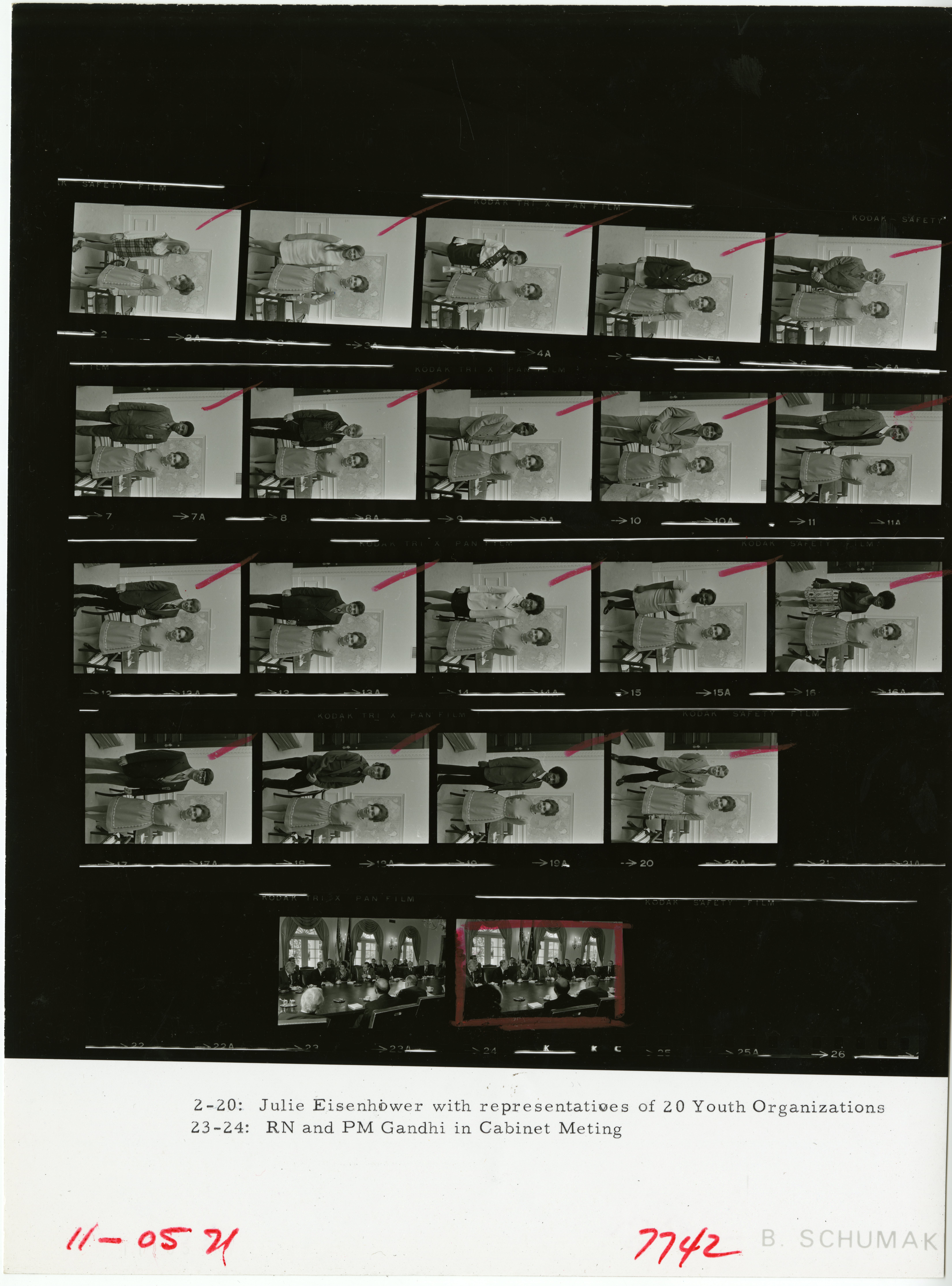
- Frame(s): WHPO-7742-02-20, Julie Eisenhower with representatives of 20 Youth Organizations. 11/5/1971, Washington, D.C. unknown. Julie Eisenhower, youth.
- Frame(s): WHPO-7742-19, President Richard Nixon and Republic of India's Prime Minister Indira Gandhi during Her Arrival Ceremony at the White House. 11/5/1971, Washington, D.C. White House, Cabinet Room. President Nixon, Indira Gandhi; present according to the PDD: Secretary of State William Rogers, Deputy Secretary David Packard, Attorney General John Mitchell, Secretary Rogers Morton, Under Secretary James Philander (Phil) Campbell, Secretary Maurice Stans, Secretary James Day Hodgson, Secretary Elliot Richardson, Secretary George Romney, Under Secretary James Beggs, Ambassador David Kennedy, Director George Shultz, Counsellor Robert Finch, Counsellor Donald Rumsfeld, Ambassador George Bush.
- Frame(s): WHPO-7742-23-24, President Nixon and Republic of India's Prime Minister Indira Gandhi meeting with members of the cabinet. 11/5/1971, Washington, D.C. White House, Cabinet Room. President Nixon, Indira Gandhi; present according to the PDD: Secretary of State William Rogers, Deputy Secretary David Packard, Attorney General John Mitchell, Secretary Rogers Morton, Under Secretary James Philander (Phil) Campbell, Secretary Maurice Stans, Secretary James Day Hodgson, Secretary Elliot Richardson, Secretary George Romney, Under Secretary James Beggs, Ambassador David Kennedy, Director George Shultz, Counsellor Robert Finch, Counsellor Donald Rumsfeld, Ambassador George Bush.
- Frame(s): WHPO-7742-24, President Nixon and Republic of India's Prime Minister Indira Gandhi meeting with members of the cabinet. 11/5/1971, Washington, D.C. White House, Cabinet Room. President Nixon, Indira Gandhi; present according to the PDD: Secretary of State William Rogers, Deputy Secretary David Packard, Attorney General John Mitchell, Secretary Rogers Morton, Under Secretary James Philander (Phil) Campbell, Secretary Maurice Stans, Secretary James Day Hodgson, Secretary Elliot Richardson, Secretary George Romney, Under Secretary James Beggs, Ambassador David Kennedy, Director George Shultz, Counsellor Robert Finch, Counsellor Donald Rumsfeld, Ambassador George Bush.
Roll WHPO-7743 Photographer: Schumaker, Byron | Color or B&W: B&W
- Frame(s): WHPO-7743-01A-05A, President Nixon signing Proclamation for Youth Appreciation Week, with representatives of 20 Youth Organizations crowding around his desk. 11/5/1971, Washington, D.C. White House, Oval Office. President Nixon, youth.
- Frame(s): WHPO-7743-04, President Nixon signing Proclamation for Youth Appreciation Week, with representatives of 20 Youth Organizations crowding around his desk. 11/5/1971, Washington, D.C. White House, Oval Office.
- Frame(s): WHPO-7743-6A-10A, Julie Eisenhower leading representatives of 20 Youth Organizations to the Executive Office Building (EOB). 11/5/1971, Washington, D.C. Executive Office Building, exterior. Julie Eisenhower, youth.
Roll WHPO-7744 Photographer: Schumaker, Byron | Color or B&W: B&W
- Frame(s): WHPO-7744-01A-08A, President Nixon and Republic of India's Prime Minister Indira Gandhi meeting with officials. 11/5/1971, Washington, D.C. White House, Cabinet Room. President Nixon, Indira Gandhi, officials.
Roll WHPO-7745 Photographer: Schumacher, Karl | Color or B&W: B&W
- Frame(s): WHPO-7745-07A-11A, President Nixon sitting at his desk with Arthur Burns, Chairman of the Board of Governors of the Federal Reserve System. 11/5/1971, Washington, D.C. White House, Oval Office. President Nixon, Arthur F. Burns.
- Frame(s): WHPO-7745-11A, President Nixon sitting at his desk with Arthur Burns, Chairman of the Board of Governors of the Federal Reserve System. 11/5/1971, Washington, D.C. White House, Oval Office. President Nixon, Arthur F. Burns.
Roll WHPO-7746 Photographer: Schumaker, Byron | Color or B&W: B&W
- Frame(s): WHPO-7746-02-13, Portrait of Lieutenant Cmdr. Alexander Larzelere. 11/5/1971, Washington, D.C. White House, South Lawn. Alexander Larzelere.
Roll WHPO-7747 Photographer: Schumaker, Byron | Color or B&W: B&W
- Frame(s): WHPO-7747-02-04, President Nixon standing with John Andrews, Mrs. John Andrews, and his parents. 11/5/1971, Washington, D.C. White House, patio. President Nixon, John Andrews, Mrs. John Andrews, parents of John Andrews.
- Frame(s): WHPO-7747-06-07, President Nixon walking to a helicopter. 11/5/1971, Washington, D.C. White House, South Lawn. President Nixon, John Andrews, Mrs. John Andrews, parents of John Andrews.
- Frame(s): WHPO-7747-07, Helicopter departing. 11/5/1971, Washington, D.C. White House, South Lawn. President Nixon, John Andrews, Mrs. John Andrews, parents of John Andrews.
Roll WHPO-7748 Photographer: Schumacher, Karl | Color or B&W: Color
- Frame(s): WHPO-7748-02A-16A, President Nixon escorting Republic of India's Prime Minister Indira Gandhi to her limousine. 11/5/1971, Washington, D.C. White House, grounds. President Nixon, Indira Gandhi, aides.
- Frame(s): WHPO-7748-17A-30A, President Nixon shaking hands with students. 11/5/1971, Washington, D.C. White House, grounds. President Nixon, aides, students.
The White House Communications Agency Sound Recordings Collection contains public statements that took place between 1969 and 1974. Visit the finding aid to learn more.
H - White House Staff Member Recordings
- WHCA-SR-H-457
Press briefing by Peter Peterson, Charles Colson, and Andrew Gibson, 39:00. (11/5/1971, [None listed])
Runtime: 39:00:00
Keywords: Press conferences, news conferences, interviews, media
Production credits: Audio feed supplied by WHCA; Recorded by LDH (initials of WHCA engineer)
Original Format: 1/4-inch reel-to-reel audiotape. Original source type: Original.
K - Informal Presidential Remarks
- WHCA-SR-K-244
Award Presentation from USAF Thunderbirds-Homestead AFB, FL. (11/5/1971)
Original Format: 1/4-inch reel-to-reel audiotape. Original source type: Original.
The White House Communications Agency Videotape Collection contains “off-the-air” recordings of televised programs produced between 1968 and 1974. Visit the finding aid to learn more.
- WHCA-4794
Weekly News Summary, Tape I.
ALL NETWORKS
Runtime: 1:30
1. Smith/Geer: Opposition to Amchitka Island, Alaska A-bomb (atomic bomb) test continues (Senator Alan Cranston). Time Code Start: 00:00. Keywords: Cannikin, Spartan anti-ballistic missile (ABM) interceptor, underground tests, nuclear weapons, atomic bombs, explosions, Aleutian Islands, atomic energy, nuclear safety, ecosystem ecology, radiation protection. Network: ABC.
2. Reasoner/Wordham: Report on the people who live near Amchitka Island, Alaska. Time Code Start: 01:39. Keywords: Cannikin, Spartan anti-ballistic missile (ABM) interceptor, underground tests, nuclear weapons, atomic bombs, explosions, Aleutian Islands, population, health, reports. Network: ABC.
3. Smith/Donaldson: Unemployment and the Pay Board. Time Code Start: 04:23. Keywords: jobs, unemployment, statistics. Network: ABC.
4. Reasoner/Kincaid: U.S. grain being sold to Russia. Time Code Start: 06:02. Keywords: American, Soviet Union, USSR, Russia, agriculture, crops, products, sales, business, imports, exports, trade. Network: ABC.
5. Reasoner/Bell: Opposition to school busing continues; Alabama Gov. George George Wallace comments. Time Code Start: 08:32. Keywords: bills, laws, legislation, desegregation, racism, racial discrimination, African Americans, schools, students, transportation, reports, Governors, speeches, Presidential elections, campaigns, primaries, candidates. Network: ABC.
6. Reasoner/Gale: School busing problems in Pontiac, Michigan. Time Code Start: 10:32. Keywords: bills, laws, legislation, desegregation, racism, racial discrimination, African Americans, schools, students, transportation, reports. Network: ABC.
7. Smith/Koppel: India Prime Minister Indira Gandhi talks with President Nixon, then before Press Club in Washington, D.C. (Indira Gandhi, President Nixon). Time Code Start: 12:28. Keywords: Presidents, Prime Ministers, meetings, speeches, statements, press conferences, news conferences, interviews, media, news organizations, reporters, organizations. Network: ABC.
8. Smith: Commentary on Ellsberg and New York Times story on publishing classified materials of Pentagon Papers. Time Code Start: 14:30. Keywords: newspapers, interviews, reports, Armed Forces, military, classified documents, secrets, Russo, Watergate, courts, trials, Vietnam War, Indochina War, bombings. Network: ABC.
9. Chancellor/Oliver/Briggs: Opposition to Amchitka Island, Alaska test, protesting in Vancouver, British Columbia. Time Code Start: 15:54. Keywords: Cannikin, Spartan anti-ballistic missile (ABM) interceptor, underground tests, nuclear weapons, atomic bombs, explosions, Aleutian Islands, Canada, demonstrations, rally, protesters, demonstraters, students, Vietnam War, anti-war. Network: NBC.
10. Chancellor/Jamieson: Phase II Pay Board meets in Washington, D.C.; Unemployment down for October. Time Code Start: 21:54. Keywords: wage and price controls, freezes, prices, costs, increases, decreases, economy, economics, budgets, finances, recession, inflation, money. Network: NBC.
11. Chancellor: U.S. grain being sold to Russia. Time Code Start: 25:25. Keywords: American, Soviet Union, USSR, Russia, agriculture, crops, products, sales, business, imports, exports, trade. Network: NBC.
12. Chancellor/Lord/Goralsky: Secretary of Defense Laird announces Vietnam war troop reductions, latest work from the Pentagon. Time Code Start: 25:47. Keywords: United States Department of Defense headquarters, Armed Forces, cabinet, advisors, military, speeches, statements, Vietnam War. Network: NBC.
13. Chancellor/Valariani: Prime Minister of India Indira Gandhi talks with President Nixon, before National Press Club (Gandhi, Nixon, the Cabinet). Time Code Start: 29:14. Keywords: Presidents, Prime Ministers, speeches, meetings, speeches, statements, press conferences, news conferences, interviews, media, news organizations, reporters, organizations. Network: NBC.
14. Cronkite/Threlkeld: Amchitka Island, Alaska test still causing protests. Time Code Start: 31:18. Keywords: Cannikin, Spartan anti-ballistic missile (ABM) interceptor, underground tests, nuclear weapons, atomic bombs, explosions, Aleutian Islands, demonstrations, rally, protesters, demonstraters, students, Vietnam War, anti-war. Network: CBS.
15. Cronkite/Morton: Unemployment in October down. Time Code Start: 34:02. Keywords: jobs, unemployment, statistics. Network: CBS.
16. Cronkite: Prime Minister of India Indira Gandhi meets with President Nixon at White House. Time Code Start: 35:37. Keywords: Presidents, Prime Ministers, meetings. Network: CBS.
17. Cronkite: Secretary of Defense Laird announces troop reductions in Vietnam. Time Code Start: 36:00. Keywords: cabinet, advisors, speeches, statements, Vietnam War, Armed Forces, mlitary, troops, decreases, withdrawals. Network: CBS.
18. Cronkite: President Nixon orders reorganization of U.S. foreign intelligence gathering groups. Time Code Start: 36:34. Keywords: Presidents, international organizations, crime, espionage, spying, Central Intelligence Agency (CIA), national security, intelligence gathering, covert activities, C.I.A. agents. Network: CBS.
Context (External Sources)
The Vanderbilt Television News Archive is the world's most extensive and complete archive of television news. They have been recording, preserving and providing access to television news broadcasts of the national networks since August 5, 1968.
Wikipedia is a free encyclopedia that anyone can edit.