
Introduction
This almanac page for Tuesday, November 25, 1969, pulls together various records created by the federal government and links to additional resources which can provide context about the events of the day.
Previous Date: Monday, November 24, 1969
Next Date: Wednesday, November 26, 1969
Schedule and Public Documents
The Daily Diary files represent a consolidated record of the President's activities. Visit the finding aid to learn more.
The President's day began at The White House - Washington, D. C.
The Weekly Compilation of Presidential Documents made available transcripts of the President's news conferences; messages to Congress; public speeches, remarks, and statements; and other Presidential materials released by the White House.
Addresses and Remarks
- Chemical and Biological Defense Policies and Programs (5 Weekly Comp. Pres. Doc. 1661, November 25, 1969)
The President's Remarks Announcing Decisions Following Study and Review.
Statements by the President
- Chemical and Biological Defense Policies and Programs (5 Weekly Comp. Pres. Doc. 1659, November 25, 1969)
Statement by the President.
Acts Approved by the President
- S. 1072 -- Public Law 91-123
An Act to authorize funds to carry out the purposes of the Appalachian Regional Development Act of 1965, as amended, and titles I, III, IV, and V of the Public Works and Economic Development Act of 1965, as amended.
Each Public Papers of the Presidents volume contains the papers and speeches of the President of the United States that were issued by the White House Office of the Press Secretary during the time period specified by the volume. The material is presented in chronological order, and the dates shown in the headings are the dates of the documents or events. In instances when the release date differs from the date of the document itself, that fact is shown in the text note.
To ensure accuracy, remarks have been checked against audio recordings (when available) and signed documents have been checked against the original, unless otherwise noted. Editors have provided text notes and cross references for purposes of identification or clarity.
The Federal Register is the official daily publication for rules, proposed rules, and notices of federal agencies and organizations, as well as executive orders and other Presidential documents.
The Congressional Record is the official daily record of the debates and proceedings of the U.S. Congress.
Archival Holdings
Any selection of archival documents will necessarily be partial. You should use the documents and folders identified below as a starting place, but consult the linked collection finding aids and folder title lists and the collections themselves for context. Many documents to be found this way do not lend themselves to association with specific dates, but are essential to a complete understanding of the material.
Selective document listing
President's Office Files
The President's Office Files consists of materials drawn together by the Special Files Unit from several administrative subdivisions within the White House Office. It is the handwriting and sensitive papers sent to the Staff Secretary that now comprise much of the President's Office Files. Visit the finding aid to learn more.
- President's Handwriting, Box 3, President's Handwriting, November 16 thru 30, 1969 [2 of 4]
- Memo; Daniel P. Moynihan to The President re: Vietnam. November 25, 1969. 5 pgs.
- Telephone Call Recommendation; John C. Whitaker to The President re: Secretary Walter J. Hickel. November 25, 1969. 1 pg.
- Memo; Christopher De Muth to John C. Whitaker re: Recommendations for Environment Message. November 25, 1969. 4 pgs.
- Statement; to The President re: Proposed Presidential Statement Upon Signature of the Instrument of Ratification of the Non-Proliferation Treaty. November 25, 1969. 2 pgs.
- Memo; Daniel P. Moynihan to The President re: Development of a national urban policy. November 25, 1969. 19 pgs.
- Letter; Richard Nixon to William W. Scranton re: Setting up meetings from time to time with William Scranton, Bob Anderson and Jack McCloy. November 25, 1969. 1 pg.
- Memo; Daniel P. Moynihan to The President re: Social Security and Family Assistance. November 25, 1969. 2 pgs.
- Memo; Herbert G. Klein to The President re: Quote attributed to me. November 25, 1969. 1 pg.
- Telephone Call Recommendation; Bryce N. Harlow to The President re: Senator John Williams, Ranking Republican Member of Finance Committee. November 25, 1969. 1 pg.
- Telephone Call Recommendation; Bryce N. Harlow to The President re: Senator Russell Long, Chairman of Finance Committee. November 25, 1969. 1 pg.
- President's Handwriting, Box 3, President's Handwriting, November 16 thru 30, 1969 [3 of 4]
- Memo; Peter Flanigan to Staff Secretary re: Log No. 2130. November 25, 1969. 2 pgs.
- President's Handwriting, Box 4, President's Handwriting, December 1 thru 15, 1969 [1 of 5]
- Newspaper; to The President re: San Francisco Chronicle, cartoon, "Nixon popularity graph". November 25, 1969. 1 pg.
- Annotated News Summaries, Box 28, News Summaries - November 1969 [During this period, the Staff Secretary only removed pages from the News Summaries which contained President Nixon's handwriting, often leaving the document with no date. Although there are no specific documents with this date, you should also consult the full folder for the month.]
- President's Meetings File, Box 76, Memoranda for the President--Beginning November 23, 1969
- President's Daily Schedule, Box 99, [President's Daily Schedule, Nov.-Dec. 1969] [1 of 2]
- The President's Schedule, Tuesday - November 25, 1969
President's Personal File
The President's Personal File is essentially a President's secretary's file, kept by Rose Mary Woods, personal secretary to the President, for two purposes: (1) preserving for posterity a collection of documents particularly close to the President, whether because he dictated or annotated them, or because of the importance of the correspondent or the event concerned and (2) giving appropriate attention–letters of gratitude, invitations to White House social events, and the like–to members and important friends and supporters of the Nixon administration. This generalization does not describe all the varied materials of a file group which is essentially a miscellany, but it does identify the reason for the existence of the file group's core. Visit the finding aid to learn more.
- President's Speech File
The H. R. Haldeman Diaries consists of seven handwritten diaries, 36 dictated diaries recorded as sound recordings, and two handwritten audio cassette tape subject logs. The diaries and logs reflect H. R. Haldeman’s candid personal record and reflections on events, issues, and people encountered during his service in the Nixon White House. As administrative assistant to the President and Chief of Staff, Haldeman attended and participated in public events and private meetings covering the entire scope of issues in which the Nixon White House engaged in during the years 1969-1973. Visit the finding aid to learn more.
- Transcript of diary entry (PDF)
Tuesday, November 25.
CBW day, with bipartisan breakfast first for briefings. Several miscellaneous appointments with Senators. Another budget session this afternoon and a social hour with the pro-Haynsworth GOP Senators.
Had a surprise session this morning when a free half hour came up and President had VP over for a chat. Mainly regarding his forthcoming trip. President wants him to go on around the world since he'll be halfway at Afghanistan. VP already has itinerary set and very reluctant to change. President told him he should now stop talking about the media except for some light quips - and said the VP could now talk about all those things he had been talking about before but no one was listening, and now they'll listen because he's become a national figure. Sort of a backhanded compliment, not intended that way. Main point was to get the VP back on to constructive ground and stop him from riding the media issue to death. He got the point.
Question of astronauts going to Vietnam came up and President was furious because NASA said they shouldn't go because of political consequences or relations with Russia. President ordered that anyone expressing this view be fired immediately. He is sending Borman over in early December, and wants Armstrong to go for Christmas with Bob Hope.
Some discussion of the atrocities case. President now realizing harm this can do in public opinion toward the war. Feels we have to make the point that this was totally contrary to national policy, and that it happened under the other administration at a time the war was escalating.
President called tonight - wants me to call a staff meeting tomorrow, to have Kissinger explain significance of recent accomplishments, make point that Johnson couldn't have gotten NPT, CBW, Okinawa and draft, because didn't have the confidence of the people or the world leaders. Thinks this gives our House liberals something to think about.
Interesting maneuver by Rumsfeld who, after refusing to support Crane's candidacy as his successor, called President to report on election returns - things look good - before anyone else - including Dent who did all the work, had called. - Handwritten diary entry (JPG)
The National Archives Catalog is the online portal to the records held at the National Archives, and information about those records. It is the main way of describing our holdings and also provides access to electronic records and digitized versions of our holdings.
The Catalog searches across multiple National Archives resources at once, including archival descriptions, digitized and electronic records, authority records, and web pages from Archives.gov and the Presidential Libraries. The Catalog also allows users to contribute to digitized historical records through tagging and transcription.
Nixon Library Holdings
All National Archives Units
National Security Documents
The President's Daily Brief is the primary vehicle for summarizing the day-to-day sensitive intelligence and analysis, as well as late-breaking reports, for the White House on current and future national security issues. Read "The President's Daily Brief: Delivering Intelligence to Nixon and Ford" to learn more.
The Foreign Relations of the United States series presents the official documentary historical record of major U.S. foreign policy decisions and significant diplomatic activity. Visit the State Department website for more information.
Vol. VI, Vietnam, January 1969-July 1970
Vietnam, January 1969-July 1970
150. Notes of Telephone Conversation Between President Nixon and his Assistant for National Security Affairs (Kissinger) , Washington, November 25, 1969, 6:30 p.m.
Source: Library of Congress, Manuscript Division, Kissinger Papers, Telephone Conversations, Chronological File. No classification marking.
Vol. XIX, Part 1, Korea, 1969-1972
U.S. Troop Reductions and Related Defense Issues, November 1969-February 1971
46. Memorandum From the President’s Assistant for National Security Affairs (Kissinger) to President Nixon, Washington, November 25, 1969
Source: National Archives, Nixon Presidential Materials, NSC Files, Box 541, Country Files, Far East, Korea, Vol. II, 10/69–5/70. Secret. Sent for information.
Vol. XXXIV, National Security Policy, 1969-1972
Chemical and Biological Warfare, Safeguard Phase II, the Draft
104. National Security Decision Memorandum 35 , Washington, November 25, 1969
Source: National Archives, Nixon Presidential Materials, NSC Files, Box 363, Subject Files, NSDMs, Nos. 1–50. Top Secret; Nodis. A copy was sent to Wheeler.
Vol. XXXVI, Energy Crisis, 1969-1974
February 20, 1969-February 19, 1970
21. Memorandum From C. Fred Bergsten and Harold H. Saunders of the National Security Council Staff to the President’s Assistant for National Security Affairs (Kissinger) , Washington, November 25, 1969
Source: National Archives, Nixon Presidential Materials, White House Special Files, Subject Files, Confidential Files, Box 63, [CF] TA 4/Oil, 1–20–69 to 2–28–70) No classification marking. Sent for action. A handwritten notation reads: “OBE—Return to Harold Saunders.”
Vol. E-2, Documents on Arms Control and Nonproliferation, 1969-1972
Eighteen-Nation Disarmament Committee; Seabed Arms Control Treaty
130. Telegram 4311 From the Mission to the United Nations to the Department of State, New York, November 25, 1969, 2137Z
The telegram discussed problems and prospects for the seabed arms control treaty in the UN General Assembly. It reiterated the more problematic issue of the Article defining the “contiguous zone,” the potential Argentinean objection, and the various positions feasible in light of the previous extensive negotiations between the U.S. and USSR centered around that same issue.
Source: National Archives, RG 59, Central Files 1967–1969, POL 33–6. Confidential. It was repeated to USNATO and USMission Geneva.
Chemical and Biological Warfare; Geneva Protocol; Biological Weapons Convention
165. National Security Decision Memorandum 35 , Washington, November 25, 1969
Among the President’s decisions on chemical warfare and bacteriological/biological research were decisions to submit the Geneva Protocol for Senate ratification and to associate the U.S. with the UK draft convention on biological warfare presented to the ENDC in August 1969.
Source: National Archives, Nixon Presidential Materials, NSC Files, Box 363, Subject Files, NSDMs (1–50). Top Secret; Nodis. A copy was sent to Wheeler.166. Statement Issued by President Nixon, Washington, November 25, 1969
The President highlighted his decisions on CBW. This statement confirmed the U.S. alliance with the objectives of the UK Draft Convention banning the use of biological agents in war. It included the decision to submit the 1925 Geneva Protocol, prohibiting the first use of chemical and biological agents in warfare, to the U.S. Senate for ratification. Moreover it established a research agenda to investigate the methods of disposal for bacteriological weaponry and restricted research to “defensive measures” only.
Source: Public Papers: Nixon, 1969, pp. 968–969. No classification marking. For text of the President’s remarks on his CBW decisions, made the same day, see ibid., pp. 969–970.
Vol. E-4, Documents on Iran and Iraq, 1969-1972
Iran 1969
40. Telegram 197323 From the Department of State to the Embassy in Tehran, Washington, November 25, 1969, 0026Z
The Department advised the Embassy on the status of the Shah’s requests for pilot training, USAF technicians, aircraft and his oil import program.
Source: National Archives, RG 59, Central Files 1967–69, POL 7 IRAN. Secret. Repeated to CINCSTRIKE/CINCMEAFSA. Drafted by McClelland; cleared by Miklos, by E/FSE, OASD/ISA, PM/MASP, JCS, and USAF; and approved by Rockwell.
Vol. E-7, Documents on South Asia, 1969-1972
India and Pakistan: Pre-Crisis, January 1969-February 1971
43. Minutes of a Meeting of the National Security Council Review Group , Washington, November 25, 1969, 3:15-3:55 p.m.
Discussion of military supply policy toward South Asia focused on the question of resuming military sales and assistance to Pakistan and the cost to U.S. relations with India of doing so.
Source: National Archives, Nixon Presidential Materials, NSC Files, NSC Institutional Files (H-Files), Box H–111, Review Group Meeting, Minutes, Originals, 1969. Secret. No drafting information appears on the minutes. The meeting was held in the White House Situation Room. For a summary of the paper prepared in response to NSSM 26, see Document 42.
The Kissinger telephone conversation transcripts consist of approximately 20,000 pages of transcripts of Kissinger’s telephone conversations during his tenure as Assistant to the President for National Security Affairs (1969-1974) and Secretary of State (1973-1974) during the administration of President Richard Nixon. Visit the finding aid for more information.
Chronological File, Box 3, Folder November 18-28, 1969 [2 of 2]
- 10:05 AM, John Ehrlichman
- 10:05 AM, John McCloy
- 10:08 AM, Ron Ziegler
- 12:30 PM, The President
- 4:00 PM, Hugh Sidey
- 4:55 PM, Professor Doty
- 5:12 PM, Ambassador Sullivan
- 6:10 PM, Secretary Laird
- 6:30 PM, The President
- 6:30 PM, Prof. Messelson
- 7:45 PM, Dr. Wiesner
Audiovisual Holdings
The White House Photo Office collection consists of photographic coverage of President Richard Nixon meeting with prominent social, political, and cultural personalities; speaking engagements and news conferences of the President and various high-ranking members of the White House staff and Cabinet; Presidential domestic and foreign travel, including Presidential vacations; social events and entertainment involving the First Family, including entertainers present; official portraits of the President, First Family, and high-ranking members of the Nixon administration; the 1969 and 1973 Inaugurals; the President’s 1972 Presidential election campaign appearances (including speeches) and other official activities of the White House staff and the President’s Cabinet from January 20, 1969 until August 9, 1974 at the White House and the Old Executive Office Building; other locations in Washington, DC, such as The Mall; and the Presidential retreats in Camp David, Maryland, Key Biscayne, Florida, and San Clemente, California. Visit the finding aid to learn more.
Roll WHPO-2487 Photographer: Atkins, Oliver | Color or B&W: B&W
- Frame(s): WHPO-2487-01-04,10, President Nixon during announcement of U.S. policies concerning chemical and biological warfare. 11/25/1969, Washington, D.C. White House, Roosevelt Room. President Nixon, Henry Kissinger, Ronald Ziegler.
- Frame(s): WHPO-2487-05-09, Henry Kissinger during the announcement of U.S. policies concerning chemical and biological warfare. 11/25/1969, Washington, D.C. White House, Roosevelt Room. President Nixon, Henry Kissinger, Ronald Ziegler.
- Frame(s): WHPO-2487-11-12, Ronald Ziegler during the announcement of U.S. policies concerning chemical and biological warfare. 11/25/1969, Washington, D.C. White House, Roosevelt Room. President Nixon, Henry Kissinger, Ronald Ziegler.
Roll WHPO-2488 Photographer: Atkins, Oliver | Color or B&W: B&W
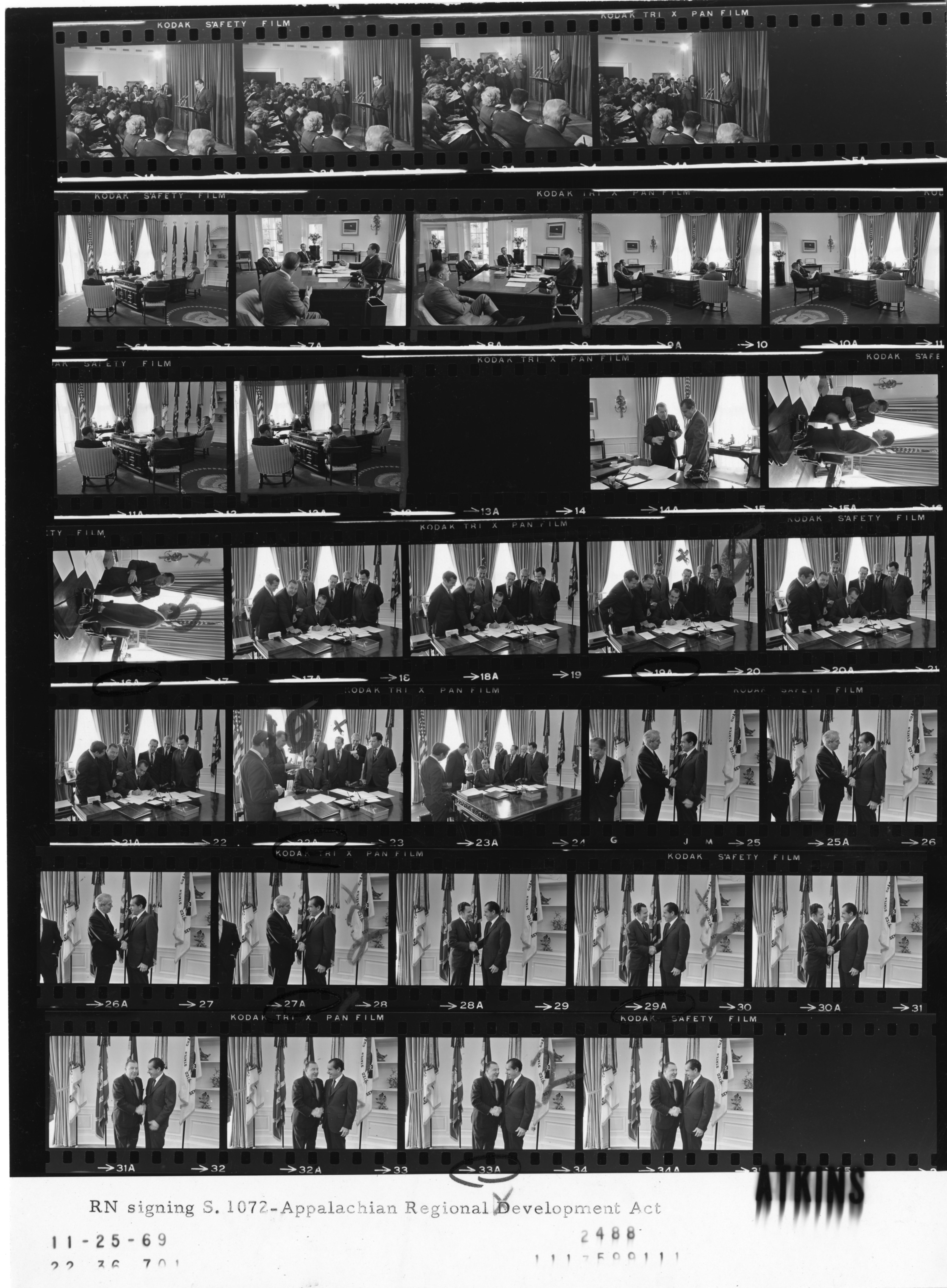
- Frame(s): WHPO-2488-01A-04A, President Nixon announcing chemical and biological warfare policies. 11/25/1969, Washington, D.C. White House, Roosevelt Room. President Nixon, reporters.
- Frame(s): WHPO-2488-06A-12A, President Nixon seated at his desk during a meeting with H.R. Haldeman, Vice President Agnew and C. Stanley Blair. 11/25/1969, Washington, D.C. White House, Oval Office. President Nixon, H.R. Haldeman, Spiro Agnew, C. Stanley Blair.
- Frame(s): WHPO-2488-14A-34A, President Nixon signing S.1072-Appalachian Regional Development Act, and standing individually with Senator Randolph, Sen. Cook and Appalachian Regional Commission Chairman Waters. 11/25/1969, Washington, D.C. White House, Oval Office. President Nixon, Spiro Agnew, Sen. Joseph Montoya, Sen. Marlow Cook, Sen. Howard Baker, Sen. Jennings Randolph, John Waters, Jr., unidentified others.
- Frame(s): WHPO-2488-20A, President Nixon signing S.1072-Appalachian Regional Development Act, and standing individually with Senator Randolph, Sen. Cook and Appalachian Regional Commission Chairman Waters. 11/25/1969, Washington, D.C. White House, Oval Office. President Nixon, Spiro Agnew, Sen. Joseph Montoya, Sen. Marlow Cook, Sen. Howard Baker, Sen. Jennings Randolph, John Waters, Jr., unidentified others.
Roll WHPO-2489 Photographer: Atkins, Oliver | Color or B&W: B&W
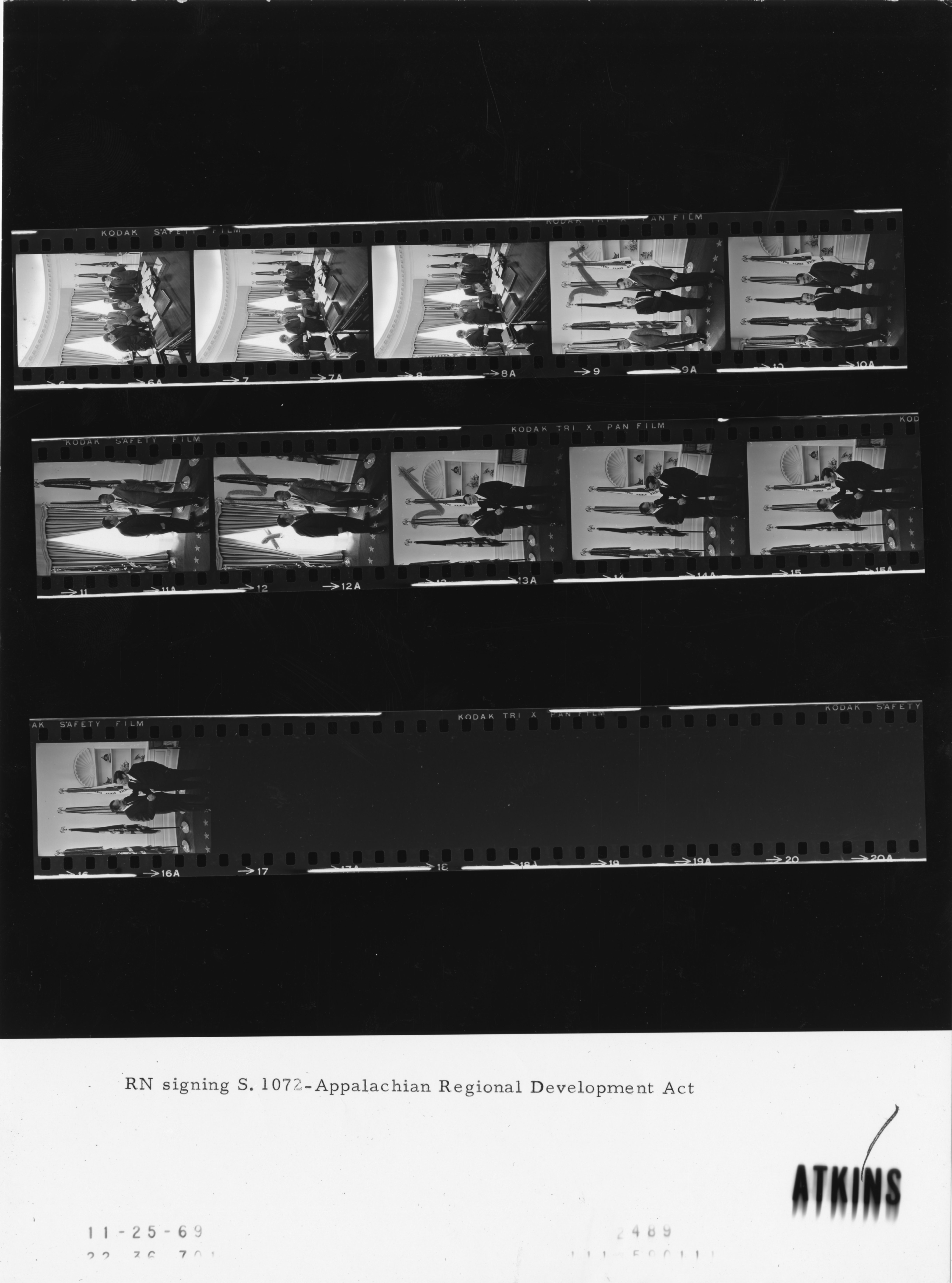
- Frame(s): WHPO-2489-, President Nixon signing S.1072, the Appalachian Regional Development Act with Senator Montoya and Senator Baker standing nearby. 11/25/1969, Washington, D.C. White House, Oval Office. President Nixon, Spiro Agnew, Sen. Joseph Montoya, Sen. Marlow Cook, Sen. Howard Baker, Sen. Jennings Randolph, John Waters, Jr.
Roll WHPO-2490 Photographer: Kightlinger, Jack | Color or B&W: B&W
- Frame(s): WHPO-2490-, Newly discovered rooms or chambers east of the White House indoor swimming pool. 11/25/1969, Washington, D.C. Swimming Pool area, White House.
Roll WHPO-2491 Photographer: Knudsen, Robert L. | Color or B&W: B&W
- Frame(s): WHPO-2491-02-04, Atomic Energy Commission (AEC) award to Lt. General Leslie R. Groves. 11/25/1969, Washington, D.C. unknown. Col. James Hughes, unidentified young men.
- Frame(s): WHPO-2491-05-12, Colonel James Hughes signing on behalf of President Nixon while young men watch. 11/25/1969, Washington, D.C. unknown. Col. James Hughes, unidentified young men.
Roll WHPO-2493 Photographer: Kightlinger, Jack | Color or B&W: B&W
- Frame(s): WHPO-2493-01A-06A, President Nixon receiving books for the library from unidentified men. 11/25/1969, Washington, D.C. White House, Library. Pat Nixon, unidentified men.
- Frame(s): WHPO-2493-07A-08A, Connie Stuart and Julie Robinson at a press briefing. 11/25/1969, Washington, D.C. unknown. Connie Stuart, Julie Robinson.
Roll WHPO-2494 Photographer: Knudsen, Robert L. | Color or B&W: B&W
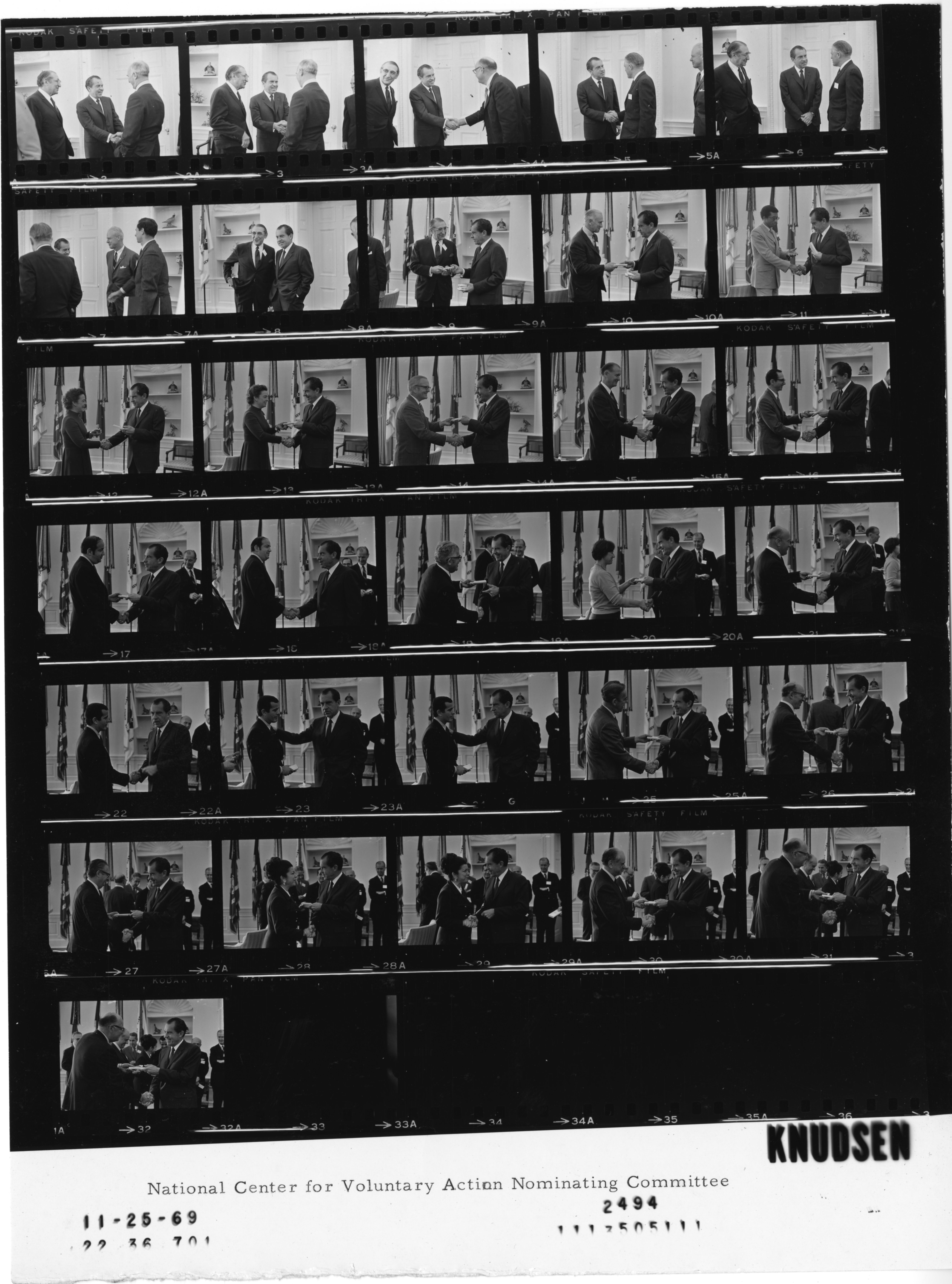
- Frame(s): WHPO-2494-03-04, 07-32, President Nixon standing in the Oval office speaking with individual members of the Nominating Committee of the National Center for Voluntary Action. Including Secretary of HUD George W. Romney and Charles B. Wilkinson. 11/25/1969, Washington, D.C. White House, Oval Office. President Nixon, Max Fisher, George W. Romney, Charles Bud Wilkinson, Arthur Ashe Jr., Philip Bernstein, Arch N. Booth, Victor Carter, Martin Castillo, Bayard Ewing, Dorothy Haight, Mrs. Elsie Hillman, Mrs. Laura Leonard, George Lindsay, Mrs. Alfred Anita Martinez, Aloysius A. Mazewski, Frank Pace, Jr., Dr. W. Robert Parks, Leo Perlis, Paul Sonnabend.
- Frame(s): WHPO-2494-05-06, President Nixon standing in the Oval office speaking with individual members of the Nominating Committee of the National Center for Voluntary Action Including Secretary of HUD George W. Romney. 11/25/1969, Washington, D.C. White House, Oval Office. President Nixon, George W. Romney, Charles Bud Wilkinson.
Roll WHPO-2495 Photographer: Atkins, Oliver | Color or B&W: B&W
- Frame(s): WHPO-2495-00-09, President Nixon with Rep. Harley Staggers. 11/25/1969, Washington, D.C. White House, Oval Office. President Nixon, Harley Staggers, M. Gene Snyder, William McCulloch.
- Frame(s): WHPO-2495-11-22, President Nixon with Rep. M. Gene Snyder. 11/25/1969, Washington, D.C. White House, Oval Office. President Nixon, Harley Staggers, M. Gene Snyder, William McCulloch.
- Frame(s): WHPO-2495-24-31, President Nixon with Rep. William McCulloch. 11/25/1969, Washington, D.C. White House, Office. President Nixon, Harley Staggers, M. Gene Snyder, William McCulloch.
Roll WHPO-2497 Photographer: Knudsen, Robert L. | Color or B&W: B&W
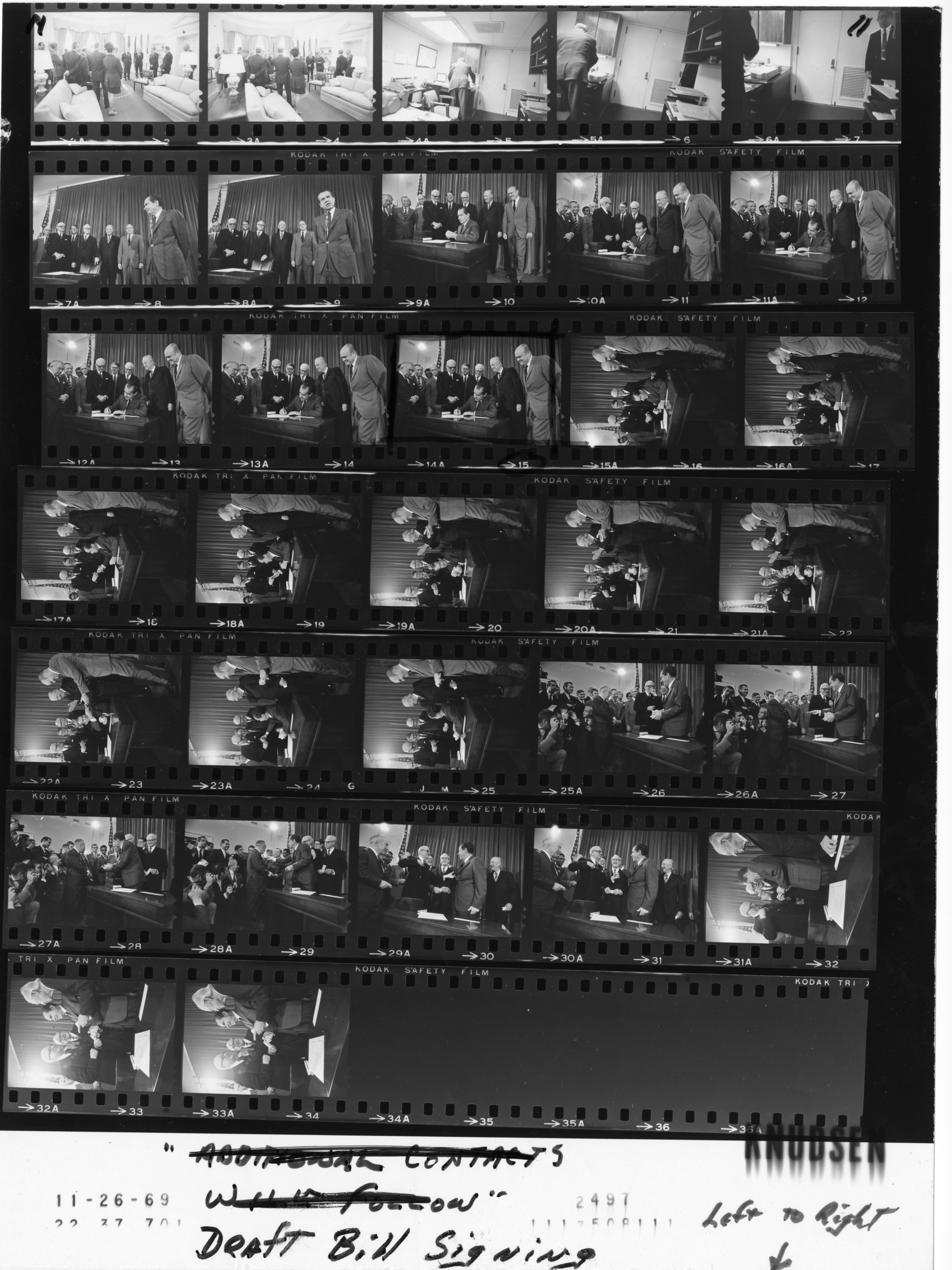
- Frame(s): WHPO-2497-02A/03-03A/04, President Nixon standing with members of the Nominating Committee of the National Center for Voluntary Action. 11/25/1969, Washington, D.C. White House, Oval Office. President Nixon, unidentified committee members.
The White House Communications Agency Sound Recordings Collection contains public statements that took place between 1969 and 1974. Visit the finding aid to learn more.
H - White House Staff Member Recordings
- WHCA-SR-H-102
Briefing by Henry Kissinger and Ronald Ziegler. (11/25/1969, Roosevelt Room, White House)
Runtime: 0:27:15
Keywords: Briefings, public briefings, statements to the press (see also Press conferences, news conferences, interviews, media)
Production credits: Audio feed supplied by WHCA; Recorded by ELB (initials of WHCA engineer)
Original Format: 1/4-inch reel-to-reel audiotape. Original source type: Original.
P - Formal Presidential Remarks
- WHCA-SR-P-691118
Statement to press on chemical warfare with Ronald Ziegler. (11/25/1969)
Runtime: 5:35
Original Format: 1/4-inch reel-to-reel audiotape. Original source type: Original.
The White House Communications Agency Videotape Collection contains “off-the-air” recordings of televised programs produced between 1968 and 1974. Visit the finding aid to learn more.
- WHCA-3537
"60 Minutes" - Vice President Agnew statement about the news media and the media's response. Walter Cronkite speaking at a question and answer session in response to Vice President Agnew's criticism of the news media. Other television commentators also voice their opinions about Agnew's statements. Dr. Frank Stanton, president of CBS.
CBS
Runtime: 01:00:42 - WHCA-3541
Weekly News Summary.
All networks
Runtime: 00:58:00
8. President Nixon's Statement on chemical/biological weapons. Time Code Start: 10:58. Keywords: Presidents, speeches, statements, chemicals, nerve gas, biological weapons, Agent Orange, herbicidal warfare, medical research. Network: CBS.
9. President Nixon's statement on chemical/biological weapons (no net audio during first few sec). Time Code Start: 13:13. Keywords: Presidents, speeches, statements, chemicals, nerve gas, biological weapons, Agent Orange, herbicidal warfare, medical research. Network: NBC.
10. President Nixon's statement on chemical/biological weapons (no net audio during first few sec). Time Code Start: 16:14. Keywords: Presidents, speeches, statements, chemicals, nerve gas, biological weapons, Agent Orange, herbicidal warfare, medical research, Agent Orange. Network: ABC.
Context (External Sources)
The Vanderbilt Television News Archive is the world's most extensive and complete archive of television news. They have been recording, preserving and providing access to television news broadcasts of the national networks since August 5, 1968.
Wikipedia is a free encyclopedia that anyone can edit.