
Introduction
This almanac page for Monday, November 15, 1971, pulls together various records created by the federal government and links to additional resources which can provide context about the events of the day.
Previous Date: Sunday, November 14, 1971
Next Date: Tuesday, November 16, 1971
Schedule and Public Documents
The Daily Diary files represent a consolidated record of the President's activities. Visit the finding aid to learn more.
The President's day began at The White House - Washington, D. C.
The Weekly Compilation of Presidential Documents made available transcripts of the President's news conferences; messages to Congress; public speeches, remarks, and statements; and other Presidential materials released by the White House.
Digitized versions can be found at HathiTrust.
Each Public Papers of the Presidents volume contains the papers and speeches of the President of the United States that were issued by the White House Office of the Press Secretary during the time period specified by the volume. The material is presented in chronological order, and the dates shown in the headings are the dates of the documents or events. In instances when the release date differs from the date of the document itself, that fact is shown in the text note.
To ensure accuracy, remarks have been checked against audio recordings (when available) and signed documents have been checked against the original, unless otherwise noted. Editors have provided text notes and cross references for purposes of identification or clarity.
The Federal Register is the official daily publication for rules, proposed rules, and notices of federal agencies and organizations, as well as executive orders and other Presidential documents.
No Federal Register published on this date
The Congressional Record is the official daily record of the debates and proceedings of the U.S. Congress.
Archival Holdings
Any selection of archival documents will necessarily be partial. You should use the documents and folders identified below as a starting place, but consult the linked collection finding aids and folder title lists and the collections themselves for context. Many documents to be found this way do not lend themselves to association with specific dates, but are essential to a complete understanding of the material.
Selective document listing
President's Office Files
The President's Office Files consists of materials drawn together by the Special Files Unit from several administrative subdivisions within the White House Office. It is the handwriting and sensitive papers sent to the Staff Secretary that now comprise much of the President's Office Files. Visit the finding aid to learn more.
- News Summaries, Annotated News Summaries, Box 31, News Summaries - November 1-15, 1971 [5 of 5] [Note: Due to the way News Summary products were compiled, you should also consult nearby days for potentially relevant materials.]
- Monday, November 15, 1971
- Weekend News Review, November 15, 1971
- President's Daily Schedule, Box 102, [President's Daily Schedule, Sept.-Dec. 1971] [2 of 3]
- The President's Schedule, Monday - November 15, 1971
The H. R. Haldeman Diaries consists of seven handwritten diaries, 36 dictated diaries recorded as sound recordings, and two handwritten audio cassette tape subject logs. The diaries and logs reflect H. R. Haldeman’s candid personal record and reflections on events, issues, and people encountered during his service in the Nixon White House. As administrative assistant to the President and Chief of Staff, Haldeman attended and participated in public events and private meetings covering the entire scope of issues in which the Nixon White House engaged in during the years 1969-1973. Visit the finding aid to learn more.
- Transcript of diary entry (PDF)
Monday, November 15.
The staff meeting this morning got into the continuing resolution problem again, and right after the meeting, I got with Shultz, Weinberger, and MacGregor for a long session on trying to work out what we do. The problem is that tonight is the expiration and legally we can't go ahead with expenditures on OEO, foreign aid, Defense, military procurement and District of Columbia operations. The option is either to get an agreement from Mahon and Ellender and go with their assurance that they'll make this legal retroactively; but the problem is we get trapped. Continued on the next tape.
[End of tape reel AC-15(B)]
[Begin tape reel AC-16(A)]
Continued. I was going over the problem on the continuing resolution and the fact that if we go along with Mahon and Ellender’s assurance that they’ll make it legal retroactively, we get trapped in that the President has to sign the ultimate bills even though some of them may be candidates for vetoes, but he'll have to sign them in order to make his actions in the interim legal.
The President asked me to get Connally's view on this, and he said we should take the hard line. That first, we are in an indefensible position: if we violate the law and box ourselves in, we'll be forced to make decisions that we should not make. Second, we have a breakdown in government operations. The Senate is acting irresponsibly. We have to run against Congress anyway. We should hit a few obstructionists for venting their anger in an irresponsible way. A tangible positive ingredient is the President as a strong decisive leader. He has to draw the distinction, praise the House, and so forth. The problem here is that, if we take the hard line and they don't go with the continuing resolution, then we have to cancel expenditures or halt expenditures as of midnight tonight; and on that basis, the government will, in effect, collapse, and that then becomes blamed on the President.
Shultz called Ellender from our meeting and basically showed him down. He came up afterwards with the fact that Ellender has a very hard strategy. He'll give us all kinds of commitments on making it legal, and he volunteered a five day continuation. Basically he's burned up because the House is going out for ten days, and he wants to put their feet to the fire and force them to pass the authorization bills. Also he wants to hold the President to the fire and force him not to veto. So we agreed that we couldn't go along with the five day extension. The net result was the President called in the big four leaders plus the four chairmen and ranking members of Appropriations of both houses and really laid the law down to them very firmly. As a result of which, Ellender backed off, agreed to pass a continuing resolution by Wednesday, and on that basis, we're going ahead with expenditures.
The President got into a discussion with Flanigan and me this morning on appointments -- several key ones, particularly Federal Reserve, where Connally wants Earl Coke appointed. The President wants to have someone close to Connally, that Connally can control, rather than Arthur controlling him. He's not worried about it being a Democrat, if the guy will do the job. Flanigan suggested Congressman Stuckey, which appealed somewhat to the President. On NATO, he likes Mansfield, Sprague or John McCloy, who Henry is exploring at the moment. Another possibility there would be Walter Thayer. Also he bought Hoyt Amadon for Japan, with Thayer as an alternative and George Champion as a possibility.
He then urged that we push on getting Mitchell to go on Stans right away, so that we can move Peterson over to Commerce, which he feels is essential in spite of the Attorney General's desire to try to put someone in that we can make some political hay out of. Later, he had Ehrlichman in on budget and general domestic plans. He said he wanted to do a poll that would determine whether the public would favor a sales tax if the funds were to be used for education or for adequate defense or for reducing property tax. He said he's inclined to go for the 4 percent valueadded tax -- not for new initiatives, but basically use it to balance the budget. He told John to set up a meeting with Ehrlichman, Shultz and Connally and the President to sit down and decide on the budget as a fundamental political decision. He wanted Ehrlichman and Shultz to brief Connally first. The President made the point that if Connally isn't briefed ahead of time, he's wrong half the time on his decisions, just as the President is wrong half the time. He explained to John that there's going to be a problem in terms of the President's time in the future, because he's got three foreign meetings before China, and from February on, he's dead regarding time availability, because he's got to spend all the time planning for China.
This afternoon we had a Cabinet meeting that started while the President was still meeting with the Congressional group, so Rogers presided since the Vice President was in California. It was a total disaster since the principal agenda item was John Volpe first reporting on his Transpo '72, which is a transportation exposition at Dulles airport, and from there he went into a report on his recent trip to Europe. Each presentation went about 20 or 25 minutes and was incredibly dull. The President arrived before the second Volpe presentation. Then following that, he tried to ease into a farewell thing to Hardin, which was rather awkward, and Hardin walked into the middle of it with a display of marijuana poppies and a few extraneous matters. The President did finally get around to telling Cliff he was presenting him with his chair, and told a little story about Nebraska football and the fact that Hardin had recruited Bob Devaney which was what made Nebraska number one. Then Hardin gave a little speech about how things aren't as bad in the Corn Belt as everybody's saying. He came up with some recommendations on how the President could deal with the farm people, and on that rather straggly note, the Cabinet meeting ended.
End of November 15. - Original audio recording (MP3)
The National Archives Catalog is the online portal to the records held at the National Archives, and information about those records. It is the main way of describing our holdings and also provides access to electronic records and digitized versions of our holdings.
The Catalog searches across multiple National Archives resources at once, including archival descriptions, digitized and electronic records, authority records, and web pages from Archives.gov and the Presidential Libraries. The Catalog also allows users to contribute to digitized historical records through tagging and transcription.
Nixon Library Holdings
All National Archives Units
National Security Documents
The President's Daily Brief is the primary vehicle for summarizing the day-to-day sensitive intelligence and analysis, as well as late-breaking reports, for the White House on current and future national security issues. Read "The President's Daily Brief: Delivering Intelligence to Nixon and Ford" to learn more.
The Foreign Relations of the United States series presents the official documentary historical record of major U.S. foreign policy decisions and significant diplomatic activity. Visit the State Department website for more information.
Vol. III, Foreign Economic Policy; International Monetary Policy, 1969-1972
International Monetary Policy, 1969-1972
195. Information Memorandum From the President’s Assistant for International Economic Affairs (Peterson) to President Nixon, Washington, November 15, 1971
Source: Washington National Records Center, Department of the Treasury, Records of Secretary Shultz: FRC 56 80 1, Council on International Economic Policy—Peterson. Confidential. A stamped note on the memorandum reads: “The President Has Seen.” It is attached to a November 24 memorandum from Huntsman to Secretary Connally informing him that the President suggested Connally receive a copy but that “the President does not endorse any of the views expressed herein.”
196. Telegram From the Embassy in the Netherlands to the Department of State, The Hague, November 15, 1971, 1010Z
Source: National Archives, RG 59, S/S Files: Lot 73 D 153, Morning Summaries. Secret. Repeated to Ankara, Athens, Bonn, Brussels, Copenhagen, Lisbon, London, Luxembourg, Oslo, Ottawa, Paris, Reykjavik, Rome, USEC, and USNATO.
197. Telegram From the Embassy in France to the Department of State, Paris, November 15, 1971, 1555Z
Source: National Archives, RG 59, S/S Files: Lot 73 D 153, Morning Summaries. Confidential. Repeated to Bonn, Brussels, The Hague, London, Rome, and USEC.
Vol. XI, South Asia Crisis, 1971
South Asia Crisis, 1971
184. Memorandum of Conversation, Washington, November 15, 1971, 4 p.m.
Source: National Archives, Nixon Presidential Materials, NSC Files, Box 643, Country Files, Middle East, India/Pakistan, July 1971. Secret;Nodis. The meeting was held in Kissingerʼs office at the White House. Sultan Khan was in Washington November 13–16 to consult on the crisis.
185. Memorandum From Rear Admiral Robert Welander to the Presidentʼs Deputy Assistant for National Security Affairs (Haig), Washington, November 15, 1971
Source: National Archives, Nixon Presidential Materials, NSC Files, Box 570, Indo-Pak War, South Asia, Oct 25–Nov 22, 1971. Secret; Eyes Only. Sent for information. Rear Admiral Robert O. Welander was assigned to the Chairmanʼs Staff Group in the Office of the Chairman of the Joint Chiefs of Staff. The memorandum was written on National Security Council letterhead, which suggests that he was detailed to the NSC as a staff member.
187. Backchannel Message From the Presidentʼs Assistant for National Security Affairs (Kissinger) to the Ambassador to Pakistan (Farland), Washington, November 15, 1971
Source: National Archives, Nixon Presidential Materials, NSC Files, Box 426, Backchannel Files, Backchannel Messages, 1971, Amb. Farland, Pakistan. Top Secret; Sensitive; Exclusively Eyes Only.
Vol. XIV, Soviet Union, October 1971-May 1972
Announcement of Summit Through the South Asia Crisis, October 12-December 1971
12. Conversation Among President Nixon, Secretary of Commerce Stans, Secretary of State Rogers, and the President’s Deputy Assistant for National Security Affairs (Haig), Washington, November 15, 1971
Source: National Archives, Nixon Presidential Materials, White House Tapes, Oval Office, Conversation No. 617–18. No classification marking. According to his Daily Diary, Nixon met Stans, Rogers, and Haig in the Oval Office from 5:21 to 5:55 p.m. The editors transcribed the portion of the conversation printed here specifically for this volume. In a November 11 briefing memorandum for a meeting Kissinger was to have with Stans, scheduled for November 12 but cancelled, Sonnenfeldt suggested to Kissinger: “You might want to stress again that it [Stans’ trip] is to be exploratory rather than conclusive, that he is to hold out the promise of greater trade but not to make specific promises.” In particular, Stans was to be advised to say or do nothing that implied a commitment to seek Most Favored Nations legislation or Export-Import Bank loans or guarantees, both of which Sonnefeldt suggested were the President’s prerogative. Should Stans meet with Kosygin or Brezhnev, he “should mostly listen and generally stay away from political subjects.” (Ibid., NSC Files, Box 213, Agency Files, Commerce (1971), Vol. II)
Vol. XVII, China, 1969-1972
China, October 1971-February 1972
172. Memorandum of Conversation, Washington, November 15, 1971, 12:08-12:49 p.m.
Source: National Archives, Nixon Presidential Materials, NSC Files, Box 522, Country Files, Far East, China, Vol. IX. Top Secret; Sensitive. Kissinger and Shen met in Kissinger’s office. The time of the meeting is taken from Kissinger’s Record of Schedule. (Library of Congress, Manuscript Division, Kissinger Papers, Box 438, Miscellany, 1968–1976, Record of Schedule) On a November 17 covering memorandum prepared by Holdridge, Kissinger indicated that he did not want further distribution of this document. Henry Chen, Political Counselor at the ROC Embassy, relayed a summary of this meeting to Charles T. Sylvester (EA/ROC) on December 1, to which was attached an unsigned December 10 note, which reads in part: “This one is marked for a very restrictive distribution because we know from earlier conversations with them that the Chinese were told by Kissinger to hold the information very closely and the implication was clear that State should not be informed.” (Memorandum of conversation and covering note; National Archives, RG 59, Central Files 1970–73, POL CHINAT–US)
Vol. XXI, Chile, 1969-1973
Cool and Correct: The U.S. Response to the Allende Administration, November 5, 1970-December 31, 1972
272. Memorandum From Arnold Nachmanoff of the National Security Council Staff to the President’s Assistant for National Security Affairs (Kissinger), Washington, November 15, 1971
Source: National Archives, Nixon Presidential Materials, NSC Files, Box 776, Country Files, Latin America, Chile, Vol. VI. Secret; Sensitive; Eyes Only; Completely Outside System. Sent for information. Kissinger and Haig initialed the memorandum at the top of the first page.
Vol. XXIII, Arab-Israeli Dispute, 1969-1972
Proximity Talks and the Backchannel: Separate Department of State and White House Negotiating Tricks
265. Memorandum From the President’s Assistant for National Security Affairs (Kissinger) to President Nixon, Washington, November 15, 1971
Source: National Archives, Nixon Presidential Materials, NSC Files, Box 658, Country Files, Middle East, Middle East Nodis/Cedar/Plus, Vol. IV. Secret; Nodis; Cedar. Sent for information. A stamped notation on the memorandum indicates the President saw it.
Vol. XXIV, Middle East Region and Arabian Peninsula, 1969-1972; Jordan, September 1970
Persian Gulf States
107. Telegram From the Embassy in Iran to the Department of State, Tehran, November 15, 1971, 0803Z
Source: National Archives, Nixon Presidential Materials, NSC Files, Box 602, Country Files, Middle East, Iran, Vol. IV. Secret; Priority; Exdis. It was repeated to Brussels (Priority) for Ambassador MacArthur, London (Priority), Dhahran, Jidda, and Kuwait.
Vol. XXXII, SALT I, 1969-1972
Narrowing the Issues, October 19, 1971-April 18, 1972
212. National Security Decision Memorandum 140, Washington, November 15, 1971
Source: National Archives, Nixon Presidential Materials, NSC Files, NSC Institutional Files (H-Files), Box H–208, National Security Decision Memoranda, NSDMs 101–150. Top Secret; Nodis; SALT. Copies were sent to the Chairman of the Joint Chiefs of Staff and the senior members of the U.S. SALT Delegation. Haig initialed the NSDM, indicating that he saw it.
Vol. XLI, Western Europe; NATO, 1969-1972
Western Europe Region and NATO
75. Information Memorandum From the Assistant Secretary of State for European Affairs (Hillenbrand) to Secretary of State Rogers, Washington, November 15, 1971
Source: National Archives, RG 59, Central Files 1970–73, POL EUR–US. Secret; Exdis. Drafted by Hillenbrand, Springsteen, Katz, Sutterlin, McGuire, Tanguy, and Beaudry.
Vol. E-7, Documents on South Asia, 1969-1972
India and Pakistan: Crisis and War, March-December 1971
154. Conversation Among President Nixon, the President’s Assistant for National Security Affairs (Kissinger), and Pakistani Foreign Secretary Sultan Khan, Washington, November 15, 1971, 4:31-4:39 p.m.
Nixon briefed Sultan Khan on his conversation with Indian Prime Minister Gandhi, assured him of U.S. sympathy and support for Pakistan, and discussed U.S. efforts to try to prevent a war.
Source: National Archives, Nixon Presidential Materials, White House Tapes, Recording of Conversation among Nixon, Kissinger, and Sultan Khan, Oval Office, Conversation No. 617–17. No classification marking. The editor transcribed the portion of the conversation published here specifically for this volume.
Vol. E-16, Documents on Chile, 1969-1973
Cool and Correct: The U.S. Response to the Allende Administration, November 5, 1970-December 31, 1972
91. Memorandum Prepared in the Central Intelligence Agency, Washington, November 15, 1971
Summary: This memorandum outlined the state of the compensation controversy for expropriated U.S. businesses, the current political situation in Chile, and the ways in which other Latin American nations viewed the U.S.-Chilean relations. It argued that U.S. attempts to ensure adequate compensation for nationalized properties would strengthen Allende’s position in Chile and throughout the rest of Latin America and concluded that no military coup appeared imminent.
Source: National Archives, Nixon Presidential Materials, NSC Files, Box 776, Country Files, Latin America, Chile, Vol. VI. Secret; No Foreign Dissem. The memorandum was prepared in the Office of National Estimates. Nachmanoff sent it to Kissinger under cover of a November 16 memorandum, which is printed in Foreign Relations, 1969–1976, vol. XXI, Chile, 1969–1973, Document 273.
The Kissinger telephone conversation transcripts consist of approximately 20,000 pages of transcripts of Kissinger’s telephone conversations during his tenure as Assistant to the President for National Security Affairs (1969-1974) and Secretary of State (1973-1974) during the administration of President Richard Nixon. Visit the finding aid for more information.
Digitized versions can be found in the National Archives Catalog.
Audiovisual Holdings
Visit the White House Tapes finding aid to learn about the taping system's operation and archival processing.
Cabinet Room
- 82-4; Unknown between 12:00 a.m. & 3:36 p.m.; Nixon, Richard M. (President); Cost of Living Council; Connally, John B.; McCracken, Paul W.; Burns, Arthur F.; Campbell, J. Philip; Stans, Maurice H.; Hodgson, James D.; Romney, George W.; Shultz, George P.; Knauer, Virginia H.; Lincoln, George A. (Gen.); Stein, Herbert; Flanigan, Peter M.; Mullaney, Joseph; Rhode, Earl D.; Cheney, Richard B.; Abrahams, Albert E.; Kosters, Marvin H.; Alfultis, Richard J.; Greener, William I. ("Bill"), Jr.; Lynn, James T.; Silberman, Laurence H.; Paarlberg, Donald A.; Partee, J. Charles; Rumsfeld, Donald H.; Grayson, C. Jackson ("Dan"), Jr. (Dr.); Boldt, George H.
- 83-1; Unknown between 3:36 p.m. & 11:59 p.m.; Nixon, Richard M. (President); Cabinet officers; Rogers, William P.; Connally, John B.; Laird, Melvin R.; Mitchell, John N.; Pecora, William T.; Hardin, Clifford M.; Stans, Maurice H.; Hodgson, James D.; Veneman, John G.; Romney, George W.; Volpe, John A.; Kennedy, David M.; Shultz, George P.; Rumsfeld, Donald H.; Haldeman, H. R. ("Bob"); Ehrlichman, John D.; Price, Raymond K., Jr.; Butterfield, Alexander P.; Bird, William; Spurgeon, Chester C.; Ziegler, Ronald L.; MacGregor, Clark
Oval Office
- 618-7; Unknown between 8:30 a.m. & 8:35 a.m.; Nixon, Richard M. (President); [Unknown person(s)]
- 618-8; 8:35 a.m. - 8:40 a.m.; Nixon, Richard M. (President); Butterfield, Alexander P.
- 618-9; Unknown between 8:40 a.m. & 8:54 a.m.; Nixon, Richard M. (President); Bull, Stephen B.
- 618-10; Unknown between 8:40 a.m. & 8:54 a.m.; Nixon, Richard M. (President); Bull, Stephen B.
- 618-11; 8:54 a.m. - 10:20 a.m.; Nixon, Richard M. (President); Flanigan, Peter M.; Haldeman, H. R. ("Bob"); Bull, Stephen B.; Kissinger, Henry A.; White House operator; Connally, John B.
- 618-12; Unknown between 10:20 a.m. & 10:24 a.m.; Nixon, Richard M. (President); Sanchez, Manolo
- 618-13; 10:24 a.m. - 11:01 a.m.; Nixon, Richard M. (President); Woods, Rose Mary; [Unknown person(s)]
- 618-14; Unknown between 11:01 a.m. & 11:02 a.m.; Nixon, Richard M. (President); Butterfield, Alexander P.
- 618-15; Unknown between 11:02 a.m. & 11:04 a.m.; Nixon, Richard M. (President); [Unknown person(s)]
- 618-16; Unknown between 11:02 a.m. & 11:04 a.m.; Nixon, Richard M. (President); Bull, Stephen B.
- 618-17; 11:04 a.m. - 11:05 a.m.; Nixon, Richard M. (President); Butterfield, Alexander P.
- 618-18; 11:07 a.m. - 11:10 a.m.; Nixon, Richard M. (President); Woods, Rose Mary; White House operator
- 618-19; 11:10 a.m. - 12:03 p.m.; Nixon, Richard M. (President); Ehrlichman, John D.; White House operator; Haldeman, H. R. ("Bob")
- 618-20; Unknown between 12:03 p.m. & 12:05 p.m.; Nixon, Richard M. (President); Bull, Stephen B.
- 618-21; 12:05 p.m. - 12:17 p.m.; Nixon, Richard M. (President); Freund, Paul A.; Goebel, Julius, Jr.; Fairman, Charles; Mumford, Quincy; Dean, John W., III; White House photographer
- 618-22; Unknown between 12:17 p.m. & 12:18 p.m.; Nixon, Richard M. (President); Bull, Stephen B.
- 618-23; 12:18 p.m. - 12:50 p.m.; Nixon, Richard M. (President); Allen, George E.; White House photographer
- 618-24; Unknown between 12:50 p.m. & 12:57 p.m.; Nixon, Richard M. (President); [Unknown person(s)]
- 618-25; Unknown between 12:50 p.m. & 12:57 p.m.; Nixon, Richard M. (President)
- 618-26; 12:57 p.m. - 1:16 p.m.; Nixon, Richard M. (President); Kissinger, Henry A.; [Unknown person(s)]
- 618-27; Unknown between 1:16 p.m. & 1:53 p.m.; Nixon, Richard M. (President); [Unknown person(s)]
- 618-28; Unknown between 1:16 p.m. & 1:53 p.m.; Nixon, Richard M. (President); Haldeman, H. R. ("Bob")
- 618-29; Unknown between 1:16 p.m. & 1:53 p.m.; Nixon, Richard M. (President); Sanchez, Manolo
- 618-30; Unknown between 1:16 p.m. & 1:53 p.m.; Nixon, Richard M. (President)
- 618-31; Unknown between 1:16 p.m. & 1:53 p.m.; Nixon, Richard M. (President); Bull, Stephen B.
- 618-32; 1:53 p.m. - 2:02 p.m.; Nixon, Richard M. (President); Grayson, C. Jackson ("Dan"), Jr. (Dr.); Boldt, George H.; Rumsfeld, Donald H.; Bull, Stephen B.; White House photographer; Ziegler, Ronald L.
- 618-33; Unknown between 2:02 p.m. & 2:13 p.m.; [Unknown person(s)]
- 618-34; Unknown between 2:13 p.m. & 2:19 p.m.; Nixon, Richard M. (President); Bull, Stephen B.
- 618-35; Unknown between 2:13 p.m. & 2:19 p.m.; Nixon, Richard M. (President); Kissinger, Henry A.
- 618-36; Unknown between 2:13 p.m. & 2:19 p.m.; Nixon, Richard M. (President); Sanchez, Manolo
- 618-37; Unknown between 2:13 p.m. & 2:19 p.m.; Nixon, Richard M. (President); White House operator
White House Telephone
- 14-101; Unknown between 9:45 a.m. & 10:03 a.m.; Nixon, Richard M. (President); White House operator
- 14-102; 10:03 a.m. - 10:05 a.m.; Nixon, Richard M. (President); White House operator; Connally, John B.
- 14-103; 11:09 a.m. - 11:09 a.m.; Nixon, Richard M. (President); White House operator
- 14-104; Unknown between 11:10 a.m. & 11:23 a.m.; Nixon, Richard M. (President); White House operator
- 14-105; Unknown between 2:13 p.m. & 2:19 p.m.; Nixon, Richard M. (President); White House operator
- 14-106; 2:20 p.m. - 2:21 p.m.; Nixon, Richard M. (President); White House operator; Baker, Howard H., Jr.
- 14-107; 5:55 p.m. - 5:55 p.m.; Nixon, Richard M. (President); White House operator
- 14-108; Unknown between 5:55 p.m. & 6:03 p.m.; Nixon, Richard M. (President); White House operator; Connally, John B.
- 14-109; Unknown between 6:03 p.m. & 6:04 p.m.; Nixon, Richard M. (President); White House operator
- 14-110; Unknown between 6:03 p.m. & 6:04 p.m.; Nixon, Richard M. (President); White House operator
- 14-111; 6:04 p.m. - 6:09 p.m.; Nixon, Richard M. (President); White House operator; Scott, Hugh
- 14-112; 6:09 p.m. - 6:10 p.m.; Nixon, Richard M. (President); Eisenhower, Julie Nixon
- 14-113; Unknown between 6:56 p.m. & 7:03 p.m.; Nixon, Richard M. (President); White House operator
- 14-114; 7:03 p.m. - 7:20 p.m.; Nixon, Richard M. (President); Colson, Charles W.
- 14-115; 7:23 p.m. - 7:26 p.m.; Nixon, Richard M. (President); White House operator; Kissinger, Henry A.
- 14-116; Unknown between 7:26 p.m. & 7:42 p.m.; Nixon, Richard M. (President); White House operator
- 14-117; Unknown between 7:26 p.m. & 7:42 p.m.; [Unknown person(s)]; White House operator
- 14-118; 7:42 p.m. - 7:45 p.m.; Nixon, Richard M. (President); Ehrlichman, John D.
- 14-119; 7:50 p.m. - 7:50 p.m.; Nixon, Richard M. (President); White House operator
- 14-120; Unknown between 7:50 p.m. & 7:54 p.m.; Nixon, Richard M. (President); White House operator
- 14-121; 7:54 p.m. - 7:54 p.m.; Nixon, Richard M. (President); White House operator
- 14-122; Unknown between 7:54 p.m. & 8:01 p.m.; Nixon, Richard M. (President); White House operator
- 14-123; Unknown between 7:54 p.m. & 8:01 p.m.; Nixon, Richard M. (President); White House operator
- 14-124; 8:01 p.m. - 8:01 p.m.; Nixon, Richard M. (President); White House operator
- 14-125; Unknown between 8:01 p.m. & 8:05 p.m.; Nixon, Richard M. (President); White House operator
- 14-126; Unknown between 8:01 p.m. & 8:05 p.m.; Nixon, Richard M. (President); White House operator
- 14-127; 8:05 p.m. - 8:09 p.m.; Nixon, Richard M. (President); Rollins, John W.
- 14-128; Unknown between 8:09 p.m. & 8:15 p.m.; Nixon, Richard M. (President); White House operator
- 14-129; 8:15 p.m. - 8:18 p.m.; Nixon, Richard M. (President); White House operator; Call, Asa V.
The White House Photo Office collection consists of photographic coverage of President Richard Nixon meeting with prominent social, political, and cultural personalities; speaking engagements and news conferences of the President and various high-ranking members of the White House staff and Cabinet; Presidential domestic and foreign travel, including Presidential vacations; social events and entertainment involving the First Family, including entertainers present; official portraits of the President, First Family, and high-ranking members of the Nixon administration; the 1969 and 1973 Inaugurals; the President’s 1972 Presidential election campaign appearances (including speeches) and other official activities of the White House staff and the President’s Cabinet from January 20, 1969 until August 9, 1974 at the White House and the Old Executive Office Building; other locations in Washington, DC, such as The Mall; and the Presidential retreats in Camp David, Maryland, Key Biscayne, Florida, and San Clemente, California. Visit the finding aid to learn more.
Roll WHPO-7796 Photographer: Schumacher, Karl | Color or B&W: B&W
- Frame(s): WHPO-7796-10A-15A, Vice President Agnew attending a Pay Board meeting. 11/15/1971, Washington, D.C. Executive Office Building, Vice Presidential conference room. Spiro T. Agnew, Pay Board members.
Roll WHPO-7797 Photographer: Schumacher, Karl | Color or B&W: B&W
- Frame(s): WHPO-7797-04-09, Vice President Agnew attending a Pay Board meeting. 11/15/1971, Washington, D.C. Executive Office Building, Vice Presidential conference room. Spiro T. Agnew, Pay Board members.
Roll WHPO-7798 Photographer: Atkins, Oliver | Color or B&W: B&W
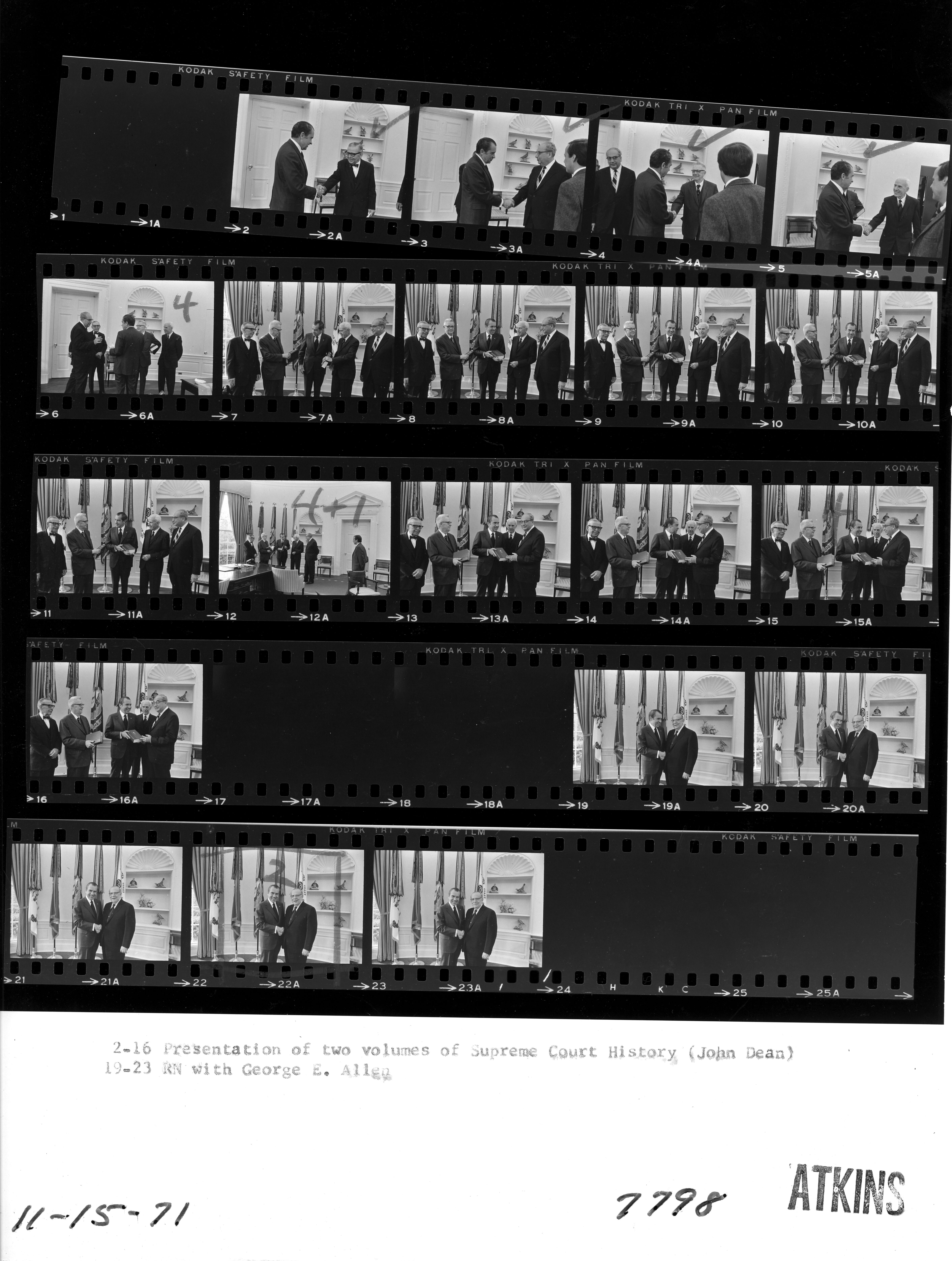
- Frame(s): WHPO-7798-02-16, President Nixon receiving copies of the first two volumes of a multi-volume history of the Supreme Court from Carl M. Loeb University Professor at Harvard University Paul Freund, Professor Emeritus of Legal History at Columbia University School of Law Julius Goebel, Jr., Librarian of Congress L. Quincy Mumford, and Professor Emeritus of Law at the Harvard Law SchoolCharles Fairman. 11/15/1971, Washington, D.C. White House, Oval Office. President Nixon, Paul Freund, Julius Goebel, Jr., L. Quincy Mumford, Charles Fairman.
- Frame(s): WHPO-7798-19-23, President Nixon standing with George E. Allen, author of "Presidents Who Have Known Me". 11/15/1971, Washington, D.C. White House, Oval Office. President Nixon, George E. Allen.
Roll WHPO-7800 Photographer: Atkins, Oliver | Color or B&W: B&W
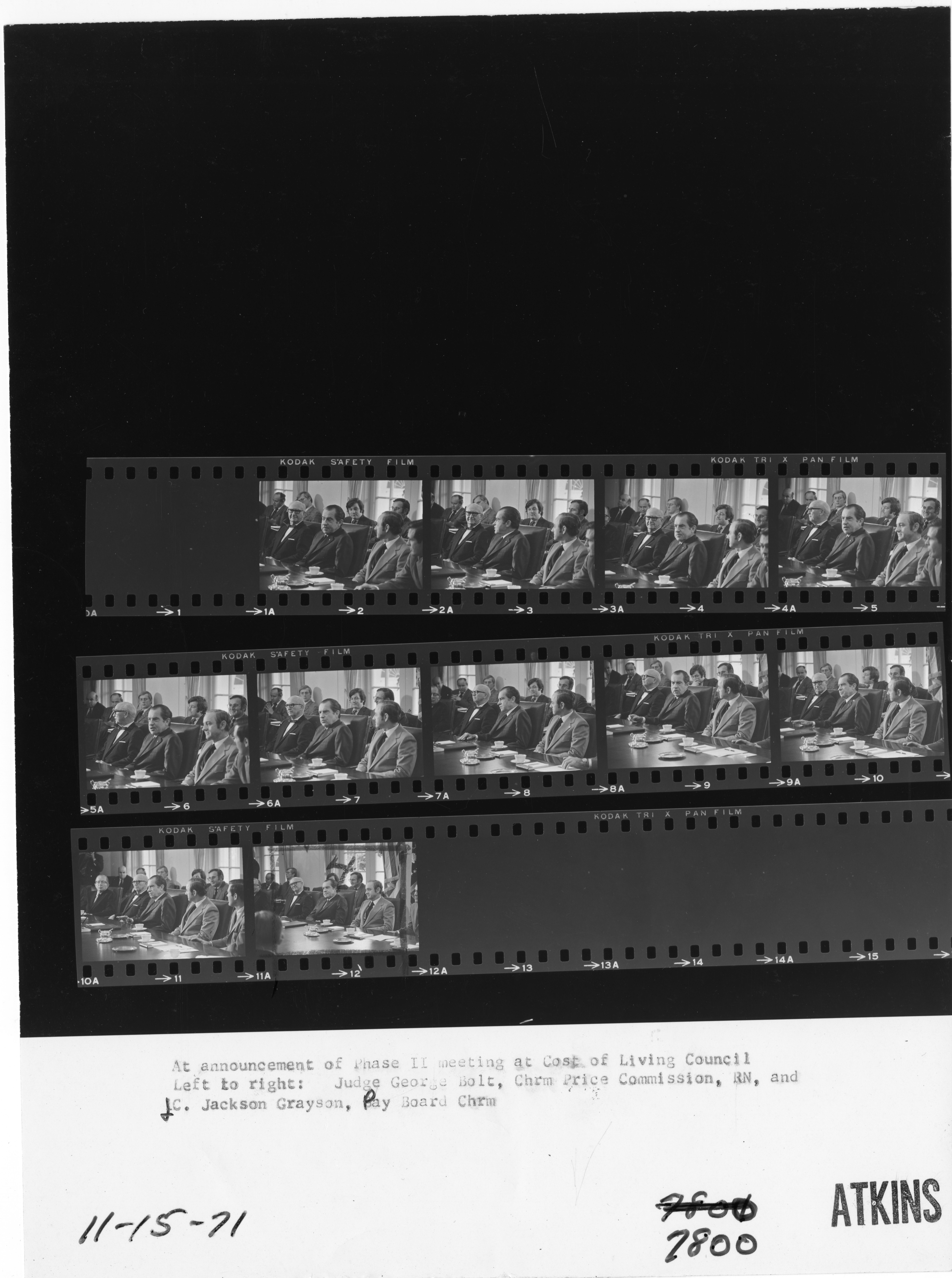
- Frame(s): WHPO-7800-01A-11A, President Nixon sitting with members of the Cost of Living Council at announcement of Phase II meeting, including Judge George Boldt, Chairman of the Price Commission, and Jackson Grayson, Chairman of the Pay Board. 11/15/1971, Washington, D.C. White House, Cabinet Room. President Nixon, C. Jackson Grayson, George Boldt, Arthur Burns, Cost of Living Council members (including Richard "Dick" Cheney).
Roll WHPO-7801 Photographer: Atkins, Oliver | Color or B&W: B&W
- Frame(s): WHPO-7801-03A, President Nixon greeting Chairman of the Pay Board Jackson Grayson, Chairman of the Price Commission Judge George Boldt, and Donald Rumsfeld. 11/15/1971, Washington, D.C. White House, Oval Office. President Nixon, C. Jackson Grayson, George Boldt, Rumsfeld.
- Frame(s): WHPO-7801-04A-06A, President Nixon sitting with Chairman of the Pay Board Jackson Grayson, Chairman of the Price Commission Judge George Boldt, and Donald Rumsfeld. 11/15/1971, Washington, D.C. White House, Oval Office. President Nixon, C. Jackson Grayson, George Boldt, Rumsfeld.
Roll WHPO-7802 Photographer: Knudsen, Robert L. | Color or B&W: B&W
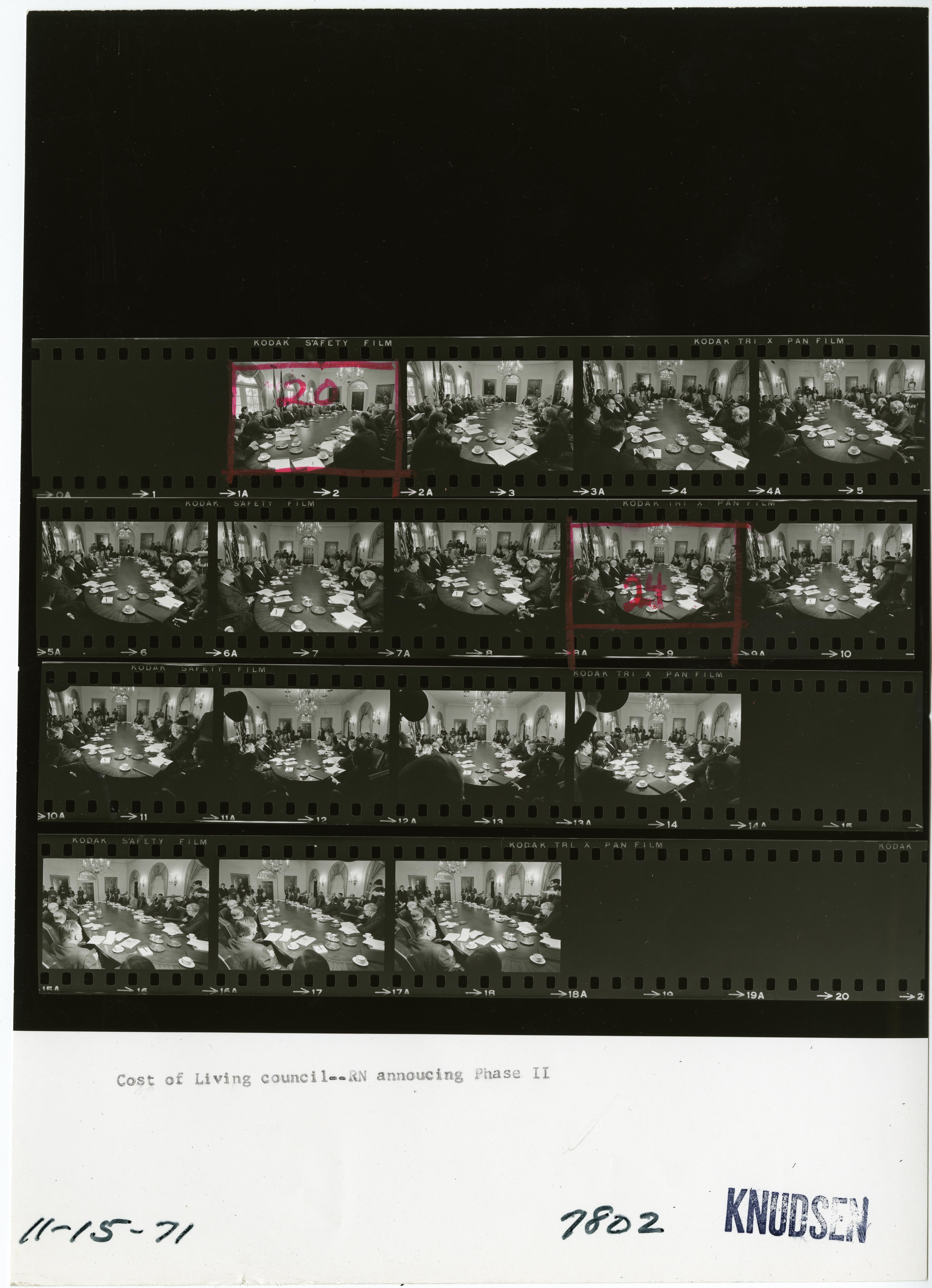
- Frame(s): WHPO-7802-01A-17A, President Nixon meeting with the Cost of Living Council about the economy, announcing Phase II. 11/15/1971, Washington, D.C. White House, Cabinet Room. President Nixon, Cost of Living Council members, including Donald Rumsfeld and Richard (Dick) Cheney, Secretary John Connally, Paul Mc Cracken, Arthur Burns, J. Philip Campbell, Secretary Maurice Stans, Secretary James Hodgson, Secretary George Romney, George Shultz, Mrs. Virginia Knauer, General George Lincoln, Herb Stein, Peter Flanigan, Joe Mullaney, Earl Rhode, Al Abrahams, Marvin Kosters, Joe Malaga, Richard Alfultis, William Greener, Under Secretary Lynn, Under Secretary Laurence Silberman, Under Secretary Donald Paarlberg, J. Charles Partee, Jackson Grayson.
- Frame(s): WHPO-7802-09, President Nixon meeting with the Cost of Living Council about the economy, announcing Phase II. 11/15/1971, Washington, D.C. White House, Cabinet Room. President Nixon, Cost of Living Council members, including Donald Rumsfeld and Richard (Dick) Cheney, Secretary John Connally, Paul Mc Cracken, Arthur Burns, J. Philip Campbell, Secretary Maurice Stans, Secretary James Hodgson, Secretary George Romney, George Shultz, Mrs. Virginia Knauer, General George Lincoln, Herb Stein, Peter Flanigan, Joe Mullaney, Earl Rhode, Al Abrahams, Marvin Kosters, Joe Malaga, Richard Alfultis, William Greener, Under Secretary Lynn, Under Secretary Laurence Silberman, Under Secretary Donald Paarlberg, J. Charles Partee, Jackson Grayson.
Roll WHPO-7803 Photographer: Atkins, Oliver | Color or B&W: B&W
- Frame(s): WHPO-7803-, Secretary of Transportation John Volpe addressing the Cabinet on the Transpo exhibition. 11/15/1971, Washington, D.C. White House, Cabinet Room. John Volpe, Cabinet members, aides.
Roll WHPO-7804 Photographer: Schumaker, Byron | Color or B&W: B&W
- Frame(s): WHPO-7804-01-04, Julie Nixon Eisenhower with a child. 11/15/1971, Cleveland, Ohio Case Western Reserve University, Mental Retardation Center. Julie Eisenhower, child.
Roll WHPO-7805 Photographer: Schumaker, Byron | Color or B&W: B&W
- Frame(s): WHPO-7805-02A-05A, Julie Eisenhower on a bus with adults and children. 11/15/1971, Cleveland, Ohio Case Western Reserve University, bus. Julie Eisenhower, children, adults.
- Frame(s): WHPO-7805-06A-31A, Julie Eisenhower interacting with adults and children at the Mental Retardation Center. 11/15/1971, Cleveland, Ohio Case Western Reserve University, Mental Retardation Center. Julie Eisenhower, children, adults.
- Frame(s): WHPO-7805-32A-35A, Julie Eisenhower sitting and talking with unidentified adults. 11/15/1971, Cleveland, Ohio unknown. Julie Eisenhower, adults.
Roll WHPO-7806 Photographer: Atkins, Oliver | Color or B&W: B&W
- Frame(s): WHPO-7806-02A-03A, President Nixon shaking hands with Sultan Mohammad Khan, Secretary of the Ministry of Foreign Affairs of Pakistan, as Henry Kissinger watches. 11/15/1971, Washington, D.C. White House, Oval Office. President Nixon, Mohammad Khan, Henry Kissinger.
- Frame(s): WHPO-7806-06A-10A, President Nixon meeting to discuss Secretary of Commerce Maurice Stans' proposed trip to the USSR with William Rogers, Brigade General Alexander Haig, and Stans. 11/15/1971, Washington, D.C. White House, Oval Office. President Nixon, William Rogers, Alexander Haig, Maurice H. Stans.
Roll WHPO-7808 Photographer: Schumaker, Byron | Color or B&W: Color
- Frame(s): WHPO-7808-01A-03A, Julie Eisenhower with an unidentified couple and their baby. 11/15/1971, Washington, D.C. White House, East Sitting Hall. Julie Eisenhower, unidentified couple, infant.
- Frame(s): WHPO-7808-04A-06A, Julie Eisenhower with an unidentified couple and their baby. 11/15/1971, Washington, D.C. White House, Lincoln Bedroom. Julie Eisenhower, unidentified couple, infant.
- Frame(s): WHPO-7808-07A-20A, Julie Eisenhower touring the Mental Retardation Center. 11/15/1971, Cleveland, Ohio Case Western Reserve University, Mental Retardation Center. Julie Eisenhower, unidentified children, adults.
- Frame(s): WHPO-7808-21, Julie Eisenhower visiting with the children and staff at the Mental Retardation Center in Cleveland. 11/15/1971, Cleveland, Ohio unknown. Julie Eisenhower, unidentified children, adults.
- Frame(s): WHPO-7808-22-30, Julie Eisenhower being interviewed in a yellow room with red drapes. 11/15/1971, Cleveland, Ohio unknown. Julie Eisenhower, unidentified children, adults.
- Frame(s): WHPO-7808-28, Julie Nixon Eisenhower being interviewed in a yellow room with red drapes. 11/15/1971, Cleveland, Ohio unknown. Julie Nixon Eisenhower.
The White House Communications Agency Sound Recordings Collection contains public statements that took place between 1969 and 1974. Visit the finding aid to learn more.
P - Formal Presidential Remarks
- WHCA-SR-P-711113
Remarks by President Nixon to Cost of Living Council with JC. (11/15/1971)
Runtime: 4:54
Original Format: 1/4-inch reel-to-reel audiotape. Original source type: Original.
The White House Communications Agency Videotape Collection contains “off-the-air” recordings of televised programs produced between 1968 and 1974. Visit the finding aid to learn more.
- WHCA-4803
"Today" Show excerpts. the plight of POW's and MIA's (Vietnam Prisoner of War and Missing in Action) Yul Brynner, economist John Kenneth Galbraith, Flying Burrito Brothers.
Group W Productions
Runtime: 0:30 - WHCA-4804
"Festival at Ford's Theatre". Mr. McLaughlin.
Metromedia
Runtime: 01:00:14 - WHCA-4813
Weekly News Summary, Tape I.
ALL NETWORKS
Runtime: 1:30
21. Reasoner/Brannigan: People's Republic of China takes a United Nations (U.N.) seat. Time Code Start: 50:38. Keywords: organization of nations, intergovernmental alliance, People's Republic of China, admissions. Network: ABC.
22. Tuckner: Chinese prisoner may be released. Time Code Start: 53:20. Keywords: People's Republic of China, Vietnam Prisoner of War. Network: ABC.
23. Smith: Economic notes. Time Code Start: 55:55. Keywords: economy, economics, budgets, finances, recession, inflation, money, wages, costs, unemployment, prices, reports. Network: ABC.
24. Jarriel/Farmer: Secretary Connally and President Nixon comment on Phase II; AFL-CIO President George Meany comments. Time Code Start: 57:18. Keywords: leaders, labor, unions, American Federation of Labor, Congress of Industrial Organizations, cabinet, advisors, wage and price controls, freezes, prices, costs, increases, decreases, economy, economics, budgets, finances, recession, inflation, money. Network: ABC.
25. Smith/Kincaid: Foreign aid; Supreme Court nominee Rehnquist, opposition to appointment. Time Code Start: 61:38. Keywords: financial aid, funding, law officials, judges, justices, courts, trials, investigations, appointments. Network: ABC.
26. Smith: Commentary on foreign aid. Time Code Start: 65:50. Keywords: bills, laws, financial aid, funding. Network: ABC.
27. Chancellor/Levine: Beginning of Phase II very gloomy (President Nixon and Connally). Time Code Start: 67:35. Keywords: Presidents, wage and price controls, freezes, prices, costs, increases, decreases, economy, economics, budgets, finances, recession, inflation, money. Network: NBC.
28. Chancellor/Frederick: United Nations (U.N.) welcomes People's Republic of China (Ambassador George Bush). Time Code Start: 70:39. Keywords: organization of nations, intergovernmental alliance, People's Republic of China, admissions. Network: NBC.
29. Chancellor: Thomas Jolley wants citizenship back after renouncing it to keep out of Vietnam. Time Code Start: 73:25. Keywords: Vietnam War. Network: NBC.
30. Chancellor/Saarinen: Resumption of SALT talks in Vienna, Austria [Strategic Arms Limitation Talks]. Time Code Start: 75:44. Keywords: SALT, S.A.L.T., Strategic Arms Limitation Talks, Russia, Soviet Union, USSR, Cold War, détente. Network: NBC.
31. Cronkite/Hottelet: United Nations (U.N.) welcomes People's Republic of China (Ambassador George Bush). Time Code Start: 77:42. Keywords: organization of nations, intergovernmental alliance, People's Republic of China, admissions. Network: CBS.
32. Cronkite/Rather: AFL-CIO President George Meany attacks President Nixon's political tactics; auto makers want to increase prices; President Nixon comments on Phase I success and Phase II wishes. Time Code Start: 80:30. Keywords: leaders, labor, unions, American Federation of Labor, Congress of Industrial Organizations, automobiles, cars, manufacturing, wage and price controls, freezes, prices, costs, increases. Network: CBS.
33. Cronkite: Balance of payments records record deficit. Time Code Start: 83:40. Keywords: economy, economics, budgets, finances, recession, inflation, money, wages, costs, employment, employees, salaries, salary, payments, freezes, controls. Network: CBS.
34. Cronkite: Former President Lyndon B. Johnson (LBJ) warns against isolationism at New York University (NYU) Business College. Time Code Start: 84:05. Keywords: Presidents, speeches, politics, education, colleges, universities. Network: CBS.
35. Sevareid: Commentary on former President Johnson (LBJ) speech at NYU. Time Code Start: 86:24. Keywords: Presidents, speeches, colleges, universities. Network: CBS.
Context (External Sources)
The Vanderbilt Television News Archive is the world's most extensive and complete archive of television news. They have been recording, preserving and providing access to television news broadcasts of the national networks since August 5, 1968.
Wikipedia is a free encyclopedia that anyone can edit.