

Introduction
This almanac page for Friday, May 18, 1973, pulls together various records created by the federal government and links to additional resources which can provide context about the events of the day.
Previous Date: Thursday, May 17, 1973
Next Date: Saturday, May 19, 1973
Schedule and Public Documents
The Daily Diary files represent a consolidated record of the President's activities. Visit the finding aid to learn more.
The President's day began at The White House - Washington, D. C.
The Weekly Compilation of Presidential Documents made available transcripts of the President's news conferences; messages to Congress; public speeches, remarks, and statements; and other Presidential materials released by the White House.
Digitized versions can be found at HathiTrust.
Each Public Papers of the Presidents volume contains the papers and speeches of the President of the United States that were issued by the White House Office of the Press Secretary during the time period specified by the volume. The material is presented in chronological order, and the dates shown in the headings are the dates of the documents or events. In instances when the release date differs from the date of the document itself, that fact is shown in the text note.
To ensure accuracy, remarks have been checked against audio recordings (when available) and signed documents have been checked against the original, unless otherwise noted. Editors have provided text notes and cross references for purposes of identification or clarity.
The Federal Register is the official daily publication for rules, proposed rules, and notices of federal agencies and organizations, as well as executive orders and other Presidential documents.
Archival Holdings
Any selection of archival documents will necessarily be partial. You should use the documents and folders identified below as a starting place, but consult the linked collection finding aids and folder title lists and the collections themselves for context. Many documents to be found this way do not lend themselves to association with specific dates, but are essential to a complete understanding of the material.
Selective document listing
President's Office Files
The President's Office Files consists of materials drawn together by the Special Files Unit from several administrative subdivisions within the White House Office. It is the handwriting and sensitive papers sent to the Staff Secretary that now comprise much of the President's Office Files. Visit the finding aid to learn more.
- News Summaries, Unmarked News Summaries, Box 56, News Summaries - May 17-30, 1973 [2 of 8] [Note: Due to the way News Summary products were compiled, you should also consult nearby days for potentially relevant materials.]
- News Summary, May 18, 1973, (Thursday nets, wires, columns)
The National Archives Catalog is the online portal to the records held at the National Archives, and information about those records. It is the main way of describing our holdings and also provides access to electronic records and digitized versions of our holdings.
The Catalog searches across multiple National Archives resources at once, including archival descriptions, digitized and electronic records, authority records, and web pages from Archives.gov and the Presidential Libraries. The Catalog also allows users to contribute to digitized historical records through tagging and transcription.
Nixon Library Holdings
All National Archives Units
National Security Documents
The President's Daily Brief is the primary vehicle for summarizing the day-to-day sensitive intelligence and analysis, as well as late-breaking reports, for the White House on current and future national security issues. Read "The President's Daily Brief: Delivering Intelligence to Nixon and Ford" to learn more.
The Foreign Relations of the United States series presents the official documentary historical record of major U.S. foreign policy decisions and significant diplomatic activity. Visit the State Department website for more information.
Vol. X, Vietnam, January 1973-July 1975
Neither War nor Peace, January 27-June 15, 1973
50. Message From the Acting Ambassador to Vietnam (Whitehouse) to the President’s Assistant for National Security Affairs (Kissinger) in Paris, Saigon, May 18, 1973, 1557Z
Source: National Archives, Nixon Presidential Materials, NSC Files, Kissinger Office Files, Box 36, HAK Trip Files, Paris Trip, May 1973, TOHAK 61–125. Secret; Sensitive; Flash. Sent to the White House for transmittal to Kissinger.
51. Message From the President’s Assistant for National Security Affairs (Kissinger) to the President’s Deputy Assistant for National Security Affairs (Scowcroft), Paris, May 18, 1973, 2200Z
Source: National Archives, Nixon Presidential Materials, NSC Files, Kissinger Office Files, Box 35, HAK Trip Files, Paris Trip, May 1973, HAKTO 1–46. Top Secret; Sensitive; Exclusively Eyes Only.
Vol. XVIII, China, 1973-1976
Kissinger's Visits to Beijing and the Establishment of the Liaison Offices, January 1973-May 1973
33. Memorandum of Conversation, Beijing, May 18, 1973
Source: National Archives, Nixon Presidential Materials, NSC Files, Box 527, Country Files, Far East, People’s Republic of China, Vol. 7, May, 1973–Jul 9, 1973. Secret; Nodis. The meeting took place in the Great Hall of People. The USLO sent this memorandum of conversation as an attachment to airgram 9 from Beijing, May 21. The USLO also sent a cable reporting the substance of this conversation. (Telegram 121 from Beijing, May 19, 0500Z; ibid.)
Vol. XXV, Arab-Israeli Crisis and War, 1973
Arab-Israeli Crisis and War, 1973
62. Backchannel Message From the President’s Assistant for National Security Affairs (Kissinger) to Jordanian King Hussein, Washington, May 18, 1973
Source: National Archives, Nixon Presidential Materials, NSC Files, Kissinger Office Files, Box 137, Country Files, Middle East, Jordan/Rifai, January 3, 1973. Top Secret; Sensitive; Exclusively Eyes Only.
Vol. XXXI, Foreign Economic Policy, 1973-1976
Negotiating the New Rules, May 1973-June 1975
38. Memorandum of Conversation, Paris, May 18, 1973, 11 a.m.
Source: National Archives, Nixon Presidential Materials, NSC Files, Kissinger Office Files, Box 56, Country Files, Europe, French Memcons (originals) January–May 1973. Top Secret; Sensitive; Exclusively Eyes Only. The meeting took place in President Pompidou’s office at the Elysée Palace. Kissinger was in Paris to discuss the implementation of the January 1973 Paris Peace Accord with DRV representatives. He also met with Egyptian National Security Adviser Hafez Ismail.
Vol. XXXV, National Security Policy, 1973-1976
National Security Policy
15. Memorandum of Conversation, Washington, May 18, 1973, 8:30 a.m.
Source: National Archives, NixonPresidential Materials, NSC Files, Box 1026, Presidential/HAK MemCons, MemCons—Presidential/HAK, January–March 1973. Secret; Nodis. All brackets, except for those added by the editor to indicate omissions in the text, are in the original. The meeting was held in the Cabinet Room of the White House. The memorandum of conversation incorrectly lists the date of the meeting as March 18. It was actually held on May 18, according to the President’s Daily Diary. (Ibid., White House Central Files)
Vol. XXXVIII, Part 1, Foundations of Foreign Policy, 1973-1976
Foundations of Foreign Policy, 1973-1976
11. Memorandum of Conversation, Washington, May 18, 1973, 8:30 a.m.
Source: National Archives, Nixon Presidential Materials, NSC Files, Box 1026, Presidential/HAK MemCons, MemCons—Jan.–Mar. 1973 Presidential/HAK. Secret; Nodis. According to the President’s Daily Diary, the meeting took place in the Cabinet Room at the White House from 8:38 until 10:11 a.m. (Ibid., White House Central Files) The memorandum is mistakenly dated March 18. Scowcroft transmitted a summary of the meeting to Kissinger in Paris, who was engaged in discussions with Pompidou prior to Nixon’s meeting with the French leader in late May. (WH31298/Tohak 81, May 18; ibid., Kissinger Office Files, Box 35, HAK Trip Files, Paris Trip May 17, 1973—Tohak 1–100 [1 of 2])
Vol. XLII, Vietnam: The Kissinger-Le Duc Tho Negotiations
Attempting To Implement the Accords, February 1973-December 1973
58. Memorandum of Conversation, Paris, May 18, 1973, 3-6:45 p.m.
Source: National Archives, Nixon Presidential Materials, NSC Files, Kissinger Office Files, Box 114, Country Files, Far East, Vietnam, Paris Memcons, May 17–23, 1973. Top Secret; Sensitive; Exclusively Eyes Only. The meeting was held at 108 Avenue du Général Leclerc, Gif-sur-Yvette. All brackets are in the original. Tab A is attached but not printed.
Kissinger reported to the President later the same day, addressing both the tone and substance of the meeting. Regarding tone, he wrote:
“Although outwardly pleasant in his general demeanor towards us today, Le Duc Tho turned tough and insolent in his presentation of DRV proposals for remedial measures for implementation of Paris Agreement. His proposals amounted to a renegotiation of significant portions of the Agreement and protocols and were reminiscent of attitudes he displayed last December.”
Regarding substance, several topics were discussed, prominently among them the U.S. role in, to use a frequent phrase of Le Duc Tho, “healing the wounds of war,” which Kissinger called “economic aid.” On this he told Nixon that “it is quite clear that they want it badly, but as yet unclear what, if anything, they are prepared to pay for it. This would seem to be major card we have to play. However, I did, once again, warn of serious military consequences if they fail to reach satisfactory understandings with us.”
The cease-fire, which was supposed to have gone into effect immediately after the Accords were signed, had yet to be achieved. On this, Kissinger told the President that Le Duc Tho had “suggested new ceasefire arrangement, which would result in GVN withdrawal from all areas it reclaimed after Communist land-grab immediately following signature of Agreement last January.” (Foreign Relations, 1969–1976, vol. X, Vietnam, January 1973–July 1975, Document 51)
Vol. E-11, Part 2, Documents on South America, 1973-1976
Brazil
85. Telegram 95947 From the Department of State to the Embassy in Brazil, Washington, May 18, 1973, 2137Z
Summary: The Department informed the Embassy that, given the rapid economic development of Brazil and con
[Page 242]
gressional hostility to indefinitely continuing assistance programs, bilateral assistance (with the exception of narcotics and family-planning assistance) would be phased out.
Source: National Archives, RG 59, Central Files 1970–73, POL 1 BRAZ–US. Confidential; Immediate. Repeated to Rio de Janeiro. Drafted by Lippincott, cleared by Low and Kleine, approved by Crimmins. The FY 1974–1975 CASP submission, February 17, is ibid. On May 10, the Embassy reported that it had “learned informally” that the IG was planning on phasing out U.S. Government economic assistance to Brazil and wanted confirmation from the Department. (Telegram 2757 from Brasília, ibid.) The final version of the CASP has not been found.
Vol. E-12, Documents on East and Southeast Asia, 1973-1976
Thailand and Burma
371. Memorandum From Acting Secretary of State Rush to the President’s Assistant for National Security Affairs (Kissinger), Washington, May 18, 1973., Washington, May 18, 1973
Rush submitted the study on U.S. counterinsurgency support for Thailand written in response to NSSM 159.
Source: National Archives, Nixon Presidential Materials, NSC Institutional Files (H-Files), Box H–193, NSSM 159. Secret; Nodis. The paper, dated March 30, is attached but not published. For NSSM 159, see Foreign Relations, 1969–1976, Vol. XX, Southeast Asia, 1969–1972, Document 174.
Vol. E-14, Part 1, Documents on the United Nations, 1973-1976
United Nations Affairs
7. Telegram 1900 From the Mission to the United Nations to the Department of State, May 18, 1973, 2339Z., May 18, 1973, 2339Z
Scali and Waldhiem discussed the general tenor of U.S.–U.N. relations.
Source: National Archives, RG 59, Central Foreign Policy Files. Confidential; Exdis.
Vol. E-15, Part 1, Documents on Eastern Europe, 1973-1976
Yugoslavia
59. Memorandum From the Chairman of the National Security Council Under Secretaries Committee (Rush) to President Nixon, Washington, May 18, 1973., Washington, May 18, 1973
The NSC Under Secretaries submitted a report to the President on the current status of U.S.-Yugoslav relations and consultations, and exchanges and cooperation in economic, scientific, technical and military fields.
Source: National Archives, Nixon Presidential Materials, NSC Files, Box 734, Country Files—Europe—Yugoslavia. Secret. The full report is attached but not published.
The Kissinger telephone conversation transcripts consist of approximately 20,000 pages of transcripts of Kissinger’s telephone conversations during his tenure as Assistant to the President for National Security Affairs (1969-1974) and Secretary of State (1973-1974) during the administration of President Richard Nixon. Visit the finding aid for more information.
Digitized versions can be found in the National Archives Catalog.
Audiovisual Holdings
Visit the White House Tapes finding aid to learn about the taping system's operation and archival processing.
Cabinet Room
Old Executive Office Building
- 437-10; 12:34 p.m. - 12:35 p.m.; Nixon, Richard M. (President); Bull, Stephen B.
- 437-11; 12:49 p.m. - 1:52 p.m.; Nixon, Richard M. (President); Haldeman, H. R. ("Bob"); [Unknown person(s)]
- 437-12; 1:55 p.m. - 2:55 p.m.; Nixon, Richard M. (President); Haig, Alexander M., Jr.; Ziegler, Ronald L.
- 437-13; Unknown between 2:55 p.m. & 2:59 p.m.; Nixon, Richard M. (President); Sanchez, Manolo
- 437-14; 2:59 p.m. - 3:00 p.m.; Nixon, Richard M. (President); Bull, Stephen B.
- 437-15; Unknown between 3:00 p.m. & 3:35 p.m.; Nixon, Richard M. (President); Sanchez, Manolo
- 437-16; Unknown between 3:00 p.m. & 3:35 p.m.; Nixon, Richard M. (President); Sanchez, Manolo
- 437-17; Unknown between 3:00 p.m. & 3:35 p.m.; Nixon, Richard M. (President); Haig, Alexander M., Jr.
- 437-18; Unknown between 3:00 p.m. & 3:35 p.m.; Nixon, Richard M. (President); Haig, Alexander M., Jr.
- 437-19; 3:35 p.m. - 4:34 p.m.; Nixon, Richard M. (President); Haldeman, H. R. ("Bob")
- 437-20; Unknown between 4:34 p.m. & 5:00 p.m.; Nixon, Richard M. (President); Haig, Alexander M., Jr.
- 437-21; Unknown between 4:34 p.m. & 5:00 p.m.; Nixon, Richard M. (President); Sanchez, Manolo
- 437-22; Unknown between 4:34 p.m. & 5:00 p.m.; Nixon, Richard M. (President); [Unknown person(s)]
- 437-23; Unknown between 4:34 p.m. & 5:00 p.m.; Nixon, Richard M. (President); White House operator
- 437-24; Unknown between 4:34 p.m. & 5:00 p.m.; Nixon, Richard M. (President); Sanchez, Manolo
- 437-25; 5:00 p.m. - 5:01 p.m.; Nixon, Richard M. (President); Bull, Stephen B.
- 437-26; 5:15 p.m. - 5:33 p.m.; Nixon, Richard M. (President); Haig, Alexander M., Jr.
- 437-27; Unknown between 5:33 p.m. & 5:34 p.m.; Nixon, Richard M. (President); Rebozo, Charles G. ("Bebe"); Sanchez, Manolo; [Unknown person(s)]
- 437-28; Unknown between 12:29 p.m. & 12:34 p.m.; Nixon, Richard M. (President); [Unknown person(s)]
Oval Office
- 922-1; Unknown between 8:18 a.m. & 8:38 a.m.; Nixon, Richard M. (President); [Unknown person(s)]
- 922-2; Unknown between 8:18 a.m. & 8:38 a.m.; Nixon, Richard M. (President); [Unknown person(s)]
- 922-3; Unknown between 10:11 a.m. & 10:15 a.m.; Nixon, Richard M. (President); Bull, Stephen B.
- 922-4; Unknown between 10:11 a.m. & 10:15 a.m.; Nixon, Richard M. (President); Bull, Stephen B.
- 922-5; Unknown between 10:11 a.m. & 10:15 a.m.; Nixon, Richard M. (President); Bull, Stephen B.
- 922-6; 10:15 a.m. - 10:40 a.m.; Nixon, Richard M. (President); Finch, Robert H.
- 922-7; 10:45 a.m. - 11:46 a.m.; Nixon, Richard M. (President); Haig, Alexander M., Jr.; Ziegler, Ronald L.; [Unknown person(s)]
- 922-8; Unknown between 11:46 a.m. & 11:56 a.m.; Nixon, Richard M. (President); [Unknown person(s)]
- 922-9; Unknown between 11:46 a.m. & 11:56 a.m.; Nixon, Richard M. (President); Sanchez, Manolo
- 922-10; Unknown between 11:46 a.m. & 11:56 a.m.; Nixon, Richard M. (President); [Unknown person(s)]
- 922-11; 11:56 a.m. - 11:58 a.m.; Nixon, Richard M. (President); Sanchez, Phillip V.; Armstrong, Anne L.; White House photographer
- 922-12; 11:58 a.m. - 11:58 a.m.; Nixon, Richard M. (President); [Unknown person(s)]
- 922-13; 12:02 p.m. - 12:14 p.m.; Nixon, Richard M. (President); Casey, Edmund C.; Cavanaugh, James H.; Scott, Stanley S.; White House photographer
- 922-14; 12:15 p.m. - 12:27 p.m.; Nixon, Richard M. (President); Haig, Alexander M., Jr.
- 922-15; Unknown between 8:18 a.m. & 8:38 a.m.; [Unknown person(s)]
- 922-16; Unknown between 12:27 p.m. & 11:59 p.m.; [Unknown person(s)]
White House Telephone
- 46-114; Unknown between 4:34 p.m. & 5:00 p.m.; Nixon, Richard M. (President); White House operator
- 46-115; 5:00 p.m. - 5:01 p.m.; Nixon, Richard M. (President); Bull, Stephen B.
- 46-116; 8:49 p.m. - 9:06 p.m.; Nixon, Richard M. (President); Haig, Alexander M., Jr.
- 46-117; Unknown between 9:06 p.m. & 9:25 p.m.; Nixon, Richard M. (President); White House operator
- 46-118; 9:25 p.m. - 9:28 p.m.; Nixon, Richard M. (President); Haig, Alexander M., Jr.
The White House Photo Office collection consists of photographic coverage of President Richard Nixon meeting with prominent social, political, and cultural personalities; speaking engagements and news conferences of the President and various high-ranking members of the White House staff and Cabinet; Presidential domestic and foreign travel, including Presidential vacations; social events and entertainment involving the First Family, including entertainers present; official portraits of the President, First Family, and high-ranking members of the Nixon administration; the 1969 and 1973 Inaugurals; the President’s 1972 Presidential election campaign appearances (including speeches) and other official activities of the White House staff and the President’s Cabinet from January 20, 1969 until August 9, 1974 at the White House and the Old Executive Office Building; other locations in Washington, DC, such as The Mall; and the Presidential retreats in Camp David, Maryland, Key Biscayne, Florida, and San Clemente, California. Visit the finding aid to learn more.
Roll WHPO-E0813 Photographer: Atkins, Oliver | Color or B&W: B&W
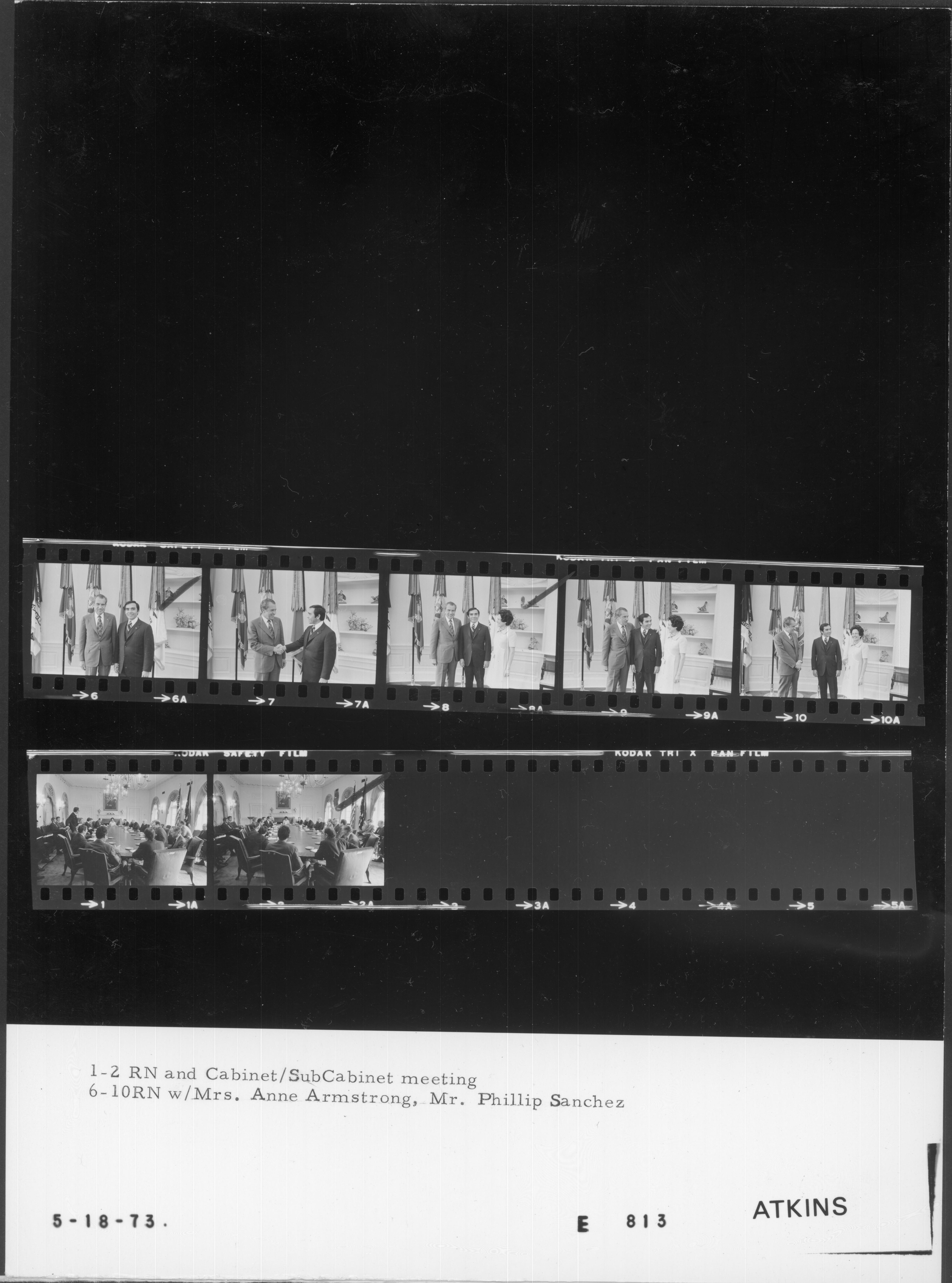
- Frame(s): WHPO-E0813-01-02, President Nixon in Cabinet and Sub-Cabinet meeting. 5/18/1973, Washington, D.C. White House.
- Frame(s): WHPO-E0813-06-10, President Nixon with Mrs. Anne Armstrong and Phillip Sanchez. 5/18/1973, Washington, D.C. White House.
Roll WHPO-E0814 Photographer: Knudsen, Robert L. | Color or B&W: B&W
- Frame(s): WHPO-E0814-, President Nixon meeting with Dr. Casey and Stan Scott. 5/18/1973, Washington, D.C. White House.
Roll WHPO-E0815 Photographer: Kightlinger, Jack | Color or B&W: B&W
- Frame(s): WHPO-E0815-, Ethel Payne interviewing John Ficklin. 5/18/1973, Washington, D.C. White House.
The White House Communications Agency Sound Recordings Collection contains public statements that took place between 1969 and 1974. Visit the finding aid to learn more.
K - Informal Presidential Remarks
- WHCA-SR-K-066
Photo opportunity/Dr. Edmund C. Casey-Oval Office. (5/18/1973)
Runtime: 12:02
Original Format: 1/4-inch reel-to-reel audiotape. Original source type: Original.
S - White House Press Office Briefings (continuation of the L-series)
- WHCA-SR-S-113
Press briefing by Ronald Ziegler. (5/18/1973, [not listed])
Runtime: 43:00:00
Keywords: Press conferences, news conferences, interviews, media, press secretary
Production credits: Audio feed supplied by WHCA; Recorded by RS (initials of WHCA engineer)
Original Format: 1/4-inch reel-to-reel audiotape. Original source type: Original.
V - Senate Select Committee on Watergate Radio Broadcasts
- WHCA-SR-V-003
Proceedings of the Senate Watergate Committee Hearings, morning session. (5/18/1973, United States Senate, Washington DC)
Keywords: Watergate, Select Committee on Presidential Campaign Activities
Original Format: 1/4-inch reel-to-reel audiotape. Original source type: Original. - WHCA-SR-V-004
Proceedings of the Senate Watergate Committee Hearings, afternoon session. (5/18/1973, United States Senate, Washington DC)
Keywords: Watergate, Select Committee on Presidential Campaign Activities
Original Format: 1/4-inch reel-to-reel audiotape. Original source type: Original.
The White House Communications Agency Videotape Collection contains “off-the-air” recordings of televised programs produced between 1968 and 1974. Visit the finding aid to learn more.
- WHCA-6302
Weekly News Summary, Tape I.
ALL NETWORKS
Runtime: 00:31:52
1. Donaldson: McCord's testimony. Time Code Start: 01:13. Keywords: Watergate, Senate committee hearings, investigations, testimony, testify, cover-ups, break-in, burglary, theft, plumbers, scandals. Network: ABC.
2. Smith: John Cauldfield comments on McCord's testimony. Time Code Start: 07:52. Keywords: Watergate, Senate committee hearings, investigations, testimony, testify, cover-ups, break-in, burglary, theft, plumbers, scandals. Network: ABC.
3. Jarriel: White House reaction to McCord's testimony. Time Code Start: 08:56. Keywords: Presidents, statements, reactions, Watergate, Senate committee hearings, investigations, testimony, testify, cover-ups, break-in, burglary, theft, plumbers, scandals. Network: ABC.
4. Smith/Clark: Archibald Cox special prosecutor with Richardson. Time Code Start: 11:15. Keywords: law officials, attorneys, lawyers, Watergate, Senate committee hearings, investigations, testimony, testify, cover-ups, break-in, burglary, theft, plumbers, scandals. Network: ABC.
5. Reasoner/Farmer: British reaction to Watergate. Time Code Start: 13:50. Keywords: Watergate, Senate committee hearings, investigations, officials, testimony, testify, cover-ups, break-in, burglary, theft, plumbers, scandals, impeachment, resignations, reactions, Europe, public opinions, polls, approval ratings, Gallup poll, Harris poll. Network: ABC.
6. Smith/Miller: President Nixon pursues narcotics reforms with Percy. Time Code Start: 18:15. Keywords: Presidents, reforms, pharmaceuticals, medicines, drugs, drug abuse, narcotics, morphine, heroin, marijuana, alcoholism, addicts, addiction, prevention, programs, tests, testing. Network: ABC.
7. Smith: Commentary on Watergate and how to perform a Presidictomy easy. Time Code Start: 25:30. Keywords: pharmaceuticals, medicines, drugs, drug abuse, narcotics, morphine, heroin, marijuana, alcoholism, addicts, addiction, prevention, programs, tests, testing, impeachment, resignations. Network: ABC. - WHCA-6303
Weekly News Summary, Tape I.
ALL NETWORKS
Runtime: 1:00
1. Chancellor: McCord testifying at Senate Watergate hearings. Time Code Start: 00:32. Keywords: Watergate, Senate committee hearings, investigations, testimony, testify, cover-ups, break-in, burglary, theft, plumbers, scandals. Network: NBC.
2. Chancellor: John Caulfield comments on McCord testimony. Time Code Start: 07:42. Keywords: Watergate, Senate committee hearings, investigations, testimony, testify, cover-ups, break-in, burglary, theft, plumbers, scandals. Network: NBC.
3. Valeriani: White House comment on McCord testimony. Time Code Start: 09:14. Keywords: bugging, bugs, wiretapping, wire taps, surveillance, spying, recordings, Watergate, Senate committee hearings, investigations, testimony, testify, cover-ups, break-in, burglary, theft, plumbers, scandals. Network: NBC.
4. Chancellor: Testimony allegedly involving Mitchell. Time Code Start: 11:37. Keywords: cabinet, advisors, law officials, pharmaceuticals, medicines, drugs, drug abuse, narcotics, morphine, heroin, marijuana, alcoholism, addicts, addiction, prevention, programs, tests, testing. Network: NBC.
5. Tombs: Mrs. Martha Mitchell tells what she thinks of the hearings and President Nixon. Time Code Start: 13:45. Keywords: cabinet, advisors, families, wife, statements, Watergate, Senate committee hearings, investigations. Network: NBC.
6. Chancellor: Archibald Cox named special Watergate prosecutor. Time Code Start: 17:31. Keywords: lawyers, attorneys, law officials, Watergate, Senate committee hearings, investigations, testimony, testify, cover-ups, break-in, burglary, theft, plumbers, scandals, impeachment, resignations. Network: NBC.
7. Brinkley: Commentary on the effects of Watergate on government. Time Code Start: 25:02. Keywords: Watergate, Senate committee hearings, investigations, testimony, testify, cover-ups, break-in, burglary, theft, plumbers, scandals, impeachment, resignations. Network: NBC.
8. Cronkite/Schorr: McCord testifies at Watergate hearings. Time Code Start: 31:07. Keywords: Watergate, Senate committee hearings, investigations, testimony, testify, cover-ups, break-in, burglary, theft, plumbers, scandals. Network: CBS.
9. Cronkite: Caulfield reads a statement concerning McCord. Time Code Start: 39:38. Keywords: Watergate, Senate committee hearings, investigations, testimony, testify, cover-ups, break-in, burglary, theft, plumbers, scandals. Network: CBS.
10. Cronkite: Ziegler denies McCord's testimony. Time Code Start: 41:12. Keywords: Watergate, Senate committee hearings, investigations, testimony, testify, cover-ups, break-in, burglary, theft, plumbers, scandals, denials. Network: CBS.
11. Cronkite/Schieffer: Richardson selects Archibald Cox as prosecutor. Time Code Start: 42:19. Keywords: law officials, courts, trials, investigations, prosecutions, Watergate, hearings, burglary, impeachment, resignations, recordings. Network: CBS.
12. Cronkite: Archibald Cox pledges to do his best. Time Code Start: 43:57. Keywords: law officials, courts, trials, investigations, prosecutions, Watergate, hearings, burglary, impeachment, resignations, recordings. Network: CBS.
13. Mudd/Dunning: Indochina [Vietnam]. Time Code Start: 46:00. Keywords: Laos, Cambodia, Vietnam War. Network: CBS.
14. Mudd: Kissinger; Vietnamese negotiator Le Duc Tho talks. Time Code Start: 50:25. Keywords: diplomats, diplomacy, meetings, Paris Peace Talks, Vietnam War, treaty, treaties, negotiations. Network: CBS.
15. Mudd/Severied: Commentary on length of presidential term. Time Code Start: 55:08. Keywords: Presidents, term of office. Network: CBS. - WHCA-W-017
Proceedings of the Senate Watergate Committee Hearings. Testimony of Police officer Carl Shoffler; and testimony of James McCord (recording begins at 10:00 AM)
ALL NETWORKS
Runtime: 01:30:55 - WHCA-W-018
Proceedings of the Senate Watergate Committee Hearings. Testimony of James McCord (recording begins at 11:30 AM)
ALL NETWORKS
Runtime: 00:50:26 - WHCA-W-019
Proceedings of the Senate Watergate Committee Hearings. Testimony of James McCord (recording begins at 2:00 PM)
ALL NETWORKS
Runtime: 01:03:26 - WHCA-W-020
Proceedings of the Senate Watergate Committee Hearings. Testimony of James McCord (recording begins at 3:00 PM)
ALL NETWORKS
Runtime: 01:07:23 - WHCA-W-021
Proceedings of the Senate Watergate Committee Hearings. Testimony of Police officer Carl Shoffler; and testimony of James McCord (cut off at end) (recording begins at 10:00 AM) U.S. Senator Howard Baker (R-TN).
NBC
Runtime: 01:05:38 - WHCA-W-022
Proceedings of the Senate Watergate Committee Hearings. Testimony of James McCord continues (recording begins at 11:00 AM) FTN: U.S. Representative John Anderson (R-IL), U.S. Senator Bill Brock (R-TN); "I&A": members of popular music vocal group "The Fifth Dimension".
CBS, ABC
Runtime: 01:06:59 - WHCA-W-023
Proceedings of the Senate Watergate Committee Hearings. Testimony of James McCord continues, persistent questioning by Howard Baker and Talmadge (recording begins at 2:00 PM) First match played in the "Battle of the Sexes" tennis series features Bobby Riggs VS Margaret Court.
CBS
Runtime: 01:06:44 - WHCA-W-024
Proceedings of the Senate Watergate Committee Hearings. Testimony of James McCord (recording begins at 3:00 PM)
CBS
Runtime: 01:06:32 - WHCA-W-025
Proceedings of the Senate Watergate Committee Hearings. Testimony of James McCord (recording begins at 4:00 PM)
CBS
Runtime: 0:30 - WHCA-W-026
Proceedings of the Senate Watergate Committee Hearings. Testimony of James McCord (recording begins at 10:00 AM) Charles Dibona.
Undetermined
Runtime: 1:30 - WHCA-W-027
Proceedings of the Senate Watergate Committee Hearings; and "The Joey Bishop Show". Testimony of James McCord (recording begins at 11:30 AM) John W. Dean III, former counsel to the President; Walter Cronkite, "CBS Evening News" anchor.
CBS
Runtime: 01:06:32 - WHCA-W-028
Proceedings of the Senate Watergate Committee Hearings. Testimony of James McCord (recording begins at 2:00 PM)
ALL NETWORKS
Runtime: 01:05:00 - WHCA-W-029
Proceedings of the Senate Watergate Committee Hearings. Testimony of James McCord (recording begins at 3:00 PM)
ALL NETWORKS
Runtime: 01:06:04
Context (External Sources)
The Vanderbilt Television News Archive is the world's most extensive and complete archive of television news. They have been recording, preserving and providing access to television news broadcasts of the national networks since August 5, 1968.
Wikipedia is a free encyclopedia that anyone can edit.