

Introduction
This almanac page for Thursday, March 29, 1973, pulls together various records created by the federal government and links to additional resources which can provide context about the events of the day.
Previous Date: Wednesday, March 28, 1973
Next Date: Friday, March 30, 1973
Schedule and Public Documents
The Daily Diary files represent a consolidated record of the President's activities. Visit the finding aid to learn more.
The President's day began at The White House - Washington, D. C.
The Weekly Compilation of Presidential Documents made available transcripts of the President's news conferences; messages to Congress; public speeches, remarks, and statements; and other Presidential materials released by the White House.
Digitized versions can be found at HathiTrust.
Each Public Papers of the Presidents volume contains the papers and speeches of the President of the United States that were issued by the White House Office of the Press Secretary during the time period specified by the volume. The material is presented in chronological order, and the dates shown in the headings are the dates of the documents or events. In instances when the release date differs from the date of the document itself, that fact is shown in the text note.
To ensure accuracy, remarks have been checked against audio recordings (when available) and signed documents have been checked against the original, unless otherwise noted. Editors have provided text notes and cross references for purposes of identification or clarity.
The Federal Register is the official daily publication for rules, proposed rules, and notices of federal agencies and organizations, as well as executive orders and other Presidential documents.
The Congressional Record is the official daily record of the debates and proceedings of the U.S. Congress.
Archival Holdings
Any selection of archival documents will necessarily be partial. You should use the documents and folders identified below as a starting place, but consult the linked collection finding aids and folder title lists and the collections themselves for context. Many documents to be found this way do not lend themselves to association with specific dates, but are essential to a complete understanding of the material.
Selective document listing
President's Office Files
The President's Office Files consists of materials drawn together by the Special Files Unit from several administrative subdivisions within the White House Office. It is the handwriting and sensitive papers sent to the Staff Secretary that now comprise much of the President's Office Files. Visit the finding aid to learn more.
- News Summaries, Unmarked News Summaries, Box 54, News Summaries - Feb. & March 1973 [8 of 9] [Note: Due to the way News Summary products were compiled, you should also consult nearby days for potentially relevant materials.]
- The President's Address to the Nation, March 29, 1973
- News Summaries, Unmarked News Summaries, Box 54, News Summaries - Feb. & March 1973 [9 of 9]
- News Summary, March 29, 1973
President's Personal File
The President's Personal File is essentially a President's secretary's file, kept by Rose Mary Woods, personal secretary to the President, for two purposes: (1) preserving for posterity a collection of documents particularly close to the President, whether because he dictated or annotated them, or because of the importance of the correspondent or the event concerned and (2) giving appropriate attention–letters of gratitude, invitations to White House social events, and the like–to members and important friends and supporters of the Nixon administration. This generalization does not describe all the varied materials of a file group which is essentially a miscellany, but it does identify the reason for the existence of the file group's core. Visit the finding aid to learn more.
- President's Speech File
The H. R. Haldeman Diaries consists of seven handwritten diaries, 36 dictated diaries recorded as sound recordings, and two handwritten audio cassette tape subject logs. The diaries and logs reflect H. R. Haldeman’s candid personal record and reflections on events, issues, and people encountered during his service in the Nixon White House. As administrative assistant to the President and Chief of Staff, Haldeman attended and participated in public events and private meetings covering the entire scope of issues in which the Nixon White House engaged in during the years 1969-1973. Visit the finding aid to learn more.
- Transcript of diary entry (PDF)
Thursday, March 29.
The President spent the whole day working on preparation for his television speech tonight. I spent virtually the whole day on various Watergate matters, and did have to hit the President on a couple of points during the day, which he seemed to want to do.
Timmons talked with Branson, Baker's AA, last night regarding the recommendation by George Webster to Branson that Murray Chotiner be the White House contact. Branson had thought that was a bad idea, too, and he had done nothing about it. So Timmons suggested George Webster for the job and Branson said he would discuss this with Howard Baker.
He called Ed Gurney last night, to see if he would be willing to provide us with input as to what was going on at the committee so we'd have some reading of what we were up against. Gurney said the committee spent a great deal of time over secrecy and that he would play by the rules and expected others to also, which is a little absurd since the whole thing leaked in all the papers today. Bill tried a different approach by asking his views of Dean testifying and so on. He volunteered that things looked pretty bad for the White House, and that the President should take some kind of initiative on the issue, and Dean's appearance would be one way. Bill suspects that Gurney would be more open in person rather than talking over the phone, and he's going to try to get to him directly.
He also was going to watch the brown package switch business at the Senate newsstand today. He's disturbed, though, because the delivery service, the man on the Senate Judiciary Committee, is a hard line anticommunist, so he's afraid maybe the FBI's the final beneficiary of the material.
The Vice President called and said that Baker had asked him to tell the President that he had a firm conviction that the stand on executive privilege is unwise, that time is of the essence, the President should waive the privilege and let some of the people come up. Veep’s also worried that Weicker's going on a press conference today, where he's going to hit heavy on the histrionics and really blast things. The VP understands that McCord did mention the names of Colson and Mitchell in his testimony, but it was all via hearsay. He did identify two people who had direct knowledge, Hunt and Liddy, and the Senate's going to call them. The VP is concerned that this is going to put us in a bad position all the way around. He thinks that the President should say that if the grand jury wants Dean, we'll waive privilege and so forth, that this will disarm the Senate and that the President doesn't have to do anything with the Senate. He does want to see the President take some action to take the ball away and do something forthcoming. He felt that especially with the President going on TV tonight, he should do the point of Dean going to the grand jury ahead of time, so it would be known.
I met with the President at 1:00 with Ehrlichman and reported those things, and we evolved a plan that we should put out today a statement saying that what is involved here are charges of criminal conduct, and the proper place for such charges is the grand jury. Therefore, I'm sending Dean to the grand jury and I'll waive the executive privilege regarding any personal involvement in the Watergate crime. Told me to check this out with Mitchell, Dean, Colson, Ziegler, and so on, and then get back to him. He feels that-- or we talked about the fact that the sticky problem here still is going to be the Mitchell-Magruder position regarding the meetings. He also-- I also pointed out to him that we have a problem that George Bush had called, wanted to see him, because he was concerned, too, about the reaction that's building. He said he would see Bush Friday, if it was necessary.
I talked to Mitchell, and he said that it-- the question of making such a release of Dean to the grand jury depends on how it's phrased, that we shouldn't get into privilege. Mitchell's main concern was that he thinks Ziegler should have hit the Senators for their attack on Mitchell today.
We met again at 2:30, because the idea was to get Ziegler to put this out at 3:00. We had Ziegler in, too. He was very much opposed to putting it out today, and we worked with Ehrlichman, Ziegler, and the President on a statement that we then decided not to put out today, but rather wait until tomorrow. Then, a little later, Dean called to say that you can't put it out at all because the lawyers say that it would be wrong for him to offer to go to the grand jury, or for the President to offer him when they haven't called him.
I talked to Bush on the phone, instead of his meeting with the President. He said that he'd talked with Baker, and he feels that we need a shift in policy regarding appearance and that if there was a vote in the whole Senate, the entire Republican Party would vote to subpoena. Bush thinks he can help, but he thinks we have a mounting political problem, that the issue in the country isn't executive privilege, it's the question of what is the White House hiding? He wants the President to take the initiative, defuse the political issue. He thinks it's really developing as a concern this week. There's a unanimous political feeling that we need to take the offensive. He feels that whatever course it is, the President needs to appear to defuse the political issue.
The President told me later in the afternoon to be sure to get ready to emphasize the three big points tonight, then he named four. First, a shot across the bow at North Vietnam, and a jab on amnesty. Second, the ceiling on meat. Third, the need to support the President on the vetoes, and fourth, don't cut the Defense budget.
Later in the afternoon, Mitchell called on the phone again regarding Dean going to the grand jury. He says it's a timing question. O'Brien feels it's a mistake to move now. It's better to get the charges out first, and structure the thing so we have an understanding that he goes after the other witnesses. He says Hunt is through with the grand jury and had no problems regarding the White House, post-June, or anything. F. Lee Bailey called. Was very pleased with his treatment at the White House by Tad Hullin. Says that Bailey and Alch are staying on top of the McCord thing. They'll blow the lid on Fenstermacher [Fensterwald] if he creates any problem. He and Alch examined McCord totally and what he said so far is all he knows. They told him not to make such statements, that he'd make a fool of himself. Alch will stay with McCord at the sentencing tomorrow, etcetera.
Bittman told O'Brien that an L.A. Times reporter is getting information from the Committee. He says that he has the story that the meeting in February was attended also by Colson and Hunt, and in his meetings with Dash, he told him about other break-ins, including a New York doctor's apartment and some other things like that. Liddy’s counsel refuses to allow him to testify. Everyone says Dean is uptight. He's not making proper judgment. Mitchell strongly suggests that I make sure he doesn't go off the reservation without my reviewing it. I'm the only one he'll trust. His opinion of Ehrlichman is incredible and frightening, so I should establish contact with Dean and maintain it. He says Weicker came on with a big espionage plan in the White House. The rumor is that he's going to hit Ehrlichman, not Colson. He then probably has some of the earlier activities, that's what he's after.
The President's speech went very well tonight. Talked to him several times after the speech, he felt it had gone well and that the writers should try to understand the approach he takes on these, and do the speeches the way he does them. Concerned that we get all the various support mechanisms moving on an all-out basis to back-up his strong defense position and his position on taxes and prices we've got in the budget.
End of March 29. - Original audio recording (MP3)
The National Archives Catalog is the online portal to the records held at the National Archives, and information about those records. It is the main way of describing our holdings and also provides access to electronic records and digitized versions of our holdings.
The Catalog searches across multiple National Archives resources at once, including archival descriptions, digitized and electronic records, authority records, and web pages from Archives.gov and the Presidential Libraries. The Catalog also allows users to contribute to digitized historical records through tagging and transcription.
Nixon Library Holdings
All National Archives Units
National Security Documents
The President's Daily Brief is the primary vehicle for summarizing the day-to-day sensitive intelligence and analysis, as well as late-breaking reports, for the White House on current and future national security issues. Read "The President's Daily Brief: Delivering Intelligence to Nixon and Ford" to learn more.
The Foreign Relations of the United States series presents the official documentary historical record of major U.S. foreign policy decisions and significant diplomatic activity. Visit the State Department website for more information.
Vol. XVIII, China, 1973-1976
Kissinger's Visits to Beijing and the Establishment of the Liaison Offices, January 1973-May 1973
24. Memorandum of Conversation, Washington, March 29, 1973, 11:05 a.m.-noon
Source: National Archives, Nixon Presidential Materials, NSC Files, Kissinger Office Files, Box 94, Country Files, East Asia, China Exchange January 1–April 14, 1973. Top Secret; Sensitive; Exclusively Eyes Only. The meeting took place in Kissinger’s office in the White House. All brackets are in the original. On March 26, Kissinger received talking points for this meeting from Holdridge. (Ibid., Box 526, Country Files, Far East, People’s Republic of China, Vol. VI, Jan–Apr 1973)
Vol. XXVII, Iran; Iraq, 1973-1976
Iraq, January 1973-December 1974
207. Memorandum From the President’s Assistant for National Security Affairs (Kissinger) to President Nixon, Washington, March 29, 1973
Source: National Security Council, Nixon Intelligence Files, Subject Files, Iraqi Kurds, Box 8, 7 April 1969–12 June 1974. Secret; Sensitive; Eyes Only; Outside System. Sent for action.
Vol. XXXIII, SALT II, 1972-1980
SALT II, 1972-1980
18. Backchannel Message From the Chief of the Delegation to the Strategic Arms Limitation Talks (Johnson) to the President’s Assistant for National Security Affairs (Kissinger), Geneva, March 29, 1973, 1634Z
Source: National Archives, Nixon Presidential Materials, NSC Files, Box 427, Backchannel Files, Backchannel Messages–1973/74–SALT–Geneva. Top Secret; Immediate; Exclusive Eyes Only.
Vol. XXXV, National Security Policy, 1973-1976
National Security Policy
14. Transcript of a Telephone Conversation Between President Nixon and the Chairman of the Joint Chiefs of Staff (Moorer), Washington, March 29, 1973, 10:19-10:23 p.m.
Source: National Archives, Nixon Presidential Materials, White House Tapes, Recording of a Conversation between Nixon and Moorer, White House Telephone, Conversation No. 44–92. No classification marking. The editors transcribed this tape recording specifically for this volume.
Intelligence and the Experiment in Competitive Analysis
136. National Security Study Memorandum 178, Washington, March 29, 1973
Source: National Archives, Nixon Presidential Materials, NSC Files, Subject Files, Box 365, NSSMs—Nos. 104–206. Secret.
Vol. XXXVIII, Part 1, Foundations of Foreign Policy, 1973-1976
Foundations of Foreign Policy, 1973-1976
6. Address by President Nixon, Washington, March 29, 1973
Source: Public Papers: Nixon, 1973, pp. 234–238. The President spoke at 9:01 p.m. from the White House Oval Office. His address was broadcast live on nationwide radio and television networks.
Vol. XXXVIII, Part 2, Organization and Management of Foreign Policy; Public Diplomacy, 1973-1976
The Intelligence Community: Investigation and Reorganization
3. National Security Study Memorandum 178, Washington, March 29, 1973
Source: National Archives, Nixon Presidential Materials, NSC Files, NSC Institutional Files (H-Files), Box H–241, Policy Papers, 1969–1974, National Security Decision Memoranda, NSDM 224. Secret.
Vol. E-9, Documents on North Africa, 1973-1976
Libya, 1973-1976
8. Telegram 51869 From the Department of State to the Mission to the United Nations, Washington, March 29, 1973, 2230Z
Summary: The U.S. Mission to the UN was sent a copy of telegram to Tripoli in which the Embassy was instructed to deliver a note to the Libyan Foreign Ministry protesting the March 21 attack of an unarmed U.S. military transport by the Libyan Air Force. The Department requested an immediate investigation into the incident.
Source: National Archives, RG 59, Central Foreign Policy Files. Secret. Drafted by Warren Clark, Jr. in AF/N; cleared by Ernest Thomas Greene in IO/UNP; and approved by Clark. Sent for action to Tripoli, and repeated to USCINCEUR and CINCUSAFE.
Vol. E-9, Part 2, Documents on the Middle East Region, 1973-1976
Kuwait and the Gulf States
32. Telegram From the Embassy in Kuwait to the Department of State, Kuwait City, March 29, 1973, 1605Z
Summary: Ambassador Stoltzfus reported on his meeting with Kuwaiti Foreign Minister Sabah al-Ahmad al-Sabah, at which Stoltzfus explained the U.S. reaction to the Iraqi incursion and urged al-Sabah to consider joining with other Gulf states for mutual protection.
Source: National Archives, RG 59, Central Foreign Policy File, [no film number]. Secret. Repeated to Abu Dhabi, Beirut, Cairo, Jidda, London, Manama, Muscat, Moscow, and Sana’a. The archived record of the telegram is misdated March 13.
Oman and the Yemens
197. Information Memorandum From the Assistant Secretary of State for Near Eastern and South Asian Affairs (Sisco) to the Deputy Secretary of State (Rush), Washington, March 29, 1973
Summary: Sisco provided a situation report on the southern Arabian Peninsula as background for Rush’s meeting with Clements.
Source: National Archives, RG 59, Central Files, 1970–73, POL 30, South Yemen. Secret. Drafted by Dickman. Davies concurred.
Vol. E-11, Part 1, Documents on Mexico; Central America; and the Caribbean, 1973-1976
Mexico
50. Special National Intelligence Estimate 81–73, Washington, March 29, 1973
Summary: This study assessed President Echeverría’s foreign and domestic policies and concluded that he desired a cooperative relationship with the United States, even as he adopted nationalistic rhetoric and sought a leadership role in the developing world.
Source: National Archives, Nixon Presidential Materials, NSC Files, Box 362, Subject Files, National Intelligence Estimates (NIE), Withdrawals, Folder 1. Secret; [handling restriction not declassified]. All brackets are in the original except those indicating text that remains classified.
Vol. E-11, Part 2, Documents on South America, 1973-1976
Venezuela
371. Telegram 58100 From the Department of State to the Embassy in Venezuela, Washington, March 29, 1973, 2020Z
Summary: Crimmins and Aguilar discussed anti-Americanism in Venezuela and United States-Venezuelan relations.
Source: National Archives, RG 59, Central Foreign Policy File, [no film number]. Confidential; Limdis. Drafted by Forrester; cleared by Edward Little and Stockman; approved by Crimmins. According to a memorandum of an April 5 conversation between Calvani and Rogers in Washington, the Venezuelan Foreign Minister expressed surprise at U.S. inquiries about changes in Venezuelan policy towards the United States, as reflected in some of Caldera’s speeches. Rogers replied that the U.S. Government had simply asked for a clarification of Venezuelan policy, just as it was frequently asked for clarifications of its own policy. (Ibid., Central Files, 1970–1973, POL VEN–US)
The Kissinger telephone conversation transcripts consist of approximately 20,000 pages of transcripts of Kissinger’s telephone conversations during his tenure as Assistant to the President for National Security Affairs (1969-1974) and Secretary of State (1973-1974) during the administration of President Richard Nixon. Visit the finding aid for more information.
Digitized versions can be found in the National Archives Catalog.
Audiovisual Holdings
Visit the White House Tapes finding aid to learn about the taping system's operation and archival processing.
Old Executive Office Building
- 424-14; 8:55 a.m. - 8:56 a.m.; Nixon, Richard M. (President); Bull, Stephen B.
- 424-15; 9:00 a.m. - 9:00 a.m.; Nixon, Richard M. (President); White House operator
- 424-16; 9:00 a.m. - 9:00 a.m.; Nixon, Richard M. (President); White House operator
- 424-17; 9:06 a.m. - 9:06 a.m.; Nixon, Richard M. (President); Bull, Stephen B.
- 424-18; Unknown between 9:08 a.m. & 9:20 a.m.; Nixon, Richard M. (President); Bull, Stephen B.
- 424-19; 9:20 a.m. - 9:33 a.m.; Nixon, Richard M. (President); Shultz, George P.
- 424-20; Unknown between 9:45 p.m. & 9:55 p.m.; Nixon, Richard M. (President); Woods, Rose Mary
- 424-21; Unknown between 9:55 p.m. & 10:43 p.m.; Nixon, Richard M. (President); Sanchez, Manolo
- 424-22; Unknown between 9:55 p.m. & 10:43 p.m.; Nixon, Richard M. (President)
- 424-23; Unknown between 9:55 p.m. & 10:43 p.m.; Nixon, Richard M. (President); [Unknown person(s)]
- 424-24; Unknown between 9:55 p.m. & 10:43 p.m.; Nixon, Richard M. (President); White House operator
- 424-25; 10:43 a.m. - 10:44 a.m.; Nixon, Richard M. (President); Kissinger, Henry A.
- 424-26; 10:50 a.m. - 10:50 a.m.; Nixon, Richard M. (President); Ziegler, Ronald L.; Kissinger, Henry A.
- 424-27; 11:20 a.m. - 11:21 a.m.; Nixon, Richard M. (President); Woods, Rose Mary
- 424-28; 12:30 p.m. - 12:31 p.m.; Nixon, Richard M. (President); Bull, Stephen B.
- 424-29; Unknown between 12:31 p.m. & 12:54 p.m.; Nixon, Richard M. (President); Haldeman, H. R. ("Bob")
- 424-30; 12:54 p.m. - 1:34 p.m.; Nixon, Richard M. (President); Haldeman, H. R. ("Bob"); Ehrlichman, John D.
- 424-31; Unknown between 1:34 p.m. & 1:35 p.m.; Nixon, Richard M. (President); Haldeman, H. R. ("Bob")
- 424-32; 1:35 p.m. - 1:37 p.m.; Nixon, Richard M. (President); Bull, Stephen B.
- 424-33; Unknown between 1:37 p.m. & 2:04 p.m.; Nixon, Richard M. (President); [Unknown person(s)]
- 426-1; Unknown between 2:05 p.m. & 2:45 p.m.; Nixon, Richard M. (President); [Unknown person(s)]
- 426-2; Unknown between 2:05 p.m. & 2:45 p.m.; Nixon, Richard M. (President); [Unknown person(s)]
- 426-3; Unknown between 2:05 p.m. & 2:45 p.m.; Nixon, Richard M. (President); [Unknown person(s)]
- 426-4; 2:45 p.m. - 4:20 p.m.; Nixon, Richard M. (President); Ehrlichman, John D.; Haldeman, H. R. ("Bob"); White House operator; Ziegler, Ronald L.; Dean, John W., III; Acker, Marjorie P.
- 426-5; Unknown between 4:20 p.m. & 4:45 p.m.; Nixon, Richard M. (President); Haldeman, H. R. ("Bob")
- 426-6; Unknown between 4:45 p.m. & 4:53 p.m.; Nixon, Richard M. (President); [Unknown person(s)]
- 426-7; 4:53 p.m. - 4:53 p.m.; Nixon, Richard M. (President); White House operator
- 426-8; 4:55 p.m. - 5:10 p.m.; Nixon, Richard M. (President); Woods, Rose Mary; White House operator; Kissinger, Henry A.
- 426-9; 5:10 p.m. - 5:11 p.m.; Nixon, Richard M. (President); Woods, Rose Mary
- 426-10; 5:11 p.m. - 5:13 p.m.; Nixon, Richard M. (President); Shultz, George P.
- 426-11; Unknown between 5:13 p.m. & 5:32 p.m.; Nixon, Richard M. (President); Woods, Rose Mary
- 426-12; Unknown between 5:13 p.m. & 5:32 p.m.; Nixon, Richard M. (President); [Unknown person(s)]
- 426-13; 5:32 p.m. - 5:32 p.m.; Nixon, Richard M. (President); White House operator
- 426-14; Unknown between 5:32 p.m. & 5:35 p.m.; Nixon, Richard M. (President); Ehrlichman, John D.
- 426-15; Unknown between 5:32 p.m. & 5:35 p.m.; Nixon, Richard M. (President); Sanchez, Manolo
- 426-16; Unknown between 5:35 p.m. & 6:24 p.m.; Nixon, Richard M. (President); Ehrlichman, John D.
- 426-17; Unknown between 5:35 p.m. & 6:24 p.m.; Nixon, Richard M. (President); Ehrlichman, John D.
- 426-18; 6:24 p.m. - 6:24 p.m.; Nixon, Richard M. (President); Woods, Rose Mary
- 426-19; Unknown between 6:24 p.m. & 6:25 p.m.; Nixon, Richard M. (President); White House operator
- 426-20; 6:25 p.m. - 6:26 p.m.; Nixon, Richard M. (President); Ehrlichman, John D.
- 426-21; Unknown between 6:26 p.m. & 6:30 p.m.; Nixon, Richard M. (President); White House operator
- 426-22; 6:30 p.m. - 6:31 p.m.; Nixon, Richard M. (President); Bull, Stephen B.
- 426-23; Unknown between 6:31 p.m. & 6:35 p.m.; Nixon, Richard M. (President); Sanchez, Manolo
- 426-24; Unknown between 6:32 p.m. & 7:35 p.m.; Nixon, Richard M. (President); Bull, Stephen B.
- 426-25; Unknown between 6:32 p.m. & 7:35 p.m.; Nixon, Richard M. (President)
- 426-26; Unknown between 6:32 p.m. & 7:35 p.m.; Nixon, Richard M. (President)
Oval Office
White House Telephone
- 44-62; Unknown between 8:55 a.m. & 9:00 a.m.; Nixon, Richard M. (President); White House operator
- 44-63; 9:00 a.m. - 9:00 a.m.; Nixon, Richard M. (President); White House operator
- 44-64; Unknown between 9:00 a.m. & 9:06 a.m.; Nixon, Richard M. (President); White House operator
- 44-65; Unknown between 9:06 a.m. & 9:08 a.m.; Nixon, Richard M. (President); Bull, Stephen B.
- 44-66; Unknown between 9:55 a.m. & 10:43 a.m.; Nixon, Richard M. (President); White House operator
- 44-67; Unknown between 10:43 a.m. & 10:44 a.m.; Nixon, Richard M. (President); Kissinger, Henry A.
- 44-68; Unknown between 2:46 p.m. & 3:01 p.m.; Haldeman, H. R. ("Bob"); White House operator
- 44-69; Unknown between 2:46 p.m. & 3:01 p.m.; Haldeman, H. R. ("Bob"); White House operator
- 44-70; Unknown between 3:30 p.m. & 4:05 p.m.; Haldeman, H. R. ("Bob"); White House operator
- 44-71; Unknown between 3:30 p.m. & 4:05 p.m.; Ehrlichman, John D.; White House operator
- 44-72; Unknown between 4:45 p.m. & 4:53 p.m.; Nixon, Richard M. (President); White House operator
- 44-73; 4:53 p.m. - 4:53 p.m.; Nixon, Richard M. (President); White House operator
- 44-74; Unknown between 4:53 p.m. & 5:11 p.m.; Nixon, Richard M. (President); White House operator
- 44-75; Unknown between 5:11 p.m. & 5:13 p.m.; Nixon, Richard M. (President); Shultz, George P.
- 44-76; Unknown between 5:11 p.m. & 5:13 p.m.; Nixon, Richard M. (President); White House operator
- 44-77; 5:32 p.m. - 5:32 p.m.; Nixon, Richard M. (President); White House operator
- 44-78; Unknown between 5:35 p.m. & 6:24 p.m.; Ehrlichman, John D.; White House operator
- 44-79; Unknown between 5:35 p.m. & 6:24 p.m.; Ehrlichman, John D.; White House operator
- 44-80; Unknown between 5:35 p.m. & 6:24 p.m.; Ehrlichman, John D.; Dean, John W., III
- 44-81; Unknown between 6:24 p.m. & 6:25 p.m.; Nixon, Richard M. (President); White House operator
- 44-82; 6:25 p.m. - 6:26 p.m.; Nixon, Richard M. (President); Ehrlichman, John D.
- 44-83; Unknown between 6:26 p.m. & 6:30 p.m.; Nixon, Richard M. (President); White House operator
- 44-84; Unknown between 6:30 p.m. & 6:31 p.m.; Nixon, Richard M. (President); Bull, Stephen B.
- 44-85; Unknown between 6:35 p.m. & 6:36 p.m.; Nixon, Richard M. (President); Bull, Stephen B.
- 44-86; Unknown between 9:39 p.m. & 9:41 p.m.; Nixon, Richard M. (President); White House operator
- 44-87; Unknown between 9:41 p.m. & 9:49 p.m.; Nixon, Richard M. (President); White House operator
- 44-88; Unknown between 9:49 p.m. & 9:50 p.m.; Nixon, Richard M. (President); Rebozo, Charles G. ("Bebe")
- 44-89; 9:51 p.m. - 9:51 p.m.; Nixon, Richard M. (President); White House operator
- 44-90; 9:51 p.m. - 9:51 p.m.; Nixon, Richard M. (President); Haldeman, H. R. ("Bob")
- 44-91; Unknown between 10:13 p.m. & 10:17 p.m.; Nixon, Richard M. (President); Woods, Rose Mary
- 44-92; Unknown between 10:19 p.m. & 10:23 p.m.; Nixon, Richard M. (President); Moorer, Thomas H. (Adm.)
- 44-93; 10:25 p.m. - 10:25 p.m.; Nixon, Richard M. (President); White House operator
- 44-94; Unknown between 10:38 p.m. & 10:47 p.m.; Nixon, Richard M. (President); Haldeman, H. R. ("Bob")
- 44-95; Unknown between 10:49 p.m. & 10:54 p.m.; Nixon, Richard M. (President); Ziegler, Ronald L.
- 44-161; Unknown between 9:00 a.m. & 9:06 a.m.; Nixon, Richard M. (President); White House operator
The White House Photo Office collection consists of photographic coverage of President Richard Nixon meeting with prominent social, political, and cultural personalities; speaking engagements and news conferences of the President and various high-ranking members of the White House staff and Cabinet; Presidential domestic and foreign travel, including Presidential vacations; social events and entertainment involving the First Family, including entertainers present; official portraits of the President, First Family, and high-ranking members of the Nixon administration; the 1969 and 1973 Inaugurals; the President’s 1972 Presidential election campaign appearances (including speeches) and other official activities of the White House staff and the President’s Cabinet from January 20, 1969 until August 9, 1974 at the White House and the Old Executive Office Building; other locations in Washington, DC, such as The Mall; and the Presidential retreats in Camp David, Maryland, Key Biscayne, Florida, and San Clemente, California. Visit the finding aid to learn more.
Roll WHPO-E0510 Photographer: Parish, William | Color or B&W: B&W
- Frame(s): WHPO-E0510-, Japanese Puppet Theatre group portrait. 3/29/1973, Washington, D.C. South Portico, White House. Japanese Puppet Theater members.
Roll WHPO-E0511 Photographer: Atkins, Oliver | Color or B&W: Color
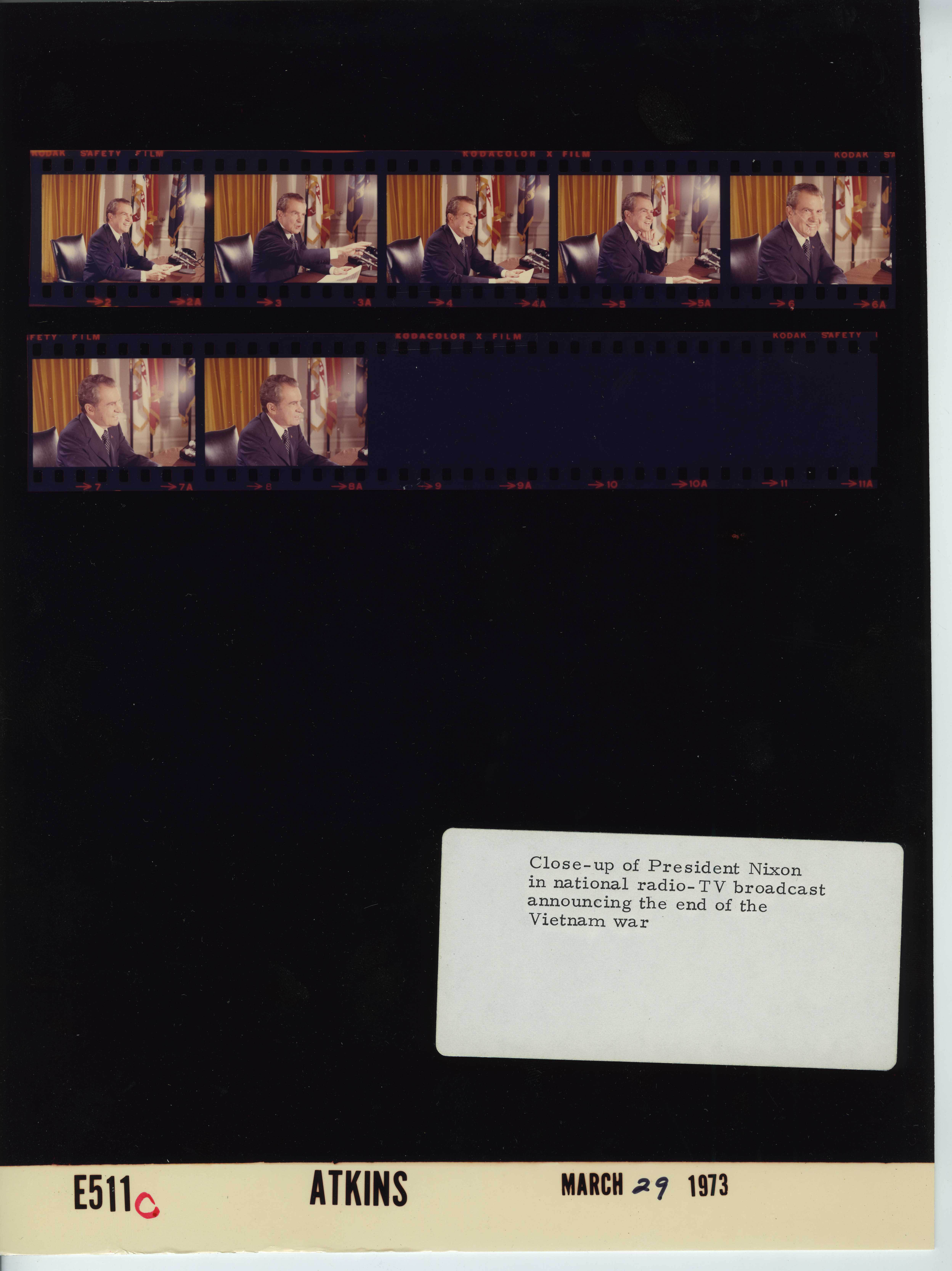
- Frame(s): WHPO-E0511-, President Nixon during national radio-TV broadcast announcing end of Vietnam War and ceiling on meat prices. 3/29/1973, Washington, D.C. White House, Oval Office. President Nixon.
Roll WHPO-E0512 Photographer: Atkins, Oliver | Color or B&W: B&W
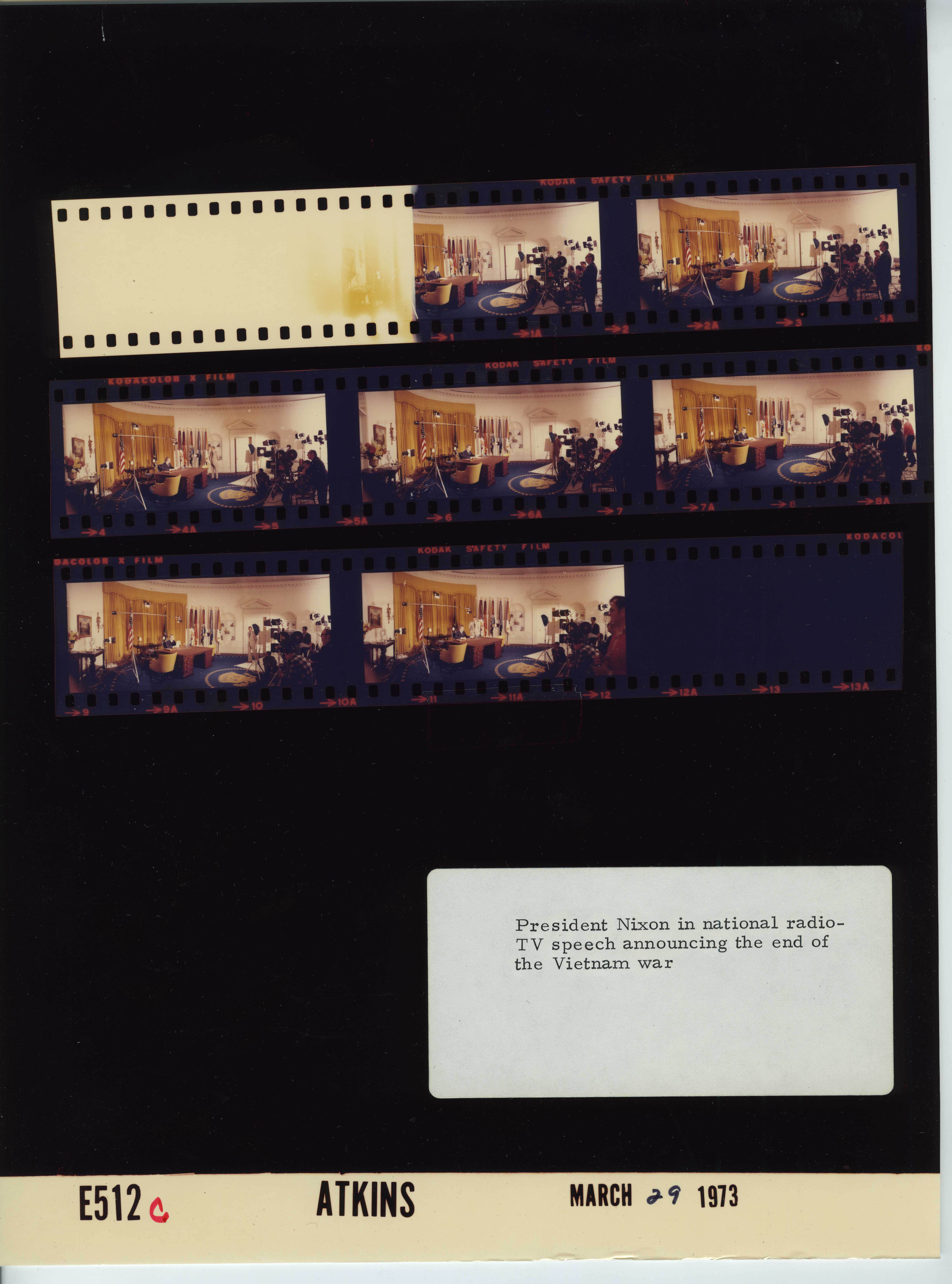
- Frame(s): WHPO-E0512-, Panoramic wide angle images - President Nixon seated at his Oval Office desk, preparing to make a national radio & televison broadcast announcing an end of the Vietnam War and a ceiling on meat prices. 3/29/1973, Washington, D.C. White House, Oval Office. President Nixon, unidentified TV camera and production crew members.
- Frame(s): WHPO-E0512-04A, Panoramic wide angle images - President Nixon, seated at his Oval Office desk, preparing to make a national radio & televison broadcast announcing an end of the Vietnam War and a ceiling on meat prices. 3/29/1973, Washington, D.C. White House, Oval Office. President Nixon, unidentified TV camera and production crew members.
Roll WHPO-E0513 Photographer: Atkins, Oliver | Color or B&W: Color
- Frame(s): WHPO-E0513-, Julie Eisenhower attending opening of Soviet art exhibition at the National Gallery of Art. 3/29/1973, Washington, D.C. National Gallery of Art, National Mall. Julie Nixon Eisenhower, unidentified guests.
Roll WHPO-E0514 Photographer: Atkins, Oliver | Color or B&W: Color
- Frame(s): WHPO-E0514-, Panoramic images of Julie Eisenhower attending opening of Soviet art exhibition at the National Gallery of Art. 3/29/1973, Washington, D.C. National Gallery of Art, National Mall. Julie Nixon Eisenhower, unidentified guests.
Roll WHPO-E0530 Photographer: Kightlinger, Jack | Color or B&W: Color
- Frame(s): WHPO-E0530-, Pat Nixon attending USC Town & Gown Benefit Luncheon. 3/29/1973, Pasadena, CA Viennese Room, Huntington Sheraton Hotel. Pat Nixon, Town & Gown President Mrs. Howard (Jeannine) Payne, Mrs. James (Jean) McBath, Mrs. Donald (Virginia) McLaran.
The White House Communications Agency Sound Recordings Collection contains public statements that took place between 1969 and 1974. Visit the finding aid to learn more.
P - Formal Presidential Remarks
- WHCA-SR-P-730327
Televised address on Vietnam and domestic economic programs. (3/29/1973)
Runtime: 19:58
Original Format: 1/4-inch reel-to-reel audiotape. Original source type: Original.
S - White House Press Office Briefings (continuation of the L-series)
- WHCA-SR-S-042
Press briefing by Ronald Ziegler. (3/29/1973, White House Press Lobby)
Runtime: 23:00
Keywords: Press conferences, news conferences, interviews, media, press secretary
Production credits: Audio feed supplied by WHCA; Recorded by JBA (initials of WHCA engineer)
Original Format: 1/4-inch reel-to-reel audiotape. Original source type: Original. - WHCA-SR-S-043
Press briefing by George Shultz, Secretary of Agriculture Earl Butz, and John Dunlop. (3/29/1973, White House Press Lobby)
Runtime: 23:00
Keywords: Press conferences, news conferences, interviews, media
Production credits: Audio feed supplied by WHCA; Recorded byCRB (initials of WHCA engineer)
Original Format: 1/4-inch reel-to-reel audiotape. Original source type: Original.
The White House Communications Agency Videotape Collection contains “off-the-air” recordings of televised programs produced between 1968 and 1974. Visit the finding aid to learn more.
- WHCA-6203
President Richard Nixon Address to the Nation on Vietnam and Domestic Problems. President spoke at 9:01 p.m. from the Oval Office of the White House.
As part of a speech focused on his upcoming battle in Congress pertaining to the Federal budget, the President spoke of the need to honor the servicemen who fought for this country in MTP: U.S. Senator George McGovern; "I&A": John D. Ehrlichman.
NBC, ABC
Runtime: 00:34:17 - WHCA-6204
Pueblo Incident, Part I.
CBS
Runtime: 00:93:48 - WHCA-6205
Pueblo Incident, Tape II.
PBS
Runtime: 00:19:27 - WHCA-6206
CBS Special Report: "Ordeal: The POW's Speak". Vietnam Prisoner of War Richard Nixon.
NA
Runtime: 01:02:44 - WHCA-6209
Weekly News Summary, Tape III.
ALL NETWORKS
Runtime: 01:29:00
10. Smith/Bell/Bennett: Films of Hanoi prison; last POWs return; Americans leave Vietnam. Time Code Start: 32:10. Keywords: Vietnam War, Vietnam Prisoner of War, releases, prison camps, prisons. Network: ABC.
11. Reasoner/Burke: Americans leave Vietnam. Time Code Start: 37:56. Keywords: Vietnam War, military, troops, withdrawals. Network: ABC.
12. Reasoner: War statistics. Time Code Start: 40:27. Keywords: Vietnam War, Killed in Action, KIA, death tolls, fatalities. Network: ABC.
13. Smith: Ex-POWs talk about captivity. Time Code Start: 41:00. Keywords: Vietnam War, Vietnam Prisoner of War, prisons, treatment, interviews. Network: ABC.
14. Reasoner/Jarriel: President Nixon to announce new economic controls with Secretary of Agriculture Butz. Time Code Start: 42:59. Keywords: economy, economics, budgets, finances, recession, inflation, money, wages, costs, unemployment, prices, cabinet, advisors. Network: ABC.
15. Smith/Donaldson: Watergate. Time Code Start: 44:51. Keywords: Watergate, Senate committee hearings, investigations, testimony, testify, cover-ups, break-in, burglary, theft, plumbers, scandals. Network: ABC.
16. Smith: More on POWs. Time Code Start: 47:03. Keywords: Vietnam War, Vietnam Prisoner of War. Network: ABC.
17. Reasoner: Commentary on Day to Smile. Time Code Start: 50:33. Keywords: American, holidays, humor. Network: ABC.
18. Chancellor/Trotta/Brady: Films of Hanoi and last POWs in prison, talk about treatment in prison. Time Code Start: 52:16. Keywords: Vietnam War, Vietnam Prisoner of War, prisons, treatment, interviews. Network: NBC.
19. Chancellor/Jones: Last American troops leave Vietnam. Time Code Start: 62:18. Keywords: Vietnam War, military, troops, withdrawals. Network: NBC.
20. Chancellor/Nessen: President Nixon to speak tonight, food control. Time Code Start: 66:33. Keywords: Presidents, speeches, food, regulations. Network: NBC.
21. Chancellor: McCord implies Mitchell in Watergate. Time Code Start: 67:06. Keywords: Watergate, Senate committee hearings, investigations, testimony, testify, cover-ups, break-in, burglary, theft, plumbers, scandals. Network: NBC.
22. Chancellor/Brinkley: History of Vietnam demonstrations; the war is over, cost of the war. Time Code Start: 67:40. Keywords: demonstrations, rally, protests, protesters, demonstraters, demonstrators, Vietnam War, anti-war. Network: NBC.
23. Mudd/Cronkite/Wagner: Last POWs leave Hanoi, arrival at Clark Air Force Base, troops leave Vietnam. Time Code Start: 63:29. Keywords: Vietnam War, Vietnam Prisoner of War, releases, arrivals, Armed Forces, military, air bases, airfields, airports, hospitals. Network: CBS.
24. Mudd: Ex-POWs talk about captivity. Time Code Start: 81:52. Keywords: Vietnam War, Vietnam Prisoner of War, prisons, treatment, interviews. Network: CBS.
25. Mudd/Strawser: President Nixon to speak tonight, Watergate hearings with Colson and McCord. Time Code Start: 87:42. Keywords: cabinet, advisors, Watergate, Senate committee hearings, investigations, testimony, testify, cover-ups, break-in, burglary, theft, plumbers, scandals. Network: CBS.
26. Mudd: Secretary of Agriculture Butz talks about food prices. Time Code Start: 90:27. Keywords: food, markets, retail stores, prices, costs, increases, shortages, cabinet, advisors. Network: CBS.
Context (External Sources)
The Vanderbilt Television News Archive is the world's most extensive and complete archive of television news. They have been recording, preserving and providing access to television news broadcasts of the national networks since August 5, 1968.
Wikipedia is a free encyclopedia that anyone can edit.