
Introduction
This almanac page for Friday, March 23, 1973, pulls together various records created by the federal government and links to additional resources which can provide context about the events of the day.
Previous Date: Thursday, March 22, 1973
Next Date: Saturday, March 24, 1973
Schedule and Public Documents
The Daily Diary files represent a consolidated record of the President's activities. Visit the finding aid to learn more.
The President's day began at Key Biscayne, Florida
The Weekly Compilation of Presidential Documents made available transcripts of the President's news conferences; messages to Congress; public speeches, remarks, and statements; and other Presidential materials released by the White House.
Digitized versions can be found at HathiTrust.
Each Public Papers of the Presidents volume contains the papers and speeches of the President of the United States that were issued by the White House Office of the Press Secretary during the time period specified by the volume. The material is presented in chronological order, and the dates shown in the headings are the dates of the documents or events. In instances when the release date differs from the date of the document itself, that fact is shown in the text note.
To ensure accuracy, remarks have been checked against audio recordings (when available) and signed documents have been checked against the original, unless otherwise noted. Editors have provided text notes and cross references for purposes of identification or clarity.
The Federal Register is the official daily publication for rules, proposed rules, and notices of federal agencies and organizations, as well as executive orders and other Presidential documents.
Archival Holdings
Any selection of archival documents will necessarily be partial. You should use the documents and folders identified below as a starting place, but consult the linked collection finding aids and folder title lists and the collections themselves for context. Many documents to be found this way do not lend themselves to association with specific dates, but are essential to a complete understanding of the material.
Selective document listing
President's Office Files
The President's Office Files consists of materials drawn together by the Special Files Unit from several administrative subdivisions within the White House Office. It is the handwriting and sensitive papers sent to the Staff Secretary that now comprise much of the President's Office Files. Visit the finding aid to learn more.
- News Summaries, Unmarked News Summaries, Box 54, News Summaries - Feb. & March 1973 [5 of 9] [Note: Due to the way News Summary products were compiled, you should also consult nearby days for potentially relevant materials.]
- Digest of Recent Comment, March 23, 1973
- News Summary, March 23, 1973, (Thursday nets, wires. Digest of Edits and a Report on Crime Message in separate compilations.)
The H. R. Haldeman Diaries consists of seven handwritten diaries, 36 dictated diaries recorded as sound recordings, and two handwritten audio cassette tape subject logs. The diaries and logs reflect H. R. Haldeman’s candid personal record and reflections on events, issues, and people encountered during his service in the Nixon White House. As administrative assistant to the President and Chief of Staff, Haldeman attended and participated in public events and private meetings covering the entire scope of issues in which the Nixon White House engaged in during the years 1969-1973. Visit the finding aid to learn more.
- Transcript of diary entry (PDF)
Friday, March 23.
I came down to Key Biscayne this morning and the President called me over to the house at 1:15. Had me there until 6:30 going over primarily Watergate. He said that he wanted me to check Colson on the point that Dean raised about clemency and how that was handled with Hunt. What specifically did Colson say to Hunt on this subject. He feels that we need to make our move now rather than just wait, but Kleindienst should do something this afternoon because of what's been said. Perhaps the grand jury is directed to call all concerned. He wanted me to talk to Dean and find out if Strachan testified at the trial, with the idea of being concerned about his possible perjury. Also whether Kleindienst has contacted Baker and Ervin, as the President told him to in the office the other day in the phone call. The President feels he doesn't like just sitting here. The President is expected to do something, and he thinks he should. We should get Kleindienst going, finding out what's up as far as Sirica is concerned. Also get Moore's judgment, Mitchell's. Have Dean ask Kleindienst.
He then had me go in the other room and call Colson on the phone and find out what his deal was with Hunt. I talked to Chuck, and he said that through Hunt's attorney he had indicated that he felt that Hunt had already been adequately punished, and that he, Chuck, would go to bat for him. Hunt's attorney said to Chuck that Hunt doesn't want to go to jail. He hopes he'll be out before the end of the year. Colson said I can't answer that and I won't try. He says he phrased it very carefully. First, that I know what Hunt's concerns are. Secondly, I'm Hunt's friend and I will do all I can. Specifically, he limited it to his desire to help Hunt. What was said and the impression on what he actually said versus what the impression gained on the other side was, might differ though Chuck admits. He said that they may have reason to believe that-- he told them he has reason to believe that his opinion would be respected by others. But he made no mention of having discussed this with the President or anybody else. He says he's had no dealing with McCord, doesn't know him, had no dealing with Liddy.
Then I hit him at the President's request on the telephone call. Specifically, whether he had, in the phone call that he made to Magruder from his office while Hunt and Liddy were with him, did he mention the President or anybody else pushing him on getting anything done? He says that the story on that was that-- actually, Chuck was a little surprised that I knew about the phone call at first, and said that he didn't think Magruder remembered the call and that he was not doing anything to recall it. But he said Hunt and Liddy dropped by his office late one afternoon or early evening and said that Liddy was setting up an intelligence operation, that Hunt would work with him, but that they can't talk to anyone to present their ideas and that's why they'd come to see Chuck. Chuck said they shouldn't talk to him, they should be talking to somebody over at 1701. They said they had tried, but nobody would listen to them, and so Chuck called Magruder. Told him that these guys had this plan and that he didn't know whether they want to do anything about it, but they should at least listen to it. And that's his story of the phone call.
He says he wrote a memo, after the Watergate, putting down everything he could remember, and he said in it that Hunt and Liddy had come by late in the day regarding intelligence and counterintelligence. He had said to them, don't tell me. Liddy had said no one would talk to them, and Colson called Jeb. Told him to listen to them. He gave this memo to Dean, and Dean gave it back to him. Said not to show it to anybody, because Jeb doesn't remember the call and it would be damaging.
He said he has made no representation regarding any clemency to Hunt, but Bittman might extend what he did say. Although Bittman would not disagree with Colson's report as to what he'd actually said, but might say that he was logically interpreting more to it than what was actually said. He has a tape of Hunt's call to him later, where Hunt said that he was very sorry that Chuck had become involved in all this, because he had-- he, Hunt, knew that Chuck had no knowledge of it and he was sorry his name had been brought up.
Regarding the grand jury, he thinks that's okay as far as he's concerned, but we should hold our executive privilege. The problem with the grand jury is that there are no safeguards and they can go on a wild fishing expedition. He says he doesn't know enough facts to make a judgment. That we should get someone else in to represent the President and his interest. Like Walsh or J. Lee Rankin or Tom Clark as outside special counsel regarding executive privilege, etcetera.
The President also then had me call John Mitchell and get a reading from him on what McCord was likely to say. This was, of course, all stirred up because this morning McCord's letter to Sirica came out, in which he said he had a lot more information that he could provide and so on. Mitchell said he hadn't the foggiest idea what McCord was likely to say, and that in any event most of it would be hearsay, since he didn't have any direct involvement in anything. Says McCord was head of security and was a private investigator for CRP right from the beginning. He's certain that Jeb and so on had no dealings with him. That Liddy probably got him into the Watergate thing, but none of our people knew he was in it. He knows nothing except what people would have told him. Sloan and Liddy were buddies, so Sloan could have talked to him about it. I discussed with Mitchell what his views are on what the President ought to do in context of all this. He said we already have a grand jury. The questions are-- the question is what are the options? Anything the President does gives the McCord development credence. So he should hunker down. The judicial process is still running its course. The rights of defendants are involved and so on. The ball is in the judge's court and that's where we should leave it. We should probably hold up on releasing Dean's report to the President, although Dean should go ahead and write it so we have it put together. We should do nothing until there's more information available. That's nothing overt at least.
He then had me call Dick Moore to get his view, and he said, first of all, we can't react to a prisoner's statement, so we should do nothing in response to the McCord thing. The question is what Justice should do? Right now they're saying no comment. But shouldn't they have some kind of reaction? Or should they say they'll await information from Sirica? He feels that the surrounding climate is such that we can't step up and talk big on this now. We've got to be careful. But on the question of cover-up, there's a danger of using government power, including executive privilege, because of the appearance of cover-up. That we should appear to come forward, ideally, we should not wait to be dragged out. The President should say I'm going to get to the bottom of this and he should get an outside lawyer to advise him. The President can't just sit for very long. But he should not just react to the McCord letter. He should consider going for a new special prosecutor and a new grand jury. This one, apparently, didn't cover the entire case. But we should recognize that going to the grand jury is a monumental step, because we don't know where it leads, such as, the area of how these people got their money and so forth. He says we've been successful so far on our day-to-day strategy. We probably can't play the McCord thing this way. We're now on a new level of concern. That is, with the first charge of perjury and so on. And even if he's lying, there's the question of what others might now do as things start unraveling.
I then talked to Dean. He said that Kleindienst doesn't have a position on this, as of now, as to what Justice ought to do. The problem is that McCord will be dealing with hearsay and innuendo. That, in analyzing it, one possibility is that what he has to say may be very limited, just to a few specifics with little first-hand knowledge. Probably a lot of hearsay, such as from the Cubans, Liddy, and Hunt. On the other hand, he may be able to do a lot of damage with information that's more than hearsay. For example, his apparent defense of Sloan in his letter bothers Dean, and he thinks the perjury thing is probably Jeb or Porter or Odle. He feels we should not overreact, we should watch and wait. McCord's greatest danger is post-June 17. He's hit on Dean's greatest concern, which is obstruction. The problem is that we're one step behind now, and from a strategic viewpoint we should question whether we should try to jump ahead.
I reported on these various conversations to the President. At that point, Ziegler came in to the meeting, and the President called Kleindienst, told him that he felt Justice should put out a statement saying that they will welcome any evidence that McCord turns up and will, of course, follow through on it in the appropriate way. He told me to call Bill Rogers and get his advice on the whole thing and fill him in on some of these background things. See what he thinks about the idea of going to the grand jury.
On a different subject, he injected the question of whether to do the appearance before Congress or a speech on TV next week. He feels that Watergate is subject A now and there's no use hitting on something else. So we don't gain anything by making a big thing out of the other subject. On Kleindienst, he made the point that on Gray we should stick by him and see what happens. That actually we will withdraw and send up Jerry Wilson. Wanted me to tell Dean to be sure that he and Kleindienst don't offer anything to Ervin if they meet with him. The plan now is to hard-line the Senate regarding executive privilege and go for sending all of the White House people to the grand jury instead. There was a lot of other sort of general discussion of options and so on. And the meeting ended at that point at about 6:30.
End of March 23. - Original audio recording (MP3)
The National Archives Catalog is the online portal to the records held at the National Archives, and information about those records. It is the main way of describing our holdings and also provides access to electronic records and digitized versions of our holdings.
The Catalog searches across multiple National Archives resources at once, including archival descriptions, digitized and electronic records, authority records, and web pages from Archives.gov and the Presidential Libraries. The Catalog also allows users to contribute to digitized historical records through tagging and transcription.
Nixon Library Holdings
All National Archives Units
National Security Documents
The President's Daily Brief is the primary vehicle for summarizing the day-to-day sensitive intelligence and analysis, as well as late-breaking reports, for the White House on current and future national security issues. Read "The President's Daily Brief: Delivering Intelligence to Nixon and Ford" to learn more.
The Foreign Relations of the United States series presents the official documentary historical record of major U.S. foreign policy decisions and significant diplomatic activity. Visit the State Department website for more information.
Vol. E-6, Documents on Africa, 1973-1976
Nigeria
200. Paper Prepared in the Bureau of Intelligence and Research, Washington, March 23, 1973
The study examined policy differences, failures of communication, and other concerns in U.S. relations with Nigeria.
Source: National Archives, RG 59, AF/W Files: Lot 77 D 84, POL 2-A, Political Relations: US/Nigeria. Secret; No Foreign Dissem; Controlled Dissem. Drafted by Clarke, cleared by Mark, and approved by Summ. The 29-page study is not published.
The Kissinger telephone conversation transcripts consist of approximately 20,000 pages of transcripts of Kissinger’s telephone conversations during his tenure as Assistant to the President for National Security Affairs (1969-1974) and Secretary of State (1973-1974) during the administration of President Richard Nixon. Visit the finding aid for more information.
Digitized versions can be found in the National Archives Catalog.
Audiovisual Holdings
The White House Photo Office collection consists of photographic coverage of President Richard Nixon meeting with prominent social, political, and cultural personalities; speaking engagements and news conferences of the President and various high-ranking members of the White House staff and Cabinet; Presidential domestic and foreign travel, including Presidential vacations; social events and entertainment involving the First Family, including entertainers present; official portraits of the President, First Family, and high-ranking members of the Nixon administration; the 1969 and 1973 Inaugurals; the President’s 1972 Presidential election campaign appearances (including speeches) and other official activities of the White House staff and the President’s Cabinet from January 20, 1969 until August 9, 1974 at the White House and the Old Executive Office Building; other locations in Washington, DC, such as The Mall; and the Presidential retreats in Camp David, Maryland, Key Biscayne, Florida, and San Clemente, California. Visit the finding aid to learn more.
Roll WHPO-E0500 Photographer: Parish, William | Color or B&W: Color
- Frame(s): WHPO-E0500-, Portraits of Herb Klein. 3/23/1973, Washington, D.C. White House, Map Room. Herbert Stein.
Roll WHPO-E0501 Photographer: Kightlinger, Jack | Color or B&W: B&W
- Frame(s): WHPO-E0501-, Vice President Agnew meeting National Advisory Council on Adult Education. 3/23/1973, Washington, D.C. White House, Cabinet Room. Agnew, unidentified council members.
Roll WHPO-E0502 Photographer: Parish, William | Color or B&W: B&W
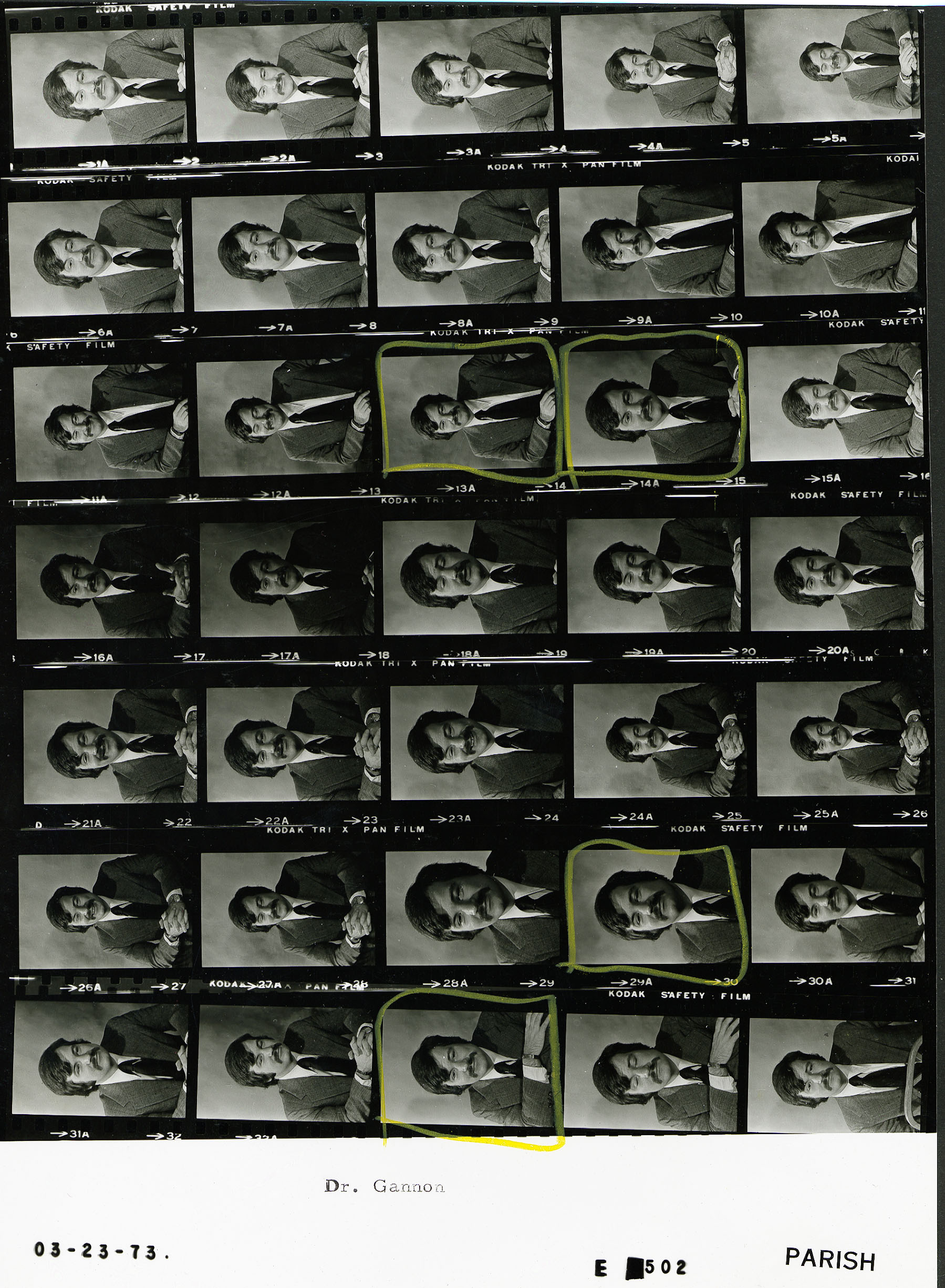
- Frame(s): WHPO-E0502-, Portraits of White House Fellow Dr. Frank Gannon. 3/23/1973, Washington, D.C. White House, Map Room. Frank Gannon.
The White House Communications Agency Sound Recordings Collection contains public statements that took place between 1969 and 1974. Visit the finding aid to learn more.
S - White House Press Office Briefings (continuation of the L-series)
- WHCA-SR-S-035
Press briefing by Gerald Warren. (3/23/1973, 4 Ambassadors Press Center)
Runtime: 0:36:31
Keywords: Press conference, news conference, interviews, media, press secretary, briefings, Watergate, Senate committee hearings, investigations, testimony, testify, cover-ups, break-in, burglary, theft, plumbers, scandals, Vietnam Prisoner of War, POW, military, e
Production credits: Audio feed supplied by WHCA; Recorded by JMC (initials of WHCA engineer)
Original Format: 1/4-inch reel-to-reel audiotape. Original source type: Original. Technical notes: 1 hour and 13 seconds of silence at end of recording removed from access copies.
The White House Communications Agency Videotape Collection contains “off-the-air” recordings of televised programs produced between 1968 and 1974. Visit the finding aid to learn more.
- WHCA-6198
"Panorama".
ALL NETWORKS
Runtime: 01:02:50 - WHCA-6207
Weekly News Summary, Tape I.
ALL NETWORKS
Runtime: 01:32:45
1. Smith/Donaldson: Watergate. Time Code Start: 00:00. Keywords: Watergate, Senate committee hearings, investigations, testimony, testify, cover-ups, break-in, burglary, theft, plumbers, scandals. Network: ABC.
2. Smith/Kaplow: Prices, prime interest. Time Code Start: 05:55. Keywords: wage and price controls, freezes, prices, costs, increases, decreases, economy, economics, budgets, finances, recession, inflation, money, automobiles, autos, vehicles. Network: ABC.
3. Reasoner/Cameron: Vietnam war aftermath. Time Code Start: 08:30. Keywords: Vietnam War. Network: ABC.
4. Smith: Commentary on Watergate. Time Code Start: 11:47. Keywords: Watergate, Senate committee hearings, investigations, testimony, testify, cover-ups, break-in, burglary, theft, plumbers, scandals. Network: ABC.
5. Chancellor/Stern/Duke/Mackin: Watergate, McCord casts more light; Senator Erwin comments; some senators. Time Code Start: 13:33. Keywords: Watergate, Senate committee hearings, investigations, testimony, testify, cover-ups, break-in, burglary, theft, plumbers, scandals. Network: NBC.
6. Chancellor/Nessen/Davis/Bell: Meat prices; food costs. Time Code Start: 20:27. Keywords: food, meats, animal products, markets, retail stores, prices, costs, increases, shortages. Network: NBC.
7. Chancellor/Jones: North Vietnam has missiles in South Vietnam; the war goes on; POWs. Time Code Start: 26:39. Keywords: Vietnam War, aircraft, artillery, weapons, Vietnam Prisoner of War. Network: NBC.
8. Chancellor: L. Patrick Gray. Time Code Start: 30:05. Keywords: Federal Bureau of Investigations, leaders, nominees, Senate committee hearings, testimony, testify. Network: NBC.
9. Mudd/Stahl/Strawser: Major break in Watergate case. Time Code Start: 30:50. Keywords: Watergate, Senate committee hearings, investigations, testimony, testify, cover-ups, break-in, burglary, theft, plumbers, scandals. Network: CBS.
10. Pierpoint: No reaction from Southern White House. Time Code Start: 35:05. Keywords: Presidents, reactions, Watergate, Senate committee hearings, investigations, testimony, testify, cover-ups, break-in, burglary, theft, plumbers, scandals. Network: CBS.
11. Mudd/Cronkite: POWs; report from Laos; missiles in South Vietnam. Time Code Start: 35:53. Keywords: Laos, aircraft, artillery, weapons, Vietnam War, Vietnam Prisoner of War. Network: CBS.
12. Mudd/Roth: United Automobile Workers (UAW) meets to decide new contract issues. Time Code Start: 39:08. Keywords: leaders, labor, unions, United Auto Workers, contracts, negotiations. Network: CBS.
13. Mudd/Chung: Democrats unite; eat fish. Time Code Start: 44:13. Keywords: political parties, Democrats, Democratic Party. Network: CBS.
14. Mudd: President Nixon relaxes oil import quotas. Time Code Start: 46:40. Keywords: energy, petroleum, drilling, oil supply, oil supplies, imports, shortages, sales, costs, increases. Network: CBS.
Context (External Sources)
The Vanderbilt Television News Archive is the world's most extensive and complete archive of television news. They have been recording, preserving and providing access to television news broadcasts of the national networks since August 5, 1968.
Wikipedia is a free encyclopedia that anyone can edit.