
Introduction
This almanac page for Wednesday, March 21, 1973, pulls together various records created by the federal government and links to additional resources which can provide context about the events of the day.
Previous Date: Tuesday, March 20, 1973
Next Date: Thursday, March 22, 1973
Schedule and Public Documents
The Daily Diary files represent a consolidated record of the President's activities. Visit the finding aid to learn more.
The President's day began at The White House - Washington, D. C.
The Weekly Compilation of Presidential Documents made available transcripts of the President's news conferences; messages to Congress; public speeches, remarks, and statements; and other Presidential materials released by the White House.
Digitized versions can be found at HathiTrust.
Each Public Papers of the Presidents volume contains the papers and speeches of the President of the United States that were issued by the White House Office of the Press Secretary during the time period specified by the volume. The material is presented in chronological order, and the dates shown in the headings are the dates of the documents or events. In instances when the release date differs from the date of the document itself, that fact is shown in the text note.
To ensure accuracy, remarks have been checked against audio recordings (when available) and signed documents have been checked against the original, unless otherwise noted. Editors have provided text notes and cross references for purposes of identification or clarity.
The Federal Register is the official daily publication for rules, proposed rules, and notices of federal agencies and organizations, as well as executive orders and other Presidential documents.
The Congressional Record is the official daily record of the debates and proceedings of the U.S. Congress.
Archival Holdings
Any selection of archival documents will necessarily be partial. You should use the documents and folders identified below as a starting place, but consult the linked collection finding aids and folder title lists and the collections themselves for context. Many documents to be found this way do not lend themselves to association with specific dates, but are essential to a complete understanding of the material.
Selective document listing
President's Office Files
The President's Office Files consists of materials drawn together by the Special Files Unit from several administrative subdivisions within the White House Office. It is the handwriting and sensitive papers sent to the Staff Secretary that now comprise much of the President's Office Files. Visit the finding aid to learn more.
- News Summaries, Annotated News Summaries, Box 45, March 20-31, 1973 [2 of 4] [Note: Due to the way News Summary products were compiled, you should also consult nearby days for potentially relevant materials.]
- News Summary, March 21, 1973, (Tuesday nets, wires)
The H. R. Haldeman Diaries consists of seven handwritten diaries, 36 dictated diaries recorded as sound recordings, and two handwritten audio cassette tape subject logs. The diaries and logs reflect H. R. Haldeman’s candid personal record and reflections on events, issues, and people encountered during his service in the Nixon White House. As administrative assistant to the President and Chief of Staff, Haldeman attended and participated in public events and private meetings covering the entire scope of issues in which the Nixon White House engaged in during the years 1969-1973. Visit the finding aid to learn more.
- Transcript of diary entry (PDF)
Wednesday, March 21.
The President had his usual Wednesday clear except for a few ceremonial items at midday. And spent most of the day on Watergate, which he's becoming more and more involved in, and I guess concerned about, as time goes on. He had a long session with Ehrlichman first thing this morning, then had John Dean at 10:00 for a couple of hours and had Dean give him a complete rundown on all the facts, which he had told him last night he wanted him to be prepared to do. And I told John to do exactly that, cover all the facts in considerable detail, so the President would actually know precisely what the situation was.
Then he called me in at the end of the Dean meeting. We had some general discussion about options and alternatives. Ehrlichman's intrigued with the possibility, which he raised yesterday, of convening a grand jury and having all of us go up there and file our statements under oath and getting that done. The President also became somewhat interested in that, especially after talking with Dean, but has some concerns about it. Felt that the time had come that Dean and Ehrlichman and I should all sit down with Mitchell, and that Dean should give us the same total fill on the facts as he had given the President today, and we should then try to come to some conclusions. He called me back in at 3:00 and went over some of his thoughts again before Dean, Ehrlichman and I met at 3:30. At that point, the President felt that we needed basically to determine, first of all, what to do right now about the Hunt threat. He's asking for money, and says he'll blow the Ehrlichman story and Bud Krogh thing if we don't pay him off now, or if they don't. And the question is to evaluate the whole thing and determine a course of action. That we now have a different situation than we did during the election. We've got to figure all the problems and possibilities. For example, the Krogh problem on where he is. Maybe it can be solved by national security considerations or we can get him immunity, and there's a question of Sullivan's memo and whether to use it.
He thinks, on thinking it over, that the grand jury is appealing, at least at first blush, because it's an opportunity for all the White House to be questioned on a sworn basis with no cover-up. We'd precede it by a general statement that would be based-- or take off from the statement by the judge at the sentencing on Friday. Then we're following up now, that the court has proceeded and then have Dean put out a general disclaimer. He feels we need something, and unless it's necessary to tough it through, we shouldn't. However, if it involves criminal prosecution of the top people, then that would be worse than having to tough it out. But if we do tough it out, it means living with it, which is going to be very tough, very difficult. He feels that the critical thing is regarding Ehrlichman and Krogh versus Hunt. The question is, can we let Hunt go. Also he thinks I ought to talk to Colson and see what would happen, as far as he's concerned, if Hunt blows. He suggested also that if we do the grand jury we should invite the press to testify, not subpoena them, but they should be invited. Not on their sources or their files, but on any facts that they have. The advantages of this, of course, are that the grand jury approach covers all the ground under oath, provides the answer about going to the Senate. How else can we show that the President is trying to get the facts and avoid anything falling on us? That becomes the basic problem, and the question is whether to go one way or the other, or just ride it through on the containment theory that Dean's been pursuing up to now. Generally you come out that the latter is really the only actually possible course, but it's not a very good one.
The President then had Ehrlichman, Dean and me in at 5:15 for another hour or so and reviewed our afternoon discussion which comes down that Ehrlichman doesn't think the Dean approach to the grand jury is satisfactory, because Dean bases it on going for immunity before the people testify, which John doesn't think is a salable approach. So we talked for quite a while and came out about the same as we went in. We'll meet with Mitchell tomorrow morning and see if we can advance it there. Dean, after the meeting, made one point that maybe we should just draw the wagons up around the White House and let things fall where they may outside; which, of course, is the tempting choice, since there is no complicity within the White House, and we'd come out in good shape on that. But the problem is what happens to Mitchell, Magruder, etcetera, on the outside.
End of March 21. - Original audio recording (MP3)
The National Archives Catalog is the online portal to the records held at the National Archives, and information about those records. It is the main way of describing our holdings and also provides access to electronic records and digitized versions of our holdings.
The Catalog searches across multiple National Archives resources at once, including archival descriptions, digitized and electronic records, authority records, and web pages from Archives.gov and the Presidential Libraries. The Catalog also allows users to contribute to digitized historical records through tagging and transcription.
Nixon Library Holdings
All National Archives Units
National Security Documents
The President's Daily Brief is the primary vehicle for summarizing the day-to-day sensitive intelligence and analysis, as well as late-breaking reports, for the White House on current and future national security issues. Read "The President's Daily Brief: Delivering Intelligence to Nixon and Ford" to learn more.
The Foreign Relations of the United States series presents the official documentary historical record of major U.S. foreign policy decisions and significant diplomatic activity. Visit the State Department website for more information.
Vol. X, Vietnam, January 1973-July 1975
Neither War nor Peace, January 27-June 15, 1973
35. Memorandum From the Director of Central Intelligence (Schlesinger) to the President’s Assistant for National Security Affairs (Kissinger), Washington, March 21, 1973
Source: Central Intelligence Agency, Executive Registry Files, Job 80–B01086A. Secret; Sensitive; Eyes Only. Colby recommended signature of the memorandum on March 20.
The Kissinger telephone conversation transcripts consist of approximately 20,000 pages of transcripts of Kissinger’s telephone conversations during his tenure as Assistant to the President for National Security Affairs (1969-1974) and Secretary of State (1973-1974) during the administration of President Richard Nixon. Visit the finding aid for more information.
Digitized versions can be found in the National Archives Catalog.
Audiovisual Holdings
Visit the White House Tapes finding aid to learn about the taping system's operation and archival processing.
Old Executive Office Building
- 421-1; Unknown between 1:21 p.m. & 2:23 p.m.; Nixon, Richard M. (President); Sanchez, Manolo
- 421-2; Unknown between 1:21 p.m. & 2:23 p.m.; Nixon, Richard M. (President); [Unknown person(s)]
- 421-3; 2:23 p.m. - 2:24 p.m.; Nixon, Richard M. (President); Eisenhower, Julie Nixon
- 421-4; Unknown between 2:23 p.m. & 2:52 p.m.; Nixon, Richard M. (President); [Unknown person(s)]
- 421-5; 2:52 p.m. - 2:52 p.m.; Nixon, Richard M. (President); White House operator
- 421-6; Unknown between 2:52 p.m. & 3:02 p.m.; Nixon, Richard M. (President); Sanchez, Manolo
- 421-7; 3:02 p.m. - 3:03 p.m.; Nixon, Richard M. (President); Haldeman, H. R. ("Bob")
- 421-8; 3:05 p.m. - 3:45 p.m.; Nixon, Richard M. (President); Haldeman, H. R. ("Bob"); [Unknown person(s)]
- 421-9; Unknown between 3:45 p.m. & 3:48 p.m.; Nixon, Richard M. (President); White House operator
- 421-10; 3:48 p.m. - 3:49 p.m.; Nixon, Richard M. (President); Scowcroft, Brent G. (Gen.)
- 421-11; Unknown between 3:49 p.m. & 4:23 p.m.; Nixon, Richard M. (President); Woods, Rose Mary
- 421-12; Unknown between 3:49 p.m. & 4:23 p.m.; Nixon, Richard M. (President); White House operator
- 421-13; 4:23 p.m. - 4:39 p.m.; Nixon, Richard M. (President); Haig, Alexander M., Jr.
- 421-14; 4:41 p.m. - 4:41 p.m.; Nixon, Richard M. (President); White House operator
- 421-15; Unknown between 4:41 p.m. & 4:43 p.m.; Nixon, Richard M. (President); White House operator
- 421-16; 4:43 p.m. - 4:45 p.m.; Nixon, Richard M. (President); Bull, Stephen B.
- 421-17; Unknown between 4:45 p.m. & 4:53 p.m.; Nixon, Richard M. (President); Woods, Rose Mary
- 421-18; 4:53 p.m. - 6:01 p.m.; Nixon, Richard M. (President); Ziegler, Ronald L.; White House operator; Rogers, William P.; Haldeman, H. R. ("Bob"); Dean, John W., III; Ehrlichman, John D.
- 421-19; Unknown between 6:01 p.m. & 6:05 p.m.; Nixon, Richard M. (President); Scowcroft, Brent G. (Gen.)
Oval Office
- 886-1; Unknown between 8:04 a.m. & 8:11 a.m.; Nixon, Richard M. (President); [Unknown person(s)]
- 886-2; 8:11 a.m. - 8:21 a.m.; Nixon, Richard M. (President); Scowcroft, Brent G. (Gen.)
- 886-3; Unknown between 8:20 a.m. & 8:24 a.m.; Nixon, Richard M. (President); [Unknown person(s)]
- 886-4; 8:24 a.m. - 8:27 a.m.; Nixon, Richard M. (President); Scowcroft, Brent G. (Gen.)
- 886-5; Unknown between 8:27 a.m. & 9:15 a.m.; Nixon, Richard M. (President); Bull, Stephen B.
- 886-6; Unknown between 8:27 a.m. & 9:15 a.m.; Nixon, Richard M. (President); Bull, Stephen B.
- 886-7; Unknown between 9:15 a.m. & 10:12 a.m.; Nixon, Richard M. (President); Ehrlichman, John D.
- 886-8; Unknown between 9:15 a.m. & 11:55 a.m.; Nixon, Richard M. (President); Bull, Stephen B.; Ehrlichman, John D.; Dean, John W., III; Haldeman, H. R. ("Bob")
- 886-9; Unknown between 11:55 a.m. & 11:57 a.m.; Nixon, Richard M. (President); [Unknown person(s)]
- 886-10; 11:57 a.m. - 12:07 p.m.; Nixon, Richard M. (President); Scowcroft, Brent G. (Gen.); White House photographer; Boganova, Lyubov I.; Korbut, Olga V.; Koshel, Antonina V.; Lazakovich, Tamara V.; Sikharulidze, Rusudan A.; Turishcheva, Lyudmila I.; Smolevskiy, Vladimir M.; Dimitriyev, Vikentiy D.; Dnysh, Renald I.; Rastrotskiy, Vladislav A.; Iläó»Yashevasaya, Lyudmila I.; Zarechnak, Dimtry
- 886-11; Unknown between 12:07 p.m. & 12:10 p.m.; Nixon, Richard M. (President); [Unknown person(s)]
- 886-12; Unknown between 12:07 p.m. & 12:10 p.m.; Nixon, Richard M. (President); [Unknown person(s)]
- 886-13; 12:10 p.m. - 12:35 p.m.; Nixon, Richard M. (President); Packard, David; Roosevelt, James; Byrnes, John W.; Baroody, William J., Jr.; White House photographer
- 886-14; 12:36 p.m. - 12:53 p.m.; Nixon, Richard M. (President); Rossi, Anthony T. ("Tony"); Mongelli, Acheille; Persico, Ralph W.; [Unknown person(s)]; White House photographer
- 886-15; 12:54 p.m. - 1:05 p.m.; Nixon, Richard M. (President); Bull, Stephen B.
- 886-16; Unknown between 1:05 p.m. & 1:06 p.m.; Nixon, Richard M. (President); [Unknown person(s)]
- 886-17; Unknown between 1:05 p.m. & 1:06 p.m.; Nixon, Richard M. (President); Bull, Stephen B.
- 886-18; 1:06 p.m. - 1:20 p.m.; Nixon, Richard M. (President); Woods, Rose Mary
- 886-19; Unknown between 1:21 p.m. & 11:59 p.m.; Nixon, Richard M. (President); Sanchez, Manolo
- 886-20; Unknown between 1:21 p.m. & 11:59 p.m.; United States Secret Service agents
White House Telephone
- 37-183; Unknown between 1:21 p.m. & 2:23 p.m.; Nixon, Richard M. (President); White House operator
- 37-184; 2:23 p.m. - 2:24 p.m.; Nixon, Richard M. (President); Cox, Tricia Nixon
- 37-185; 2:52 p.m. - 2:52 p.m.; Nixon, Richard M. (President); White House operator
- 37-186; 3:02 p.m. - 3:03 p.m.; Nixon, Richard M. (President); Haldeman, H. R. ("Bob")
- 37-187; Unknown between 3:45 p.m. & 3:48 p.m.; Nixon, Richard M. (President); White House operator
- 37-188; 3:48 p.m. - 3:49 p.m.; Nixon, Richard M. (President); Scowcroft, Brent G. (Gen.)
- 37-189; Unknown between 3:49 p.m. & 4:23 p.m.; Nixon, Richard M. (President); White House operator
- 37-190; 4:23 p.m. - 4:39 p.m.; Nixon, Richard M. (President); Haig, Alexander M., Jr.
- 37-191; 4:41 p.m. - 4:41 p.m.; Nixon, Richard M. (President); White House operator
- 37-192; Unknown between 4:41 p.m. & 4:43 p.m.; Nixon, Richard M. (President); White House operator
- 37-193; 4:43 p.m. - 4:45 p.m.; Nixon, Richard M. (President); Bull, Stephen B.
- 37-194; Unknown between 4:53 p.m. & 4:58 p.m.; Nixon, Richard M. (President); White House operator
- 37-195; 4:58 p.m. - 5:00 p.m.; Nixon, Richard M. (President); Rogers, William P.
- 37-196; Unknown between 6:09 p.m. & 7:25 p.m.; Nixon, Richard M. (President); White House operator
- 37-197; 7:25 p.m. - 7:26 p.m.; Nixon, Richard M. (President); Scowcroft, Brent G. (Gen.)
- 37-198; Unknown between 7:26 p.m. & 7:27 p.m.; Nixon, Richard M. (President); White House operator
- 37-199; 7:27 p.m. - 7:28 p.m.; Nixon, Richard M. (President); Scowcroft, Brent G. (Gen.)
- 37-200; Unknown between 7:28 p.m. & 7:35 p.m.; Nixon, Richard M. (President); White House operator
- 37-201; 7:35 p.m. - 7:44 p.m.; Nixon, Richard M. (President); Haig, Alexander M., Jr.
- 37-202; Unknown between 7:44 p.m. & 7:50 p.m.; Nixon, Richard M. (President); White House operator
- 37-203; 7:50 p.m. - 7:50 p.m.; Nixon, Richard M. (President); White House operator
- 37-204; Unknown between 7:50 p.m. & 7:53 p.m.; Nixon, Richard M. (President); White House operator
- 37-205; 7:53 p.m. - 8:24 p.m.; Nixon, Richard M. (President); Colson, Charles W.
The White House Photo Office collection consists of photographic coverage of President Richard Nixon meeting with prominent social, political, and cultural personalities; speaking engagements and news conferences of the President and various high-ranking members of the White House staff and Cabinet; Presidential domestic and foreign travel, including Presidential vacations; social events and entertainment involving the First Family, including entertainers present; official portraits of the President, First Family, and high-ranking members of the Nixon administration; the 1969 and 1973 Inaugurals; the President’s 1972 Presidential election campaign appearances (including speeches) and other official activities of the White House staff and the President’s Cabinet from January 20, 1969 until August 9, 1974 at the White House and the Old Executive Office Building; other locations in Washington, DC, such as The Mall; and the Presidential retreats in Camp David, Maryland, Key Biscayne, Florida, and San Clemente, California. Visit the finding aid to learn more.
Roll WHPO-E0485 Photographer: Atkins, Oliver | Color or B&W: Color
- Frame(s): WHPO-E0485-01-06, President Nixon standing in the Oval Office with members of the Russian Soviet Women's Gymnastics Team. Olympic Gold Medal winner Olga Korbut stands next to the President Nixon. 3/21/1973, Washington, D.C. White House, Oval Office. President Nixon, Olga Korbut, Lyubov Boganova, Antonina V. Koshel, Tamara V. Lazakovich, Rusudan A. Sikharulidze, Lyudmila Turishcheva, Vladimir M. Smolevsky, Vikenty D. Dmitriyev, Renald I. Dnysh, Vladislav A. Rastorotsky.
- Frame(s): WHPO-E0485-01A, President Nixon standing in the Oval Office with members of the Russian Soviet Women's Gymnastics Team. President Nixon shakes hands with Olympic Gold Medal winner Olga Korbut. 3/21/1973, Washington, D.C. White House, Oval Office. President Nixon, Olga Korbut, Lyubov Boganova, Antonina V. Koshel, Tamara V. Lazakovich, Rusudan A. Sikharulidze, Lyudmila Turishcheva, Vladimir M. Smolevsky, Vikenty D. Dmitriyev, Renald I. Dnysh, Vladislav A. Rastorotsky.
- Frame(s): WHPO-E0485-02/02A, President Nixon standing in the Oval Office with members of the Russian Soviet Women's Gymnastics Team. President Nixon shakes hands with Olympic Gold Medal winner Olga Korbut. 3/21/1973, Washington, D.C. White House, Oval Office. President Nixon, Olga Korbut, Lyubov Boganova, Antonina V. Koshel, Tamara V. Lazakovich, Rusudan A. Sikharulidze, Lyudmila Turishcheva, Vladimir M. Smolevsky, Vikenty D. Dmitriyev, Renald I. Dnysh, Vladislav A. Rastorotsky.
- Frame(s): WHPO-E0485-07-08, President Nixon meeting David M. Packard, James Roosevelt, John W. Byrnes, William J. Baroody, Jr. in the Oval Office. 3/21/1973, Washington, D.C. White House, Oval Office. President Nixon, David M. Packard, James Roosevelt, John W. Byrnes, William J. Baroody, Jr.
Roll WHPO-E0486 Photographer: Knudsen, Robert L. | Color or B&W: B&W
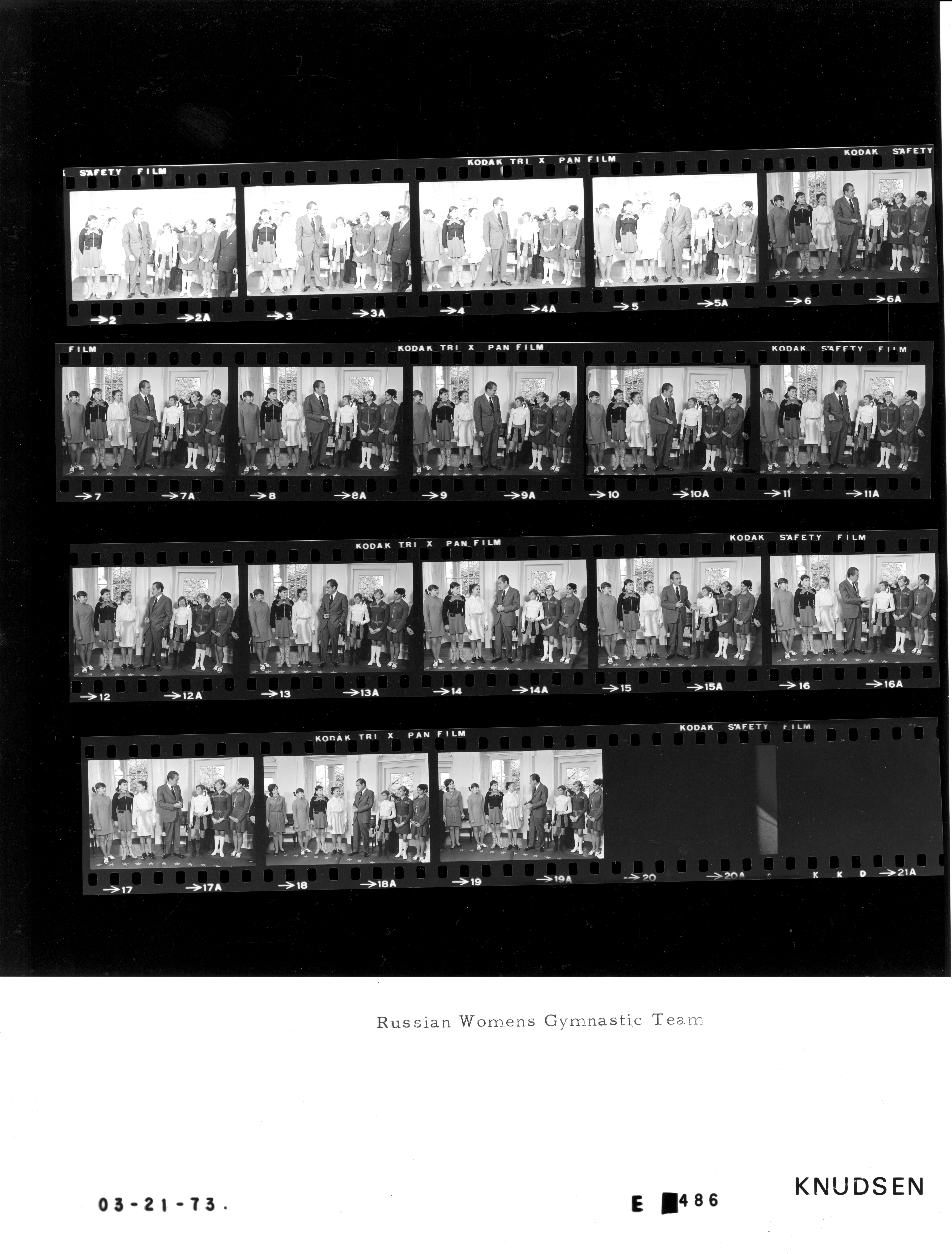
- Frame(s): WHPO-E0486-, President Nixon standing in the Oval Office with members of the Russian Soviet Women's Gymnastics Team. Olympic Gold Medal winner Olga Korbut stands next to the President Nixon. 3/21/1973, Washington, D.C. White House, Oval Office. President Nixon, Olga Korbut, Lyubov Boganova, Antonina V. Koshel, Tamara V. Lazakovich, Rusudan A. Sikharulidze, Lyudmila Turishcheva, Vladimir M. Smolevsky, Vikenty D. Dmitriyev, Renald I. Dnysh, Vladislav A. Rastorotsky.
- Frame(s): WHPO-E0486-10A, President Nixon standing in the Oval Office with members of the Russian Soviet Women's Gymnastics Team. Olympic Gold Medal winner Olga Korbut stands next to the President Nixon. 3/21/1973, Washington, D.C. White House, Oval Office. President Nixon, Olga Korbut, Lyubov Boganova, Antonina V. Koshel, Tamara V. Lazakovich, Rusudan A. Sikharulidze, Lyudmila Turishcheva, Vladimir M. Smolevsky, Vikenty D. Dmitriyev, Renald I. Dnysh, Vladislav A. Rastorotsky.
Roll WHPO-E0487 Photographer: Schumacher, Karl | Color or B&W: B&W
- Frame(s): WHPO-E0487-, Herb Klein and a grandchild. 3/21/1973, Washington, D.C. White House interior. Herbert G. Klein, unidentified grandchild.
Roll WHPO-E0488 Photographer: Kightlinger, Jack | Color or B&W: B&W
- Frame(s): WHPO-E0488-, President Nixon meeting B. Freeman and Sons, Inc. tailors Tony Rossi, Ralph Persico, Achille Mongelli. 3/21/1973, Washington, D.C. White House, Oval Office. President Nixon, Tony Rossi, Ralph Persico, Acheille Mongelli.
The White House Communications Agency Sound Recordings Collection contains public statements that took place between 1969 and 1974. Visit the finding aid to learn more.
P - Formal Presidential Remarks
- WHCA-SR-P-730322
Photo opportunity with USSR Women's Gymnastics Team. (3/21/1973)
Runtime: 3:30
Keywords: Gymnastic, sports
Original Format: 1/4-inch reel-to-reel audiotape. Original source type: Original.
S - White House Press Office Briefings (continuation of the L-series)
- WHCA-SR-S-030
Press briefing by Kenneth Cole. (3/21/1973, White House Press Lobby)
Runtime: 11:38
Keywords: Press conferences, news conferences, interviews, media
Production credits: Audio feed supplied by WHCA; Recorded by DB (initials of WHCA engineer)
Original Format: 1/4-inch reel-to-reel audiotape. Original source type: Original. - WHCA-SR-S-031
Press briefing by Gerald Warren. (3/21/1973, White House Press Lobby)
Runtime: 21:30
Keywords: Press conferences, news conferences, interviews, media
Production credits: Audio feed supplied by WHCA; Recorded by DB (initials of WHCA engineer)
Original Format: 1/4-inch reel-to-reel audiotape. Original source type: Original.
The White House Communications Agency Videotape Collection contains “off-the-air” recordings of televised programs produced between 1968 and 1974. Visit the finding aid to learn more.
- WHCA-6190
News watch WWJTV. FTN: Israeli PM Golda Meir; "I&A": Governors Marvin Mandel (MD) and Lynwood Holton (VA).
CBS, ABC
Runtime: 00:24:34 - WHCA-6191
"The Dick Cavett Show" with American Indian Movement members. Guests are members of "AIM" (the American Indian Movement, "Wounded Knee Show"). Frank Fools Crow, Frank Kills Enemy, Matthew King, Meredith Quinn, Vernon Bellecourt, Robert Burnette, Charles Trimble, Richard Full Bull
CBS
Runtime: 01:30:10 - WHCA-6195
Weekly News Summary, 16-22 Mar 73, Tape III.
ALL NETWORKS
Runtime: 01:35:25
1. Reasoner/Koppel: Libya shoots everybody. Time Code Start: 00:00. Keywords: Middle East, Mideast, wars, death, shootings. Network: ABC.
2. Smith/Donaldson/Brannigan: Costs of food. Time Code Start: 01:30. Keywords: food, costs, prices, sales, increases, decreases. Network: ABC.
3. Smith/Clark: L. Patrick Gray and Watergate. Time Code Start: 06:30. Keywords: Watergate, Senate committee hearings, investigations, testimony, testify, cover-ups, break-in, burglary, theft, plumbers, scandals. Network: ABC.
4. Smith/Tomlinson: International Telephone & Telegraph (ITT Corporation) hearings. Time Code Start: 09:10. Keywords: International Telephone & Telegraph, communications, world, corporations, conglomerates, campaign funding, investigations, hearings. Network: ABC.
5. Smith/Kaplow: President Nixon crime bill. Time Code Start: 10:52. Keywords: bills, laws, House of Representatives, anti-crime, offences, infractions, criminals, criminality, law breaking. Network: ABC.
6. Reasoner/Jarriel: Soviet gymnasts visit White House. Time Code Start: 13:43. Keywords: Presidents, Gymnastics, sports Olympics, Olympians, teams, athletes, women, celebrites, meetings. Network: ABC.
7. Smith: Commentary on foreign policy. Time Code Start: 14:50. Keywords: foreign relations, diplomacy, negotiations. Network: ABC.
8. Chancellor/Bell: Prices going up 8%; Stein comments. Time Code Start: 16:32. Keywords: wage and price controls, freezes, prices, costs, increases, decreases, economy, economics, budgets, finances, recession, inflation, money. Network: NBC.
9. Chancellor/Duke: International Telephone & Telegraph (ITT Corporation) meddling with Chilean election. Time Code Start: 21:50. Keywords: International Telephone & Telegraph, communications, world, corporations, conglomerates, campaign funding, investigations, hearings. Network: NBC.
10. Chancellor/Stern: L. Patrick Gray, Watergate, and John Dean. Time Code Start: 23:57. Keywords: advisors, Watergate, Senate committee hearings, investigations, testimony, testify, cover-ups, break-in, burglary, theft, plumbers, scandals. Network: NBC.
11. Chancellor/Brinkley: Education and property tax. Time Code Start: 26:18. Keywords: taxes, taxation, revenue. Network: NBC.
12. Chancellor: Frederick Dent comments on taxes. Time Code Start: 28:30. Keywords: taxes, taxation, revenue. Network: NBC.
13. Chancellor: POWs; Ceasefire. Time Code Start: 29:55. Keywords: Vietnam War, Vietnam Prisoner of War, ceasefires. Network: nBC.
14. Chancellor: Russian gymnasts visit White House with President Nixon. Time Code Start: 30:39. Keywords: Presidents, meetings, Soviet Union, USSR, sports, games, Olympics, Olympians, medal winners, gymnastics, teams. Network: NBC.
15. Mudd/Walker/Morton: Cost of living up; food prices; Stein comment. Time Code Start: 32:15. Keywords: food, meat, agriculture, animal products, dairy products, prices, costs, increases, shortages. Network: CBS.
16. Mudd: Sample of public opinion. Time Code Start: 35:38. Keywords: public opinions, polls, approval ratings, Gallup poll, Harris poll. Network: CBS.
17. Mudd/Strawser: L. Patrick Gray and Watergate, John Dean. Time Code Start: 37:40. Keywords: advisors, Watergate, Senate committee hearings, investigations, testimony, testify, cover-ups, break-in, burglary, theft, plumbers, scandals. Network: CBS.
18. Mudd/Herman: International Telephone & Telegraph (ITT Corporation) and Chilean election. Time Code Start: 39:10. Keywords: International Telephone & Telegraph, communications, world, corporations, conglomerates, campaign funding, investigations, hearings. Network: CBS.
19. Mudd/Threlkeld: POWs. Time Code Start: 41:54. Keywords: Vietnam War, Vietnam Prisoner of War. Network: CBS.
Context (External Sources)
The Vanderbilt Television News Archive is the world's most extensive and complete archive of television news. They have been recording, preserving and providing access to television news broadcasts of the national networks since August 5, 1968.
Wikipedia is a free encyclopedia that anyone can edit.