
Introduction
This almanac page for Sunday, March 2, 1969, pulls together various records created by the federal government and links to additional resources which can provide context about the events of the day.
Previous Date: Saturday, March 1, 1969
Next Date: Monday, March 3, 1969
Schedule and Public Documents
The Daily Diary files represent a consolidated record of the President's activities. Visit the finding aid to learn more.
The President's day began at Paris, France
The Weekly Compilation of Presidential Documents made available transcripts of the President's news conferences; messages to Congress; public speeches, remarks, and statements; and other Presidential materials released by the White House.
European Trip
- Paris, France (5 Weekly Comp. Pres. Doc. 353, March 2, 1969)
The President's Remarks to Personnel of the American Embassy. - Paris, France (5 Weekly Comp. Pres. Doc. 354, March 2, 1969)
Remarks of President Nixon and President de Gaulle Upon President Nixon's Departure at Orly Airport. - The Vatican (5 Weekly Comp. Pres. Doc. 355, March 2, 1969)
The President's Remarks to American Priests, Nuns, and Students. - Andrews Air Force Base (5 Weekly Comp. Pres. Doc. 356, March 2, 1969)
Remarks of the President and the Vice President Following the President's Return to Washington From Europe. - The President's Visit to the Vatican (5 Weekly Comp. Pres. Doc. 410, March 2, 1969)
Remarks of the President and His Holiness Pope Paul VI Following Their Meeting.
Each Public Papers of the Presidents volume contains the papers and speeches of the President of the United States that were issued by the White House Office of the Press Secretary during the time period specified by the volume. The material is presented in chronological order, and the dates shown in the headings are the dates of the documents or events. In instances when the release date differs from the date of the document itself, that fact is shown in the text note.
To ensure accuracy, remarks have been checked against audio recordings (when available) and signed documents have been checked against the original, unless otherwise noted. Editors have provided text notes and cross references for purposes of identification or clarity.
The Federal Register is the official daily publication for rules, proposed rules, and notices of federal agencies and organizations, as well as executive orders and other Presidential documents.
No Federal Register published on this date
Archival Holdings
Any selection of archival documents will necessarily be partial. You should use the documents and folders identified below as a starting place, but consult the linked collection finding aids and folder title lists and the collections themselves for context. Many documents to be found this way do not lend themselves to association with specific dates, but are essential to a complete understanding of the material.
Selective document listing
President's Office Files
The President's Office Files consists of materials drawn together by the Special Files Unit from several administrative subdivisions within the White House Office. It is the handwriting and sensitive papers sent to the Staff Secretary that now comprise much of the President's Office Files. Visit the finding aid to learn more.
- Annotated News Summaries, Box 28, News Summaries - March 1969 [During this period, the Staff Secretary only removed pages from the News Summaries which contained President Nixon's handwriting, often leaving the document with no date. Although there are no specific documents with this date, you should also consult the full folder for the month.]
President's Personal File
The President's Personal File is essentially a President's secretary's file, kept by Rose Mary Woods, personal secretary to the President, for two purposes: (1) preserving for posterity a collection of documents particularly close to the President, whether because he dictated or annotated them, or because of the importance of the correspondent or the event concerned and (2) giving appropriate attention–letters of gratitude, invitations to White House social events, and the like–to members and important friends and supporters of the Nixon administration. This generalization does not describe all the varied materials of a file group which is essentially a miscellany, but it does identify the reason for the existence of the file group's core. Visit the finding aid to learn more.
- President's Speech File
The H. R. Haldeman Diaries consists of seven handwritten diaries, 36 dictated diaries recorded as sound recordings, and two handwritten audio cassette tape subject logs. The diaries and logs reflect H. R. Haldeman’s candid personal record and reflections on events, issues, and people encountered during his service in the Nixon White House. As administrative assistant to the President and Chief of Staff, Haldeman attended and participated in public events and private meetings covering the entire scope of issues in which the Nixon White House engaged in during the years 1969-1973. Visit the finding aid to learn more.
- Transcript of diary entry (PDF)
Sunday, March 2.
The Vatican
Arrived at Fiumicino Airport, brief welcome, and into helicopters. Landed in Piazza S. Pietro, right in front of the steps to St. Peter's. Piazza was cleared of people. Crowds on the roofs and at the barricades at the entrances. Moved right into Vatican cars and drove through the gate at the left of the church, as you look at it.
Arrived finally at some inner courtyard in the Vatican. Met by a bishop from Chicago, and other dignitaries. Whole court lit up for television, as was every room we went through inside. We went up the elevators to Pope's floor, walked through a series of rooms. One of them was filled with the members of the North American College, who gave a tremendous cheer when the President came in. Then on to anteroom of Pope's chambers where we waited while President went in for private meeting, lasted over an hour.
In our party were fourteen, including the top protocol group plus several Catholic staff members. We were ushered into Pope's library. Pope and President sat in chairs at one end, we sat in two rows of facing chairs, at right angles to them. [diagram of seating arrangement] Pope spoke in English, read his prepared remarks. Television and stills covered it, so cameras were grinding all the way through it. Then we rose - Pope and President went to table at other end of room and exchanged gifts. Pope gave President a beautiful huge picture (17th century) of Piazza S. Pietro.
Then President introduced each of us to the Pope and he shook hands, chatted briefly with each, and gave us each a silver medal. He was most gracious and warm. During President's remarks, Pope responded with raised hands gesture to President's comment about Pope's visit to United States and speech at Yankee Stadium. Talks went well.
Trip home was uneventful. President slept a little but spent most of the time talking to Rogers and staff. Some of us tried the bunks, they're pretty good.
Colorful arrival ceremonies at Andrews, with Cabinet, Congress leaders, troops, etc. Poor Agnew slipped on the icy runway during troop review and smashed his nose. Then went on TV to introduce President with huge cut on nose bleeding profusely. Then helicopter to White House.
Couple of sidebars. Kissinger's great delight in finally "one-upping" Hughes by asking him during troop review at Paris if his bag of gold got on the plane all right. Kissinger's reaction to announcement of Apollo shot tomorrow, "Well, I'm not going." Kissinger's note to Ziegler at some meeting that said, "Don't worry, they're taking the speakers in alphabetical order." Henry swings from very tense to very funny. He's getting into the swing of things pretty well. - Handwritten diary entry (JPG)
The National Archives Catalog is the online portal to the records held at the National Archives, and information about those records. It is the main way of describing our holdings and also provides access to electronic records and digitized versions of our holdings.
The Catalog searches across multiple National Archives resources at once, including archival descriptions, digitized and electronic records, authority records, and web pages from Archives.gov and the Presidential Libraries. The Catalog also allows users to contribute to digitized historical records through tagging and transcription.
Nixon Library Holdings
All National Archives Units
National Security Documents
The President's Daily Brief is the primary vehicle for summarizing the day-to-day sensitive intelligence and analysis, as well as late-breaking reports, for the White House on current and future national security issues. Read "The President's Daily Brief: Delivering Intelligence to Nixon and Ford" to learn more.
- President's Daily Brief of 02 March 1969 [consult link for visuals and extent of redactions]
The President's Daily Brief
2 March 1969
19
Top Secret
I. MAJOR DEVELOPMENTS
MIDDLE EAST
The picture of what has been going on inside Syria during the past two days is. blurred. It is reasonably certain, however, that the Defense Minister, Hafiz A'sad, moved on 28 February to take full control of the government. Reports from neighboring countries indicate that he has not yet encountered serious resistance, but it is by no means clear that the coup is a complete success. Although a member of the so-called radical Baathist Party, which has ruled Syria since 1966, he is counted less doctrinaire than most of the men he is trying to oust. He is reported to favor bringing Syria into closer alignment with the other Arab countries in the interest of developing a common anti-Israeli policy. He seems also to favor keeping the Communist Party of Syria at arms length and reducing his coμntry's dependence on Soviet military aid.
EUROPE
[redacted]
SOVIET AFFAIRS
There were intermittent delays of traffic moving to and from West Berlin during the past 24 hours, including one total closure of the major access route to the city between 1 AM and 3 AM yesterday. Backups at the checkpoints appear to have been due both to heavy weekend traffic and a slow-down in processing by the East Germans.
A meeting yesterday between Chancellor Kiesinger and Soviet Ambassador Tsarapkin brought no results. In a television report on the meeting, Kiesinger said "there was no possibility of reaching an understanding" on the question of the site of the Federal Assembly, and. that the assembly therefore will convene in West Berlin on 5 March. He said he had also rejected Soviet charges that military goods were being manufactured in West Berlin. Kiesinger stated the West Germans will be better able because of President Nixon's recent reaffirmation of America's commitments to stand up to the "war of nerves" which can be expected in coming days.
Soviet military units coritinue to deploy to exercise areas between Berlin and the West German border, and, apparently, to positions astride the Berlin-Helmstedt autobahn. Large numbers of Soviet tanks, trucks, and other vehicles were seen in the woods along the highway on 28 February and 1 March. The situation in the Berlin (air) Control Zone and air corridors has thus far remained quiet.
VIETNAM
Enemy activity declined further during the past 24 hours. Most of this activity occurred in III Corps. There were two terrorist incidents in Saigon, and a small en~my force attacked the outskirts of An Loe, the capital of Binh Long Province. There was little enemy action in I Corps, and Hue and Da Nang were quiet. In II Corps, fewer incidents of enemy shelling were reported than on any day since the offensive began. Sporadic mortar fire was directed against scattered allied military bases in IV Corps.
Prisoners in I Corps have reported that the second round of the offensive will open on 2 March. [redacted] Attacks could, in any event, come at any time because of the proximity of the enemy's main force units to major objectives.
II. OTHER IMPORTANT DEVELOPMENTS
LAOS
The important government guerrilla base of Na Khang in northeastern Laos has fallen. North Vietnamese troops, believed to number about 1,000, attacked and seized outlying defensive positions early on 1 March. The US Air Force Tactical Air Navigation (TACAN) installation nearby was also captured. Enemy assaults on the main base continued into the night, finally forcing the defenders--who numbered 600 at the outset--to withdraw.
Loss of this base is a serious setback to the pro-government guerrilla operations in northern Laos. There will also be some impairment of air navigation through the loss of the TACAN facility, but no severe disruption of US air operations.
The military situation elsewhere in northern Laos remains quiet.
CHILE
The Annex discusses the important congressional election in Chile today.
ANNEX
CONGRESSIONAL ELECTIONS IN CHILE
The results of the congressional elections to be held in Chile today will have an important influence on the development of the campaign for the presidential election in 1970, particularly in the formation of a coalition of the far left. Chile's large Communist Party and its rival, the even more extremist Socialist Party, together have the highest vote-getting strength of any Marxist parties in Latin America and will play important roles in both elections. In fact, Chile is the only Latin American country where a Communist-dominated coalition has a reasonable chance of winning a free presidential election.
* * *
The Elections
Many of the electoral contests--for 30 of the 50 Senate seats and all 150 seats in the Chamber of Deputies--will be decided more on the basis of local issues and personalities than on national politics. Because of Chile's complicated proportional representation system, the percentage of the popular vote received will not be directly reflected in the make-up of Congress. For example, in the last congressional elections in 1965 the Christian Democratic Party (PDC) received 42.3 percent of the popular vote, but obtained an absolute majority in the Chamber of Deputies.
Some races have assumed national importance because the candidates are mentioned as presidential nominees. In particular, the Tenth Senatorial District could have an important impact on the presidential race as three presidential hopefuls--Socialist Salvador Allende, Popular Socialist Raul Ampuero, and Christian Democrat Juan Hamilton--are among the contenders for the five Senate seats.
Pblitical Situation
The choices to be made in the election will demonstrate the strengths not only of the five major parties but also of the competing factions within them.
Of particular interest is President Frei's Christian Democratic Party, in which a vocal leftist faction advocates cooperation with the Communists in the presidential election. Factionalism plus the problems of any incumbent party in off-year elections make it unlikely that the PDC can approach its 1965 percentage. To maintain its position as the country's dominant party, however, it hopes to obtain about a third of the vote. Frei hopes for a strong showing by PDC moderates that will weaken the leftists' position at the party congress to be held a few months after the elections. Since that meeting will set the tone for the presidential campaign, and may also choose the nominee, the congressional election results could be crucial for the future direction of the party.
Other political groups have equally important interests at stake. The Socialist Party is engaged in a bitter battle with its breakaway faction, the Popular Socialist Union. This strife is almost certain to decrease the total Socialist vote, which in the last congressional election was ten percent. If pro-Castro Socialist Senator Allende wins a large victory, he would have a good chance for the nomination, for the third time; of the Communist-Socialist Popular Action Front. It would be Allende's fourth try for the presidency.
The conservative National Party, which was formed in 1966 from two traditional parties after their serious defeat in the congressional elections of 1965, may profit from a general feeling of uncertainty in the electorate. The pace of reform in recent years, too slow for many leftists, has at the same time upset some members of the middle class. Although some National Party candidates suffer from political inexperience, and the party lacks organization and a popular base, it could emerge as the second-largest vote-getter. It may derive some support from followers of former president Jorge Alessandri, whom the Nationals openly favor for the presidency. As an independent the 72-year-old Alessandri has been careful to dissociate himself from partisan activities.
The Radical Party, a traditional middle-class group, has lately been led by people who see the party's future tied to that of the Communists. Although the Communist Party has not spurned Radical advances, it might be reluctant to support a "bourgeois" Radical presidential candidate if its more militant Socialist allies did not follow its lead. Indeed, the Radicals' national organization has been so fragmented by factionalism that if the party did make a strong showing it might not have the unity of leadership necessary to consolidate its gains.
The Communists themselves have the strongest organization of any of the parties and should improve on the 12 percent of the vote they received in 1965. Because the Communist Party can deliver its vote virtually intact to the presidential candidate it supports, the Socialists, Radicals, and part of the PDC are courting it assiduously. Its support could be decisive in a close race.
Consequences
If the Communists, Socialists, and Radicals can agree on one candidate, he would be a strong contender in the presidential race next year. A strong showing by the Christian Democrats, particularly the moderates, will improve Frei's hand at the PDC congress and give the party strong momentum for the presidential race. A strong showing by the National Party would give Alessandri's campaign added momentum.
The Foreign Relations of the United States series presents the official documentary historical record of major U.S. foreign policy decisions and significant diplomatic activity. Visit the State Department website for more information.
Vol. II, Organization and Management of U.S. Foreign Policy, 1969-1972
The NSC System
30. Memorandum From the President’s Military Assistant (Haig) to the President’s Assistant for National Security Affairs (Kissinger) , Washington, March 2, 1969
Source: Johnson Library, Halperin Papers, NSC/RG. No classification marking. Kissinger wrote “OK, HK” at the top of the page.
Vol. III, Foreign Economic Policy; International Monetary Policy, 1969-1972
Foreign Economic Policy
7. Memorandum of Conversation , Paris, March 2, 1969, 12:41-1:49 p.m.
Source: National Archives, Nixon Presidential Materials, NSC Files, Presidential/HAK Memcons, Box 1023, De Gaulle 2/28-3/2/69. Secret. The meeting was held at the Elysee Palace; the time is taken from the Daily Diary. (Ibid., White House Central Files, President’s Daily Diary) The two Presidents also met on February 28. Their discussion touched on economic issues, and President Nixon told De Gaulle that he thought “it was clear that both the USSR and the US would like to reduce the financial burden [of defense expenditures] on themselves. He wished to make clear that on this matter he would not make the decision in this matter on a financial basis, the US had to be able to afford whatever security required.” (Ibid., NSC Files, Presidential/HAK Memcons, Box 1023, De Gaulle 2/28-3/2/69) The two also met on March 1; a record of that meeting is ibid. President Nixon traveled to Belgium, the United Kingdom, the Federal Republic of Germany, Italy, and France February 23-March 2.
Vol. VI, Vietnam, January 1969-July 1970
Vietnam, January 1969-July 1970
27. Notes by President Nixon of a Meeting , Paris, March 2, 1969
Source: National Archives, Nixon Presidential Materials, White House Special Files, President’s Personal File, Box 57, Security Classified (3), Speech File, February–March 1969, RN Notes–European Trip. No classification marking. These are handwritten notes by Nixon apparently on the meeting with the U.S. Delegation to the Paris Peace Conference. At 8:38 a.m. on March 2 the President met privately with Lodge for 15 minutes at the American Embassy in Paris. They were then joined by Rogers, Kissinger, Walsh, Green, and Habib. The meeting with the U.S. Delegation was followed by a 15 minute private meeting with Ky and then a longer meeting with Ky and the Chief Republic of Vietnam negotiator, Pham Dang Lam, as well as most of the U.S. officials from the earlier meeting. The four sessions lasted until 12:39 p.m. (Ibid., White House Central Files, Daily Diary) An account of the meeting with Ky is in Document 28. According to Marshall Green, the initial meeting between Nixon and the U.S. Delegation lasted for 2½ hours and was held in the Embassy’s special security room. (Marshall Green, Indonesia: Crisis and Transformation, 1965–1968 (Compass Press: Washington, 1990), p. 144)
28. Telegram From the Embassy in France to the Department of State, Paris, March 2, 1969, 1550Z
Source: National Archives, RG 59, EAP/ACA Files: Lot 70 D 47. Secret; Immediate; Nodis; Paris Meetings; Plus. A stamped notation reads: “Mr. Bundy has seen”; a handwritten note reads: “3/4 W[illiam]PB[undy] had repeated to Saigon with revision in septel.”
Vol. XXXIV, National Security Policy, 1969-1972
The Joint Chiefs of Staff Readiness Test
58. Memorandum From the Senior Military Assistant, National Security Council Staff (Haig) to the President’s Assistant for National Security Affairs (Kissinger) , Washington, March 2, 1969
Source: National Archives, Nixon Presidential Materials, NSC Files, Box 1023, Presidential/HAK Memcons, The President and General DeGaulle, Feb. 28–March 2, 1969. Top Secret; Sensitive. Printed from an uninitialed copy.
Audiovisual Holdings
The White House Photo Office collection consists of photographic coverage of President Richard Nixon meeting with prominent social, political, and cultural personalities; speaking engagements and news conferences of the President and various high-ranking members of the White House staff and Cabinet; Presidential domestic and foreign travel, including Presidential vacations; social events and entertainment involving the First Family, including entertainers present; official portraits of the President, First Family, and high-ranking members of the Nixon administration; the 1969 and 1973 Inaugurals; the President’s 1972 Presidential election campaign appearances (including speeches) and other official activities of the White House staff and the President’s Cabinet from January 20, 1969 until August 9, 1974 at the White House and the Old Executive Office Building; other locations in Washington, DC, such as The Mall; and the Presidential retreats in Camp David, Maryland, Key Biscayne, Florida, and San Clemente, California. Visit the finding aid to learn more.
Roll WHPO-0420 Photographer: Atkins, Oliver | Color or B&W: B&W
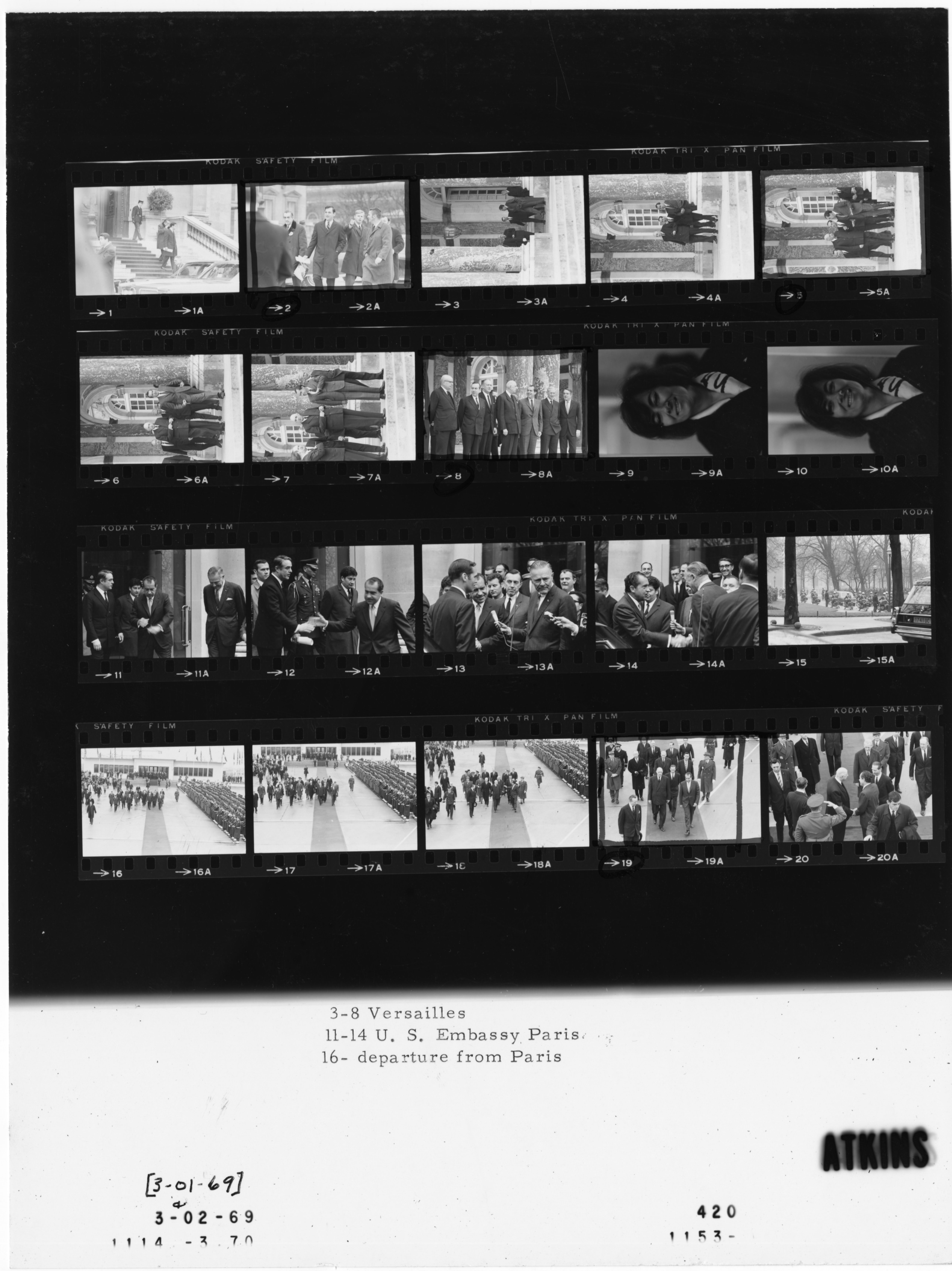
- Frame(s): WHPO-0420-11A-15A, President Nixon, Henry Cabot Lodge, Sargent Shriver, and others leaving after talks with South Vietnamese officials. 3/2/1969, Paris, France American Embassy. President Nixon, Charles de Gaulle, Prime Minister, Maurice Couve de Murville, William Rogers, Sargent Shriver, unidentified officials, possibly an interpreter.
- Frame(s): WHPO-0420-16A-20A, President Nixon and his party from a distance walking on the tarmac prior to departure. President Nixon and President Charles de Gaulle shaking hands. 3/2/1969, Paris, France Orly Field. President Nixon, Charles de Gaulle, Prime Minister, Maurice Couve de Murville, William Rogers, Sargent Shriver, unidentified officials, possibly an interpreter.
- Frame(s): WHPO-0420-19, President Nixon, President Charles de Gaulle, Secretary of State William Rogers, Sargent Shriver, Maurice Couve de Murville, possibly agent Robert Taylor, and officials walking along a red carpet. 3/2/1969, Paris, France Orly Field. President Nixon, Charles de Gaulle, Prime Minister, Maurice Couve de Murville, William Rogers, Sargent Shriver, possibly Robert Taylor, unidentified officials, possibly an interpreter.
Roll WHPO-0421 Photographer: Atkins, Oliver | Color or B&W: B&W
- Frame(s): WHPO-0421-, President Nixon arriving at the American Embassy. President Nixon standing outside with Henry Cabot Lodge and others. Informal seated shots of Nixon with South Vietnam's Vice-President and chief peace negotiator. 3/2/1969, Paris, France American Embassy. President Nixon, Henry Cabot Lodge, William Rogers, Vice-President Nguyen Cao Ky, negotiator Pham Dang Lam, other officials.
- Frame(s): WHPO-0421-08, President Nixon seated with William Rogers, Henry Cabot Lodge, Nguyen Cao Ky and Pham Dang during negotiations for the Vietnam Peace talks. An unidentified official stands in the shadows behind them. 3/2/1969, Paris, France American Embassy. L-R: Vice-President Nguyen Cao Ky of South Vietnam, President Nixon, William Rogers, Henry Cabot Lodge, negotiator Pham Dang Lam, unidentified official.
Roll WHPO-0422 Photographer: Atkins, Oliver | Color or B&W: B&W
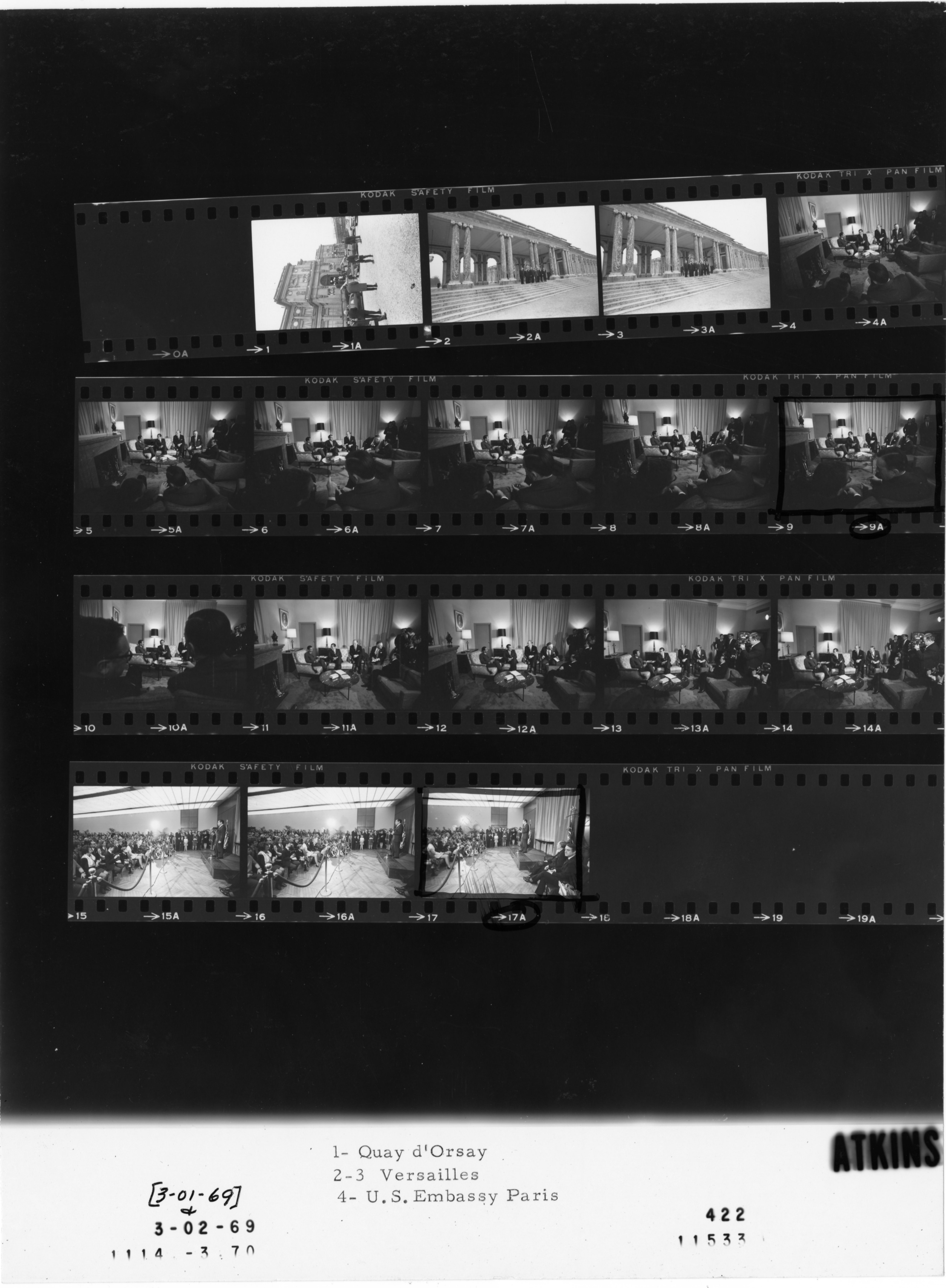
- Frame(s): WHPO-0422-04A-14A, President Nixon seated informally with American and South Vietnamese officials, reporters looking on. 3/2/1969, Paris, France American Embassy. President Nixon, Henry Cabot Lodge, William Rogers, South Vietnam Vice-President Nguyen Cao Ky, South Vietnam chief peace negotiator Pham Dang Lam, press corps.
- Frame(s): WHPO-0422-15A-17A, President Nixon standing at a microphone addressing Embassy employees. 3/2/1969, Paris, France American Embassy. President Nixon, Sargent Shriver, William Rogers, Embassy employees.
Roll WHPO-0423 Photographer: Knudsen, Robert L. | Color or B&W: B&W
- Frame(s): WHPO-0423-02-05, Vietnamese officials leaving the American Embassy in Paris, after their talks with President Nixon. 3/2/1969, Paris, France American Embassy. Unidentified Vietnamese officials, press corps reporters.
- Frame(s): WHPO-0423-06-12, A portrait study of unidentified men standing out of doors in Paris, France. 3/2/1969, Paris, France unknown, possibly support staff and journalists.
- Frame(s): WHPO-0423-13-28, President Nixon inside the Grand Salon, trading farewell comments at a microphone with Charles de Gaulle. The Nixon Presidential party walking to Air Force One. 3/2/1969, Paris, France Orly Field. President Nixon, Charles de Gaulle, Kissinger, William Rogers, Ehrlichman, Haldeman, other officials.
Roll WHPO-0424 Photographer: Knudsen, Robert L. | Color or B&W: B&W

- Frame(s): WHPO-0424-, President Nixon's departure ceremony, both inside and outside. Informal photos of Henry Cabot Lodge, Henry Kissinger and William Rogers talking while seated. President Nixon and Charles de Gaulle standing at a microphone. 3/2/1969, Paris, France Grand Salon and tarmac, Orly Field. President Nixon, Charles de Gaulle, William Rogers, Henry Kissinger, Henry Cabot Lodge, H.R. Haldeman, John Ehrlichman, other officials.
- Frame(s): WHPO-0424-06A, Departure ceremony, Henry Cabot Lodge, Henry Kissinger, and William Rogers talking while seated. 3/2/1969, Paris, France Grand Salon and tarmac, Orly Field. Henry Cabot Lodge, Henry Kissinger, William Rogers.
- Frame(s): WHPO-0424-17A, President Nixon and Charles de Gaulle standing at a microphone during Nixon's departure ceremony. Behind them stand H.R. Haldeman, John Ehrlichman, Henry Kissinger, and Secretary of State William Rogers. 3/2/1969, Paris, France Grand Salon and tarmac, Orly Field. President Nixon, Charles de Gaulle, William Rogers, Henry Kissinger, H.R. Haldeman, John Ehrlichman.
The White House Communications Agency Sound Recordings Collection contains public statements that took place between 1969 and 1974. Visit the finding aid to learn more.
P - Formal Presidential Remarks
- WHCA-SR-P-690302
Remarks by President Nixon at the American Embassy in Paris, with Ambassador R. Sargent Shriver, Jr. (3/2/1969, American Embassy in Paris)
Runtime: 10:25
Keywords: 1969 trip to Europe
Original Format: 1/4-inch reel-to-reel audiotape. Original source type: Original. - WHCA-SR-P-690303
Remarks by President Nixon at Orly Airport on Departure From France, with Remarks by President DeGaulle. (3/2/1969, Orly Airport near Paris)
Runtime: 0:50
Keywords: 1969 trip to Europe
Original Format: 1/4-inch reel-to-reel audiotape. Original source type: Original. - WHCA-SR-P-690304
Remarks by President Nixon and Pope Paul VI in the Vatican. (3/2/1969, Papal Salon at the Vatican)
Runtime: 2:10
Keywords: 1969 trip to Europe
Original Format: 1/4-inch reel-to-reel audiotape. Original source type: Original. - WHCA-SR-P-690305
Remarks by President Nixon to American Priests and Students at the Vatican. (3/2/1969, Salla Clementine at the Vatican)
Runtime: 7:09
Keywords: 1969 trip to Europe
Original Format: 1/4-inch reel-to-reel audiotape. Original source type: Original. - WHCA-SR-P-690306
Remarks by President Nixon at Andrews Air Force Base on Returning From Europe, with welcoming remarks by Vice President Agnew. (3/2/1969, Andrews Air Force Base, Maryland)
Runtime: 3:06
Keywords: 1969 trip to Europe
Original Format: 1/4-inch reel-to-reel audiotape. Original source type: Original.
The White House Communications Agency Videotape Collection contains “off-the-air” recordings of televised programs produced between 1968 and 1974. Visit the finding aid to learn more.
- WHCA-3239
The President in Rome, Part One.
NBC, CBS
Runtime: 1:00 - WHCA-3240
The President in Rome, Part Two AND The President in Europe.
ABC, CBS
Runtime: 1:00 - WHCA-3241
The President in Europe (ABC) AND The President in Europe (CBS).
NBC
Runtime: 1:00 - WHCA-3242
"A Time of Consultation". President Richard Nixon, (with excerpt of Hubert Humphrey and George McGovern unidentified footage).
CBS
Runtime: 00:59:52
Context (External Sources)
The Vanderbilt Television News Archive is the world's most extensive and complete archive of television news. They have been recording, preserving and providing access to television news broadcasts of the national networks since August 5, 1968.
Wikipedia is a free encyclopedia that anyone can edit.