
Introduction
This almanac page for Saturday, March 1, 1969, pulls together various records created by the federal government and links to additional resources which can provide context about the events of the day.
Previous Date: Friday, February 28, 1969
Next Date: Sunday, March 2, 1969
Schedule and Public Documents
The Daily Diary files represent a consolidated record of the President's activities. Visit the finding aid to learn more.
The President's day began at Paris, France
The Weekly Compilation of Presidential Documents made available transcripts of the President's news conferences; messages to Congress; public speeches, remarks, and statements; and other Presidential materials released by the White House.
Announcements
- Flood Threat From Accumulated Snow (5 Weekly Comp. Pres. Doc. 349, March 1, 1969)
Announcement of Preparations To Reduce or Alleviate Possible Damage.
European Trip
- Dinner Honoring President de Gaulle (5 Weekly Comp. Pres. Doc. 348, March 1, 1969)
Exchange of Toasts Between President Nixon and President de Gaulle at a Dinner Honoring the French President and Madame de Gaulle at the Residence of the American Ambassador. - Paris Discussions on Developments in Berlin (5 Weekly Comp. Pres. Doc. 349, March 1, 1969)
Announcement of Meeting of Secretary of State William P. Rogers With Sigismund von Braun, Ambassador to France of the Federal Republic of Germany.
White House Statements
- Presidential Directives on Domestic Issues (5 Weekly Comp. Pres. Doc. 349, March 1, 1969)
White House Statement on Directives Calling ofr Action or Recommendations by Government Departments and Agencies, With List of the Directives.
Checklist of White House Press Releases
The releases listed below, made public by the Office of the White House Press Secretary during the period covered by this issue, are not included in the issue.
- List of French citizens who met with the President.
Each Public Papers of the Presidents volume contains the papers and speeches of the President of the United States that were issued by the White House Office of the Press Secretary during the time period specified by the volume. The material is presented in chronological order, and the dates shown in the headings are the dates of the documents or events. In instances when the release date differs from the date of the document itself, that fact is shown in the text note.
To ensure accuracy, remarks have been checked against audio recordings (when available) and signed documents have been checked against the original, unless otherwise noted. Editors have provided text notes and cross references for purposes of identification or clarity.
The Federal Register is the official daily publication for rules, proposed rules, and notices of federal agencies and organizations, as well as executive orders and other Presidential documents.
Archival Holdings
Any selection of archival documents will necessarily be partial. You should use the documents and folders identified below as a starting place, but consult the linked collection finding aids and folder title lists and the collections themselves for context. Many documents to be found this way do not lend themselves to association with specific dates, but are essential to a complete understanding of the material.
Selective document listing
President's Office Files
The President's Office Files consists of materials drawn together by the Special Files Unit from several administrative subdivisions within the White House Office. It is the handwriting and sensitive papers sent to the Staff Secretary that now comprise much of the President's Office Files. Visit the finding aid to learn more.
- Annotated News Summaries, Box 28, News Summaries - March 1969 [During this period, the Staff Secretary only removed pages from the News Summaries which contained President Nixon's handwriting, often leaving the document with no date. Although there are no specific documents with this date, you should also consult the full folder for the month.]
President's Personal File
The President's Personal File is essentially a President's secretary's file, kept by Rose Mary Woods, personal secretary to the President, for two purposes: (1) preserving for posterity a collection of documents particularly close to the President, whether because he dictated or annotated them, or because of the importance of the correspondent or the event concerned and (2) giving appropriate attention–letters of gratitude, invitations to White House social events, and the like–to members and important friends and supporters of the Nixon administration. This generalization does not describe all the varied materials of a file group which is essentially a miscellany, but it does identify the reason for the existence of the file group's core. Visit the finding aid to learn more.
- President's Speech File
The H. R. Haldeman Diaries consists of seven handwritten diaries, 36 dictated diaries recorded as sound recordings, and two handwritten audio cassette tape subject logs. The diaries and logs reflect H. R. Haldeman’s candid personal record and reflections on events, issues, and people encountered during his service in the Nixon White House. As administrative assistant to the President and Chief of Staff, Haldeman attended and participated in public events and private meetings covering the entire scope of issues in which the Nixon White House engaged in during the years 1969-1973. Visit the finding aid to learn more.
- Transcript of diary entry (PDF)
Saturday, March 1.
Paris
Saturday - we left the Quai by motorcade (after breakfast in state dining room) for Versailles. All the roads en route completely closed off in both directions, and uniformed guards at attention every fifty yards, the entire way. Also many plainclothes men along the route and scattered back through the woods, especially in Bois du Bologne.
Arrived at Le Grand Trianon, met at steps by de Gaulle. He and President went right in to start their talks. Ehrlichman and I then went to Versailles Palace and had a special tour arranged by M. Vander Kamp, the curator. Had our guide, and an interpreter. Covered all of the public tour, and went into many back rooms and private chambers not shown to the public. Would like to go back in spring when the gardens are in bloom. At two, we went back to Trianon to get pictures of President and de Gaulle. Then lunch at the Trianon hotel and back to Paris for John to find maps on the Rive Gauche.
President didn't get back to the Quai until after 6:00 - so put in a nine hour working day, before the U.S. State Dinner at the Residence. Then left at 7:45 for the dinner. Kissinger says that talks went extremely well and that our mission is accomplished.
The big issue now is the Berlin blockade. They lowered the gate, and so we are now sending extra convoys down the autobahn at an increasing rate to call their bluff. We are prepared to fight our way through if necessary. Four convoys got through today and we're sending eight tomorrow, and then a hundred plus vehicles on Monday. The point is to build up our average daily volume, so if there is a civilian blockade, we'll have a higher level of allowable military traffic which we feel they will not try to cut off.
As for the future possibility, ref. p. 9, it has had to be called off because State will not accept responsibility, and risk otherwise is too great. Kissinger very disappointed.
Dinner at the Residence worked out pretty well, but there were too many people (about eighty) for the House to handle comfortably. Toasts were again very warm and considered very significant. De Gaulle said this visit had increased his admiration of President, if that were possible. Yehudi Menuhin played. Very good. Interesting to watch Eunice Shriver last night and tonight - she obviously hates seeing Nixon as President, and is astonishingly old and worn-looking. She talked to herself and winced all through the toasts, both nights, and must have been thinking back to JFK. His visit here was all ceremony and no substance. But it was a great show and made an indelible impression.
Tomorrow we leave for Rome then home.
Sunday morning President met with Vietnam group about Paris Peace Talks. We slept in, had leisurely breakfast, packed, and did a little sightseeing. Ehrlichman and I went to the bird market, Montmartre, and the Louvre. Then out to the airport, where de Gaulle again went all out in his farewell speech. President announced de Gaulle would visit United States in January or
February. This was the big news. More ceremonies and we're off. - Handwritten diary entry (JPG)
The National Archives Catalog is the online portal to the records held at the National Archives, and information about those records. It is the main way of describing our holdings and also provides access to electronic records and digitized versions of our holdings.
The Catalog searches across multiple National Archives resources at once, including archival descriptions, digitized and electronic records, authority records, and web pages from Archives.gov and the Presidential Libraries. The Catalog also allows users to contribute to digitized historical records through tagging and transcription.
Nixon Library Holdings
All National Archives Units
National Security Documents
The President's Daily Brief is the primary vehicle for summarizing the day-to-day sensitive intelligence and analysis, as well as late-breaking reports, for the White House on current and future national security issues. Read "The President's Daily Brief: Delivering Intelligence to Nixon and Ford" to learn more.
- President's Daily Brief of 01 March 1969 [consult link for visuals and extent of redactions]
The President's Daily Brief
1 March 1969
19
Top Secret
I. MAJOR DEVELOPMENTS
MIDDLE EAST
The Dayan forces are wasting no time pressing their man's case. A Tel Aviv broadcast the day before Eshkol's funeral cites their claims that a petition campaign for "Moshe Dayan as premier within or outside the Labor Party" has already come up with 47,000 signatures. Mrs. Meir and Pinhas Sapir, the Labor Party secretary general, have both attacked the petition drive. Mrs. Meir said it was "undemocratic"--"the party and not the street will decide who will be the candidate for prime minister."
We are not sure Dayan himself is behind this activity. Ambassador Barbour in Tel Aviv in fact reported yesterday that there was a good deal of talk about Dayan's not being "in fighting spirit" at this stage.
EUROPE
As the press has reported, things in Rome are simmering down. The Italian police arrested 194 people in connection with Thursday night's demonstrations; eight of these were ultimately placed under arrest. Fourteen civilians were injured, five of them seriously enough to be hospitalized. The only word on the student who died is that he fell from the roof of the Rome Teaching Faculty building. This part of the building is still occupied by the students, however, and the police have not been able to verify the report.
SOVIET AFFAIRS
The Soviet note delivered to the East German Government yesterday can be construed as giving Ulbricht a virtual free hand in hampering West German traffic to and from Berlin. The note raised the familiar claim that Bonn was illegally recruiting soldiers and manufacturing military and strategic goods in West Berlin and secretly transferring them to West Germany.
The East Germans almost immediately ordered their checkpoint officials to begin applying an already-existing decree which bans the transport of goods- used "for military purposes" across their territory. This decree is deliberately worded so that the East Germans can ban the transport of most of the goods manufactured in West Berlin as well as materials sent to the city for use in their manufacture. The reference to the alleged recruitment of West Berliners for service in the West German armed forces, moreover, provides Pankow still another rationale for at least slowing down all passenger traffic.
Soviet Deputy Foreign Minister Semenov and Marshal Yakubovsky, commander of the Warsaw Pact, arrived in East Berlin from Moscow yesterday and met with Ulbricht and other East German political and military officials. Moscow had announced on 20 February that Yakubovsky would direct a joint Soviet - East German exercise early in March.
Meanwhile, units from at least two, and perhaps as many as four, of the five Soviet armies in East Germany appear to be preparing for the exercise. They are located in a training area between Berlin and the West German border, along with units from an East German division. Soviet tactical aircraft have not yet moved to alternate bases near Berlin and its air corridors to the West.
Chancellor Kiesinger, Foreign Minister Brandt, and Mayor Schuetz had earlier publicly aired their views that the presidential election will take place in Berlin next Wednesday, as scheduled. Implicit in their statements, however, was the thought that a last-minute deal would not be entirely ruled out. According to Kiesinger's press secretary, Sunday is the last day on which a change of venue can be arranged. Thereafter, he implied, technical arrangements would have to go forward.
VIETNAM
The scope and intensity of enemy activity throughout South Vietnam slackened considerably on 28 February, for the second consecutive day, suggesting the opening phase of the Communist's offensive may be drawing to a close as they regroup, refit and assess the results of their initial round of attacks. It is not clear how long this lull will last. There is strong evidence, however, that the offensive will be resumed, probably on a countrywide basis, and quite possibly featuring operations by at least some of the large numbers of main force units which have not yet been committed.
Except for sporadic fire fights in Saigon's outlying districts and one isolated terrorist incident downtown, Saigon remained free of enemy activity yesterday. Hue, so far unscathed during the offensive, also was quiet. There has been no significant enemy activity at Da Nang since the heavy explosions in the dock area of 27-28 February that caused numerous US casualties and destroyed nearly 350 tons of ammunition.
In I Corps, little significant ground fighting developed in any of the northern provinces or in the area of the Demilitarized Zone. Allied forces on sweep operations in the northern A Shau Valley uncovered more than 100 tons of enemy arms and munitions. No enemy actions of significance occurred in the II Corps area. Although no major actions were reported in III Corps, large numbers of enemy troops continued to be noted along the approach routes to the allied military complex at Bien Hoa - Long Binh and in the vicinity of the provincial capitals of Song Be and An Loe in the northern sector. Viet Cong activity in the Mekong Delta was generally light and scattered.
* * *
Thieu and Ky are edging closer to opening direct contact with the Liberation Front in Paris. Ky told Ambassador Lodge on 26 February that he is "available" to talk to the Viet Cong in Paris and that Thieu has authorized him to offer a deal. In exchange for the withdrawal of all North Vietnamese north of the 17th Parallel, the GVN would allow all Viet Cong to be eligible to vote and to run as candidates in elections for the senate, the assembly, local offices, and even the presidency in 1971.
This approach is a major step forward on the part of Thieu and Ky and indicates that they are now more confident of their strength in South Vietnam. It is clear from Ky's remarks to Ambassador Lodge, however, that he and Thieu want the US not only to tell them whether they ought to continue down this path but also to hold their hands while they travel it. The degree to which Ky and Thieu are counting on continuing US help was revealed in Ky's comment to Ambassador Lodge that the US could dissuade various nationalist candidates from running for the presidency, thereby avoiding a split in the anti-Communist vote.
The Communists would be intrigued and enticed by any discreet approach from Ky to open talks, despite their frequent assertions that they will not deal with the present GVN leadership. If the Communists were convinced that Ky genuinely wants discussions involving the political future of South Vietnam, they would probably agree to meet with him. They might, however, seek to establish through an intermediary beforehand precisely what Ky has to offer. Thieu has previously suggested that the soviets or the US might have to play the role of intermediary in establishing contact between the Front and the GVN.
At present, however, the Communists are trying to encourage the US to open direct talks with the Liberation Front and they might regard an approach by Ky as nothing more than a US counter to their own strategy. [redacted]
On the issue of mutual de-escalation, it is possible that the Communists may soon become more active. In response to allied protests about the current Communist offensive, both Hanoi and the Front have repeatedly taken the line that US "intensification" of the war has made this necessary and that the first requirement for progress in Paris is cessation of US "aggression." Justifying Communist military activity on grounds of "self-defense" is nothing new, but perhaps something more is involved in this current emphasis, and it is conceivable that the Communists may try to bring about some mutual reduction in hostilities before long.
The main argument against the Communists pushing for a cease-fire, or even for significant de-escalation, is that one of their main forms of pressure on the Allies would be reduced. The Communists generally have been negative about the idea of an early cease-fire or de-escalation, calling them inappropriate until the shape of a settlement is clear, or arguing that the US only wants to use a cease-fire as a device to tie the hands of Communist forces while the Allies continue to build a "position of strength."
We doubt very much that the Communists want or will press for a formal cease-fire until they have a settlement pretty well nailed down. It is conceivable, however, that the current offensive might be capped by an attempt by the Communists to bring about some kind of tacit reduction in the level of fighting in South Vietnam. In a post-offensive period when their forces presumably would be resting and regrouping anyway, the Communists might see some advantage in trying to curb US military activities.
The Communists clearly have an elaborate political scenario devised to accompany the current military offensive. There are many indications that the Communist political offensive this time is to center on agitation of the peace issue in support of their call for a "peace cabinet" in Saigon.
If after widespread, intensive fighting there appeared to be no end of the fighting in sight, a peace campaign might have considerable appeal both in South Vietnam and elsewhere, particularly if it were coupled with suggestions that a reduction in the fighting could be prolonged if the Allies were willing to curb their military operations.
A successful Communist effort to take advantage of widespread sentiment for peace is one of the few ways they might be able to muster any real popular response in South Vietnam and to bring about activities such as demonstrations and strikes which would serve their ends. There is a good chance such an effort is going to be mounted before long.
II. OTHER MAJOR DEVELOPMENTS
SPAIN
Madrid has just given a sign of flexibility over the 26 March deadline for concluding the negotiations on the base renewal agreement. A high Foreign Ministry official told the US Embassy that if no agreement is reached by then, negotiations could still continue. He said that in this event the one-year phase-out period for dismantling the bases which technically starts on the deadline date--could perhaps be deferred in return for an interim military assistance package.
The Foreign Relations of the United States series presents the official documentary historical record of major U.S. foreign policy decisions and significant diplomatic activity. Visit the State Department website for more information.
Vol. XXIX, Eastern Mediterranean, 1969-1972
Greece
241. Memorandum of Conversation , Washington, March 1, 1969, 11 a.m.
Source: National Archives, RG 59, Central Files 1967–69, POL 17 GREECE–US. Confidential. Drafted by Brewster on March 3 and approved in U on March 5.
Vol. XXXIV, National Security Policy, 1969-1972
Parity, Safeguard, and the SS-9 Controversy
13. Memorandum of Conversation , Versailles, March 1, 1969
Source: National Archives, Nixon Presidential Materials, NSC Files, Box 1023, President/HAK Memcons, Memcons—The President/Gen. De Gaulle, February 28–March 2, 1969. No classification marking. The meeting took place in the Grand Trianon Palace in Versailles. Nixon traveled in Europe from February 23 through March 2. Presidents de Gaulle and Nixon held discussions focusing on the Soviet Union on February 28; on Germany, Berlin, and the future of Europe during the morning of March 1; and on economic matters on March 2. Memoranda of these conversations are ibid. The record of the talks held on the morning of March 1 is scheduled for publication in Foreign Relations, 1969–1976, volume XLI, Western Europe; NATO, 1969–1972. The memorandum of conversation of the March 1 discussion of economic matters is ibid., volume III, Foreign Economic Policy, 1969–1972; International Monetary Policy, 1969–1972, Document 7. For Nixon’s recollections of these meetings, see Nixon, RN, pp. 371–375.
Vol. XLI, Western Europe; NATO, 1969-1972
France
118. Memorandum of Conversation , Paris, March 1, 1969
Source: National Archives, Nixon Presidential Materials, NSC Files, Box 1023, Presidential/HAK MemCons. No classification marking. The meeting took place in the Grand Trianon in Versailles. Presidents de Gaulle and Nixon held discussions focusing on the Soviet Union on February 28, on armaments and the U.S. role in Europe on the afternoon of March 1, and on economic matters and Vietnam on March 2. Memoranda of these conversations are ibid. The portion of the March 2 memorandum of conversation on economic matters is printed in Foreign Relations, 1969–1976, volume III, Foreign Economic Policy, 1969–1972; International Monetary Policy, 1969–1972, Document 7. For Nixon’s recollections of these meetings, see Nixon, RN , pp. 371–375.
Vol. E-2, Documents on Arms Control and Nonproliferation, 1969-1972
Nuclear Non-Proliferation Treaty; Implementation of Safeguard System
13. Study Prepared by Ad Hoc Interagency Group , Washington, March 1, 1969
Prepared in response to NSSM 13, the study outlined three courses of action that the U.S. could utilize to secure the signing and ratification of NPT that ranged from a passive approach to a uniquely tailored and intensive treatment. In the 28-page discussion, not published here, the Ad Hoc Interagency Group recommended courses of action on a country-by-county basis.
Source: National Archives, Nixon Presidential Materials, NSC Files, NSC Institutional Files (H-Files), Box H–34, Senior Review Group Meeting, 3/6/69. Secret.
Vol. E-5, Part 1, Documents on Sub-Saharan Africa, 1969-1972
Nigerian Civil War
48. Memorandum of Conversation , Paria, March 1, 1969, 10 a.m.
According to this draft memorandum, French Foreign Minister Michel Debri emphasized Franceʼs support for Biafra on moral and political grounds while Secretary of State William Rogers stressed the necessity for humanitarian relief on both sides.
Source: National Archives, RG 59, Conference Files 1969–1972, Box 484, Presidentʼs Trip to Europe 2/23–3/2/69, Chronology, Memcons—Vol. I of VIII. Secret. The conversation took place in the Grand Trianon.
Audiovisual Holdings
The White House Photo Office collection consists of photographic coverage of President Richard Nixon meeting with prominent social, political, and cultural personalities; speaking engagements and news conferences of the President and various high-ranking members of the White House staff and Cabinet; Presidential domestic and foreign travel, including Presidential vacations; social events and entertainment involving the First Family, including entertainers present; official portraits of the President, First Family, and high-ranking members of the Nixon administration; the 1969 and 1973 Inaugurals; the President’s 1972 Presidential election campaign appearances (including speeches) and other official activities of the White House staff and the President’s Cabinet from January 20, 1969 until August 9, 1974 at the White House and the Old Executive Office Building; other locations in Washington, DC, such as The Mall; and the Presidential retreats in Camp David, Maryland, Key Biscayne, Florida, and San Clemente, California. Visit the finding aid to learn more.
Roll WHPO-0415 Photographer: Atkins, Oliver | Color or B&W: B&W
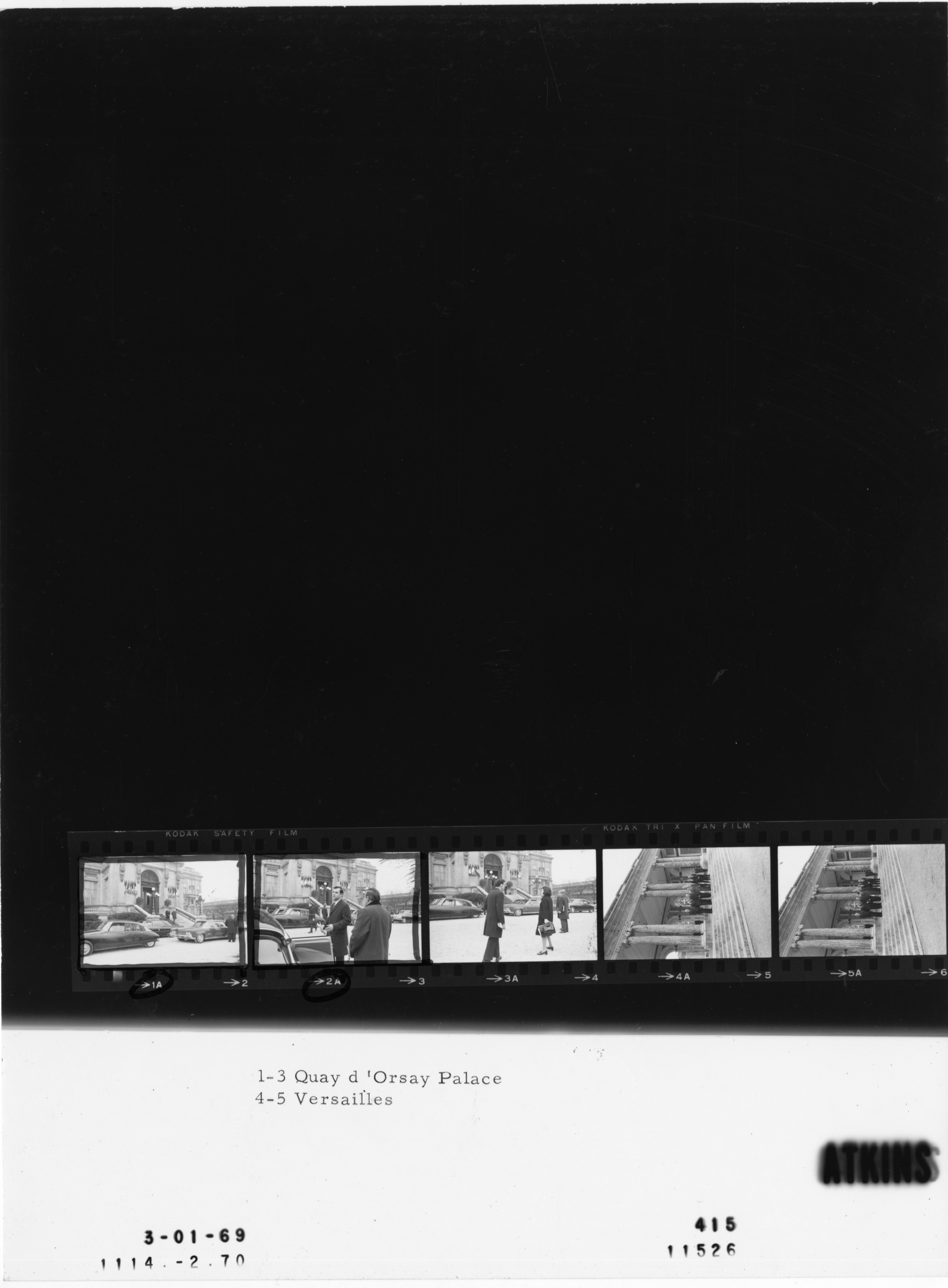
- Frame(s): WHPO-0415-04A-05A, President Nixon, Charles de Gaulle, and other in a group shot on the steps of the Trianon in Versailles. 3/1/1969, Versailles, France Trianon. President Nixon, Charles de Gaulle, other officials.
Roll WHPO-0416 Photographer: Knudsen, Robert L. | Color or B&W: B&W
- Frame(s): WHPO-0416-, President Nixon arriving at the American Embassy. Nixon greeting invited French citizens and sitting with them around a conference table. Nixon shaking hands with Embassy employees and Marine guard. 3/1/1969, Paris, France American Embassy. President Nixon, Henry Kissinger, American officials, French citizens.
Roll WHPO-0417 Photographer: Knudsen, Robert L. | Color or B&W: B&W
- Frame(s): WHPO-0417-02-10, President Nixon meeting with French citizens around a conference table. 3/1/1969, Paris, France American Embassy. President Nixon, Henry Kissinger, French citizens, American officials.
- Frame(s): WHPO-0417-11-25, Tables set for a formal state dinner honoring Charles de Gaulle. Receiving line seen from a distance. 3/1/1969, Paris, France American Ambassador's residence. President Nixon, Charles de Gaulle, Madame de Gaulle, Ambassador Sargent Shriver, other officials, guests.
Roll WHPO-0418 Photographer: Knudsen, Robert L. | Color or B&W: B&W
- Frame(s): WHPO-0418-, Guests at black tie dinner honoring Charles de Gaulle seated at tables. 3/1/1969, Paris, France American Ambassador's residence. President Nixon, Charles de Gaulle, Henry Kissinger, invited guests.
Roll WHPO-0419 Photographer: Knudsen, Robert L. | Color or B&W: B&W
- Frame(s): WHPO-0419-, President Nixon, President Charles de Gaulle, Madame de Gaulle, and Ambassador Sargent Shriver stand together in a receiving line greeting guests before a state dinner honoring President de Gaulle. 3/1/1969, Paris, France American Ambassador's residence. President Nixon, Charles de Gaulle, Madame de Gaulle, Sargent Shriver, officials, guests.
- Frame(s): WHPO-0419-10A, President Nixon, President Charles de Gaulle, Madame de Gaulle, and Ambassador Sargent Shriver stand together in a receiving line greeting guests before a state dinner honoring President de Gaulle. 3/1/1969, Paris, France American Ambassador's residence. President Nixon, Charles de Gaulle, Madame de Gaulle, Sargent Shriver, officials, guests.
Roll WHPO-0420 Photographer: Atkins, Oliver | Color or B&W: B&W
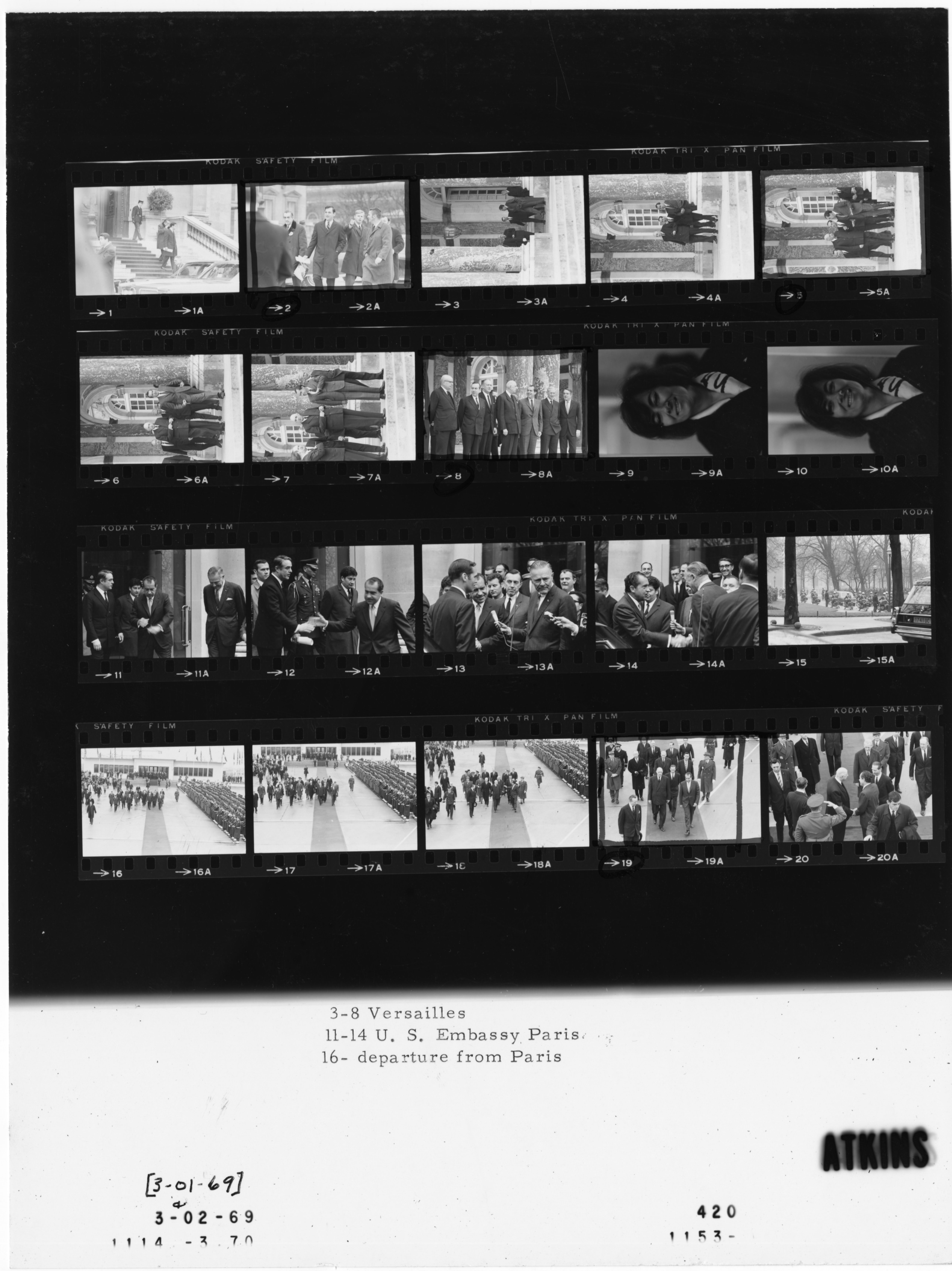
- Frame(s): WHPO-0420-03A-08A, President Nixon and President Charles de Gaulle leaving the Trianon and standing in a group photo. 3/1/1969, Versailles, France Trianon. President Nixon, Charles de Gaulle, Maurice Couve de Murville, William Rogers, Sargent Shriver, unidentified officials, possibly an interpreter.
- Frame(s): WHPO-0420-05, President Nixon and President Charles de Gaulle talk while walking away from the Trianon. 3/1/1969, Versailles, France Trianon. President Nixon, Charles de Gaulle, Maurice Couve de Murville, William Rogers, unidentified officials, possibly an interpreter.
- Frame(s): WHPO-0420-08A, President Nixon, President Charles de Gaulle, Secretary of State William Rogers, Maurice Couve de Murville, possibly Sargent Shriver, and other officials standing together outside the Trianon. 3/1/1969, Versailles, France Trianon. President Nixon, Charles de Gaulle, Prime Minister, Maurice Couve de Murville, William Rogers, unidentified officials, possibly an interpreter, possibly Sargent Shriver.
Roll WHPO-0422 Photographer: Atkins, Oliver | Color or B&W: B&W
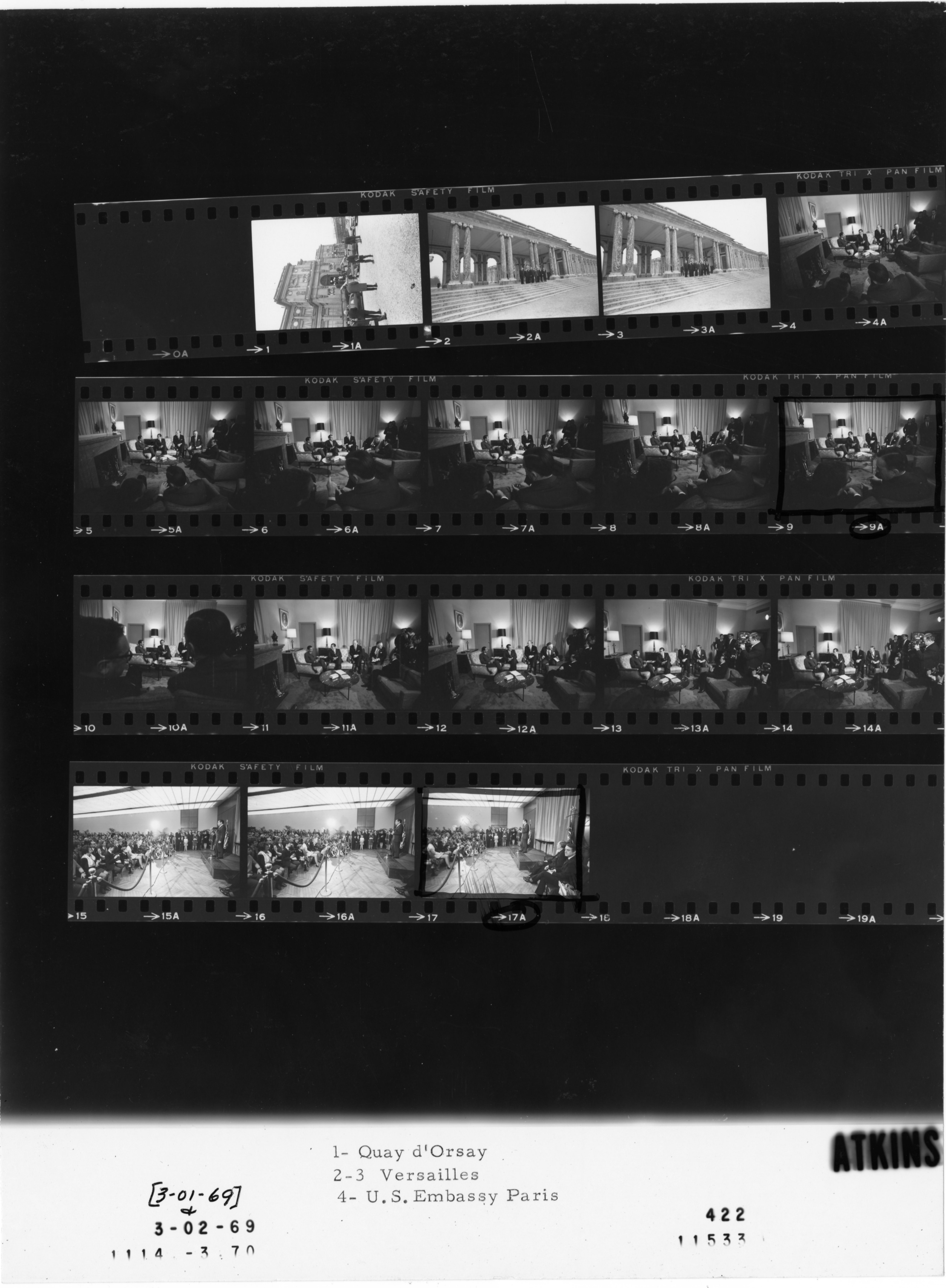
- Frame(s): WHPO-0422-02A-03A, Government officials seen outside on the steps of the Trianon. 3/1/1969, Versailles, France Trianon.
The White House Communications Agency Sound Recordings Collection contains public statements that took place between 1969 and 1974. Visit the finding aid to learn more.
P - Formal Presidential Remarks
- WHCA-SR-P-690301
Exchange of toasts by President Nixon and President de Gaulle at a Dinner at the American Ambassador's Residence. (3/1/1969, American Ambassador's Residence, Paris)
Runtime: 3:37
Keywords: 1969 trip to Europe
Original Format: 1/4-inch reel-to-reel audiotape. Original source type: Original.
The White House Communications Agency Videotape Collection contains “off-the-air” recordings of televised programs produced between 1968 and 1974. Visit the finding aid to learn more.
- WHCA-3238
Huntley-Brinkley Coverage of the President's Trip.
NBC
Runtime: 1:00
Context (External Sources)
The Vanderbilt Television News Archive is the world's most extensive and complete archive of television news. They have been recording, preserving and providing access to television news broadcasts of the national networks since August 5, 1968.
Wikipedia is a free encyclopedia that anyone can edit.