
Introduction
This almanac page for Thursday, June 29, 1972, pulls together various records created by the federal government and links to additional resources which can provide context about the events of the day.
Previous Date: Wednesday, June 28, 1972
Next Date: Friday, June 30, 1972
Schedule and Public Documents
The Daily Diary files represent a consolidated record of the President's activities. Visit the finding aid to learn more.
The President's day began at Camp David, Maryland
The Weekly Compilation of Presidential Documents made available transcripts of the President's news conferences; messages to Congress; public speeches, remarks, and statements; and other Presidential materials released by the White House.
Digitized versions can be found at HathiTrust.
Each Public Papers of the Presidents volume contains the papers and speeches of the President of the United States that were issued by the White House Office of the Press Secretary during the time period specified by the volume. The material is presented in chronological order, and the dates shown in the headings are the dates of the documents or events. In instances when the release date differs from the date of the document itself, that fact is shown in the text note.
To ensure accuracy, remarks have been checked against audio recordings (when available) and signed documents have been checked against the original, unless otherwise noted. Editors have provided text notes and cross references for purposes of identification or clarity.
The Federal Register is the official daily publication for rules, proposed rules, and notices of federal agencies and organizations, as well as executive orders and other Presidential documents.
The Congressional Record is the official daily record of the debates and proceedings of the U.S. Congress.
Decided
Archival Holdings
Any selection of archival documents will necessarily be partial. You should use the documents and folders identified below as a starting place, but consult the linked collection finding aids and folder title lists and the collections themselves for context. Many documents to be found this way do not lend themselves to association with specific dates, but are essential to a complete understanding of the material.
Selective document listing
President's Office Files
The President's Office Files consists of materials drawn together by the Special Files Unit from several administrative subdivisions within the White House Office. It is the handwriting and sensitive papers sent to the Staff Secretary that now comprise much of the President's Office Files. Visit the finding aid to learn more.
- News Summaries, Annotated News Summaries, Box 36, June 1972 26-29 [2 of 3] [Note: Due to the way News Summary products were compiled, you should also consult nearby days for potentially relevant materials.]
- News Conference Commentary and Wires, June 29, 1972
- News Summaries, Annotated News Summaries, Box 36, June 1972 26-29 [3 of 3]
- News Summary, June 29, 1972, (Wed. nets, wires, columns)
- News Summaries, Annotated News Summaries, Box 36, July 1-24, 1972 [1 of 4]
- Special Reports: Coverage of the President's June 28 Withdrawal Announcement and Initial Coverage of the June 29 News Conference
President's Personal File
The President's Personal File is essentially a President's secretary's file, kept by Rose Mary Woods, personal secretary to the President, for two purposes: (1) preserving for posterity a collection of documents particularly close to the President, whether because he dictated or annotated them, or because of the importance of the correspondent or the event concerned and (2) giving appropriate attention–letters of gratitude, invitations to White House social events, and the like–to members and important friends and supporters of the Nixon administration. This generalization does not describe all the varied materials of a file group which is essentially a miscellany, but it does identify the reason for the existence of the file group's core. Visit the finding aid to learn more.
- President's Speech File
Among Pat Buchanan’s duties was the compilation and coordination of background briefing materials for Presidential and a few Vice Presidential press conferences. The briefings—for both the larger, announced press conferences and the smaller, informal ones held in the Oval Office—related to a widespread number of topics and were in the form of probable questions which the White House staff members anticipated news reporters would address to the President. Along with the questions, were answers recommended by Buchanan, other members of the White House staff, and the heads of major departments of the government.
The briefing books are primarily in the form of potential questions and suggested answers (often with heavy annotation by President Nixon), along with associated memos. A listing of briefing books is below, with indication of whether President Nixon annotated the book or not. Each book has an index to the potential questions with direct links to the National Archives Catalog. You should consult the full digital folder for suggested responses, President Nixon's annotations, and other documents and topics not covered by the index.
Foreign from HAK [June 29, 1972] (Annotated)
Citation: Foreign from HAK [June 29, 1972]; box 5; White House Central Files: Staff Member and Office Files: Patrick J. Buchanan; Richard Nixon Presidential Library and Museum, Yorba Linda, CA
Consult the full digital folder for other briefing materials not in the form of prepared questions and answers.
- CURRENT SITUATION ON BATTLEFIELD
- RESIDUAL FORCE
- EFFECTIVENESS OF MINING AND BOMBING
- CIVILIAN CASUALTIES
- BOMBING HALT CONDITIONS
- SOVIET SUPPLIES IN-TRANSIT VIA CHINA
- GENERAL LAVELLE
- LAIRD TESTIMONY ON WAR COSTS
- KISSINGER - PODGORNY TRIPS
- ROLE OF U. S. GROUND FORCES
- SUMMIT IMPACT ON INDOCHINA
- CHINESE LABOR IN THE NORTH
- INCREASED AIR AND NAVAL ASSETS
- RELATIONS BETWEEN CHINESE, SOVIETS AND HANOI
- BOMBING OF DIKES
- BOMBING AND VIETNAMIZATION
- MORALE IN NORTH VIETNAM
- COMMANDO ATTACKS AGAINST THE NORTH
- CLOUD SEEDING OVER THE NORTH
- PEOPLE'S REPUBLIC OF CHINA
- KOREA
- KISSINGER TRIP TO JAPAN
- KOREA
- PEOPLE'S REPUBLIC OF CHINA
- SEQUENCE OF CONGRESSIONAL ACTION ON SALT AND DEFENSE PROCUREMENT AUTHORIZATION BILL
- SALT
- SALT-SOVIET SUPERIORITY
- SALT
- Are the Soviets testing MIRV? In any case, won't the agreement simply let them catch up in an area where we are ahead and keep us from catching up in the areas they are ahead?
- How do we meet the threat posed by China which the Administration was previously so concerned about in recommending Safeguard?
- Why have we agreed to stop an on-going US ABM defense program while allowing Soviet ABM programs to expand beyond their current deployed levels?
- MOSCOW SUMMIT -- "PEACEFUL COEXISTENCE"
- NATO FORCE LEVELS
- MBFR
- US-SOVIET TRADE
- MOSCOW SUMMIT: TRADE/VIETNAM LINKAGE
- USSR-CHINA
- BURUNDI
- RHODESIAN SANCTIONS
- SOUTHERN AFRICA
- RELATIONS WITH CUBA
- CONNALLY'S TRIP TO LATIN AMERICA
- MEXICO-ECHEVERRIA VISIT
- CUBA -- GUANTANAMO NAVAL BASE
- SOUTH ASIA
- MIDDLE EAST
- In the wake of the Moscow summit, has there been any change in the US position on the Middle East or in the prospects for a peace settlement?
- What is your view of Israeli raids on Lebanon? Do you see a period of increased tension and possible conflict in the Middle East?
- What is the US view of King Hussein's plan for creating an autonomous Palestinian province in Jordan? Was King Hussein promised US support for it?
- MCGOVERN DEFENSE BUDGET
- DEFENSE BUDGET
- TRIDENT AND B-1
- COMPREHENSIVE NUCLEAR TEST BAN
- THE FLOATING POUND
- STOCKHOLM ENVIRONMENT CONFERENCE
- US CONTRIBUTIONS TO THE UN
- WAR POWERS
- EXECUTIVE AGREEMENTS
The H. R. Haldeman Diaries consists of seven handwritten diaries, 36 dictated diaries recorded as sound recordings, and two handwritten audio cassette tape subject logs. The diaries and logs reflect H. R. Haldeman’s candid personal record and reflections on events, issues, and people encountered during his service in the Nixon White House. As administrative assistant to the President and Chief of Staff, Haldeman attended and participated in public events and private meetings covering the entire scope of issues in which the Nixon White House engaged in during the years 1969-1973. Visit the finding aid to learn more.
- Transcript of diary entry (PDF)
Thursday, June 29.
The President stayed at Camp David until mid-afternoon then came down. Holed up at the EOB for the rest of the afternoon preparing for the press conference. He did have me come over right after he got back to give him a report on the Mitchell situation. I had a long talk with John just before that, and fortunately he's come up also with the conclusion that he's got to leave, and he made the big pitch to me as to why, giving me the whole background story on Martha. The fact that she felt Pat Nixon had snubbed her at the Duke alumni reception, and then very definitely Pat had snubbed her at the celebrities reception in California last weekend or the weekend before last. After that, John left without telling her about the Watergate caper. She discovered that in the papers or on TV, blew her stack, got drunk, told her FBI agent and John's secretary, who were staying at the Newporter with her, that her husband had every Democrat in Washington bugged, and then decided she'd call a reporter and tell them so. The FBI agent got concerned at that, called John in Washington and got Fred LaRue, who said if she starts to do that, pull her phone out. So the FBI guy took his key, went up to her room, unlocked the door, went in and pulled her phone out. She then had a monumental tantrum. Started throwing things at him, demolishing the room. They locked her in. She busted the window with her hand, cut herself badly. They had to get a doctor, who had to throw her on the bed and give her a shot in order to subdue her.
Mitchell then sent some friends of theirs out from New York to get her back. They took her to the Westchester Country Club. The press got in to her there. She gave her story out. Her whole pitch is that she's absolutely serious about leaving John if he won't leave the campaign. He feels she's suicidal as well as a little cracked, plus drinking very heavily, and that there's nothing he can do to cure it. He's afraid she'll jump off the balcony at the Watergate. So he's got to quit. He'll stay on as a consultant. Help us with the campaign, but will move to New York and pull out. That solved my having to raise the thing. I played the reluctant role in this instance and it worked out very well. John also listed the possible successors. He had Rumsfeld, MacGregor, Bill Brock, Weinberger, and Bigsby from New York. Bigsby, of course, is out because the President doesn't know him; Rumsfeld because the President has no confidence in him; Brock because he's a sitting Senator and wouldn't have the time and we'd be stuck with his positions; Weinberger because we can't move him out of the job he's in. That leaves MacGregor, which was our choice anyway. Apparently we'll be able to convince Mitchell on that.
McGovern had a bad day today. He lost most of the California delegation on a Credentials Committee ruling and blew his stack, which looked pretty bad on television. Then he's been widely picked up with his quote, that “begging is better than bombing”, that he'd be "happy to go beg Hanoi to release the prisoners." The President had his press conference tonight on TV. Went very well. He let it run 45 minutes. Got a lot of good questions. Some pretty bad ones. He was in better form in a sense because he wasn't so completely programmed. More relaxed, some good quips, little nervousness.
End of June 29. - Original audio recording (MP3)
The National Archives Catalog is the online portal to the records held at the National Archives, and information about those records. It is the main way of describing our holdings and also provides access to electronic records and digitized versions of our holdings.
The Catalog searches across multiple National Archives resources at once, including archival descriptions, digitized and electronic records, authority records, and web pages from Archives.gov and the Presidential Libraries. The Catalog also allows users to contribute to digitized historical records through tagging and transcription.
Nixon Library Holdings
All National Archives Units
National Security Documents
The President's Daily Brief is the primary vehicle for summarizing the day-to-day sensitive intelligence and analysis, as well as late-breaking reports, for the White House on current and future national security issues. Read "The President's Daily Brief: Delivering Intelligence to Nixon and Ford" to learn more.
The Foreign Relations of the United States series presents the official documentary historical record of major U.S. foreign policy decisions and significant diplomatic activity. Visit the State Department website for more information.
Vol. XXIV, Middle East Region and Arabian Peninsula, 1969-1972; Jordan, September 1970
The Two Yemens
192. Telegram From the Department of State to Secretary of State Rogers in Perth, the Interests Section in Sanaa, and the Embassy in Japan, Washington, June 29, 1972, 0130Z
Source: National Archives, Nixon Presidential Materials, NSC Files, Box 953, VIP Visits, Secretary of State’s Visit to the Mid-East and European Countries, June 28–July 7, 1972. Secret; Immediate; Exdis. Drafted on June 28 by Stephen M. Boyd (L/NEA); cleared in L/C, L/M/SCA, and NEA/ARP; and approved by Atherton.
Vol. XXXVI, Energy Crisis, 1969-1974
March 16, 1972-March 6, 1973
125. Memorandum From the President’s Assistant for International Economic Affairs (Flanigan) to Secretary of Labor Shultz and the President’s Assistant for National Security Affairs (Kissinger), Washington, June 29, 1972
Source: National Archives, Nixon Presidential Materials, NSC Files, Box 671, Country Files, Europe, Canada, Vol. III, Sept 71–Dec 72. No classification marking.
Vol. XXXIX, European Security
Prelude to Negotiations, June 1972-November 1972
99. Minutes of a Joint Senior Review Group and Verification Panel Meeting, Washington, June 29, 1972, 3:24-3:55 p.m.
Source: National Archives, Nixon Presidential Materials, NSC Institutional Files (H–Files), Box H–113, SRG Meetings Minutes, Originals, 1972–73. Secret. The meeting took place in the White House Situation Room.
Vol. E-2, Documents on Arms Control and Nonproliferation, 1969-1972
Chemical and Biological Warfare; Geneva Protocol; Biological Weapons Convention
258. Memorandum From the Assistant Secretary of Defense for International Security Affairs (Nutter) to Secretary of Defense Laird, Washington, June 29, 1972
Nutter forwarded a DOD study of chemical warfare initiatives for the Conference of the Committee on Disarmament and offered a detailed analysis of the options presented.
Source: Washington National Records Center, OASD/ISA Files: FRC 330–75–155, 384. Top Secret. Appendices A and B to JCSM–276–72 are not published.
Vol. E-4, Documents on Iran and Iraq, 1969-1972
Iran 1972
209. Backchannel Message From the President’s Assistant for National Security Affairs (Kissinger) to the Former Secretary of the Treasury (Connally), Washington, June 29, 1972
Kissinger sent Connally a background paper and talking points for his upcoming meeting with the Shah of Iran.
Source: National Archives, Nixon Presidential Materials, NSC Files, Box 425, Backchannel, Backchannel Messages, Middle East, 1972. Secret. Haig signed the memo for Kissinger. The memorandum was sent to the Embassy in Singapore for Connally through Hoskinson. The source text is the White House message as approved for transmission. The separate message on the Kurdish problem was not found, but it is clear from previous and subsequent documentation that Connally was instructed to confirm U.S. willingness to cooperate with the Shah in aiding the Kurds.
Vol. E-16, Documents on Chile, 1969-1973
Cool and Correct: The U.S. Response to the Allende Administration, November 5, 1970-December 31, 1972
116. National Intelligence Estimate, Washington, June 29, 1972
Summary: This National Intelligence Estimate, titled “Chile: The Alternatives Facing the Allende Regime,” outlined the substantial changes initiated by the Allende government and the implications of those changes. It then discussed the prospects for the Allende regime and concluded that Allende would try to slow the pace of the revolution over the next year.
Source: Central Intelligence Agency, ODDI Registry, Job 79R01012A: Box 446, F.4: (NIE 94–72) Chile: The Alternatives Facing the Allende Regime. Secret. The cover page states that this estimate supersedes SNIE 94–71 (Document 78). The Central Intelligence Agency and the intelligence organizations of the Departments of State, Defense, and Treasury, and NSA participated in the preparation of this estimate. The Director of CIA submitted this estimate with the concurrence of all members of the USIB with the exception of the representative of the FBI who abstained on the grounds it was outside his jurisdiction.
The Kissinger telephone conversation transcripts consist of approximately 20,000 pages of transcripts of Kissinger’s telephone conversations during his tenure as Assistant to the President for National Security Affairs (1969-1974) and Secretary of State (1973-1974) during the administration of President Richard Nixon. Visit the finding aid for more information.
Digitized versions can be found in the National Archives Catalog.
Audiovisual Holdings
Visit the White House Tapes finding aid to learn about the taping system's operation and archival processing.
Camp David Hard Wire
- 195-1; Unknown between 11:00 a.m. & 11:07 a.m.; Nixon, Richard M. (President); [Unknown person(s)]
- 195-2; Unknown between 11:00 a.m. & 11:07 a.m.; Nixon, Richard M. (President); [Unknown person(s)]
- 195-3; Unknown between 11:00 a.m. & 11:07 a.m.; Nixon, Richard M. (President); Camp David Operator
- 195-4; Unknown between 11:00 a.m. & 11:07 a.m.; Nixon, Richard M. (President); [Unknown person(s)]
- 195-5; 11:07 a.m. - 11:18 a.m.; Nixon, Richard M. (President); Kissinger, Henry A.
- 195-6; Unknown between 11:18 a.m. & 12:57 p.m.; Nixon, Richard M. (President); [Unknown person(s)]
- 195-7; Unknown between 11:18 a.m. & 12:57 p.m.; Nixon, Richard M. (President); Camp David Operator
- 195-8; 12:57 p.m. - 12:59 p.m.; Nixon, Richard M. (President); Haldeman, H. R. ("Bob")
- 195-9; Unknown between 12:59 p.m. & 1:00 p.m.; Nixon, Richard M. (President); Camp David Operator
- 195-10; 1:00 p.m. - 1:28 p.m.; Nixon, Richard M. (President); Colson, Charles W.
- 195-11; Unknown between 1:28 p.m. & 1:33 p.m.; Nixon, Richard M. (President); Camp David Operator
- 195-12; Unknown between 1:28 p.m. & 1:33 p.m.; Nixon, Richard M. (President); [Unknown person(s)]
- 195-13; Unknown between 1:28 p.m. & 1:33 p.m.; Nixon, Richard M. (President); [Unknown person(s)]
- 195-14; 1:33 p.m. - 1:43 p.m.; Nixon, Richard M. (President); Ehrlichman, John D.
- 195-15; Unknown between 1:43 p.m. & 1:57 p.m.; Nixon, Richard M. (President); [Unknown person(s)]
- 195-16; Unknown between 1:43 p.m. & 1:57 p.m.; Nixon, Richard M. (President); [Unknown person(s)]
- 195-17; Unknown between 1:43 p.m. & 11:59 p.m.; [Unknown person(s)]
Camp David Study Desk
- 174-1; Unknown between 12:01 a.m., 6/29 & 11:59 p.m., 11/14; [Unknown person(s)]; Camp David Operator
- 174-2; Unknown between 12:01 a.m., 6/29 & 11:59 p.m., 11/14; [Unknown person(s)]; Camp David Operator
- 174-3; Unknown between 12:01 a.m., 6/29 & 11:59 p.m., 11/14; [Unknown person(s)]; Camp David Operator
- 174-4; Unknown between 12:01 a.m., 6/29 & 11:59 p.m., 11/14; [Unknown person(s)]
- 174-5; Unknown between 12:01 a.m., 6/29 & 11:59 p.m., 11/14; [Unknown person(s)]; Camp David Operator
- 174-6; Unknown between 12:01 a.m., 6/29 & 11:59 p.m., 11/14; [Unknown person(s)]
- 174-7; Unknown between 12:01 a.m., 6/29 & 11:59 p.m., 11/15; [Unknown person(s)]; Camp David Operator
- 174-8; Unknown between 12:01 a.m., 6/29 & 11:59 p.m., 11/15; [Unknown person(s)]; Camp David Operator
- 174-9; Unknown between 12:01 a.m., 6/29 & 11:59 p.m., 11/16; [Unknown person(s)]; Camp David Operator
- 174-10; Unknown between 12:01 a.m., 6/29 & 11:59 p.m., 11/16; [Unknown person(s)]
Camp David Study Table
- 135-1; Unknown between 11:00 a.m. & 11:07 a.m.; Nixon, Richard M. (President); Camp David Operator
- 135-2; 11:07 a.m. - 11:18 a.m.; Nixon, Richard M. (President); Kissinger, Henry A.
- 135-3; Unknown between 11:18 a.m. & 12:57 p.m.; Nixon, Richard M. (President); Camp David Operator
- 135-4; 12:57 p.m. - 12:59 p.m.; Nixon, Richard M. (President); Haldeman, H. R. ("Bob"); Mitchell, John N.
- 135-5; Unknown between 12:59 p.m. & 1:00 p.m.; Nixon, Richard M. (President); Camp David Operator
- 135-6; 1:00 p.m. - 1:28 p.m.; Nixon, Richard M. (President); Colson, Charles W.
- 135-7; Unknown between 1:28 p.m. & 1:33 p.m.; Nixon, Richard M. (President); Camp David Operator
- 135-8; 1:33 p.m. - 1:43 p.m.; Nixon, Richard M. (President); Ehrlichman, John D.
- 135-9; Unknown between 1:43 p.m. & 11:59 p.m.; [Unknown person(s)]; Camp David Operator
- 135-10; Unknown between 1:43 p.m. & 11:59 p.m.; [Unknown person(s)]; White House operator
- 135-11; Unknown between 1:43 p.m. & 11:59 p.m.; [Unknown person(s)]
- 135-12; Unknown between 1:43 p.m. & 11:59 p.m.; [Unknown person(s)]; Sisco, Frank A.
- 135-13; Unknown between 1:43 p.m. & 11:59 p.m.; [Unknown person(s)]; White House operator
- 135-14; Unknown between 1:43 p.m. & 11:59 p.m.; Sisco, Frank A.; San Clemente Operator; [Unknown person(s)]
- 136-1; Unknown between 12:01 a.m., 6/29 & 1:23 p.m., 9/5; [Unknown person(s)]; Camp David Operator
- 136-2; Unknown between 12:01 a.m., 6/29 & 1:23 p.m., 9/5; [Unknown person(s)]; Camp David Operator
- 136-3; Unknown between 12:01 a.m., 6/29 & 1:23 p.m., 9/7; [Unknown person(s)]; Camp David Operator
Old Executive Office Building
- 345-7; Unknown between 2:35 p.m. & 2:40 p.m.; Nixon, Richard M. (President); [Unknown person(s)]
- 345-8; Unknown between 2:35 p.m. & 2:40 p.m.; Nixon, Richard M. (President); White House operator
- 345-9; Unknown between 2:35 p.m. & 2:40 p.m.; Nixon, Richard M. (President); Haldeman, H. R. ("Bob")
- 345-10; 2:40 p.m. - 3:50 p.m.; Nixon, Richard M. (President); Haldeman, H. R. ("Bob"); Butterfield, Alexander P.; Kissinger, Henry A.; [Unknown person(s)]
- 345-11; Unknown between 3:50 p.m. & 3:55 p.m.; Nixon, Richard M. (President); [Unknown person(s)]
- 345-12; 3:50 p.m. - 4:35 p.m.; Nixon, Richard M. (President); White House operator; Colson, Charles W.; Kissinger, Henry A.; Sanchez, Manolo
- 345-13; Unknown between 4:35 p.m. & 5:55 p.m.; Nixon, Richard M. (President); White House operator
- 345-14; Unknown between 4:35 p.m. & 5:55 p.m.; Nixon, Richard M. (President); Sanchez, Manolo; Buchanan, Patrick J.
- 345-15; 5:55 p.m. - 6:00 p.m.; Nixon, Richard M. (President); Buchanan, Patrick J.; [Unknown person(s)]
- 345-16; Unknown between 6:00 p.m. & 6:25 p.m.; Nixon, Richard M. (President); [Unknown person(s)]
- 345-17; Unknown between 6:00 p.m. & 6:25 p.m.; Nixon, Richard M. (President); White House operator
- 345-18; Unknown between 6:00 p.m. & 6:25 p.m.; Nixon, Richard M. (President); Sanchez, Manolo
- 345-19; 6:25 p.m. - 6:25 p.m.; Nixon, Richard M. (President); Kissinger, Henry A.
- 345-20; 6:54 p.m. - 6:55 p.m.; Nixon, Richard M. (President); Hoopes, David C.
- 345-21; Unknown between 6:55 p.m. & 8:27 p.m.; Nixon, Richard M. (President); [Unknown person(s)]
- 345-22; Unknown between 6:55 p.m. & 8:27 p.m.; Nixon, Richard M. (President); Sanchez, Manolo
The White House Photo Office collection consists of photographic coverage of President Richard Nixon meeting with prominent social, political, and cultural personalities; speaking engagements and news conferences of the President and various high-ranking members of the White House staff and Cabinet; Presidential domestic and foreign travel, including Presidential vacations; social events and entertainment involving the First Family, including entertainers present; official portraits of the President, First Family, and high-ranking members of the Nixon administration; the 1969 and 1973 Inaugurals; the President’s 1972 Presidential election campaign appearances (including speeches) and other official activities of the White House staff and the President’s Cabinet from January 20, 1969 until August 9, 1974 at the White House and the Old Executive Office Building; other locations in Washington, DC, such as The Mall; and the Presidential retreats in Camp David, Maryland, Key Biscayne, Florida, and San Clemente, California. Visit the finding aid to learn more.
Roll WHPO-9502 Photographer: Knudsen, Robert L. | Color or B&W: B&W
- Frame(s): WHPO-9502-, Ron Ziegler and Donald Rumsfeld at a podium during a briefing. 6/29/1972, Washington, D.C. Press Room, White House. Rumsfeld, Ziegler.
Roll WHPO-9503 Photographer: Schumaker, Byron | Color or B&W: B&W
- Frame(s): WHPO-9503-, Connie Stuart talking to summer interns. 6/29/1972, Washington, D.C. unknown. Connie Stuart, interns.
Roll WHPO-9504 Photographer: Knudsen, Robert L. | Color or B&W: B&W
- Frame(s): WHPO-9504-, John Nidecker receiving a presentation from two men on behalf of the President. 6/29/1972, Washington, D.C. unknown. Nidecker, unidentified men.
Roll WHPO-9505 Photographer: Knudsen, Robert L. | Color or B&W: B&W
- Frame(s): WHPO-9505-, Photos of children seated around the conference table while military and civilian adults stand behind them. 6/29/1972, Washington, D.C. White House, Cabinet Room. children, adults.
Roll WHPO-9506 Photographer: Knudsen, Robert L. | Color or B&W: B&W
- Frame(s): WHPO-9506-, Photos of damaged paintings displayed on easels. 6/29/1972, Washington, D.C. unknown.
Roll WHPO-9507 Photographer: Knudsen, Robert L. | Color or B&W: Color
- Frame(s): WHPO-9507-, Photos of damaged paintings displayed on easels. 6/29/1972, Washington, D.C. unknown.
Roll WHPO-9508 Photographer: Atkins, Oliver | Color or B&W: B&W
- Frame(s): WHPO-9508-, Shots taken during the retirement party for Mosbacher showing the dessert table and his receiving and opening a gift. 6/29/1972, Washington, D.C. room, Blair House. Mosbacher, Kissinger, Rumsfeld, Richardson, Shultz, unidentified men and women.
Roll WHPO-9509 Photographer: Grove, Andrew | Color or B&W: B&W
- Frame(s): WHPO-9509-, President Nixon giving a televised press conference. 6/29/1972, Washington, D.C. White House, East Room. President Nixon, press corps members.
- Frame(s): WHPO-9509-13A, President Nixon giving a televised press conference. 6/29/1972, Washington, D.C. White House, East Room.
Roll WHPO-9510 Photographer: Grove, Andrew | Color or B&W: Color
- Frame(s): WHPO-9510-, Panoramic or wide lux view of President Nixon giving a televised press conference. 6/29/1972, Washington, D.C. White House, East Room. President Nixon, White House press corps reporters and photographers.
- Frame(s): WHPO-9510-25, Panoramic or wide lux view of President Nixon giving a televised press conference. 6/29/1972, Washington, D.C. White House, East Room.
Roll WHPO-9511 Photographer: Grove, Andrew | Color or B&W: Color
- Frame(s): WHPO-9511-, President Nixon giving a televised press conference. 6/29/1972, Washington, D.C. White House, East Room. President Nixon, press corps members.
- Frame(s): WHPO-9511-08A, President Nixon giving a televised press conference. 6/29/1972, Washington, D.C. White House, East Room.
- Frame(s): WHPO-9511-15A, President Nixon giving a televised press conference. 6/29/1972, Washington, D.C. White House, East Room.
Roll WHPO-9512 Photographer: Kightlinger, Jack | Color or B&W:
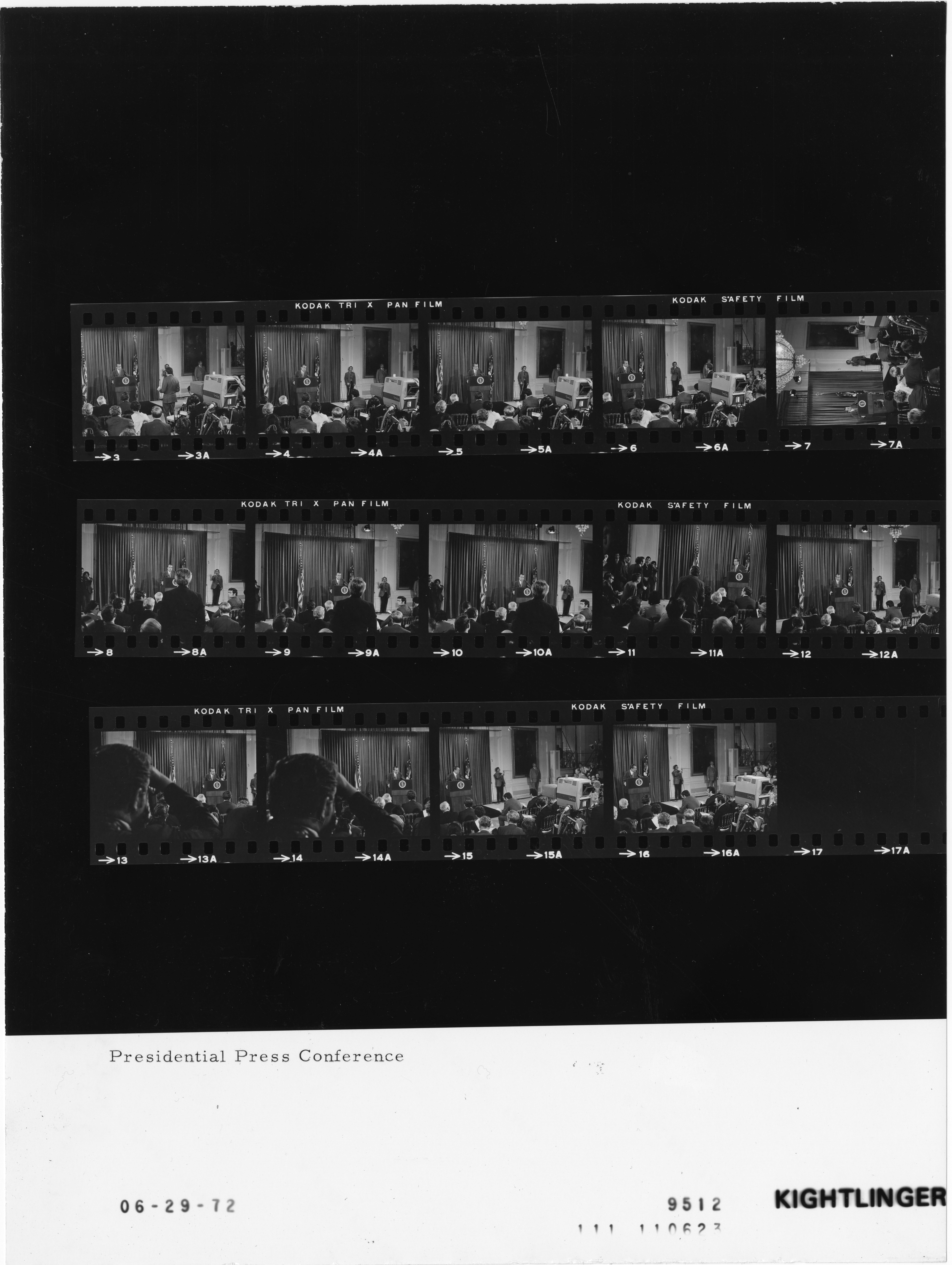
- Frame(s): WHPO-9512-, President Nixon giving a televised press conference. 6/29/1972, Washington, D.C. White House, East Room. President Nixon, press corps members.
- Frame(s): WHPO-9512-03A, President Nixon during a televised press conference. 6/29/1972, Washington, D.C. White House, East Room. President Nixon, press corps members.
- Frame(s): WHPO-9512-15A, President Nixon giving a televised press conference. 6/29/1972, Washington, D.C. White House, East Room.
Roll WHPO-9513 Photographer: Kightlinger, Jack | Color or B&W: Color
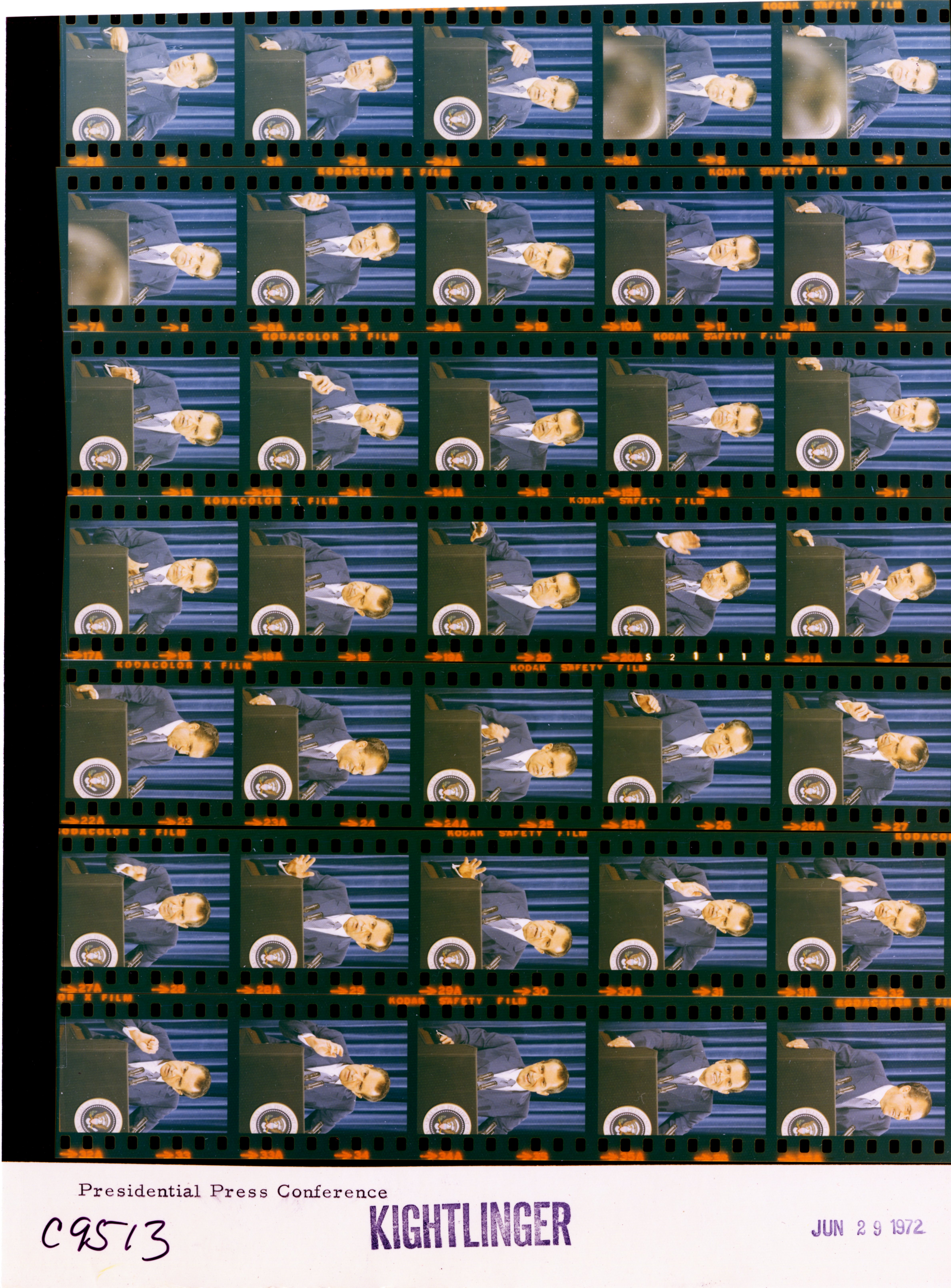
- Frame(s): WHPO-9513-, Head and shoulders shots of President Nixon at a podium during a press conference. 6/29/1972, Washington, D.C. White House, East Room. President Nixon.
Roll WHPO-9514 Photographer: Kightlinger, Jack | Color or B&W: Color
- Frame(s): WHPO-9514-, Head and shoulders shots of President Nixon at a podium during a press conference. 6/29/1972, Washington, D.C. White House, East Room. President Nixon.
Roll WHPO-9515 Photographer: Kightlinger, Jack | Color or B&W: Color
- Frame(s): WHPO-9515-, Pat Nixon lighting a ceremonial candle as a delegation from Indiana watches. 6/29/1972, Washington, D.C. White House, Library. Pat Nixon, unidentified men from Indiana.
Roll WHPO-9530 Photographer: Schumacher, Karl | Color or B&W: Color
- Frame(s): WHPO-9530-, Julie Nixon Eisenhower greeting adults and children at a Sickle Cell Anemia Clinic at Deaconess Hospital. 6/29/1972, unknown Deaconess Hospital MWE. Julie Nixon Eisenhower, adults and children.
- Frame(s): WHPO-9530-, Julie Nixon Eisenhower speaking to an audience at a Sickle Cell Anemia Clinic at Deaconess Hospital. 6/29/1972, unknown Deaconess Hospital MWE. Julie Nixon Eisenhower, adults and children.
Roll WHPO-9531 Photographer: Schumacher, Karl | Color or B&W: Color
- Frame(s): WHPO-9531-03A-06A, Julie Eisenhower addressing an audience. 6/29/1972, unknown Deaconess Hospital MWE. Julie Eisenhower.
- Frame(s): WHPO-9531-07A-15A, Julie Eisenhower at the dedication program for the Rock Island Franciscan Hospital. 6/29/1972, unknown Outdoor Stadium. Julie Eisenhower.
Roll WHPO-9532 Photographer: Schumacher, Karl | Color or B&W: Color
- Frame(s): WHPO-9532-03A-10A, Julie Eisenhower in the stands at the dedication ceremony for a hospital. 6/29/1972, unknown outdoor stadium. Julie Eisenhower, adults, clergy.
- Frame(s): WHPO-9532-11A-16A, Julie Eisenhower seated at a table, speaking into microphones. 6/29/1972, unknown room. Julie Eisenhower, adults, clergy.
Roll WHPO-9533 Photographer: Schumacher, Karl | Color or B&W: Color
- Frame(s): WHPO-9533-, Julie Eisenhower at various sites and addressing various audiences. 6/29/1972, unknown Deaconess Hospital MWE. Julie Eisenhower, adults.
The White House Communications Agency Sound Recordings Collection contains public statements that took place between 1969 and 1974. Visit the finding aid to learn more.
H - White House Staff Member Recordings
- WHCA-SR-H-604
Briefing by Donald Rumsfeld. (6/29/1972, Family Theater, White House)
Runtime: 0:23:37
Keywords: Briefings, public briefings, statements to the press (see also Press conferences, news conferences, interviews, media)
Production credits: Audio feed supplied by WHCA; Recorded by LDH (initials of WHCA engineer)
Original Format: 1/4-inch reel-to-reel audiotape. Original source type: Original. - WHCA-SR-H-605
Press briefing by Ronald Ziegler and Donald Rumsfeld. (6/29/1972, Press Lobby, White House)
Runtime: 0:45:24
Keywords: Press conferences, news conferences, interviews, media, press secretary
Production credits: Audio feed supplied by WHCA; Recorded by JMC (initials of WHCA engineer)
Original Format: 1/4-inch reel-to-reel audiotape. Original source type: Original. Technical notes: 51 mintes and 8 seconds of silence removed from access copies.
P - Formal Presidential Remarks
- WHCA-SR-P-720615
Remarks by President Nixon in a press conference. (6/29/1972)
Runtime: 42:10:00
Keywords: Presidential press conferences, presidential news conferences, interviews, media, restoration of death penalty, capital punishment, Vietnam War, Paris Peace Talks, Vice President Agnew, John Connally, SALT, S.A.L.T., Strategic Arms Limitation Talks, Russi
Original Format: 1/4-inch reel-to-reel audiotape. Original source type: Original.
The White House Communications Agency Videotape Collection contains “off-the-air” recordings of televised programs produced between 1968 and 1974. Visit the finding aid to learn more.
- WHCA-5509
"CBS Morning News" interview with Patrick Buchanan.
NPACT
Runtime: 00:15:30 - WHCA-5510
President Nixon's Press Conference, with CBS commentary. U.S. Representative Wilbur Mills (D-OK).
WETA
Runtime: 01:05:45 - WHCA-5513
Weekly News Summary, Tape III.
ALL NETWORKS
Runtime: 1:00
9. Smith/Geer: McGovern loses 150 California delegates. Time Code Start: 23:49. Keywords: Vote, voters, voting, Presidential elections, campaigns, campaigning, candidates, primaries, voting, conventions, delegations, delegates. Network: ABC.
10. Donalson: Senator Humphrey's reaction to the credential's decision. Time Code Start: 26:20. Keywords: Presidents, elections, delegates, officials, investigations. Network: ABC.
11. Smith/Kaplow: Supreme Court votes against the death penalty; Snell/Krieger: Prisoner reactions to the Court's decision. Time Code Start: 29:42. Keywords: courts, laws, voting, jails, penal institutions, incarceration, penitentiary, inmates, capital punishments, death sentences, death penalty. Network: ABC.
12. Smith/Jarriel/Wordham: All food except meat now under price controls. Time Code Start: 36:03. Keywords: food, meats, animal products, markets, retail stores, prices, costs, increases, shortages. Network: ABC.
13. Smith: commentary on freedom of the press. Time Code Start: 39:09. Keywords: media, newspapers, magazines, publications, civil rights, constitutional rights, First Amendment. Network: ABC.
14. Chancellor/Stern: Supreme Court decision on death penalty. Time Code Start: 40:58. Keywords: law officials, judges, justices, courts, trials, investigations, rulings, decisions, inmates, capital punishments, death sentences. Network: ABC.
15. Chancellor/Pettit: California primary delegates (Senators McGovern and Humphrey). Time Code Start: 45:39. Keywords: Vote, voters, voting, Presidential elections, campaigns, campaigning, candidates, primaries, voting, conventions, delegates. Network: ABC.
16. Chancellor/Levine: (Rumsfield) Cost of living council. Time Code Start: 54:00. Keywords: economy, economics, budgets, finances, recession, inflation, money, wages, costs, unemployment, prices, reports. Network: ABC.
17. Cronkite/Dean: McGovern loses some California delegates; Clark: Senator Humphrey reaction; Schoumacher: McGovern reaction; Scalenger: Senator Humphrey's Los Angeles headquarters. Time Code Start: 55:49. Keywords: Vote, voters, voting, Presidential elections, campaigns, campaigning, candidates, primaries, voting, conventions, delegations, delegates. Network: CBS. - WHCA-5514
Weekly News Summary, Tape IV.
ALL NETWORKS
Runtime: 0:12
1. Cronkite/Herman/Hall: Death penalty. Time Code Start: 00:00. Keywords: jails, penal institutions, incarceration, penitentiary, inmates, capital punishments, death sentences, death penalty. Network: CBS.
2. Cronkite/Rather/Walker: President Nixon's press conference tonight; price controls. Time Code Start: 04:06. Keywords: Presidents, speeches, statements, media, press conferences, news conferences, interviews, economy, budgets, finances, recession, inflation, money, wages, costs, prices. Network: CBS.
Context (External Sources)
The Vanderbilt Television News Archive is the world's most extensive and complete archive of television news. They have been recording, preserving and providing access to television news broadcasts of the national networks since August 5, 1968.
Wikipedia is a free encyclopedia that anyone can edit.