
Introduction
This almanac page for Tuesday, June 22, 1971, pulls together various records created by the federal government and links to additional resources which can provide context about the events of the day.
Previous Date: Monday, June 21, 1971
Next Date: Wednesday, June 23, 1971
Schedule and Public Documents
The Daily Diary files represent a consolidated record of the President's activities. Visit the finding aid to learn more.
The President's day began at Key Biscayne, Florida
The Weekly Compilation of Presidential Documents made available transcripts of the President's news conferences; messages to Congress; public speeches, remarks, and statements; and other Presidential materials released by the White House.
Digitized versions can be found at HathiTrust.
Each Public Papers of the Presidents volume contains the papers and speeches of the President of the United States that were issued by the White House Office of the Press Secretary during the time period specified by the volume. The material is presented in chronological order, and the dates shown in the headings are the dates of the documents or events. In instances when the release date differs from the date of the document itself, that fact is shown in the text note.
To ensure accuracy, remarks have been checked against audio recordings (when available) and signed documents have been checked against the original, unless otherwise noted. Editors have provided text notes and cross references for purposes of identification or clarity.
The Federal Register is the official daily publication for rules, proposed rules, and notices of federal agencies and organizations, as well as executive orders and other Presidential documents.
The Congressional Record is the official daily record of the debates and proceedings of the U.S. Congress.
Archival Holdings
Any selection of archival documents will necessarily be partial. You should use the documents and folders identified below as a starting place, but consult the linked collection finding aids and folder title lists and the collections themselves for context. Many documents to be found this way do not lend themselves to association with specific dates, but are essential to a complete understanding of the material.
Selective document listing
President's Office Files
The President's Office Files consists of materials drawn together by the Special Files Unit from several administrative subdivisions within the White House Office. It is the handwriting and sensitive papers sent to the Staff Secretary that now comprise much of the President's Office Files. Visit the finding aid to learn more.
- Annotated News Summaries, Box 30, News Summaries - June 1971 [1 of 2]
- Annotated News Summaries, Box 30, News Summaries - June 1971 [2 of 2] [During this period, the Staff Secretary only removed pages from the News Summaries which contained President Nixon's handwriting, often leaving the document with no date. Although there are no specific documents with this date, you should also consult the full folder for the month.]
- President's Daily Schedule, Box 101, [President's Daily Schedule, June-Aug. 1971] [1 of 3]
- The President's Schedule, Tuesday - June 22, 1971
President's Personal File
The President's Personal File is essentially a President's secretary's file, kept by Rose Mary Woods, personal secretary to the President, for two purposes: (1) preserving for posterity a collection of documents particularly close to the President, whether because he dictated or annotated them, or because of the importance of the correspondent or the event concerned and (2) giving appropriate attention–letters of gratitude, invitations to White House social events, and the like–to members and important friends and supporters of the Nixon administration. This generalization does not describe all the varied materials of a file group which is essentially a miscellany, but it does identify the reason for the existence of the file group's core. Visit the finding aid to learn more.
- President's Speech File
The H. R. Haldeman Diaries consists of seven handwritten diaries, 36 dictated diaries recorded as sound recordings, and two handwritten audio cassette tape subject logs. The diaries and logs reflect H. R. Haldeman’s candid personal record and reflections on events, issues, and people encountered during his service in the Nixon White House. As administrative assistant to the President and Chief of Staff, Haldeman attended and participated in public events and private meetings covering the entire scope of issues in which the Nixon White House engaged in during the years 1969-1973. Visit the finding aid to learn more.
- Transcript of diary entry (PDF)
Tuesday, June 22
Started at Key Biscayne this morning and flew to Atlantic City for the President's address to the American Medical Association, which went fine. Good reception in the city, and speech and the reception there also went well. Then, back to Washington for an afternoon of getting caught up.
Big problem currently today was the round of Senate resolutions launched by a Cook-Stevens amendment to require an end of the war in nine months. This got all hung up in a lot of Parliamentary maneuvering, amendments, etcetera, but -- during part of which we were going to back a substitute which wasn't really what we wanted, but it turned out it couldn't get any backing anyway, so we pulled off. And, the net result was that Cook-Stevens was amended by Stennis to put in a relatively favorable amendment for us, and then it passed on that basis. But then Mansfield offered his resolution as a substitute for it and Mansfield passed 57-42, which is a pretty strong vote and solidly against us. So we've now taken our basic defeat in the Senate on the anti-war deal.
This worried the President some and worried Henry a great deal more. He got really cranked up about it, because he really feels that this is the collapse of the country, and that it will mean not much chance for his negotiation in Paris this weekend, which is especially galling to him. The -- line we'll take on this with the press, and so on, is that it is only a Sense of the Senate resolution, has no force of law and that it's, in any event, not a Sense of the House of Representatives, that it is contradictory on its face because setting a deadline is totally inconsistent with a cease-fire negotiation and release of POW's -- so the enemy's initiative, or incentive to negotiate would be eliminated. Makes the point also that we respect the Senate on the other matters in here, other than the deadline, and that we actually initiated negotiations ourselves October 7th on the other points and have been pursuing them through all channels and will continue to do so.
We got into a thing--or I did, with the President in the further follow-up, on how to handle Rogers regarding Kissinger's trip, and he's told me that he wants me to move in on it now and tell Rogers that the President wants Henry to go on this trip, that only four people know the basic reason: the President, Haig, Kissinger and me. And that is, that Yahya has, as Bill knows, shown a great interest in the US-China situation, and he's now indicated to us that he has a personal communication from the Chinese at the highest level for the President, and he wants to deliver it to Kissinger personally, not through the Ambassador, especially not now after The New York Times stuff has come out. President believes that we should have Kissinger pick this up from Yahya. He doesn't know what it will amount to. It could be very important, or it could be just another reiteration of the Taiwan position; but anyway, he thinks that we should take a stab at it because the stakes are so high. He says to assure Bill that Henry will take no position regarding India and Pakistan; he’ll listen respectively to both and we’ll leave it at this: that we have to do this-- you know the President says to me that we have to do this to lay the groundwork, so that-- because we've got to let Bill know that something's in the mill and put him in a position to be able to say he was informed when the time comes. Point is: first, that there is something that Yahya feels that he must convey directly to the President's emissary; second, the President considers it worth doing because of the high stakes; third, it may not develop into anything, either it will be very important or it will be nothing, but any chance of getting anything depends on absolute secrecy. Also, we'll get a report in San Clemente if anything develops. In the meantime Rogers must tell nobody about this. So-- Henry was-- I'm not-- also not supposed to tell Henry about this; so I'm kind of caught in the middle. Henry was in poking around today to see what we were going to do on it.
The President met most reluctantly with Frank Shakespeare this afternoon, who plodded through a stage by stage report on his trip in Asia, some items on Ambassadors, and so forth, nothing very significant.
The New York Times Papers question goes on. The President now wants to set up a small team, as he's told Ehrlichman, by getting Huston back. He wants me tell Haig this is an order to have Huston set up a small team under Ehrlichman to start rifling through all the secret documents, and especially the Cuban missile crisis, etcetera, as well as Vietnam, and then get some newspapers to demand that it come out and also get a Congressman to do so. He doesn't want to get Kissinger into this. That's what he said this morning on the plane. And then later today when he had Kissinger in the office, he got to talking on the general subject and made the point that he had had a call from The Chicago Tribune, and that they're demanding that we release and declassify World War II and Korea documents, also the Bay of Pigs and the Cuban confrontation, and that the President is ordering that this be done, everything that's not involved in current security. And he wants to get some pros in to handle it. This was his second stage on this to shake Henry; he knows that Henry is concerned with covering up some of this stuff, because he was involved in the early part of it.
Ehrlichman was right up the wall, because Laird today directly disobeyed his orders not to do anything on The Times Papers and, instead, went out and made the announcement that he was accelerating the declassification procedure, in order to make as many of the papers available as quickly as possible. This was clearly a direct violation of what John had told him to do, and it really distressed Ehrlichman. Then it turned out that Rogers and Laird were planning to go up and see Carl Albert on the basis, on the subject of turning the papers over to Congress, which would have one-upped the President on that one too. This time, the President also was furious and told Ehrlichman to order them not to go, and he'll meet with Mansfield for breakfast tomorrow morning and set it up with him to release the papers to the Select Congressional Committee, thus, undercutting Laird on it.
The President feels, going back to the release of the other papers, that the Democrats are playing with a big fire here, because all the wars are theirs; and getting out those other papers will make a difference, because it will clearly paint them as the war party. It now appears that this Congressional thing will fit into that pretty well too, because they'll set up this select committee and start having hearings and come this fall, we'll have this spectacle of McNamara and Rusk and Rostow, etcetera, being called before this Congressional committee to explain why we got into Vietnam and all the details that are involved, which could really put them in a bad spot.
We got our poll today, and it indicates that half the people aren't even aware of The Times controversy, and even those that are aware of it only half feel that it's a serious problem. There's considerable confusion, obviously, and mixed opinion on this whole thing, which is what we expected we'd find. As we got into how to handle the Laird situation, I made the suggestion that we just cover it through a Ziegler briefing, which the President agreed we ought to do, and that would get our thing on the table without getting into a problem. Later in the afternoon, we had a meeting with Mitchell and Ehrlichman on the overall strategy. The President had asked for some PR judgment on whether or not to go to the Supreme Court. He's concerned that if we don't, it might appear that we quit, and we'd lose our friends that way. If we are going to drop it before the Supreme Court, we need a strong offense to sell, on the basis that it would require too much delay, and so on, to go ahead with.
President had his Gideon's Army of Businessmen for dinner tonight and was not particularly pleased with the prospect and was not looking forward to having to-- handle that group, but I'm sure it will go very well.
End of June 22. - Original audio recording (MP3)
The National Archives Catalog is the online portal to the records held at the National Archives, and information about those records. It is the main way of describing our holdings and also provides access to electronic records and digitized versions of our holdings.
The Catalog searches across multiple National Archives resources at once, including archival descriptions, digitized and electronic records, authority records, and web pages from Archives.gov and the Presidential Libraries. The Catalog also allows users to contribute to digitized historical records through tagging and transcription.
Nixon Library Holdings
All National Archives Units
National Security Documents
The President's Daily Brief is the primary vehicle for summarizing the day-to-day sensitive intelligence and analysis, as well as late-breaking reports, for the White House on current and future national security issues. Read "The President's Daily Brief: Delivering Intelligence to Nixon and Ford" to learn more.
The Foreign Relations of the United States series presents the official documentary historical record of major U.S. foreign policy decisions and significant diplomatic activity. Visit the State Department website for more information.
Vol. IV, Foreign Assistance, International Development, Trade Policies, 1969-1972
Coordinating Committee on Export Controls, 1969-1972
376. Memorandum From Secretary of Defense Laird to President Nixon, Washington, June 22, 1971
Source: National Archives, Nixon Presidential Materials, NSC Files, Subject Files, Box 402, Trade, Volume IV 7-12/71. Confidential. Kissinger, in a July 9 memorandum forwarding this memorandum to the President, summarized Laird’s points, and reported that other agency comments had not been requested because the administration was not yet ready for a decision on COCOM list revision, pending bilateral discussions with other COCOM members during the summer. “The President has seen” is stamped on the July 9 transmittal memorandum.
Vol. VII, Vietnam, July 1970-January 1972
The Consequences of Operation Lan Som 719 and the Search for a Settlement, April 8-October 6, 1971
222. Transcript of a Telephone Conversation Between the President’s Assistant for National Security Affairs (Kissinger) and Senator Robert P. Griffin, Washington, June 22, 1971, 11:24 a.m.
Source: National Archives, Nixon Presidential Materials, Kissinger Telephone Conversations, Box 10, Chronological File. No classification marking. The omission is in the original.
Vol. XI, South Asia Crisis, 1971
South Asia Crisis, 1971
77. Telegram From the Department of State to the Embassy in Pakistan, Washington, June 22, 1971, 0029Z
Source: National Archives, RG 59, Central Files 1970–73, POL 15 PAK. Confidential; Limdis. Drafted by G. Jonathan Greenwald (L/NEA) on June 17; cleared by Spengler, Deputy Legal Adviser J. Edward Lyerly, and Donald J. Simon (A/OPR/RS); and approved by Van Hollen. Repeated to New Delhi, Calcutta, Dacca, and Karachi.
Vol. XIII, Soviet Union, October 1970-October 1971
"One of Two Routes": Soviet-American Relations and Kissinger's Secret Trip to China, April 23-July 18, 1971
264. Conversation Among President Nixon, the President’s Assistant for National Security Affairs (Kissinger), and the White House Chief of Staff (Haldeman), Washington, June 22, 1971
Source: National Archives, Nixon Presidential Materials, White House Tapes, Conversation 527–4. No classification marking. The editors transcribed the portion of the tape recording printed here specifically for this volume. According to the President’s Daily Diary, Nixon, who had just returned from a weekend vacation at Key Biscayne, Florida, met Kissinger in the Oval Office from 1:55 to 2:43 p.m. (Ibid., White House Central Files)
Vol. XXIV, Middle East Region and Arabian Peninsula, 1969-1972; Jordan, September 1970
Persian Gulf States
99. Memorandum From Harold Saunders of the National Security Council Staff to the President’s Assistant for National Security Affairs (Kissinger), Washington, June 22, 1971
Source: National Archives, Nixon Presidential Materials, NSC Files, Box 647, Country Files, Middle East, General, Vol. VIII. Secret; Exdis. Sent for information. Hoskin-son initialed for Saunders. A typed note indicates the memorandum was for the London Briefing Book.
Vol. XXIX, Eastern Europe, 1969-1972
Radio Free Europe and Radio Liberty
57. Memorandum for the Record, Washington, June 22, 1971
Source: Department of State, INR/IL Historical Files, 40 Committee Minutes. Secret; Eyes Only. Presumably drafted by Kennedy on June 25.
Vol. XXIX, Eastern Mediterranean, 1969-1972
Cyprus
373. Memorandum From the Officer in Charge of Cyprus Affairs (Jones) to the Assistant Secretary of State for Near Eastern and South Asian Affairs (Sisco), Washington, June 22, 1971
Source: Department of State, Cyprus Desk Files: Lot 75 D 41, Pol 1 Cyp. Secret. Sent through Davies.
Vol. E-1, Documents on Global Issues, 1969-1972
Oceans Policy
399. Memorandum From Secretary of State Rogers to President Nixon, Washington, June 22, 1971
Rogers informed Nixon that, in exchange for an Ecuadorian promise to cease seizures of U.S. fishing vessels, the Department of State intended to release loans to Ecuador. Rogers believed those actions would to improve relations with Ecuador and enhance the U.S. position on crucial Law of the Sea provisions.
Source: National Archives, Nixon Presidential Materials, NSC Files, NSC Institutional Files (H-Files), Box H-055, SRG Meeting, Oceans Policy (NSSM 125) 7/12/71 [2 of 2]. Secret. Attached was Section 620(o) of the Foreign Assistance Act of 1961 (as amended), which reads: “In determining whether or not to furnish assistance under this Act, consideration shall be given to excluding from such assistance any country which hereafter seizes, or imposes any penalty or sanction against, any United States fishing vessel on account of its fishing activities in international waters. The provisions of this subsection shall not be applicable in any case governed by international agreement to which the United States is a party.” (Ibid.)
Vol. E-4, Documents on Iran and Iraq, 1969-1972
Iran 1971
133. Memorandum From the President’s Assistant for National Security Affairs (Kissinger) to President Nixon, Washington, June 22, 1971
Kissinger recommended that the President sign a waiver to allow Iran to continue to receive grant military assistance despite its reclassification the previous year as a “developed” country.
Source: National Archives, Nixon Presidential Materials, NSC Files, Box 1268, Saunders Files, Middle East Negotiations, Iran Military, 1/1/71–12/31/71. Secret. Sent for action. The memorandum from OMB Director George Shultz, June 9, is not published. The President signed the attached waiver, Presidential Determination No. 71–18, on June 24, 1971
Vol. E-5, Part 1, Documents on Sub-Saharan Africa, 1969-1972
Nigerian Civil War
209. Airgram A–22 From the Department of State to the Embassy in Nigeria, Washington, June 22, 1971, 4:11 p.m.
The Policy Planning Paper for Nigeria, dated June 1971 and approved by the National Security Council Inter-departmental Group for Africa, contained sections on U.S. interests, U.S. objectives, Nigeriaʼs objectives, and recommended courses of action.
Source: National Archives, RG 59, Central Files 1970–73, POL 1 Nigeria-U.S. Secret; Limdis; Noforn. Drafted by Rawls on June 21. The annexes are not published.
The Horn
316. Item Prepared by Marshall Wright of the National Security Council Staff for the Presidentʼs Daily Briefing, Washington, June 22, 1971
Wright reported that there still had been no consular access to the Americans on board the vessels seized by Somalia. The shipsʼ owners were “hopping mad” and believed there was a lack of urgency on the part of the United States. The owners had been in contact with George Bush at the United Nations who, in turn, had contacted the Department of State.
Source: National Archives, Nixon Presidential Materials, NSC Files, Box 743, Country Files, Africa, Somalia Republic, Vol. I. Confidential.
Vol. E-5, Part 2, Documents on North Africa, 1969-1972
Tunisia
154. Airgram A–41 From the Department of State to the Embassy in Tunisia, Washington, June 22, 1971
The Department sent copies of a Policy Planning Paper for Tunisia as approved by the NSC Interdepartmental Group for Africa. The paper was to be an official statement of U.S. policy toward Tunisia and was to be used as a guideline by all elements of the Embassy in the preparation of policy statements, action plans, and future budgetary projections.
Source: National Archives, RG 59, Central Files 1970–73, POL 1 TUN-US. Secret; Noforn; Limdis. Drafted on June 21 by Nancy Rawls (AF/NSC-IG) and approved by Carter.
The Kissinger telephone conversation transcripts consist of approximately 20,000 pages of transcripts of Kissinger’s telephone conversations during his tenure as Assistant to the President for National Security Affairs (1969-1974) and Secretary of State (1973-1974) during the administration of President Richard Nixon. Visit the finding aid for more information.
Digitized versions can be found in the National Archives Catalog.
Audiovisual Holdings
The White House Tapes are sound recordings of President Richard Nixon's telephone conversations and of meetings held in the Oval Office and the Cabinet Room in the White House, the President's office in the Old Executive Office Building (OEOB), the Lincoln Sitting Room in the residence section of the White House, and several locations at the Presidential retreat at Camp David, Maryland. These recordings document many of the major events and decisions of the Nixon Administration from February 16, 1971 to July 18, 1973. Visit the White House Tapes finding aid to learn about the taping system's operation and archival processing.
Oval Office
- 527-1; Unknown between 1:48 p.m. & 1:50 p.m.; Nixon, Richard M. (President); Sanchez, Manolo
- 527-2; Unknown between 1:48 p.m. & 1:50 p.m.; Nixon, Richard M. (President); Butterfield, Alexander P.
- 527-3; 1:48 p.m. - 1:50 p.m.; Nixon, Richard M. (President); [Unknown person(s)]
- 527-4; 1:50 p.m. - 3:07 p.m.; Nixon, Richard M. (President); Butterfield, Alexander P.; Haldeman, H. R. ("Bob"); [Unknown person(s)]; Ehrlichman, John D.; Kissinger, Henry A.; Laird, Melvin R.
- 527-5; Unknown between 3:07 p.m. & 3:11 p.m.; Nixon, Richard M. (President); [Unknown person(s)]
- 527-6; Unknown between 3:07 p.m. & 3:11 p.m.; Nixon, Richard M. (President); Bull, Stephen B.
- 527-7; Unknown between 3:07 p.m. & 3:11 p.m.; Nixon, Richard M. (President); [Unknown person(s)]
- 527-8; Unknown between 3:11 p.m. & 3:41 p.m.; Nixon, Richard M. (President); Shakespeare, Frank J.; Haldeman, H. R. ("Bob"); Sanchez, Manolo; Bull, Stephen B.
- 527-9; 3:42 p.m. - 5:06 p.m.; Nixon, Richard M. (President); Ehrlichman, John D.; Bull, Stephen B.; Ziegler, Ronald L.; Holton, Linwood; Nunn, Louie B.; Harper, Edwin L.; Butterfield, Alexander P.; Kissinger, Henry A.; Agnew, Spiro T. (Vice President)
- 527-10; Unknown between 5:06 p.m. & 5:09 p.m.; Nixon, Richard M. (President); Bull, Stephen B.
- 527-12; 5:09 p.m. - 6:46 p.m.; Nixon, Richard M. (President); Mitchell, John N.; Haldeman, H. R. ("Bob"); Ehrlichman, John D.; Ziegler, Ronald L.; White House operator; Butterfield, Alexander P.; Kissinger, Henry A.
- 527-17; Unknown between 6:46 p.m. & 10:43 p.m.; [Unknown person(s)]
White House Telephone
- 5-128; Unknown between 1:48 p.m. & 10:24 p.m.; Ehrlichman, John D.; White House operator; Nixon, Richard M. (President); MacGregor, Clark
- 5-129; Unknown between 1:48 p.m. & 10:24 p.m.; Nixon, Richard M. (President); White House operator
- 5-130; 10:24 p.m. - 10:30 p.m.; Nixon, Richard M. (President); Ziegler, Ronald L.
- 5-131; 10:31 p.m. - 10:38 p.m.; Nixon, Richard M. (President); Kissinger, Henry A.
- 5-171; 10:30 p.m. - 10:31 p.m.; Nixon, Richard M. (President); White House operator
The White House Photo Office collection consists of photographic coverage of President Richard Nixon meeting with prominent social, political, and cultural personalities; speaking engagements and news conferences of the President and various high-ranking members of the White House staff and Cabinet; Presidential domestic and foreign travel, including Presidential vacations; social events and entertainment involving the First Family, including entertainers present; official portraits of the President, First Family, and high-ranking members of the Nixon administration; the 1969 and 1973 Inaugurals; the President’s 1972 Presidential election campaign appearances (including speeches) and other official activities of the White House staff and the President’s Cabinet from January 20, 1969 until August 9, 1974 at the White House and the Old Executive Office Building; other locations in Washington, DC, such as The Mall; and the Presidential retreats in Camp David, Maryland, Key Biscayne, Florida, and San Clemente, California. Visit the finding aid to learn more.
Roll WHPO-6663 Photographer: unknown | Color or B&W: Color
- Frame(s): WHPO-6663-01, Closeup portrait study of Herb Klein. 6/22/1971, Washington, D.C. unknown. Herb Klein.
- Frame(s): WHPO-6663-01-04, Closeup portrait study of Herb Klein. 6/22/1971, Washington, D.C. unknown. Herb Klein.
Roll WHPO-6664 Photographer: Schumacher, Karl | Color or B&W: B&W
- Frame(s): WHPO-6664-03-17, Vice President Agnew standing with Rep. R. Mittendorf. 6/22/1971, Washington, D.C. Executive Office Building, Vice Presidential Office. Spiro Agnew, R. Mittendorf.
Roll WHPO-6665 Photographer: Schumaker, Byron | Color or B&W: B&W
- Frame(s): WHPO-6665-01A-03A, President Nixon and Pat Nixon arriving at the airport. 6/22/1971, Pomona, New Jersey U.S. Naval Air Facility. President Nixon, Pat Nixon, GOP leaders.
- Frame(s): WHPO-6665-04A-23A, President Nixon and Pat Nixon greeting local GOP leaders. 6/22/1971, Pomona, New Jersey U.S. Naval Air Facility. President Nixon, Pat Nixon, GOP leaders.
Roll WHPO-6666 Photographer: Schumaker, Byron | Color or B&W: B&W
- Frame(s): WHPO-6666-03-34, President Nixon and Pat Nixon in a receiving line, greeting delegates to the American Medical Association Convention. 6/22/1971, Atlantic City, New Jersey Haddon Hall Hotel. President Nixon, Pat Nixon, Dr. Walter Bornemeier, unidentified AMA delegates.
Roll WHPO-6667 Photographer: Schumaker, Byron | Color or B&W: B&W
- Frame(s): WHPO-6667-01, President Nixon and Pat Nixon being greeted upon arrival at an airport by Governor William Cahill, Barbara Burns, and an unidentified man. 6/22/1971, New Jersey, Ponoma U.S. Naval Air Facility, tarmac. President Nixon, Pat Nixon, William Cahill, Mrs. William Cahill, Clifford Case, Charles Sandman, Barbara Burns, Harrison Williams, Durwood Hall, crowd.
- Frame(s): WHPO-6667-02-10, President Nixon and Pat Nixon being greeted upon arrival at the airport. 6/22/1971, New Jersey, Ponoma U.S. Naval Air Facility, tarmac. President Nixon, Pat Nixon, William Cahill, Mrs. William Cahill, Clifford Case, Charles Sandman, Barbara Burns, Harrison Williams, Durwood Hall, crowd.
- Frame(s): WHPO-6667-11-25, President Nixon and Pat Nixon greeting the crowd near the AMA Convention site. 6/22/1971, New Jersey Haddon Hall entrance. President Nixon, Pat Nixon, William Cahill, Mrs. William Cahill, Clifford Case, Charles Sandman, Harrison Williams, Durwood Hall, crowd.
- Frame(s): WHPO-6667-26-34, President Nixon and Pat Nixon on a podium near the AMA Convention site. 6/22/1971, New Jersey Haddon Hall entrance. President Nixon, Pat Nixon, William Cahill, Mrs. William Cahill, Clifford Case, Charles Sandman, Harrison Williams, Durwood Hall, crowd.
Roll WHPO-6668 Photographer: Schumaker, Byron | Color or B&W: B&W
- Frame(s): WHPO-6668-01A-12A, President Nixon addressing crowd outside of AMA convention hotel. 6/22/1971, Atlantic City, New Jersey Haddon Hall Hotel. President Nixon, Pat Nixon, William Cahill, Mrs. William Cahill, Clifford Case, Charles Sandman, Harrison Williams, AMA delegates, Dr. Merlin DuVal, Elliot Richardson, Dr. Walter Bornemeier, Roger Egeberg.
- Frame(s): WHPO-6668-13A-35A, President Nixon addressing the approximately 2,500 delegates to the 120th Annual AMA Convention. 6/22/1971, Atlantic City, New Jersey Haddon Hall Hotel. President Nixon, Pat Nixon, William Cahill, Mrs. William Cahill, Clifford Case, Charles Sandman, Harrison Williams, AMA delegates, Dr. Merlin DuVal, Elliot Richardson, Dr. Walter Bornemeier, Roger Egeberg.
Roll WHPO-6669 Photographer: Schumaker, Byron | Color or B&W: B&W
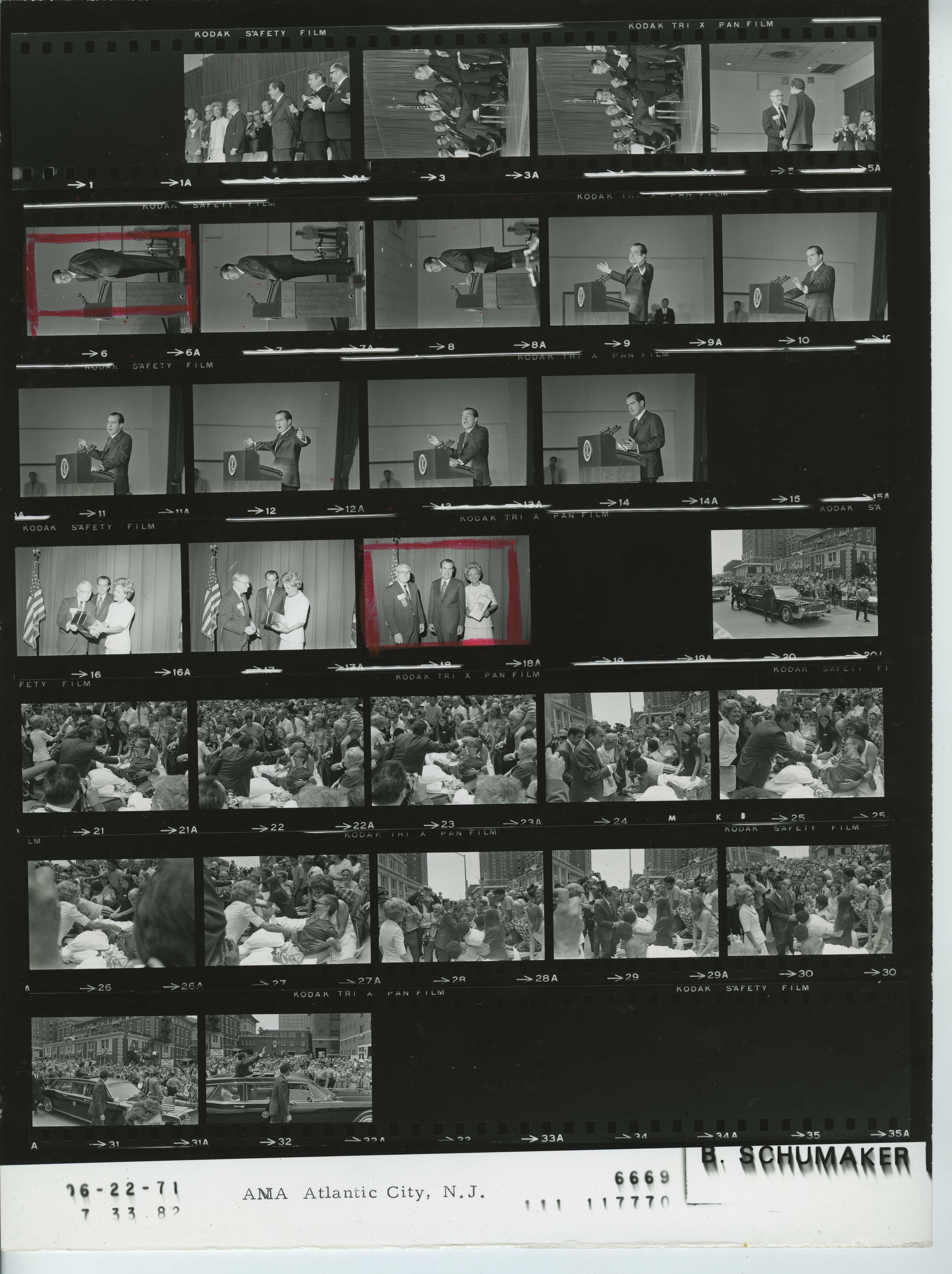
- Frame(s): WHPO-6669-02-05, President Nixon on a podium at the AMA convention. 6/22/1971, Atlantic City, New Jersey Haddon Hall Hote. President Nixon, Pat Nixon, AMA officials, crowd.
- Frame(s): WHPO-6669-06-14, President Nixon addressing the AMA convention. 6/22/1971, Atlantic City, New Jersey Haddon Hall Hote. President Nixon, Pat Nixon, AMA officials, crowd.
- Frame(s): WHPO-6669-16-18, President Nixon, Pat Nixon and Dr. Walter Bornemeier standing on the podium at the AMA convention. 6/22/1971, Atlantic City, New Jersey Haddon Hall Hote. President Nixon, Pat Nixon, AMA officials, crowd.
- Frame(s): WHPO-6669-20-32, President Nixon and Pat Nixon greeting the crowd outside the hotel, including young patients (some in hospital beds) and their parents with nursing staff from Atlantic City's Seashore Children's House. 6/22/1971, Atlantic City, New Jersey Haddon Hall Hotel, exterior. President Nixon, Pat Nixon, children, AMA officials, crowd.
Roll WHPO-6673 Photographer: Knudsen, Robert L. | Color or B&W: B&W
- Frame(s): WHPO-6673-, President Nixon seated informally with Appalachian Governors. 6/22/1971, Washington, D.C. White House, Oval Office. President Nixon, Linwood Holton, Louie Nunn, Arch Moore, Jr.
- Frame(s): WHPO-6673-07, President Nixon seated informally during a meeting with Appalachian Governors, Linwood Holton, Louie Nunn, and Arch Moore, Jr. 6/22/1971, Washington, D.C. White House, Oval Office. President Nixon, Linwood Holton, Louie Nunn, Arch Moore, Jr.
Roll WHPO-6674 Photographer: Atkins, Oliver | Color or B&W: B&W
- Frame(s): WHPO-6674-, President Nixon seated informally with Appalachian area Governors. 6/22/1971, Washington, D.C. White House, Oval Office. President Nixon, Linwood Holton, Louis Nunn, Arch Moore, Jr.
The White House Communications Agency Sound Recordings Collection contains public statements that took place between 1969 and 1974. Visit the finding aid to learn more.
P - Formal Presidential Remarks
- WHCA-SR-P-710620
Remarks by President Nixon to crowd outside Chalfont Haddon Hall in Atlantic City. (6/22/1971)
Runtime: 5:23
Original Format: 1/4-inch reel-to-reel audiotape. Original source type: Original. - WHCA-SR-P-710621
Remarks by President Nixon to members of AMA in Chalfont Haddon Hall in Atlantic City. (6/22/1971)
Runtime: 34:04:00
Original Format: 1/4-inch reel-to-reel audiotape. Original source type: Original. - WHCA-SR-P-710622
Remarks by President Nixon at state dinner. (6/22/1971)
Runtime: 33:52:00
Original Format: 1/4-inch reel-to-reel audiotape. Original source type: Original.
The White House Communications Agency Videotape Collection contains “off-the-air” recordings of televised programs produced between 1968 and 1974. Visit the finding aid to learn more.
- WHCA-4466
"The Mike Douglas Show".
Daphne Productions and Roland & Jaffee Productions
Runtime: 00:32:36 - WHCA-4467
"POW's. . . Pawns of War?". Vietnam Prisoner of War Tricia Nixon, Edward Cox, Richard Nixon, Pat Nixon, wedding guests.
Undetermined
Runtime: 59:30:00 - WHCA-4468
"The Advocates" AND "Dick Cavett Show with Viet Vets" Part 2 (June 11 1971). The advocates debate "Should the United States set a firm pullout date for Vietnam?" Tricia Nixon, Edward Cox, Richard Nixon, Pat Nixon, wedding guests.
Undetermined
Runtime: 01:05:25 - WHCA-4469
"The Dick Cavett Show," guest host Tony Randall, Turner Catledge, Jack Douglas. Tricia Nixon, Edward Cox, Richard Nixon, Pat Nixon, wedding guests.
Undetermined
Runtime: 01:31:19 - WHCA-4476
Weekly News Summary, Tape II.
ALL NETWORKS
Runtime: 1:30
11. Smith/Clark/Reasoner/Geer: Senate votes to end war in VN; troop withdraw within 9 months with POW release. Boston Globe publishes series on Pentagon Papers; Globe Editor Winship comments: peoples’ right to know. NY times & Washington Post in court—gov. of. Time Code Start: 00:30:14. Keywords: . Network: ABC.
12. Reasoner/Tuckner: B-52 bombed communists near DMZ, Vietcong overrun village in Mekong Delta; interview with Col. Hackworth (resigning); Hackworth comments: need South Vietnamese to identify w government, need to gain hearts & minds of people, comments on . Time Code Start: 00:36:58. Keywords: . Network: CBS.
13. Smith/Jarriel: Atlantic City AMA convention; debates on upcoming health plan Nixon's vs. Kennedy’s plan; Nixon comments on increasing dug problem: culture of drugs in America, urges AMA to educate on dangers of drug abuse. Time Code Start: 00:40:48. Keywords: . Network: ABC.
14. Smith: AFL-CIO Pres. Meany says Nixon’s economic policies are miserable failure; Sen. Javitz calls for freeze on wage/prices; Pres. proposes tax depreciation allowances . Time Code Start: 00:43:10. Keywords: . Network: ABC.
15. Chancellor: Senate vote to withdraw all US servicemen from Indochina within next 9 months with release of POWs (proposed by Senator Mansfield). Time Code Start: 00:43:58. Keywords: . Network: NBC.
16. Chancellor/Stern: Boston Globe rejects appeal to print no further material; district court considers gov. request for temporary restraining order; temporary court bans extended for NY Times and Washington Post; gov. offers declassification of reports; Sen. Time Code Start: 00:44:50. Keywords: . Network: NBC.
17. Chancellor/Kaplowith Nessen: AMA convention in Atlantic City; Nixon condemns nationalized health insurance plan as burden to doctors; AMA becoming more liberal and number of AMA doctors decreasing . Time Code Start: 00:50:59. Keywords: . Network: NBC.
18. Chancellor: Wages/purchasing power increase; Senate Banking Committee hearing on administration plans for Lockheed bailout; treasury approves Nixon plan for $39 billion tax write off for businessmen . Time Code Start: 00:56:01. Keywords: . Network: NBC.
19. Cronkite/Mudd: Senate 1 vote short of peace proposal cutting off Vietnam War funds in 9 months; Mansfield Declaration of National Policy: declare withdraw date within 9 months and start negotiations for ceasefire. Time Code Start: 00:57:01. Keywords: . Network: CBS.
20. Cronkite/Serafin/Schakne: appeals courts extends temporary restraints on newspapers (artist Bob Templeton); Griswold offers government task force to declassify Pentagon Reports; Washington Post lawyers warns against government curtailing freedom of speech. Time Code Start: 00:59:19. Keywords: . Network: CBS.
21. Cronkite/Rather: Atlantic City AMA convention; Nixon's AMA comments: condemns Senator Kennedy's health insurance plan and America's "culture of drugs". Time Code Start: 01:04:05. Keywords: . Network: CBS.
22. Cronkite/Benton: Veterans Administration announces opening of new drug treatment centers; Senate public welfare subcommittee debates amnesty of GI drug use and confidentiality . Time Code Start: 01:06:48. Keywords: . Network: CBS.
23. Cronkite/Schorr: House approves Nixon Welfare Reform; Administration proclaims new tax rules to save money for business and industry. Time Code Start: 01:09:45. Keywords: . Network: CBS.
24. Cronkite: White House Spokesman Ziegler says Mansfield Resolution is the not the view of Congress as a whole. Time Code Start: 01:11:41. Keywords: . Network: CBS.
Context (External Sources)
The Vanderbilt Television News Archive is the world's most extensive and complete archive of television news. They have been recording, preserving and providing access to television news broadcasts of the national networks since August 5, 1968.
Wikipedia is a free encyclopedia that anyone can edit.