
Introduction
This almanac page for Wednesday, June 21, 1972, pulls together various records created by the federal government and links to additional resources which can provide context about the events of the day.
Previous Date: Tuesday, June 20, 1972
Next Date: Thursday, June 22, 1972
Schedule and Public Documents
The Daily Diary files represent a consolidated record of the President's activities. Visit the finding aid to learn more.
The President's day began at The White House - Washington, D. C.
The Weekly Compilation of Presidential Documents made available transcripts of the President's news conferences; messages to Congress; public speeches, remarks, and statements; and other Presidential materials released by the White House.
Digitized versions can be found at HathiTrust.
The Federal Register is the official daily publication for rules, proposed rules, and notices of federal agencies and organizations, as well as executive orders and other Presidential documents.
The Congressional Record is the official daily record of the debates and proceedings of the U.S. Congress.
Archival Holdings
Any selection of archival documents will necessarily be partial. You should use the documents and folders identified below as a starting place, but consult the linked collection finding aids and folder title lists and the collections themselves for context. Many documents to be found this way do not lend themselves to association with specific dates, but are essential to a complete understanding of the material.
Selective document listing
President's Office Files
The President's Office Files consists of materials drawn together by the Special Files Unit from several administrative subdivisions within the White House Office. It is the handwriting and sensitive papers sent to the Staff Secretary that now comprise much of the President's Office Files. Visit the finding aid to learn more.
- News Summaries, Annotated News Summaries, Box 35, June 7-23, 1972 [4 of 5] [Note: Due to the way News Summary products were compiled, you should also consult nearby days for potentially relevant materials.]
- News Summary, June 21, 1972, (Tues. nets, wires, columns)
- President's Daily Schedule, Box 102, [President's Daily Schedule, Apr.-July 1972] [2 of 3]
- The President's Schedule, Wednesday - June 21, 1972
Source: June 7-23, 1972 [4 of 5], box 35, White House Special Files: Staff Member and Office Files: President's Office Files: Annotated News Summaries [consult original for annotations made by President Nixon]
NEWS SUMMARY
June 21, 1972
(Tues. nets, wires, columns)
The major stories of the day:
-- ABC /CBS led w /what Chancellor called the "year's jukiest political scandal" -- the DNC breakin w/O'Brien filing a $1M damage suit against Comm. for Re-Election and note of WH aide Hunt's link to 2 of accused. Film of Comm. to Re-Elect on 2 nets and O'Brien on all nets saying WH itself may well be involved in this cheap cloak and dagger doing. ABC from Miami (nearly 6 min. lead) told of Dem. concern over possible bugging of headquarters there.
-- In other political news, late closing of NY Polls and intricacies of ballot likely to prevent any complete tabluation of what all expect to be a substantial McG victory. McG/Muskie/HHH -the latter w /by far the warmest reception - - on film on all nets at Mayor's Conf as they recited what ABC's Kaplow called the standard pledge of allegiance on revenue sharing. ABC also w/film of McG/HHH differences which were similarly noted by CBS tho only McG on film presenting his views.
-- NBC led w/report covered by CBS w/film: The return home of the last of the 112 US combat brigades which were in VN in '68. NBC followed w /highly negative report on buildup in Thailand while CBS gave some attention to the combat GIs staying in VN who don't appreciate US public's lack of recognition of their continuing role.
-- Laird's testimony only covered by NBC as he said Soviets will begin MIRV testing earlier than anticipated and he said he couldn't support SALT pact w /out B-1 and Trident. Brinkley's sarcastic response followed.
-- CBS w/some of 1st film of survivors of slaughter in Burundi where 200,000 may have died in a tragic and savage conflict given little attention in US press.
INDOCHINA
The last US combat unit in SVN furled its colors and prepared for the trip home. Only 2600 combat GIs left in VN, said Chancellor including Custer's old unit. But while leaving SVN, there's also at least a temporary buildup in Thailand, said Chancellor leading into one of Phil Brady's uniquely negative reports. Phil emphasized how US officials don't like to discuss the new buildup and Thai officials don't want it known. Lengthy exchange between reporter and US soldier who said cameras had to go and that was an order tho he'd not say from who except to say Thais don't want US presence reported. Still NBC cameras "slipped onto the base" and it's clear runways can handle jets and B-52s, said Brady. US officials say Amer. forces will be there only 3-4 months but, said Brady, that's if there's a ceasefire, if there's a POW deal; if NVA cuts back its offensive . So , said Phil, it's likely US will be here more than a few months.
CBS had film of the "important ceremony" as the 1st Cav's return brings US combat role officially to end w/overfly by US planes symbolizing a changing war. Reporter Simon said planes came from Bien Hoa, a re-Americanized base since the offensive. And he noted 2000 1st Cav. who've arrived recently will remain as part of "so- called" task force. 2 were interviewed and reflected bitterness over US public's idea that all combat forces are coming home.
RN will make a new announcement on withdrawals before the end of June. RZ said RN's pledge to get down to 49,000 troops is being met. UPI said RZ appeared to be hinting at further troop pullouts.
All nets noted bitter fighting as 3,000 ARVN fought NVA in Quang Tri province and knocked out 18 tanks with aid of US air and naval support. NBC film of "some success'' by ARVN as they drove NVA out of one area but, said reporter, they'll not be able to stay long as manpower is inadequate .... CBS noted ARVN' s QT drive is apparently bogged down and ABC said it was "rough going." ... ABC then w /film from An Loe where AR VN admittedly has what's left of town but relief column is still unable to get into the city. US adviser told of heavy ARVN casualties, so far and reporter said much
hard fighting is probably ahead as are more casualties in what may already be VN' s most costly battle for both sides.
Only NBC noted HAK's meeting w/PRC leaders. ... The head of a US educational foundation gained the impression on a visit to PRC that the Chinese expect the VN war to end by Aug. 15. The
Pres of the Greek Heritage Foundation said lower level officials and guides repeatedly said that US was expected to recognize PRC diplomatically by that date. The officials also said an important announcement would be made before then on the state of Mao's health. Mao has not been seen in public since RN's trip.
ABC's Koppel reported on a new batch of State documents which shows the US told France in '47 that the VN war was playing into Communist hands and urged Paris to be "most generous" in seeking an early solution. Koppel read several cables sounding like today's situation and concluded by noting relevance of phrase: Those who forget history are condemned to repeat it.
ABC noted some MCs led by Hughes asked a Federal Appeals Court to order the nets to sell them time to discuss end the war proposals pending in Congress.
NBC/CBS noted RN will name Abrams to be the new Army Chief of Staff, and he also reappointed Adm. Moorer for another 2 year term as JCS Chmn. ... AP profiles "Abe" by leading: "It is often said in Saigon that he deserved a better war. His performance was considered superb by many and perhaps his biggest accomplishment was getting the US ground combat units out without a disaster. He weathered many storms: the Green Beret case, My Lai, drugs, ebbing morale, boredom, racial tensions, antiwar feelings." But the Lavelle affair may be the next storm for him, says AP. "Just remember this," he is quoted as saying, "the higher you get up he greasy pole, the more your tail shows." AP asserts that Abrams' place in military history may depend upon whether the ARVN he built survives. The story also says Vietnamization "really meant only one thing: a reversal of roles of the US and the SViets."
US/USSR
NBC noted that Laird said again he couldn't urge adoption of SALT unless Hill funds new weapons systems. If Congress refuses, he'd recommend construction of all 12 original ABM sites. ... Stennis asked Laird where his "stepping-off point" would be for rejecting the accords and said surely it would not be if only Trident or only the B1 were disapproved. "Yes, it would," Laird replied.
Laird estimated Russ MIRV flight test timing would begin in 6-9 months, a period 6 months earlier than DOD "officially" estimated only 2 weeks ago, noted Chancellor. ... Laird said SU could overtake US in both numbers and accuracy of warheads if they achieve MIRV accuracy. ... Pointing to the new Soviet testing Laird said "peace can't be bought cheaply."
Moorer said it's anticipated SU "will move vigorously into MIRV's." He said: "If we fail to follow the legitimate dictates of our own security...SU will chalk it up, not to goodwill, but a failure of will."
NBC's report on Laird's call for a "triple play for peace" -SALT/ABM/Trident-B1 -- included Jackson on film questioning details and saying absence of knowing a lot of things can prevent both sides from knowing what's expected and thus cause instability in future, rather than stability. Laird followed on film saying verification procedures were complete and deserving of full confidence. After noting Laird's view that unless US goes ahead w/offensive weapons, SALT's value will be jeopardized, Chancellor turned to Brinkley and David told us how no other generation has ever seen such spectacles. There's the burglary or bugging of DNC which saw 5 men caught flatfooted. He doubts it was a robbery w/Dems $9 M in debt -- not even CIA could find funds there -- but even if it were a successful bugging, tel. company may have cut off phones due to overdue bills. And there's the spectacle of the Secy of Defense who, after DOD got $30B in war funds when VN was in full fury, won't give back money, even wanting more, tho VN is grinding to an end. And in one of the great phrases of our time, said Brinkley, Laid says "peace can't be bought cheaply." Well, said David, we're not buying peace but weapons and in wholesale quantity tho at retail prices, we've done that for 25 years and got 10 years of war. Brinkley doubts if country can stand many more bargains like that.
CS Monitor edit. said U.S. military security "is in excellent shape" and US "is in no immediate danger of being outgunned." Edit. said new bomber is probably obsolete already, but Calif. (where it'd be built) is an election battleground. Paper sees new defense programs largely as due to political desires. Thus, Laird's position on new weapons "could be called blackmail. Or the most practical kind of 1972 politics."
Healy in the Globe says "RN has had a good season ... carrying on the business of the nation" while the Dems. had their battles. The summits were "smashing successes. ... He now appears invincible at the polls." But Laird's remarks that VN costs will possibly go up ignore the public's concern over domestic problems. Even Mahon was surprised to hear of the possible increased costs in light of Admin. claims on Vietnamization. And Healy says Laird's "white flag " remark isn't the type of message being bought in the primaries. The Secy. has equated "the cost of preserving Thieu's gov't w/a better life for a lot of Americans." And, says Healy, the fact that the $400M spent on munitions in SE Asia in 2-1/2 months could have gone for US schools and transit "could be as important [an issue] in Nov. as those diplomatic [summits] victories."
National Review's cover story: "When the SALT Hit the Fan," is by Brennan of the Hudson Institute who writes that the unwisdom of SALT "lies in the dramatic announcement it makes that US has not only become, but apparently is willing to remain, the 2nd nuclear power. " He says that while Soviets are permitted to catch up to US in MIRVs, US is prohibited from achieving payload capacity that Sovs have. Brennan says political consequences of Sov superiority are all bad -- psychologically, it'll inspire Soviets, and hinder US and allies -- "it's an invitation to be pushed around in the next crisis." And Brennan questions the "MAD" strategy because it's absurd to foreclose possibility of protecting US civilians from attack, and, further, "it's actually doubtful that US has an assured destruction cap bility" against SU, in view of their strong civil defense program. Brennan says Admin argument that Congress won't spend more on defense, anyway, can't be considered a justification because RN "has never once gone to the country to explain that our military posture was in jeopardy and that more money was needed for strategic forces."
The USSR called for an end to all atomic testing , above or below ground, as a first step toward nuclear disarmament and claimed the US blocked an underground test ban by continuing to demand international inspection. NBC noted both listed as the most promising subject a ban on chemical weapons.
UPI's Thomas leads an analysis: "Moscow and Peking -- and a lot of other non-Red foreign power centers - - apparently are gambling on RN's reelection chances and playing their cards accordingly." Sov leaders, she says, privately say they expect to deal with RN for 4 more years, and there are indications SU and PRC have warned NVN that RN may take a harder line on ending the war after Nov.
Thimmesch on CBS Spectrum said life in East Europe was "more routine than brutal." Life in US is so much better -- most importantly, the infinite variety of publications and broadcast channels. And there isn't a long wait for housing, nor illegal currency manipulations. And, despite failings, US judicial system has high ideals. And, noted Nick, nat'l conventions are coming up. We love to complain, he said, but our complainers want to stay here, while those in Red Europe want to leave -- they really do.
Moscow's 48-year old Commandant Astakhov who officially greeted RN at the Kremlin is dead.
OTHER FOREIGN AFFAIRS
Marcos said neither he nor wife Ymelda will seek nomination for Philippines presidency....Heath blamed political opponents for devaluation rumors that drove the sterling sharply lower. Amid angry scenes in Commons, opposition lawmakers jeered back, "Resign: Resign:" One called the PM "The biggest Judas in the last 1,000 years." The steep drop was due largely to the prediction by Labor's Denis Healey that the pound could be devalued by July or August unless the Government changed its policies.
Echeverria hailed understandings reached in Wash. as "a reborn good neighbor policy." In his strongest statement ever on Chicanos, the Mex. Pres. publicly demanded equal opportunities for them and aides said he laid out "w/great frankness" such a demand in his private talks with RN.
DEFENSE
All 215 US-based F-111s were grounded as a precautionary measure following 2 crashes. Noted by all nets. This was 7th time in 4 years.
8,900 will be drafted in Aug. but the lottery number is still unlikely to reach beyond 100 either this year or next. All nets noted the 8,900 is highest monthly figure in over a year.
ADMINISTRATION
Rogers contended that contrary to appearance, promoted by the media, State is fully involved in foreign policy decisions and he told Foreign Affairs members trying to bolster the Dept's image that "State would be better off w/out friends saying how we've been left out."
Dunn's has feature on Fred Malek who feels good men have to take pay cuts when they work for gov't and several dramatic examples are given. While noting this sacrifice and the family confusion, etc. in such moves, Dunn's also points out that such execs often go on to higher positions after leaving govt. While men with GOP background have an edge, some independents and Dems have been appointed by this Admin, noted Dunn's in a straight to positive assessment.
Doug Hallett just turned 23 and already has made it to the WH -- as 1 of the youngest persons to serve on a presidential staff." Lead on a UPI story which notes Hallet works from 7:30 am to 7:30 pm -- "we do work very hard here, because the Pres. does," says the Yale grad who has always been GOP "because it seems to be the party more likely to be libertarian.
Common Cause announced a suit against NY Times and the Comm, that placed the ad calling for RN's impeachment -- the Comm. failed to file financial reports said suit....National Review says Admin response to pressman's threatened refusal to print impeachment ad "was grotesquely heavy-handed -- and this is not the 1st such instance." Does the fact that an ad is, in Ford's words -- "irresponsible" -- justify assumption of edit function by pressmen? asks NR....Kilpatrick on CBS Spectrum also failed to see logic of Admin's strong display of support to an attempted violation of free speech.
ECONOMY
A day in advance of May's CPI, Herb Stein said meat prices would be going up even higher. He said recent increases in wholesale prices "will be showing up in retail prices, although not necessarily in the same proportion."....Don Rumsfeld said gov't voluntary ceiling on dividend payments has been effective, and has increased, corp liquidity thus holding down interest rates.
Rules Comm. rejected attempts to amend pending debt limit bill with modifications of tax loopholes.
The UN predicts a 5% growth rate for the US economy this year compared to 2.7% in '71 and a rate over the annual 4% average from '61- '70.
With 15M D-J shares traded, industrials were up 6.39 to 948.22....Pierre Rinfret, reports Herald Traveler, said: "If there's an even chance McG will get elected pres., sell 50% of your common stock and put the money in a reserve account." McG's election would mean "economic stagnation," and his program is "violently inflationary." US capital would flee the country and Eur. capital stay out. Rinfret added he'd "hide every nickel" he legally could if McG wins. He also said controls are working "incredibly well."
All nets noted ITT consented to a permanent injunction barring it from further violations of securities laws in the sale of ITT stock last year. It did not admit to the charges, however. Cronkite said ITT didn't admit doing anything wrong but said it would stop doing it anyway.
Patman said Gov't should impose broad new regulations on bank trust departments, foundations, pension funds and other institutional investors. He said the regulations should include the power to directly control investments when necessary.
OTHER DOMESTIC AFFAIRS
Only CBS noted the 73-12 vote by Senate which, after taking pains to insure that parents aren't replaced with government babysitters, approved what UPI calls a "far-reaching" $2.9B child care bill....UPI says Admin scored a "key victory" as Senate voted early, 45-38, to modify bill along lines favored by WH. The amendment allows the states a major role in running child development programs. But AP points out that closing votes beat back several GOP moves to carry out Admin views and several GOP solons believe another veto is likely if bill remains in current form after House acts on it.
RN said US achieved most of its objectives at Stockholm Conf. And he said: "deepest significance" of session was that it was 1st time in history nations have joined together to try to resolve environmental problems....At the urging of HEW's Dr. Hellman a Gov't advisory panel voted against endorsing the Pop. Comm's abortion policy which RN had earlier opposed,
Secy. Richardson said a court decision forcing schools to end over-reliance on local property taxes would be the biggest step toward equal education opportunity since free public schools were started. (The high court has agreed to hear such a case from San Antonio.)
ABC film of McG, HHH, Muskie before mayors as Kaplow said they showed a harmony of views on cities. Muskie and HHH both claimed authorship of revenue sharing bill. McG promised program would be strengthened under him. Kaplow said support of this sacred doctrine by all 3 men wasn't likely to change their relative nomination chances....NBC/CBS both noted mayors, largely Dem, have been grumbling that top Dem aspirants weren't addressing problems of cities. But they devoted Tues. speeches almost solely to that issue and said "all the things the mayors" like to hear, said NBC. Impassive, semi-bored mayors shown during clips on all nets w/only applause for HHH who ''turned 'em on," said CBS. But no anticipated stop McG effort developed and tho HHH was clearly the favorite and the day's big hit, NBC said few of the mayors have any party slout except for Daley.
On welfare, McG plugged for a minimum income bill, but said he wasn't wedded "to any specific figure of income support or eligibility."...McG told mayors that "every bomb we drop on VN hits some neighborhood in one of your cities." He promised major revenue sharing and urban efforts of elected and said the cities are starved by foreign adventures of US.
AP says HHH received an "overwhelmingly favorable reception," and by contrast Muskie was interrupted once only by appluase....HHH proposed local, state, and county officials be included in fed gov'ts budget process thru hearings around country. He said: "decisions are made every day about our city by faceless bureaucrats in Wash. You are seldom consulted." His TV clips were far more evangelical as he cried out for bettering the beauty of the cities and pledged to be 1st witness at Senate's revenue sharing hearings.
Muskie told Mayors Conf: "It's ironic that our nat'l gov't, which insists on winning, or creating the illusion of winning, a war 10,000 miles away, seems willing to surrender our nation's cities without a struggle." He said Admin has "retreated" on unemployment, housing, educ, school desegregation, pollution, poverty, and drug control.
NBC/CBS noted that, recalling the 10-year fight over the amount of peanuts in peanut butter, FDA moved to short cut such delays by requiring that labels declare the percentage of the primary ingredient in certain food products. Sea Food Cocktails must now, list the percent of shrimp, crab meat and other seafood ingredients.
NBC film of Hurricane Agnes which left some rough times in her wake in Fla.
CRIME-RELATED
CBS/NBC note that the Security Council approved a declaration condemning acts against the safety of civil aviation and calling for ''effective measures to deal with those who commit such acts." George Bush said it was not as strong as the US desired but he welcomed the decision....Nets noted the action was far short of demands by pilots and is unlikely to satisfy them....The Int'l Civil Aviation organization took what was called a "helluva 1st step" by taking steps preparatory to obliging its 124 member countries to take sanctions against countries that cooperate w/hijackers or extortionists.
Magnuson called for prohibiting US planes from flying to any country which offers sanctuary to hijackers. Vote on proposal on Thurs....Meany pledged labor backing to pilots campaign: "There must be an end in this dastardly threat to life and civilized human relations."
The FAA's Shaffer affirmed, then denied, the government has compiled a list of the names of 100,000 potential air lane hijackers. He said his reference had been to a "hijackers profile" which singled out traits that should be watched for in airports.
The Sun-Times and Trib report that 4-5 black Chicago police have been implicated in the drug-related slayings of 6 blacks in recent months. The cops are reputedly members of a police-criminal narcotics ring....Three high-echelon importers of heroin convicted in NYC of conspiracy and possession of 86 pounds of the drug with a street value of $11.5M, received 20 year prison sentences.
The Sup. Court has broadened the power of Fed. Courts to stop State civil proceedings against persons such as the poor and minorities who claim a violation of their federal constitutional rights....Reasoner took a light, cynical look at Burger's comment that he was sure lawyers could rise to burden of providing legal counsel to everyone who wanted it. Harry knows of no law or decision which has reduced need for lawyers and he doubts no fault or easier tax laws were likely altho both would reduce "burden" of lawyers.
Harvard Law Prof. Dershowitz, on NBC TV's Comment, said Bill of Rights "is in the process of being significantly eroded". Admin deeds and words have contributed to this erosion, he said, by conscious attempt to weaken power of other branches of gov't to protect liberties, and by adopting and encouraging the "rhetoric of repression." Further, "there seems to be a mood of repression, of intolerance in the air." But he adds in an otherwise quite critical commentary that such attacks on Bill of Rights aren't unique to this Admin, nor do they show US is a repressive society.
Detroit News edit says those who criticize RN on civil rights should compare RN with the supposedly liberal FDR. FDR didn't even support anti-lynching laws, says paper, while RN has made many advances including virtual end of dual school system; many blacks in fed office and tripling of fed aid to minority businesses. Says News: "Anybody who claims Admin is turning the clock back on civil rights should take a look at the record."
POLITICS
All nets noted Margaret Chase Smith's easy win over a man who was half her age and who campaigned w/computers and much money.
Because he is "much more in harmony w /the general set of the nation on the issues of grave importance, " RN would defeat McG said Joe Kraft in Buffalo where he also described RN's summits and VN policy as a "masterpece of diplomacy."
Poll at Emory Univ., noted in Atlanta Journal showed RN over McG 48% to 40%; RN over HHH 64% to 19%; and RN over EMK 53% to 32%. And poll showed 52% favored mini action with only 28% against. Writer emphsized RN's surprising showing at a quite representative liberal arts college.
Phillips says "Nixon: Now More Than Ever" has been tentatively selected as the '72 slogan....As to reports the GOP could take the House if McG runs, Phillips says there's little chance -- the GOP isn't prepared; GOP candidates are so-so; ticket-splitting is much more extensive now; and there's been little WH interest except in the "big race". Vs. McG, Phillips sees a RN landslide.
A Conn. union leader who heads a 6,000-man local of Operating Engineers will endorse RN to matter whom the Dems nominate. Elwood Metz was uncommitted in '68 and is a past supporter of Dodd.
Meany urged all AFL-CIO unions to boycott GOP labor platform meet, but about 40 officials plan to attend so far....UPI says there are "growing indications many labor leaders have strong reservations about McG and may support RN or sit out election if McG is nominee.
Labor leaders active in NR's reelection campaign have indicated preference for Rocky as VP, so he can run for Pres. once more in '76, writes Risel. NY union leader and RN supporter Pete Brennan said: "I've always felt badly that the Gov. never made Pres. You're the greatest and we're with you 100%." The meeting of labor leaders to write up labor plank for GOP platform is a far cry from '68 when Meany presented labor's suggestions and left, says Riesel. The leaders represent 5 million men, writes Victor, and their "open collaboration" with reelection Comm. "will be a signal for a swing to RN." But they're not for VP Agnew. A WH source said the VP himself seem ed not to care whether he was on the ticket until recently and "it seemed...that RN deliberately peaked Connally because RN was piqued with the VP and wanted to stimulate the VP to become a lot more active, to assert himself, to make a fight for it. There's no sign now that RN is unhappy with the VP," said this source.
In his column, Phillips says the VP is "growing more and more unhappy about WH refusal to say whether or not he'll be on the '72 ticket. His aides say the Veep believes RN would like to dump him if possible." And the VP's associates say the WH has sought to squelch discussion of the VP's endorsement by GOP Govs who a year ago doubted the Veep. In his newsletter, Phillips also says the VP is being "shabbily treated" according to aides and that "senior officials are taking cheap shots at conservative staffers."
DNC BREAK-IN
Both ABC /CBS led their leads on O'Brien's suit w /news of the link of Hunt to the break-in suspects. O'Brien avoided mentioning names, said CBS but leveled finger at GOP in all manifestations of the case. CBS noted Hunt' s current office in private business is in building adjoining the Committee for the Re-Election....After giving background on Hunt-recommended to WH by Helms, said HK Smith -- and noting Colson' s denial of any knowledge along w/Ziegler's refusal to take any more questions on it, ABC said Dems were anything but tightlipped....NBC's Stern said some of suspects may have been involved in earlier DNC break-in (May 28) and he noted money in suspect's possession came from Miami and Philly banks. NBC further said DNC lawyer Edward Bennett Williams plans to take depositions from 1701 and WH staffers next week.
O'Brien called break-in "gutter level" politics. "As far as I'm personally concerned, there's a clear line of direction to the Comm. for Re-election and a developing clear line to WH," said Larry on CBS/ABC....On NBC he said he's pleased FBI is investigating but "shocked to learn that the WH...deems unworthy of notice this blatant act of political espionage, (and now, said O'Brien, "we learn of the potential involvement of a WH special consultant who is said to specialize in delicate assignments for RN."...) ABC's Sherwood said O'Brien maintains suit isn't a political manuever but a move to deal with a case related not only to Comm. but reaching into WH itself.
Only NBC noted O'Brien hinted Dems have other evidence but won't disclose it because it'll be used in court suit, He said break-in seems to be part of a "continuing long-term activity." O'Brien claims he knows more than he's telling, said NBC's Stern and feels he's on the right track.
ABC noted O'Brien was "appalled to hear that Mitchell tried to make it look as if McCord's employment at Reelection Comm had ended months ego. "If John Mitchell's reflex attempt to conceal that fact is any signal of what's to come from GOP and Admin, I fear we shall be a long time getting at the truth." He asked on NBC/CBS: "How many other attempts have there been and just who was involved?"
In a remark noted by ABC/NBC, John Mitchell called the Dem lawsuit a "political stunt" and "sheer demagoguery" and said the Comm. for the Re -Election abhorred the break-in which was neither authorized nor condoned by the Comm. Silent ABC film of Van Shumway at Comm. w/Mitchell declining to be on camera because case didn't warrant such prominence. Camera focused on RN photos. When asked if McCord would handle planned debugging at 1701, Shumway bitterly smiled, said ABC, and replied "absolutely not."
Scott said "we may well find that this man (McCord) had contracts with prominent Dems as well." RZ said RN "has read with interest -- as everyone has -- about this case. This is something RN won1t get personally involved in." He also said he talked to Colson, who "made it quite clear he's in no way involved....In this case, in any other case, the full process of the law will run its course."
On CBS, Dole said O'Brien's actions were to be expected of a party Chairman. He showed initiative -- waiting 15-20 seconds to comment and then engaged in guilt by association -- a McCarthy tactic. But such responses are what most Dems expected of Larry, said Dole....ABC reporter said Dole couldn't say flatly break-in wasn't ordered at a high level, however neither he nor Mitchell did it. But, said the Sen., there are thousands of other Republicans and some are at "top levels. "
HHH said McG is candidate of the establishment with primary support from "the affluent suburbs and upper-income blacks and the univ. group." He could support McG with some modifications in views on tax reform and defense spending or "my support won't be as effective."
ABC said HHH's "slugging" pulled back some Tues. as he said he didntt think McG was "unelectable" -- only that he could be. McG on film on both ABC/CBS with what ABC called "a sharp attack:" "a broadside" as he said backroom deals aid public demagoguery can destroy Dem hopes of defeating RN....CBS added that Muskie also said McG will have to reassure a lot of people as NY campaign ended on note of invective.
Baskin, of Dallas News, said McG "is in trouble -- has extremist views that don't sit well with regular Dems." Responsible Dems are "frightened by the prospect of the left-wing, hippy elements led by McG achieving any degree of ascendancy." Baskin predicted nat'l Dems are in for a "period of trauma - - it's a critical and unpromising year for the party."....CBS noted McG and Daley met in super secret meeting w/McG saying the Mayor disavowed any "stop McG" role in their friendly, congenial meeting.
In report from Miami ABC noted press reports there that 2 of suspects had been to hotel which is headquartering Dem Conv. Various debugging plans into operation. At various points in ABC's lead report, word "spy" was on screen.....CBS noted Dems ordered daily debugging of HQ at Watergate.... Voice over film of DC jail where suspects remain, Herman of CBS said whole political atmosphere has undergone major change -- at meeting in Mansfield's office attended by Kleindienst, security in Miami was topic. (UPI says session was for a Kleindienst briefing to prevent "another Chicago," Askew is "extremely pleased with the cooperation expressed by the federal government."
Proxmire said the Fed "may be covering up for someone high in the Executive Branch" in the bugging incident. He issued what UPI calls "a steaming statement" after Fed officials refused to provide him information on the bills found on the Watergate 5. He tried for two days to get the info but officials "ducked, misled, hid out, avoided calls, and gave us the idiot treatment."
Joining the Star w/Tues. banners on the story, the Wash. News reports HRH-associate Kampelman's law firm was broken into on May 16th. The break-in was done in much the same way as the Watergate incident.
DEM POLITICS
AP leads a dispatch: "The political rivalry between McG and HHH has taken on feud-like proportion..." McG charged HHH was "undermining his (HHH's) reputation and jeopardizing his party by the kind of misleading statements he has been making about my positions....He knows I'm a reasonable man. Yet he persists in twisting my positions to serve his own desperate purposes. He said HHH "seems bent upon further political self-destruction in a frantic effort to mislead the voters" about domestic issues.
CBS AM News report on McG's last day in NY wooing labor vote. On film, he noted HHH's charges were ironic because in past, he'd been accused in S. Dak. of having been infected by HHH's radicalism.
McG said, "Before the final tally is in, we'll get at least 200 votes." All nets set that as his target. He started w/41 unopposed delegates. Voting was light.
McG's young pollster Caddell, on CBS AM News, said McG staff is in process of deciding priority states for Fall. He said few states are safe for either party. McG would have problems in Farm Belt and deep South, but he'd have a shot at rest of South. Caddell said RN can be defeated by stressing credibility and honesty, and who owns the gov't. Even if the war is ended, McG will have a good chance. He said it'll be difficult for RN to run, and stay above campaign, he'll have to get involved. And he said that if McG shifts on the issues, his credibility will suffer, and that's his main asset.
Means writes that John Mitchell "is going to a lot of trouble" to convince listeners that McG will be the Goldwater of the Dems. But, she says, "There's more bravado than conviction involved." Polls show McG much closer to RN than Goldwater was to LBJ, and there's a "current pervasive mood to throw the rascals out." Further, McG has shown himself more flexible on the issues. Thus, says Means, "it's not realistic to write him off in advance as a Goldwater-style repeat."...National Review's Washington man, Cato, also cites several differences between McG and Goldwater and contends McG will not be a "Goldwater" and could be a winner. "In a year of feisty, anti-establishment feeling, it'll take more than Agnew rhetoric to distract the voters from the fact that RN is the establishment." Further, if McG chooses someone such as Stevenson, or Bentsen, Tunney, or Gilligan as VP, then we'll know he's serious about winning.
EMK has become "masterful at the art of political double-talk" says Means, and "he's still at it," shifting to the VP spot, now that top spot seems sewed up. But there'd be grave problems with a McG-EMK ticket as both appeal to same groups and it would not reassure moderates, etc. Further, it'd mean a highly risky regional campaign concentrating on NE and Calif. Also, EMK still carries burden of Chappaquiddick, writes Means -- a Harris Poll showed only 7% of female voters considered him sincere; 12%, honest; and 9%, a good family man. But Means notes that McG told her he'd given EMK no more thought than several others.
Muskie on Today said "odds are long" for him, but he picked up 100 delegates in his recent campaign swing. He said McG should get well over 200 delegates in NY -- if he doesn't, it'll be a setback. And Ed said McG didn't do better in Calif. vote because of HHH's attacks on McG's stand on the issues. Further, some of McG's positions haven't been thought thru or worked out." He said McG "is going to have to reassure a great many people," especially on the county and local levels, who're "deeply concerned" they can't sell George's present positions. He also said he had "strong feeling" EMK doesn't want to be on ticket at all this year.
Bella Abzug was decisively defeated for renomination by William F. Ryan. ... Celler was in a tight race against a young woman attorney, Elizabeth Holtzman.
Incumbents Bingham and Scheuer were running neck and neck. ... Rooney beat back a challenge by Lowenstein.
Vacating Hart's order, a US Court of Appeals held that reform measures aimed at sending more minority-group members to the Dem Convention cannot be ruled on til they are put into effect .... McG was "frankly puzzled" by the decision scrapping three of his reform rules.
Cronkite will move to DC this week to start covering the real beginning of Dem Conv -- the platform, rules and credentials committees where the controversies which threaten Dem unity will be tested .... Chancellor noted there'll be an eclipse of sun on Jul 10 so it'll be darker than usual in Miami Beach but unlikely to be noticed due to Dem Conv. start John's not sure whether that's good or bad omen for Dems - - have to wait til Nov, he said.
New York has feature by Nova, who worked as a campaign "media-man" in the past. He writes that RN's 168 massive TV effort "didn't increase his constituency." -- "Close to $15 M in advertising apparently moved no voters at all." Reviewing his experiences in various campaigns, Nova says that he remains "unsure about the usefulness of professional political media-men." One of story's
interesting anecdotes tells how HHH awoke from sleep on plane and started giving a lecture on foreign policy to the ceiling .... Rep. Wayne Hays called Gardner of Common Cause a "past master of innuendo and dragging in extraneous matter" during hearings on revision of campaign finance law.
LATE NEWS/MISCELLANY
On p. 15 of Tuesday's Summary it was incorrectly said that a Judge refused to "discuss" charges against Hanrahan. Actually, he refused to "dismiss" the charges.
Lest MDs be viewed as condoning pot use, the AMA's governing body rejected recommendations that criminal penalties be abolished for private possession of marijuana. The compromise said possession of insignificant amounts of the weed should be considered, "at most, a misdemeanor." This still represented a substantial change from the AMA's 1969 policy declaring marijuana to be a "dangerous drug."
A UPI feature says Connally as Secy of State is considered enough of a real prospect in light of his world tour to become a subject of speculation by foreign and US diplomats. He admits ambivalence on the possibility while flatly saying he won't be the VP candidate. Report goes on at some length to relate the bilateral matters discussed by Connally in Latin America.
As of midnite, McG won at least 67 delegates in early counting in New York and his forces claimed "well over 200" would wind up in his column. UPI says ''he seemed assured of getting enough to bring his national total to more than 1,200 -- an eyelash away from a first-ballot nomination." UPI says "a jubilant McG told his cheering supporters that the ballotting was going in favor of his slates "beyond our wildest expectations."
# # # #
The H. R. Haldeman Diaries consists of seven handwritten diaries, 36 dictated diaries recorded as sound recordings, and two handwritten audio cassette tape subject logs. The diaries and logs reflect H. R. Haldeman’s candid personal record and reflections on events, issues, and people encountered during his service in the Nixon White House. As administrative assistant to the President and Chief of Staff, Haldeman attended and participated in public events and private meetings covering the entire scope of issues in which the Nixon White House engaged in during the years 1969-1973. Visit the finding aid to learn more.
- Transcript of diary entry (PDF)
Wednesday, June 21.
Staff meeting this morning was mainly on economics and the Congressional outlook. The Price Commission meets today and there's some concern they may take action on food prices, but Rumsfeld assures us they won't do anything to embarrass the Administration or without programming with Rumsfeld. The hope is to avoid any overt action by Grayson that would go counter to our position.
Consumer price index out today. Comes out all right but apparently next month meat is going to be up 3 percent so we're keeping quiet about it this month. The problem in the Senate that Griffin is going to try to push busing-- the President’s busing moratorium, but doing it as an amendment to Foreign Aid, trying to force a vote each day. Some concern about the Mansfield Amendment. vote comes out probably early next week, and as of now it's about even up as to whether it will pass or not.
The bugging deal at the Democratic headquarters is still the main issue of the day. The President is somewhat concerned about it. Had Colson in this morning, presumably to cheer him up, but got into strategy on it, which was exactly what I don't want to do with Colson. Colson apparently told the President that Bebe has been involved by Jack Anderson. That he knows the Cubans or something like that. The President wanted me to check that out. And his main concern, of course, is that we make sure we keep the White House out of it.
He wants-- thinks Dole ought to attack O'Brien for his malicious libeling and guilt by association of the White House and the President. Mitchell and Ehrlichman and I talked about the whole thing again this morning, and Ehrlichman comes up with the possible scenario of moving the guilt level up to Liddy. Having him confess and going from there. The problem is apparently that we can't pull that off, because Liddy doesn't have the authority to commit the amount of money that was involved and that's now known under the campaign spending act requirements. So it would have to go up to Magruder in order to reach a responsible point. And that they, I'm sure, won't want to do.
The President got into concern about the campaign organizations citing an old Chotiner rule which the President believes in strongly, that a campaign team must be lean and in their conduct. They must think of themselves as the candidate. Avoid ostentatious appearance in terms of hotel suites, booze in their rooms, fancy restaurants and all, because it just gives the opposition ammunition about us being the party of the fat cats and it's also hard to justify to our contributors and volunteers. He thinks this has to be handled very toughly with all the campaign staff. Mitchell should tighten up the organization so it doesn't look fat. Then he felt we needed a counterattack on McGovern's huge spending program. He also thinks every time we have a leak in our organization we should charge that we're being bugged. Even maybe plant one and then discover it.
He had Ziegler in to talk about how to cover the press conference tomorrow as to it being just domestic policy, and then got into a long chat with Ron about the press, their attitude and so on. The usual analysis of how they're going to try and build McGovern up, because they're really for him and that this will pose an even greater than normal problem for us. Although he does, to a degree, buy the argument that they have now gained respect for him which Ziegler feels very strongly is the case.
End of June 21. - Original audio recording (MP3)
The National Archives Catalog is the online portal to the records held at the National Archives, and information about those records. It is the main way of describing our holdings and also provides access to electronic records and digitized versions of our holdings.
The Catalog searches across multiple National Archives resources at once, including archival descriptions, digitized and electronic records, authority records, and web pages from Archives.gov and the Presidential Libraries. The Catalog also allows users to contribute to digitized historical records through tagging and transcription.
Nixon Library Holdings
All National Archives Units
National Security Documents
The President's Daily Brief is the primary vehicle for summarizing the day-to-day sensitive intelligence and analysis, as well as late-breaking reports, for the White House on current and future national security issues. Read "The President's Daily Brief: Delivering Intelligence to Nixon and Ford" to learn more.
The Foreign Relations of the United States series presents the official documentary historical record of major U.S. foreign policy decisions and significant diplomatic activity. Visit the State Department website for more information.
Vol. II, Organization and Management of U.S. Foreign Policy, 1969-1972
The Intelligence Community and the White House
278. Memorandum From Thomas Latimer of the National Security Council Staff to the President’s Deputy Assistant for National Security Affairs (Haig), Washington, June 21, 1972
Source: National Archives, Nixon Presidential Materials, NSC Files, Agency Files, Box 242, FBI, Vol. IV, 26 June 1970–27 July 1973. No classification marking. Sent for action.
Vol. XV, Soviet Union, June 1972-August 1974
Post-Moscow Summit Discussions and Issues, June-August 1972
4. Letter From Soviet General Secretary Brezhnev to President Nixon, Moscow, June 21, 1972
Source: National Archives, Nixon Presidential Materials, NSC Files, Box 494, President’s Trip Files, Dobrynin/Kissinger, Vol. 12. Top Secret. A stamped notation on the memorandum indicates the President saw it. A handwritten notation reads: “Delivered to Gen. Haig by Mr. Sokolov at 9:30 a.m. on 6/22/72.” In message Tohak 15, June 22, Haig forwarded to Kissinger in Beijing a copy of the letter and wrote: “As you will note it is a general smorgasbord without any specific indications of real progress, other than an obvious reference to the fact that Hanoi is willing to enter into give-and-take secret negotiations during which our positions would be carefully considered.” (Ibid., Box 993, Alexander M. Haig Chronological File)
Vol. XVII, China, 1969-1972
China, March-December 1972
232. Memorandum of Conversation, Beijing, June 21, 1972, 3:25-6:45 p.m.
Source: National Archives, Nixon Presidential Materials, NSC Files, Kissinger Office Files, Box 97, Country Files—Far East, China, Dr. Kissinger’s Visit June 1972, Memcons (Originals). Top Secret; Sensitive; Exclusively Eyes Only. This meeting was held in the Great Hall of the People. Kissinger sent a brief synopsis of this meeting to Haig on June 21. (Ibid., NSC Files, Box 1139, Jon Howe—Trip Files, HAK’s China Trip, June 1972) See Foreign Relations, 1969–1976, vol. E–13, Document 143.
Vol. E-2, Documents on Arms Control and Nonproliferation, 1969-1972
Chemical and Biological Warfare; Geneva Protocol; Biological Weapons Convention
257. Report by Secretary of State Rogers to President Nixon, Washington, June 21, 1972
Rogers summarized the negotiations concerning the Biological Weapons Convention and analyzed its terms in anticipation of its submission to the Senate for ratification.
Source: Documents on Disarmament, 1972, pp. 380–386. No classification marking. Nixon submitted the convention to the Senate for its advice and consent on August 10, 1972, but the Senate Foreign Relations Committee held up the vote along with the vote on the Geneva Protocol because of its disagreement with the administration over whether the Protocol prohibited the use of herbicides and riot control agents. In December 1974, after a concerted lobbying effort by the Ford administration, the Senate gave its consent to both treaties, and President Ford ratified them on January 22, 1975.
Vol. E-13, Documents on China, 1969-1972
142. Memorandum of Conversation, Beijing, June 21, 1972, 10:05 a.m.-12:30 p.m., Beijing, June 21, 1972, 10:05 a.m.-12:30 p.m.
Topics discussed included trade mechanisms and increased cooperation between the United States and the People’s Republic of China in the areas of medicine and public health-specifically cancer research-scientific and cultural issues, cultural exchanges, and agricultural research
Source: National Archives, Nixon Presidential Materials, NSC Files, Kissinger Office Files, Box 87, Country Files, Far East, China, PRC Counterpart Talks, 1971-73. Top Secret; Sensitive; Exclusively Eyes Only. No drafting information appears on the memorandum; presumably drafted by Richard Solomon. The meeting was held at the Guest House.143. Backchannel Message HAKTO 12 From the President’s Assistant for National Security Affairs (Kissinger) to the President’s Deputy Assistant for National Security Affairs (Haig), Beijing, June 21, 1972, 1615Z, Beijing, June 21, 1972, 1615Z
Kissinger recounted his 3 ½ hour session with Chinese Premier Chou En-lai. Topics discussed included the Soviet Union and Vietnam. Chou indicated that continuation of the war in Vietnam would not interfere in U.S.-Chinese rapprochement.
Source: National Archives, Nixon Presidential Materials, NSC Files, Kissinger Office Files, Box 97, Country Files, Far East, China-Dr. Kissinger’s June 1972 Visit. Top Secret; Sensitive; Exclusively Eyes Only. A copy was sent to Rodman. Haig transmitted the message to Nixon under an attached June 21 covering memorandum summarizing Kissinger’s third meeting with the Chinese. A notation on the memorandum indicates that the President saw it.
The Kissinger telephone conversation transcripts consist of approximately 20,000 pages of transcripts of Kissinger’s telephone conversations during his tenure as Assistant to the President for National Security Affairs (1969-1974) and Secretary of State (1973-1974) during the administration of President Richard Nixon. Visit the finding aid for more information.
Digitized versions can be found in the National Archives Catalog.
Audiovisual Holdings
Visit the White House Tapes finding aid to learn about the taping system's operation and archival processing.
Old Executive Office Building
- 343-19; Unknown between 3:15 p.m. & 3:30 p.m.; Nixon, Richard M. (President); Sanchez, Manolo
- 343-20; Unknown between 3:15 p.m. & 3:30 p.m.; Nixon, Richard M. (President); White House operator
- 343-21; 3:30 p.m. - 3:30 p.m.; Nixon, Richard M. (President); White House operator
- 343-22; Unknown between 3:30 p.m. & 3:56 p.m.; Nixon, Richard M. (President); Haldeman, H. R. ("Bob")
- 343-23; Unknown between 3:30 p.m. & 3:56 p.m.; Nixon, Richard M. (President); Ehrlichman, John D.
- 343-24; Unknown between 3:30 p.m. & 3:56 p.m.; Nixon, Richard M. (President); White House operator
- 343-25; 3:56 p.m. - 3:57 p.m.; Nixon, Richard M. (President); Colson, Charles W.
- 343-26; Unknown between 3:57 p.m. & 4:00 p.m.; Nixon, Richard M. (President); [Unknown person(s)]
- 343-27; 4:00 p.m. - 5:15 p.m.; Nixon, Richard M. (President); Colson, Charles W.; White House operator; Delaney, James J.
Oval Office
- 739-1; Unknown between 9:02 a.m. & 9:10 a.m.; Nixon, Richard M. (President); White House operator
- 739-2; 9:10 a.m. - 9:10 a.m.; Nixon, Richard M. (President); White House operator
- 739-3; 9:23 a.m. - 9:25 a.m.; Nixon, Richard M. (President); Welch, Louie
- 739-4; 9:30 a.m. - 10:38 a.m.; Nixon, Richard M. (President); Haldeman, H. R. ("Bob"); [Unknown person(s)]; Butterfield, Alexander P.; White House operator
- 739-5; Unknown between 10:38 a.m. & 10:40 a.m.; Nixon, Richard M. (President); Butterfield, Alexander P.
- 739-6; 10:40 a.m. - 12:30 p.m.; Nixon, Richard M. (President); Shultz, George P.; Burns, Arthur F.; Weinberger, Caspar W. ("Cap"); Stein, Herbert; Rooney, John J.; [Unknown person(s)]; White House operator; Walters, Vernon A.
- 739-7; Unknown between 12:30 p.m. & 12:33 p.m.; Nixon, Richard M. (President); White House operator; Monzon, Zosimo T.
- 739-8; 12:33 p.m. - 12:34 p.m.; Nixon, Richard M. (President); Eisenhower, Julie Nixon
- 739-9; Unknown between 12:34 p.m. & 12:38 p.m.; Nixon, Richard M. (President); Butterfield, Alexander P.; White House operator
- 739-10; 12:38 p.m. - 1:22 p.m.; Nixon, Richard M. (President); Rockefeller, Nelson A.; Volpe, John A.; Javits, Jacob K.; Buckley, James L.; Ehrlichman, John D.; Gifford, William L.; Ronan, William A.; Butterfield, Alexander P.; [Unknown person(s)]
- 739-11; 1:24 p.m. - 3:11 p.m.; Nixon, Richard M. (President); Haldeman, H. R. ("Bob"); [Unknown person(s)]; White House operator; Colson, Charles W.; Sanchez, Manolo; Ziegler, Ronald L.
White House Telephone
- 25-95; Unknown between 9:05 a.m. & 9:10 a.m.; Nixon, Richard M. (President); White House operator
- 25-96; 9:10 a.m. - 9:10 a.m.; Nixon, Richard M. (President); White House operator
- 25-97; 9:23 a.m. - 9:25 a.m.; Nixon, Richard M. (President); Welch, Louie
- 25-98; Unknown between 10:13 a.m. & 10:22 a.m.; Nixon, Richard M. (President); Haldeman, H. R. ("Bob"); Colson, Charles W.; White House operator
- 25-99; 10:22 a.m. - 10:22 a.m.; Nixon, Richard M. (President); White House operator
- 25-100; 10:44 a.m. - 10:45 a.m.; Nixon, Richard M. (President); Rooney, John J.
- 25-101; Unknown between 12:26 p.m. & 12:28 p.m.; Nixon, Richard M. (President); White House operator
- 25-102; 12:28 p.m. - 12:29 p.m.; Nixon, Richard M. (President); Walters, Vernon A.
- 25-103; Unknown between 12:30 p.m. & 12:33 p.m.; Nixon, Richard M. (President); White House operator
- 25-104; 12:33 p.m. - 12:34 p.m.; Nixon, Richard M. (President); Eisenhower, Julie Nixon
- 25-105; Unknown between 1:24 p.m. & 2:11 p.m.; Nixon, Richard M. (President); White House operator
- 25-106; 2:11 p.m. - 2:15 p.m.; Nixon, Richard M. (President); Colson, Charles W.
- 25-107; Unknown between 3:15 p.m. & 3:30 p.m.; Nixon, Richard M. (President); White House operator
- 25-108; 3:30 p.m. - 3:30 p.m.; Nixon, Richard M. (President); White House operator
- 25-109; Unknown between 3:15 p.m. & 3:56 p.m.; Nixon, Richard M. (President); White House operator
- 25-110; 3:56 p.m. - 3:57 p.m.; Nixon, Richard M. (President); Colson, Charles W.
- 25-111; Unknown between 4:00 p.m. & 4:38 p.m.; Nixon, Richard M. (President); White House operator
- 25-112; 4:38 p.m. - 4:41 p.m.; Nixon, Richard M. (President); Delaney, James J.
- 25-113; Unknown between 4:41 p.m., 6/21 & 9:40 a.m., 5/8; [Unknown person(s)]
- 25-138; Unknown between 3:15 p.m. & 3:30 p.m.; Nixon, Richard M. (President); White House operator
The White House Photo Office collection consists of photographic coverage of President Richard Nixon meeting with prominent social, political, and cultural personalities; speaking engagements and news conferences of the President and various high-ranking members of the White House staff and Cabinet; Presidential domestic and foreign travel, including Presidential vacations; social events and entertainment involving the First Family, including entertainers present; official portraits of the President, First Family, and high-ranking members of the Nixon administration; the 1969 and 1973 Inaugurals; the President’s 1972 Presidential election campaign appearances (including speeches) and other official activities of the White House staff and the President’s Cabinet from January 20, 1969 until August 9, 1974 at the White House and the Old Executive Office Building; other locations in Washington, DC, such as The Mall; and the Presidential retreats in Camp David, Maryland, Key Biscayne, Florida, and San Clemente, California. Visit the finding aid to learn more.
Roll WHPO-9430 Photographer: Knudsen, Robert L. | Color or B&W: B&W
- Frame(s): WHPO-9430-01A-12A, John Volpe accepting books on behalf of President Nixon. 6/21/1972, Washington, D.C. White House, Roosevelt Room, Cabinet Room, Rose Garden. John A. Volpe, unidentified persons.
- Frame(s): WHPO-9430-13A-14A, Unidentified group standing by the chairs in the Cabinet Room. 6/21/1972, Washington, D.C. White House, Roosevelt Room, Cabinet Room, Rose Garden. John A. Volpe, unidentified persons.
- Frame(s): WHPO-9430-15A-19A, Photos of an unidentified group in the White House Rose Garden. 6/21/1972, Washington, D.C. White House, Roosevelt Room, Cabinet Room, Rose Garden. John A. Volpe, unidentified persons.
Roll WHPO-9431 Photographer: Grove, Andrew | Color or B&W: B&W
- Frame(s): WHPO-9431-, John Nidecker receiving a gift presentation. 6/21/1972, Washington, D.C. unknown. Nidecker, unidentified men.
Roll WHPO-9432 Photographer: Atkins, Oliver | Color or B&W: B&W
- Frame(s): WHPO-9432-02A-07A, George Shultz, Arthur Burns, Caspar Weinberger, Herbert Stein waiting in the Cabinet Room. 6/21/1972, Washington, D.C. White House, Cabinet Room. George Shultz, Arthur Burns, Caspar Weinberger, Herbert Stein, press corps members.
- Frame(s): WHPO-9432-08A-15A, George Shultz, Arthur Burns, Caspar Weinberger, Herbert Stein sitting with President Nixon. 6/21/1972, Washington, D.C. White House, Oval Office. President Nixon, George Shultz, Arthur Burns, Caspar Weinberger, Herbert Stein, press corps members.
Roll WHPO-9433 Photographer: Kightlinger, Jack | Color or B&W: B&W
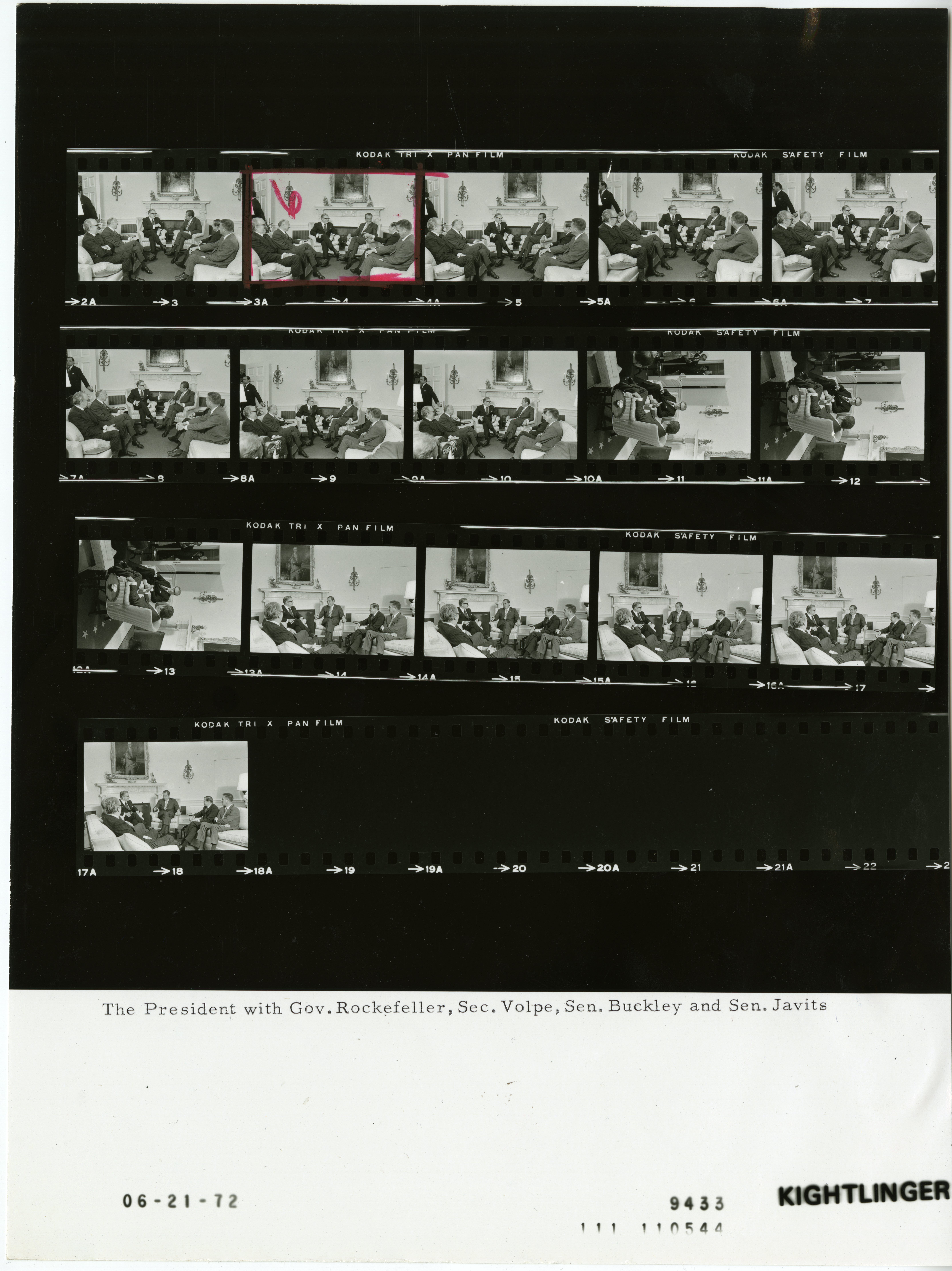
- Frame(s): WHPO-9433-, President Nixon seated informally with Nelson Rockefeller, John Volpe, Senator Jacob Javits, Sen. James Buckley, and William Ronan. 6/21/1972, Washington, D.C. White House, Oval Office. President Nixon, Rockefeller, John A. Volpe, Jacob Javits, James Buckley, William Ronan.
- Frame(s): WHPO-9433-10, President Nixon seated informally with Nelson Rockefeller, John Volpe, Senator Jacob Javits, Sen. James Buckley, and William Ronan. 6/21/1972, Washington, D.C. White House, Oval Office. President Nixon, Nelson Rockefeller, John A. Volpe, Jacob Javits, James Buckley, William Ronan.
Roll WHPO-9434 Photographer: Grove, Andrew | Color or B&W: B&W
- Frame(s): WHPO-9434-, President Nixon walking to his Executive Office Building (EOB) office in the rain. 6/21/1972, Washington, D.C. driveway, steps, Executive Office Building. President Nixon, aides.
Roll WHPO-9435 Photographer: Grove, Andrew | Color or B&W: B&W
- Frame(s): WHPO-9435-, Vice President Agnew giving a briefing. 6/21/1972, Washington, D.C. unidentified room. Agnew, audience.
Roll WHPO-9436 Photographer: Kightlinger, Jack | Color or B&W: Color
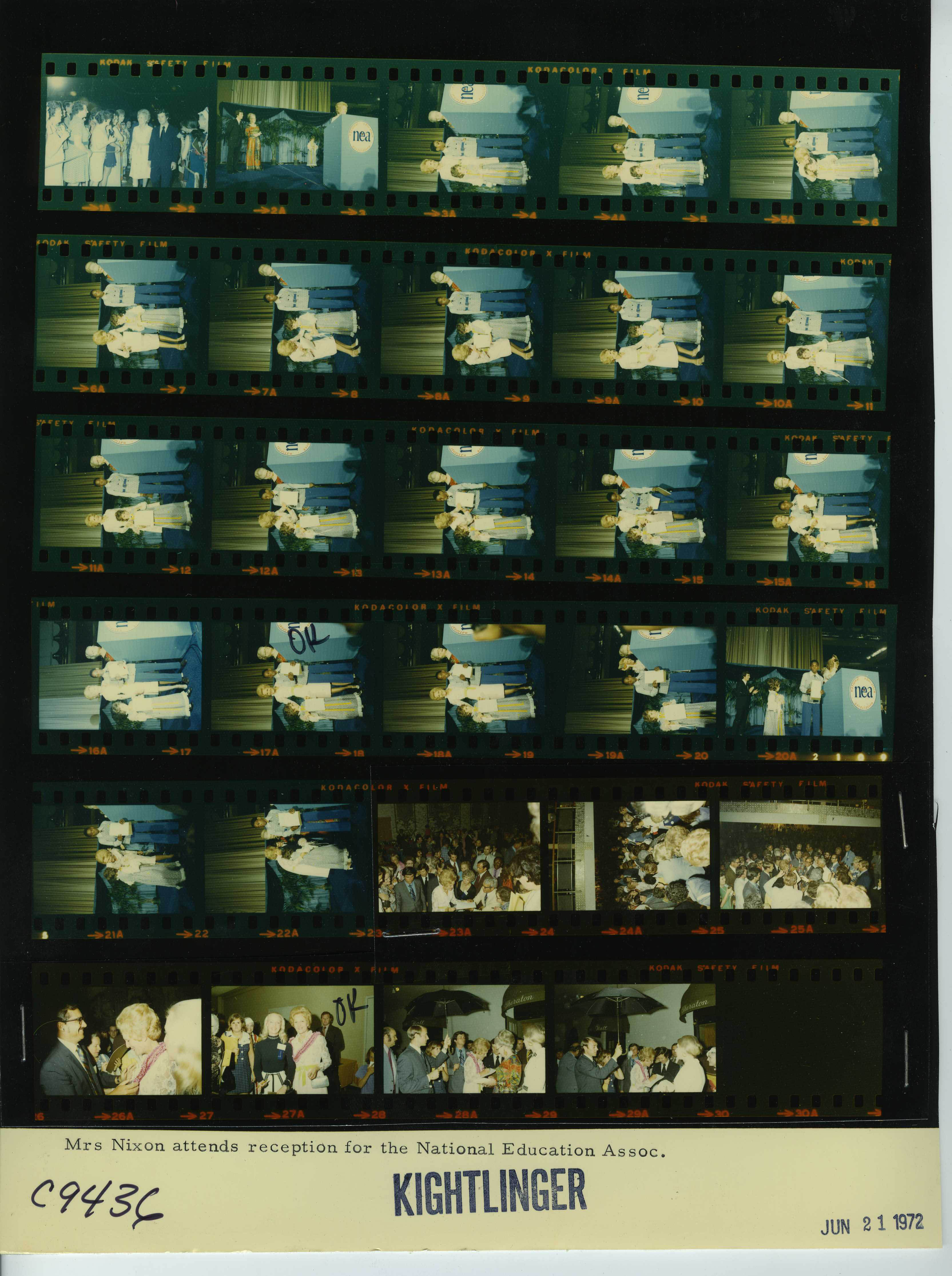
- Frame(s): WHPO-9436-, Pat Nixon arriving at the Sheraton Park Hotel for the Salute to Education Reception, on the speaker's platform with NEA President-Elect Catharine Barrett and two children, and leaving the hotel. 6/21/1972, Washington, D.C. entrance, Ballroom, Sheraton Park Hotel. Pat Nixon, Catharine Barrett, Eilene Sonnenberg, Legrande Latney, attendees.
- Frame(s): WHPO-9436-23A, Pat Nixon arriving at the Sheraton Park Hotel for the Salute to Education Reception. 6/21/1972, Washington, D.C. entrance, Ballroom, Sheraton Park Hotel. Pat Nixon, unidentified attendees.
Roll WHPO-9437 Photographer: Kightlinger, Jack | Color or B&W: Color
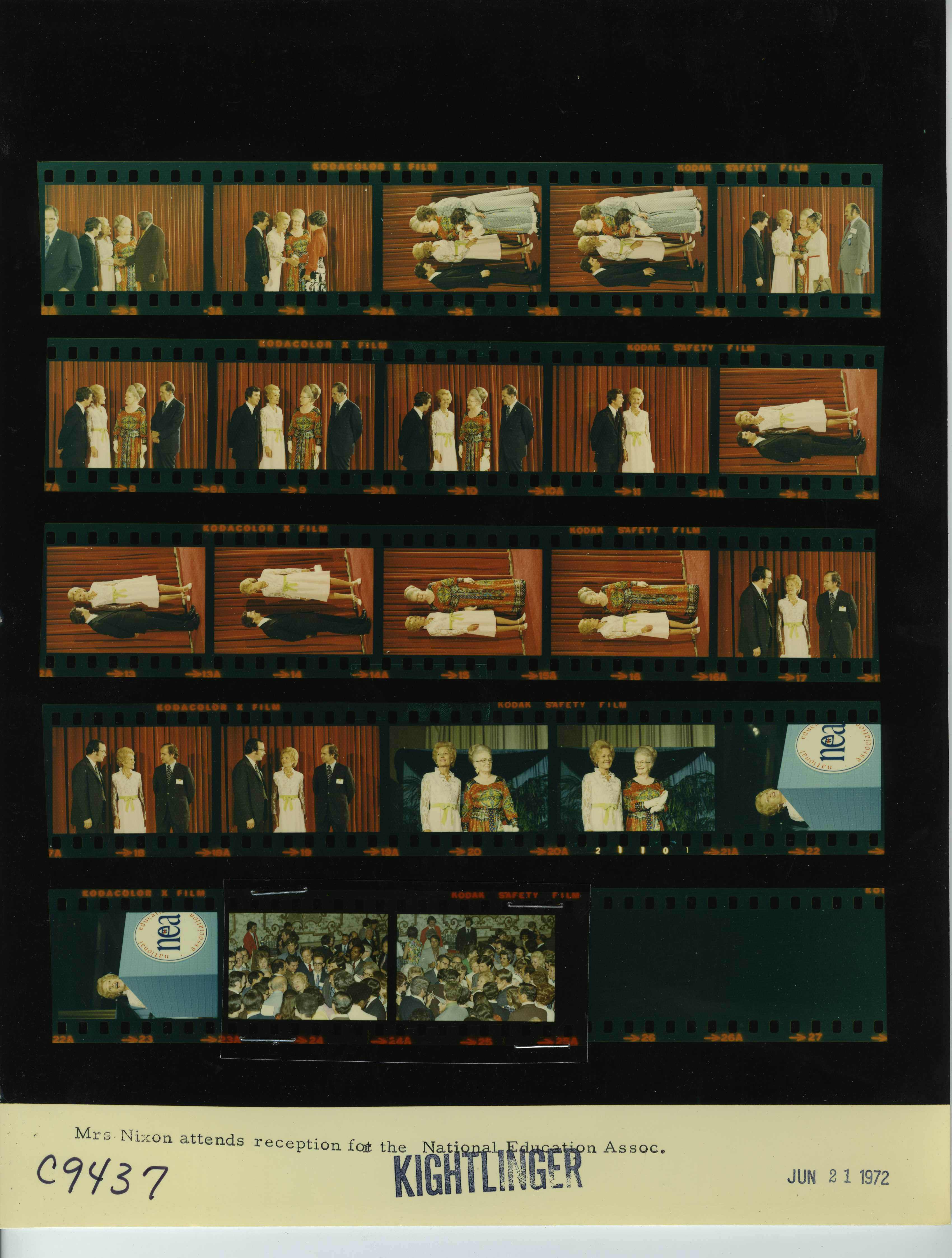
- Frame(s): WHPO-9437-, Pat Nixon in a receiving line and among the crowd at the National Educators of American (NEA) reception. 6/21/1972, Washington, D.C. Continental Room, Ballroom, Sheraton Park Hotel. Pat Nixon, Catharine Barrett, officials, attendees.
- Frame(s): WHPO-9437-22, Pat Nixon speaking at a podium, in the Continenal Room at the Sheraton Park Hotel during the National Educators of American (NEA) reception. 6/21/1972, Washington, D.C. Continental Room, Ballroom, Sheraton Park Hotel. Pat Nixon.
The White House Communications Agency Sound Recordings Collection contains public statements that took place between 1969 and 1974. Visit the finding aid to learn more.
B - Vice-Presidential (Agnew and Ford)
- WHCA-SR-B-224
Remarks to the National Teenage Republicans-E.O.B. Conference Rm. (6/21/1972)
Runtime: 15:00
Original Format: 1/4-inch reel-to-reel audiotape. Original source type: Original.
C - First Lady
- WHCA-SR-C-129
Remarks by Pat Nixon at the National Education Association's "Salute to Education" at the Sheraton Park Hotel in Washington, D.C. (6/21/1972, Washington, D.C.)
Runtime: 0:15:55
Production credits: Audio feed supplied by WHCA; Recorded by RWF (initials of WHCA engineer)
Original Format: 1/4-inch reel-to-reel audiotape. Original source type: Original.
G - Cabinet Officer Briefings
- WHCA-SR-G-172
Briefing by Secretary of Transportation John A. Volpe, with Nelson Rockefeller, Mr. Roonan, and Senators Jacob Javits and James Buckley. (6/21/1972, Press Center)
Runtime: 8:00
Production credits: Audio feed supplied by WHCA; Recorded by RHD (initials of WHCA engineer)
Original Format: 1/4-inch reel-to-reel audiotape. Original source type: Original.
H - White House Staff Member Recordings
- WHCA-SR-H-598
Press briefing by Edward David. (6/21/1972, [None listed])
Runtime: [Nonelisted]
Keywords: Press conferences, news conferences, interviews, media
Production credits: Audio feed supplied by WHCA; Recorded by LDH (initials of WHCA engineer)
Original Format: 1/4-inch reel-to-reel audiotape. Original source type: Original.
The White House Communications Agency Videotape Collection contains “off-the-air” recordings of televised programs produced between 1968 and 1974. Visit the finding aid to learn more.
- WHCA-5494
"A Public Affair: Election '72".
NBC
Runtime: 0:30 - WHCA-5497
Weekly News Summary, Tape II.
ALL NETWORKS
Runtime: 01:35:00
18. Smith/Geer: Cost of living figures, Dr. Whitman (President Nixon with Cost of Living Council). Time Code Start: 62:27. Keywords: economy, economics, budgets, finances, recession, inflation, money, wages, costs, unemployment, prices, reports, cabinet, advisors, Presidents. Network: ABC.
19. Fordham: Beef prices and cattlemen. Time Code Start: 64:50. Keywords: food, animal products, meat, sales, costs, prices, supply, shortages, freezes, wage and price controls, freezes, prices, costs, increases, decreases, economy, economics, budgets, finances, recession, inflation, money. Network: ABC.
20. Reasoner/Matney: Federal troops to be at conventions; McGovern thinks he can win. Time Code Start: 66:51. Keywords: Presidential elections, campaigns, campaigning, candidates. Network: ABC.
21. Reasoner: Senator Ted Kennedy says no, he will not run. Time Code Start: 68:40. Keywords: Presidential elections, campaigns, campaigning, candidates. Network: ABC.
22. Bell: Governor George Wallace's wife, Mrs. Wallace addresses Democratic delegation, Columbus, Ohio. Time Code Start: 70:10. Keywords: Governors, familes, wife, speeches, Presidential elections, campaigns, primaries, candidates, reports, assassinations, shootings. Network: ABC.
23. Reasoner/Derland: Vietnam; Mayor's conference denounces President Nixon on the war, Mayor Daley. Time Code Start: 71:54. Keywords: Vietnam War, Mayors, conferences, conventions, statements. Network: ABC.
24. Smith: Commentary on Democrats. Time Code Start: 73:55. Keywords: political parties, Democrats, Democratic Party. Network: ABC.
25. Chancellor/Levine: Phase II. Time Code Start: 75:42. Keywords: wage and price controls, freezes, prices, costs, increases, decreases, economy, economics, budgets, finances, recession, inflation, money. Network: NBC.
26. Chancellor/Perkins: Campaign '72, McGovern. Time Code Start: 78:13. Keywords: Presidential elections, campaigns, campaigning, candidates. Network: NBC.
27. Chancellor/Kiker: Humphrey thinks he can win. Time Code Start: 81:07. Keywords: Presidential elections, campaigns, campaigning, primaries, candidates, voting, speeches. Network: NBC.
28. Brinkley's Journal: Bugging of the Democratic headquarters. Time Code Start: 83:18. Keywords: bugging, bugs, wiretapping, wire taps, surveillance, spying, recordings, Watergate, Senate committee hearings, investigations, testimony, testify, cover-ups, break-in, burglary, theft, plumbers, scandals. Network: NBC.
29. Chancellor: Primary results in New York. Time Code Start: 84:55. Keywords: Presidential elections, campaigns, primaries, voting. Network: NBC.
30. Chancellor: Mayor Daley supports President Nixon on war policy. Time Code Start: 85:16. Keywords: Mayors, conferences, conventions, speeches, Presidents, Vietnam War. Network: NBC.
31. Chancellor/Lewis: Vietnam, bombing of ports, ground fighting, Highway 13. Time Code Start: 87:32. Keywords: Vietnam War, harbors, bombings,. Network: NBC.
32. Chancellor/Goralski:Secretary of Defense Laird at Senate hearing. Time Code Start: 90:32. Keywords: cabinet, advisors, military, Cambodia, Vietnam War, speeches, statements. Network: NBC.
33. Chancellor: Senator Ted Kennedy says no, he will not run. Time Code Start: 93:00. Keywords: Presidential elections, campaigns, campaigning, candidates. Network: NBC. - WHCA-5498
Weekly News Summary, Tape III.
ALL NETWORKS
Runtime: 00:47:47
1. Hart/Rather: Vietnam ceasefire. Time Code Start: 00:00. Keywords: Vietnam War, ceasefires. Network: CBS.
2. Hart: Vietnam war, ground fighting. Time Code Start: 01:19. Keywords: Vietnam War. Network: CBS.
3. Hart: McGovern, campaign '72. Time Code Start: 02:25. Keywords: Presidential elections, campaigns, campaigning, candidates. Network: CBS.
4. Hart/Clark: Mayor Daley supports President Nixon's war policy at Mayor's Conference. Time Code Start: 03:50. Keywords: Mayors, conferences, conventions, speeches, Presidents, Vietnam War. Network: CBS.
5. Hart/Shoumacher: Campaign '72, McGovern, Humphrey. Time Code Start: 06:40. Keywords: Presidential elections, campaigns, campaigning, primaries, candidates, voting, speeches. Network: CBS.
6. Hart: Senator Ted Kennedy says no, he will not run. Time Code Start: 10:40. Keywords: Presidential elections, campaigns, campaigning, candidates. Network: CBS.
7. Hart: Elections in New York. Time Code Start: 11:00. Keywords: elections, campaigns, campaigning, candidates. Network: CBS.
8. Hart: Israel and Lebanon. Time Code Start: 11:45. Keywords: Middle East, Mideast, war, Israeli, Lebanon, Lebanese. Network: CBS.
9. Hart/Blocker: Federal Housing Administration (FHA), Detroit, Michigan and Romney. Time Code Start: 12:10. Keywords: mortgage insurance, housing, homes. Network: CBS.
Context (External Sources)
The Vanderbilt Television News Archive is the world's most extensive and complete archive of television news. They have been recording, preserving and providing access to television news broadcasts of the national networks since August 5, 1968.
Wikipedia is a free encyclopedia that anyone can edit.