
Introduction
This almanac page for Friday, June 16, 1972, pulls together various records created by the federal government and links to additional resources which can provide context about the events of the day.
Previous Date: Thursday, June 15, 1972
Next Date: Saturday, June 17, 1972
Schedule and Public Documents
The Daily Diary files represent a consolidated record of the President's activities. Visit the finding aid to learn more.
The President's day began at The White House - Washington, D. C.
The Weekly Compilation of Presidential Documents made available transcripts of the President's news conferences; messages to Congress; public speeches, remarks, and statements; and other Presidential materials released by the White House.
Digitized versions can be found at HathiTrust.
Each Public Papers of the Presidents volume contains the papers and speeches of the President of the United States that were issued by the White House Office of the Press Secretary during the time period specified by the volume. The material is presented in chronological order, and the dates shown in the headings are the dates of the documents or events. In instances when the release date differs from the date of the document itself, that fact is shown in the text note.
To ensure accuracy, remarks have been checked against audio recordings (when available) and signed documents have been checked against the original, unless otherwise noted. Editors have provided text notes and cross references for purposes of identification or clarity.
The Federal Register is the official daily publication for rules, proposed rules, and notices of federal agencies and organizations, as well as executive orders and other Presidential documents.
The Congressional Record is the official daily record of the debates and proceedings of the U.S. Congress.
Archival Holdings
Any selection of archival documents will necessarily be partial. You should use the documents and folders identified below as a starting place, but consult the linked collection finding aids and folder title lists and the collections themselves for context. Many documents to be found this way do not lend themselves to association with specific dates, but are essential to a complete understanding of the material.
Selective document listing
President's Office Files
The President's Office Files consists of materials drawn together by the Special Files Unit from several administrative subdivisions within the White House Office. It is the handwriting and sensitive papers sent to the Staff Secretary that now comprise much of the President's Office Files. Visit the finding aid to learn more.
- News Summaries, Unmarked News Summaries, Box 50, News Summaries - June 1972 [5 of 6] [Note: Due to the way News Summary products were compiled, you should also consult nearby days for potentially relevant materials.]
- News Summary, June 16, 1972, (Thurs. nets, wires, mags, columns)
- President's Daily Schedule, Box 102, [President's Daily Schedule, Apr.-July 1972] [2 of 3]
- The President's Schedule, Friday - June 16, 1972
President's Personal File
The President's Personal File is essentially a President's secretary's file, kept by Rose Mary Woods, personal secretary to the President, for two purposes: (1) preserving for posterity a collection of documents particularly close to the President, whether because he dictated or annotated them, or because of the importance of the correspondent or the event concerned and (2) giving appropriate attention–letters of gratitude, invitations to White House social events, and the like–to members and important friends and supporters of the Nixon administration. This generalization does not describe all the varied materials of a file group which is essentially a miscellany, but it does identify the reason for the existence of the file group's core. Visit the finding aid to learn more.
- President's Speech File
The H. R. Haldeman Diaries consists of seven handwritten diaries, 36 dictated diaries recorded as sound recordings, and two handwritten audio cassette tape subject logs. The diaries and logs reflect H. R. Haldeman’s candid personal record and reflections on events, issues, and people encountered during his service in the Nixon White House. As administrative assistant to the President and Chief of Staff, Haldeman attended and participated in public events and private meetings covering the entire scope of issues in which the Nixon White House engaged in during the years 1969-1973. Visit the finding aid to learn more.
- Transcript of diary entry (PDF)
Friday, June 16th. Food price problem came up again at the staff meeting. Concern about what we can do, but no real conclusions. We had a long Cabinet meeting today and the President followed up after Johnnie Rhodes’s platform presentation, and he did a superb monologue of laying out our general position mainly on foreign policy. He said that a basic decision has to be made assuming that McGovern is the candidate. Recognize that his line has to be to stay as far left as possible, at least until the nomination is wrapped up and even afterwards, probably, because of his supporters. And even though the propagandists will eventually control the general opinion of his view and swing it over to the middle. His support, while it amounts to only 25 percent of the Democrats according to the polls, is more enthusiastic than the other support, even the Wallace people aren't well organized, so you can be sure that at the Convention, and after his nomination, they will try and buff off all the rough edges, and the purpose of the platform is to make it appear that there are no issues. So that the candidate can then make them the way he wants to. It will be hard to change his position on the National Defense and Foreign Policy, because he set it for too long. The line they will take is to keep him on the left and not compromise until he gets to the Convention and wraps it up, then he has to move to the center to win and keep Hubert, Meany, and so forth with him. To do that, he'd use the platform and the acceptance speech to move from the left to the center, so we'll find that our people will say we should move from the right to the center and try to pre-empt the center. We should not do that because McGovern is an extremist, and we should pay no attention to his moves. There should be no Goldwater. There could be no greater mistake for us than to allow him to get off of what he really believes. When he moves, we should not move. The line has to be drawn clearly on the critical issues. There are some really good issues we have to ride. As far as the President is concerned regarding tactics, he does not believe we should move to the center. We are already plenty centrist enough. We should draw a clear line, where possible, on the gut issues. We should not buy our fight where it doesn't matter. Also where it really matters to certain groups, we should draw the line, take a position clearly with no equivocation.
Laird interjected here that the people support a strong country. McGovern is associated with a weak country: the problem of 1960 on the missile gap, and the failure to increase the Defense Budget, shows that up. We must not lose the good strong differences. Don’t erode them as we did in '60 by having a fight on the platform that's unnecessary.
The President then made the point on the Lincoln amnesty that we should put in the platform the idea that deserters have got to live with their choice because hundreds of others died for theirs. We should make them serve and not in the Peace Corps. He hit that pretty hard and then said maybe that gives you some idea of the tone that I want to have, and everybody laughed. He said that the situation on the platform is that candidates can't get off of their positions, even though shifting is inevitable. We confront something quite different than in '64, then, when Goldwater said anything, the media wouldn't give him a chance, except on his interesting off-hand comments like dropping a bomb in the men's room of the Kremlin. This time the media that matters will be desperately engaging in an effort to allow McGovern to move to the center, and they will ignore his previous positions and accept his new ones and paper them over. So, we have to pick up a few issues where the record is really clear cut and ride them hard. We need a debate on the record, not on his shift: that's his problem to explain. The area of clearest difference is foreign and defense policy. These are a matter of faith, and he can't compromise, and neither can we. They may prove to be a very critical issue. Laird's idea of the issue of strength of the country may well be it. The view of the President’s policy at the present, in foreign policy and defense policy, is that we should examine the reaction of the media who have supported the China and Soviet initiatives, but will be on the other side later. The news magazines recently said that why shouldn't McGovern change, because Nixon used to be an anti-Communist, now he's changed. What disturbs him is that too many of the media were for the trips for the wrong reasons. For example: China was never a threat to the United States, they say, China was never a threat to the United States. Korea and Vietnam were aberrations, and Nixon has finally seen this and turned it around, so now we get along well together and so forth. This is the general reaction because the people want to believe the best, but nations are motivated by their self-interest, not by love and affection and so forth.
-------------------------------------------------------------------------------------------------------------------
DECLASSIFIED - E.O. 13526, Sect. 3.4: by MS, NARA, June 12, 2013
Audio Cassette 22, Side A, Withdrawn Item Number 10 [AC-22(A) Sel 6, 7]
Duration: 10 minutes 57 seconds
As we look at China and the Soviet Union, the reason China and the US got together was not because we or they reached the conclusion that we'd been mistaken about each other, but because there are fundamental shifts in the world balance of power that made it to both our interests to have a relationship with each other. Chinese leaders are more dedicated to Communism than the Soviets are, because they're in an earlier stage. Also they're more dedicated to supporting the third world, because they're weaker economically. It's not because they love the Africans and so on, but because they have an overriding concern and a competition with the Soviets for the leadership of the Communist world.
That the Soviet is accommodating the major powers, China is trying to develop relations with the secondary powers. Their foreign policy has not been too successful. Fundamental point: Why is it to the Chinese interest to meet with the United States? Well, they have the Russians on the border with enormous divisions and nuclear capability. On the South, they have India. They have complete contempt for them, because of the Chinese conquering of India in their war in '62, or whenever it was, but it gives them pause to see how the Chinese--, how the Indians did against China's friend, Pakistan. Also, the Indians have a very big population. Then to the Northeast, they have Japan. They have no reason to fear Japan militarily, but they have great and enormous respect for Japan because of the historical invasions of China by Japan and because of Japan's strong economic power. And because, even with the nuclear prohibitions, Japan has the capability to develop a nuclear power fast because of their industrial base. So, China is surrounded by Soviets, India, Japan, and the US. And they have to figure out what to do with them.
We, as a system are the most antagonistic, we have deep philosophical differences that are greater than they have with anyone else. Mao and Chou make no decisions on the basis of personal factors however. So China welcomes the opportunity for different relationships with the US which might give some restraint. They know that the US can restrain Japan. China says that the US should get out of the Pacific, but they don't want that, because that would weaken Japan militarily and they wouldn't be neutral: they'd either go with the Soviets or they'd rearm themselves. So, the US is China's hope for Japanese restraint.
The media don't understand this, because they see it in terms of their biases of the past. They have to rationalize the present situation to prove that they were tight before.
Regarding the Soviets, why are they interested in talking to the US? Mainly because they link everything; they want trade, arms control, and so forth, for other purposes than those ends in themselves. Their problems are regarding China, they have nothing to fear now, but they know what totalitarian control can do, and they know what the ability of China, the Chinese people, and the number of Chinese people; and realize that they could in the future be an enormous threat.
Regarding Western Europe, they find they have a real opportunity. Their purpose is to weaken the European alliance, and so they use the idea of a Soviet threat to try to divide the weaker, to divide and weaken, and separate the European nations. Their interest is not now served by allowing a Chinese-US dialogue to develop to the point of accommodation. [Unintelligible] to say, of course, that we didn't go to either summit to play on the other, because, if it was said by either of us, then it wouldn't happen. But, obviously this is the basis for all of us in these summits.
Regarding arms control there would have been none if there hadn't been an ABM. Soviet are not interested in peace as an end in itself. They do prefer peace mainly because their people don't want war, but their goals haven't changed. They want Communism to spread throughout the world.
China lost 75 to 100,000 men in Korea, but no Soviet men have been lost in war since World War II: they've played it smarter. They avoided outright military combat, particularly with us. The Soviet leaders are a new breed, but they haven't abandoned the ultimate goal of victory for Communism. But, on the West, they have a European problem: the Poles, Hungarians, Czechs, Romanians, and so forth. They are all pulled toward Western Europe and they don’t like the Russians. Communist rule has not sunk in in those countries. Soviets also have an internal problem just as we do.
Actual improvement in consumer goods areas, but they are still a very primitive society by our standards. They need more, want more. And they're putting too much into defense, which is a problem for them. So, where can they turn? France, England? No, because they don't matter. The Soviets and Chinese are both total pragmatists. They know and understand power. So, unless the US has strength and leadership, we're not worth talking to. Thus, it was a difficult decision to mine North Vietnam, but we either had to do that, or lose the war. The President took the action because a loss in Vietnam, if it deteriorated, as it looked like it was doing, would have pleased the Soviet and Chinese, but they would have gained no respect for an American president, because we would have proved ourselves ineffective. This doesn't mean we should run around starting wars, but it does mean where we are involved, we must be credible, and we must stand by our allies and our friends.
So, in the arms race, the Soviets have caught the US in many categories, but they respect our economic power, and they believe that if we have an arms race, they can't hope to win it, because they know we're capable of moving ahead of them. So, they seek to reach an agreement even though they are ahead in some areas.
The fundamental point is that we are entering a new creative relationship with the Soviet in terms of cooperation in space, health, environment, trade, and so forth. But, as far as the Soviet leaders are concerned, there's no change in their goals. They're dealing with us in non-military areas, because they think it will help them in their domestic economy in a manner of enlightened selfishness.
On the military side, their dealing, because the alternative is not attractive to them, and there's a race that neither can win, so they need some attempt to control it. We go into the second round of SALT in October and there'll be a tendency in Congress to put the ABM in escrow, saying that we don't need it now. But we can forget any further negotiations if we do that. They will make a deal only if we have strength. We now have a situation where to capitalize on SALT, which may be the most--, this may be the most significant arms act in history, because you have the two superpowers with the cap--, capacity to destroy each other, and now, restraining themselves voluntarily and bilaterally.
Public opinion in the United States, as reflected in Congress, makes it difficult to get the new programs that we need. Because we're naïve, wishful-thinking, peace-loving people that grab at any straw. The offensive weapon agreement now only covers a few things and only for five years. We need a permanent freeze. We can't get it unless the US is credible and speaks from strength. This includes ending the war in Vietnam in the right way. If we throw in the towel, this will erode the Soviet intension to deal with us. In defense, it's essential to have a credible defense position. He hopes we won’t have to build the B-1s and so forth, but unless we have progress moving forward on them, Brezhenv is going to ignore us, and he has made clear that he is going forward in all areas.
Wilson and the League of Nations went down the drain because of Wilson's lack of pragmatism, and practicalism. This may be the last time in our history when the US can negotiate, because we have nothing on the line in production that is going to move us ahead. This is the legacy of McNamara and our weak position over recent years. So, why would the Soviets agree with us if we're weak? One, because of the Chinese initiative; two, because of their economic needs; and three, because of their fear of the arms race, and their sense that the US might pick up. And they know our technological ability to do so.
It's important now for the US to make the best deal that we can now, because it won't be able to be done three or four years from now. A unilateral cutback in defense spending would torpedo any chance for arms agreements or for the Soviet to get the impression of weakness of will in Vietnam or Middle East. It would reduce the Soviet incentive to negotiate. We tend to underestimate the leaders of different societies. Their philosophies and manners are different from ours. For example, we laughed at Khruschev as being a clown, but he was only a clown when he wanted to be. They do have problems with their bureaucracy. The President found he could make decisions much faster than Brezhnev could. But, they are men of great ability and firm minds. Brezhnev is not an intellectual—Kosygin is. But, no one reaches the top in their kind of society without stamina, steel-like determination, and this compensates for their lack of college degrees, like the people around this table have.
A new world is developing, not because we or the Communists have changed, but because the Communists are split. They have problems in Europe which offer opportunities for the US to affect change; to do it and make it last. We have to maintain our strength and credibility not just with the Communists, but also with our allies. It makes no impression in a Communist country if we let down our allies. Most of the media approach the trips on the basis of thank God Nixon finally saw the light regarding the Communists. The chances of a more peaceful world are substantially increased from what we've done, but they wouldn't have, it wouldn't have been possible from weakness and wooly-headed idealism. It's only possible through hard-headedness and pragmatic dealing. We have not been belligerent, we've avoided exacerbating the problems and shouting matches, and the personal relationship are as good as they can be. But, the President is convinced that if he had gone to Moscow after being kicked out of Vietnam and in a weak defensive posture, we would have had no deal at all.
Remember how they'll deal by evaluating us. If they’re weak, they will pounce on us; if they’re stron--, if we're strong, they'll deal with us. The President then received long applause from the Cabinet. He then said he appreciated what all the Cabinet had done in standing up regarding Vietnam and so on. Everybody should understand that we're not tough in Vietnam or fighting for a strong defense just to throw our weight around, or to save the military-industrial complex. We'd like to move away from it. But in this world today, it's not being for peace that matters, it's finding an effort--, effective method to do something about it. He recalled his last talk with De Gaulle, when he said rather sadly that France is no longer a power in the world…
-------------------------------------------------------------------------------------------------------------------
...that he criticized American foreign policy on the basis that we're good at fighting wars but we're not good at negotiating peaces, for example, World War I and World War II. Now we're trying to prevent wars by learning from the mistakes of the past. We have an opportunity that will never come again to build a real structure of peace. We're all going to have to take a lot of heat, because we can't take irresponsible positions like McGovern argues, just to get the college kids to cheer for us.
Continued on the next side...
[End of tape reel AC-22(A)]
[Begin tape reel AC-22(B)]
Continuing Friday, June 16th. On the plane to Florida, the President got into some general political things. He wants to push hard to get name Democrats to start coming out for us examining all the Governors, Senators, and Congressmen, present and former, and making contacts with them. He also was talking about the mythology of this success idea. The kind of people who are attracted to Nixon, not because of his personal charisma, but, because of the fact, that he is doing the right thing in the right way. He then sort of talked about odds and ends, that, on operational items. He got off the plane at Grand Bahama and is going on over to Walkers Key. We came on to Key Biscayne.
End of June 16th. - Original audio recording (MP3)
The National Archives Catalog is the online portal to the records held at the National Archives, and information about those records. It is the main way of describing our holdings and also provides access to electronic records and digitized versions of our holdings.
The Catalog searches across multiple National Archives resources at once, including archival descriptions, digitized and electronic records, authority records, and web pages from Archives.gov and the Presidential Libraries. The Catalog also allows users to contribute to digitized historical records through tagging and transcription.
Nixon Library Holdings
All National Archives Units
National Security Documents
The President's Daily Brief is the primary vehicle for summarizing the day-to-day sensitive intelligence and analysis, as well as late-breaking reports, for the White House on current and future national security issues. Read "The President's Daily Brief: Delivering Intelligence to Nixon and Ford" to learn more.
The Foreign Relations of the United States series presents the official documentary historical record of major U.S. foreign policy decisions and significant diplomatic activity. Visit the State Department website for more information.
Vol. I, Foundations of Foreign Policy, 1969-1972
Foundations of Foreign Policy, 1969-1972
119. Memorandum for the President’s File by the President’s Special Assistant (Price), Washington, June 16, 1972
Source: National Archives, Nixon Presidential Materials, White House Special Files, President’s Office Files, B Series Documents, Box 7 (“B” Box 59, Folder 14). Confidential. The President addressed the Cabinet and selected members of the White House staff in the Cabinet Room. According to the Daily Diary, the meeting convened at 8:37 and ended at 10:17 a.m. (Ibid., White House Central Files, Staff Members and Office Files, Office of Presidential Papers and Archives, Daily Diary)
Vol. E-2, Documents on Arms Control and Nonproliferation, 1969-1972
Nuclear Non-Proliferation Treaty; Implementation of Safeguard System
59. Memorandum From Helmut Sonnenfeldt of the National Security Council Staff to the President’s Assistant for National Security Affairs (Kissinger), Washington, June 16, 1972
Sonnenfeldt summarized negotiations between IAEA and Euratom on a safeguards agreement under the NPT. The attached telegram reported on a meeting between Department of State officials and a European Community delegation.
Source: National Archives, Nixon Presidential Materials, NSC Files, Box 322, Subject Files, European Common Market, Vol. II 1971–1972. Confidential. Sent for information. At Tab A is Document 56. Initialed by Kissinger. Tab B was drafted in ACDA and EUR; cleared in AEC/DIS, AEC/NUMS, SCI/AE, ACD, and EUR/RPE; approved by Springsteen. It was repeated for information to Vienna, Bonn, Rome, The Hague, Brussels, Luxembourg, Paris, and Tokyo.
Vol. E-4, Documents on Iran and Iraq, 1969-1972
Iraq 1972
317. Telegram 5798 From the Embassy in the Soviet Union to the Department of State, Moscow, June 16, 1972, 1653Z
The Embassy reported that the Soviet-Iraqi treaty had been ratified, and that Moscow had expressed strong support for the IPC nationalization.
Source: National Archives, RG 59, Central Files 1970–73, POL 7 IRAQ. Confidential. Repeated to Amman, Beirut, Cairo, Jidda, London, Paris, Tel Aviv, USUN, Tehran, Kuwait, and Manama.
Vol. E-10, Documents on American Republics, 1969-1972
Jamaica
428. Airgram A–144 From the Embassy in Jamaica to the Department of State, Kingston, June 16, 1972., Kingston, June 16, 1972
The Embassy reported on a June 6 speech by Jamaican Governor General Sir Clifford Campbell, in which he spelled out the policy guidelines of the new PNP Government, led by new Prime Minister Manley. Among the issues discussed, the Embassy noted that the new government planned to examine Jamaica’s bauxite arrangements, and that the country’s foreign affairs would stress improved relations with Africa and the developing world.
Source: National Archives, RG 59, Central Files 1970–73, POL 15 JAM. Limited Official Use. Drafted on June 14 by Falkner; cleared by Slater and Rogers; approved by Roberts; and signed by de Roulet. Stamped notations on the Airgram indicate that it was received at the Department of State at 8:32 a.m. on June 26, the Bureau of Inter-American Affairs on June 29, and at the RS/AN Analysis Branch.
Vol. E-13, Documents on China, 1969-1972
138. Memorandum From Secretary of Defense Laird to the President’s Assistant for National Security Affairs (Kissinger), Washington, June 16, 1972, Washington, June 16, 1972
Secretary of Defense Laird outlined for the President’s Assistant for National Security Affairs Kissinger the findings of the investigation concerning PRC allegations of airspace intrusion.
Source: National Archives, Nixon Presidential Materials, NSC Files, Box 851, President’s File-China Trip, Memcons, HAK China Visit 19-23 June 1972 Staff. Top Secret; Sensitive; Codeword. Published from a copy that indicates Laird signed the original.
The Kissinger telephone conversation transcripts consist of approximately 20,000 pages of transcripts of Kissinger’s telephone conversations during his tenure as Assistant to the President for National Security Affairs (1969-1974) and Secretary of State (1973-1974) during the administration of President Richard Nixon. Visit the finding aid for more information.
Digitized versions can be found in the National Archives Catalog.
Audiovisual Holdings
Visit the White House Tapes finding aid to learn about the taping system's operation and archival processing.
Oval Office
- 737-1; Unknown between 8:07 a.m. & 8:37 a.m.; Nixon, Richard M. (President); Bull, Stephen B.
- 737-2; Unknown between 10:18 a.m. & 11:18 a.m.; Nixon, Richard M. (President); Butterfield, Alexander P.; Ehrlichman, John D.; Haldeman, H. R. ("Bob"); Hodgson, James D.; Richardson, Elliot L.; Weinberger, Caspar W. ("Cap"); MacGregor, Clark; Cole, Kenneth R., Jr.; Korologos, Thomas C.; Bull, Stephen B.
- 737-3; Unknown between 11:18 a.m. & 11:22 a.m.; Nixon, Richard M. (President); Bull, Stephen B.
- 737-4; 11:22 a.m. - 12:26 p.m.; Nixon, Richard M. (President); Alvarez, Luis Echeverria; Mishkin, Emilio Rabasa; Haig, Alexander M., Jr.; Barnes, Donald F.
- 737-5; 12:33 p.m. - 2:38 p.m.; Nixon, Richard M. (President); Bull, Stephen B.; Coffey, Vernon C., Jr.; Scowcroft, Brent G. (Gen.)
- 737-6; Unknown between 12:38 p.m. & 12:44 p.m.; Nixon, Richard M. (President); Bull, Stephen B.
- 737-7; 12:44 p.m. - 12:53 p.m.; Nixon, Richard M. (President); Bull, Stephen B.; Vann, John A.; Vann, John A.; Vann, Thomas; Vann, Peter; Vann, Frank; Vann, Eugene; Cadorette, Dorothy Vann; Cadorette, Dorothy Vann; Vann, Mary Jane; Rogers, William P.; Laird, Melvin R.; Ziegler, Ronald L.; Scowcroft, Brent G. (Gen.); Coffey, Vernon C., Jr.; Andrews, John K., Jr.; Alsop, Joseph W.
- 737-8; Unknown between 12:53 p.m. & 12:56 p.m.; Nixon, Richard M. (President); [Unknown person(s)]
- 737-9; 12:56 p.m. - 1:35 p.m.; Nixon, Richard M. (President); Woods, Rose Mary; Ehrlichman, John D.; Butterfield, Alexander P.; Haldeman, H. R. ("Bob")
White House Telephone
The White House Photo Office collection consists of photographic coverage of President Richard Nixon meeting with prominent social, political, and cultural personalities; speaking engagements and news conferences of the President and various high-ranking members of the White House staff and Cabinet; Presidential domestic and foreign travel, including Presidential vacations; social events and entertainment involving the First Family, including entertainers present; official portraits of the President, First Family, and high-ranking members of the Nixon administration; the 1969 and 1973 Inaugurals; the President’s 1972 Presidential election campaign appearances (including speeches) and other official activities of the White House staff and the President’s Cabinet from January 20, 1969 until August 9, 1974 at the White House and the Old Executive Office Building; other locations in Washington, DC, such as The Mall; and the Presidential retreats in Camp David, Maryland, Key Biscayne, Florida, and San Clemente, California. Visit the finding aid to learn more.
Roll WHPO-9396 Photographer: Grove, Andrew | Color or B&W: B&W
- Frame(s): WHPO-9396-, Mike Farrell standing with a man, a woman, and four men from Tennessee on horseback. 6/16/1972, Washington, D.C. White House, South Grounds. Mike Farrell, unidentified woman and men.
Roll WHPO-9397 Photographer: Atkins, Oliver | Color or B&W: B&W
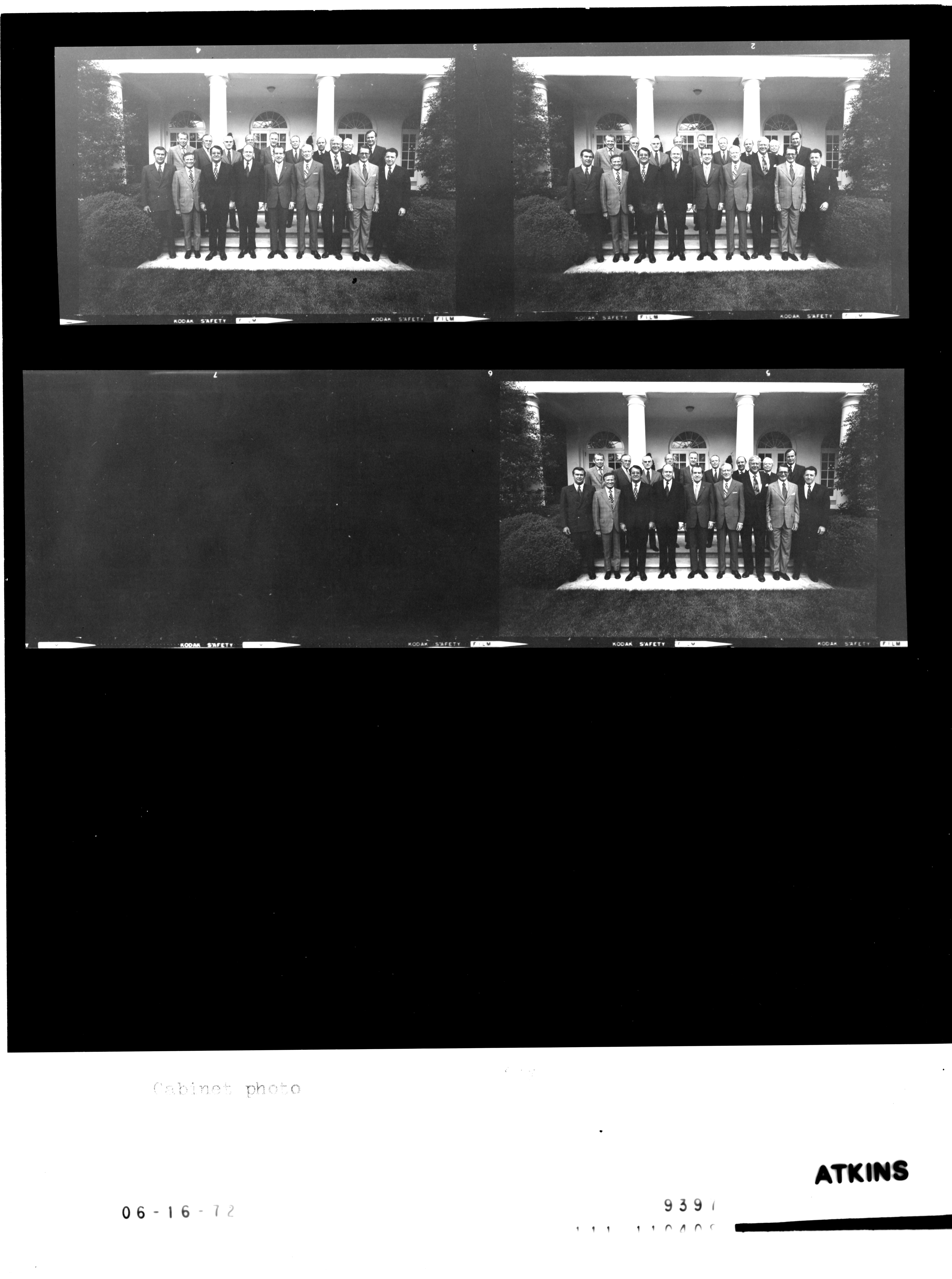
- Frame(s): WHPO-9397-, President Nixon and members of his cabinet. 6/16/1972, Washington, D.C. Rose Garden steps, White House. President Nixon, Donald Rumsfeld, John A. Volpe, Peterson, Melvin Laird, William Rogers, Morton, Richardson, Weinberger, Finch, Romney, Butz, Shultz, Agnew, Kleindienst, Hodgson, David Kennedy, George Bush.
Roll WHPO-9399 Photographer: Atkins, Oliver | Color or B&W: Color
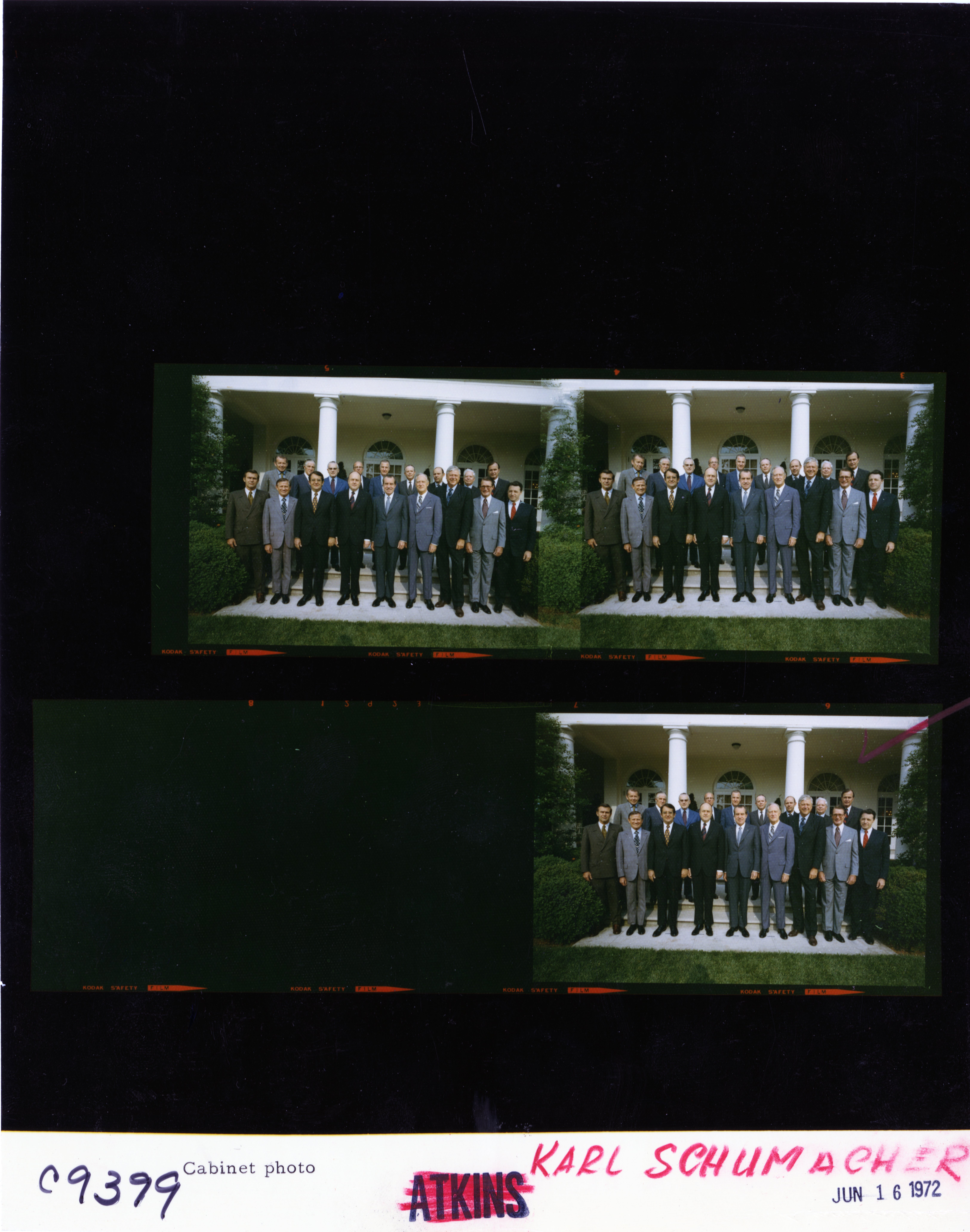
- Frame(s): WHPO-9399-, President Nixon and members of his Cabinet pose for a formal portrait outside the Oval Office porch area. 6/16/1972, Washington, D.C. Rose Garden steps, White House. President Nixon, Vice President Agnew, Donald Rumsfeld, John A. Volpe, Peterson, Melvin Laird, William Rogers, Morton, Richardson, Weinberger, Finch, George Romney, Earl Butz,George Shultz, Richard Kleindienst, Hodgson, David Kennedy, George Bush.
- Frame(s): WHPO-9399-07, President Nixon and members of his Cabinet pose for a formal portrait outside the Oval Office porch area. 6/16/1972, Washington, D.C. Rose Garden steps, White House. President Nixon, Vice President Agnew, Donald Rumsfeld, John A. Volpe, Peterson, Melvin Laird, William Rogers, Morton, Richardson, Weinberger, Finch, George Romney, Earl Butz,George Shultz, Richard Kleindienst, Hodgson, David Kennedy, George Bush.
Roll WHPO-9400 Photographer: Schumacher, Karl | Color or B&W: Color
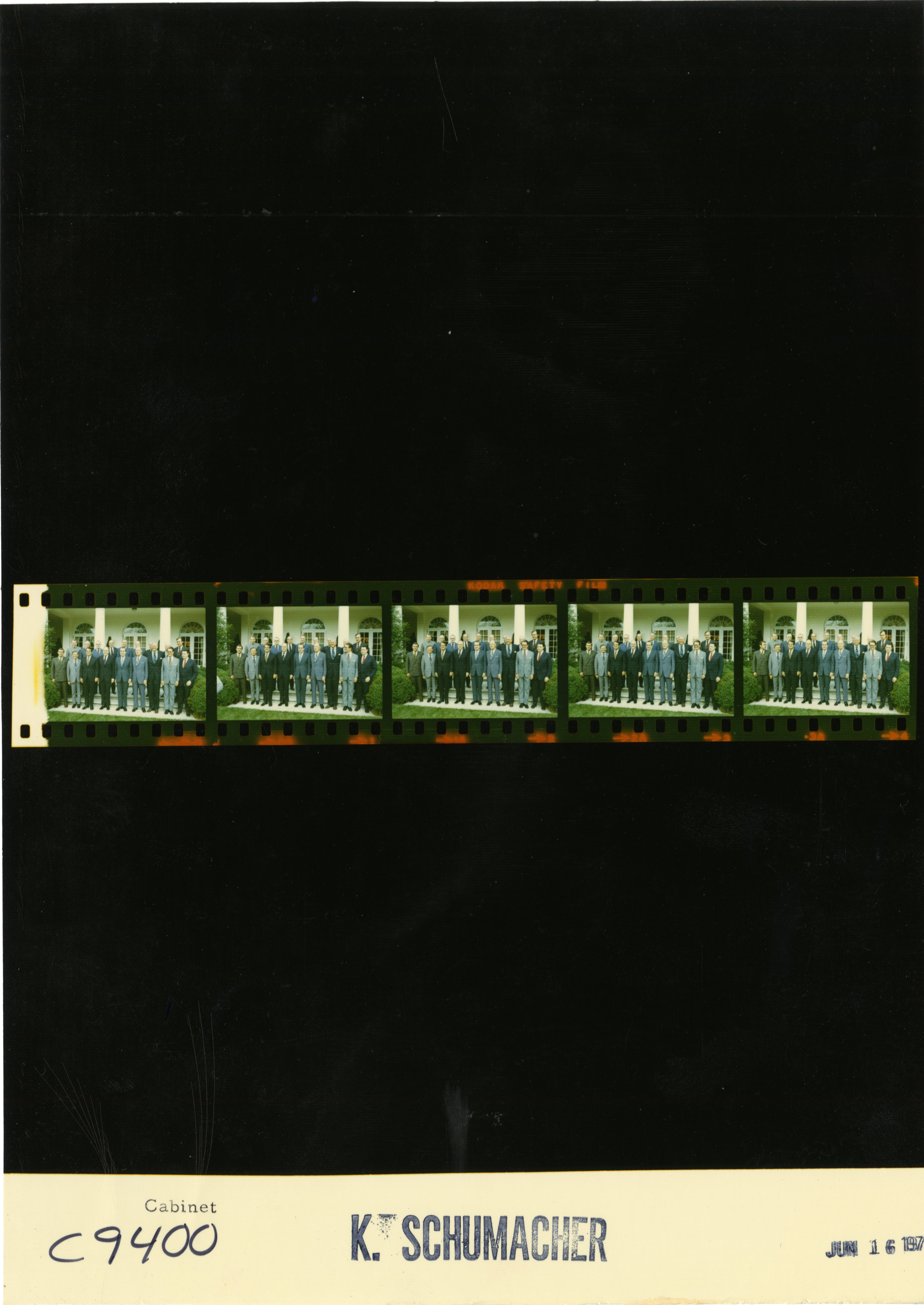
- Frame(s): WHPO-9400-, President Nixon and members of his cabinet. 6/16/1972, Washington, D.C. Rose Garden steps, White House. President Nixon, Donald Rumsfeld, John A. Volpe, Peterson, Melvin Laird, William Rogers, Morton, Richardson, Weinberger, Finch, Romney, Butz, Shultz, Agnew, Kleindienst, Hodgson, David Kennedy, George Bush.
Roll WHPO-9401 Photographer: Grove, Andrew | Color or B&W: B&W
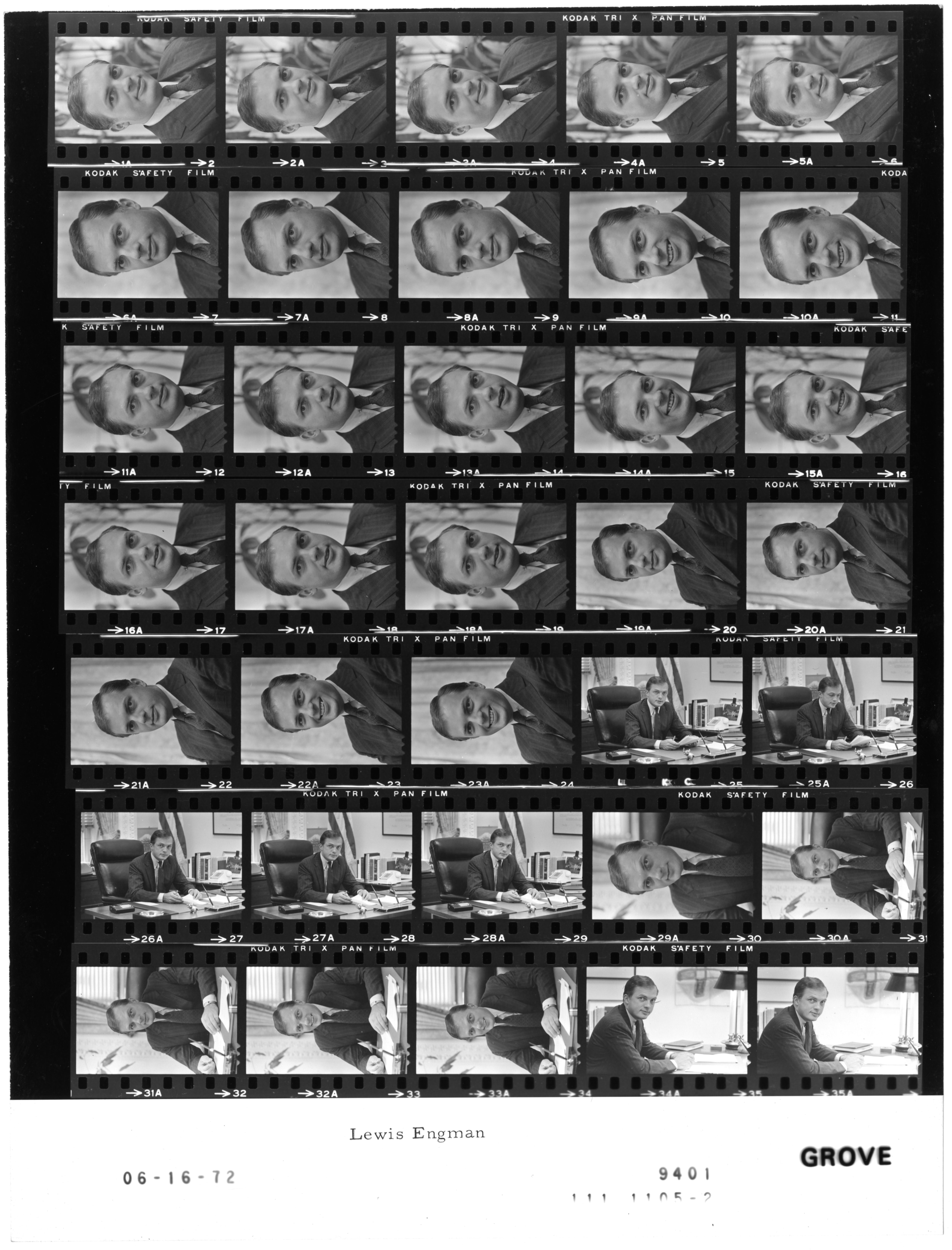
- Frame(s): WHPO-9401-, Posed shots of Lewis Engman. 6/16/1972, Washington, D.C. room, Executive Office Building. Lewis Engman.
Roll WHPO-9402 Photographer: Knudsen, Robert L. | Color or B&W: Color
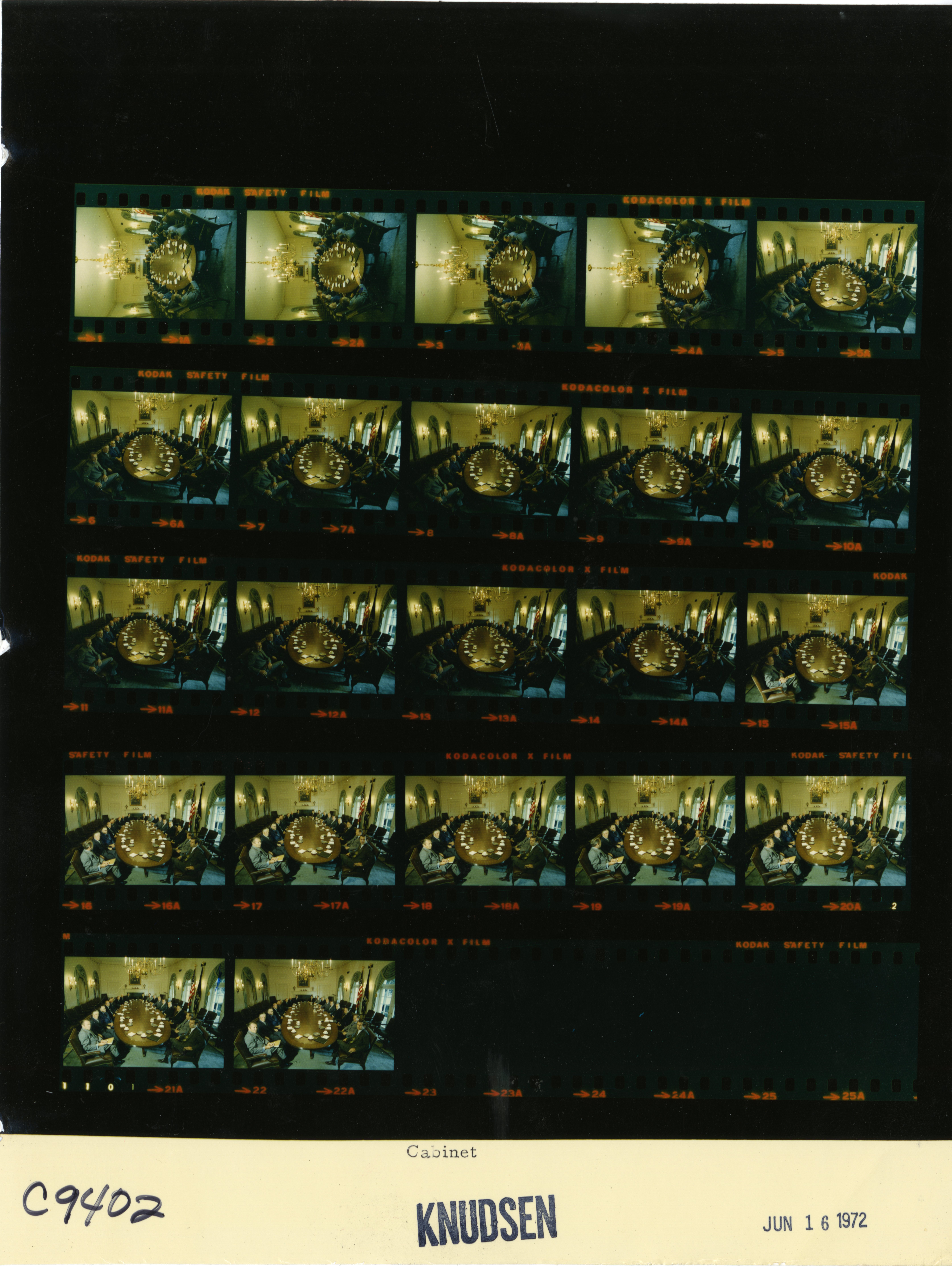
- Frame(s): WHPO-9402-, President Nixon and members of his cabinet. 6/16/1972, Washington, D.C. Cabinet, Room, White House. President Nixon, Melvin Laird, Peterson, John A. Volpe, Donald Rumsfeld, Finch, George Romney, Butz, George Shultz, Spiro Agnew, Kleindienst, Hodgson, David Kennedy, George Bush, Weinberger, Richardson, Morton, William Rogers.
Roll WHPO-9403 Photographer: Schumacher, Karl | Color or B&W: B&W
- Frame(s): WHPO-9403-, Susan Agnew standing with Carolle Stein. 6/16/1972, unknown unknown. Susan Agnew, Carolle Stein.
Roll WHPO-9404 Photographer: Schumacher, Karl | Color or B&W: B&W
- Frame(s): WHPO-9404-, Susan Agnew alone and with Carolle Stein. 6/16/1972, unknown unknown. Susan Agnew, Carolle Stein.
Roll WHPO-9405 Photographer: Atkins, Oliver | Color or B&W: B&W
- Frame(s): WHPO-9405-03-08, George Romney and Richardson at the cabinet table, with unidentified men behind them. 6/16/1972, Washington, D.C. White House, Cabinet Room. President Nixon, Melvin Laird, Peterson, John A. Volpe, Donald Rumsfeld, Finch, George Romney, Butz, Shultz, Agnew, Kleindienst, Hodgson, David Kennedy, George Bush, Weinberger, Richardson, Morton, William Rogers, unidentified men.
- Frame(s): WHPO-9405-03-08, President Nixon and his cabinet seated at the table. 6/16/1972, Washington, D.C. White House, Cabinet Room. President Nixon, Melvin Laird, Peterson, John A. Volpe, Donald Rumsfeld, Finch, George Romney, Butz, Shultz, Agnew, Kleindienst, Hodgson, David Kennedy, George Bush, Weinberger, Richardson, Morton, William Rogers, unidentified men.
Roll WHPO-9406 Photographer: Atkins, Oliver | Color or B&W: Color
- Frame(s): WHPO-9406-, President Nixon and members of his cabinet. 6/16/1972, Washington, D.C. Cabinet, Room, White House. President Nixon, Melvin Laird, Peterson, John A. Volpe, Donald Rumsfeld, Finch, George Romney, Butz, Shultz, Agnew, Kleindienst, Hodgson, David Kennedy, George Bush, Weinberger, Richardson, Morton, William Rogers.
Roll WHPO-9407 Photographer: Atkins, Oliver | Color or B&W: B&W
- Frame(s): WHPO-9407-04-06, William Rogers and Laird seated to the side of the conference table. 6/16/1972, Washington, D.C. White House, Cabinet Room. William Rogers, Melvin Laird.
- Frame(s): WHPO-9407-07-13, Scenes during the posthumous Medal of Freedom ceremony for John Paul Vann. 6/16/1972, Washington, D.C. White House, Oval Office. President Nixon, William Rogers, Vann family members, Melvin Laird, unidentified man.
Roll WHPO-9408 Photographer: Atkins, Oliver | Color or B&W: B&W
- Frame(s): WHPO-9408-, President Nixon shaking hands with Sue King as Nidecker looks on. 6/16/1972, Washington, D.C. West Wing Colonnade, White House. President Nixon, Sue King, Nidecker.
Roll WHPO-9409 Photographer: Schumaker, Byron | Color or B&W: Color
- Frame(s): WHPO-9409-02-28, President Nixon walking with Mexican President Echeverria and seeing him off in a limousine. 6/16/1972, Washington, D.C. South Entrance, White House, South Lawn. President Nixon, Luis Echeverria Alvarez, aides.
- Frame(s): WHPO-9409-29-31, President Nixon and John A. Vann during the posthumous Medal of Freedom ceremony for John Vann. 6/16/1972, Washington, D.C. White House, Oval Office. President Nixon, John A. Vann.
Roll WHPO-9410 Photographer: Schumacher, Karl | Color or B&W: Color
- Frame(s): WHPO-9410-, Before and during a luncheon given by Judy Agnew for Mrs. Echeverria. 6/16/1972, Washington, D.C. Kennedy Center. Judy Agnew, Mrs. Echeverria, guests.
Roll WHPO-9411 Photographer: Grove, Andrew | Color or B&W: Color
- Frame(s): WHPO-9411-, President Nixon entering the Air Force One (AF1) helicopter. 6/16/1972, Washington, D.C. White House, South Grounds. President Nixon, H.R. Haldeman, military aides.
- Frame(s): WHPO-9411-04A, President Nixon, H.R. Haldeman, and an unidentfied military official walking toward the presidential helicopter parked on the South Grounds of the White House. A military guard salutes nearby. 6/16/1972, Washington, D.C. White House, South Grounds. President Nixon, H.R. Haldeman, military aides.
Roll WHPO-9412 Photographer: Grove, Andrew | Color or B&W: B&W
- Frame(s): WHPO-9412-, Peter Flanigan briefing the press. 6/16/1972, Washington, D.C. room, Executive Office Building. Peter Flanigan, press corps members.
Roll WHPO-9413 Photographer: Grove, Andrew | Color or B&W: B&W
- Frame(s): WHPO-9413-, Herb Klein standing and sitting with Carlos Conde, Pedro Vargas, and an unidentified man. 6/16/1972, Washington, D.C. unknown. Herb Klein, Carlos Conde, Pedro Vargas, unidentified man.
Roll WHPO-9417 Photographer: Kightlinger, Jack | Color or B&W: Color
- Frame(s): WHPO-9417-02-12, Pat Nixon in posed shots with Future Business Leaders of America members and others. 6/16/1972, Houston, Texas unidentified site. Pat Nixon, FBLA members, adults.
Roll WHPO-9418 Photographer: Kightlinger, Jack | Color or B&W: Color
- Frame(s): WHPO-9418-, Pat Nixon at a podium and greeting Future Business Leaders of America (FBLA) members. 6/16/1972, Houston, Texas unidentified site. Pat Nixon, FBLA members.
- Frame(s): WHPO-9418-21A, Pat Nixon speaking to a young Future Business Leaders of America (FBLA) member wearing a tan cowboy hat. 6/16/1972, Houston, Texas unidentified site. Pat Nixon, FBLA members.
- Frame(s): WHPO-9418-29A, Pat Nixon standing for a photo with costumed Future Business Leaders of America (FBLA) members. 6/16/1972, Houston, Texas unidentified site. Pat Nixon, FBLA members.
Roll WHPO-9419 Photographer: Kightlinger, Jack | Color or B&W: Color
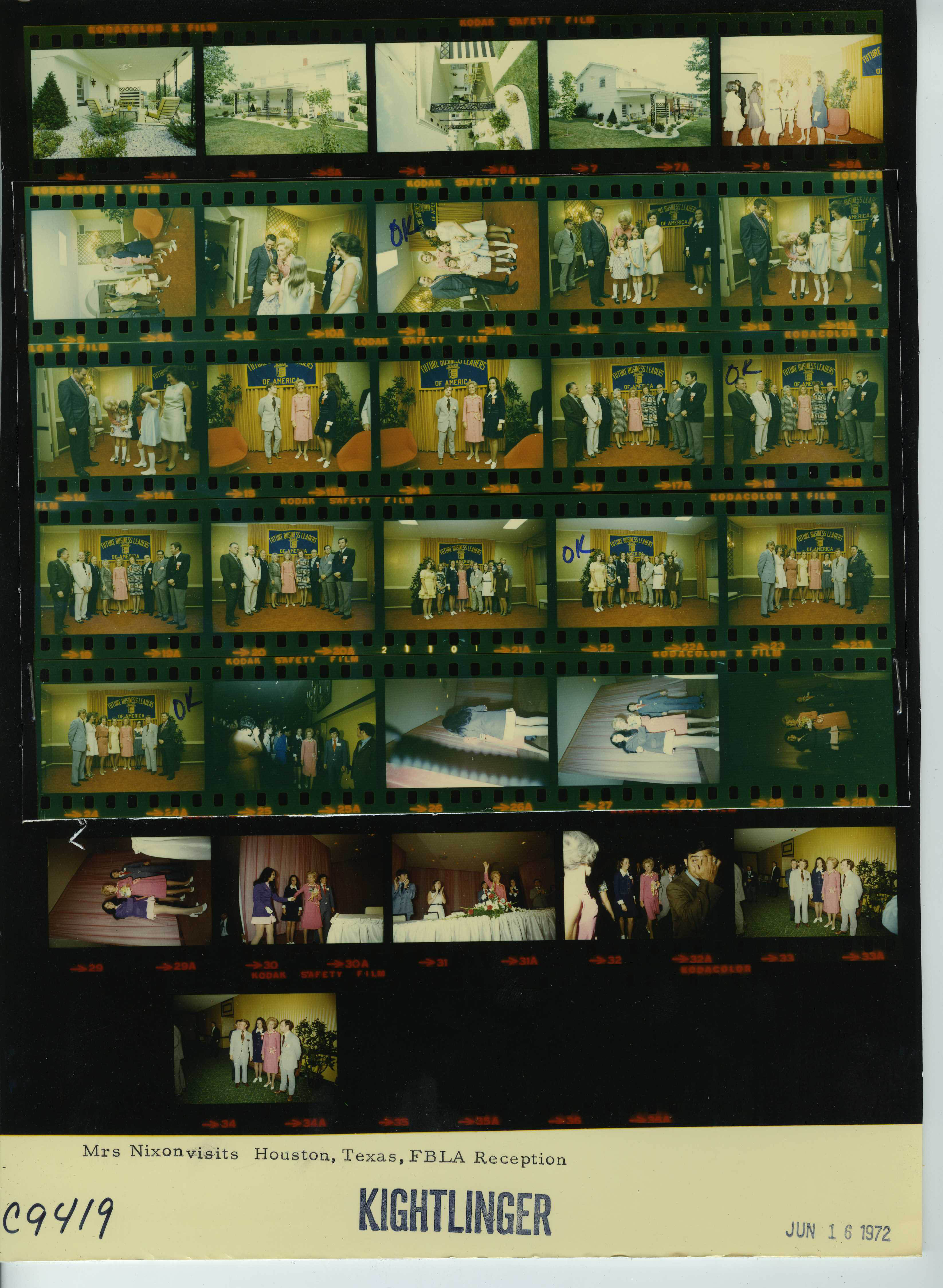
- Frame(s): WHPO-9419-04-07, Outdoor shots of an unidentified house. 6/16/1972, unknown unknown.
- Frame(s): WHPO-9419-08-34, Pat Nixon with Future Business Leaders of America (FBLA) members, children and adults. 6/16/1972, Houston, Texas unidentified site. Pat Nixon, unidentified persons and children.
Roll WHPO-9420 Photographer: Grove, Andrew | Color or B&W: B&W
- Frame(s): WHPO-9420-, Ehrlichman playing doubles tennis with unidentified staff members. 6/16/1972, unknown unknown. Ehrlichman, unidentified men.
Roll WHPO-9458 Photographer: Ron Ziegler | Color or B&W: Color
- Frame(s): WHPO-9458-04-07, Unidentified persons walking. 6/16/1972, Washington, D.C. White House grounds. unidentified persons.
- Frame(s): WHPO-9458-08-13, President Nixon and President Luis Echeverria of Mexico, leaving White House and walking on the grounds. 6/16/1972, Washington, D.C. White House, Rose Garden, grounds. President Nixon, Luis Echeverria Alvarez, aides.
The White House Communications Agency Sound Recordings Collection contains public statements that took place between 1969 and 1974. Visit the finding aid to learn more.
C - First Lady
- WHCA-SR-C-128
Remarks by Pat Nixon to Future Business Leaders of America at the Shamrock Hilton in Houston, Texas. (6/16/1972, Houston, Texas)
Runtime: 1:28
Production credits: Audio feed supplied by WHCA; Recorded by GLG (initials of WHCA engineer)
Original Format: 1/4-inch reel-to-reel audiotape. Original source type: Original.
The White House Communications Agency Videotape Collection contains “off-the-air” recordings of televised programs produced between 1968 and 1974. Visit the finding aid to learn more.
- WHCA-5483
"Martin Agronsky: Evening Edition". Lyndon Baines Johnson, former President of the United States.
PBS
Runtime: 00:29:38 - WHCA-5496
Weekly News Summary, Tape I.
ALL NETWORKS
Runtime: 01:31:43
1. Reasoner/Tucker: Vietnam. Time Code Start: 00:00. Keywords: Vietnam War. Network: ABC.
2. Smith/Clark: Governor George Wallace, McGovern. Time Code Start: 04:11. Keywords: Governors, Presidential elections, campaigns, primaries, candidates, reports, assassinations, shootings. Network: ABC.
3. Reasoner/Reynolds: Senator Margaret Chase Smith. Time Code Start: 07:27. Keywords: Senators, women, media, interviews. Network: ABC.
4. Smith/Troleston: Politics in New York. Time Code Start: 10:20. Keywords: political activities. Network: ABC.
5. Smith: Commentary on airline hijacking. Time Code Start: 13:25. Keywords: aviation industry, commercial airlines, aircraft, planes, jets, airliners, hijackings, skyjackings, kidnappings, terrorism. Network: ABC.
6. Chancellor/Bell: Governor George Wallace, Senator Ted Kennedy. Time Code Start: 15:06. Keywords: Governors, Presidential elections, campaigns, primaries, candidates, reports, assassinations, shootings. Network: NBC.
7. Chancellor/Perkins/Nessen: Primary '72 (McGovern, Governor George Wallace). Time Code Start: 17:24. Keywords: Presidential elections, campaigns, campaigning, candidates, primaries, voting, conventions, delegates, voting, assassinations, shootings. Network: NBC.
8. Chancellor: John Paul Vann's funeral (President Nixon). Time Code Start: 21:37. Keywords: Presidents, death memorials, burials, internments, religious services, funerals. Network: NBC.
9. Cronkite/Rather/Kalb: Vietnam peace rumors. Time Code Start: 23:43. Keywords: Vietnam War, treaty, treaties, negotiations. Network: CBS.
10. Cronkite/Schoumacher/Pappas: Primary '72 (McGovern, Muskie, Mayor Daley). Time Code Start: 28:48. Keywords: Presidential elections, campaigns, campaigning, candidates, primaries, voting, conventions, delegates. Network: CBS.
11. Cronkite/Schieffer: John Paul Vann's funeral. Time Code Start: 36:36. Keywords: death memorials, burials, internments, religious services, funerals. Network: CBS.
Context (External Sources)
The Vanderbilt Television News Archive is the world's most extensive and complete archive of television news. They have been recording, preserving and providing access to television news broadcasts of the national networks since August 5, 1968.
Wikipedia is a free encyclopedia that anyone can edit.