
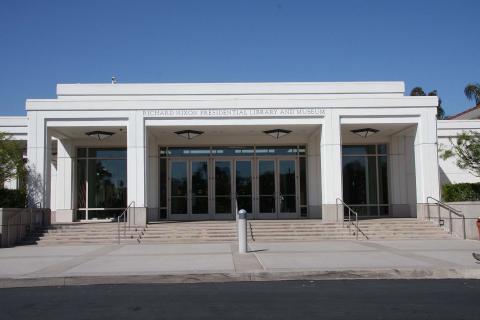
Introduction
This almanac page for Tuesday, June 13, 1972, pulls together various records created by the federal government and links to additional resources which can provide context about the events of the day.
Previous Date: Monday, June 12, 1972
Next Date: Wednesday, June 14, 1972
Schedule and Public Documents
The Daily Diary files represent a consolidated record of the President's activities. Visit the finding aid to learn more.
The President's day began at The White House - Washington, D. C.
The Weekly Compilation of Presidential Documents made available transcripts of the President's news conferences; messages to Congress; public speeches, remarks, and statements; and other Presidential materials released by the White House.
Digitized versions can be found at HathiTrust.
Each Public Papers of the Presidents volume contains the papers and speeches of the President of the United States that were issued by the White House Office of the Press Secretary during the time period specified by the volume. The material is presented in chronological order, and the dates shown in the headings are the dates of the documents or events. In instances when the release date differs from the date of the document itself, that fact is shown in the text note.
To ensure accuracy, remarks have been checked against audio recordings (when available) and signed documents have been checked against the original, unless otherwise noted. Editors have provided text notes and cross references for purposes of identification or clarity.
- Letter to the Speaker of the House Transmitting the Antiballistic Missile Treaty and the Interim Agreement on Strategic Offensive Arms
- Remarks on Transmitting to the Congress the Antiballistic Missile Treaty and the Interim Agreement on Strategic Offensive Arms
- Message to the Senate Transmitting the Antiballistic Missile Treaty and the Interim Agreement on Strategic Offensive Arms.
The Federal Register is the official daily publication for rules, proposed rules, and notices of federal agencies and organizations, as well as executive orders and other Presidential documents.
The Congressional Record is the official daily record of the debates and proceedings of the U.S. Congress.
Archival Holdings
Any selection of archival documents will necessarily be partial. You should use the documents and folders identified below as a starting place, but consult the linked collection finding aids and folder title lists and the collections themselves for context. Many documents to be found this way do not lend themselves to association with specific dates, but are essential to a complete understanding of the material.
Selective document listing
President's Office Files
The President's Office Files consists of materials drawn together by the Special Files Unit from several administrative subdivisions within the White House Office. It is the handwriting and sensitive papers sent to the Staff Secretary that now comprise much of the President's Office Files. Visit the finding aid to learn more.
- News Summaries, Unmarked News Summaries, Box 50, News Summaries - June 1972 [5 of 6] [Note: Due to the way News Summary products were compiled, you should also consult nearby days for potentially relevant materials.]
- News Summary, June 13, 1972, (Mon. nets, wires, mags, columns)
President's Personal File
The President's Personal File is essentially a President's secretary's file, kept by Rose Mary Woods, personal secretary to the President, for two purposes: (1) preserving for posterity a collection of documents particularly close to the President, whether because he dictated or annotated them, or because of the importance of the correspondent or the event concerned and (2) giving appropriate attention–letters of gratitude, invitations to White House social events, and the like–to members and important friends and supporters of the Nixon administration. This generalization does not describe all the varied materials of a file group which is essentially a miscellany, but it does identify the reason for the existence of the file group's core. Visit the finding aid to learn more.
- President's Speech File
The H. R. Haldeman Diaries consists of seven handwritten diaries, 36 dictated diaries recorded as sound recordings, and two handwritten audio cassette tape subject logs. The diaries and logs reflect H. R. Haldeman’s candid personal record and reflections on events, issues, and people encountered during his service in the Nixon White House. As administrative assistant to the President and Chief of Staff, Haldeman attended and participated in public events and private meetings covering the entire scope of issues in which the Nixon White House engaged in during the years 1969-1973. Visit the finding aid to learn more.
- Transcript of diary entry (PDF)
Tuesday, June 13th. Leadership meeting this morning. Mainly to review the plans on the SALT treaty, and the arms agreement, both of which are being sent up to the Hill today.
The President had me over afterwards. We got into some discussion on the McGovern follow-up and attack, the problem being that McGovern made a statement last night, or yesterday, that I heard on the radio last night, saying he wasn't going to change his views, that none of this was reported in the paper. So the question arises is what happened to our man who is supposed to be monitoring all of McGovern's statements? The more we got to thinking about it the more upset the President got about that as he realized that our McGovern record is only what the media have reported if we aren't taping him. I found out later today, however, that we have been taping him, although we've missed some occasions, including the one in New York yesterday.
We got into the plan for the Congressional briefing and the question of whether it's a good idea to shoot Kissinger this early on television. The decision was that it was not, and that what we should do is go for the East Room deal, not televised, with the President giving an opening statement and Kissinger handling the Q and A for a couple of hours, covering both the ABM and the Agreement, inviting all four committees. After going back and forth on timing we decided to do it Thursday morning even with the Echevarria arrival conflict, and we'll work it out on that basis. In the same connection, the President got into a discussion of when and whether he should do a press conference. He still has the urge to do an in-office press conference rather than one on TV, but has agreed now to wait until next week to do that probably on domestic policy only. And then definitely to do one on TV the following week, before we go to California.
He got into a discussion of strategy on the McGovern attack, making the point that he made yesterday on the Buchanan memo, that we've got to build up our issue rather than just attacking his—ours being foreign policy. He's concerned about who can write this. He needs someone with more spine than Price, more bite, but it can't be Safire—maybe Kerolikus or someone like that. Buchanan can't do it, because he doesn't believe in our foreign policy position. It may be that the new writer that we've got is enough of a hawk that he can handle that. In any event, he's anxious that we maintain the effort on that kind of an attack.
We talked a little about things in general. Henry seems to be optimistic on Vietnam again...
-------------------------------------------------------------------------------------------------------------------
DECLASSIFIED - E.O. 13526, Sect. 3.4: by MS, NARA, June 12, 2013
Audio Cassette 22, Side A, Withdrawn Item Number 8 [AC-22(A) Sel 4]
Duration: 28 seconds
…a little concerned about the Chinese being upset on our bombing so close to the border. And the official protest they filed today. It turns out we actually bombed across the border and hit a Chinese convoy by accident, which is what the Chinese were complaining about although they didn't say so publicly.
-------------------------------------------------------------------------------------------------------------------
End of June 13th. - Original audio recording (MP3)
The National Archives Catalog is the online portal to the records held at the National Archives, and information about those records. It is the main way of describing our holdings and also provides access to electronic records and digitized versions of our holdings.
The Catalog searches across multiple National Archives resources at once, including archival descriptions, digitized and electronic records, authority records, and web pages from Archives.gov and the Presidential Libraries. The Catalog also allows users to contribute to digitized historical records through tagging and transcription.
Nixon Library Holdings
All National Archives Units
National Security Documents
The President's Daily Brief is the primary vehicle for summarizing the day-to-day sensitive intelligence and analysis, as well as late-breaking reports, for the White House on current and future national security issues. Read "The President's Daily Brief: Delivering Intelligence to Nixon and Ford" to learn more.
The Foreign Relations of the United States series presents the official documentary historical record of major U.S. foreign policy decisions and significant diplomatic activity. Visit the State Department website for more information.
Vol. XV, Soviet Union, June 1972-August 1974
Post-Moscow Summit Discussions and Issues, June-August 1972
3. Transcript of Telephone Conversation Between the President’s Assistant for National Security Affairs (Kissinger) and Soviet Ambassador Dobrynin, Washington, June 13, 1972, 4:53 p.m.
Source: National Archives, Nixon Presidential Materials, NSC Files, Kissinger Telephone Conversations (Telcons), Box 14, Chronological File. No classification marking. Blank underscores are omissions in the original
Vol. XIX, Part 1, Korea, 1969-1972
Republic of Korea Troops in Vietnam and Force Modernization, April 1971-December 1972
147. Telegram From the Embassy in Korea to the Department of State, Seoul, June 13, 1972, 0939Z
Source: National Archives, Nixon Presidential Materials, NSC Files, Box 543, Country Files, Far East, Korea, Vol. V, 1 Jan–31 Dec. 1972. Secret; Priority; Nodis.
Vol. XXIX, Eastern Mediterranean, 1969-1972
Cyprus
416. Record of Department of State Roundtable Discussion, Washington, June 13, 1972
Source: National Archives, RG 59, Central Files 1970–73, POL 27 CYP. Secret; Nodis. Drafted by Long, approved by Davies on July 3, and distributed to the participants.
Vol. XXXII, SALT I, 1969-1972
The Summit and Congressional Approval of the SALT Agreements, May 19-October 4, 1972
326. Conversation Among President Nixon, Members of the Republican Congressional Leadership, and Others, Washington, June 13, 1972
Source: National Archives, Nixon Presidential Materials, White House Tapes, Cabinet Room, Conversation No. 102–8. No classification marking. According to the Nixon Tapes Log, the recording began after 8:01 a.m. at an unknown time while the conversation was already in progress. The editor transcribed the portion of the conversation printed here specifically for this volume. Other participants included Shultz, Deputy Secretary of the Treasury Charls Walker, Senator Margaret Chase Smith, Senator Gordon Allott, Senator Norris Cotton, Congressman Leslie Arends, Congressman John Anderson, Congressman John Rhodes, Congressman Bob Wilson, Congressman H. Allen Smith, Congressman Samuel Devine, Congressman Richard Poff, Congressman Barber Conable, Senator Robert Dole, Haig, MacGregor, Flanigan, Cole, Timmons, Dent, Klein, Buchanan, Weinberger, Cook, Korologos, and Ziegler. On June 13 Nixon sent a message to the Senate and a letter to the House of Representatives that transmitted the ABM Treaty and the Interim Agreement on Strategic Offensive Arms. The text of those messages is in Public Papers: Nixon, 1972, pp. 674–676.
Source: National Archives, Nixon Presidential Materials, White House Tapes, Oval Office, Conversation No. 732–6. No classification marking. According to the President’s Daily Diary, Nixon met with Stennis, Kissinger, Haldeman, and Korologos from 9:52 to 11:09 a.m. (Ibid., White House Central Files) The editor transcribed the portion of the conversation printed here specifically for this volume.
Vol. E-1, Documents on Global Issues, 1969-1972
U.S. Policy Towards Terrorism, Hijacking of Aircraft, and Attacks on Civil Aviation: U.S. Response to Hijackings by the Popular Front for the Liberation of Palestine and Additional Anti-Hijacking Measures, September 1970-June 1972
87. Memorandum From Melvin Levine of the National Security Council Staff to the President’s Assistant for National Security Affairs (Kissinger), Washington, June 13, 1972
Levine updated Kissinger on recent activities generated by new acts of air piracy.
Source: National Archives, Nixon Presidential Materials, NSC Files, Subject Files, Box 330, Hijackings II. Secret. Sent for information.
Vol. E-2, Documents on Arms Control and Nonproliferation, 1969-1972
Nuclear Non-Proliferation Treaty; Implementation of Safeguard System
58. Conversation Between President Nixon and his Assistant for National Security Affairs (Kissinger), Washington, June 13, 1972, 11:43 a.m.-1:18 p.m.
The President and Kissinger discussed the NPT and the Department of State’s effort to get Kissinger to urge Japanese ratification of the treaty while visiting that nation.
Source: National Archives, Nixon Presidential Materials, White House Tapes, Conversation No. 732–11. No classification marking. The editor transcribed the portions of the tape recording published here specifically for this volume.
Vol. E-4, Documents on Iran and Iraq, 1969-1972
Iraq 1972
316. Memorandum From the Country Director for Lebanon, Jordan, the Syrian Arab Republic, and Iraq (Seelye) to the Assistant Secretary of State for Near Eastern and South Asian Affairs (Sisco), Washington, June 13, 1972
Seelye argued that while the immediate effects of the Iraqi nationalization of the IPC were insignificant, the longer-rang consequences were substantial.
Source: National Archives, RG 59, NEA/ARN, Office of Lebanon, Jordan, Syria, and Iraq Affairs, Lot file 75D44, Box 13, IRAQ PET 6, Petroleum Companies, 1972. Secret.
The Kissinger telephone conversation transcripts consist of approximately 20,000 pages of transcripts of Kissinger’s telephone conversations during his tenure as Assistant to the President for National Security Affairs (1969-1974) and Secretary of State (1973-1974) during the administration of President Richard Nixon. Visit the finding aid for more information.
Digitized versions can be found in the National Archives Catalog.
Audiovisual Holdings
Visit the White House Tapes finding aid to learn about the taping system's operation and archival processing.
Cabinet Room
- 102-8; Unknown between 8:01 a.m. & 9:39 a.m.; Nixon, Richard M. (President); Agnew, Spiro T. (Vice President); Shultz, George P.; Walker, Charls E.; Scott, Hugh; Griffin, Robert P.; Smith, Margaret Chase; Allott, Gordon L.; Cotton, Norris; Ford, Gerald R.; Arends, Leslie C.; Anderson, John B.; Rhodes, John J.; Wilson, Robert C. ("Bob"); Smith, H. Allen; Devine, Samuel L.; Poff, Richard H.; Conable, Barber B., Jr.; Dole, Robert J.; Haig, Alexander M., Jr.; MacGregor, Clark; Flanigan, Peter M.; Cole, Kenneth R., Jr.; Timmons, William E.; Dent, Harry S.; Klein, Herbert G.; Buchanan, Patrick J.; Weinberger, Caspar W. ("Cap"); Cook, Richard K.; Korologos, Thomas C.; Ziegler, Ronald L.
- 103-1; Unknown between 8:01 a.m. & 9:39 a.m.; Nixon, Richard M. (President); Agnew, Spiro T. (Vice President); Shultz, George P.; Walker, Charls E.; Scott, Hugh; Griffin, Robert P.; Smith, Margaret Chase; Allott, Gordon L.; Cotton, Norris; Ford, Gerald R.; Arends, Leslie C.; Anderson, John B.; Rhodes, John J.; Wilson, Robert C. ("Bob"); Smith, H. Allen; Devine, Samuel L.; Poff, Richard H.; Conable, Barber B., Jr.; Dole, Robert J.; Haig, Alexander M., Jr.; MacGregor, Clark; Flanigan, Peter M.; Cole, Kenneth R., Jr.; Timmons, William E.; Dent, Harry S.; Klein, Herbert G.; Buchanan, Patrick J.; Weinberger, Caspar W. ("Cap"); Cook, Richard K.; Korologos, Thomas C.; Ziegler, Ronald L.
- 103-3; Unknown between 9:39 a.m. & 5:20 p.m.; [Unknown person(s)]
Old Executive Office Building
- 342-1; Unknown between 1:18 p.m. & 2:50 p.m.; Nixon, Richard M. (President); [Unknown person(s)]
- 342-2; Unknown between 1:18 p.m. & 2:50 p.m.; Nixon, Richard M. (President); [Unknown person(s)]
- 342-3; Unknown between 1:18 p.m. & 2:50 p.m.; Nixon, Richard M. (President); [Unknown person(s)]
- 342-4; Unknown between 1:18 p.m. & 2:50 p.m.; Nixon, Richard M. (President); [Unknown person(s)]
- 342-5; Unknown between 1:18 p.m. & 2:50 p.m.; Nixon, Richard M. (President); [Unknown person(s)]
- 342-6; Unknown between 2:50 p.m. & 4:14 p.m.; Nixon, Richard M. (President); Haldeman, H. R. ("Bob"); White House operator; LaRue, Fredrick C.; Kissinger, Henry A.; [Unknown person(s)]
- 342-7; Unknown between 3:49 p.m. & 4:14 p.m.; Nixon, Richard M. (President); White House operator
- 342-8; 4:14 p.m. - 4:15 p.m.; Nixon, Richard M. (President); Colson, Charles W.
- 342-9; 4:17 p.m. - 5:38 p.m.; Nixon, Richard M. (President); Colson, Charles W.; Haldeman, H. R. ("Bob"); Sanchez, Manolo
- 342-10; Unknown between 5:38 p.m. & 11:59 p.m.; United States Secret Service agents
Oval Office
- 732-1; Unknown between 7:45 a.m. & 8:01 a.m.; Nixon, Richard M. (President); Bull, Stephen B.
- 732-2; Unknown between 8:01 a.m. & 9:39 a.m.; [Unknown person(s)]
- 732-3; Unknown between 8:01 a.m. & 9:39 a.m.; United States Secret Service agents
- 732-4; Unknown between 8:01 a.m. & 9:39 a.m.; [Unknown person(s)]
- 732-5; 9:39 a.m. - 9:50 a.m.; Nixon, Richard M. (President); Scott, Hugh; Ford, Gerald R.; MacGregor, Clark; Klein, Herbert G.; Ziegler, Ronald L.
- 732-6; 9:52 a.m. - 11:09 a.m.; Nixon, Richard M. (President); Ziegler, Ronald L.; Haldeman, H. R. ("Bob"); Bull, Stephen B.; Kissinger, Henry A.; Stennis, John C.; Korologos, Thomas C.
- 732-7; 11:15 a.m. - 11:17 a.m.; Nixon, Richard M. (President); Bull, Stephen B.
- 732-8; Unknown between 11:17 a.m. & 11:28 a.m.; Nixon, Richard M. (President); Butterfield, Alexander P.
- 732-9; Unknown between 11:36 a.m. & 11:43 a.m.; Nixon, Richard M. (President); Bull, Stephen B.
- 732-10; Unknown between 11:36 a.m. & 11:43 a.m.; Nixon, Richard M. (President); [Unknown person(s)]
- 732-11; 11:43 a.m. - 1:18 p.m.; Nixon, Richard M. (President); Haldeman, H. R. ("Bob"); Bull, Stephen B.; Kissinger, Henry A.
- 732-12; 1:18 p.m. - 1:18 p.m.; Nixon, Richard M. (President); Sanchez, Manolo
White House Telephone
- 25-56; Unknown between 11:45 a.m. & 12:27 p.m.; Haldeman, H. R. ("Bob"); White House operator; Colson, Charles W.; Howard, W. Rick
- 25-57; Unknown between 2:50 p.m. & 3:30 p.m.; Haldeman, H. R. ("Bob"); White House operator; LaRue, Fredrick C.
- 25-58; 3:48 p.m. - 3:49 p.m.; Nixon, Richard M. (President); Haldeman, H. R. ("Bob")
- 25-59; Unknown between 3:49 p.m. & 4:24 p.m.; Nixon, Richard M. (President); White House operator
- 25-60; 4:14 p.m. - 4:15 p.m.; Nixon, Richard M. (President); Colson, Charles W.
- 25-61; 5:29 p.m. - 5:30 p.m.; Nixon, Richard M. (President); Haldeman, H. R. ("Bob")
- 25-62; Unknown between 5:30 p.m., 6/13 & 10:45 a.m., 5/4; [Unknown person(s)]
The White House Photo Office collection consists of photographic coverage of President Richard Nixon meeting with prominent social, political, and cultural personalities; speaking engagements and news conferences of the President and various high-ranking members of the White House staff and Cabinet; Presidential domestic and foreign travel, including Presidential vacations; social events and entertainment involving the First Family, including entertainers present; official portraits of the President, First Family, and high-ranking members of the Nixon administration; the 1969 and 1973 Inaugurals; the President’s 1972 Presidential election campaign appearances (including speeches) and other official activities of the White House staff and the President’s Cabinet from January 20, 1969 until August 9, 1974 at the White House and the Old Executive Office Building; other locations in Washington, DC, such as The Mall; and the Presidential retreats in Camp David, Maryland, Key Biscayne, Florida, and San Clemente, California. Visit the finding aid to learn more.
Roll WHPO-9347 Photographer: Schumaker, Byron | Color or B&W: B&W
- Frame(s): WHPO-9347-, Posed portrait of Ron Jackson. 6/13/1972, Washington, D.C. unknown. Ron Jackson.
Roll WHPO-9359 Photographer: Schumacher, Karl | Color or B&W: B&W
- Frame(s): WHPO-9359-, Ron Ziegler and family meeting with President Nixon. 6/13/1972, Washington, D.C. West Wing Colonnade. President Nixon, Ronald Ziegler, Ziegler family members.
Roll WHPO-9360 Photographer: Atkins, Oliver | Color or B&W: B&W
- Frame(s): WHPO-9360-, President Nixon seated informally in the Oval office during a meeting with Senator John Stennis, Henry Kissinger and Tom Korologos. 6/13/1972, Washington, D.C. White House, Oval Office. President Nixon, John Stennis, Kissinger, Tom Korologos.
- Frame(s): WHPO-9360-03A, President Nixon seated informally in the Oval office during a meeting with Senator John Stennis, Henry Kissinger and Tom Korologos. 6/13/1972, Washington, D.C. White House, Oval Office. President Nixon, John Stennis, Henry Kissinger, Tom Korologos.
Roll WHPO-9361 Photographer: Grove, Andrew | Color or B&W: B&W
- Frame(s): WHPO-9361-, A Campfire Girls group of Willowick, Ohio, in the East Garden at the White House. 6/13/1972, Washington, D.C. East Garden, White House. Campfire Girls, unidentified adults and boys.
Roll WHPO-9362 Photographer: Schumacher, Karl | Color or B&W: B&W
- Frame(s): WHPO-9362-, Vice President Agnew receiving a model ship from members of the Essex Club. 6/13/1972, Washington, D.C. Vice Presidential Office, Executive Office Building. Agnew, Essex Club members.
Roll WHPO-9363 Photographer: Schumacher, Karl | Color or B&W: B&W
- Frame(s): WHPO-9363-, Vice President Agnew speaking to and shaking hands with Presidential Scholars. Vice President Agnew walking along the colonnade with aides. 6/13/1972, Washington, D.C. East Garden, West Wing Colonnade, White House. Agnew, Presidential Scholars, aides.
Roll WHPO-9364 Photographer: Schumacher, Karl | Color or B&W: B&W
- Frame(s): WHPO-9364-, Presidential Scholars group. 6/13/1972, Washington, D.C. steps, Diplomatic Entrance. Presidential Scholars.
Roll WHPO-9365 Photographer: Kightlinger, Jack | Color or B&W: B&W
- Frame(s): WHPO-9365-, Herb Klein and Peterson conducting a briefing. 6/13/1972, Washington, D.C. Family Theatre, White House. Herb Klein, Peter Peterson, audience.
The White House Communications Agency Sound Recordings Collection contains public statements that took place between 1969 and 1974. Visit the finding aid to learn more.
B - Vice-Presidential (Agnew and Ford)
- WHCA-SR-B-223
Remarks to presidential scholars-East Garden, 15:15. (6/13/1972)
Original Format: 1/4-inch reel-to-reel audiotape. Original source type: Original.
G - Cabinet Officer Briefings
- WHCA-SR-G-171
Briefing to Mexican press by Peter Peterson, with Herb Klein. (6/13/1972, EOB conference Room)
Runtime: 1:10:00
Production credits: Audio feed supplied by WHCA; Recorded by CBW (initials of WHCA engineer)
Original Format: 1/4-inch reel-to-reel audiotape. Original source type: Original.
P - Formal Presidential Remarks
- WHCA-SR-P-720604
Film spot on arms limitation. (6/13/1972)
Runtime: 0:45
Original Format: 1/4-inch reel-to-reel audiotape. Original source type: Original.
The White House Communications Agency Videotape Collection contains “off-the-air” recordings of televised programs produced between 1968 and 1974. Visit the finding aid to learn more.
- WHCA-5475
"Martin Agronsky: Evening Edition".
ALL NETWORKS
Runtime: 00:29:35 - WHCA-5476
"Conversation with Julie Eisenhower", Denver, Colorado.
Post-Newsweek Stations, Inc.
Runtime: 00:32:55 - WHCA-5481
Weekly News Summary, Tape II.
ALL NETWORKS
Runtime: 1:30
6. Smith/Geer: End the Vietnam War Senate proposal with Scott; arms limitations; President Nixon. Time Code Start: 13:01. Keywords: SALT, S.A.L.T., Strategic Arms Limitation Talks, Russia, Soviet Union, USSR, Cold War, détente. Network: ABC.
7. Reasoner/Tucker: Vietnam, An Loc. Time Code Start: 16:34. Keywords: Vietnam War. Network: ABC.
8. Smith/Landy/Gill: Governor George Wallace to go to convention; Texas party reform. Time Code Start: 19:26. Keywords: Governors, Presidential elections, campaigns, primaries, candidates, reports, assassinations, shootings. Network: ABC.
9. Chancellor/Valeriani: President Nixon on arms limitations. Time Code Start: 24:02. Keywords: SALT, S.A.L.T., Strategic Arms Limitation Talks, Russia, Soviet Union, USSR, Cold War, détente. Network: NBC.
10. Chancellor/Brady: Vietnam. Time Code Start: 27:20. Keywords: Vietnam War. Network: NBC.
11. Chancellor: Governor George Wallace to go to convention. Time Code Start: 31:00. Keywords: Governors, Presidential elections, campaigns, primaries, candidates, reports, assassinations, shootings. Network: NBC.
12. Chancellor/Duke: Welfare bill in Congress. Time Code Start: 31:48. Keywords: bills, laws, Family Assistance Programs, government aid, financial aid, health and welfare assistance, financial aid, voting, House of Representatives. Network: NBC.
13. Cronkite/Dunning: Vietnam; An Loc. Time Code Start: 33:35. Keywords: Vietnam War, killed in action, KIA, death tolls, fatalities, casualty, casualties, military, troops. Network: CBS.
14. Cronkite/Rather: Arms limitations with President Nixon. Time Code Start: 36:43. Keywords: SALT, S.A.L.T., Strategic Arms Limitation Talks, Russia, Soviet Union, USSR, Cold War, détente. Network: CBS.
15. Cronkite/Dean: Party reform for Texas Democrats. Time Code Start: 40:21. Keywords: political parties, Democrats, Democratic Party. Network: CBS.
Context (External Sources)
The Vanderbilt Television News Archive is the world's most extensive and complete archive of television news. They have been recording, preserving and providing access to television news broadcasts of the national networks since August 5, 1968.
Wikipedia is a free encyclopedia that anyone can edit.