
Introduction
This almanac page for Monday, January 24, 1972, pulls together various records created by the federal government and links to additional resources which can provide context about the events of the day.
Previous Date: Sunday, January 23, 1972
Next Date: Tuesday, January 25, 1972
Schedule and Public Documents
The Daily Diary files represent a consolidated record of the President's activities. Visit the finding aid to learn more.
The President's day began at The White House - Washington, D. C.
The Weekly Compilation of Presidential Documents made available transcripts of the President's news conferences; messages to Congress; public speeches, remarks, and statements; and other Presidential materials released by the White House.
Digitized versions can be found at HathiTrust.
Each Public Papers of the Presidents volume contains the papers and speeches of the President of the United States that were issued by the White House Office of the Press Secretary during the time period specified by the volume. The material is presented in chronological order, and the dates shown in the headings are the dates of the documents or events. In instances when the release date differs from the date of the document itself, that fact is shown in the text note.
To ensure accuracy, remarks have been checked against audio recordings (when available) and signed documents have been checked against the original, unless otherwise noted. Editors have provided text notes and cross references for purposes of identification or clarity.
The Federal Register is the official daily publication for rules, proposed rules, and notices of federal agencies and organizations, as well as executive orders and other Presidential documents.
No Federal Register published on this date
The Congressional Record is the official daily record of the debates and proceedings of the U.S. Congress.
Archival Holdings
Any selection of archival documents will necessarily be partial. You should use the documents and folders identified below as a starting place, but consult the linked collection finding aids and folder title lists and the collections themselves for context. Many documents to be found this way do not lend themselves to association with specific dates, but are essential to a complete understanding of the material.
Selective document listing
President's Office Files
The President's Office Files consists of materials drawn together by the Special Files Unit from several administrative subdivisions within the White House Office. It is the handwriting and sensitive papers sent to the Staff Secretary that now comprise much of the President's Office Files. Visit the finding aid to learn more.
- News Summaries, Annotated News Summaries, Box 33, [Jan. 19-24, 1972] [2 of 2] [Note: Due to the way News Summary products were compiled, you should also consult nearby days for potentially relevant materials.]
- Weekend News Review, January 24, 1972
- President's Daily Schedule, Box 102, [President's Daily Schedule, Jan.-Mar. 1972] [3 of 3]
- The President's Schedule, Monday - January 24, 1972
President's Personal File
The President's Personal File is essentially a President's secretary's file, kept by Rose Mary Woods, personal secretary to the President, for two purposes: (1) preserving for posterity a collection of documents particularly close to the President, whether because he dictated or annotated them, or because of the importance of the correspondent or the event concerned and (2) giving appropriate attention–letters of gratitude, invitations to White House social events, and the like–to members and important friends and supporters of the Nixon administration. This generalization does not describe all the varied materials of a file group which is essentially a miscellany, but it does identify the reason for the existence of the file group's core. Visit the finding aid to learn more.
- President's Speech File
The H. R. Haldeman Diaries consists of seven handwritten diaries, 36 dictated diaries recorded as sound recordings, and two handwritten audio cassette tape subject logs. The diaries and logs reflect H. R. Haldeman’s candid personal record and reflections on events, issues, and people encountered during his service in the Nixon White House. As administrative assistant to the President and Chief of Staff, Haldeman attended and participated in public events and private meetings covering the entire scope of issues in which the Nixon White House engaged in during the years 1969-1973. Visit the finding aid to learn more.
- Transcript of diary entry (PDF)
Monday, January 24.
Budget message day. President also released a statement calling on Congress to set a ceiling, which stirred things up a bit. He met with Rizzo, the Mayor of Philadelphia, who was in to see Ehrlichman, and President had John bring him in. Rizzo flatly informed the President he would back him, would announce at any time he wanted him to, and felt he could deliver Pennsylvania, which the President also feels, so this was good news. President told him not to announce now, they'll just play the Democrats along for the time being, wait till after their convention, and then come out for Nixon, which is the plan.
We had quite a discussion with Henry on the PR plan for the Vietnam speech tomorrow night. He wants to be sure we, we carry out a very comprehensive plan, that we have Henry avoid babbling to a few selected columnists, and leaving out the important people, so we laid out a pretty good coverage program that should work pretty well in getting everybody informed and mobilized.
Ehrlichman came up with a startling thing as a result of Kissinger's breakfast with Laird this morning, which was that Laird-- or I guess the breakfast was over the weekend. Laird told Henry that the White House had asked for his security jacket, but Laird assured him that he would protect him and not send it over to us. Very curious since nobody at the White House has asked for it and in any event, we wouldn't ask Laird, who doesn't have it.
President had a long talk with Flanigan this afternoon regarding his new assignment, got that pretty well worked out. I think Pete's going to be happy with it although not overjoyed, certainly.
End of January 24. - Original audio recording (MP3)
The National Archives Catalog is the online portal to the records held at the National Archives, and information about those records. It is the main way of describing our holdings and also provides access to electronic records and digitized versions of our holdings.
The Catalog searches across multiple National Archives resources at once, including archival descriptions, digitized and electronic records, authority records, and web pages from Archives.gov and the Presidential Libraries. The Catalog also allows users to contribute to digitized historical records through tagging and transcription.
Nixon Library Holdings
All National Archives Units
National Security Documents
The President's Daily Brief is the primary vehicle for summarizing the day-to-day sensitive intelligence and analysis, as well as late-breaking reports, for the White House on current and future national security issues. Read "The President's Daily Brief: Delivering Intelligence to Nixon and Ford" to learn more.
The Foreign Relations of the United States series presents the official documentary historical record of major U.S. foreign policy decisions and significant diplomatic activity. Visit the State Department website for more information.
Vol. III, Foreign Economic Policy; International Monetary Policy, 1969-1972
International Monetary Policy, 1969-1972
222. Urgent Information Memorandum From Robert Hormats and Helmut Sonnenfeldt of the National Security Council Staff to the President’s Assistant for National Security Affairs (Kissinger), Washington, January 24, 1972
Source: National Archives, Nixon Presidential Materials, NSC Files, Country Files—Europe, Box 678, France Volume 9 Jan-July 72. Secret.
Vol. V, United Nations, 1969-1972
High-Level Meetings; Miscellaneous Issues
40. Memorandum for the President’s File, Washington, January 24, 1972
Source: National Archives, Nixon Presidential Materials, White House Special Files, President’s Office Files, Box 87, Memoranda for the President, December 12, 1971–February 20, 1972. Secret. Drafted by Kissinger.
Vol. VIII, Vietnam, January-October 1972
Before the Easter Offensive, January 20-March 29, 1972
4. Minutes of a Senior Review Group Meeting, Washington, January 24, 1972, 4:25-5:30 p.m.
Source: National Archives, Nixon Presidential Materials, NSC Files, Box 158, Vietnam Country Files, Vietnam, Jan–Feb 1972. Top Secret; Sensitive; Exclusively Eyes Only. The meeting was held in the White House Situation Room. All brackets are in the original.
Vol. XVII, China, 1969-1972
China, October 1971-February 1972
186. Message From the Government of the United States to the Government of the People’s Republic of China, Washington, January 24, 1972
Source: National Archives, Nixon Presidential Materials, NSC Files, Box 849, President’s File—China Trip, China Exchanges. No classification marking. This message, a 3-page “Republic of Vietnam and United States Proposal for a Negotiated Settlement of the Indochina Conflict,” and information about communication, aircraft, and other preparations for the President’s February 1972 trip were sent to Paris on January 24, under a covering letter from Haig to Walters. (Ibid.) The 3-page document was replaced with a later version, which was sent at 2 a.m. on January 25 under a covering memorandum from Haig to Walters. (Ibid.) See also Foreign Relations, 1969–1976, vol. E–13, Documents 80 and 81.
Vol. XXVIII, Southern Africa
Regional Issues
70. Memorandum From Robert Hormats and Marshall Wright of the National Security Council Staff to the President’s Assistant for National Security Affairs (Kissinger), Washington, January 24, 1972
Source: National Archives, Nixon Presidential Materials, NSC Files, Box 744, Country Files, Africa, South Africa, Vol. II. Confidential. Sent for action. A copy was sent to Peterson.
Vol. XXXII, SALT I, 1969-1972
Narrowing the Issues, October 19, 1971-April 18, 1972
228. Memorandum From Philip Odeen of the National Security Council Staff to the President’s Assistant for National Security Affairs (Kissinger), Washington, January 24, 1972
Source: National Archives, Nixon Presidential Materials, NSC Files, NSC Institutional Files (H-Files), Box H–010, Verification Panel Meeting SALT Cancelled 1/27/72. Top Secret; Sensitive. Sent for urgent information.
Vol. E-7, Documents on South Asia, 1969-1972
U.S. Relations with India and Pakistan, 1972
214. Letter From the Pakistani Ambassador (Raza) to Secretary of State Rogers, Washington, January 24, 1972
Raza transmitted a letter to Nixon from Pakistani President Bhutto in which Bhutto asked the United States to underwrite the sale of rice by Pakistan to what he continued to refer to as East Pakistan.
Source: National Archives, Nixon Presidential Materials, NSC Files, Box 760, Presidential Correspondence File, Pakistan, President Bhutto. Most Immediate. The attached letter is undated and bears an unsigned typed signature. Kissinger’s handwritten notation on Raza’s letter reads: “Al–Make sure this receives urgent attention.” Haig, in turn, wrote on the letter: “Saunders Rush.” The text of Bhutto’s letter was transmitted to Islamabad on January 29 in telegram 16993. (Ibid., RG 59, Central Files 1970–73, INCO–RICE 17 BANGLA DESH–US)
Vol. E-10, Documents on American Republics, 1969-1972
Guatemala
361. Telegram 380 From the Embassy in Guatemala to the Department of State, January 24, 1972, 2310Z., January 24, 1972, 2310Z
In a conversation with Ambassador Bowdler, President Arana affirmed that he planned to “continue pressure against extremists of the left and right.”
Source: National Archives, RG 59, Central Files 1970–73, POL 15–1 GUAT. Confidential; Limdis. In Airgram A–21 from Guatemala City, February 11, the Embassy reported that Army counter-guerrilla actions were unsuccessful in the face of FAR attacks on Government personnel. (Ibid., POL 23 GUAT)
Vol. E-10, Documents on American Republics, 1969-1972
Haiti
405. Intelligence Note From the Bureau of Intelligence and Research, RARN–2, Washington, January 24, 1972., Washington, January 24, 1972
The Bureau of Intelligence and Research (INR) provided an assessment of President Jean-Claude Duvalier’s new government and concluded that closer relations with the United States indicated “a turn away from the old attitudes of suspicion and self-isolation.”
Source: National Archives, RG 59, Central Files 1970–73, POL 15–1 HAI. Secret; No Foreign Dissem. Drafted on January 20 in INR/American Republics by Godfrey and Pace.
Vol. E-10, Documents on American Republics, 1969-1972
Nicaragua
512. Memorandum of Conversation, Puerto Somoza, January 24, 1972., Puerto Somoza, January 24, 1972
During an informal two-hour meeting with Ambassador Shelton, President Somoza discussed his plans for governing jointly with Conservative Party leader Fernando Agüero and the future of two-party politics in Nicaragua.
Source: National Archives, RG 59, Central Files 1970–73, POL 15–1 NIC. Confidential. Drafted by Hines. A copy was sent to ARA/CEN, INR/RAR, CIA/OCI, CIA/BR, and the Embassy in Managua.
Vol. E-13, Documents on China, 1969-1972
80. Letter From the President’s Deputy Assistant for National Security Affairs (Haig) to the Military Attaché at the Embassy in France (Walters), Washington, January 24, 1972, Washington, January 24, 1972
Haig furnished instructions for documents Walters was asked to deliver to the Chinese ambassador on January 26.
Source: National Archives, Nixon Presidential Materials, NSC Files, Box 849, President’s File-China Trip, China Exchanges, January 1-February 29, 1972. Top Secret; Sensitive; Eyes Only. The tabs are attached but not published. Walters’ account of the January 26 meeting is Document 82.
Vol. E-16, Documents on Chile, 1969-1973
Cool and Correct: The U.S. Response to the Allende Administration, November 5, 1970-December 31, 1972
100. Conversation Among President Nixon, the President’s Assistant (Flanigan), and the White House Chief of Staff (Haldeman), Washington, January 24, 1972
Summary: Nixon, Flanigan, and Haldeman discussed possible jobs for Korry.
Source: National Archives, Nixon Presidential Materials, White House Tapes, Conversation 654–1. Sensitive But Unclassified. According to the President’s Daily Diary, Nixon, Flanigan, and Haldeman met in the Oval Office from 5:18 to 6:05 p.m. (Ibid., White House Central Files) The editors transcribed the portion of the conversation printed here specifically for this volume.
The Kissinger telephone conversation transcripts consist of approximately 20,000 pages of transcripts of Kissinger’s telephone conversations during his tenure as Assistant to the President for National Security Affairs (1969-1974) and Secretary of State (1973-1974) during the administration of President Richard Nixon. Visit the finding aid for more information.
Digitized versions can be found in the National Archives Catalog.
Audiovisual Holdings
Visit the White House Tapes finding aid to learn about the taping system's operation and archival processing.
Cabinet Room
Old Executive Office Building
- 317-1; Unknown between 1:05 p.m. & 1:51 p.m.; Nixon, Richard M. (President); Sanchez, Manolo
- 317-2; Unknown between 1:05 p.m. & 1:51 p.m.; Nixon, Richard M. (President); Sanchez, Manolo
- 317-3; Unknown between 1:05 p.m. & 1:51 p.m.; Nixon, Richard M. (President); Ehrlichman, John D.
- 317-4; Unknown between 1:05 p.m. & 1:51 p.m.; Nixon, Richard M. (President); Sanchez, Manolo
- 317-5; Unknown between 1:05 p.m. & 1:51 p.m.; Nixon, Richard M. (President); White House operator
- 317-6; 1:51 p.m. - 3:00 p.m.; Nixon, Richard M. (President); Ehrlichman, John D.; Mills, Wilbur D.; Mills, Abbie L. (Daigh)
- 317-7; Unknown between 3:00 p.m. & 3:08 p.m.; Nixon, Richard M. (President); Bull, Stephen B.
- 317-8; 3:08 p.m. - 3:09 p.m.; Nixon, Richard M. (President); Safire, William L.
- 317-9; Unknown between 3:09 p.m. & 3:15 p.m.; Nixon, Richard M. (President); Kissinger, Henry A.
- 317-10; 3:15 p.m. - 3:17 p.m.; Nixon, Richard M. (President); Butterfield, Alexander P.
- 317-11; Unknown between 3:17 p.m. & 3:23 p.m.; Nixon, Richard M. (President); White House operator
- 317-12; 3:23 p.m. - 3:29 p.m.; Nixon, Richard M. (President); Connally, John B.
- 317-13; Unknown between 3:29 p.m. & 3:32 p.m.; Nixon, Richard M. (President); White House operator
- 317-14; 3:32 p.m. - 3:32 p.m.; Nixon, Richard M. (President); White House operator
- 317-15; 3:35 p.m. - 4:20 p.m.; Nixon, Richard M. (President); Kissinger, Henry A.; Bow, Frank T.; Rogers, Adele (Langston); Woods, Rose Mary; White House operator; Safire, William L.; Sanchez, Manolo
- 317-16; Unknown between 4:20 p.m. & 4:27 p.m.; Nixon, Richard M. (President); White House operator
- 317-17; 4:27 p.m. - 4:55 p.m.; Nixon, Richard M. (President); Mitchell, John N.
- 317-18; 4:55 p.m. - 4:55 p.m.; Nixon, Richard M. (President); Sanchez, Manolo
Oval Office
- 653-1; Unknown between 8:58 a.m. & 10:04 a.m.; Nixon, Richard M. (President); Sanchez, Manolo
- 653-2; Unknown between 8:58 a.m. & 10:04 a.m.; Nixon, Richard M. (President); [Unknown person(s)]
- 653-3; Unknown between 8:58 a.m. & 10:04 a.m.; Nixon, Richard M. (President); Bull, Stephen B.
- 653-4; Unknown between 8:58 a.m. & 10:04 a.m.; Nixon, Richard M. (President); Sanchez, Manolo
- 653-5; Unknown between 8:58 a.m. & 10:04 a.m.; Nixon, Richard M. (President); [Unknown person(s)]
- 653-6; Unknown between 10:04 a.m. & 10:34 a.m.; Nixon, Richard M. (President); Haldeman, H. R. ("Bob"); Kissinger, Henry A.; [Unknown person(s)]; Woods, Rose Mary; Bull, Stephen B.
- 653-7; 10:34 a.m. - 11:02 a.m.; Nixon, Richard M. (President); Haldeman, H. R. ("Bob"); Kissinger, Henry A.; Bull, Stephen B.
- 653-8; 11:04 a.m. - 11:53 a.m.; Nixon, Richard M. (President); Kissinger, Henry A.; Waldheim, Kurt; Rogers, William P.; Bush, George H. W.; Mosbacher, Emil, Jr. (Bus); White House photographer; [Unknown person(s)]
- 653-9; 11:53 a.m. - 11:55 a.m.; Nixon, Richard M. (President); Ziegler, Ronald L.
- 653-10; Unknown between 11:55 a.m. & 11:59 a.m.; Nixon, Richard M. (President); Bull, Stephen B.
- 653-11; Unknown between 11:55 a.m. & 11:59 a.m.; Nixon, Richard M. (President); Bull, Stephen B.
- 653-12; 11:59 a.m. - 12:32 p.m.; Nixon, Richard M. (President); Rizzo, Frank L.; Ehrlichman, John D.; White House photographer; Miller, Jacqui; Caracciolo, John; Mulloney, Thomas; Schoenfeld, Henry; Harris, Gene; Katz, John; Zacharias, Lou; Mitchell, Andre; Lynch, Dan; Bull, Stephen B.
- 653-13; Unknown between 12:32 p.m. & 12:33 p.m.; United States Secret Service agents
- 653-14; Unknown between 12:32 p.m. & 12:33 p.m.; Nixon, Richard M. (President); Bull, Stephen B.
- 653-15; Unknown between 12:33 p.m. & 4:55 p.m.; [Unknown person(s)]
- 654-1; Unknown between 4:55 p.m. & 6:09 p.m.; Nixon, Richard M. (President); Haldeman, H. R. ("Bob"); White, William S.; [Unknown person(s)]; Flanigan, Peter M.; White House operator
- 654-2; Unknown between 6:10 p.m. & 11:59 p.m.; United States Secret Service agents; Sanchez, Manolo; [Unknown person(s)]
White House Telephone
- 19-41; Unknown between 1:05 p.m. & 1:51 p.m.; Nixon, Richard M. (President); White House operator
- 19-42; 1:52 p.m. - 1:56 p.m.; Nixon, Richard M. (President); Mills, Wilbur D.; Mills, Abbie L. (Daigh)
- 19-43; 3:08 p.m. - 3:09 p.m.; Nixon, Richard M. (President); Safire, William L.
- 19-44; Unknown between 3:17 p.m. & 3:23 p.m.; Nixon, Richard M. (President); White House operator
- 19-45; 3:23 p.m. - 3:29 p.m.; Nixon, Richard M. (President); Connally, John B.
- 19-46; Unknown between 3:29 p.m. & 3:32 p.m.; Nixon, Richard M. (President); White House operator
- 19-47; 3:32 p.m. - 3:32 p.m.; Nixon, Richard M. (President); White House operator
- 19-48; 3:36 p.m. - 3:38 p.m.; Nixon, Richard M. (President); Bow, Frank T.
- 19-49; 3:46 p.m. - 3:47 p.m.; Nixon, Richard M. (President); Kissinger, Henry A.; Rogers, Adele (Langston)
- 19-50; Unknown between 4:05 p.m. & 4:20 p.m.; Kissinger, Henry A.; White House operator
- 19-51; Unknown between 4:05 p.m. & 4:20 p.m.; Kissinger, Henry A.; Safire, William L.; Nixon, Richard M. (President)
- 19-52; Unknown between 4:20 p.m. & 4:27 p.m.; Nixon, Richard M. (President); White House operator
- 19-53; 4:27 p.m. - 4:55 p.m.; Nixon, Richard M. (President); Mitchell, John N.
- 19-54; 4:59 p.m. - 5:02 p.m.; Nixon, Richard M. (President); White, William S.
- 19-55; Unknown between 5:18 p.m. & 5:47 p.m.; Nixon, Richard M. (President); White House operator
- 19-56; 5:47 p.m. - 5:47 p.m.; Nixon, Richard M. (President); White House operator
- 19-57; 7:08 p.m. - 7:14 p.m.; Nixon, Richard M. (President); Connally, John B.
- 19-58; 7:55 p.m. - 7:58 p.m.; Nixon, Richard M. (President); Kissinger, Henry A.
The White House Photo Office collection consists of photographic coverage of President Richard Nixon meeting with prominent social, political, and cultural personalities; speaking engagements and news conferences of the President and various high-ranking members of the White House staff and Cabinet; Presidential domestic and foreign travel, including Presidential vacations; social events and entertainment involving the First Family, including entertainers present; official portraits of the President, First Family, and high-ranking members of the Nixon administration; the 1969 and 1973 Inaugurals; the President’s 1972 Presidential election campaign appearances (including speeches) and other official activities of the White House staff and the President’s Cabinet from January 20, 1969 until August 9, 1974 at the White House and the Old Executive Office Building; other locations in Washington, DC, such as The Mall; and the Presidential retreats in Camp David, Maryland, Key Biscayne, Florida, and San Clemente, California. Visit the finding aid to learn more.
Roll WHPO-8313 Photographer: Schumaker, Byron | Color or B&W: B&W
- Frame(s): WHPO-8313-, President Nixon seated informally in the Oval Office during a meeting with United Nations Secretary General Kurt Waldheim to discuss U.N. issues. 1/24/1972, Washington, D.C. White House, Oval Office. President Nixon, Kurt Waldheim.
- Frame(s): WHPO-8313-05A, President Nixon seated informally in the Oval Office during a meeting with United Nations Secretary General Kurt Waldheim to discuss U.N. issues. 1/24/1972, Washington, D.C. White House, Oval Office. President Nixon, Kurt Waldheim.
Roll WHPO-8314 Photographer: Atkins, Oliver | Color or B&W: B&W
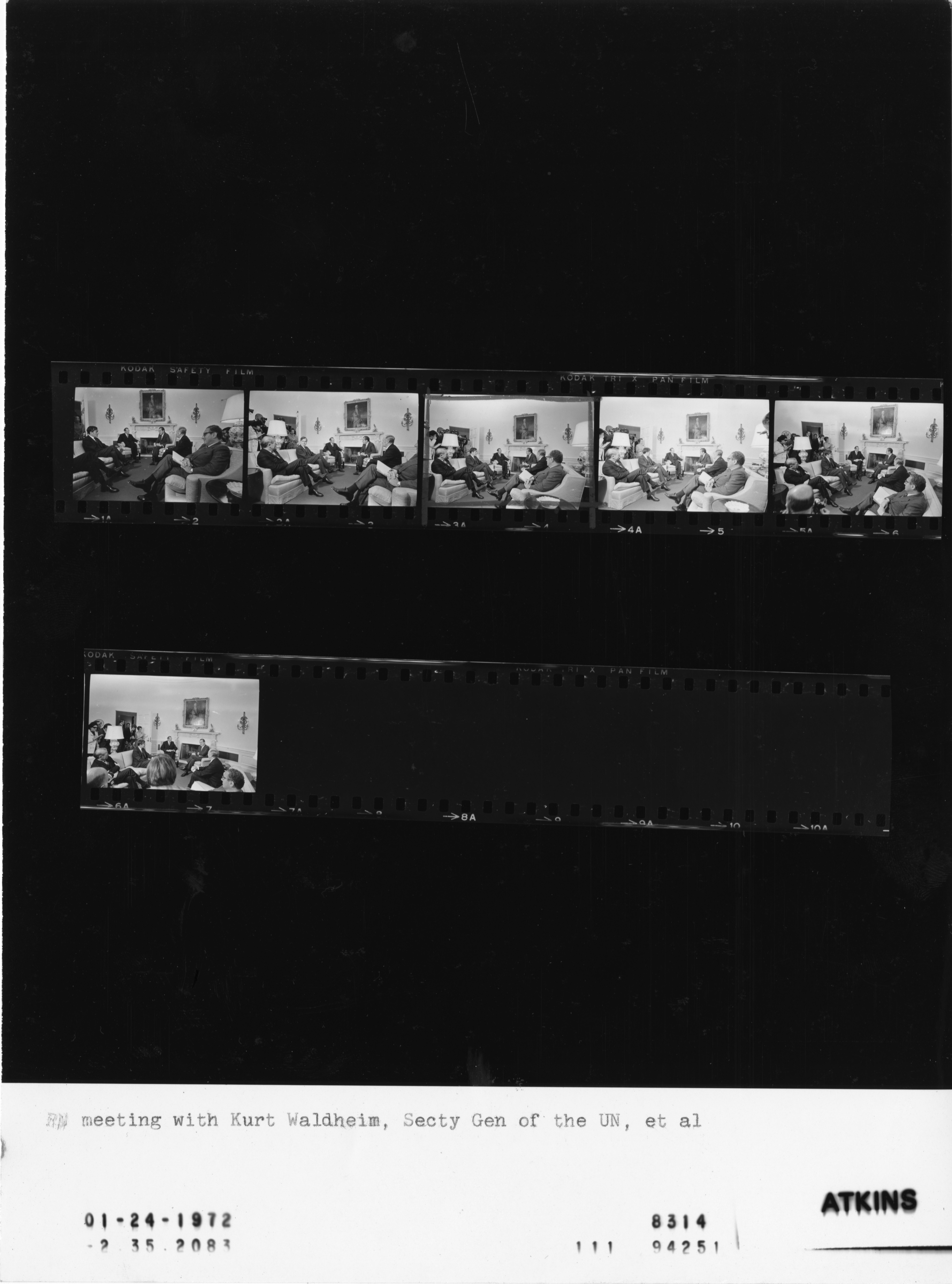
- Frame(s): WHPO-8314-, Meeting to discuss United Nations problems with Kurt Waldheim and George H. W. Bush. 1/24/1972, Washington, D.C. White House, Oval Office. Emil Mosbacher, George Bush, Kurt Waldheim, President Nixon, William P. Rogers, Henry Kissinger.
- Frame(s): WHPO-8314-06, President Nixon, Henry Kissinger, William P. Rogers, and Emil Mosbacher, sitting in the Oval Office during a meeting to discuss United Nations problems with Kurt Waldheim and George H. W. Bush. Reporters with Helen Thomas are standing nearby at the doorway, taking notes. 1/24/1972, Washington, D.C. White House, Oval Office. Emil Mosbacher, George H.W. Bush, Kurt Waldheim, President Nixon, William P. Rogers, Henry Kissinger, Helen Thomas, unidentified members of the press.
Roll WHPO-8315 Photographer: Schumaker, Byron | Color or B&W: B&W
- Frame(s): WHPO-8315-, Panoramic view of President Nixon signing the 1973 Budget Message. 1/24/1972, Washington, D.C. White House, Oval Office. President Nixon, Members of OMB staff, Caspar Weinberger to the right, to the left George P. Shultz.
- Frame(s): WHPO-8315-09A, Panoramic view of President Nixon signing the 1973 Budget Message. 1/24/1972, Washington, D.C. White House, Oval Office. President Nixon, Members of OMB staff, Caspar Weinberger to the right, to the left George P. Shultz.
Roll WHPO-8316 Photographer: Atkins, Oliver | Color or B&W: B&W
- Frame(s): WHPO-8316-, Close-up portrait of President Nixon signing the message. 1/24/1972, Washington, D.C. White House, Oval Office. President Nixon.
- Frame(s): WHPO-8316-, Signing Ceremony of the 1973 Budget Message. 1/24/1972, White House, Oval Office White House, Oval Office. President Nixon.
- Frame(s): WHPO-8316-09A, Close up of President Nixon signing the 1973 Budget Message. 1/24/1972, White House, Oval Office White House, Oval Office. President Nixon.
- Frame(s): WHPO-8316-13A, Close up of President Nixon signing the 1973 Budget Message. 1/24/1972, White House, Oval Office White House, Oval Office. President Nixon.
Roll WHPO-8317 Photographer: Schumaker, Byron | Color or B&W: B&W
- Frame(s): WHPO-8317-, Executive Committee of Religious Broadcasters. 1/24/1972, Washington, D.C. Outside of White House. Religious Broadcasters.
Roll WHPO-8318 Photographer: Schumacher, Karl | Color or B&W: B&W
- Frame(s): WHPO-8318-, Vice President Agnew arriving at the airport, addressing the National Home Builders Association convention, and shaking hands with uniformed men. 1/24/1972, Houston, Texas airport, unidentified convention site. Spiro Agnew, unidentified persons.
Roll WHPO-8319 Photographer: Schumacher, Karl | Color or B&W: B&W
- Frame(s): WHPO-8319-, Vice President Agnew greeting people and addressing the National Association of Home Builders convention. 1/24/1972, Houston, Texas convention site. Spiro Agnew, unidentified persons.
Roll WHPO-8320 Photographer: Kightlinger, Jack | Color or B&W: B&W
- Frame(s): WHPO-8320-03A-06A, President Nixon seated informally with Philadelphia Mayor Frank Rizzo. 1/24/1972, Washington, D.C. White House, Oval Office. President Nixon, Frank Rizzo, Phillip Sanchez, Mrs. Sanchez, Robert Finch.
- Frame(s): WHPO-8320-08A-21A, Swearing-in ceremony for Phillip Sanchez. 1/24/1972, Washington, D.C. White House, Oval Office. President Nixon, Frank Rizzo, Phillip Sanchez, Mrs. Sanchez, Robert Finch.
Roll WHPO-8321 Photographer: Schumaker, Byron | Color or B&W: B&W
- Frame(s): WHPO-8321-, "1-6 R. Ziegler and Geo Shultz make Budge statement to press. 8-11 UN Sec Gen Kurt Waldheim makes statement to press.". 1/24/1972, Washington, D.C. Press Room, White House. Ziegler, Shultz, Kurt Waldheim.
The White House Communications Agency Sound Recordings Collection contains public statements that took place between 1969 and 1974. Visit the finding aid to learn more.
H - White House Staff Member Recordings
- WHCA-SR-H-495
Press briefing by George Shultz and Ronald Ziegler. (1/24/1972, Press Center, White House)
Runtime: 27:00:00
Keywords: Press conferences, news conferences, interviews, media, press secretary
Production credits: Audio feed supplied by WHCA; Recorded by LRR (initials of WHCA engineer)
Original Format: 1/4-inch reel-to-reel audiotape. Original source type: Original.
H - White House Staff Member Recordings
- WHCA-SR-H-496
Press briefing by the United Nations Secretary General. (1/24/1972, Press Center, White House)
Runtime: 2:00
Keywords: Press conferences, news conferences, interviews, media
Production credits: Audio feed supplied by WHCA; Recorded by LRR (initials of WHCA engineer)
Original Format: 1/4-inch reel-to-reel audiotape. Original source type: Original.
The White House Communications Agency Videotape Collection contains “off-the-air” recordings of televised programs produced between 1968 and 1974. Visit the finding aid to learn more.
- WHCA-4996
Promotional video for Miami Tele Productions featuring the Norelco PCP90 and the Ampex VR3000. Secretary Rogers and Morton.
CBS
Runtime: 00:10:47 - WHCA-5007
Weekly News Summary, Tape I.
All networks
Runtime: 1:30
19. Smith/Zimmerman/Bergman/Smith: The budget '73, Connally. Time Code Start: 44:50. Keywords: reports, economy, economics, budgets, finances, recession, inflation, money, wages, costs, unemployment, prices, payments. Network: ABC.
20. Reasoner/Geer: Berrigan trial starts (Harrisburg 7). Time Code Start: 50:15. Keywords: Protests, militants, bombings, violence, sabotage, shootings, kidnappings, courts, trials, investigations, prosecutions. Network: ABC.
21. Smith/Snell: State welfare laws. Time Code Start: 52:24. Keywords: bills, laws, Family Assistance Programs, government aid, financial aid, health and welfare assistance, financial aid. Network: ABC.
22. Smith: Commentary on the budget. Time Code Start: 55:14. Keywords: reports, economy, economics, budgets, finances, recession, inflation, money, wages, costs, unemployment, prices, payments. Network: ABC.
23. Chancellor/Levine: The budget, Connally. Time Code Start: 56:55. Keywords: reports, economy, economics, budgets, finances, recession, inflation, money, wages, costs, unemployment, prices, payments. Network: NBC.
24. Chancellor: Shultz's comments on the Budget. Time Code Start: 60:15. Keywords: reports, economy, economics, budgets, finances, recession, inflation, money, wages, costs, unemployment, prices, payments. Network: NBC.
25. Chancellor/Stern: The Berrigan Gang (Harrisburg 7). Time Code Start: 61:52. Keywords: Protests, militants, bombings, violence, sabotage, shootings, kidnappings, courts, trials, investigations, prosecutions. Network: NBC.
26. Chancellor/Utley: Laos war report. Time Code Start: 64:38. Keywords: Laos, Vietnam War, reports. Network: NBC.
27. Chancellor/Oliver: The Russian fishing boats in Alaska. Time Code Start: 68:29. Keywords: Soviet Union, USSR, ships, boats, oceans, fish, fishing, illegal fishing. Network: NBC.
28. Cronkite/Schorr: The budget, Connally, Shultz. Time Code Start: 71:08. Keywords: reports, economy, economics, budgets, finances, recession, inflation, money, wages, costs, unemployment, prices, payments. Network: CBS.
29. Cronkite/Serafin: The Berrigan trial (Harrisburg 7). Time Code Start: 77:05. Keywords: Protests, militants, bombings, violence, sabotage, shootings, kidnappings, courts, trials, investigations, prosecutions. Network: CBS.
30. Cronkite/Kalb: President Nixon and United Nations (U.N.) Secretary Waldhein. Time Code Start: 80:56. Keywords: cabinet, advisors, organization of nations, intergovernmental alliance. Network: CBS.
31. Sevareid: Commentary on the budget. Time Code Start: 82:33. Keywords: reports, economy, economics, budgets, finances, recession, inflation, money, wages, costs, unemployment, prices, payments. Network: CBS.
Context (External Sources)
The Vanderbilt Television News Archive is the world's most extensive and complete archive of television news. They have been recording, preserving and providing access to television news broadcasts of the national networks since August 5, 1968.
Wikipedia is a free encyclopedia that anyone can edit.