

Introduction
This almanac page for Wednesday, January 22, 1969, pulls together various records created by the federal government and links to additional resources which can provide context about the events of the day.
Previous Date: Tuesday, January 21, 1969
Next Date: Thursday, January 23, 1969
Schedule and Public Documents
The Daily Diary files represent a consolidated record of the President's activities. Visit the finding aid to learn more.
The President's day began at The White House - Washington, D. C.
The Weekly Compilation of Presidential Documents made available transcripts of the President's news conferences; messages to Congress; public speeches, remarks, and statements; and other Presidential materials released by the White House.
Appointments and Nominations
- Bureau of the Budget (5 Weekly Comp. Pres. Doc. 158, January 22, 1969)
Announcement of Appointment of Phillip S. Hughes as Deputy Director. - Treasury Department (5 Weekly Comp. Pres. Doc. 159, January 22, 1969)
Statement by Secretary David M. Kennedy Introducing the New Under Secretary and Under Secretary for Monetary Affairs. - Treasury Department (5 Weekly Comp. Pres. Doc. 159, January 22, 1969)
Announcement of the Appointment of Dr. Charls E. Walker as Under Secretary and Paul A. Volcker as Under Secretary for Monetary Affairs.
Nominations Submitted to the Senate
Does not include promotions of members of the Uniformed Services, nominations to the Service Academies, or nominations of Foreign Service Officers.
- RICHARD G. KLEINDIENST, of Arizona, to be Deputy Attorney General, vice Warren Christopher, resigned.
- WILLIAM H. REHNQUIST, of Arizona, to be an Assistant Attorney General, vice Frank M. Wozencraft.
- WILL WILSON, of Texas, to be an Assistant Attorney General, vice Fred M. Vinson.
- RICHARD W. MCLAREN, of Illinois, to be an Assistant Attorney General, vice Edwin M. Zimmerman, resigned.
- WILLIAM D. RUCKELSHAUS, of Indiana, to be an Assistant Attorney General, vice Edwin L. Weisl, Jr.
- JERRIS LEONARD, of Wisconsin, to be an Assistant Attorney General, vice Stephen J. Pollak.
- JOHNNIE M. WALTERS, of South Carolina, to be an Assistant Attorney General, vice Mitchell Rogovin.
- WILLI J. USERY, JR., of Georgia, to be an Assistant Secretary of Labor.
- HERBERT STEIN, of Maryland, to be a member of the Council of Economic Advisers.
- HENDRIK S. HOUTHASKER, of Massachusetts, to be a member of the Council of Economic Advisers.
- The following-named persons to be members of the Board of Directors of the Commodity Credit Corporation: J. PHIL CAMPBELL, of Georgia; CLARENCE D. PALMBY, of Virginia
Each Public Papers of the Presidents volume contains the papers and speeches of the President of the United States that were issued by the White House Office of the Press Secretary during the time period specified by the volume. The material is presented in chronological order, and the dates shown in the headings are the dates of the documents or events. In instances when the release date differs from the date of the document itself, that fact is shown in the text note.
To ensure accuracy, remarks have been checked against audio recordings (when available) and signed documents have been checked against the original, unless otherwise noted. Editors have provided text notes and cross references for purposes of identification or clarity.
The Federal Register is the official daily publication for rules, proposed rules, and notices of federal agencies and organizations, as well as executive orders and other Presidential documents.
The Congressional Record is the official daily record of the debates and proceedings of the U.S. Congress.
Archival Holdings
Any selection of archival documents will necessarily be partial. You should use the documents and folders identified below as a starting place, but consult the linked collection finding aids and folder title lists and the collections themselves for context. Many documents to be found this way do not lend themselves to association with specific dates, but are essential to a complete understanding of the material.
Selective document listing
President's Office Files
The President's Office Files consists of materials drawn together by the Special Files Unit from several administrative subdivisions within the White House Office. It is the handwriting and sensitive papers sent to the Staff Secretary that now comprise much of the President's Office Files. Visit the finding aid to learn more.
- President's Handwriting, Box 1, President's Handwriting--January 1969 [1 of 2]
- Notes; First Cabinet meeting. January 22, 1969. 5 pgs.
- Newspaper; Washington Star editorial and New York Times article, with cover sheets. January 22, 1969. 4 pgs.
- Memo; Buchanan to The President re: Washington Daily News front page editorial. January 22, 1969. 1 pg.
- Memo; John Whitaker to Bob Haldeman re: Status - Longshoreman's Strike. January 22, 1969. 2 pgs.
- Annotated News Summaries, Box 28, News Summaries - January 1969 [During this period, the Staff Secretary only removed pages from the News Summaries which contained President Nixon's handwriting, often leaving the document with no date. In addition to the individual document listed below, you should also consult the full folder for the month.]
- Memo; Buchanan to The President re: Washington Daily News front page editorial, January 22, 1969.
- President's Meetings File, Box 73, Memoranda for the President--Beginning January 21, 1969
Selective document listing
The White House Press Office during the Presidency of Richard Nixon was responsible for daily communication with the White House press corps. Ronald L. Ziegler was the Press Secretary to the President for Nixon's entire term in office from January 1969 to August 1974 and Gerald Warren served as the Deputy Press Secretary. The office held daily briefings for the press and produced the White House’s press releases. Visit the finding aid to learn more.
- White House Press Releases, Box 1
- THE WHITE HOUSE
HERBERT G. KLEIN
DIRECTOR OF COMMUNICATIONS
FOR EXECUTIVE DEPARTMENTS
FOR IMMEDIATE RELEASE JANUARY 22, 1969
WASHINGTON, January 22 -- The nomination by President Nixon of Philip S. Hughes for appointment as deputy director of the Bureau of the Budget was announced Wednesday at the White House by Ronald L. Ziegler, press secretary.
Hughes held this post in the Johnson Administration, taking office March 10, 1966. Previously he was assistant director for eight years of the legislative reference bureau of the Bureau of the Budget and was deputy director for two and one-half years.
A career civil servant with the Bureau since 1949, Hughes joined the staff as a budget examiner for veterans programs. He was named as assistant division chief in 1953.
He was born in Chicago in 1917 and in 1930 his family moved to the State of Washington. Hughes received a B. A. from the University of Washington in 1938.
Hughes served in the Navy during World War II after being employed briefly by the War Manpower Commission as an analyst. He worked with the Veterans Administration 1946-49.
In 1965 Hughes was presented the Bureau's Exceptional Service Award and in 1962 he was the recipient of the Career Service Award of the National Service League.
Hughes is married to the former Jean Evans. They have three daughters and one son. Hughes and his family reside in Chevy Chase, Maryland. - FOR IMMEDIATE RELEASE JANUARY 22, 1969
OFFICE OF THE WHITE HOUSE PRESS SECRETARY
THE WHITE HOUSE
REMARKS OF THE PRESIDENT AT SWEARING-IN CEREMONY FOR THE CABINET
THE EAST ROOM
AT 8:03 A.M. EST
THE PRESIDENT: Mr. Chief Justice , Mr. Vice President, ladies and gentlemen:
This is an historic occasion in any Administration. It involves, of course, the swearing-in of our Cabinet.
Before coming down this morning, I was reading a little background with regard to the appropriate term to apply to a Cabinet.
Andrew Jackson was the man who first used the term Kitchen Cabinet.
Theodore Roosevelt called his Cabinet a Tennis Cabinet, because he played tennis.
Herbert Hoover's Cabinet was a Medicine Ball Cabinet.
I have been asked what this Cabinet is. In view of the fact that we started at 8:oo in the morning for the swearing-in , we will call it a working Cabinet.
We are honored today to have the Chief Justice of the United States to swear in each member of the Cabinet.
As I call the name of the member of the Cabinet, if he would step forward with his wife, his wife will hold the Bible as the Chief Justice swears in each member of the Cabinet.
The Secretary of State, Mr. William P. Rogers, and Mrs. Rogers.
(The Chief Justice administered the oath of office.)
THE PRESIDENT: The Secretary of the Treasury, Mr. David M. Kennedy, and Mrs. Kennedy.
(The Chief Justice administered the oath of office.)
THE PRESIDENT: The Secretary of Defense, Mr. Melvin R. Laird, and Mrs. Laird.
(The Chief Justice administered the oath of office.)
THE PRESIDENT: The Attorney General, Mr. John N. Mitchell, and Mrs. Mitchell.
(The Chief Justice administered the oath of office.)
TRF PRESIDENT: The Postmaster General, Mr. Winton M. Blount, and Mrs. Blount.
(The Chief Justice administered the oath of office.)
THE PRESIDENT: The Secretary of Agriculture, Mr. Clifford M. Hardin , and Mrs. Hardin.
(The Chief Justice administered the oath of office.)
THE PRESIDENT: Since I missed the name of the next Cabinet officer on nation-wide television a few weeks ago, I want to be sure that everybody on television knows that I remembered it on this occasion.
The Secretary of Commerce.
(The Chief Justice administered the oath of office.)
THE PRESIDENT: I congratulate you, Mr. Stans.
The Secretary of Labor, Mr. George P. Shultz, and Mrs. Shultz.
(The Chief Justice administered the oath of office.)
THE PRESIDENT: The Secretary of Health, Education, and Welfare, Mr. Robert H. Finch, and Mrs. Finch.
(The Chief Justice administered the oath of office.)
THE PRESIDENT: Mr. Chief Justice, just another historical note.
This is the first time in the history of this Nation that the President of the United States, the Chief Justice of the United States, and the Cabinet officer being sworn-in were all born in the State of California.
The Secretary of Housing and Urban Development, Mr. George W. Romney, and Mrs. Romney.
(The Chief Justice administered the oath of office.)
THE PRESIDENT: The Secretary of the Department of Transportation, Mr. John A. Volpe, and Mrs. Volpe.
(The Chief Justice administered the oath of office.)
THE PRESIDENT: Mr. Chief Justice, you will note that I almost automatically started to raise my hand, too, on that occasion.
The other night, with all the traffic conditions in Washington, it was very difficult to get a cab. I got a ride with the Secret Service.
Another historical note: George Washington had the first Cabinet. There were four members of that Cabinet.
Since that time the Cabinet has begun to grow until now we have 12 official members of the Cabinet. There have been several recommendations from time to time that new members should be added.
President Harry Truman suggested there should be a Secretary for Columnists, and also a Secretary for Semantics.
We have no plans to add to the Cabinet as far as its official stature is concerned, but there are two who will be members of the Cabinet in everything except the official position.
One is the Director of the Budget, Mr. Robert P. Mayo.
Mr. Mayo and Mrs. Mayo.
(The Chief Justice administered the oath of office.)
THE PRESIDENT: When President Eisenhower set up his Cabinet procedure, he invited as a member of the Cabinet the Ambassador to the United Nations, because of the importance that that role plays in our foreign policy, and particularly in seeking routes to peace.
I am also following that practice.
The Ambassador to the United Nations, our designee, Ambassador Charles W. Yost, and Mrs. Yost.
(The Chief Justice administered the oath of office.)
THE PRESIDENT: Mr. Chief Justice, ladies and gentlemen, that completes the swearing-in of the Cabinet this morning.
For the benefit not so much of the Cabinet members, but for the benefit of their families, and particularly their children who are here, one other historical note:
I found that during the course of our history, eight men who have served the Cabinet went on to become President of the United States.
My grade school mathematics tells me that each member of this Cabinet then has one chance in 48 to be the tenant of this house in which I now live, the White House, and to become President of the United States.
Those odds are pretty good.
The only thing I would suggest now is that if any one of you is going to come through, we must get to work. It is time for the Cabinet meeting, 8:30.
Thank you very much.
END (AT 8 : 30 A.M. EST) - FOR IMMEDIATE RELEASE JANUARY 22, 1969
OFFICE OF THE WHITE HOUSE PRESS SECRETARY
THE WHITE HOUSE
THE WHITE HOUSE
STATEMENT BY SECRETARY KENNEDY IN INTRODUCING THE TREASURY UNDER SECRETARIES
I am very happy today to introduce to you two men who will be providing the top level support for me in the Treasury. Dr. Charls Walker will be the Under Secretary and number two man; and Mr. Paul Volcker will become Under Secretary for Monetary Affairs, where he will carry the principal international responsibilities of the Treasury.
Dr. Walker was born in Graham, Texas, in 19231 studied at the University of Texas, at the University of Pennsylvania, and was on the faculties of the Wharton School of Finance and Commerce, University of Pennsylvania, and the University of Texas. He was ·at the Federal Reserve Bank of Dallas and at the Federal Reserve Bank of Philadelphia. He served for a period from 1959 to 1961 as Assistant to the Secretary of the Treasury and principal economic adviser to Secretary Robert B. Anderson. Since 1961 he has been E:llecutive Vice President and Executive Manager of the American Bankers Association.
Mr. Volcker was born in 1927 in New Jersey. He is a graduate of Princeton University and Harvard University and he also studied at the London School of Economics. Mr. Volcker was in the Research Department of the Federal Reserve Bank of New York. After graduating from Harvard University Mr. Volcker served at the Treasury Department. After leaving the Treasury he returned to New York where he was working on national and international matters at the Chase Manhattan Bank.
Complete biographical sketches on these men are of course available to you. These two men will be in the front line in both shaping and implementing the Administration's economic and financial policies.
The immediate challenge before them is plain. We have inherited inflationary pressures that are seriously distorting the economy and financial markets. That inflation must, and will, be contained.
We are all conscious of the risks of abrupt and blunt action that could bring unnecessary unemployment. We mean to avoid that. But we are equally conscious of the risks of not moving decisively, because inflation is undermining both the foundation of our prosperity at home and our
balance of payments position.
The indications of an over-all statistical balance in our international payments last year are welcome.
But no one should be deluded. Underneath the over-all result, our trade balance has sagged to the vanishing point under the pressure of inflation, and additional controls on American investment were imposed to achieve the balance. We do not plan to rely indefinitely on tight controls or statistical window dressing to disguise, but not cure, a basic deficit. Maintained too long, these devices can only be self-defeating.
It will be our purpose to maintain a strong dollar both at home and abroad. We will not seek an answer to our problems by a change in the monetary price of gold. We see no need or reason for such action.
Calm study in cooperation with our friends -- not unilateral actions or disruptive changes in the· vital role of the dollar and gold -- must remain the foundation of real reform and progress in the international financial system.
Responsible budgeting and support for firm monetary policies are the core of the actions that must lie behind any successful attack on inflation and our balance of payments problems.
As a first order of business, these gentlemen will be working on this basis with their colleagues in the Administration to develop a detailed economic program.
- THE WHITE HOUSE
- White House Press Conferences, Box 55
- News Conference #5 at the White House with Robert P. Mayo, Director, Bureau of the Budget; Philip S. Hughes, Deputy Director of the Bureau of the Budget; and Ron Ziegler, Press Secretary, January 22, 1969, 11:56 AM EST. 3 pgs.
NEWS CONFERENCE #5
AT THE WHITE HOUSE
WITH ROPERT P. MAYO, DIRECTOR, BUREAU OF THE BUDGET, PHILIP S. HUGHES, DEPUTY DIRECTOR OF THE BURFAU OF THE BUDGET, AND RON ZIEGLER, PRESS SECRETARY
AT 11 : 56 A.M. EST
JANUARY 22, 1969
WEDNESDAY
MR. ZIEGLER: The President has asked me to announce today the appointment of Philip S. Hughes as Deputy Director of the Bureau of the Budget.
Sam Hughes, as he is known, held this post in the Johnson Administration. Previously he was Assistant Director for eight years of the Legislative Reference Bureau of the Budget and was Deputy Director for 2-1/2 years.
His career in the Civil Service with the Bureau began in 1949, when Mr. Hughes joined the staff as a budget examiner for veterans programs. He was named as Assistant Division Chief in 1953.
A release on Mr. Hughes and his appointment is available in the bin.
Mr. Hughes and Mr. Mayo are here, if you have any questions of either gentlemen, other than on the fiscal 1970 and 1971 budgets. I am sure they will be happy to respond.
Q You have been Deputy Director for about how long, Mr. Hughes?
MR. HUGHES: Three years in March.
MR. ZIEGLER: Both Mr. Mayo and Mr. Hughes will be available now outside the West Lobby for pictures for those who would like to take pictures. Then we will continue with the briefing.
Q Mr. Mayo, how long have you known Mr. Hughes?
MR. MAYO: Strangely enough, we both got out of the University of Washington in 1938, but we met only casually until two years ago, when I became involved with Mr. Kennedy's Commission on Budget Concepts under President Johnson. That is when I first got to know Sam.
Q Mr. Mayo, can you give us any idea what you are doing on the budget?
MR. MAYO: We are working at it. We started this morning.
Q Will you be submitting your own budget?
MR. MAYO: There will be revisions of the 1970 budget in due course.
Q You are talking about amendments, really?
MR. MAYO: Amendments.
Q Do you know when?
MR. MAYO: That has not been decided yet.
Q Will there be a new budget message by the President, also?
MR. MAYO: There is no decision as to how specific this will be, but there will be amendments to the budget.
They will be discussed with the Appropriations Committee in due course. We have to do our work before we can have something to say.
Q Will these revisions be up or down?
MR. MAYO: We hope to get it down.
Q Do you have a mandate to that effect from the President?
MR. MAYO: We are going to look at every program individually?
Q Have you had a chance at all to study the Johnson budget?
MR. MAYO: We are not complete strangers to it.
Q If you get it down, Mr. Mayo, would that increase the chances of doing without or scaling down the ten percent surtax?
MR. MAYO: I think the answer to that is pretty obvious. It is part of the equation.
Q Mr. Mayo, did you say you do have a mandate from the President to try and lower the budget?
MR. MAYO: We have a mandate from the President to keep the budget under strict control. That is as far as I think I ought to go today.
Q When you talk about part of the equation, will you elaborate on that, Mr. Mayo?
MR. MAYO: There are many things that this Administration will want to do, where the budget is a very key part. This includes the question of the surtax. This includes the question of how you redirect programs. It is too early to give answers to any of those questions.
Q Are these revisions you are talking about only on the appropriations side, or are you talking on the revenue side, also?
MR. MAYO: We are going to study everything. Both sides are important. This is the scissors.
Q So, despite what Mr. Nixon's position as stated in supporting Mr. Johnson's position on the surtax, in the State of the Union Message, it is still a possibility that Mr. Nixon will recommend something else on the surtax?
MR. MAYO: As of the moment, that statement stands, that under present circumstances, with Vietnam and economic conditions as they are, the surtax muss continue.
Q Mr. Mayo, would part of your revisions on the budget deal possibly with ways of accommodating tax incentive programs or setting up the machinery by which you might be able to do this?
MR. MAYO: Again, this is in the area of discussion.
MR. ZIEGLER: If I can interrupt for just a moment, I think what has been wade very clear here is that Mr. Mayo and his staff are taking a good, hard look at the budget, and anything on that good, hard look will be discussed at a later time.
Q Can I ask just one more question?
MR. ZIEGLER: Sure.
Q Do you have any target figure for the amount you are trying to cut out of the budget?
MR. MAYO: No.
Q Mr. Mayo, could you conceivably bring the budget down without keeping the surtax?
MR. MAYO: That is a tough question . I can't answer that yet.
Q The surtax could be lowered, possibly? You are not irrevocably committed to a ten percent surtax?
MR. MAYO: As I said before, the surtax should continue as long as we have an economic outlook and a budget outlook such as we have today, period.
Q Mr. Mayo, if you manage to cut down spending and keep the surtax, presumably that would increase the surplus which would result in a much more restrictive budget. Just on the question of the $3.4 billion surplus, do you think the restrictiveness of the budget as sent up by President Johnson is approximately what the economy needs now?
MR. MAYO: It is a reasonable approximation of that.
We can't be too precise.
MR. ZIEGLER: Thank you very much, Mr. Mayo.
END (AT 12:03 P.M. EST) - News Conference #6 at the White House with Herbert G. Klein, Director of Communications for Executive Branch; and Ron Ziegler, Press Secretary, January 22, 1969, 12:04 P.M. EST. 9 pgs.
NEWS CONFERENCE #6
AT THE WHITE HOUSE
WITH HERBERT G. KLEIN, DIRECTOR OF COMMUNICATIONS FOR EXECUTIVE BRANCH, AND RON ZIEGLER, PRESS SECRETARY
AT 12:04 P.M. EST
JANUARY 22, 1969
WEDNESDAY
MR. ZIEGLER: The Cabinet meeting started at 8:45 a.m. and concluded at 11:45 a.m.
Basically, the Cabinet meeting was procedural in nature, discussing matters of communication and agenda development for future Cabinet meetings. Some logistical discussions were held. Dr. Burns discussed program development. Mr. Mayo, Director of the Budget, discussed budget matters. Also, there were discussions on staffing of the various agencies.
The Cabinet will meet as a complete group regularly every two weeks for two months. Following that, it will meet at least once per month.
Q Do you mean until March 20, sometime?
MR . ZIEGLER: Approximately. For approximately two months it will meet every two weeks and following that once a month.
In addition to that, of course, and this has been previously announced, members of the Cabinet will be meeting with various other councils, for example, the Urban Affairs Council which will meet here tomorrow at 10:00 a.m. Secretary Romney will attend that.
The Attorney General, the Secretary of HEW, the Secretary of Labor, the Secretary of Transportation, and also the Secretary of Agriculture will be members of the Urban Affairs Council.
The reason for this is: as most of you know, the urban and rural problems are overlapping significantly at this time. The President feels this and wants them to be included on the Urban Affairs Council, within the council meeting.
Q Does this constitute the Urban Affairs Council now?
MR. ZIEGLER: These are the members of the Cabinet who will be on the Urban Affairs Council.
Q Are there other members?
MR. ZIEGLER: This is the way the Urban Affairs Council will be structured at the outset.
Q Ron, when the President announced the Urban Affairs Council, as I recall it, in New York, in December, he indicated that the Secretary of Agriculture would sit with the Council when it was dealing with matters in which the agriculture sector was involved. Is there a change in this or am I not remembering it correctly?
MR. ZIEGLER: The Secretary of Agriculture will sit on the Urban Affairs Council.
Q Go over those again.
MR. ZIEGLER: HEW, the Attorney General, HUD, Labor, Transportation, and Agriculture.
Q And the Vice President and Mr. Moynihan?
MR. ZIEGLER: Yes.
Q What is Dr. Burns' role in the Cabinet? I don't quite understand it.
MR. ZIEGLER: Dr. Burns, as you know, Bob, has been serving in the transition period as an adviser to President Nixon and was involved in compiling and summarizing the Task Force Reports and obtaining other information in relation to program development from other groups -- Congressmen, citizens, leaders in various areas. He was involved in the Cabinet meeting on that basis this morning.
Q Has a new role for him been determined yet?
MR. ZIEGLER: I don't have anything to announce on that today. I think I indicated yesterday that it is very likely that he would be involved in the Administration.
To conclude the briefing on the Cabinet meeting, the President commented briefly on Congressional relations, and also on policy regarding information.
The President discussed Mr. Herb Klein's role in working with the Cabinet, and expressed the goal that Herb would be pursuing-- that is a full and open Administration -- and to set up some procedures for this, for Mr. Klein and his staff, to work with the various Cabinet members' staffs.
That was a part of the Cabinet meeting that I can relate to you.
Q What where these procedures to be set up for Mr . Klein?
MR. ZIEGLER: In terms of speeches and coordination of the public information officers. This was made very clear, not to clear things with Mr. Klein and his staff but to coordinate with them so that there can he a full dissemination of information on matters of the Administration.
Q: Ron, does that mean that the various departments are to check with Mr. Klein to be sure that Mr. Klein is satisfied that they have told the whole story?
MR. ZIEGLER: No , that is not the intent at all. I think this has been discussed on many occasions.
Mr. Klein is here to back up what I am saying.
This was the thing that the President referred to in the Cabinet meeting. The intent here is to expand the flow of information. The intent is not to funnel it into one approving source. In order to do this , there is obviously a need for communication between the PIO's. Mr. Klein, I know, plans to have a weekly meeting with public information officers to discuss ways to improve and to coordinate the dissemination of news of the Administration.
Q Is he their superior, then?
MR. KLEIN: They work directly for the Cabinet officer. I only coordinate with them.
MR. ZIEGLER: The whole matter of the Czar of Information, I think, has been pretty well passed over.
Q On a related subject, Ron, is there a policy that applies to White House Staff members talking with the President? Do they have to go through you?
MR. ZIEGLER: As we move along here, I think this will develop. I don't want to get into the scheduling of appointment business.
Q I was told by one staff member, a secretary, that I was to go to you.
MR. ZIEGLER: I think in some cases this will occur. Of course , in the area of the National Security Council and matters like that, obviously the White House has to have some coordination as to conversation on these matters. But there is not going to be a scheduling procedure.
Q As a matter of procedure, will announcements regarding foreign affairs, for example, come out of the State Department rather than the White House, such as the Paris peace talks?
MR. ZIEGLER : Many matters which you have been accustomed to having come out of the White House will no longer come out of the White House. We feel this is appropriate.
Q Can you give us an example of that?
MR. ZIEGLER: Many of them will come out of the appropriate agency. In other words, we are not going to bring information into the White House and disseminate it from here on secondary matters in relation, for example, to the Department of Agriculture or the Department of Interior; any of those.
Much of this will be disseminated by the Public Information Office in the particular agency. We will be aware of it, of course.
Q The specific question dealt with foreign policy. Can you address yourself to that?
MR. ZIEGLER: I can't, because I don't think there is a specific question to address myself to. Foreign policy is a wide-ranging thing. Some matters, of course, on foreign policy, will absolutely come out of the White House.
Q With a number of members of the Cabinet working formally in Mr. Moynihan's group, can you say whether there will be any formal participation by members of the Cabinet in Mr. Kissinger's operation?
MR. ZIEGLER: Yes, there will be. Yesterday, for example, as you know, Secretary Kennedy sat in on the Security Council meeting. Secretary Kennedy will sit in on many of the NSC meetings.
Q He is a statutory member of the NSC.
MR. ZIEGLER: No, he is not.
Q Why would he be sitting in on many of the meetings?
MR. ZIEGLER: Because many of the matters that are discussed there deal with the things that fall under the Treasury Department -- foreign monetary structure and so on. But to finish the answer, and the President mentioned this this morning in discussing procedural matters, when the National Security Council is discussing a matter, or has on its agenda a matter, that relates to the area of concentration of a particular agency, then that particular Secretary will be brought into the NSC meeting.
I think this pretty well indicates how the Cabinet members will be brought into the various areas that they have a particular involvement in and are working on.
Q Ron, will Mr. Klein decide what agency will announce various developments or make announcements?
MR. ZIEGLER: I don't think it will be a decision process. I think it will be a process that will evolve
from communication. If there is a full communication between the agencies and Mr. Klein, then obviously that eliminates a great deal of duplication on the same day.
Q Somebody would decide whether the White House or the State Department releases an announcement, for example?
MR. KLEIN : In the first place, you really have to get to specific cases. My feeling in terms of the State Department and the White House, because they have a process where they are doing this pretty daily there, is that there would be less change there than in other areas, probably.
Q Ron, in response to a question back here, the gentleman said he had the experience of trying to talk to a White House staffer and you said in some instances there would be coordination. You used the same word in reference to Mr. Klein in terms of agency Secretaries coordinating with him. I get the impression t hat you implied that in some cases White House staffers would have to coordinate with you. Does that mean seek your approval? If it does, does it mean the same thing
with Mr. Klein in terms of agency Secretaries?
MR. ZIEGLER: No, I think that is entirely the wrong interpretation. It is not an approval system. It is
just a matter of those of us who have a responsibility of disseminating news -- and I am talking from my standpoint -- communicating what is happening in the White House, on the President's activities. Everyone benefits for us to be aware of similar discussions.
Q Perhaps we can shorten this. Can you tell us which members of the White House staff would be authorized to decide without coordinating with you whether or not they wish to see a reporter?
MR. ZIEGLER: I think we are carrying very much too far the whole subject. No member of the White House staff currently -- except at one request, and that is Dr. Kissinger -- has asked to talk to me before he has an appointment with a member of the press. There have been no instruction issued to any member of the White House staff.
Q Dr. Kissinger has asked you to clear first?
MR. ZIEGLER: To discuss it.
Q Before he talks to a reporter?
MR. ZIEGLER : That is right.
Q Did he say why?
MR. ZIEGLER: Just that he wants me to be aware of it.
Q Can I ask you something about the President?
MR. ZIEGLER: Certainly.
Q Can I ask that question now?
MR. ZIEGLER: Yes. I think we have concluded this other matter.
Q Can you tell us what Mr. Nixon's feeling is and whether he has sent any Message to the Hill on the Nuclear Non-Proliferation Treaty? What is his position? Has he sent any word to the Senate? What is happening on that?
MR. ZIEGLER: I don't have anything for you on that today. He has not sent a Message to the Hill.
Q Not to the leaders or anybody?
MR. ZIEGLER: To my knowledge, he has not.
Q Ron, can you say whether the President plans a State of the Union Message?
MR. ZIEGLER: A decision on that has not been made.
Q Ron, when was the decision made to expand the Urban Affairs Council to include the Attorney General?
MR. ZIEGLER: I can't put a specific date on that, but that decision, it seems to me, was in the last two to three weeks.
Q What was the thinking on that?
MR. ZIEGLER: The Attorney General, of course, is involved in many matters in relation to urban problems, and the President values his judgment.
Q Which matters?
MR. ZIEGLER: Mr. Klein?
MR. KLEIN: I think basically, looking at the Council, it is a wide-ranging council.
Q But I mean which matters.
MR. ZIEGLER: I think the way we will leave that answer is the way it is, that the President values his judgment on matters in relation to urban problems and wants him on the Council.
Q Is it not a Departmental matter? Is he not on there because his Department deals with crime?
MR. ZIEGLER: Of course; that obviously follows. Many of the matters in relation to urban problems fall within the Attorney General's Department.
Q Do you have a date yet for the swearing in of Secretary-designate Hickel?
MR. ZIEGLER: No.
Q What is on the President's schedule for the rest of the day, Ron?
MR. ZIEGLER: The President, for the rest of the day, has nothing scheduled. He will work in his office. He is working in his office now. He is meeting with some members of his staff. He will continue to do this all day.
If there are additions to the schedule, we will announce those at the four o'clock briefing.
Q Do you know when the Justice Department nominations that were announced yesterday are going to the Hill, Ron?
MR. ZIEGLER : They are in the process now of being signed.
Q Do you have a figure on how many of the 300 appointments have been filled?
MR. ZIEGLER: No, I don't have the figure on that. Alan Woods is in the process of working up that information.
Q On that subject, did the President indicate today that he is satisfied at the rate of progress in filling these sub-Cabinet positions?
MR. ZIEGLER: As a matter of fact, he made a very good point, and I think this point has been made before. He again emphasized his desire and objective that he has in filling all positions and all posts. That is to not rush into the filling of positions, but to seek and find the best qualified man. Also, he emphasized the desire that he has always had, and as many of you know, with members of the staff, that he has worked very hard in trying to achieve finding those within minority groups for some of these positions.
Q Ron, how are you coming along in finding out who some of those 81 people were who were sworn in yesterday?
MR. ZIEGLER: We are moving right along on that.
Q Ron, was the news summary prepared for the President this morning? Can you tell us anything about it how long it was, who prepared it, was the President satisfied with it?
MR. ZIEGLER: The one he referred to yesterday?
Q That is right.
MR. ZIEGLER: I don't know if he looked at that this morning. I am sure he did.
Q Can you tell us how long it was?
MR. ZIEGLER: If he looked at it, he looked at it before he came over here. I haven't seen the one prepared for today. We have been involved with the Cabinet meeting up to this point. Generally, they are moderate in length.
Q Is that something you did in the campaign and in the transition period?
MR. ZIEGLER: Yes.
Q Other than the procedural matters and discussions of the budget in the Cabinet meeting, were
any other matters taken up?
MR. ZIEGLER: There were other matters discussed at the Cabinet meeting. I can't go beyond what I have said was discussed. I have given you a pretty full outline of it.
Q You said earlier he commented briefly on Congressional relations. Can you develop that any further or summarize what he said about it?
MR. ZIEGLER: I can only give you a general feel of what he said. It is simply in relation to the various agencies and the need to communicate with the Congressional committees, and so forth, reflecting his experiences.
Q Ron, as a matter of housekeeping, as these various agencies complete their staffing, will the announcements of these Assistant Secretaries, and so on, be made by the Cabinet officer, or will they be made here?
MR. ZIEGLER: Many of them will be made by the Cabinet officer. The high level announcements, many of them, will be made here.
Q I was thinking of those which require Senate confirmation.
MR . ZIEGLER: Most of those will be made here, but not all of them.
Q What was Mr. Hickel's participation in the Cabinet meeting today?
MR. ZIEGLER: As a Member of the Cabinet.
Q Is the President at all concerned about the image, in having nominated Mr. Kleindienst as Deputy Attorney General, in view of the fact that he managed the Goldwater campaign in 1964 and the image that he has in the eyes of minority groups in the country?
MR. ZIEGLER: I think, if you will take a close look at the announcements that the Attorney General made yesterday, you will find that the Department of Justice probably has one of the best-rounded high level staff of any previous Department of Justice.
Q But I am wondering about the President's concern. That is why I am asking.
MR. ZIEGLER: I have no response to that.
Q Is the President going to answer, or has he answered, the letter that Mr. Nasser is supposed to have sent last week?
MR. ZIEGLER: I just can't go into that.
Q He has received the letter?
MR. ZIEGLER: The letter has been received. It was addressed to the President. The letter was received through the State Department.
Q Is there any response to the inquiry about the dock strike?
MR. ZIEGLER: No; not this morning.
Q You said the letter was received through the State Department. Did you say a time?
MR. ZIEGLER: No, I did not.
Q Can you tell us about how many pages your news summary is? What does "moderate" mean?
MR. ZIEGLER: I guess there is interest in this news summary.
Q Who compiles it?
MR. ZIEGLER: The news summary was prepared during the campaign by members of the research staff and Herb's staff. We haven't really determined yet who is going to prepare the news summary. It is quite a task. There is some discussion amongst the staff as to who will prepare it. A lot of that, of course, will fall in my office.
Q Can you tell us whether it was done today?
MR. ZIEGLER: I don't know if it was done today or not. If it was done, it was not done by my office.
Incidentally, the cabinet meetings in the future will be held at 10:00 a.m.
THE PRESS: Thank you.
END (AT 12:25 PM EST) - News Conference #7 at the White House with David M. Kennedy, Secretary of the Treasury; and Ron Ziegler, Press Secretary, January 22, 1969, 4:10 P.M. EST. 6 pgs.
NEWS CONFERENCE #7
AT THE WHITE HOUSE
WITH DAVID M. KENNEDY, SECRETARY OF THE TREASURY, AND RON ZIEGLER, PRESS SECRETARY
AT 4:10 P.M. EST
JANUARY 22, 1969
WEDNESDAY
MR. ZIEGLER: Secretary Kennedy has just completed a 30- minute meeting with the President and has some announcements to make.
SECRETARY KENNEDY: Ladies and gentlemen, I am very happy today to introduce to you two men who will be providing the top level support for me in the Treasury.
Dr. Charls Walker will be the Under Secretary, number two man at the Treasury, and Mr. Paul Volcker will become Under Secretary for Monetary Affairs, where he will carry the principal international responsibilities for the Treasury.
Dr. Walker was born in Graham, Texas, in 1923. He studied at the University of Texas and the University of Pennsylvania. He was on the faculties of the Wharton School of Finance and Commerce, the University of Pennsylvania, and the University of Texas.
He was at the Federal Reserve Bank of Dallas and at the Federal Reserve Bank of Philadelphia. He served for a period from 1959 through 1961 as Assistant to the Secretary of the Treasury, and principal economic adviser to Secretary Robert B. Anderson. Since 1961 he has been Executive Vice President and Executive Manager of the American Bankers Association.
Mr. Volcker was born in 1927, in New Jersey. He is a graduate of Princeton University and Harvard University. He also studied at the London School of Economics.
Mr. Volcker was in the research department of the Federal Reserve Bank of New York, and after graduating from Harvard University served at the Treasury Department.
After leaving the Treasury, he returned to New York where he was working on national and international matters for the Chase Manhattan Bank.
More complete biographical sketches on these men, of course, are available to you.
These two men will be in the front line in both shaping and implementing the Administration's economic and financial policies.
The immediate challenge before us is plain: We have inherited inflationary pressures that are seriously distorting the economic and financial markets. That inflation must, and will be, contained.
We are all conscious of the risks of abrupt and blunt action that could bring unnecessary unemployment. We mean to avoid that. But we are equally conscious of the risks of not moving decisively, because inflation is undermining both the foundation of our prosperity at home and our balance of payments position. The indications of an overall statistical balance in our international balance of payments last year are welcome. But no one should be deluded.
Underneath the overall result, our trade balance has sagged to the vanishing point under the pressure of inflation, and additional controls on American investments were imposed to achieve the balance. We do not plan to rely indefinitely on tight controls or statistical window dressing to disguise but not cure a basic deficit. Maintained too long these devices can only be self-defeating. It will be our purpose to maintain a strong dollar, both at home and abroad.
We will not seek to answer our problems by a change in the monetary price of gold. We see no need or reason for such action.
Calm study, in cooperation with our friends, not unilateral action or disruptive changes in the value of the dollar or gold, must remain the foundation of real reform and progress in the international financial system.
Responsible budgeting and support for firm monetary policies are the core of the actions that must lie behind any successful attack on inflation and our balance of payments problems.
As a first order of business, these gentlemen will be working on this basis with their colleagues in the Administration to develop detailed economic programs.
That concludes my statement.
MR. ZIEGLER: Gentlemen, Secretary Kennedy's statement is available in the bin, and also the biographical information.
Q Mr. Secretary, you said that you wanted to avoid blunt action that would cause unnecessary unemployment. Do you think that the action taken by this Administration will, of necessity, against inflation, cause some unemployment?
SECPETARY KENNEDY: You have the wording in the statement just as it is on what we are going to do. It will be action that will be designed to slow down, to take out the inflationary pressures, with a minimal effect.
Q What might some of those actions be, Mr. Secretary.
SECRETARY KENNEDY: Well, the tax proposals, the budget control, expenditure control, and monetary policy.
Q Mr. Secretary, some of us are not expert in economic matters. You speak of the tax proposals. What kind?
SECRETARY KENNEDY: That is the question of whether or not we can take off the surtax. That will depend, as has already been indicated, on budgetary considerations, the economy, the war in Vietnam, and so on.
Q Mr. Secretary, in that reference to blunt action to avoid an increase in unemployment, you then said but and you went on. I don't have the statement. It seems as though that statement suggests that maybe the two would not be reconciled.
SECRETARY KENNEDY: We are all conscious of the risks of abrupt action ---
Q Then what did you say?
SECRETARY KENNEDY: -- that could bring unnecessary unemployment. We mean to avoid that. But we are equally conscious of the risks of not moving decisively because inflation is undermining both our prosperity at home and our balance of payments position.
In other words, we have to take action, and we are taking it, but not bluntly forcing the economy to a halting position. In other words, try to get through this with taking just the steam out of the boiler, the high pressure.
Mr. Secretary, the problem that some of us have is that there seems to be an implication in what you said, in the sentence there about trying to avoid abrupt action, that whatever action you take may result in some increase in the unemployment level. I think this is the problem that several of us are concerned about. I wondered if you could go on a little on that to try to clear up precisely what you mean.
SECRETARY KENNEDY: I don't think anyone in the Administration would want to cause an increase in unemployment. We do have large areas of people who have to be trained and brought into the labor force.
At the same time we are holding down on the budget, there will be programs, of course, in trying to bring people into the work force that will relieve pressures on the other side which will add to total employment, rather than affect unemployment. That is a very interesting and, I think , a very important concept in this.
Q Mr. Secretary, do you see the need for a policy of greater restraint than the one you have inherited, a bigger budget surplus, for instance?
SECRETARY KENNEDY: We are now examining the budget very carefully. I think the shift from the $25 billion deficit of a year ago to the projected surplus at this time is the right kind of action. That is what we are working to hold.
Q Mr. Secretary, do I understand you to say, then, that you have arrived at a formula that will permit you to lower the temperature of the inflationary spiral without more than a minimal Effect on unemployment, or is this a formula that you are now seeking?
SECRETARY KENNEDY: No, I don't think it is a fixed science where you have a mathematical formula on this. The program would he to gear monetary policy, fiscal policy and budgetary policy to a point where it takes a little of the steam out of the economy, rather than to just try to force it completely down.
Q Mr. Secretary, are you working to hold that surplus or are you working to increase the projected surplus in the budget?
SECRETARY KENNEDY: I think we will have to work very hard to hold that surplus. I think when we get into the individual programs, we will find that is a very tight budget and it doesn't leave very much leeway. But I am not prepared to go into that because we have net examined the budget in detail. They are going through it piecemeal now.
Q You are talking of the Johnson budget as a very tight budget?
SECRETARY KENNEDY: Tight in the sense that the programs that are already passed by the Congress are in there, and it will take a program by program analysis to see where and if you can reduce the expenditure side. The receipt side, of course, is an estimate, based on national income and the GNP figures.
Q Are you saying, in effect, then, that there isn't much area for reduction?
SECRE'I'A.RY KENNEDY: No, I am not really saying it that way. I am saying we are taking a look to see if there is, and we will. But my own view is that it is going to be very difficult to reduce expenditures substantially from that figure.
Q Mr. Secretary , I am speaking again as a non-economist. What you call a sound dollar, is that incompatible, really, with what we call full employment?
SECRETARY KENNEDY: I don It think so. I think we can't have over full employment and carry it, but if we have a dollar that keeps its purchasing power -- and we have done that over a period of years. We lost control of it just a few years ago. We had it for several years, a fairly stable dollar.
Q Mr. Secretary, your statement on the balance of payments seems to indicate that Mr. Johnson's optimistic statement at the end of the year was a little bit misleading, that there is more than meets the eye in that. Can you explain?
SECRETARY KENNEDY: We have had a number of factors in there that have brought money into the capital markets here is the real thing I am saying. The figures are there. You have them. That money that comes in can go back out. So it is vulnerable in that.
The thing I was stressing is that on balance of trade, rather than on balance of payments, which goes into the balance of payments figure, we have had serious deterioration and that is reflected in part in the inflationary pressures in our economy.
Q Do you see any possibility of ending, this year, the mandatory overseas investment controls or voluntary controls on the part of the banks?
SECRETARY KENNEDY: That is something that has yet to be decided. I think all of us would agree that as soon as we can get away from the controls, the better off we will be, because they just breed more and more controls.
The question will have to be analyzed in the light of the conditions that exist and what effect it will have on balance of payments and what we are trying to accomplish on the soundness of the dollar.
Q Is it possible, Mr. Secretary, concerning the balance of trade matter, that despite the figure that Mr. Johnson had mentioned -- he said there would be, perhaps, even a slight surplus although they hadn't anticipated it a year ago -- that actually by the end of the fiscal year we might wind up not with a surplus but with a deficit, that once again there could be that much of a shift?
SECRETARY KENNEDY: There could be quite a shift, because if you have the funds coming in here in the investment markets for interest rate reasons or for lack of confidence in other currencies, and so on, that money can go back to other places. So I couldn't give you a forecast on what would happen there.
My main point is that we want to increase our exports in order to get a better balance of trade.
Q Mr. Secretary, when you talk about tax proposals, are you considering also tax reforms?
SECRETARY KENNEDY: That is a question that, of course, is Congressional. I am sure that the House Ways and Means Committee will be considering some reforms. The timing or the way it will take place I just can't answer.
Q Mr. Secretary, does your view of the budget indicate any overestimation of anticipated revenues?
SECRETARY KENNEDY: I couldn't answer. I have no fix on that.
The Budget Bureau is taking a look, and I haven't gone into that.
THE PRESS: Thank you.
END (AT 4:24 PM EST) - News Conference #8 at the White House with Ron Ziegler, January 22, 1969, 4:25 P.M. EST. 4 pgs.
NEWS CONFERENCE #8
AT THE WHITE HOUSE
WITH RON ZIEGLER
JANUARY 22, 1969
AT 4:25 PM EST
WEDNESDAY
MR. ZIEGLER: The President had a two-hour lunch today at the mansion with Attorney General Mitchell. This is the first Member of the Cabinet that he has had lunch with here at the White House.
They discussed programs regarding law enforcement and other matters in relation to the Department of Justice.
There is no further public schedule for today. By that I mean the First Family will take a tour of the White House this evening. The tour will be led by Mr. Jim Ketchum, Curator, and Mr. J.B. West, the Chief Usher. The tour will be private.
Q No pool?
MR. ZIEGLER: No. It is a family tour.
Q Is there any chance of getting a picture of that?
MR. ZIEGLER: We will have a lot of pictures in the White House. This is a family tour of the White House. We felt it would be of interest to you to note that the tour is taking place, but there will be no coverage opportunity.
The schedule for tomorrow stands as announced:
At 10:00 a.m., the Urban Affairs Council.
We will brief at 11:00 and 4:00 again tomorrow.
Q Can you tell us if the President plans to appoint Thomas E. Kelly as an Assistant Secretary of the
Department of Interior for Conservation Affairs?
MR. ZIEGLER: I wouldn't have a comment before the announcement is made.
Q Who do you have as Ambassadorial appointments?
MR. ZIEGLER: I don't have a firm date on that. As I said in New York, we would announce them in groups. At that time, I said within the next 30 days. That gives us about 15 to 18 days.
Q Does Mr. Nixon have any plans for meeting with Alexis Johnson when he returns from Vietnam?
MR. ZIEGLER: I think he returned today.
Q Does he have plans to meet him?
MR. ZIEGLER: We don't have that scheduled at this time. If there is a meeting, we will let you know.
Q Will you be putting out an appointment schedule from now on the night before?
MR. ZIEGLER: As soon as we get geared up, we intend to, yes.
Q You said the President discussed law enforcement matters with Mr. Mitchell. Can you be more specific about what programs, or anything?
MR. ZIEGLER: No, I can't. This was a general discussion, a private discussion, that the Attorney General and the President had on programs in relation to law enforcement.
Q Did it have to do with legislative proposals that they want to send to the Hill?
MR. ZIEGLER: Not in specific terms, but in general terms. It was a whole area of legislative and other activities of the Justice Department.
Q Will there be a Crime Message? And did this discussion include crime in the District?
MR. ZIEGLER: I don't have information for you on a Crime Message. There has been no decision made on any messages.
I am not aware that the discussion covered crime in the District.
All of the information which was in Secretary Kennedy's statement and the biogs are in the bins.
Also, the nominations sent to the Senate are in the bins.
Q Did the Secretary go over with the President this statement in his half-hour meeting?
MR. ZIEGLER: Yes, it was discussed very thoroughly with the President.
Q Will those two appointments require confirmation?
MR. ZIEGLER: Yes.
Q Did Alexis Johnson correctly describe the President's Vietnam policy when he said it would not be very different from the outgoing President's policy?
MR. ZIEGLER: The President has not stated anything in relation to policy in Vietnam.
Q Were you going to say anything more than it had been discussed very thoroughly with the President, the statement of Secretary Kennedy?
MR. ZIEGLER: It was discussed with the President and he, of course, endorses what the Secretary said.
Q Was it discussed at the Cabinet meeting, too?
MR. ZIEGLER: Yes.
Q Did he endorse the statement that the budget was tight?
MR. ZIEGLER: The statement was discussed and the President indicated his approval of the statement.
Q Ron, another question about Alexis Johnson: You say the President has not stated any policy on Vietnam. Is the White House in any way disputing or disagreeing with what Alexis Johnson said in Saigon?
MR. ZIEGLER: Not at all. There is no comment on what Alexis Johnson said.
Q Ron, can you tell us whether the President has been in touch with any of the Soviet leaders regarding possible missile talks?
MR. ZIEGLER: The President has not been in touch.
Q Have any of them been in touch with him?
MR. ZIEGLER: No.
Q Has anyone else in the Administration been in touch with the Soviets on this matter?
MR. ZIEGLER: To my knowledge, they have not been.
Q Does the President, Ron, contemplate having lunch tomorrow with another Cabinet officer?
MR. ZIEGLER: There is no luncheon scheduled tomorrow with a Cabinet officer, but there will be luncheons with the officers as we move along in the coming days.
Q Is there any particular reason in the President's mind as to why he got together with the Attorney General first of all?
MR. ZIEGLER: No, there is no major significance that should be read into it. The Attorney General was there in the President's office at the time of the lunch hour and they walked over to the mansion, had lunch, and had a two-hour conversation.
Q The people in Mr. Moynihan's shop have not been announced yet?
MR. ZIEGLER: No, but they will be immediately.
There is a lid. We will put the lid on as of 5:15.
Q Do you expect anything before that?
MR. ZIEGLER: No, but I am just not sure.
THE PRESS: Thank you.
END (AT 4:32 PM EST)
- News Conference #5 at the White House with Robert P. Mayo, Director, Bureau of the Budget; Philip S. Hughes, Deputy Director of the Bureau of the Budget; and Ron Ziegler, Press Secretary, January 22, 1969, 11:56 AM EST. 3 pgs.
The H. R. Haldeman Diaries consists of seven handwritten diaries, 36 dictated diaries recorded as sound recordings, and two handwritten audio cassette tape subject logs. The diaries and logs reflect H. R. Haldeman’s candid personal record and reflections on events, issues, and people encountered during his service in the Nixon White House. As administrative assistant to the President and Chief of Staff, Haldeman attended and participated in public events and private meetings covering the entire scope of issues in which the Nixon White House engaged in during the years 1969-1973. Visit the finding aid to learn more.
- Transcript of diary entry (PDF)
Wednesday, January 22.
The day started with the Cabinet swearing-in - in the East Room, coffee at 7:30, ceremony at
8:00. I didn't go.
Then the first Cabinet meeting, at 8:30. President told me at last minute I should attend. Plan was
for me to stay out of these, but he felt I had to be there. I was called on for several administrative
items near the end. President roared in right on time, announced by Chapin. Took immediate
command, and started on the agenda full tilt with no nonsense. The Governors distinguished
themselves by their compulsion to talk - whether or not they had anything to say. Arthur Burns
started in on his policy book and implacably went on and on. Overall, excellent meeting - set a
great tone.
I was in with President for an hour in the afternoon on myriad of general items, mainly details.
He used the little office for a while. I don't think he liked it.
Teddy White saw him for an hour - for the final session. Then I spent another half hour getting
papers signed. Our staff system is working remarkably well - the staff is in on time and usually
right. Cole is doing a very fine job. Chapin has yet to get on top of his role, but he's not blowing
anything.
This morning I had a fire in my fireplace - and it was a disaster! The chimney didn't draw, and
smoke poured into the office. They had to break through years of accumulated paint to get my
windows open. Rose furious - smoke all through the West Wing. Fortunately, I went to the
Cabinet meeting and missed it all.
Pat Buchanan had his first meeting with President this afternoon - and discovered when he left
after an hour session regarding press and TV briefings that his fly was open. - Handwritten diary entry (JPG)
The National Archives Catalog is the online portal to the records held at the National Archives, and information about those records. It is the main way of describing our holdings and also provides access to electronic records and digitized versions of our holdings.
The Catalog searches across multiple National Archives resources at once, including archival descriptions, digitized and electronic records, authority records, and web pages from Archives.gov and the Presidential Libraries. The Catalog also allows users to contribute to digitized historical records through tagging and transcription.
Nixon Library Holdings
All National Archives Units
National Security Documents
The President's Daily Brief is the primary vehicle for summarizing the day-to-day sensitive intelligence and analysis, as well as late-breaking reports, for the White House on current and future national security issues. Read "The President's Daily Brief: Delivering Intelligence to Nixon and Ford" to learn more.
- President's Daily Brief of 22 January 1969 [consult link for visuals and extent of redactions]
The President's Daily Brief
22 January 1969
19
I. MAJOR PROBLEMS
MIDDLE EAST
Israel is taking strong exception to a speech Nasir gave to the Arab Socialist Union Monday. Even though Nasir reaffirmed Egypt's acceptance of the UN Security Council resolution of 22 November 1967, Foreign Minister Eban said the speech "rejected each and every principle of that resolution." Prime Minister Eshkol complained that the speech has "made prospects of rapprochement remote," since it showed that the Arabs have not changed their ultimate objective of destroying Israel.
The speech actually was fairly standard Nasir fare. He emphasized the need for Arab preparedness and promised once again Egypt's support of Jarring's peace efforts. Nasir also played on two perennial Arab themes--support for the fedayeen terrorists and refusal to negotiate with an occupying enemy. In contrast to the Cairo press, the Egyptian leader eschewed mention of the US response to the Soviet note, clearly to avoid prejudicing relations with the new administration.
* * *
[REDACTED]
The US Embassy in Tel Aviv reports that Deputy Prime Minister Allon is unhappy about being by-passed by Eshkol in the cabinet decision-making process. He fears a rapprochement between Eshkol and Minister of Defense Dayan. Allon has resigned from two of his lesser government posts, although for the moment at least he will keep his principal job.
At the root of the problem are the competing ambitions of Dayan and Allon to succeed Eshkol. (We expect Eshkol to stay in power through 1970, at least.) The prime minister has tried to maintain a precarious balance in Israel's unwieldy coalition cabinet by playing off Dayan and Allon and respective factions against each other. We suspect that Eshkol will manage to smooth over his difficulties with Allon this time, but the affair is illustrative of the chronic infighting, in the Israeli cabinet which complicates the problem of fathoming Israeli intentions. Dayan takes a considerably harder line toward the Arabs than Allon.
EUROPE
Nothing of significance to report.
SOVIET AFFAIRS
Prague was quiet today, but indications are growing that Saturday's funeral of the first young man who burned himself to death will turn into a serious anti-Soviet demonstration, perhaps even as early as Friday when the coffin is put on public view. In the meantime, a fourth person has attempted to take his life by fire.
Czechoslovak President Svoboda, who still retains the trust of the people, went on national television today to urge moderation "while there is still time" and to "indicate frankly the seriousness of the situation." He literally begged his live audience of trade unionists to turn their support back to the party's leaders, implying that the workers should ignore the student dissidents.
Svoboda failed to repeat the harsh threats of repression uttered by Premier Cernik on 21 January. He
avoided Cernik's condemnation of youthful demonstrators as anti-Communists, and instead tried to be conciliatory. He added weight to his words by announcing he was speaking also for party chief Dubcek, who was home in Bratislava with a cold.
VIETNAM
[REDACTED]
* * *
Several major allied positions, including the Da Nang airbase, were hit by Communist rocket and mortar fire on 21-22 January. In general, however, the pace of military activity slackened over the previous day.
[REDACTED]
* * *
[REDACTED]
II. OTHER IMPORTANT DEVELOPMENTS
VENEZUELA-GUYANA
The US may soon be faced with choosing between friends as Venezuelan officials [REDACTED] to press their claim on the Essequibo region of Guyana. [REDACTED]
President-elect Caldera's silence on the border dispute may have sharpened fears by military and political groups in the lame-duck Leoni administration that Caldera will not press Venezuela's claim as vigorously as they have done. Recent moves by these groups may have been intended to tie Caldera's hands when he assumes the presidency in March.
KOREA
Today's Annex is a discussion of North Korean pressures on the South.
COMMUNIST CHINA
Peking yesterday issued another blast at President Nixon's administration. The content was essentially similar to earlier statements about the previous US administration.
NORTH KOREAN PRESSURES ON THE SOUTH
SIGNIFICANCE: The mounting North Korean pressures of armed harassment and terrorism against the South hold considerable potential for straining relations between Seoul and Washington as South Korea seeks to ensure a high level of US political and material commitment to its security. At worst, North Korean pressures, especially if large-scale paramilitary raids continue, could cause South Korean retaliation in kind and thus risk escalation into conventional warfare involving US forces stationed in Korea.
* * *
South Korea is now faced with the most formidable North Korean pressures and harassment since the 1953 armistice. The Communists are increasing their forays across the Demilitarized Zone and infiltrating armed agents deep into the South. Their short-term aim probably is to probe for vulnerabilities in South Korea's defenses which might be exploited in the future to disrupt the nation's political and economic stability and shake public confidence in the Seoul government. The North Koreans almost certainly believe that these subversive pressures will also generate serious frictions between Seoul and Washington over measures to meet the threat.
We believe that North Korea's long-range goal is to unify the peninsula under its control. Pyongyang's tactics over the past two years have been aimed at achieving what it probably regards as the indispensable condition for advancing toward this goal--building a strong subversive apparatus in the South and initiating an armed guerrilla movement against the South Korean Government. In launching their campaign of harassment and terrorism in the fall of 1966, the North Koreans probably calculated that the US was too heavily committed in Vietnam to undertake major counteraction in Korea.
North Korea's capability for agent operations and sabotage in the South has substantially increased during the past year. [REDACTED]
The level of violence on the peninsula has steadily increased over the past two years. The assassination attempt against South Korean President Pak in January 1968 and the sea infiltration of over one hundred armed guerrillas in November are only the more dramatic aspects of a generally more aggressive North Korean posture.
Pyongyang's policy seems designed to avoid the risk of open aggression. North Korea's formidable conventional military capability appears designed primarily for defensive purposes and places a heavy emphasis on underground location of strategic facilities and a comprehensive air defense system. This fortress-state mentality accentuates the North Koreans' confidence that they can engage in a war of subversion with relative impunity.
Pyongyang's campaign has had little success to date, but it has heightened South Korean anxieties about the availability of greater American military, political and economic support. Despite the generally strong anti-Communist attitude of the South Korean population, concern has been expressed in official circles over the possible cumulative effect of North Korean raids in arousing public fears. Suspicion has also been kindled outside the government that broadened security measures will be used to suppress legitimate criticism of the regime and to rig the 1971 election to assure a third term for President Pak.
Seoul, with US assistance, is reacting sharply to cope with the growing infiltration threat, and has been quick to perceive the need to remedy shortcomings in its security performance. Nevertheless, the emergence of larger-scale North Korean guerrilla warfare would sorely tax the country's resources, causing massive diversion of personnel and imposing severe financial burdens. Additionally, the prospect of extensive sabotage could discourage foreign investors, depriving the economy of needed capital and slowing the country's economic growth on which public acceptance of the Seoul government largely depends.
There is danger that pressures on President Pak--particularly from his military supporters--to retaliate in kind against North Korean forays could lead to encounters that might at some point involve the two US combat divisions stationed in Korea. [REDACTED]
On the other hand, US efforts to discourage retaliation in the face of continuing South Korean losses from North Korean harassment could produce serious strains in US - South Korean relations, particularly if Seoul felt that US political and material support was inadequate.
The larger the threat looms from the North, the greater the pressures South Korea will put on the US for additional assistance. Seoul already is pressing for changes in the US - South Korean mutual defense treaty to provide for automatic US retaliation in the event of an outright Communist military attack. South Korea is also seeking modern military equipment, an upgrading of its navy and air force, and the continued presence of large-scale US military forces in Korea. It would react with dismay to any indication of a possible reduction in either US presence or determination in Korea.
The Foreign Relations of the United States series presents the official documentary historical record of major U.S. foreign policy decisions and significant diplomatic activity. Visit the State Department website for more information.
Vol. II, Organization and Management of U.S. Foreign Policy, 1969-1972
The Intelligence Community and the White House
181. Memorandum From Director of Central Intelligence Helms to Secretary of State Rogers, Washington, January 22, 1969
Source: Central Intelligence Agency, Executive Registry Files, Job 80–R01580R, Box 1, Folder 10, State. Secret; Sensitive. Drafted by Godfrey on January 21.
Vol. E-2, Documents on Arms Control and Nonproliferation, 1969-1972
Nuclear Test Ban Issues; Peaceful Nuclear Explosions
277. Telegram 9903 From the Department of State to the Embassy in the Soviet Union, Washington, January 22, 1969
Soviet Chargé Chernyakov delivered an aide-mémoire protesting the fallout from a December 8, 1968, U.S. underground nuclear test (Schooner).
Source: National Archives, RG 59, Central Files 1967–1969, AE 6 US. Secret. It was repeated to Ottawa. Drafted by MacCracken (EUR/SOV); cleared by Toon and Springsteen (EUR), Dubs (EUR/SOV), Scott (EUR/CAN), and Lehman (G/PM); and approved by Bohlen.
The Kissinger telephone conversation transcripts consist of approximately 20,000 pages of transcripts of Kissinger’s telephone conversations during his tenure as Assistant to the President for National Security Affairs (1969-1974) and Secretary of State (1973-1974) during the administration of President Richard Nixon. Visit the finding aid for more information.
Chronological File, Box 1, Folder January 21-31, 1969 [1 of 2]
- 10:40 AM, Amb Murphy; Mr. Kissinger
Amb Murphy
Mr. Kissinger
1-22-69 10:40 AM
K. told M about NSC meeting on Saturday and M said he would be attending. K said he would send M the paper we will be discussing at the meeting.
M talked about the Hanoi leadership crowd and fact that none of personalities have been attacked and that we should do something about this - said he had tried to sell this to the Johnson Administration but no success. K said he would like to discuss this with M and they agreed to meet after the NSC meeting on Saturday. K said he would have Genl Wheeler present also.
M mentioned his luncheon appt with British Amb today and asked for guidance re Wilson visit. K said President is not very eager to receive foreign visitors to put it mildly - should be turned off until European trip decided. M said Wilson has problems on his schedule and is trying to avoid commitments until he knows when he can see Nixon. M said he would tell him we are doing our best; not firmed up yet but probably will have proposal within short time. K said he could tell Dean that Nixon will not see any other leader before he sees Wilson over here.
jm - AM, Genl Wheeler; Mr. Kissinger
Genl Wheeler
Mr. Kissinger
1-22-69 AM
W said he had checked into length of time desirable to devote to SIOP (I think) briefing next week - two hours should be allocated. There are three subjects to be discussed and Wheeler said it was their thought this would be just for the President. Both agreed Laird should be asked along with the Chiefs. Wheeler said he would talk with L and K said he would check out with President.
Discussed Ginsburg replacing Signius (? ). Cabot wants Fred Wyant rather than Ginsburg. K said Wyant knows nothing about political military role - this is no reflection on Wyant but he is not the right one for this job. K said Wheeler should tell Cabot he has talked it over with K and give him K's judgment - K said he would also talk to him about it the next time he calls. Both also agreed that rank of Lt Genl a little too high for this job.
Discussed emergency procedures. K asked if he needed briefing on what he does in times of crisis. W said he would get it at SIOP briefing. Suggested he go over bac black and gold books in the vault.
K asked whether W had recommendation for him on contingency planning. W said yes he would talk to him about it - should not be drawn into NSC group.
jm - 11:00 AM, Richard Helms; Mr. Kissinger
Richard Helms
Mr. Kissinger
1-22-69 11:00 AM
Helms said Bill Bundy had just called him to say he had been charged by Richardson with organizing briefing for Saturday NSC meeting on Vietnam. K said this is not State Dept show and Bundy is not in charge of briefing - State will have 20 minutes, Helms 20 minutes and Joint Chiefs 20 minutes or so. K asked H to hit North Vietnamese angles, Laotian/ Cambodian, plus whatever he wants to say about domestic situation in South including pacification.
K said he would get word to State that they are not in charge of briefing.
K said Pres would like 303 briefing from Helms and at that time would like occasion to meet some of senior people. President would also like review of world situation from Helms (after the 303 briefing). No times have been set for these meetings but K wanted H to think about them.
K said he thought we should have a meeting of the 303 Committee and the time was tentatively set for 10:00 AM, Monday, Jan 27. K said he would confirm.
jm - 11:10 AM, General Wheeler; Mr. Kissinger
General Wheeler
Mr. Kissinger
1-22-69 11:10 AM
K said the first hour at the NSC meeting on Saturday would be for the briefings. K said he thought there should be a military briefing and Wheeler agreed. It was decided to allot 30 minutes for this and K told W that he did not have to coordinate with any other Department.
K said W would receive a formal paper on the meeting. - 11:15, HAK; John Walsh, State Secretariat
Phone conversation HAK and John Walsh, State Secretariat 1/22/69 11 15
John Walsh said it had been the practice to call this office early in the morning to see if Mr. Rostow had any particular problems in mind. Mr. Kissinger mentioned he is setting aside from 8-9 to get himself brought up to date, so he would appreciate if the practice were continued. - 11:25 AM, Rowland Evans; Mr. Kissinger
Rowland Evans
Mr. Kissinger
1-22-69 11:25 AM
Evans said he would like to see K and it was agreed that Evans would call early next week to set up appt for later in the week.
jm - 11:45 AM, Robert Ellsworth; Mr. Kissinger
Robert Ellsworth
Mr. Kissinger
1/22/69 11 45 AM
(Ellsworth must have posed some question about a Soviet lunch, to which HAK responded as follows)
HAK: If you listen, it would be very useful -- we are trying to keep an air of mystery. See if you can link these strategic arms talks to some political progress. If you could sort of drop the idea, with out going into it, so that we all say the same thing -- that we are eager to have these things -- that we are eager to see some sign of Soviet goodwill on both the Middle East and especially Vietnam. Then that would fit in with what we are saying to them otherwise.
Ellsworth said OK, and asked if HAK would want to go to that lunch -- it would be whenever convenient for us.
HAK said he would reply to that at the end of the day.
Ellsworth said Varonsov(?) is saying to journalists that the reason for their fast and favorable reaction to the Inaugural speech was that they wanted to react strongly to Nixon's positive peaceful words, in an effort to make sure that he followed through. HAK said he hadn't seen their reaction, and Ellsworth said they praised it highly. One of the reasons for this is that HAK had been making positive statements in New York, whereas in Washington, Laird and Rogers had not been so positive, so the Sov Govt wanted to smoke out President Nixon and see what he really wanted.
Ellsworth said he had been in touch with Bergsten on the textile thing.
HAK said we have the NSC machinery to make a policy decision. We have to put it in the process and, after a decision is made, you ought to go. But it is unwise to go unless the President wants you to -- but it is unwise before we've had a chance to have NSC discussion on it. HAK said he first heard of the matter thru Allen Greenspan the other day. He has no views on the merits of the subject.
Ellsworth said the problem, as he sees it, is not so much arriving at policy decisions in any broad sense at all. Pres. Nixon already arrived at that and made it clear numerous times during the campaign, and in public and private, what his policy would be. He feels very strongly and he is trying to hold the departments to following an orderly procedure.
HAK: What he said in the campaign is one of the things he will be guided by, but not the only thing. And I think for a Presidential Assistant to go abroad as one of the first contacts, without State and other interested agencies having a chance to express their views...
Ellsworth: I don't think anyone is suggesting any such thing.
HAK: I have no problem with policy if that is his wish. My understanding was that you wanted to leave within a week -- by Feb. 1.
Ellsworth said, ridiculous, who told you that?
HAK: Greenspan, I think, by Feb. 1. I have no problem with your going.
Ellsworth: We have an objective of getting a Presidential statement by Feb. 1, but no one has further goals or objectives in terms of time -- we have to get SecState, Commerce, involved. All of these people have to be informed before it is done.
HAK: Then you and I have no problem at all. You are going through the process that I'm recommending.
Ellsworth: That's correct.
HAK: But what technical procedure are we following.....set up an interagency committee and have you sit on it for the White House.
Ellsworth: I think that's proper. Substantial interagency committee in government with regard to the textile problem. But we do need an immediate task force on this problem.
HAK: ....reconstitute all committees and make them part of the NSC process, and I would like to have this considered in context of general trade policy, and maybe that's the way to handle this. What is your preference on this?
Ellsworth: I have no objection to anything that facilitates the expeditious handling of this matter. We have a problem on timing from three different points of view. In the first place, great pressures have been left over from the last session of Congress and re-emerge from this on textile imports. This is something to be avoided. The President doesn't want that to happen -- nobody does. We want to move forcefully and speedily in this area to avoid pressures from industry and..
Second, the foreign governments involved generally expect a strong early Nixon initiative in this area because they have all read his statements during the campaign, and they anticipate you'll move in this way. They are prepared to accept it. The longer there is delay, the more they might get to think it is slipping by.
Third, within the Executive Branch of government and various places in the State Department there is basic fundamental resistance to the idea of any kind of productive{?) move.
HAK: Shouldn't we give them a hearing?
Ellsworth: It's a question of whether or not they are being asked for their views on policy. My understanding from the President is he has made the policy decision.
HAK: If the President has made the policy decision, then we have to carry it out. I have no contrary view, since economics is not my strong suit. My point is that I have to see to it that there is an orderly procedure for making the decisions. He doesn't have to make them according to that procedure, and he has a right to make them any way he wants. If he sends me a chit saying, I want this, then I will throw this machinery in motion to support it. Until I have heard, I will handle this policy issue as all others by giving every agency a hearing, get a Presidential decision, and getting it implemented.
That's got to be my position. And I just don't want to go around town saying "this is a Presidential decision" when I haven't discussed it with him.
Ellsworth: That's correct.
HAK: Therefore my suggestion would be, set up this committee, get it a 2 or 3 week deadline, let them know the view we have on it at the White House, and do it that way. But if you think that's not right, you raise it with the President -- you have equal status -- and I'm willing to go along either way you do it. Is that reasonable?
Ellsworth: Yes, certainly.
HAK: What is your alternative?
Ellsworth: I don't have any alternatives to the two that you have outlined. I'm seeing the President today. I should have an indication from him.
HAK: Don't misunderstand; I'm not opposed to going ahead on it. I want to go ahead if that's the decision through the regular NSC process.
HAK: You tell me what his decision is, and I'll enthusiastically support it.
Ellsworth: I'll let you know by the end of the day about this lunch.
I'll get back to you.
## - 1:00 PM, Mr. DuBridge; Mr. Kissinger
Mr. DuBridge
Mr. Kissinger
1-22-69 1:00 PM
DuB said he thought it might be useful for him, Keaney and HAK to lunch one day soon. Luncheon was arranged for January 27 at 1:00 in the White House Mess.
jm - 3:50 PM, Gen. Goodpaster; Mr. Kissinger
Gen. Goodpaster
Mr. Kissinger
1/22/69 3:50 pm
Gen. Goodpaster forgot to mention (at lunch) that Gen. Wheeler brought up the protocol of this business in Europe of informing Brosio at the appropriate time--this is one of the bases to be touched. HAK said absolutely, it helps, and Brosio is very sensitive on these things.
There was discussion of replacement for Gen. Gins burgh. (Wyant?) Goodpaster said he was a good and able officer but didn't have depth and grasp of international is sues as Ginsburgh does.
Goodpaster is going to send HAK a note on his idea of trying to get several young people that could work with our people--from Woodrow Wilson School at Princeton, from midwest, etc. - 4:00 PM, Secretary Rogers; Mr. Kissinger
Secretary Rogers
Mr. Kissinger
1- 22-69 4:00 PM
R said he had been talking to the President about Bonn and wanted K's view on Bill Tyler. K said he is a real pro - very thoughtful but not very forceful. K said he would rate him very close to the top among the professionals. The immediate reaction in Germany would not be overwhelming - the great advantage would be that Tyler would be right on top of the situation. K said he did not think Tyler and the President would establish the most intimate rapport but his immediate reaction is favorable. K agreed to think it over and be back to Rogers on it.
R said he did not do anything on the Czech thing. K said he agreed that R should not call them in just for that.
R said he wanted to be in touch with K on the draft statement for Saturday and about the reply to Nasser.
jm - 4:50 PM, Ben Read; Mr. Kissinger
Ben Read
Mr. Kissinger
1-22-69 4:50 PM
Talked about 952 from NATO. Ben gave background as he knew it. BR said other governments had been asked to give their views on it tomorrow and that he would give K copy of info memo to the Secretary as soon as he has it. K said the President has said he does not want to get locked into positions by the cable process. K said we have NSC discussion on this whole complex for mid-Feb. K asked what could be done to cool it off a bit. B said we can't cool it off in terms of tomorrow since we did ask other governments for their views. He said we can accept views without endangering course of action indicated by HAK. BR said principles are very broad and will not be locked in by receiving views. HAK said the Pres is also concerned that our reps abroad act as if there has been no change in Administration - Pres does not object at all to creating impression that there is a new look. Cleveland should not be too enthusiastic tomorrow. BR agreed to get cable over before it goes out.
jm - 6:10 PM, Ben Read; Mr. Kissinger
Ben Read
Mr, Kissinger
1-22-69 6:10 PM
Discussion re clearance process between K's office and State. K said he wants to make it clear we will not be going all around the Department. K will deal with Pedersen and Read on these matters. Once the basic thing is established would be able to call the Asst Secy concerned. K asked if he should establish some clearing procedures, BR said yes, he can't accept clearances from all the people who work for K. BR said perhaps Eagleburger and Moose could be designated. K said he agreed with BR on the clearance procedure.
jm - 6:40 PM, Secy Rogers; Mr. Kissinger
Secy Rogers
Mr. Kissinger
1-22-69 6:40 PM
HK said he had had a chance to think about their earlier conversation and thought he would try his hand at a draft and they could compare the two. R said Bill Bundy and Pedersen were working on it and that HK should get together with them in an hour.
R said if there is any doubt on it they should show it to the President. H agreed.
jm - 7:10 PM, Mr. Vaky; Mr. Kissinger
Mr. Vaky
Mr. Kissinger
1/22/69 7:10 pm
Vaky asked if the President got in touch with Rockefeller, and HAK said yes, about 5;30, but he forgot to tell Bill Rogers. The President and Gov. Rockefeller were going to talk again, and it was beginning to look much more hopeful.
No decision has been made as to when Vaky will be coming to join us. Secy Rogers was going to talk to HAK. HAK said he will be having lunch with Elliott (and presumably will take up matter with him). HAK ended conversation by saying "I'm going to give 'em hell tomorrow. "
One more item:
Vaky said Galo Plaza is seeing members of OAS Council privately on his visit to President. Vaky stressed that the Rockefeller business isn't firm, and Galo Plaza said he understood that. So Vaky thinks that's all right, although sometimes Galo Plaza is an "unguided missile." - 8:00 PM, Joseph Alsop; Mr. Kissinger
Joseph Alsop
Mr. Kissinger
1/22/69 8 pm
HAK can call as late as Friday afternoon to see if he will be able to come at all that evening to dinner at the Alsops (Tommy Thompson and Alice Longworth will be there). Alsop made suggestion HAK could come at 5 to 8, and leave 9: 15. He also asked him if Jan. 29 would be OK for dinner, and Mr. Kissinger accepted. (no details of time, etc.)
(note: I am not sure the January 29 dinner would hold, should Mr Kissinger be able to go to the dinner this Friday.) - 8:00 PM, Joseph Johnson; Mr. Kissinger
Joseph Johnson
Mr. Kissinger
1/22/69 8:00 p. m.
Joe Johnson said that the paper will be in print in revised form next week, and they're planning to hold a press conference for release. HAK saw no reason for delaying release on this (in answer to question from JJ).
HAK said that, starting sometime next month, he hopes to get an hour or two at regular intervals with the President for outsiders, and JJ might give some thought to which 3 or 4 people of this group he might bring in. HAK reminded Johnson of his injunction that they shouldn't all be people committed to one point of view.
JJ said HAK has invitation to Bilderberg from Ernst, and HAK said he'd love to come - - although he might not be able to go, he likes the illusion he can. It will be around 11 May, outside of Copenhagen. JJ wants HAK's help in inviting Rogers and Richardson to this conference. (written invitations aren't out yet) JJ asked what the feeling was about inviting Dean Rusk. HAK said Rusk enjoys the full respect here--he was certain of this. JJ said Ball would be coming because he is on the steering committee.
JJ said he spent last weekend with Ernst in Holland, who told him HAK had been asking questions about Bonn. JJ had a way-out idea- -what about General McCormack.(?), Rhodes scholar, spent some time in Germany. Also mentioned Shep, but HAK said that's useless. Jake Beam might be a possibility. People who know both Bill Tyler and Jake Beam think Tyler is better. HAK said Beam would be very acceptable here. JJ said Beam spent a lot of time in Eastern Europe, and one of our major problems is going to be that one; and Beam is a man who has been respected wherever he has been. Johnson said he would take the judgment of others, but he didn't think either would be a mistake.
HAK invited JJ to feel free to call fairly regularly giving his views on matters like this.
Audiovisual Holdings
The White House Photo Office collection consists of photographic coverage of President Richard Nixon meeting with prominent social, political, and cultural personalities; speaking engagements and news conferences of the President and various high-ranking members of the White House staff and Cabinet; Presidential domestic and foreign travel, including Presidential vacations; social events and entertainment involving the First Family, including entertainers present; official portraits of the President, First Family, and high-ranking members of the Nixon administration; the 1969 and 1973 Inaugurals; the President’s 1972 Presidential election campaign appearances (including speeches) and other official activities of the White House staff and the President’s Cabinet from January 20, 1969 until August 9, 1974 at the White House and the Old Executive Office Building; other locations in Washington, DC, such as The Mall; and the Presidential retreats in Camp David, Maryland, Key Biscayne, Florida, and San Clemente, California. Visit the finding aid to learn more.
Roll WHPO-0045 Photographer: Atkins, Oliver | Color or B&W: B&W
- Frame(s): WHPO-0045-00-07, First meeting of President Nixon with his Cabinet. 1/22/1969, Washington, D.C. White House, Cabinet Room. Clockwise around table: President Nixon, Melvin Laird, Clifford Hardin, George Romney, Arthur Burns, Robert Mayo, Robert Finch, Walter Hickel, David Kennedy, Spiro Agnew, John Mitchell, Maurice Stans, John Volpe, Charles Yost, George Shultz, Winton Blount, William Rogers; Background L-R: Andrew Goodpaster, Patrick Moynihan, Paul McCracken, Herbert Klein, John Whitaker.
Roll WHPO-0046 Photographer: Atkins, Oliver | Color or B&W: B&W
- Frame(s): WHPO-0046-00A-05A, President Nixon speaking from the podium, next to Chief Justice Earl Warren, before beginning the swearing-in ceremony of new Cabinet members. 1/22/1969, Washington, D.C. White House, East Room. President Nixon, Chief Justice Earl Warren, Melvin Laird, Clifford Hardin, George Romney, Arthur Burns, Robert Mayo, Robert Finch, Walter Hickel, David Kennedy, Spiro Agnew, John Mitchell, Maurice Stans, John Volpe, Charles Yost, George Shultz, Winton Blount, William Rogers.
- Frame(s): WHPO-0046-06A-09A, Chief Justice Earl Warren administers the Swearing-in of Cabinet member, William Rogers. 1/22/1969, Washington, D.C. White House, East Room. President Nixon, Chief Justice Earl Warren, Melvin Laird, Clifford Hardin, George Romney, Arthur Burns, Robert Mayo, Robert Finch, Walter Hickel, David Kennedy, Spiro Agnew, John Mitchell, Maurice Stans, John Volpe, Charles Yost, George Shultz, Winton Blount, William Rogers.
Roll WHPO-0047 Photographer: Atkins, Oliver | Color or B&W: B&W
- Frame(s): WHPO-0047-00A-29A, Swearing-in of individual Cabinet members, at the podium, by Chief Justice Earl Warren with President Nixon standing nearby. 1/22/1969, Washington, D.C. White House, East Room. President Nixon, Chief Justice Earl Warren, Melvin Laird, Clifford Hardin, George Romney, Arthur Burns, Robert Mayo, Robert Finch, Walter Hickel, David Kennedy, Spiro Agnew, John Mitchell, Maurice Stans, John Volpe, Charles Yost, George Shultz, Winton Blount, William Rogers.
- Frame(s): WHPO-0047-03A, Swearing-in of individual Cabinet members, at the podium, by Chief Justice Earl Warren with President Nixon standing nearby. 1/22/1969, Washington, D.C. White House, East Room. President Nixon, Chief Justice Earl Warren, William Rogers, Mrs. Adele Langston Rogers.
- Frame(s): WHPO-0047-05A, Swearing-in of individual Cabinet members, at the podium, by Chief Justice Earl Warren with President Nixon standing nearby. David Kennedy being sworn in, William Rogers, Mrs. Adele Langston Rogers are seated nearby. 1/22/1969, Washington, D.C. White House, East Room. President Nixon, Chief Justice Earl Warren, David M. Kennedy, William Rogers, Mrs. Adele Langston Rogers, guests.
- Frame(s): WHPO-0047-07A, Swearing-in of individual Cabinet members, at the podium, by Chief Justice Earl Warren with President Nixon standing nearby. Melvin Laird being sworn in, William Rogers, Mrs. Adele Langston Rogers are seated nearby. 1/22/1969, Washington, D.C. White House, East Room. President Nixon, Chief Justice Earl Warren, Melvin Laird, Mrs. Laird, William Rogers, Mrs. Adele Langston Rogers.
- Frame(s): WHPO-0047-10A, Swearing-in of individual Cabinet members, at the podium, by Chief Justice Earl Warren with President Nixon standing nearby. John Mitchell being sworn in, William Rogers, Mrs. Adele Langston Rogers are seated nearby. 1/22/1969, Washington, D.C. White House, East Room. President Nixon, Chief Justice Earl Warren, John N. Mitchell, William Rogers, Mrs. Adele Langston Rogers.
- Frame(s): WHPO-0047-14A, Swearing-in of individual Cabinet members, at the podium, by Chief Justice Earl Warren with President Nixon standing nearby. Clifford Hardin being sworn in, William Rogers, Mrs. Adele Langston Rogers are seated nearby. 1/22/1969, Washington, D.C. White House, East Room. President Nixon, Chief Justice Earl Warren, Clifford Hardin, Mrs. Hardin, William Rogers, Mrs. Adele Langston Rogers.
- Frame(s): WHPO-0047-16A, Swearing-in of individual Cabinet members, at the podium, by Chief Justice Earl Warren with President Nixon standing nearby.William M. Blount being sworn in, William Rogers, Mrs. Adele Langston Rogers are seated nearby. 1/22/1969, Washington, D.C. White House, East Room. President Nixon, Chief Justice Earl Warren, William M. Blount, William Rogers, Mrs. Adele Langston Rogers.
- Frame(s): WHPO-0047-20A, Swearing-in of individual Cabinet members, at the podium, by Chief Justice Earl Warren with President Nixon standing nearby. Robert Finch being sworn in, William Rogers, Mrs. Adele Langston Rogers are seated nearby. 1/22/1969, Washington, D.C. White House, East Room. President Nixon, Chief Justice Earl Warren, Robert Finch, William Rogers, Mrs. Adele Langston Rogers.
- Frame(s): WHPO-0047-21A, Swearing-in of individual Cabinet members, at the podium, by Chief Justice Earl Warren with President Nixon standing nearby. Robert Finch being sworn in, William Rogers, Mrs. Adele Langston Rogers are seated nearby. 1/22/1969, Washington, D.C. White House, East Room. President Nixon, Chief Justice Earl Warren, Robert Finch, William Rogers, Mrs. Adele Langston Rogers.
- Frame(s): WHPO-0047-23A, Swearing-in of individual Cabinet members, at the podium, by Chief Justice Earl Warren with President Nixon standing nearby. George Romney being sworn in. 1/22/1969, Washington, D.C. White House, East Room. President Nixon, Chief Justice Earl Warren, George Romney, Mrs. Romney.
- Frame(s): WHPO-0047-25A, Swearing-in of individual Cabinet members, at the podium, by Chief Justice Earl Warren with President Nixon standing nearby. John Volpe being sworn in. 1/22/1969, Washington, D.C. White House, East Room. President Nixon, Chief Justice Earl Warren, John Volpe, Jennie Volpe.
- Frame(s): WHPO-0047-26A, Swearing-in of individual Cabinet members, at the podium, by Chief Justice Earl Warren with President Nixon standing nearby. Robert Mayo being sworn in, William Rogers, Mrs. Adele Langston Rogers are seated nearby. 1/22/1969, Washington, D.C. White House, East Room. President Nixon, Chief Justice Earl Warren, Robert Mayo, Mrs. Mayo, William Rogers, Mrs. Adele Langston Rogers.
- Frame(s): WHPO-0047-28A, Swearing-in of individual Cabinet members, at the podium, by Chief Justice Earl Warren with President Nixon standing nearby. Charles Yost being sworn in, William Rogers, Mrs. Adele Langston Rogers are seated nearby. 1/22/1969, Washington, D.C. White House, East Room. President Nixon, Chief Justice Earl Warren, Charles Yost, Mrs. Yost, William Rogers, Mrs. Adele Langston Rogers.
Roll WHPO-0048 Photographer: Atkins, Oliver | Color or B&W: B&W
- Frame(s): WHPO-0048-00-31, A closeup portrait study of Alexander Butterfield. 1/22/1969, Washington, D.C. Col. Alexander Butterfield.
Roll WHPO-0049 Photographer: Vincent | Color or B&W: Color
- Frame(s): WHPO-0049-01-02, Architectural conceptual drawing of Lady Bird Johnson's proposed Beautification Program for monuments in Washington, D. C. Featured: Jefferson Monument, Washington monument and water fountains. 1/22/1969, Washington, D.C.
Roll WHPO-0050 Photographer: Vincent | Color or B&W: Color
- Frame(s): WHPO-0050-01-02, Architectural conceptual drawing of Lady Bird Johnson's proposed Beautification Program for monuments in Washington, D. C. Featured: Lincoln Monument, Washington monument and water fountains, bridge walkway. 1/22/1969, Washington, D.C.
Roll WHPO-0051 Photographer: Atkins, Oliver | Color or B&W: B&W
- Frame(s): WHPO-0051-01-08, President Nixon meeting informally with top Treasury Deptartment officials. 1/22/1969, Washington, D.C. White House, Oval Office. L-R: Charles Walker, President Nixon, David M. Kennedy, Paul Volcker.
Roll WHPO-0053 Photographer: Atkins, Oliver | Color or B&W: B&W
- Frame(s): WHPO-0053-01-17, Closeup and standing full length portraits of Tim Elbourne, Deputy Press Secretary. 1/22/1969, Washington, D.C. White House Grounds. Tim Elbourne.
- Frame(s): WHPO-0053-03, Closeup portrait of Tim Elbourne, Deputy Press Secretary. 1/22/1969, Washington, D.C. White House Grounds. Tim Elbourne.
Roll WHPO-0058 Photographer: dupe | Color or B&W: B/W
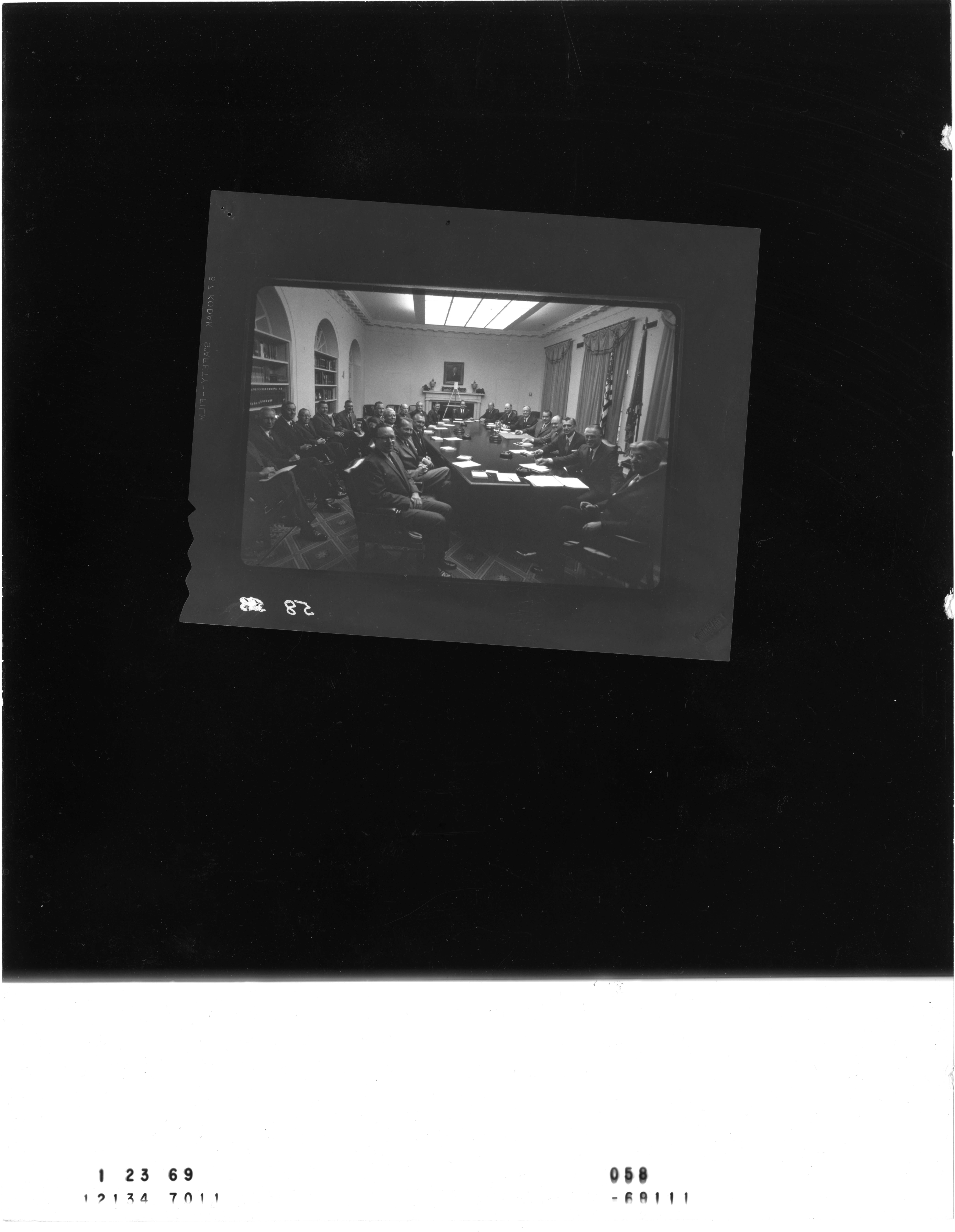
- Frame(s): WHPO-0058-01, Portrait of the Cabinet members during a meeting; members sitting at conference table and in chairs set along the wall. Interneg number 58. 1/22/1969, Washington, D.C. White House, Cabinet Room. Clockwise around table: President Nixon, Melvin Laird, Clifford Hardin, George Romney, Arthur Burns, Robert Mayo, Robert Finch, Walter Hickel, David Kennedy, Spiro Agnew, John Mitchell, Maurice Stans, John Volpe, Charles Yost, George Shultz, Winton Blount, William Rogers; Background L-R: Andrew Goodpaster, Patrick Moynihan, Paul McCracken, Herbert Klein, John Whitaker.
Roll WHPO-0084 Photographer: Overbey | Color or B&W: Color
- Frame(s): WHPO-0084-01, Frame C-84: Chief Justice Earl Warren administers the swearing-in ceremony for Secretary of Agriculture Clifford Hardin, Mrs. Hardin and President Nixon stand nearby. 1/22/1969, Washington, D.C. White House, East Room. L-R: President Nixon, Clifford M. Hardin, Mrs. Hardin, Earl Warren.
Roll WHPO-0085 Photographer: Overbey | Color or B&W: Color
- Frame(s): WHPO-0085-01, Frame C-85: Chief Justice Earl Warren administers the swearing-in ceremony for Secretary of the Treasury David M. Kennedy, Mrs. Kennedy and President Nixon stand nearby. 1/22/1969, Washington, D.C. White House, East Room. L-R: President Nixon, David M. Kennedy, Mrs. Kennedy, Earl Warren.
Roll WHPO-0086 Photographer: Overbey | Color or B&W: Color
- Frame(s): WHPO-0086-01, Frame C-86: Chief Justice Earl Warren administers the swearing-in ceremony for Secretary of HEW, Robert H. Finch, Mrs. Finch and President Nixon stand nearby. 1/22/1969, Washington, D.C. White House, East Room. L-R: President Nixon, Robert H. Finch, Mrs. Finch, Earl Warren.
Roll WHPO-0087 Photographer: Overbey | Color or B&W: Color
- Frame(s): WHPO-0087-01, Frame C-87: Chief Justice Earl Warren administers the swearing-in ceremony for Director of the Budget Robert P. Mayo, Mrs. Mayo and President Nixon stand nearby. 1/22/1969, Washington, D.C. White House, East Room. L-R: President Nixon, Director of the Budget Robert P. Mayo, Mrs. Mayo, Chief Justice Earl Warren.
Roll WHPO-0088 Photographer: Overbey | Color or B&W: Color
- Frame(s): WHPO-0088-01, Frame C-88: Chief Justice Earl Warren administers the swearing-in ceremony for Postmaster General Winton M. Blount, Mrs. Blount and President Nixon stand nearby. 1/22/1969, Washington, D.C. White House, East Room. L-R: President Nixon, Winton M. Blount, Mrs. Blount, Earl Warren.
Roll WHPO-0089 Photographer: Overbey | Color or B&W: Color
- Frame(s): WHPO-0089-01, Frame C-89: Chief Justice Earl Warren administers the swearing-in ceremony for Secretary of HUD George W. Romney, Mrs. Romney and President Nixon stand nearby. 1/22/1969, Washington, D.C. White House, East Room. L-R: President Nixon, George W. Romney, Mrs. Romney, Earl Warren.
Roll WHPO-0090 Photographer: Overbey | Color or B&W: Color
- Frame(s): WHPO-0090-01, Frame C-90: Chief Justice Earl Warren administers the swearing-in ceremony for Secretary of Defense Melvin R. Laird, Mrs. Laird and President Nixon stand nearby. 1/22/1969, Washington, D.C. White House, East Room. L-R: President Nixon, Melvin R. Laird, Mrs. Laird, Earl Warren.
Roll WHPO-0091 Photographer: Overbey | Color or B&W: Color
- Frame(s): WHPO-0091-01, Frame C-91: Chief Justice Earl Warren administers the swearing-in ceremony for the Ambassador to the United Nations Charles W. Yost, Mrs. Yost and President Nixon stand nearby. 1/22/1969, Washington, D.C. White House, East Room. L-R: President Nixon, Charles W. Yost, Mrs. Yost, Earl Warren.
Roll WHPO-0092 Photographer: Overbey | Color or B&W: Color
- Frame(s): WHPO-0092-01, Frame C-92: Chief Justice Earl Warren administers the swearing-in ceremony for Secretary of State William P. Rogers, Mrs. Adele Rogers and President Nixon stand nearby. 1/22/1969, Washington, D.C. White House, East Room. L-R: President Nixon, William P. Rogers, Mrs. Adele Rogers, Earl Warren.
Roll WHPO-0093 Photographer: Overbey | Color or B&W: Color
- Frame(s): WHPO-0093-01, Frame C-93: Chief Justice Earl Warren administers the swearing-in ceremony for Secretary of Transportation John A. Volpe, Mrs. Volpe and President Nixon stand nearby. 1/22/1969, Washington, D.C. White House, East Room. L-R: President Nixon, John A. Volpe, Mrs. Volpe, Earl Warren.
Roll WHPO-0094 Photographer: Overbey | Color or B&W: Color
- Frame(s): WHPO-0094-01, Frame C-94: Chief Justice Earl Warren administers the swearing-in ceremony for Secretary of Labor George P. Shultz, Mrs. Shultz and President Nixon stand nearby. 1/22/1969, Washington, D.C. White House, East Room. L-R: President Nixon, George P. Shultz, Mrs. Shultz, Earl Warren.
Roll WHPO-0095 Photographer: Overbey | Color or B&W: Color
- Frame(s): WHPO-0095-01, Frame C-95: Chief Justice Earl Warren administers the swearing-in ceremony for Attorney General John N. Mitchell, Mrs. Martha Mitchell and President Nixon stand nearby. 1/22/1969, Washington, D.C. White House, East Room. L-R: President Nixon, John N. Mitchell, Mrs. Martha Mitchell, Earl Warren.
Roll WHPO-0096 Photographer: Overbey | Color or B&W: Color
- Frame(s): WHPO-0096-01, Frame C-96: Chief Justice Earl Warren administers the swearing-in ceremony for Secretary of Commerce Maurice H. Stans, Mrs. Stans and President Nixon stand nearby. 1/22/1969, Washington, D.C. White House, East Room. L-R: President Nixon, Maurice H. Stans, Mrs. Stans, Earl Warren.
The White House Communications Agency Sound Recordings Collection contains public statements that took place between 1969 and 1974. Visit the finding aid to learn more.
P - Formal Presidential Remarks
- WHCA-SR-P-690110
Remarks by President Nixon at the swearing-in ceremony for the Cabinet. (1/22/1969, White House East Room)
Runtime: 0:22:04
Production credits: Audio feed supplied by ABC
Original Format: 1/4-inch reel-to-reel audiotape. Original source type: Original.
The White House Communications Agency Videotape Collection contains “off-the-air” recordings of televised programs produced between 1968 and 1974. Visit the finding aid to learn more.
- WHCA-3202
The Swearing-in of the Nixon Cabinet.
NBC
Runtime: 00:23:35
Context (External Sources)
The Vanderbilt Television News Archive is the world's most extensive and complete archive of television news. They have been recording, preserving and providing access to television news broadcasts of the national networks since August 5, 1968.
Wikipedia is a free encyclopedia that anyone can edit.