

Introduction
This almanac page for Tuesday, January 21, 1969, pulls together various records created by the federal government and links to additional resources which can provide context about the events of the day.
Previous Date: Monday, January 20, 1969
Next Date: Wednesday, January 22, 1969
Schedule and Public Documents
The Daily Diary files represent a consolidated record of the President's activities. Visit the finding aid to learn more.
The President's day began at Washington, D. C.
The Weekly Compilation of Presidential Documents made available transcripts of the President's news conferences; messages to Congress; public speeches, remarks, and statements; and other Presidential materials released by the White House.
Addresses and Remarks
- Reception for Campaign Workers (5 Weekly Comp. Pres. Doc. 154, January 21, 1969)
Remarks of the President and Mrs. Nixon, Vice President Spiro T. Agnew, and Mr. and Mrs. David Eisenhower.
Swearing-In Ceremonies
- White House Staff (5 Weekly Comp. Pres. Doc. 156, January 21, 1969)
Remarks of the President and Chief Justice Earl Warren at the Swearing In of New Staff Members. - The Cabinet (5 Weekly Comp. Pres. Doc. 157, January 21, 1969)
The President's Remarks at the Swearing In of the Cabinet.
Digest of Other White House Announcements
Following is a listing of items of general interest which were announced in the press but not made public as formal White House press releases during the period covered by this issue. Appointments requiring Senate approval are not included since they appear in the list of nominations submitted to the Senate, below.
- The President designated Robert E. Hampton as Chairman of the Civil Service Commission.
- The President met with Secretary General Galo Plaza of the Organization of American States at the White House.
Nominations Submitted to the Senate
Does not include promotions of members of the Uniformed Services, nominations to the Service Academies, or nominations of Foreign Service Officers.
- ELLIOT L. RICHARDSON, of Massachusetts, to be Under Secretary of State.
- U. ALEXIS JOHNSON, of California, a Foreign Service Officer of the Class of Career Ambassador, to be Under Secretary of State for Political Affairs.
- RICHARD F. PEDERSEN, of California, to be Counselor of the Department of State.
- DAVID PACKARD, of California, to be Deputy Secretary of Defense.
- ROBERT F. FROEHLKE, of Wisconsin, to be an Assistant Secretary of Defense.
- ROBERT C. SEAMANS, JR., of Massachusetts, to be Secretary of the Air Force.
- JOHN H. CHAFEE, of Rhode Island, to be Secretary of the Navy.
- J. PHIL CAMPBELL, of Georgia, to be Under Secretary of Agriculture.
- CLARENCE D. PALMBY, of Virginia, to be an Assistant Secretary of Agriculture.
- ROCCO C. SICILIANO, of California, to be Under Secretary of Commerce.
- JAMES D. HODGSON, of California, to be Under Secretary of Labor.
- ARNOLD R. WEBER, of Illinois, to be an Assistant Secretary of Labor.
- GEOFFREY H. MOORE, of New Jersey, to be Commissioner of Labor Statistics, United States Department of Labor, for a term of 4 years.
- ELIZABETH DUNCAN KOONTZ, of North Carolina, to be Director of the Women's Bureau, Department of Labor.
- PATRICIA REILLY HITT, of California, to be an Assistant Secretary of Health, Education, and Welfare.
- JAMES E. JOHNSON, of California, to be a Civil Service Commissioner for the remainder of a term expiring March 1, 1971, vice John Williams Macy, Jr., resigned.
- WALTER E. WASHINGTON, of the District of Columbia, to be Commissioner of the District of Columbia for a term expiring February 1, 1973 (reappointment).
- PAUL W. MCCRACKEN, of Michigan, to be a member of the Council of Economic Advisers.
- GEORGE A. LINCOLN, of Michigan, to be Director of the Office of Emergency Preparedness.
- LEE A. DuBRIDGE, of California, to be Director of the Office of Science and Technology.
Each Public Papers of the Presidents volume contains the papers and speeches of the President of the United States that were issued by the White House Office of the Press Secretary during the time period specified by the volume. The material is presented in chronological order, and the dates shown in the headings are the dates of the documents or events. In instances when the release date differs from the date of the document itself, that fact is shown in the text note.
To ensure accuracy, remarks have been checked against audio recordings (when available) and signed documents have been checked against the original, unless otherwise noted. Editors have provided text notes and cross references for purposes of identification or clarity.
The Federal Register is the official daily publication for rules, proposed rules, and notices of federal agencies and organizations, as well as executive orders and other Presidential documents.
No Federal Register published on this date
The Congressional Record is the official daily record of the debates and proceedings of the U.S. Congress.
Archival Holdings
Any selection of archival documents will necessarily be partial. You should use the documents and folders identified below as a starting place, but consult the linked collection finding aids and folder title lists and the collections themselves for context. Many documents to be found this way do not lend themselves to association with specific dates, but are essential to a complete understanding of the material.
Selective document listing
President's Office Files
The President's Office Files consists of materials drawn together by the Special Files Unit from several administrative subdivisions within the White House Office. It is the handwriting and sensitive papers sent to the Staff Secretary that now comprise much of the President's Office Files. Visit the finding aid to learn more.
- Annotated News Summaries, Box 28, News Summaries - January 1969 [During this period, the Staff Secretary only removed pages from the News Summaries which contained President Nixon's handwriting, often leaving the document with no date. Although there are no specific documents with this date, you should also consult the full folder for the month.]
Selective document listing
The White House Press Office during the Presidency of Richard Nixon was responsible for daily communication with the White House press corps. Ronald L. Ziegler was the Press Secretary to the President for Nixon's entire term in office from January 1969 to August 1974 and Gerald Warren served as the Deputy Press Secretary. The office held daily briefings for the press and produced the White House’s press releases. Visit the finding aid to learn more.
- White House Press Releases, Box 1
- FOR IMMEDIATE RELEASE JANUARY 21, 1969
OFFICE OF THE WHITE HOUSE PRESS SECRETARY
THE WHITE HOUSE
REMARKS OF THE PRESIDENT, THE VICE PRESIDENT, MRS. RICHARD M. NIXON, AND MR. AND MRS. DAVID EISENHOWER CAMPAIGN WORKERS' RECEPTION
THE EAST ROOM
11:05 A.M. EST
THE PRESIDENT: In speaking to all of you here this morning, I think you should know how this little gathering was set up.
What we had planned was to have a few friends in, particularly those who would be going back to faraway places -- to California, Florida, and the rest -- and also those who had worked in the campaign headquarters in New York and also in Washington.
Well, the party began to grow, as you can see. Everybody got together. We think it is wonderful. It is more than we expected, but we are so glad to have you here and to welcome you to your house. It is ours, too, but it is yours, and we are glad to be here.
We are also very glad to have the Vice President and his wife here. I feel that with him by my side, we are going to be able to provide some direction and leadership to the Nation that the Nation wants and that the Nation needs.
I am particularly happy to have him here because when I went over to my office -- I was over there quite early this morning, I found that the desk that I have in my office s the Vice President's desk. I took it out of the office down there.
The reason that I took that desk, incidentally and you will be reading this in the papers tomorrow --- was that for about 50 years it has been the desk in the Vice President's office. It was there when I was there for eight years. It was the desk that Woodrow Wilson had used when he was President.
I had always liked the Wilsonian background, and also liked the desk itself. The President has always been given a choice of the various desks that he can have. That is one of the prerogatives. So I took the Wilson desk, and I think he has the Jefferson desk.
We had hoped and expected, this morning, too, that we would have a chance to give you some refreshment of some sort. I think there will be something down in the other end of the room.
We had hoped, too, that we could have a chance, at least, to talk with everybody here, to have one of those nice little chats. I see so many people here that I would just love to sit down with and really find out how to settle Vietnam and a few other things, but that will come.
I think perhaps more than anything else what I wanted you to know was this: that a President has to make a determination, a very important determination, as to who will be the first guests in the White House. Naturally, your first guests have to be and should be the members of your family, so I had members of my family yesterday, about 200 or 300, and we had a nice affair here just before the Inaugural Balls.
The second group, of course, that you want in are members of your family that are not related but who are members of what we call "the official family." That is this group. By "the official family" I mean not only people who worked in campaigns, as all of you did, people who helped out, as all of you did, but people I have known going back over the years. I see so many here, some of those who entertained during the course of the campaign. I know that some of you are here.
Wasn't that a great group that went to those Inaugural Balls and put on the programs for it? I really thought they did a wonderful job.
I think perhaps the best way I can describe it is by one of my favorite stories that I got out of studying the various Inaugurals and the backgrounds which involved President Buchanan.
As you know, he did not go down in history as one of our most distinguished Presidents, probably because he was followed by Lincoln, and the comparison was difficult for anybody. But in any event, Buchanan became President at an older age -- he thought it was older -- at a later time than he had expected or wanted. Consequently, he felt at that time that the office had come to him too late. He was disappointed that it had come so late.
It is reported that as he was driving down from the Capitol to the White House, he made a comment to this effect: that all of his friends that he wanted to reward had died, and all of his enemies that he hated and wanted to punish were now his friends. I just want you to know you are all our friends here.
There is a lot of business, of course, that has to be undertaken today. We are going to have the first meeting of the National Security Council. I have already been through quite a few State papers, signed some more appointments and a few other things -- no pardons yet, though.
As far as business is concerned, I can assure you that nothing on this first day, the first day of being officially in the White House, will mean more to us than to be here with our friends. We are grateful for your friendship. We are grateful for your support.
We want you back here in this house on other occasions when it won't be quite as crowded as it is when we will have a chance to at least see that you do have some refreshment and a few other things.
I can only say that this is a great house. It has a great history. It has a magnificent presence, as we walked through it for the first time, with nobody in it at all.
But what really makes the house, what really gives the feel to this house, is the presence of people for whom you have affection and people you love. This house right now, I think, means more to us than it will ever mean in the future, because you are our friends and our people. We are thankful to you and we wish you the very best.
The Vice President has to go up to open the Senate. I used to have to do that for eight years. I don't want to make him late, but I wanted him to see this house and have an opportunity for you to see him, because he was a great campaigner in this last campaign, believe me.
You never know what a man is until you put him in the fire, and he has been through the fire, believe me. He knows how to take the heat. Since he will be presiding over the Senate, the body in this Nation's Capital where there is a rule of unlimited debate, I think we ought to give him a chance to talk as long as he wants to talk right now.
THE VICE PRESIDENT: Thank you, Mr. President.
One thing that the President didn't mention was that that unlimited debate rule does not apply to the Vice President. He is a very silent, austere member of that honorable body.
I do want to say that it seems as if no one's desk is secure any more, Mr. President. We had one thing to warn the rest of the staff about: that their desks are not secure, either.
Whatever the President wants is what I want. I envisage that as the principal role of the Vice Presidency -- to implement the policies of the Chief Executive.
Not many people have had the chance to come to the office, to work for a man like Richard Nixon, and I deeply appreciate the opportunity. He has been a towering source of strength to me through that campaign he mentioned, which had its traumatic moments.
I think the measure of a man rests in his first actions and his thoughts, and his consideration. I believe that your presence here today gives you an accurate measure of Richard Nixon -- the fact that you are here as invited guests to receive his appreciation, to which I certainly want to add mine. It is wonderful to have this chance to greet you.
As the President has indicated, I must make my way to the tender mercies of -the Senate. Thank you.
THE PRESIDENT: I know that some of you were not at the balls yesterday, and, consequently, I will share with you, if you weren't listening to the morning news report, what I thought was the best crack of the day -- and there were many, I am sure, which I didn't hear.
This one was Art Linkletter. As we walked in with Tricia, my older daughter, and David and Julie, and I made a little talk, then Art came on to respond. He said, "Well, you know, I would have liked to have had the opportunity to introduce the President because if I had introduced him, I would have done it in this way: I would have presented him as General Eisenhower's grandson's father-in-law.
Last night, you will be interested to know, we didn't have much time for dinner because we had the family reception and then we went on to the balls. We had to get into that white tie, and my neck is still hurting. Anyway, we went into the little family dining room upstairs and had something to eat.
The people who served there were the same ones who served the General, General Eisenhower, when he was President. Of course, David used to be here quite often in those days, and he is going to be here quite often these days, too.
We sat down and I wondered what they were going to serve. They brought out steak. They said from the time he was this high, whenever he came there he always wanted steak. So that is the way we are going to get Julie back. We are going to have steak all the time.
Maybe you would like to hear a word from Pat, David and Julie. How about that?
I see so many others we could have words from. I see Jim Drury out here. We could have the Virginian.
Here is Pat.
MRS. NIXON: I just want to add my thanks to those expressed already, and that we hope to see you soon. You will be invited often. This time, instead of having the "big shots", so-called, we are going to have all our friends on a rotation basis. We hope to see you here again soon.
THE PRESIDENT: Just to keep the record clear, in my book all of our friends are ''big shots".
MRS. DAVID EISENHOWER: I just think I will tell you about our first night in the White House.
David and I are carrying on a tradition. In 1953, when his grandfather spent the first night in the White House, David's father was flown over from Korea as a surprise so he could be at the Inauguration. President Truman had him flown over. He surprised the first family.
David's family spent the night in the Queen's Room, so to carry on the tradition, last night we spent the night in the Queen's Room and it was a thrill.
THE PRESIDENT: I was just going to say, isn't it nice to have an Eisenhower in the White House again?
MR . DAVID EISENHOWER: In line with what the President was saying, I remember thinking last night when John, the Chief Butler, came up to me and he said, "No, Mr. David, no steak tonight." Then he brought out the steak. I knew that happy days were here again.
THE PRESIDENT: We do want you to know, again, that you are always welcome in this house. We can never express in words our appreciation for your loyalty, friendship, support and hard work far beyond the call of duty over the years.
Now we are going to have to -- not "have to" , but we are going to want to return it manyfold. We are going to get up early and work late and do everything we can so that this house will always be a happy house, and your home will always be a happy home.
Thank you.
END (AT 11:25 A.M. EST)
- FOR IMMEDIATE RELEASE JANUARY 21, 1969
- White House Press Conferences, Box 55
- News Conference #2 at the White House with Ron Ziegler, January 21, 1969, 10:35 A.M. EST. 3 pgs.
NEWS CONFERENCE #2
AT THE WHITE HOUSE
WITH RON ZIEGLER
10:35 A.M. EST
JANUARY 21, 1969
TUESDAY
MR. ZIEGLER: What we are going to do this morning is as follows:
The President will go over to the campaign workers' reception. He will receive them in a reception line.
Following that I will be back over here and give you a little more detail on the rest of the day.
As I told you yesterday, at 1:00 o'clock today there will be a staff swearing-in ceremony, in the East Room. That will be open to full coverage.
Let me give you a few things about this morning very quickly and then we will take the photos in for a picture in the President's office at his desk.
The President got up early this morning. First of all, let me say that he turned in this morning about 2:30 a.m. He got up this morning and had his usual light breakfast of orange juice, oatmeal, and coffee.
He was the first one in the office this morning, arriving at 7:30. I was the fifth. I arrived at 8:15. The
President was looking for me at 7:30.
Q What time did he get up? Was it about 6:30?
MR. ZIEGLER: Forty-five minutes or so before he came over here.
When he arrived at the office, he went through papers. He did some dictating on the briefing papers for the National Security Council meeting today. He also had some staff meetings this morning with Dr. Kissinger prior to the National Security Council meeting.
The schedule stands as I indicated yesterday, with the National Security Council meeting and the meeting with General Wheeler. There are no other additions to the schedule for today.
I will announce this later in the day, but the Cabinet will be sworn in here tomorrow. Early this afternoon I would like to meet with representatives from the broadcasters to work out coverage for that ceremony.
Q Where will that be?
MR. ZIEGLER: In the East Room.
Q What do you mean, you will announce it later?
MR. ZIEGLER: We don't have the time, but it will be tomorrow.
Q Where is the reception for the campaign workers?
MR. ZIEGLER: In the East Room.
Q Are these campaign workers or staff workers?
MR. ZIEGLER: They are campaign workers. I said 11 staff II yesterday. They are campaign workers. There will be some 1,300 people here.
Q How long will that last, Ron?
MR. ZIEGLER : I would say about an hour and a half. That is going on right now. We have a tight morning here to put things together. If the photos will get into position to go into the President's office for a picture, we will go ahead. We will take the two wires, Mr. Fentress and Mr. Pierpoint, to observe the photo session.
Q When will we see you next?
MR. ZIEGLER: Tim will announce a pool in the press room to come in and observe the campaign workers' reception. Then I will be over here immediately after that to give you a fix on the Cabinet ceremony time for tomorrow.
Q Do you expect Mr. Hickel to be confirmed by then?
MR. ZIEGLER: Yes.
Q You will have no substantive briefing this morning?
MR. ZIEGLER: No.
Q Do you know any of the details of what the President did when he arrived here last night and when he went to the office this morning? Was somebody with him?
MR. ZIEGLER: No. He walked over alone.
Q Did someone show him around, or anything?
MR. ZIEGLER: No. He came here alone, with one agent who was on duty. He went into the Oval Office and dictated.
Q Rose Mary was here?
MR. ZIEGLER: No, she wasn't.
Q Who was here?
MR. ZIEGLER : No one.
Q How did he dictate?
MR. ZIEGLER: Into a dictaphone.
Q Did he tell you anything about going into the office for the first time?
MR. ZIEGLER: No. The President talked about the desk that he has, which you will see when you go in. It is the Woodrow Wilson desk which he had when he was Vice President. He has always been very fond of the desk.
Q Where did he have that -- in the Capitol or over here?
MR. ZIEGLER: it is my understanding that he had it at the Capitol.
Q What does it look like?
MR. ZIEGLER: You will be able to see it in a few minutes. It is a very large, dark, wood desk.
Q How did he get it, Ron? How did he acquire it when he was Vice President?
MR. ZIEGLER: I am sure he simply requested it. He had been aware of the desk. He always liked it.
Q Was it the desk Woodrow Wilson used as President?
MR. ZIEGLER: Yes.
THE PRESS: Thank you.
END (AT 10:40 A.M. EST) - News Conference #3 at the White House with Ron Ziegler, January 21, 1969, 1:45 PM EST. 7 pgs.
NEWS CONFERENCE #3
AT THE WHITE HOUSE
WITH RON ZIEGLER
1:45 P.M. EST
JANUARY 21, 1969
TUESDAY
MR. ZIEGLER: There are two additional items on the schedule today:
1:45 - The President will meet with Secretary Kennedy.
4:15 - The President will meet with Dr. Arthur Burns.
As I indicated this morning, at 3:30 the President will meet ·with General Wheeler. Dr. Kissinger will join in that meeting.
We will put a lid on until 4:00 o'clock. We will brief at that time.
There will be an opportunity for the photos on the first National Security Council meeting at 2:00 o'clock.
The wires can observe the photo session.
Q Will there be a photo opportunity on the Wheeler session?
MR . ZIEGLER" No. General Wheeler will be in the other one.
Q Will there be a pool in that?
MR. ZIEGLER: Yes, a photo pool.
Q Is Helms going to be at the NSC meeting, too?
MR . ZIEGLER: Yes.
The President this morning signed 20 nominations which have been previously announced. There is a release available on those now.
Q How many people were sworn in in the ceremony just completed?
MR. ZIEGLER: I don't have the exact number, but secretaries and other clerical staff members here at the White House were also sworn in. The President felt it would be meaningful to them to have that occur, so in addition to those who have traditionally been sworn in, the entire White House Staff was sworn in.
Q They have to take an oath anyway, don't they?
MR. ZIEGLER: Yes, but this was in a formal way.
Q Have you a round figure on what that total number would be?
MR. ZIEGLER: The figure I received just before we went over there was 81. I think it was 80 to 90.
Q Will we have a final figure?
MR. ZIEGLER: Yes, we will. As soon as we get the list completed, we will issue that to you.
Q Were there some people sworn in whose appointments had not been previously announced?
MR. ZIEGLER: That may have occurred.
Q Can we get a list of those?
MR. ZIEGLER: As soon as I compile the list, we will certainly provide it to you.
Q Do you expect that today?
MR. ZIEGLER: We expect to have it by 4:00 o'clock.
The only name to add to this list of nominations that the President signed this morning is Robert E. Hampton. His nomination does not have to go to the Senate; but the order designating him as Chairman was signed also by the President. That is not shown on this list, so you would want to make that note.
Q Chairman of what?
MR. ZIEGLER : Of the Civil Service Commission. All of these 1 of course, have been announced.
Q How serious is the President about getting an office in the EOB and using this as a ceremonial office?
MR. ZIEGLER: Very serious.
Q Can you explain that?
MR. ZIEGLER : I think he indicated this morning that he will be working at the EOB in an office over there. The full extent to which he will use it I don't think he has determined yet, but he will have an office in the EOB.
Q Does he know about the little office off of his big office?
MR. ZIEGLER: Yes, he has examined it.
Q When he gets up in the morning, where will he go to work? Will he go to the EOB?
MR. ZIEGLER: I think initially he will be coming here to the Oval Office.
Q Will he receive visitors here?
MR. ZIEGLER: Yes.
Q This will be his office, but the other will be an auxiliary?
MR. ZIEGLER: That is right. As he indicated this morning, and I think Bob can verify the feeling that I got in the conversation, he will do a lot of work here and have a lot of meetings here.
The purpose of the office in the EOB, as he indicated, is that a number of key staff members are officed over there and if he is doing work which they are involved in, he would go over there to do that work.
Q Is the entire Kissinger shop going to be over there?
MR. ZIEGLER: I don't believe so.
Q Mr. Kissinger himself, for example?
MR. ZIEGLER: Dr. Kissinger is here, downstairs.
Q Mr. Moynihan also will be here in this building?
MR. ZIEGLER : I am sorry. I don't know his office location. I haven't had a chance to get around through the entire White House.
Q Does the Vice President have an office here?
MR. ZIEGLER: Yes. It is the one previously indicated that he would have.
Q When will the President move to the EOB, and have you chosen a room yet?
MR. ZIEGLER : I will have to get that information for you.
Q He hasn't scouted out a room yet?
MR. ZIEGLER: I think they are looking at several. I will try to have that for you soon.
Q Was the Chief Justice serious about a 7:30 swearing-in for the Cabinet in the morning?
MR. ZIEGLER: Yes. There will be a swearing-in of the Cabinet tomorrow. They will be here at 7:30. The swearing-in will take place at 8:00 a.m. in the East Room.
Q Will there be coverage?
MR. ZIEGLER : Yes, full coverage, networks and so forth.
Q Will there be a breakfast?
MR. ZIEGLER: There will be a brief coffee session before the swearing- in ceremony.
Q If Mr. Hickel is not approved by the Senate, will the swearing-in still take place tomorrow morning?
MR. ZIEGLER: I haven't even thought of the possibility that he wouldn't be confirmed.
Q The Senate has put off until tomorrow consideration of the nomination. Will he be there?
MR. ZIEGLER : I will have to find out. I wasn't aware of this.
Q Is there a Cabinet meeting scheduled after that?
MR . ZIEGLER: Yes.
Q I think I missed some of the exchange. Does Mr . Nixon plan to work in the EOB and leave Mr. Agnew in the White House?
MR. ZIEGLER: The Vice President will have an office here in the White House, as has been previously indicated. The President, of course, will do a substantial amount of his work in the Oval Office at the White House. He will do some work in an office in the Executive Office Building.
Q Ron, does this mean that you have scheduled the swearing-in of the Cabinet not knowing that Hickel's confirmation had been delayed?
MR. ZIEGLER: I would say that we scheduled the swearing-in of the Cabinet without concern that Secretary Hickel would be confirmed by the Senate. We have confidence that he will be confirmed.
Q In other words, you will go ahead with eleven tomorrow morning and Hickel will be sworn in later. Is that the idea?
MR. ZIEGLER: I will have to check that for you, Jack. The Cabinet swearing-in for tomorrow morning has been scheduled at 8:00 a.m. Any information beyond that I don't have at the moment.
Q What time is the Cabinet supposed to meet?
MR. ZIEGLER: Following the swearing-in ceremony.
Q Will that be in the East Room?
MR. ZIEGLER: The swearing-in will be in the East Room.
Q Will you check as to whether or not Mr. Hickel might sit in, at least unofficially, in the Cabinet meeting?
MR. ZIEGLER: Yes.
Q Is Mr. Kennedy coming in to discuss the staffing of the Department?
MR. ZIEGLER: I am quite sure.
Q How about the Burns meeting?
MR. ZIEGLER: All of these gentlemen today, as has been occurring, are discussing procedural matters in the particular area that they are involved.
Q Ron, the only photo that you know of will be of the security meeting?
MR. ZIEGLER: That is right, at two o'clock.
Q Does Mr. Burns have an official capacity? I know he has been advisor to Mr. Nixon in the past , but has he been named to a position?
MR. ZIEGLER: No. He was announced as an advisor to the President-elect during the transition period and worked, as you know, on the task force project in New York.
Q Didn't he make a trip for him also?
Q He did.
Q He is continuing in an official capacity as an advisor, Ron?
MR. ZIEGLER: I don't have an announcement on what capacity he will fill in the Administration.
Q So call him advisor at the present time?
MR. ZIEGLER: That is correct.
Q Is that what they are meeting about today?
MR. ZIEGLER: I don't know.
Q Are you concerned about the Hickel nomination being delayed?
MR. ZIEGLER: There is not a great wave of concern about Secretary Hickel's nomination. We are confident that he will be confirmed.
Q Ron, does it seem pretty clear that Mr. Burns will have some role to play in the Administration, as well as having been in the transition period?
MR. ZIEGLER: I am sure he will, yes.
Q Ron, one other question: You say, "We scheduled the swearing-in of the Cabinet without regard to Mr. Hickel's" plight. Does that mean that the Cabinet will be sworn in tomorrow morning regardless of the Hickel situation?
MR. ZIEGLER: I don't recall using the word "plight".
Q No. That was mine.
MR. ZIEGLER: What I said was that the Cabinet swearing-in ceremony has been set for tomorrow morning, as the Chief Justice indicated in the staff swearing-in.
Q Ron, yesterday the Soviet Government held a press conference in Moscow and talked about the possibility of missile talks, stating that the time was ripe for them. Has there been any private communication from the President with the Soviet Union on this matter?
MR. ZIEGLER: Not that I am aware of. Of course, all of these matters will be looked at carefully and discussed fully with the National Security Council.
Q Has the President read the reports on the press conference, and does he have any reaction to them?
MR. ZIEGLER: He is very much aware of them. There is no reaction.
Q Has he had any communication since he was sworn in yesterday with any of the major leaders of the western world or with the Soviet Union?
MR. ZIEGLER: I am quite sure he has not.
Q It was announced in Paris that they will begin political talks on Saturday. Is there any reaction to that?
MR. ZIEGLER: No, there is not.
Q Ron, has the President or the Government made any kind of response at any level to the Soviet proposal for the opening of missile reduction talks?
MR. ZIEGLER: This Administration?
Q Yes.
MR. ZIEGLER: There has been, to my knowledge, no communication to them on that matter.
THE PRESS: Thank you.
END (AT 1:55 P.M. EST) - News Conference #4 at the White House with Ron Ziegler, January 21, 1969, 4:25 PM EST. 10 pgs.
NEWS CONFERENCE #4
AT THE WHITE HOUSE
WITH RON ZIEGLER
4:25 P.M. EST
JANUARY 21, 1969
TUESDAY
MR. ZIEGLER: The National Security Council met from 2:00 p.m. until 3:47 p.m. Those who attended the National Security Council meeting were: The Vice President, Secretary of State Rogers, Elliot Richardson, Under Secretary of State; Melvin Laird, David Kennedy, Richard Helms, General Wheeler, George Lincoln, Andrew Goodpaster, and Col. Alexander Haig of the NSC staff took notes of the meeting.
The National Security Council will meet again this coming Saturday at 10 a.m. It was decided in the meeting that the National Security Council will meet two times a week through January. The tentative plan is to meet on Thursday and Saturday. Saturday is pretty firm as a meeting date. The Thursday meeting may move to Wednesday. Initially, they will meet Thursday and Saturday through January.
Today's meeting included an intelligence briefing by the Director of the CIA, Richard Helms, on the international situation. This led to a discussion on the basic issues, including Vietnam.
The National Security Council also worked out a work program on those items to be discussed in the upcoming meetings. In anticipation of the question as to what those items are, I will not have those available to announce today.
I have an addition to the schedule:
4:45 - The President will meet with Galo Plaza, Secretary General of the OAS. The President asked
him to come in to discuss matters involving the OAS.
The Cabinet will meet in the morning for coffee prior to the 8:00 a.m. swearing-in.
Also to be sworn in tomorrow will be Ambassador Yost and Director of the Budget Mayo.
Q At the same time?
MR. ZIEGLER: That is correct.
The Cabinet will meet immediately after the swearing-in. In addition to the 12 Members of the Cabinet, Ambassador Yost and Mr. Mayo will be in the Cabinet meeting.
Q Will Mr. Hickel be there?
MR. ZIEGLER: Yes.
Q You said 12 members of the Cabinet. That includes Mr. Hickel?
MR. ZIEGLER: Yes.
Q Will the President be there?
MR. ZIEGLER: Yes.
Q Is the swearing-in open for coverage?
MR. ZIEGLER: Yes.
Q Starting at 7:30 or 8:00 o'clock?
MR. ZIEGLER: Starting at 8:00 o'clock.
Q Hickel will not be sworn in, but he will attend?
MR. ZIEGLER: Yes, he will attend, but he will not be sworn in.
Q Why is it to be so early?
MR. ZIEGLER: The President is anxious to meet
with his Cabinet early in the morning, at 8:oo a.m.
Q Ron, do you expect the Vice President to sit in on the meeting with Galo Plaza?
MR. ZIEGLER: No.
Q Ron, could you tell us a little bit more about the National Security Council meeting? Did the President preside at the meeting?
MR. ZIEGLER: Yes. He indicated before that he would preside at the National Security Council meetings, and also I think he indicated the Urban Affairs Council meeting.
Q Ron, can we properly assume that these successive meetings in January, each of them, will deal with one topic as a major topic for the meeting? Is this kind of lining up the issues?
MR. ZIEGLER: That is right. It may be beyond one topic.
Q But the central agenda item will be one topic?
MR. ZIEGLER: That is right.
Q Can you tell us whether the Soviet indications that they are ready for serious discussions on disarmament was among the subjects discussed today?
MR. ZIEGLER: I can't go into the subjects discussed beyond what I have given you.
Q Ron, can it be assumed that the meeting with General Wheeler was an overall briefing on the military situation, including Vietnam, a separate meeting?
MR. ZIEGLER: The meeting is occurring now. I have not been in on that meeting. There was no formal agenda for the meeting, so I can't indicate to you what they will discuss.
Q At the NSC meeting, were there any nonparticipating members or staff present, like Dr. Kissinger?
MR. ZIEGLER: Yes, he was at the meeting. I didn't mention his name. I am sorry.
Q Were there any others present besides him?
MR. ZIEGLER : No. These were gentlemen who remained throughout the meeting and actively participated in the National Security Council.
Q Were you or a member of your staff present?
MR. ZIEGLER: We were in and out, but not there through the whole meeting.
Q What was General Goodpaster's capacity?
MR. ZIEGLER : General Goodpaster was called back by the President during the transition period to discuss planning for National Security Affairs. He was sitting in as an observer on part of the discussion because of his previous activity and experience, of course, during the Eisenhower Administration.
Q Do you know when he is going back to Vietnam?
MR. ZIEGLER: I don't have an exact date, but he does plan to return to Vietnam as Deputy Commander.
Q We were told in Florida that the President had ordered a list of all realistic, affirmative courses of action to be prepared on Vietnam, the treaty to stop the spread of nuclear weapons, and disarmament talks with the Soviet Union. This was to be ready by Inauguration Day. The implication was that it was to be presented at the first NSC meeting.
MR. ZIEGLER: I am aware of the background on that. The material has, of course, been completed and the material has been fully discussed with the President in conversations between Dr. Kissinger and the President. That did occur, as you were told. However, I think it was made clear that the material that was to be given to the President on this date was not specific recommendations, but the full range of courses and directions that could be taken on the major problems.
A So the whole thing was delivered, the alternatives on these three subjects?
MR. ZIEGLER: The material has been completed as the President requested.
Q And read by the President?
MR. ZIEGLER: And discussed with Dr. Kissinger.
Q Are these reports now forming the basis of the NSC discussions?
MR. ZIEGLER: They are playing a part in them, of course.
Q Do I understand the papers were brought up this afternoon at the NSC meeting, or not?
MR. ZIEGLER: I cannot go into what was discussed at the NSC beyond what I have given you. What I am saying in response to the question is that this material has been prepared and assimilated by Dr. Kissinger, and there will be other material being developed to be used in discussions of the NSC and in discussions between staff members and the President.
Q What we are getting at, Ron, is you said a minute ago that this material, these reports, "played a part" in today's NSC meeting. From that, the only inference would be that they were discussed today. Is that correct?
MR. ZIEGLER: They played a part because they exist and have been discussed previously. It is material which is under discussion and has been under discussion.
Q These reports went to Dr. Kissinger, evidently.
MR. ZIEGLER: That is correct.
Q Has Secretary Rogers seen these reports?
MR. ZIEGLER: He played a part in preparing them.
Q Has he seen the reports before today's meeting?
MR. ZIEGLER : I don't know if he has looked at them all. I am sure he has, because he has been involved in all these discussions.
Q Ron, were they used as background for the NSC?
MR. ZIEGLER: Let's not pursue this too far, because I want to keep it in proper perspective. All of you weren't in Florida for this background session. What is being referred to here is the request by the President before January 20th, when he was in Florida and when he met with Secretary Rogers, Dr. Kissinger and Secretary Laird.
It was indicated after that meeting that he had requested information to be prepared which would present to him alternative courses, alternate courses, that could be taken on the major problems that face us. This is what we are talking about. It doesn't go beyond that.
Q Were there just three problems?
MR. ZIEGLER: Well, all problems. I was using those examples.
Q Ron, could you go so far as to say that the options on Vietnam were discussed today?
MR. ZIEGLER: I can't go beyond what was discussed in the meeting other than what I have said.
Q We were also told down there that one fallout to the Vietnam paper would be that the President wanted to send out very early after Inauguration coordinated instructions to the negotiators in Paris, the Embassy in Saigon and the military command, a coordinated policy. Have those instructions gone out?
MR. ZIEGLER: I will have more for you in this whole area in the next few days as thing develop here. I don't have anything for you on that right now.
Q Did the selection of people at the NSC meeting indicate a new, formal structure of membership for the NSC?
MR. ZIEGLER: These gentlemen will be involved in all of the NSC meetings. Andrew Goodpaster, of course, as we discussed earlier, plans to return to Vietnam as Deputy Commander.
Q Does this include Mr. Richardson?
MR. ZIEGLER: Yes.
Q Mr. Kennedy?
MR. ZIEGLER: Yes. It is my understanding it does include Secretary Kennedy.
Q Since the membership of the NSC is established by statute, is the President, on a non-formal basis, expanding the working membership of the National Security Council?
MR. ZIEGLER: The only way I could respond to that is that if these gentlemen are involved, it does indicate an expansion.
Q You are saying you expect them to be involved as we go down the line in the future?
MR. ZIEGLER: Yes.
Q You expect Mr. Kennedy and Mr. Richardson to attend regularly?
MR. ZIEGLER: Yes.
Q Will this take a statutory form?
MR. ZIEGLER: I don't have any other information beyond this. I have not discussed this particular matter. I will discuss it and have it for you.
Q Ron, there was a meeting this morning of some representatives of Mexican-American groups in Washington, apparently to make representations that Mr. Nixon had not appointed any Mexican-American to his Administration so far. Does the White House have any comment on their desire for representation of Mexican-Americans in the Administration?
MR. ZIEGLER: No new comment. There has been comment by the President when he was President-elect in relation to the fact that he would bring into the Administration people from all segments of our society. This, of course, would include Mexican-Americans. All appointments and selections have not been made at this point.
Q Has any decision been made on Dr. Burns' future?
MR. ZIEGLER: No.
Q Has the White House anything beyond what the State Department said on the Russian overtures for talks?
MR. ZIEGLER: No.
Q The State Department said today that the Government had received a note from President Nasser. Was that note directed to Mr. Nixon, or was that part of the outgoing Administration's business?
MR. ZIEGLER: I don't have any information on that particular announcement or report that you have referred to.
Q Do you have the figure for the number of persons who were sworn?
MR. ZIEGLER: Yes. There were 81 sworn in. We have a list which is in the release bin of those who were sworn in. It does not include those members of the staff who have not been formally announced. You will be able to fill it in.
Q Is it a list of 81?
MR. ZIEGLER: No. As you know, Pat Moynihan's staff has not been announced, and there are some other staff members who have not been announced.
Q Now that you have sworn them in, can you tell us who they are?
MR. ZIEGLER: I knew you would ask that. That is why we prepared the list this way.
Q Does the President have any plans to attend the National Baseball Writers' Association meeting tonight?
MR. ZIEGLER: No.
Q Have you any other schedule to announce for tomorrow?
MR . ZIEGLER: The only schedule for tomorrow is the Cabinet meeting after the swearing-in ceremony.
Q Why were these men not announced who were sworn in?
MR. ZIEGLER: It is not that complicated. Some of the people wanted to be announced formally. Their hometown newspapers have an interest in them. They want it that way. It will be coming along shortly.
Q Have you set up a briefing schedule yet?
MR. ZIEGLER: Yes. We will brief daily at 11:00 and 4:00. We will go on a regular schedule tomorrow.
Q Ron, with the President starting work at an early hour, is there any chance in having the morning briefing shoved up so it would be more useful to the evening papers? After all, it was the Democratic Administration who blew forward to 11:00. We used to have them at 10:00 or 10:30.
MR. ZIEGLER: Jim Hagerty told me he felt 11:00was a good time.
Q He had them at 10:30 all the time.
MR. ZIEGLER: He said that was a bad time. He said if he had it to do over, he would do it at 11:00.
Q Ron, does that include Saturday, the 11:00 briefing?
MR. ZIEGLER: As we go along here, I would hope, if there is not a great deal of activity on the weekends, that we would be able to adjust the briefing schedule. Any adjustment in the briefing schedule would be announced far enough in advance that everyone would be aware of the change. But we will start off briefing at 11:00 and 4:00.
Q Is the 8:00 a.m. Cabinet meeting going to be a stan1ard practice?
MR. ZIEGLER: We are all going to have to wait and see.
Q Senator Mansfield says he expects the President to send up a State of the Union Message of his own. Senator Dirksen says he doesn't think he will. Will he? Won't he?
MR. ZIEGLER: There are two different points of view, as you have expressed. This matter, of course, has been discussed, but there is no decision.
Q Ron, can we expect a press conference with the President in the next few days?
MR. ZIEGLER: This is a matter we are discussing right now. I didn't realize that pressure would begin to build up quite this quickly for it. And I expected the question from Don Oberdorfer.
Q President Kennedy's first press conference was January 25th, and President Eisenhower's somewhat later.
MR. ZIEGLER: I don't think this is an area of concern. We will be having regular news conferences.
Q Will they be announced?
MR. ZIEGLER: Yes, and they will be announced perhaps two days in advance, maybe even longer.
Q Will they be televised news conferences?
MR. ZIEGLER: Yes, I think most of them will be.
Q How about non-televised?
MR. ZIEGLER: We are not far enough along in our discussions to get into a debate on that.
Q How often do you think news conferences will be held?
MR. ZIEGLER: Regularly.
Q Governor Rockefeller and Senators Javits and Goodell have wired Mr. Nixon asking him to do something to put a stop to the dock strike. Has he replied? What is he going to do?
MR. ZIEGLER: I haven't discussed that matter. I am not aware of the wire. I have no information as to what course of action the President will take on that.
Q Ron, Senator Kennedy, in a Floor speech today, urged that President Nixon give immediate attention to starvation in Biafra. Have you anything on that?
MR. ZIEGLER: Again, that matter has not been discussed. However , I think his statements during the campaign would somewhat indicate his feeling toward that problem. There is no discussion on that or statement of position that I would have for you today.
Q Can you tell us anything more about the Burns meeting with the President? Is it still going on?
MR. ZIEGLER: I think the Burns meeting is still going on.
Q Will there be any more information on that this afternoon?
MR. ZIEGLER: No, there will not be. We are putting a lid on at 5:00. The President plans to remain here at the White House throughout the evening. We will have a photo session at 5:00 with Galo Plaza that will be observed by the two wires.
Q Have you found out where the Vice President's office is?
MR. ZIEGLER: I indicated that to you today. It will be in the corner office.
There was some interest this morning about some of the offices so I now have a chart. Some of you may be interested in this because someone said that these were offices with history. Henry Kissinger will be in the Rostow office, as I indicated to you.
Q We have had people leave the briefing, people who are reporters.
MR. ZIEGLER: I haven't announced this, but we have no intentions to change the rules of the briefings.
Q Ron, going back to the question about the Mexican-American groups, a spokesman, the legal counsel for the group, Tony Boniga, said that the President should have a White House conference on Mexican-Americans but without any contacts with the Mexican-American community he questions whether there will be a conference.
MR. ZIEGLER: I don't know about the contacts within the community. I don't recall the exact dates, but during the last four months, or the last five months, during the campaign, the President did meet with representatives of the Mexican-American community in California and in Texas.
Let me continue with the offices. Mr. Moynihan will be in the Cater office. Bob Haldeman will be in Jim Jones' office. The Vice President's office will be the one in the corner.
Q The one that Califano had?
MR. ZIEGLER: No.
Q The one that Sherman Adams used to have.
MR. ZIEGLER: Let me make this clear. It wasn't during the last Administration a full office. It was a secretarial office prior to this and they have expanded it.
Q Is it next door to where Califano was?
MR. ZIEGLER: It is a corner office. Califano's office now has Mr. Bryce Harlow. Mr. Chapin is in Miss
Robert's office. Rose Mary Woods is in Temple's office. John Ehrlichman is in the Larry O'Brien office, I have been told it was referred to. The previous man to have that is Bob Hardesty. The Congressional Relations offices upstairs remain about the same.
THE PRESS: Thank you.
END (AT 4:50 PM EST)
- News Conference #2 at the White House with Ron Ziegler, January 21, 1969, 10:35 A.M. EST. 3 pgs.
The H. R. Haldeman Diaries consists of seven handwritten diaries, 36 dictated diaries recorded as sound recordings, and two handwritten audio cassette tape subject logs. The diaries and logs reflect H. R. Haldeman’s candid personal record and reflections on events, issues, and people encountered during his service in the Nixon White House. As administrative assistant to the President and Chief of Staff, Haldeman attended and participated in public events and private meetings covering the entire scope of issues in which the Nixon White House engaged in during the years 1969-1973. Visit the finding aid to learn more.
- Transcript of diary entry (PDF)
Tuesday, January 21.
The first day on the job - pretty hectic - family all came to the White House, including Raines.
Staff reception. President and Mrs. Nixon down grand staircase - "Hail to the Chief" at the
landing - Marine Band in hall - into East Room for brief remarks.
Back to the office, papers to get ready. Ehrlichman and I in with President for an hour - general
discussion before swearing in of staff.
Staff swearing in - Chief Justice Warren. President brief informal remarks, mainly directed to
families of staff. Then lunch with Jo and kids in the mess. Good-bye - family back to California.
NSC meeting in the afternoon. Long meetings in my office regarding Arthur Burns problems.
At end of day President decided to see his office in EOB - so we headed over with no notice.
First took swing through West Wing. Higby led EOB tour. President agreed on the old VP's
office after looking it all over - and checking out the old Betty Furness corner office - agreed it
was best. Took tour through first floor, chatted with staff that were still there (7:00).
Back to office. Fifteen minutes with President to wrap up the day. - Handwritten diary entry (JPG)
The National Archives Catalog is the online portal to the records held at the National Archives, and information about those records. It is the main way of describing our holdings and also provides access to electronic records and digitized versions of our holdings.
The Catalog searches across multiple National Archives resources at once, including archival descriptions, digitized and electronic records, authority records, and web pages from Archives.gov and the Presidential Libraries. The Catalog also allows users to contribute to digitized historical records through tagging and transcription.
Nixon Library Holdings
All National Archives Units
National Security Documents
The President's Daily Brief is the primary vehicle for summarizing the day-to-day sensitive intelligence and analysis, as well as late-breaking reports, for the White House on current and future national security issues. Read "The President's Daily Brief: Delivering Intelligence to Nixon and Ford" to learn more.
- President's Daily Brief of 21 January 1969 (Afternoon) [consult link for visuals and extent of redactions]
The President's Daily Brief
21 January 1969
19
I. MAJOR PROBLEMS
MIDDLE EAST
The Iraqis are becoming the most militant of all the Arabs states directly concerned with the problem of Israel. [REDACTED]
Iraq, which has no common border with Israel, presumably is driven by its own serious internal difficulties to appear the most Arab of all the Arab states.
* * *
The ranking Egyptian representative in Washington--a Dr. Ghorbal who sits in the Indian Embassy-yesterday professed surprise at the sharp American reaction to the newspaper Al Ahram's recent vilification of US policy. He told Deputy Assistant Secretary Davies that such publishing practices were not something unknown in other countries--even in the US. Ghorbal claimed, however, that Egypt had acted to "end this chapter" before a new administration took over. He hoped the two countries could now look forward, not backward to past differences.
EUROPE
Officials of Kiesinger's party say the Germans will delay a decision on the Nonproliferation Treaty until Kiesinger learns what the new US administration's tactics will be. Kiesinger told a meeting of his party's parliamentarians recently that he expects intensive consultations with the US on the issue after the administration has settled in.
The Germans are also pressing the Soviets for some clarifications. The issue here is Moscow's claim that it has the right under the UN charter to intervene in West Germany to prevent a resurgence of Nazism. Before they sign the treaty, the Germans want some kind of assurance that the Soviets will renounce or at least not press this interpretation.
One knowledgeable German official told our embassy that he thinks Kiesinger realizes Bonn cannot withhold its signature if it obtains satisfaction from the US and the Soviets on these points.
* * *
At Annex today we discuss possible Soviet and East German pressures against West Berlin.
* * *
Pompidou announced publicly last week that he is in the running for the presidency when De Gaulle steps down. Moreover, he has strongly intimated [REDACTED] that he has De Gaulle's blessing. His pronouncements have stimulated new speculation that De Gaulle is thinking of retiring soon.
Pompidou has played his cards extremely well since he was ousted from the premiership last July, keeping his fences mended with the Gaullist parliamentary group, supporting De Gaulle on crucial issues such as the Israeli arms embargo, and still making it clear that he is not a slavish follower of the President. His prospects have been further improved by Couve's lackluster performance as premier.
SOVIET AFFAIRS
The Soviets are still having trouble with their largest operational space launch vehicle, the SL-12. The
booster, which has a thrust of three million pounds, [redacted] It compares roughly in thrust to the US Saturn 1B, but our rocket is more sophisticated and more reliable.
We believe that the Soviets intend to use the SL-12 as the workhorse of their space launches through the 1970s. It was apparently designed for circumlunar and deep space operations, such as Mars and Venus probes. It was first flight-tested in March 1967. Since then, it has been fired nine times, but only four without mishap.
* * *
[REDACTED]
VIETNAM
The pace of Communist military activity, which was stepped up last weekend, continues at a relatively high level. A number of small-unit actions and terrorist incidents were reported.
The enemy appears through these actions to be seeking control over a greater segment of the population. This is an important consideration as the substantive phase of the talks in Paris begins. In the past few weeks, the Communists have also increased acts of mass intimidation, such as assassinations, terrorism and threats of violence, kidnapings, and attacks on small populated centers.
The Communists made a unique effort to lay out their case to the new US administration in two secret meetings with Ambassadors Harriman and Vance on 14 and 17 January. Although their remarks were couched in familiar terms, Le Due Tho and Xuan Thuy were far more forthcoming about Communist political objectives than in any previous encounters with US negotiators.
A demand that the US accept the "reality" of the situation in South Vietnam was the nub of the Communist argument. For them, "reality" requires a solution which guarantees the Communists a share of political power in the South and which gives them a clear shot at eventual reunification of the country under Communist control. Despite Harriman's rejoinders that reality, like beauty, is in the eye of the beholder, Le Due Tho indicated that this objective remains fundamental for the Communists; he made every effort to convince his listeners that Hanoi will persist in the war until it is achieved.
Le Due Tho, in particular, made clear that Hanoi does not intend to let the US off the hook in Vietnam unless the Communists obtain some tangible political rewards. He said specifically that they would not accept a gradual withdrawal of US forces which was keyed to the consolidation of the GVN's position. Tho strongly suggested that the Communists will try to prevent such a gradual US disengagement, if necessary with military force.
[REDACTED]
II. OTHER IMPORTANT DEVELOPMENTS
JAPAN
[REDACTED]
SOVIET AND EAST GERMAN PRESSURE ON BERLIN
SIGNIFICANCE: When West Germany's Federal Assembly convenes in Berlin on 5 March, the USSR and East Germany may decide to harass the city or the access routes to it. A serious and sustained challenge which would set Soviet-American relations on a course of hostility early in the new administration seems unlikely. Lesser harassments, however, would confront the US with the perennial problem of finding an appropriate response which at the same time satisfied the Germans and won the concurrence of our French and British allies.
* * *
On 5 March 1969 the West German Bundesversammlung (Federal Assembly) will convene in West Berlin to elect a new West German president. The Soviet Union made oral statements to the US, UK and France on 23 December 1968 protesting the forthcoming Bundesversammlung session, using the familiar argument that West Berlin is a separate political entity, not part of the Federal Republic. The early protest appeared to be for the record, but did allude to "retaliatory measures."
In subsequent diplomatic contacts with Bonn and the Allies, Soviet protests have, as expected, grown somewhat stronger. Moscow has been playing on West German and Allied differences over the issue, but as yet has given no sign that it has finally decided on what course of action it may adopt. It has even been hinting that it might accept the meeting if the USSR got, in advance, some concession from Bonn on bilateral affairs. [REDACTED]
Both Moscow and Pankow can be expected to launch another propaganda campaign as March approaches, and some type of harassment of the city may occur at the time of the meeting itself. The USSR, West Germany, and other US allies will be closely watching US reaction to any such Communist threats to West Berlin as a key indicator of how foreign policy will be conducted by the new administration.
The Pros and Cons, From Moscow's Viewpoint
There are grounds for thinking that Berlin will escape serious pressures this time. The Soviets want the West to forget their invasion of Czechoslovakia and to cooperate in restoring an atmosphere of reduced tensions in Europe. This consideration presumably led them to veto any East German harassment of the city last October and November when West Berlin was the site of allegedly provocative meetings of the West German parliamentary committees and the Christian Democratic Party. Furthermore, Moscow will have to calculate whether it wants to put its relations with the new administration at risk so soon after the Inauguration.
On the other hand it is possible that by next March Moscow may be inclined to end what it has called its "great restraint" concerning West German political meetings in the city. The USSR probably continues to be under pressure from the Ulbricht regime to permit Pankow to do something more than talk about "provocations," and Moscow may believe it should not continue fending off its most loyal ally. And the Soviets may judge that certain kinds of limited harassments could produce important divisions among the three Allies and Bonn. Finally, Moscow may wish to let the new administration know that it cannot tolerate forever what it considers deliberate political aggravations in Berlin.
Soviet Options
Should Moscow decide to provoke an incident over the Bundesversammlung session, it has a variety of options to choose from. Extreme measures which would approach a repetition of the blockade of 1948 are unlikely. It also seems unlikely that the Soviets would take actions directly affecting the western Allies. Should the Soviets nevertheless decide to risk a direct encounter with the Allies, they could use the same type of limited and well-controlled measures as they did in the last Berlin crisis of April 1965, when they closed the autobahn to all traffic for various periods of time, "reserved" airspace in the corridors, and buzzed West Berlin with low-flying jets.
A less risky undertaking would be for the USSR to permit the always-ready East Germans to take some action affecting only West Germans. Pankow could employ many harassing tactics, including an outright closure of the surface access routes to West German travelers or, short of this, the introduction of new procedures to complicate and limit this traffic. East German measures which affect only West Germans have proven difficult to counteract. The West has little leverage over the East Germans, and the US, UK and France on the one hand and Bonn on the other have argued inconclusively over who should take the lead in applying sanctions against Pankow.
Allied Reactions
Both the British and the French recommended against the Bundesversarnmlung session being held in Berlin, but have accepted the German decision. Should the East Germans harass the West Germans, the UK and France might be disposed to do little except protest, although the British, at least, would be interested in aligning their position with that of the US. Both the UK and France, however, would react sternly to any interference with Allied rights.
In the event of harassment during the Bundesversammlung meeting, the West Germans are certain to look to the Western Allies for an appropriate response. The Bonn government itself--and particularly its Social Democratic (SPD) members--would probably remain most reluctant to institute countermeasures.
If the Allies and West Germany could not agree on appropriate countermeasures, this could produce a round of acrimonious exchanges between Bonn and its Western Allies. Relations between the two coalition partners in Bonn might also suffer. In this election year, the Christian Democrats would be tempted to charge that the SPD, by its advocacy of conciliatory and soft-line policies toward Pankow, had encouraged the East Germans to think they could get away with encroachments against West Berlin.
The Foreign Relations of the United States series presents the official documentary historical record of major U.S. foreign policy decisions and significant diplomatic activity. Visit the State Department website for more information.
Vol. II, Organization and Management of U.S. Foreign Policy, 1969-1972
The NSC System
15. Minutes of the First Meeting of the National Security Council , Washington, January 21, 1969, 2 p.m.
Source: Library of Congress, Manuscript Division, Kissinger Papers, Box TS 82, NSC Meetings, Jan–Mar 1969. Top Secret; Sensitive. The time of the meeting is from the President’s Daily Diary. (National Archives, Nixon Presidential Materials, White House Central Files) The Diary indicates that Haig also attended the meeting, and presumably he prepared the minutes. The Record of Actions prepared by Haig is ibid., NSC Files, Haig Chronological File, Box 955, Chron—Col. Haig–January 1969.
Vol. III, Foreign Economic Policy; International Monetary Policy, 1969-1972
International Monetary Policy, 1969-1972
109. National Security Study Memorandum 7 , Washington, January 21, 1969
Source: National Archives, RG 59, S/S Files: Lot 80 D 212, NSSM 7. Secret. NSSM 7 established what became known as the Volcker Group after its Chairman, Under Secretary of the Treasury for Monetary Affairs Paul A. Volcker. The members were Volcker, Fred Bergsten, Dewey Daane, Henrik Houthakker, and Nathaniel Samuels. The Volcker Group was the successor to the Deming Group in the Johnson administration, chaired by then Under Secretary of the Treasury for Monetary Affairs, Frederick L. Deming. From 1969 to 1974 various U.S. Government, foreign government, IMF, and academic papers were distributed, in several numbered series, to members of the Group for their consideration, often at scheduled meetings. A set of these papers is in the Washington National Records Center, Department of the Treasury, Volcker Group Masters: FRC 56 86 30. A duplicate set of Volcker Group papers, bound into folders and indexed, is ibid., Office of the Assistant Secretary for International Affairs Central Files: FRC 56 86 24, The World/l/555 Volcker Group 1969. The papers were most often distributed under cover of a memorandum from George H. Willis, Deputy to the Assistant Secretary of the Treasury for International Affairs. Willis attended Volcker Group meetings and many international meetings on international monetary issues, such as G-10 and C-20 Deputies meetings. Spiral notebooks with his handwritten notes from some of these meetings are ibid., Deputy to the Assistant Secretary for International Affairs: FRC 56 83 26, Willis Notes.
Vol. VI, Vietnam, January 1969-July 1970
Vietnam, January 1969-July 1970
3. Memorandum of Conversation Between Secretary of State Rogers and the Former Head of the Delegation to the Paris Peace Talks on Vietnam (Harriman) , Washington, January 21, 1969
Source: Library of Congress, Manuscript Division, Harriman Papers, Box 562, Special Files of Public Service, Kennedy–Johnson Administration, Trips and Missions, 1968–1969, Paris Peace Talks, Memoranda of Conversation. No classification marking. Drafted by Harriman.
4. National Security Study Memorandum 1 , Washington, January 21, 1969
Source: National Archives, Nixon Presidential Materials, NSC Files, Box 365, Subject Files, NSSMs 1–42. Secret.
Vol. XIX, Part 2, Japan, 1969-1972
January-November 1969: The Decision for Okinawa Reversion
2. National Security Study Memorandum 5 , Washington, January 21, 1969
Source: National Archives, Nixon Presidential Materials, NSC Files, Box 365, Subject Files, National Security Study Memoranda, Nos. 1–42.
Vol. XXIII, Arab-Israeli Dispute, 1969-1972
The Rogers Plan
3. National Security Study Memorandum 2, Washington, January 21, 1969
Source: National Archives, Nixon Presidential Materials, NSC Files, NSC Institutional Files (H-Files), Box H–126, National Security Study Memoranda, Secret.
Vol. XXIV, Middle East Region and Arabian Peninsula, 1969-1972; Jordan, September 1970
Middle East Region
1. National Security Study Memorandum 2 , Washington, January 21, 1969
Source: National Archives, Nixon Presidential Materials, NSC Files, NSC Institutional Files (H-Files), Box H–126, National Security Study Memoranda, NSSM 2. Secret.
Vol. XXIX, Eastern Europe, 1969-1972
Czechoslovakia
77. Memorandum From Helmut Sonnenfeldt of the National Security Council Staff to the Presidentʼs Assistant for National Security Affairs (Kissinger) , Washington, January 21, 1969
Source: National Archives, Nixon Presidential Materials, NSC Files, Box 672, Country Files—Europe, Czechoslovakia, Vol. I Jan 69–31 Jan 70. Secret.
Vol. XXXIV, National Security Policy, 1969-1972
Parity, Safeguard, and the SS-9 Controversy
2. National Security Study Memorandum 3 , Washington, January 21, 1969
Source: National Archives, Nixon Presidential Materials, NSC Files, Box 365, Subject Files, NSSMs, Nos. 1–42. Secret.
3. National Security Study Memorandum 8 , Washington, January 21, 1969
Source: National Archives, Nixon Presidential Materials, NSC Files, Box 365, Subject Files, NSSMs, Nos. 1–42. Top Secret.
Vol. XLI, Western Europe; NATO, 1969-1972
Western Europe Region and NATO
1. Intelligence Memorandum Prepared in the Central Intelligence Agency , Washington, January 21, 1969
Source: National Archives, Nixon Presidential Materials, NSC Files, Box 254, Agency Files, NATO. Secret; [handling restriction not declassified]. Prepared in the Office of Current Intelligence and coordinated with the Office of Strategic Research, the Office of National Estimates, and the Office of Economic Research. Distributed to Bergsten, Sonnenfeldt, and Haig.
Vol. XLI, Western Europe; NATO, 1969-1972
Western Europe Region and NATO
2. National Security Study Memorandum 6 , Washington, January 21, 1969
Source: National Archives, Nixon Presidential Materials, NSC Files, Box 365, Subject Files, National Security Study Memoranda (NSSM’s)—Nos. 1 thru. Secret.
Vol. E-1, Documents on Global Issues, 1969-1972
U.S. Policy Towards Terrorism, Hijacking of Aircraft, and Attacks on Civil Aviation: Israeli Attack on Beirut Airport and Hijacking of TWA Flight 840, January-December 1969
4. Telegram 9888 From the Department of State to the Embassies in Lebanon and Israel, Washington, January 21, 1969, 2342Z
The Department informed the Embassies that the ICAO Council voted to consider the Lebanese complaint on the Beirut airport raid but to exclude the Israeli counter-complaint on the Athens El Al hijacking. Australia, Canada, the United Kingdom, and the U.S. began to draft a resolution on prevention of violence against international civil aviation.
Source: National Archives, RG 59, Central Files 1967-69, POL 27 ARAB-ISR. Limited Official Use. Repeated to USUN. Drafted by Carolan; cleared in NEA/ARN and in substance in NEA/IAI and E/OA/AL; and approved by Brown.
The Kissinger telephone conversation transcripts consist of approximately 20,000 pages of transcripts of Kissinger’s telephone conversations during his tenure as Assistant to the President for National Security Affairs (1969-1974) and Secretary of State (1973-1974) during the administration of President Richard Nixon. Visit the finding aid for more information.
Chronological File, Box 1, Folder January 21-31, 1969 [1 of 2]
- 11:50, David Kennedy
[David Kennedy]
1/21/69 11 50
Joan - Larry
The gist of Secy Kennedy's conversation with Mr. Kissinger was: Secy Kennedy thought he should be at the NSC meeting today, and that if Mr. Kissinger wasn't going to ask the Pres, Kennedy would. HAK said he would try to get the President (who was at a reception) and be back to Secy Kennedy in a half-hour.
Secy Kennedy said President Nixon had told him that an agenda would be sent to the Secy for every meeting, and he would decide whether or not he wanted to attend.
Mr. Kissinger's understanding was that, if there were issues like international monetary policy, Secy Kennedy would attend.
Also:
HAK mentioned that a Prof. Cooper (from yale) and Mr. Bergston would be here, and perhaps Secy Kennedy would like to talk to them.
The Secy agreed and then said perhaps they could talk to a Paul Volker(?) Under Secy for Monetary Affairs. - 12:05 PM, Secy Rogers; Mr. Kissinger
TELCON
Secy Rogers
Mr. Kissinger
1- 21-69 12:05 PM
K said President was pleased with way this thing had worked out and said anytime K and R agreed they should just go ahead unless matter was of overriding importance . K told R about his conversation with Richardson.
K said the President would like to see Galo Plaza today or tomorrow but he does want to visit the OAS later. K asked R to arrange meeting. K said he would call R's office within the next 10 minutes to tell R what half hour would be suitable on the President's schedule. K asked R if he would like to accompany and R said yes. R said he had talk,ed to Rockefeller about a trip to Latin America and he thought it was very good idea and he suggested we should have the President ask Galo Plaza what he thinks and have it come from that source.
K also asked R to have his people send a note over as to what else should be brought up at meeting.
R asked K to take a look at his article in latest issue of IFE (I am trying to get copy)
jm - 1:40 PM, Ambassador Lucet of France; Mr. Kissinger
TELCON
Ambassador Lucet of France
Mr. Kissinger
1-21-69 1:40 PM
K said he was calling about the request from de Gaulle - received through our Embassy in Paris - to publish the President's letter. K said the difficulty is that the President-elect wrote the letter as a personal token of his respect for President de Gaulle - he did not write similar letters to other chiefs of state nor were there other letters with handwritten comments. K said we would appreciate it if the exchange of letters were not published as there would be hurt feelings on the part of other chiefs of state. K said if President de Gaulle ~ wished to say he had sent a private message to President Nixon
without giving the text that would be appropriate. Lucet said he understood and K asked him whether he thought this would be understood in Paris. Lucet said yes. K asked him to transmit this word to Paris today if possible and Lucet said he would.
Lucet said he hoped to see K as soon as he was settled in and K said perhaps next week.
jm - 7:20 PM, Mr. Kissinger; Governor Rockefeller
Phone conversation, Mr. Kissinger and Governor Rockefeller, 1/21/69 7:20 p
HAK said the President had asked him to make the call, and that he (Pres) had been trying to reach the Governor during the day, and would call the Gov. tomorrow (Jan. 22). Subject: what to do with respect to Latin America -- what could be done to show some special concern for LA. Then Galo Plaza came in, and there was discussion, and that what Latin Americans need is an American who is willing to listen, whom they respect, and who is willing to work cooperatively rather than telling them what to do. When the President asked which American best met that description, Galo Plaza said "Governor Rockefeller."
That is what the President will ask the Governor tomorrow; to go to Latin America as his Special Representative on a series of trips. He would be free to do it on one trip, if he wanted to do 22 countries. HAK said if the Gov. agreed to do it, he could do so a few countries at a time.
Rockefeller said he had a serious problem with the legislature -- budget matters.
HAK said perhaps he could do it over a period of months -- 4 or 5 days at a time. Then HAK repeated that, in conversation the President had with Galo Plaza today, he said: If you had to pick someone of all the Americans that could be sent, who would it be, and Galo Plaza said, there is only one man: Gov. Rockefeller.
Gov. R said he appreciated this. He raised 3 points: (1) timing; (2) the intelligence group, and (3) relation of this area to other areas of the world in the long term (he pointed out the last two go together).
HAK said if the Gov. could at least get started on the mission in February then subsequent trips could be phased into his own schedule.
Gov. R. said the President had spoken to him in Palm Springs about the Foreign Intelligence Board. HAK said although he hadn't had a chance to discuss this, he didn't think these two things were mutually exclusive. Gov. R. said he thought to be part of the Foreign Intelligence Advisory Board would be helpful. HAK pointed out that Clark Clifford was a Presidential adviser and was also on the Board. Re FIAB, HAK said he hasn't taken up matter with the President -- a new Executive Order has to be issued -- and he is planning to discuss it with President tomorrow morning.
Gov. R. said he would check things out, that is the timing, the intelligence group, the relation of this area to other areas of the world in the long term. HAK said, in terms of the governor's long-term impact on society his relation to other foreign policy problems will really develop out of this, and he would not raise it as an issue now.
Gov R: I'm just saying this to you because I want you to know the background. I would not like, after the years you and I worked together, to get solely related to that area of the world.
HAK: But it would seem to me, speaking as a friend, it would be tremendously helpful to get you connected with some foreign policy problems.
Gov R: I am looking ahead -- you and I understand these things.
HAK: I ought to be able to get a lead for you on the other thing {FIAB?).
Gov. R: The other thing would be an indication of what this thing is...
HAK: I would not have agreed to call you unless I thought that he was really sincerely interested in you as a person on this, rather than as a symbol. Otherwise, I would have let Bill Rogers do the calling.
Gov. R. : Henry, this is very good, and I will check it out.
HAK: May I make a suggestion? I would feel, in terms of your long-term impact on society, that your relationship to other foreign policy problems will really develop out of this, and I would not raise it as an issue now.
Gov. R: I'm just saying this to you because I want you to know the background of my thinking. I have no problem. I'm just raising points. Another point: I have made some suggestions and am very interested in working very hard on this Federal/State/local....and I have now an understanding with John Mitchell where he is going to come back to me. I don't want to drop this other field, which is terribly important. But I would like to be able to tell you my thinking, so when we talk you have the background...
HAK: But as Governor you cannot possibly give up that other field.
Gov. R. That's just it,.
HAK: I don't think there exists even the remotest thought of that here. If it does, it was not discussed with me.
Gov. R. I view it now from the outside and in a total relationship, so I have to put the pieces together.
HAK: My impression was that there was a really sincere effort to get a handle on the Latin American situation -- that they don't feel it can be done through established procedures.
Gov. R: (he asked if HAK read From Years...?...)
HAK: Yes, I read it. I think it's a very interesting approach.
Gov. R. : But he didn't do anything on that.
HAK: No, he decided not to do any such statement during the preinauguration period.
Gov. R.: I think that raises some interesting aspects -- I think what one would have to do is to take various areas of relationship -- and I'm going to see Galo next week --- now that you have talked to him.
HAK: Galo couldn't have been more enthusiastic.
Gov. R: He is a good friend of mine and yours and a great guy.
HAK: And you and I had lunch with him together a few weeks ago.
Gov. R: It's very interesting.
HAK: I wanted to tell you what the President would be raising with you tomorrow and he knows I'm calling you, and of course I need hardly add it would be a great joy for me to have an opportunity to work with you even indirectly.
Gov. R: But the way you put it now makes it much more possible...
HAK: I didn't see how you could do a 22-country trip, and Galo Plaza, incidentally, agreed that when he took over the head of OAS he did it (tour of LA) in four trips, spread out over a period 3 months. The President would be very content and so would the Secretary of State if you approached it on that basis.
Gov. R: Have you got someone for Assistant Secretary?
HAK: No.
Gov. R: I think it will be very interesting to talk to him tomorrow. Tell him I talked to you today, if that 1s OK with you. I'd just like to mention the problem, etc.
Gov. R: I will not mention any of the things I mentioned to you, except the responsibility in Albany. I feel I can say things to you, and I think probably I will say I've got this problem of Federal/State....and that that's a matter..
HAK: It was wonderful to see you yesterday.
Gov. R: Well, you're great, and God Bless you. I'll call you afterwards.
###
Audiovisual Holdings
The White House Photo Office collection consists of photographic coverage of President Richard Nixon meeting with prominent social, political, and cultural personalities; speaking engagements and news conferences of the President and various high-ranking members of the White House staff and Cabinet; Presidential domestic and foreign travel, including Presidential vacations; social events and entertainment involving the First Family, including entertainers present; official portraits of the President, First Family, and high-ranking members of the Nixon administration; the 1969 and 1973 Inaugurals; the President’s 1972 Presidential election campaign appearances (including speeches) and other official activities of the White House staff and the President’s Cabinet from January 20, 1969 until August 9, 1974 at the White House and the Old Executive Office Building; other locations in Washington, DC, such as The Mall; and the Presidential retreats in Camp David, Maryland, Key Biscayne, Florida, and San Clemente, California. Visit the finding aid to learn more.
Roll WHPO-0035 Photographer: Atkins, Oliver | Color or B&W: B&W
- Frame(s): WHPO-0035-01-34, A White House election celebration buffet, for President Nixon's campaign staff. 1/21/1969, Washington, D.C. White House, East Room. Unidentified campaign staff members and guests.
Roll WHPO-0036 Photographer: Atkins, Oliver | Color or B&W: B&W
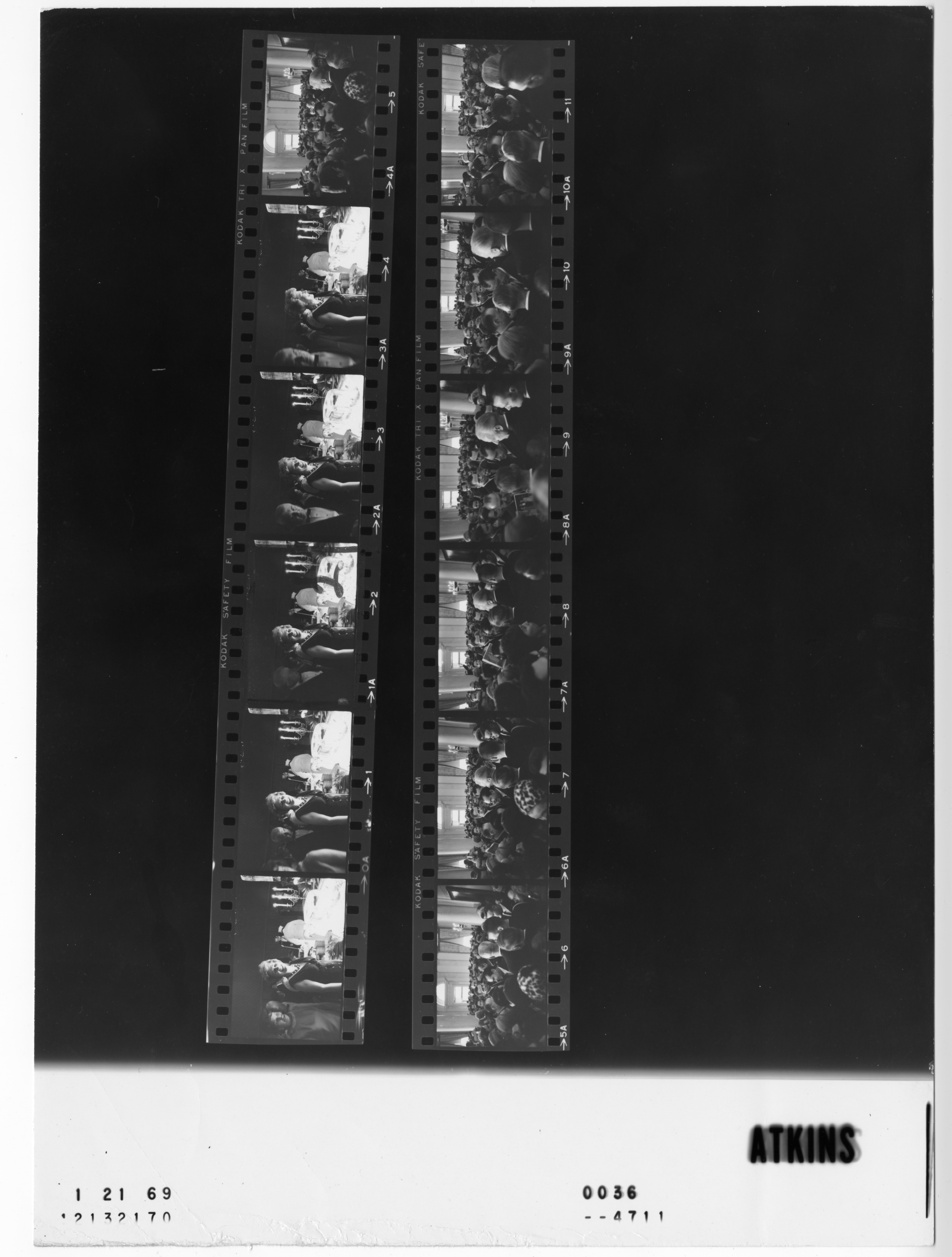
- Frame(s): WHPO-0036-00-04, An unidentified woman and man admire the ice sculpture at the White House election celebration buffet for his campaign staff. 1/21/1969, Washington, D.C. White House, East Room. President Nixon, Unidentified campaign staff members and guests.
- Frame(s): WHPO-0036-05-11, President Nixon is surrounded by well wishers, during a White House election celebration buffet, for his campaign staff. 1/21/1969, Washington, D.C. White House, East Room. President Nixon, Unidentified campaign staff members and guests.
Roll WHPO-0037 Photographer: Knudsen, Robert L. | Color or B&W: B&W
- Frame(s): WHPO-0037-02A-04A, President Nixon is surrounded by well wishers, during a White House election celebration buffet, for his campaign staff. 1/21/1969, Washington, D.C. White House, East Room. President Nixon, Unidentified campaign staff members and guests.
- Frame(s): WHPO-0037-05A-09A, Pat Nixon and President Nixon wave to campaign staff during a White House election celebration buffet. 1/21/1969, Washington, D.C. White House, East Room. President Nixon, Pat Nixon, Unidentified campaign staff members and guests.
- Frame(s): WHPO-0037-10A, Pat Nixon ascending a staircase. 1/21/1969, Washington, D.C. White House, East Room. Pat Nixon.
Roll WHPO-0038 Photographer: Knudsen, Robert L. | Color or B&W: B&W
- Frame(s): WHPO-0038-01, Unidentified man sitting in an office flipping through pages of a three ring binder notebook, simliar to the the White House Photo Office notebooks for contact sheets. 1/21/1969, Washington, D.C. White House, possibly Photo Office. Unidentified man.
- Frame(s): WHPO-0038-02-27, President Nixon and Pat Nixon attending the campaign staff White House election celebration buffet. 1/21/1969, Washington, D.C. White House, East Room. President Nixon, Pat Nixon, Spiro Agnew, Judy Agnew, Julie Nixon Eisenhower, David Eisenhower, guests.
Roll WHPO-0039 Photographer: Knudsen, Robert L. | Color or B&W: B&W
- Frame(s): WHPO-0039-03-6, President Nixon, Pat Nixon and David Eisenhower descend the East Room stairway to attend the campaign staff White House election celebration buffet. 1/21/1969, Washington, D.C. White House, East Room. President Nixon, Pat Nixon, Spiro Agnew, Judy Agnew, Julie Nixon Eisenhower, David Eisenhower, guests.
- Frame(s): WHPO-0039-07-09, President Nixon and Pat Nixon and Vice President Agnew wit to mingle with guests while attending the campaign staff White House election celebration buffet. 1/21/1969, Washington, D.C. White House, East Room. President Nixon, Pat Nixon, Spiro Agnew, unidentifed guests.
- Frame(s): WHPO-0039-10-27, President Nixon and Pat Nixon mingling with guests while attending the campaign staff White House election celebration buffet. 1/21/1969, Washington, D.C. White House, East Room. President Nixon, Pat Nixon, unidentifed guests.
- Frame(s): WHPO-0039-28-37, Pat Nixon sitting with small children while attending the campaign staff White House election celebration buffet. 1/21/1969, Washington, D.C. White House, East Room. Pat Nixon, unidentified small children.
Roll WHPO-0040 Photographer: Kightlinger, Jack | Color or B&W: B&W
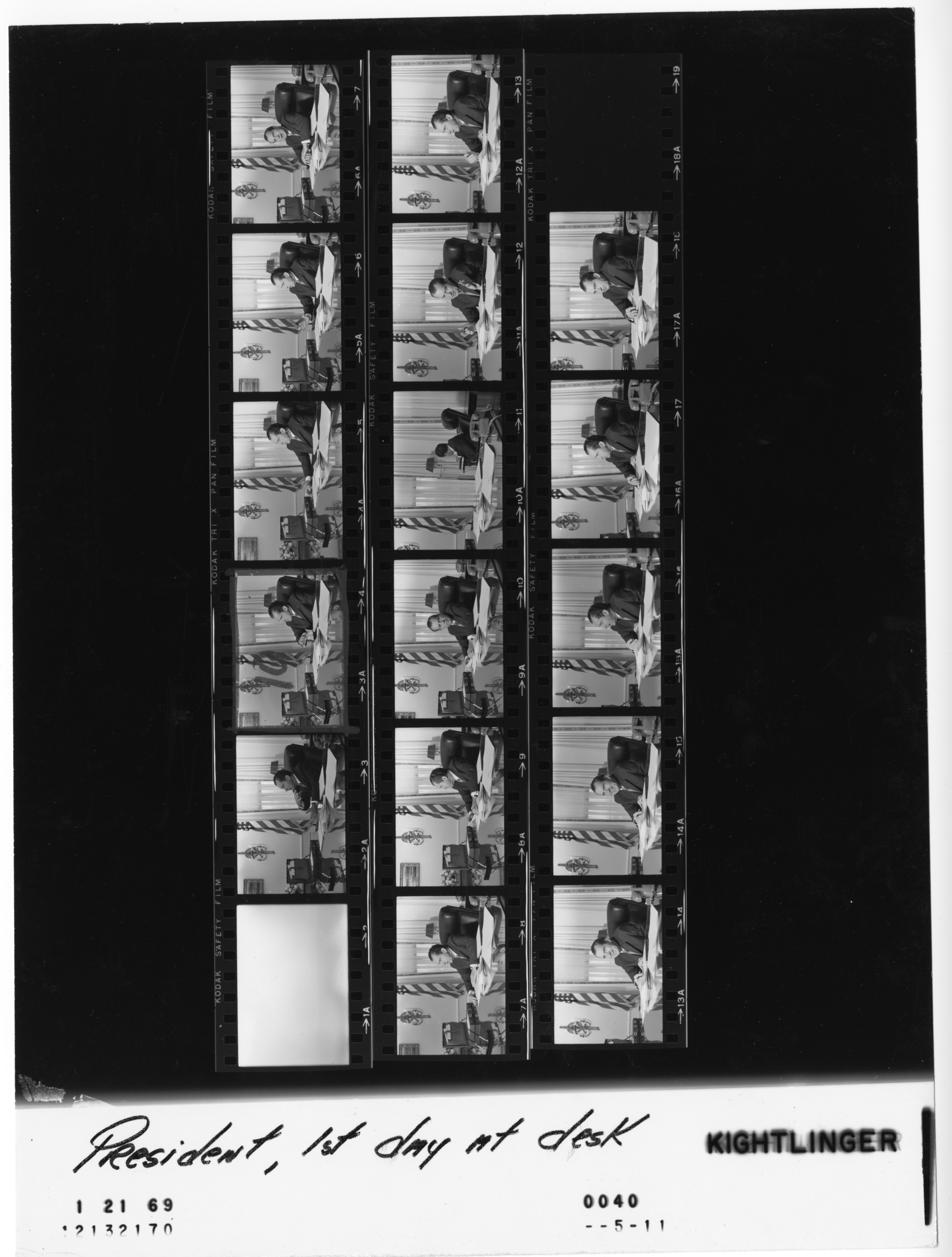
- Frame(s): WHPO-0040-02A-17A, President Nixon at his desk on his first day in office. 1/21/1969, Washington, D.C. White House, Oval Office. President Nixon.
Roll WHPO-0041 Photographer: Kightlinger, Jack | Color or B&W: B&W
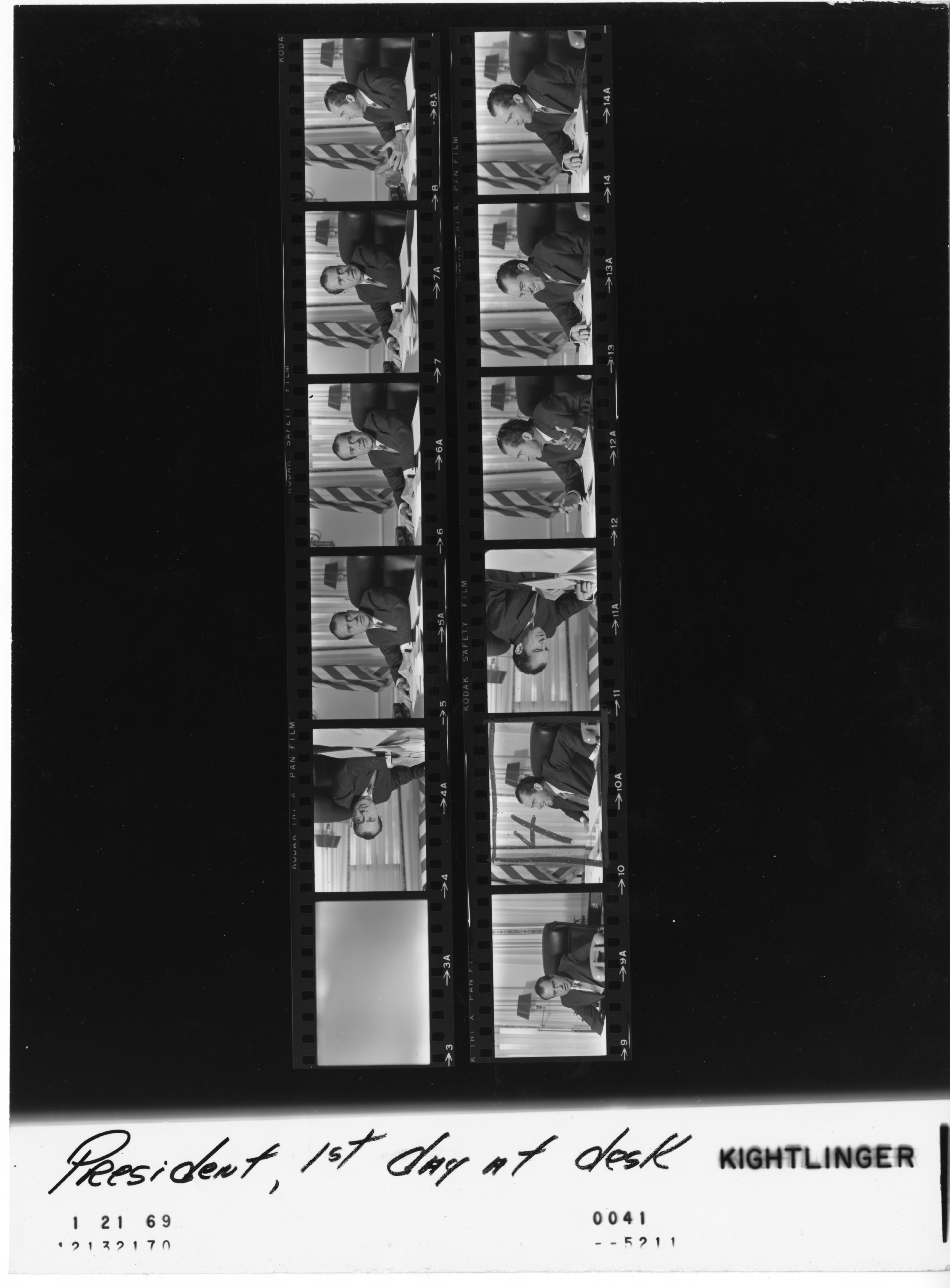
- Frame(s): WHPO-0041-04-14, President Nixon at his desk on his first day in office. 1/21/1969, Washington, D.C. White House, Oval Office. President Nixon.
Roll WHPO-0042 Photographer: Atkins, Oliver | Color or B&W: B&W
- Frame(s): WHPO-0042-00A-06A, East Room reception after the swearing-in of White House Staff members. 1/21/1969, Washington, D.C. White House, East Room. Unidentified staff.
- Frame(s): WHPO-0042-07A, Members of the National Security Council (NSC) arriving for the first meeting. 1/21/1969, Washington, D.C. White House, Cabinet Room. L-R: Earle G. Wheeler, Richard Helms, Henry Kissinger, William Rogers, Spiro Agnew, Melvin Laird, David Kennedy.
- Frame(s): WHPO-0042-07A-35A, President Nixon leads the first meeting of the National Security Council, NSC. 1/21/1969, Washington, D.C. White House, Cabinet Room. Clockwise from the President: President Nixon, Melvin Laird, Gen. Earle Wheeler, Henry Kissinger, Andrew J. Goodpaster, David Kennedy, Spiro Agnew, George A. Lincoln, Richard Helms, Elliott Richardson, William Rogers.
- Frame(s): WHPO-0042-20A, National Security Council (NSC) meeting with President Nixon and other attendees. 1/21/1969, Washington, D.C. White House, Cabinet Room. Clockwise from the President: President Nixon, Melvin Laird, Gen. Earle Wheeler, Henry Kissinger, Andrew J. Goodpaster, David Kennedy, Spiro Agnew, George A. Lincoln, Richard Helms, Elliott Richardson, William Rogers.
Roll WHPO-0043 Photographer: Knudsen, Robert L. | Color or B&W: B&W
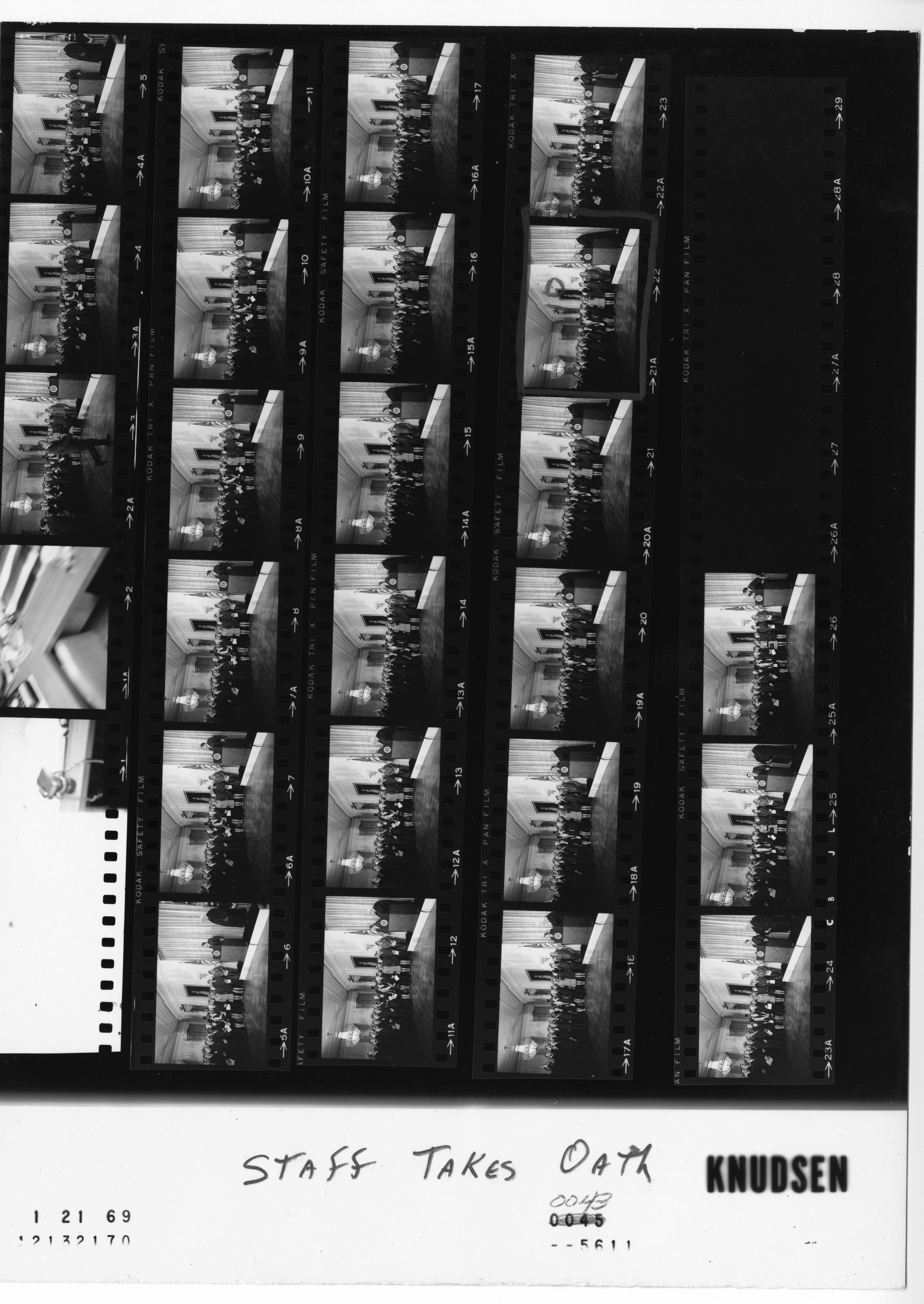
- Frame(s): WHPO-0043-02A-25A, White House staff swearing-in ceremony by Chief Justice Earl Warren. 1/21/1969, Washington, D.C. White House, East Room. President Nixon, Earl Warren, H.R. Haldeman, John Erhlichman, many unidentified White House Staff officials.
- Frame(s): WHPO-0043-15, White House staff swearing-in ceremony by Chief Justice Earl Warren. 1/21/1969, Washington, D.C. White House, East Room. President Nixon, Earl Warren, H.R. Haldeman, John Erhlichman, many unidentified White House Staff officials.
Roll WHPO-0044 Photographer: Knudsen, Robert L. | Color or B&W: B&W
- Frame(s): WHPO-0044-02-13, President Nixon speaking at the podium, standing near Chief Justice Earl Warren, after the White House staff swearing-in ceremony. 1/21/1969, Washington, D.C. White House, East Room. President Nixon, Earl Warren, H.R. Haldeman. , V. Knauer, Anne Armstrong, and others.
- Frame(s): WHPO-0044-14-15, President Nixon shaking hands with Chief Justice Earl Warren, after the White House staff swearing-in ceremony. 1/21/1969, Washington, D.C. White House, East Room. President Nixon, Earl Warren.
Roll WHPO-0059 Photographer: Halstead (UPI) | Color or B&W: B&W
- Frame(s): WHPO-0059-04-10, Ron Zielger conducts a Press Briefing, speaking with reporters writing notes. Faye Gillis Wells in front row center. UPI photo. 1/21/1969, Washington, D.C. Executive Office Building. Ron Ziegler, unidentified members of the White House press corps. Faye Gillis Wells.
The White House Communications Agency Sound Recordings Collection contains public statements that took place between 1969 and 1974. Visit the finding aid to learn more.
P - Formal Presidential Remarks
- WHCA-SR-P-690106
Remarks by President Nixon at Inaugural Ball at Mayflower Hotel. (1/21/1969, Mayflower Hotel, Washington, D.C.)
Runtime: 0:31:50
Production credits: Audio feed supplied by WHCA
Original Format: 1/4-inch reel-to-reel audiotape. Original source type: Original. - WHCA-SR-P-690107
Remarks by President Nixon at an Inaugural Ball at Statler Hilton. (1/21/1969)
Runtime: 0:33:01
Production credits: Audio feed supplied by "Hotel"
Original Format: 1/4-inch reel-to-reel audiotape. Original source type: Original. - WHCA-SR-P-690108
Remarks by President Nixon at reception for friends and campaign workers. (1/21/1969, White House East Room)
Runtime: 0:19:25
Production credits: Audio feed supplied by WHCA
Original Format: 1/4-inch reel-to-reel audiotape. Original source type: Original. - WHCA-SR-P-690109
Remarks by President Nixon at the swearing-in ceremony for the White House staff. (1/21/1969, White House East Room)
Runtime: 0:13:52
Production credits: Audio feed supplied by WHCA; Recorded by CBS
Original Format: 1/4-inch reel-to-reel audiotape. Original source type: Original.
Context (External Sources)
The Vanderbilt Television News Archive is the world's most extensive and complete archive of television news. They have been recording, preserving and providing access to television news broadcasts of the national networks since August 5, 1968.
Wikipedia is a free encyclopedia that anyone can edit.