
Introduction
This almanac page for Thursday, January 13, 1972, pulls together various records created by the federal government and links to additional resources which can provide context about the events of the day.
Previous Date: Wednesday, January 12, 1972
Next Date: Friday, January 14, 1972
Schedule and Public Documents
The Daily Diary files represent a consolidated record of the President's activities. Visit the finding aid to learn more.
The President's day began at The White House - Washington, D. C.
The Weekly Compilation of Presidential Documents made available transcripts of the President's news conferences; messages to Congress; public speeches, remarks, and statements; and other Presidential materials released by the White House.
Digitized versions can be found at HathiTrust.
Each Public Papers of the Presidents volume contains the papers and speeches of the President of the United States that were issued by the White House Office of the Press Secretary during the time period specified by the volume. The material is presented in chronological order, and the dates shown in the headings are the dates of the documents or events. In instances when the release date differs from the date of the document itself, that fact is shown in the text note.
To ensure accuracy, remarks have been checked against audio recordings (when available) and signed documents have been checked against the original, unless otherwise noted. Editors have provided text notes and cross references for purposes of identification or clarity.
The Federal Register is the official daily publication for rules, proposed rules, and notices of federal agencies and organizations, as well as executive orders and other Presidential documents.
Archival Holdings
Any selection of archival documents will necessarily be partial. You should use the documents and folders identified below as a starting place, but consult the linked collection finding aids and folder title lists and the collections themselves for context. Many documents to be found this way do not lend themselves to association with specific dates, but are essential to a complete understanding of the material.
Selective document listing
President's Office Files
The President's Office Files consists of materials drawn together by the Special Files Unit from several administrative subdivisions within the White House Office. It is the handwriting and sensitive papers sent to the Staff Secretary that now comprise much of the President's Office Files. Visit the finding aid to learn more.
- News Summaries, Annotated News Summaries, Box 33, [Jan. 13-18, 1972] [1 of 2] [Note: Due to the way News Summary products were compiled, you should also consult nearby days for potentially relevant materials.]
- News of Interest, January 13
- News Summary, January 13, 1972, (Wednesday telecasts, wires, columns)
The H. R. Haldeman Diaries consists of seven handwritten diaries, 36 dictated diaries recorded as sound recordings, and two handwritten audio cassette tape subject logs. The diaries and logs reflect H. R. Haldeman’s candid personal record and reflections on events, issues, and people encountered during his service in the Nixon White House. As administrative assistant to the President and Chief of Staff, Haldeman attended and participated in public events and private meetings covering the entire scope of issues in which the Nixon White House engaged in during the years 1969-1973. Visit the finding aid to learn more.
- Transcript of diary entry (PDF)
Thursday, January 13.
President had a super loaded schedule this morning, while he was down from Camp David just for the day to get some things cleaned up. By 2:30, when he finally finished it, he called me in and was pretty upset. Really blasted me on the point that we must never lie to ourselves regarding the schedule. For example, the McElroy meeting on schools was set up-- school financing was set up for a half-hour. There was no way to do it in a half-hour, because both McElroy and Bob Merriam each had a 15 minute monologue, plus you had the Vice President and Elliot Richardson and so on in there. So that resulted in Bob Anderson getting in an hour late, so the President had to give him more time because he-- than he was scheduled for, because he had delayed him for so long. So then I guess the highlight of disaster in it was that during the McElroy meeting, Steve Bull came in to try to break it up while the Vice President was talking. The Vice President stopped, looked at Steve, said, "Yes, is there something you want", and the President had to kick Steve out.
Got into a couple personnel questions today. Shakespeare replacement: the President said to go ahead on Loomis. On Peterson: President said he would take Eberle for that job if that seemed to be the right thing, although his inclination was still to go with Flanigan, which apparently everyone else agrees on. We had a report at the staff meeting this morning from MacGregor that he had been told by Walter Mote, who had presumably been told by Muskie's administrative assistant, that in the next three or four days, Muskie's going to make a major charge against the President regarding the Anderson papers. And he'll announce that he's going to identify the culprit who leaked the papers, that it's a member of the President's Cabinet, and that it's the Secretary of Defense, or it might be the Secretary of State. He'll make the charge that we prosecute Ellberg-- Ellsberg for his leak, which was of old, outdated stuff while we protect the guy who leaks the Anderson papers, which are current, secret, and hot.
Finch came in this morning to tell me that he was seriously considering going for the Al Smith seat in Congress, since Smith announced yesterday he's not going to run again. If the five at-large seats don't materialize next Tuesday, then Bob will announce for the Al Smith seat. Haig raised the point with me that our latest on the Kissinger problem is that Reston and The New York Times are now charging that the President's whole policy is based on an attempt to save the China trip, and that the President was acting in anger, both of which are not true. He says also that Joe Alsop has done a piece that's real dynamite, based on information he's gotten from State and Helms and his own judgment. Very heavily anti-State and anti-Rogers, and this will open another round of battles on that. As a result, Henry's planning to do a press briefing on Friday, feeling that he's got to clear the whole thing up.
I had a meeting with the VP today to work out campaign relationships. He says he trusts only me at the White House and wants to deal directly with me on any orders he gets from the President. He also has an idea to come up with new legislation for our Top Secret classification that will be declared only by the President, and not subject to question as to substance, so that we'll have a way to convict people who leak stuff.
On the Kissinger problem, Haig-- I gave the Haig report to President, and he said that Henry must not have a press briefing. That if we have to settle for something, get him to do the Frankel backgrounder, just as a one-on-one, to get the Pakistan story out, and let it go at that. Haig agreed that was the right thing to do. Later in the day, the President made the point that he's really been thinking about the Kissinger thing, and that maybe we've got to bite the bullet now and get him out. The problem is, if we don't, he'll be in the driver's seat during the campaign, and we've got to remember that he did leak things to us in '68, and that we've got to assume he's capable of doing the same thing to our opponents in '72. Then he called me at home tonight from Camp David and said that he had talked with Haig and told him to take a very hard line with Henry when he gets back. That it's better for him to blow now than after Russia, and if we don't face up to it now he may go off cockeyed during the campaign, as he did in '68.
His other problem at the time of the phone call was that he's still sitting around waiting for a draft from Price. This has been a speech writing disaster in getting the State of the Union put together. Ray just can't get himself buttoned up to get the thing done. President is at Camp David tonight, and presumably will stay there through the weekend. He's got Price up there, or Price is going up by car this evening. And Rose and Marge are up there, as well as Pat, Tricia, and Ed.
End of January 13. - Original audio recording (MP3)
The National Archives Catalog is the online portal to the records held at the National Archives, and information about those records. It is the main way of describing our holdings and also provides access to electronic records and digitized versions of our holdings.
The Catalog searches across multiple National Archives resources at once, including archival descriptions, digitized and electronic records, authority records, and web pages from Archives.gov and the Presidential Libraries. The Catalog also allows users to contribute to digitized historical records through tagging and transcription.
Nixon Library Holdings
All National Archives Units
National Security Documents
The President's Daily Brief is the primary vehicle for summarizing the day-to-day sensitive intelligence and analysis, as well as late-breaking reports, for the White House on current and future national security issues. Read "The President's Daily Brief: Delivering Intelligence to Nixon and Ford" to learn more.
The Foreign Relations of the United States series presents the official documentary historical record of major U.S. foreign policy decisions and significant diplomatic activity. Visit the State Department website for more information.
Vol. IV, Foreign Assistance, International Development, Trade Policies, 1969-1972
East-West Trade, 1969-1972
354. Memorandum From the Chairman of the National Security Council Under Secretaries Committee (Irwin) to President Nixon, Washington, January 13, 1972
Source: National Archives, RG 59, S/S Files: Lot 83 D 276, NSC-U/DM 60D. Secret. A January 13 transmittal memorandum from Hartman to the Deputy Secretary of Defense; the President’s Assistant for National Security Affairs; the President’s Assistant for International Economic Affairs; the Director of Central Intelligence; the Chairman of the Joint Chiefs of Staff; the Under Secretaries of the Treasury, Commerce, Labor, Transportation, and Agriculture; the Deputy Attorney General; the Director of the U.S. Information Agency; and the Special Trade Representative, is ibid. Regarding the preparation and clearance of Irwin’s memorandum, see Document 353.
Vol. VII, Vietnam, July 1970-January 1972
Military and Diplomatic Stalemate, October 11, 1971-January 26, 1972
289. Memorandum for the President’s File by the President’s Deputy Assistant for National Security Affairs (Haig), Washington, January 13, 1972
Source: National Archives, Nixon Presidential Materials, NSC Files, Box 998, Haig Chronological Files, Memcons, Jan–Dec 1972 (3 of 3). Top Secret; Sensitive. There is an extensive tape of this conversation with Laird in which he and the President discussed what Laird should say to the press and in which they talked more generally about Vietnam than Haig’s summary account indicates. (Ibid., White House Tapes, January 13, 10:35–11:05 a.m., Conversation 647–7)
Vol. XVII, China, 1969-1972
China, October 1971-February 1972
185. Memorandum From the Chairman of the Under Secretaries Committee (Irwin) to President Nixon, Washington, January 13, 1972
Source: National Archives, RG 59, General Files on NSC Matters: Lot 73 D 288, NSC–U/SM Memoranda, 1972. Secret.
Vol. E-7, Documents on South Asia, 1969-1972
U.S. Relations with India and Pakistan, 1972
203. Backchannel Message from the Ambassador to Pakistan (Farland) to the President’s Assistant for National Security Affairs (Kissinger), Islamabad, January 13, 1972, 0949Z
Farland assessed the situation in Pakistan and concluded that Pakistani President Bhutto faced serious difficulties in virtually every area of national activity.
Source: National Archives, Nixon Presidential Materials, NSC Files, Box 138, Kissinger Office Files, Country Files, Middle East, Farland, Amb. (Pakistan). Secret. Kissinger’s and Nixon’s initials were written on the message in what appears to be Haig’s handwriting, suggesting it was forwarded to both of them. Farland was responding to a request from Nixon, sent to him backchannel on January 2, for an assessment of the situation in Pakistan. (Backchannel message WH 20010 from Kissinger to Farland; ibid., Box 426, Backchannel Files, Backchannel Messages 1972, Amb. Farland, Pakistan)
Vol. E-7, Documents on South Asia, 1969-1972
Bangladesh, December 1971-December 1972
386. Letter From the Minister of the British Embassy (Tebbit) to the President’s Assistant for National Security Affairs (Kissinger), Washington, January 13, 1972
The British Embassy forwarded a message from Prime Minister Heath to President Nixon. In the message, Heath discussed a meeting he had just had in London with Prime Minister Mujibur Rahman. Mujibur told Heath that there could be no question of a formal link between Bangladesh and West Pakistan. Under the circumstances, Heath felt it was important for Western powers to move fairly quickly toward recognition, and he asked Nixon to try to persuade Pakistani President Bhutto of the inevitability of recognizing Bangladesh.
Source: National Archives, Nixon Presidential Materials, NSC Files, NSC Institutional Files (H-Files), Box H-062, SRG Meeting, South Asia, 1/19/72. Secret. On January 14 the Foreign Office told the Embassy in London that British recognition of Bangladesh would come within 2 weeks. (Telegram 412 from London, January 14; ibid., RG 59, Central Files 1970–73, POL 16 BANGLA DESH)
Vol. E-7, Documents on South Asia, 1969-1972
Bangladesh, December 1971-December 1972
387. Letter From the Australian Ambassador (Plimsoll) to the President’s Assistant for National Security Affairs (Kissinger), Washington, January 13, 1972
Plimsoll forwarded a message from Australian Prime Minister McMahon to President Nixon. McMahon pointed up his concern about Soviet influence in South Asia and argued the importance of repairing relations with India and providing economic assistance to the new nation of Bangladesh.
Source: National Archives, Nixon Presidential Materials, NSC Files, NSC Institutional Files (H-Files), Box H-062, SRG Meeting, South Asia, 1/19/72. Top Secret
Vol. E-10, Documents on American Republics, 1969-1972
Brazil
146. National Intelligence Estimate 93–72, Washington, January 13, 1972., Washington, January 13, 1972
The intelligence community estimated that over the next several years Brazil would probably chart a more independent and nationalistic course in its foreign policy, and U.S.-Brazilian relations would probably deteriorate.
Source: National Archives, Nixon Presidential Materials, NSC Files, Box 361, Subject Files, National Intelligence Estimates, Part 3. Secret; Controlled Dissem. According to the covering sheet, the CIA and the intelligence organizations of the Departments of State and Defense and the NSA participated in the preparation of the estimate. All members of the intelligence board concurred in the estimate except the FBI and the Atomic Energy Commission, on the grounds that the subject was outside their jurisdiction.
The Kissinger telephone conversation transcripts consist of approximately 20,000 pages of transcripts of Kissinger’s telephone conversations during his tenure as Assistant to the President for National Security Affairs (1969-1974) and Secretary of State (1973-1974) during the administration of President Richard Nixon. Visit the finding aid for more information.
Digitized versions can be found in the National Archives Catalog.
Audiovisual Holdings
Visit the White House Tapes finding aid to learn about the taping system's operation and archival processing.
Old Executive Office Building
- 314-1; 2:34 p.m. - 3:41 p.m.; Nixon, Richard M. (President); Haldeman, H. R. ("Bob"); Bull, Stephen B.; White House operator; Hughes, James D. ("Don"); Ziegler, Ronald L.; Butterfield, Alexander P.
- 314-2; Unknown between 3:41 p.m. & 3:50 p.m.; Nixon, Richard M. (President); Ehrlichman, John D.
- 314-3; Unknown between 3:41 p.m. & 3:50 p.m.; Nixon, Richard M. (President); Butterfield, Alexander P.
- 314-4; Unknown between 3:41 p.m. & 3:50 p.m.; Nixon, Richard M. (President); Ehrlichman, John D.
- 314-5; Unknown between 3:41 p.m. & 3:50 p.m.; Nixon, Richard M. (President); White House operator
- 314-6; 3:50 p.m. - 3:52 p.m.; Nixon, Richard M. (President); Eisenhower, Julie Nixon
- 314-7; Unknown between 3:52 p.m. & 3:55 p.m.; Nixon, Richard M. (President); Haig, Alexander M., Jr.
- 314-8; Unknown between 3:52 p.m. & 3:55 p.m.; Nixon, Richard M. (President); Sanchez, Manolo
- 314-9; 3:55 p.m. - 4:15 p.m.; Nixon, Richard M. (President); Haig, Alexander M., Jr.; Brennan, John V.
- 314-10; Unknown between 3:45 p.m. & 4:12 p.m.; Nixon, Richard M. (President); [Unknown person(s)]
- 314-11; Unknown between 3:45 p.m. & 4:12 p.m.; Nixon, Richard M. (President); Haldeman, H. R. ("Bob")
- 314-12; 4:12 p.m. - 4:12 p.m.; Nixon, Richard M. (President); White House operator
- 314-13; 4:15 p.m. - 5:00 p.m.; Nixon, Richard M. (President); Safire, William L.; [Unknown person(s)]
- 314-14; 5:23 p.m. - 5:23 p.m.; Nixon, Richard M. (President); White House operator
- 314-15; Unknown between 5:23 p.m. & 5:25 p.m.; Nixon, Richard M. (President); [Unknown person(s)]
- 314-16; Unknown between 5:25 p.m. & 5:26 p.m.; Nixon, Richard M. (President); Kissinger, Henry A.
- 314-17; 5:26 p.m. - 6:16 p.m.; Nixon, Richard M. (President); Price, Raymond K., Jr.
Oval Office
- 647-1; Unknown between 10:10 a.m. & 10:12 a.m.; Nixon, Richard M. (President); Haldeman, H. R. ("Bob")
- 647-2; 10:12 a.m. - 10:19 a.m.; Nixon, Richard M. (President); Woods, Rose Mary; Bull, Stephen B.
- 647-3; Unknown between 10:19 a.m. & 10:34 a.m.; Nixon, Richard M. (President); Bull, Stephen B.
- 647-4; Unknown between 10:19 a.m. & 10:34 a.m.; Nixon, Richard M. (President); Sanchez, Manolo
- 647-5; Unknown between 10:19 a.m. & 10:34 a.m.; Nixon, Richard M. (President); [Unknown person(s)]
- 647-6; 10:34 a.m. - 10:35 a.m.; Nixon, Richard M. (President); Ziegler, Ronald L.
- 647-7; 10:35 a.m. - 11:05 a.m.; Nixon, Richard M. (President); Laird, Melvin R.; Haig, Alexander M., Jr.; Ziegler, Ronald L.
- 647-8; Unknown between 11:05 a.m. & 11:07 a.m.; United States Secret Service agents; Sanchez, Manolo; [Unknown person(s)]
- 647-9; 11:11 a.m. - 11:41 a.m.; Nixon, Richard M. (President); Haldeman, H. R. ("Bob"); Ziegler, Ronald L.; Bull, Stephen B.
- 647-10; Unknown between 11:41 a.m. & 12:38 p.m.; Nixon, Richard M. (President); Agnew, Spiro T. (Vice President); McElroy, Neil H.; Marland, Sidney P., Jr. (Dr.); Richardson, Elliot L.; Ehrlichman, John D.; Engman, Lewis A.; Morey, Roy D.; Merriam, Robert E.; [Unknown person(s)]
- 647-11; Unknown between 12:36 p.m. & 12:38 p.m.; Nixon, Richard M. (President); Bull, Stephen B.
- 647-12; Unknown between 12:37 p.m. & 1:02 p.m.; Nixon, Richard M. (President); Sheehan, James E. (Lt. Cmdr.); Sheehan, John; Sheehan, Kathleen; Sheehan, Kelly; Sheehan, Kevin; Sheehan, Eugene T.; Sheehan, Edward J.; Smith, Geneva; Griffin, C. D. (Adm.); Nunn, Louie B.; Cooper, John Sherman; Sparkman, John J.; Burns, Arthur F.; Robertson, J. L.; Mitchell, George W.; Daane, J. Dewey; Maisel, Sherman J.; Brimmer, Andrew F.; Holland, Robert; Shultz, George P.; Stein, Herbert; Flanigan, Peter M.; Malek, Frederic V.; Atkins, Oliver F. ("Ollie"); James, E. Pendleton
- 647-13; Unknown between 1:02 p.m. & 1:03 p.m.; Nixon, Richard M. (President); Bull, Stephen B.
- 647-14; 1:03 p.m. - 1:19 p.m.; Nixon, Richard M. (President); Cevey, Arthene; Pontier, Andrey; Wunderlich, Karl; Yu, Peter; Slattery, Michael; McNight, Billy; Buck, Richard; Bazo, Stephen; Toomey, James; Burke, Russell; Clark, Brian; Beauregard, Phillip; Wyrough, Pete; Ross, Brooks; Jones, Robert; Bunce, Brian; Sharood, John; McMahon, Peter; Van Der Menbrugge, Francois; Cook, Christopher; White House photographer; Ziegler, Ronald L.; Bull, Stephen B.
- 647-15; 1:19 p.m. - 1:23 p.m.; Nixon, Richard M. (President); Bull, Stephen B.; Fauver, Edwin M.; Fauver, Edwin M. (Mrs.); Zook, Ray M.; Ziegler, Ronald L.; White House photographer
- 647-16; 1:23 p.m. - 1:24 p.m.; Nixon, Richard M. (President); Bull, Stephen B.
- 647-17; 1:24 p.m. - 2:14 p.m.; Nixon, Richard M. (President); Anderson, Robert O.; Jonsson, J. Erik; Cole, Kenneth R., Jr.; Garment, Leonard; Butterfield, Alexander P.
- 647-18; Unknown between 2:14 p.m. & 2:16 p.m.; Nixon, Richard M. (President); Bull, Stephen B.; Sanchez, Manolo
- 647-19; 2:16 p.m. - 2:21 p.m.; Huntsman, Jon M.; Huntsman, Jon M. (Mrs.); Huntsman, Jon M., Jr.; Huntsman, Peter; Huntsman, Kathleen; Huntsman, Kristina; Huntsman, James; Huntsman, Paul; Huntsman, David; Butterfield, Alexander P.; White House photographer
- 647-20; 2:22 p.m. - 2:22 p.m.; Nixon, Richard M. (President); Bull, Stephen B.
- 647-21; Unknown between 2:22 p.m. & 2:34 p.m.; Nixon, Richard M. (President); Butterfield, Alexander P.; Bull, Stephen B.; Ziegler, Ronald L.; United States Secret Service agents
- 647-22; Unknown between 2:22 p.m. & 2:34 p.m.; Nixon, Richard M. (President); Haldeman, H. R. ("Bob"); Bull, Stephen B.
White House Telephone
- 18-77; Unknown between 2:34 p.m. & 2:45 p.m.; Haldeman, H. R. ("Bob"); White House operator; Nixon, Richard M. (President)
- 18-78; 2:45 p.m. - 2:45 p.m.; Haldeman, H. R. ("Bob"); Hughes, James D. ("Don")
- 18-79; 2:45 p.m. - 2:45 p.m.; Nixon, Richard M. (President); White House operator
- 18-80; 2:45 p.m. - 2:47 p.m.; Nixon, Richard M. (President); Ziegler, Ronald L.
- 18-81; Unknown between 2:47 p.m. & 3:09 p.m.; Haldeman, H. R. ("Bob"); Hughes, James D. ("Don")
- 18-82; Unknown between 2:47 p.m. & 3:09 p.m.; Haldeman, H. R. ("Bob"); White House operator; Hughes, James D. ("Don")
- 18-83; Unknown between 2:47 p.m. & 3:09 p.m.; Haldeman, H. R. ("Bob"); White House operator; Nixon, Richard M. (President); Bull, Stephen B.
- 18-84; Unknown between 3:09 p.m. & 3:50 p.m.; Nixon, Richard M. (President); White House operator
- 18-85; 3:50 p.m. - 3:52 p.m.; Nixon, Richard M. (President); White House operator
The White House Photo Office collection consists of photographic coverage of President Richard Nixon meeting with prominent social, political, and cultural personalities; speaking engagements and news conferences of the President and various high-ranking members of the White House staff and Cabinet; Presidential domestic and foreign travel, including Presidential vacations; social events and entertainment involving the First Family, including entertainers present; official portraits of the President, First Family, and high-ranking members of the Nixon administration; the 1969 and 1973 Inaugurals; the President’s 1972 Presidential election campaign appearances (including speeches) and other official activities of the White House staff and the President’s Cabinet from January 20, 1969 until August 9, 1974 at the White House and the Old Executive Office Building; other locations in Washington, DC, such as The Mall; and the Presidential retreats in Camp David, Maryland, Key Biscayne, Florida, and San Clemente, California. Visit the finding aid to learn more.
Roll WHPO-8270 Photographer: Atkins, Oliver | Color or B&W: Color
- Frame(s): WHPO-8270-, Ed and Tricia Cox with Soviet performers at the Kennedy Center. 1/13/1972, Washington, D.C. Kennedy Center. Ed and Tricia Cos and Soviet performers.
Roll WHPO-8272 Photographer: Schumacher, Karl | Color or B&W: B&W
- Frame(s): WHPO-8272-, Vice President Agnew and Jon Huntsman. 1/13/1972, Washington, D.C. White House. Spiro Agnew, Jon Huntsman.
Roll WHPO-8273 Photographer: Schumaker, Byron | Color or B&W: B&W
- Frame(s): WHPO-8273-, Secretary Laird makes troop strength statement. 1/13/1972, Washington, D.C. White House. Melvin Laird.
- Frame(s): WHPO-8273-[none], Secretary Laird makes troop strength statement. 1/13/1972, Washington, D.C. White House. Melvin Laird.
Roll WHPO-8274 Photographer: Schumaker, Byron | Color or B&W: B&W
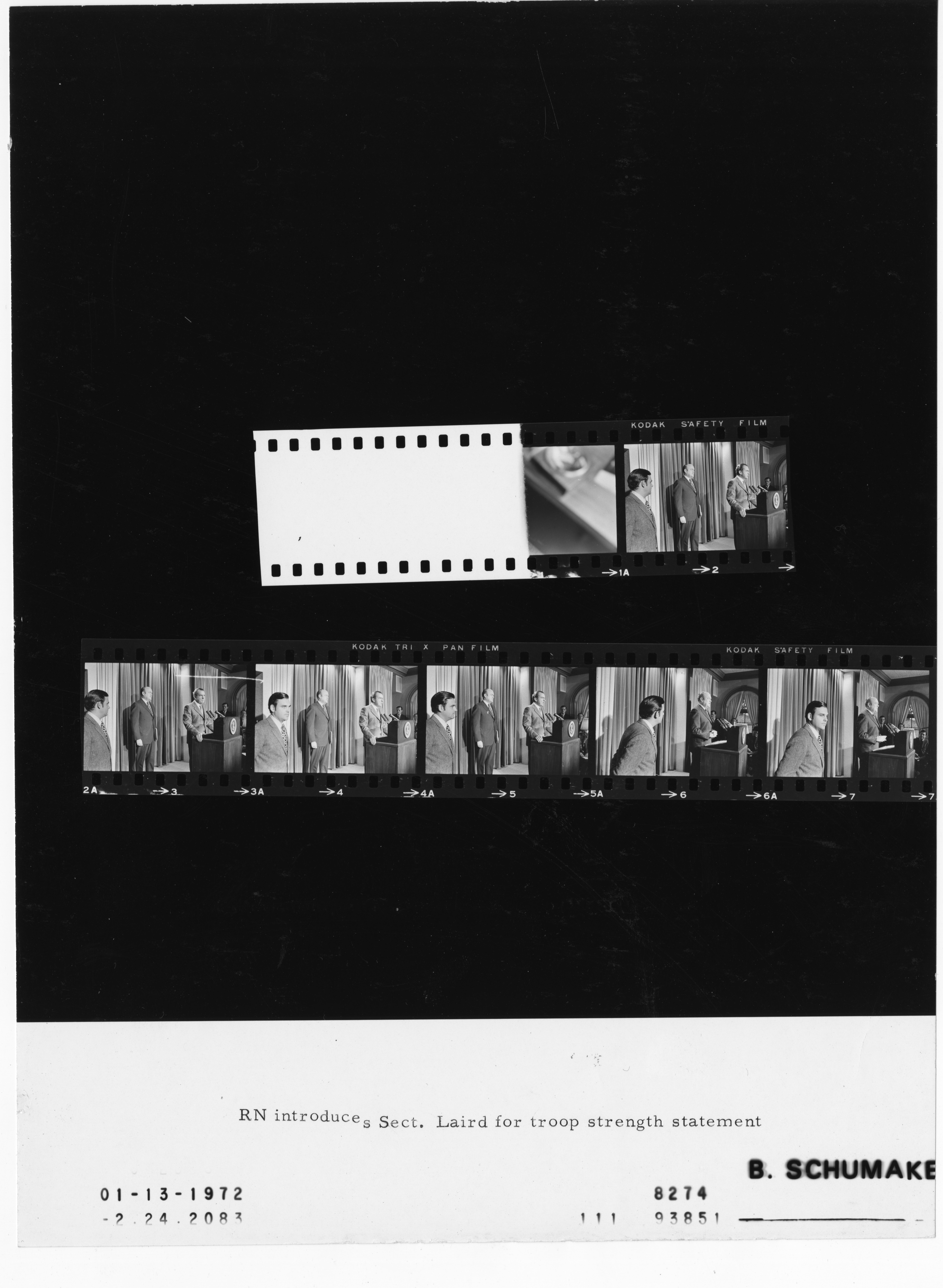
- Frame(s): WHPO-8274-, President announcing the withdrawal of 70,000 troops from Vietnam to members of the press. 1/13/1972, Washington, D.C. White House. Ron Ziegler, Melvin Laird, President Nixon.
Roll WHPO-8275 Photographer: Atkins, Oliver | Color or B&W: B&W
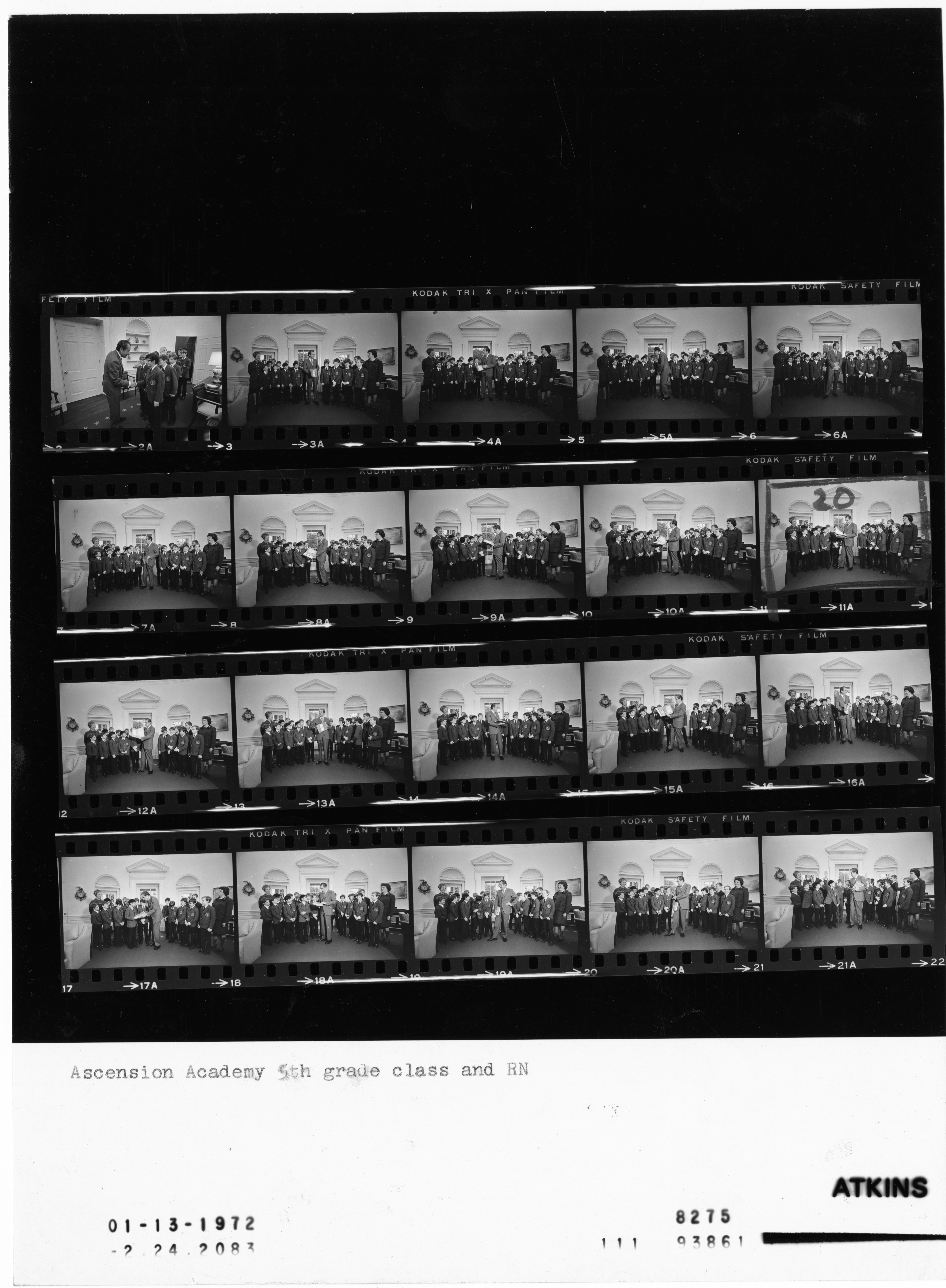
- Frame(s): WHPO-8275-, Greeting members of the fifth grade class of Ascension Academy in Alexandria, Va. 1/13/1972, Washington, D.C. White House. President Nixon and students from the fifth grade class of Ascension Academy in Alexandria.
Roll WHPO-8276 Photographer: Atkins, Oliver | Color or B&W: B&W
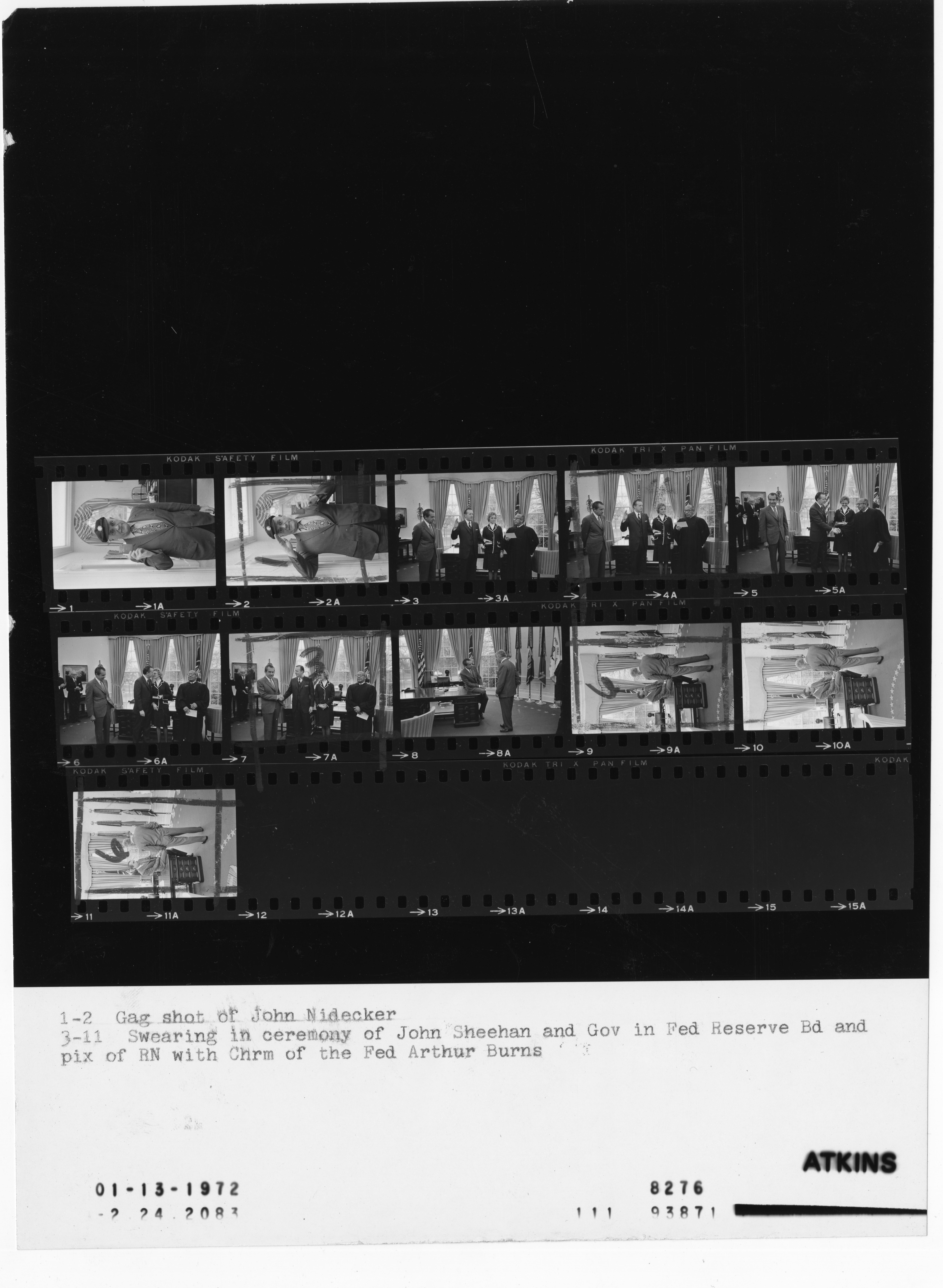
- Frame(s): WHPO-8276-, Gag shot of John Nidecker. 1/13/1972, Washington, D.C. White House. John Nidecker.
- Frame(s): WHPO-8276-, Swearing-in ceremony of John Sheehan as member of the board of Governors of the Federal Reserve System (FRS). 1/13/1972, Washington, D.C. White House. President Nixon, John Sheehan, Mrs. John Sheehan and Judge Hubert B. Pair of the DC Court of Appeals.
- Frame(s): WHPO-8276-, Swearing- ceremony of John Sheehan as member of the Board of Governors of the Federal Reserve. 1/13/1972, Washington, D.C. White House. President Nixon, John Sheehan, Mrs. Sheehan, Judge Hubert Pair of the DC Court of Appeals.
- Frame(s): WHPO-8276-, President Nixon during a meeting with Arthur Burns, Chairman of the Board of Governors of the Federal Reserve System. 1/13/1972, Washington, D.C. White House, Oval Office. President Nixon, Arthur Burns.
Roll WHPO-8277 Photographer: Atkins, Oliver | Color or B&W: B&W
- Frame(s): WHPO-8277-, President Nixon meeting with Robert O. Anderson (Chairman of Senior Executive Council, National Industrial Board) Industrial Conference Board, J. Erik Jonsson. 1/13/1972, Washington, D.C. Oval Office of White House. President Nixon, Spiro Agnew, John Ehrlichman, Robert O. Anderson, J. Erik Jonsson.
- Frame(s): WHPO-8277-07A, Swearing-in ceremony of John Sheehan as member of the Federal Reserve System Board Of Governors. 1/13/1972, Washington, D.C. Oval Office in White House. Kathleen Sheehan, Nixon, John E. Sheehan, Mrs. John E. Sheehan, Judge Hubert B. Pair, Kevin Sheehan, Kelly Sheehan, J.L. Robertson, Arthur F. Burns, Sen. John J. Sparkman, Louie B. Nunn, and Sen. John Sherman Cooper.
- Frame(s): WHPO-8277-08A, 10A, Swearing-in ceremony of John Sheehan as member of the Federal Reserve System Board Of Governors. 1/13/1972, Washington, D.C. Oval Office of White House. President Nixon, Arthur F. Burns, John E. Sheehan, Mrs. John E. Sheehan, Judge Hubert B. Pair-in background-J.L. Robertson, Sen. John J. Sparkman, Louie B. Nunn, and Senator John Sherman Cooper.
- Frame(s): WHPO-8277-16A, Swearing-in ceremony of John Sheehan as member of the Federal Reserve System Board Of Governors. 1/13/1972, Washington, D.C. Oval Office of White House. President Nixon with all the members of the Federal Reserve Bd.
Roll WHPO-8278 Photographer: Atkins, Oliver | Color or B&W: B&W
- Frame(s): WHPO-8278-, Meeting to discuss a proposal to establish a nongovernmental Institute for National Objectives. 1/13/1972, White House White House, Oval Office. President Nixon, John D. Ehrlichman, Kenneth R. Cole, Robert O. Anderson, J. Erik Jonsson, Leonard Garment.
Roll WHPO-8279 Photographer: Schumacher, Karl | Color or B&W: B&W
- Frame(s): WHPO-8279-, 11A Meeting with departing staff member. 1/13/1972, Washington, D.C. White House, Oval Office. President Nixon, "Jiggs" family.
- Frame(s): WHPO-8279-, Meeting with departing staff member, Jiggs Fauver. 1/13/1972, Washington, D.C. White House, Oval Office. John Fauver, son and Edwin m. "Jiggs" Fauver.
- Frame(s): WHPO-8279-, Meeting with departing staff member, Jiggs Fauver. 1/13/1972, Washington, D.C. White House, Oval Office. John Fauver, son and Edwin M. "Jiggs" Fauver.
Roll WHPO-8280 Photographer: Atkins, Oliver | Color or B&W: Color
- Frame(s): WHPO-8280-, Pat Nixon and Tricia with USSR minister of Culture Yekaterina Furtseva and the Osipov Orchestra. 1/13/1972, Washington, D.C. State Dinning Room, White house. Pat Nixon ,Tricia, USSR Minister of Culture Yekaterina Furtseva, Osipov Orchestra.
Roll WHPO-8281 Photographer: Atkins, Oliver | Color or B&W: Color
- Frame(s): WHPO-8281-, President Nixon with the Huntsman family. 1/13/1972, Washington, D.C. White House. President Nixon, Huntsman family.
Roll WHPO-8282 Photographer: Schumacher, Karl | Color or B&W: B&W
- Frame(s): WHPO-8282-, Meeting in Herb Klein's office. 1/13/1972, Washington, D.C. Herb Klein's office. Herb Klein.
Roll WHPO-8283 Photographer: Schumacher, Karl | Color or B&W: B&W
- Frame(s): WHPO-8283-, Vice President Agnew and Attorney General Mitchell announcing a new law enforcement program. 1/13/1972, Washington, D.C. Executive Office Building. Spiro Agnew, Attorney General Mitchell.
Roll WHPO-8284 Photographer: Schumacher, Karl | Color or B&W: B&W
- Frame(s): WHPO-8284-08A, Vice President Agnew and Attorney General Mitchell announcing the new law enforcement program. 1/13/1972, Washington, D.C. Executive Office Building. Spiro Agnew, Attorney General Mitchell.
The White House Communications Agency Sound Recordings Collection contains public statements that took place between 1969 and 1974. Visit the finding aid to learn more.
B - Vice-Presidential (Agnew and Ford)
- WHCA-SR-B-215
Remarks concerning the LEAA-Indian Treaty Rm./J. Mitchell. (1/13/1972)
Runtime: 60:00:00
Original Format: 1/4-inch reel-to-reel audiotape. Original source type: Original.
P - Formal Presidential Remarks
- WHCA-SR-P-720106
Introduction of ML re Vietnam troop withdrawals with ML, Ronald Ziegler. (1/13/1972)
Runtime: 0:36
Original Format: 1/4-inch reel-to-reel audiotape. Original source type: Original.
P - Formal Presidential Remarks
- WHCA-SR-P-720107
Private taping re the Vince Lombardi Award. (1/13/1972)
Runtime: 1:09
Original Format: 1/4-inch reel-to-reel audiotape. Original source type: Original.
The White House Communications Agency Videotape Collection contains “off-the-air” recordings of televised programs produced between 1968 and 1974. Visit the finding aid to learn more.
- WHCA-4963
Thirty Minutes. Richard Nixon, CBS correspondent Dan Rather.
CBS
Runtime: 00:29:16 - WHCA-4964
Agronsky: Evening Edition.
CBS
Runtime: 00:29:17 - WHCA-4965
CBS Morning News. Richard Nixon.
Undetermined
Runtime: 00:09:42 - WHCA-4967
Weekly News Summary II.
ALL NETWORKS
Runtime: 01:29:29
20. Smith/Miller/Jarriel: Troop withdrawal announcement with President Nixon and Secretary of Defense Laird; Vietnamese Air Force. Time Code Start: 47:30. Keywords: Presidents, statements, speeches, Vietnam War, military, troops, withdrawals, departures, reassignments, cabinet, advisors. Network: ABC.
21. Smith/Bell: Governor George Wallace announces candidacy in Florida. Time Code Start: 52:43. Keywords: Governors, Presidential elections, campaigns, primaries, candidates. Network: ABC.
22. Reasoner/Clark: Senator Jackson in Wisconsin. Time Code Start: 55:00. Keywords: Presidential elections, campaigns, campaigning, candidates. Network: ABC.
23. Farmer: Senator McGovern in Iowa campaigning. Time Code Start: 57:00. Keywords: Presidential elections, campaigns, campaigning, candidates. Network: ABC.
24. Reasoner: Commentary on sexist ads; Commentator agrees with Women's Lib claim that advertising degrades their sex, criticizes those degrading males. Time Code Start: 59:03. Keywords: advertising, commercials, sexism, sex, sexuality, Feminism, Feminist movement, women's rights, Womens Liberation, equality, equal rights, gender, civil rights, activists, women, criticisms, public opinions. Network: ABC.
25. Chancellor: President Nixon announces new troop withdrawal with Secretary of Defense Laird. Time Code Start: 60:58. Keywords: Presidents, statements, speeches, Vietnam War, military, troops, withdrawals, departures, reassignments, cabinet, advisors. Network: NBC.
26. Chancellor/Lewis: Enemy attacks increasing in Southeast Asia; report med-vac helicopters. Time Code Start: 64:07. Keywords: Vietnam War, military, troops, aircraft, injured, rescues. Network: NBC.
27. Chancellor/Briggs: Governor George Wallace enters Florida Democratic Primary. Time Code Start: 67:09. Keywords: Governors, Presidential elections, campaigns, primaries, candidates. Network: NBC.
28. Brinkley: Commentary on Governor George Wallace. Time Code Start: 69:25. Keywords: Governors, Presidential elections, campaigns, primaries, candidates. Network: NBC.
29. Cronkite/Pierpoint: President Nixon announces troop withdrawal; with Secretary of Defense Laird troops leaving Vietnam. Time Code Start: 71:40. Keywords: Presidents, statements, speeches, Vietnam War, military, troops, withdrawals, departures, reassignments, cabinet, advisors. Network: CBS.
30. Cronkite/Dick: Governor George Wallace enters Florida Democratic Primary. Time Code Start: 78:54. Keywords: Governors, Presidential elections, campaigns, primaries, candidates. Network: CBS.
31. Cronkite: Administration announces new fight on crime with Vice President Agnew. Time Code Start: 91:43. Keywords: Vice Presidents, anti-crime, crime prevention, offences, infractions, criminals, criminality, law breaking. Network: CBS.
32. End of news summary. Time Code Start: 94:42. Keywords: end of news summary. Network: CBS. - WHCA-4968
News Coverage. Mrs. Nixon's Trip to Africa U.S. Senator Edmund Muskie (D-ME).
CBS
Runtime: 00:24:21
Context (External Sources)
The Vanderbilt Television News Archive is the world's most extensive and complete archive of television news. They have been recording, preserving and providing access to television news broadcasts of the national networks since August 5, 1968.
Wikipedia is a free encyclopedia that anyone can edit.