
Introduction
This almanac page for Monday, February 7, 1972, pulls together various records created by the federal government and links to additional resources which can provide context about the events of the day.
Previous Date: Sunday, February 6, 1972
Next Date: Tuesday, February 8, 1972
Schedule and Public Documents
The Daily Diary files represent a consolidated record of the President's activities. Visit the finding aid to learn more.
The President's day began at The White House - Washington, D. C.
The Weekly Compilation of Presidential Documents made available transcripts of the President's news conferences; messages to Congress; public speeches, remarks, and statements; and other Presidential materials released by the White House.
Digitized versions can be found at HathiTrust.
Each Public Papers of the Presidents volume contains the papers and speeches of the President of the United States that were issued by the White House Office of the Press Secretary during the time period specified by the volume. The material is presented in chronological order, and the dates shown in the headings are the dates of the documents or events. In instances when the release date differs from the date of the document itself, that fact is shown in the text note.
To ensure accuracy, remarks have been checked against audio recordings (when available) and signed documents have been checked against the original, unless otherwise noted. Editors have provided text notes and cross references for purposes of identification or clarity.
- Special Message to the Congress on Special Revenue Sharing for Manpower.
- Statement on Signing the Federal Election Campaign Act of 1971.
- Statement on Signing the Foreign Assistance Act of 1971.
- Remarks to the White House Conference on the "Industrial World Ahead: A Look at Business in 1990."
- Statement About the Death of Ambassador Llewellyn E. Thompson
The Federal Register is the official daily publication for rules, proposed rules, and notices of federal agencies and organizations, as well as executive orders and other Presidential documents.
No Federal Register published on this date
The Congressional Record is the official daily record of the debates and proceedings of the U.S. Congress.
Archival Holdings
Any selection of archival documents will necessarily be partial. You should use the documents and folders identified below as a starting place, but consult the linked collection finding aids and folder title lists and the collections themselves for context. Many documents to be found this way do not lend themselves to association with specific dates, but are essential to a complete understanding of the material.
Selective document listing
President's Office Files
The President's Office Files consists of materials drawn together by the Special Files Unit from several administrative subdivisions within the White House Office. It is the handwriting and sensitive papers sent to the Staff Secretary that now comprise much of the President's Office Files. Visit the finding aid to learn more.
- News Summaries, Annotated News Summaries, Box 33, [Feb. 1-7, 1972] [2 of 2] [Note: Due to the way News Summary products were compiled, you should also consult nearby days for potentially relevant materials.]
- Weekend News Review, February 7, 1972
President's Personal File
The President's Personal File is essentially a President's secretary's file, kept by Rose Mary Woods, personal secretary to the President, for two purposes: (1) preserving for posterity a collection of documents particularly close to the President, whether because he dictated or annotated them, or because of the importance of the correspondent or the event concerned and (2) giving appropriate attention–letters of gratitude, invitations to White House social events, and the like–to members and important friends and supporters of the Nixon administration. This generalization does not describe all the varied materials of a file group which is essentially a miscellany, but it does identify the reason for the existence of the file group's core. Visit the finding aid to learn more.
- President's Speech File
The H. R. Haldeman Diaries consists of seven handwritten diaries, 36 dictated diaries recorded as sound recordings, and two handwritten audio cassette tape subject logs. The diaries and logs reflect H. R. Haldeman’s candid personal record and reflections on events, issues, and people encountered during his service in the Nixon White House. As administrative assistant to the President and Chief of Staff, Haldeman attended and participated in public events and private meetings covering the entire scope of issues in which the Nixon White House engaged in during the years 1969-1973. Visit the finding aid to learn more.
- Transcript of diary entry (PDF)
Monday, February 7th. Feature of the day today was my blast on the Vietnam critics, which appeared this morning on the Today show. Escalated gradually during the day to the point where it ended up being the lead story on all three TV network news’s tonight. Mansfield has blasted me, Scott's defended me, and the thing has turned into quite a donnybrook. Ziegler was concerned about how to handle it, but seems to have come out all right in trying to sort of semi-waffle it, in the middle between repudiating me and escalating the attack.
The President made a point late this afternoon, when I was over at the EOB, of getting a chance to tell me not to worry about the whole thing. That it would blow away, and it was his very thoughtful way of trying to make sure I wasn't worried about it, which basically I wasn't.
We had a session, with Ehrlichman and Rose in part of it, regarding the Don Nixon problem this morning. That’s come back up now, because Don's now demanded that he see the President this week, and he's going to go see Anderson also. It was agreed that Ehrlichman should talk first to Bill Marriott, tell him the facts regarding Anderson, that he wrote all the anti-Nixon stuff and so on—that we cannot allow Don to see Anderson under any circumstances. Tell him that the AG, no, then, Don, John reported that the AG had called John and said that Don Nixon should see Anderson, but then he reversed it and said he would turn it off when John gave him some of the facts on the thing.
The President made the point that he has to save himself as the big gun for the big problems, therefore, he can't even know what's going on with the Don Nixon calls. Maybe Ehrlichman and the AG should talk to Don, after Marriott has stomped on it. He pointed out that money's no object, maybe the thing to do is get him a retainer of some kind, a couple thousand a month to keep him out of all political and public activities.
Later in the day, Ehrlichman discovered that Don had already talked to an Anderson reporter who he thought was just a personal friend of Johnny Meyers from the Howard Hughes organization. So he spilled the whole bundle of stuff to him, which Anderson has and is going to run in a series of three columns starting later this week. Don now knows this and that's why he feels he has to see Anderson. So it's left that Ehrlichman, the Attorney General, Rose, and I are going to meet with Don and Eddie on Wednesday, and just...
[End of tape reel AC-18(B)]
[Begin tape reel AC-19(A)]
Continuing Monday, February 7th, talking about the Don Nixon question. We ended up agreeing that Don would have to just be completely turned off and handled basically very brutally.
-------------------------------------------------------------------------------------------------------------------
DECLASSIFIED - E.O. 13526, Sect. 3.4: by MS, NARA, June 12, 2013
Audio Cassette 19, Side A, Withdrawn Item Number 2 [AC-19(A) Sel 1]
Duration: 1 munite 5 seconds
Kissinger was in late this afternoon and reported that he had had a good session with Dobrynin, and had a letter from Brezhnev. The Soviet cooperation etcetera appears to be working out very well, so he's very pleased about that. The President then got into a long chat with him on this whole China business. And in the process pulled out Henry's memorandum of conversation with Chou En-lai, and with great glee pointed out some of the historical errors that Chou had made in there, which, to the President, proved that Chou's great intellect, which so enormously impressed Kissinger, was subject to some flaws. I think he kind of enjoyed catching him in these and particularly enjoyed pointing them out to Kissinger.
-------------------------------------------------------------------------------------------------------------------
He has to go to the 1990 conference dinner tonight, so he sat around the EOB until fairly late. Kept Henry and me there, just to talk about sort of odds and ends; seemed to be in a pretty good mood, as he's gradually getting himself into gear for doing his tough homework on China. Right now, he's primarily simply reading the background books, etcetera to get a basic flavor of the whole thing.
End of February 7th. - Original audio recording (MP3)
The National Archives Catalog is the online portal to the records held at the National Archives, and information about those records. It is the main way of describing our holdings and also provides access to electronic records and digitized versions of our holdings.
The Catalog searches across multiple National Archives resources at once, including archival descriptions, digitized and electronic records, authority records, and web pages from Archives.gov and the Presidential Libraries. The Catalog also allows users to contribute to digitized historical records through tagging and transcription.
Nixon Library Holdings
All National Archives Units
National Security Documents
The President's Daily Brief is the primary vehicle for summarizing the day-to-day sensitive intelligence and analysis, as well as late-breaking reports, for the White House on current and future national security issues. Read "The President's Daily Brief: Delivering Intelligence to Nixon and Ford" to learn more.
The Foreign Relations of the United States series presents the official documentary historical record of major U.S. foreign policy decisions and significant diplomatic activity. Visit the State Department website for more information.
Vol. XIV, Soviet Union, October 1971-May 1972
Preparing for Moscow and Nixon's Trip to China, January 1-March 29, 1972
46. Memorandum of Conversation, Washington, February 7, 1972, 1:07 p.m.
Source: National Archives, Nixon Presidential Materials, NSC Files, Box 493, President’s Trip Files, Dobrynin/Kissinger, 1972, Vol. 9 [Pt. 2]. Top Secret; Sensitive; Exclusively Eyes Only. The meeting was held in the Map Room at the White House. Kissinger forwarded the President a summary of the meeting in an undated memorandum. (Ibid.)
Vol. XXIX, Eastern Mediterranean, 1969-1972
Cyprus
390. Telegram From the Embassy in Cyprus to the Department of State, Nicosia, February 7, 1972, 1615Z
Source: National Archives, Nixon Presidential Materials, NSC Files, Box 592, Country Files—Middle East, Cyprus, Vol. I Jan 1969–June 30, 1974. Secret; Priority; Limdis. Repeated priority to Athens, Ankara, London, Prague, USUN, USNATO, USDOCOSOUTH, and EUCOM. Another copy of the telegram is ibid., RG 59, Central Files 1970–73, DEF 19–6 CZECH–CYP.
Vol. E-7, Documents on South Asia, 1969-1972
Bangladesh, December 1971-December 1972
393. Letter From the Ambassador of Pakistan (Raza) to Secretary of State Rogers, Washington, February 7, 1972
Raza conveyed to Rogers a message from Pakistani President Bhutto to President Nixon in which Bhutto asked Nixon to intervene with the Indian Government and “the elected leaders in East Pakistan” on behalf of “hundreds of thousands of non-Bengalis including women and children whose very existence in East Pakistan is threatened as a result of planned retaliation and reprisals by armed personnel.”
Source: National Archives, RG 59, Central Files 1970–73, POL BANGLA DESH. Immediate; no further classification marking. Forwarded under a covering memorandum by Eliot to Kissinger on February 8. (Ibid.) On February 10 the Department instructed Sober to acknowledge receipt of the message and to inform Bhutto that the United States shared his concern and was watching the situation closely. Sober responded on February 11 that he had done so. (Telegrams 23379 to Islamabad and 1364 from Islamabad, respectively; ibid., SOC 14 BANGLA DESH)
Vol. E-10, Documents on American Republics, 1969-1972
Argentina
74. Memorandum for the President’s File, Washington, February 7, 1972., Washington, February 7, 1972
President Lanusse thanked President Nixon for the helpful attitude of U.S. officials working with the Brignone Mission from Argentina. Nixon stated that he would do what he could to help Argentina economically.
Source: National Archives, Nixon Presidential Materials, NSC Files, Memos for the President’s File, Beginning February 6, 1972. No classification marking. The call took place at 11:15 a.m. Drafted by interpreter Donald Barnes. The Brignone Mission, headed up by the President of the Central Bank of Argentina, Carlos Brignone, was a group of Argentine officials who worked with U.S. officials and the International Monetary Fund, to coordinate a loan for Argentina. According to telegram 581 from Buenos Aires, January 29, Lanusse requested the call to Nixon on January 28. (Ibid., Box 769, Country Files, Latin America, Argentina 1 September 1970–31 December 1973)
Vol. E-10, Documents on American Republics, 1969-1972
Argentina
75. Memorandum of Meeting, Washington, February 7, 1972., Washington, February 7, 1972
Ismael Bruno Quijano, Argentina’s Minister of Justice, noted the importance of U.S. economic assistance for his country, and asked for President’s Assistant for National Security Affairs Kissinger to notify the Treasury Department that it should put in a good word with First National City Bank of New York to ensure the Argentine Financial Mission’s success the following week.
Source: National Archives, Nixon Presidential Materials, NSC Files, Box 769, Country Files, Latin America, Argentina, 1 September 1970–31 December 1973. Secret. This memorandum is attached to a February 8 memorandum from Hewitt to Kissinger, which made two recommendations: “1.—That Kissinger call Secretary Connally concerning the Argentine Financial Mission’s discussions with the New York banking community,” which Kissinger approved; and“2.—That Kissinger approve distribution of the memorandum of meeting to the Department of State on a limited basis,” which Kissinger disapproved. In a January 11 memorandum from Kissinger to Hewitt, the National Security Advisor agreed to meet with Quijano sometime between February 1–10. (Ibid.)
The Kissinger telephone conversation transcripts consist of approximately 20,000 pages of transcripts of Kissinger’s telephone conversations during his tenure as Assistant to the President for National Security Affairs (1969-1974) and Secretary of State (1973-1974) during the administration of President Richard Nixon. Visit the finding aid for more information.
Digitized versions can be found in the National Archives Catalog.
Audiovisual Holdings
Visit the White House Tapes finding aid to learn about the taping system's operation and archival processing.
Cabinet Room
- 90-1; 11:54 a.m. - 12:18 p.m.; Nixon, Richard M. (President); Seymour, Whitney N.; Keller, William D.; Thompson, James R., Jr.; Titus, Harold H., Jr.; Bechtle, Louis C.; Guy, Ralph, Jr.; Tauro, Joseph L.; Browning, James L., Jr.; Thornburgh, Richard L.; Beall, George; Stein, Herbert; Farris, Anthony J. B.; Mahon, Eldon B.; Pitkin, Stan; Stokes, John W., Jr.; O'Connor, Donald; Steward, Harry D.; Rust, Robert W.; Treece, James L.; Gallinghouse, Gerald J.; Bartlett, Daniel; Coleman, Frederick; Lezak, Sidney I.; Smitherman, William; Milligan, William W.; Cannon, David L.; Briggs, John L.; Sherrer, Wayman G.; Sullivan, James M., Jr.; Stone, F. L. Peter; Kleindienst, Richard G.; a.m.brose, Myles J.; Petersen, Henry E.; Leonard, Jerris; Ingersoll, John E. ("Jack"); Wood, Harlington, Jr.; Rossides, Eugene T.; Hanlon, John F.; Krogh, Egil ("Bud"), Jr.; Shepard, Geoffrey C.; White House photographer
- 90-4; Unknown between 12:18 p.m., 2/7 & 11:22 a.m., 4/10; [Unknown person(s)]
Old Executive Office Building
- 319-1; Unknown between 2:04 p.m. & 3:04 p.m.; Nixon, Richard M. (President); Haldeman, H. R. ("Bob")
- 319-2; Unknown between 2:04 p.m. & 3:04 p.m.; Nixon, Richard M. (President); Sanchez, Manolo
- 319-3; Unknown between 2:04 p.m. & 3:04 p.m.; Nixon, Richard M. (President); Haldeman, H. R. ("Bob")
- 319-4; Unknown between 2:04 p.m. & 3:04 p.m.; Nixon, Richard M. (President); Sanchez, Manolo
- 319-5; 3:04 p.m. - 3:09 p.m.; Nixon, Richard M. (President); Butterfield, Alexander P.
- 319-6; 3:15 p.m. - 3:16 p.m.; Nixon, Richard M. (President); Price, Raymond K., Jr.
- 319-7; Unknown between 3:16 p.m. & 3:41 p.m.; Nixon, Richard M. (President); White House operator
- 319-8; Unknown between 3:16 p.m. & 3:41 p.m.; Nixon, Richard M. (President); Bull, Stephen B.
- 319-9; 3:41 p.m. - 3:44 p.m.; Nixon, Richard M. (President); Price, Raymond K., Jr.
- 319-10; Unknown between 3:44 p.m. & 3:50 p.m.; Nixon, Richard M. (President); Sanchez, Manolo
- 319-11; 3:50 p.m. - 4:40 p.m.; Nixon, Richard M. (President); Ehrlichman, John D.
- 319-12; 4:40 p.m. - 4:43 p.m.; Nixon, Richard M. (President); Butterfield, Alexander P.
- 319-13; Unknown between 4:43 p.m. & 4:44 p.m.; Nixon, Richard M. (President); White House operator
- 319-14; 4:44 p.m. - 4:49 p.m.; Nixon, Richard M. (President); Ziegler, Ronald L.
- 319-15; Unknown between 4:49 p.m. & 4:52 p.m.; Nixon, Richard M. (President); Sanchez, Manolo
- 319-16; Unknown between 4:49 p.m. & 4:52 p.m.; Nixon, Richard M. (President); White House operator
- 319-17; Unknown between 4:49 p.m. & 4:52 p.m.; Nixon, Richard M. (President); Woods, Rose Mary
- 319-18; 4:52 p.m. - 4:53 p.m.; Nixon, Richard M. (President); Nixon, Thelma C. ("Pat") (Ryan)
- 319-19; 4:55 p.m. - 7:15 p.m.; Nixon, Richard M. (President); Woods, Rose Mary; Haldeman, H. R. ("Bob"); Price, Raymond K., Jr.; [Unknown person(s)]; White House operator; Ziegler, Ronald L.; Sanchez, Manolo; Kissinger, Henry A.; Bull, Stephen B.
- 319-20; Unknown between 7:15 p.m. & 11:59 p.m.; Nixon, Richard M. (President)
- 320-1; Unknown between 7:15 p.m. & 9:05 p.m.; Nixon, Richard M. (President)
- 320-2; Unknown between 7:15 p.m. & 9:05 p.m.; Nixon, Richard M. (President); Bull, Stephen B.
- 320-3; Unknown between 7:15 p.m. & 9:05 p.m.; Nixon, Richard M. (President); Sanchez, Manolo
- 320-4; Unknown between 7:15 p.m. & 9:05 p.m.; Nixon, Richard M. (President); White House operator
- 320-5; Unknown between 7:15 p.m. & 9:05 p.m.; Nixon, Richard M. (President)
- 320-6; Unknown between 8:52 p.m., 2/7 & 10:21 p.m., 1/1; Nixon, Richard M. (President); Bull, Stephen B.
Oval Office
- 666-1; Unknown between 8:55 a.m. & 9:32 a.m.; Nixon, Richard M. (President); [Unknown person(s)]
- 666-2; Unknown between 9:32 a.m. & 11:54 a.m.; Nixon, Richard M. (President); Sanchez, Manolo; Haldeman, H. R. ("Bob"); [Unknown person(s)]; Ehrlichman, John D.; Woods, Rose Mary; Ziegler, Ronald L.; Bull, Stephen B.; White House operator; Barnes, Donald F.; Kissinger, Henry A.; Lanusse, Alejandro A. (Gen.)
- 666-3; Unknown between 11:54 a.m. & 12:23 p.m.; Bull, Stephen B.; [Unknown person(s)]
- 666-4; Unknown between 11:54 a.m. & 12:23 p.m.; Nixon, Richard M. (President); Bull, Stephen B.
- 666-5; Unknown between 11:54 a.m. & 12:23 p.m.; Sanchez, Manolo; [Unknown person(s)]
- 666-6; 12:42 p.m. - 1:30 p.m.; Nixon, Richard M. (President); Woods, Rose Mary; Sanchez, Manolo; Bull, Stephen B.; Ziegler, Ronald L.
- 666-7; 1:31 p.m. - 2:03 p.m.; Nixon, Richard M. (President); Ziegler, Ronald L.
- 666-8; 2:04 p.m. - 2:04 p.m.; Nixon, Richard M. (President); Sanchez, Manolo
- 666-9; Unknown between 12:18 p.m. & 12:23 p.m.; Bull, Stephen B.; [Unknown person(s)]
- 666-10; Unknown between 12:18 p.m. & 12:23 p.m.; Bull, Stephen B.; Sanchez, Manolo
- 666-11; Unknown between 2:04 p.m. & 11:59 p.m.; United States Secret Service agents
White House Telephone
- 20-46; Unknown between 8:55 a.m. & 11:41 a.m.; Nixon, Richard M. (President); White House operator; Kissinger, Henry A.; Barnes, Donald F.; [Unknown person(s)]; Lanusse, Alejandro A. (Gen.)
- 20-47; Unknown between 11:41 a.m. & 3:41 p.m.; Nixon, Richard M. (President); White House operator
- 20-48; 3:41 p.m. - 3:44 p.m.; Nixon, Richard M. (President); Price, Raymond K., Jr.; Haldeman, H. R. ("Bob")
- 20-49; Unknown between 3:44 p.m. & 4:44 p.m.; Nixon, Richard M. (President); White House operator
- 20-50; 4:44 p.m. - 4:49 p.m.; Nixon, Richard M. (President); Ziegler, Ronald L.
- 20-51; Unknown between 4:49 p.m. & 4:52 p.m.; Nixon, Richard M. (President); White House operator
- 20-52; Unknown between 4:53 p.m. & 8:52 p.m.; Nixon, Richard M. (President); Nixon, Thelma C. ("Pat") (Ryan)
- 20-53; Unknown between 4:53 p.m. & 8:52 p.m.; Nixon, Richard M. (President); White House operator
- 20-54; Unknown between 4:53 p.m. & 8:52 p.m.; Nixon, Richard M. (President); White House operator
- 20-55; 8:52 p.m. - 8:52 p.m.; Nixon, Richard M. (President); White House operator
The White House Photo Office collection consists of photographic coverage of President Richard Nixon meeting with prominent social, political, and cultural personalities; speaking engagements and news conferences of the President and various high-ranking members of the White House staff and Cabinet; Presidential domestic and foreign travel, including Presidential vacations; social events and entertainment involving the First Family, including entertainers present; official portraits of the President, First Family, and high-ranking members of the Nixon administration; the 1969 and 1973 Inaugurals; the President’s 1972 Presidential election campaign appearances (including speeches) and other official activities of the White House staff and the President’s Cabinet from January 20, 1969 until August 9, 1974 at the White House and the Old Executive Office Building; other locations in Washington, DC, such as The Mall; and the Presidential retreats in Camp David, Maryland, Key Biscayne, Florida, and San Clemente, California. Visit the finding aid to learn more.
Roll WHPO-8387 Photographer: Atkins, Oliver | Color or B&W: B&W
- Frame(s): WHPO-8387-, President Nixon at a meeting discussing the Drug Prosecution Program. 2/7/1972, Washington, D.C. White House, Cabinet Room. President Nixon, officials.
Roll WHPO-8388 Photographer: Atkins, Oliver | Color or B&W: B&W
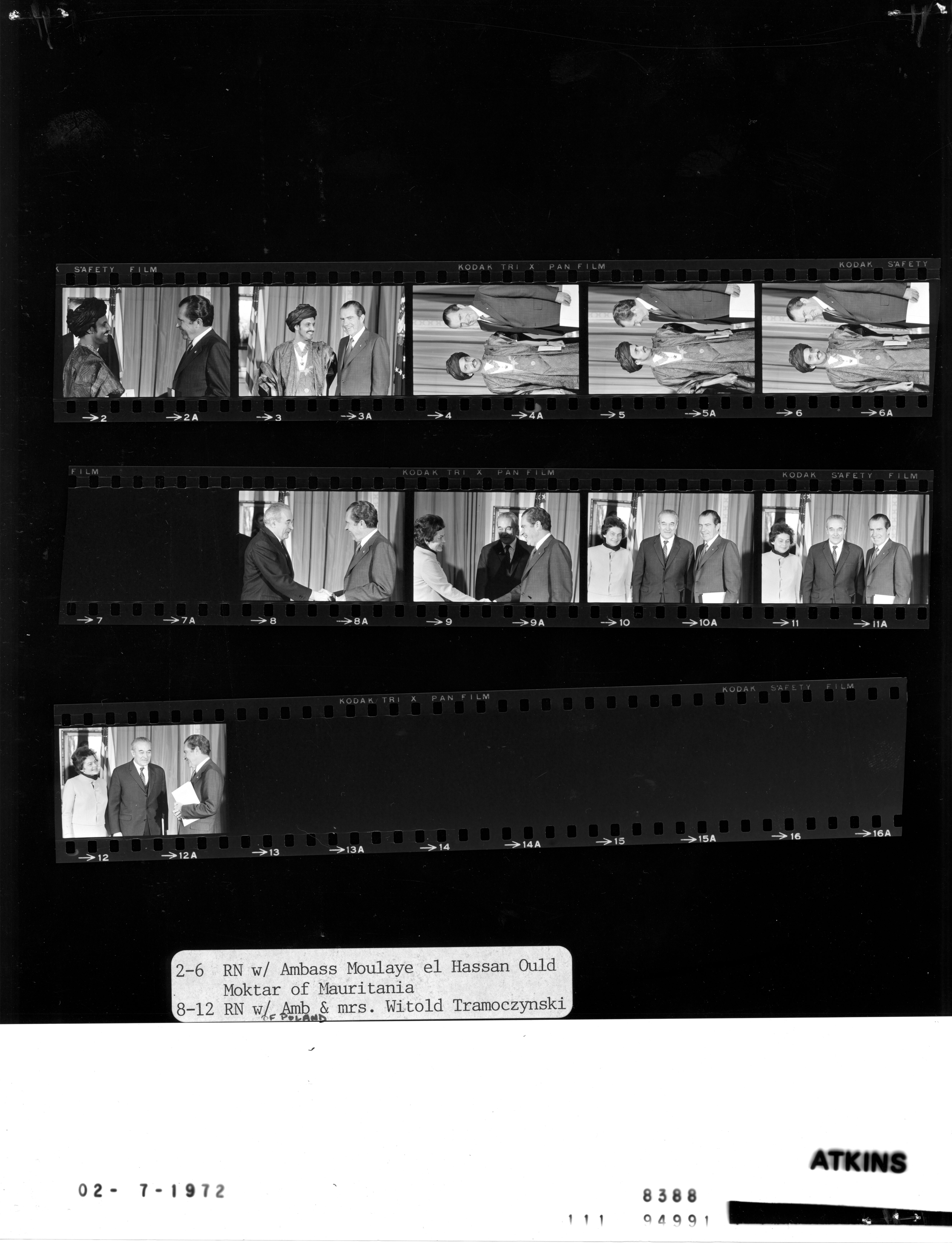
- Frame(s): WHPO-8388-02-06, President Nixon receiving diplomatic credentials from Ambassador Moulaye el Hassan Ould Moktar of Mauritania and Polish Ambassador Witold Trampczynski. 2/7/1972, Washington, D.C. White House, Blue Room. President Nixon, Moulaye el Hassan Ould Moktar, Witold Trampczynski, Mrs. Trampczynski.
Roll WHPO-8393 Photographer: Knudsen, Robert L. | Color or B&W: B&W
- Frame(s): WHPO-8393-, President Nixon addressing the delegates to White House Conference on the Industrial World Ahead. 2/7/1972, Washington, D.C. Ballroom, Sheraton Park Hotel. President Nixon, Stans, Hodgson, Mitchell, officials, delegates.
The White House Communications Agency Sound Recordings Collection contains public statements that took place between 1969 and 1974. Visit the finding aid to learn more.
G - Cabinet Officer Briefings
- WHCA-SR-G-151
Press briefing by Secretary of the Interior Rogers Morton and EPA (Environmental Protection Agency). (2/7/1972, Indian Treaty Room)
Runtime: 1:27:27
Production credits: Audio feed supplied by WHCA; Recorded by LDH (initials of WHCA engineer)
Original Format: 1/4-inch reel-to-reel audiotape. Original source type: Original. - WHCA-SR-G-152
Press briefing by Secretary of Labor James D. Hodgson, with Gerald Warren. (2/7/1972, Press Center)
Production credits: Audio feed supplied by WHCA; Recorded by MJF (initials of WHCA engineer)
Original Format: 1/4-inch reel-to-reel audiotape. Original source type: Original. - WHCA-SR-G-153
Press briefing by Secretary of the Interior Rogers Morton and EPA (Environmental Protection Agency). (2/7/1972, Indian Treaty Room)
Runtime: 1:04:45
Production credits: Audio feed supplied by WHCA; Recorded by LDH (initials of WHCA engineer)
Original Format: 1/4-inch reel-to-reel audiotape. Original source type: Original.
H - White House Staff Member Recordings
- WHCA-SR-H-513
Interview with H.R. Haldeman by Barbara Walters on NBC "Today" show. (2/7/1972, [None listed])
Runtime: 10:00
Keywords: interviews, media, television
Production credits: Audio feed supplied by "TV Tuner"; Recorded by MJP (initials of WHCA engineer)
Original Format: 1/4-inch reel-to-reel audiotape. Original source type: Original. - WHCA-SR-H-514
Briefing by William Rhatican to a group of veterans. (2/7/1972, Family Theater, White House)
Runtime: [Nonelisted]
Keywords: Briefings, private briefings
Production credits: Audio feed supplied by WHCA; Recorded by LDH (initials of WHCA engineer)
Original Format: 1/4-inch reel-to-reel audiotape. Original source type: Original. - WHCA-SR-H-515
Press briefing by Henry Kissinger and James Hodgson. (2/7/1972, Press Center, White House)
Runtime: 30:00:00
Keywords: Press conferences, news conferences, interviews, media
Production credits: Audio feed supplied by WHCA; Recorded by GLG (initials of WHCA engineer)
Original Format: 1/4-inch reel-to-reel audiotape. Original source type: Original.
P - Formal Presidential Remarks
- WHCA-SR-P-720203
Filmed statement on environment and career education. (2/7/1972)
Runtime: 4:24
Original Format: 1/4-inch reel-to-reel audiotape. Original source type: Original. - WHCA-SR-P-720204
Remarks by President Nixon at Businessmen's Dinner at Sheraton Park Hotel. (2/7/1972)
Runtime: 26:07:00
Original Format: 1/4-inch reel-to-reel audiotape. Original source type: Original.
T - China Advance Team
- WHCA-SR-T-007
Walker, Henkel, start 1730. (2/7/1972)
Runtime: 10:00
Keywords: People's Republic of China, trips
Original Format: 1/4-inch reel-to-reel audiotape. Original source type: Original.
The White House Communications Agency Videotape Collection contains “off-the-air” recordings of televised programs produced between 1968 and 1974. Visit the finding aid to learn more.
- WHCA-5035
"Man on the Street, Interviews on Nixon," New Hampshire. Lyndon Baines Johnson.
CBS
Runtime: 0:15 - WHCA-5036
"China: An Open Door?". People's Republic of China
Eastern Educational Network
Runtime: 1:00 - WHCA-5048
Weekly News Summary, Tape I.
ALL NETWORKS
Runtime: 1:30
20. Smith/Downs: Haldeman statements on Today Show. Time Code Start: 60:05. Keywords: media, television shows, TV programs, appearances, interviews. Network: ABC.
21. Smith/Giggans: Vietnam film report. Time Code Start: 64:11. Keywords: Vietnam War. Network: ABC.
22. Smith: Herbert Stein says unemployment will go down to 5%. Time Code Start: 67:48. Keywords: jobs, unemployment, statistics. Network: ABC.
23. Smith/Matney: Secretary of Labor Hodgson speaks about future of labor negotiaions. Time Code Start: 68:38. Keywords: cabinet, advisors. Network: ABC.
24. Smith/Koppel: Israel's Minister of Defense Moshe Dayan in Washington. Time Code Start: 70:20. Keywords: Mideast, Middle East, Israeli, military, Armed Forces, leaders, meetings, war. Network: ABC.
25. Smith/Zimmerman: President Nixon signs campaign spending bill. Time Code Start: 72:35. Keywords: Presidents, bills, laws, elections, campaigns, funding, limitations, signings, signing ceremony. Network: ABC.
26. Smith: Commentary on Northern Ireland. Time Code Start: 76:00. Keywords: United Kingdom, Irish Republican Army, terrorism, explosions, riots, violence. Network: ABC.
27. Chancellor: Haldeman's criticism of President Nixon's critics; Senator McGovern rebuts, O'Brien comments. Time Code Start: 77:49. Keywords: advisors, counsels, attorneys, lawyers, Presidential elections, campaigns, campaigning, candidates, criticisms. Network: NBC.
28. Chancellor/Flick: Senate stops dock strike with 60-day injunction. Time Code Start: 82:30. Keywords: harbors, Stevedores, dock workers, longshoremen, strikes, recession, inflation, wages, unemployment, trade, negotiations, trade, negotiations. Network: NBC.
29. Chancellor/Levine: Pay Board taken to court with Leonard Woodcock of United Automobile Workers (UAW). Time Code Start: 85:15. Keywords: leaders, labor, unions, United Auto Workers, lawsuits, courts. Network: NBC.
30. Chancellor/Spurr: What President Nixon may see in Peking, China a film report. Time Code Start: 87:50. Keywords: Presidents, travel, trips, Nixon trips, international, People's Republic of China, tourism. Network: NBC. - WHCA-5049
Weekly News Summary, Tape II.
ALL NETWORKS
Runtime: 1:30
1. Cronkite/Rather: Haldeman speaks, Senator McGovern rebuts, O'Brien comments. Time Code Start: 00:00. Keywords: South Vietnam, Presidents, speeches, statements, Vietnam War,Senators, diplomacy, truces, treaty, treaties, peace, ceasefires, treaties, negotiations. Network: CBS.
2. Cronkite/Schoumacher: Senator Hubert H. Humphrey organization shambles. Time Code Start: 03:18. Keywords: Presidential elections, campaigns, campaigning, primaries, candidates, voting, speeches. Network: CBS.
3. Sevareid: Former Ambassador to Soviet Union Llewellyn Thompson dies, and with him his kind of diplomacy. Time Code Start: 05:02. Keywords: Ambassadors, officials, leaders, death, Russia, Soviet Union, USSR. Network: CBS.
Context (External Sources)
The Vanderbilt Television News Archive is the world's most extensive and complete archive of television news. They have been recording, preserving and providing access to television news broadcasts of the national networks since August 5, 1968.
Wikipedia is a free encyclopedia that anyone can edit.