

Introduction
This almanac page for Monday, February 22, 1971, pulls together various records created by the federal government and links to additional resources which can provide context about the events of the day.
Previous Date: Sunday, February 21, 1971
Next Date: Tuesday, February 23, 1971
Schedule and Public Documents
The Daily Diary files represent a consolidated record of the President's activities. Visit the finding aid to learn more.
The President's day began at The White House - Washington, D. C.
The Weekly Compilation of Presidential Documents made available transcripts of the President's news conferences; messages to Congress; public speeches, remarks, and statements; and other Presidential materials released by the White House.
Digitized versions can be found at HathiTrust.
Each Public Papers of the Presidents volume contains the papers and speeches of the President of the United States that were issued by the White House Office of the Press Secretary during the time period specified by the volume. The material is presented in chronological order, and the dates shown in the headings are the dates of the documents or events. In instances when the release date differs from the date of the document itself, that fact is shown in the text note.
To ensure accuracy, remarks have been checked against audio recordings (when available) and signed documents have been checked against the original, unless otherwise noted. Editors have provided text notes and cross references for purposes of identification or clarity.
The Federal Register is the official daily publication for rules, proposed rules, and notices of federal agencies and organizations, as well as executive orders and other Presidential documents.
No Federal Register published on this date
The Congressional Record is the official daily record of the debates and proceedings of the U.S. Congress.
Archival Holdings
Any selection of archival documents will necessarily be partial. You should use the documents and folders identified below as a starting place, but consult the linked collection finding aids and folder title lists and the collections themselves for context. Many documents to be found this way do not lend themselves to association with specific dates, but are essential to a complete understanding of the material.
Selective document listing
President's Office Files
The President's Office Files consists of materials drawn together by the Special Files Unit from several administrative subdivisions within the White House Office. It is the handwriting and sensitive papers sent to the Staff Secretary that now comprise much of the President's Office Files. Visit the finding aid to learn more.
- Annotated News Summaries, Box 30, News Summaries - February 1971 [1 of 2] [During this period, the Staff Secretary only removed pages from the News Summaries which contained President Nixon's handwriting, often leaving the document with no date. In addition to the individual document(s) listed below, you should also consult the full folder for the month.]
- [2/22/71]
- Suggested Remarks -- National Governors' Dinner, February 22, 1971
- Annotated News Summaries, Box 30, News Summaries - February 1971 [2 of 2]
- Monday, February 22, 1971
- President's Daily Schedule, Box 101, [President's Daily Schedule, Jan.-Feb. 1971] [3 of 3]
- The President's Schedule, Monday - February 22, 1971
The H. R. Haldeman Diaries consists of seven handwritten diaries, 36 dictated diaries recorded as sound recordings, and two handwritten audio cassette tape subject logs. The diaries and logs reflect H. R. Haldeman’s candid personal record and reflections on events, issues, and people encountered during his service in the Nixon White House. As administrative assistant to the President and Chief of Staff, Haldeman attended and participated in public events and private meetings covering the entire scope of issues in which the Nixon White House engaged in during the years 1969-1973. Visit the finding aid to learn more.
- Transcript of diary entry (PDF)
Monday, February 22.
The President had a very full schedule so I didn't spend much time with him except a couple of short sessions in and out where he went through a number of odds and ends. For example, he was upset because Mrs. Nixon's show on black art didn't get any publicity, and he wants to set up a series of "PN Teas" with the Congressional wives. He's decided to do a couple of more sittings for portraits to try and get a good one. He wants to be sure and send a nice personal note to Harriet Elam, thanking her for her services. And he wanted Ehrlichman to follow up with Ronald Reagan on the McCloskey problem.
In a meeting this afternoon with Dr. David, he called me in to set some schedule things for a meeting with PSAC, but then also got into a discussion of the use of aerospace unemployed scientists, and made the point that he wants to try to redirect some of the science grants to this purpose. Feels that if we can spend $600 million in things through the National Science Foundation, we ought to devote-- be able to devote $100 million or so of that to the-- taking care of this serious unemployment problem. It is particularly sensitive because the people that are unemployed are basically our supporters this time and all are also highly articulate. A little later had Harlow in, and chatted for about half an hour before he remembered what the purpose of the meeting was, which was to get into the problem of the Vice President. Before that, he discussed the farm question and Bryce urged him to try it again on Hyde Murray, but also recommended Earl Butz, of Purdue, as an alternative that would be preferable to Spitzer, whom the President had concluded was our only other possibility.
The real problem with the Vice President is basically his staff, and Harlow had a few suggestions, none of them very good, as to possibilities for correction there. In any event, he's going to talk to Roy Goodearle and see what he can dredge up as to possible solutions. But he admits that it won't be easy to lick this one. The other part of the problem is the Vice President's super-sensitivity to taking instructions from low-level people and his particular sensitivity to the White House. In any event, the President asked Bryce to step in and help to try to work this out, which he's agreed to do.
I had a three-hour lunch with Rogers, ostensibly for the purpose of discussing State Department personnel, which we did go into in considerable detail. It was clear, however, that Rogers' principle concern was to try to work out the Henry Kissinger problem, and he specifically asked for ways that he could direct communications to the President directly, rather than via Henry. Also wanted some help on trying to undo some of the operation of the NSSMs, which have him concerned, as well as Mel Laird. Basically he is sincerely trying to do what he thinks is best for the President and, of course, so is Henry, but the two of them just stay on a collision course, and somehow we've got to figure out how to work it out. Henry caught me later and made it clear that his dissatisfaction is again reaching a peak also, so we have a lot to do.
The other area of discussion today was the plans for the State of the World message, and we've gone back and forth on this, but the conclusion is to stay with the radio announcement. Although, Henry made a strong pitch, and asked me to get into it with the President, for reopening the question of doing it on live TV at night. The President feels very strongly that this is not the right thing to do, so it's now finally been ruled out. Ziegler argues that we should release the text on Thursday, the same time as the radio address. And I've now concurred on that, and that's the plan we're going ahead with.
End of February 22. - Original audio recording (MP3)
The National Archives Catalog is the online portal to the records held at the National Archives, and information about those records. It is the main way of describing our holdings and also provides access to electronic records and digitized versions of our holdings.
The Catalog searches across multiple National Archives resources at once, including archival descriptions, digitized and electronic records, authority records, and web pages from Archives.gov and the Presidential Libraries. The Catalog also allows users to contribute to digitized historical records through tagging and transcription.
Nixon Library Holdings
All National Archives Units
National Security Documents
The President's Daily Brief is the primary vehicle for summarizing the day-to-day sensitive intelligence and analysis, as well as late-breaking reports, for the White House on current and future national security issues. Read "The President's Daily Brief: Delivering Intelligence to Nixon and Ford" to learn more.
The Foreign Relations of the United States series presents the official documentary historical record of major U.S. foreign policy decisions and significant diplomatic activity. Visit the State Department website for more information.
Vol. II, Organization and Management of U.S. Foreign Policy, 1969-1972
Managing the Department of State
331. Information Memorandum From the Director of the Bureau of Politico-Military Affairs (Spiers) to the Under Secretary of State for Political Affairs (Johnson), Washington, February 22, 1971
Source: National Archives, RG 59, Central Files 1970–73, ORG 8. Confidential.
Vol. III, Foreign Economic Policy; International Monetary Policy, 1969-1972
Foreign Economic Policy
53. Memorandum From the President’s Assistant for International Economic Affairs (Peterson) to President Nixon, Washington, February 22, 1971
Source: National Archives, Nixon Presidential Materials, NSC Files, Agency Files, Box 218, CIEP. Confidential. A stamped notation reads: “The President has seen.” Attached to a March 1 memorandum from Peterson to Kissinger regarding the CIEP’s role. Another copy is attached to a February 24 memorandum from Bergsten to Kissinger, which called Kissinger’s attention to item IV on “rethinking” balance of payments and international financial policy, in which Peterson was reflecting Shultz’ desire “to rid ourselves completely of the capital controls inherited by the Administration.” Bergsten noted that this “could cause serious foreign policy problems and in fact the international monetary scene could become very troublesome before the year is out if our payments position remains in heavy deficit.” (Ibid.)
Vol. VII, Vietnam, July 1970-January 1972
Operational Lam Son 719, February 8-April 7, 1971
132. Memorandum From Secretary of Defense Laird to President Nixon, Washington, February 22, 1971
Source: National Archives, Nixon Presidential Materials, NSC Files, Box 153, Vietnam Country Files, Vietnam, 11 Feb 1971–28 March 1971. Top Secret; Sensitive; Eyes Only. Kissinger forwarded the memorandum to Nixon under a covering memorandum, February 22. A stamped notation on Laird’s memorandum reads, “The President has seen.”
133. Memorandum of Conversation, Washington, February 22, 1971, 7:15-8:25 p.m.
Source: National Archives, Nixon Presidential Materials, NSC Files, Box 490, President’s Trip Files, Dobrynin/Kissinger, 1971, Vol. 4 [Part 2]. Top Secret; Sensitive; Eyes Only. The meeting was held in the Map Room at the White House. The time of the meeting is taken from Kissinger’s Record of Schedule. (Library of Congress, Manuscript Division, Kissinger Papers, Box 438, Miscellany, 1968–76) Kissinger forwarded the memorandum of conversation to Nixon under a covering memorandum, February 27. The full text is in Foreign Relations, 1969–1976, volume XIII, Soviet Union, October 1970–October 1971, Document 121.
134. Transcript of a Telephone Conversation Between President Nixon and the Chairman of the Joint Chiefs of Staff (Moorer), Washington, February 22, 1971
Source: National Archives, RG 218, Records of the Chairman, Moorer Diary, July 1970–July 1974. No classification marking.
135. Memorandum for the 40 Committee, Washington, February 22, 1971
Source: Department of State, INR/IL Historical Files, 40 Committee Meetings. Secret; Eyes Only.
Vol. XIII, Soviet Union, October 1970-October 1971
"A Key Point in Our Relationship": Backchannel Talks on SALT, Berlin, and the Summit
121. Memorandum of Conversation, Washington, February 22, 1971
Source: National Archives, Nixon Presidential Materials, NSC Files, Box 490, President’s Trip Files, Dobrynin/Kissinger, 1971, Vol. 4 [part 2]. Top Secret; Sensitive; Eyes Only. The meeting was held in the Map Room at the White House. According to Kissinger’s Record of Schedule, the meeting lasted from 7:15 to 8:25 p.m. (Library of Congress, Manuscript Division, Kissinger Papers, Box 438, Miscellany, 1968–76) Kissinger forwarded this memorandum of conversation and a memorandum summarizing it (as well as the memorandum of his conversation with Dobrynin on February 16) to Nixon on February 27. A note on the summary memorandum indicates that the President saw it. For Kissinger’s memoir account, see Kissinger, White House Years, pp. 814, 826.
122. Transcript of a Telephone Conversation Between President Nixon and the President’s Assistant for National Security Affairs (Kissinger), Washington, February 22, 1971, 9:23 p.m.
Source: National Archives, Nixon Presidential Materials, Henry Kissinger Telephone Conversation Transcripts, Box 8, Chronological File. No classification marking.
Vol. XXIII, Arab-Israeli Dispute, 1969-1972
207. Paper Prepared by the National Security Council Staff, Washington, February 22, 1971
Source: National Archives, Nixon Presidential Materials, NSC Files, NSC Institutional Files (H-Files), Box H–052, Senior Review Group Meetings, SRG Meeting—Middle East/Chile 2/25/71 (1 of 2). Secret; Nodis. All brackets are in the original.
Vol. XXXII, SALT I, 1969-1972
From Stalemate to Breakthrough, August 24, 1970-May 20, 1971
134. Memorandum of Conversation, Washington, February 22, 1971
Source: National Archives, Nixon Presidential Materials, NSC Files, Kissinger Office Files, Box 79, Country Files, Europe, USSR, SALT, May 20, 1971 Announcement—State Department. Top Secret; Sensitive. According to Kissinger’s Record of Schedule, the meeting took place in the Map Room at the White House from 7:15 to 8:25 p.m. (Library of Congress, Manuscript Division, Kissinger Papers, Box 438, Miscellany, 1968–1976 Record of Schedule) The NSC staff extracted this discussion of SALT from a memorandum of conversation of the entire meeting, which covered a range of topics. The memorandum of conversation, which is the National Archives, Nixon Presidential Materials, NSC Files, Box 490, President’s Trip Files, Dobrynin/Kissinger, 1971, Vol. 4, is printed in Foreign Relations, 1969–1976, volume XIII, Soviet Union, October 1970–September 1971, Document 121.
Vol. XXXIV, National Security Policy, 1969-1972
The Defense Budget and U.S. National Security Policy
177. Minutes of Defense Program Review Committee Meeting, Washington, February 22, 1971, 3:15-4:10 p.m.
Source: National Archives, Nixon Presidential Materials, NSC Institutional Files (H-Files), Box H–118, DPRC Minutes, Originals, ‘69–’73 [1 of 3]. Top Secret. The meeting was held in the White House Situation Room. All brackets are in the original.
Vol. XL, Germany and Berlin, 1969-1972
Germany and Berlin, 1969-1972
185. Message From the President’s Assistant for National Security Affairs (Kissinger) to the Ambassador to Germany (Rush), Washington, February 22, 1971
Source: National Archives, Nixon Presidential Materials, NSC Files, Kissinger Office Files, Box 59, Country Files, Europe, Ambassador Rush, Berlin, Vol. 1 [2 of 2]. Top Secret; Exclusively Eyes Only; Limited Distribution. The message was sent through the special Navy channel in Frankfurt; no time of transmission or receipt appears on the message. Kissinger sent a nearly identical message to Bahr; the divergence in text is noted in footnote 3 below. (Ibid., Box 60, Egon Bahr, Berlin File [3 of 3])
Vol. E-4, Documents on Iran and Iraq, 1969-1972
Iran 1971
116. Airgram A–56 From the Embassy in Iran to the Department of State, Tehran, February 22, 1971
The report examined the attitudes of Iranian youth and the implications of these attitudes for US foreign policy.
Source: National Archives, RG 59, Central Files 1970–73, POL 13–2 IRAN. Secret; Noforn. Drafted by Embassy Youth Committee. Cleared by Arnold L. Raphel. Approved by Donald R. Toussaint. Repeated to Khorramshahr and Tabriz. In a comment to Jack Miklos, May 4, Timothy Childs agreed that the attitudes of the activist youth were widespread, but that their beliefs would be tempered by time. Of the suggestion that the U.S. government attempt to draw nearer to the activists, Childs wrote “the only way to do that would be for the United States to urge, and be seen to be urging, further steps towards liberalization upon the Shah. For a variety of reasons I am sure we would be most hesitant to do this. Therefore I conclude that we should not worry too much about the ill-informed views of activist youths. By the time they reach positions of influence it should be apparent to them that the United States has a lot to offer Iran.” (NEA/IRN, Office of Iran Affairs, Lot File 75D351, Box 6, POL 13–2, Students, Youth Groups, Iran 1971.)
Vol. E-7, Documents on South Asia, 1969-1972
India and Pakistan: Pre-Crisis, January 1969-February 1971
118. Memorandum From the President’s Assistant for National Security Affairs (Kissinger) to President Nixon, Washington, February 22, 1971
Kissinger assessed the political tensions in Pakistan that were raising questions about the continued viability of the state, and which were compelling the U.S. to “walk a very narrow tightrope.”
Source: National Archives, Nixon Presidential Materials, NSC Files, Box 624, Country Files, Middle East, Pakistan, Vol. III, 1 Oct 70–28 Feb 71. Secret; Exdis. Sent for information. A notation on the memorandum indicates the President saw it. Nixon underlined the last sentence of the sixth paragraph from “Counsel General” to the end and added the following handwritten comment in the margin: “Good.” In the following paragraph, he underlined the part of the third sentence that reads: “more neutral stance toward Rahman, who is basically friendly toward the United States” and wrote in the margin: “not yet–correct–but not any position which encourages secession.”
The Kissinger telephone conversation transcripts consist of approximately 20,000 pages of transcripts of Kissinger’s telephone conversations during his tenure as Assistant to the President for National Security Affairs (1969-1974) and Secretary of State (1973-1974) during the administration of President Richard Nixon. Visit the finding aid for more information.
Digitized versions can be found in the National Archives Catalog.
Audiovisual Holdings
The White House Tapes are sound recordings of President Richard Nixon's telephone conversations and of meetings held in the Oval Office and the Cabinet Room in the White House, the President's office in the Old Executive Office Building (OEOB), the Lincoln Sitting Room in the residence section of the White House, and several locations at the Presidential retreat at Camp David, Maryland. These recordings document many of the major events and decisions of the Nixon Administration from February 16, 1971 to July 18, 1973. Visit the White House Tapes finding aid to learn about the taping system's operation and archival processing.
Oval Office
- 455-1; 9:15 a.m. - 10:09 a.m.; Nixon, Richard M. (President); Haldeman, H. R. ("Bob"); Butterfield, Alexander P.; Sanchez, Manolo
- 455-2; 10:09 a.m. - 10:38 a.m.; Nixon, Richard M. (President); Morton, Rogers C. B.; Hitt, Robert J.; Ehrlichman, John D.
- 455-3; 10:39 a.m. - 11:58 a.m.; Nixon, Richard M. (President); Ehrlichman, John D.; Ziegler, Ronald L.; Hodgson, James D.; Shultz, George P.; White House photographer; [Unknown person(s)]; Colson, Charles W.
- 455-4; 11:59 a.m. - 11:59 a.m.; Nixon, Richard M. (President); Butterfield, Alexander P.
- 455-5; 11:59 a.m. - 12:21 p.m.; Nixon, Richard M. (President); Wyly, Samuel E.; Burrell, Berkeley G.; Belindo, John; Fernandez, Ben; Roche, James M.; Steelman, Alan; Siciliano, Rocco C.; Venable, Abraham; Garment, Leonard
- 455-6; 12:23 p.m. - 12:33 p.m.; Nixon, Richard M. (President); Hoffman, Oswald; Bell, George T.; Price, Raymond K., Jr.; White House photographer
- 455-7; 12:33 p.m. - 12:33 p.m.; Nixon, Richard M. (President); Butterfield, Alexander P.
- 455-8; 12:34 p.m. - 12:40 p.m.; Nixon, Richard M. (President); Geneen, Harold S.; Goldenson, Leonard H.; McFall, Rusell; Haggerty, Patrick E.; Wyly, Samuel E.; Scott, Walter D.; Hart, Milledge A.; Stanton, Frank; Flanigan, Peter M.; Boatner, James G.; Parker, David N.; Price, Raymond K., Jr.; White House photographer
- 455-9; 12:41 p.m. - 12:45 p.m.; Nixon, Richard M. (President); Udall, James; Chotiner, Murray M.; Parker, David N.; Price, Raymond K., Jr.; White House photographer
- 455-10; 12:46 p.m. - 12:49 p.m.; Nixon, Richard M. (President); Kunzig, Robert L.; Rhoads, John B.; Spence, A. N.; Price, Raymond K., Jr.; Bellinger, Cecelia D.; Parker, David N.; White House photographer
- 455-11; 12:50 p.m. - 12:56 p.m.; Nixon, Richard M. (President); Haley, Carl W.; Haley, Carl W. (Mrs.); Woods, Rose Mary; Parker, David N.; Price, Raymond K., Jr.; White House photographer
- 455-12; 12:57 p.m. - 1:01 p.m.; Nixon, Richard M. (President); Popper, David H.; Haig, Alexander M., Jr.; Parker, David N.; Price, Raymond K., Jr.; White House photographer
- 455-13; 1:01 p.m. - 1:01 p.m.; Nixon, Richard M. (President); Bull, Stephen B.
- 455-14; 1:01 p.m. - 1:12 p.m.; Nixon, Richard M. (President); Sanders, H. E.; Sanders, H. E. (Mrs.); Cashen, Henry C., II; Parker, David N.; Price, Raymond K., Jr.; White House photographer
- 455-15; 1:12 p.m. - 1:13 p.m.; Nixon, Richard M. (President); Bull, Stephen B.
- 455-16; 1:13 p.m. - 1:37 p.m.; Nixon, Richard M. (President); Whitehouse, Charles; Haig, Alexander M., Jr.; Price, Raymond K., Jr.; White House photographer
- 455-17; Unknown between 1:37 p.m. & 1:43 p.m.; Nixon, Richard M. (President); Bull, Stephen B.
- 455-18; 1:43 p.m. - 2:07 p.m.; Nixon, Richard M. (President); Woods, Rose Mary; Bull, Stephen B.
- 455-19; 2:07 p.m. - 2:07 p.m.; Nixon, Richard M. (President); Sanchez, Manolo
- 455-20; Unknown between 2:07 p.m. & 3:02 p.m.; Nixon, Richard M. (President); Butterfield, Alexander P.
- 455-21; 3:02 p.m. - 3:09 p.m.; Nixon, Richard M. (President); Ziegler, Ronald L.
- 455-22; 3:09 p.m. - 3:50 p.m.; Nixon, Richard M. (President); Shultz, George P.; Ehrlichman, John D.; Bull, Stephen B.; Woods, Rose Mary
- 455-23; 3:50 p.m. - 4:33 p.m.; Nixon, Richard M. (President); David, Edward E., Jr. (Dr.); Flanigan, Peter M.; Haldeman, H. R. ("Bob"); [Unknown person(s)]; Ehrlichman, John D.
- 455-24; Unknown between 4:33 p.m. & 4:36 p.m.; Nixon, Richard M. (President); White House operator
- 455-25; Unknown between 4:36 p.m. & 5:21 p.m.; Nixon, Richard M. (President); Haldeman, H. R. ("Bob"); Harlow, Bryce N.; Flanigan, Peter M.
The White House Photo Office collection consists of photographic coverage of President Richard Nixon meeting with prominent social, political, and cultural personalities; speaking engagements and news conferences of the President and various high-ranking members of the White House staff and Cabinet; Presidential domestic and foreign travel, including Presidential vacations; social events and entertainment involving the First Family, including entertainers present; official portraits of the President, First Family, and high-ranking members of the Nixon administration; the 1969 and 1973 Inaugurals; the President’s 1972 Presidential election campaign appearances (including speeches) and other official activities of the White House staff and the President’s Cabinet from January 20, 1969 until August 9, 1974 at the White House and the Old Executive Office Building; other locations in Washington, DC, such as The Mall; and the Presidential retreats in Camp David, Maryland, Key Biscayne, Florida, and San Clemente, California. Visit the finding aid to learn more.
Roll WHPO-5719 Photographer: Atkins, Oliver | Color or B&W: B&W
- Frame(s): WHPO-5719-01-08, President Nixon shaking hands with Ambassador David Popper. 2/22/1971, Washington, D.C. White House, Oval Office. President Nixon, David Popper.
- Frame(s): WHPO-5719-09-13, President Nixon shaking hands with Rev. Carl Haley and Mrs. Carl Haley. 2/22/1971, Washington, D.C. White House, Oval Office. President Nixon, Carl Haley and Mrs. Carl Haley.
- Frame(s): WHPO-5719-15-20, President Nixon shaking hands with James Udall. 2/22/1971, Washington, D.C. White House, Oval Office. President Nixon, James Udall, Charles Whitehouse, Haig.
- Frame(s): WHPO-5719-21-29, President Nixon shaking hands with H.E. Sanders and Mrs. H.E. Sanders. 2/22/1971, Washington, D.C. White House, Oval Office. President Nixon, David Popper, H.E. Sanders and Mrs. H.E. Sanders.
- Frame(s): WHPO-5719-31-33, President Nixon sitting with Charles Whitehouse and Haig. 2/22/1971, Washington, D.C. White House, Oval Office. President Nixon, Charles Whitehouse, Haig.
Roll WHPO-5720 Photographer: Atkins, Oliver | Color or B&W: B&W
- Frame(s): WHPO-5720-01A-05A, President Nixon with business leaders. 2/22/1971, Washington, D.C. White House, Oval Office. President Nixon, Harold Geneen, Leonard Goldenson, Russell McFall, Patrick Haggerty, Samuel Wyly, Walter Scott, Milledge Hart, Frank Stanton, Peter Flanigan.
- Frame(s): WHPO-5720-07A-10A, President Nixon standing with GSA Administrator Robert Kunzig, Archivist of the USA James Rhoads, Public Printer A.N. Spence, and Cecilia Bellinger during the presentation of Public Papers of the Presidents. 2/22/1971, Washington, D.C. White House, Oval Office. President Nixon, Robert Kunzig, James Rhoads, A.N. Spence, Cecilia Bellinger.
Roll WHPO-5721 Photographer: Knudsen, Robert L. | Color or B&W: B&W
- Frame(s): WHPO-5721-, President Nixon with Lutheran Hour Speaker Dr. Oswald Hoffman. 2/22/1971, Washington, D.C. White House, Oval Office. President Nixon, Oswald Hoffman.
Roll WHPO-5722 Photographer: Knudsen, Robert L. | Color or B&W: B&W
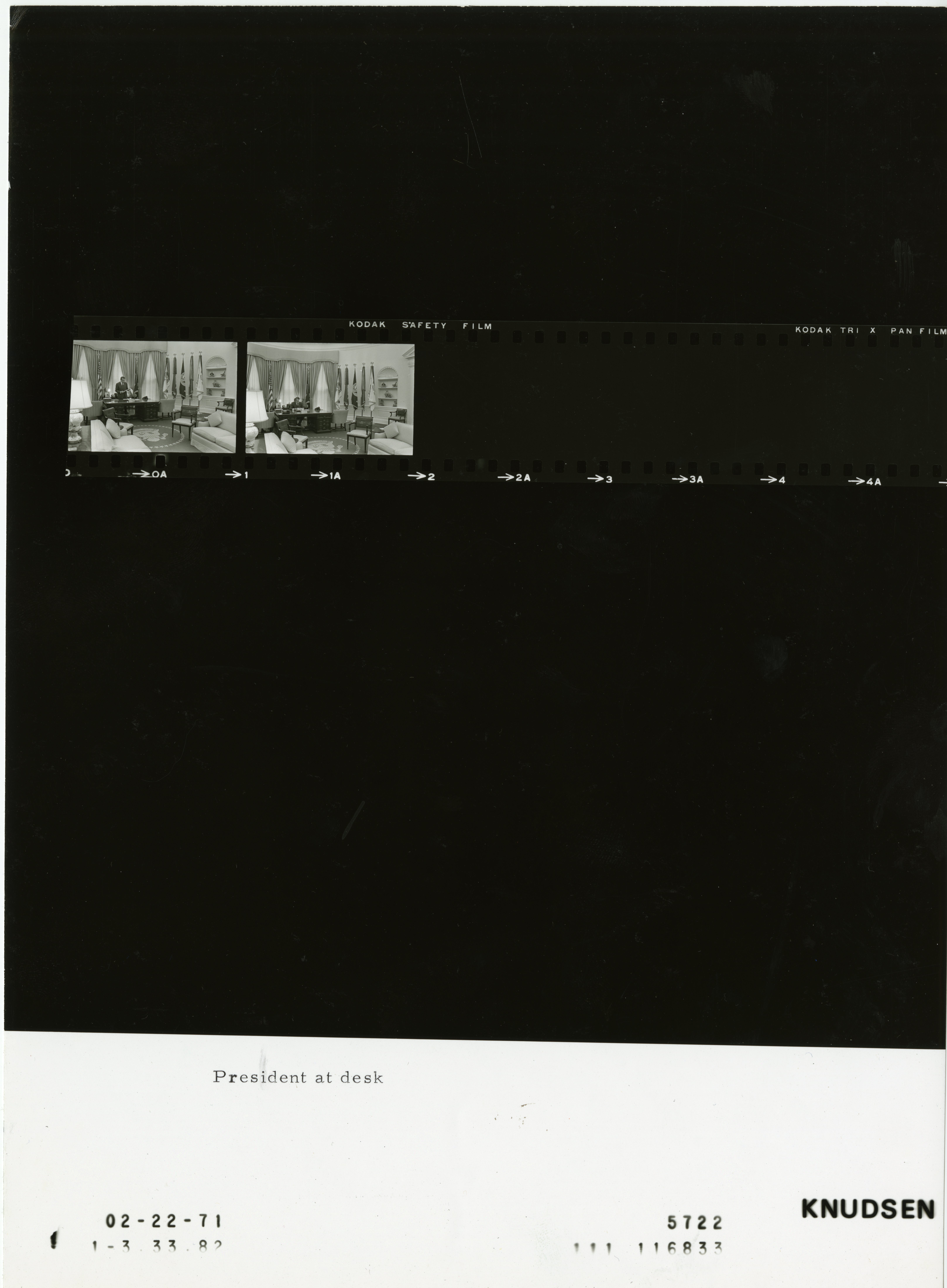
- Frame(s): WHPO-5722-, President Nixon alone in the Oval Office working at his desk. 2/22/1971, Washington, D.C. White House, Oval Office. President Nixon.
- Frame(s): WHPO-5722-00A, President Nixon standing at his Oval Office desk working. 2/22/1971, Washington, D.C. White House, Oval Office. President Nixon.
Roll WHPO-5723 Photographer: Atkins, Oliver | Color or B&W: B&W
- Frame(s): WHPO-5723-02A, President Nixon seated at his Oval Office desk during a meeting with Secretary of the Interior Rogers Morton. 2/22/1971, Washington, D.C. White House, Oval Office. President Nixon, Rogers Morton.
- Frame(s): WHPO-5723-02A-04A, President Nixon seated at his Oval Office desk during a meeting with Secretary of the Interior Rogers Morton. 2/22/1971, Washington, D.C. White House, Oval Office. President Nixon, Rogers Morton.
- Frame(s): WHPO-5723-08A, President Nixon and Pat Nixon seated with George Shultz, John Ehrlichman, and James Hodgson. 2/22/1971, Washington, D.C. White House, Oval Office. President Nixon, John Ehrlichman, George Shultz, James Hodgson, Rogers Morton.
- Frame(s): WHPO-5723-09A, President Nixon seated informally in the Oval Office during a meeting with George Shultz, John Ehrlichman, and James Hodgson. 2/22/1971, Washington, D.C. White House, Oval Office. John Ehrlichman, George Shultz, James Hodgson.
- Frame(s): WHPO-5723-09A, President Nixon seated informally in the Oval Office during a meeting with George Shultz, John Ehrlichman, and James Hodgson. 2/22/1971, Washington, D.C. White House, Oval Office. President Nixon, John Ehrlichman, George Shultz, James Hodgson, Rogers Morton.
Roll WHPO-5724 Photographer: Knudsen, Robert L. | Color or B&W: B&W
- Frame(s): WHPO-5724-, President Nixon seated with members of the Advisory Council on Minority Business Enterprises. 2/22/1971, Washington, D.C. White House, Oval Office. President Nixon, Sam Wyly, Berkeley Burrell, John Belindo, Ben Fernandez, James Roche, Alan Steelman, Rocco Siciliano, Abraham Venable, Donald Rumsfeld.
Roll WHPO-5725 Photographer: Atkins, Oliver | Color or B&W: B&W
- Frame(s): WHPO-5725-, President Nixon seated with members of the Advisory Council on Minority Business Enterprises. 2/22/1971, Washington, D.C. White House, Oval Office. President Nixon, Sam Wyly, Berkeley Burrell, John Belindo, Ben Fernandez, James Roche, Alan Steelman, Rocco Siciliano, Abraham Venable, Donald Rumsfeld.
Roll WHPO-5726 Photographer: Kightlinger, Jack | Color or B&W: B&W
- Frame(s): WHPO-5726-, Treasury Secretary John Connally demonstrating how to hold and showing the part of a rifle to President Nixon a rifle, while others watch. 2/22/1971, Washington, D.C. White House, Oval Office. President Nixon, John Connally, George Shultz, John Ehrlichman, Ron Ziegler.
- Frame(s): WHPO-5726-03A, Treasury Secretary John Connally holding up a shotgun in the Oval Office as President Nixon stands nearby. 2/22/1971, Washington, D.C. White House, Oval Office. President Nixon, John Connally.
- Frame(s): WHPO-5726-05A, President Nixon and Treasury Secretary John Connally look over a shotgun that John Connally is holding during an Oval Office meeting. 2/22/1971, Washington, D.C. White House, Oval Office. President Nixon, John Connally.
Roll WHPO-5727 Photographer: Assoc. Press | Color or B&W: B&W
- Frame(s): WHPO-5727-, Tricia Nixon's birthday party. 2/22/1971, Chevy Chase, Maryland Columbia Country Club. President Nixon, Pat Nixon, Tricia Nixon, Julie Eisenhower, unidentified man.
- Frame(s): WHPO-5727-10, President Nixon, Pat Nixon, Tricia Nixon, and Julie Eisenhower stand together on the steps together on Tricia Nixon's birthday. 2/22/1971, Chevy Chase, Maryland Columbia Country Club. President Nixon, Pat Nixon, Tricia Nixon, Julie Eisenhower, unidentified men.
Roll WHPO-5728 Photographer: UPI | Color or B&W: B&W
- Frame(s): WHPO-5728-, Tricia Nixon's birthday party. 2/22/1971, Chevy Chase, Maryland Columbia Country Club. President Nixon, Pat Nixon, Tricia Nixon, Julie Eisenhower, unidentified man.
The White House Communications Agency Sound Recordings Collection contains public statements that took place between 1969 and 1974. Visit the finding aid to learn more.
H - White House Staff Member Recordings
- WHCA-SR-H-342
Press briefing by Gerald Warren, Sydney Marland, and Dr. Murhead of the Office of Education. (2/22/1971, Press Center, White House)
Runtime: 32:00:00
Keywords: Press conferences, news conferences, interviews, media
Production credits: Audio feed supplied by WHCA; Recorded by RSM (initials of WHCA engineer)
Original Format: 1/4-inch reel-to-reel audiotape. Original source type: Original.
The White House Communications Agency Videotape Collection contains “off-the-air” recordings of televised programs produced between 1968 and 1974. Visit the finding aid to learn more.
- WHCA-4188
"Today" Show AND "CBS Morning News".
Runtime: 00:24:22 - WHCA-4189
"SST: Super Sound and Fury". Supersonic Transport (SST) Senator Harold Hughes (D-IA).
WETA
Runtime: 00:29:31 - WHCA-4195
Weekly News Summary, Tape I.
ALL NETWORKS
Runtime: 01:31:19
10. Reasoner/Giggins/Tuckner: Laos. Time Code Start: 22:14. Keywords: Laos, Vietnam War. Network: ABC.
11. Smith/Scali: Laos. Time Code Start: 28:38. Keywords: Laos, Vietnam War. Network: ABC.
12. Smith: Construction labor, education and medical plans. Time Code Start: 29:58. Keywords: jobs, unemployment, labor, buildings, housing, wages, costs,. Network: ABC.
13. Mew: Phil Brady aids and reports on refuge (possibly refugees). Time Code Start: 31:16. Keywords: war, refugees, immigrants, homeless. Network: NBC.
14. Newman: President Nixon sends bill to Congress for aid to families of college students and National Health Program debate. Time Code Start: 34:10. Keywords: health care, health insurance, Presidents, House of Representatives, bills, student aid, education, colleges, tuition, expenses, health insurance. Network: NBC.
15. Chancellor/Perkins: Welfare (President Nixon). Time Code Start: 36:50. Keywords: Presidents, statements, Family Assistance Programs, government aid, financial aid, health and welfare assistance, financial aid. Network: NBC.
16. Cronkite/Duval: Laos setback. Time Code Start: 42:00. Keywords: Laos, Vietnam War. Network: CBS.
17. Cronkite/Rather: Construction labor. Time Code Start: 49:50. Keywords: jobs, unemployment, labor, buildings, housing, wages, costs. Network: CBS.
18. Cronkite/Schorr: National Health Insurance debate. Time Code Start: 51:23. Keywords: health care, health insurance, insurance, benefits, medicine, medical care, hospitals, costs, financial aid, debates. Network: CBS. - WHCA-4211
Excerpts From the "NBC Nightly News" Indochina War Coverage, Tape I (Weekly News Summary).
NBC
55. Newman: Loss of South Vietnamese ranger post at Tchepone. Time Code Start: 60:09. Keywords: Vietnam War. Network: NBC.
56. Newman/Brady: Revisits Laotian refugees in South Vietnam; war action in Cambodia. Time Code Start: 60:50. Keywords: Laos, Cambodia, Vietnam War, homeless, immigrants, war. Network: NBC. - WHCA-4246
NBC News Excerpts: Phil Brady's Indochina Reports [Weekly News Summary]. Phil Brady.
NBC
Runtime: 00:34:02
2. Newman/Brady: Brady revisits Laotian refugees in South Vietnam whom he had helped a week before. Time Code Start: 02:32. Keywords: Laos, Vietnam War, refugees, homeless. Network: NBC.
Context (External Sources)
The Vanderbilt Television News Archive is the world's most extensive and complete archive of television news. They have been recording, preserving and providing access to television news broadcasts of the national networks since August 5, 1968.
Wikipedia is a free encyclopedia that anyone can edit.