
Introduction
This almanac page for Friday, February 14, 1969, pulls together various records created by the federal government and links to additional resources which can provide context about the events of the day.
Previous Date: Thursday, February 13, 1969
Next Date: Saturday, February 15, 1969
Schedule and Public Documents
The Daily Diary files represent a consolidated record of the President's activities. Visit the finding aid to learn more.
The President's day began at The White House - Washington, D. C.
The Weekly Compilation of Presidential Documents made available transcripts of the President's news conferences; messages to Congress; public speeches, remarks, and statements; and other Presidential materials released by the White House.
Addresses and Remarks
- Department of Health, Education, and Welfare (5 Weekly Comp. Pres. Doc. 270, February 14, 1969)
The President's Remarks to Employees at the Department. - Department of Treasury (5 Weekly Comp. Pres. Doc. 272, February 14, 1969)
The President's Remarks to Employees at the Department.
Executive Orders
- Office of Intergovernmental Relations (5 Weekly Comp. Pres. Doc. 258, February 14, 1969)
Executive Order 11455. - Special Assistant to the President for Liaison With Former Presidents (5 Weekly Comp. Pres. Doc. 259, February 14, 1969)
Executive Order 11456.
Statements by the President
- Office of Intergovernmental Relations (5 Weekly Comp. Pres. Doc. 258, February 14, 1969)
Statement by the President Upon Signing Executive Order Creating the Office.
Checklist of White House Press Releases
The releases listed below, made public by the Office of the White House Press Secretary during the period covered by this issue, are not included in the issue.
- Announcement of intention to nominate Rear Adm. Robert L. Townsend, USN, for appointment to the grade of vice admiral and assignment as Commander, Naval Air Force, U.S. Atlantic Fleet.
- Biography of Rear Adm. Robert Lee Townsend.
- Announcement of intention to nominate Rear Adm. Vincent P. de Poix, USN, for appointment to the grade of vice admiral and assignment as Deputy Director for Administration, Evaluation and Management, Office of Director of Defense Research and Engineering.
- Biography of Rear Adm. Vincent Paul de Poix.
- Biography of Nils A. Boe.
- Press conference of the Vice President concerning the Office of Intergovernmental Relations.
- Biography of Gen. Robert L. Schulz.
- Biography of Gen. Frank Schaffer Besson, Jr., assigned as Chairman, Joint Logistics Review Board.
Digest of Other White House Announcements
Following is a listing of items of general interest which were announced in the press but not made public as formal White House press releases during the period covered by this issue. Appointments requiring Senate approval are not included since they appear in the list of nominations submitted to the Senate, below.
- The President visited the Department of Health, Education, and Welfare and the Treasury Department to speak to employees.
- The President today received and approved the CAB order vacating the previous order and certificates in the international phase of the trans-Pacific route investigation.
- The President met with members of the Civil Rights Commission at the White House.
Each Public Papers of the Presidents volume contains the papers and speeches of the President of the United States that were issued by the White House Office of the Press Secretary during the time period specified by the volume. The material is presented in chronological order, and the dates shown in the headings are the dates of the documents or events. In instances when the release date differs from the date of the document itself, that fact is shown in the text note.
To ensure accuracy, remarks have been checked against audio recordings (when available) and signed documents have been checked against the original, unless otherwise noted. Editors have provided text notes and cross references for purposes of identification or clarity.
- Statement on Signing Executive Order Establishing the Office of Intergovernmental Relations.
- Remarks to Employees at the Department of Health, Education, and Welfare.
- Remarks to Top Personnel at the Department of the Treasury.
- Executive Order 11456—Providing For a Special Assistant to the President for Liaison With Former Presidents
- Executive Order 11455—Establishing an Office of Intergovernmental Relations
The Federal Register is the official daily publication for rules, proposed rules, and notices of federal agencies and organizations, as well as executive orders and other Presidential documents.
Archival Holdings
Any selection of archival documents will necessarily be partial. You should use the documents and folders identified below as a starting place, but consult the linked collection finding aids and folder title lists and the collections themselves for context. Many documents to be found this way do not lend themselves to association with specific dates, but are essential to a complete understanding of the material.
Selective document listing
President's Office Files
The President's Office Files consists of materials drawn together by the Special Files Unit from several administrative subdivisions within the White House Office. It is the handwriting and sensitive papers sent to the Staff Secretary that now comprise much of the President's Office Files. Visit the finding aid to learn more.
- Annotated News Summaries, Box 28, News Summaries - February 1969 [During this period, the Staff Secretary only removed pages from the News Summaries which contained President Nixon's handwriting, often leaving the document with no date. Although there are no specific documents with this date, you should also consult the full folder for the month.]
- President's Meetings File, Box 73, Memoranda for the President--Beginning February 9, 1969
President's Personal File
The President's Personal File is essentially a President's secretary's file, kept by Rose Mary Woods, personal secretary to the President, for two purposes: (1) preserving for posterity a collection of documents particularly close to the President, whether because he dictated or annotated them, or because of the importance of the correspondent or the event concerned and (2) giving appropriate attention–letters of gratitude, invitations to White House social events, and the like–to members and important friends and supporters of the Nixon administration. This generalization does not describe all the varied materials of a file group which is essentially a miscellany, but it does identify the reason for the existence of the file group's core. Visit the finding aid to learn more.
- President's Speech File
Selective document listing
The White House Press Office during the Presidency of Richard Nixon was responsible for daily communication with the White House press corps. Ronald L. Ziegler was the Press Secretary to the President for Nixon's entire term in office from January 1969 to August 1974 and Gerald Warren served as the Deputy Press Secretary. The office held daily briefings for the press and produced the White House’s press releases. Visit the finding aid to learn more.
- White House Press Conferences, Box 55
- News Conference #48 at the White House with Ron Ziegler, February 14, 1969, 11:20 A.M. EST. 8 pgs.
- News Conference #49 at the White House with Ron Ziegler, February 14, 1969, 4:20 P.M. EST. 5 pgs.
The H. R. Haldeman Diaries consists of seven handwritten diaries, 36 dictated diaries recorded as sound recordings, and two handwritten audio cassette tape subject logs. The diaries and logs reflect H. R. Haldeman’s candid personal record and reflections on events, issues, and people encountered during his service in the Nixon White House. As administrative assistant to the President and Chief of Staff, Haldeman attended and participated in public events and private meetings covering the entire scope of issues in which the Nixon White House engaged in during the years 1969-1973. Visit the finding aid to learn more.
- Transcript of diary entry (PDF)
Friday, February 14.
President pushing at staff meeting for plans to get things rolling. Wants weekly program with plan for major event each day - especially now a major legislative proposal every day. Game plan instead of reaction.
More discussion of plan for Presidential action regarding campus disorders. Feels Congress will overreact, and we should get the jump with our own plan. Told me to have Finch and Mitchell develop plan - precisely drawn by Monday. Later, after I talked with them and they urged caution, President changed approach and decided to give a national radio address right after return from Europe. Has Price working on it. Wants to use the "bully pulpit" to give leadership - but now recognizes actual action should be local - not Federal.
Decided to bite the bullet on the Willie May Rogers flap. Will ask her to withdraw - too much criticism to make her role possible - and more to come from Congress. Better to withdraw now as gracefully as possible.
Thinking of Garment for OEO - Moynihan says he's interested. Would be good, except not an administrator.
Made decision to remove Hershey - I've urged ever since election - will have good effect on youth. Problems with Congress and veterans.
President met with Civil Rights Commission and came out all jazzed up - as he did yesterday after National Science Board. Wants to make something of the Commission - and utilize its staff productively. Long talk afterwards with Moynihan. Going to ask Father Hesburgh to take Chairmanship.
Later, family, Julie and David, Tricia and Pat Nixon, all came over to office - President discussed decor, etc. - lots of advice, all conflicting. - Handwritten diary entry (JPG)
The National Archives Catalog is the online portal to the records held at the National Archives, and information about those records. It is the main way of describing our holdings and also provides access to electronic records and digitized versions of our holdings.
The Catalog searches across multiple National Archives resources at once, including archival descriptions, digitized and electronic records, authority records, and web pages from Archives.gov and the Presidential Libraries. The Catalog also allows users to contribute to digitized historical records through tagging and transcription.
Nixon Library Holdings
All National Archives Units
National Security Documents
The President's Daily Brief is the primary vehicle for summarizing the day-to-day sensitive intelligence and analysis, as well as late-breaking reports, for the White House on current and future national security issues. Read "The President's Daily Brief: Delivering Intelligence to Nixon and Ford" to learn more.
- President's Daily Brief of 14 February 1969 [consult link for visuals and extent of redactions]
The President's Daily Brief
14 February 1969
19
Top Secret
LATE NOTES FOR THE PRESIDENT'S DAILY BRIEF OF
14 FEBRUARY 1969
[redacted]
15 February 1969
LATE NOTES FOR THE PRESIDENT'S DAILY BRIEF OF
14 FEBRUARY 1969
I. MAJOR PROBLEMS
MIDDLE EAST
There is nothing significant to report.
EUROPE
The East German restriction on land travel to West Berlin by members of the presidential electoral college went into effect this morning. It was preceded by a period in which travelers passing through two checkpoints leading into West Germany were exposed to "more severe examinations than usual" by East German police. They were also handed propaganda leaflets warning of unspecified consequences if the elections are held. (Press, 15 Feb 69)
* * *
[redacted]
* * *
A lecturer at the East German Institute of Marxism-Leninism told an officer of our mission in Berlin yesterday that there would be no harassment in the air corridors during the West German presidential election, that the autobahn would not be blocked, and that there would be no military maneuvers. To emphasize fast German restraint, he said "we will not play cowboys and Indians as we did in 1965" (date of the last presidential election). He added that the recent note from the East German Government to Bonn, the restriction on land travel scheduled to go into effect today, and the current propaganda campaign are to establish a "GDR case for future reference." [redacted]
SOVIET AFFAIRS
There is nothing significant to report.
VIETNAM
Ambassador Sullivan in Vientiane notes that while the return to Hanoi of the North Vietnamese ambassador to Cambodia may be related to the Tet holidays, it is significant that he has usually been in Hanoi each time major decisions with respect to peace negotiations have been under discussion, and that these visits have coincided with those of Le Due Tho, who arrived in Hanoi Thursday. [redacted]
The Viet Cong Tet cease-fire began at 7:00 AM today local (6:00 PM Friday EST). All South Vietnamese troops are confined to barracks and on the alert against a repetition of last year. In the first few hours after the truce, the Viet Cong assassinated a hamlet chief in the central highlands and invaded the docks at Saigon to plant Viet Cong flags and take potshots at US guards, but they fled when chased. (Various press, 15 Feb 69)
President Thieu has decided that Tet cease-fire for allied forces will be for only 24 hours from 6:00 PM Sunday local (5:00 AM Sunday EST) to 6:00 PM Monday local (5:00 AM Monday EST). This decision was made because Gen Tri, commander of the South Vietnamese III Corps, said 36 hours stand-down would mean no B-52 bombings for two nights, which he felt might be critical in his sector. [redacted]
II. OTHER IMPORTANT DEVELOPMENTS
USSR-GHANA
[redacted]
JAPAN-COMMUNIST CHINA
A seven-man Japanese trade delegation has left for Peking to negotiate a renewal of the one-year Sino-Japanese trade agreement which expired at the end of last year. Two Liberal-Democratic members of the Diet are in the delegation, and one press report out of Tokyo claims that Prime Minister Sato has asked them to sound out China's attitude on the possibility of ambassadorial-level talks in a third country aimed at breaking the deadlocked relations between the two countries. [redacted]
II. MAJOR PROBLEMS
MIDDLE EAST
There is nothing of significance to report.
EUROPE
Britain's erratic trade picture improved markedly in January. January exports rose by $53 million and imports dropped by $29 million; the resulting merchandise trade deficit is the smallest for any month since devaluation. The improvement in the trade balance and predictably strong performances in certain other elements of the balance of payments may lead to a three-month (November-January) surplus on current account for the first time since early 1967.
The requirement that importers must deposit half of the value of certain imports before the goods clear customs seems not to have had much impact on January imports. If the deposit scheme, which has been in effect since November, does begin to exert a braking effect, the chances are good that there will be continued strong performance in trade statistics.
SOVIET AFFAIRS
Moscow has extended assurances that Allied rights in Berlin will not be challenged, but appears to be giving East Germany more leeway to harass the West Germans.
A Soviet note delivered to Chancellor Kiesinger on 13 February used considerably harsher language than earlier notes in protesting the decision to hold the presidential election in West Berlin. It implied that the East Germans might be given a relatively free hand to take action against
land access to West Berlin and warned that the USSR would assume "only those responsibilities" specified in the quadripartite decisions, i.e., Allied travel only.
In Moscow the Soviets finally accepted a tripartite Allied protest note after having evaded acceptance on Wednesday. The delay had apparently been used to formulate a reply which was delivered to the Allied representatives immediately after receipt of their protest. The Soviet reply reiterated earlier charges against the West Germans and gave support for measures being taken by Pankow: presumably the restrictive measures which are to go into effect Saturday against land travel by West German officials.
As part of its campaign to heighten tensions, Moscow has also launched a spirited rumor campaign. Reports that Soviet and East German forces will begin maneuvers shortly to block land access routes to Berlin and that some action might be taken to impede air travel are totally unsubstantiated at this time.
Current military activity in the Berlin area seems to be limited to routine training. Warsaw Pact commander Marshal Yakubovsky and military representatives from each of the member countries, who had been meeting in East Germany since 10 February, returned home yesterday. Soviet air exercises west of Berlin, apparently held for the visiting Pact officials, terminated on 12 February [redacted]
VIETNAM
No significant shifts of positions were discernible to us in yesterday's formal presentations by the Communist side or in the follow-up press conferences. Xuan Thuy and Tran Buu Kiem soft-pedaled their earlier emphasis on the priority of political issues in the same way they have done outside the talks. In effect, they stuck to their basic demand that military and political issues will have to be treated as a package. The Communists described the questions of troop withdrawals and military bases as "fundamental," thus suggesting they might be prepared to take up military questions first. The Communists may indeed be prepared to open substantive discussions with such military matters, but they have made it quite clear that no agreements will be reached on these issues without parallel understandings on broader political questions.
* * *
President Thieu probably hopes that he has taken some of the wind out of Vice President Ky's sails by selecting Interior Minister General Khiem to supervise the pacification and revolutionary development programs. Ky has, at the least, made a major nuisance of himself recently by politicking for the replacement of Prime Minister Huong, whom Thieu installed last May to replace a Ky man. Thieu presumably expects that Ky will continue his campaign against Huong while he is back in South Vietnam for the Tet holidays, and he appears to have undercut Ky by admitting that Huong is getting old and somewhat frail and needs help. The Khiem appointment is expected to take some of the load off Huong's staff, which should then be able to give him better support.
Thieu's principal motive for giving this additional assignment to Khiem, however, seems to be his desire to have a close associate run programs which will have a great deal to do with the government's political position in the countryside during any future political competition with the Communists. Khiem is one of the few top leaders who seems to have developed a fairly close relationship with the President.
The President also sees the government's land reform program as offering a major opportunity to develop support among the rural population. [redacted]
Thieu's recent refusal to make greater use of civilian politicians in top government posts, as suggested by Huong, partly reflects his low estimate of the political value of these men. There are only a handful of politicians in South Vietnam with whom even a significant fraction of the people identify, and the government is unlikely to acquire a broader political base merely by bringing some new faces into the cabinet. Thieu clearly prefers the government to concentrate on extending its control over the people--and possibly building its popularity among them--through land reform, by improving pacification and revolutionary development, and by achieving a more impressive military record.
II. OTHER IMPORTANT DEVELOPMENTS
PERU
[redacted]
* * *
At Annex we discuss the background of the dispute with Peru.
INDONESIA
General Suharto [redacted] has decided to seek Soviet economic and technical assistance for Indonesia's.five-year development plan, which begins this April. This decision was taken partly out of concern that the Western consortium would not meet Djakarta's 500-million-dollar aid request for this year [redacted]
During the Sukarno regime the Soviets poured aid of all types into Indonesia to the tune of over one billion dollars. Most of this sum is still owed Moscow. The Soviets up to now have maintained that Indonesia must arrange to repay these substantial debts before aid can be discussed. They have agreed only to sell the Indonesians limited amounts of military spare parts on a hard cash basis.
PAKISTAN
The government's announcement that the three-year-Qld state of emergency will be lifted Monday is the latest in a number of steps Ayub has taken to improve the climate for the "dialogue" with opposition elements that he hopes to begin that day. Opposition leaders will give Ayub an answer on his offer of negotiations tomorrow. [redacted]
These talks may ease the situation, but the opposition, its appetite whetted by the concessions Ayub has already given, may increase its demands. Although Ayub may yet retrieve the situation, speculation in Pakistan is increasingly centering not on whether the President will go but when and how.
The opposition should be further emboldened by today's general strike. All reports so far suggest that it was extremely effective, bringing activity in most cities to a standstill.
ANNEX
PERU AND THE UNITED STATES
SIGNIFICANCE: The serious impasse between the US and Peruvian governments over expropriation of the International Petroleum Company (IPC) is the culmination of nearly forty-five years of recurrent wrangling between the company and the Peruvian government. The IPC issue, however, has been only one, although the most serious of a number of irritants that have from time to time troubled generally friendly relations. Most incidents have involved either the threat or the actual suspension of US economic aid in response to actions taken by the Peruvian government. The basic issues have often been economic--a reflection of latent but very real resentment in Peru over the country's heavy dependence on the US economy. Peru's present military rulers are strong nationalists; apparently determined to set the country on the road toward greater political and economic independence of the US.
Recent US-Peruvian Relations:
The rioting that greeted Mr. Nixon in Lima on 8 May 1958 was, for Peru, a rare outburst of open hostility against the US. Communist "students" were mainly responsible for that affair. There had been other destructive riots earlier that year which had not involved relations with the US. President Prado was trying to maintain a democratic government in a time of serious economic and political deterioration.
Except for a brief but bitter period later in 1958 when the US import quota for Peruvian lead and zinc was cut back, relations with the US were friendly during Prado's tenure. The military coup that overthrew him in 1962, however, prompted the US to suspend diplomatic relations and economic aid for one month. They were resumed after the US had secured guarantees that constitutional government would be restored within a reasonable time.
The military government did step down in June 1963, after Fernando Belaunde had been elected president. Belaunde's campaign had inflamed the IPC issue to a new intensity, but he failed to fulfill his campaign promise to solve the IPC problem within 90 days. He did, however, declare void an arbitration agreement of 1922 on which IPC's ownership of the La Brea y Parinas oilfields was based. He thus laid the basis for the present claim that the company had been operating illegally in Peru since it bought the fields in 1924.
The IPC issue bedeviled Belaunde throughout the five and a half years of his tenure. During late 1964 and early 1965, he seemed to be moving toward outright expropriation. A large part of the US aid program was held up, prompting charges that the US was using aid to coerce Peru into settling
on IPC's terms. In 1966, US aid was substantially increased and these charges died down, but the IPC issue would not go away.
Problems of a different nature arose in 1967 which were especially galling to the Peruvian military. Peru's decision to upgrade its armed forces by buying French tanks and Mirage fighter planes--despite strong criticism from the US Congress-raised the prospect that amendments to the us Foreign Assistance Act (the Symington and Conte-Long Amendments) would require a decrease or suspension of US aid. The Peruvian cries of "economic aggression" were quick and loud. No new US loans have been programmed for Peru since July 1967 and implementation of existing aid projects has been considerably slowed.
Another periodic irritant involves seizure of US fishing boats within the 200-mile territorial sea claimed by Peru. It appeared for a while in 1967 that this issue also might force application of US laws imposing economic sanctions.
The October 1968 Coup
The pretext for the coup was President Belaunde's "settlement" with the IPC in August 1968. The agreement provided for reversion of the disputed La Brea y Parinas oilfields to Peru in return for cancellation of the large debt which Peru claimed the company owed for "illegally" exploiting the fields for so long. The settlement was instantly attacked by a wide segment of Peruvians as a "sellout" for dropping the debt and not including the Talara refinery in the takeover. As the controversy wore on into the autumn, the President's own party split over the issue.
On 3 October, the army seized power in a quick, bloodless coup. Six days later the military government formally nationalized both the La Brea y Parinas oilfields and the refinery complex at Talara. Moreover, it reaffirmed that IPC still owed a multimillion-dollar debt for the "unjust profits" it made while "illegally" exploiting the oilfields since 1924.
Factors other than the IPC issue played an equal if not greater role in bringing about the coup. For one thing, the split in Belaunde's party all but assured victory for Victor Raul Haya de la Torre in the presidential elections then scheduled for June 1969. Haya and the military have a history of bitter mutual animosity going back more than 35 years, and this was not the first time that the military had used force to keep him from power.
For all this, however, President Velasco and his closest military advisers are strong nationalists. Their prompt and decisive action against the IPC brought them general public acclaim and a greater degree of popularity than any previous military regime had enjoyed.
Velasco, however, is not well regarded by many of his military colleagues, some of whom have been pressing for a more moderate course. Velasco has thus far been able to outmaneuver his rivals by playing on the nationalism of the public and keeping the IPC issue in the forefront, but dissatisfaction with his leadership has been growing within the military during the past two weeks.
Consequences
The present military government in Peru is unlike anything in the country's past. [redacted] Their plans are still vague, but one thing is clear: they are in no mood to be intimidated by the prospect of US economic sanctions. US aid, they feel, has too often in the past been used to interfere with sovereign Peruvian decisions.
The ranking generals are all strong nationalists, though they vary in the bluntness of the tactics they would use to assert Peru's "independence." Velasco may be replaced as President, perhaps soon, but his successors would be military men dedicated to the same goals.
The Foreign Relations of the United States series presents the official documentary historical record of major U.S. foreign policy decisions and significant diplomatic activity. Visit the State Department website for more information.
Vol. II, Organization and Management of U.S. Foreign Policy, 1969-1972
The NSC System
28. Memorandum From the Chairman of the President’s Foreign Intelligence Advisory Board (Taylor) to the President’s Assistant for National Security Affairs (Kissinger) , Washington, February 14, 1969
Source: National Archives, Nixon Presidential Materials, NSC Files, NSC Institutional Files (H-Files), Box H–300, NSC System, IFG (Institutional File General) 1969 through 1974. Confidential.
Managing the Department of State
298. Memorandum From President Nixon to his Assistant for National Security Affairs (Kissinger) , Washington, February 14, 1969
Source: National Archives, Nixon Presidential Materials, White House Special Files, Staff Member and Office Files, President’s Personal Files, RN Memos, 1968–Dec 1969, #1 Feb ’69. No classification marking. Printed from an unsigned copy.
Vol. XXIX, Eastern Europe, 1969-1972
Czechoslovakia
79. Telegram From the Embassy in Czechoslovakia to the Department of State, Prague, February 14, 1969, 1655Z
Source: National Archives, Nixon Presidential Materials, NSC Files, Box 672, Country Files—Europe, Czechoslovakia, Vol. I Jan 69–31 Jan 70. Confidential; Immediate.
Vol. XXXIV, National Security Policy, 1969-1972
Parity, Safeguard, and the SS-9 Controversy
7. Notes of National Security Council Meeting , Washington, February 14, 1969, 10:40 a.m.
Source: National Archives, Nixon Presidential Materials, NSC Files, NSC Institutional Files (H-Files), Box H–20, NSC Meeting, February 14, 1969. Top Secret; Sensitive. No drafting information appears on the notes. These notes were transcribed from Alexander Haig’s handwritten notes, which are ibid. According to the President’s Daily Diary, the following attended the meeting, held in the Cabinet Room of the White House: Nixon, Agnew, Rogers, Laird, Secretary of the Treasury David Kennedy, Gerard Smith, Lincoln, Helms, Elliot Richardson, David Packard, General John P. McConnell, Ellis H. Veatch, Director of the Bureau of the Budget’s National Security Programs Division, Kissinger, and Haig. (Ibid., White House Central Files, President’s Daily Diary)
Vol. XL, Germany and Berlin, 1969-1972
Germany and Berlin, 1969-1972
9. Memorandum From Helmut Sonnenfeldt of the National Security Council Staff to the President’s Assistant for National Security Affairs (Kissinger) , Washington, February 14, 1969
Source: National Archives, Nixon Presidential Materials, NSC Files, Box 689, Country Files, Europe, Germany (Berlin), Vol. I. Secret; Noforn. Urgent; sent for action. Drafted by Lesh. A checkmark indicates that Kissinger saw the memorandum. With minor revisions and deletions, Kissinger transmitted the text of the memorandum in his written intelligence brief for the President on February 15. (Ibid., Box 2, President’s Daily Briefs, February 15–18, 1969) Several of the President’s markings on the text of the brief are noted below.
10. Telegram From the Embassy in the Soviet Union to the Department of State, Moscow, February 14, 1969, 1205Z
Source: National Archives, RG 59, Central Files 1967–69, POL 28 GER B. Confidential; Immediate. Repeated to Bonn, Berlin, USNATO, London, Paris, CINCUSAREUR, CINCEUR, and USELMLO. Kissinger forwarded the text of the telegram in a February 15 memorandum to the President. (Ibid., Nixon Presidential Materials, NSC Files, Box 2, President’s Daily Briefs, February 15–18, 1969)
Vol. XLI, Western Europe; NATO, 1969-1972
Western Europe Region and NATO
7. Memorandum of Conversation , Washington, February 14, 1969, 12:30 p.m.
Source: Ford Library, Laird Papers, Accession 2001–NLF–020, Box 1, NATO, Vol. 1. Secret. Drafted by Frederick Wyle, Deputy Assistant Secretary of Defense for International Security Affairs. The meeting took place in Laird’s office. Brosio spent February 13–14 in Washington in order to discuss NATO-related topics. On February 13 he met with Nixon and Kissinger and attended a dinner party at the White House. (President’s Daily Diary; National Archives, Nixon Presidential Materials, White House Central Files)
France
117. Memorandum From the President’s Assistant for National Security Affairs (Kissinger) to President Nixon, Washington, February 14, 1969
Source: National Archives, Nixon Presidential Materials, NSC Files, Box 674, Country Files, France, Vol. I. Secret; Exdis.
Vol. E-4, Documents on Iran and Iraq, 1969-1972
Iraq 1969-1971
251. Research Memorandum RNA–6 From the Director of the Bureau of Intelligence and Research (Hughes) to Secretary of State Rogers, Washington, February 14, 1969
The report, entitled “Iraq: Internal Stresses and the Search for the Bogeyman,” analyzed the recent arrests and executions in Iraq within the framework of the insecurities of the Ba’ath government.
Source: National Archives, RG 59, Central Files 1967–69, POL 27 ARAB-ISR. Secret; No Foreign Dissem.
Vol. E-5, Part 1, Documents on Sub-Saharan Africa, 1969-1972
Nigerian Civil War
40. Memorandum From Roger Morris of the National Security Council Staff to the Presidentʼs Assistant for National Security Affairs (Kissinger) , Washington, February 14, 1969
In anticipation of the NSC meeting later that day, Morris outlined the latest developments regarding relief flights, prospects for a neutral relief airstrip, the war, and French policy on Biafra.
Source: National Archives, Nixon Presidential Materials, NSC Files, NSC Institutional Files (H-Files), Box H–20, NSC Meeting, Biafra, Strategic Policy Issues 2/14/69. Secret.41. Issues Paper , Washington, February 14, 1969
This paper, prepared for President Nixon, outlined issues for decision at the NSC meeting on February 14. Attached was a letter to Nixon from Major-General Gowon, Chairman of the Supreme Military Council of Nigeria, to President Nixon, January 16, 1969.
Source: National Archives, Nixon Presidential Materials, NSC Files, NSC Institutional Files (H-Files), Box H–20, NSC Meeting, Biafra, Strategic Policy Issues 2/14/69. Secret.42. Issues Paper Prepared for President Nixon, Washington, February 14, 1969
The paper outlined issues for decision at the NSC meeting on February 14 and recommended courses of action.
Source: National Archives, Nixon Presidential Materials, NSC Files, NSC Institutional Files (H-Files), Box H–20, NSC Meeting, Biafra, Strategic Policy Issues 2/14/69. Secret; also, Library of Congress, Manuscript Division, Kissinger Papers, Box CL 312, NSC Meetings Feb–Mar 1969. Secret.
Vol. E-10, Documents on American Republics, 1969-1972
Peru
579. Memorandum From the President’s Assistant for National Security Affairs (Kissinger) to President Nixon, Washington, February 14, 1969, 2:45 p.m. , Washington, February 14, 1969, 2:45 p.m.
President’s Assistant for National Security Affairs Kissinger informed President Nixon that he would explore with Ambassador Jones the advantages and disadvantages of sending a presidential emissary to Peru. In addition, Kissinger reviewed recent incidents of Peruvian harassment of U.S. fishing vessels and concluded that the incidents were not necessarily related to the IPC issue.
Source: National Archives, Nixon Presidential Materials, NSC Files, Box 794, Country Files, Latin America, Peru, 21 January–31 March 1969, Vol. I, IPC Hickenlooper Amendment. Confidential. No other substantive record of the meeting has been found.
The Kissinger telephone conversation transcripts consist of approximately 20,000 pages of transcripts of Kissinger’s telephone conversations during his tenure as Assistant to the President for National Security Affairs (1969-1974) and Secretary of State (1973-1974) during the administration of President Richard Nixon. Visit the finding aid for more information.
Chronological File, Box 1, Folder February 12-22, 1969
- 1:30 PM, Mr. Pete Vaky; Mr. Kissinger
Mr. Pete Vaky
Mr. Kissinger
2/14/69 1 30 pm
Re Peru incident:
HAK asked Vaky to give him a list of what is in the pipeline on sales and grants in the military field, and a scenario of how we would handle a possible emissary. HAK said P was thinking of sending Murphy. HAK asked if Vaky could do this by 3:00 pm, and Vaky said he would try. - 5:00 PM, Secretary Romney; Mr. Kissinger
Secretary Romney
Mr. Kissinger
2-14-69 5:00 PM
R said he had suggestion that K probably already has in mind re American investment in Europe. R spelled out something he found to be rather unique - international trade bridge with Canada . He is thinking of a trade bridge idea between companies in Europe and the US. He has something on paper which he will send over to HAK. K said he would have someone on his staff look at it.
jm - 5:40 PM, Secy Rogers; Mr. Kissinger
Secy Rogers
Mr. Kissinger
2-14-69 5:40 PM
R said Vaky had told him about President wanting to send emissary to Peru and mentioned Bob Murphy - R said he had a question about that at the moment (both on emissary and Murphy). R said timing is not too good as there is a lot of intelligence that there may be a coup in a few days. K said he thought this was the sort of thing on which we should take R's judgment. K said Jones was under the impression that this would bring additional pressure. R said he doesn't think they believe we will invoke the Hickelooper thing - he believes we can isolate them from the others. R said all he is saying is let's hold it up. R said he did not think Bob Murphy was the one for this - thought someone like Jack Irwin would be better - legal background, etc. K said Pres would probably be happy with Irwin. R said Pete is fixing up a telegram which he will send over. R said he has been in touch with our Amb at the OAS and with Pres of OAS as well as Berikemyer, who he thought was going to have a stroke.
R said he just got word that they have released the boat and asked K to get the word to the President.
jm - 6:10 PM, The President; Mr. Kissinger
HAK informed the President that the Peruvians have released the fishing boat, so the immediate crisis is over. The President asked why they released it--at our request, or demand? HAK said we called in their ambassador, and we went to the OAS. Bill Rogers feels that because of possibility of a coup, we ought to hold off with the emissary for a few days, maybe a week. The President said in the meantime, won't HAK check Bob Murphy and see if he will be willing to do it. HAK said Rogers thinks Irwin is better-younger and more manageable. President said he would talk to Bill. President said he knows Franklin Murphy is a tough negotiator, close to him (the Pres), and Pres thinks he would like to do it. HAK said if he agrees he would check him out so he would be ready to do it if we want.
RN: Now, on the Soviet Ambassador -- try it on Monday.
HAK: My recommendation is not before noon.
RN: I'll talk to Haldeman and have him call and set it up, probably Monday--we aren't going to rush.
RN: Anything else new?
HAK: I'll have something for you on Berlin when you see the Ambassador (Soviet); it looks like they're building up a series of harassments.
RN: I'd like for you to develop a talking paper: first, background -- a little of that; and points he is probably going to make, and that I'll make.
HAK: I'll be getting it from State.
RN: Get them to do it, and you can hone it up. For example , if we talk about going forward on political talks: what do we say? I think we ought to talk about Vietnam.
HAK; The Middle East. The French Ambassador and their Middle East man came to see me to develop the line deGaulle intends to develop with you. I have written a memo to you. DeGaulle may turn out to be more cooperate on the MliddleEast than we thought.
RN: I'm for him for putting on other talks with the Soviets.
HAK: He doesn't know that if we play it cool and sell it in terms of his cooperation on the Middle East, I think it can be worked out, as you will see in the memo. I think we ought to hold up 4-power meeting until you see DeGaulle and establish the ground rules.
N: Ask State for a report on their bilateral talks up to now, before they go ahead with 4-power talks. Tell State about this business about deGaulle.
HAK: They are being informed.
RN: I feel it might give us some bargaining position to drag our feet -- to continue talks at bilateral level until we have a chance to talk to De Gaulle.
HAK: I'll tell them that.
RN: The most important thing, we are finally facing up to today, on the basis of that briefing today, etc., is that all these games we have been playing and briefings, etc., and so on, we do that, we do this, a lot of it is almost irrelevant, isn't it, in view of the power situation. I really feel that this country has not been facing up to what the facts are. The columnists haven't, no one has.
HAK: One of these days you will face a crisis where someone is going to ram these facts of life home to us. We ought to prevent these crises from breaking out.
RN: Very subtly you can let Alsop know that. He is already writing that. If you can convince Alsop--you know what I mean. Why don't you go up and spend two days up there with your family? There's no reason for you to be here tomorrow.
Re briefing books on Europe. The President said to send up anything that comes in by way of briefing books--he doesn't care in what shape they are--HAK agreed to send up the raw ones at noon tomorrow (Saturday). - 6:15 PM, Secy Rogers; Mr. Kissinger
Secy Rogers
Mr. Kissinger
2-14-69 6:15 PM
R said he had talked to the President yesterday about Dobrynin's request to see him. K said President had just talked to him about it. R said we should not delay too long. K said President is going to see him on Monday - Haldeman will get in touch with R re time. R hoped President would see him before that. K said he did not think 48 hours makes any difference - in 1961 we sent Thompson over and it was three weeks before they even received him. R said he thought Dobrynin should be advised of appointment by tomorrow.
K said on the Peruvian matter, the President goes along with R's recommendation - he would prefer Frank Murphy to Bob Murphy or Irwin. R said o. k. they will keep him in mind.
R brought up fact that new Amb from Brazil is waiting to present credentials. Also, Amb of Panama is waiting. K said he would take up with the President.
jm - 7:10 PM, Richard Goodwin; Mr. Kissinger
Richard Goodwin
Mr. Kissinger
2-14-69 7:10 PM
G said he was going to do a piece on Europe for the New Yorker and wanted to talk with K about it - generally on way problems of Europe have changed since 1963 to present. K said he would be delighted to talk with G about it and G will let him know when he is coming to Washington - perhaps next week.
jm - John Cannon (in Gov. Rockefeller's office); Mr. Kissinger
John Cannon (in Gov. Rockefeller's office)
Mr. Kissinger
2/14/69
Draft statement that Rockefeller would like to see the President make is going to be delivered to HAK's office this evening sometime. Gov. felt that the statement Vaky sent up did not do justice to the importance of the mission, and he is very conscious how the Latins will regard how the President makes the statement. HAK asked him to furnish both Vaky's statement and the revised version, and he will check it out with the President who, he is quite sure, will go along with the version the Gov wants. The Gov. wants to talk to HAK about it.
Secy Rogers had indicated that they would be quite happy to go along with the new version. (Rogers does not know that HAK is getting a copy - - and HAK said he'd square it with Rogers.
Cannon is getting a copy in mail tonight, special delivery.
HAK said he thought the President would be happy if Frank Murphy (former Chancellor of UCLA1 were made part of the team; and unless Nelson has personal objections to him, it would sort of settle question of level of the delegation. HAK said (1) the President is eager for this to be a success; (2) whatever Nelson wants, he will, within reason, go along with. HAK said, "Could you let me know tomorrow (Saturday) about this?"
(Governor Rockefeller was going to be in Tarrytown during the day on Saturday and in NY in evening for a political dinner.
HAK: I'll call him in the morning.
Audiovisual Holdings
The White House Photo Office collection consists of photographic coverage of President Richard Nixon meeting with prominent social, political, and cultural personalities; speaking engagements and news conferences of the President and various high-ranking members of the White House staff and Cabinet; Presidential domestic and foreign travel, including Presidential vacations; social events and entertainment involving the First Family, including entertainers present; official portraits of the President, First Family, and high-ranking members of the Nixon administration; the 1969 and 1973 Inaugurals; the President’s 1972 Presidential election campaign appearances (including speeches) and other official activities of the White House staff and the President’s Cabinet from January 20, 1969 until August 9, 1974 at the White House and the Old Executive Office Building; other locations in Washington, DC, such as The Mall; and the Presidential retreats in Camp David, Maryland, Key Biscayne, Florida, and San Clemente, California. Visit the finding aid to learn more.
Roll WHPO-0287 Photographer: Atkins, Oliver | Color or B&W: B&W
- Frame(s): WHPO-0287-01-13, President Nixon signing an executive order creating a new Office of Intergovernmental Relations. Vice President Agnew and Nils A. Boe are present but not pictured. 2/14/1969, Washington, D.C. White House, Cabinet Room. President Nixon, Spiro T. Agnew, Nils A. Boe.
Roll WHPO-0288 Photographer: Atkins, Oliver | Color or B&W: B&W
- Frame(s): WHPO-0288-01-15, President Nixon signing an executive order creating a new Office of Intergovernmental Relations. Witnesses present are: Vice President Agnew, Nils A. Boe, Charles Byrley, John Gunther, Pat Healy, Bernie Hillenbrand, Bill Leonard, Bill Coleman, David Walker, Daniel Patrick Moynihan and unidentified officials. 2/14/1969, Washington, D.C. White House, Cabinet Room. President Nixon, Spiro Agnew, Nils A. Boe, Charles Byrley, John Gunther, Pat Healy, Bernie Hillenbrand, Bill Leonard, Bill Coleman, David Walker, unidentified officials.
Roll WHPO-0291 Photographer: Knudsen, Robert L. | Color or B&W: B&W
- Frame(s): WHPO-0291-02A, 06A-15A, Vice President Agnew, Nils A. Boe, and other government officials at a Press Conference concerning the establishment of the Office of Intergovernmental Relations. See Also: WHPO 0288. 2/14/1969, Washington, D.C. White House, Fish Room. Spiro Agnew, Nils A. Boe, unidentified officials.
- Frame(s): WHPO-0291-03A-05A, Closeups of Vice President Agnew's face while speaking at a Press Conference concerning the establishment of the Office of Intergovernmental Relations. See Also: WHPO 0288. 2/14/1969, Washington, D.C. White House, Fish Room. Spiro Agnew.
Roll WHPO-0292 Photographer: Knudsen, Robert L. | Color or B&W: B&W
- Frame(s): WHPO-0292-03-12, Vice President Agnew, Nils A. Boe, and other government officials (most unseen) at a Press Conference concerning the establishment of the Office of Intergovernmental Relations. See Also: WHPO 0288. 2/14/1969, Washington, D.C. White House, Fish Room. President Nixon, Spiro Agnew, Nils A. Boe, Charles Byrley, John Gunther, Pat Healy, Bernie Hillenbrand, Bill Leonard, Bill Coleman, David Walker, unidentified officials, White House Press Corps reporters.
Roll WHPO-0293 Photographer: Atkins, Oliver | Color or B&W: B&W
- Frame(s): WHPO-0293-01A-03A, President Nixon speaking to an unseen audience at the Health, Education and Welfare (HEW) Department. Secretary of HEW Robert Finch sitting on stage nearby. 2/14/1969, Washington, D.C. Health, Education and Welfare building auditorium (HEW). President Nixon, Robert Finch.
- Frame(s): WHPO-0293-04A-06A, President Nixon Secretary of HEW Robert Finch greet officials in a receiving line on stage at the Health, Education and Welfare (HEW) Department. 2/14/1969, Washington, D.C. Health, Education and Welfare building auditorium (HEW). President Nixon, Robert Finch, various HEW officials.
- Frame(s): WHPO-0293-07A-16A, President Nixon and Secretary of HEW Robert Finch smiling as they leave the Health, Education and Welfare (HEW) Department building. 2/14/1969, Washington, D.C. Health, Education and Welfare building (HEW). President Nixon, Robert Finch, various HEW officials.
- Frame(s): WHPO-0293-12A, President Nixon and Secretary of HEW Robert Finch smile and wave as they leave the Health, Education and Welfare (HEW) Department building. 2/14/1969, Washington, D.C. Health, Education and Welfare building (HEW). President Nixon, Robert Finch, unidentified official.
- Frame(s): WHPO-0293-18A-20A, President Nixon with Secretary of the Treasury David Kennedy walking to the Treasury Department building. 2/14/1969, Washington, D.C. Treasury Department building. President Nixon, David M. Kennedy, various Treasury officials.
- Frame(s): WHPO-0293-21A-24A, President Nixon with Secretary of the Treasury David Kennedy greeting officials at the Treasury Department. Officials include Director U.S. Secret Service James J. Rowley, Director of the Mint Eva Adams, Director U.S. Savings Bonds Glen R. Johnson, Commissioner Public Debt Donald M. Merritt, Deputy Commissioner IRS Internal Revenue Service William Smith, Commissioner of Customs Lester D. Johnson, Deputy Treasurer William T. Howell, Special Assistant to Secrectary (Enforcement) James Hendrick, Comptroller of the Currency John K. Carlock, Acting Director Executive Secretariat James E. Ammerman, Asst. Sec. designate Edwin S. Cohen, Deputy General Counsel Roy T. Englert, Commissioner of Accounts Sidney Sokol, Undersecretary of Treasury Charles E. Walker, Asst. Sec. for Administration A. E. Weatherbee, Asst. Sec. Donald A. Webster. 2/14/1969, Washington, D.C. Treasury Department building. President Nixon, David M. Kennedy, Eva Adams, James J. Rowley, Glen R. Johnson, Donald M. Merritt, William Smith, Lester D. Johnson, William T. Howell, James Hendrick, John K. Carlock, James E. Ammerman, Edwin S. Cohen, Roy T. Englert, Sidney Sokol, Charles E. Walker, A. E. Weatherbee, Donald A. Webster.
- Frame(s): WHPO-0293-25A-26A, President Nixon speaking at the Treasury Department to an unseen audience, Secretary of the Treasury David Kennedy sitting nearby. 2/14/1969, Washington, D.C. Treasury Department. President Nixon, David M. Kennedy, various Treasury officials.
- Frame(s): WHPO-0293-27A-31A, President Nixon, Secretary of the Treasury David Kennedy and others looking at the Liberty Bell on display, in front of the Treasury Department. 2/14/1969, Washington, D.C. Treasury Department. President Nixon, David M. Kennedy, various Treasury officials.
- Frame(s): WHPO-0293-30A, President Nixon, Secretary of the Treasury David Kennedy and others looking at the Liberty Bell on display, in front of the Treasury Department. View is from behind the Bell with the Bell on the left of the frame. 2/14/1969, Washington, D.C. Treasury Department. President Nixon, David M. Kennedy, various Treasury officials.
- Frame(s): WHPO-0293-32A-35A, President Nixon with Secretary of the Treasury David Kennedy leaving the Treasury Department building. 2/14/1969, Washington, D.C. Treasury Department building. President Nixon, David M. Kennedy.
Roll WHPO-0294 Photographer: Atkins, Oliver | Color or B&W: B&W
- Frame(s): WHPO-0294-01A-02A, Secretary of HEW Robert Finch introduces President Nixon on stage, to an unseen audience at the Health, Education and Welfare (HEW) Department. President Nixon sitting on stage nearby. 2/14/1969, Washington, D.C. Health, Education and Welfare building auditorium (HEW). President Nixon, Robert Finch.
- Frame(s): WHPO-0294-04-19, President Nixon gestures while speaking to an unseen audience at the Health, Education and Welfare (HEW) Department. 2/14/1969, Washington, D.C. Health, Education and Welfare building auditorium (HEW). President Nixon.
- Frame(s): WHPO-0294-04-19, President Nixon addressing officials from microphone. (Profile). 2/14/1969, Washington, D.C. Treasury Department. President Nixon, David Kennedy.
- Frame(s): WHPO-0294-20-32, Closeup portrait of President Nixon's face while speaking at the Treasury Department. 2/14/1969, Washington, D.C. Treasury Department. President Nixon.
- Frame(s): WHPO-0294-33-34, President Nixon standing with Secretary of the Treasury David Kennedy at the Department of the Treasury. 2/14/1969, Washington, D.C. Treasury Department. President Nixon, David Kennedy.
Roll WHPO-0295 Photographer: Atkins, Oliver | Color or B&W: B&W
- Frame(s): WHPO-0295-01-03, President Nixon speaking with Dwight Chapin in an office, view from outside the door, looking into the office area. 2/14/1969, Washington, D.C. White House, unspecified office. President Nixon, Dwight Chapin.
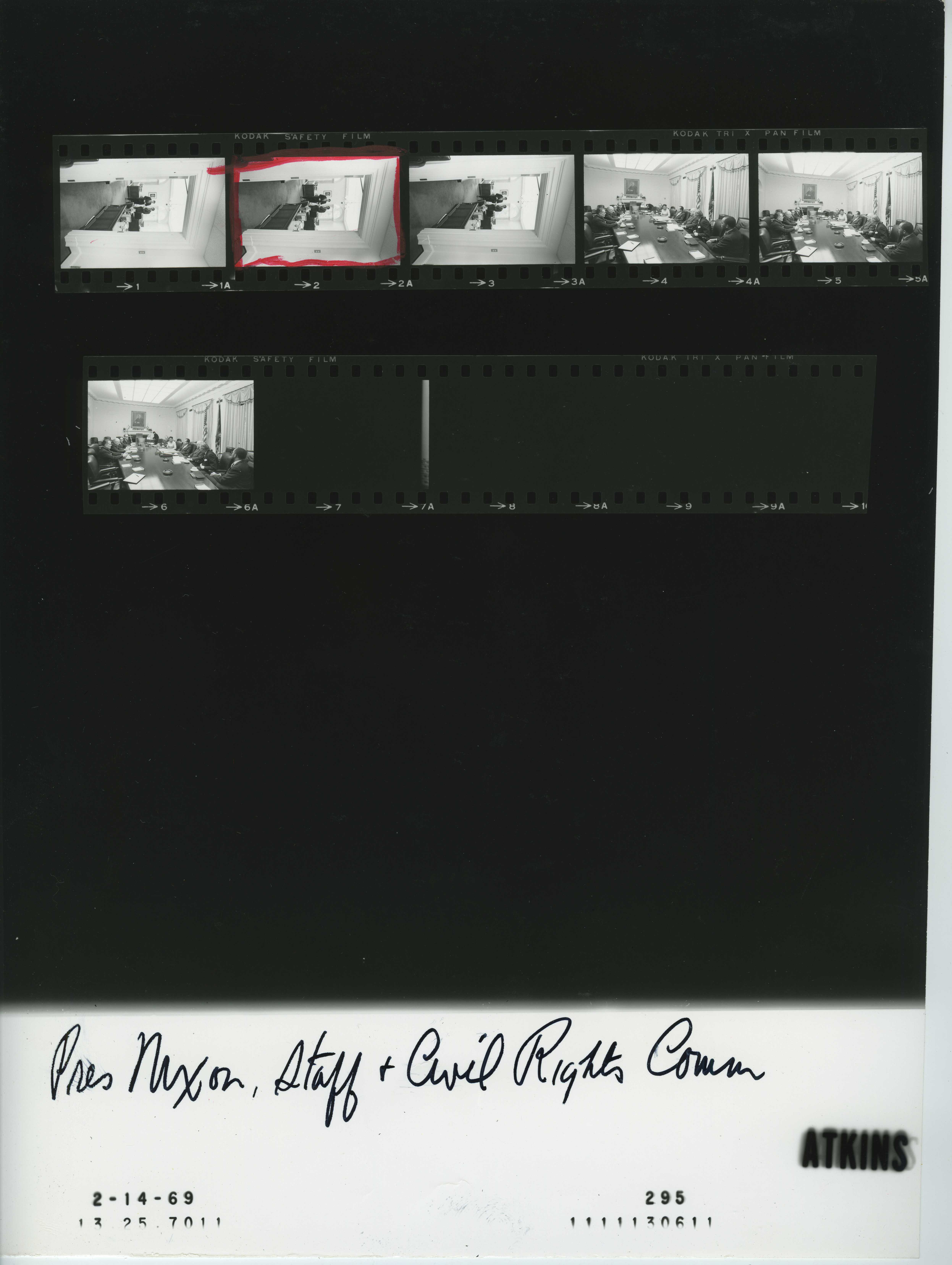
- Frame(s): WHPO-0295-04-06, President Nixon with members of the Commission on Civil Rights, Howard Glickstein, John A. Hannah, Frank M. Freeman, Theodore M. Hesburgh, Robert s. Rankin, Maurice Mitchell, Dr. Hector P. Garcia. 2/14/1969, Washington, D.C. White House, Cabinet Room. President Nixon, Howard Glickstein, John A. Hannah, Frank M. Freeman, Theodore M. Hesburgh, Robert s. Rankin, Maurice Mitchell, Dr. Hector P. Garcia, White House staff members.
The White House Communications Agency Sound Recordings Collection contains public statements that took place between 1969 and 1974. Visit the finding aid to learn more.
B - Vice-Presidential (Agnew and Ford)
- WHCA-SR-B-008
Press conference-Roosevelt Rm., White House. (2/14/1969)
Runtime: 16:23
Original Format: 1/4-inch reel-to-reel audiotape. Original source type: Original.
P - Formal Presidential Remarks
- WHCA-SR-P-690217
Remarks by President Nixon to employees at the Department of Health, Education, and Welfare, with additional remarks by Robert Finch. (2/14/1969, Auditorium, Department of Health, Education, and Welfare, Washington, DC)
Runtime: 0:22:28
Production credits: Audio feed supplied by WHCA (mult feed by ABC); (initials of WHCA engineer not provided)
Original Format: 1/4-inch reel-to-reel audiotape. Original source type: Original. - WHCA-SR-P-690218
Remarks by President Nixon to Top Personnel at the Department of the Treasury Department,. (2/14/1969, Department of the Treasury)
Runtime: 16:22
Original Format: 1/4-inch reel-to-reel audiotape. Original source type: Original.
Context (External Sources)
The Vanderbilt Television News Archive is the world's most extensive and complete archive of television news. They have been recording, preserving and providing access to television news broadcasts of the national networks since August 5, 1968.
Wikipedia is a free encyclopedia that anyone can edit.