
Introduction
This almanac page for Thursday, February 13, 1969, pulls together various records created by the federal government and links to additional resources which can provide context about the events of the day.
Previous Date: Wednesday, February 12, 1969
Next Date: Friday, February 14, 1969
Schedule and Public Documents
The Daily Diary files represent a consolidated record of the President's activities. Visit the finding aid to learn more.
The President's day began at The White House - Washington, D. C.
The Weekly Compilation of Presidential Documents made available transcripts of the President's news conferences; messages to Congress; public speeches, remarks, and statements; and other Presidential materials released by the White House.
Appointments and Nominations
- Oil Spillage Problem (5 Weekly Comp. Pres. Doc. 257, February 13, 1969)
Announcement of Appointment of Panel To Meet in Santa Barbara To Study the Problems.
Proclamations
- National Poison Prevention Week, 1969 (5 Weekly Comp. Pres. Doc. 257, February 13, 1969)
Proclamation 3893. Dated February 13, 1969. Released February 14, 1969.
Reports to the President
- Railway Labor Dispute (5 Weekly Comp. Pres. Doc. 257, February 13, 1969)
Announcement of Report of Emergency Board No. 174 Investigating the Dispute Between Certain Railroads and Conductors and Engineers.
Swearing-In Ceremonies
- District of Columbia Government (5 Weekly Comp. Pres. Doc. 256, February 13, 1969)
Remarks of the President and Walter Washington aat the Swearing In of Mayor Washington, With the Introduction of Three Nominees to the D. C. Council.
Checklist of White House Press Releases
The releases listed below, made public by the Office of the White House Press Secretary during the period covered by this issue, are not included in the issue.
- Biography of Gilbert Hahn, Jr.
- Biography of Sterling Tucker.
- Biography of Jerry A. Moore, Jr.
- List of members of the National Science Board of the National Science Foundation.
- List of winners of the Arthur S. Flemming Award for 1968.
Digest of Other White House Announcements
Following is a listing of items of general interest which were announced in the press but not made public as formal White House press releases during the period covered by this issue. Appointments requiring Senate approval are not included since they appear in the list of nominations submitted to the Senate, below.
- The President met with members of the National Science Board of the National Science Foundation at the White House.
- The President met with the 10 winners of the Arthur S. Flemming Award for 1968. The award is given to outstanding young men in the Federal Government.
- NATO Secretary General Manlio Brosio was the President's guest at a private dinner at the White House.
- Arnold Palmer, professional golfer, Chris Schenkel of ABC, Al Kaline of the Detroit Tigers, and Bart Starr of the Green Bay Packers visited the President at the White House.
Each Public Papers of the Presidents volume contains the papers and speeches of the President of the United States that were issued by the White House Office of the Press Secretary during the time period specified by the volume. The material is presented in chronological order, and the dates shown in the headings are the dates of the documents or events. In instances when the release date differs from the date of the document itself, that fact is shown in the text note.
To ensure accuracy, remarks have been checked against audio recordings (when available) and signed documents have been checked against the original, unless otherwise noted. Editors have provided text notes and cross references for purposes of identification or clarity.
The Federal Register is the official daily publication for rules, proposed rules, and notices of federal agencies and organizations, as well as executive orders and other Presidential documents.
Archival Holdings
Any selection of archival documents will necessarily be partial. You should use the documents and folders identified below as a starting place, but consult the linked collection finding aids and folder title lists and the collections themselves for context. Many documents to be found this way do not lend themselves to association with specific dates, but are essential to a complete understanding of the material.
Selective document listing
President's Office Files
The President's Office Files consists of materials drawn together by the Special Files Unit from several administrative subdivisions within the White House Office. It is the handwriting and sensitive papers sent to the Staff Secretary that now comprise much of the President's Office Files. Visit the finding aid to learn more.
- Annotated News Summaries, Box 28, News Summaries - February 1969 [During this period, the Staff Secretary only removed pages from the News Summaries which contained President Nixon's handwriting, often leaving the document with no date. In addition to the individual document listed below, you should also consult the full folder for the month.]
- Staff and Department Briefs, February 13, 1969
- President's Meetings File, Box 73, Memoranda for the President--Beginning February 9, 1969
- Safire to Haldeman, Report on Meeting of the Cabinet Committee on Economic Policy, February 13, 1969, Cabinet Room. 2/13/1969, 10:09 a.m. [per President's Daily Diary]. 7 pgs.
- Harold H. Saunders, Memorandum of Conversation, The President, Henry Kissinger, Harold Saunders, Congressman Cellar, Congressman Rooney, Congressman Farbstein, Congressman Ford, Congressman H. R. Gross, Congressman Halpern. 2/13/1969, 11:50 a.m. [per President's Daily Diary]. 3 pgs.
- Alexander P. Butterfield to The President's File, Early afternoon meeting in the Cabinet Room with Dr. DuBridge and the National Science Board. 2/13/1969, 2:04 p.m. [per President's Daily Diary]. 3 pgs.
- Charles B. Wilkinson to The President's File, February 13, 1969, Meeting in President's Office with Arnold Palmer, Bart Starr, Al Kaline, and Chris Schenkel. 2/13/1969, 5:11 p.m. [per President's Daily Diary]. 1 pg.
Selective document listing
The White House Press Office during the Presidency of Richard Nixon was responsible for daily communication with the White House press corps. Ronald L. Ziegler was the Press Secretary to the President for Nixon's entire term in office from January 1969 to August 1974 and Gerald Warren served as the Deputy Press Secretary. The office held daily briefings for the press and produced the White House’s press releases. Visit the finding aid to learn more.
- White House Press Conferences, Box 55
- News Conference #46 at the White House with Ron Ziegler, February 13, 1969, 11:10 A.M. EST. 7 pgs.
- News Conference #47 at the White House with Ron Ziegler, February 13, 1969, 4:15 P.M. EST. 5 pgs.
The H. R. Haldeman Diaries consists of seven handwritten diaries, 36 dictated diaries recorded as sound recordings, and two handwritten audio cassette tape subject logs. The diaries and logs reflect H. R. Haldeman’s candid personal record and reflections on events, issues, and people encountered during his service in the Nixon White House. As administrative assistant to the President and Chief of Staff, Haldeman attended and participated in public events and private meetings covering the entire scope of issues in which the Nixon White House engaged in during the years 1969-1973. Visit the finding aid to learn more.
- Transcript of diary entry (PDF)
Thursday, February 13.
Each morning Kissinger and I start with breakfast to rework schedule and plans for trip. Quite a project. Poor Ehrlichman calls us at breakfast, in the Mess, and we louse up his whole day's work.
President told me to have Ellsworth seated next to Rogers at dinner so Bob could make some hay about NATO. Plan is to appoint him Ambassador. I talked Rogers into it yesterday, but he's not really sold on it.
Big concern this morning was plan for swearing in Mayor Washington and announcing new City Council. President upset by plan to do this in East Room with band, etc. - feels we've already over-promoted Washington. I agree.
I spent another day haranguing Cabinet officers regarding firing people. Went pretty well. Also got most of backlog cleaned up. Have started evening staff meetings with my crew - soon as the President leaves for his swim. Should help. Will try to set routine - and then get President to let me use the pool, massage, sauna and sun lamp.
President met with National Science Board - scheduled for a half hour, stayed one hour and ten minutes. Was fascinated, and impressed by caliber of Board, especially large number of college presidents. Roger Heyns was there, but I didn't know it.
Some discussion of routine and procedures. President very impressed with Kissinger staff work - and rightly so. If we can get everything working that way we'll really have an operation. Hard to do. I had long talk with Burns on this subject - he drives me nuts with his persistence - maybe we'll eventually get him to do it right. - Handwritten diary entry (JPG)
The National Archives Catalog is the online portal to the records held at the National Archives, and information about those records. It is the main way of describing our holdings and also provides access to electronic records and digitized versions of our holdings.
The Catalog searches across multiple National Archives resources at once, including archival descriptions, digitized and electronic records, authority records, and web pages from Archives.gov and the Presidential Libraries. The Catalog also allows users to contribute to digitized historical records through tagging and transcription.
Nixon Library Holdings
All National Archives Units
National Security Documents
The President's Daily Brief is the primary vehicle for summarizing the day-to-day sensitive intelligence and analysis, as well as late-breaking reports, for the White House on current and future national security issues. Read "The President's Daily Brief: Delivering Intelligence to Nixon and Ford" to learn more.
- President's Daily Brief of 13 February 1969 [consult link for visuals and extent of redactions]
The President's Daily Brief
13 February 1969
19
Top Secret
14 February 1969
LATE NOTES FOR THE PRESIDENT'S DAILY BRIEF OF
13 FEBRUARY 1969
I. MAJOR PROBLEMS
MIDDLE EAST
Paris realizes that four-power talks in New York can only come to a useful stage after considerable bilateral exchange and perhaps only after President Nixon's return from Europe, according to a French Foreign Ministry official. This official pointed out "important differences" in the French and US positions on the talks. Where the US looks at the talks as support for the Jarring mission, France regards them as an end in themselves. The French hope that the result of the talks would be a "self-imposed" peace agreed to by the parties concerned through the direct intervention of the four powers and on the basis of an agreement by the four after consultation with the parties.
When asked if the Soviets had given any new indications of their positions in eventual negotiations, the French official said the Soviets had indicated they would only unveil their real positions on Jerusalem, Arab refugees, and other key matters in "general conversations" and when it appeared there was some give in the Israeli position. However, they had also indicated to the French that they were ready to be much more flexible on these matters and to press the Arabs much harder than it had so far appeared in public. [redacted]
* * *
Soviet Ambassador Malik, in conversation with Ambassador Yost, expressed mild doubt whether it would be sufficient merely to give Jarring and the parties a general statement of encouragement. He stressed their lack of progress thus far and suggested the four powers might lay down some specific guidelines, such as direction to implement the Security Council resolution in all its parts. In his usual fashion, Malik attributed the absence of progress to Israeli "negativism" and "arrogance." He was particularly irked that they had so swiftly rejected the Soviet plan, which, he argued, went far to meet their interests. [redacted]
EUROPE
There is nothing significant to report.
SOVIET AFFAIRS
The Soviets and East Germans have confirmed that Marshal Yakubovsky, supreme commander of the Warsaw Pact, has been chairing a meeting in East Germany of the organization's chiefs of staff and deputy defense ministers. Yesterday's announcements did not give the precise location of the meeting, but it may have been at a training area west of Berlin where artillery and tactical air exercises have been noted. The Rumanian chief of staff was listed among the participants. Although the announcements of the meeting avoided any hint of its purpose, this is the time of year and the right level of military representation for planning 1969 maneuvers. (FBIS 39, 43, 13 Feb 69)
VIETNAM
There is nothing significant to report.
II. OTHER IMPORTANT DEVELOPMENTS
INDIA
As part of a sudden cabinet reshuffle, Prime Minister Gandhi has appointed Commerce Minister Dinesh Singh as Minister of External Affairs. Singh, a confidant of Mrs. Gandhi, has a pro-Soviet reputation, and his opportunism has earned him widespread dislike among his colleagues. He has been generally critical of US policies and a difficult negotiator in his official dealings with Americans. (Various press, 13 Feb 69)
I. MAJOR PROBLEMS
MIDDLE EAST
[redacted]
EUROPE
The French, temporarily nonplussed at last week's Western European Union meeting, have begun to return to form. They have let it be known that they will not attend the meeting of Western European ambassadors which the British have called to discuss the Middle East. They have also come out against the compulsory consultations to which the other WEU members agreed.
The question now is whether all the other five Community members will stand up to the French. The West Germans, as usual, occupy a pivotal position. With Kiesinger and De Gaulle scheduled to meet next month, the Germans will be particularly sensitive to storm signals from Paris.
* * *
So far the Germans seem to be holding the line. The communique issued today after the talks between Wilson and Kiesinger is a forthright affirmation of the two leaders' devotion to the goal of a unified Europe which would include Britain.
SOVIET AFFAIRS
[redacted]
VIETNAM
[redacted]
* * *
The concept of the Communists operating as a legal political entity in South Vietnam seems to be gaining some acceptability among anti-Communists of long standing.
Spokesmen for a major faction of the Vietnam Nationalist Party (VNQDD), one of the few groups that can claim a national following in South Vietnam, have expressed their confidence that Vietnamese nationalists could accept "a political struggle" with the Communists. One ·1eader went even further in implying that if coalition with the Communists "is the only way to restore peace," the nationalists would accept it. Coalition, the spokesman stated, is not something the nationalists have to fear. It remains to be seen whether other nationalist groups adopt a similar line or condemn it as playing into the hands of the enemy.
[redacted] the government is still sticking to its "national reconciliation" line, i.e., the Communists will be welcomed into the body politic only if they lay down their arms and renounce Communism.
* * *
[redacted]
* * *
Ground action picked up somewhat yesterday as the Communists launched their first battalion-sized attack in several weeks, and allied forces caught several enemy units in unprepared positions. Enemy troops spotted setting up rockets some nine miles from the Bien Hoa Air Base 15 miles northwest of Saigon were hit by air and artillery.
[redacted]
II. OTHER IMPORTANT DEVELOPMENTS
THAILAND
The government, as forecast, was embarrassed by this week's lower house elections. Its party won only about 35 percent of the seats country-wide and none in Bangkok. The military leadership, however, should have little trouble lining up enough independents to form a working majority in the lower house, whose powers are in any case severely limited by the constitution.
The election results may nonetheless influence both the future policies and the make-up of the military leadership. Opposition elements, although they will have to tread lightly, for the first time in over ten years have a legitimate forum to express political dissent. Without a clear mandate from the electorate, the leadership will be more solicitous of such views. Within the establishment, factual disputes will be worsened as attempts are made to lay the blame for the government party's poor showing.
BELGIUM
The Annex reviews major domestic pressures affecting the government of Belgium.
INDIA
Returns from elections in four key states in north India are trickling in, and the Congress Party is in trouble. Perhaps the most ominous development is the landslide victory being won in West Bengal by a united front led by India's two Communist parties.
A leftist front similar to this ousted the Congress government in elections two years ago. It then proceeded to show broad tolerance toward labor unrest in Calcutta and a peasant revolt in the northern part of the state. The front eventually fell apart, turmoil increased, and Mrs. Gandhi's government was forced to impose direct rule from New Delhi last February. Some such chain of events is a distinct possibility this time as well, but Congress, whose hold on the country has slipped badly in the last two years, is less well equipped now to cope with trouble.
In addition to diminishing further the chances for stable government in the four affected states, the elections do not speak well for Congress's ability to win the next national election, which must be held sometime in the next three years. Northern India has traditionally given the party its strongest support. Even in the current parliament, Congress has only a slight majority.
USSR-GHANA
Soviet President Podgorny has asked Ghana for the immediate release of two Soviet trawlers and their crews. The trawlers were seized last October ostensibly for violating Ghana's territorial waters [redacted] Podgorny's request, following a similar one by Acting Foreign Minister Kuznetsov only three weeks ago, is evidence pf Moscow's increasing impatience and may lead to further steps aimed at freeing the ships. One such, cancellation of a crude oil shipment to Accra, apparently has had no effect.
[redacted]
ANNEX
BELGIUM*
SIGNIFICANCE: Belgium's friendship for the United States, its advocacy of European integration, and its support of the Western Alliance have not wavered in the face of recurring crises and sixteen post-war changes in government. Through most of this century domestic political instability has been a direct outgrowth of the country's major ethnic division between the French-speaking Walloons, who traditionally dominated political and cultural life, and the now more numerous Dutch-speaking Flemings, whose language and culture were regarded as second rate. The survivability of the current coalition of Belgium's two largest parties, the moderate Social Christians and the Socialists, is now in considerable doubt, as Prime Minister Gaston Eyskens finds himself unable to muster the needed majorities in parliament for his basic program to ease ethnic tensions.
* * *
The existence of three major political parties and a plethora of smaller ones, all based on regional as well as ideological differences of approach, make coalition governments the rule in Belgium. The sixty-three-year-old Eyskens is no stranger to the role of Prime Minister, having headed up three earlier governments. His present coalition came to power last June on a program of basic reforms, some of
*This is the first in a series of annexes dealing with domestic problems in the countries President Nixon is to visit.
which require constitutional amendment, designed to lessen the country's ethnic antagonisms. The elections of March 1968 showed overwhelming support for increased autonomy of the two linguistic communities, but none of the political parties was able to get a majority for its program. In fact, the parties are not themselves agreed internally on their own programs, because each contains a Walloon and a Flemish wing.
The showdown on the government's program may come as soon as Easter. The coalition commands the majority vote in parliament needed to pass the economic decentralization measures by which the Walloons hope to revive their region's lagging economy, but the Flemish deputies in both coalition parties have said they will vote for these measures only as a part of a package which includes their cultural demands. These include regional control of education, communication and the arts, and, being incorporated in a constitutional amendment, must have the support of two-thirds of the deputies. The coalition does not control two-thirds of the vote, and may not even be able to bring either program to a vote due to the decision of the opposition Liberals to boycott the session and thus prevent a quorum.
Ethnic disputes are not limited to affairs of government. The projected construction of a new electric steel furnace in Flanders, for example, aroused strong opposition in Wallonia, historically Belgium's iron and coal-producing region. The Flemings, for their part, have protested the establishment of a nuclear institute in Wallonia. When Brussels was proposed as the site for the first European World Trade Center, the Flemings drew up impressive plans for a competing center in Antwerp. (This dispute has recently been settled through compromise.) A decision to promote equality between Flemish and Walloon officers in the Army through early retirement of several French-speaking officers led a prominent Francophone general to resign in protest.
As bitter and protracted as the ethnic animosities are, there is little likelihood that the country will break up. There is almost no sentiment in Wallonia favoring incorporation into France, and the largely Roman Catholic Flemings have a hoary dislike for the Protestant House of Orange in the Netherlands. The Belgian economy, furthermore, is basically healthy and the business-oriented Belgians have been careful not to let ethnic considerations interfere with their pursuit of profits.
A hopeful sign is the recent intervention of King Baudouin on the side of cooperation between the two communities. At the end of World War II, there was strong antimonarchical sentiment in Belgium, largely because of the unheroic decisions of Baudouin's father at the time of the German invasion in 1940 and his choice of a consort following the queen's death. Although the monarchy was preserved at the price of his father's abdication in 1951; Baudouin until recently has striven to remain as passive a leader as possible.
We believe the outlook is for a continuation of the almost glacial separation of the two communities. This will mean continued governmental instability and an unwillingness (even an inability at times) to deal decisively with pressing domestic issues. The result is likely to be a projection of the current tendency to compromise on makeshift and ad hoc solutions, leaving definitive resolution to the future. There may also be an increasing duplication of institutions in both communities accompanied by a burgeoning bureaucracy and waste of resources.
The Foreign Relations of the United States series presents the official documentary historical record of major U.S. foreign policy decisions and significant diplomatic activity. Visit the State Department website for more information.
Vol. II, Organization and Management of U.S. Foreign Policy, 1969-1972
The NSC System
25. Memorandum From the President’s Assistant for National Security Affairs (Kissinger) to President Nixon, Washington, February 13, 1969
Source: National Archives, Nixon Presidential Materials, NSC Files, NSC Institutional Files (H-Files), Box H–136, National Security Study Memoranda, NSSM 21. Secret; Sensitive.
26. National Security Study Memorandum 21 , Washington, February 13, 1969
Source: National Archives, Nixon Presidential Materials, NSC Files, NSC Institutional Files (H-Files), Box H–207, National Security Study Memoranda, NSSM 21. Confidential. Copies were sent to the Chairman of the Joint Chiefs of Staff and the Director of the U.S. Information Agency.
27. Memorandum for the Record , Washington, February 13, 1969
Source: Central Intelligence Agency, Executive Registry Files, Job 80–B01086A, Box 7, Folder 223, NSC Review Group Meeting. Secret. Drafted by Smith on February 15.
Vol. IV, Foreign Assistance, International Development, Trade Policies, 1969-1972
International Development Policy, 1969-1972
106. Memorandum From President Nixon to Secretary of State Rogers, Washington, February 13, 1969
Source: National Archives, RG 59, S/S Files: Lot 73 D 288, NSC/Misc. No classification marking. Attached to an undated memorandum from Secretary Rogers to AID Administrator Hannah and Assistant Secretary Greenwald asking that they prepare the analysis requested by the President.
Vol. XXIX, Eastern Mediterranean, 1969-1972
Greece
240. Memorandum of Conversation , Rome, February 13, 1969
Source: National Archives, Nixon Presidential Materials, NSC Files, Box 593, Country Files—Middle East, Greece, Vol. I Jan 69–Oct 70. Confidential. Drafted by Mosbacher. The date was added to the memorandum in an unknown hand. A copy was sent to Saunders.
Vol. XXXIV, National Security Policy, 1969-1972
Chemical and Biological Warfare, Safeguard Phase II, the Draft
94. National Intelligence Estimate , Washington, February 13, 1969
Source: Central Intelligence Agency, NIC Files, Job 79–R01012A. Secret; Controlled Dissem. The Central Intelligence Agency and the intelligence organizations of the Department of State, Department of Defense, and the National Security Agency participated in the preparation of this estimate. The Director of Central Intelligence submitted this estimate with the concurrence of all members of the United States Intelligence Board with the exception of the representative of the Federal Bureau of Investigation, who abstained on the grounds that it was outside his jurisdiction. The table of contents is not printed. The full text of this NIE is in the CIA FOIA Electronic Reading Room (www.foia.cia.gov). The NIE later served as a source for discussion at the NSC Review Group meeting of October 30 and the NSC meeting of November 18 regarding chemical and biological warfare issues. See Documents 97 and 103.
Vol. XL, Germany and Berlin, 1969-1972
Germany and Berlin, 1969-1972
8. Memorandum of Conversation , Washington, February 13, 1969, 2:45-3:40 p.m.
Source: National Archives, RG 59, Central Files 1967–69, POL 14 GER W. Confidential. Drafted by Dubs and approved in S on February 18. The memorandum is part III of V. The time of the meeting is from Rogers’ Appointment Book. (Personal Papers of William P. Rogers) Rogers summarized his conversation with Dobrynin for the President’s Evening Reading on February 13. (National Archives, Nixon Presidential Materials, NSC Files, Box 2, President’s Daily Briefs, February 9–14, 1969) In a February 14 memorandum forwarding this summary to the President, Kissinger commented: “The conversations appeared to be exceptionally forthcoming although his [Dobrynin’s] comments on Berlin might suggest some fairly severe actions by the East Germans were in the wind.” (Ibid.)
Vol. E-2, Documents on Arms Control and Nonproliferation, 1969-1972
Eighteen-Nation Disarmament Committee; Seabed Arms Control Treaty
65. Memorandum From the Director of the Arms Control and Disarmament Agency (Smith) to the President’s Assistant for National Security Affairs (Kissinger) , Washington, February 13, 1969
Smith reviewed the issues on the agenda for the March ENDC meeting. The items included a comprehensive test ban (CTB), seabed arms control, chemical and biological warfare (CBW), prohibitions on nuclear weapons or fissionable material, nuclear free zones, conventional disarmament, general and complete disarmament, and ENDC enlargement.
Source: National Archives, Nixon Presidential Materials, NSC Files, Box 319, Subject Files, Eighteen-Nation Disarmament Conference (ENDC). Confidential.
Vol. E-5, Part 1, Documents on Sub-Saharan Africa, 1969-1972
Nigerian Civil War
39. Memorandum From Richard V. Allen of the National Security Council Staff to the Presidentʼs Assistant for National Security Affairs (Kissinger) , Washington, February 13, 1969
Allen commented that the three Biafra situation papers had given insufficient attention to the roles of Western Europe and the United Nations. Anticipating that when a policy decision was made, Nixonʼs two statements on the Nigerian Civil War made during his Presidential campaign might be recalled, he attached a composite of Nixonʼs statements from July 17 and September 10, 1968.
Source: National Archives, Nixon Presidential Materials, NSC Files, Box 741, Country Files, Nigeria, Vol. I. Secret; Exdis. A copy was sent to Morris.
Vol. E-7, Documents on South Asia, 1969-1972
Afghanistan, 1969-1972
324. Memorandum From the Political Counselor of the Embassy in Afghanistan (Naas) to the Ambassador to Afghanistan (Neumann) , Kabul, February 13, 1969
NAAS recalled the assurance Neumann had received from King Zahir that Afghanistan did not plan military expenditures large enough to trigger congressionally mandated constraints on economic assistance to Afghanistan.
Source: National Archives, RG 59, NEA/PAB Files: Lot 75 D 129, AID 1–1, Conte–Symington amendments 1969. Secret. Neumann’s meeting with King Zahir on December 30, 1968, was reported to the Department on January 4 in telegram 42 from Kabul. (National Archives, RG 59, Central Files 1967–69, DEF 1 AFG) The Conte–Long amendment was section 119 of the Foreign Assistance and Related Appropriations Act of 1968. The amendment directed the President to withhold economic assistance in an amount equivalent to the amount spent by any underdeveloped country other than Greece, Turkey, Iran, Israel, the Republic of China, the Philippines, and Korea for the purchase of sophisticated weapons systems. (PL 90–249; 81 Stat. 936) The Symington amendment was section 620(s) of the Foreign Assistance Act of 1967. The amendment required the President to withhold economic assistance if in his view the recipient country excessively and unnecessarily diverted resources to military expenditures. (PL 90–137; 81 Stat. 445)
The Kissinger telephone conversation transcripts consist of approximately 20,000 pages of transcripts of Kissinger’s telephone conversations during his tenure as Assistant to the President for National Security Affairs (1969-1974) and Secretary of State (1973-1974) during the administration of President Richard Nixon. Visit the finding aid for more information.
Chronological File, Box 1, Folder February 12-22, 1969
- 9:55 AM, Professor Hoffman; Mr. Kissinger
Professor Hoffman
Mr. Kissinger
2-13-69 9:55 AM
K said re the trip to Europe, he has been thinking about getting some time with President for a briefing by outside group. In addition to Hoffman, K asked for ideas re other participants. Discussed various possibilities - HAK said he would have Osgood of his staff present. HAK does not know whether he will get the time but if so it will probably be Thursday or Friday of next week. H said he would think it over and call back in a couple of hours with some suggested names.
jm - 10:15 AM, David Rockefeller; Mr. Kissinger
David Rockefeller
Mr. Kissinger
2-13-69 10:15 AM
K said he will be going to Europe with the President and will be tied up until then. R said he is leaving for Europe tomorrow. K asked if he would be seeing Strauss - R said yes.
K asked R to find out if he (I did not hear all of this and assume ''he" is Strauss) could come to breakfast with K on Feb 27 at 7:00 AM at hotel or perhaps he could come at 7:00 the evening of Feb 26.
R said he would be glad to speak to George Harrar re the job. K said he would check with Rogers to be WK sure he had been offered the job.
R mentioned letter he had received some time ago from former President of South Vietnam and asked to whom he should sent it. K said R could send it to him and he would pass it on. - 10:25, Secy Rogers; Mr. Kissinger
Secy Rogers
Mr. Kissinger
2-13-69 10:25
K. said President has now gone over this thing (Chinese letter, I guess) and there are just a few minor changes.
K said he had just talked with David Rockefeller and he would be happy to talk with Harrar if R thought it would help. R said he would call Rockefeller.
R said Scranton had called to say he did not want to do it.
jm - 2:20, Egil Krogh (Ehrlichman's office)
Egil Krough (Ehrlichman's office)
2:20 2/13/69
K wanted to know if Kissinger was aware that Pat Bucannan had been having contacts with Soviets and if there was some way HAK wanted the results of these meetings passed on to us.
HAK said for Bucannan to contact Hal Sonnenfeldt.
Bucannan is having meeting tomorrow and the subject is likely to be the Berlin situation. - 3:50 PM, Herbert Brownell; Mr. Kissinger
Herbert Brownell
Mr. Kissinger
2-13-69 3:50 PM
B said he wanted to report to K that he had talked to Rogers about the Iranian thing. Rogers only comment was that it seemed to be entirely consistent with our foreign policy. B said he would appreciate it if K would get together with R on this. B said what they would like, of course, would be a joint resolution that could be sent to the oil people, saying this was a welcome addition, etc. K said he would get in touch with Rogers and see what he thinks.
jm - 4:00 PM, Secy Genl Galo Plaza; Mr. Kissinger
Secy Genl Galo Plaza
Mr. Kissinger
2-13-69 4:00 PM
GP said they were disappointed nothing was announced as a result of the President's meeting with Gov Rockefeller. GP had been advised by Rockefeller sources that the Gov is very happy, very positive and is moving ahead and will make a statement accepting on Monday to be released on Tuesday. K said it is true that he will do this but it is his understanding this will be announced by the White House and it is not to be released until then.
GP said he is going to send K a memo he did for Rockefeller - just for K's background.
Discussed American Ambassador in Peru - agreed Govt has good chance in replacing him to get some capable negotiator down there. If pre sent Amb is replaced this will call no attention to the fact
and the new man could work on them.
jm - 5:50 PM, Ambassador Ortona of Italy; Mr. Kissinger"
Ambassador Ortona of Italy
Mr. Kissinger
2-13-69 5:50 PM
K said it may be best to go along with Amb's recommendation of having all the parties - he will discuss with the President. K said it may be that Amb' s President's judgment is the right one on this, but he would like to give the President a chance to make a judgment and asked the Amb to hold off on getting in touch with Rome on it. They agreed to meet on Saturday.
jm - 6:40 PM, The President; Mr. Kissinger
The President
Mr. Kissinger
2-13-69 6:40 PM
President asked whether K was talking with Brosio - K said he was practically finised. Pres said he had just talked with Rogers and he told him Brosio wanted to talk with him and asked K if he thought it would be worthwhile to bring him up now rather than waiting until tonight. K said yes and agreed to bring Brosio right up.
jm - 7:15 PM, Secretary Rogers; Mr. Kissinger
Secretary Rogers
Mr. Kissinger
2-13-69 7:15 PM
K said he was calling about the Chire se thing which has not come out of the President's office. If it is not out the first thing in the morning, K will tell R what his suggestions (one or two) are and they will let it go. R said if we can get it out tomorrow morning we will just about make it. K said he'll call R by noon.
jm
Audiovisual Holdings
The White House Photo Office collection consists of photographic coverage of President Richard Nixon meeting with prominent social, political, and cultural personalities; speaking engagements and news conferences of the President and various high-ranking members of the White House staff and Cabinet; Presidential domestic and foreign travel, including Presidential vacations; social events and entertainment involving the First Family, including entertainers present; official portraits of the President, First Family, and high-ranking members of the Nixon administration; the 1969 and 1973 Inaugurals; the President’s 1972 Presidential election campaign appearances (including speeches) and other official activities of the White House staff and the President’s Cabinet from January 20, 1969 until August 9, 1974 at the White House and the Old Executive Office Building; other locations in Washington, DC, such as The Mall; and the Presidential retreats in Camp David, Maryland, Key Biscayne, Florida, and San Clemente, California. Visit the finding aid to learn more.
Roll WHPO-0271 Photographer: Atkins, Oliver | Color or B&W: B&W
- Frame(s): WHPO-0271-01-08, President Nixon and Henry Kissinger speaking in the Oval Office seated at the President's desk. 2/13/1969, Washington, D.C. White House, Oval Office. President Nixon, Henry Kissinger.
- Frame(s): WHPO-0271-02, President Nixon and Henry Kissinger speaking in the Oval Office seated at the President's desk. 2/13/1969, Washington, D.C. White House, Oval Office. President Nixon, Henry Kissinger.
Roll WHPO-0272 Photographer: Knudsen, Robert L. | Color or B&W: B&W
- Frame(s): WHPO-0272-02, 04, Pat Nixon sits next to Mrs. Walter Washington while they wait for Supreme Court Justice Thurgood Marshall to conduct the swearing-In ceremony of Walter E. Washington as Mayor of Washington, D. C. 2/13/1969, Washington, D.C. White House, East Room. Pat Nixon, Thurgood Marshall, Walter E. Washington, Mrs. Benetta Washington, Gilbert Hahn, Sterling Tucker, Rev. Jerry Moore.
- Frame(s): WHPO-0272-03, Pat Nixon speaking with an attendee before Mrs. Supreme Court Justice Thurgood Marshall conducts the swearing-In ceremony of Walter E. Washington as Mayor of Washington, D. C. 2/13/1969, Washington, D.C. White House, East Room. Pat Nixon, Thurgood Marshall, Walter E. Washington, Mrs. Benetta Washington, Gilbert Hahn, Sterling Tucker, Rev. Jerry Moore.
- Frame(s): WHPO-0272-05-10, Supreme Court Justice Thurgood Marshall conducts the swearing-In ceremony of Walter E. Washington as Mayor of Washington, D. C. Mrs. Walter Washington, holding the Bible, with President Nixon standing nearby. 2/13/1969, Washington, D.C. White House, East Room. President Nixon, Pat Nixon, Thurgood Marshall, Walter E. Washington, Mrs. Benetta Washington.
- Frame(s): WHPO-0272-08, Supreme Court Justice Thurgood Marshall conducts the swearing-In ceremony of Walter E. Washington as Mayor of Washington, D. C. Mrs. Walter Washington, holding the Bible, with President Nixon standing nearby. 2/13/1969, Washington, D.C. White House, East Room. President Nixon, Pat Nixon, Thurgood Marshall, Walter E. Washington, Mrs. Benetta Washington.
- Frame(s): WHPO-0272-11-13, President Nixon congratulates Walter E. Washington after he was sworn in as Mayor of the Washington, D. C. Mrs. Walter Washington stands nearby with Supreme Court Justice Thurgood Marshall who conducted the swearing-In ceremony. 2/13/1969, Washington, D.C. White House, East Room. President Nixon, Thurgood Marshall, Walter E. Washington, Mrs. Benetta Washington.
- Frame(s): WHPO-0272-11-13, President Nixon introduces Gilbert Hahn as Chairman of the D.C. city council. Newly Sworn in Mayor Walter E. Washington and Mrs. Washington standing nearby. 2/13/1969, Washington, D.C. White House, East Room. President Nixon, Gilbert Hahn, Walter E. Washington, Mrs. Benetta Washington.
- Frame(s): WHPO-0272-14-15, Pat Nixon speaking with an attendee before Mrs. Supreme Court Justice Thurgood Marshall conducts the swearing-In ceremony of Walter E. Washington as Mayor of Washington, D. C. 2/13/1969, Washington, D.C. White House, East Room. President Nixon, Gilbert Hahn, Sterling Tucker, Rev. Jerry Moore, Walter E. Washington, Mrs. Benetta Washington.
- Frame(s): WHPO-0272-16, President Nixon shaking hands with Sterling Tucker as Vice Chairman of the D.C. city council. Gilbert Hahn and newly sworn in Mayor Walter E. Washington and Mrs. Washington standing nearby. 2/13/1969, Washington, D.C. White House, East Room. President Nixon, Gilbert Hahn, Walter E. Washington, Mrs. Benetta Washington, Sterling Tucker.
- Frame(s): WHPO-0272-17, President Nixon shaking hands with Rev. Jerry Moore as a member of the Washington, D.C. city council. Gilbert Hahn, Sterling Tucker and newly sworn in Mayor Walter E. Washington and Mrs. Washington standing nearby. 2/13/1969, Washington, D.C. White House, East Room. President Nixon, Gilbert Hahn, Walter E. Washington, Mrs. Washington, Sterling Tucker, Rev. Jerry Moore.
- Frame(s): WHPO-0272-18-20, President Nixon speaking at the microphone, with Mayor Walter E. Washington, Mrs. Washington, Gilbert Hahn, Sterling Tucker, and Rev. Jerry Moore standing nearby after the swearing-In ceremony of Walter E. Washington as Mayor of Washington, D. C. 2/13/1969, Washington, D.C. White House, East Room. President Nixon, Gilbert Hahn, Walter E. Washington, Mrs. Washington, Sterling Tucker, Rev. Jerry Moore.
- Frame(s): WHPO-0272-21-22, President Nixon speaking at the microphone, with Mayor Walter E. Washington, Mrs. Washington, Gilbert Hahn, Sterling Tucker, Supreme Court Justice Thurgood Marshall and Rev. Jerry Moore standing nearby after the swearing-In ceremony of Walter E. Washington as Mayor of Washington, D. C. 2/13/1969, Washington, D.C. White House, East Room. President Nixon, Gilbert Hahn, Walter E. Washington, Mrs. Washington, Sterling Tucker, Rev. Jerry Moore, Thurgood Marshall.
- Frame(s): WHPO-0272-23, Mayor Walter E. Washington speaking at the microphone, with President Nixon, Mrs. Washington, and Gilbert Hahn standing nearby after the swearing-In ceremony of Walter E. Washington as Mayor of Washington, D. C. 2/13/1969, Washington, D.C. White House, East Room. President Nixon, Gilbert Hahn, Walter E. Washington, Mrs. Benetta Washington.
- Frame(s): WHPO-0272-24, President Nixon, Walter E. Washington, and Supreme Court Justice Thurgood Marshall after the swearing-In ceremony of Walter E. Washington as Mayor of Washington, D. C. 2/13/1969, Washington, D.C. White House, East Room. President Nixon, Thurgood Marshall, Walter E. Washington.
Roll WHPO-0273 Photographer: Knudsen, Robert L. | Color or B&W: B&W
- Frame(s): WHPO-0273-02-04, Supreme Court Justice Thurgood Marshall conducts the swearing-In ceremony of Walter E. Washington as Mayor of Washington, D. C. Mrs. Benetta Washington, holding the Bible, with President Nixon standing nearby. 2/13/1969, Washington, D.C. White House, East Room. President Nixon, Justice Thurgood Marshall, Walter Washington, Mrs. Benetta Washington, Gilbert Hahn, Sterling Tucker, Rev. Jerry Moore, unidentified persons.
- Frame(s): WHPO-0273-05-10, President Nixon speaking at the microphone, with Mayor Walter E. Washington, Mrs. Benetta Washington, Gilbert Hahn, Sterling Tucker, Supreme Court Justice Thurgood Marshall and Rev. Jerry Moore standing nearby, after the swearing-In ceremony of Walter E. Washington as Mayor of Washington, D. C. 2/13/1969, Washington, D.C. White House, East Room. President Nixon, Justice Thurgood Marshall, Walter Washington, Mrs. Benetta Washington, Gilbert Hahn, Sterling Tucker, Rev. Jerry Moore, unidentified persons.
- Frame(s): WHPO-0273-11, Mayor Walter E. Washington speaking to a large audience after Supreme Court Justice Thurgood Marshall conducted his swearing-In ceremony as Mayor of Washington, D. C. President Nixon, Mrs. Benetta Washington, Supreme Court Justice Thurgood Marshall, Gilbert Hahn, Sterling Tucker, and Rev. Jerry Moore, stand nearby. A large group of Press Corps photographers stand at the back of the room. 2/13/1969, Washington, D.C. White House, East Room. President Nixon, Supreme Court Justice Thurgood Marshall, Gilbert Hahn, Walter E. Washington, unidentified audience members and Press Corps photographers.
- Frame(s): WHPO-0273-12-15, Mayor Walter E. Washington speaking after Supreme Court Justice Thurgood Marshall conducted his swearing-In ceremony as Mayor of Washington, D. C. President Nixon, Mrs. Benetta Washington, Supreme Court Justice Thurgood Marshall, Gilbert Hahn, Sterling Tucker, and Rev. Jerry Moore, stand nearby. 2/13/1969, Washington, D.C. White House, East Room. President Nixon, Supreme Court Justice Thurgood Marshall, Gilbert Hahn, Walter E. Washington.
- Frame(s): WHPO-0273-16, President Nixon shaking hands with Mayor Walter Washington, after Supreme Court Justice Thurgood Marshall conducted Walter E. Washington's swearing-In ceremony as Mayor of Washington, D. C. Mrs. Benetta Washington, Supreme Court Justice Thurgood Marshall, Gilbert Hahn, Sterling Tucker, and Rev. Jerry Moore, stand nearby. 2/13/1969, Washington, D.C. White House, East Room. President Nixon, Justice Thurgood Marshall, Walter Washington, Mrs. Benetta Washington, Gilbert Hahn, Sterling Tucker, Rev. Jerry Moore.
- Frame(s): WHPO-0273-17, President Nixon speaking to female attendees after Supreme Court Justice Thurgood Marshall conducted the swearing-In ceremony of Walter E. Washington as Mayor of Washington, D. C. 2/13/1969, Washington, D.C. White House, East Room. President Nixon, unidentified women.
Roll WHPO-0274 Photographer: Knudsen, Robert L. | Color or B&W: B&W
- Frame(s): WHPO-0274-02A-07A, President Nixon speaking at the microphone, with Mayor Walter E. Washington, Mrs. Benetta Washington, Gilbert Hahn, Sterling Tucker, Supreme Court Justice Thurgood Marshall and Rev. Jerry Moore standing nearby, after the swearing-In ceremony of Walter E. Washington as Mayor of Washington, D. C. A large group of Press Corps photographers stand at the back of the room. 2/13/1969, Washington, D.C. White House, East Room. President Nixon, Justice Thurgood Marshall, Walter Washington, Mrs. Benetta Washington, Gilbert Hahn, Sterling Tucker, Rev. Jerry Moore, unidentified persons.
- Frame(s): WHPO-0274-08A, Mayor Walter E. Washington speaking to a large audience after Supreme Court Justice Thurgood Marshall conducted his swearing-In ceremony as Mayor of Washington, D. C. President Nixon, Mrs. Benetta Washington, Supreme Court Justice Thurgood Marshall, Gilbert Hahn, Sterling Tucker, and Rev. Jerry Moore, stand nearby. A large group of Press Corps photographers stand at the back of the room. 2/13/1969, Washington, D.C. White House, East Room. President Nixon, Justice Thurgood Marshall, Walter Washington, Mrs. Benetta Washington, Gilbert Hahn, Sterling Tucker, Rev. Jerry Moore, unidentified audience members and Press Corps photographers.
Roll WHPO-0279 Photographer: Knudsen, Robert L. | Color or B&W: Color
- Frame(s): WHPO-0279-01-28, President Nixon meeting with Vice President Agnew and members of the National Science Board in the Cabinet conference room. 2/13/1969, Washington, D.C. White House, Cabinet Room. President Nixon, Spiro T. Agnew, Vernice Anderson, Harvey Brooks, Mary I. Bunting, H. E. Carter, William A. Fowler, Julian R. Goldsmith, Norman Hackerman, Philip Handler, Leland J. Haworth Roger W. Heyns William J. Hoff Thomas F. Jones, Louis Levin, James G. March, Grover E. Murray, Robert S. Morison, Harvey Picker, Mina S. Rees, Joseph M. Reynolds, Frederick E. Smith, Richard H. Sullivan, Athelstan F. Spilhause, F. P. Thieme.
Roll WHPO-0280 Photographer: Atkins, Oliver | Color or B&W: B&W

- Frame(s): WHPO-0280-00A-08A, President Nixon meeting in the Oval Office with celebrity sports figures: golf pro Arnold Palmer, baseball player Al Kaline of the Detroit Tigers, Green Bay Packer football star Bart Starr, and football Hall of Fame player, coach and broadcaster turned politician Charles Bud Wilkinson, Sportscaster Chris Schenkel in the Oval Office. 2/13/1969, Washington, D.C. White House, Oval Office. President Nixon, Arnold Palmer, Al Kaline, Bryan Bartlett "Bart" Starr, Charles Bud Wilkinson, Christopher Eugene "Chris" Schenkel.
- Frame(s): WHPO-0280-08A, President Nixon meeting in the Oval Office with celebrity sports figures: golf pro Arnold Palmer, baseball player Al Kaline of the Detroit Tigers, Green Bay Packer football star Bart Starr, and football Hall of Fame player, coach and broadcaster turned politician Charles Bud. 2/13/1969, Washington, D.C. White House, Oval Office. President Nixon, Arnold Palmer, Al Kaline, Bryan Bartlett "Bart" Starr, Charles Bud Wilkinson, Christopher Eugene "Chris" Schenkel.
Roll WHPO-0281 Photographer: Atkins, Oliver | Color or B&W: B&W

- Frame(s): WHPO-0281-01-02, 07-12, 15-21, President Nixon personally congratulating an Arthur S. Flemming Award recipient. 2/13/1969, Washington, D.C. White House, Oval Office. President Nixon, Dr. Norman F. Ness of the Extraterrestrial Physics Branch, Goddard Space Flight Center NASA. Dr. Martin Glicksman the Section Head, Metal Physics U.S. Naval research Laboratory Dept. of Navy. Edward Stone II the Chief Landscape Architect, Forest Service, Department of Agriculture. Dr. Bertram Brown the Deputy Director National Institute of Mental Health, Dept. of Health, Education and Welfare. James Dramer the Chief of Propulsion Systems Acoustics Branch NASA. John R. Petty the Assistant Secretary for International Affairs, Treasury Dept. Edward F. Rose the Director of Selective Placement Programs, U.S. Civil Service Commission. Robert A. Wilson, the General Chairman of the Awards Commission.
- Frame(s): WHPO-0281-03-04, President Nixon congratulating Terence A. Todman, accepting for Arthur S. Flemming Award recipient Glenn W. Ferguson, U.S. Ambassador to Kenya, in the Department of State category. 2/13/1969, Washington, D.C. White House, Oval Office. President Nixon, Terance A. Todman.
- Frame(s): WHPO-0281-05-06, President Nixon congratulating Arthur S. Flemming Award recipient Barry R. Flamm, Supervisory Forester, U.S. Department of Agriculture. 2/13/1969, Washington, D.C. White House, Oval Office. President Nixon, Barry R. Flamm.
- Frame(s): WHPO-0281-13-14, President Nixon congratulating Arthur S. Flemming Award recipient Dr. Richard E. Hallgren, Director World Weather Systems, Environmental Science Servies Administration, Department of Commerce. 2/13/1969, Washington, D.C. White House, Oval Office. President Nixon, Richard E. Hallgren.
Roll WHPO-0282 Photographer: Atkins, Oliver | Color or B&W: B&W
- Frame(s): WHPO-0282-01-13, President Nixon with Dr. Arthur S. Flemming in the Oval Office with the 1969 Arthur S. Flemming Award recipients. 2/13/1969, Washington, D.C. White House, Oval Office. President Nixon, Dr. Norman Ness, Dr. Martin Glicksman, Barry Flamm, Edward Stone II, Richard Hallgren, Dr. Bertram Brown, Dr. Arthur S. Flemming, James Dramer, Terence A. Todman, John Petty, Edward Rose, Robert Wilson.
- Frame(s): WHPO-0282-14-20, President Nixon with Dr. Arthur S. Flemming in the Oval Office with the 1969 Arthur S. Flemming Award recipients group, while Press Corps photographers crowd in to take photos. 2/13/1969, Washington, D.C. White House, Oval Office. President Nixon, Dr. Norman Ness, Dr. Martin Glicksman, Barry Flamm, Edward Stone II, Richard Hallgren, Dr. Bertram Brown, Dr. Arthur S. Flemming, James Dramer, Terence A. Todman, John Petty, Edward Rose, Robert Wilson, Press Corps photographers and reporters.
Roll WHPO-0283 Photographer: Atkins, Oliver | Color or B&W: B&W
- Frame(s): WHPO-0283-02-11, 15-21, 25-35, President Nixon and Vice President Agnew meeting with the National Science Board in the Cabinet conference room. 2/13/1969, Washington, D.C. White House, Cabinet Room. President Nixon, Spiro T. Agnew, Vernice Anderson, Harvey Brooks, Mary I. Bunting, H. E. Carter, William A. Fowler, Julian R. Goldsmith, Norman Hackerman, Philip Handler, Leland J. Haworth, Roger W. Heyns, William J. Hoff, Thomas F. Jones, Louis Levin, James G. March, Grover E. Murray, Robert S. Morison, Harvey Picker, Mina S. Rees, Joseph M. Reynolds, Frederick E. Smith, Richard H. Sullivan, Athelstan F. Spilhause, F. P. Thieme.
- Frame(s): WHPO-0283-12-14, Press Corps photographers taking photos of President Nixon and Vice President Agnew's meeting with the National Science Board in the Cabinet conference room. J. Bruce Whelihan, press assistant standing behind them. 2/13/1969, Washington, D.C. White House, Cabinet Room. President Nixon, Spiro T. Agnew, Vernice Anderson, Harvey Brooks, Mary I. Bunting, H. E. Carter, William A. Fowler, Julian R. Goldsmith, Norman Hackerman, Philip Handler, Leland J. Haworth, Roger W. Heyns, William J. Hoff, Thomas F. Jones, Louis Levin, James G. March, Grover E. Murray, Robert S. Morison, Harvey Picker, Mina S. Rees, Joseph M. Reynolds, Frederick E. Smith, Richard H. Sullivan, Athelstan F. Spilhause, F. P. Thieme, Press Corps photographers and reporters, Helen Thomas, J. Bruce Whelihan.
- Frame(s): WHPO-0283-22-24, Ron Ziegler standing with the group of Press Corps photographers taking photos while reporters listen to President Nixon and Vice President Agnew's meeting with the National Science Board in the Cabinet conference room. 2/13/1969, Washington, D.C. White House, Cabinet Room. President Nixon, Spiro T. Agnew, Ron Ziegler, Helen Thomas, unidentified Press Corps photographers.
- Frame(s): WHPO-0283-34, President Nixon and Vice President Agnew meeting with the National Science Board in the Cabinet conference room. 2/13/1969, Washington, D.C. White House, Cabinet Room. President Nixon, Spiro Agnew, Vernice Anderson, Harvey Brooks, Mary I. Bunting, H.E. Carter, William A. Fowler, Julian R. Goldsmith , Norman Hackerman, Roger W. Heyns, William J. Hoff, Thomas F. Jones, Louis Levin, James G. March, Grover E. Murray, Robert S. Morison, Harvey Picker, Mina S. Rees, Joseph M. Reynolds, Frederick E. Smith, Richard H. Sullivan, Athelstan F. Spilhause, F.P. Thieme.
Roll WHPO-0284 Photographer: Atkins, Oliver | Color or B&W: B&W
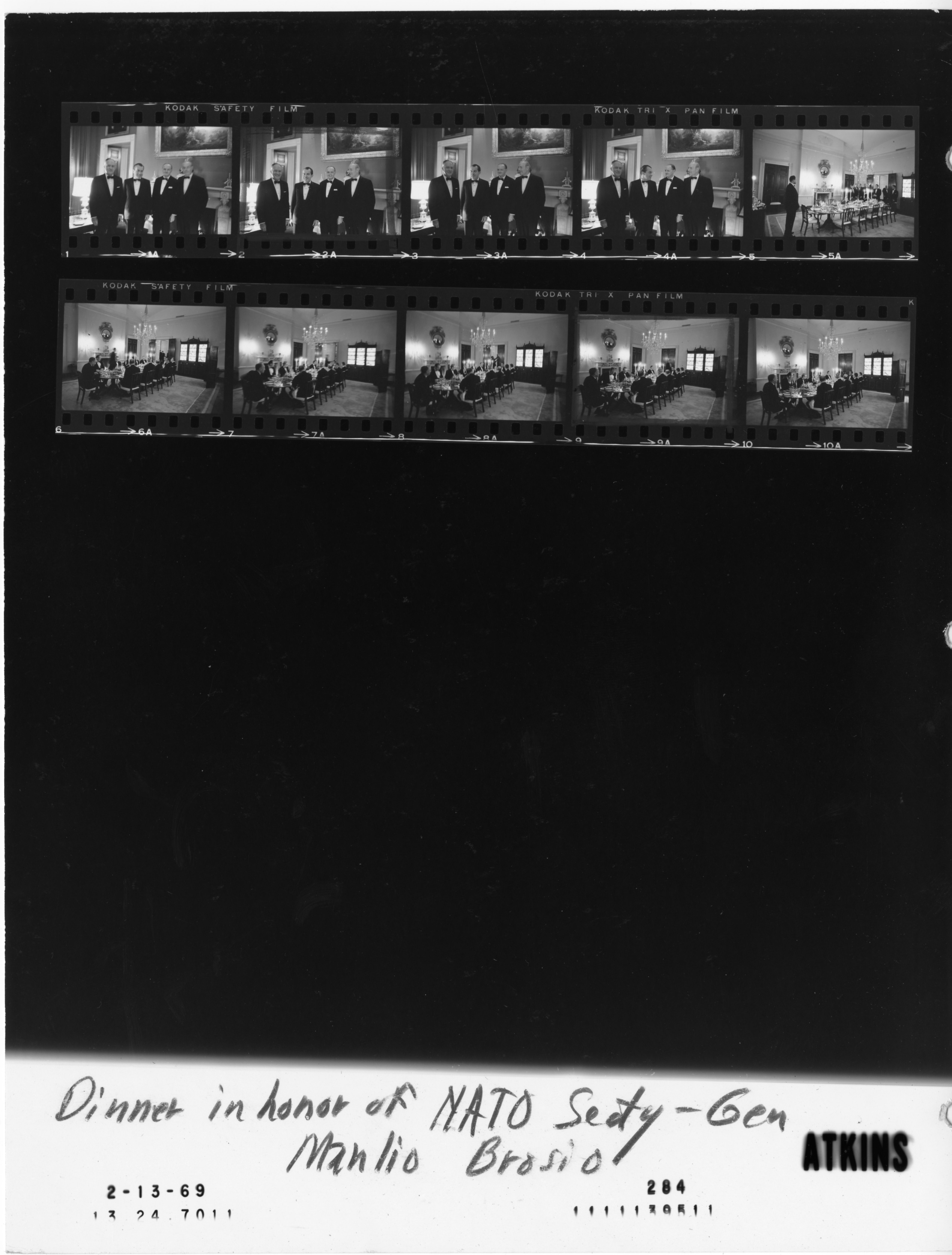
- Frame(s): WHPO-0284-01A-04A, President Nixon standing with Secretary of State William Rogers, NATO Secretary General Manlio Giovanni Brosio, and the Ambassador to NATO Harlan Cleveland, before a private dinner honoring Brosio. 2/13/1969, Washington, D.C. White House, Red Room and Family Dining Room. L-R: William Rogers, President Nixon, Manlio G. Brosio, Harlan Cleveland.
- Frame(s): WHPO-0284-05A, Two White House butlers (the nearest one probably is Eugene Allen) standing at either end of the dining table, while guests file in for President Nixon's private dinner honoring NATO Secretary General Manlio Brosio. 2/13/1969, Washington, D.C. White House, Red Room and Family Dining Room. President Nixon, William Rogers, Manlio G. Brosio, Harlan Cleveland, John M. Leddy, Melvin Laird , Maurice Stans, Dr. Arthur Burns, Henry Kissinger, Robert Ellsworth, Dr. Franklin Murphy, James A. Linen, unidentified butlers.
- Frame(s): WHPO-0284-05A-10A, President Nixon hosting a private dinner honoring NATO Secretary General Manlio Brosio. 2/13/1969, Washington, D.C. White House, Red Room and Family Dining Room. President Nixon, William Rogers, Manlio G. Brosio, Harlan Cleveland, John M. Leddy, Melvin Laird , Maurice Stans, Dr. Arthur Burns, Henry Kissinger, Robert Ellsworth, Dr. Franklin Murphy, James A. Linen.
The White House Communications Agency Sound Recordings Collection contains public statements that took place between 1969 and 1974. Visit the finding aid to learn more.
H - White House Staff Member Recordings
- WHCA-SR-H-005
Remarks of Lee DuBridge to the press. (2/13/1969, Indian Treaty Room, Executive Office Building)
Runtime: 36:00:00
Keywords: Press conferences, news conferences, interviews, media
Production credits: Audio feed supplied by CBS; Recorded by ADS (initials of WHCA engineer)
Original Format: 1/4-inch reel-to-reel audiotape. Original source type: Original.
P - Formal Presidential Remarks
- WHCA-SR-P-690216
Remarks by President Nixon at the Swearing In of Walter E. Washington as Mayor of the District of Columbia. (2/13/1969, East Room, White House)
Runtime: 4:45
Original Format: 1/4-inch reel-to-reel audiotape. Original source type: Original.
Context (External Sources)
The Vanderbilt Television News Archive is the world's most extensive and complete archive of television news. They have been recording, preserving and providing access to television news broadcasts of the national networks since August 5, 1968.
Wikipedia is a free encyclopedia that anyone can edit.