
Introduction
This almanac page for Saturday, December 5, 1970, pulls together various records created by the federal government and links to additional resources which can provide context about the events of the day.
Previous Date: Friday, December 4, 1970
Next Date: Sunday, December 6, 1970
Schedule and Public Documents
The Daily Diary files represent a consolidated record of the President's activities. Visit the finding aid to learn more.
The President's day began at The White House - Washington, D. C.
The Weekly Compilation of Presidential Documents made available transcripts of the President's news conferences; messages to Congress; public speeches, remarks, and statements; and other Presidential materials released by the White House.
Statements by the President
- The Supersonic Transport Program (6 Weekly Comp. Pres. Doc. 1630, December 5, 1970)
Statement by the President Urging Reversal of the Senate's Disapproval of the SST.
Each Public Papers of the Presidents volume contains the papers and speeches of the President of the United States that were issued by the White House Office of the Press Secretary during the time period specified by the volume. The material is presented in chronological order, and the dates shown in the headings are the dates of the documents or events. In instances when the release date differs from the date of the document itself, that fact is shown in the text note.
To ensure accuracy, remarks have been checked against audio recordings (when available) and signed documents have been checked against the original, unless otherwise noted. Editors have provided text notes and cross references for purposes of identification or clarity.
The Federal Register is the official daily publication for rules, proposed rules, and notices of federal agencies and organizations, as well as executive orders and other Presidential documents.
Archival Holdings
Any selection of archival documents will necessarily be partial. You should use the documents and folders identified below as a starting place, but consult the linked collection finding aids and folder title lists and the collections themselves for context. Many documents to be found this way do not lend themselves to association with specific dates, but are essential to a complete understanding of the material.
Selective document listing
President's Office Files
The President's Office Files consists of materials drawn together by the Special Files Unit from several administrative subdivisions within the White House Office. It is the handwriting and sensitive papers sent to the Staff Secretary that now comprise much of the President's Office Files. Visit the finding aid to learn more.
- Annotated News Summaries, Box 29, News Summaries - December 1970 [1 of 2]
- Annotated News Summaries, Box 29, News Summaries - December 1970 [2 of 2] [During this period, the Staff Secretary only removed pages from the News Summaries which contained President Nixon's handwriting, often leaving the document with no date. Although there are no specific documents with this date, you should also consult the full folder for the month.]
- President's Daily Schedule, Box 101, [President's Daily Schedule, Nov.-Dec. 1970] [2 of 3]
- The President's Schedule, Saturday - December 5, 1970
The H. R. Haldeman Diaries consists of seven handwritten diaries, 36 dictated diaries recorded as sound recordings, and two handwritten audio cassette tape subject logs. The diaries and logs reflect H. R. Haldeman’s candid personal record and reflections on events, issues, and people encountered during his service in the Nixon White House. As administrative assistant to the President and Chief of Staff, Haldeman attended and participated in public events and private meetings covering the entire scope of issues in which the Nixon White House engaged in during the years 1969-1973. Visit the finding aid to learn more.
- Transcript of diary entry (PDF)
Saturday, December 5.
President came in late. Spent the morning kind of cleaning up loose ends before he left for Camp David at 2:00. Got back on the writer thing as he analyzed last night and the speech, and wants Price really to go all out for a top speechwriter who can get mood and attitude across, and leave something for the audience to think about, establish some sense of leadership, move the audience, so people will walk out and say that's a great speech. He feels none of the writers we have now can move people. And that if we had a writer who could, he would do more speeches.
He discussed the press conference, and decided the best time to do it would be at 7:00, rather than prime time. His rationale is that you should only use prime time when there's a big issue up, not just for the routine periods, like this. The major interest in the press conference now is just the fact of his doing it. He thinks this is one that won't have any particular impact on people. We then talked about future plans, and he's thinking of doing an office-type press conference in January, since he'll be doing the State of the Union on television. And then probably a prime time press conference from the West or Midwest in February.
He got back on the Connally thing, and wants to be sure I get a hold of him tonight, and make the points just as he had covered them on the plane last night. We started in on the purge list, but Henry walked in, so we concentrated only on some of the specific problems of State, and then dropped the subject as President shifted to a meeting with Ehrlichman, Shultz, and Weinberger. He did first have Colson bring in the photographs and file on Teddy Kennedy's activities in Paris. President seemed to be pleased with the evidence we have on this and wants Colson to follow up on getting it out.
I finally got Connally on the phone at about 11:00 tonight, and interestingly enough, he seems to be favorably inclined towards taking the job. He was obviously pleased that I had called, and that I felt as strongly as I did about his taking it. He made the point that he wasn't interested in just being Secretary of Treasury or any other department, but he was very much impressed with what the President said about wanting his help on a broad basis and wanting to put him on the NSC.
He has the problem of personal finances, and will have to make extensive adjustments. He's apparently paying about $80,000 or $90,000 a year in interest now, so he'll have to divest himself to reduce the interest load. He said he'd try like hell to do this, because he recognized the importance of taking on the assignment. One of his concerns, although he felt it probably would not be a problem, was the flak we'd get from within the Republican Party, and the concern that they might waylay him at every corner. He's also concerned about the timing and whether he can divest and organize his financial things in time to meet the President's deadline of January 20. He had talked with his children tonight and with his wife, and found no negative block there. He's going to meet with his partner tomorrow. He wants to be sure in our mind—in his own mind—that he can make the contribution that the President wants. He recognizes the problem of no leadership in either of the Parties. He was highly pleased and delighted with the President's remarks to him, said he would do anything to help him, but wants to be sure he really can help by doing this. If he does do it, he'll do anything in his power to do it right.
End. - Original audio recording (MP3)
The National Archives Catalog is the online portal to the records held at the National Archives, and information about those records. It is the main way of describing our holdings and also provides access to electronic records and digitized versions of our holdings.
The Catalog searches across multiple National Archives resources at once, including archival descriptions, digitized and electronic records, authority records, and web pages from Archives.gov and the Presidential Libraries. The Catalog also allows users to contribute to digitized historical records through tagging and transcription.
Nixon Library Holdings
All National Archives Units
National Security Documents
The President's Daily Brief is the primary vehicle for summarizing the day-to-day sensitive intelligence and analysis, as well as late-breaking reports, for the White House on current and future national security issues. Read "The President's Daily Brief: Delivering Intelligence to Nixon and Ford" to learn more.
The Foreign Relations of the United States series presents the official documentary historical record of major U.S. foreign policy decisions and significant diplomatic activity. Visit the State Department website for more information.
Vol. XIX, Part 2, Japan, 1969-1972
December 1969-March 1971: Relations After the First Nixon-Sato Summit
63. Memorandum From the President’s Assistant for National Security Affairs (Kissinger) to Secretary of Defense Laird, Washington, December 5, 1970
Source: National Archives, Nixon Presidential Materials, NSC Files, Box 554, Country Files, Far East, Okinawa, Vol. I, 1969 and 1970. Secret; Eyes Only. Haig received this memorandum under a December 2 covering memorandum from Guhin. (Ibid.) Copies were sent to Davis, Behr, Kennedy, and Holdridge.
Vol. XXI, Chile, 1969-1973
Cool and Correct: The U.S. Response to the Allende Administration, November 5, 1970-December 31, 1972
186. Memorandum From Richard T. Kennedy and Arnold Nachmanoff of the National Security Council Staff to the President’s Assistant for National Security Affairs (Kissinger), Washington, December 5, 1970
Source: National Archives, Nixon Presidential Materials, NSC Files, NSC Institutional Files (H-Files), Box H–50, SRG Meeting, 12/7/70. Top Secret. Sent for information. Kissinger wrote, “I want Chilean media analysis,” at the top of the first page. To the right of that note, he wrote, “Options 1 + 2 in Paper 2 not commensurate. 1 talks of advocacy if req[uired], 2 talks exclusion now.” References throughout this memorandum to the “State Paper” and its Tabs are to a collection of papers prepared by the Ad Hoc Working Group on Chile pursuant to the November 19 SRG meeting (see Document 183). The tabs are papers on the Security Implications of Chile’s Participation in the Inter-American Defense Board (IADB); a Study of Options for U.S. Strategy Concerning Chile’s Future Participation in the Organization of American States; Legal Implications of Chilean Trade with Communist Countries; Plans for Congressional Consultations on U.S. Policy towards Chile—January 1971; Status Report on U.S. Actions to Discourage Further Resumptions of Relations with Cuba; Status Report on U.S. Stance on IDB Lending to Chile; Status Report on Restrictions on IBRD Lending to Chile; Status Report on Discussions with Export-Import Bank on Discontinuation of New Credits and Guarantees; and the U.S. Scientific Projects in Chile. (Ibid., National Security Study Memorandum 97)
Vol. XXXII, SALT I, 1969-1972
From Stalemate to Breakthrough, August 24, 1970-May 20, 1971
116. Memorandum From Helmut Sonnenfeldt of the National Security Council Staff to the President’s Assistant for National Security Affairs (Kissinger), Washington, December 5, 1970
Source: National Archives, Nixon Presidential Materials, NSC Files, NSC Institutional Files (H-Files), Box H–006, Verification Panel Meeting—SALT 12/8/70. Secret; Nodis. Sent for urgent information.
Vol. XXXVI, Energy Crisis, 1969-1974
March 10, 1970-April 2, 1971
64. Telegram From the Embassy in Libya to the Department of State, Tripoli, December 5, 1970, 0730Z
Source: National Archives, RG 59, Central Files 1970–73, PET 14 LIBYA. Secret; Limdis. Repeated to Algiers, Beirut, Benghazi, Caracas, Dhahran, Jidda, Kuwait, London, Paris, Rome, Tehran, and Vienna.
Vol. XXXIX, European Security
MBFR and the Conference on European Security, December 1970-December 1971
41. Memorandum From Secretary of State Rogers to President Nixon, Washington, December 5, 1970
Source: National Archives, RG 59, Conference Files, 1966–1972, Entry 3051B, Box 100, CF 482, Volume II, NATO Ministerial, Dec. 2–4. Confidential.
Vol. XLI, Western Europe; NATO, 1969-1972
Western Europe Region and NATO
56. Memorandum From Secretary of State Rogers to President Nixon, Washington, December 5, 1970
Source: National Archives, RG 59, Executive Secretariat, Conference Files, 1949–72, CF 479–482. Confidential. On December 19, Sonnenfeldt drafted a cover memorandum from Kissinger to Nixon, but a notation of January 2, 1971, reads: “OBE’d by HAK’s office. Memo did not go to President.” (Ibid., Nixon Presidential Materials, NSC Files, Box 260, Agency Files, NATO, Vol. IX)
Vol. E-10, Documents on American Republics, 1969-1972
Bolivia
96. Information Memorandum From the Acting Assistant Secretary for Inter-American Affairs (Crimmins) to the Acting Secretary (Irwin), Washington, December 5, 1970., Washington, December 5, 1970
Acting Assistant Secretary Crimmins argued that the U.S. Government should postpone tin sales for 90 days starting on December 7 in order to stabilize Bolivia’s economy and thus support General Torres’s inclinations towards political moderation.
Source: National Archives, RG 59, ARA Deputy Assistant Secretary, Subject and Country Files: Lot 73 D 353, JHC [John H. Crimmins] Chronological File, July, August, September 1970. Secret. Drafted by Freeman. Copies were sent to U, J, C, and D. The memorandum is an unsigned copy. Tab A, Telegram 6098 from La Paz, was not found. Attached but not printed at Tab B is the December 2 memorandum. In a July 24 memorandum to Rogers, Crimmins predicted that sales of the U.S. Government tin stockpile “might well push President Ovando to the left, away from the political center of gravity which he has been seeking, would present new opportunities for exploitation by the USSR.” (Ibid.)
Guyana
370. Telegram 1436 From the Embassy in Guyana to the Department of State, December 5, 1970, 1700Z., December 5, 1970, 1700Z
The Embassy discussed the upcoming negotiations between Guyana and ALCAN, and predicted an agreement would not be reached. Because the issue was very important to many Guyanese citizens, there was a possibility of large demonstrations, which could turn violent.
Source: National Archives, Nixon Presidential Materials, NSC Files, Box 785, Country Files, Latin America, Guyana, Vol. 1. Secret; Priority. Copies sent to Bridgetown, Caracas, Kingston, London, Ottawa, Port of Spain, USINCO POLAD, and Paramaribo UNN.
The Kissinger telephone conversation transcripts consist of approximately 20,000 pages of transcripts of Kissinger’s telephone conversations during his tenure as Assistant to the President for National Security Affairs (1969-1974) and Secretary of State (1973-1974) during the administration of President Richard Nixon. Visit the finding aid for more information.
Digitized versions can be found in the National Archives Catalog.
Audiovisual Holdings
The White House Photo Office collection consists of photographic coverage of President Richard Nixon meeting with prominent social, political, and cultural personalities; speaking engagements and news conferences of the President and various high-ranking members of the White House staff and Cabinet; Presidential domestic and foreign travel, including Presidential vacations; social events and entertainment involving the First Family, including entertainers present; official portraits of the President, First Family, and high-ranking members of the Nixon administration; the 1969 and 1973 Inaugurals; the President’s 1972 Presidential election campaign appearances (including speeches) and other official activities of the White House staff and the President’s Cabinet from January 20, 1969 until August 9, 1974 at the White House and the Old Executive Office Building; other locations in Washington, DC, such as The Mall; and the Presidential retreats in Camp David, Maryland, Key Biscayne, Florida, and San Clemente, California. Visit the finding aid to learn more.
Roll WHPO-5216 Photographer: Atkins, Oliver | Color or B&W: B&W
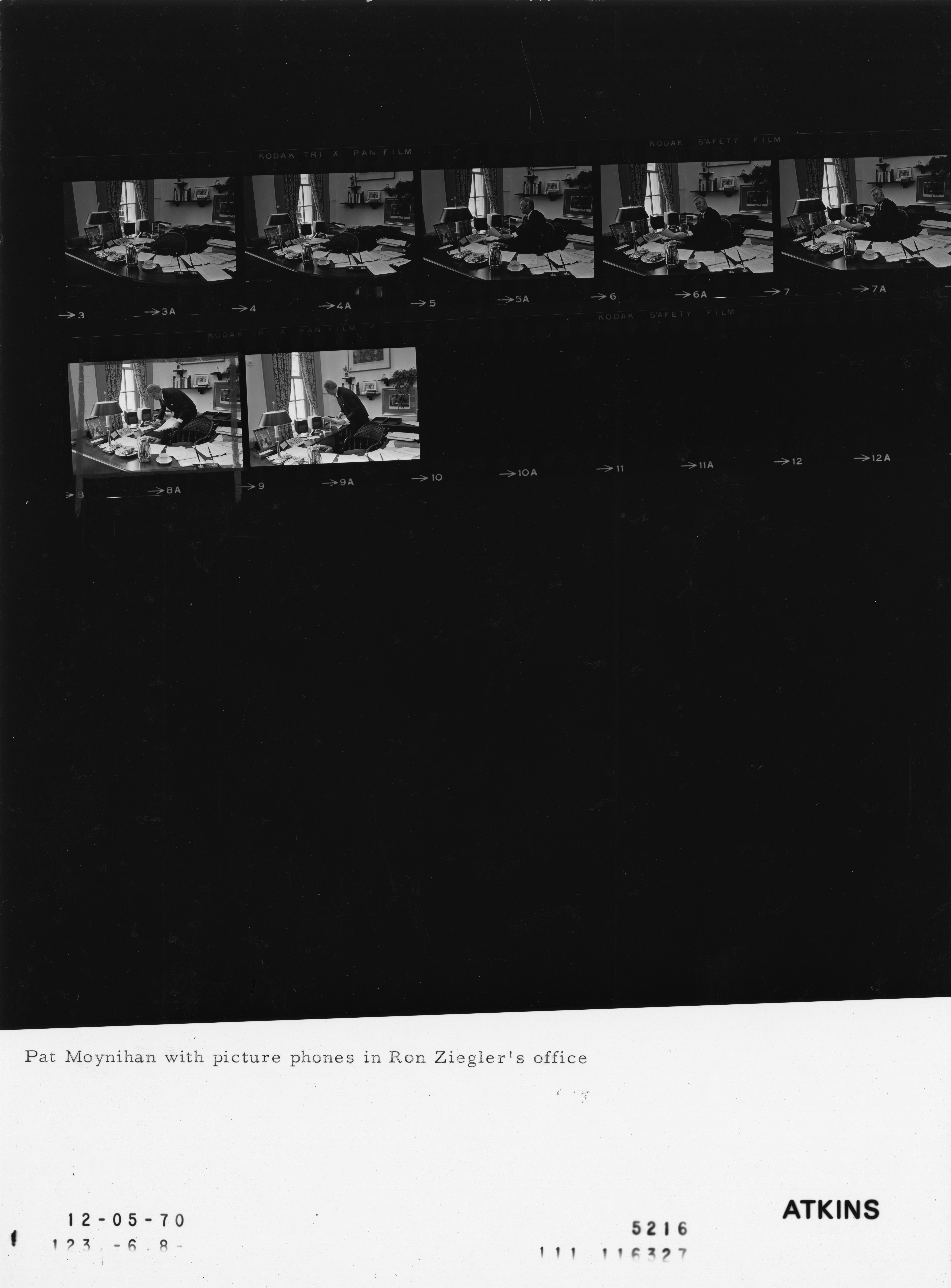
- Frame(s): WHPO-5216-03-09, Daniel Patrick Moynihan with picture phones in Ron Ziegler's office. 12/5/1970, Washington, D.C. White House. Daniel Patrick Moynihan.
Roll WHPO-5217 Photographer: Atkins, Oliver | Color or B&W: B&W
- Frame(s): WHPO-5217-01A-06A, President Nixon leaving White House for Camp David. 12/5/1970, Washington, D.C. White House, exterior. President Nixon, unidentified Marine.
Roll WHPO-5218 Photographer: Kightlinger, Jack | Color or B&W: B&W
- Frame(s): WHPO-5218-05-15, George Bell and group on staircase outside White House during a presentation. 12/5/1970, Washington, D.C. White House, exterior. George Bell, unidentified group.
The White House Communications Agency Sound Recordings Collection contains public statements that took place between 1969 and 1974. Visit the finding aid to learn more.
B - Vice-Presidential (Agnew and Ford)
- WHCA-SR-B-162
Speech-New Orleans, Louisiana. (12/5/1970)
Runtime: 29:15:00
Original Format: 1/4-inch reel-to-reel audiotape. Original source type: Original.
The White House Communications Agency Videotape Collection contains “off-the-air” recordings of televised programs produced between 1968 and 1974. Visit the finding aid to learn more.
- WHCA-4028
Weekly News Summary - Tape I.
All networks
Runtime: 1:00
1. Brinkley: President Nixon applies pressure to oil and construction industries; Mansfield recommends Nixon work with democrats. Time Code Start: 00:01:00. Keywords: energy crisis, petroleum, oil supply, gasoline, fuel, shortages, rationing. Network: NBC.
2. Chancellor: President Nixon urges restoration of funding for supersonic transports (SST) after funding rejected. Time Code Start: 00:01:58. Keywords: Supersonic Transport, SST, aircraft, subsonic airliners, Congress, funding, bills, rejections. Network: NBC.
3. Chancellor/Burrington: Secretary of Defense Laird returns from NATO conference; Secretary of State Rogers: U.S. and NATO allies agree to negotiate with the Soviet Union; denies a military approach but will not look weak; renewed distrust with Soviet Union. Time Code Start: 00:02:14. Keywords: N.A.T.O., North Atlantic Treaty Organization, Europe, military, conferences, negotiations, Russia, Soviet Union, USSR. Network: NBC.
4. Mudd/Serafin: President Nixon reacts to Senate rejection of SSTs: says rejection will cause a loss of jobs, a blow to US aerospace industry, and major financial losses; opponents confident that House will not pass SST bill. Time Code Start: 00:05:02. Keywords: Supersonic Transport, SST, aircraft, subsonic airliners, Congress, funding, bills, rejections. Network: CBS.
5. Mudd/Rather: Senator Mansfield urges President Nixon to set wage and price controls, econony will be major issue, Nixon's NYC speech to National Association of Manufacturers on the economy: says worst of inflation is over, government has done its part in . Time Code Start: 00:06:30. Keywords: Presidents, speeches, economy, economics, inflation, money, wages, costs, unemployment, employees, salaries, salary, payments, freezes, controls. Network: CBS.
6. Mudd/Schoumacher: controversial trade bill in Congress; Senator Percy comments: we have to adjust to foreign competition; Senator Thurmond comments: duty of the government to protect the people; public fears they will be hurt by new trading regulations . Time Code Start: 00:09:40. Keywords: Senate, bills, voting, trade regulation. Network: CBS.
7. Mudd: Residents of Colerain Ohio worried strip-mine operators will open unmarked graves of millhouses, including Nixon's ancestors. Time Code Start: 00:10:52. Keywords: Presidents, families, graveyards, cemetery, mining, criticisms. Network: CBS.
Context (External Sources)
The Vanderbilt Television News Archive is the world's most extensive and complete archive of television news. They have been recording, preserving and providing access to television news broadcasts of the national networks since August 5, 1968.
Wikipedia is a free encyclopedia that anyone can edit.