
Introduction
This almanac page for Thursday, December 31, 1970, pulls together various records created by the federal government and links to additional resources which can provide context about the events of the day.
Previous Date: Wednesday, December 30, 1970
Next Date: Friday, January 1, 1971
Schedule and Public Documents
The Daily Diary files represent a consolidated record of the President's activities. Visit the finding aid to learn more.
The President's day began at The White House - Washington, D. C.
The Weekly Compilation of Presidential Documents made available transcripts of the President's news conferences; messages to Congress; public speeches, remarks, and statements; and other Presidential materials released by the White House.
Bill Signings
- International Financial Institutions Bill (7 Weekly Comp. Pres. Doc. 10, December 31, 1970)
Statement by the President on Signing the Bill Into Law. - Clean Air Amendments of 1970 (7 Weekly Comp. Pres. Doc. 11, December 31, 1970)
The President's Remarks Upon Signing the Bill Into Law. - Disaster Relief Act of 1970 (7 Weekly Comp. Pres. Doc. 12, December 31, 1970)
Statement by the President Upon Signing the Bill Into Law.
Executive Orders
- Disaster Relief Act of 1970 (7 Weekly Comp. Pres. Doc. 12, December 31, 1970)
Executive Order 11575.
Proclamations
- Imports of Dairy Products (7 Weekly Comp. Pres. Doc. 8, December 31, 1970)
Proclamation 4026.
Statements by the President
- Coal Mine Disaster in Kentucky (7 Weekly Comp. Pres. Doc. 10, December 31, 1970)
Statement by the President.
Acts Approved by the President
- H.J. Res. 1162 -- Public Law 91-632
Joint Resolution to amend Public Law 403, Eightieth Congress, of January 28, 1948, providing for membership and participation by the United States in the South Pacific Commission. - H.J. Res. 1417 -- Public Law 91-602
Joint Resolution extending the dates for transmission to the Congress of the President's Economic Report and of the report of the Joint Economic Committee. - H.R. 212 -- Public Law 91-621
An Act to clarify the status and benefits of commissioned officers of the National Oceanic and Atmospheric Administration, and for other purposes. - H.R. 380 -- Public Law 91-627
An Act to amend section 7 of the Act of August 9, 1946 (60 Stat. 968). - H.R. 956 -- Public Law 91-608
An Act to rename a lock of the Cross-Florida Barge Canal the "Henry Holland Buckman lock." - H.R. 3107 -- Public Law 91-640
An Act to officially designate the Totten Trail Pumping Station. - H.R. 4982 -- Private Law 91-224
An Act for the relief of Thomas J. Beck. - H.R. 4983 -- Private Law 91-225
An Act for the relief of James M. Buster. - H.R. 6049 -- Public Law 91-613
An Act to amend the definition of "metal bearing ores" in the Tariff Schedules of the United States. - H.R. 6100 -- Private Law 91-226
An Act for the relief of Hershel Smith, publisher of the Lindsay News, of Lindsay, Oklahoma. - H.R. 6114 -- Public Law 91-612
An Act for the relief of Elmer M. Grade and for other purposes. - H.R. 6400 -- Private Law 91-223
An Act for the relief of Reddick B. Still, Junior, and Richard Carpenter. - H.R. 6778 -- Public Law 91-607
Bank Holding Company Act Amendments of 1970. - H.R. 6854 -- Private Law 91-227
An Act to provide for the free entry of a peal of eight bells and fittings for use of Smith College, Northampton, Massachusetts. - H.R. 7264 -- Private Law 91-228
An Act for the relief of Mrs. Pearl C. Davis. - H.R. 7334 -- Public Law 91-625
An Act to designate the lake formed by the waters impounded by the Libby Dam, Montana, as "Lake Koocanusa". - H.R. 8933 -- Public Law 91-636
An Act to provide that the lock and dam referred to as the "Jackson lock and dam" on the Tombigbee River, Alabama, shall hereafter be known as the Coffeeville lock and dam. - H.R. 9183 -- Public Law 91-615
An Act to amend the Tariff Schedules of the United States to provide that imported articles which are exported and thereafter reimported to the United States for failure to meet sample or specifications shall, in certain instances, be entered free of duty upon such reimportation. - H.R. 10150 -- Private Law 91-229
An Act for the relief of certain individuals employed by the Department of the Air Force at Kelly Air Force Base, Texas. - H.R. 10704 -- Private Law 91-230
An Act for the relief of Samuel R. Stephenson. - H.R. 11547 -- Public Law 91-620
An Act to amend the Consolidated Farmers Home Administration Act of 1961, as amended, to increase the loan limitation on certain loans. - H.R. 12128 -- Private Law 91-231
An Act for the relief of William Heidman, Junior. - H.R. 12564 -- Public Law 91-637
An Act to rename a pool of the Cross Florida Barge Canal "Lake Ocklawaha". - H.R. 12621 -- Private Law 91-232
An Act for the relief of Lieutenant Robert J. Scanlon. - H.R. 13182 -- Private Law 91-233
An Act for the relief of Frank E. Dart. - H.R. 13676 -- Private Law 91-234
An Act for the relief of certain retired officers of the Army, Navy, and Air Force. - H.R. 13806 -- Private Law 91-235
An Act for the relief of Irwin Katz. - H.R. 13862 -- Public Law 91-638
An Act to authorize the naming of the reservoir to be created by the Little Goose lock and dam, Snake River, Washington, in honor of the late Doctor Enoch A. Bryan. - H.R. 14271 -- Private Law 91-236
An Act for the relief of Jack A. Duggins. - H.R. 14683 -- Public Law 91-628
An Act to designate as the John H. Overton Lock and Dam the lock and dam authorized to be constructed on the Red River near Alexandria, Louisiana. - H.R. 15270 -- Private Law 91-237
An Act for the relief of Thaddeus J. Pawlak. - H.R. 15272 -- Private Law 91-238
An Act for the relief of David L. Kennison. - H.R. 15505 -- Private Law 91-239
An Act for the relief of Jack B. Smith and Charles N. Martin, Junior. - H.R. 15549 -- Public Law 91-603
Seamen's Service Act. - H.R. 15979 -- Public Law 91-617
An Act to provide that the interest on certain Insured loans sold out of the Agricultural Credit Insurance Fund shall be included in gross income. - H.R. 16199 -- Public Law 91-614
Excise, Estate, and Gift Tax Adjustment Act of 1970. - H.R. 16502 -- Private Law 91-240
An Act for the relief of Gary W. Stewart. - H.R. 16506 -- Public Law 91-618
An Act to amend the Internal Revenue Code of 1954 to clarify the applicability of the exemption from income taxation of cemetery corporations. - H.R. 16940 -- Public Law 91-635
An Act to extend until December 31, 1972, the suspension of duty on electrodes for use in producing aluminum. - H.R. 16965 -- Private Law 91-241
An Act for the relief of Richard N. Stanford. - H.R. 17255 -- Public Law 91-604
Clean Air Amendments of 1970. - H.R. 17473 -- Public Law 91-642
An Act to extend the period for filing certain manufacturers claims for floor stocks refunds under section 209(b) of the Excise Tax Reduction Act of 1965, and for other purposes. - H.R. 17750 -- Public Law 91-624
An Act to grant the consent of Congress to the city of Boston to construct, maintain, and operate a causeway and fixed-span bridge in Fort Point Channel, Boston, Massachusetts. - H.R. 17867 -- Public Law 91-619
Foreign Assistance and Related Programs Appropriation Act, 1971. - H.R. 18858 -- Public Law 91-639
An Act to change the name of the West Branch Dam and Reservoir, Mahoning River, Ohio, to the Michael J. Kirwan Dam and Reservoir. - H.R. 19401 -- Public Law 91-610
An Act to extend for one additional year the authorization for programs under the Vocational Rehabilitation Act. - H.R. 19436 -- Public Law 91-609
Housing and Urban Development Act of 1970. - H.R. 19504 -- Public Law 91-605
An Act to authorize appropriations for the construction of certain highways in accordance with title 23 of the United States Code, and for other purposes. - H.R. 19855 -- Public Law 91-634
An Act to designate the lake formed by the waters impounded by the Butler Valley Dam, California, as "Blue Lake". - H.R. 19877 -- Public Law 91-611
An Act authorizing the construction, repair, and preservation of certain public works on rivers and harbors for navigation, flood control, and for other purposes. - H.R. 19890 -- Public Law 91-633
An Act to name a Federal building in Memphis, Tennessee, for the late Clifford Davis. - S. 704 -- Public Law 91-629
An Act to amend the Act of October 15, 1966 (80 Stat. 953; 20 U.S.C. 65a), relating to the National Museum of the Smithsonian Institution so as to authorize additional appropriations to the Smithsonian Institution for carrying out the purposes of said Act. - S. 719 -- Public Law 91-631
Mining and Minerals Policy Act of 1970. - S. 2102 -- Private Law 91-242
An Act for the relief of Percy Ispas Avram. - S. 2984 -- Public Law 91-630
An Act to permit certain Federal employment to be counted toward retirement. - S. 3619 -- Public Law 91-606
Disaster Relief Act of 1970. - S. 3835 -- Public Law 91-616
Comprehensive Alcohol Abuse and Alcoholism Prevention, Treatment, and Rehabilitation Act of 1970. - S. 4106 -- Public Law 91-623
Emergency Health Personnel Act of 1970. - S. 4571 -- Public Law 91-626
An Act to amend the Central Intelligence Agency Retirement Act of 1964 for Certain Employees, as amended, and for other purposes. - S.J. Res. 173 -- Public Law 91-622
Joint Resolution authorizing a grant to defray a portion of the cost of expanding the United Nations headquarters in the United States. - S.J. Res. 249 -- Public Law 91-641
Joint Resolution to extend the time for the proclamation of marketing quotas for burley tobacco for the three marketing years beginning October 1, 1971.
Checklist of White House Press Releases
The releases listed below, made public by the Office of the White House Press Secretary during the period covered by this issue, are not included in the issue.
- Press conference of Russell E. Train, Chairman, Council on Environmental Quality, and William D. Ruckelshaus, Administrator, Environmental Protection Agency, on the Clean Air Amendments of 1970.
Digest of Other White House Announcements
Following is a listing of items of general interest which were announced in the press but not made public as formal White House press releases during the period covered by this issue. Appointments requiring Senate approval are not included since they appear in the list of nominations submitted to the Senate, below.
- Retiring Senator John J. Williams of Delaware breakfasted with the President at the White House.
- Archbishop Luigi Raimondi, the Apostolic Delegate, called on the President at the White House to present a copy of the Pope's New Year's Day message in celebration of peace.
Each Public Papers of the Presidents volume contains the papers and speeches of the President of the United States that were issued by the White House Office of the Press Secretary during the time period specified by the volume. The material is presented in chronological order, and the dates shown in the headings are the dates of the documents or events. In instances when the release date differs from the date of the document itself, that fact is shown in the text note.
To ensure accuracy, remarks have been checked against audio recordings (when available) and signed documents have been checked against the original, unless otherwise noted. Editors have provided text notes and cross references for purposes of identification or clarity.
- Statement on Signing the International Financial Institutions Bill.
- Statement on the Coal Mine Disaster in Kentucky.
- Remarks on Signing the Clean Air Amendments of 1970.
- Statement on Signing the Disaster Relief Act of 1970.
- Executive Order 11575—Providing for the Administration of the Disaster Relief Act of 1970
- Proclamation 4026—Proclamation Amending and Correcting Part 3 of the Appendix to the Tariff Schedules of the United States With Respect to the Importation of Agricultural Commodities
The Federal Register is the official daily publication for rules, proposed rules, and notices of federal agencies and organizations, as well as executive orders and other Presidential documents.
The Congressional Record is the official daily record of the debates and proceedings of the U.S. Congress.
Archival Holdings
Any selection of archival documents will necessarily be partial. You should use the documents and folders identified below as a starting place, but consult the linked collection finding aids and folder title lists and the collections themselves for context. Many documents to be found this way do not lend themselves to association with specific dates, but are essential to a complete understanding of the material.
Selective document listing
President's Office Files
The President's Office Files consists of materials drawn together by the Special Files Unit from several administrative subdivisions within the White House Office. It is the handwriting and sensitive papers sent to the Staff Secretary that now comprise much of the President's Office Files. Visit the finding aid to learn more.
- Annotated News Summaries, Box 29, News Summaries - December 1970 [1 of 2] [During this period, the Staff Secretary only removed pages from the News Summaries which contained President Nixon's handwriting, often leaving the document with no date. In addition to the individual document(s) listed below, you should also consult the full folder for the month.]
- [12/31/70]
- Annotated News Summaries, Box 29, News Summaries - December 1970 [2 of 2]
- [12/31/70]
- President's Daily Schedule, Box 101, [President's Daily Schedule, Nov.-Dec. 1970] [3 of 3]
- The President's Schedule, Thursday - December 31, 1970
President's Personal File
The President's Personal File is essentially a President's secretary's file, kept by Rose Mary Woods, personal secretary to the President, for two purposes: (1) preserving for posterity a collection of documents particularly close to the President, whether because he dictated or annotated them, or because of the importance of the correspondent or the event concerned and (2) giving appropriate attention–letters of gratitude, invitations to White House social events, and the like–to members and important friends and supporters of the Nixon administration. This generalization does not describe all the varied materials of a file group which is essentially a miscellany, but it does identify the reason for the existence of the file group's core. Visit the finding aid to learn more.
- President's Speech File
- Box 63, December 31, 1970, Clean Air Act
Among Pat Buchanan’s duties was the compilation and coordination of background briefing materials for Presidential and a few Vice Presidential press conferences. The briefings—for both the larger, announced press conferences and the smaller, informal ones held in the Oval Office—related to a widespread number of topics and were in the form of probable questions which the White House staff members anticipated news reporters would address to the President. Along with the questions, were answers recommended by Buchanan, other members of the White House staff, and the heads of major departments of the government.
The briefing books are primarily in the form of potential questions and suggested answers (often with heavy annotation by President Nixon), along with associated memos. A listing of briefing books is below, with indication of whether President Nixon annotated the book or not. Each book has an index to the potential questions with direct links to the National Archives Catalog. You should consult the full digital folder for suggested responses, President Nixon's annotations, and other documents and topics not covered by the index.
DOMESTIC BRIEFING BOOK December 31, 1970 I (Annotated)
Citation: DOMESTIC BRIEFING BOOK December 31, 1970 I; box 2; White House Central Files: Staff Member and Office Files: Patrick J. Buchanan; Richard Nixon Presidential Library and Museum, Yorba Linda, CA
Consult the full digital folder for other briefing materials not in the form of prepared questions and answers.
- PRESIDENCY
- In your address on the Presidency in 1968, you said the "next President must unite America. He must calm its angers, ease its terrible frictions, and bring its people together once again in peace and mutual respect." Do you think the campaign of 1970 helped to contribute to that.
- In your address on the Presidency, you said you believed in a "system in which the appropriate Cabinet officer gets credit for what goes right, and the President takes the blame for what goes wrong." Does that still apply in light of the departure of Secretary Hickel?
- FIRST TWO YEARS
- POLITICS - THE YEAR AHEAD
- 1972 ISSUES
- "BRING US TOGETHER"
- CAMPAIGN TACTICS
- IF BOMBING IS RENEWED
- RNC CHAIRMAN, CABINET, STAFF
- MOVE TO THE RIGHT
- VICE PRESIDENT ON THE MEDIA
- MORE PRESS CONFERENCES
- TV CONVERSATION
- FOOD STAMP BILL
- THE PRESIDENT & THE BLACK COMMUNITY
- WHITNEY YOUNG
- GHETTOES AND SUBURBS
- ECONOMY
- BICENTENNIAL YEAR
- J. EDGAR HOOVER
- VALUE-ADDED TAX
- NEW IMAGE
- TRADE LEGISLATION
- EGYPT
- RECENT HANOI MOVES IN PARIS
- SALT
- ECONOMIC BRIEFING
- VALUE ADDED TAX
The H. R. Haldeman Diaries consists of seven handwritten diaries, 36 dictated diaries recorded as sound recordings, and two handwritten audio cassette tape subject logs. The diaries and logs reflect H. R. Haldeman’s candid personal record and reflections on events, issues, and people encountered during his service in the Nixon White House. As administrative assistant to the President and Chief of Staff, Haldeman attended and participated in public events and private meetings covering the entire scope of issues in which the Nixon White House engaged in during the years 1969-1973. Visit the finding aid to learn more.
- Transcript of diary entry (PDF)
Thursday, December 31st. The President called me late last night at home to say that he had decided, if possible, he wanted to go to Kentucky to visit the mine disaster, he hasn't, that occurred yesterday afternoon killing 39 people. I did some calling to see if we could set it up, and we agreed to wait until today to decide. He had a breakfast with Senator Williams, and then he came over to the office and decided to follow my recommendation not to go to Kentucky, although he still really wanted to go. The talking point we used to have him cancel the trip was the fact that the airports were snowed in. Without that, I think he probably would have gone. We felt he shouldn't go because it appeared to be a grandstanding move, since the disaster wasn't really great enough to warrant a Presidential trip and hadn't gotten that big a play in the news. The President did call Louie Nunn and asked him to express the Presidential concern and the fact that the President intended to come but couldn't because of the airport situation. He also had some points to cover with Nunn regarding the Governors' Conference and his appointment today with Marlow Cook, regarding his trying for the job of Campaign Chairman in the Senate. And he discussed with Nunn the question of Agnew handling the whole job of contacts with the Governors and the President's concern that Agnew needs a big man with him who can carry out things on this assignment. He asked Nunn to talk with the Vice President about this.
We had a flap with Teddy Kennedy, who is trying to capitalize on the decision of the Spanish government to commute the death sentences of some Basques. Teddy is going to put out the fact that he had wired the Spanish government before the decision and was wiring them his approval after the decision.
------------------------------------------------------------------------------------------------
DECLASSIFIED - E.O. 13526, Sect. 3.4: by MS, NARA, June 12, 2013
Audio Cassette 2, Side B, Withdrawn Item Number 10 [AC-2(B) Sel 6]
Duration: 32 seconds
The fact of the matter is, that we had intervened and our intervention had been helpful in the case, but it was greatly appreciated by the Spanish government, because we had not put it out in any way, shape, or form. So, now Teddy's going to come along and try to capitalize on it. This is sort of typical, and creates a problem, but we're just going to let it ride, because the Spanish government would be extremely upset if we tried to do anything about it. They're furious with Teddy and maybe they'll say something.
------------------------------------------------------------------------------------------------
The President got into some guidance for the Monday television conversation. He now doesn't want to have any restrictions, wants to make it clear that they can raise any questions they want, that we're not trying to direct the press in any way; but, that for their guidance, he won't comment on partisan political questions of any kind, because that's not a proper use of public service time. Other than that, there's no restriction at all.
The PR item of the day was an article by Evans and Novak that blasted us for, our, a lot of the positions we've been taking and made a big deal out of the fact that there is strong Republican opposition to the Administration. The President was disturbed by this and wants to get some careful analysis, both of who's cutting us up and the degree of validity of the report, because he feels there may be something to it.
I had a meeting with Bill Rogers regarding ambassadorial and other personnel changes, and then we went in and talked with the President briefly. The President used most of his time with Bill to discuss some - his views on the whole PR area rather than getting into the personnel things Bill wanted to cover. The President had to, call, cut the meeting short because he had a bill signing, so we never really got into the things we were supposed to be discussing.
The President spent most of the afternoon over at the EOB. He told Ziegler not to let the press leave because, as long as he was working, they might as well too. So Ron didn't put a lid on and some of the press had to stay around. At 6:00 the President called Ron and told him to bring whatever press was left, and there were only about six, over to the EOB for a drink. And this apparently worked out pretty well. The President gave them about a 40 minute Q and A session standing up. It was kind of funny when they walked in, Frank Cormier and Helen Thomas and Herb Kaplow were the only reporters plus a couple of photographers and a radio technician. Helen Thomas, while the President was mixing the martinis in his little bar, said, now I know why you spend so much time at the EOB office. The President apparently did make a number of pretty good points to these people. Ziegler was particularly amused by his statement that I, and the other key members of the staff, had the highest IQ's of any White House staff people at least since Roosevelt, and that, as a group, Ehrlichman, Shultz, Rum--, Weinberger, and I were the most brilliant White House staff in history, intellectually. Ron, for some reason, thought that was very funny.
The President called me later at home wanting to be sure that Ziegler was getting across the importance of this little meeting with the press, the fact that he just called them over and handled it on an informal basis and the subtlety of this as a special event. Ron's working to peddle it and we'll see what we can get going. The President also wanted to be sure we got the poll information out. Our latest telephone poll shows his popularity back up to 60 percent. The last poll, taken the 1st of December, had him down to 55. This appears to me to be a direct result of the press conference and the visibility gained therefrom. We're going to do another poll next week after the conversation, and I would guess he'll go up another couple of points, not much more than that, but, because he's pretty high, but I think he will gain some.
End of December 31st. - Original audio recording (MP3)
The National Archives Catalog is the online portal to the records held at the National Archives, and information about those records. It is the main way of describing our holdings and also provides access to electronic records and digitized versions of our holdings.
The Catalog searches across multiple National Archives resources at once, including archival descriptions, digitized and electronic records, authority records, and web pages from Archives.gov and the Presidential Libraries. The Catalog also allows users to contribute to digitized historical records through tagging and transcription.
Nixon Library Holdings
All National Archives Units
National Security Documents
The President's Daily Brief is the primary vehicle for summarizing the day-to-day sensitive intelligence and analysis, as well as late-breaking reports, for the White House on current and future national security issues. Read "The President's Daily Brief: Delivering Intelligence to Nixon and Ford" to learn more.
The Foreign Relations of the United States series presents the official documentary historical record of major U.S. foreign policy decisions and significant diplomatic activity. Visit the State Department website for more information.
Vol. XL, Germany and Berlin, 1969-1972
Germany and Berlin, 1969-1972
157. Memorandum From William Hyland of the National Security Council Staff to the President’s Assistant for National Security Affairs (Kissinger), Washington, December 31, 1970
Source: National Archives, Nixon Presidential Materials, NSC Files, Box 685, Country Files, Europe, Germany, Vol. VIII. Secret; Limdis. Sent for information. Kissinger initialed the memorandum indicating that he had seen it.
158. Letter From President Nixon to German Chancellor Brandt, Washington, December 31, 1970
Source: National Archives, RG 59, Central Files 1970–73, POL GER W–US. No classification marking. Although no drafting information appears on the letter, Rogers attached the text to a December 23 memorandum for the President. (Ibid.) Kissinger forwarded both in a December 30 memorandum to Nixon (see footnote 3 below). On January 4 the Department pouched the letter to the Embassy for delivery and transmitted the text by telegram. (Telegram 629 to Bonn, January 4; National Archives, RG 59, Central Files 1970–73, POL GER W–US) In telegram 84 from Bonn, January 5, Fessenden reported delivering the letter that morning to Bahr, who said he would forward it to Brandt on vacation in Kenya. According to Fessenden, “Bahr read the letter quickly and was obviously pleased with its contents. He noted particularly the favorable comments on the Warsaw Treaty and the comments on future procedure for the Berlin talks, which he said was generally in line with German views.” (Ibid.) See also Dokumente zur Deutschlandpolitik, 1969–1970, Nr. 265, pp. 1038–39.
Vol. E-1, Documents on Global Issues, 1969-1972
U.S. Policy Towards Terrorism, Hijacking of Aircraft, and Attacks on Civil Aviation: Policy Towards Kidnapping of U.S. Officials Abroad, April 1970-April 1971
43. Position Paper Prepared in the Department of State, Washington, December 31, 1970
The position paper was written for the special Organization of American States meeting on kidnapping and other criminal acts against diplomats and officials abroad.
Source: National Archives, RG 59, Central Files 1970-73, POL 23-8. Confidential. Attached but not published were Tabs A and B.
Vol. E-5, Part 2, Documents on North Africa, 1969-1972
Libya
69. Briefing Memorandum From the Acting Deputy Assistant Secretary of State for African Affairs (Moore) to Secretary of State Rogers, Washington, December 31, 1970
Moore submitted to Rogers an action memorandum on the various views within the administration on F–5 sales to Libya.
Source: National Archives, RG 59, Central Files 1970–73, DEF 12–5 LIBYA. Secret. The paper was drafted by Blake, and cleared by PM/MAS, NEA, and H. In telegram 196791 to Tripoli, Tunis, and USCINCEUR, December 9, the Department explained that it saw no way to deliver the F–5s to Libya for later transfer to a third party. (Ibid.)
The Kissinger telephone conversation transcripts consist of approximately 20,000 pages of transcripts of Kissinger’s telephone conversations during his tenure as Assistant to the President for National Security Affairs (1969-1974) and Secretary of State (1973-1974) during the administration of President Richard Nixon. Visit the finding aid for more information.
Digitized versions can be found in the National Archives Catalog.
Audiovisual Holdings
The White House Photo Office collection consists of photographic coverage of President Richard Nixon meeting with prominent social, political, and cultural personalities; speaking engagements and news conferences of the President and various high-ranking members of the White House staff and Cabinet; Presidential domestic and foreign travel, including Presidential vacations; social events and entertainment involving the First Family, including entertainers present; official portraits of the President, First Family, and high-ranking members of the Nixon administration; the 1969 and 1973 Inaugurals; the President’s 1972 Presidential election campaign appearances (including speeches) and other official activities of the White House staff and the President’s Cabinet from January 20, 1969 until August 9, 1974 at the White House and the Old Executive Office Building; other locations in Washington, DC, such as The Mall; and the Presidential retreats in Camp David, Maryland, Key Biscayne, Florida, and San Clemente, California. Visit the finding aid to learn more.
Roll WHPO-5421 Photographer: Schumaker, Byron | Color or B&W: B&W
- Frame(s): WHPO-5421-02A-18A, President Nixon signing the Clean Air Act of 1970, enacted to reduce air pollution and protect air quality. As enacted, the bill (H.R. 17255) is Public Law 91-604 (84 Stat. 1676). Also known as the Clean Air Amendments of 1970. 12/31/1970, Washington, D.C. White House, Roosevelt Room. President Nixon, Russell Train, William Ruckelshaus, Sen. Jennings Randolph, Sen. John Sherman Cooper, Rep. William Springer, unidentified persons.
- Frame(s): WHPO-5421-10A/11, President Nixon signing the Clean Air Act of 1970, enacted to reduce air pollution and protect air quality. As enacted, the bill (H.R. 17255) is Public Law 91-604 (84 Stat. 1676). Also known as the Clean Air Amendments of 1970. 12/31/1970, Washington, D.C. White House, Roosevelt Room. President Nixon, Russell Train, William Ruckelshaus.
- Frame(s): WHPO-5421-11, President Nixon signing the Clean Air Act of 1970, enacted to reduce air pollution and protect air quality. As enacted, the bill (H.R. 17255) is Public Law 91-604 (84 Stat. 1676). Also known as the Clean Air Amendments of 1970. 12/31/1970, Washington, D.C. White House, Roosevelt Room. President Nixon, Russell Train, William Ruckelshaus.
- Frame(s): WHPO-5421-19A-21A, President Nixon standing at his Oval Office desk talking with Papal Nuncio Archbishop Luigi Raimondi, Vatican Apostolic Delegate to the United States. 12/31/1970, Washington, D.C. White House, Oval Office. President Nixon, Archbishop Luigi Raimondi.
Roll WHPO-5422 Photographer: Schumaker, Byron | Color or B&W: B&W
- Frame(s): WHPO-5422-04-07, President Nixon and Russell Train at the signing of the Clean Air Amendments Bill. As enacted, the bill (H.R. 17255) is Public Law 91-604 (84 Stat. 1676). 12/31/1970, Washington, D.C. White House, Roosevelt Room. President Nixon, Russell Train.
- Frame(s): WHPO-5422-11-19, President Nixon standing at his Oval Office desk talking with Papal Nuncio Archbishop Luigi Raimondi, Vatican Apostolic Delegate to the United States. 12/31/1970, Washington, D.C. White House, Oval Office. President Nixon, Archbishop Luigi Raimondi.
- Frame(s): WHPO-5422-17, President Nixon standing at his Oval Office desk talking with Papal Nuncio Archbishop Luigi Raimondi, Vatican Apostolic Delegate to the United States. 12/31/1970, Washington, D.C. White House, Oval Office. President Nixon, Archbishop Luigi Raimondi.
Roll WHPO-5423 Photographer: Schumaker, Byron | Color or B&W: B&W
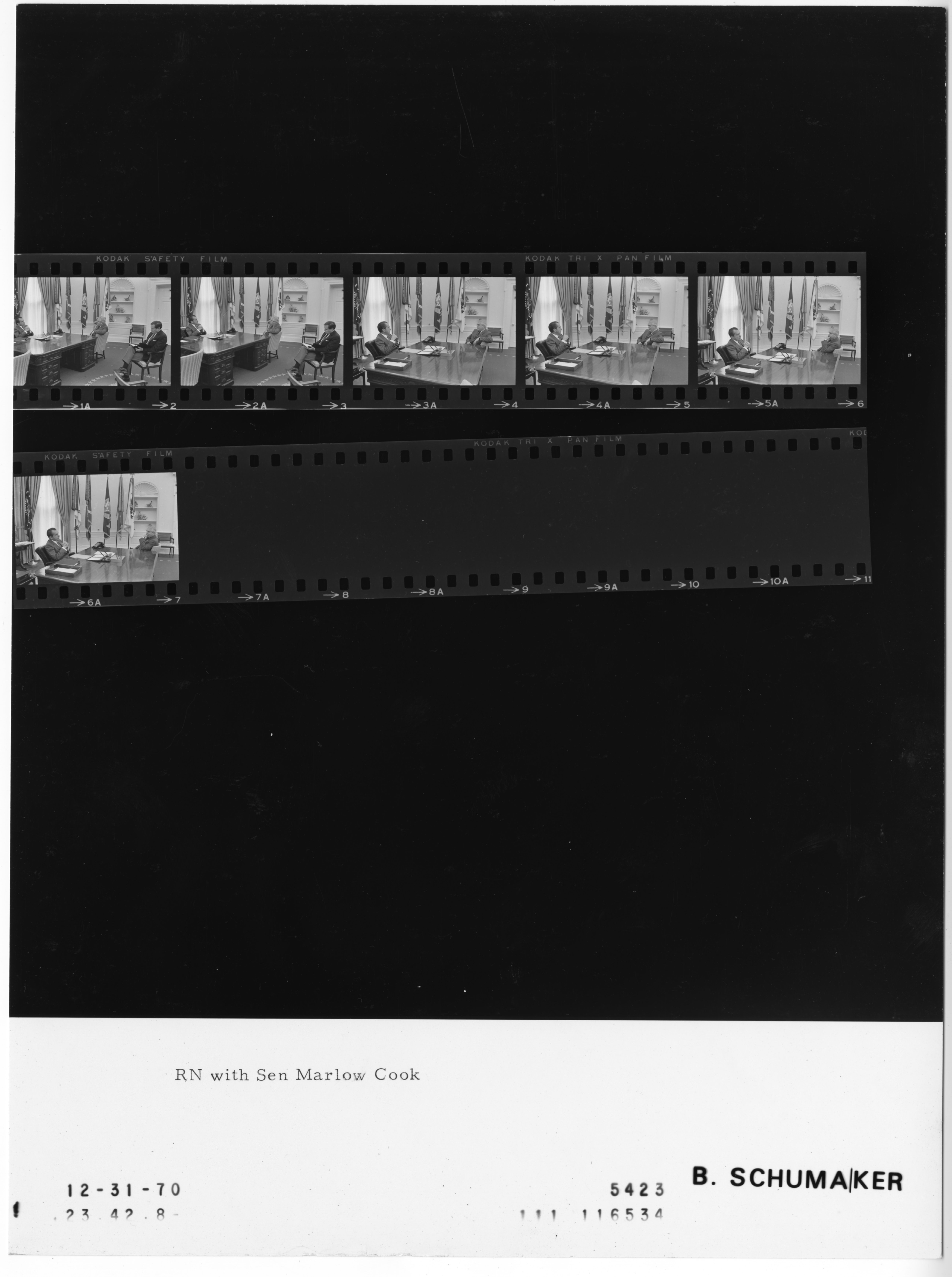
- Frame(s): WHPO-5423-01A-06A, President Nixon seated at his Oval Office desk during a meeting with Kentucky Senator Marlow Cook. 12/31/1970, Washington, D.C. White House, Oval Office. President Nixon, Marlow Cook.
- Frame(s): WHPO-5423-03A, President Nixon seated at his Oval Office desk during a meeting with Kentucky Senator Marlow Cook. 12/31/1970, Washington, D.C. White House, Oval Office. President Nixon, Marlow Cook.
The White House Communications Agency Sound Recordings Collection contains public statements that took place between 1969 and 1974. Visit the finding aid to learn more.
H - White House Staff Member Recordings
- WHCA-SR-H-314
Press briefing by Ronald Ziegler and Hendrick Houthakker. (12/31/1970, Press Center, White House)
Runtime: 25:00:00
Keywords: Press conferences, news conferences, interviews, media, press secretary
Production credits: Audio feed supplied by WHCA; Recorded by KAP (initials of WHCA engineer)
Original Format: 1/4-inch reel-to-reel audiotape. Original source type: Original. - WHCA-SR-H-315
Press briefing by Gerald Warren, William Ruckelshaus, and Russell Train (Clean Air amendments of 1970). (12/31/1970, Press Center, White House)
Runtime: 0:10:33
Keywords: environment, environmental, ecology, polution, mountains, lakes, rivers, clean air, Environmental Protection Agency (EPA), Press conferences, news conferences, interviews, media
Production credits: Audio feed supplied by WHCA; Recorded by KAP (initials of WHCA engineer)
Original Format: 1/4-inch reel-to-reel audiotape. Original source type: Original.
P - Formal Presidential Remarks
- WHCA-SR-P-701224
Remarks by President Nixon upon signing Clean Air amendments of 1970. (12/31/1970, Roosevelt Room, White House)
Runtime: 0:09:44
Keywords: Environment, environmental, ecology, polution, mountains, lakes, rivers, clean air, Environmental Protection Agency (EPA)
Production credits: Audio feed (probably pool feed) supplied by MBS; No WHCA engineer initials listed
Original Format: 1/4-inch reel-to-reel audiotape. Original source type: Original.
The White House Communications Agency Videotape Collection contains “off-the-air” recordings of televised programs produced between 1968 and 1974. Visit the finding aid to learn more.
- WHCA-4066
"Claire". Donald Rumsfeld, Counselor to the President.
CBS
Runtime: 0:30 - WHCA-4067
"Science 1970 - 'Health And Medicine' ".
Undetermined
Runtime: 1:00 - WHCA-4068
"The Courts, Warts and All" - A Conversation With Walter Cronkite. Nick Thimmesch, newspaper columnist.
Undetermined
Runtime: 0:30 - WHCA-4073
Weekly News Summary, Tape II.
ALL NETWORKS
Runtime: 00:16:30
1. Smith/Jarriel: Clean Air Bill (President Nixon). Time Code Start: 00:00. Keywords: Presidents, speeches, Clean Air Act, bills, laws, signings, signing ceremony, environment, pollution, anti-pollution, smog, environment, environmental, ecology, polution, mountains, lakes, rivers, clean air, Environmental Protection Agency (EPA). Network: ABC.
2. Chancellor: Congress and President Nixon signing the Clean Air Bill. Time Code Start: 02:05. Keywords: Presidents, House of Representatives, Clean Air Act, bills, laws, signings, signing ceremony, environment, pollution, anti-pollution, smog, environment, environmental, ecology, polution, mountains, lakes, rivers, clean air, Environmental Protection Agency. Network: NBC.
3. Collingwood/Morton: Congress. Time Code Start: 05:00. Keywords: House of Representatives. Network: CBS.
4. Peirpoint: Clean Air Bill. Time Code Start: 07:46. Keywords: Clean Air Act, pollution, pollutants, lakes, water, ecology, environment, water pollution, litter, sludge, contamination, debris, environment, environmental, ecology, polution, mountains, lakes, rivers, clean air, Environmental Protection Agency (EPA). Network: CBS.
Context (External Sources)
The Vanderbilt Television News Archive is the world's most extensive and complete archive of television news. They have been recording, preserving and providing access to television news broadcasts of the national networks since August 5, 1968.
Wikipedia is a free encyclopedia that anyone can edit.