
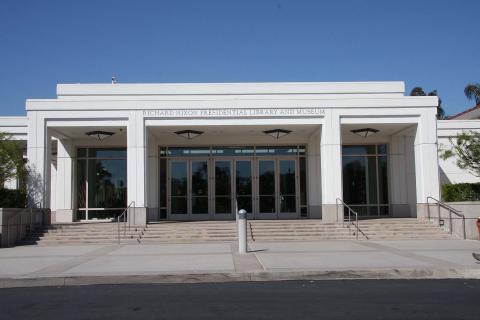
The Life
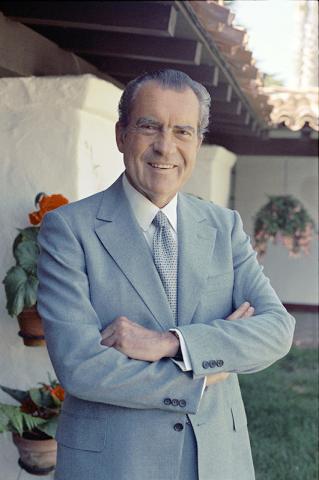
Born on January 9, 1913, on his parents' citrus farm in Yorba, Linda, California, Richard Milhous Nixon's life spanned eight decades. Follow the links below to learn more about the events in Nixon's life.
Richard Milhous Nixon was born on January 9, 1913, on the citrus farm of his parents, Francis Anthony Nixon (1878-1956) and Hannah Milhous Nixon (1885-1967), in a house his father built in Yorba Linda, California. Richard was the second of five brothers: Harold (1909-1933), Donald (1914-1987), Arthur (1918-1925), and Edward (1930-2019).
His early life was marked by financial hardship and by the deaths of his brothers Harold and Arthur. In 1922, after the failure of the Nixons' ranch (today the site of the Nixon Presidential Library and Museum), the family moved to be nearer Hannah's relatives in Whittier, California. There, Frank Nixon opened a combination grocery store and gas station in which the entire Nixon family worked in order to make ends meet.
Richard Nixon enrolled at Whittier College in September 1930. He was an active student, pursuing his interests in student government, drama, and football while living at home and helping to run the family's store. Nixon won a scholarship to attend Duke University School of Law in May 1934, where he was president of the Student Bar Association and a member of the law review. He graduated in June 1937.
Nixon returned to Whittier and joined the law firm Wingert and Bewley. On January 16, 1938, he met a schoolteacher named Thelma Catherine "Pat" Ryan at a rehearsal for a community play in which they were both acting. Smitten, Nixon pursued Ryan. They were married on June 21, 1940, in the Presidential Suite of the Mission Inn in Riverside, California, and honeymooned in Mexico.
In January 1942, the Nixons moved to Washington, D.C., where Nixon joined the Office of Price Administration. On June 15, 1942, he accepted an appointment as a lieutenant junior grade in the United States Naval Reserve and entered the Naval Training School, Naval Air Station in Quonset Point, Rhode Island on August 17, 1942.
Upon completing the training in October 1942, Nixon served as Aide to the Executive Officer at the Naval Reserve Aviation Base in Ottumwa, Iowa until May 1943. He volunteered for sea duty and was assigned to the Commander, Air Force, U.S. Pacific Fleet. He served as Officer in Charge of the South Pacific Combat Air Transport Command on the island of New Caledonia at Bougainville, Vella Lavella and Guadalcanal in the Solomon Islands, and later at Green Island.
Nixon was promoted to Lieutenant on October 1, 1943. He went on to serve with Fleet Air Wing EIGHT and at various military offices throughout the United States. He was promoted again in June 1953 to the rank of Commander in the Naval Reserve.
For his service, Richard Nixon was awarded a Letter of Commendation, the American Campaign Medal, the Asiatic-Pacific Campaign Medal, and the World War II Victory Medal.
After fifteen months overseas, Nixon was transferred to the Fleet Air Wing at Alameda, California and later, the Navy Bureau of Aeronautics in Washington, D.C.
At the end of the war he was engaged in negotiating the termination of Navy contracts with aircraft manufacturers in Baltimore, Maryland. For his performance on this assignment Nixon received a second Letter of Commendation. He was released from active duty as a Lieutenant Commander in March, 1946 and retired from the Naval Reserve on June 1, 1966.
His full naval biographical profile is available via the U.S. Navy's Naval History and Heritage Command website.
Following the end of the war, prominent Republicans in Whittier approached Nixon about running for Congress in 1946. Nixon accepted their offer, and, on November 6, 1946, defeated Democratic Congressman Jerry Voorhis by more than fifteen thousand votes. He moved to Washington with his wife Pat and their young daughter, Patricia (known as "Tricia"), who had been born on February 21, 1946. (Their second daughter, Julie, was born on July 5, 1948.)
As a congressman, he served on the Education and Labor Committee and supported the enactment of the Taft-Hartley Act, which greatly restricted the powers of labor unions. Nixon also served on the Herter Committee, which traveled to Europe to prepare a preliminary report on the Marshall Plan.
In 1948, as a member of the House Un-American Activities Committee (HUAC), he took the lead in investigating charges against former State Department official Alger Hiss of spying for the Soviet Union before and during World War II. The case turned the young congressman into a national figure—and a controversial one, because many prominent figures asserted Hiss's innocence. Not until decades later, after the end of the Cold War, would intelligence information released both by the U.S. government and the Russian government confirm Hiss' guilt.
Nixon was easily re-elected in 1948.
In 1950, he defeated Democratic Congresswoman Helen Gahagan Douglas to win California's vacant U.S. Senate seat by more than half a million votes. The campaign was fierce. Nixon, who thought the former actress was too sympathetic to left-wing causes, said Douglas was "pink right down to her underwear." In response, Douglas labeled Nixon "Tricky Dick."
As senator, Nixon criticized President Harry S. Truman's handling of the Korean War and gave speeches across the nation warning of the threat of global Communism.
Nixon's prominence as an anti-Communist soon brought him to greater national attention. General Dwight Eisenhower, the Republican candidate for president in 1952, selected Nixon as his running mate at the Republican convention in Chicago on July 11, 1952.
Two months later, the New York Post ran an article claiming that campaign donors were buying influence with Nixon by providing him with a secret cash fund for his personal expenses. Nixon defended himself against the accusations, noting that the fund was neither secret nor unusual and produced an independent audit showing that the funds had been used only for political purposes. To rebut his critics, Nixon appeared on television to the largest audience in history to date. In the live, nationwide broadcast, Nixon detailed his personal financial history and then outflanked his detractors by saying that his family had accepted one campaign gift for themselves: a beloved black-and-white cocker spaniel named Checkers whom they intended to keep. The speech was a great success, shoring up his support with the Republican Party's base, demonstrating his appeal to the wider public, and thus keeping him on the Republican ticket-and proving the importance of television as a political medium.
In November 1952, Eisenhower and Nixon defeated the candidates on the Democratic ticket, presidential nominee Illinois Governor Adlai Stevenson and running mate Alabama Senator John Sparkman, by seven million votes.
Under Eisenhower, Nixon made the vice presidency a visible and important office. Nixon chaired National Security Council meetings in the president's absence and undertook many goodwill tours of foreign countries in an effort to shore up support for American policies during the Cold War. On one such trip to Caracas, Venezuela, on May 13, 1958, protesters first spat on the vice president and Mrs. Nixon at the airport. Later that day, rioters assaulted Nixon's motorcade, injuring Venezuela's foreign minister and making Nixon realize that he might actually be killed. Nixon attracted international notice for his coolness in the face of anti-American demonstrations.
In July 1959, Eisenhower sent Nixon to the Soviet Union to represent the United States at the opening of the American National Exhibition in Moscow, the Soviet capital. While touring the exhibit with Soviet leader Nikita Khrushchev, the pair stopped at a model of an American kitchen. There they engaged in an impromptu discussion about the American standard of living that quickly escalated into an exchange over the two countries' ideological and military strength. Nixon's performance in the "Kitchen Debate" further raised his stature back in the United States.
In 1960, facing little competition, Nixon won the Republican nomination for president and chose former Massachusetts Senator Henry Cabot Lodge, Jr., then U.S. Ambassador to the United Nations, to be his running mate. The election of 1960 was a hard-fought contest between Nixon and the Democratic nominee, Massachusetts Senator John F. Kennedy, who had also been elected to Congress in 1946. Many observers then and later concluded that the turning point came during the first-ever televised debates. Nixon, wearing little make-up, looked wan and uncomfortable, while Kennedy appeared to be cool, composed, and confident. In November, Nixon lost to Kennedy by less than 120,000 votes, or 0.2 percent of the popular vote.
Following the 1960 election defeat, the Nixon family left Washington in January 1961 and returned to Southern California, where Nixon practiced law and wrote a bestselling memoir, Six Crises. Throughout 1961, local and national Republican leaders encouraged Nixon to run for governor in 1962 against Democratic incumbent Edmund G. "Pat" Brown, Sr., arguing that staying on the sidelines would mean the end of Nixon's political life. Despite initial reluctance, Nixon entered the race.
His gubernatorial campaign was hobbled by a combination of the public's suspicion that Nixon viewed the office as a stepping-stone, opposition from the far right of his own party, and his own lack of interest in being governor. He lost to Brown by nearly 300,000 votes. At the time, even Nixon viewed the defeat as the end of his career in politics, telling reporters the Wednesday morning following election night 1962 that "You won't have Nixon to kick around anymore because, gentlemen, this is my last press conference."
The Nixon family then moved to New York City, where Nixon resumed his practice as a lawyer. Later, after he had become president, Nixon called this period his "wilderness years," comparing his time out of office to similar interludes in the lives of leaders such as Winston Churchill and Charles de Gaulle. Although largely out of the public eye, Nixon remained active in politics, commenting on the policies of the Kennedy and Johnson administrations and campaigning for Republican candidates. Nixon retained the support of many Republicans across the country who respected his knowledge of politics and international affairs, a reputation enhanced in 1967 by Nixon's article "Asia After Vietnam" in the eminent journal Foreign Affairs. Nixon's strenuous efforts on behalf of Republican congressional candidates around the country in 1966 further solidified his support among members of the party.
1968 Campaign
In January 1968, Nixon decided to once again seek the nomination of the Republican Party for president. Portraying himself as a figure of stability in a time of national upheaval, Nixon promised a return to traditional values and "law and order." He fended off challenges from other candidates such as California Governor Ronald Reagan, New York Governor Nelson Rockefeller, and Michigan Governor George Romney to secure the nomination at the Republican convention in Miami. Nixon unexpectedly chose Governor Spiro Agnew of Maryland as his running mate.
Nixon's campaign was helped by the tumult within the Democratic Party in 1968. Consumed by the war in Vietnam, President Lyndon B. Johnson announced on March 31 that he would not seek re-election. On June 5, immediately after winning the California primaries, former attorney general and then-U.S. Senator Robert F. Kennedy (brother of the late president John F. Kennedy) was assassinated in Los Angeles. The campaign of Vice President Hubert Humphrey, the Democratic nominee for president, went into a tailspin after the Democratic national convention in Chicago was marred by mass protests and violence. By contrast, Nixon appeared to represent a calmer society, and his campaign promised peace at home and abroad. Despite a late surge by Humphrey, Nixon won by nearly 500,000 popular votes. Third-party candidate George Wallace, the once and future governor of Alabama, won nearly ten million popular votes and 46 electoral votes, principally in the Deep South.
First Term
Once in office, Nixon and his staff faced the problem of how to end the Vietnam War, which had broken his predecessor's administration and threatened to cause major unrest at home. As protesters in America's cities called for an immediate withdrawal from Southeast Asia, Nixon made a nationally televised address on November 3, 1969, calling on the "silent majority" of Americans to renew their confidence in the American government and back his policy of seeking a negotiated peace in Vietnam. Earlier that year, Nixon and his Defense Secretary Melvin Laird had unveiled the policy of "Vietnamization," which entailed reducing American troop levels in Vietnam and transferring the burden of fighting to South Vietnam; accordingly, U.S. troop strength in Vietnam fell from 543,000 in April 1969 to zero on March 29, 1973. Nevertheless, the Nixon administration was harshly criticized for its use of American military force in Cambodia and its stepped-up bombing raids during the later years of the first term.
Nixon's foreign policy aimed to reduce international tensions by forging new links with old rivals. In February 1972, Nixon traveled to Beijing (Peking), Hangzhou (Hangchow), and Shanghai in China for talks with Chinese leaders Chairman Mao Zedong (Mao Tse Tung) and Premier Zhou Enlai (Chou En-lai). Nixon's trip was the first high-level contact between the United States and the People's Republic of China in more than twenty years, and it ushered in a new era of relations between Washington and Beijing. Several weeks later, in May 1972, Nixon visited Moscow for a summit meeting with Leonid Brezhnev, general secretary of the Communist Party of the Soviet Union, and other Soviet leaders. Their talks led to the signing of the Strategic Arms Limitation Treaty (SALT), the first comprehensive and detailed nuclear weapons limitation pact between the two superpowers.
Foreign policy initiatives represented only one aspect of Nixon's presidency during his first term. In August 1969, Nixon proposed the Family Assistance Plan, a welfare reform that would have guaranteed an income to all Americans. The plan, however, did not receive congressional approval. In August 1971, spurred by high inflation rates, Nixon imposed wage and price controls in an effort to gain control of price levels in the U.S. economy; at the same time, prompted by worries over the soundness of U.S. currency, Nixon took the dollar off the gold standard and let it float against other countries' currencies.
On July 20, 1969, astronauts Neil Armstrong and Edwin Eugene "Buzz" Aldrin, Jr. became the first humans to walk on the Earth's moon, while fellow astronaut Michael Collins orbited in the Apollo 11 command module. Nixon made what has been termed the longest-distance telephone call ever made to speak with the astronauts from the Oval Office. And on September 28, 1971, Nixon signed legislation abolishing the military draft.
In addition to such weighty affairs of state, Nixon's first term was also full of lighter-hearted moments. On April 29, 1969, Nixon awarded the Presidential Medal of Freedom, the nation's highest civilian honor, to Duke Ellington and then led hundreds of guests in singing "Happy Birthday" to the famed band leader.
On June 12, 1971, Tricia Nixon became the sixteenth White House bride when she and Edward Finch Cox of New York married in the Rose Garden. Theirs was the first wedding held in the Rose Garden. Julie Nixon had wed Dwight David Eisenhower II, grandson of President Eisenhower, on December 22, 1968, in New York's Marble Collegiate Church, while her father was President-elect.
Perhaps most famous was Nixon's meeting with Elvis Presley on December 21, 1970, when the President and the King of Rock 'n' Roll discussed the drug problem facing American youth.
Re-election, Second Term, and Watergate
In his 1972 bid for re-election, Nixon defeated South Dakota Senator George McGovern, the Democratic candidate for president, by one of the widest electoral margins ever, winning 520 electoral college votes to McGovern's 17 and nearly 61 percent of the popular vote. Just a few months later, investigations and public controversy over the Watergate scandal had sapped Nixon's popularity. The Watergate scandal began with the June 1972 discovery of a break-in at the Democratic National Committee offices in the Watergate office complex in Washington, D.C., but media and official investigations soon revealed a broader pattern of abuse of power by the Nixon administration, leading to his resignation.
The Watergate burglars were soon linked to officials of the Committee to Re-elect the President, the group that had run Nixon's 1972 re-election campaign. Soon thereafter, several administration officials resigned; some, including former attorney general John Mitchell, were later convicted of offenses connected with the break-in and other crimes and went to jail. Nixon denied any personal involvement with the Watergate burglary, but the courts forced him to yield tape recordings of conversations between the president and his advisers indicating that the president had, in fact, participated in the cover-up, including an attempt to use the Central Intelligence Agency to divert the FBI's investigation into the break-in. (For more information about Watergate, please visit the Ford Presidential Library and Museum's online Watergate exhibit.)
Investigations into Watergate also revealed other abuses of power, including numerous warrantless wiretaps on reporters and others, campaign "dirty tricks," and the creation of a "Plumbers" unit within the White House. The Plumbers, formed in response to the leaking of the Pentagon Papers to news organizations by former Pentagon official Daniel Ellsberg, broke into the office of Ellsberg's psychiatrist.
Adding to Nixon's worries was an investigation into Vice President Agnew's ties to several campaign contributors. The Department of Justice found that Agnew had taken bribes from Maryland construction firms, leading to Agnew's resigning in October 1973 and his entering a plea of no contest to income tax evasion. Nixon nominated Gerald Ford, Republican leader in the House of Representatives, to succeed Agnew. Ford was confirmed by both houses of Congress and took office on December 6, 1973.
Such controversies all but overshadowed Nixon's other initiatives in his second term, such as the signing of the Paris peace accords ending American involvement in the Vietnam war in January 1973; two summit meetings with Brezhnev, in June 1973 in Washington and in June and July 1974 in Moscow; and the administration's efforts to secure a general peace in the Middle East following the Yom Kippur War of 1973.
The revelations from the Watergate tapes, combined with actions such as Nixon's firing of Watergate special prosecutor Archibald Cox, badly eroded the president's standing with the public and Congress. Facing certain impeachment and removal from office, Nixon announced his decision to resign in a national televised address on the evening of August 8, 1974. He resigned effective at noon the next day, August 9, 1974. Vice President Ford then became president of the United States. On September 8, 1974, Ford pardoned Nixon for "all offenses against the United States" which Nixon "has committed or may have committed or taken part in" during his presidency. In response, Nixon issued a statement in which he said he regretted "not acting more decisively and forthrightly in dealing with Watergate."
Richard Milhous Nixon
Birth Date: January 9, 1913, in Yorba Linda, California
Death Date: April 22, 1994, in New York City, New York
Father: Francis Anthony Nixon (1878-1956)
Born: Dec. 3, 1878, Elk, Ohio
Married: Hannah Milhous - June 25, 1908, Whittier, California
Died: Sept. 4, 1956, La Habra, California
Religion: Quaker
Mother: Hannah Milhous Nixon (1885-1967)
Born: March 7, 1885, near Butlerville, Indiana
Married: Frank Nixon on June 25, 1908, Whittier, California
Died: September 30, 1967, Whittier, California
Father: Franklin Milhous, 1848-1919
Mother: Almira Park Burdg Milhous, 1849-1943
Grandfather: Joshua Vickers Milhous, 1820-1883
Grandmother: Elizabeth Price Griffith, 1827-1923
Religion: Quaker
Paternal Grandparents: Samuel Brady Nixon (1847-1914) and Sarah Ann Wadsworth (1852-1886)
Maternal Grandparents: Franklin Milhous (1848-1919) and Almira Park Burdg (1849-1943)
Brothers:
Harold Samuel Nixon - Born June 1, 1909; died March 7, 1933 at age 23 from tuberculosis
Francis Donald Nixon - Born November 23, 1914; died June 27, 1987 at age 73 from cancer; m. Clara Jane Lemke, August 9, 1942
Arthur Burdg Nixon - Born May 26, 1918; died August 10, 1925 at the age of 7 of tubercular encephalitis
Edward Calvert Nixon - Born May 3, 1930; died February 27, 2019; m. Gay Lynne Woods, June 1, 1957
Thelma Catherine (Patricia) Ryan
Birth Date: March 16, 1912, in Ely, Nevada
Death Date: June 22, 1993, in Park Ridge, New Jersey
Father: William Martin Ryan (1866-1930)
Mother: Katharine "Kate" Halberstadt (1879-1926)
Siblings: Children of William Martin Ryan and Kate Halberstadt:
William George Ryan, 1910-1997
Thomas Sanford Ryan, 1911-1991
Thelma Catherine "Pat" Ryan, 1912-1993
Children of Kate Halberstadt by her first marriage to Matthew Bender (d. 1904):
Matthew Gottfried Bender, 1903-1973
Neva Louise (Bender) Renter, 1904-1981
The Nixons
Wedding: Thelma Catherine (Pat) Ryan and Richard Milhous Nixon married on June 21, 1940, in the Presidential Suite of the Mission Inn in Riverside, California, and honeymooned in Mexico.
Daughters:
Patricia (known as "Tricia") born on February 21, 1946 in Whittier, California. On June 12, 1971, Tricia became the sixteenth White House bride when she and Edward Finch Cox of New York married in the Rose Garden. They have one son: Christopher Nixon Cox (1979-).
Julie born on July 5, 1948 in Washington, D.C. Julie wed Dwight David Eisenhower II, grandson of President Eisenhower, on December 22, 1968, in New York's Marble Collegiate Church, while her father was President-elect. They have three children: Jennie Elizabeth Eisenhower (1978-); Alex Richard Eisenhower (1980-); and Melanie Catherine Eisenhower (1984-).
Pets:
Checkers - Cocker Spaniel - given to Nixon Family in 1952, died September 6, 1964. Buried at Bideawee Association Pet Cemetery Memorial Park, Wantagh, Nassau County, New York.
White House Pets
King Timahoe - Irish Setter - given to President Nixon by staff in January 1969 - died circa 1979
Vicky - Miniature Poodle - Julie Nixon Eisenhower's pet - died circa 1976
Pasha - Yorkshire Terrier - Trisha Nixon Cox's pet - died circa 1978
Timeline of Events
The following list illustrates the wide range of social, cultural, and political events that occurred during the years of Richard Nixon's life (1913-1994).
- January 9, 1913
Richard Nixon is born in Yorba Linda, California, to Frank and Hannah Milhous Nixon.
- June 28, 1914
The assassination of Archduke Franz Ferdinand, heir to the throne of the Austro-Hungarian Empire, leads within weeks to the outbreak of World War I.
- November 7, 1917
The Bolsheviks overthrow the Russian government in Petrograd (later Leningrad, still later St. Petersburg), leading to the formation of a Communist government, the sparking of a civil war within the former Russian empire, and finally, in December 1922, the foundation of the Union of Soviet Socialist Republics.
- August 18, 1920
Upon the Tennessee legislature's approval of the 19th amendment to the constitution, the document becomes law, guaranteeing that neither the federal government nor the state governments can deny women the right to vote.
- 1928-1930
Attends Whittier High School
- October 29, 1929
Stock market crash; start of the Great Depression
- 1930-1934
Nixon attends Whittier College in Whittier, California
- 1934-1937
Nixon attends Duke University Law School in Durham, North Carolina.
- November 9, 1937
Admitted to California Bar and joins law firm of Wingert and Bewley in Whittier
- January 1, 1939
Becomes a partner in the reorganized law firm of Bewley, Knoop and Nixon; opens a branch office in La Habra, California
- September 1, 1939
Germany invades Poland; start of World War II
- June 21, 1940
Nixon marries Thelma Catherine ("Pat") Ryan in Riverside, California.
- December 7, 1941
Japanese attack on U.S. naval base at Pearl Harbor
- January 9, 1942
Nixon moves to Washington, D.C., to join the Office of Price Administration, the federal agency charged with regulating wartime prices and and overseeing rationing.
- June 15, 1942
Receives commission as United States Navy Lieutenant (junior grade)
- 1943-1945
Nixon serves active duty in the U.S. Navy. Nixon is assigned to South Pacific Combat Air Transport Command as a ground officer; he serves at New Caledonia, Bougainville, and Green Island.
- August 6, 1945
Following the end of hostilities in Europe, the war in the Pacific is brought to a close after the first military use of nuclear weapons against the Japanese cities of Hiroshima and Nagasaki. Japan formally surrenders on September 2, 1945.
- February 21, 1946
Daughter Patricia ("Tricia") Nixon is born.
- March 10, 1946
Released from active duty in the United States Naval Reserve
- November 5, 1946
Elected to Congress, defeating incumbent Jerry Voorhis
- January 3, 1947
Nixon is sworn in as Representative for the Twelfth Congressional District of California. His tenure lasts until his resignation in November 1950 following his election to the Senate. Assigned to House Education and Labor Committee and House Committee on Un-American Activities
- May 14, 1948
Manages passage of Mundt-Nixon bill, the first piece of legislation passed by the House Committee on Un-American Activities in ten years, providing for the annual registration of members of the Communist party
- July 5, 1948
Daughter Julie Nixon is born.
- August 5, 1948-December 15, 1948
Nixon brings former State Department official Alger Hiss to the witness stand of the House Un-American Activities Committee after Whittaker Chambers accuses Hiss of being a Soviet agent. The course of the Hiss case, which ended with Hiss' conviction for perjury, catapults Nixon into national attention.
- October 1, 1949
People's Republic of China formally proclaimed
- November 7, 1950
Nixon is elected as Senator for California and serves from December 1, 1950, until January 1, 1953.
- May 1951
Attends the World Health Organization Conference in Geneva, Switzerland
- July 11, 1952
Receives the Republican Vice-Presidential nomination
- September 23, 1952
In a nationally televised speech, Nixon responds to charges of improper use of campaign funds, which had jeopardized his spot on the Republican national ticket. During his defense, and after refuting the charges, he states that his wife wears only a "respectable Republican cloth coat" and the only gift he has kept was Checkers, the family's cocker spaniel--giving the appearance its other name, the "Checkers speech".
- November 4, 1952
Nixon is elected Vice President of the United States on the ticket of President Dwight Eisenhower.
- January 20, 1953
Inaugurated as Vice President
- June 1, 1953
Promoted to Commander in the Naval Reserve
- June 2, 1953
Coronation of Queen Elizabeth II
- August 13, 1953
Made chairman of the President's committee on government contracts
- October 6, 1953-December 14, 1953
Goodwill tour of Asia and Africa
- December 8, 1954
Supreme Court decides Brown v. Board of Education, ordering integration of public schools in the United States.
- June 2, 1955-March 5, 1955
Goodwill tour of the Caribbean
- September 24, 1955
President Eisenhower suffers a heart attack
- December 1, 1955
Rosa Parks refuses to give up her seat, sparking Montgomery, Alabama, bus boycott
- January 1956-February 1956
Attends Brazilian presidential inauguration as the representative of the United States
- June 30, 1956-July 11, 1956
Goodwill tour of Asia
- October 23, 1956-November 10, 1956
Hungarian citizens revolt against the Hungarian government and Soviet influence in Hungary, leading to the occupation of the country by the Soviet Red Army.
- October 29, 1956-November 7, 1956
Suez crisis
- November 6, 1956
Nixon is re-elected Vice President of the United States to President Dwight Eisenhower.
- December 18, 1956-December 24, 1956
Visits Austria to inspect conditions of Hungarian refugees who fled Hungary after the unsuccessful revolt against Communist rule there.
- January 21, 1957
Public Inauguration
- January 27, 1957
Elvis single "Heartbreak Hotel" released
- February 28, 1957-March 21, 1957
Travels to Italy and Africa
- September 25, 1957
National Guard troops escort African-American students to class in Central High School in Little Rock, Arkansas, as part of the desegregation of schools there.
- October 4, 1957
Soviet Union launches Sputnik, Earth's first artificial satellite.
- April 27, 1958-May 15, 1958
In Latin America trip, Nixon faces anti-Nixon riots in Lima, Peru, on May 8th and in Caracas, Venezuela, on May 13th.
- November 24, 1958-November 29, 1958
Travels to England
- January 31, 1959
Appointed chairman of Cabinet committee on price stability for economic growth
- July 22, 1959-August 2, 1959
Travels to the Soviet Union
- July 24, 1959
Nixon participates in spontaneous the "Kitchen Debate" with Soviet Premier Nikita Krushchev in a model kitchen in the American National Exhibition in Moscow. Nixon's strong showing against the Soviet leader gives him a new standing in the United States.
- August 2, 1959-August 5, 1959
Visits Poland
- July 27, 1960
Nixon receives Republican nomination for President.
- September 26, 1960-October 21, 1960
Nixon-Kennedy debates
- November 8, 1960
Loses Presidential election
- March 13, 1961
Joins Los Angeles law firm of Adams, Duque and Hazeltine
- April 12, 1961
Soviet cosmonaut Yuri Gagarin becomes first human in space.
- April 15, 1961
Bay of Pigs Invasion
- March 29, 1962
Six Crises published
- November 6, 1962
Nixon is defeated in California gubernatorial race by Democratic incumbent Edmund G. "Pat" Brown. After his defeat becomes clear, Nixon tells reporters "You won't have Nixon to kick around any more, because, gentlemen, this is my last press conference."
- 1963-1967
Nixon practices law in New York City. Joins the law firm of Mudge, Stern, Baldwin and Todd. Reorganized firm becomes Nixon, Mudge, Rose, Guthrie and Alexander in 1964.
- June 16, 1963
Cosmonaut Valentina Tereshkova becomes first woman in space.
- November 22, 1963
President John F. Kennedy assassinated
- February 9, 1964
The Beatles appear on The Ed Sullivan Show.
- April 27, 1966
Argues first case before the Supreme Court
- June 1, 1966
Retired from U.S. Naval Reserve
- September 8, 1966
First episode of Star Trek broadcast on television.
- April 4, 1968
Martin Luther King, Jr., assassinated
- June 5, 1968
Robert Kennedy assassinated
- August 8, 1968
Nominated as Republican candidate for President
- August 20, 1968
Soviet troops invade Czechoslovakia, ending the "Prague Spring"
- September 16, 1968
Nixon appears on Rowan and Martin's "Laugh-in" delivering the famous phrase "Sock it to ME?"
- November 5, 1968
Nixon is elected 37th President of the United States.
- December 22, 1968
Nixon's daughter Julie marries Dwight David Eisenhower II, grandson of former president Dwight Eisenhower.
- February 4
In Cairo, Yasser Arafat is appointed Palestinian Liberation Organization leader at the Palestinian National Congress, and takes command the next day.
- February 24
The U.S. Supreme Court (Tinker v. Des Moines Independent Community School District) rules that the First Amendment applies to public schools.
- March 1
Mickey Mantle of the New York Yankees announces his retirement.
- March 25
John Lennon and Yoko Ono marry in Gibraltar
- March 28
General and 34th U.S. President, Dwight D. Eisenhower, dies after a long illness in the Walter Reed Army Medical Center, Washington, D.C.
- April 9
The Harvard University Administration Building is seized by close to 300 students, mostly members of the Students for a Democratic Society. Before the takeover ends, 45 will be injured and 184 arrested.
- April 29
Nixon celebrates Duke Ellington's birthday and awards Ellington the Presidential Medal of Freedom.
- May 1969
Nixon orders FBI wiretaps to track the sources of leaks revealing secret bombings of Cambodia.
- June 28
The Stonewall riots in New York City mark the start of the modern gay rights movement in the U.S.
- August 15-August 18
Woodstock Music and Art Festival
- September 1
A coup in Libya ousts King Idris and installs Colonel Muammar el-Qaddafi.
- September 2
The first automatic teller machine in the United States is installed in Rockville Centre, New York.
- September 13
Scooby-Doo, Where are You! (1969-1972) premieres on CBS Saturday Morning.
- October 21
Willy Brandt becomes Chancellor of West Germany
- November 9
A group of American Indians, led by Richard Oakes, seizes the Alcatraz island for 19 months, inspiring a wave of renewed Indian pride and government reform.
- November 10
Sesame Street debuts
- November 14
NASA launches Apollo 12 (Pete Conrad, Richard Gordon, Alan Bean), the second manned mission to the Moon.
- December 2
The Boeing 747 jumbo jet makes its debut. It carries 191 people, most of them reporters and photographers, from Seattle to New York City.
- January 26
Vetoes the Department of Health, Education, and Welfare (HEW)- Labor Appropriation Bill
- March 18
United States Postal Service workers in New York City go on strike; the strike spreads to the state of California and the cities of Akron, Philadelphia, Chicago, Boston, and Denver; 210,000 out of 750,000 U.S. postal employees walk out. President Nixon assigns military units to New York City post offices. The strike lasts two weeks.
- March 25
The Concorde makes its first supersonic flight (700 mph/1127 km/h).
- April 1
President Richard Nixon signs the Public Health Cigarette Smoking Act into law, banning cigarette television advertisements in the United States, starting on January 1, 1971.
- April 11
Apollo 13 (Jim Lovell, Fred Haise, Jack Swigert) is launched toward the Moon. On April 13, an oxygen tank in the spacecraft explodes, forcing the crew to abort the mission. They return safely to Earth on April 17.
- April 18
Nixon presents the Presidential Medal of Freedom to Apollo 13 astronauts.
- April 22
The first Earth Day is celebrated.
- May 9
One hundred thousand people demonstrate in Washington, DC against the Vietnam War.
- June 18
Edward Heath is elected Prime Minister of the United Kingdom in the general election.
- September 1970
The Jordan Crisis, also known as "Black September," marks violence against Palestinian attempts to overthrow King Hussein's monarchy.
- September 18
Jimi Hendrix, guitarist and singer, dies
- September 21
NFL Monday Night Football premieres on ABC
- October 1970
The Public Broadcasting Service (PBS) begins broadcasting.
- October 4
Janis Joplin, singer, dies
- October 17
Anwar Sadat officially becomes President of Egypt
- January 31
Apollo 14 (Alan Shepard, Stuart Roosa, Edgar Mitchell) lifts off on the third successful lunar landing mission.
- February 5
Apollo 14 lands on the moon.
- February 8
A new stock market index called the Nasdaq debuts.
- February 9
Satchel Paige becomes the first Negro League player to become voted into the Baseball Hall of Fame.
- March 1
A bomb explodes in the men's room on the Senate side of the U.S. Capitol; the Weather Underground claims responsibility.
- April 1971-May 1971
"MayDay" demonstrations in Washington, D.C., and across the country
- April 24
Five hundred thousand people in Washington, DC and 125,000 in San Francisco march against the Vietnam War.
- July 3
Jim Morrison, is found dead in a bath tub in Paris, France aged 27.
- July 9
Nixon sends National Security Adviser Henry Kissinger to Peking, China, to arrange with Prime Minister Chou en Lai a visit for President Nixon.
- October 1
Walt Disney World opens in Florida.
- April 20
Bob Hope visits the White House.
- August 1
A $25,000 cashier check designated for the Nixon campaign is found in the bank account of a Watergate burglar.
- November 8
Home Box Office (HBO) is launched.
- January 22
George Foreman beats Joe Frazier by a knockout in two rounds to lift the world's Heavyweight championship from Frazier. It is HBO Boxing's first telecast.
- April 4
Ribbon-cutting ceremony for the World Trade Center in NYC
- April 17
Federal Express officially begins operations, with the launch of 14 small aircraft from Memphis International Airport.
- May 17-August 7
Each network aired coverage in rotation every third day (ABC was first, then CBS and NBC).
- July 1
The United States Drug Enforcement Administration is founded.
- September 20
Billie Jean King defeats Bobby Riggs in a televised tennis match.
- November 17
To the Associated Press managing editors, Nixon says, "People have got to know whether or not their President is a crook. Well, I'm not a crook."
- November 29
Atari kicks off the first generation of video games with the release of their seminal arcade version of PONG, the first game to achieve commercial success
- February 27
People magazine is published for the first time.
- April 8
Hank Aaron hits his career home run # 715, breaking Babe Ruth's career home run record.
- September 8, 1974
Nixon accepts the pardon of President Gerald Ford "for all offenses against the United States which he, Richard Nixon, has committed or may have committed or taken part in during the period from January 20, 1969 through August 9,1974."
- August 8-September, 1985
In a five-week fact-finding trip, Nixon visits and meets with top leaders in China, Japan, South Korea, Hong Kong, Singapore, Malaysia, Thailand, Burma, Pakistan, Turkey, and Great Britain.
- 1986
Nixon meets with Mikhail Gorbachev.
- June 22, 1993
Mrs. Nixon dies at home in Park Ridge, New Jersey.
- April 22, 1994
Nixon dies in New York City.
About the References
In many cases, the source cited is the Public Papers of the Presidents: Richard Nixon.
- The numbers in parentheses refer to the item number of the statement in the Public Papers, not the page number.
The Public Papers of the Presidents volumes are available in print at many public or university libraries and on the following websites:
- The United States Government Printing Office Bookstore (https://bookstore.gpo.gov/)
- The American Presidency Project (http://www.presidency.ucsb.edu/index.php)
- The complete collection can be found at any Federal Depository Library