
The Early Years
Patricia Nixon, wife of President Richard Nixon, was born on March 16, 1912, in Ely, Nevada to Katherine “Kate” Halberstadt Bender Ryan, an emigrant from Germany, and William Martin Ryan of Connecticut who had traveled much of the world as a sailor and prospector. Kate named her daughter Thelma Catherine. Hours later, William learned of her birth after coming home past midnight from his work in the mines. He called her his “St. Patrick’s babe in the morn.” She was to be “Pat” to him always.
Before Pat Nixon was a year old, Kate persuaded William to give up mining. The Ryan family then moved from Nevada to a ten-acre farm in Artesia, California, 20 miles southeast of Los Angeles. Today, Pat Nixon Park occupies the site of the farm in what is now Cerritos, California.
The future First Lady’s early childhood was marked by tragedy when her mother died in 1926. At the age of 13, Mrs. Nixon took over the household duties for her father and her two brothers. Two years later, while she was attending Excelsior High School, her father became seriously ill. She cared for him until his death in 1930. It was in his memory that she decided to go by the name Pat instead of Thelma. By age 18, Pat Nixon was a high school graduate and completely on her own.
Her first ambition was to receive a college education. She enrolled at Fullerton College, paying for her tuition by working part time as a janitor in a local bank. She was able to fulfill her second ambition of traveling in 1931, when elderly friends of her family asked her to drive them to the East Coast. She drove them to New York City, where she stayed for two years. She first worked at Seton Hospital as a secretary and later as an X-ray technician and lab technician, after taking a Columbia University summer course in radiology.
In 1934, she returned to California to enroll at the University of Southern California. During her college years, she worked as many as 40 hours a week, both on and off campus, at the Bullocks Wilshire department store, as a secretary, and as a motion picture film extra. In 1937, she graduated cum laude with a Bachelor of Science degree in commerce and a teaching credential.
Her first job following graduation was teaching business education courses at Whittier Union High School for a monthly salary of $190. Whittier Union High School was located on the main street of the quiet Quaker community at the foot of the Puente Hills.
Pat and Richard
Pat’s interest in theatre arts began during her college days when she earned $25 for a walk-on part as an extra in the movie Becky Sharp. In addition to directing high school plays, she joined the Whittier Little Theater group. It was there that she met Dick Nixon, a young lawyer who had recently graduated from Duke University Law School in Durham, North Carolina. They were given the leading roles in The Dark Tower, a mystery drama by George Kaufman and Alexander Wolcott. Pat later related that Nixon proposed to her the first night they met. Two years later, she said yes.
They were married on June 21, 1940, in a Quaker ceremony at the historic Mission Inn in Riverside, California. The couple left for a honeymoon in Mexico, driving to Laredo and then south along the Pan American Highway to Mexico City. They returned to Whittier and settled in an apartment over a garage while Mrs. Nixon continued teaching and Richard Nixon was in private law practice.
One year later, they moved to Washington, DC, where Mr. Nixon was an attorney in the Office of Emergency Management. Following the Japanese attack on Pearl Harbor, he volunteered for naval service. In June 1942, he accepted an appointment as lieutenant junior grade in the United States Naval Reserve. After completing training at the Naval Training School, Naval Air Station in Quonset Point, Rhode Island, he received his first active-duty assignment to Ottumwa, Iowa, as an aide to the officer in charge of setting up a Naval Air Base. Mrs. Nixon found employment in a bank in Ottumwa. When her husband was assigned to duty in the South Pacific, she moved to San Francisco, California, where she worked as an economist for the Office of Price Administration. After 14 months in the South Pacific, Lt. Nixon returned and they moved to Baltimore, Maryland. Upon returning to the United States, Nixon was assigned to Fleet Air Wing EIGHT and served in the Bureau of Aeronautics, where he helped terminate Navy contracts as World War II ended.
Pre-Presidential Years
When Mr. Nixon was released from active naval duty in early 1946, the Nixons returned to Whittier, California. It was then that Richard Nixon entered political life as the Republican candidate for California’s 12th Congressional District. Nine days after Mr. Nixon announced his candidacy, their first daughter, Patricia, or Tricia, was born on February 21, 1946, in Whittier, California. Richard Nixon was elected to the U.S. House of Representatives and was re-elected to the seat in 1948. That year, on July 5, Pat Nixon gave birth to their second daughter, Julie, in Washington, DC.
In 1950, Richard Nixon won the election as United States Senator from California. Two years later he was elected Vice President of the United States under Dwight D. Eisenhower. Both were re-elected in 1956. During all the Nixon campaigns, Pat Nixon campaigned tirelessly by her husband's side so much that the Nixons became known as the “Pat and Dick Team.”
As the wife of the Vice President, Second Lady Pat Nixon accompanied her husband to 53 countries around the world, visiting hospitals and schools by day and dining with heads of state by night. She was such an effective goodwill ambassador that President Eisenhower always sent the Nixons as a team. She was staunchly behind her husband during his unsuccessful political campaigns for the Presidency in 1960, and for the Governorship of California in 1962.
After his gubernatorial election defeat in 1962, the former Vice President and his wife made their home in New York City, in an apartment overlooking Central Park. Mr. Nixon maintained a successful law practice and Mrs. Nixon enjoyed the city’s cultural life. When her husband decided to re-enter politics in 1968, Pat Nixon once again began the campaign life, fulfilling her role graciously and effectively.
First Lady
The First Lady was a confident player on the world stage, traveling to over 80 countries during her years of public service. She accompanied President Nixon to the People’s Republic of China and undertook solo missions to Africa and South America. During her trips, she kept luncheons, banquets, and formal receptions to a minimum so she could visit schools, hospitals, orphanages, old people’s homes, and even a leper colony in Panama.
Her work in the White House stemmed from her boundless compassion for humanity; she was the first First Lady to champion volunteerism, blazed the literacy trail with the “Right to Read” program, and pushed to establish new recreational areas in or near big cities for those who could not afford to visit distant national parks. “People are my project,” she said on more than one occasion as she championed volunteerism by lending her significant support to worthwhile organizations across the country; indeed, she personally chaired many prominent national organizations and took an active interest in furthering their missions.
During the Nixons’ 1969 trip to South Vietnam, she became the first First Lady to visit an active combat zone, in an open helicopter and accompanied by Secret Service agents draped with bandoleers. In June 1970, the First Lady flew supplies gathered by volunteers to earthquake-ruptured Peru. For this, the Peruvian government awarded her the highest decoration their country can bestow: the Grand Cross of the Order of the Sun (Orden del Sol). This honor is the oldest civilian award in the Americas and First Lady Pat Nixon became the first North American woman to receive it.
At home, First Lady Pat Nixon reached out to the American people by inviting them into the People’s House and taking special care to preserve and enhance it. “The Nixon era was the greatest single period of collecting in White House history,” historian William Seale said. “The great collection of White House Americana today is the long shadow of Mrs. Nixon. The impulse, the idea, and the energy were hers.”
She arranged the first White House tours for the visually and hearing impaired and inaugurated the famous candlelight tours for people who worked during the day. She began the tradition of having the White House lit at night, believing that the house into which she brought so much light should be seen at night like Washington, DC’s other monuments.
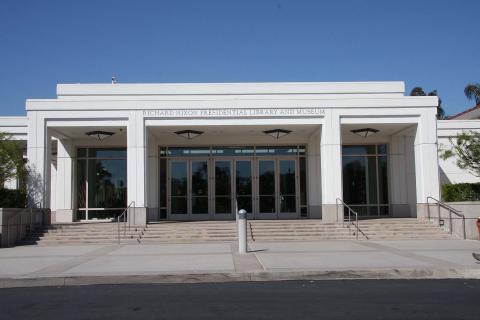
In retirement, First Lady Pat Nixon was a devoted grandmother to Christopher, Jennie, Alex, and Melanie. Although she kept her public appearances to a minimum, polls showed that she remained one of America’s most admired women. She died on June 22, 1993, at home in Park Ridge, New Jersey with her family at her side. She was buried on the grounds of the Richard Nixon Presidential Library and Museum, a few steps from her husband’s birthplace, on June 26, 1993. Richard Nixon was interred beside her on April 27, 1994.
Pat Nixon - The Pioneer
From 1969 through 1974, the United States underwent a major cultural change, particularly for women. Pat Nixon’s involvement in White House initiatives, diplomacy, and domestic activities solidified her role as a pioneer for future First Ladies.
To emphasize her role during the Nixon Presidency – we have compiled a list of “Firsts” and unique events that occurred while Pat Nixon served as the First Lady of the United States:
- Special tours of the White House for the visually and hearing impaired
- Installation of ramps in the White House making tours accessible for visitors using wheelchairs
- The most traveled First Lady until Hillary Clinton, including the FIRST to visit China, Moscow, and Africa
- The first First Lady to visit an active combat zone (Vietnam)
- The first to be awarded Peru’s Grand Cross of the Order of the Sun for her earthquake relief efforts
- The first to walk across the border of Mexico
- The first to promote volunteerism
- The first to address the Republican National Convention
- The first to wear a pantsuit on an official First Lady activity
- The first to publicly support the Equal Rights Amendment