
Introduction
This almanac page for Thursday, December 14, 1972, pulls together various records created by the federal government and links to additional resources which can provide context about the events of the day.
Previous Date: Wednesday, December 13, 1972
Next Date: Friday, December 15, 1972
Schedule and Public Documents
The Daily Diary files represent a consolidated record of the President's activities. Visit the finding aid to learn more.
The President's day began at The White House - Washington, D. C.
The Weekly Compilation of Presidential Documents made available transcripts of the President's news conferences; messages to Congress; public speeches, remarks, and statements; and other Presidential materials released by the White House.
Digitized versions can be found at HathiTrust.
Each Public Papers of the Presidents volume contains the papers and speeches of the President of the United States that were issued by the White House Office of the Press Secretary during the time period specified by the volume. The material is presented in chronological order, and the dates shown in the headings are the dates of the documents or events. In instances when the release date differs from the date of the document itself, that fact is shown in the text note.
To ensure accuracy, remarks have been checked against audio recordings (when available) and signed documents have been checked against the original, unless otherwise noted. Editors have provided text notes and cross references for purposes of identification or clarity.
- Statement Following Lift-Off From the Moon of the Apollo 17 Lunar Module.
- Executive Order 11690—Delegation of Certain Functions to the Executive Director of the Domestic Council
- Statement on Signing Executive Order Transferring Operations of the Office of Intergovernmental Relations to the Domestic Council.
The Federal Register is the official daily publication for rules, proposed rules, and notices of federal agencies and organizations, as well as executive orders and other Presidential documents.
Archival Holdings
Any selection of archival documents will necessarily be partial. You should use the documents and folders identified below as a starting place, but consult the linked collection finding aids and folder title lists and the collections themselves for context. Many documents to be found this way do not lend themselves to association with specific dates, but are essential to a complete understanding of the material.
Selective document listing
President's Office Files
The President's Office Files consists of materials drawn together by the Special Files Unit from several administrative subdivisions within the White House Office. It is the handwriting and sensitive papers sent to the Staff Secretary that now comprise much of the President's Office Files. Visit the finding aid to learn more.
- News Summaries, Annotated News Summaries, Box 41, Dec. 1972 [3 of 5] [Note: Due to the way News Summary products were compiled, you should also consult nearby days for potentially relevant materials.]
- News Summary, December 14, 1972, (Wed. nets, wires, columns)
- President's Daily Schedule, Box 102, [President's Daily Schedule, Oct.-Dec. 1972] [2 of 2]
- The President's Schedule, Thursday - December 14, 1972
The H. R. Haldeman Diaries consists of seven handwritten diaries, 36 dictated diaries recorded as sound recordings, and two handwritten audio cassette tape subject logs. The diaries and logs reflect H. R. Haldeman’s candid personal record and reflections on events, issues, and people encountered during his service in the Nixon White House. As administrative assistant to the President and Chief of Staff, Haldeman attended and participated in public events and private meetings covering the entire scope of issues in which the Nixon White House engaged in during the years 1969-1973. Visit the finding aid to learn more.
- Transcript of diary entry (PDF)
Thursday, December 14th.
-------------------------------------------------------------------------------------------------------------------
DECLASSIFIED - E.O. 13526, Sect. 3.4: by MS, NARA, June 12, 2013
Audio Cassette 28, Side B, Withdrawn Item Number 19 [AC-28(B) Sel 9]
Duration: 20 seconds
The President had me talk to Helms today to tell him that he had talked to Kissinger and Scoop Jackson about some special assignments for Helms based out of Iran regarding the oil situation in the general area there. And he had told Scoop to talk to him about it.
-------------------------------------------------------------------------------------------------------------------
Also, I told Helms today Schlesinger was going to be his replacement and that we wanted his support on that.
The President told me to handle the Connie Stuart firing, and then Mrs. Nixon called me later and also asked me to do it, so I called Connie in, worked pretty well. She said she didn't think it was going to work for Mrs. Nixon not to have a staff director, but she, at least, didn't fight the thing, so I think we're going to be able to pull it off all right.
On general personnel, he came up with the idea of moving Dr. David to NASA so we could give AEC to the women, or move Breniger to NASA and giving Transportation to Anne Armstrong. He wants to know if Flanigan would take the EEC. He’s now feeling it would be better to get him out of the White House that we made a mistake on that. Later this afternoon, we got into ambassadors, and some general discussion of the speechwriter problem, the need for an inaugural address, and getting some other people to look at it. He wants to consider Judge Shinetag, who was at the reception last night, as a key appointment, also Cafiero, the Italian, and some further discussion of Carlucci's assignment.
Henry was back; spent most of the morning with the President, and apparently the talks have broken off for now. So there won't be anything developing on that in the immediate future. The President's going to have to move to step up the bombing, and then hope that we can get a political settlement.
-------------------------------------------------------------------------------------------------------------------
DECLASSIFIED - E.O. 13526, Sect. 3.4: by MS, NARA, June 12, 2013
Audio Cassette 28, Side B, Withdrawn Item Number 21 [AC-28(B) Sel 10]
Duration: 28 seconds
If we don't get the settlement within a few weeks, which Henry thinks we might, then we have to make a straight deal offer that, get out, and end the bombing in return for the POW’s, see what we get on that. The President thinks Congress will back him on forcing that one through and will not force him to take any worse settlement than that.
-------------------------------------------------------------------------------------------------------------------
He got into some discussion of general concern that we're going to lose control of our big win if we don't keep the attitude up real tight, really ride herd on people. He thinks we're not getting the kind of appointments we should and not really riding to get the kind of action out of people that we should be getting now.
Kissinger came in to talk with me this morning about his personal problems. He wants to have a long meeting later, which we never got around to today. We got into the press thing, and it was really kind of hysterical, because he flatly told me that he had not talked with John Osborne and did not understand why the President and others were disturbed about the Osborne story, and didn't understand why we didn't trust him when he says he doesn't talk to these people. Then, I read him the direct quotes in the story, and after hemming and hawing a bit, he said, well, I talked with him on the phone, but I didn't meet with him. He also told the President he had not talked with Reston, although he told me he had talked with Reston on the phone in Paris when Scotty called him to thank him for meeting with Monet.
The President met with Scali this afternoon to offer him the UN post, and made the pitch that regarding the UN, the key for Scali is to get along with State and Kissinger, or at least appear to, but that he must be the President's Ambassador, no one else's. At the US mission we want smart people, but they must be loyal with this Administration, and he should be ruthless in cleaning it up. He should not become the captive of the Foreign Service.
-------------------------------------------------------------------------------------------------------------------
DECLASSIFIED - E.O. 13526, Sect. 3.4: by MS, NARA, June 12, 2013
Audio Cassette 28, Side B, Withdrawn Item Number 22 [AC-28(B) Sel 11]
Duration: 39 seconds
For example, on black Africa, State's views are exactly right. For 1,000 years from now, but they're impossible now. On the Mideast, he must appear to be working on it, but it will probably be settled by a great power politics, and not at the UN, although he should keep up the appearance. Said the image of the UN is bad in the United States such as their hijacking vote earlier this week where all those cannibals wouldn't even vote to support it. You may have the opportunity to stand up on TV as Lodge did, and you'll have a chance to serve the country's interests and your own in this regard.
-------------------------------------------------------------------------------------------------------------------
He said the announcement will raise hell in some quarters. The State Department bureaucrats will knife you and the press will try to dump on it, but your assets are such that you'll override. You've been around the world, you know the White House, you know PR and the press. And in making a play like this, you have to prepare for it, you will take a lot of heat, but you would murder them. This will include a seat in the Cabinet, only because it's you. I'm getting rid of all the other fringe seats, such as Finch, Rumsfeld, and Kennedy. The President will see that you're properly clued in on our thinking, and on the State Department; that is, you'll sit in on NSC meetings when they involve the UN, sit in on all Cabinet meetings, etcetera; and he'd like to get this announced on Saturday. Scali came back with a really very moving reaction, making the point that he would serve as the President's Ambassador, not the Secretary's or the bureaucracy's or the Foreign Service's. That it was the greatest honor ever given to an Italian in this country. He recalled all the shoes that he shined in his father's shoe store, and working his way through school, and how proud his mother would be if she could be there for his swearing in. And he understood the need to build the new establishment to work with our kind of people in New York. That he would be the President's main, senior representative in New York and could very helpful there. He obviously got the picture and was very much impressed, and really overwhelmed by the offer. So that one may turn out to be a better appointment than a lot of people think.
End of December 14th. - Original audio recording (MP3)
The National Archives Catalog is the online portal to the records held at the National Archives, and information about those records. It is the main way of describing our holdings and also provides access to electronic records and digitized versions of our holdings.
The Catalog searches across multiple National Archives resources at once, including archival descriptions, digitized and electronic records, authority records, and web pages from Archives.gov and the Presidential Libraries. The Catalog also allows users to contribute to digitized historical records through tagging and transcription.
Nixon Library Holdings
All National Archives Units
National Security Documents
The President's Daily Brief is the primary vehicle for summarizing the day-to-day sensitive intelligence and analysis, as well as late-breaking reports, for the White House on current and future national security issues. Read "The President's Daily Brief: Delivering Intelligence to Nixon and Ford" to learn more.
The Foreign Relations of the United States series presents the official documentary historical record of major U.S. foreign policy decisions and significant diplomatic activity. Visit the State Department website for more information.
Vol. IV, Foreign Assistance, International Development, Trade Policies, 1969-1972
Foreign Assistance Policy, 1969-1972
103. Memorandum From Secretary of State Rogers to President Nixon, Washington, December 14, 1972
Source: National Archives, Nixon Presidential Materials, NSC Files, Subject Files, Box 324, Foreign Aid, Volume II 1972. Confidential. Attached to a January 4, 1973, memorandum from Kissinger to Laird (see footnote 1, Document 101).
Vol. IV, Foreign Assistance, International Development, Trade Policies, 1969-1972
Trade and Commerce, 1969-1972
285. Action Memorandum From Robert Hormats of the National Security Council Staff to the President’s Assistant for National Security Affairs (Kissinger), Washington, December 14, 1972
Source: National Archives, Nixon Presidential Materials, NSC Files, Subject Files, Box 402, Trade, Volume V 1/72-4/7/73. Secret. Concurred in by Sonnenfeldt. Attached to a 6 p.m. December 14 note from Hormats to Haig informing him that the subject would likely be discussed the following afternoon and that it was urgent that Haig or Kissinger give Shultz and Flanigan their views within the next 18 hours. Also attached is a December 15 memorandum from Haig to Kissinger informing him that Shultz had stopped by that morning to discuss the broad approach to trade legislation, which would be taken up at a 6 p.m. meeting that day of interested Cabinet officers and Flanigan. Shultz reportedly wanted the most senior member of Kissinger’s staff to participate and since he (Haig) would be leaving shortly, he recommended Sonnenfeldt attend. Shultz would report to Kissinger the next day on the meeting.
Vol. IX, Vietnam, October 1972-January 1973
The Christmas Bombings, December 14-29, 1972
174. Message From John D. Negroponte of the National Security Council Staff to the President’s Assistant for National Security Affairs (Kissinger), Paris, December 14, 1972, 1156Z
Source: Library of Congress, Manuscript Division, Kissinger Papers, Box TS 43, Geopolitical File, Vietnam, Bombing, 1972–73. Top Secret; Sensitive; Eyes Only. Sent via Guay and Haig.
175. Conversation Among President Nixon, the President’s Assistant for National Security Affairs (Kissinger), and the President’s Deputy Assistant for National Security Affairs (Haig), Washington, December 14, 1972
Source: National Archives, Nixon Presidential Materials, White House Tapes, Oval Office, Conversation 823–1. No classification marking. According to the President’s Daily Diary, Kissinger and Haig met with Nixon in the Oval Office from 10:08 to 11:46 a.m. (Ibid., White House Central Files) The editors transcribed the portions of the conversation printed here specifically for this volume. Nixon, Kissinger, and Haig each discuss this meeting in their respective memoirs. See RN, pp. 733–734; White House Years, pp. 1447–1448; and Inner Circles, p. 309.
176. Transcript of a Telephone Conversation Between the Chairman of the Joint Chiefs of Staff (Moorer) and the Deputy Commander, Military Assistance Command, Vietnam (Vogt), December 14, 1972, 11:05 a.m.
Source: National Archives, RG 218, Records of the Chairman, Moorer Diary, July 1970–July 1974. Top Secret. Moorer was in Washington; Vogt was in Saigon.
177. Message From the President’s Assistant for National Security Affairs (Kissinger) to the Chief of the U.S. Delegation to the Paris Peace Talks (Porter), Washington, December 14, 1972, 1908Z
Source: National Archives, Nixon Presidential Materials, NSC Files, Box 858, For the President’s Files (Winston Lord)—China Trip/Vietnam, Sensitive Camp David, Vol. XXII (2). Top Secret; Sensitive; Exclusively Eyes Only. Sent via Guay and Haig.
178. Memorandum From William L. Stearman of the National Security Council Staff to the President’s Assistant for National Security Affairs (Kissinger), Washington, December 14, 1972
Source: National Archives, Nixon Presidential Materials, NSC Files, Box 113, Vietnam Subject Files, Vietnam—Ceasefire 1972. Secret; Sensitive. Sent for information. Initialed by Kissinger.
Vol. XXIV, Middle East Region and Arabian Peninsula, 1969-1972; Jordan, September 1970
Saudi Arabia
169. Briefing Paper Prepared by the National Security Council Staff, Washington, December 14, 1972
Source: National Archives, Nixon Presidential Materials, NSC Files, Box 1287, Saunders Files, Saudi Arabia. No classification marking. All tabs, with the exception of Tab F, are attached but not printed. Tab F is not attached. A handwritten note by Saunders reads: “for Connally in preparation for Saudi Arabian trip.”
Vol. XLI, Western Europe; NATO, 1969-1972
Western Europe Region and NATO
86. National Intelligence Estimate, Washington, December 14, 1972
Source: Central Intelligence Agency, History Staff Files. Secret; Controlled Dissem.
Vol. E-5, Part 1, Documents on Sub-Saharan Africa, 1969-1972
Burundi
231. Memorandum From the Presidentʼs Assistant for National Security Affairs (Kissinger) to Secretary of State Rogers and Secretary of the Treasury Schultz, Washington, December 14, 1972
Kissinger informed Rogers and Schultz of the Presidentʼs approval regarding the World Bank loan and his condition that a strong statement be issued condemning the genocide.
Source: Library of Congress, Manuscript Division, Kissinger Papers, Box CL 296, Memoranda to the President, December 1972. Confidential. Haig signed the memorandum for Kissinger.
Vol. E-7, Documents on South Asia, 1969-1972
U.S. Relations with India and Pakistan, 1972
322. Memorandum From Harold Saunders and Samuel Hoskinson of the National Security Council Staff to the President’s Assistant for National Security Affairs (Kissinger), Washington, December 14, 1972
Saunders and Hoskinson reviewed U.S. relations with India and Pakistan and proposed a scenario involving a gradual improvement of relations with India, based to some extent on economic assistance, and a positive response to Pakistan’s requests for economic assistance and limited military supplies. Kissinger approved and sent to the President the proposed memorandum dealing with military supplies for Pakistan but did not act on the larger proposed scenario.
Source: National Archives, Nixon Presidential Materials, NSC Files, Box 642, Country Files, Middle East, South Asia, Vol. IV (1972). Secret. Sent for action. The documents cited at Tabs A and C were attached but not published. Kissinger initialed the memorandum at Tab B and sent it to Nixon on December 23. (See Document 323) He apparently did not send to the President the memorandum attached at Tab A, which would have advanced the three phase proposals put forward by Saunders and Hoskinson.
Under Phase I.a., Kissinger put a check mark in the margin to indicate he wished to discuss the President’s letter to Jha. Under Phase I.b., Kissinger wrote “No” in the margin next to the suggestion that Connally should be sent back to India. Under the same heading, Kissinger asked in the margin about an informal agenda to be discussed with the Indians: “What’s the agenda[?]” And under Phase II.a., Kissinger wrote in the margin next to the first item: “What is that? Expand.”
The Kissinger telephone conversation transcripts consist of approximately 20,000 pages of transcripts of Kissinger’s telephone conversations during his tenure as Assistant to the President for National Security Affairs (1969-1974) and Secretary of State (1973-1974) during the administration of President Richard Nixon. Visit the finding aid for more information.
Digitized versions can be found in the National Archives Catalog.
Audiovisual Holdings
Visit the White House Tapes finding aid to learn about the taping system's operation and archival processing.
Old Executive Office Building
- 383-1; Unknown between 2:30 p.m. & 3:24 p.m.; Nixon, Richard M. (President); Kissinger, Henry A.; Haig, Alexander M., Jr.; Bull, Stephen B.; Getty, Jean Paul
- 383-2; Unknown between 3:24 p.m. & 3:25 p.m.; Nixon, Richard M. (President); Haldeman, H. R. ("Bob")
- 383-3; 3:25 p.m. - 3:25 p.m.; Nixon, Richard M. (President); White House operator
- 383-4; Unknown between 3:25 p.m. & 3:29 p.m.; Nixon, Richard M. (President); Bull, Stephen B.
- 383-5; Unknown between 3:25 p.m. & 3:29 p.m.; Nixon, Richard M. (President); White House operator
- 383-6; 3:29 p.m. - 6:01 p.m.; Nixon, Richard M. (President); Colson, Charles W.; Krock, Arthur; Haldeman, H. R. ("Bob"); Scali, John A.; Sanchez, Manolo; Ehrlichman, John D.; [Unknown person(s)]; White House operator; Shultz, George P.
- 384-5; Unknown between 1:39 p.m. & 2:09 p.m.; Nixon, Richard M. (President); Kissinger, Henry A.
- 384-6; Unknown between 1:39 p.m. & 2:09 p.m.; Nixon, Richard M. (President); Sanchez, Manolo
- 384-7; Unknown between 1:39 p.m. & 2:09 p.m.; Nixon, Richard M. (President); Sanchez, Manolo; [Unknown person(s)]
- 384-8; Unknown between 1:39 p.m. & 2:09 p.m.; Nixon, Richard M. (President); White House operator
- 384-9; 2:09 p.m. - 2:10 p.m.; Nixon, Richard M. (President); Timmons, William E.
- 384-10; Unknown between 2:10 p.m. & 2:15 p.m.; Nixon, Richard M. (President); Sanchez, Manolo
- 384-11; Unknown between 2:10 p.m. & 2:15 p.m.; Nixon, Richard M. (President); Sanchez, Manolo
- 384-12; 2:15 p.m. - 3:24 p.m.; Nixon, Richard M. (President); Colson, Charles W.; Kissinger, Henry A.; Haig, Alexander M., Jr.
Oval Office
- 823-1; 9:59 a.m. - 11:46 a.m.; Nixon, Richard M. (President); Ziegler, Ronald L.; Bull, Stephen B.; Kissinger, Henry A.; Haig, Alexander M., Jr.; White House photographer; Haldeman, H. R. ("Bob")
- 823-2; 11:49 a.m. - 11:49 a.m.; Nixon, Richard M. (President); White House operator
- 823-3; Unknown between 11:49 a.m. & 11:54 a.m.; White House operator; Nixon, Richard M. (President)
- 823-4; 11:54 a.m. - 11:54 a.m.; Nixon, Richard M. (President); White House operator
- 823-5; Unknown between 11:54 a.m. & 11:55 a.m.; Nixon, Richard M. (President); [Unknown person(s)]
- 823-6; 11:55 a.m. - 12:30 p.m.; Nixon, Richard M. (President); Haldeman, H. R. ("Bob"); Sanchez, Manolo; Bull, Stephen B.; Eisenhower, Julie Nixon
- 823-7; 12:32 p.m. - 1:02 p.m.; Nixon, Richard M. (President); Scott, Hugh; Timmons, William E.
- 823-8; 1:02 p.m. - 1:05 p.m.; Nixon, Richard M. (President); Cox, Tricia Nixon
- 823-9; Unknown between 1:05 p.m. & 1:07 p.m.; Nixon, Richard M. (President); White House operator
- 823-10; Unknown between 1:05 p.m. & 1:07 p.m.; Nixon, Richard M. (President); Sanchez, Manolo
- 823-11; Unknown between 1:05 p.m. & 1:07 p.m.; Nixon, Richard M. (President); White House operator
- 823-12; Unknown between 1:05 p.m. & 1:25 p.m.; Nixon, Richard M. (President); Haldeman, H. R. ("Bob"); Eisenhower, Julie Nixon
White House Telephone
- 34-70; 11:49 a.m. - 11:49 a.m.; Nixon, Richard M. (President); White House operator
- 34-71; 11:54 a.m. - 11:54 a.m.; Nixon, Richard M. (President); White House operator
- 34-72; 12:01 p.m. - 12:04 p.m.; Nixon, Richard M. (President); Eisenhower, Julie Nixon
- 34-73; 1:02 p.m. - 1:05 p.m.; White House operator; Butterfield, Alexander P.; Nixon, Richard M. (President); Cox, Tricia Nixon
- 34-74; Unknown between 1:05 p.m. & 1:07 p.m.; Nixon, Richard M. (President); White House operator
- 34-75; Unknown between 1:05 p.m. & 1:07 p.m.; Nixon, Richard M. (President); White House operator
- 34-76; 1:07 p.m. - 1:08 p.m.; Nixon, Richard M. (President); Eisenhower, Julie Nixon
- 34-77; Unknown between 1:39 p.m. & 2:09 p.m.; Nixon, Richard M. (President); White House operator
- 34-78; 2:09 p.m. - 2:10 p.m.; Nixon, Richard M. (President); Timmons, William E.
- 34-79; Unknown between 2:10 p.m. & 3:04 p.m.; Nixon, Richard M. (President); White House operator
- 34-80; 3:04 p.m. - 3:05 p.m.; Nixon, Richard M. (President); Getty, Jean Paul
- 34-81; 3:25 p.m. - 3:25 p.m.; Nixon, Richard M. (President); White House operator
- 34-82; Unknown between 3:25 p.m. & 3:29 p.m.; Nixon, Richard M. (President); White House operator
- 34-83; 3:32 p.m. - 3:35 p.m.; Nixon, Richard M. (President); Krock, Arthur
- 34-84; Unknown between 3:35 p.m. & 4:03 p.m.; Haldeman, H. R. ("Bob"); White House operator
- 34-85; Unknown between 4:03 p.m. & 6:01 p.m.; Haldeman, H. R. ("Bob"); Shultz, George P.
- 34-151; Unknown between 11:49 a.m. & 11:54 a.m.; White House operator; Nixon, Richard M. (President)
- 34-152; Unknown between 11:54 a.m. & 11:55 a.m.; White House operator; Nixon, Richard M. (President)
The White House Photo Office collection consists of photographic coverage of President Richard Nixon meeting with prominent social, political, and cultural personalities; speaking engagements and news conferences of the President and various high-ranking members of the White House staff and Cabinet; Presidential domestic and foreign travel, including Presidential vacations; social events and entertainment involving the First Family, including entertainers present; official portraits of the President, First Family, and high-ranking members of the Nixon administration; the 1969 and 1973 Inaugurals; the President’s 1972 Presidential election campaign appearances (including speeches) and other official activities of the White House staff and the President’s Cabinet from January 20, 1969 until August 9, 1974 at the White House and the Old Executive Office Building; other locations in Washington, DC, such as The Mall; and the Presidential retreats in Camp David, Maryland, Key Biscayne, Florida, and San Clemente, California. Visit the finding aid to learn more.
Roll WHPO-D1103 Photographer: Atkins, Oliver | Color or B&W: B&W
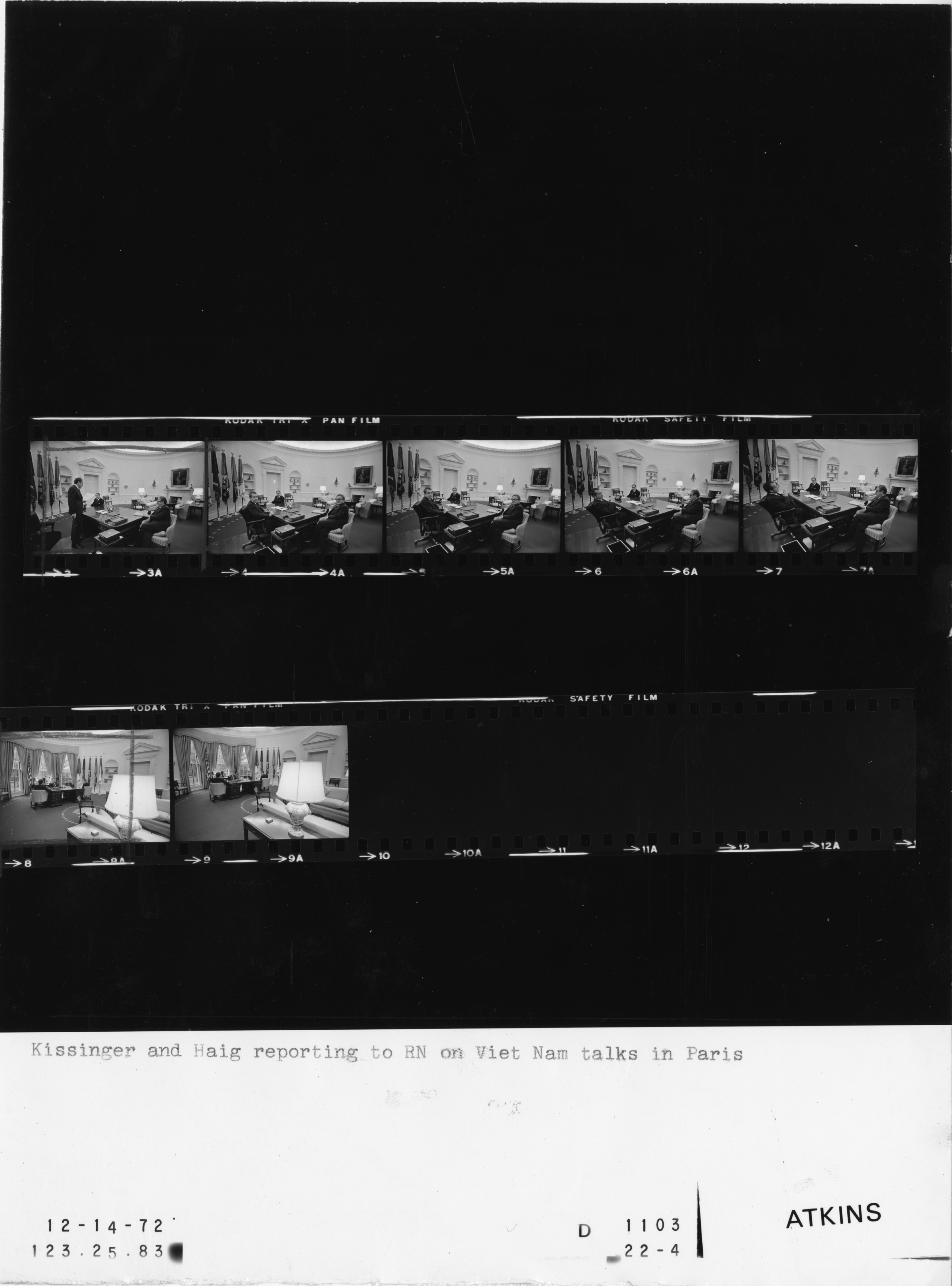
- Frame(s): WHPO-D1103-03A, President Nixon seated at his Oval Office desk talking with Henry Kissinger, Assistant and Major General Alexander Haig, Jr., Deputy Assistant during an early morning meeting. 12/14/1972, Washington, D.C. White House, Oval Office.
- Frame(s): WHPO-D1103-03A-09A, President Nixon seated at his Oval Office desk talking with Henry Kissinger, Assistant and Major General Alexander Haig, Jr., Deputy Assistant during an early morning meeting. 12/14/1972, Washington, D.C. White House, Oval Office. President Nixon, Henry Kissinger, Major General Alexander M. Haig, Jr..
- Frame(s): WHPO-D1103-08A, President Nixon seated at his Oval Office desk talking with Henry Kissinger, Assistant and Major General Alexander Haig, Jr., Deputy Assistant during an early morning meeting. 12/14/1972, Washington, D.C. White House, Oval Office. President Nixon, Henry Kissinger, Alexander M. Haig, Jr..
Roll WHPO-D1104 Photographer: Royer | Color or B&W: B&W
- Frame(s): WHPO-D1104-05-13, Press Secretary Ron Ziegler speaking with young school students (children) who are seated and standing around the Cabinet room conference table. 12/14/1972, Washington, D.C. White House, Cabinet Room. Ron Ziegler, Cindy Ziegler, children, adults.
- Frame(s): WHPO-D1104-14-20, Young school students (children) who are seated and standing around the Cabinet room conference table. 12/14/1972, Washington, D.C. White House, Cabinet Room. children, young students.
Roll WHPO-D1105 Photographer: Kightlinger, Jack | Color or B&W: B&W
- Frame(s): WHPO-D1105-05-20, Vice President Agnew seated in his office with Polish Ambassador Witold Trampczynski and three unidentified men. 12/14/1972, Washington, D.C. Executive Office Building, Executive Office Building, Vice Presidential Office. Spiro Agnew, Witold Trampczynski, unidentified men.
Roll WHPO-D1106 Photographer: Schumacher, Karl | Color or B&W: Color
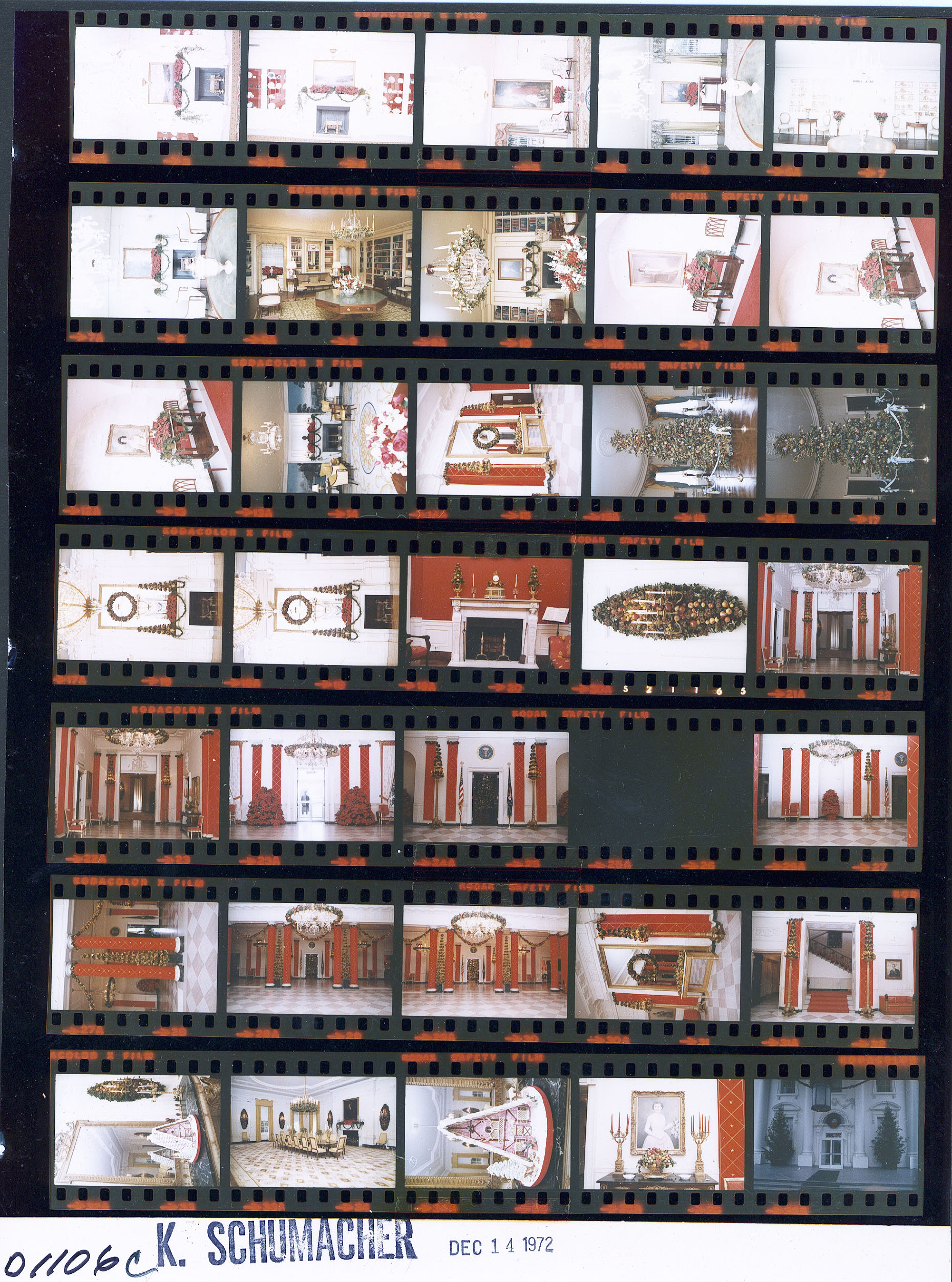
- Frame(s): WHPO-D1106-03-15, 16-34, White House interior rooms and wall in red Christmas decorations. 12/14/1972, Washington, D.C. Interior room, White House.
- Frame(s): WHPO-D1106-16-17, A decorated White House Christmas tree. 12/14/1972, Washington, D.C. Interior room, White House.
- Frame(s): WHPO-D1106-33, White House Christmas decorations. The Pink 1972 A-framed Gingerbread house sitting on a mantle. 12/14/1972, Washington, D.C. White House.
- Frame(s): WHPO-D1106-35, White House interior room and wall Christmas decorations near portrait of First Lady Mamie Eisenhower. NOTE: Digital Image 35 sent from A2 is of a pink iced A-Frame gingerbread house with 1972 address written over the door - Pam E. 12/14/1972, Washington, D.C. Interior room, White House.
- Frame(s): WHPO-D1106-36, White House North Portico entrance Christmas trees and decorations. 12/14/1972, Washington, D.C. North Portico Entrance door, White House.
Roll WHPO-D1107 Photographer: Knudsen, Robert L. | Color or B&W: Color
- Frame(s): WHPO-D1107-02-14, 16-34, Night view of the White House façade with lit Christmas trees on either side of the door. 12/14/1972, Washington, D.C. Exterior building, White House.
- Frame(s): WHPO-D1107-15, Night shot of White House façade in background and blurred Christmas ball decorations in foreground. 12/14/1972, Washington, D.C. Exterior building, White House.
Roll WHPO-D1108 Photographer: Knudsen, Robert L. | Color or B&W: Color
- Frame(s): WHPO-D1108-01-13, Exterior of White House and driveway in the day time. 12/14/1972, Washington, D.C. White House.
- Frame(s): WHPO-D1108-14-26, Exterior of White House façade at dusk, with lit Christmas trees on either side of the door. 12/14/1972, Washington, D.C. White House.
- Frame(s): WHPO-D1108-27-36, Exterior of White House façade and water fountain pond, at dusk, with lit Christmas trees on either side of the door. 12/14/1972, Washington, D.C. White House.
The White House Communications Agency Sound Recordings Collection contains public statements that took place between 1969 and 1974. Visit the finding aid to learn more.
L - White House Press Office Briefings
- WHCA-SR-L-088
Press briefing by Ronald Ziegler. (12/14/1972, White House Press Lobby)
Runtime: 33:00:00
Keywords: Press conferences, news conferences, interviews, media, press secretary
Original Format: 1/4-inch reel-to-reel audiotape. Original source type: Original. - WHCA-SR-L-089
Briefing by Connie Stuart. (12/14/1972, Family Theater)
Keywords: Briefings, public briefings, statements to the press (see also Press conferences, news conferences, interviews, media)
Original Format: 1/4-inch reel-to-reel audiotape. Original source type: Original.
The White House Communications Agency Videotape Collection contains “off-the-air” recordings of televised programs produced between 1968 and 1974. Visit the finding aid to learn more.
- WHCA-5948
Weekly News Summary, Tape II.
ALL NETWORKS
Runtime: 1:30
12. Reasoner/Jarriel/Koppel: Paris peace talks; Kissinger meets with President Nixon. Time Code Start: 35:42. Keywords: Paris Peace Talks, Vietnam War, treaty, treaties, negotiations, cabinet, advisors, travel, trips. Network: ABC.
13. Chancellor/Brinkley: Apollo 17 liftoff from moon; comment on future of space program. Time Code Start: 40:33. Keywords: NASA, National Aeronautics and Space Administration, space program, astronauts, moon, flights. Network: NBC.
14. Chancellor/Valeriani/Dobyns/Streithorst: Paris peace talks; Vietnam. Time Code Start: 44:11. Keywords: Paris Peace Talks, Vietnam War, treaty, treaties, negotiations. Network: NBC.
15. Cronkite/Kalisher/Kalb: Paris peace talks. Time Code Start: 49:54. Keywords: Paris Peace Talks, Vietnam War, treaty, treaties, negotiations. Network: CBS.
16. Cronkite: More on Watergate. Time Code Start: 53:14. Keywords: Watergate, Senate committee hearings, investigations, testimony, testify, cover-ups, break-in, burglary, theft, plumbers, scandals. Network: CBS.
Context (External Sources)
The Vanderbilt Television News Archive is the world's most extensive and complete archive of television news. They have been recording, preserving and providing access to television news broadcasts of the national networks since August 5, 1968.
Wikipedia is a free encyclopedia that anyone can edit.