
Introduction
This almanac page for Monday, August 14, 1972, pulls together various records created by the federal government and links to additional resources which can provide context about the events of the day.
Previous Date: Sunday, August 13, 1972
Next Date: Tuesday, August 15, 1972
Schedule and Public Documents
The Daily Diary files represent a consolidated record of the President's activities. Visit the finding aid to learn more.
The President's day began at The White House - Washington, D. C.
The Weekly Compilation of Presidential Documents made available transcripts of the President's news conferences; messages to Congress; public speeches, remarks, and statements; and other Presidential materials released by the White House.
Digitized versions can be found at HathiTrust.
The Federal Register is the official daily publication for rules, proposed rules, and notices of federal agencies and organizations, as well as executive orders and other Presidential documents.
No Federal Register published on this date
The Congressional Record is the official daily record of the debates and proceedings of the U.S. Congress.
Archival Holdings
Any selection of archival documents will necessarily be partial. You should use the documents and folders identified below as a starting place, but consult the linked collection finding aids and folder title lists and the collections themselves for context. Many documents to be found this way do not lend themselves to association with specific dates, but are essential to a complete understanding of the material.
Selective document listing
President's Office Files
The President's Office Files consists of materials drawn together by the Special Files Unit from several administrative subdivisions within the White House Office. It is the handwriting and sensitive papers sent to the Staff Secretary that now comprise much of the President's Office Files. Visit the finding aid to learn more.
- News Summaries, Annotated News Summaries, Box 37, August 5-11, 1972 [4 of 4] [Note: Due to the way News Summary products were compiled, you should also consult nearby days for potentially relevant materials.]
- Weekend News Review, August 14, 1972
- President's Daily Schedule, Box 102, [President's Daily Schedule, Aug.-Sept. 1972] [1 of 2]
- The President's Schedule, Monday - August 14, 1972
The H. R. Haldeman Diaries consists of seven handwritten diaries, 36 dictated diaries recorded as sound recordings, and two handwritten audio cassette tape subject logs. The diaries and logs reflect H. R. Haldeman’s candid personal record and reflections on events, issues, and people encountered during his service in the Nixon White House. As administrative assistant to the President and Chief of Staff, Haldeman attended and participated in public events and private meetings covering the entire scope of issues in which the Nixon White House engaged in during the years 1969-1973. Visit the finding aid to learn more.
- Transcript of diary entry (PDF)
Monday, August 14.
Back in Washington for a heavy schedule today before returning to Camp David for more work on the speech. President met first with Connally at 9:00 this morning, got into a number of things on ideas for the campaign. Agreed to spend the night at Connally's when he does the Democratic-- Democrats for Nixon deal at his ranch. Agrees that we should get Billy Graham to talk to Lyndon Johnson and urge him to be cool to MacGregor when he comes to see him next week, making that point Johnson's friends won't understand if he puts his arm around him. Connally recommends that we crank up Milt Friedman on the International Economic thing, because Arthur Burns is cutting us up with the Jewish columnist. Also thinks we should use Rinfret to take on the others. Connally felt Rogers did not do a good job in attacking Shriver, that he didn't nail him hard enough, and that we need someone else other than Rogers to do this. This doesn’t jibe with our earlier input and actually Connally came back to me later in the day and said he had had another reading on that and revised his view. He feels we need someone in the defense field also besides Laird, but that we should get Laird to work as mean as possible. We should make all our responses in the form of an attack, we should not defend against their charges, and that we have to destroy Shriver now. President asked him for ideas on his acceptance speech, and he made the point that he should hit hard, be political, give a fighting speech. He should take on the defense thing strongly, hit permissiveness, welfare, the idea of the ring-around-the-Treasury. That he should hold up on unleashing Agnew for a while, not until September anyway, but should throw in Rogers, Laird, and Stein hard now.
Next meeting was with Mitchell and MacGregor, on the general political question, they made a pitch, or MacGregor did, that California is very much improved, that Reagan is broadening the base, problem is Finch and his activities, press conferences and so on. Finch announcing how the President would open his campaign, which has got Reagan upset. President told me to get Finch to quit doing this. Clark wanted to know what the President's September plans were, and President told him to say the line there was it depends on how long Congress is here, that he will not be out campaigning until they adjourn, although he actually will be. That he should not speculate on what he'll be doing after that. Regarding the strategy on a debate: first, make the point that the President doesn't intend to debate, especially because of the way McGovern is distorting things. Secondly, hang the whole thing on the national interest, just as LBJ decided to do. And on 315, if repeal is involved, the President might sign it, so we've got to be prepared on that.
Then into the question of Watergate, President made the point that we should wait until the indictment. No, the question was raised whether we should wait until the indictment or whether we should prepare in advance. We must make a case for the reelection committee on how it conducted its own investigation, so that when the grand jury indicts, it will cover the noninvolvement of others. First, we should leak out now about our investigation. And second, while the President's in Hawaii, MacGregor should put out a statement describing the results of the investigation. Forget the legal question, deal with the political PR, get our line out in our way. If we can absolve all the top officials, then we should put it at the lowest common denominator. The funds were misused, the culprits have left, no one else was involved. But we must be sure of our facts from the grand jury and we must know what Justice is going to seek out of the grand jury. Be sure of those facts.
President then met with Moynihan, who's writing an article for the New York Times Magazine, and wanted to get a view of the President's look at his second four years. President expanded quite completely for Pat at on this, made the point of the coherent philosophy, tying in foreign policy, economic policy, and domestic policy. He should say that here there is a new philosophy and a new way. Make the point that the FDR coalition was made up because they wanted to win, but they didn't belong together, they were drawn together by their fears. First, the economy and then the war. Our new coalition will be held not by fears but by common hopes and a shared philosophy. Not total agreement, but a recognition of the need for civility, of different ways to approach the government goals-- great goals. In other words, we will form a national coalition that shares common views regarding what the country ought to be, at home and abroad. We have to find coherent policies, not to suit the new left or the new libs, but closer to the 19th century liberals. Internationalism without imperialism. Change that works. Constructive. We’ll build, not destroy, based on the old values. We have to find a way to get the pragmatists and the idealists together. Moynihan was ecstatic with all this material, and got quite responsive and excited with the President's views, and should come up with a pretty good article.
President went through quite a few speech needs this afternoon, wants some specific lines and thoughts from Buchanan on the general thrust of the acceptance speech, was concerned about the line we're putting out particularly on how we're handling the Shriver and Clark attacks. Feels that we should be hitting Shriver hard on the point that he didn't know what was going on, so he was wrong on this thing. That he was not told anything, because LBJ didn't trust him and we don’t believe he knew. There should be a categorical denial that we ever discussed anything with Shriver.
On the POW offer from Ramsey Clark, we should refer to the fact that McGovern came back with the same deal from Paris, it turned out to be a phony, now Ramsey Clark is also a phony. We got into quite a thing with Colson and Haig on this, and the point that Haig doesn't want to push too hard, because at the proper time, Kissinger will pull the rug out from the whole thing. We must stay away from it until we know what he has. The problem is that Clark may have a legitimate POW offer. Like that they'll release a few now, and a few when the bombing stops, or something, and it might backfire on the basis that he did get the prisoners. So everyone backed off today and laid low on it, which was probably just as well. Connally had some feeling that we had the opportunity to really jump this on the basis that Bill Jordan and Kissinger shop was the staff man in Paris for Harriman and Vance, and knows everything about it.
We can be sure of our facts, but he says don't let the issue die, we have the chance to destroy Shriver, we should document the fact that there's no evidence here. Get a statement from Rusk or Rostow, which Bill Rogers is going to follow-up on. We had an idea that we get some mileage out of Max Taylor's book, and that he eats Harriman alive, because Harriman went counter to Rusk, and that Bill Rogers or someone should use the quotes on that. So everybody's getting into the act and all cranked up about it. President wants to be sure that all hands call upon Shriver, Clark, McGovern, and so on, to denounce the North Vietnamese atrocities such as in Binh Dinh province.
[End of tape reel AC-23(B)]
[Begin tape reel AC-24(A)]
[August] 14, 1972 continued--We’re now up at Camp David probably for the rest of the week while the President works on his acceptance address.
End of August 14. - Original audio recording (MP3)
The National Archives Catalog is the online portal to the records held at the National Archives, and information about those records. It is the main way of describing our holdings and also provides access to electronic records and digitized versions of our holdings.
The Catalog searches across multiple National Archives resources at once, including archival descriptions, digitized and electronic records, authority records, and web pages from Archives.gov and the Presidential Libraries. The Catalog also allows users to contribute to digitized historical records through tagging and transcription.
Nixon Library Holdings
All National Archives Units
National Security Documents
The President's Daily Brief is the primary vehicle for summarizing the day-to-day sensitive intelligence and analysis, as well as late-breaking reports, for the White House on current and future national security issues. Read "The President's Daily Brief: Delivering Intelligence to Nixon and Ford" to learn more.
The Foreign Relations of the United States series presents the official documentary historical record of major U.S. foreign policy decisions and significant diplomatic activity. Visit the State Department website for more information.
Vol. VIII, Vietnam, January-October 1972
The Parties Move Toward Agreement, July 19-October 7, 1972
237. Memorandum From the President’s Deputy Assistant for National Security Affairs (Haig) to President Nixon, Washington, August 14, 1972
Source: National Archives, Nixon Presidential Materials, NSC Files, Henry A. Kissinger Office Files, Box 22, HAK Trip Files. Top Secret; Sensitive; Exclusively Eyes Only. A stamped notation on the memorandum indicates the President saw it.
Vol. XXIII, Arab-Israeli Dispute, 1969-1972
Proximity Talks and the Backchannel: Separate Department of State and White House Negotiating Tricks
305. Memorandum From the President’s Assistant for National Security Affairs (Kissinger) to President Nixon, Washington, August 14, 1972
Source: National Archives, Nixon Presidential Materials, NSC Files, Kissinger Office Files, Box 131, Country Files, Middle East. Top Secret; Sensitive; Exclusively Eyes Only. Sent for information. A stamped notation on the memorandum indicates the President saw it. All brackets are in the original except those indicating text that remains classified.
Vol. XXIV, Middle East Region and Arabian Peninsula, 1969-1972; Jordan, September 1970
Persian Gulf States
119. Memorandum From the President’s Assistant for National Security Affairs (Kissinger) to President Nixon, Washington, August 14, 1972
Source: National Archives, Nixon Presidential Materials, NSC Files, NSC Institutional Files (H-Files), Box H–236, National Security Decision Memoranda, NSDM 186. Secret. Sent for action. Haig initialed the memorandum for Kissinger. A handwritten notation on the memorandum indicates the President saw it.
Vol. XXXIV, National Security Policy, 1969-1972
Taking Stock
223. National Security Decision Memorandum 184, Washington, August 14, 1972
Source: National Archives, Nixon Presidential Materials, NSC Files, Subject Files, Box 364, NSDMs, Nos. 145–264. Limited Official Use. Copies were sent to Helms, Gerard Smith, Moorer, Weinberger, and David.
Vol. XLI, Western Europe; NATO, 1969-1972
Spain
307. Memorandum From the President’s Assistant for National Security Affairs (Kissinger) to President Nixon, Washington, August 14, 1972
Source: National Archives, Nixon Presidential Materials, NSC Files, Box 706, Country Files—Europe, Spain, Vol. IV. Confidential. Sent for information. Haig signed the memorandum for Kissinger. A stamped notation on the memorandum reads: “The President has seen.”
Vol. XLII, Vietnam: The Kissinger-Le Duc Tho Negotiations
Serious Negotiations and the October Settlement, July 1972-October 1972
17. Memorandum of Conversation, Paris, August 14, 1972, 9:28 a.m.-5 p.m.
Source: National Archives, Nixon Presidential Materials, NSC Files, Box 864, For the President’s Files (Winston Lord)—China/Vietnam Negotiations, Sensitive, Camp David Memcons, May–October 1972 [4 of 5]. Top Secret; Sensitive; Exclusively Eyes Only. The meeting took place at the North Vietnamese Residence at 11 Rue Darthé, Choisy-le-Roi. All brackets are in the original. The tabs are attached but not printed.
As directed by Kissinger, Haig reported to President Nixon that the 7½-hour “meeting was a holding action pending review in the capitals by both sides, especially on the political issue.” Haig continued: “Kissinger informed the other side that he was proceeding to Saigon to discuss the negotiations. Le Duc Tho, in turn, told Dr. Kissinger that he was returning to Hanoi in a few days to review the North Vietnamese position and it was then clear that he was not about to give anything away prior to that review. Kissinger emphasized that the PR effect of the nearly simultaneous visit of Kissinger to Saigon and Le Duc Tho to Hanoi should be significant.”
A stamped notation on Haig’s memorandum indicates the President saw it, and Nixon wrote on the last page as follows:
“I. Al—It is obvious that no progress was made & that none can be expected—Henry must be discouraged—as I have always been on this front until after the election.
“We have reached the stage where the mere fact of private talks helps us very little—if at all. We can soon expect the opposition to begin to make that point.
“II. Disillusionment about K’s talks could be harmful psychologically—particularly in view of the fact that the Saigon trip, regardless of how we downplay it—may raise expectations.
“What we need most now is a P.R. game plan to either stop talks or if we continue them to give some hope of progress.” ( Foreign Relations, 1969–1976, vol. VIII, Vietnam, January–October 1972, Document 237)
In an August 19 memorandum to President Nixon, Kissinger provided further details about this meeting:
“As the meeting headed toward a close I registered my disillusionment with their generally negative performance. They could hardly expect me to work hard in Saigon on political issues when they were underscoring differences on other issues as well. This had a salutary effect; their tone changed markedly:
“—They emphasized that both sides had been showing good will and that we were engaged in serious negotiations.
“—They emphasized that neutral ground must be found on the tough questions, like the political issues.
“—They opined that if the political problem could be solved, the other issues would fall into place.
“—They underlined their desire for rapid progress toward a settlement.
“—And Tho informed me that he was returning shortly to Hanoi; this was the first time he had accounted for his travels to me. (Ibid., Document 246. A stamped notation on the memorandum indicates the President saw it.)
Le Duc Tho and Xuan Thuy, looking beyond this meeting, assessed for the Politburo a way forward for the next stage of the Paris talks:
“[A]fter the three last private meetings, we decided
“—gradually to lead the US into real negotiations, and
“—step by step to try to understand the US scheme.
“Watching how much they show their cards, we should open our hands as wide as they do. Generally speaking, we should see what they put forward to follow suit and then play a similar card. However, we must be flexible, it was not necessary that they always made the first step and we always followed them, at times we should take the initiative to show our card first for sounding purposes and to direct them to our aim.
“We should firmly hold principles and be flexible in tactics.” (Luu and Nguyen, Le Duc Tho-Kissinger Negotiations in Paris, p. 273)
Vol. E-10, Documents on American Republics, 1969-1972
Haiti
408. Telegram 1036 From the Embassy in Haiti to the Department of State, August 14, 1972, 1920Z., August 14, 1972, 1920Z
Ambassador Knox indicated that in spite of many shortcomings, Haiti had “perhaps the best government it could have in the existing circumstances.”
Source: National Archives, RG 59, Central Files 1970–73, POL 1 HAI–US. Confidential.
Vol. E-13, Documents on China, 1969-1972
151. Memorandum of Conversation, New York, August 14, 1972, 3:30-4:10 p.m., New York, August 14, 1972, 3:30-4:10 p.m.
Chinese Ambassador to the UN Huang Hua reiterated to NSC staff member Howe China’s opposition to the Soviet nuclear non-aggression proposal, described a recent visit to China by Gerhard Schroeder of the West German Bundestag, and expressed optimism about a rapprochement between China and Japan. Howe also read the text of a note, outlining U.S. opposition to a Soviet treaty on the non-use of nuclear weapons, informing the Chinese of President’s Assistant for National Security Affairs Kissinger’s planned trip to Saigon following a secret meeting with North Vietnamese negotiators in Paris, and noting that Kissinger might consider stopping briefly in Japan on his return trip from Saigon.
Source: National Archives, Nixon Presidential Materials, NSC Files, Box 850, President’s File-China Trip, China Exchanges, June 25, 1972-Oct 17, 1972. Top Secret; Sensitive; Exclusively Eyes Only. The precise location of the meeting is not indicated. Attached at Tab A are the U.S. note and a copy of the Soviet-proposed treaty on the non-use of nuclear weapons.
The Kissinger telephone conversation transcripts consist of approximately 20,000 pages of transcripts of Kissinger’s telephone conversations during his tenure as Assistant to the President for National Security Affairs (1969-1974) and Secretary of State (1973-1974) during the administration of President Richard Nixon. Visit the finding aid for more information.
Digitized versions can be found in the National Archives Catalog.
Audiovisual Holdings
Visit the White House Tapes finding aid to learn about the taping system's operation and archival processing.
Camp David Hard Wire
- 202-1; Unknown between 6:05 p.m., 8/14 & 8:17 p.m., 5/17; Nixon, Richard M. (President)
- 202-2; Unknown between 6:05 p.m., 8/14 & 8:17 p.m., 5/17; Nixon, Richard M. (President); Sanchez, Manolo; Haldeman, H. R. ("Bob")
- 202-3; Unknown between 6:05 p.m., 8/14 & 8:17 p.m., 5/17; Nixon, Richard M. (President)
- 202-4; Unknown between 6:05 p.m., 8/14 & 8:17 p.m., 5/17; Nixon, Richard M. (President); Sanchez, Manolo
- 202-5; Unknown between 6:05 p.m., 8/14 & 8:17 p.m., 5/17; Nixon, Richard M. (President); Haldeman, H. R. ("Bob")
- 202-6; Unknown between 6:05 p.m., 8/14 & 8:17 p.m., 5/17; Nixon, Richard M. (President); Sievers, Roy Edward
- 202-7; Unknown between 6:05 p.m., 8/14 & 8:17 p.m., 5/18; Nixon, Richard M. (President); Staubach, Roger
- 202-8; Unknown between 6:05 p.m., 8/14 & 8:17 p.m., 5/18; Nixon, Richard M. (President); Sanchez, Manolo
Camp David Study Table
Old Executive Office Building
- 362-15; Unknown between 2:50 p.m. & 3:52 p.m.; Nixon, Richard M. (President); Sanchez, Manolo
- 362-16; Unknown between 2:50 p.m. & 3:52 p.m.; Nixon, Richard M. (President); Haldeman, H. R. ("Bob")
- 362-17; Unknown between 2:50 p.m. & 3:52 p.m.; Nixon, Richard M. (President); Sanchez, Manolo
- 362-18; Unknown between 2:50 p.m. & 3:52 p.m.; Nixon, Richard M. (President); White House operator
- 362-19; 3:52 p.m. - 3:54 p.m.; Nixon, Richard M. (President); Eisenhower, Julie Nixon
- 362-20; Unknown between 3:54 p.m. & 4:34 p.m.; Nixon, Richard M. (President); White House operator
- 362-21; 4:34 p.m. - 4:36 p.m.; Nixon, Richard M. (President); Haldeman, H. R. ("Bob")
- 362-22; 4:40 p.m. - 5:15 p.m.; Nixon, Richard M. (President); Haldeman, H. R. ("Bob"); Ziegler, Ronald L.; [Unknown person(s)]; Butterfield, Alexander P.; White House operator; Haig, Alexander M., Jr.
- 362-23; Unknown between 5:15 p.m., 8/14 & 12:40 p.m., 7/27; Nixon, Richard M. (President); Sanchez, Manolo
- 362-24; Unknown between 5:15 p.m., 8/14 & 12:40 p.m., 7/27; Nixon, Richard M. (President); Sanchez, Manolo
Oval Office
- 768-1; 8:38 a.m. - 8:45 a.m.; Nixon, Richard M. (President); Butterfield, Alexander P.
- 768-2; Unknown between 8:45 a.m. & 9:00 a.m.; Nixon, Richard M. (President); Buchanan, Patrick J.; Bull, Stephen B.
- 768-3; Unknown between 8:45 a.m. & 9:00 a.m.; Nixon, Richard M. (President); [Unknown person(s)]
- 768-4; 9:00 a.m. - 10:42 a.m.; Nixon, Richard M. (President); Connally, John B.; Haldeman, H. R. ("Bob"); Mitchell, John N.; MacGregor, Clark
- 768-5; 10:42 a.m. - 11:09 a.m.; Nixon, Richard M. (President); Eberle, William D.; Flanigan, Peter M.; Haig, Alexander M., Jr.; White House photographer
- 768-6; 11:09 a.m. - 11:11 a.m.; Nixon, Richard M. (President); Bull, Stephen B.
- 768-7; Unknown between 11:11 a.m. & 11:14 a.m.; Nixon, Richard M. (President); Ehrlichman, John D.
- 768-8; 11:14 a.m. - 11:28 a.m.; Nixon, Richard M. (President); Keating, Kenneth B.; Haig, Alexander M., Jr.; Bull, Stephen B.
- 768-9; Unknown between 11:28 a.m. & 11:29 a.m.; Nixon, Richard M. (President); Bull, Stephen B.
- 768-10; 11:29 a.m. - 12:04 p.m.; Nixon, Richard M. (President); Rinfret, Pierre; Colson, Charles W.; Connally, John B.; White House photographer
- 768-11; Unknown between 12:04 p.m. & 12:07 p.m.; Nixon, Richard M. (President); Bull, Stephen B.
- 768-12; 12:07 p.m. - 12:09 p.m.; Nixon, Richard M. (President); Bull, Stephen B.; Winer, Samuel D.; Winer, Samuel D. (Mrs.); Colson, Charles W.; White House photographer
- 768-14; 12:09 p.m. - 12:17 p.m.; Nixon, Richard M. (President); Bull, Stephen B.; Dirksen, Louella (Carver); Woods, Rose Mary; White House photographer
- 768-16; 12:17 p.m. - 12:38 p.m.; Nixon, Richard M. (President); Howard, Bailey K.; Ziegler, Ronald L.; White House photographer
- 768-17; 12:38 p.m. - 12:38 p.m.; Nixon, Richard M. (President); Bull, Stephen B.
- 768-18; 12:39 p.m. - 12:45 p.m.; Nixon, Richard M. (President); Bull, Stephen B.; Forst, Robert A.; Evans, L. John; White House photographer
- 768-19; Unknown between 12:45 p.m. & 12:49 p.m.; Nixon, Richard M. (President); Bull, Stephen B.; Nixon, Thelma C. ("Pat") (Ryan)
- 768-20; 12:49 p.m. - 1:12 p.m.; Nixon, Richard M. (President); Butterfield, Alexander P.; Nixon, Thelma C. ("Pat") (Ryan); Ratchford, John J.; Haldeman, H. R. ("Bob"); Ehrlichman, John D.; Dean, John W., III; Alexander, John H.; Ritzel, Richard S.; White House photographer; Bull, Stephen B.
- 768-21; Unknown between 1:12 p.m. & 1:15 p.m.; Nixon, Richard M. (President); Bull, Stephen B.
- 768-22; 1:15 p.m. - 1:44 p.m.; Nixon, Richard M. (President); Roberts, Oral; Henley, Wallace B.; White House photographer
- 768-23; Unknown between 1:44 p.m. & 1:47 p.m.; Nixon, Richard M. (President); Bull, Stephen B.
- 768-24; 1:47 p.m. - 2:48 p.m.; Nixon, Richard M. (President); Haldeman, H. R. ("Bob"); Moynihan, Daniel P.; White House photographer
- 769-1; Unknown between 1:47 p.m. & 2:48 p.m.; Nixon, Richard M. (President); Haldeman, H. R. ("Bob"); Moynihan, Daniel P.
- 769-2; Unknown between 2:48 p.m. & 2:50 p.m.; Nixon, Richard M. (President); Sanchez, Manolo
White House Telephone
- 29-65; 3:52 p.m. - 3:54 p.m.; Nixon, Richard M. (President); Eisenhower, Julie Nixon
- 29-66; 4:34 p.m. - 4:36 p.m.; Nixon, Richard M. (President); White House operator; Haldeman, H. R. ("Bob")
- 29-67; 5:02 p.m. - 5:02 p.m.; Nixon, Richard M. (President); White House operator
- 29-68; Unknown between 5:02 p.m., 8/14 & 11:17 a.m., 7/1;
- 29-73; Unknown between 2:50 p.m. & 3:52 p.m.; Nixon, Richard M. (President); White House operator
- 30-52; Unknown between 5:18 p.m., 8/14 & 11:17 a.m., 7/21;
The White House Photo Office collection consists of photographic coverage of President Richard Nixon meeting with prominent social, political, and cultural personalities; speaking engagements and news conferences of the President and various high-ranking members of the White House staff and Cabinet; Presidential domestic and foreign travel, including Presidential vacations; social events and entertainment involving the First Family, including entertainers present; official portraits of the President, First Family, and high-ranking members of the Nixon administration; the 1969 and 1973 Inaugurals; the President’s 1972 Presidential election campaign appearances (including speeches) and other official activities of the White House staff and the President’s Cabinet from January 20, 1969 until August 9, 1974 at the White House and the Old Executive Office Building; other locations in Washington, DC, such as The Mall; and the Presidential retreats in Camp David, Maryland, Key Biscayne, Florida, and San Clemente, California. Visit the finding aid to learn more.
Roll WHPO-9789 Photographer: Schumaker, Byron | Color or B&W: B&W
- Frame(s): WHPO-9789-[none], Head and shoulders portrait of Tricia Nixon Cox. 8/14/1972, Washington, D.C. unknown. Tricia Nixon Cox.
Roll WHPO-9794 Photographer: Schumacher, Karl | Color or B&W: B&W
- Frame(s): WHPO-9794-, Vice President Agnew meeting with interns. 8/14/1972, Washington, D.C. Conference Room, Executive Office Building (EOB). Spiro Agnew, unidentified interns.
Roll WHPO-9795 Photographer: Schumacher, Karl | Color or B&W: B&W
- Frame(s): WHPO-9795-, Vice President Agnew meeting with interns. 8/14/1972, Washington, D.C. Conference Room, Executive Office Building (EOB). Spiro Agnew, unidentified interns.
Roll WHPO-9796 Photographer: Atkins, Oliver | Color or B&W: B&W
- Frame(s): WHPO-9796-02A-07A, President Nixon seated at his Oval Office desk during a meeting with William Eberle, Special Representative for Trade Negotiations, Peter Flanigan, and Maj. Gen. Alexander Haig. 8/14/1972, Washington, D.C. White House, Oval Office. President Nixon, William D. Eberle, Peter M. Flanigan, Alexander Haig.
- Frame(s): WHPO-9796-06A, President Nixon seated at his Oval Office desk during a meeting with William Eberle, Special Representative for Trade Negotiations, Peter Flanigan, and Maj. Gen. Alexander Haig. 8/14/1972, Washington, D.C. White House, Oval Office. President Nixon, William D. Eberle, Peter M. Flanigan, Alexander Haig.
- Frame(s): WHPO-9796-11A-14A, President Nixon in the Oval Office during a meeting with Treasury Secretary John Connally and Pierre Rinfret, President of Rinfret-Boston Associates, Inc. 8/14/1972, Washington, D.C. White House, Oval Office. President Nixon, John Connally, Pierre Rinfret.
Roll WHPO-9797 Photographer: Atkins, Oliver | Color or B&W: B&W
- Frame(s): WHPO-9797-, President Nixon seated at his desk during a meeting with departing Ambassador Kenneth Keating. 8/14/1972, Washington, D.C. White House, Oval Office. President Nixon, Kenneth Keating.
Roll WHPO-9798 Photographer: Atkins, Oliver | Color or B&W: B&W
- Frame(s): WHPO-9798-, President Nixon seated informally with U.S. Jaycees President Samuel Weiner. 8/14/1972, Washington, D.C. White House, Oval Office. President Nixon, Samuel Weiner.
Roll WHPO-9799 Photographer: Atkins, Oliver | Color or B&W: B&W
- Frame(s): WHPO-9799-, President Nixon standing and seated informally with U.S. Jaycees President Samuel Weiner and Mrs. Weiner. 8/14/1972, Washington, D.C. White House, Oval Office. President Nixon, Samuel Weiner, Mrs. Weiner.
Roll WHPO-9800 Photographer: Kightlinger, Jack | Color or B&W: B&W
- Frame(s): WHPO-9800-03A-10A, President Nixon standing in the Oval Office shaking hands with Robert Allen Fors. 8/14/1972, Washington, D.C. White House, Oval Office. President Nixon, Robert Allen Forst.
- Frame(s): WHPO-9800-12-21A, President Nixon standing in the Oval Office shaking hands with Rev. Oral Roberts. 8/14/1972, Washington, D.C. White House, Oval Office. President Nixon, Oral Roberts.
- Frame(s): WHPO-9800-14A, President Nixon standing in the Oval Office shaking hands with Rev. Oral Roberts. 8/14/1972, Washington, D.C. White House, Oval Office. President Nixon, Oral Roberts.
Roll WHPO-9801 Photographer: Atkins, Oliver | Color or B&W: B&W
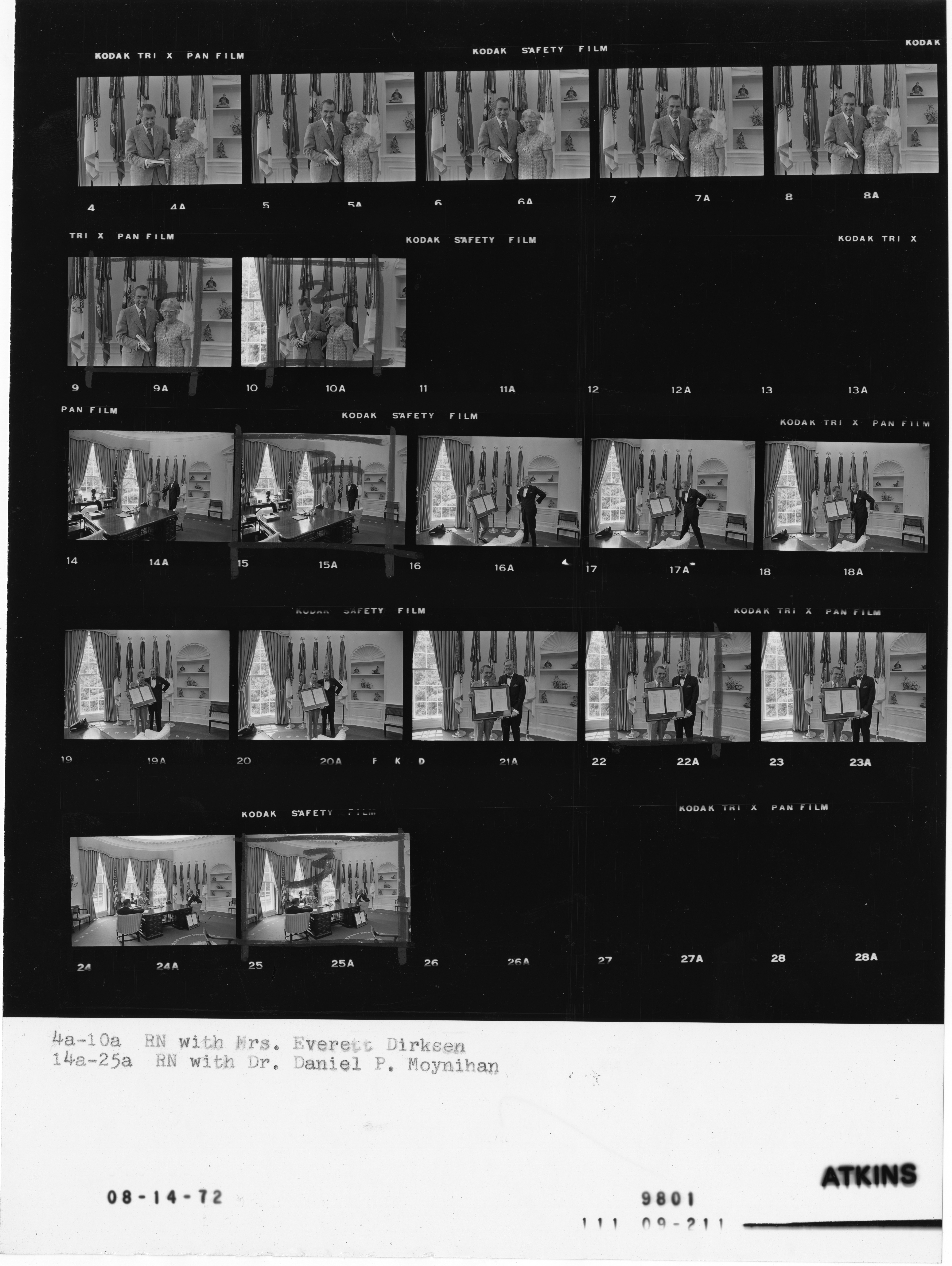
- Frame(s): WHPO-9801-04A-10A, President Nixon receiving a book from Mrs. Everett Dirksen. 8/14/1972, Washington, D.C. White House, Oval Office. President Nixon, Mrs. Everett Dirksen.
- Frame(s): WHPO-9801-14A-25A, President Nixon standing, receiving a presentation, and seated at his desk with Daniel Moynihan. 8/14/1972, Washington, D.C. White House, Oval Office. President Nixon, Daniel Patrick Moynihan.
Roll WHPO-9802 Photographer: Atkins, Oliver | Color or B&W: B&W
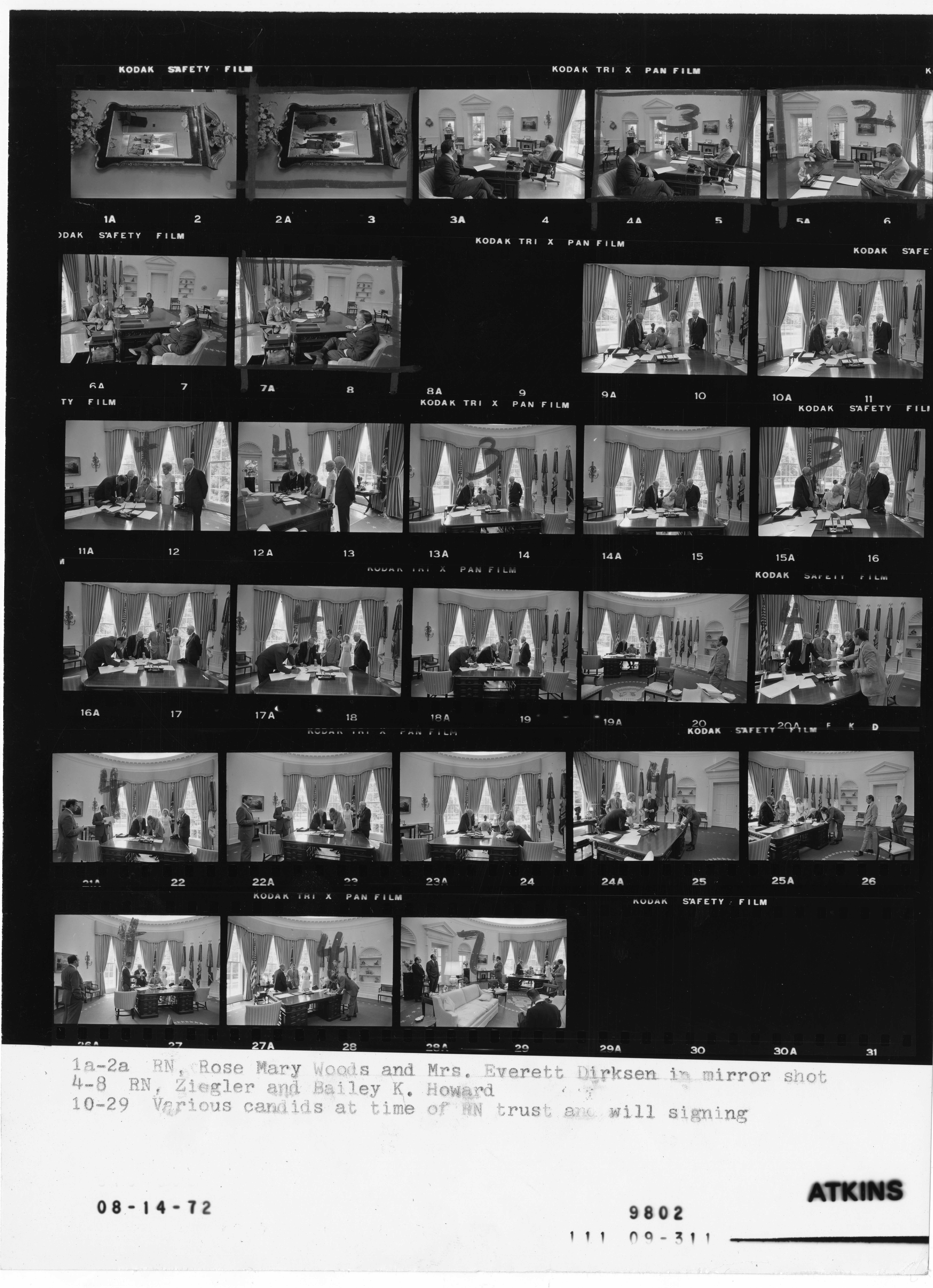
- Frame(s): WHPO-9802-02-03, Mirror shots of President Nixon, Mrs. Everett Dirksen and Rose Mary Woods. 8/14/1972, Washington, D.C. White House, Oval Office. President Nixon, Mrs. Everett Dirksen, Rose Mary Woods, Ziegler, Bailey Howard, Pat Nixon, Ehrlichman, John Dean, Haldeman, John Alexander, Richard Ritzel, Butterfield.
- Frame(s): WHPO-9802-04-08, President Nixon seated informally with ron Ziegler and Bailey Howard. 8/14/1972, Washington, D.C. White House, Oval Office. President Nixon, Mrs. Everett Dirksen, Rose Mary Woods, Ziegler, Bailey Howard, Pat Nixon, Ehrlichman, John Dean, Haldeman, John Alexander, Richard Ritzel, Butterfield.
- Frame(s): WHPO-9802-10-29, President Nixon signing the Nixon Will and Trust Agreements as others watch. 8/14/1972, Washington, D.C. White House, Oval Office. President Nixon, Mrs. Everett Dirksen, Rose Mary Woods, Ron Ziegler, Bailey Howard, Pat Nixon, John Ehrlichman, John Dean, Haldeman, John Alexander, Richard Ritzel, Alexander Butterfield, Nixon Literary Trust.
- Frame(s): WHPO-9802-11, President Nixon sitting at his Oval Office desk during a meeting with Ronald Ziegler and Bailey K. Howard. 8/14/1972, Washington, D.C. White House, Oval Office. President Nixon, Ronald Ziegler, Bailey K. Howard.
- Frame(s): WHPO-9802-16, Pat Nixon at the Oval Office desk signing the Nixon Will and Trust Agreements as others watch. 8/14/1972, Washington, D.C. White House, Oval Office. President Nixon, Pat Nixon, two unidentified men.
Roll WHPO-9803 Photographer: Grove, Andrew | Color or B&W: B&W
- Frame(s): WHPO-9803-, Caspar Weinberger presenting Federal Safety Awards to unidentified persons. 8/14/1972, Washington, D.C. White House, South Lawn. Caspar Weinberger, Federal Safety awardees.
Roll WHPO-9804 Photographer: Kightlinger, Jack | Color or B&W: B&W
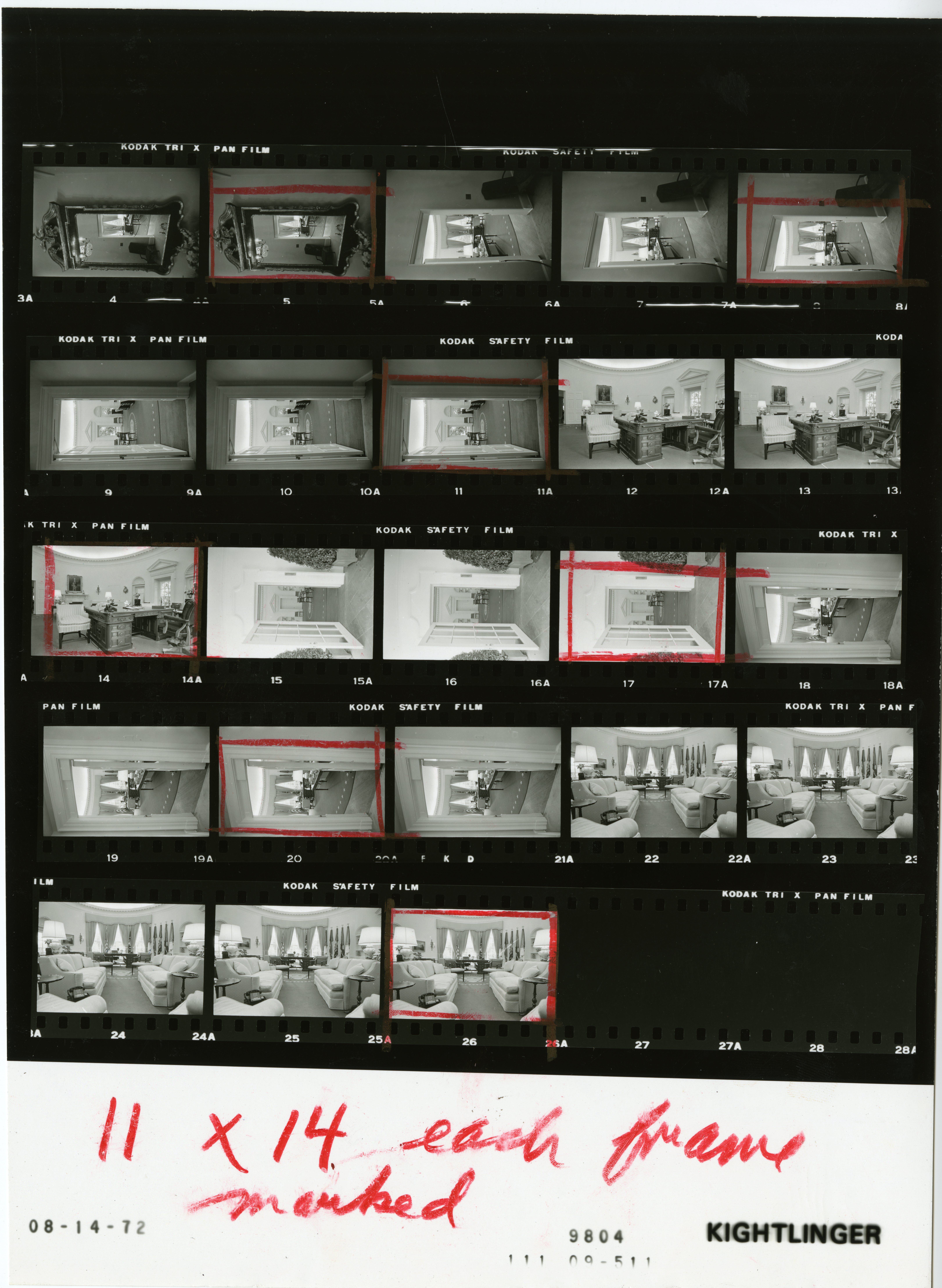
- Frame(s): WHPO-9804-, the unoccupied Oval Office viewed from various angles. 8/14/1972, Washington, D.C. White House, Oval Office.
The White House Communications Agency Sound Recordings Collection contains public statements that took place between 1969 and 1974. Visit the finding aid to learn more.
G - Cabinet Officer Briefings
- WHCA-SR-G-185
Briefing by Secretary James D. Hodgson (Labor), Director George Shultz (Office of Management and Budget), and Caspar Weinberger, with Helen Bentley, Mr. Larson, Mr. Shimp, and John Clent. (8/14/1972, The East Garden)
Runtime: 18:00
Production credits: Audio feed supplied by WHCA; Recorded by GLG (initials of WHCA engineer)
Original Format: 1/4-inch reel-to-reel audiotape. Original source type: Original.
H - White House Staff Member Recordings
- WHCA-SR-H-639
Doug Engman briefs Summer Interns on the White House Conference on Youth. (8/14/1972, Room 444, Executive Office Building)
Runtime: 50:00:00
Keywords: Briefings, private briefings
Production credits: Audio feed supplied by WHCA; Recorded by CBW (initials of WHCA engineer)
Original Format: 1/4-inch reel-to-reel audiotape. Original source type: Original.
L - White House Press Office Briefings
- WHCA-SR-L-001
Press briefing by Ronald Ziegler. (8/14/1972, White House Press Lobby)
Runtime: 27:00:00
Keywords: Press conferences, news conferences, interviews, media, press secretary
Original Format: 1/4-inch reel-to-reel audiotape. Original source type: Original.
The White House Communications Agency Videotape Collection contains “off-the-air” recordings of televised programs produced between 1968 and 1974. Visit the finding aid to learn more.
- WHCA-5651
"CBS Morning News" excerpt.
NBC
Runtime: 00:13:48 - WHCA-5654
Weekly News Summary, Tape I.
ALL NETWORKS
Runtime: 01:34:39
26. Reasoner/Kaplow: Republican platform hearings. Time Code Start: 69:55. Keywords: Presidential elections, campaigns, campaigning, candidates, primaries, voting, conventions, political parties, Republicans, GOP. Network: ABC.
27. Smith/Wordham: Former Attorney General Ramsey Clark with film from North Vietnam. Time Code Start: 72:35. Keywords: Vietnam War, bombings, protests, lawyers, attorneys, activists. Network: ABC.
28. Smith/Geer: McGovern, economic program and AFL-CIO viewpoint and McGovern endorsement. Time Code Start: 77:12. Keywords: economy, economics, budgets, finances, recession, inflation, money, wages, costs, unemployment, prices, reports. Network: ABC.
29. Reasoner/Collins: Kissinger in Paris again; Vietnam. Time Code Start: 80:09. Keywords: Paris Peace Talks, Vietnam War, treaty, treaties, negotiations, government, officials, travel, trips. Network: ABC.
30. Smith: Commentary on the end of the Vietnam war. Time Code Start: 83:25. Keywords: Vietnam War. Network: ABC.
31. Chancellor/Duke: Republican party platform hearings with Secretary of State Rogers. Time Code Start: 85:03. Keywords: Presidential elections, campaigns, campaigning, candidates, primaries, voting, conventions, political parties, Republicans, GOP. Network: NBC.
32. Chancellor/Kiker/MackinMore on the Republican platform position on abortion. Time Code Start: 88:45. Keywords: Presidential elections, campaigns, campaigning, candidates, primaries, voting, conventions, political parties, political parties, Republicans, GOP, abortion, pregnancy, birth. Network: NBC. - WHCA-5655
Weekly News Summary, Tape II.
ALL NETWORKS
Runtime: 01:29:30
1. Pettit: The Republicans are slowing working towards quotas for blacks, women, young, etc. for convention delegates. Time Code Start: 00:00. Keywords: Vote, voters, voting, political parties, Republicans, GOP, racial quota, affirmative action,Feminism, Feminist movement, women's rights, Womens Liberation, equality, equal rights, gender, civil rights, activists, women, African Americans. Network: NBC.
2. Chancellor/Stern: Former Attorney General Ramsey Clark says the POWs can come home if the bombing is stopped, and some other results of his trip. Time Code Start: 02:50. Keywords: Vietnam Prisoner of War, Vietnam War, bombings, protests, lawyers, attorneys, activists. Network: NBC.
3. Chancellor/Nessen: Many unions of the AFL-CIO are supporting McGovern in spite of what AFL-CIO President George Meany and his supporters say. Time Code Start: 06:58. Keywords: leaders, labor, unions, American Federation of Labor, Congress of Industrial Organizations. Network: NBC.
4. Cronkite/Schorr: Secretary of State Rogers at Republican Party platform hearings, denounces Shriver. Time Code Start: 09:17. Keywords: Presidential elections, campaigns, campaigning, candidates, primaries, voting, conventions, political parties, Republicans, GOP. Network: CBS.
5. Kalb: Maybe Shriver was correct that President Nixon blew it. Time Code Start: 12:17. Keywords: Presidents, Vice Presidents, Presidential elections, campaigns, campaigning, candidates. Network: CBS.
6. Dean: The Republican party doesn't want quotas for delegates, with Senator Percy. Time Code Start: 13:05. Keywords: Vote, voters, voting, political parties, Republicans, GOP, Presidential elections, campaigns, campaigning, conventions, delegates. Network: CBS.
7. Cronkite/Schorr: The platform admits that they will give President Nixon whatever he wants, Earl Butz criticizes Democrats advocating lettuce boycott. Patricia Hill BURNETTof NOW org advocates abortion, commentary on the abortion problem arguments. Time Code Start: 17:03. Keywords: Presidents, Presidential elections, campaigns, campaigning, candidates, primaries, voting, conventions, political parties, Pro-Life issues, pregnancy, birth, right to life. Network: CBS.
8. Cronkite/Culhane: Shriver makes his first campaign promise, visiting with hardhats (Hard Hats). Time Code Start: 20:17. Keywords: Presidential elections, campaigns, campaigning, primaries, candidates, construction workers. Network: CBS.
9. Collingwood/Clark: Former Attorney General Ramsey Clark's news conference, POWs OK, release conditions, bombing. Time Code Start: 22:12. Keywords: Vietnam Prisoner of War, Vietnam War, bombings, protests, lawyers, attorneys, activists, media, press conferences, news conferences, interviews. Network: CBS.
10. Sevareid: Commentary on rejuvenation of the Republican party. Time Code Start: 25:12. Keywords: political parties, Republicans, GOP, reforms. Network: CBS.
11. Cronkite/Pappas: Protesters are collecting around Flamingo Park in Miami, Florida. Time Code Start: 27:30. Keywords: Presidential elections, campaigns, conventions, conferences, demonstrations, rally, protests, protesters, demonstraters, demonstrators, Vietnam War, anti-war. Network: CBS.
Context (External Sources)
The Vanderbilt Television News Archive is the world's most extensive and complete archive of television news. They have been recording, preserving and providing access to television news broadcasts of the national networks since August 5, 1968.
Wikipedia is a free encyclopedia that anyone can edit.