

Introduction
This almanac page for Wednesday, April 7, 1971, pulls together various records created by the federal government and links to additional resources which can provide context about the events of the day.
Previous Date: Tuesday, April 6, 1971
Next Date: Thursday, April 8, 1971
Schedule and Public Documents
The Daily Diary files represent a consolidated record of the President's activities. Visit the finding aid to learn more.
The President's day began at The White House - Washington, D. C.
The Weekly Compilation of Presidential Documents made available transcripts of the President's news conferences; messages to Congress; public speeches, remarks, and statements; and other Presidential materials released by the White House.
Digitized versions can be found at HathiTrust.
Each Public Papers of the Presidents volume contains the papers and speeches of the President of the United States that were issued by the White House Office of the Press Secretary during the time period specified by the volume. The material is presented in chronological order, and the dates shown in the headings are the dates of the documents or events. In instances when the release date differs from the date of the document itself, that fact is shown in the text note.
To ensure accuracy, remarks have been checked against audio recordings (when available) and signed documents have been checked against the original, unless otherwise noted. Editors have provided text notes and cross references for purposes of identification or clarity.
- Special Message to the Congress About the District of Columbia.
- Message to the Congress Transmitting Annual Manpower Report of the President.
- Message to the Congress Transmitting Annual Report on Marine Resources and Engineering Development.
- Address to the Nation on the Situation in Southeast Asia
- Proclamation 4044—National Farm Safety Week, 1971
The Federal Register is the official daily publication for rules, proposed rules, and notices of federal agencies and organizations, as well as executive orders and other Presidential documents.
The Congressional Record is the official daily record of the debates and proceedings of the U.S. Congress.
Archival Holdings
Any selection of archival documents will necessarily be partial. You should use the documents and folders identified below as a starting place, but consult the linked collection finding aids and folder title lists and the collections themselves for context. Many documents to be found this way do not lend themselves to association with specific dates, but are essential to a complete understanding of the material.
Selective document listing
President's Office Files
The President's Office Files consists of materials drawn together by the Special Files Unit from several administrative subdivisions within the White House Office. It is the handwriting and sensitive papers sent to the Staff Secretary that now comprise much of the President's Office Files. Visit the finding aid to learn more.
- Annotated News Summaries, Box 30, News Summaries - April 1971 [During this period, the Staff Secretary only removed pages from the News Summaries which contained President Nixon's handwriting, often leaving the document with no date. Although there are no specific documents with this date, you should also consult the full folder for the month.]
President's Personal File
The President's Personal File is essentially a President's secretary's file, kept by Rose Mary Woods, personal secretary to the President, for two purposes: (1) preserving for posterity a collection of documents particularly close to the President, whether because he dictated or annotated them, or because of the importance of the correspondent or the event concerned and (2) giving appropriate attention–letters of gratitude, invitations to White House social events, and the like–to members and important friends and supporters of the Nixon administration. This generalization does not describe all the varied materials of a file group which is essentially a miscellany, but it does identify the reason for the existence of the file group's core. Visit the finding aid to learn more.
- President's Speech File
The H. R. Haldeman Diaries consists of seven handwritten diaries, 36 dictated diaries recorded as sound recordings, and two handwritten audio cassette tape subject logs. The diaries and logs reflect H. R. Haldeman’s candid personal record and reflections on events, issues, and people encountered during his service in the Nixon White House. As administrative assistant to the President and Chief of Staff, Haldeman attended and participated in public events and private meetings covering the entire scope of issues in which the Nixon White House engaged in during the years 1969-1973. Visit the finding aid to learn more.
- Transcript of diary entry (PDF)
Wednesday, April 7.
The day of the latest Vietnam speech. The President spent the whole day at the EOB working on the speech. He had a session with Laird and Rogers at noon and then a bipartisan leaders' meeting at 7:00 to brief them on his withdrawal announcement plans. He had me come over a couple of times for general conversation, as he had his drafts finished and was sort of relaxing.
At one session, while Henry was there, he said he was going to let me in on the secret part of the speech, the ad-lib closing, and he then read me, from his yellow pad, his notes for the closing. As it turned out, they were almost verbatim what he used on the speech, and he obviously had been working very hard on putting them together. They related to the Medal of Honor incident when the little boy saluted him. He had asked me some weeks ago, then a little more recently, then again today, to verify the data on the incident.
The general reaction to the speech was extremely good, especially to the closing segment because of its emotional quality. There is, of course, considerable disappointment and concern because the withdrawal rate has not stepped up far enough, nor is there any fixed terminal date. But the sincerity, conviction, and basic emotion of the President's presentation seemed to override this with most people, and I think overall, we'll end up with a very positive plus.
In the middle of the day, I got the poll report from our interview on Monday and Tuesday, and it came out extremely well. The President's up from 41 to 54 in approval; so although he had told me he didn't want to see the poll before the speech, I decided he ought to know about it and went over and gave him the results, which of course, cheered him up considerably.
The only real lack of enthusiasm within the staff for the speech was from MacGregor, who was very dispirited and disappointed because the withdrawals weren't high enough, and he'd been taking the heat from Congress. The President was very much attuned to this all day and also in the evening after the speech on the phone, and wanted a very cold-blooded evaluation of all the staff people, as to which ones were standing firm and which ones weren't. He feels very strongly that we've got to get rid of all those who don't really hang tight, as he went through with me yesterday.
The Calley case popped up again this morning in the form of a release of a letter to the President from Captain Daniel, the prosecutor, which created a substantial flap. The President wanted me to call Laird and tell him that he wanted Resor's resignation by May 1, because he had another man in mind and he had some information that Resor stirred this up with the prosecutor. He feels that the prosecutor must have had higher clearance in order to have made this overt move. He was also distressed that Ehrlichman didn't go out and answer this head-on, and he called John to say he should do the briefing; but John talked him out of it on the grounds that it was a one day story, and that would only accelerate it. I'm not really sure that's the case.
Later in the afternoon, we had a long general talk about Connally, and staff, and so on, the President's dissatisfaction with the Cabinet, primarily because of some of Henry's comments about the fact that none of them had called him up before the speech to wish him well, or anything of that sort. The reason, of course, is that he's never encouraged that kind of thing, and none of them feel they can call him up. In any event, he expressed considerable disappointment in this situation, and then got to talking about Connally and the Vice President and revealed his thought that the way out of the whole deal is to have the Vice President resign later this year, which then gives the President the opportunity to appoint a new Vice President under the new law of succession; this, subject to a majority approval of both houses of Congress. He would then appoint Connally, which would set him up for succession and probably would work out extremely well. He was up late tonight and on the phone to me even after I got home, three or four times, in the usual follow-up kind of activity. Even though he said he wouldn't take any calls, he did take a number of them and made several himself.
End of April 7. - Original audio recording (MP3)
The National Archives Catalog is the online portal to the records held at the National Archives, and information about those records. It is the main way of describing our holdings and also provides access to electronic records and digitized versions of our holdings.
The Catalog searches across multiple National Archives resources at once, including archival descriptions, digitized and electronic records, authority records, and web pages from Archives.gov and the Presidential Libraries. The Catalog also allows users to contribute to digitized historical records through tagging and transcription.
Nixon Library Holdings
All National Archives Units
National Security Documents
The President's Daily Brief is the primary vehicle for summarizing the day-to-day sensitive intelligence and analysis, as well as late-breaking reports, for the White House on current and future national security issues. Read "The President's Daily Brief: Delivering Intelligence to Nixon and Ford" to learn more.
The Foreign Relations of the United States series presents the official documentary historical record of major U.S. foreign policy decisions and significant diplomatic activity. Visit the State Department website for more information.
Vol. XXI, Chile, 1969-1973
Cool and Correct: The U.S. Response to the Allende Administration, November 5, 1970-December 31, 1972
219. Backchannel Message From the Ambassador to Chile (Korry) to the President’s Assistant for National Security Affairs (Kissinger) and the Under Secretary of State for Political Affairs (Johnson), Santiago, April 7, 1971
Source: National Security Council, Nixon Intelligence Files, Subject Files, Chile, 1971–72. Secret; Sensitive; Eyes Only. The message is summarized in an attached April 7 memorandum from Nachmanoff to Kissinger.
Vol. E-5, Part 2, Documents on North Africa, 1969-1972
Algeria
24. Telegram 58412 From the Department of State to the Embassy in France, Washington, April 7, 1971, 1955Z
This 5 page telegram transmitted Secretary Rogers account of the April 6 meeting between Assistant Secretary of State for African Affairs David Newsom and French Ambassador Lucet at which Lucet inquired as to U.S. relations with Algeria. Lucet was particularly interested in the U.S. importation of Algerian liquefied natural gas.
Source: National Archives, RG 59, Central Files 1970–73, POL ALG-US. Secret. It was repeated to Algiers. Drafted on April 6 by Blake (AF/N); cleared by EUR/FBX, E/ORF/FSE, and AF; and approved by Blake. As a series of documents indicates, Paris, still in negotiations with Algiers over post-independence expropriations, was not eager to see the United States act on the El Paso Company’s proposed deal with SONATRACH. (Ibid., Nixon Presidential Materials Project, NSC Files, Boxes 677–678, Country Files, Europe, France) In telegram 65768, April 17, the Department sent an oral message from Nixon to President Pompidou indicating that the United States had no desire to impede France in resolving its problems with Algeria, and that there was time for French-Algerian negotiations to be completed before the natural gas deal was finalized. The restoration of political relations with Algeria, Nixon emphasized, would benefit all in the West. (Ibid., Box 678, Country Files, Europe, France, Volume VIII, 4/71–12/71)
Vol. E-7, Documents on South Asia, 1969-1972
India and Pakistan: Crisis and War, March-December 1971
129. Telegram 58039 From the Department of State to the Consulate General in Dacca, Washington, April 7, 1971, 0014Z
This telegram, drafted by Assistant Secretary of State Sisco and cleared by the senior leadership of the Department of State, USIA, and AID, responded to the charge made by the staff of the Consulate General that the U.S. had failed to condemn what it viewed as atrocities in East Pakistan.
Source: National Archives, RG 59, Central Files 1970–73, POL 27 INDIA–PAK. Secret; Immediate; Nodis. Drafted on April 6 by Sisco; cleared by Irwin, U. Alexis Johnson, Eliot, Macomber, Deputy Assistant Secretary for Press Relations Robert J. McCloskey, Deputy Director Henry Loomis (USIA), and Maurice Williams (AID); and approved by Rogers. Repeated to Islamabad, Karachi, and Lahore.
The Kissinger telephone conversation transcripts consist of approximately 20,000 pages of transcripts of Kissinger’s telephone conversations during his tenure as Assistant to the President for National Security Affairs (1969-1974) and Secretary of State (1973-1974) during the administration of President Richard Nixon. Visit the finding aid for more information.
Digitized versions can be found in the National Archives Catalog.
Audiovisual Holdings
The White House Tapes are sound recordings of President Richard Nixon's telephone conversations and of meetings held in the Oval Office and the Cabinet Room in the White House, the President's office in the Old Executive Office Building (OEOB), the Lincoln Sitting Room in the residence section of the White House, and several locations at the Presidential retreat at Camp David, Maryland. These recordings document many of the major events and decisions of the Nixon Administration from February 16, 1971 to July 18, 1973. Visit the White House Tapes finding aid to learn about the taping system's operation and archival processing.
Old Executive Office Building
- 246-1; Unknown between 10:50 a.m. & 10:55 a.m.; Nixon, Richard M. (President); Bull, Stephen B.
- 246-2; Unknown between 10:50 a.m. & 10:55 a.m.; Nixon, Richard M. (President); [Unknown person(s)]
- 246-3; Unknown between 10:50 a.m. & 10:55 a.m.; Nixon, Richard M. (President); [Unknown person(s)]
- 246-4; Unknown between 10:50 a.m. & 10:55 a.m.; Nixon, Richard M. (President); Sanchez, Manolo
- 246-5; 10:55 a.m. - 12:15 p.m.; Nixon, Richard M. (President); Haldeman, H. R. ("Bob"); Wood, Ken; [Unknown person(s)]; Woods, Rose Mary; Ehrlichman, John D.; Ziegler, Ronald L.; Bull, Stephen B.; Shultz, George P.; Kissinger, Henry A.
- 246-7; 12:16 p.m. - 2:00 p.m.; Nixon, Richard M. (President); Laird, Melvin R.; Rogers, William P.; Kissinger, Henry A.; Ziegler, Ronald L.; Haldeman, H. R. ("Bob"); White House operator; Hughes, James D. ("Don")
- 246-8; Unknown between 2:00 p.m. & 2:07 p.m.; Nixon, Richard M. (President); Sanchez, Manolo
- 246-9; Unknown between 2:00 p.m. & 2:07 p.m.; Nixon, Richard M. (President); Sanchez, Manolo
- 246-10; Unknown between 2:00 p.m. & 2:07 p.m.; Nixon, Richard M. (President); White House operator
- 246-11; 2:07 p.m. - 2:11 p.m.; Nixon, Richard M. (President); Ziegler, Ronald L.
- 246-12; Unknown between 2:11 p.m. & 3:10 p.m.; Nixon, Richard M. (President); Haldeman, H. R. ("Bob")
- 246-13; Unknown between 2:11 p.m. & 3:10 p.m.; Nixon, Richard M. (President); Ziegler, Ronald L.
- 246-15; 3:10 p.m. - 3:11 p.m.; Nixon, Richard M. (President); Haldeman, H. R. ("Bob")
- 246-16; Unknown between 3:11 p.m. & 3:15 p.m.; Nixon, Richard M. (President)
- 246-17; 3:15 p.m. - 3:55 p.m.; Nixon, Richard M. (President); Kissinger, Henry A.
- 246-18; Unknown between 3:55 p.m. & 4:09 p.m.; Nixon, Richard M. (President)
- 246-19; Unknown between 3:55 p.m. & 4:09 p.m.; Nixon, Richard M. (President); White House operator
- 246-20; 4:09 p.m. - 4:10 p.m.; Nixon, Richard M. (President); Woods, Rose Mary
- 246-21; Unknown between 4:10 p.m. & 4:30 p.m.; Nixon, Richard M. (President); Kissinger, Henry A.
- 246-22; Unknown between 4:10 p.m. & 4:30 p.m.; Nixon, Richard M. (President)
- 246-23; Unknown between 4:10 p.m. & 4:30 p.m.; Nixon, Richard M. (President); Haldeman, H. R. ("Bob")
- 246-24; Unknown between 4:10 p.m. & 4:30 p.m.; Nixon, Richard M. (President); Sanchez, Manolo
- 246-25; Unknown between 4:10 p.m. & 4:30 p.m.; Nixon, Richard M. (President)
- 246-26; 4:30 p.m. - 5:05 p.m.; Nixon, Richard M. (President); Haldeman, H. R. ("Bob"); [Unknown person(s)]; White House operator; Dean, John W., III
- 246-27; Unknown between 5:05 p.m. & 5:22 p.m.; Nixon, Richard M. (President)
- 246-28; Unknown between 5:05 p.m. & 5:22 p.m.; Nixon, Richard M. (President)
- 246-29; 5:22 p.m. - 5:40 p.m.; Nixon, Richard M. (President); Kissinger, Henry A.; [Unknown person(s)]
- 246-30; Unknown between 5:40 p.m. & 5:50 p.m.; Nixon, Richard M. (President)
- 246-31; 5:50 p.m. - 5:55 p.m.; Nixon, Richard M. (President); Ziegler, Ronald L.
- 246-32; Unknown between 5:55 p.m. & 6:01 p.m.; Nixon, Richard M. (President)
- 246-33; 6:01 p.m. - 6:10 p.m.; Nixon, Richard M. (President); Ziegler, Ronald L.; Goode, Mark I.
- 246-34; Unknown between 6:10 p.m. & 7:09 p.m.; Nixon, Richard M. (President)
- 246-35; Unknown between 6:10 p.m. & 7:09 p.m.; Nixon, Richard M. (President); [Unknown person(s)]
- 246-36; Unknown between 6:10 p.m. & 7:09 p.m.; Nixon, Richard M. (President); Bull, Stephen B.
- 246-37; 7:09 p.m. - 7:59 p.m.; Nixon, Richard M. (President); Scott, Hugh; Byrd, Robert C.; Griffin, Robert P.; Ford, Gerald R.; Albert, Carl B.; Timmons, William E.; MacGregor, Clark; Ziegler, Ronald L.; Whelihan, J. Bruce; Kissinger, Henry A.
- 246-38; Unknown between 7:59 p.m. & 8:15 p.m.; Nixon, Richard M. (President)
Oval Office
White House Telephone
- 1-7; Unknown between 9:25 p.m. & 9:27 p.m.; Nixon, Richard M. (President); White House operator
- 1-8; 9:27 p.m. - 9:31 p.m.; Nixon, Richard M. (President); Haldeman, H. R. ("Bob")
- 1-9; 9:31 p.m. - 9:31 p.m.; Nixon, Richard M. (President); [Unknown person(s)]; White House operator
- 1-10; 9:31 p.m. - 9:39 p.m.; Nixon, Richard M. (President); Kissinger, Henry A.
- 1-11; Unknown between 9:39 p.m. & 9:42 p.m.; Nixon, Richard M. (President); White House operator
- 1-12; 9:42 p.m. - 9:49 p.m.; Nixon, Richard M. (President); Woods, Rose Mary; Sanchez, Manolo
- 1-13; Unknown between 9:49 p.m. & 9:52 p.m.; Nixon, Richard M. (President); White House operator; Sanchez, Manolo; [Unknown person(s)]
- 1-14; 9:52 p.m. - 9:55 p.m.; Nixon, Richard M. (President); Graham, William F. ("Billy")
- 1-15; 9:56 p.m. - 10:00 p.m.; Nixon, Richard M. (President); Agnew, Spiro T. (Vice President)
- 1-16; Unknown between 10:00 p.m. & 10:07 p.m.; Nixon, Richard M. (President); Rogers, William P.
- 1-17; 10:07 p.m. - 10:16 p.m.; Nixon, Richard M. (President); Haldeman, H. R. ("Bob")
- 1-18; Unknown between 10:16 p.m. & 10:20 p.m.; Nixon, Richard M. (President); White House operator
- 1-19; 10:20 p.m. - 10:20 p.m.; Nixon, Richard M. (President); White House operator
- 1-20; Unknown between 10:20 p.m. & 10:21 p.m.; Nixon, Richard M. (President); White House operator
- 1-21; 10:21 p.m. - 10:27 p.m.; Nixon, Richard M. (President); Kissinger, Henry A.
- 1-22; 10:27 p.m. - 10:28 p.m.; Nixon, Richard M. (President); White House operator
- 1-23; 10:28 p.m. - 10:32 p.m.; Nixon, Richard M. (President); Woods, Rose Mary
- 1-24; 10:34 p.m. - 10:34 p.m.; Nixon, Richard M. (President); White House operator
- 1-25; 10:34 p.m. - 10:35 p.m.; Nixon, Richard M. (President); White House operator
- 1-26; 10:35 p.m. - 10:37 p.m.; Nixon, Richard M. (President); Kissinger, Henry A.
- 1-27; 10:38 p.m. - 10:45 p.m.; Nixon, Richard M. (President); Rebozo, Charles G. ("Bebe"); Sanchez, Manolo
- 1-28; 10:45 p.m. - 10:45 p.m.; Nixon, Richard M. (President); White House operator
- 1-29; 10:45 p.m. - 10:45 p.m.; Nixon, Richard M. (President); White House operator
- 1-30; 10:45 p.m. - 10:45 p.m.; Nixon, Richard M. (President); White House operator
- 1-31; 10:46 p.m. - 10:48 p.m.; Nixon, Richard M. (President); Colson, Charles W.
- 1-32; 10:49 p.m. - 10:50 p.m.; Nixon, Richard M. (President); Ziegler, Ronald L.; Nixon, Thelma C. ("Pat") (Ryan); Eisenhower, Julie Nixon
- 1-33; 10:51 p.m. - 10:52 p.m.; Nixon, Richard M. (President); Rockefeller, Nelson A.
- 1-34; Unknown between 10:52 p.m. & 11:08 p.m.; Nixon, Richard M. (President); Woods, Rose Mary
- 1-35; 11:08 p.m. - 11:11 p.m.; Nixon, Richard M. (President); Haldeman, H. R. ("Bob")
- 1-36; 11:12 p.m. - 11:12 p.m.; Nixon, Richard M. (President); Lewis, Hobart D.
- 1-37; 11:13 p.m. - 11:14 p.m.; Nixon, Richard M. (President); Kissinger, Henry A.
- 1-38; Unknown between 11:14 p.m. & 11:21 p.m.; Nixon, Richard M. (President); White House operator
- 1-39; Unknown between 11:14 p.m. & 11:21 p.m.; Nixon, Richard M. (President); Haldeman, H. R. ("Bob")
- 1-40; Unknown between 11:14 p.m. & 11:21 p.m.; Nixon, Richard M. (President); White House operator
- 1-41; Unknown between 11:14 p.m. & 11:21 p.m.; Nixon, Richard M. (President); Kissinger, Henry A.
- 1-42; Unknown between 11:14 p.m. & 11:21 p.m.; Nixon, Richard M. (President); White House operator
- 1-43; Unknown between 11:14 p.m. & 11:21 p.m.; Nixon, Richard M. (President); Gosden, Freeman F., Jr.
- 1-44; Unknown between 11:14 p.m. & 11:21 p.m.; Nixon, Richard M. (President); White House operator
- 1-45; 11:21 p.m. - 11:32 p.m.; Nixon, Richard M. (President); Haldeman, H. R. ("Bob")
- 1-46; 11:33 p.m. - 11:36 p.m.; Nixon, Richard M. (President); Byrd, Robert C.
The White House Photo Office collection consists of photographic coverage of President Richard Nixon meeting with prominent social, political, and cultural personalities; speaking engagements and news conferences of the President and various high-ranking members of the White House staff and Cabinet; Presidential domestic and foreign travel, including Presidential vacations; social events and entertainment involving the First Family, including entertainers present; official portraits of the President, First Family, and high-ranking members of the Nixon administration; the 1969 and 1973 Inaugurals; the President’s 1972 Presidential election campaign appearances (including speeches) and other official activities of the White House staff and the President’s Cabinet from January 20, 1969 until August 9, 1974 at the White House and the Old Executive Office Building; other locations in Washington, DC, such as The Mall; and the Presidential retreats in Camp David, Maryland, Key Biscayne, Florida, and San Clemente, California. Visit the finding aid to learn more.
Roll WHPO-5987 Photographer: Atkins, Oliver | Color or B&W: B&W
- Frame(s): WHPO-5987-03-30, Closeup portrait study of Donald Rumsfeld. 4/7/1971, Washington, D.C. unknown. Donald Rumsfeld.
- Frame(s): WHPO-5987-16, Head and shoulders 3/4 portrait study of Donald Rumsfeld. 4/7/1971, Washington, D.C. unknown. Donald Rumsfeld.
- Frame(s): WHPO-5987-20, Closeup portrait study of Donald Rumsfeld. 4/7/1971, Washington, D.C. unknown. Donald Rumsfeld.
Roll WHPO-5988 Photographer: Knudsen, Robert L. | Color or B&W: B&W
- Frame(s): WHPO-5988-02A-10A, Bill Timmons receiving petitions concerning Lt. Calley from Senator Bill Brock. 4/7/1971, Washington, D.C. unknown. Bill Timmons, Bill Brock.
Roll WHPO-5989 Photographer: unknown | Color or B&W: B&W
- Frame(s): WHPO-5989-01-02, Copy of portraits of Commander Campbell. 4/7/1971, Washington, D.C. unknown. Commander Campbell.
Roll WHPO-5990 Photographer: unknown | Color or B&W: B&W
- Frame(s): WHPO-5990-01, Formal portrait photograph copy of George H. W. Bush. 4/7/1971, Washington, D.C. unknown. George Bush.
- Frame(s): WHPO-5990-02, Copy of photograph of Elliot Richardson. 4/7/1971, Washington, D.C. unknown. Elliot Richardson.
- Frame(s): WHPO-5990-03, Copy of photograph of Clifford Hardin. 4/7/1971, Washington, D.C. unknown. Clifford Hardin.
- Frame(s): WHPO-5990-04, Copy of photograph of Rogers Morton. 4/7/1971, Washington, D.C. unknown. Rogers Morton.
Roll WHPO-5991 Photographer: unknown | Color or B&W: B&W
- Frame(s): WHPO-5991-02, Copy of photograph of Elmer Staats. 4/7/1971, Washington, D.C. unknown. Elmer Staats.
- Frame(s): WHPO-5991-02-03, Copy of photograph of James Hodgson. 4/7/1971, Washington, D.C. unknown. James Hodgson.
- Frame(s): WHPO-5991-04, Copy of photograph of Maurice Stans. 4/7/1971, Washington, D.C. unknown. Maurice Stans.
Roll WHPO-5992 Photographer: unknown | Color or B&W: B&W
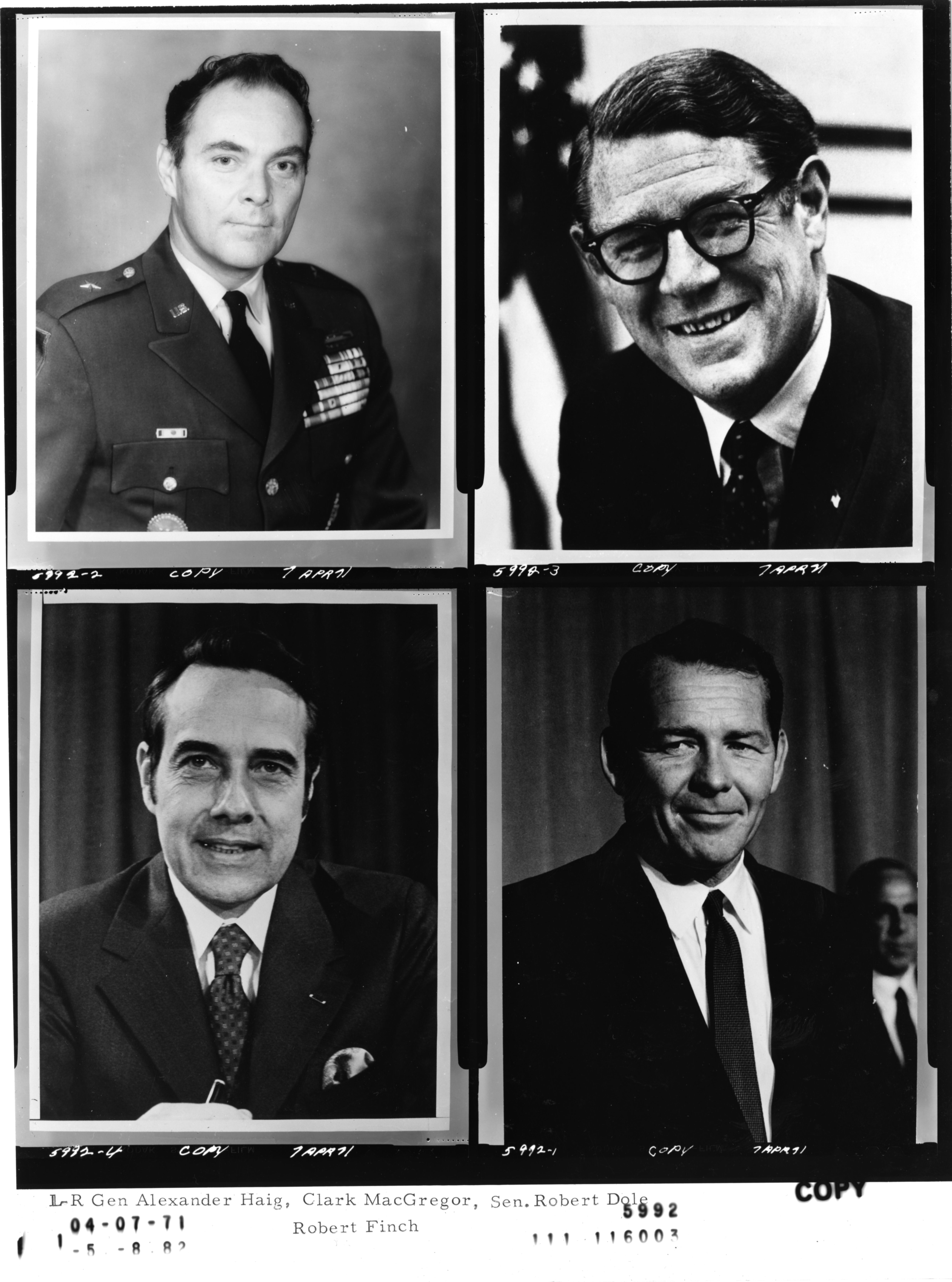
- Frame(s): WHPO-5992-01, Copy of photograph of Robert Finch. 4/7/1971, Washington, D.C. unknown. Robert Finch.
- Frame(s): WHPO-5992-02, Copy of photograph of Gen. Alexander Haig. 4/7/1971, Washington, D.C. unknown. Alexander Haig.
- Frame(s): WHPO-5992-03, Copy of photograph of Clark MacGregor. 4/7/1971, Washington, D.C. unknown. Clark MacGregor.
- Frame(s): WHPO-5992-04, Copy of photograph of Bob Dole. 4/7/1971, Washington, D.C. unknown. Bob Dole.
Roll WHPO-5993 Photographer: unknown | Color or B&W: B&W
- Frame(s): WHPO-5993-01-02, Copy of photograph of Speaker of the House Carl Albert. 4/7/1971, Washington, D.C. unknown. Carl Albert.
Roll WHPO-5994 Photographer: Atkins, Oliver | Color or B&W: B&W
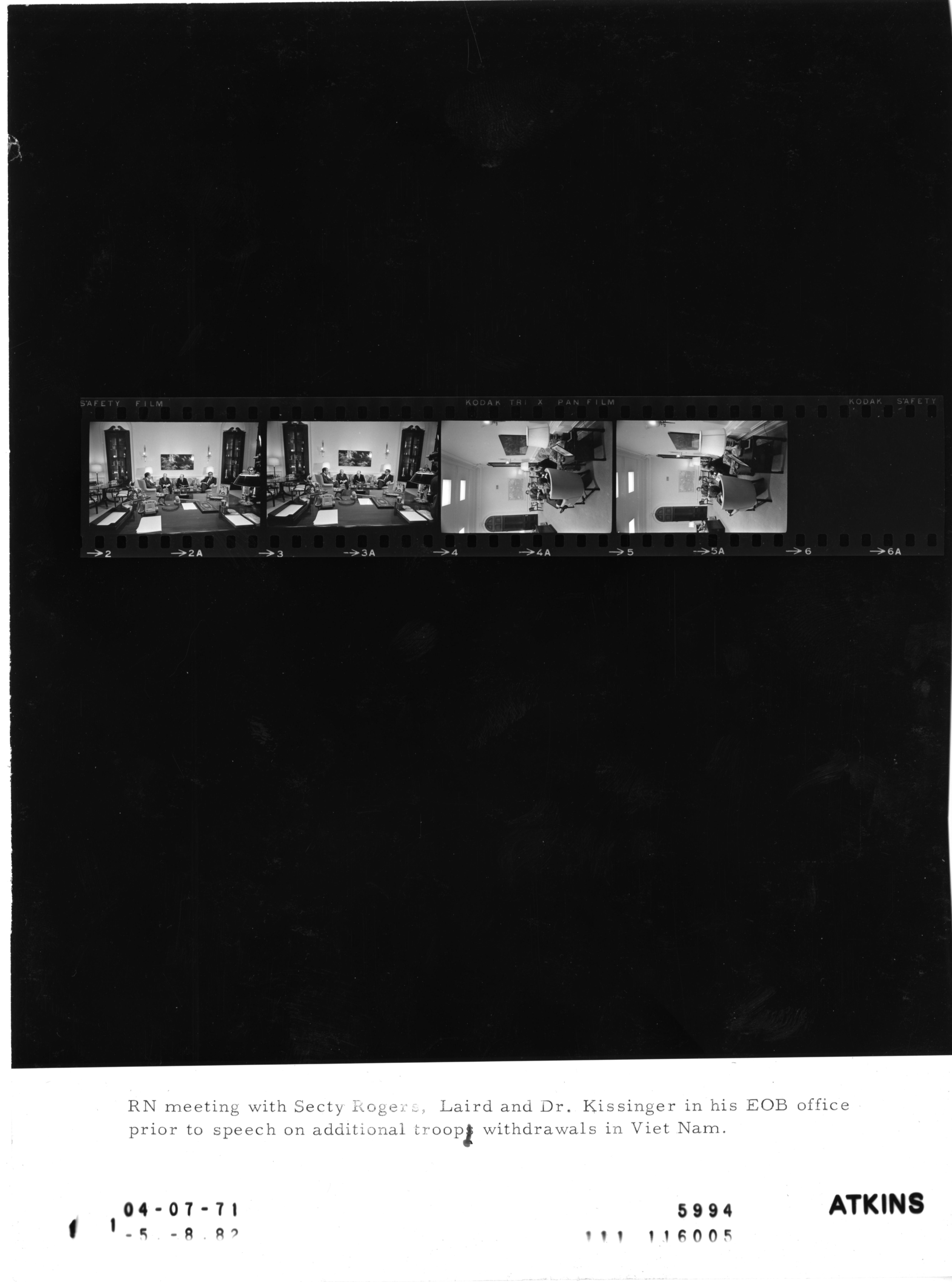
- Frame(s): WHPO-5994-02-05, President Nixon sitting with Melvin Laird, Henry Kissinger, and William Rogers. 4/7/1971, Washington, D.C. White House, Oval Office. President Nixon, Melvin Laird, William Rogers, Henry Kissinger, press corps members.
- Frame(s): WHPO-5994-03A, President Nixon sitting with Melvin Laird, Henry Kissinger, and William Rogers. 4/7/1971, Washington, D.C. White House, Oval Office. President Nixon, Melvin Laird, William Rogers, Henry Kissinger.
Roll WHPO-5995 Photographer: Schumacher, Karl | Color or B&W: B&W
- Frame(s): WHPO-5995-03-07, Mike Farrell with a group on the Diplomatic Entrance steps. 4/7/1971, Washington, D.C. White House, Diplomatic Entrance steps. Mike Farrell, unidentified persons.
Roll WHPO-5996 Photographer: Schumacher, Karl | Color or B&W: B&W
- Frame(s): WHPO-5996-02-05, Harry Dent receiving a gift presentation from an unidentified man. 4/7/1971, Washington, D.C. unknown. Harry Dent, unidentified man.
Roll WHPO-5997 Photographer: Schumacher, Karl | Color or B&W: B&W
- Frame(s): WHPO-5997-06-12, Commander Larson receiving a medal. 4/7/1971, Washington, D.C. unknown room. Commander Larson, unidentified military man.
- Frame(s): WHPO-5997-13-16, Commander Larson with his family. 4/7/1971, Washington, D.C. unknown room. Commander Larson, Mrs. Larson, Larson family members, unidentified military man.
- Frame(s): WHPO-5997-17-30, Harry Dent accepting petitions concerning Lt. Calley from Sen. Bill Brock and another man. 4/7/1971, Washington, D.C. unknown room. unidentified military man, Bill Brock, Harry Dent, unidentified man.
Roll WHPO-5998 Photographer: Kightlinger, Jack | Color or B&W: B&W
- Frame(s): WHPO-5998-03-06, Herb Klein accepting a gift from an unidentified man. 4/7/1971, Washington, D.C. unknown room. Herb Klein, unidentified man.
- Frame(s): WHPO-5998-07-19, President Nixon seated informally in his EOB office during a meeting with bi-partisan leaders of the House and Senate. 4/7/1971, Washington, D.C. Executive Office Building, (EOB), Presidential Office. President Nixon, Hugh Scott, Gerald Ford, Carl Albert, Robert Griffin, Robert Byrd, Clark MacGregor.
- Frame(s): WHPO-5998-14, President Nixon sitting with bi-partisan leaders of the House and Senate. 4/7/1971, Washington, D.C. Executive Office Building, Presidential Office. President Nixon, Hugh Scott, Gerald Ford, Carl Albert, Robert Griffin, Robert Byrd, Clark MacGregor.
Roll WHPO-5999 Photographer: Kightlinger, Jack | Color or B&W: B&W
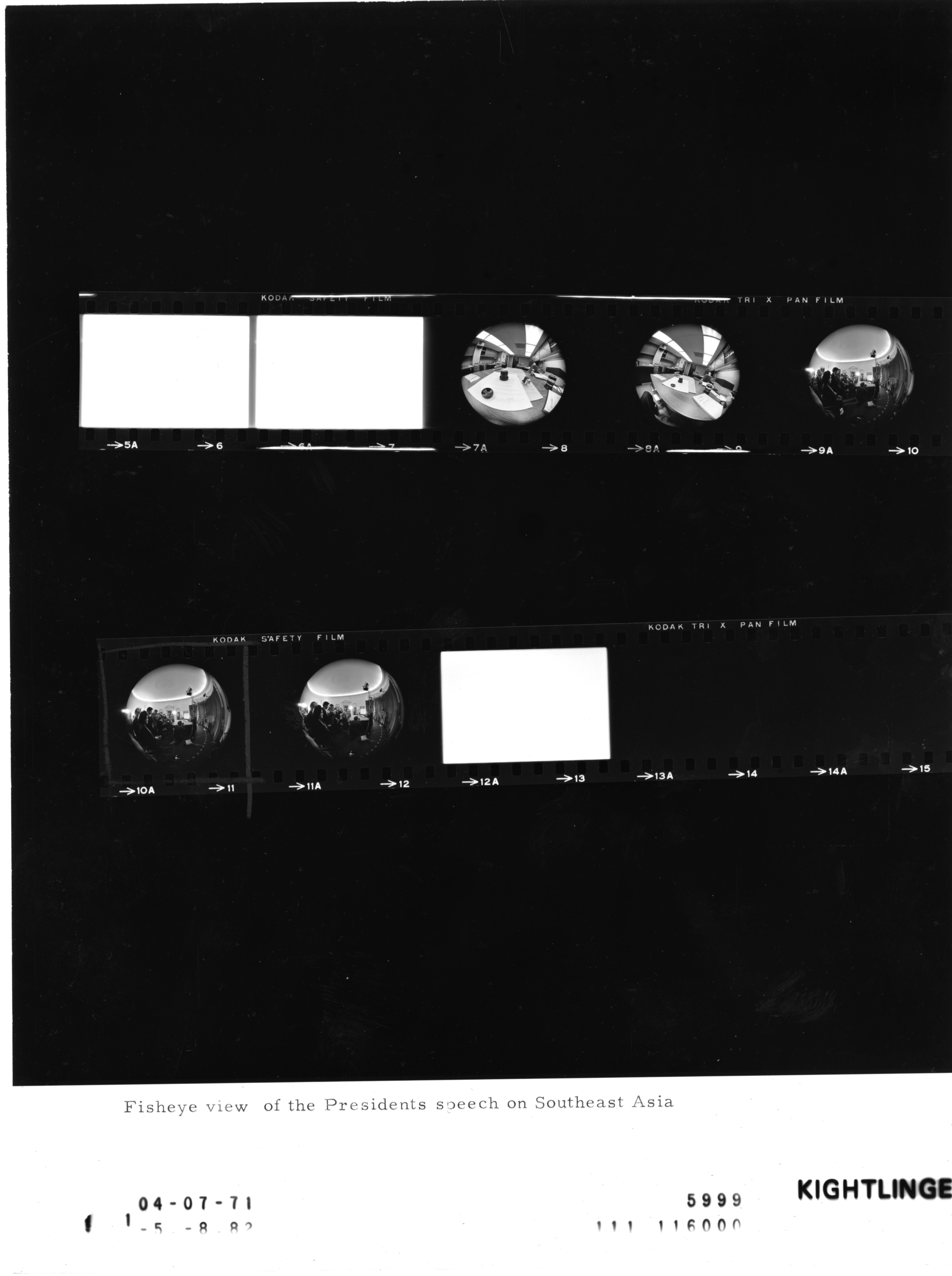
- Frame(s): WHPO-5999-07A-11A, President Nixon sitting at his oval office desk during his televised speech concerning South East Asia, Vietnam, Cambodia, Laos and the success of Vietnamization. 4/7/1971, Washington, D.C. White House, Oval Office. President Nixon, press corps members, reporters.
- Frame(s): WHPO-5999-12, Fish-eye photo of President Nixon sitting at his oval office desk during his televised speech concerning South East Asia, Vietnam, Cambodia, Laos, and the success of Vietnamization. 4/7/1971, Washington, D.C. White House, Oval Office. President Nixon, press corps members, reporters.
Roll WHPO-6000 Photographer: Kightlinger, Jack | Color or B&W: B&W
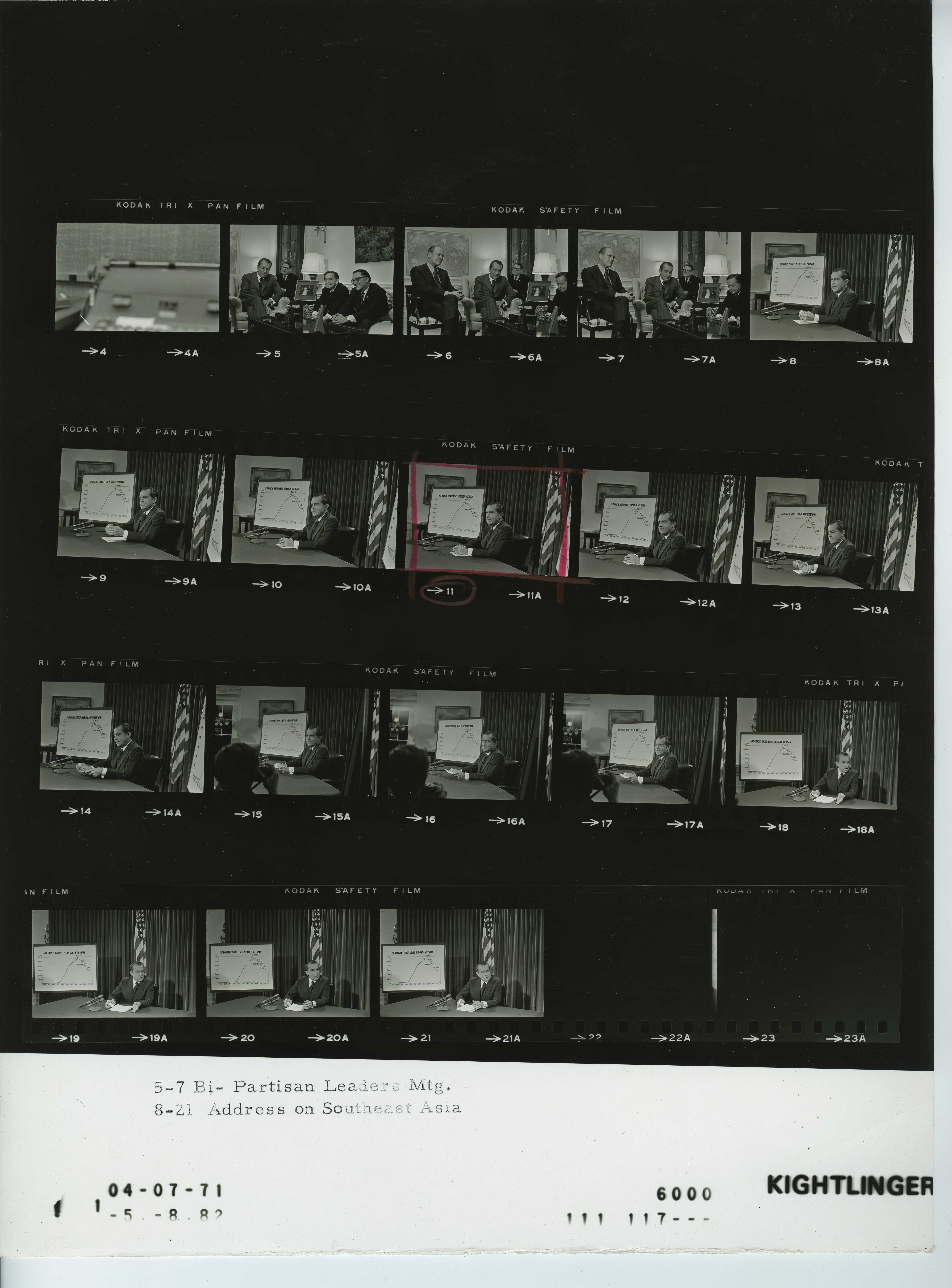
- Frame(s): WHPO-6000-05-07, President Nixon sitting with bi-partisan leaders. 4/7/1971, Washington, D.C. Executive Office Building, Presidential Office. President Nixon, Carl Albert, Robert Griffin, Gerald Ford, Clark MacGregor.
- Frame(s): WHPO-6000-08-21, President Nixon sitting at his oval office desk during his televised speech concerning South East Asia, Vietnam, Cambodia, Laos, and the success of Vietnamization. The president is seated next to a chart labeled "Authorized Troop Label in South Vietnam.". 4/7/1971, Washington, D.C. White House, Oval Office. President Nixon.
- Frame(s): WHPO-6000-10, President Nixon sitting at his oval office desk during his televised speech concerning South East Asia, Vietnam, Cambodia, Laos, and the success of Vietnamization. The president is seated next to a chart labeled "Authorized Troop Label in South Vietnam.". 4/7/1971, Washington, D.C. White House, Oval Office. President Nixon.
- Frame(s): WHPO-6000-11, President Nixon sitting at his oval office desk during his televised speech concerning South East Asia, Vietnam, Cambodia, Laos, and the success of Vietnamization. The president is seated next to a chart labeled "Authorized Troop Label in South Vietnam.". 4/7/1971, Washington, D.C. White House, Oval Office. President Nixon.
Roll WHPO-6001 Photographer: Kightlinger, Jack | Color or B&W: Color
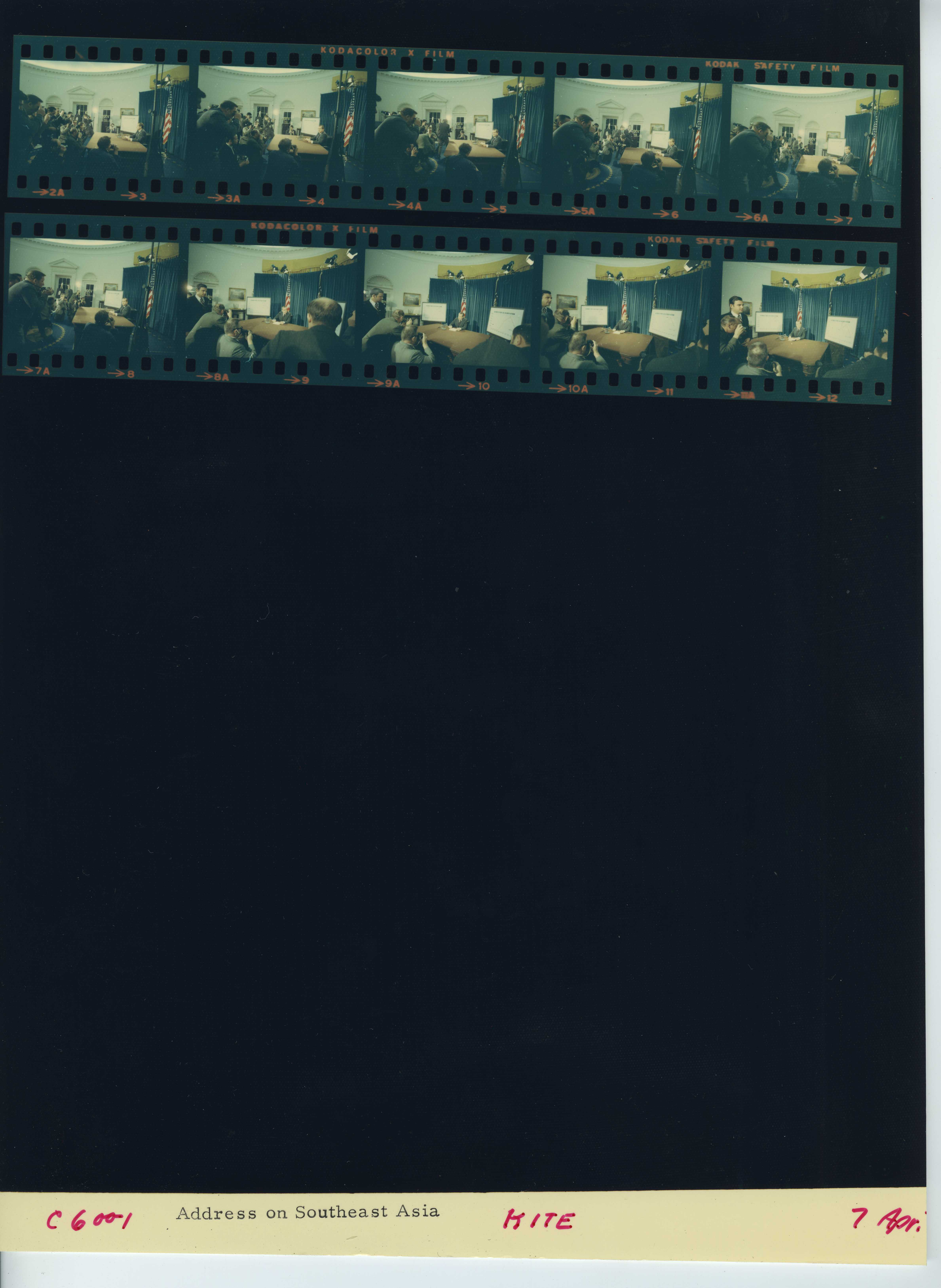
- Frame(s): WHPO-6001-02A-11A, President Nixon sitting at his oval office desk during his televised speech concerning South East Asia, Vietnam, Cambodia, Laos, and the success of Vietnamization with a large chart as visual aid. Press corps members and reporters stand nearby. 4/7/1971, Washington, D.C. White House, Oval Office. President Nixon, press corps members, reporters, photographers.
- Frame(s): WHPO-6001-04, President Nixon sitting at his oval office desk during his televised speech concerning South East Asia, Vietnam, Cambodia, Laos, and the success of Vietnamization with a large chart as visual aid. Press corps members and reporters stand nearby. 4/7/1971, Washington, D.C. White House, Oval Office. President Nixon, press corps members, reporters, photographers.
The White House Communications Agency Sound Recordings Collection contains public statements that took place between 1969 and 1974. Visit the finding aid to learn more.
G - Cabinet Officer Briefings
- WHCA-SR-G-101
Press briefing by Secretary of Transportation John Volpe. (4/7/1971, Press Center)
Runtime: 30:00:00
Production credits: Audio feed supplied by WHCA; Recorded by JLS (initials of WHCA engineer)
Original Format: 1/4-inch reel-to-reel audiotape. Original source type: Original.
H - White House Staff Member Recordings
- WHCA-SR-H-367
Press briefing by Henry Kissinger and Ronald Ziegler. (4/7/1971, Roosevelt Room, White House)
Runtime: 37:00:00
Keywords: Press conferences, news conferences, interviews, media, press secretary
Production credits: Audio feed supplied by WHCA; Recorded by BAC (initials of WHCA engineer)
Original Format: 1/4-inch reel-to-reel audiotape. Original source type: Original. - WHCA-SR-H-368
Press briefing by Henry Kissinger. (4/7/1971, East Room, White House)
Runtime: 26:00:00
Keywords: Press conferences, news conferences, interviews, media
Production credits: Audio feed supplied by WHCA; Recorded by KAP (initials of WHCA engineer)
Original Format: 1/4-inch reel-to-reel audiotape. Original source type: Original.
P - Formal Presidential Remarks
- WHCA-SR-P-710404
Televised remarks on troop withdrawals from SE Asia. (4/7/1971)
Runtime: 19:40
Original Format: 1/4-inch reel-to-reel audiotape. Original source type: Original.
The White House Communications Agency Videotape Collection contains “off-the-air” recordings of televised programs produced between 1968 and 1974. Visit the finding aid to learn more.
- WHCA-4262
President Richard Nixon Address to the Nation on the Situation in Southeast Asia. actor Bill Cosby.
NBC
Runtime: 00:56:17 - WHCA-4267
Weekly News Summary, Tape II.
ALL NETWORKS
Runtime: 00:27:42
1. Smith/Jarriel: President Nixon's report. Time Code Start: 00:00. Keywords: Presidents, reports. Network: ABC.
2. Smith/Clark: Calley trial Prosecutor Captain Aubrey Daniel's letter to President Nixon. Time Code Start: 02:20. Keywords: Presidents, intervention, attorneys, laywers, letters, writings, criticisms, Vietnam War, Lt. Calley, My Lai Massacre, military trials, massacres, war crimes, atrocities, mass murders, civilians deaths, shootings. Network: ABC.
3. Smith: Bogg's charges of wiretaps. Time Code Start: 04:45. Keywords: bugging, bugs, wiretapping, wire taps, surveillance, spying, investigations, recordings. Network: ABC.
4. Smtih: Vice President Agnew on thinking positive; CBS newsman in Vietnam. Time Code Start: 06:48. Keywords: Vice Presidents, speeches, statements, media, reporters, interviews, Vietnam War. Network: ABC.
5. Smith: Congress/Presidential powers to wage war. Time Code Start: 09:08. Keywords: House of Representatives, bills, Presidents, declaration of war. Network: ABC.
6. Chancellor: President Nixon's speech tonight. Time Code Start: 10:53. Keywords: Presidents, speeches. Network: NBC.
7. McGee: Calley trial Prosecutor Captain Aubrey Daniel's letter to President Nixon and congressional reaction. Time Code Start: 12:07. Keywords: Presidents, intervention, attorneys, laywers, letters, writings, criticisms, Vietnam War, Lt. Calley, My Lai Massacre, military trials, massacres, war crimes, atrocities, mass murders, civilians deaths, shootings. Network: NBC.
8. Goralski: Reaction at Pentagon to Calley trial Prosecutor Captain Aubrey Daniel's letter. Time Code Start: 13:47. Keywords: Presidents, intervention, attorneys, laywers, letters, writings, criticisms, Vietnam War, Lt. Calley, My Lai Massacre, military trials, massacres, war crimes, atrocities, mass murders, civilians deaths, shootings. Network: NBC.
9. Cronkite/Rather: President Nixon's 1972 campaign. Time Code Start: 16:33. Keywords: Presidents, Presidential elections, campaigns, campaigning, candidates, speeches. Network: CBS.
10. Cronkite: Reaction to Calley trial Prosecutor Captain Aubrey Daniel's letter. Time Code Start: 18:37. Keywords: Presidents, intervention, attorneys, laywers, letters, writings, criticisms, Vietnam War, Lt. Calley, My Lai Massacre, military trials, massacres, war crimes, atrocities, mass murders, civilians deaths, shootings. Network: CBS.
11. Cronkite/Kalb: People's Republic of China & our Ping Pong team (table tennis). Time Code Start: 19:20. Keywords: People's Republic of China, sports, ping pong, table tennis, games, teams. Network: CBS.
Context (External Sources)
The Vanderbilt Television News Archive is the world's most extensive and complete archive of television news. They have been recording, preserving and providing access to television news broadcasts of the national networks since August 5, 1968.
Wikipedia is a free encyclopedia that anyone can edit.