
Introduction
This almanac page for Tuesday, April 6, 1971, pulls together various records created by the federal government and links to additional resources which can provide context about the events of the day.
Previous Date: Monday, April 5, 1971
Next Date: Wednesday, April 7, 1971
Schedule and Public Documents
The Daily Diary files represent a consolidated record of the President's activities. Visit the finding aid to learn more.
The President's day began at The White House - Washington, D. C.
The Weekly Compilation of Presidential Documents made available transcripts of the President's news conferences; messages to Congress; public speeches, remarks, and statements; and other Presidential materials released by the White House.
Digitized versions can be found at HathiTrust.
Each Public Papers of the Presidents volume contains the papers and speeches of the President of the United States that were issued by the White House Office of the Press Secretary during the time period specified by the volume. The material is presented in chronological order, and the dates shown in the headings are the dates of the documents or events. In instances when the release date differs from the date of the document itself, that fact is shown in the text note.
To ensure accuracy, remarks have been checked against audio recordings (when available) and signed documents have been checked against the original, unless otherwise noted. Editors have provided text notes and cross references for purposes of identification or clarity.
- Special Message to the Congress on Special Revenue Sharing for Education.
- Statement About an Alaska Natives' Claims Bill
- Toasts of the President and Ambassador Guillermo Sevilla-Sacasa of Nicaragua at a Dinner Honoring the Chiefs of Mission of the Americas.
- Proclamation 4043—National Maritime Day, 1971
The Federal Register is the official daily publication for rules, proposed rules, and notices of federal agencies and organizations, as well as executive orders and other Presidential documents.
The Congressional Record is the official daily record of the debates and proceedings of the U.S. Congress.
Archival Holdings
Any selection of archival documents will necessarily be partial. You should use the documents and folders identified below as a starting place, but consult the linked collection finding aids and folder title lists and the collections themselves for context. Many documents to be found this way do not lend themselves to association with specific dates, but are essential to a complete understanding of the material.
Selective document listing
President's Office Files
The President's Office Files consists of materials drawn together by the Special Files Unit from several administrative subdivisions within the White House Office. It is the handwriting and sensitive papers sent to the Staff Secretary that now comprise much of the President's Office Files. Visit the finding aid to learn more.
- Annotated News Summaries, Box 30, News Summaries - April 1971 [During this period, the Staff Secretary only removed pages from the News Summaries which contained President Nixon's handwriting, often leaving the document with no date. Although there are no specific documents with this date, you should also consult the full folder for the month.]
President's Personal File
The President's Personal File is essentially a President's secretary's file, kept by Rose Mary Woods, personal secretary to the President, for two purposes: (1) preserving for posterity a collection of documents particularly close to the President, whether because he dictated or annotated them, or because of the importance of the correspondent or the event concerned and (2) giving appropriate attention–letters of gratitude, invitations to White House social events, and the like–to members and important friends and supporters of the Nixon administration. This generalization does not describe all the varied materials of a file group which is essentially a miscellany, but it does identify the reason for the existence of the file group's core. Visit the finding aid to learn more.
- President's Speech File
The H. R. Haldeman Diaries consists of seven handwritten diaries, 36 dictated diaries recorded as sound recordings, and two handwritten audio cassette tape subject logs. The diaries and logs reflect H. R. Haldeman’s candid personal record and reflections on events, issues, and people encountered during his service in the Nixon White House. As administrative assistant to the President and Chief of Staff, Haldeman attended and participated in public events and private meetings covering the entire scope of issues in which the Nixon White House engaged in during the years 1969-1973. Visit the finding aid to learn more.
- Transcript of diary entry (PDF)
Tuesday, April 6.
No schedule except for a quick filming and message signing. The President spent the whole day at the EOB working on the speech. He had me over first thing this morning and obviously wanted to have a long chat. But I had to leave to go to Ann's school, Father's Day. He did get into a few items, and it turned out that what he wanted to talk about was his concern about jittery members of the staff. He feels that this is the time that we should ruthlessly weed out all of those who will not stand strongly behind us. He specifically mentioned Finch, Rumsfeld, and MacGregor. He asked that I have Colson delay bringing Scali on for a week, that he must not come on the day of the speech, and that we should give him the chance to pull out of the commitment, if after the speech and its reaction, he isn't as strong about coming in as he was before. He feels that people are in an unstable frame of mind at this point, and they'll jump at anything. He made the quote that, "None of the staff are here because of what they did, they're here because of what I did; and therefore, there's no reason for anybody on the staff to be strong in a tough time like this." He then stated very positively, "I shall not go forward with anyone who has shown weakness in this situation. I want them all weeded out within thirty days."
He said the Cabinet is a different problem, and he doesn't quite know how to deal with that. Rogers has stood pretty well on this situation; Laird has not. He said it's a question of those who are so emotionally disturbed about situations and serious events that they'll have to desert us, and we can't give them that opportunity next year. We’ve got to weed them out now. He made the point that he didn't think I see this as clearly as he does, but wanted me to be thinking about it in any event. He also decided not to put Gates on the McCoy Commission, because he doesn't want to have any establishment people any more. He wants to use Midwesterners or Southerners, people who will stand with us. He asked me to get instructions to Agnew to do nothing in reaction to the speech until after the weekend and we see how things have set in. I left then, because I was late for the trip to Ann's school.
This afternoon he had me over again and asked how everything was. He was in kind of an introspective mood. Discussed a few of the minor logistics regarding the speech, and then settled back and said he wanted to read me the speech. He made the point that he was not showing me a copy––so that I would be able to say I had not seen the speech––and use that as a backup argument for not letting anyone else see it. He then read it through quite quickly. He feels it’ll run 18 to 20 minutes as it's now written, but it only took him 12 minutes to read it to me, even stopping to make a few notes from time to time. It comes off very well and makes the case exactly as he should. It's my view, at least, that it will be pretty successful in accomplishing what he's after. He had the OAS white tie dinner tonight. All of the key staff were at the Finch's for dinner, as sort of a farewell party before they and the Rumsfeld's leave on their European trip.
End of April 6. - Original audio recording (MP3)
The National Archives Catalog is the online portal to the records held at the National Archives, and information about those records. It is the main way of describing our holdings and also provides access to electronic records and digitized versions of our holdings.
The Catalog searches across multiple National Archives resources at once, including archival descriptions, digitized and electronic records, authority records, and web pages from Archives.gov and the Presidential Libraries. The Catalog also allows users to contribute to digitized historical records through tagging and transcription.
Nixon Library Holdings
All National Archives Units
National Security Documents
The President's Daily Brief is the primary vehicle for summarizing the day-to-day sensitive intelligence and analysis, as well as late-breaking reports, for the White House on current and future national security issues. Read "The President's Daily Brief: Delivering Intelligence to Nixon and Ford" to learn more.
The Foreign Relations of the United States series presents the official documentary historical record of major U.S. foreign policy decisions and significant diplomatic activity. Visit the State Department website for more information.
Vol. XI, South Asia Crisis, 1971
South Asia Crisis, 1971
19. Telegram From the Consulate General in Dacca to the Department of State, Dacca, April 6, 1971, 0730Z
Source: National Archives, RG 59, Central Files 1970–73, POL 1 PAK–US. Confidential; Priority; Limdis. Sent as a joint State/AID/USIS message. Also sent to Islamabad and repeated to Karachi and Lahore. Received at 1008Z. In his memoirs Kissinger suggests that the Consulate General deliberately gave a low classification to this telegram in order to encourage broad circulation in Washington. (White House Years, p. 853) The distribution limitation was added to the telegram in the Department.
20. Transcript of Telephone Conversation Between Secretary of State Rogers and the Presidentʼs Assistant for National Security Affairs (Kissinger), Washington, April 6, 1971, 9:35 a.m.
Source: Library of Congress, Manuscript Division, Kissinger Papers, Box 367, Telephone Conversations, Chronological File. No classification marking.
21. Telegram From the Embassy in Pakistan to the Department of State, Islamabad, April 6, 1971, 0838Z
Source: National Archives, RG 59, Central Files 1970–73, POL PAK–US. Secret; Immediate; Nodis. Received at 5:25 a.m.
Vol. XIII, Soviet Union, October 1970-October 1971
"A Key Point in Our Relationship": Backchannel Talks on SALT, Berlin, and the Summit
169. Conversation Between President Nixon and the President’s Assistant for National Security Affairs (Kissinger), Washington, April 6, 1971
Source: National Archives, Nixon Presidential Materials, White House Tapes, Conversation 245–18. No classification marking. The editors transcribed the portion of the tape recording printed here specifically for this volume. The conversation began at 1 p.m.
Vol. XXIII, Arab-Israeli Dispute, 1969-1972
220. Telegram From the Department of State to the Embassy in Jordan, Washington, April 6, 1971, 2058Z
Source: National Archives, Nixon Presidential Materials, NSC Files, Box 757, Presidential Correspondence 1969–1974, Jordan King Hussein Corres. Confidential; Priority. Drafted by Seelye and Lloyd W. Sutherland (PA); cleared by Pickering, Hartman, and MacDonald (AID); cleared in substance by Jeanne Davis; and approved by Sisco.
Vol. XLI, Western Europe; NATO, 1969-1972
Portugal
265. Memorandum From Helmut Sonnenfeldt of the National Security Council Staff to the President’s Assistant for National Security Affairs (Kissinger), Washington, April 6, 1971
Source: National Archives, Nixon Presidential Materials, NSC Files, Box 701, Country Files—Europe, Portugal, Vol. I. Confidential. Sent for urgent action. The tabs are not printed.
Vol. E-4, Documents on Iran and Iraq, 1969-1972
Iran 1971
121. Memorandum from the President’s Assistant for National Security Affairs (Kissinger) to President Nixon, Washington, April 6, 1971
Kissinger advised Nixon to discuss a proposed visit to Iran during his upcoming meeting with Ambassador MacArthur.
Source: National Archives, Nixon Presidential Materials, NSC Files, Box 602, Country Files, Middle East Files, Iran, Vol. III, 1/1/71–8/31/71. Confidential. Sent for information. A note on the memorandum indicates that the President saw it.
Vol. E-16, Documents on Chile, 1969-1973
Cool and Correct: The U.S. Response to the Allende Administration, November 5, 1970-December 31, 1972
59. Conversation Between President Nixon and the President’s Assistant for National Security Affairs (Kissinger), Washington, April 6, 1971
Summary: Nixon and Kissinger discussed the recent elections in Chile.
Source: National Archives, Nixon Presidential Materials, White House Tapes, Conversation 245–6. Secret. According to the President’s Daily Diary, Nixon and Kissinger met in the Executive Office Building from 10:06 to 10:35 a.m. (Ibid., White House Central Files) The editors transcribed the portion of the conversation printed here specifically for this volume.
The Kissinger telephone conversation transcripts consist of approximately 20,000 pages of transcripts of Kissinger’s telephone conversations during his tenure as Assistant to the President for National Security Affairs (1969-1974) and Secretary of State (1973-1974) during the administration of President Richard Nixon. Visit the finding aid for more information.
Digitized versions can be found in the National Archives Catalog.
Audiovisual Holdings
The White House Tapes are sound recordings of President Richard Nixon's telephone conversations and of meetings held in the Oval Office and the Cabinet Room in the White House, the President's office in the Old Executive Office Building (OEOB), the Lincoln Sitting Room in the residence section of the White House, and several locations at the Presidential retreat at Camp David, Maryland. These recordings document many of the major events and decisions of the Nixon Administration from February 16, 1971 to July 18, 1973. Visit the White House Tapes finding aid to learn about the taping system's operation and archival processing.
Old Executive Office Building
- 245-1; Unknown between 7:49 a.m. & 9:20 a.m.; Nixon, Richard M. (President); Haldeman, H. R. ("Bob")
- 245-2; 9:20 a.m. - 9:59 a.m.; Nixon, Richard M. (President); Haldeman, H. R. ("Bob"); White House operator; Mansfield, Michael J. ("Mike"); Kissinger, Henry A.
- 245-3; 9:59 a.m. - 9:59 a.m.; Nixon, Richard M. (President); Haldeman, H. R. ("Bob")
- 245-4; 9:59 a.m. - 9:59 a.m.; Nixon, Richard M. (President); White House operator
- 245-5; 9:59 a.m. - 10:06 a.m.; Nixon, Richard M. (President); Ford, Gerald R.; Kissinger, Henry A.
- 245-6; 10:05 a.m. - 11:03 a.m.; Nixon, Richard M. (President); Kissinger, Henry A.; Bull, Stephen B.; Mansfield, Michael J. ("Mike")
- 245-7; Unknown between 11:03 a.m. & 11:10 a.m.; Nixon, Richard M. (President); White House operator
- 245-8; Unknown between 11:03 a.m. & 11:10 a.m.; Nixon, Richard M. (President); Acker, Marjorie P.
- 245-9; Unknown between 11:03 a.m. & 11:10 a.m.; Nixon, Richard M. (President); White House operator
- 245-10; 11:10 a.m. - 11:11 a.m.; Nixon, Richard M. (President); Acker, Marjorie P.
- 245-11; Unknown between 11:11 a.m. & 11:13 a.m.; Nixon, Richard M. (President); White House operator
- 245-12; 11:13 a.m. - 11:14 a.m.; Nixon, Richard M. (President); Acker, Marjorie P.
- 245-13; Unknown between 11:14 a.m. & 11:19 a.m.; Nixon, Richard M. (President); White House operator
- 245-14; 11:19 a.m. - 11:21 a.m.; Nixon, Richard M. (President); Butterfield, Alexander P.
- 245-15; Unknown between 11:21 a.m. & 11:35 a.m.; Nixon, Richard M. (President); White House operator
- 245-16; 11:35 a.m. - 11:37 a.m.; Nixon, Richard M. (President); Bull, Stephen B.
- 245-17; Unknown between 11:37 a.m. & 1:00 p.m.; Nixon, Richard M. (President); Kissinger, Henry A.
- 245-18; Unknown between 1:00 p.m. & 1:45 p.m.; Nixon, Richard M. (President); Kissinger, Henry A.
- 245-19; Unknown between 7:49 a.m. & 9:20 a.m.; Nixon, Richard M. (President); Sanchez, Manolo
Oval Office
- 475-1; Unknown between 11:53 a.m. & 11:55 a.m.; Nixon, Richard M. (President); [Unknown person(s)]
- 475-2; Unknown between 11:53 a.m. & 11:55 a.m.; Nixon, Richard M. (President); [Unknown person(s)]
- 475-3; Unknown between 11:53 a.m. & 11:55 a.m.; Nixon, Richard M. (President); Bull, Stephen B.
- 475-4; Unknown between 11:55 a.m. & 12:20 p.m.; Nixon, Richard M. (President); Ehrlichman, John D.; Morgan, Edward L.; Mead, Dana G.; McLane, James; Gartland, John; Evans, John F., Jr.; Harper, Edwin L.; Waldeman, Raymond J.; Rhatican, William F.; Rice, Donald B.; Crabill, Donald E.; Page, David; Adkins, Roger; Nathan, Richard P.; Robinson, William; Blum, James; Havens, Harry S.; Hamm, William; Rommel, Wilfred H.; Fischer, C. William; Sweeney, Naomi; Cook, Richard K.; Deane, John Russell, III; Fuller, Bill; Weidenbaum, Murray L.; Joss, Robert; Johnson, William H.; Velde, Richard W.; Copf, Jerry; Orlebeck, Charles J.; Ahlgram, Henry; Blunt, William W.; Olsson, John P.; Lovell, Malcolm R., Jr.; Cross, Christopher T.; Ottina, John R.; Granlich, Ned; Thompson, Larry; White House photographer; Michel, Peter; Barzel, Rainer; Pauls, Rolf; Hamm, William
- 475-5; Unknown between 12:17 p.m. & 12:20 p.m.; Nixon, Richard M. (President); Bull, Stephen B.
- 475-6; 12:20 p.m. - 12:25 p.m.; Nixon, Richard M. (President); Wright, Don; Morton, Rogers C. B.; Stevens, Ted; Behren, Fritz; Garment, Leonard; Patterson, Bradley H., Jr.; Kilberg, Barbara ("Bobbie") (Greene); White House photographer
- 475-7; Unknown between 12:25 p.m. & 12:27 p.m.; Nixon, Richard M. (President); Bull, Stephen B.
- 475-8; 8:59 p.m. - 8:59 p.m.; Nixon, Richard M. (President); [Unknown person(s)]
- 475-9; 9:00 p.m. - 9:20 p.m.; Nixon, Richard M. (President)
- 475-10; Unknown between 9:20 p.m. & 9:25 p.m.; Nixon, Richard M. (President); [Unknown person(s)]
- 476-1; Unknown between 12:27 p.m. & 8:59 p.m.; [Unknown person(s)]
White House Telephone
- 1-1; Unknown between 11:51 a.m. & 11:53 a.m.; United States Secret Service agents; White House operator
- 1-2; Unknown between 11:51 a.m. & 11:53 a.m.; [Unknown person(s)]; White House operator
- 1-3; Unknown between 11:53 a.m. & 12:10 p.m.; Nixon, Richard M. (President); White House operator
- 1-4; Unknown between 11:53 a.m. & 12:10 p.m.; Nixon, Richard M. (President); Kissinger, Henry A.
- 1-5; Unknown between 12:10 a.m. & 12:14 a.m.; Nixon, Richard M. (President); Ehrlichman, John D.; Butterfield, Alexander P.; White House operator
- 1-6; 12:14 p.m. - 12:17 p.m.; Nixon, Richard M. (President); Hardin, Clifford M.; Gifford, Claude W.
- 42-2; 8:54 a.m. - 8:58 p.m.; Nixon, Richard M. (President); Eisenhower, Julie Nixon
- 42-3; Unknown between 8:54 a.m. & 9:10 a.m.; Nixon, Richard M. (President); White House operator
- 42-4; 9:10 a.m. - 9:10 a.m.; Nixon, Richard M. (President); White House operator
- 42-5; Unknown between 9:20 a.m. & 9:22 a.m.; Nixon, Richard M. (President); White House operator
- 42-6; 9:22 a.m. - 9:27 a.m.; Nixon, Richard M. (President); Mansfield, Michael J. ("Mike"); Haldeman, H. R. ("Bob")
- 42-7; Unknown between 9:27 a.m. & 9:59 a.m.; Haldeman, H. R. ("Bob"); White House operator; Bull, Stephen B.
- 42-8; 9:59 a.m. - 9:59 a.m.; Nixon, Richard M. (President); White House operator
- 42-9; 9:59 a.m. - 10:06 a.m.; Nixon, Richard M. (President); Ford, Gerald R.
- 42-10; Unknown between 11:03 a.m. & 11:10 a.m.; Nixon, Richard M. (President); White House operator
- 42-11; Unknown between 11:03 a.m. & 11:10 a.m.; Nixon, Richard M. (President); Acker, Marjorie P.
- 42-12; Unknown between 11:03 a.m. & 11:10 a.m.; Nixon, Richard M. (President); White House operator
- 42-13; 11:10 a.m. - 11:11 a.m.; Nixon, Richard M. (President); Acker, Marjorie P.
- 42-14; Unknown between 11:11 a.m. & 11:13 a.m.; Nixon, Richard M. (President); White House operator
- 42-15; 11:13 a.m. - 11:14 a.m.; Nixon, Richard M. (President); Acker, Marjorie P.
- 42-16; Unknown between 11:14 a.m. & 11:19 a.m.; Nixon, Richard M. (President); White House operator
- 42-17; 11:19 a.m. - 11:21 a.m.; Nixon, Richard M. (President); Butterfield, Alexander P.
- 42-18; Unknown between 11:21 a.m. & 11:35 a.m.; Nixon, Richard M. (President); White House operator
- 42-19; 11:35 a.m. - 11:37 a.m.; Nixon, Richard M. (President); Bull, Stephen B.
- 42-20; Unknown between 11:37 a.m. & 1:50 p.m.; Nixon, Richard M. (President); White House operator
- 42-21; 1:50 p.m. - 1:51 p.m.; Nixon, Richard M. (President); Woods, Rose Mary
- 42-22; Unknown between 1:51 p.m. & 5:20 p.m.; Kissinger, Henry A.; White House operator
- 42-23; Unknown between 1:51 p.m. & 5:20 p.m.; Nixon, Richard M. (President); White House operator
- 42-24; 5:20 p.m. - 5:23 p.m.; Nixon, Richard M. (President); Richardson, Elliot L.
- 42-25; Unknown between 5:23 p.m. & 5:43 p.m.; Kissinger, Henry A.; White House operator
- 42-26; Unknown between 5:23 p.m. & 5:43 p.m.; Nixon, Richard M. (President); White House operator
- 42-27; 5:43 p.m. - 5:44 p.m.; Nixon, Richard M. (President); Woods, Rose Mary
- 42-28; 7:15 p.m. - 7:16 p.m.; Nixon, Richard M. (President); Woods, Rose Mary
- 42-29; Unknown between 7:16 p.m., 4/6 & 10:59 a.m., 1/30; [Unknown person(s)]; White House operator
- 42-107; Unknown between 7:16 p.m., 4/6 & 10:59 a.m., 3/8; [Unknown person(s)]; White House operator
The White House Photo Office collection consists of photographic coverage of President Richard Nixon meeting with prominent social, political, and cultural personalities; speaking engagements and news conferences of the President and various high-ranking members of the White House staff and Cabinet; Presidential domestic and foreign travel, including Presidential vacations; social events and entertainment involving the First Family, including entertainers present; official portraits of the President, First Family, and high-ranking members of the Nixon administration; the 1969 and 1973 Inaugurals; the President’s 1972 Presidential election campaign appearances (including speeches) and other official activities of the White House staff and the President’s Cabinet from January 20, 1969 until August 9, 1974 at the White House and the Old Executive Office Building; other locations in Washington, DC, such as The Mall; and the Presidential retreats in Camp David, Maryland, Key Biscayne, Florida, and San Clemente, California. Visit the finding aid to learn more.
Roll WHPO-5974 Photographer: Schumacher, Karl | Color or B&W: B&W
- Frame(s): WHPO-5974-01-17, Vice President Agnew standing with Luxembourg Foreign Minister Gaston Thorn and others. 4/6/1971, Washington, D.C. Executive Office Building, Vice Presidential Office. Spiro Agnew, Gaston Thorn, unidentified men.
Roll WHPO-5975 Photographer: Atkins, Oliver | Color or B&W: B&W
- Frame(s): WHPO-5975-02A-28A, Close-up portrait study of Charles Stuart. 4/6/1971, Washington, D.C. unknown. Charles Stuart.
Roll WHPO-5976 Photographer: Knudsen, Robert L. | Color or B&W: B&W
- Frame(s): WHPO-5976-02-06, President Nixon taping a film clip message on education. 4/6/1971, Washington, D.C. White House, Theatre. President Nixon, unidentified persons.
- Frame(s): WHPO-5976-07-12, President Nixon returning to the West Wing. 4/6/1971, Washington, D.C. White House, West Wing Portico. President Nixon, unidentified persons, Manolo Sanchez.
Roll WHPO-5977 Photographer: Schumacher, Karl | Color or B&W: B&W
- Frame(s): WHPO-5977-03A-09A, Vice President Agnew seated informally with Ambassador Chow Shu-Kai of China. 4/6/1971, Washington, D.C. Executive Office Building, Vice Presidential Office. Spiro Agnew, Chow Shu-Kai.
Roll WHPO-5978 Photographer: unknown | Color or B&W: B&W
- Frame(s): WHPO-5978-, Copy of close-up portrait study of Dr. Paul McCracken. 4/6/1971, Washington, D.C. unknown. Paul McCracken.
Roll WHPO-5979 Photographer: unknown | Color or B&W: B&W
- Frame(s): WHPO-5979-, Copy of close-up portrait study of Dr. Paul McCracken. 4/6/1971, Washington, D.C. unknown. Paul McCracken.
Roll WHPO-5983 Photographer: Schumacher, Karl | Color or B&W: Color
- Frame(s): WHPO-5983-06-07, Pat Nixon standing with Mrs. Franco Mario Malfatti and three other women. 4/6/1971, Washington, D.C. White House, Yellow Oval Room. Pat Nixon, Mrs. Franco Mario Malfatti, unidentified women.
Roll WHPO-5984 Photographer: Kightlinger, Jack | Color or B&W: Color
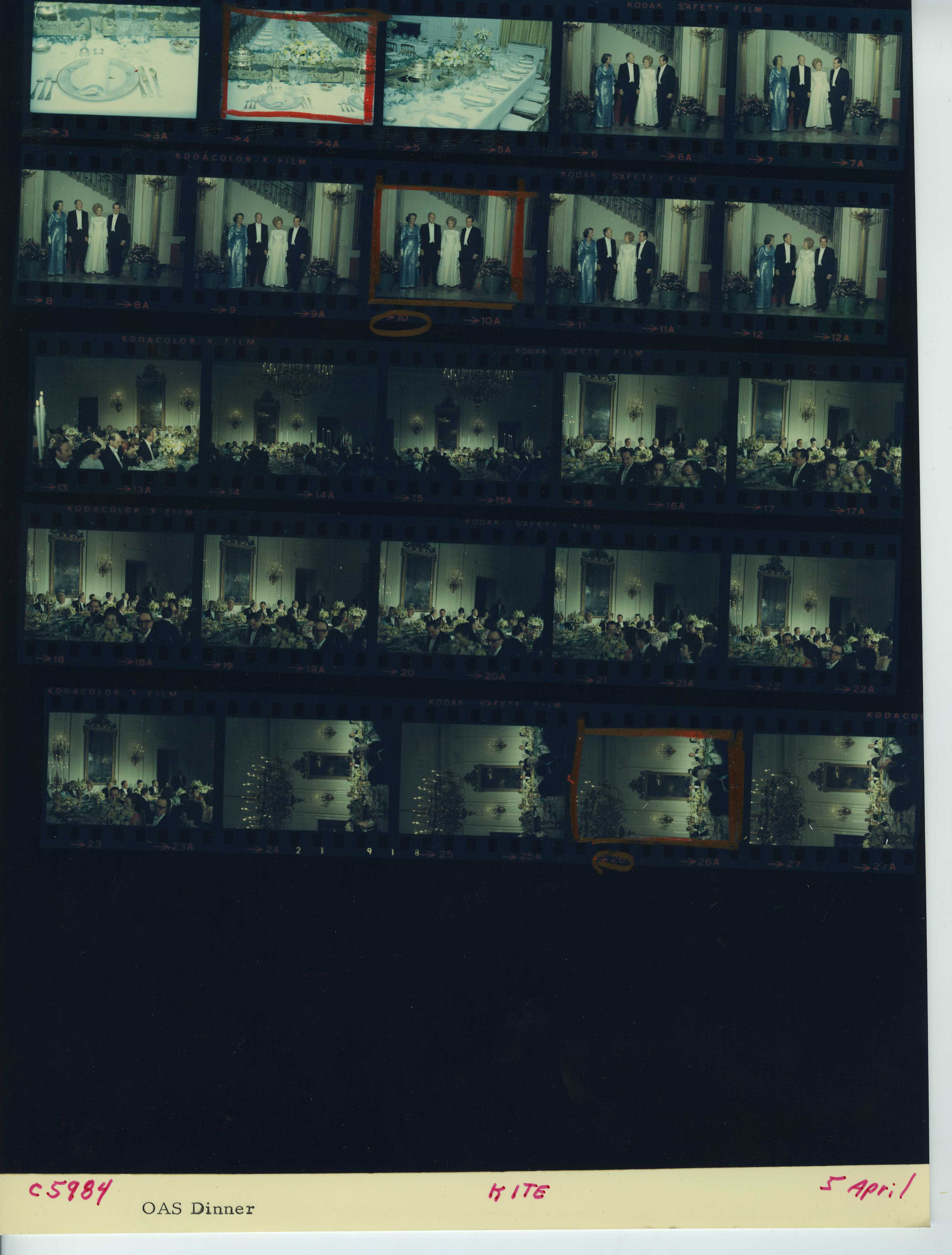
- Frame(s): WHPO-5984-03-05, Dinner Table settings, plates and flowers ready for State Dinner honoring the Chiefs of Missions of the Americas. 4/6/1971, Washington, D.C. White House, Grand Hall. President Nixon, Pat Nixon, William Rogers, Adele Rogers, guests.
- Frame(s): WHPO-5984-06-12, President Nixon, Pat Nixon, Secretary of State William Rogers and Mrs. Adele Rogers entering the Grand Hall before a State Dinner honoring Chiefs of Mis sions of the Americas and their wives. 4/6/1971, Washington, D.C. White House, Grand Hall. President Nixon, Pat Nixon, William Rogers, Adele Rogers, guests.
- Frame(s): WHPO-5984-11A, President Nixon, Pat Nixon, Secretary of State William Rogers and Mrs. Adele Rogers pose for a formal state photograph at the Grand Staircase before entering the Chiefs of Mis sions of the Americas State Dinner. 4/6/1971, Washington, D.C. White House, Grand Hall. President Nixon, Pat Nixon, William Rogers, Adele Rogers.
- Frame(s): WHPO-5984-13-17, President Nixon, Pat Nixon, Secretary of State William Rogers and Mrs. Adele Rogers attending a Chiefs of Mis sions of the Americas State Dinner. 4/6/1971, Washington, D.C. White House, State Dining Room. President Nixon, Pat Nixon, William Rogers, Adele Rogers, guests.
Roll WHPO-5985 Photographer: Kightlinger, Jack | Color or B&W: Color
- Frame(s): WHPO-5985-03A-08A, Table settings for State Dinner honoring Chiefs of Missions of the Americas. 4/6/1971, Washington, D.C. White House, State Dining Room.
- Frame(s): WHPO-5985-04-09, President Nixon, Pat Nixon, William Rogers and Adele Rogers entering the Grand Hall. 4/6/1971, Washington, D.C. White House, Grand Hall. President Nixon, Pat Nixon, Adele Rogers.
- Frame(s): WHPO-5985-13-21, President Nixon, Pat Nixon, William Rogers and Adele Rogers with guests in various rooms after dinner. 4/6/1971, Washington, D.C. White House. President Nixon, Pat Nixon, William Rogers, Adele Rogers, guests, Kissinger.
Roll WHPO-5986 Photographer: Kightlinger, Jack | Color or B&W: Color
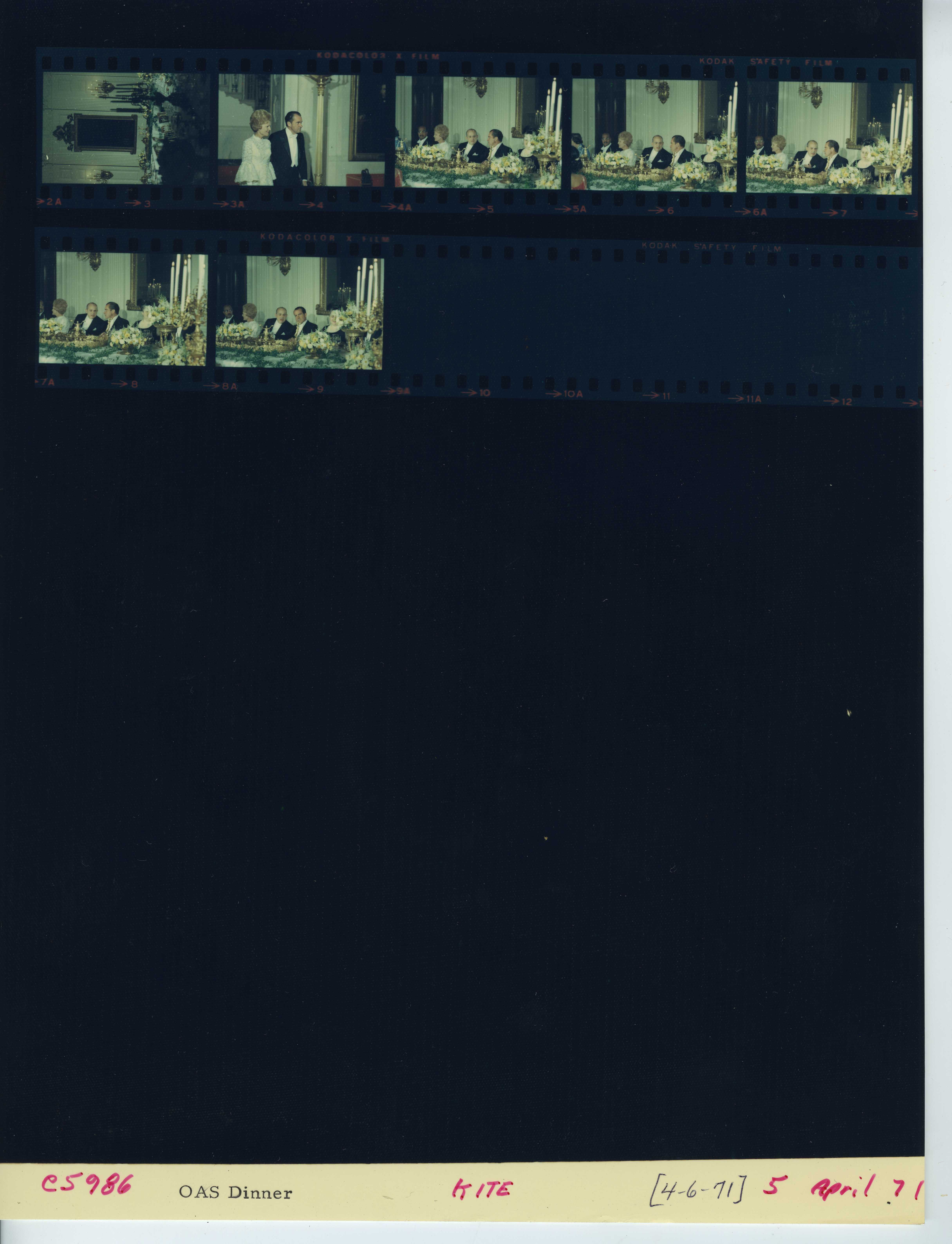
- Frame(s): WHPO-5986-02A, Dinner service table settings for the OAS Dinner guests. 4/6/1971, Washington, D.C. White House, State Dining Room.
- Frame(s): WHPO-5986-03A, President Nixon and Pat Nixon entering the dining room to attend the OAS dinner. 4/6/1971, Washington, D.C. White House, State Dining Room. President Nixon, Pat Nixon.
- Frame(s): WHPO-5986-04A-08A, President Nixon and Pat Nixon sitting at the head table during the OAS dinner. 4/6/1971, Washington, D.C. White House, State Dining Room. President Nixon, Pat Nixon, guests.
The White House Communications Agency Sound Recordings Collection contains public statements that took place between 1969 and 1974. Visit the finding aid to learn more.
G - Cabinet Officer Briefings
- WHCA-SR-G-100
Press briefing by Secretary of the Interior Rogers Morton, U.S. Senator Ted Stevens (R-AK), with Ronald Ziegler and Mr. Wright. (4/6/1971, Press Center)
Runtime: 37:00:00
Production credits: Audio feed supplied by WHCA; Recorded by JRS (initials of WHCA engineer)
Original Format: 1/4-inch reel-to-reel audiotape. Original source type: Original.
H - White House Staff Member Recordings
- WHCA-SR-H-366
Press briefing by Ronald Ziegler and Edwin Harper. (4/6/1971, Press Center, White House)
Runtime: 37:00:00
Keywords: Press conferences, news conferences, interviews, media, press secretary
Production credits: Audio feed supplied by WHCA; Recorded by JRS (initials of WHCA engineer)
Original Format: 1/4-inch reel-to-reel audiotape. Original source type: Original.
P - Formal Presidential Remarks
- WHCA-SR-P-710402
Film clip re revenue sharing. (4/6/1971)
Runtime: 2:20
Original Format: 1/4-inch reel-to-reel audiotape. Original source type: Original. - WHCA-SR-P-710403
Remarks by President Nixon in toast to members of OAS Diplomatic Corps. (4/6/1971)
Runtime: 10:12
Original Format: 1/4-inch reel-to-reel audiotape. Original source type: Original.
The White House Communications Agency Videotape Collection contains “off-the-air” recordings of televised programs produced between 1968 and 1974. Visit the finding aid to learn more.
- WHCA-4260
"What Happened to Earth Day?". Richard Nixon.
WCVE
Runtime: 1:00 - WHCA-4261
"The Dick Cavett Show": Hubert Humphrey, Maureen Stapelton, Austin Pendleton. folk singer Judy Collins, actress and anti-Vietnam War activist Jane Fonda, Anthony Burgess and John Marchi.
Daphne Productions and Roland & Jaffee Productions
Runtime: 01:33:40 - WHCA-4266
Weekly News Summary, Tape I.
ALL NETWORKS
Runtime: 1:30
25. Smith/Clark: Representative Boggs on FBI bugging on the the Hill. Time Code Start: 65:20. Keywords: Federal Bureau of Investigations, bugging, bugs, wiretapping, wire taps, surveillance, spying, recordings. Network: ABC.
26. Smith/Geer: Calley case and war crimes council in the House (Lt. Calley and My Lai Massacre trial). Time Code Start: 68:11. Keywords: House of Representatives, Congress, Vietnam War, Lt. Calley, My Lai Massacre, military trials, massacres, war crimes, atrocities, mass murders, civilians deaths, shootings. Network: ABC.
27. Brinkley: Calley Case Prosecutor Captain Aubrey Daniel letter to President Nixon charges intervention in case has damaged system of military justice, charges subject to political influence; South vietnam raid into Laos destroyed 9 tons rice. Time Code Start: 70:35. Keywords: Vietnam War, Lt. Calley, My Lai Massacre, military trials, massacres, war crimes, atrocities, mass murders, civilians deaths, shootings. Network: NBC.
28. Cronkite: POW issue & withdrawals from Vietnam. Time Code Start: 71:50. Keywords: Vietnam War, troops, withdrawals, Vietnam Prisoner of War. Network: CBS.
29. Rather: President Nixon against set date of Indochina withdrawal. Time Code Start: 72:48. Keywords: Laos, Cambodia, Vietnam War, military, troops, withdrawals, ceasefires. Network: CBS.
30. Cronkite: Revenue sharing proposal for education from President Nixon to Congress. Time Code Start: 74:32. Keywords: bills, laws, State and Local Fiscal Assistance Act of 1972, financial aid, Presidents, House of Representatives, student aid, education, colleges, tuition. Network: CBS.
31. Cronkite: Supersonic Transport (SST) & Alaska proposals. Time Code Start: 75:09. Keywords: Supersonic Transport, SST, aircraft, speed of sound, subsonic airliners. Network: CBS.
32. Cronkite/Benton: Representative Boggs on bugging. Time Code Start: 76:18. Keywords: Congress, officials, reports, bugging, bugs, wiretapping, wire tap, surveillance, investigations. Network: CBS.
33. Cronkite/Sevareid: Commentary on Herbert Hoover. Time Code Start: 78:28. Keywords: Presidents, history, Quakers, comparisons. Network: CBS.
34. Cronkite: Calley case (Lt. Calley and My Lai Massacre trial). Time Code Start: 80:55. Keywords: Vietnam War, Lt. Calley, My Lai Massacre, military trials, massacres, war crimes, atrocities, mass murders, civilians deaths, shootings. Network: CBS.
Context (External Sources)
The Vanderbilt Television News Archive is the world's most extensive and complete archive of television news. They have been recording, preserving and providing access to television news broadcasts of the national networks since August 5, 1968.
Wikipedia is a free encyclopedia that anyone can edit.