
Introduction
This almanac page for Thursday, April 19, 1973, pulls together various records created by the federal government and links to additional resources which can provide context about the events of the day.
Previous Date: Wednesday, April 18, 1973
Next Date: Friday, April 20, 1973
Schedule and Public Documents
The Daily Diary files represent a consolidated record of the President's activities. Visit the finding aid to learn more.
The President's day began at Camp David, Maryland
The Weekly Compilation of Presidential Documents made available transcripts of the President's news conferences; messages to Congress; public speeches, remarks, and statements; and other Presidential materials released by the White House.
Digitized versions can be found at HathiTrust.
The Federal Register is the official daily publication for rules, proposed rules, and notices of federal agencies and organizations, as well as executive orders and other Presidential documents.
The Congressional Record is the official daily record of the debates and proceedings of the U.S. Congress.
Archival Holdings
Any selection of archival documents will necessarily be partial. You should use the documents and folders identified below as a starting place, but consult the linked collection finding aids and folder title lists and the collections themselves for context. Many documents to be found this way do not lend themselves to association with specific dates, but are essential to a complete understanding of the material.
Selective document listing
President's Office Files
The President's Office Files consists of materials drawn together by the Special Files Unit from several administrative subdivisions within the White House Office. It is the handwriting and sensitive papers sent to the Staff Secretary that now comprise much of the President's Office Files. Visit the finding aid to learn more.
- News Summaries, Unmarked News Summaries, Box 55, News Summaries - Apr. 16-30, 1973 [3 of 7] [Note: Due to the way News Summary products were compiled, you should also consult nearby days for potentially relevant materials.]
- News Summary, April 19, 1973
The H. R. Haldeman Diaries consists of seven handwritten diaries, 36 dictated diaries recorded as sound recordings, and two handwritten audio cassette tape subject logs. The diaries and logs reflect H. R. Haldeman’s candid personal record and reflections on events, issues, and people encountered during his service in the Nixon White House. As administrative assistant to the President and Chief of Staff, Haldeman attended and participated in public events and private meetings covering the entire scope of issues in which the Nixon White House engaged in during the years 1969-1973. Visit the finding aid to learn more.
- Transcript of diary entry (PDF)
Thursday, April 19.
At Camp David. Ehrlichman and I spent the night up here last night with the President after a painful sort of farewell dinner. At least, I think that's what he had in mind. Kissinger called first thing this morning. Said that the President had called him Tuesday night late after the Sinatra dinner and said that he thought Ehrlichman and Haldeman would be destroyed by what is going to happen. And Kissinger said that we should, in his view, pull the wagons around the White House and fight. On Wednesday, the President asked Kissinger again. If we were destroyed--Henry said that if we were going to be destroyed, that we should be given a way to get out without being implicated. We could leave on the ground that I was implicated-- one way I could leave is on the grounds I was implicated. The other is on the grounds that I didn't know and this only I should do, if we're going to fall eventually anyway. Kissinger believes every effort should be made to keep me, and probably I'll end up stronger. But that if I'm going to be destroyed anyway, I must be sure that I am, and then get out before the slow erosion starts. The course now should be to pull the wagons around until the hysteria subsides. Haldeman should not be lumped with Magruder and Dean and should not be bled to death. If I stay, I should start asserting command, giving orders. If not, everything is going to go on leaking around the White House. The leaks will stop if they think I'm out or if they think I'm in. But you need one or the other.
On the chopper in today, the President talked about the question of our lawyers. Wondered about the question of what kind of immunity Ervin can give Dean? What effect the resignation would have on the prosecution and on the Dean deal? What kind of a bargain can we make? He made the point over and over that the thing we must avoid, at any cost, is being indicted. Went into the question of the grand jury leak and the legal possibilities there, and our idea of a libel action against Weicker for what he said about me on TV last night.
The President is trying to get Dean nailed down. He makes the point that we relied on Dean for both supervision and advice. That is, he'd say you don't want to know that, because of a deposition of a civil case and so on. Ehrlichman argues that the prosecution of Dean is what we need to destroy his credibility. After we got back from Camp David, he had us in the Oval Office. Made the point that he can't run the White House without a strong person, and that if Ehrlichman can survive, that will solve it. If not, and we both have to leave, then he's going to put Lynn over here to replace me. He feels that we should not let the day come when the grand jury comes out and the President has to be forced to move on us. It's getting to the point where we have to bite the bullet. He had thought we should separate the innocent from the guilty, Mitchell, Magruder and so forth. So Haldeman and Ehrlichman should step out and say they want to fight this battle. We must fight all the way, with every legal device, to avoid prosecution legally. He wants us to think of the PR side in terms of ourselves and the Presidency both.
John and I then pulled out of there to meet with our lawyers and go over the things. They feel strongly we should not leave and, having covered that ground, it was decided it would be a good idea for the President perhaps to meet with the lawyers this evening, which he decided to do. He spent the afternoon pondering this with other people over at the EOB. Then went out for dinner on the Sequoia alone. Came back and met with our lawyers for about an hour.
In the meantime, Ziegler called me at home to say that the Post has another story for tomorrow saying Dean's associates have said that Dean will implicate people above and below himself, and that Haldeman engineered a cover-up to hide the involvement of Presidential aides in the bugging matter, and goes on with other details of the story. We checked this back and forth, and Ziegler finally checked it with Dean, who said that he suspects who it is that put it out. That he has things scrambled, that he never mentioned Haldeman. That there's some fact and some fiction in the story. Eventually, Dean agreed to have Ziegler say that he denied mentioning Haldeman. And so we're going to try that, to see if it'll help any.
The President called me at 9:30. Said he had talked to the lawyers and I told him about the Post story. He liked the lawyers and felt that had been a good meeting. He sounded much more relieved than he has up to now. I told him about the Post story and he said, well, we've just got to expect that kind of thing, don't we? He said the lawyers don't buy Garment's idea that is Haldeman getting out. He feels now we have to play it day by day. The President warned them about the news stories and said it's going to be tough to ride, but we'll see what we can do. Wilson, the lawyer, called, said he had a good meeting with the President. He's a little concerned about word getting out as to why we have counsel, and suggested the line that we simply say we thought we should get the advice of competent counsel.
End of April 19. - Original audio recording (MP3)
The National Archives Catalog is the online portal to the records held at the National Archives, and information about those records. It is the main way of describing our holdings and also provides access to electronic records and digitized versions of our holdings.
The Catalog searches across multiple National Archives resources at once, including archival descriptions, digitized and electronic records, authority records, and web pages from Archives.gov and the Presidential Libraries. The Catalog also allows users to contribute to digitized historical records through tagging and transcription.
Nixon Library Holdings
All National Archives Units
National Security Documents
The President's Daily Brief is the primary vehicle for summarizing the day-to-day sensitive intelligence and analysis, as well as late-breaking reports, for the White House on current and future national security issues. Read "The President's Daily Brief: Delivering Intelligence to Nixon and Ford" to learn more.
The Foreign Relations of the United States series presents the official documentary historical record of major U.S. foreign policy decisions and significant diplomatic activity. Visit the State Department website for more information.
Vol. XXXVIII, Part 1, Foundations of Foreign Policy, 1973-1976
Foundations of Foreign Policy, 1973-1976
7. Secretary of State Rogers’s Annual Report on U.S. Foreign Policy, Washington, April 19, 1973
Source: Department of State Bulletin, May 7, 1973, pp. 545–557. The complete 743-page report is entitled “United States Foreign Policy 1972: A Report of the Secretary of State.” Rogers sent the report to Congress on April 19 under a transmittal letter, in which he noted that “1973 will be a year of building, a year of intensive negotiations that will move us forward into the structure of peace which President Nixon has made our foremost national goal.” (Ibid., p. 545)
Vol. XXXIX, European Security
Opening Negotiations, December 1972-July 1973
140. Memorandum of Conversation, Washington, April 19, 1973, 1:15-1:45 p.m.
Source: Library of Congress, Manuscript Division, Kissinger Papers, Box TS 27, Geopolitical File, Great Britain, Chronological File. Top Secret; Sensitive; Exclusively Eyes Only. The conversation took place at the British Embassy.
141. Memorandum for the Record by the Assistant Secretary of State for European Affairs (Stoessel), Washington, April 19, 1973
Source: National Archives, Nixon Presidential Materials, NSC Files, Kissinger Office Files, Box 77, Country Files, Europe, USSR, Moscow Trip, CSCE. Secret; Eyes Only.
Vol. E-9, Documents on North Africa, 1973-1976
Libya, 1973-1976
15. Memorandum From Director of Central Intelligence Schlesinger to the President’s Assistant for National Security Affairs (Kissinger), Washington, April 19, 1973
Summary: Schlesinger summarized an Agency report of Qadhafi’s impact on U.S. interests, the Arab world and Africa. [text not declassified]
Source: Central Intelligence Agency, Office of the Director of Central Intelligence, Job 80M01066A, OPI 10, Box 13, Folder 8. Secret, [text not declassified].
Vol. E-11, Part 1, Documents on Mexico; Central America; and the Caribbean, 1973-1976
Nicaragua
239. Memorandum From the Director of the Office of Central American Affairs (Lazar) to the Assistant Secretary of State for Inter-American Affairs (Kubisch), Washington, April 19, 1973
Summary: Lazar recommended that Nicaragua not be included on the itinerary for Secretary Rogers’ upcoming trip to Latin America, noting that such a visit might be misinterpreted in the region as a sign of a U.S. preference for “client-state” relationships.
Source: National Archives, RG 59, ARA/CEN/N Files, Lot 75D469, Nicaragua–Political, 1973. Confidential. Sent through Hurwitch. An April 19 notation by Kubisch reads: “a thoughtful memo and much appreciated.” At the end of the recommendation, Kubisch wrote: “will consider further.” Rogers made a five-hour stop in Managua on the afternoon of May 14. In a July 2 letter to Lazar, Shelton wrote that he had “never seen an official trip go off so smoothly,” adding that Rogers appeared to have been “touched by the scene of total destruction in Central Managua” and that his “sympathetic understanding was felt by others who were deeply appreciative of his feeling.” (Ibid.)
Vol. E-12, Documents on East and Southeast Asia, 1973-1976
Thailand and Burma
368. Memorandum From President Nixon to Secretary of State Rogers, Washington, April 19, 1973., Washington, April 19, 1973
Nixon announced the appointment of Ambassadors to Thailand and Cambodia.
Source: National Archives, Nixon Presidential Materials, NSC Files, Box 286, Agency Files, State, Vol. 18. Confidential.
Vol. E-15, Part 1, Documents on Eastern Europe, 1973-1976
East Europe Regional
6. Memorandum From Secretary of Transportation Brinegar to the President’s Assistant for National Security Affairs (Kissinger), Washington, April 19, 1973., Washington, April 19, 1973
Brinegar informed Kissinger of the Port Security Committee’s decision to close the port of Charleston, South Carolina, to vessels of the Warsaw Pact and the People’s Republic of China.
Source: National Archives, Nixon Presidential Materials, NSC Files, NSC Institutional Files (H-Files), Box H-242, NSDM 232. Secret. On September 1, the President issued NSDM 232, barring access of Warsaw Pact and PRC ships to Charleston. (Ibid.) The attachment is a copy with an indication that Eagleburger signed the original.
Vol. E-15, Part 2, Documents on Western Europe, 1973-1976, Second, Revised Edition
Western Europe Regional, 1973-1976
11. Memorandum From Philip Odeen of the National Security Council Staff to the President’s Assistant for National Security Affairs (Kissinger), Washington, April 19, 1973
Summary: Odeen reviewed the issue of balance of payments offset agreements and summarized the interagency study prepared in response to NSSM 170, Offsetting the Costs of U.S. Forces in Europe.
Source: National Archives, Nixon Presidential Materials, NSC Files, NSC Institutional Files (H-Files), Box H–67, Meeting Files, SRG Meeting—Cancelled 4/26/73. Confidential. Sent for action. Sonnenfeldt and NSC staff member John Lehman concurred. Attached but not published are the enclosures included in the briefing book. The 43-page study prepared in response to NSSM 170, dated April 1973, is ibid.
The Kissinger telephone conversation transcripts consist of approximately 20,000 pages of transcripts of Kissinger’s telephone conversations during his tenure as Assistant to the President for National Security Affairs (1969-1974) and Secretary of State (1973-1974) during the administration of President Richard Nixon. Visit the finding aid for more information.
Digitized versions can be found in the National Archives Catalog.
Audiovisual Holdings
Visit the White House Tapes finding aid to learn about the taping system's operation and archival processing.
Cabinet Room
Old Executive Office Building
- 429-4; 1:39 p.m. - 1:41 p.m.; Nixon, Richard M. (President); Ziegler, Ronald L.
- 429-5; 1:45 p.m. - 1:46 p.m.; Nixon, Richard M. (President); Ziegler, Ronald L.
- 429-6; 1:48 p.m. - 1:49 p.m.; Nixon, Richard M. (President); Ehrlichman, John D.
- 429-7; Unknown between 1:50 p.m. & 1:57 p.m.; Nixon, Richard M. (President); Sanchez, Manolo
- 429-8; Unknown between 1:50 p.m. & 1:57 p.m.; Nixon, Richard M. (President); [Unknown person(s)]; Sanchez, Manolo
- 429-9; Unknown between 1:50 p.m. & 1:57 p.m.; Nixon, Richard M. (President); Sanchez, Manolo
- 429-10; 1:57 p.m. - 1:58 p.m.; Nixon, Richard M. (President); Bull, Stephen B.
- 429-11; Unknown between 1:58 p.m. & 2:05 p.m.; Nixon, Richard M. (President); Sanchez, Manolo
- 429-12; 2:05 p.m. - 2:08 p.m.; Nixon, Richard M. (President); Kissinger, Henry A.
- 429-13; Unknown between 2:05 p.m. & 3:38 p.m.; Nixon, Richard M. (President); Sanchez, Manolo
- 429-14; 3:38 p.m. - 3:38 p.m.; Nixon, Richard M. (President); White House operator
- 429-15; 3:46 p.m. - 5:00 p.m.; Nixon, Richard M. (President); Moore, Richard A.
- 429-16; Unknown between 5:01 p.m. & 5:10 p.m.; Nixon, Richard M. (President); Bull, Stephen B.; Ehrlichman, John D.
- 429-17; 5:10 p.m. - 5:10 p.m.; [Unknown person(s)]; White House operator
- 429-18; 5:15 p.m. - 5:45 p.m.; Nixon, Richard M. (President); Ehrlichman, John D.; Sanchez, Manolo; [Unknown person(s)]; Eisenhower, Julie Nixon
- 429-19; 5:58 p.m. - 5:59 p.m.; Nixon, Richard M. (President); Ehrlichman, John D.
- 429-20; 5:59 p.m. - 6:00 p.m.; Nixon, Richard M. (President); Bull, Stephen B.
- 429-21; 6:00 p.m. - 6:03 p.m.; Nixon, Richard M. (President); Ehrlichman, John D.
- 429-22; 8:26 p.m. - 9:32 p.m.; Nixon, Richard M. (President); Wilson, John J.; Strickler, Frank H.; Sanchez, Manolo
- 429-23; Unknown between 9:32 p.m. & 9:37 p.m.; Nixon, Richard M. (President); White House operator
- 429-24; 9:37 p.m. - 9:53 p.m.; Nixon, Richard M. (President); Haldeman, H. R. ("Bob")
- 429-25; 9:54 p.m. - 9:54 p.m.; White House operator; Nixon, Richard M. (President)
- 429-26; Unknown between 1:46 p.m. & 1:48 p.m.; Nixon, Richard M. (President); White House operator
- 429-27; Unknown between 2:05 p.m. & 2:08 p.m.; Nixon, Richard M. (President); [Unknown person(s)]
- 429-28; Unknown between 5:01 p.m. & 5:10 p.m.; Nixon, Richard M. (President); White House operator
Oval Office
- 902-1; 9:31 a.m. - 10:12 a.m.; Nixon, Richard M. (President); Haldeman, H. R. ("Bob"); Ehrlichman, John D.; [Unknown person(s)]; Bull, Stephen B.
- 902-2; 10:12 a.m. - 10:12 a.m.; Nixon, Richard M. (President); [Unknown person(s)]
- 902-3; 10:12 a.m. - 11:07 a.m.; Nixon, Richard M. (President); Petersen, Henry E.; Bull, Stephen B.; [Unknown person(s)]
- 902-4; 11:08 a.m. - 11:09 a.m.; Nixon, Richard M. (President); Kissinger, Henry A.
- 902-5; Unknown between 12:29 p.m. & 12:48 p.m.; Nixon, Richard M. (President); Ziegler, Ronald L.; White House operator; Dean, John W., III
- 902-6; Unknown between 12:48 p.m. & 1:03 p.m.; Nixon, Richard M. (President); Sanchez, Manolo
- 902-7; Unknown between 12:48 p.m. & 1:03 p.m.; Nixon, Richard M. (President); Bull, Stephen B.
- 902-8; Unknown between 12:48 p.m. & 1:03 p.m.; Nixon, Richard M. (President); Bull, Stephen B.
- 902-9; 1:03 p.m. - 1:30 p.m.; Nixon, Richard M. (President); Ehrlichman, John D.
- 902-10; Unknown between 1:30 p.m. & 1:36 p.m.; Nixon, Richard M. (President); Sanchez, Manolo
- 902-11; Unknown between 11:07 a.m. & 11:08 a.m.; [Unknown person(s)]
- 902-12; Unknown between 11:08 a.m. & 12:48 p.m.; Bull, Stephen B.; [Unknown person(s)]
- 902-13; Unknown between 1:30 p.m. & 1:36 p.m.; [Unknown person(s)]
White House Telephone
- 38-105; Unknown between 9:36 a.m. & 12:29 p.m.; Nixon, Richard M. (President); White House operator; Ehrlichman, John D.
- 38-106; Unknown between 12:29 p.m. & 12:48 p.m.; Ziegler, Ronald L.; White House operator; Nixon, Richard M. (President)
- 38-107; Unknown between 12:29 p.m. & 12:48 p.m.; Ziegler, Ronald L.; Dean, John W., III
- 38-108; Unknown between 1:36 p.m. & 1:39 p.m.; Nixon, Richard M. (President); White House operator
- 38-109; 1:39 p.m. - 1:41 p.m.; Nixon, Richard M. (President); Ziegler, Ronald L.
- 38-110; Unknown between 1:41 p.m. & 1:45 p.m.; Nixon, Richard M. (President); White House operator
- 38-111; 1:45 p.m. - 1:46 p.m.; Nixon, Richard M. (President); Ziegler, Ronald L.
- 38-112; Unknown between 1:46 p.m. & 1:48 p.m.; Nixon, Richard M. (President); White House operator
- 38-113; 1:48 p.m. - 1:50 p.m.; Nixon, Richard M. (President); Ehrlichman, John D.
- 38-114; 2:05 p.m. - 2:08 p.m.; Kissinger, Henry A.; Nixon, Richard M. (President)
- 38-115; 3:38 p.m. - 3:38 p.m.; Nixon, Richard M. (President); White House operator
- 38-116; Unknown between 3:38 p.m. & 5:03 p.m.; Nixon, Richard M. (President); White House operator
- 38-117; 5:03 p.m. - 5:04 p.m.; Nixon, Richard M. (President); Ehrlichman, John D.
- 38-118; Unknown between 5:04 p.m. & 5:10 p.m.; Nixon, Richard M. (President); White House operator
- 38-119; 5:10 p.m. - 5:10 p.m.; White House operator; Nixon, Richard M. (President)
- 38-120; 5:43 p.m. - 5:45 p.m.; Nixon, Richard M. (President); Eisenhower, Julie Nixon
- 38-121; Unknown between 5:45 p.m. & 5:48 p.m.; Nixon, Richard M. (President); White House operator
- 38-122; 5:58 p.m. - 5:59 p.m.; Nixon, Richard M. (President); Ehrlichman, John D.
- 38-123; 6:00 p.m. - 6:03 p.m.; Ehrlichman, John D.; Nixon, Richard M. (President)
- 38-124; Unknown between 9:32 p.m. & 9:37 p.m.; Nixon, Richard M. (President); White House operator
- 38-125; Unknown between 9:32 p.m. & 9:37 p.m.; Nixon, Richard M. (President); White House operator
- 38-126; 9:37 p.m. - 9:53 p.m.; Nixon, Richard M. (President); Haldeman, H. R. ("Bob")
- 38-127; 9:54 p.m. - 9:54 p.m.; White House operator; Nixon, Richard M. (President)
The White House Photo Office collection consists of photographic coverage of President Richard Nixon meeting with prominent social, political, and cultural personalities; speaking engagements and news conferences of the President and various high-ranking members of the White House staff and Cabinet; Presidential domestic and foreign travel, including Presidential vacations; social events and entertainment involving the First Family, including entertainers present; official portraits of the President, First Family, and high-ranking members of the Nixon administration; the 1969 and 1973 Inaugurals; the President’s 1972 Presidential election campaign appearances (including speeches) and other official activities of the White House staff and the President’s Cabinet from January 20, 1969 until August 9, 1974 at the White House and the Old Executive Office Building; other locations in Washington, DC, such as The Mall; and the Presidential retreats in Camp David, Maryland, Key Biscayne, Florida, and San Clemente, California. Visit the finding aid to learn more.
Roll WHPO-E0679 Photographer: Schumacher, Karl | Color or B&W: B&W
- Frame(s): WHPO-E0679-, Julie Eisenhower standing with a group from Whittier College. 4/19/1973, Washington, D.C. White House, Rose Garden. Julie Eisenhower, unidentified Whittier College students.
Roll WHPO-E0680 Photographer: Atkins, Oliver | Color or B&W: B&W
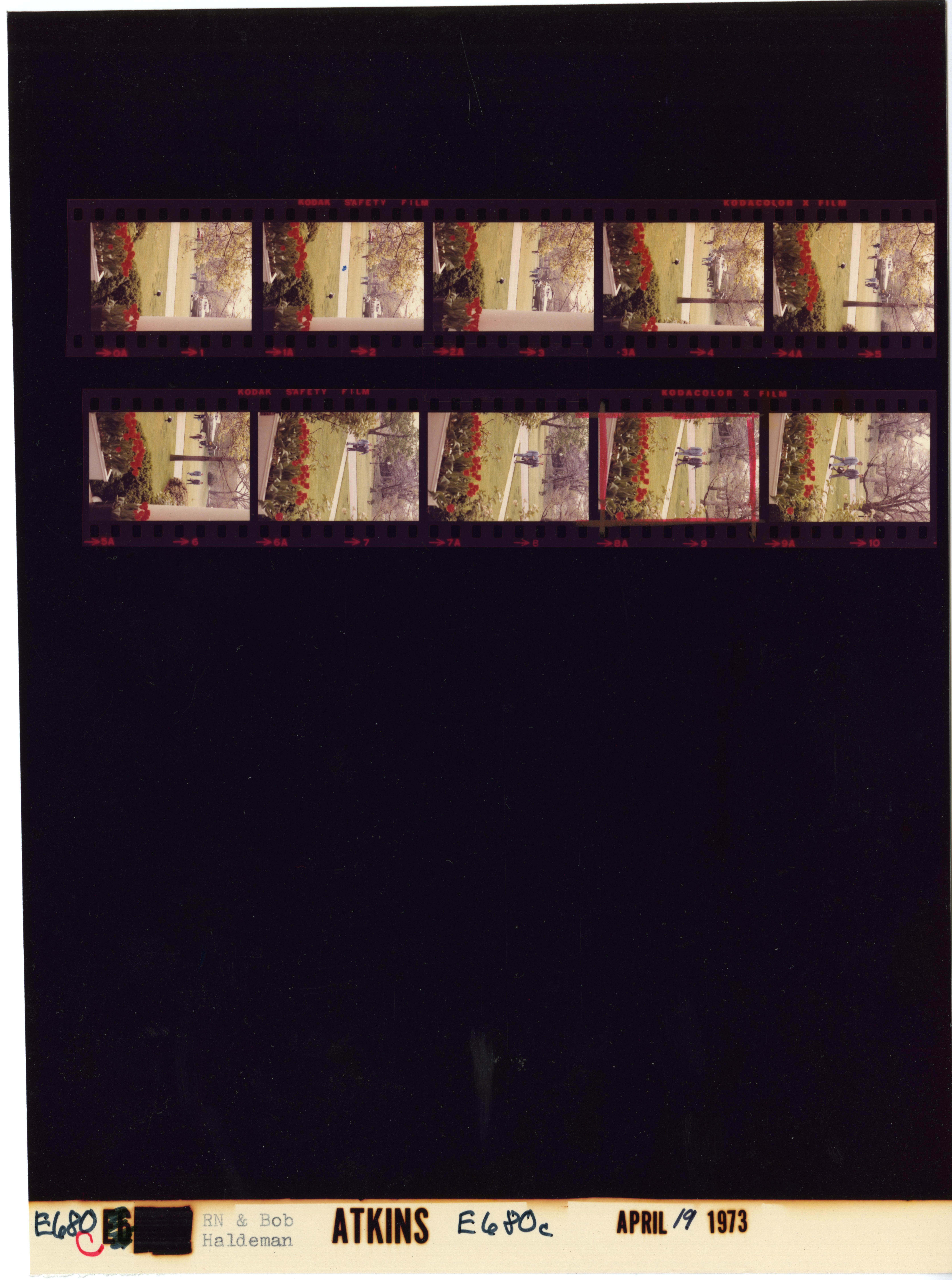
- Frame(s): WHPO-E0680-, President Nixon and Bob Haldeman walking across south grounds from helicopter "Spirit of '76.". 4/19/1973, Washington, D.C. White House, South Grounds. President Nixon, Robert Haldeman.
- Frame(s): WHPO-E0680-09, President Nixon and Bob Haldeman walking across south grounds from helicopter "Spirit of '76.". 4/19/1973, Washington, D.C. White House, South Grounds. President Nixon, Robert Haldeman.
The White House Communications Agency Sound Recordings Collection contains public statements that took place between 1969 and 1974. Visit the finding aid to learn more.
S - White House Press Office Briefings (continuation of the L-series)
- WHCA-SR-S-076
Energy briefing by Charles DiBona. (4/19/1973, White House Press Lobby)
Runtime: 58:00:00
Keywords: Briefings, public briefings, statements to the press (see also Press conferences, news conferences, interviews, media)
Production credits: Audio feed supplied by WHCA; Recorded by Earl Doss (initials of WHCA engineer)
Original Format: 1/4-inch reel-to-reel audiotape. Original source type: Original. - WHCA-SR-S-077
Press briefing by Ronald Ziegler. (4/19/1973, White House Press Lobby)
Runtime: 0:39:01
Keywords: Press conference, news conference, interviews, media, press secretary, briefings, Soviet Union, Russia, USSR, advisors, People’s Republic of China, economy, foreign relations, foreign policy, refugees, immigration, migration, resignations, Watergate, hear
Production credits: Audio feed supplied by WHCA; Recorded by GET (initials of WHCA engineer)
Original Format: 1/4-inch reel-to-reel audiotape. Original source type: Original. Technical notes: 57 minutes and 58 seconds of silence at end of recording removed from access copies. - WHCA-SR-S-078
Briefing by Secretary of Housing and Urban Development James T. Lynn. (4/19/1973, White House Press Lobby)
Runtime: 45:00:00
Keywords: Briefings, public briefings, statements to the press (see also Press conferences, news conferences, interviews, media)
Production credits: Audio feed supplied by WHCA; Recorded by JDF (initials of WHCA engineer)
Original Format: 1/4-inch reel-to-reel audiotape. Original source type: Original.
The White House Communications Agency Videotape Collection contains “off-the-air” recordings of televised programs produced between 1968 and 1974. Visit the finding aid to learn more.
- WHCA-6237
"Panorama".
ABC
Runtime: 01:31:00 - WHCA-6240
Weekly News Summary, Tape III.
ALL NETWORKS
Runtime: 1:00
4. Reasoner/Gill/ Jarriel/Zimmerman: Watergate. Time Code Start: 08:42. Keywords: Watergate, Senate committee hearings, investigations, testimony, testify, cover-ups, break-in, burglary, theft, plumbers, scandals. Network: ABC.
5. Reasoner/Koppel/Peterson/Ellis/Mariano: Indochina peace problems. Time Code Start: 14:16. Keywords: Laos, Cambodia, Paris Peace Talks, Vietnam War, treaty, treaties, negotiations. Network: ABC.
6. Reasoner/Tucker: Revenue sharing. Time Code Start: 19:38. Keywords: bills, laws, State and Local Fiscal Assistance Act of 1972, financial aid. Network: ABC.
7. Reasoner: Commentary on irresponsibility of Congress bill rejection to divert highway trust fund money for use in mass transit systems. Time Code Start: 23:46. Keywords: bills, laws, Congress, budgets, voting, spending, funding, financial aid, energy crisis, petroleum, oil supply, gasoline, fuel, shortages, rationing, mass transportation, commuters, commuting, railroads, trains, buses. Network: ABC.
8. Chancellor/Kiker/Stern/Duke: Watergate. Time Code Start: 25:51. Keywords: Watergate, Senate committee hearings, investigations, testimony, testify, cover-ups, break-in, burglary, theft, plumbers, scandals. Network: NBC.
9. Chancellor/Rich: Ceasefire is fading in Cambodia (Friedheim). Time Code Start: 31:58. Keywords: Cambodia, Vietnam War, truces, treaty, treaties, peace, ceasefires. Network: NBC.
10. Chancellor/Jones: Economy gets worse. Time Code Start: 36:06. Keywords: reports, economy, economics, budgets, finances, recession, inflation, money, wages, costs, unemployment, prices. Network: NBC.
11. Chancellor/Brinkley: Watergate. Time Code Start: 36:43. Keywords: Watergate, Senate committee hearings, investigations, testimony, testify, cover-ups, break-in, burglary, theft, plumbers, scandals. Network: NBC.
12. Cronkite/Pierpoint/Schorr: Watergate. Time Code Start: 39:02. Keywords: Watergate, Senate committee hearings, investigations, testimony, testify, cover-ups, break-in, burglary, theft, plumbers, scandals. Network: CBS.
13. Cronkite/Webster: More peace problems in Vietnam. Time Code Start: 44:19. Keywords: Paris Peace Talks, Vietnam War, treaty, treaties, negotiations. Network: CBS.
14. Cronkite/Kalb: Secretary of State Rogers warns North Vietnam. Time Code Start: 46:29. Keywords: cabinet, advisors, Vietnam War. Network: CBS.
15. Cronkite: Kerner and Mayor Daley has problems with Chicago, Illinois. Time Code Start: 47:49. Keywords: Presidential elections, campaigns, campaigning, primaries, candidates, speeches. Network: CBS.
16. Cronkite: Gross national product (GNP). Time Code Start: 52:57. Keywords: gross national product, market value, products, goods and services, labor, property. Network: CBS.
17. Cronkite/Severied: Americans overdo things, GNP and inflation, economists see disaster ahead. Time Code Start: 53:44. Keywords: gross national product, market value, products, goods and services, economy, economics, budget, finances, recession, inflation, money, wages, costs, unemployment, prices. Network: CBS.
Context (External Sources)
The Vanderbilt Television News Archive is the world's most extensive and complete archive of television news. They have been recording, preserving and providing access to television news broadcasts of the national networks since August 5, 1968.
Wikipedia is a free encyclopedia that anyone can edit.