
Introduction
This almanac page for Saturday, April 14, 1973, pulls together various records created by the federal government and links to additional resources which can provide context about the events of the day.
Previous Date: Friday, April 13, 1973
Next Date: Sunday, April 15, 1973
Schedule and Public Documents
The Daily Diary files represent a consolidated record of the President's activities. Visit the finding aid to learn more.
The President's day began at The White House - Washington, D. C.
The Weekly Compilation of Presidential Documents made available transcripts of the President's news conferences; messages to Congress; public speeches, remarks, and statements; and other Presidential materials released by the White House.
Digitized versions can be found at HathiTrust.
Each Public Papers of the Presidents volume contains the papers and speeches of the President of the United States that were issued by the White House Office of the Press Secretary during the time period specified by the volume. The material is presented in chronological order, and the dates shown in the headings are the dates of the documents or events. In instances when the release date differs from the date of the document itself, that fact is shown in the text note.
To ensure accuracy, remarks have been checked against audio recordings (when available) and signed documents have been checked against the original, unless otherwise noted. Editors have provided text notes and cross references for purposes of identification or clarity.
The Federal Register is the official daily publication for rules, proposed rules, and notices of federal agencies and organizations, as well as executive orders and other Presidential documents.
No Federal Register published on this date
Archival Holdings
Any selection of archival documents will necessarily be partial. You should use the documents and folders identified below as a starting place, but consult the linked collection finding aids and folder title lists and the collections themselves for context. Many documents to be found this way do not lend themselves to association with specific dates, but are essential to a complete understanding of the material.
Selective document listing
President's Office Files
The President's Office Files consists of materials drawn together by the Special Files Unit from several administrative subdivisions within the White House Office. It is the handwriting and sensitive papers sent to the Staff Secretary that now comprise much of the President's Office Files. Visit the finding aid to learn more.
- News Summaries, Unmarked News Summaries, Box 54, News Summaries - April 2-14, 1973 [10 of 10] [Note: Due to the way News Summary products were compiled, you should also consult nearby days for potentially relevant materials.]
- News Summary, April 14, 1973, (Friday nets, wires)
President's Personal File
The President's Personal File is essentially a President's secretary's file, kept by Rose Mary Woods, personal secretary to the President, for two purposes: (1) preserving for posterity a collection of documents particularly close to the President, whether because he dictated or annotated them, or because of the importance of the correspondent or the event concerned and (2) giving appropriate attention–letters of gratitude, invitations to White House social events, and the like–to members and important friends and supporters of the Nixon administration. This generalization does not describe all the varied materials of a file group which is essentially a miscellany, but it does identify the reason for the existence of the file group's core. Visit the finding aid to learn more.
- President's Speech File
The H. R. Haldeman Diaries consists of seven handwritten diaries, 36 dictated diaries recorded as sound recordings, and two handwritten audio cassette tape subject logs. The diaries and logs reflect H. R. Haldeman’s candid personal record and reflections on events, issues, and people encountered during his service in the Nixon White House. As administrative assistant to the President and Chief of Staff, Haldeman attended and participated in public events and private meetings covering the entire scope of issues in which the Nixon White House engaged in during the years 1969-1973. Visit the finding aid to learn more.
- Transcript of diary entry (PDF)
Saturday, April 14.
The President agreed last night that he'd let Ehrlichman and me work out alternatives. Henry reported to him about 11:00 or 11:30 this morning, but he called us over at 9:00. He kept us there for two and a half hours, reviewing his notes on alternatives and so on. The point he was concerned about was the question of the President's involvement, whether anything had developed on that, and he said that Colson argues that-- or that Ehrlichman had told him that Colson argues that the President should persuade Liddy to talk, so that the President will appear to crack the case. Based on doing that, this weekend, prior to Hunt coming out on Monday or going to the grand jury on Monday, the President felt we need to put all the pieces together, such as the question of Magruder going to the press and all the other stories we've got, as to whether they've really worked out.
Ehrlichman then said that he had stayed up a good part of the night writing out what would be his report to the President on his overall findings, and he wanted to review that with the President. The President obviously didn't particularly want to hear it, although he listened to several points on it. His interest was reviewing the checklist that he had prepared. The Magruder question to the press was one item, the question of clemency to Hunt and whether that had actually been promised, he is concerned about. And he said maybe we’ve got to get to Mitchell now and say the jig is up and that the only way for this to be a plus is for you to go in and volunteer a statement.
[End of tape reel AC-33(A)]
[Begin tape reel AC-33(B)]
Saturday, April 14. The point that the President was trying to determine with Ehrlichman and me is, who should talk to Mitchell to tell him the jig is up. Ken Rush, Bill Rogers, Haldeman, the President, Elliot Richardson, Kleindienst, Rebozo, and then got to Ehrlichman. And it was agreed that really Ehrlichman was probably the only one that could do it. On his checklist he also had the point that Rogers must be told now that it's essential that he delay his departure until the whole Watergate thing is over; that we can't have him leaving in the middle of it. During all this, the President kept interrupting, wouldn't let us spin out any line at all. He had all these notes with his questions, especially regarding Hunt and Colson that he kept coming back to, and he insisted that we work with those.
We did zero in, then, on the need to talk to Mitchell, and I suggested that I ought to call him so as to set Ehrlichman up right and then Ehrlichman should talk with him. So I went out, called Mitchell, told him that we had been reviewing things with the President and the President felt that it was important that he come down immediately, if possible, to meet with Ehrlichman and review where we presently stand. Mitchell immediately said he would do so and that was at, I believe, 11:00 and he arrived by around 1:30.
We went over some other items with the President, agreed that Ehrlichman should also call Magruder in and review things with him. The point of Ehrlichman's review with each of them would be to say that he had been conducting an investigation of the entire situation for the President, for the last couple of weeks and that it had come to his attention that it was possible that some people were laboring under the assumption that their not testifying was in some way a service to the President, and that the President wanted them to know they should not restrict themselves out of that option. That if they wish to say anything or take any action, they should not refrain from doing so because of any concern that it would be harmful to the President. The point here being to try to get the basic point to Mitchell that the time has come for him to speak up. He was then to lead on from that into all the details of what the situation was. When I called Magruder, I couldn't get through to him, but finally did.
We adjourned from the meeting with the President, so that he could meet with Haig and there were a couple of other things so we could get ready for Ehrlichman's meeting with Mitchell and that I could reach Magruder.
I had trouble reaching Jeb, and when I finally did get him, he said he had made his decision late last night to tell everything and that he was going ahead with that. Then he sort of spelled out to me that he’d concluded now that there was no hope for him. There were witnesses on top of witnesses and there was nothing he could do now but tell the truth, and hope that that would lighten his punishment. I told him the same pitch I gave Mitchell, that Ehrlichman wanted to talk with him and review the President's thing. He said fine and he would come over at 4:00 and do that. Ehrlichman felt when I reported to him that Jeb had already made his decision that he didn't need to see Jeb, but in talking with the President a little later to report on the Mitchell meeting, it was agreed that Ehrlichman should see Jeb so that we'd be on the record.
It was further agreed that Ehrlichman should talk with the Attorney General following these meetings and turn over what information he had gained to him, so that the President would be clear on having cooperated fully with whatever information he had.
Ehrlichman had his meeting with Mitchell, which lasted about an hour, and the upshot of it was that Mitchell says he feels completely clear in his own heart and in his own mind, that he has no guilt and has no intention of stepping forward. That he has his reputation and position to protect and he's going to have to defend that in every possible way and will do so. He apparently lobbed in a number of sort of veiled illusions to Mitchell on things that might come up, problems we might have and all, if people started talking and totally stonewalled any question of his own involvement.
The next development then was Ehrlichman's meeting with Magruder, at which Magrder told him he not only had made his decision but had carried out his act and that he and his attorneys had met with the US Attorney and given them the full story. Jeb's attorneys were with him when he met with John and they said they'd be happy to give Ehrlichman the same story that they-- the same full report that they gave the US Attorney. They proceeded to do so, spelling out the step-by-step development of Watergate and related matters and follow-up. It almost totally and precisely confirmed what Ehrlichman had written down last night late in terms of how, based on the hearsay he picked up, he saw the thing as having unfolded and very totally and clearly implicates Mitchell as part of the planning, approval, review and so on of the Watergate, which is directly contrary to Mitchell's assertions, and will give Mitchell a serious problem when they call him, which now they will have to do, of course.
Jeb also implicates John Dean in the earlier planning meetings, which is no problem, because Dean intended to do that himself, but he also ties Dean into the ongoing stuff and very heavily into the activity post-discovery, post-June. He ties Strachan in fairly heavily on knowledge, saying he had a copy of the budget for the final and approved activity and that since he had no objection from Strachan, he assumed it was approved over here. He has no reason to believe that I had seen the budget, which I didn't, and he apparently completely clears me of any involvement. But it creates a problem, indirectly, by his involvement of Strachan.
Ehrlichman reviewed the whole story with me. Then we went over and reviewed it with the President, and the general feeling is that that pretty well settles things. That, then, just got us in to a discussion of the question of our tactics regarding a Haldeman statement, our dealings with the Ervin Committee and so forth, which poses the next set of problems. As a matter of strategy, it's the general feeling of Magruder's lawyers and others that, based on this whole thing, Ervin can't go ahead with his hearings, at least until the trials and sentencing are completed on the Watergate process, but we have the problem of having to announce something this week. The general feeling of the President at this point, and he at one point said he had made the decision, is that we would go ahead on agreement to send our people up on television, that we need to get out in front of something and that that's our best bet. I still argue that the break in the Watergate case will dominate everything and that we don't need other action, but I'm not sure that's a good evaluation.
We worked at this discussion until 6:30 and then had to leave to hurriedly get ready for the White House Correspondents dinner, which went off with no problems, but it was no particular plus.
End of April 14.
The President called me at home late tonight after the dinner to sort of talk through it. He felt it had gone pretty well. Laughed about the quote he used from David Lawrence, because he said he never told me that, but it's the kind of thing he might have said anyway, which was about the only problem, the only tougher job than that of the President's waging war, was that of the President's waging peace. Then he sort of reviewed our situation, made the point that when you think about it, the hopes for peace in the world really depend on the office of the President, and we can't be compromised in carrying out that office by lack of confidence in the President arising out of the Watergate, and that really overrides the consideration of any individual or any other problems.
[End of April 14.] - Original audio recording (MP3)
The National Archives Catalog is the online portal to the records held at the National Archives, and information about those records. It is the main way of describing our holdings and also provides access to electronic records and digitized versions of our holdings.
The Catalog searches across multiple National Archives resources at once, including archival descriptions, digitized and electronic records, authority records, and web pages from Archives.gov and the Presidential Libraries. The Catalog also allows users to contribute to digitized historical records through tagging and transcription.
Nixon Library Holdings
All National Archives Units
National Security Documents
The President's Daily Brief is the primary vehicle for summarizing the day-to-day sensitive intelligence and analysis, as well as late-breaking reports, for the White House on current and future national security issues. Read "The President's Daily Brief: Delivering Intelligence to Nixon and Ford" to learn more.
The Foreign Relations of the United States series presents the official documentary historical record of major U.S. foreign policy decisions and significant diplomatic activity. Visit the State Department website for more information.
Vol. E-9, Part 2, Documents on the Middle East Region, 1973-1976
Saudi Arabia
84. Telegram From the Department of State to the Embassy in Saudi Arabia, Washington, April 14, 1973, 0102Z
Summary: The Department instructed the Embassies in Jidda and Tehran to encourage closer cooperation between Saudi Arabia and Iran regarding regional security.
Source: National Archives, RG 59, Central Foreign Policy File, 1970–73, POL Iran-Saudi Arabia. Secret. Drafted by Brooks Wrampelmeier (NEA/ARP); cleared in NEA/IRN, NEA/ARP, and NEA; approved by Atherton. Repeated to Tehran, Kuwait City, London, and Sana’a. Brackets are in the original. Telegrams 1450 from Jidda, April 9, and 2372 from Tehran, April 12, are in the National Archives, RG 59, Central Foreign Policy File, [no film number]. The difficulties of Iranian-Saudi cooperation were discussed in INR study RNAS–6, April 12, “Iran and Saudi Arabia—The Odd Couple.” (Ibid.) Both Ambassadors attempted to facilitate discussions during the spring of 1973 while emphasizing the difficulty of encouraging trust between King Faisal and the Shah, reported in telegram 2450 from Tehran, April 16, and telegram 1618 from Jidda, April 20. (Ibid., [no film number] and D760430–0677)
The Kissinger telephone conversation transcripts consist of approximately 20,000 pages of transcripts of Kissinger’s telephone conversations during his tenure as Assistant to the President for National Security Affairs (1969-1974) and Secretary of State (1973-1974) during the administration of President Richard Nixon. Visit the finding aid for more information.
Digitized versions can be found in the National Archives Catalog.
Audiovisual Holdings
Visit the White House Tapes finding aid to learn about the taping system's operation and archival processing.
Old Executive Office Building
- 428-15; Unknown between 8:44 a.m. & 8:47 a.m.; Nixon, Richard M. (President); Sanchez, Manolo
- 428-16; 8:47 a.m. - 8:47 a.m.; Nixon, Richard M. (President); White House operator
- 428-17; 8:47 a.m. - 8:49 a.m.; Nixon, Richard M. (President); Bull, Stephen B.
- 428-18; 8:49 a.m. - 8:54 a.m.; Nixon, Richard M. (President); White House operator
- 428-19; 8:53 a.m. - 12:30 p.m.; Nixon, Richard M. (President); Ehrlichman, John D.; Richardson, Elliot L.; Bull, Stephen B.; Haldeman, H. R. ("Bob"); White House operator; Dean, John W., III; Kissinger, Henry A.; Haig, Alexander M., Jr.
- 428-20; 12:53 p.m. - 12:54 p.m.; Nixon, Richard M. (President); Bull, Stephen B.
- 428-21; Unknown between 12:54 p.m. & 4:58 p.m.; Nixon, Richard M. (President); Sanchez, Manolo
- 428-22; Unknown between 12:54 p.m. & 4:58 p.m.; Nixon, Richard M. (President); Bull, Stephen B.
- 428-23; Unknown between 12:54 p.m. & 4:58 p.m.; Nixon, Richard M. (President); Sanchez, Manolo
- 428-24; Unknown between 12:54 p.m. & 4:58 p.m.; Nixon, Richard M. (President); Sanchez, Manolo
- 428-25; Unknown between 12:54 p.m. & 4:58 p.m.; Nixon, Richard M. (President); [Unknown person(s)]
- 428-26; Unknown between 12:54 p.m. & 4:58 p.m.; Nixon, Richard M. (President); [Unknown person(s)]
- 428-27; 4:58 p.m. - 4:59 p.m.; Nixon, Richard M. (President); Nixon, Thelma C. ("Pat") (Ryan)
- 428-28; 5:15 p.m. - 6:45 p.m.; Nixon, Richard M. (President); Haldeman, H. R. ("Bob"); Ehrlichman, John D.; White House operator; Kleindienst, Richard G.; Eisenhower, Julie Nixon
- 428-29; Unknown between 6:45 p.m. & 8:11 p.m.; Nixon, Richard M. (President); Sanchez, Manolo
- 428-30; Unknown between 6:45 p.m. & 8:11 p.m.; Nixon, Richard M. (President); [Unknown person(s)]
- 428-31; Unknown between 6:45 p.m. & 8:11 p.m.; Nixon, Richard M. (President); Sanchez, Manolo
- 428-32; Unknown between 6:45 p.m. & 8:11 p.m.; Nixon, Richard M. (President); Sanchez, Manolo
- 428-33; Unknown between 6:45 p.m. & 8:11 p.m.; Nixon, Richard M. (President)
- 428-34; Unknown between 6:45 p.m. & 8:11 p.m.; Nixon, Richard M. (President)
- 428-35; Unknown between 6:45 p.m. & 8:11 p.m.; Nixon, Richard M. (President); Sanchez, Manolo
Oval Office
- 896-1; Unknown between 1:52 p.m. & 2:13 p.m.; Nixon, Richard M. (President); [Unknown person(s)]
- 896-2; Unknown between 1:52 p.m. & 2:13 p.m.; Nixon, Richard M. (President); Bull, Stephen B.
- 896-3; Unknown between 1:52 p.m. & 2:13 p.m.; Nixon, Richard M. (President); Bull, Stephen B.
- 896-4; Unknown between 1:52 p.m. & 2:13 p.m.; Nixon, Richard M. (President); [Unknown person(s)]; Haldeman, H. R. ("Bob"); Ehrlichman, John D.
- 896-5; Unknown between 2:13 p.m. & 3:55 p.m.; Haldeman, H. R. ("Bob"); Ehrlichman, John D.; Nixon, Richard M. (President); Ziegler, Ronald L.; Sanchez, Manolo; [Unknown person(s)]; Magruder, Jeb Stuart
White House Telephone
- 38-16; Unknown between 8:44 a.m. & 8:47 a.m.; Nixon, Richard M. (President); White House operator
- 38-17; 8:47 a.m. - 8:49 a.m.; Nixon, Richard M. (President); Bull, Stephen B.
- 38-18; Unknown between 8:49 a.m. & 8:54 a.m.; Nixon, Richard M. (President); White House operator
- 38-19; 8:54 a.m. - 8:56 a.m.; Nixon, Richard M. (President); Richardson, Elliot L.
- 38-20; Unknown between 9:00 a.m. & 10:49 a.m.; Nixon, Richard M. (President); White House operator
- 38-21; 10:49 a.m. - 10:50 a.m.; Nixon, Richard M. (President); Bull, Stephen B.
- 38-22; Unknown between 10:50 a.m. & 11:30 a.m.; Ehrlichman, John D.; White House operator
- 38-23; Unknown between 10:50 a.m. & 11:30 a.m.; Ehrlichman, John D.; Dean, John W., III; Nixon, Richard M. (President)
- 38-24; Unknown between 10:50 a.m. & 11:33 a.m.; Nixon, Richard M. (President); White House operator; [Unknown person(s)]
- 38-25; 11:33 a.m. - 11:34 a.m.; Nixon, Richard M. (President); Bull, Stephen B.; [Unknown person(s)]
- 38-26; Unknown between 12:30 p.m. & 12:53 p.m.; Nixon, Richard M. (President); White House operator
- 38-27; 12:53 p.m. - 12:54 p.m.; Nixon, Richard M. (President); Bull, Stephen B.
- 38-28; Unknown between 3:55 p.m. & 4:58 p.m.; Nixon, Richard M. (President); White House operator
- 38-29; 4:58 p.m. - 4:59 p.m.; Nixon, Richard M. (President); Nixon, Thelma C. ("Pat") (Ryan)
- 38-30; Unknown between 5:15 p.m. & 6:08 p.m.; Ehrlichman, John D.; White House operator
- 38-31; Unknown between 5:15 p.m. & 6:08 p.m.; Ehrlichman, John D.; Kleindienst, Richard G.
- 38-32; 6:08 p.m. - 6:09 p.m.; Eisenhower, Julie Nixon; Nixon, Richard M. (President)
- 38-33; Unknown between 10:28 p.m. & 11:02 p.m.; Nixon, Richard M. (President); White House operator
- 38-34; 11:02 p.m. - 11:16 p.m.; Nixon, Richard M. (President); Haldeman, H. R. ("Bob")
- 38-35; Unknown between 11:16 p.m. & 11:22 p.m.; Nixon, Richard M. (President); White House operator
- 38-36; Unknown between 11:16 p.m. & 11:22 p.m.; Nixon, Richard M. (President); White House operator
- 38-37; 11:22 p.m. - 11:53 p.m.; Nixon, Richard M. (President); Ehrlichman, John D.
The White House Photo Office collection consists of photographic coverage of President Richard Nixon meeting with prominent social, political, and cultural personalities; speaking engagements and news conferences of the President and various high-ranking members of the White House staff and Cabinet; Presidential domestic and foreign travel, including Presidential vacations; social events and entertainment involving the First Family, including entertainers present; official portraits of the President, First Family, and high-ranking members of the Nixon administration; the 1969 and 1973 Inaugurals; the President’s 1972 Presidential election campaign appearances (including speeches) and other official activities of the White House staff and the President’s Cabinet from January 20, 1969 until August 9, 1974 at the White House and the Old Executive Office Building; other locations in Washington, DC, such as The Mall; and the Presidential retreats in Camp David, Maryland, Key Biscayne, Florida, and San Clemente, California. Visit the finding aid to learn more.
Roll WHPO-E0632 Photographer: Atkins, Oliver | Color or B&W: Color
- Frame(s): WHPO-E0632-, President Nixon and Pat Nixon guide a tour group through the White House Rose Garden. Washington D.C. Mayor Walter E. Washington joins student winners of a poster contest sponsored by the Society for a More Beautiful National Capitol, Inc., poster winner Duane Bolton, and Awards Chairman Amanda MacKenzie. 4/14/1973, Washington, D.C. White House, South Grounds. President Nixon, Pat Nixon, Mayor Walter E. Washington, poster winner Duane Bolton, Awards Chairman Amanda MacKenzie, unidentified students.
- Frame(s): WHPO-E0632-07, President Nixon and Pat Nixon guide a tour group through the White House Rose Garden. Washington D.C. Mayor Walter E. Washington joins student winners of a poster contest sponsored by the Society for a More Beautiful National Capitol, Inc. (poster winner Duane Bolton) and Awards Chairman Amanda MacKenzie. 4/14/1973, Washington, D.C. White House, South Grounds. President Nixon, Pat Nixon, Mayor Walter E. Washington, poster winner Duane Bolton, Awards Chairman Amanda MacKenzie, unidentified students.
- Frame(s): WHPO-E0632-11, President Nixon guides a tour group through the White House Rose Garden. Washington D.C. Mayor Walter E. Washington joins student winners of a poster contest sponsored by the Society for a More Beautiful National Capitol, Inc. (poster winner Duane Bolton) and Awards Chairman Amanda MacKenzie. 4/14/1973, Washington, D.C. White House, South Grounds. President Nixon, Mayor Walter E. Washington, poster winner Duane Bolton, possibly Awards Chairman Amanda MacKenzie, attendees.
- Frame(s): WHPO-E0632-16, President Nixon guides a tour group through the White House Rose Garden. Washington D.C. Mayor Walter E. Washington joins student winners of a poster contest sponsored by the Society for a More Beautiful National Capitol, Inc. (poster winner Duane Bolton) and Awards Chairman Amanda MacKenzie. 4/14/1973, Washington, D.C. White House, South Grounds. President Nixon, Pat Nixon, Mayor Walter E. Washington, poster winner Duane Bolton, possibly Awards Chairman Amanda MacKenzie, unidentified students.
Roll WHPO-E0633 Photographer: Atkins, Oliver | Color or B&W: Color
- Frame(s): WHPO-E0633-, President Nixon and Pat Nixon guide a tour group through the White House Rose Garden. Washington D.C. Mayor Walter E. Washington joins student winners of a poster contest sponsored by the Society for a More Beautiful National Capitol, Inc., poster winner Duane Bolton, and Awards Chairman Amanda MacKenzie. Yellow tulips and white flowering trees are in full bloom. 4/14/1973, Washington, D.C. Gardens, White House. President Nixon, Pat Nixon, Mayor Walter E. Washington, poster winner Duane Bolton, Awards Chairman Amanda MacKenzie, unidentified students.
Roll WHPO-E0634 Photographer: Schumacher, Karl | Color or B&W: Color
- Frame(s): WHPO-E0634-, President Nixon and Pat Nixon guide a tour group through the White House Rose Garden. Washington D.C. Mayor Walter E. Washington joins student winners of a poster contest sponsored by the Society for a More Beautiful National Capitol, Inc., poster winner Duane Bolton, and Awards Chairman Amanda MacKenzie. 4/14/1973, Washington, D.C. White House, South Grounds. President Nixon, Pat Nixon, Mayor Walter E. Washington, poster winner Duane Bolton, Awards Chairman Amanda MacKenzie, attendees.
Roll WHPO-E0635 Photographer: Schumacher, Karl | Color or B&W: Color
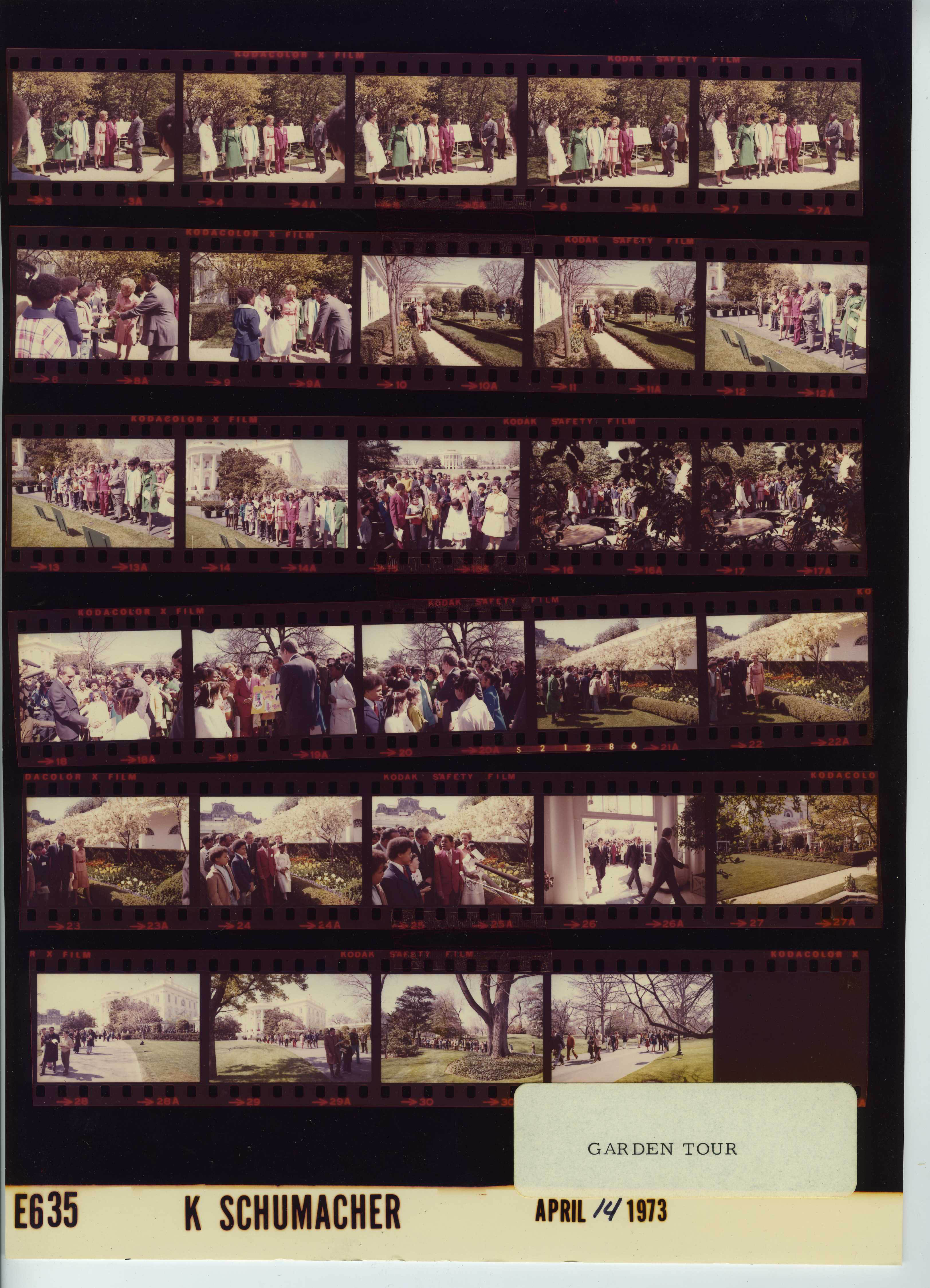
- Frame(s): WHPO-E0635-, President Nixon and Pat Nixon guide a tour group through the White House Rose Garden. Washington D.C. Mayor Walter E. Washington joins student winners of a poster contest sponsored by the Society for a More Beautiful National Capitol, Inc., poster winner Duane Bolton, and Awards Chairman Amanda MacKenzie. 4/14/1973, Washington, D.C. White House, South Grounds, Rose Garden. President Nixon, Pat Nixon, Mayor Walter E. Washington, poster winner Duane Bolton, Awards Chairman Amanda MacKenzie, unidentified young students.
- Frame(s): WHPO-E0635-16, Pat Nixon guides a tour group through the White House Rose Garden. The group includes student winners of a poster contest sponsored by the Society for a More Beautiful National Capitol, Inc., poster winner Duane Bolton, Awards Chairman Amanda MacKenzie Washington, and D.C. Mayor Walter E. Washington. 4/14/1973, Washington, D.C. White House, South Grounds, Rose Garden. President Nixon, Pat Nixon, Walter E. Washington, Duane Bolton, Amanda MacKenzie, unidentified young students.
Roll WHPO-E0636 Photographer: Schumacher, Karl | Color or B&W: Color
- Frame(s): WHPO-E0636-, President Nixon and Pat Nixon guide a tour group through the White House Rose Garden. Washington D.C. Mayor Walter E. Washingto joins student poster contest winners sponsored by the Society for a More Beautiful National Capitol, Inc. Yellow tulips and white flowering trees in full bloom. 4/14/1973, Washington, D.C. White House, South Grounds, Rose Garden. President Nixon, Pat Nixon, Mayor Walter E. Washington, poster winner Duane Bolton, Awards Chairman Amanda MacKenzie, unidentified young students.
- Frame(s): WHPO-E0636-13, President Nixon and Pat Nixon guide a tour group through the White House Rose Garden. Washington D.C. Mayor Walter E. Washington joins student poster contest winners sponsored by the Society for a More Beautiful National Capitol, Inc. Yellow tulips and white flowering trees in full bloom. 4/14/1973, Washington, D.C. White House, South Grounds, Rose Garden. President Nixon, Pat Nixon, Mayor Walter E. Washington, poster winner Duane Bolton, Awards Chairman Amanda MacKenzie, unidentified young students.
Roll WHPO-E0637 Photographer: Atkins, Oliver | Color or B&W: Color

- Frame(s): WHPO-E0637-, President Nixon and Pat Nixon attending White House Correspondents' Association Dinner as Guests of Honor. 4/14/1973, Washington, D.C. International Ballroom, Washington Hilton Hotel. President Nixon, Pat Nixon, Ted Knap, Edgar A. Poe, attendees.
- Frame(s): WHPO-E0637-09A, President Nixon shaking hands with returned Vietnam POW (Vietnam Prisoner of War) John McCain and while standing near a dining table at the White House Correspondents' Association dinner. 4/14/1973, Washington, D.C. International Ballroom, Washington Hilton Hotel. President Nixon, John McCain (Vietnam Prisoner of War), Mrs. Carol Shepp McCain (wife).
- Frame(s): WHPO-E0637-14A, President Nixon receiving an award during the White House Correspondents Association Dinner. 4/14/1973, Washington, D.C. International Ballroom, Washington Hilton Hotel. President Nixon, unidentified persons.
The White House Communications Agency Sound Recordings Collection contains public statements that took place between 1969 and 1974. Visit the finding aid to learn more.
P - Formal Presidential Remarks
- WHCA-SR-P-730411
Remarks by President Nixon to tour group on the South Grounds of the White House with PN. (4/14/1973)
Runtime: 6:35
Original Format: 1/4-inch reel-to-reel audiotape. Original source type: Original. - WHCA-SR-P-730412
Remarks by President Nixon at the White House correspondents dinner. (4/14/1973, Washington Hilton, Washington DC)
Runtime: 0:53:08
Production credits: No feed information listed; Recorded by RMM (initials of WHCA engineer)
Original Format: 1/4-inch reel-to-reel audiotape. Original source type: Original.
The White House Communications Agency Videotape Collection contains “off-the-air” recordings of televised programs produced between 1968 and 1974. Visit the finding aid to learn more.
- WHCA-6233
"Agronsky & Company". U.S. Senator William Proxmire.
CBS
Runtime: 00:29:34 - WHCA-6238
Weekly News Summary, Tape I.
ALL NETWORKS
Runtime: 01:28:30
15. Utley/Jones/Rich: Cambodia, South Vietnam ceasefire violations. Time Code Start: 35:00. Keywords: Cambodia, Vietnam War, ceasefires. Network: NBC.
16. Utley/McCormick: Gerald Ford calls on White House to clear up Watergate; executive privilege, various comments. Time Code Start: 39:33. Keywords: Watergate, Senate committee hearings, investigations, testimony, testify, cover-ups, break-in, burglary, theft, plumbers, scandals. Network: NBC.
17. Mudd/Schorr/Shaw: Mitchell says President Nixon's people (staff) want to testify at Watergate hearings. Time Code Start: 45:27. Keywords: Watergate, Senate committee hearings, investigations, testimony, testify, cover-ups, break-in, burglary, theft, plumbers, scandals. Network: CBS.
18. Mudd/Rabel: Senator Stennis attends class reunion. Time Code Start: 48:37. Keywords: Senators, schools, celebrations, reunions, classmates, students, history, commemorations. Network: CBS.
19. Hottelet: United Nations (U.N.) and the Middle East. Time Code Start: 50:40. Keywords: organization of nations, intergovernmental alliance, Middle East, Mideast, war. Network: CBS.
20. Mudd/Davis: South Vietnam's President Thieu returns to Vietnam; the children of Vietnam. Time Code Start: 52:14. Keywords: Vietnam War, South Vietnam, Preesidents, children, homeless, immgrants. Network: CBS.
Context (External Sources)
The Vanderbilt Television News Archive is the world's most extensive and complete archive of television news. They have been recording, preserving and providing access to television news broadcasts of the national networks since August 5, 1968.
Wikipedia is a free encyclopedia that anyone can edit.