
Introduction
This almanac page for Friday, September 8, 1972, pulls together various records created by the federal government and links to additional resources which can provide context about the events of the day.
Previous Date: Thursday, September 7, 1972
Next Date: Saturday, September 9, 1972
Schedule and Public Documents
The Daily Diary files represent a consolidated record of the President's activities. Visit the finding aid to learn more.
The President's day began at The White House - Washington, D. C.
The Weekly Compilation of Presidential Documents made available transcripts of the President's news conferences; messages to Congress; public speeches, remarks, and statements; and other Presidential materials released by the White House.
Digitized versions can be found at HathiTrust.
Each Public Papers of the Presidents volume contains the papers and speeches of the President of the United States that were issued by the White House Office of the Press Secretary during the time period specified by the volume. The material is presented in chronological order, and the dates shown in the headings are the dates of the documents or events. In instances when the release date differs from the date of the document itself, that fact is shown in the text note.
To ensure accuracy, remarks have been checked against audio recordings (when available) and signed documents have been checked against the original, unless otherwise noted. Editors have provided text notes and cross references for purposes of identification or clarity.
The Federal Register is the official daily publication for rules, proposed rules, and notices of federal agencies and organizations, as well as executive orders and other Presidential documents.
The Congressional Record is the official daily record of the debates and proceedings of the U.S. Congress.
Archival Holdings
Any selection of archival documents will necessarily be partial. You should use the documents and folders identified below as a starting place, but consult the linked collection finding aids and folder title lists and the collections themselves for context. Many documents to be found this way do not lend themselves to association with specific dates, but are essential to a complete understanding of the material.
Selective document listing
President's Office Files
The President's Office Files consists of materials drawn together by the Special Files Unit from several administrative subdivisions within the White House Office. It is the handwriting and sensitive papers sent to the Staff Secretary that now comprise much of the President's Office Files. Visit the finding aid to learn more.
- News Summaries, Annotated News Summaries, Box 38, Sept. 1-18, 1972 [1 of 7] [Note: Due to the way News Summary products were compiled, you should also consult nearby days for potentially relevant materials.]
- News Summary, September 8, 1972, (Thursday nets, wires, mags, columns)
- President's Daily Schedule, Box 102, [President's Daily Schedule, Aug.-Sept. 1972] [2 of 2]
- The President's Schedule, Friday - September 8, 1972
The H. R. Haldeman Diaries consists of seven handwritten diaries, 36 dictated diaries recorded as sound recordings, and two handwritten audio cassette tape subject logs. The diaries and logs reflect H. R. Haldeman’s candid personal record and reflections on events, issues, and people encountered during his service in the Nixon White House. As administrative assistant to the President and Chief of Staff, Haldeman attended and participated in public events and private meetings covering the entire scope of issues in which the Nixon White House engaged in during the years 1969-1973. Visit the finding aid to learn more.
- Transcript of diary entry (PDF)
Friday, September 8.
President had me in first thing in the morning just to review some odds and ends on the schedule. Then made the point that we've got to emphasize to all of our people the importance of attacking rather than defending, that we should hit back on McGovern making the point that he's swinging wildly. Ehrlichman should move on the O'Brien-Hughes money now, force him to divulge his other clients, that kind of thing. Connally had raised the other day the point that we could probably get Gene McCarthy to endorse the President publicly if we could get him a seat on the PBL board, or the FCC. I discovered that we have the Johnson seat coming up on the FCC in June of next year and we can commit that to him, and then try to accelerate it. He feels very strongly that we should be running on the attack on Ramsey Clark, the $1,000’s, pot, and amnesty, and all of that kind of thing. I covered this in the political meeting, with our group. No new developments there. President visited the 1701 this afternoon, on a surprise basis. Went very well, we did the volunteer headquarters at 7:30, and all of the floors of offices at 1701.
He got into a discussion of post-election points. He wants to be sure that Edward Bennett Williams and all the other lawyers of that sort in Washington, Democrats who haven't joined us, such as the airline lawyer that Flanigan sees all the time and so on, that we should make a list of all these people, lobbyists and lawyers, and after the election cut them out forever. Cut Williams completely, on the Redskins and everything else, then build up our own lawyers in this kind of area. I suggested that this is the ideal job for Colson after the election. The President basically agreed. Also wants to get individual reporters and the bad publishers, and establish a blacklist there, and move on it. He wants a study made by Buchanan and Allen on the 20 most vicious, influential D.C. reporters and television people, and then make a list for each of them of the things they would like to forget they said. Especially their predictions regarding Nixon and McGovern, for instance Kraft's point that Nixon's support is wide and thin, and so on. He has in mind Kraft and Reston, and that kind of people.
He met with Stans this afternoon to try and cheer him up, since there was concern that he was depressed. On the basis of that, he decided to include some more RNC people at the Cabinet breakfast on Tuesday morning, also agreed that he'd see Hugh Sloan. And agreed to do an audio tape for the Home Builder's Convention, and then let them use it for the dinners, although I had turned down letting him do any tape for the Home Builders.
End of September 8. - Original audio recording (MP3)
The National Archives Catalog is the online portal to the records held at the National Archives, and information about those records. It is the main way of describing our holdings and also provides access to electronic records and digitized versions of our holdings.
The Catalog searches across multiple National Archives resources at once, including archival descriptions, digitized and electronic records, authority records, and web pages from Archives.gov and the Presidential Libraries. The Catalog also allows users to contribute to digitized historical records through tagging and transcription.
Nixon Library Holdings
All National Archives Units
National Security Documents
The President's Daily Brief is the primary vehicle for summarizing the day-to-day sensitive intelligence and analysis, as well as late-breaking reports, for the White House on current and future national security issues. Read "The President's Daily Brief: Delivering Intelligence to Nixon and Ford" to learn more.
The Foreign Relations of the United States series presents the official documentary historical record of major U.S. foreign policy decisions and significant diplomatic activity. Visit the State Department website for more information.
Vol. VIII, Vietnam, January-October 1972
The Parties Move Toward Agreement, July 19-October 7, 1972
256. Memorandum From Philip A. Odeen of the National Security Council Staff to the President’s Assistant for National Security Affairs (Kissinger), Washington, September 8, 1972
Source: National Archives, Nixon Presidential Materials, NSC Files, Box 115, Vietnam Subject Files, Net Assessment of North and South Vietnam (Defense). Top Secret; Sensitive. Sent for information. Kissinger initialed the memorandum.
257. Memorandum From John H. Holdridge of the National Security Council Staff to the President’s Assistant for National Security Affairs (Kissinger), Washington, September 8, 1972
Source: Library of Congress, Manuscript Division, Kissinger Papers, Box CL 26, Chronological File, 8–12 September 1972. Secret; Sensitive. Sent for information. Haig initialed for Kissinger.
Vol. XVII, China, 1969-1972
China, March-December 1972
251. Memorandum of Conversation, Washington, September 8, 1972
Source: National Archives, Nixon Presidential Materials, NSC Files, Box 523, Country Files, Far East, China, Vol. XI. Secret; Sensitive. Kissinger and Shen met from 3:30 to 3:44 p.m. in Kissinger’s office. (Library of Congress, Manuscript Division. Kissinger Papers, Box 438, Miscellany, 1968–1976, Record of Schedule)
252. Memorandum of Conversation, Washington, September 8, 1972, 6:15-7:20 p.m.
Source: National Archives, Nixon Presidential Materials, NSC Files, Box 850, President’s File—China Trip, China Exchanges. Top Secret; Sensitive; Exclusively Eyes Only. Attached but not printed are talking points for this meeting.
Vol. E-1, Documents on Global Issues, 1969-1972
U.S. Policy Towards Terrorism, Hijacking of Aircraft, and Attacks on Civil Aviation: The Olympic Attack and the Anti-Terrorism Initiatives, September−December 1972
98. Telegram 164170 From the Department of State to Embassy in Israel, Washington, September 8, 1972, 2025Z
Rogers and Israeli Ambassador Rabin discussed how to respond to the Munich incident.
Source: National Archives, Nixon Presidential Materials, NSC Files, Box 609, Country Files, Middle East, Israel, Sept 1971-Sept. 1972. Secret; Exdis. Drafted by Stackhouse (NEA/IAI) on September 7 and approved by Atherton, Bremer, and Eliot. Repeated to Amman, Cairo, Beirut, Kuwait, Jidda, Bonn, London, Moscow, Paris, Tripoli, and USUN.
Vol. E-5, Part 2, Documents on North Africa, 1969-1972
Morocco
130. Telegram 4147 From the Embassy in Morocco to the Department of State, Rabat, September 8, 1972, 1600Z
In this 8 page telegram, Ambassador Stuart Rockwell reported on his September 7 meeting with King Hassan. Hassan analyzed the coup attempt and described his future plans for restoring order.
Source: National Archives, RG 59, Central Files 1970–73, POL 15–1 MOR. Secret. It was repeated to Paris, Madrid, Tunis, Tripoli, Algiers, Casablanca, Tangier, USCINCEUR, and COMNAVTRACOM.
Vol. E-7, Documents on South Asia, 1969-1972
U.S. Relations with India and Pakistan, 1972
301. Memorandum From the President’s Assistant for National Security Affairs (Kissinger) to President Nixon, Washington, September 8, 1972
Nixon approved Kissinger’s recommendation that he defer a decision on a Pakistani request for the release of a limited amount of military equipment owned by Pakistan but still in the U.S. as a result of the embargo on military shipments to India and Pakistan.
Source: Library of Congress, Manuscript Division, Kissinger Papers, Box CL 210, Geopolitical File, South Asia, Chronological File, July 1972–Oct 1974. Secret. Sent for action. A notation on the memorandum indicates the President saw it. A notation at the end of the memorandum indicates that Caspar Weinberger and William Timmons, the President’s Assistant for Congressional Relations, endorsed Kissinger’s recommendation. Nixon initialed his approval of the recommendation.302. Telegram 7547 From the Embassy in Pakistan to the Department of State, Islamabad, September 8, 1972, 1314Z
Pakistani President Bhutto explained to Chargé Sober why Pakistan had not recognized Bangladesh by August as had been anticipated in the Simla agreement.
Source: National Archives, Nixon Presidential Materials, NSC Files, Box 628, Country Files, Middle East, Pakistan, Vol. X, Sept 72–Oct 73. Confidential; Exdis. Repeated to Dacca, London, New Delhi, USUN, Karachi, and Lahore.
The Kissinger telephone conversation transcripts consist of approximately 20,000 pages of transcripts of Kissinger’s telephone conversations during his tenure as Assistant to the President for National Security Affairs (1969-1974) and Secretary of State (1973-1974) during the administration of President Richard Nixon. Visit the finding aid for more information.
Digitized versions can be found in the National Archives Catalog.
Audiovisual Holdings
Visit the White House Tapes finding aid to learn about the taping system's operation and archival processing.
Cabinet Room
- 105-1; Unknown between 10:43 a.m. & 5:31 p.m.; Nixon, Richard M. (President); a.m.brose, Myles J.; Allott, Gordon L.; Baker, James E.; Alter, Samuel A.; Buckley, Francis M.; Caballero, Romualdo; Callahan, William; Cloud, Stephen J.; Cooney, John F.; Corcoran, William J.; Dana, Frederick J.; Fitzsimmons, J. Michael; Fletcher, Stephen M.; Gibbons, John C.; Pinnell, Charles; Jacquet, Harold; Levine, Samuel; Luckel, Eb B.; Marinaccio, Lee A.; Marrs, Michael D.; Martinez, Jose E.; Miller, Scott T.; Morachnik, Charles; Morrison, Alexia; Nadel, Norbert A.; Paris, Wayne H.; Poole, Charles I.; Praeger, Irving; Promuto, Vincent L.; Rosen, Peter M.; Sprague, Robert; Stool, Anna; Sullivan, Patrick; Torres, Rick; Waldman, Jay C.; White, Jackson; Wilbur, John S., Jr.; Wright, Dale R.; Zitko, Robert D.; Jaffe, David; Gray, Monty; Krogh, Egil ("Bud"), Jr.; Shepard, Geoffrey C.; White House photographer
- 105-2; Unknown between 5:31 p.m., 9/8 & 10:06 a.m., 5/20; White House tour group
- 105-3; Unknown between 5:31 p.m., 9/8 & 10:06 a.m., 5/20; White House tour group
- 105-11; Unknown between 5:31 p.m., 9/8 & 10:06 a.m., 6/8; Nixon, Richard M. (President); Bull, Stephen B.
- 105-12; Unknown between 5:31 p.m., 9/8 & 10:06 a.m., 6/8; White House tour group
Camp David Hard Wire
- 208-1; Unknown between 6:03 p.m., 9/8 & 2:26 p.m., 7/23; [Unknown person(s)]
- 208-2; Unknown between 6:03 p.m., 9/8 & 2:26 p.m., 7/23; Eisenhower, Julie Nixon; Nixon, Thelma C. ("Pat") (Ryan)
- 208-3; Unknown between 6:03 p.m., 9/8 & 2:26 p.m., 7/23; [Unknown person(s)]
- 208-4; Unknown between 6:03 p.m., 9/8 & 2:26 p.m., 7/23; Nixon, Thelma C. ("Pat") (Ryan); Eisenhower, Julie Nixon
- 208-5; Unknown between 6:03 p.m., 9/8 & 2:26 p.m., 7/23; Nixon, Thelma C. ("Pat") (Ryan); Eisenhower, Julie Nixon
- 208-6; Unknown between 6:03 p.m., 9/8 & 2:26 p.m., 7/23; Nixon, Richard M. (President); Eisenhower, Julie Nixon
- 208-7; Unknown between 6:03 p.m., 9/8 & 2:26 p.m., 7/23; Nixon, Thelma C. ("Pat") (Ryan); Eisenhower, Julie Nixon
- 209-1; Unknown between 6:03 p.m., 9/8 & 11:44 a.m., 7/23; Eisenhower, Julie Nixon; Nixon, Thelma C. ("Pat") (Ryan)
- 209-2; Unknown between 6:03 p.m., 9/8 & 11:44 a.m., 7/23; Nixon, Richard M. (President); Nixon, Thelma C. ("Pat") (Ryan); Eisenhower, Julie Nixon
Camp David Study Desk
- 177-1; Unknown between 6:03 p.m., 9/8 & 2:26 p.m., 11/17; Haldeman, H. R. ("Bob"); [Unknown person(s)]
- 177-2; Unknown between 6:03 p.m., 9/8 & 2:26 p.m., 11/17; Haldeman, H. R. ("Bob"); Camp David Operator
- 177-3; Unknown between 6:03 p.m., 9/8 & 2:26 p.m., 11/17; Haldeman, H. R. ("Bob"); Higby, Lawrence M.
Old Executive Office Building
- 360-1; Unknown between 1:05 p.m. & 2:12 p.m.; Nixon, Richard M. (President); Sanchez, Manolo
- 360-2; Unknown between 1:05 p.m. & 2:12 p.m.; Nixon, Richard M. (President); Sanchez, Manolo
- 360-3; Unknown between 1:05 p.m. & 2:12 p.m.; Nixon, Richard M. (President); White House operator
- 360-4; 2:12 p.m. - 2:13 p.m.; Nixon, Richard M. (President); Ehrlichman, John D.
- 360-5; 2:13 p.m. - 3:01 p.m.; Nixon, Richard M. (President); Colson, Charles W.; Bull, Stephen B.
- 360-6; 3:01 p.m. - 3:40 p.m.; Nixon, Richard M. (President); Ehrlichman, John D.; Krogh, Egil ("Bud"), Jr.; Sanchez, Manolo
- 360-7; Unknown between 3:40 p.m. & 3:44 p.m.; Nixon, Richard M. (President); Haldeman, H. R. ("Bob")
- 360-8; Unknown between 3:40 p.m. & 3:44 p.m.; Nixon, Richard M. (President); Woods, Rose Mary
- 360-9; 3:44 p.m. - 4:40 p.m.; Nixon, Richard M. (President); Haldeman, H. R. ("Bob"); [Unknown person(s)]; Bull, Stephen B.; Stans, Maurice H.
Oval Office
- 773-1; 9:28 a.m. - 10:20 a.m.; Nixon, Richard M. (President); Haldeman, H. R. ("Bob")
- 773-2; Unknown between 10:20 a.m. & 10:28 a.m.; Nixon, Richard M. (President); Bull, Stephen B.
- 773-3; 10:28 a.m. - 10:42 a.m.; Nixon, Richard M. (President); Kissinger, Henry A.; Panggabean, Marader (Gen.); Bull, Stephen B.; White House photographer
- 773-4; Unknown between 10:42 a.m. & 10:43 a.m.; Nixon, Richard M. (President); Bull, Stephen B.
- 773-5; Unknown between 11:15 a.m. & 11:23 a.m.; Nixon, Richard M. (President); Bull, Stephen B.
- 773-6; Unknown between 11:15 a.m. & 11:23 a.m.; Nixon, Richard M. (President); Bull, Stephen B.
- 773-7; 11:23 a.m. - 11:30 a.m.; Nixon, Richard M. (President); Woods, Rose Mary; Bull, Stephen B.
- 773-8; 11:30 a.m. - 11:32 a.m.; Nixon, Richard M. (President); Goode, Mark I.
- 773-9; Unknown between 11:32 a.m. & 11:39 a.m.; Nixon, Richard M. (President); Tower, John G.; Baker, Howard H., Jr.; Timmons, William E.; Atkins, Oliver F. ("Ollie")
- 773-10; Unknown between 11:44 a.m. & 11:49 a.m.; Nixon, Richard M. (President); Bull, Stephen B.
- 773-11; Unknown between 11:44 a.m. & 11:49 a.m.; Nixon, Richard M. (President); Sanchez, Manolo
- 773-12; 11:49 a.m. - 12:12 p.m.; Nixon, Richard M. (President); Kissinger, Henry A.; [Unknown person(s)]; Bull, Stephen B.
- 773-13; Unknown between 12:12 p.m. & 12:14 p.m.; Nixon, Richard M. (President); Bull, Stephen B.
- 773-14; 12:14 p.m. - 12:18 p.m.; Nixon, Richard M. (President); Sikes, Robert L. F.; Sikes, Robert L. F. (Mrs.); Cook, Richard K.; Nidecker, John E.; White House photographer
- 773-15; Unknown between 12:18 p.m. & 12:22 p.m.; Nixon, Richard M. (President); Butterfield, Alexander P.
- 773-16; Unknown between 12:18 p.m. & 12:22 p.m.; Nixon, Richard M. (President); [Unknown person(s)]
- 773-17; 12:25 p.m. - 1:05 p.m.; Nixon, Richard M. (President); Ehrlichman, John D.
- 773-18; Unknown between 1:05 p.m., 9/8 & 9:18 a.m., 7/28; [Unknown person(s)]
The White House Photo Office collection consists of photographic coverage of President Richard Nixon meeting with prominent social, political, and cultural personalities; speaking engagements and news conferences of the President and various high-ranking members of the White House staff and Cabinet; Presidential domestic and foreign travel, including Presidential vacations; social events and entertainment involving the First Family, including entertainers present; official portraits of the President, First Family, and high-ranking members of the Nixon administration; the 1969 and 1973 Inaugurals; the President’s 1972 Presidential election campaign appearances (including speeches) and other official activities of the White House staff and the President’s Cabinet from January 20, 1969 until August 9, 1974 at the White House and the Old Executive Office Building; other locations in Washington, DC, such as The Mall; and the Presidential retreats in Camp David, Maryland, Key Biscayne, Florida, and San Clemente, California. Visit the finding aid to learn more.
Roll WHPO-D0320 Photographer: Atkins, Oliver | Color or B&W: B&W
- Frame(s): WHPO-D0320-04-09, President Nixon seated at his Oval Office desk during a meeting with Senator John Tower. 9/8/1972, Washington, D.C. White House, Oval Office. President Nixon, John Tower, Howard Baker.
- Frame(s): WHPO-D0320-10-13, 15, President Nixon seated at his Oval Office desk during a meeting with Senator John Tower and Senator Howard Baker. 9/8/1972, Washington, D.C. White House, Oval Office. President Nixon, John Tower, Howard Baker.
- Frame(s): WHPO-D0320-14, President Nixon seated at his Oval Office desk during a meeting with Senator Howard Baker. 9/8/1972, Washington, D.C. White House, Oval Office. President Nixon, Howard Baker.
- Frame(s): WHPO-D0320-16-23, 25-34, President Nixon and Senator John Tower during a meeting, talking while they walk to, in, and from the White House Rose Garden. (Oval Office porch, windows and door are visible in background with Façade of Executive Office Building's (EOB) top 3 floors and roof). 9/8/1972, Washington, D.C. White House, Rose Garden. President Nixon, John Tower.
- Frame(s): WHPO-D0320-24, President Nixon and Senator John Tower talking while standing in the White House Rose Garden lawn. (Oval Office french door windows visible in background with Façade of Executive Office Building's (EOB) top 3 floors.). 9/8/1972, Washington, D.C. White House, Rose Garden. President Nixon, John Tower.
Roll WHPO-D0321 Photographer: Atkins, Oliver | Color or B&W: B&W
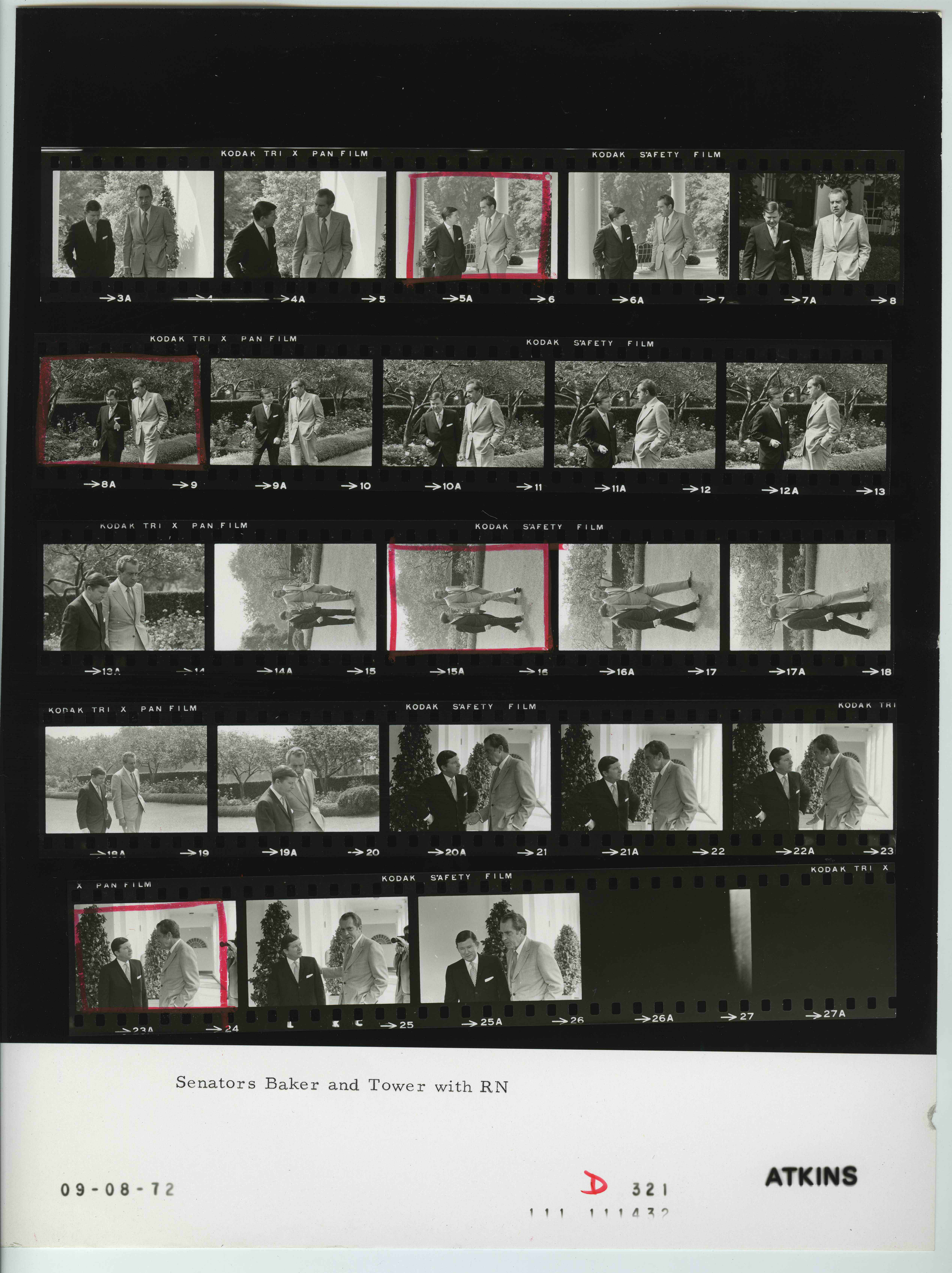
- Frame(s): WHPO-D0321-, President Nixon and Senator John Tower walking in the White House Rose Garden. 9/8/1972, Washington, D.C. White House, Rose Garden. President Nixon, John Tower.
- Frame(s): WHPO-D0321-10A, President Nixon and Senator Howard Baker talking during a meeting while standing on the White House Rose Garden porch behind the Oval Office. 9/8/1972, Washington, D.C. White House, Rose Garden. President Nixon, Howard Baker.
- Frame(s): WHPO-D0321-11A, President Nixon and Senator John Tower talk while standing in the White House Rose Garden. 9/8/1972, Washington, D.C. White House, Rose Garden. President Nixon, John Tower.
Roll WHPO-D0322 Photographer: Atkins, Oliver | Color or B&W: B&W
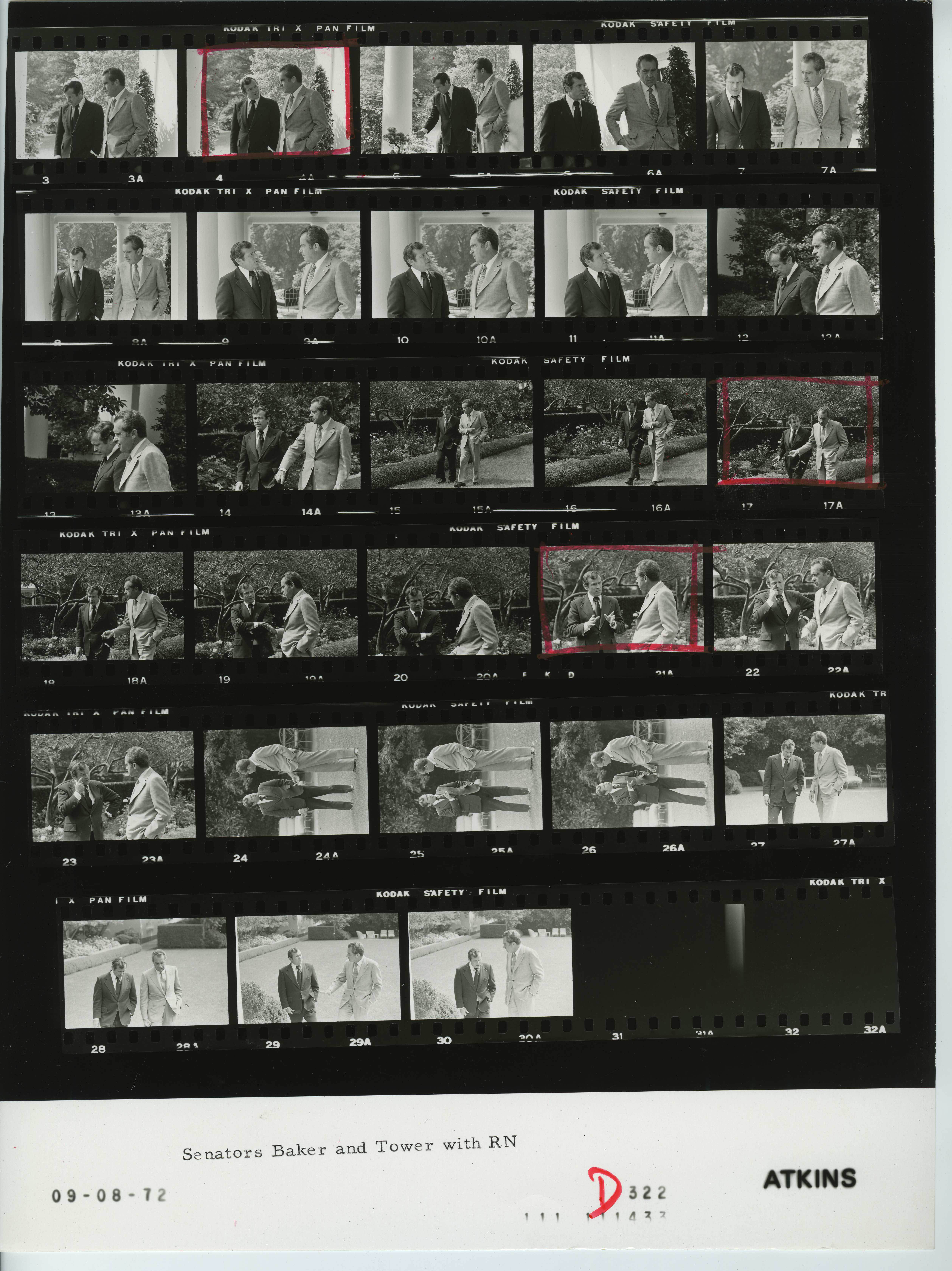
- Frame(s): WHPO-D0322-, President Nixon and Senator Howard Baker walking to, in, and from the Rose Garden. 9/8/1972, Washington, D.C. White House, Rose Garden. President Nixon, Howard Baker.
- Frame(s): WHPO-D0322-11A, President Nixon and Senator Howard Baker talk while standing on the Oval Office porch near the Rose Garden. 9/8/1972, Washington, D.C. White House, Rose Garden. President Nixon, Howard Baker.
Roll WHPO-D0323 Photographer: Atkins, Oliver | Color or B&W: B&W
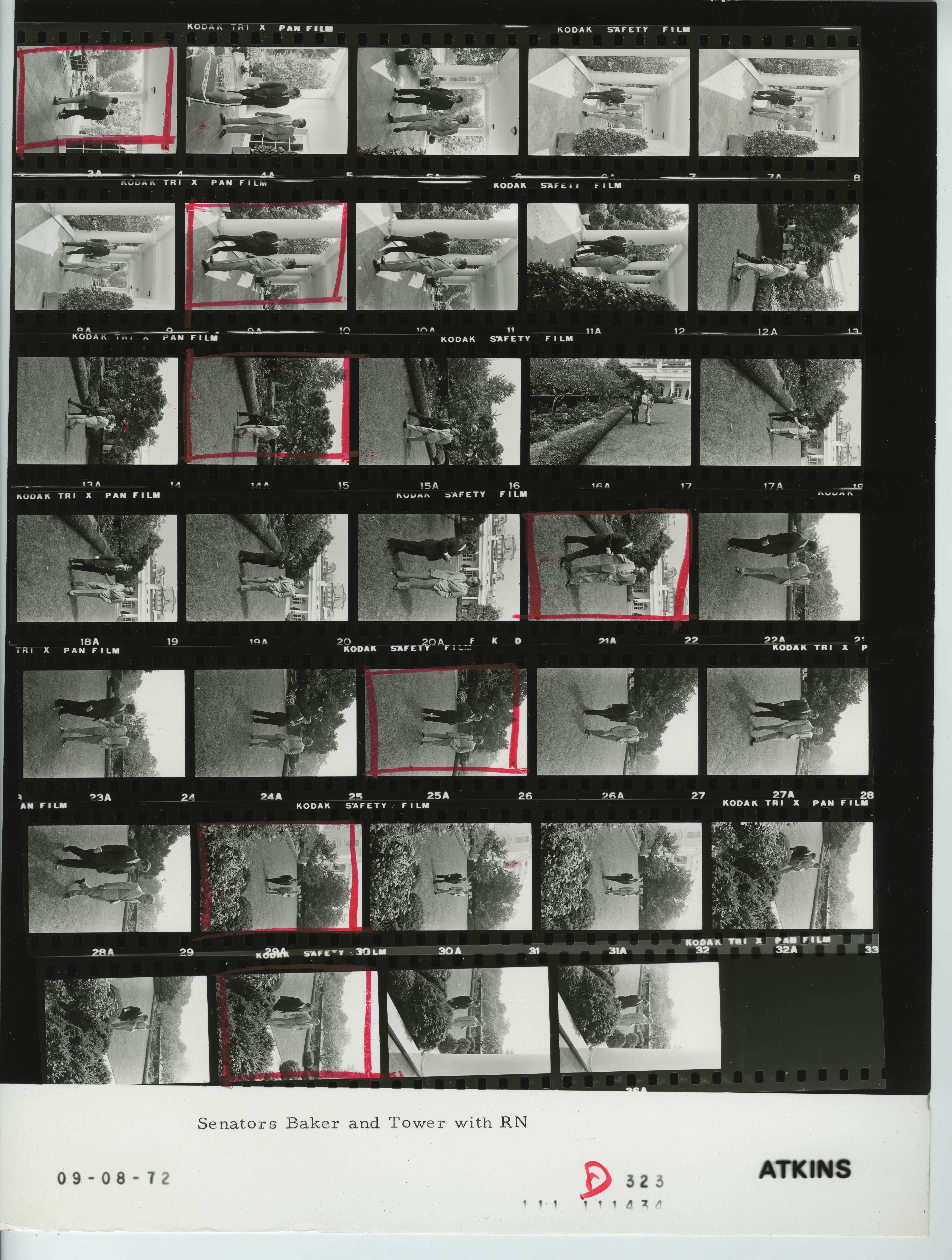
- Frame(s): WHPO-D0323-, President Nixon and Senator Howard Baker walking to, in, and from the Rose Garden. 9/8/1972, Washington, D.C. White House, Rose Garden. President Nixon, Howard Baker.
- Frame(s): WHPO-D0323-10A, President Nixon and Senator Howard Baker talk while standing on the Oval Office porch near the Rose Garden. 9/8/1972, Washington, D.C. White House, Rose Garden. President Nixon, Howard Baker.
Roll WHPO-D0324 Photographer: Atkins, Oliver | Color or B&W: B&W
- Frame(s): WHPO-D0324-, President Nixon standing with Indonesian Minister of State General Maraden Panggabean and his aide. 9/8/1972, Washington, D.C. White House, Oval Office. President Nixon, Maraden Panggabean , unidentified official.
Roll WHPO-D0325 Photographer: Atkins, Oliver | Color or B&W: B&W
- Frame(s): WHPO-D0325-, President Nixon, attorneys and Drug Enforcement officials attending a Drug Abuse Law Enforcement training seminar in the Cabinet room. sponsored by the Drug Abuse Law Enforcement Agency. (ODALE). 9/8/1972, Washington, D.C. White House, Cabinet Room. President Nixon, Egil Krogh, Deputy Assistant. Geoffrey Shepard, Staff Assistant for the Domestic Council and various attorneys or ODALE personnel: Myles J. Ambrose, Special Consultant; Gordon L. Allott, Jr., Regional Director, ODALE, Denver, Colorado; James E. Baker, ODALE, Atlanta, Georgia; Samuel A. Alter, ODALE, Miami, Florida; Francis M. Buckley, ODALE, Hartford, Conn; Romualdo Caballero, Detailed from Tax Division, San Diego, California; William Callahan, ODALE, New York, NY; Stephen J. Cloud, ODALE, Chicago, Illinois; John F. Cooney, Assistant U.S. Attorney, San Francisco, CA; William J. Corcoran, ODALE, Philadelphia, Pennsylvania; Frederick J. Dana, ODALE, St. Louis, Missouri; J. Michael Fitzsimmons, Regional Director, ODALE, Chicago, Illinois; Stephen M. Fletcher, Detailed from the Johnson County, Kansas Attorney's Office; John C. Gibbons, ODALE, San Francisco, CA; Charles Pinnell, Assistant U.S. Attorney, Seattle, Washington; Harold Jacquet, Assistant District Attorney, Detailed from Travi County, Austin, Texas; Samuel Levine, Financial Officer, Law Enforcement Assistance Anministration; Eb. B. Luckel, ODALE, San Antonio Philadelphia, PA; Lee A. Marinaccio, ODALE, Chicago, IL; Michael D. Marrs, Assistant U. S. Attorney, Chicago, IL; Jose E. Martinez, Regional Director, ODALE, Miami, Florida; Scott T. Miller, Assistant U.S. Attorney, Indianapolis, Indiana; Charles Morachnik, Detailed from Public Defenders' Staff, Newark, New Jersey. Alexia Morrison, Legal Clerk, ODALE. Norbert A. Nadel, Assistant U.S. Attorney, Cincinnati, Ohio. Wayne H. Paris, Assistant U.S. Attorney, Seattle, WA. Charles I. Poole, ODALE, Miami, Fl. Irving Praeger, Assistant U.S. Attorney, Los Angeles, CA. Vincent L. Promuto, ODALE, New York, NY. Peter M. Rosen, ODALE, Detroit. Benjamin P. Schoen, ODALE, Los· Angeles, CA. Daniel J. Sears, ODALE, Denver, Colorado. Robert Sprague, ODALE, Los Angeles. CA. Anna Stool, ODALE, Houston, TX. Patrick Sullivan, Assistant U.S. Attorney, Miami, FL. Rick Torres, LEAA, Los Angeles. Jay C. Waldman, Assistant U.S. Attorney, Pittsburgh, PA. Jackson White, ODALE, Dallas, TX. John S. Wilbur, Jr., ODALE, Cleveland, OH. Dale R. Wright, Community Relations Officer, Detailed from Narcotics Addiction Control Commission, New York State. Robert D. Zitko, Assistant U.S. Attorney, Columbus, OH. David Jaffe, Deputy Director for Technical Support, ODALE, Washington, D.C. Monty Gray, Attorney, ODALE, Washington, D.C. Egil Krogh, Deputy Assistant. Geoffrey Shepard, Staff Assistant for the Domestic Council.
- Frame(s): WHPO-D0325-10, President Nixon, attorneys and Drug Enforcement officials attending a Drug Abuse Law Enforcement training seminar in the Cabinet room. sponsored by the Office of Drug Abuse Law Enforcement. (ODALE). 9/8/1972, Washington, D.C. White House, Cabinet Room. President Nixon, Egil Krogh, Deputy Assistant, possibly Geoffrey Shepard, Staff Assistant for the Domestic Council; For a full list of attendees see Appendix "A" for September 8, 1972 in the PDD.
Roll WHPO-D0326 Photographer: Atkins, Oliver | Color or B&W: B&W
- Frame(s): WHPO-D0326-, President Nixon standing with Rep. Robert Sikes and Mrs. Sikes. 9/8/1972, Washington, D.C. White House, Oval Office. President Nixon, Robert Sikes, Mrs. Sikes.
Roll WHPO-D0327 Photographer: Knudsen, Robert L. | Color or B&W: B&W
- Frame(s): WHPO-D0327-, President Nixon talking with members of the staff of CREP. 9/8/1972, Washington, D.C. CREP offices, 1701 Pennsylvania Avenue. President Nixon, CREP staff members.
Roll WHPO-D0328 Photographer: Knudsen, Robert L. | Color or B&W: B&W
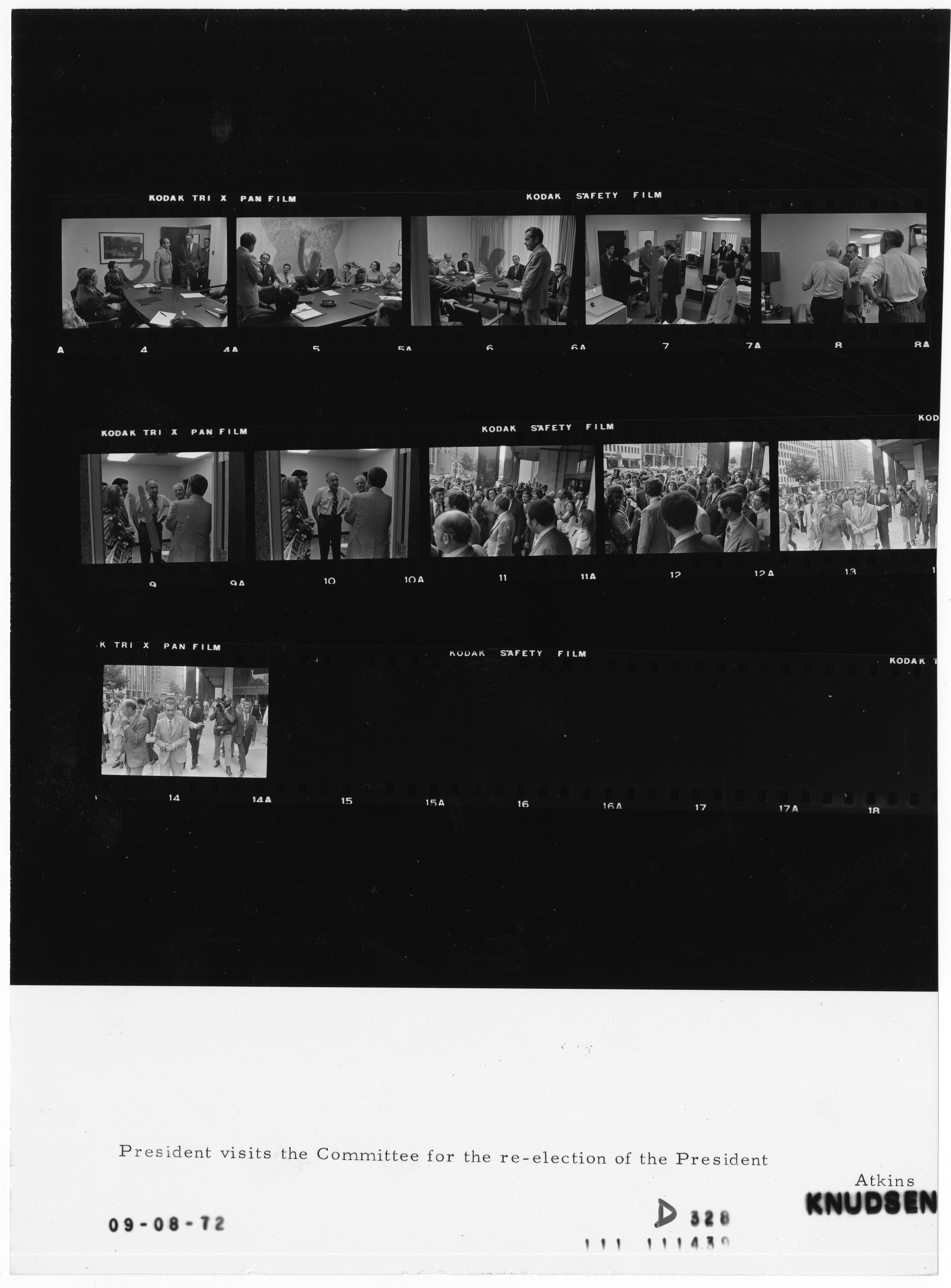
- Frame(s): WHPO-D0328-, President Nixon talking during a meeting, at Committee for Re-election of the President (CRP) headquarters, with members of the CREP staff, and then leaving the building. 9/8/1972, Washington, D.C. CREP offices, 1701 Pennsylvania Avenue. President Nixon, Committee for Re-election of the President (CRP) staff members list not available in the Presidential Daily Diary.
- Frame(s): WHPO-D0328-05, President Nixon talking during a meeting, at Committee for Re-election of the President (CRP) headquarters, with members of the CREP staff. 9/8/1972, Washington, D.C. CREP offices, 1701 Pennsylvania Avenue. President Nixon, Committee for Re-election of the President (CRP) staff members [list not available in the Presidential Daily Diary].
- Frame(s): WHPO-D0328-06, President Nixon talking during a meeting, at Committee for Re-election of the President (CRP) headquarters, with members of the CREP staff. 9/8/1972, Washington, D.C. CREP offices, 1701 Pennsylvania Avenue. President Nixon, Committee for Re-election of the President (CRP) staff members [list not available in the Presidential Daily Diary].
Roll WHPO-D0329 Photographer: Knudsen, Robert L. | Color or B&W: B&W
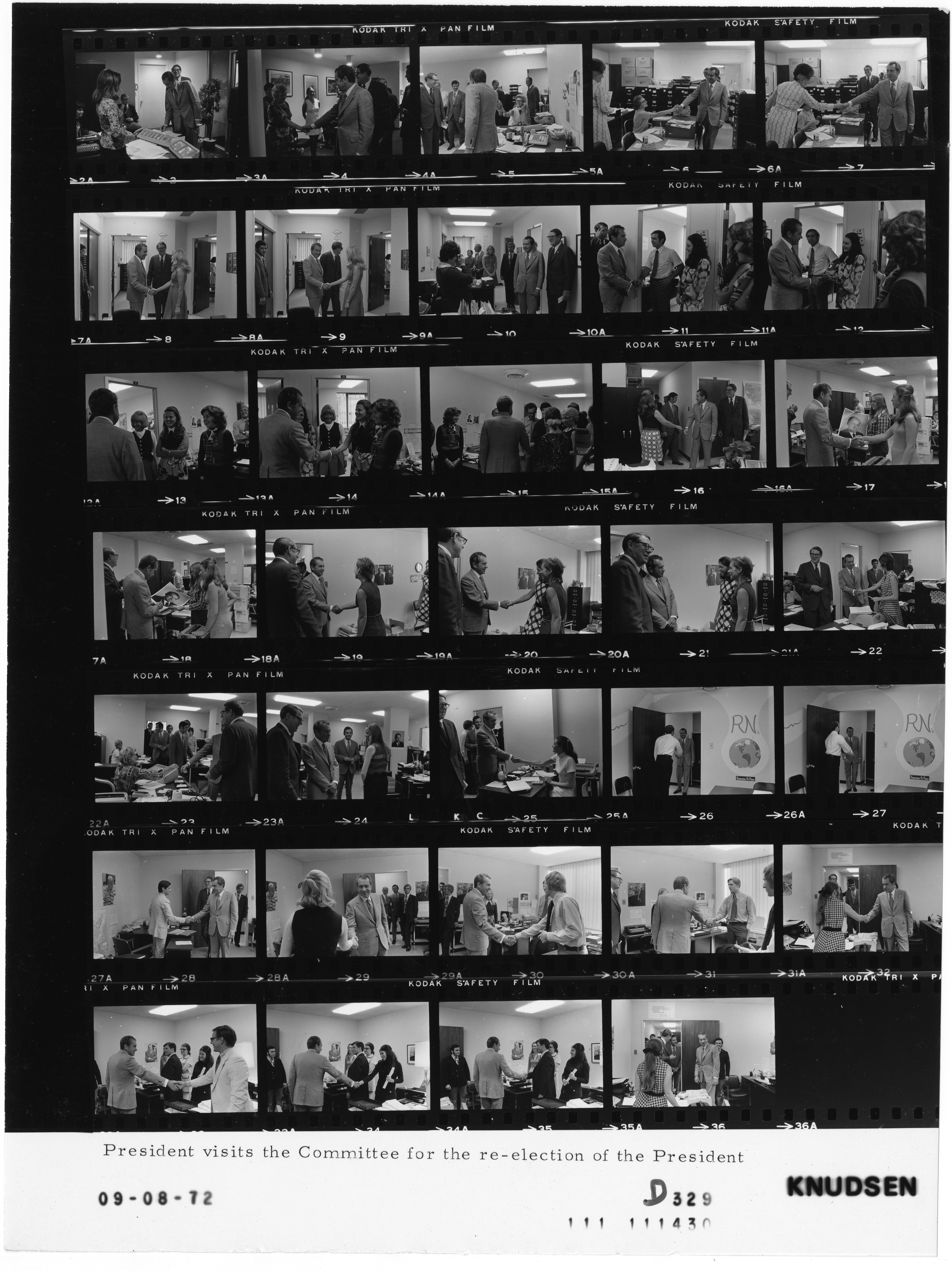
- Frame(s): WHPO-D0329-, President Nixon at Committee for Re-election of the President (CRP) headquarters, shaking hands with members of the CREP staff., and then departing with Clark MacGregor. 9/8/1972, Washington, D.C. CREP offices, 1701 Pennsylvania Avenue. President Nixon, Clark MacGregor, President Nixon, Committee for Re-election of the President (CRP) staff members list not available in the Presidential Daily Diary.
Roll WHPO-D0330 Photographer: Knudsen, Robert L. | Color or B&W: B&W
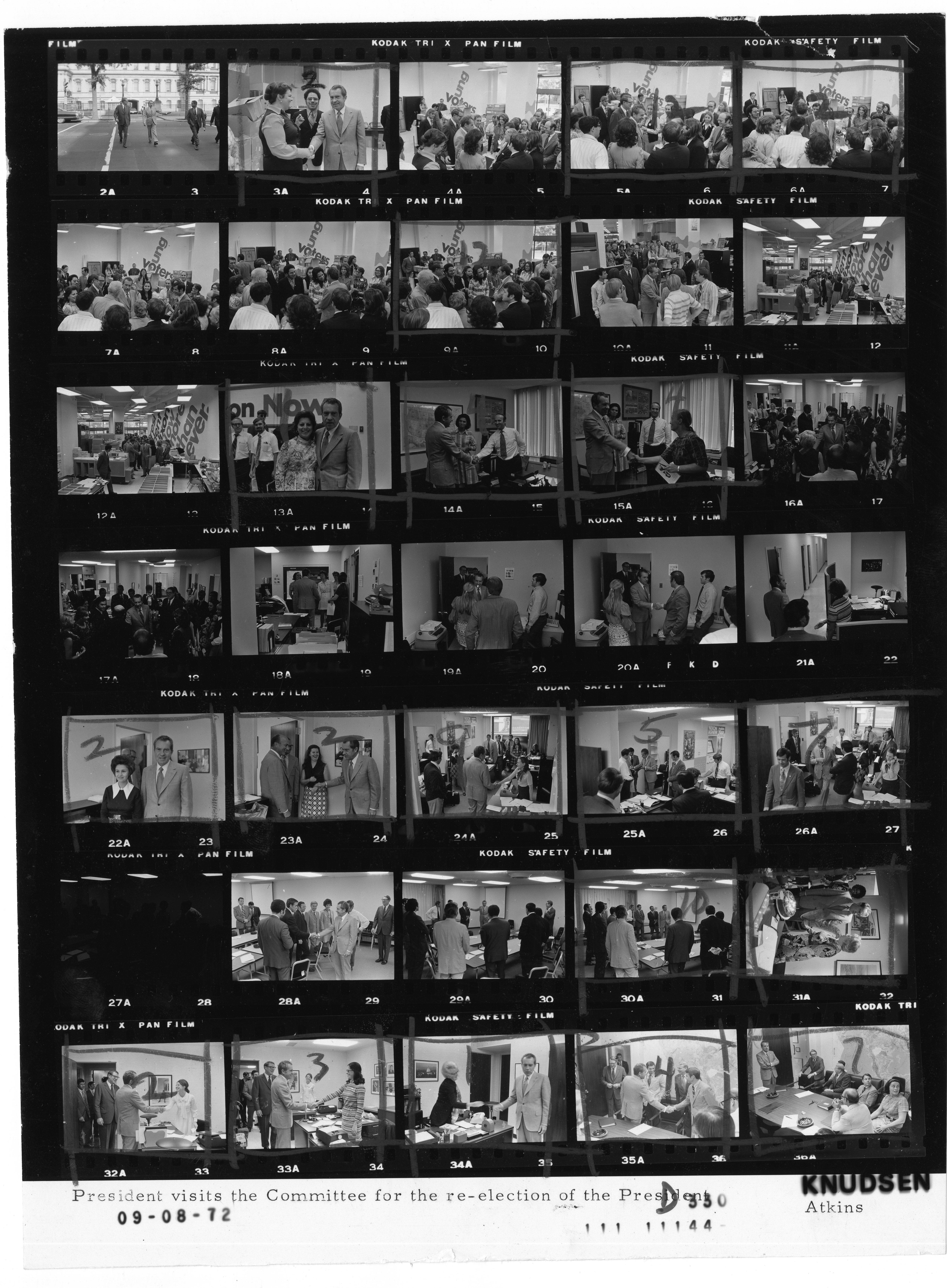
- Frame(s): WHPO-D0330-02A-13A, President Nixon greeting staff members at the Committee for Re-election of the President (CRP) headquarters. 9/8/1972, Washington, D.C. street, campaign headquarters, 1730 Pa. Ave.; CREP offices, 1701 Pa. Ave. President Nixon, Clark MacGregor, President Nixon, Committee for Re-election of the President (CRP) staff members list not available in the Presidential Daily Diary.
- Frame(s): WHPO-D0330-14A-36A, President Nixon greeting staff members at the Committee for Re-election of the President (CRP) headquarters. 9/8/1972, Washington, D.C. street, campaign headquarters, 1730 Pa. Ave.; CREP offices, 1701 Pa. Ave. President Nixon, Clark MacGregor, President Nixon, Committee for Re-election of the President (CRP) staff members list not available in the Presidential Daily Diary.
The White House Communications Agency Sound Recordings Collection contains public statements that took place between 1969 and 1974. Visit the finding aid to learn more.
H - White House Staff Member Recordings
- WHCA-SR-H-651
Press briefing by Myles Ambrose. (9/8/1972, Press Lobby, White House)
Runtime: 25:30:00
Keywords: drugs, drug abuse, narcotics, heroin, marijuana, addicts, addiction, prevention, programs
Production credits: Audio feed supplied by WHCA; Recorded by GET (initials of WHCA engineer)
Original Format: 1/4-inch reel-to-reel audiotape. Original source type: Original.
L - White House Press Office Briefings
- WHCA-SR-L-017
Press briefing by Ronald Ziegler. (9/8/1972, White House Press Lobby)
Runtime: 59:15:00
Keywords: Press conferences, news conferences, interviews, media, press secretary
Original Format: 1/4-inch reel-to-reel audiotape. Original source type: Original. - WHCA-SR-L-018
Press briefing by Connie Stuart. (9/8/1972, Family Theater)
Runtime: 36:00:00
Keywords: Press conferences, news conferences, interviews, media
Original Format: 1/4-inch reel-to-reel audiotape. Original source type: Original.
P - Formal Presidential Remarks
- WHCA-SR-P-720907
Private tapings for Congressman Charles Jonas, Mr. Gross, and for the advancemen. (9/8/1972)
Runtime: 3:20
Original Format: 1/4-inch reel-to-reel audiotape. Original source type: Original.
The White House Communications Agency Videotape Collection contains “off-the-air” recordings of televised programs produced between 1968 and 1974. Visit the finding aid to learn more.
- WHCA-5752
Southern Governors Conference. U.S. Senator George McGovern (D-SD), Richard Nixon; "Ag&Co.": Daniel Ellsberg.
Eastern Education Network
Runtime: 01:02:34 - WHCA-5753
President Nixon and Vice-President Agnew footage excerpts. Richard Nixon, American Legion officials and leaders.
NA
Runtime: 00:09:30 - WHCA-5771
Weekly News Summary, Tape I.
ALL NETWORKS
Runtime: 1:30
1. Smith/Greer: Wholesale prices up; (Dr. Stein) on McGovern; McGovern campaigning. Time Code Start: 00:00. Keywords: Presidential elections, campaigns, campaigning, candidates. Network: ABC.
2. Smith/Donaldson/Zimmerman: White House will not talk about Watergate affair, head of Democratic National Committee Jean Westwood does; Senator Eagleton and Sargent Shriver in St. Louis. Time Code Start: 02:56. Keywords: Presidents, Senate Committee hearings, cover-ups, Presidential elections, campaigns, campaigning, candidates, leaders, women, advisors, political parties, Demomcrats. Network: ABC.
3. Smith/Kincaid: The campaign in Columbus, Ohio. Time Code Start: 06:58. Keywords: Presidential elections, campaigns, campaigning, candidates, primaries, voting. Network: ABC.
4. Smith/Koppel: More on Hoffa trip that wasn't. Time Code Start: 11:19. Keywords: labor, unions, IBT, International Brotherhood of Teamsters, leaders, travel, trips, Vietnam, prisons, sentences, releases. Network: ABC.
5. Smith: Commentary on Civil rights and Olympics. Time Code Start: 12:58. Keywords: African Americans, desegregation, racism, racial discrimination, world, sports, games, Olympic teams, Olympians,. Network: ABC.
6. Chancellor/Levine: Herbert Stein on the economy. Time Code Start: 14:42. Keywords: reports, officials, economy, economics, debt, budgets, finances, recession, inflation, money, wages. Network: NBC.
7. Chancellor/Mackin/Oliver: McGovern in Wisconsin; AFL-CIO will not endorse McGovern. Time Code Start: 16:42. Keywords: labor, unions, American Federation of Labor, Congress of Industrial Organizations, candidates, endorsements. Network: NBC.
8. Chancellor/Valeriani: Hoffa. Time Code Start: 20:52. Keywords: labor, unions, IBT, International Brotherhood of Teamsters, leaders, travel, trips. Network: NBC.
9. Cronkite: Wholesale prices up. Time Code Start: 22:54. Keywords: wage and price controls, freezes, prices, costs, increases, decreases, economy, economics, budgets, finances, recession, inflation, money. Network: CBS.
10. Cronkite/Rather: (President Nixon) and Hoffa. Time Code Start: 24:13. Keywords: Presidents, labor, unions, IBT, International Brotherhood of Teamsters, leaders. Network: CBS.
11. Cronkite/Morton: (McGovern) in Dallas. Time Code Start: 26:58. Keywords: Presidential elections, campaigns, campaigning, candidates. Network: CBS.
12. Cronkite/Schieffer: Senator Eagleton and Sargent Shriver in St. Louis. Time Code Start: 31:36. Keywords: Vice Presidents, Presidential elections, campaigns, campaigning, candidates. Network: CBS.
Context (External Sources)
The Vanderbilt Television News Archive is the world's most extensive and complete archive of television news. They have been recording, preserving and providing access to television news broadcasts of the national networks since August 5, 1968.
Wikipedia is a free encyclopedia that anyone can edit.