
Introduction
This almanac page for Thursday, October 7, 1971, pulls together various records created by the federal government and links to additional resources which can provide context about the events of the day.
Previous Date: Wednesday, October 6, 1971
Next Date: Friday, October 8, 1971
Schedule and Public Documents
The Daily Diary files represent a consolidated record of the President's activities. Visit the finding aid to learn more.
The President's day began at The White House - Washington, D. C.
The Weekly Compilation of Presidential Documents made available transcripts of the President's news conferences; messages to Congress; public speeches, remarks, and statements; and other Presidential materials released by the White House.
Digitized versions can be found at HathiTrust.
Each Public Papers of the Presidents volume contains the papers and speeches of the President of the United States that were issued by the White House Office of the Press Secretary during the time period specified by the volume. The material is presented in chronological order, and the dates shown in the headings are the dates of the documents or events. In instances when the release date differs from the date of the document itself, that fact is shown in the text note.
To ensure accuracy, remarks have been checked against audio recordings (when available) and signed documents have been checked against the original, unless otherwise noted. Editors have provided text notes and cross references for purposes of identification or clarity.
The Federal Register is the official daily publication for rules, proposed rules, and notices of federal agencies and organizations, as well as executive orders and other Presidential documents.
The Congressional Record is the official daily record of the debates and proceedings of the U.S. Congress.
Archival Holdings
Any selection of archival documents will necessarily be partial. You should use the documents and folders identified below as a starting place, but consult the linked collection finding aids and folder title lists and the collections themselves for context. Many documents to be found this way do not lend themselves to association with specific dates, but are essential to a complete understanding of the material.
Selective document listing
President's Office Files
The President's Office Files consists of materials drawn together by the Special Files Unit from several administrative subdivisions within the White House Office. It is the handwriting and sensitive papers sent to the Staff Secretary that now comprise much of the President's Office Files. Visit the finding aid to learn more.
- News Summaries, Annotated News Summaries, Box 31, News Summaries - October 1-11, 1971 [2 of 3] [Note: Due to the way News Summary products were compiled, you should also consult nearby days for potentially relevant materials.]
- October 7, 1971
- News Summary, October 7, 1971 (Wednesday, TV, wires, columns, magazines)
- President's Daily Schedule, Box 102, [President's Daily Schedule, Sept.-Dec. 1971] [2 of 3]
- The President's Schedule, Thursday - October 7, 1971
President's Personal File
The President's Personal File is essentially a President's secretary's file, kept by Rose Mary Woods, personal secretary to the President, for two purposes: (1) preserving for posterity a collection of documents particularly close to the President, whether because he dictated or annotated them, or because of the importance of the correspondent or the event concerned and (2) giving appropriate attention–letters of gratitude, invitations to White House social events, and the like–to members and important friends and supporters of the Nixon administration. This generalization does not describe all the varied materials of a file group which is essentially a miscellany, but it does identify the reason for the existence of the file group's core. Visit the finding aid to learn more.
- President's Speech File
The H. R. Haldeman Diaries consists of seven handwritten diaries, 36 dictated diaries recorded as sound recordings, and two handwritten audio cassette tape subject logs. The diaries and logs reflect H. R. Haldeman’s candid personal record and reflections on events, issues, and people encountered during his service in the Nixon White House. As administrative assistant to the President and Chief of Staff, Haldeman attended and participated in public events and private meetings covering the entire scope of issues in which the Nixon White House engaged in during the years 1969-1973. Visit the finding aid to learn more.
- Transcript of diary entry (PDF)
Thursday, October 7.
President spent the day holed up at the EOB getting ready for the TV speech tonight. We had considerable discussion on the phone, and I was over there several times. First of all, on the problem of the appointments to the Wage Price-- Wage and Price Boards. A number of our people who we had suggested have turned it down. He agreed to go with Scranton as Chairman of the General Board, even though he was concerned that his public image may be too flabby for this. He agreed to consider Levy as chair of the Pay Board and agreed that Rumsfeld should take it on as the Director of the Cost of Living Council, which wonder of wonders, Rumsfeld later in the day agreed to accept.
The big concern during the day was the upcoming Senate vote on the federal pay raise and the fear that we might well lose it. As it turned out, we won it quite handily, and our crew did a superb lobbying job on it. That, plus the wholesale price index that came out this morning with the first drop in six years in industrial prices, set the framework very well for the speech tonight.
President called Moynihan on the phone during the day to talk with him about the Herrnstein article from Atlantic Monthly that Moynihan had sent in to him. It discusses IQ and racial relationships, and the President made the point that it was important for him to know these things and then do everything possible to deny them--that is, the genetical-- genetic-racial problem. And he commented on Muskie's point, that he was right, if you look cynically at the polls, that a lack would hurt; but no leader must say that, or say it regarding a Jew or a Catholic or anyone else, or else you'll encourage latent prejudice. It's clear that not everybody is equal, but we must insure that anybody might go to the top. Moynihan recommended Bunche for the Medal of Freedom to the President, and he sort of finessed that. He told Pat to give a kick to the Education and HEW people on the first five years program and the need to get going on connecting school with work, at the high school level, with vocational education.
We got into some discussion of the LA Times instigating the Immigration Service investigation of Ramona Foods in order to screw up Mrs. Banuelos' confirmation, and the President called the Attorney General and ordered him to hit the LA Times for their racial violations and to fire Rosenberg, the District Director. He shook Mitchell up a bit, because this is the first time he's really pounced on him directly with one of those very firm instant orders.
Colson was in later in the day with some reports on shifts in the Harris Poll, showing the President ten points ahead of Muskie in the current trial heat, versus two points only a week ag--a couple of weeks ago. The speech tonight went very well and got good reaction from our phone call people, although many felt that it wasn't specific enough to handle all the problems; that, we expected, and should do no long-range harm. Connally will handle that in his press conference tomorrow when he follows up on the details.
End of October 7. - Original audio recording (MP3)
The National Archives Catalog is the online portal to the records held at the National Archives, and information about those records. It is the main way of describing our holdings and also provides access to electronic records and digitized versions of our holdings.
The Catalog searches across multiple National Archives resources at once, including archival descriptions, digitized and electronic records, authority records, and web pages from Archives.gov and the Presidential Libraries. The Catalog also allows users to contribute to digitized historical records through tagging and transcription.
Nixon Library Holdings
All National Archives Units
National Security Documents
The President's Daily Brief is the primary vehicle for summarizing the day-to-day sensitive intelligence and analysis, as well as late-breaking reports, for the White House on current and future national security issues. Read "The President's Daily Brief: Delivering Intelligence to Nixon and Ford" to learn more.
The Foreign Relations of the United States series presents the official documentary historical record of major U.S. foreign policy decisions and significant diplomatic activity. Visit the State Department website for more information.
Vol. II, Organization and Management of U.S. Foreign Policy, 1969-1972
The NSC System
163. Memorandum of Conversation, Washington, October 7, 1971
Source: National Archives, Nixon Presidential Materials, NSC Files, NSC Institutional Files (H-Files), Box H–209, National Security Decision Memoranda, NSDM 2. Confidential. Drafted by Thomas Pinckney.
Vol. XI, South Asia Crisis, 1971
South Asia Crisis, 1971
157. Analytical Summary Prepared by the National Security Council Staff, Washington, October 7, 1971
Source: National Archives, Nixon Presidential Materials, NSC Files, NSC Institutional Files (H-Files), Box H–082, WSAG Meeting, India–Pakistan, 10/7/71. Secret; Exdis. No drafting information appears on the summary. Transmitted to Kissinger on October 7 under cover of a memorandum from Samuel Hoskinson and Richard Kennedy that indicated they had prepared it. (Ibid.)
158. Analytical Summary Prepared by the National Security Council Staff, Washington, October 7, 1971
Source: National Archives, Nixon Presidential Materials, NSC Files, NSC Institutional Files (H-Files), Box H–082, WSAG Meeting, India–Pakistan, 10/7/71. Secret; Exdis. No drafting information appears on the summary. Transmitted to Kissinger on October 7 under cover of a memorandum from Hoskinson and Kennedy that indicated they had prepared it. (Ibid.) The summary is undated; the date used is from the covering memorandum.
159. Minutes of Washington Special Actions Group Meeting, Washington, October 7, 1971, 3:10-3:50 p.m.
Source: National Archives, Nixon Presidential Materials, NSC Files, NSC Institutional Files (H-Files), Box H–115, WSAG Minutes, Originals, 1971. Secret;Exdis; Code-word. The meeting was held in the White House Situation Room. No drafting information appears on the minutes. A briefer record of the meeting, prepared by James Noyes (DOD/ISA), is in the Washington National Records Center, OSD Files, FRC 330 76 0197, Box 74, Pakistan 381 (Jan–Nov) 1971.
Vol. XXIII, Arab-Israeli Dispute, 1969-1972
Proximity Talks and the Backchannel: Separate Department of State and White House Negotiating Tricks
255. Telegram From Secretary of State Rogers to the Department of State, New York, October 7, 1971, 2157Z
Source: National Archives, Nixon Presidential Materials, NSC Files, Box 658, Country Files, Middle East, Middle East Nodis/Cedar/Plus, Vol. IV. Secret; Priority; Nodis; Cedar Plus.
256. Telegram From Secretary of State Rogers to the Department of State, New York, October 7, 1971, 2317Z
Source: National Archives, Nixon Presidential Materials, NSC Files, Box 658, Country Files, Middle East, Middle East Nodis/Cedar/Plus, Vol. IV. Secret; Nodis; Cedar Plus.
Vol. XXVIII, Southern Africa
Regional Issues
60. Telegram From the Department of State to the Embassies in South Africa, the United Kingdom, and France, and the Mission to the United Nations, Washington, October 7, 1971, 0120Z
Source: National Archives, RG 59, Central Files 1970–73, POL 19 SW AFR. Secret; Exdis. Drafted by Newsom on October 6, cleared in AF/S, and approved by Newsom.
Vol. XXIX, Eastern Europe, 1969-1972
Finland
103. Telegram From Secretary of State Rogers to the Department of State, New York, October 7, 1971, 0143Z
Source: National Archives, RG 59, Central Files 1970–73, POL FIN–US Confidential; Priority. Repeated to Helsinki and USNATO, and priority to Bonn. Rogers was in New York attending the UN General Assembly meeting.
Vol. XXIX, Eastern Mediterranean, 1969-1972
Cyprus
382. Telegram From Secretary of State Rogers to the Department of State, New York, October 7, 1971, 1514Z
Source: National Archives, RG 59, Central Files 1970–73, POL 7 GREECE. Secret; Priority; Exdis. Repeated priority to Ankara, Athens, London, Nicosia, and USNATO.
Vol. E-1, Documents on Global Issues, 1969-1972
Oceans Policy
409. Memorandum of Conversation, Washington, October 7, 1971, 10:00 a.m.
The Spanish Ambassador to the United States Arguelles recounted his recent discussion with the Spanish Foreign Minister Lopez Bravo concerning Spain’s straits policy, which was at odds with U.S. policy.
Source: National Archives, RG 59, Central Files 1970-73, POL 33-8. Confidential; Nodis. Drafted by Landau. The conversation was held in Johnson’s office at the Department of State.
Vol. E-5, Part 1, Documents on Sub-Saharan Africa, 1969-1972
U.S.-African Policy
17. National Intelligence Estimate 70–71, Washington, October 7, 1971
This NIE, “Troubles in East Africa,” examined growing domestic problems, communist activities, and other issues in Kenya, Uganda, Tanzania, and Zambia, and discussed the outlook for those counties and the implications for external powers.
Source: Central Intelligence Agency Files, NIC Files, Job 79R–01012A, Box 421, Folder 1. Secret; Controlled Dissem.
The Kissinger telephone conversation transcripts consist of approximately 20,000 pages of transcripts of Kissinger’s telephone conversations during his tenure as Assistant to the President for National Security Affairs (1969-1974) and Secretary of State (1973-1974) during the administration of President Richard Nixon. Visit the finding aid for more information.
Digitized versions can be found in the National Archives Catalog.
Audiovisual Holdings
The White House Tapes are sound recordings of President Richard Nixon's telephone conversations and of meetings held in the Oval Office and the Cabinet Room in the White House, the President's office in the Old Executive Office Building (OEOB), the Lincoln Sitting Room in the residence section of the White House, and several locations at the Presidential retreat at Camp David, Maryland. These recordings document many of the major events and decisions of the Nixon Administration from February 16, 1971 to July 18, 1973. Visit the White House Tapes finding aid to learn about the taping system's operation and archival processing.
Cabinet Room
- 78-4; Unknown between 4:30 p.m. & 4:57 p.m.; Nixon, Richard M. (President); Bennett, Wallace F.; Byrd, Robert C.; Ellender, Allen J.; Griffin, Robert P.; Javits, Jacob K.; Long, Russell B.; Mansfield, Michael J. ("Mike"); Miller, Jack R.; Scott, Hugh; Sparkman, John J.; Talmadge, Herman E.; Proxmire, William; Tower, John G.; Belcher, Page; Byrnes, John W.; Ford, Gerald R.; Mahon, George H.; Quie, Albert H.; Patman, Wright; Springer, William L.; Boggs, [Thomas] Hale; Connally, John B.; McCracken, Paul W.; Shultz, George P.; Ehrlichman, John D.; Timmons, William E.; Cook, Richard K.; Cowen, Eugene S.
- 78-5; Unknown between 4:52 p.m., 10/7 & 12:01 p.m., 3/28; Nixon, Richard M. (President); [Unknown person(s)]
Old Executive Office Building
- 285-5; Unknown between 4:27 p.m. & 4:30 p.m.; Nixon, Richard M. (President); Sanchez, Manolo
- 285-6; Unknown between 8:30 a.m. & 8:50 a.m.; Nixon, Richard M. (President); Sanchez, Manolo
- 285-7; Unknown between 8:30 a.m. & 8:50 a.m.; Nixon, Richard M. (President); [Unknown person(s)]
- 285-8; 8:50 a.m. - 9:10 a.m.; Nixon, Richard M. (President); Kissinger, Henry A.
- 285-9; 9:22 a.m. - 9:22 a.m.; Nixon, Richard M. (President); White House operator
- 285-10; Unknown between 9:22 a.m. & 10:24 a.m.; Nixon, Richard M. (President); Haldeman, H. R. ("Bob"); Safire, William L.; White House operator; Connally, John B.; [Unknown person(s)]
- 285-11; 10:24 a.m. - 10:24 a.m.; Nixon, Richard M. (President); White House operator
- 285-12; Unknown between 10:24 a.m. & 10:30 a.m.; Nixon, Richard M. (President); Sanchez, Manolo
- 285-13; Unknown between 10:24 a.m. & 10:32 a.m.; Nixon, Richard M. (President); White House operator
- 285-14; Unknown between 10:24 a.m. & 10:32 a.m.; Nixon, Richard M. (President); Haldeman, H. R. ("Bob")
- 285-15; Unknown between 10:24 a.m. & 10:32 a.m.; Nixon, Richard M. (President); White House operator
- 285-16; 10:30 a.m. - 12:16 p.m.; Nixon, Richard M. (President); Haldeman, H. R. ("Bob"); Moynihan, Daniel P.; White House operator; Mitchell, John N.; Burns, Arthur F.; Safire, William L.; Nixon, Thelma C. ("Pat") (Ryan); Acker, Marjorie P.
- 285-17; Unknown between 12:16 p.m. & 12:26 p.m.; Nixon, Richard M. (President); White House operator
- 285-18; 12:16 p.m. - 12:27 p.m.; Nixon, Richard M. (President); Safire, William L.
- 285-19; 12:28 p.m. - 12:28 p.m.; Nixon, Richard M. (President); White House operator
- 285-20; 12:28 p.m. - 12:31 p.m.; Nixon, Richard M. (President); Safire, William L.
- 285-21; Unknown between 12:31 p.m. & 12:48 p.m.; Nixon, Richard M. (President); White House operator
- 285-22; 12:48 p.m. - 12:51 p.m.; Nixon, Richard M. (President); Safire, William L.
- 285-23; Unknown between 12:51 p.m. & 1:02 p.m.; Nixon, Richard M. (President); White House operator
- 285-24; Unknown between 12:51 p.m. & 1:02 p.m.; Nixon, Richard M. (President); White House operator
- 285-25; 1:02 p.m. - 1:03 p.m.; Nixon, Richard M. (President); Acker, Marjorie P.
- 285-26; Unknown between 1:05 p.m. & 2:43 p.m.; Nixon, Richard M. (President); Acker, Marjorie P.; White House operator; Safire, William L.
- 285-27; Unknown between 1:25 p.m. & 2:43 p.m.; Nixon, Richard M. (President); Sanchez, Manolo
- 285-28; Unknown between 1:25 p.m. & 2:43 p.m.; Nixon, Richard M. (President); [Unknown person(s)]
- 285-29; Unknown between 1:25 p.m. & 2:43 p.m.; Nixon, Richard M. (President); Sanchez, Manolo
- 285-30; Unknown between 1:25 p.m. & 2:43 p.m.; Nixon, Richard M. (President); Haldeman, H. R. ("Bob")
- 285-31; Unknown between 1:25 p.m. & 2:43 p.m.; Nixon, Richard M. (President)
- 285-32; 2:43 p.m. - 2:47 p.m.; Nixon, Richard M. (President); Butterfield, Alexander P.; Atkins, Oliver F. ("Ollie"); Acker, Marjorie P.
- 285-33; Unknown between 2:47 p.m. & 2:50 p.m.; Nixon, Richard M. (President); Sanchez, Manolo
- 285-34; Unknown between 2:47 p.m. & 2:50 p.m.; Nixon, Richard M. (President)
- 285-35; Unknown between 2:47 p.m. & 2:50 p.m.; Nixon, Richard M. (President); Sanchez, Manolo
- 285-36; 2:50 p.m. - 3:05 p.m.; Nixon, Richard M. (President); Kissinger, Henry A.
- 285-37; Unknown between 3:05 p.m. & 3:25 p.m.; Nixon, Richard M. (President)
- 285-38; Unknown between 3:05 p.m. & 3:25 p.m.; Nixon, Richard M. (President); Sanchez, Manolo
- 285-39; 3:25 p.m. - 3:32 p.m.; Nixon, Richard M. (President); Safire, William L.
- 285-40; Unknown between 3:32 p.m. & 3:43 p.m.; Nixon, Richard M. (President)
- 285-41; Unknown between 3:32 p.m. & 3:43 p.m.; Nixon, Richard M. (President); White House operator
- 285-42; 3:43 p.m. - 3:48 p.m.; Nixon, Richard M. (President); MacGregor, Clark
- 285-43; Unknown between 3:48 p.m. & 4:12 p.m.; Nixon, Richard M. (President)
- 285-44; Unknown between 3:48 p.m. & 4:12 p.m.; Nixon, Richard M. (President); White House operator
- 285-45; 4:12 p.m. - 4:27 p.m.; Nixon, Richard M. (President); Colson, Charles W.
- 286-1; Unknown between 5:10 p.m. & 5:36 p.m.; Nixon, Richard M. (President)
- 286-3; Unknown between 5:10 p.m. & 5:36 p.m.; Nixon, Richard M. (President)
- 286-4; Unknown between 5:10 p.m. & 5:36 p.m.; Nixon, Richard M. (President); [Unknown person(s)]
- 286-5; 5:36 p.m. - 5:36 p.m.; Nixon, Richard M. (President); White House operator
- 286-6; 5:36 p.m. - 6:10 p.m.; Nixon, Richard M. (President); Sanchez, Manolo; Haldeman, H. R. ("Bob"); Colson, Charles W.; White House operator; Safire, William L.
- 286-7; Unknown between 6:10 p.m. & 7:11 p.m.; Nixon, Richard M. (President)
- 286-8; Unknown between 6:10 p.m. & 7:11 p.m.; Nixon, Richard M. (President); Sanchez, Manolo
- 286-9; Unknown between 6:10 p.m. & 7:11 p.m.; Nixon, Richard M. (President); [Unknown person(s)]
- 286-10; Unknown between 6:10 p.m. & 7:11 p.m.; Nixon, Richard M. (President); Sanchez, Manolo
- 286-11; Unknown between 6:10 p.m. & 7:11 p.m.; Nixon, Richard M. (President)
Oval Office
White House Telephone
- 10-110; 9:22 a.m. - 9:22 a.m.; Nixon, Richard M. (President); White House operator
- 10-111; Unknown between 9:22 a.m. & 10:24 a.m.; Nixon, Richard M. (President); White House operator
- 10-112; Unknown between 9:22 a.m. & 10:24 a.m.; White House operator; Safire, William L.; Connally, John B.
- 10-113; 10:24 a.m. - 10:24 a.m.; Nixon, Richard M. (President); White House operator
- 10-114; Unknown between 10:24 a.m. & 10:32 a.m.; Nixon, Richard M. (President); White House operator
- 10-115; Unknown between 10:24 a.m. & 10:32 a.m.; Nixon, Richard M. (President); White House operator
- 10-116; 10:32 a.m. - 10:58 a.m.; Nixon, Richard M. (President); Moynihan, Daniel P.
- 10-117; Unknown between 10:58 a.m. & 11:07 a.m.; Nixon, Richard M. (President); White House operator
- 10-118; 11:07 a.m. - 11:08 a.m.; Nixon, Richard M. (President); Mitchell, John N.
- 10-119; Unknown between 11:08 a.m. & 11:10 a.m.; Nixon, Richard M. (President); White House operator
- 10-120; 11:10 a.m. - 11:13 a.m.; Nixon, Richard M. (President); Mitchell, John N.
- 10-121; 11:19 a.m. - 11:24 a.m.; Nixon, Richard M. (President); White House operator; Burns, Arthur F.
- 10-122; Unknown between 11:24 a.m. & 11:51 a.m.; Nixon, Richard M. (President); White House operator
- 10-123; 11:51 a.m. - 11:56 a.m.; Nixon, Richard M. (President); Nixon, Thelma C. ("Pat") (Ryan)
- 10-124; Unknown between 11:56 a.m. & 12:01 p.m.; Nixon, Richard M. (President); White House operator
- 10-125; 12:01 p.m. - 12:02 p.m.; Nixon, Richard M. (President); Safire, William L.
- 10-126; Unknown between 12:02 p.m. & 12:26 p.m.; Nixon, Richard M. (President); White House operator
- 10-127; 12:26 p.m. - 12:27 p.m.; Nixon, Richard M. (President); Safire, William L.
- 10-128; 12:28 p.m. - 12:28 p.m.; Nixon, Richard M. (President); White House operator
- 10-129; 12:28 p.m. - 12:31 p.m.; Nixon, Richard M. (President); Safire, William L.
- 10-130; Unknown between 12:31 p.m. & 12:48 p.m.; Nixon, Richard M. (President); White House operator
- 10-131; 12:48 p.m. - 12:51 p.m.; Nixon, Richard M. (President); Safire, William L.
- 10-132; Unknown between 12:51 p.m. & 1:02 p.m.; Nixon, Richard M. (President); White House operator
- 10-133; 1:02 p.m. - 1:02 p.m.; Nixon, Richard M. (President); White House operator
- 10-134; 1:02 p.m. - 1:03 p.m.; Nixon, Richard M. (President); Acker, Marjorie P.
- 10-135; Unknown between 1:03 p.m. & 1:20 p.m.; Nixon, Richard M. (President); White House operator; Acker, Marjorie P.; Safire, William L.
- 10-136; 3:25 p.m. - 3:32 p.m.; Nixon, Richard M. (President); White House operator; Safire, William L.
- 10-137; Unknown between 3:32 p.m. & 3:43 p.m.; Nixon, Richard M. (President); White House operator
- 10-138; 3:43 p.m. - 3:48 p.m.; Nixon, Richard M. (President); MacGregor, Clark
- 10-139; Unknown between 3:48 p.m. & 4:12 p.m.; Nixon, Richard M. (President); White House operator
- 10-140; 4:12 p.m. - 4:27 p.m.; Nixon, Richard M. (President); Colson, Charles W.
- 10-141; 12:02 p.m. - 12:02 p.m.;
- 11-1; 5:36 p.m. - 5:36 p.m.; Nixon, Richard M. (President); White House operator
- 11-2; Unknown between 5:36 p.m. & 5:49 p.m.; Nixon, Richard M. (President); White House operator
- 11-3; 5:49 p.m. - 5:50 p.m.; Nixon, Richard M. (President); Safire, William L.
- 11-4; Unknown between 5:50 p.m. & 8:11 p.m.; Nixon, Richard M. (President); White House operator
- 11-5; 8:11 p.m. - 8:24 p.m.; Nixon, Richard M. (President); Haldeman, H. R. ("Bob")
- 11-6; Unknown between 8:24 p.m. & 8:45 p.m.; Nixon, Richard M. (President); White House operator
- 11-7; Unknown between 8:24 p.m. & 8:53 p.m.; Nixon, Richard M. (President); White House operator
- 11-8; 8:53 p.m. - 8:57 p.m.; Nixon, Richard M. (President); Safire, William L.
- 11-9; 8:57 p.m. - 8:57 p.m.; Nixon, Richard M. (President); White House operator
- 11-10; 8:58 p.m. - 8:58 p.m.; Nixon, Richard M. (President); White House operator
- 11-11; Unknown between 8:58 p.m. & 9:03 p.m.; Nixon, Richard M. (President); White House operator
- 11-12; Unknown between 8:58 p.m. & 9:03 p.m.; Nixon, Richard M. (President); White House operator
- 11-13; Unknown between 8:58 p.m. & 9:03 p.m.; Nixon, Richard M. (President); White House operator
- 11-14; 9:03 p.m. - 9:09 p.m.; Nixon, Richard M. (President); Colson, Charles W.
- 11-15; 9:09 p.m. - 9:11 p.m.; Nixon, Richard M. (President); Rebozo, Charles G. ("Bebe")
- 11-16; 9:17 p.m. - 9:20 p.m.; Nixon, Richard M. (President); Colson, Charles W.
- 11-17; Unknown between 9:20 p.m. & 9:40 p.m.; Nixon, Richard M. (President); White House operator
- 11-18; 9:40 p.m. - 9:44 p.m.; Nixon, Richard M. (President); Graham, William F. ("Billy")
- 11-19; Unknown between 9:44 p.m. & 9:52 p.m.; Nixon, Richard M. (President); White House operator
- 11-20; 9:52 p.m. - 9:53 p.m.; Nixon, Richard M. (President); Colson, Charles W.
- 11-21; Unknown between 9:53 p.m. & 11:35 p.m.; Nixon, Richard M. (President); Colson, Charles W.
- 11-22; Unknown between 11:35 p.m. & 11:44 p.m.; Nixon, Richard M. (President); Haldeman, H. R. ("Bob")
The White House Photo Office collection consists of photographic coverage of President Richard Nixon meeting with prominent social, political, and cultural personalities; speaking engagements and news conferences of the President and various high-ranking members of the White House staff and Cabinet; Presidential domestic and foreign travel, including Presidential vacations; social events and entertainment involving the First Family, including entertainers present; official portraits of the President, First Family, and high-ranking members of the Nixon administration; the 1969 and 1973 Inaugurals; the President’s 1972 Presidential election campaign appearances (including speeches) and other official activities of the White House staff and the President’s Cabinet from January 20, 1969 until August 9, 1974 at the White House and the Old Executive Office Building; other locations in Washington, DC, such as The Mall; and the Presidential retreats in Camp David, Maryland, Key Biscayne, Florida, and San Clemente, California. Visit the finding aid to learn more.
Roll WHPO-7454 Photographer: Atkins, Oliver | Color or B&W: B&W
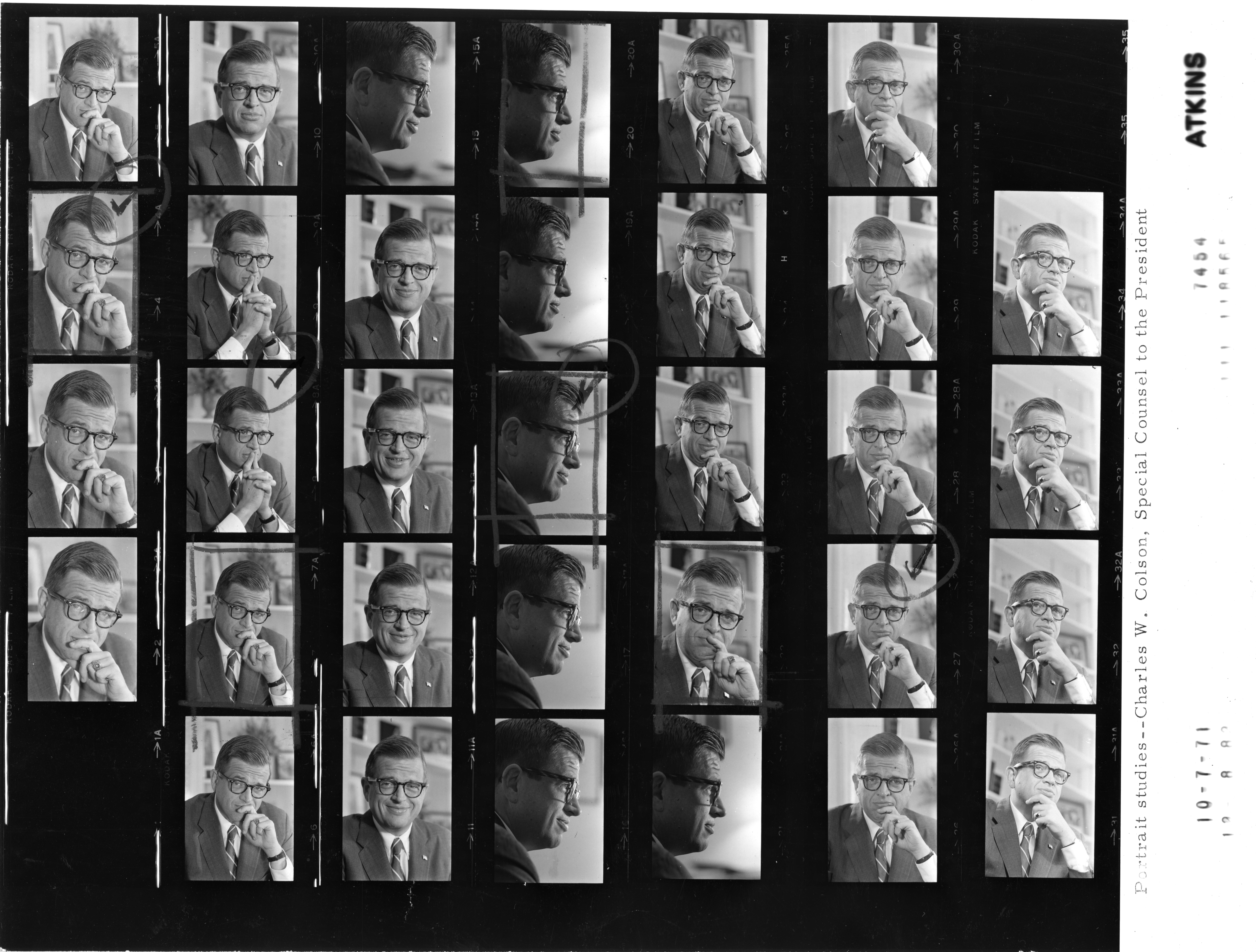
- Frame(s): WHPO-7454-02-34, Formal portrait of Charles Colson, Special Counsel to the President. 10/7/1971, Washington, D.C. unknown. Charles W. Colson.
- Frame(s): WHPO-7454-07, Formal portrait of Charles Colson, Special Counsel to the President. 10/7/1971, Washington, D.C. unknown. Charles W. Colson.
- Frame(s): WHPO-7454-18, Profile closeup portrait of Charles Colson, Special Counsel to the President. 10/7/1971, Washington, D.C. unknown. Charles W. Colson.
Roll WHPO-7455 Photographer: Schumacher, Karl | Color or B&W: B&W
- Frame(s): WHPO-7455-03-30, Portrait of Dick Cook. 10/7/1971, Washington, D.C. unknown. Dick Cook.
Roll WHPO-7456 Photographer: Schumacher, Karl | Color or B&W: Color
- Frame(s): WHPO-7456-04A-05A, Vice President Agnew with unidentified Middle Eastern men. 10/7/1971, unknown unknown. Spiro Agnew, unidentified men.
Roll WHPO-7457 Photographer: Atkins, Oliver | Color or B&W: B&W
- Frame(s): WHPO-7457-03A-31A, President Nixon working at a table, with a secretary in attendance, on his Phase II Economic Program. 10/7/1971, Washington, D.C. Executive Office Building, Presidential Office. President Nixon, Marjorie Acker.
- Frame(s): WHPO-7457-19, President Nixon working at a table on his Phase II Economic Program in the Executive Office Building EOB. A gavel and elephant statue are visible on his desk. 10/7/1971, Washington, D.C. Executive Office Building, Presidential Office. President Nixon.
Roll WHPO-7458 Photographer: Atkins, Oliver | Color or B&W: B&W
- Frame(s): WHPO-7458-03-30, Closeup portrait of Tim Elbourne. 10/7/1971, Washington, D.C. unknown. Tim Elbourne.
- Frame(s): WHPO-7458-15, Closeup portrait of Tim Elbourne. 10/7/1971, Washington, D.C. unknown. Tim Elbourne.
- Frame(s): WHPO-7458-21, Head and shoulders portrait of Tim Elbourne. 10/7/1971, Washington, D.C. unknown. Tim Elbourne.
Roll WHPO-7459 Photographer: Knudsen, Robert L. | Color or B&W: B&W
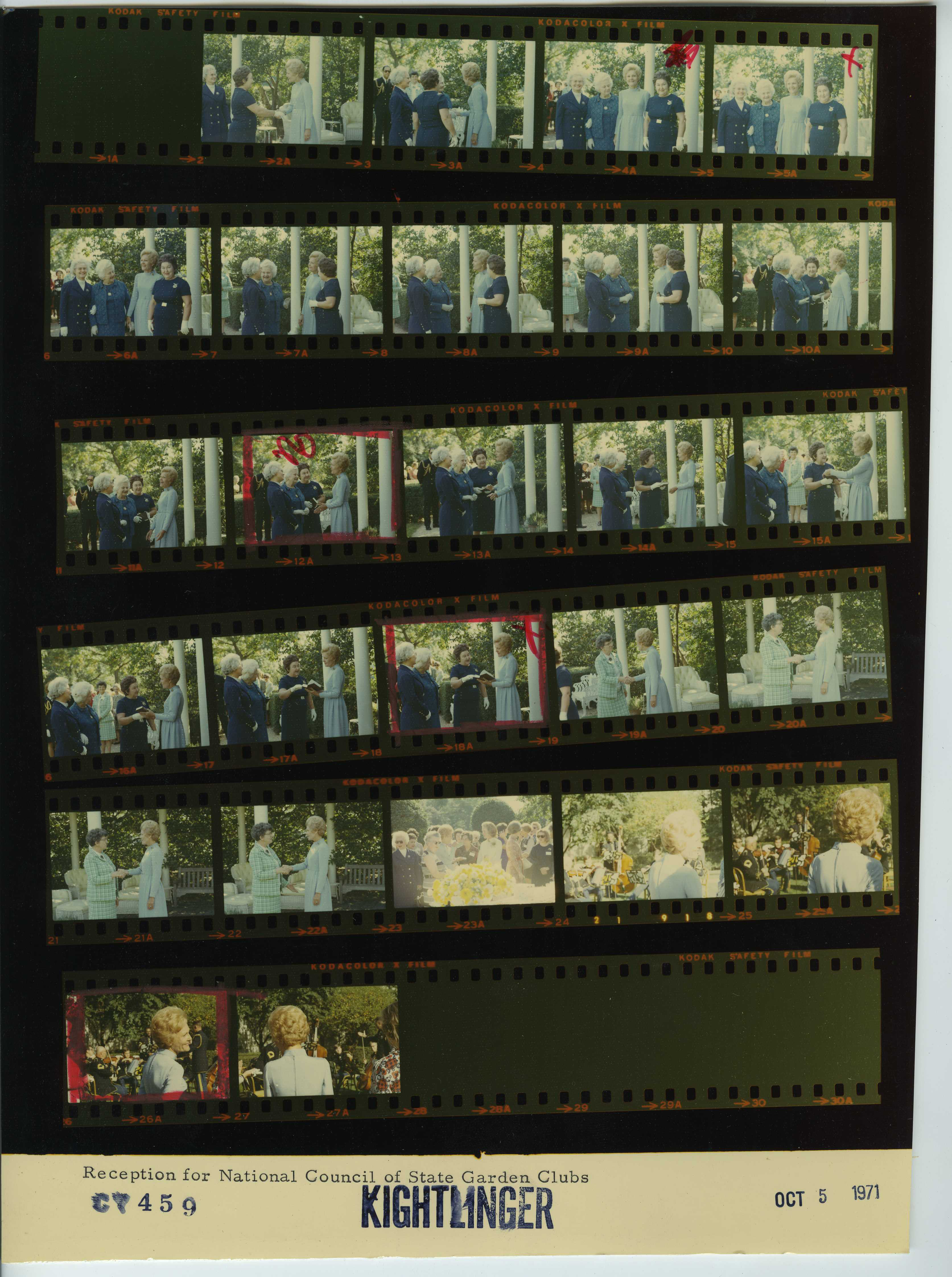
- Frame(s): WHPO-7459-02-17, President Nixon at a bi-partisan leadership meeting concerning Phase II of the new economic policy. 10/7/1971, Washington, D.C. White House, Cabinet Room. President Nixon, Senate and House leaders, aides, officials.
Roll WHPO-7460 Photographer: Kightlinger, Jack | Color or B&W: Color
- Frame(s): WHPO-7460-02A-33A, Pat Nixon hosting a reception for delegates to the Second World Meeting of Women Journalists and Writers. 10/7/1971, Washington, D.C. White House, State Dining Room. Pat Nixon, unidentified women.
Roll WHPO-7461 Photographer: Kightlinger, Jack | Color or B&W: Color
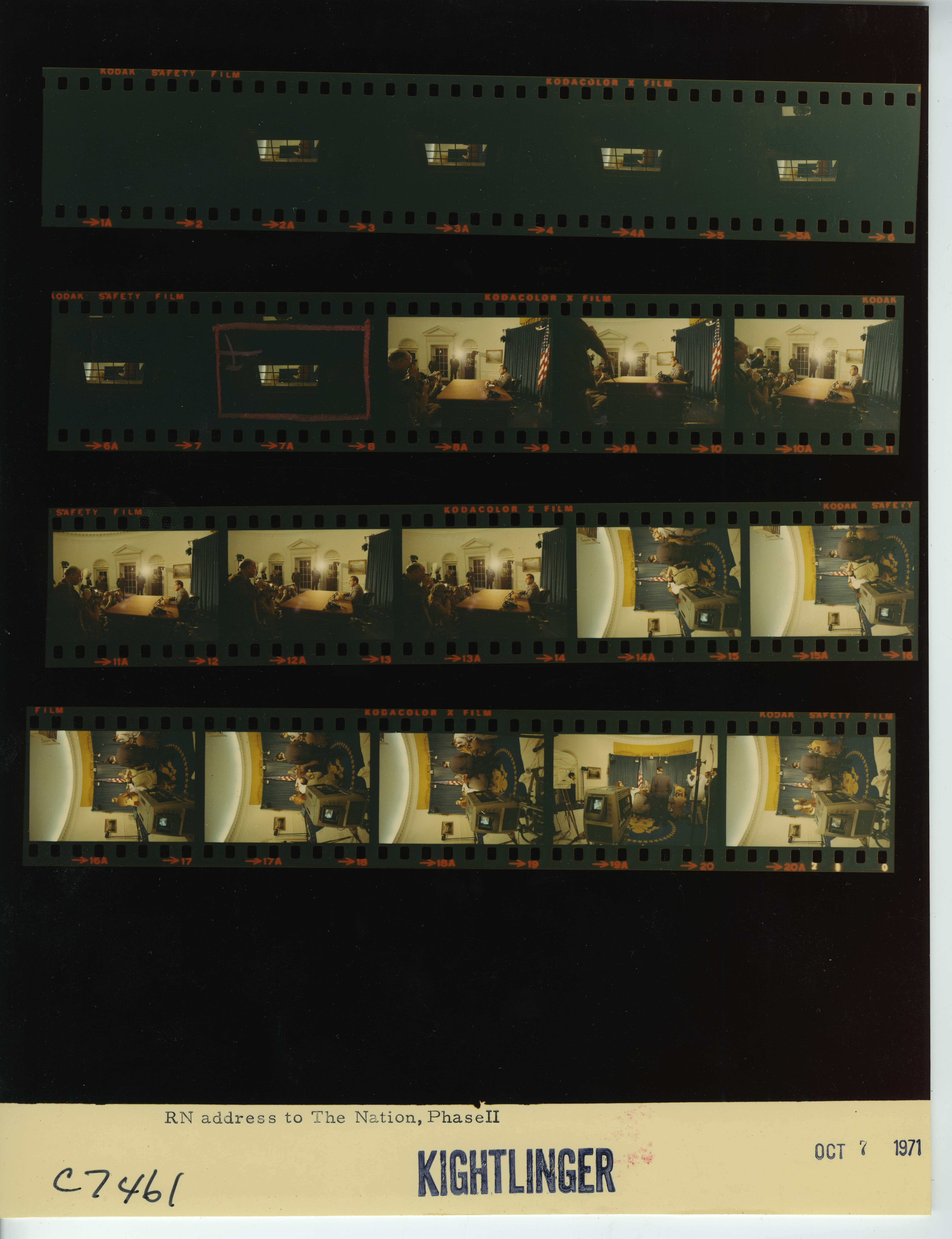
- Frame(s): WHPO-7461-02A-07A, President Nixon, through a window, announcing plans for Phase II of the new economic policy during a televised address to a nationwide audience. 10/7/1971, Washington, D.C. White House, Oval Office. President Nixon, press corps members.
- Frame(s): WHPO-7461-08A-20A, President Nixon, at his oval office desk, announcing plans for Phase II of the new economic policy during a televised address to a nationwide audience. 10/7/1971, Washington, D.C. White House, Oval Office. President Nixon, press corps members.
- Frame(s): WHPO-7461-18A, President Nixon, at his oval office desk, announcing plans for Phase II of the new economic policy during a televised address to a nationwide audience. A CBS camera is seen in the foreground. 10/7/1971, Washington, D.C. White House, Oval Office. President Nixon, reporters, photographers, press corps members.
Roll WHPO-7462 Photographer: Kightlinger, Jack | Color or B&W: Color
- Frame(s): WHPO-7462-03A-15A, President Nixon preparing to make a television address annoucing plans for Phase II of the new economic policy. 10/7/1971, Washington, D.C. White House, Oval Office. President Nixon.
- Frame(s): WHPO-7462-06, President Nixon preparing to make a television address annoucing plans for Phase II of the new economic policy. 10/7/1971, Washington, D.C. White House, Oval Office. President Nixon.
- Frame(s): WHPO-7462-16A-17A, President Nixon's image on a screen as he gives his speech annoucing plans for Phase II of the new economic policy to a nationwide audience. 10/7/1971, Washington, D.C. White House, unknown room. President Nixon, unidentified woman.
The White House Communications Agency Sound Recordings Collection contains public statements that took place between 1969 and 1974. Visit the finding aid to learn more.
H - White House Staff Member Recordings
- WHCA-SR-H-442
Remarks by Henry Kissinger and Peter Peterson to a group of European businessmen. (10/7/1971, Indian Treaty Room, Executive Office Building)
Runtime: 2:03:00
Production credits: Audio feed supplied by WHCA; Recorded by RRS (Bob Schroder, WHCA engineer)
Original Format: 1/4-inch reel-to-reel audiotape. Original source type: Original. - WHCA-SR-H-443
Briefing by George Shultz on Phase II of the new economic policy. (10/7/1971, Room 248, Executive Office Building)
Runtime: 1:24:00
Keywords: Briefings, public briefings, statements to the press (see also Press conferences, news conferences, interviews, media)
Production credits: Audio feed supplied by WHCA; Recorded by JAD (initials of WHCA engineer)
Original Format: 1/4-inch reel-to-reel audiotape. Original source type: Original. - WHCA-SR-H-444
Background briefing by George Shultz and Ronald Ziegler prior to Nixon's live TV broadcast. (10/7/1971, East Room, White House)
Runtime: 38:30:00
Keywords: Briefings, public briefings, statements to the press (see also Press conferences, news conferences, interviews, media)
Production credits: Audio feed supplied by WHCA; Recorded by DAS (initials of WHCA engineer)
Original Format: 1/4-inch reel-to-reel audiotape. Original source type: Original.
P - Formal Presidential Remarks
- WHCA-SR-P-711002
Televised remarks re Phase II of New Economic Policy. (10/7/1971)
Runtime: 16:00
Original Format: 1/4-inch reel-to-reel audiotape. Original source type: Original.
The White House Communications Agency Videotape Collection contains “off-the-air” recordings of televised programs produced between 1968 and 1974. Visit the finding aid to learn more.
- WHCA-4706
Presidential Speech - Phase II of the Wage/Price Freeze, with commentary from three networks. U.S. Senator Henry Jackson (D-WA) and Jim Bishop.
Group W Productions
Runtime: 1:00 - WHCA-4707
"Thirty Minutes".
ALL NETWORKS
Runtime: 00:29:32 - WHCA-4708
Washington Week in Review. A discussion of the President's Phase II Economic Plan
ALL NETWORKS
Runtime: 01:06:22 - WHCA-4709
"The David Frost Show" : George Meany, President of the AFL-CIO.
ALL NETWORKS
Runtime: 01:29:54 - WHCA-4710
"Martin Agronsky: Evening Edition". Richard Nixon.
Runtime: 00:29:15 - WHCA-4712
Weekly News Summary, Tape II.
CBS
Runtime: 1:00
11. Reasoner/Baker: Wholesale prices decline (McCraken). Time Code Start: 24:50. Keywords: wage and price controls, freezes, prices, costs, increases, decreases, economy, economics, budgets, finances, recession, inflation, money. Network: ABC.
12. Reasoner/Donaldson: Phase II (Secretary Connally before Senate). Time Code Start: 26:39. Keywords: cabinet, advisors, wage and price controls, freezes, prices, costs, increases, decreases, economy, economics, budgets, finances, recession, inflation, money. Network: ABC.
13. Reasoner/Reynolds: Senator Muskie, Mayor John Lindsay, Senator McGovern campaign in New York City. Time Code Start: 29:11. Keywords: Presidential elections, campaigns, campaigning, candidates, Mayors, Senators. Network: ABC.
14. Reasoner/Brannigan: Senator Ted Kennedy in Massachusetts on Vietnam war. Time Code Start: 32:21. Keywords: Vietnam War. Network: ABC.
15. Chancellor: Wholesale prices down. Time Code Start: 35:03. Keywords: wage and price controls, freezes, prices, costs, increases, decreases, economy, economics, budgets, finances, recession, inflation, money. Network: NBC.
16. Chancellor/Levine: Connally defending tax cuts before Senate. Time Code Start: 36:52. Keywords: Senate, Senators, debates, bills, laws, reforms, taxes, taxation, revenue, reductions, decreases. Network: NBC.
17. Chancellor: Senator Muskie endorsed; Senator Muskie, Senator McGovern, and Mayor John Lindsay speaking in New York City. Time Code Start: 39:02. Keywords: Presidential elections, campaigns, campaigning, candidates. Network: NBC.
18. Brinkley: Commentary on Supreme Court nominations. Time Code Start: 42:38. Keywords: law officials, judges, justices, courts, trials, investigations, nominees. Network: NBC.
19. Chancellor: Charles Bebe Rebozo rented island in Florida owned by government. Time Code Start: 44:45. Keywords: Presidents, friends, banks, executives, real estate, land, transactions. Network: NBC.
20. Chancellor: Illegal immigrants found in California. Time Code Start: 45:36. Keywords: jobs, unemployment, illegal immigrants, immigration, foreign workers. Network: NBC.
21. Cronkite/Rather: Phase II economics. Time Code Start: 46:29. Keywords: wage and price controls, freezes, prices, costs, increases, decreases, economy, economics, budgets, finances, recession, inflation, money. Network: CBS.
22. Sevareid: Commentary on economic actions. Time Code Start: 47:53. Keywords: economy, economics, budgets, finances, recession, inflation, money, wages, costs, unemployment, prices, reports, speeches. Network: CBS.
23. Cronkite/Rather: Herbert Stein, economic advisor to President Nixon. Time Code Start: 50:10. Keywords: economy, economics, budgets, finances, recession, inflation, money, wages, costs, unemployment, prices, reports, speeches. Network: CBS.
24. Cronkite/Herman: Wholesale prices down. Time Code Start: 53:27. Keywords: wage and price controls, freezes, prices, costs, increases, decreases, economy, economics, budgets, finances, recession, inflation, money. Network: CBS.
25. Cronkite: Illegal immigrant worked at San Clemente, California. Time Code Start: 55:13. Keywords: Presidents, jobs, unemployment, illegal immigrants, immigration, foreign workers, Western White House, La Casa Pacifica. Network: CBS.
Context (External Sources)
The Vanderbilt Television News Archive is the world's most extensive and complete archive of television news. They have been recording, preserving and providing access to television news broadcasts of the national networks since August 5, 1968.
Wikipedia is a free encyclopedia that anyone can edit.