
Introduction
This almanac page for Tuesday, October 5, 1971, pulls together various records created by the federal government and links to additional resources which can provide context about the events of the day.
Previous Date: Monday, October 4, 1971
Next Date: Wednesday, October 6, 1971
Schedule and Public Documents
The Daily Diary files represent a consolidated record of the President's activities. Visit the finding aid to learn more.
The President's day began at The White House - Washington, D. C.
The Weekly Compilation of Presidential Documents made available transcripts of the President's news conferences; messages to Congress; public speeches, remarks, and statements; and other Presidential materials released by the White House.
Digitized versions can be found at HathiTrust.
Each Public Papers of the Presidents volume contains the papers and speeches of the President of the United States that were issued by the White House Office of the Press Secretary during the time period specified by the volume. The material is presented in chronological order, and the dates shown in the headings are the dates of the documents or events. In instances when the release date differs from the date of the document itself, that fact is shown in the text note.
To ensure accuracy, remarks have been checked against audio recordings (when available) and signed documents have been checked against the original, unless otherwise noted. Editors have provided text notes and cross references for purposes of identification or clarity.
The Federal Register is the official daily publication for rules, proposed rules, and notices of federal agencies and organizations, as well as executive orders and other Presidential documents.
The Congressional Record is the official daily record of the debates and proceedings of the U.S. Congress.
Archival Holdings
Any selection of archival documents will necessarily be partial. You should use the documents and folders identified below as a starting place, but consult the linked collection finding aids and folder title lists and the collections themselves for context. Many documents to be found this way do not lend themselves to association with specific dates, but are essential to a complete understanding of the material.
Selective document listing
President's Office Files
The President's Office Files consists of materials drawn together by the Special Files Unit from several administrative subdivisions within the White House Office. It is the handwriting and sensitive papers sent to the Staff Secretary that now comprise much of the President's Office Files. Visit the finding aid to learn more.
- News Summaries, Annotated News Summaries, Box 31, News Summaries - October 1-11, 1971 [1 of 3] [Note: Due to the way News Summary products were compiled, you should also consult nearby days for potentially relevant materials.]
- October 5, 1971
- News Summary, October 5, 1971, (Monday telecasts, wires, newspapers)
The H. R. Haldeman Diaries consists of seven handwritten diaries, 36 dictated diaries recorded as sound recordings, and two handwritten audio cassette tape subject logs. The diaries and logs reflect H. R. Haldeman’s candid personal record and reflections on events, issues, and people encountered during his service in the Nixon White House. As administrative assistant to the President and Chief of Staff, Haldeman attended and participated in public events and private meetings covering the entire scope of issues in which the Nixon White House engaged in during the years 1969-1973. Visit the finding aid to learn more.
- Transcript of diary entry (PDF)
Tuesday, October 5th. The President had me in first thing this morning for some general schedule notes. The more odd among them being that, in spite of all his sarcastic comments about tennis, and the people that are interested in tennis, he now wants to stage a special tennis match at the White House courts, putting up bleachers, setting up line men, etcetera; having Billie Jean King, and Stan Smith, and some of the top stars play. This springs out of his phone call to Billie Jean King yesterday, when she became the first woman to win $100,000. He also decided he ought to have one Evening at the White House this season, and we should have Lawrence Welk star at it. And he wants to find a reason for a reception where we have only conservative newsmen, something honoring Goldwater, or Buckley's birthday, or something like that. He's also decided maybe Detroit, the Economic Club, was more worthwhile than he thought, and that he recognizes that he goes overboard on the theory that everything has to be so perfect, but we got a lot of good reaction out of Detroit, so maybe he should do more of that kind of Q and A.
He met with Shultz, Connally, McCracken, and Stein for several hours this morning on Phase II. They got back into the argument of prime time for the announcement, and the group pretty well persuaded him that he did need prime time in order to sell the general public on the need for cooperation on everyone's part. He agreed then that he would do that, but very briefly—ten minutes. Making the point that the, of what the program in general is, and saying there would be special interest groups that will oppose this, but it will only work with the cooperation of the people, and I ask for your support, and so on. He'd also work in the points on the international monetary progress and the wide-ranging consultation that he's had before making this decision. I suggested that he consider 7:00 news time instead of prime time, and he thought that was a very good idea, and also the rest of the group agreed to it, so that ended up being the plan. After that meeting, Henry was in.
-------------------------------------------------------------------------------------------------------------------
DECLASSIFIED - E.O. 13526, Sect. 3.4: by MS, NARA, June 12, 2013
Audio Cassette 14, Side B, Withdrawn Item Number 1 [AC-14(B) Sel 1-1]
Duration: 30 seconds
The President hit him on Allende, which Connally had raised at the end of the other meeting. Because he's moving now in Chile on expropriating American companies. Connally recommends that we move on him in a very tough way and Henry agrees. So the President is going to go ahead on that, making Allende a villain and kicking him. That led him in to the point with Henry that we need to have some sort of Latin American meeting. Maybe gather all the heads of states in Mexico City or something of that sort.
------------------------------------------------------------------------------------------------------------------
Henry then reported on the very positive reactions he'd had this morning to his announcement of his trip to China.
-------------------------------------------------------------------------------------------------------------------
DECLASSIFIED - E.O. 13526, Sect. 3.4: by MS, NARA, June 12, 2013
Audio Cassette 14, Side B, Withdrawn Item Number 1 [AC-14(B) Sel 1-2]
Duration: 10 seconds
He said Dobrynin had told him that this was diplomacy in the grand style, and that it's exactly what Kennedy wanted to do, but couldn't.
------------------------------------------------------------------------------------------------------------------
This, of course, delighted both Henry and the President.
He then met with Safire for a while to go over what he wants to cover in the speech. Gave him some pretty good light, guidelines on the basis that he wants to refer to the fact that the freeze has been enormously successful due to the cooperation and support of the American people, and then that we're going to follow on with the continued program. He doesn't want much detail on how it works, but we will have a Pay Board and a Price Board. Our goal will be to reduce inflation to 2 or 3 percent. This will be a great benefit to every American. There may be selfish interests that oppose it, but it will, he will count on the cooperation of the people. This is the way to provide more jobs, new prosperity. Says the handling of profits is very ticklish, this is the time not to assume that prices always must go up. The consumer should get some of the break on productivity, too, so let's have some price reductions. He wants more poetry than prose, upbeat confidence, reassured, things are going well. This is not a new program. He wants to hit interest hard on the basis that rates are too high, and include a reference to all his consultations. Make the point that we can make '72 the greatest year economically—prosperity with peace and without inflation. We don't need an army of bureaucrats to administer this. The American citizens are our army. He wants to use the line of confidence more than sacrifice; ask for cooperation and support. He wants to reuse the good sentences from his earlier announcement in the Congressional speech. The purpose this time is exhortation, not an announcement.
-------------------------------------------------------------------------------------------------------------------
DECLASSIFIED - E.O. 13526, Sect. 3.4: by MS, NARA, June 12, 2013
Audio Cassette 14, Side B, Withdrawn Item Number 2 [AC-14(B) Sel 2]
Duration: 44 seconds
Late in the day, we had a new flap, because Bill Rogers up at the UN, had indicated his support of the Fulbright Amendment in opposition to the Byrd Amendment regarding Rhodesian Chrome, which creates a huge problem almost necessitating our repudiating Rogers. But we decided to try to get Byrd to withdraw his amendment on the grounds that Rogers was doing this in order to win four black African nations' votes on the China question. And that we’d re-raise a point at a later time. Nobody seems to feel this is very likely to work, but they're going to give it a try.
------------------------------------------------------------------------------------------------------------------
The President left at 5:30 for a reception at Rollins in Delaware.
End of October 5th. - Original audio recording (MP3)
The National Archives Catalog is the online portal to the records held at the National Archives, and information about those records. It is the main way of describing our holdings and also provides access to electronic records and digitized versions of our holdings.
The Catalog searches across multiple National Archives resources at once, including archival descriptions, digitized and electronic records, authority records, and web pages from Archives.gov and the Presidential Libraries. The Catalog also allows users to contribute to digitized historical records through tagging and transcription.
Nixon Library Holdings
All National Archives Units
National Security Documents
The President's Daily Brief is the primary vehicle for summarizing the day-to-day sensitive intelligence and analysis, as well as late-breaking reports, for the White House on current and future national security issues. Read "The President's Daily Brief: Delivering Intelligence to Nixon and Ford" to learn more.
The Foreign Relations of the United States series presents the official documentary historical record of major U.S. foreign policy decisions and significant diplomatic activity. Visit the State Department website for more information.
Vol. V, United Nations, 1969-1972
U.S. Position Papers and Assessments of General Assembly Sessions
100. Telegram From the Mission to the United Nations to the Department of State, New York, October 5, 1971, 0002Z
Source: National Archives, RG 59, Central Files 1970–73, UN 3 GA. Limited Official Use. Repeated to London, Paris, Moscow, Tel Aviv, and to the Interests Section in Cairo.
UN Finances and Reduction of the U.S. Assessment
170. Telegram From the Mission to the United Nations to the Department of State, New York, October 5, 1971, 1552Z
Source: National Archives, RG 59, Central Files 1970–73, UN 10. Confidential.
Secretary-General Succession
224. Telegram From the Mission to the United Nations to the Department of State, New York, October 5, 1971, 0003Z
Source: National Archives, Nixon Presidential Materials, NSC Files, Box 302, Agency Files, USUN, Vol. VIII. Secret; Exdis.
Vol. XIX, Part 1, Korea, 1969-1972
Republic of Korea Troops in Vietnam and Force Modernization, April 1971-December 1972
111. Memorandum From Robert Hormats of the National Security Council Staff to the President’s Assistant for National Security Affairs (Kissinger), Washington, October 5, 1971
Source: National Archives, Nixon Presidential Materials, NSC Files, Box 542, Country Files, Far East, Korea, Vol. IV, 1 Jan–31 Dec 1971. No classification marking. Sent for information. Concurred in by Holdridge.
Vol. XXI, Chile, 1969-1973
Cool and Correct: The U.S. Response to the Allende Administration, November 5, 1970-December 31, 1972
263. Memorandum From Arnold Nachmanoff of the National Security Council Staff to the President’s Assistant for National Security Affairs (Kissinger), Washington, October 5, 1971
Source: National Archives, Nixon Presidential Materials, NSC Files, Box 776, Country Files, Latin America, Chile, Vol. VI. Secret; Eyes Only. Haig initialed the memorandum. A covering memorandum by Nachmanoff states that the Soviet Ambassador and possibly two Ambassadors from the Eastern Bloc would be present at the October 6 dinner at the Chilean Embassy. Members of the press corps, specifically representatives from the New York Times and the Washington Post, would “probably” also be in attendance. (Ibid.)
Vol. XL, Germany and Berlin, 1969-1972
Germany and Berlin, 1969-1972
333. Memorandum From Helmut Sonnenfeldt of the National Security Council Staff to the President’s Assistant for National Security Affairs (Kissinger), Washington, October 5, 1971
Source: National Archives, Nixon Presidential Materials, NSC Files, Box 692, Country Files, Europe, Germany (Berlin), Vol. V. Secret; Eyes Only.
Vol. XLI, Western Europe; NATO, 1969-1972
Malta
236. Minutes of a Senior Review Group Meeting, Washington, October 5, 1971, 3:35-3:57 p.m.
Source: National Archives, Nixon Presidential Materials, NSC Files, NSC Institutional Files (H-Files), Box H–060, Senior Review Group Meetings, SRG Meeting—Malta 10/5/71. Top Secret. The meeting took place in the White House Situation Room. All brackets are in the original. The meeting focused on the response to NSSM 135, Document 232.
Vol. E-2, Documents on Arms Control and Nonproliferation, 1969-1972
Chemical and Biological Warfare; Geneva Protocol; Biological Weapons Convention
245. Memorandum From Acting Secretary of State Johnson to President Nixon, Washington, October 5, 1971
Responding to the IPMG’s report on the Geneva Protocol, Johnson, like Edward David, recommended Alternative 1 of Option B. This alternative affirmed that the Protocol did not cover riot control agents and herbicides, but maintained that, in future conflicts, the U.S. would not initiate their first use.
Source: National Archives, RG 59, General Files on NSC Matters, Box 8, NSC Miscellaneous Memos, October & November 1971. Secret.
Vol. E-16, Documents on Chile, 1969-1973
Cool and Correct: The U.S. Response to the Allende Administration, November 5, 1970-December 31, 1972
85. Conversation Among President Nixon, Secretary of the Treasury Connally, the White House Chief of Staff (Haldeman), and the President’s Assistant for National Security Affairs (Kissinger), Washington, October 5, 1971
Summary: Nixon, Connally, and Kissinger discussed Allende’s refusal to pay companies for expropriated property.
Source: National Archives, Nixon Presidential Materials, White House Tapes, Conversation 584–3. Sensitive But Unclassified. According to the President’s Daily Diary, Nixon met first with John Connally, George P. Shultz, Paul W. McCracken, and Herbert Stein in the Oval Office at 10:06 a.m.; Haldeman entered the Oval Office at 11. The conversation transcribed here, which the editors transcribed specifically for this volume, began after Shultz, McCracken, and Stein left at 11:59 a.m. and continued until Kissinger left at 12:38 p.m. (Ibid., White House Central Files)
The Kissinger telephone conversation transcripts consist of approximately 20,000 pages of transcripts of Kissinger’s telephone conversations during his tenure as Assistant to the President for National Security Affairs (1969-1974) and Secretary of State (1973-1974) during the administration of President Richard Nixon. Visit the finding aid for more information.
Digitized versions can be found in the National Archives Catalog.
Audiovisual Holdings
The White House Tapes are sound recordings of President Richard Nixon's telephone conversations and of meetings held in the Oval Office and the Cabinet Room in the White House, the President's office in the Old Executive Office Building (OEOB), the Lincoln Sitting Room in the residence section of the White House, and several locations at the Presidential retreat at Camp David, Maryland. These recordings document many of the major events and decisions of the Nixon Administration from February 16, 1971 to July 18, 1973. Visit the White House Tapes finding aid to learn about the taping system's operation and archival processing.
Oval Office
- 584-1; 8:56 a.m. - 9:02 a.m.; Nixon, Richard M. (President); Rogers, William P.
- 584-2; Unknown between 9:02 a.m. & 9:12 a.m.; Nixon, Richard M. (President); [Unknown person(s)]
- 584-3; 9:12 a.m. - 1:11 p.m.; Nixon, Richard M. (President); Haldeman, H. R. ("Bob"); Butterfield, Alexander P.; [Unknown person(s)]; Bull, Stephen B.; Connally, John B.; Shultz, George P.; McCracken, Paul W.; Stein, Herbert; Kissinger, Henry A.; Ziegler, Ronald L.; Safire, William L.
- 584-4; 1:11 p.m. - 1:11 p.m.; Nixon, Richard M. (President); Woods, Rose Mary
- 584-5; 1:11 p.m. - 1:25 p.m.; Nixon, Richard M. (President); Woods, Rose Mary; Bull, Stephen B.
- 584-6; Unknown between 1:25 p.m. & 1:32 p.m.; Nixon, Richard M. (President); Sanchez, Manolo
- 584-7; Unknown between 1:25 p.m. & 1:32 p.m.; Nixon, Richard M. (President); [Unknown person(s)]
- 584-8; 2:13 p.m. - 2:29 p.m.; Nixon, Richard M. (President); Kissinger, Henry A.; Bull, Stephen B.; [Unknown person(s)]
- 584-9; Unknown between 2:29 p.m. & 11:59 p.m.; [Unknown person(s)]
- 585-1; 3:03 p.m. - 3:26 p.m.; Nixon, Richard M. (President); Swim, Dudley; Flanigan, Peter M.; White House photographer; Sanchez, Manolo; Bull, Stephen B.; Huntsman, Jon M.
- 585-2; Unknown between 3:26 p.m. & 3:27 p.m.; Nixon, Richard M. (President); [Unknown person(s)]
- 585-3; Unknown between 3:26 p.m. & 3:27 p.m.; Nixon, Richard M. (President); Bull, Stephen B.
- 585-4; 3:27 p.m. - 3:49 p.m.; Nixon, Richard M. (President); Vicites, Joseph L.; Holt, Cooper T.; Colson, Charles W.; White House photographer
- 585-5; Unknown between 3:49 p.m. & 3:55 p.m.; Butterfield, Alexander P.; Bull, Stephen B.; Nixon, Richard M. (President)
- 585-6; Unknown between 3:55 p.m. & 3:59 p.m.; Nixon, Richard M. (President); White House operator
- 585-7; 3:59 p.m. - 4:02 p.m.; Nixon, Richard M. (President); Mitchell, John N.; Colson, Charles W.; Sanchez, Manolo; Haldeman, H. R. ("Bob"); Kissinger, Henry A.; White House operator; Connally, John B.
- 585-8; 4:33 p.m. - 5:12 p.m.; Nixon, Richard M. (President); Razak, Abdul (Tun); Haig, Alexander M., Jr.; White House operator; [Unknown person(s)]
- 585-9; Unknown between 5:12 p.m. & 5:15 p.m.; [Unknown person(s)]
- 585-10; Unknown between 5:15 p.m. & 5:19 p.m.; Nixon, Richard M. (President); Haig, Alexander M., Jr.
- 585-11; Unknown between 5:15 p.m. & 5:19 p.m.; Nixon, Richard M. (President); [Unknown person(s)]
- 585-12; Unknown between 5:15 p.m. & 5:19 p.m.; Nixon, Richard M. (President); White House operator
- 585-13; Unknown between 5:15 p.m. & 5:19 p.m.; Nixon, Richard M. (President); Butterfield, Alexander P.
- 585-14; 5:18 p.m. - 5:19 p.m.; Nixon, Richard M. (President); Connally, John B.
- 585-15; 5:19 p.m. - 5:39 p.m.; Nixon, Richard M. (President); Haldeman, H. R. ("Bob"); Connally, John B.; White House operator; Butterfield, Alexander P.; Poff, Richard H.
- 585-16; Unknown between 5:39 p.m. & 11:59 p.m.; [Unknown person(s)]
White House Telephone
- 10-40; 8:56 a.m. - 9:02 a.m.; Nixon, Richard M. (President); Rogers, William P.
- 10-41; Unknown between 9:02 a.m. & 3:59 p.m.; Nixon, Richard M. (President); White House operator
- 10-42; 3:59 p.m. - 4:02 p.m.; Nixon, Richard M. (President); Mitchell, John N.
- 10-43; Unknown between 4:02 p.m. & 4:26 p.m.; Nixon, Richard M. (President); White House operator
- 10-44; 4:26 p.m. - 4:30 p.m.; Nixon, Richard M. (President); Connally, John B.
- 10-45; Unknown between 4:30 p.m. & 5:18 p.m.; Nixon, Richard M. (President); White House operator
- 10-46; 5:18 p.m. - 5:19 p.m.; Nixon, Richard M. (President); Connally, John B.
- 10-47; 5:20 p.m. - 5:21 p.m.; Nixon, Richard M. (President); White House operator; Connally, John B.
- 10-48; Unknown between 5:21 p.m. & 5:29 p.m.; Nixon, Richard M. (President); White House operator
- 10-49; 5:29 p.m. - 5:33 p.m.; Nixon, Richard M. (President); Poff, Richard H.
- 10-50; Unknown between 5:33 p.m. & 9:25 p.m.; Nixon, Richard M. (President); White House operator
- 10-51; 9:25 p.m. - 9:25 p.m.; Nixon, Richard M. (President); White House operator
- 10-52; 9:25 p.m. - 9:44 p.m.; Nixon, Richard M. (President); Colson, Charles W.
- 10-53; Unknown between 9:44 p.m. & 9:50 p.m.; Nixon, Richard M. (President); White House operator
- 10-54; 9:50 p.m. - 9:51 p.m.; Nixon, Richard M. (President); Allen, George E.
The White House Photo Office collection consists of photographic coverage of President Richard Nixon meeting with prominent social, political, and cultural personalities; speaking engagements and news conferences of the President and various high-ranking members of the White House staff and Cabinet; Presidential domestic and foreign travel, including Presidential vacations; social events and entertainment involving the First Family, including entertainers present; official portraits of the President, First Family, and high-ranking members of the Nixon administration; the 1969 and 1973 Inaugurals; the President’s 1972 Presidential election campaign appearances (including speeches) and other official activities of the White House staff and the President’s Cabinet from January 20, 1969 until August 9, 1974 at the White House and the Old Executive Office Building; other locations in Washington, DC, such as The Mall; and the Presidential retreats in Camp David, Maryland, Key Biscayne, Florida, and San Clemente, California. Visit the finding aid to learn more.
Roll WHPO-7441 Photographer: Knudsen, Robert L. | Color or B&W: B&W
- Frame(s): WHPO-7441-02-12, President Nixon at his desk with National Airlines Chairman of the Board Dudley Swim. 10/5/1971, Washington, D.C. White House, Oval Office. President Nixon, Dudley Swim.
- Frame(s): WHPO-7441-14-26, President Nixon at his desk with National Commander of the Veterans of Foreign Wars Joseph Vicites and VFW Executive Director Cooper Holt. 10/5/1971, Washington, D.C. White House, Oval Office. President Nixon, Dudley Swim, Jon Huntsman, Joseph Vicites, Cooper Holt, Charles W. Colson.
Roll WHPO-7442 Photographer: Knudsen, Robert L. | Color or B&W: B&W
- Frame(s): WHPO-7442-02A-16A, Close-up portrait study of Dick Cook. 10/5/1971, Washington, D.C. unknown. Dick Cook.
Roll WHPO-7443 Photographer: Knudsen, Robert L. | Color or B&W: B&W
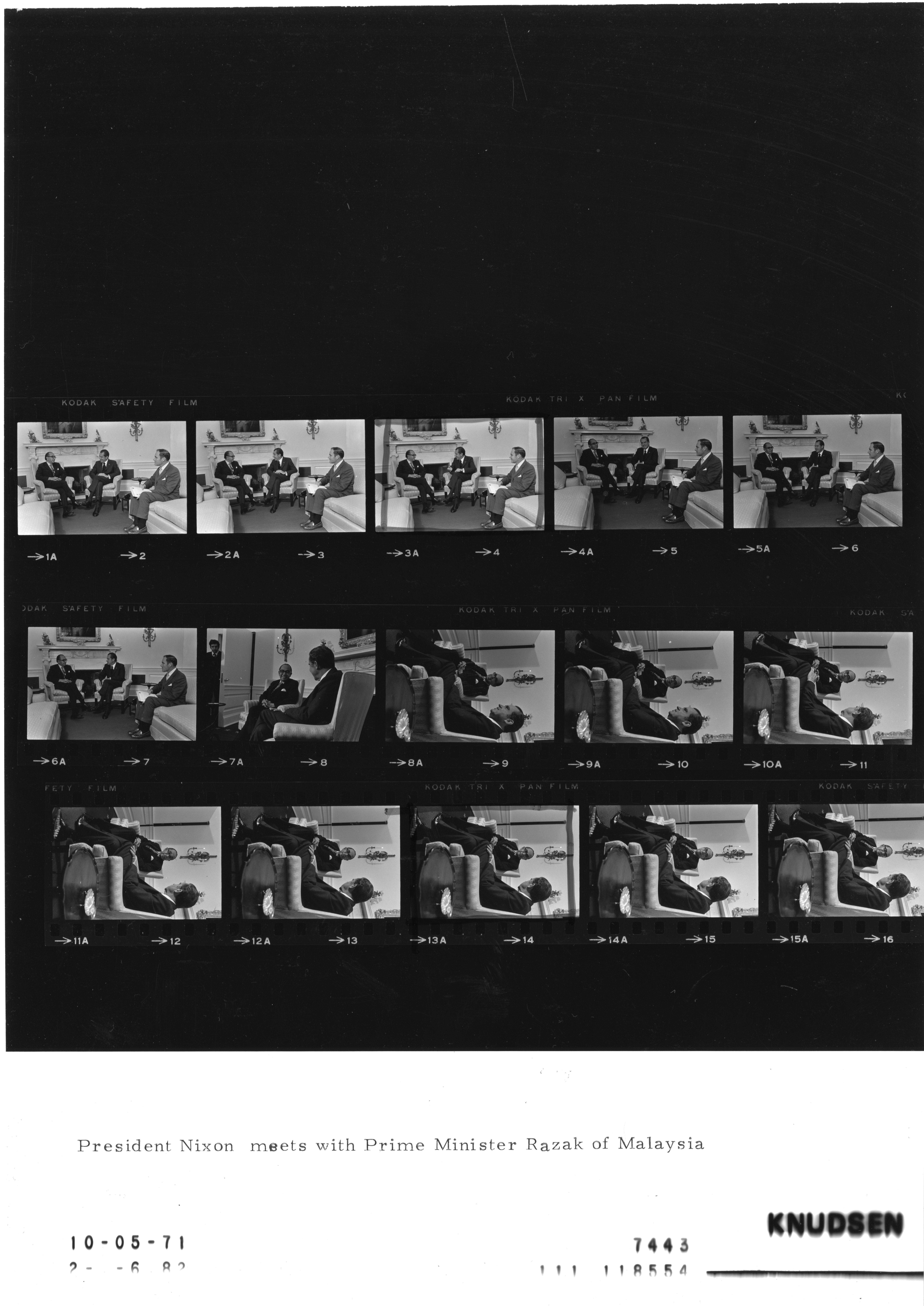
- Frame(s): WHPO-7443-01A-15A, President Nixon, Malaysian Prime Minister Tun Abdul Razak, and Brig. Gen. Alexander Haig, Jr. seated informally during an Oval Office meeting. 10/5/1971, Washington, D.C. White House, Oval Office. President Nixon, Gen. Alexander M. Haig, Jr., Tun Abdul Razak.
- Frame(s): WHPO-7443-04, President Nixon, Malaysian Prime Minister Tun Abdul Razak, and Brig. Gen. Alexander Haig, Jr. seated informally during an Oval Office meeting. 10/5/1971, Washington, D.C. White House, Oval Office. President Nixon, Gen. Alexander M. Haig, Jr., Tun Abdul Razak.
Roll WHPO-7444 Photographer: Knudsen, Robert L. | Color or B&W: B&W
- Frame(s): WHPO-7444-02-10, Fire damage in a closet. 10/5/1971, Washington, D.C. unknown.
Roll WHPO-7445 Photographer: Atkins, Oliver | Color or B&W: B&W
- Frame(s): WHPO-7445-02A-06A, President Nixon landing by helicopter at the estate of Republican National Dinner Chairman John Rollins to attend a reception for chairmen of the Republican National convention's "Salute to the President" fund-raising dinners. 10/5/1971, Greenville, Delaware Rollins Estate grounds. President Nixon, John Rollins, Pierre S. duPont, Harry S. Dent.
- Frame(s): WHPO-7445-07A-12A, President Nixon walking with Republican National Dinner Chairman John Rollins. 10/5/1971, Greenville, Delaware Rollins Estate grounds. President Nixon, John Rollins, Rollins family, Harry Haskell, Haskell family, John Mitchell, officials, aides.
- Frame(s): WHPO-7445-14A-17A, President Nixon with Wilmington Mayor Harry Haskell, Mrs. Harry Haskell, Jr., and their children. 10/5/1971, Greenville, Delaware Rollins Estate grounds. President Nixon, John Rollins, Harry Haskell, Jr., Mrs Harry Haskell, Jr., Haskell children.
- Frame(s): WHPO-7445-18A-20A, President Nixon with Republican National Dinner Chairman John Rollins, Mrs. Rollins and their children. 10/5/1971, Greenville, Delaware Rollins Estate grounds. President Nixon, John Rollins, Mrs. John Rollins, Rollins children.
Roll WHPO-7446 Photographer: Atkins, Oliver | Color or B&W: B&W
- Frame(s): WHPO-7446-01-29, President Nixon individually receiving guests at the reception for chairmen of the Republican National convention's "Salute to the President" fund-raising dinners. 10/5/1971, Greenville, Delaware Rollins home. President Nixon, John Rollins, Mrs. Rollins, Bob Dole, guests.
Roll WHPO-7447 Photographer: Kightlinger, Jack | Color or B&W: Color
- Frame(s): WHPO-7447-02A-05A, Pat Nixon being greeted upon arrival at the Disney on Parade show. 10/5/1971, Washington, D.C. Washington Coliseum. Pat Nixon, Disney and Coliseum officials, crowd, Disney character actors.
- Frame(s): WHPO-7447-06A-12A, Pat Nixon sitting in the stands for the Disney on Parade show. 10/5/1971, Washington, D.C. Washington Coliseum. Pat Nixon, Disney and Coliseum officials, crowd, Disney character actors.
- Frame(s): WHPO-7447-13A-14A, 17A-24A, Pat Nixon interacting with Mickey Mouse at the Disney on Parade show. 10/5/1971, Washington, D.C. Washington Coliseum. Pat Nixon, Disney and Coliseum officials, crowd, Disney character actors.
- Frame(s): WHPO-7447-15A-16A, Pat Nixon attending the Disney on Parade show. 10/5/1971, Washington, D.C. Washington Coliseum. Pat Nixon, Disney and Coliseum officials, crowd, Disney character actors.
Roll WHPO-7448 Photographer: Kightlinger, Jack | Color or B&W: Color
- Frame(s): WHPO-7448-02A-09A, Pat Nixon seated in the stands, greeting children and Disney themed character actors, during the Disney on Parade show appearance. 10/5/1971, Washington, D.C. Washington Coliseum. Pat Nixon, Disney and Coliseum officials, crowd, Disney character actors.
Roll WHPO-7449 Photographer: Kightlinger, Jack | Color or B&W: Color
- Frame(s): WHPO-7449-02A-23A, Pat Nixon meeting with officials of the Central Atlantic Regional Conference of the National Council of State Garden Clubs. 10/5/1971, Washington, D.C. White House, East Garden. Pat Nixon, Garden Club officials and members.
- Frame(s): WHPO-7449-25A-27A, Pat Nixon addressing the members of the Central Atlantic Regional Conference of the National Council of State Garden Clubs. 10/5/1971, Washington, D.C. White House, East Garden. Pat Nixon, Garden Club officials and members.
Roll WHPO-7450 Photographer: Kightlinger, Jack | Color or B&W: Color
- Frame(s): WHPO-7450-02A-14A, Pat Nixon attending a reception for the Central Atlantic Regional Conference of the National Council of State Garden Clubs. 10/5/1971, Washington, D.C. White House, East Garden. Pat Nixon, Garden Club officials and members.
Roll WHPO-7459 Photographer: Knudsen, Robert L. | Color or B&W: B&W
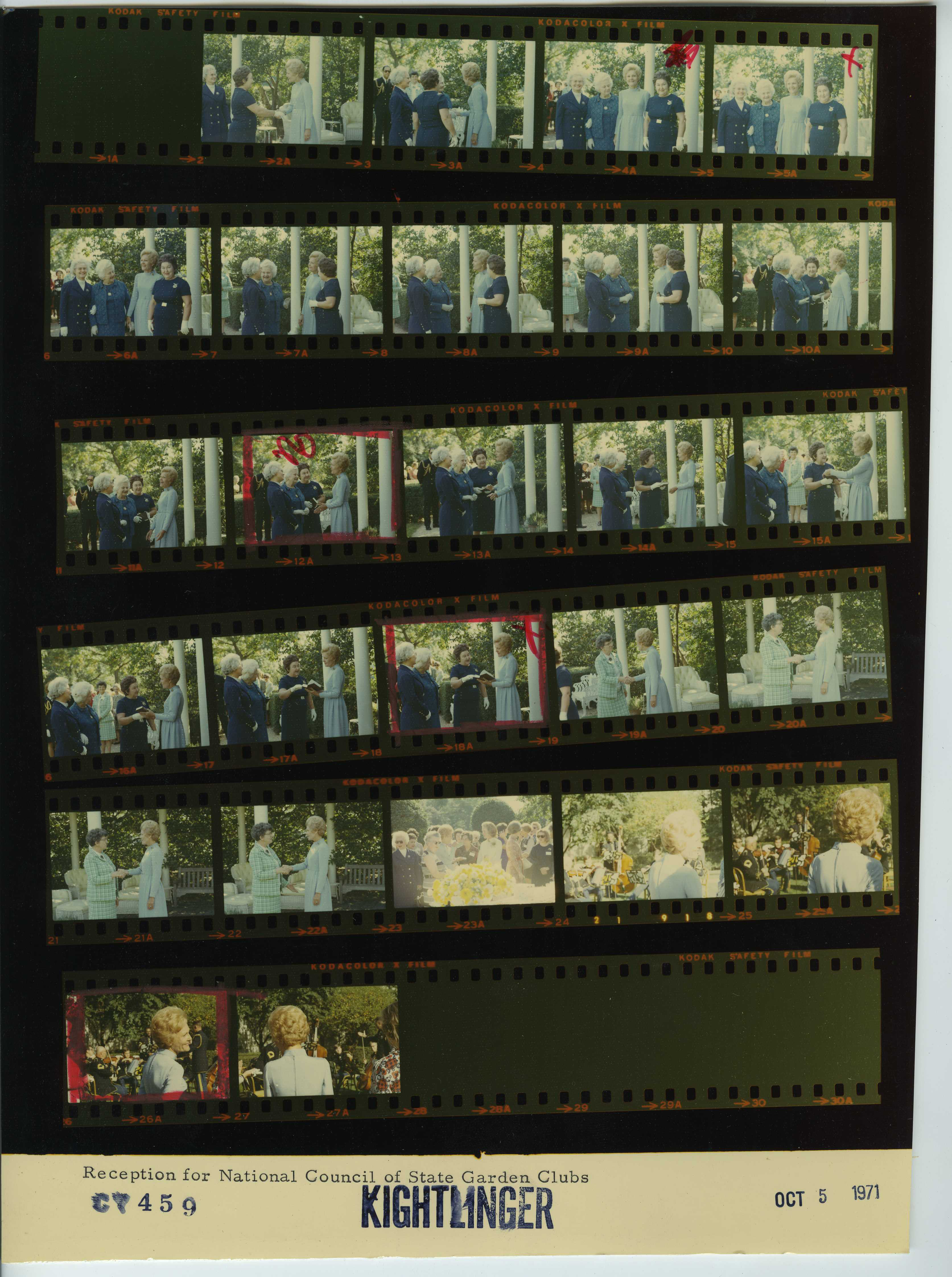
- Frame(s): WHPO-7459-, Pat Nixon addressing the members of the Central Atlantic Regional Conference of the National Council of State Garden Clubs. 10/5/1971, Washington, D.C. White House, East Garden. Pat Nixon, Garden Club officials and members.
The White House Communications Agency Sound Recordings Collection contains public statements that took place between 1969 and 1974. Visit the finding aid to learn more.
H - White House Staff Member Recordings
- WHCA-SR-H-441
Press briefing by Ronald Ziegler and Henry Kissinger. (10/5/1971, Press Center, White House)
Runtime: 30:00:00
Keywords: Press conferences, news conferences, interviews, media, press secretary
Production credits: Audio feed supplied by WHCA; Recorded by RWF (initials of WHCA engineer)
Original Format: 1/4-inch reel-to-reel audiotape. Original source type: Original.
K - Informal Presidential Remarks
- WHCA-SR-K-030
Photo opportunity-Wilmington, DE. (10/5/1971)
Runtime: 1:53
Original Format: 1/4-inch reel-to-reel audiotape. Original source type: Original. - WHCA-SR-K-242
Photo Opportunity-Wilmington, DE. (10/5/1971)
Runtime: 1:53
Original Format: 1/4-inch reel-to-reel audiotape. Original source type: Original.
The White House Communications Agency Videotape Collection contains “off-the-air” recordings of televised programs produced between 1968 and 1974. Visit the finding aid to learn more.
- WHCA-4701
"The David Frost Show" ; Captain Ernest E. Medina, attorney F. Lee Bailey. Laurie Lea Schaefer '72, Phyllis Ann George '71, Mary Ann Mobley '59, Marilyn Buferd '46.
Group W Productions
Runtime: 01:29:23 - WHCA-4702
"Firing Line".
WETA
Runtime: 00:59:53 - WHCA-4703
"The Tonight Show". Ambassador W. Averell Harriman (former Ambassador to the United Kingdom and Soviet Union).
Eastern Educational Network
Runtime: 01:30:13 - WHCA-4704
"The Dick Cavett Show".
Undetermined
Runtime: 01:29:44 - WHCA-4711
Weekly News Summary, Tape I.
All networks
Runtime: 01:24:53
33. Smith/Jarriel/Koppel: Kissinger to return to Red China. Time Code Start: 67:05. Keywords: cabinet, advisors, travel, trips, People's Republic of China. Network: ABC.
34. Smith/Jackson: School busing bill voted down and busing in Florida. Time Code Start: 70:04. Keywords: bills, laws, legislation, desegregation, racism, racial discrimination, African Americans, schools, students, transportation, reports, voting. Network: ABC.
35. Smith: Commentary on Red China mysteriousness. Time Code Start: 73:12. Keywords: People's Republic of China, public opinions. Network: ABC.
36. Chancellor/Kaplow: Kissinger to return to Red China. Time Code Start: 75:03. Keywords: cabinet, advisors, travel, trips, People's Republic of China. Network: NBC.
37. Chancellor/Levine: AFL-CIO President George Meany and wages after wage freeze. Time Code Start: 76:47. Keywords: leaders, labor, unions, American Federation of Labor, Congress of Industrial Organizations, economy, economics, budgets, finances, recession, inflation, money, wages, costs, employment, employees, money, wages, salaries, salary, freezes, controls. Network: NBC.
38. Chancellor/Neal: President Nixon's fact finding force goes to work on dock strike. Time Code Start: 78:15. Keywords: harbors, Stevedores, dock workers, longshoremen, strikes, economy, recession, inflation, money, wages, costs, unemployment, foreign relations, trade, negotiations. Network: NBC.
39. Cronkite/Rather: Kissinger to Red China. Time Code Start: 79:48. Keywords: cabinet, advisors, travel, trips, People's Republic of China. Network: CBS.
40. Cronkite/Schorr: AFL-CIO President George Meany on wage freeze. Time Code Start: 81:39. Keywords: leaders, labor, unions, American Federation of Labor, Congress of Industrial Organizations, economy, economics, budgets, finances, recession, inflation, money, wages, costs, employment, employees, money, wages, salaries, salary, freezes, controls. Network: CBS.
41. Cronkite: President Nixon's fact finding force and dock strike. Time Code Start: 84:03. Keywords: harbors, Stevedores, dock workers, longshoremen, strikes, recession, inflation, wages, unemployment, trade, negotiations, trade, negotiations. Network: CBS.
42. Sevareid: Commentary on economy "Phase II". Time Code Start: 84:33. Keywords: wage and price controls, freezes, prices, costs, increases, decreases, economy, economics, budgets, finances, recession, inflation, money. Network: CBS.
Context (External Sources)
The Vanderbilt Television News Archive is the world's most extensive and complete archive of television news. They have been recording, preserving and providing access to television news broadcasts of the national networks since August 5, 1968.
Wikipedia is a free encyclopedia that anyone can edit.