

Introduction
This almanac page for Wednesday, October 13, 1971, pulls together various records created by the federal government and links to additional resources which can provide context about the events of the day.
Previous Date: Tuesday, October 12, 1971
Next Date: Thursday, October 14, 1971
Schedule and Public Documents
The Daily Diary files represent a consolidated record of the President's activities. Visit the finding aid to learn more.
The President's day began at The White House - Washington, D. C.
The Weekly Compilation of Presidential Documents made available transcripts of the President's news conferences; messages to Congress; public speeches, remarks, and statements; and other Presidential materials released by the White House.
Digitized versions can be found at HathiTrust.
Each Public Papers of the Presidents volume contains the papers and speeches of the President of the United States that were issued by the White House Office of the Press Secretary during the time period specified by the volume. The material is presented in chronological order, and the dates shown in the headings are the dates of the documents or events. In instances when the release date differs from the date of the document itself, that fact is shown in the text note.
To ensure accuracy, remarks have been checked against audio recordings (when available) and signed documents have been checked against the original, unless otherwise noted. Editors have provided text notes and cross references for purposes of identification or clarity.
- Special Message to the Congress Urging Expansion of the Minority Business Enterprise Program
- Executive Order 11626—The Honorable Dean Acheson
- Executive Order 11625—Prescribing Additional Arrangements for Developing and Coordinating a National Program for Minority Business Enterprise
- Proclamation 4088—National Forest Products Week, 1971
The Federal Register is the official daily publication for rules, proposed rules, and notices of federal agencies and organizations, as well as executive orders and other Presidential documents.
The Congressional Record is the official daily record of the debates and proceedings of the U.S. Congress.
Archival Holdings
Any selection of archival documents will necessarily be partial. You should use the documents and folders identified below as a starting place, but consult the linked collection finding aids and folder title lists and the collections themselves for context. Many documents to be found this way do not lend themselves to association with specific dates, but are essential to a complete understanding of the material.
Selective document listing
President's Office Files
The President's Office Files consists of materials drawn together by the Special Files Unit from several administrative subdivisions within the White House Office. It is the handwriting and sensitive papers sent to the Staff Secretary that now comprise much of the President's Office Files. Visit the finding aid to learn more.
- News Summaries, Annotated News Summaries, Box 31, News Summaries - October 13-20, 1971 [1 of 4] [Note: Due to the way News Summary products were compiled, you should also consult nearby days for potentially relevant materials.]
- News Summary, October 13, 1971 (Tuesday Newscasts, Wires, Mags, Columns)
- President's Daily Schedule, Box 102, [President's Daily Schedule, Sept.-Dec. 1971] [2 of 3]
- The President's Schedule, Wednesday - October 13, 1971
The H. R. Haldeman Diaries consists of seven handwritten diaries, 36 dictated diaries recorded as sound recordings, and two handwritten audio cassette tape subject logs. The diaries and logs reflect H. R. Haldeman’s candid personal record and reflections on events, issues, and people encountered during his service in the Nixon White House. As administrative assistant to the President and Chief of Staff, Haldeman attended and participated in public events and private meetings covering the entire scope of issues in which the Nixon White House engaged in during the years 1969-1973. Visit the finding aid to learn more.
- Transcript of diary entry (PDF)
Wednesday, October 13.
As he reviewed the schedule for this morning, he looked with considerable disfavor on the discovery that he had to do a diplomatic credential ceremony this afternoon and said he wanted to skip those from now on, and as much other stuff of that kind as possible. Later in the day-- so we cut the ceremonies down to eliminate the five minute talk. The President simply received the credentials and ushered the Ambassador to the door. That gave him a little guilty feeling, and later in the day, he came up with the plan of having each Ambassador bring his family to watch the ceremony, but still eliminate the five minute talk. So, we'll try that in the future. He was very anxious to try and work out the opportunity to go to Dean Acheson's funeral, but we can't do it because it's at 2:00 on Friday, when he's scheduled to be in North Carolina. He did call Mrs. Acheson and gave her a military aide, etcetera, but was very disappointed we couldn't make the funeral, even to the point of having me call to see if they could change it to 11:00 in the morning, which they were unable to do.
We had quite a long discussion this morning about China plans, going back on some of the things Henry had discussed with him. He's now decided that he won't go to more than one other city beyond Peking, and maybe not even any others. He said that Henry's book, that he went over with him last night, was-- is brilliant; but the President now wants a brief memo that tells first, what do we want to have come out of this visit, what are our goals in other words; and second, what will the Chinese want to have come out of it that we have to resist. In other words, he wants to get down to the basics of what we're going to say and what our minimum goals are. He wants the book boiled down to its essentials: come directly to the point and cut out the BS on historical processes and everything, and get it buttoned down. I covered this with Haig, who immediately called Henry, who was in Chicago today. Henry called me back for clarification, being somewhat upset by the critique.
End of October 13. - Original audio recording (MP3)
The National Archives Catalog is the online portal to the records held at the National Archives, and information about those records. It is the main way of describing our holdings and also provides access to electronic records and digitized versions of our holdings.
The Catalog searches across multiple National Archives resources at once, including archival descriptions, digitized and electronic records, authority records, and web pages from Archives.gov and the Presidential Libraries. The Catalog also allows users to contribute to digitized historical records through tagging and transcription.
Nixon Library Holdings
All National Archives Units
National Security Documents
The President's Daily Brief is the primary vehicle for summarizing the day-to-day sensitive intelligence and analysis, as well as late-breaking reports, for the White House on current and future national security issues. Read "The President's Daily Brief: Delivering Intelligence to Nixon and Ford" to learn more.
The Foreign Relations of the United States series presents the official documentary historical record of major U.S. foreign policy decisions and significant diplomatic activity. Visit the State Department website for more information.
Vol. XLI, Western Europe; NATO, 1969-1972
Malta
237. National Security Decision Memorandum 138, Washington, October 13, 1971
Source: National Archives, Nixon Presidential Materials, NSC Files, Box 622, Country Files—Middle East, Malta, Vol. I. Secret. Copies were sent to the Director of Central Intelligence, the Chairman of the Joint Chiefs of Staff, and the Secretary of the Treasury.
Vol. E-13, Documents on China, 1969-1972
32. Letter From the Military Attaché at the Embassy in France (Walters) to the President’s Deputy Assistant for National Security Affairs (Haig), Paris, October 13, 1971, Paris, October 13, 1971
Walters recounted his October 13 meeting with Chinese Ambassador to France Huang Chen. The two officials discussed the relatively mild press reaction to the announcement of President Nixon’s trip to the Soviet Union.
Source: National Archives, Nixon Presidential Materials, NSC Files, Box 849, President’s File-China Trip, China Exchanges, July 1971-Oct 20, 1971. No classification marking.
The Kissinger telephone conversation transcripts consist of approximately 20,000 pages of transcripts of Kissinger’s telephone conversations during his tenure as Assistant to the President for National Security Affairs (1969-1974) and Secretary of State (1973-1974) during the administration of President Richard Nixon. Visit the finding aid for more information.
Digitized versions can be found in the National Archives Catalog.
Audiovisual Holdings
The White House Tapes are sound recordings of President Richard Nixon's telephone conversations and of meetings held in the Oval Office and the Cabinet Room in the White House, the President's office in the Old Executive Office Building (OEOB), the Lincoln Sitting Room in the residence section of the White House, and several locations at the Presidential retreat at Camp David, Maryland. These recordings document many of the major events and decisions of the Nixon Administration from February 16, 1971 to July 18, 1973. Visit the White House Tapes finding aid to learn about the taping system's operation and archival processing.
Oval Office
- 590-1; Unknown between 8:53 p.m. & 9:05 p.m.; Nixon, Richard M. (President); Butterfield, Alexander P.
- 590-2; Unknown between 8:53 a.m. & 11:06 a.m.; Nixon, Richard M. (President); Butterfield, Alexander P.; Haldeman, H. R. ("Bob"); White House operator; Colson, Charles W.; Nelsen, Ancher; Bull, Stephen B.
- 590-3; 11:06 a.m. - 12:02 p.m.; Nixon, Richard M. (President); Bull, Stephen B.; Washington, Walter E.; Wilson, Jerry V.; Ehrlichman, John D.; Krogh, Egil ("Bud"), Jr.; [Unknown person(s)]
- 590-4; 12:03 p.m. - 12:14 p.m.; Nixon, Richard M. (President); Clausen, Henry C.; Clausen, Henry C. (Mrs.); Lockwood, R. Lee; Lockwood, R. Lee (Mrs.); Shepard, Joshua K.; Kleinknecht, C. Fred; Newbury, George A.; Witter, Donald L.; Doane, Harvey R.; Hone, Ralph (Sir); Hone, Sybil (Simond) (Lady); Clark, R. A. Ingham; McFarland, Basil (Sir); Johnson-Gilbert, Ian A. (Sir); Burnett, Robert; Timmons, William E.; Cashen, Henry C., II; Bull, Stephen B.
- 590-5; Unknown between 12:14 p.m. & 12:16 p.m.; Nixon, Richard M. (President); Butterfield, Alexander P.
- 590-6; 12:16 p.m. - 12:31 p.m.; Nixon, Richard M. (President); Buchanan, John H., Jr.; Crane, Philip M.; Jonas, Charles R.; Scherle, William J.; Spence, Floyd D.; Flood, Daniel J.; Ryan, John J.; Sikes, Robert L. F.; Waggonner, Joe D., Jr.; Zablocki, Clement J.; Timmons, William E.; Cook, Richard K.; Haig, Alexander M., Jr.; Ziegler, Ronald L.
- 590-7; Unknown between 12:31 p.m. & 1:15 p.m.; Nixon, Richard M. (President); White House operator; Haldeman, H. R. ("Bob"); Dyer, Kenneth; Acheson, Dean G. (Mrs.)
- 590-8; Unknown between 12:32 p.m. & 1:15 p.m.; Nixon, Richard M. (President); Haldeman, H. R. ("Bob")
- 590-9; Unknown between 12:32 p.m. & 1:15 p.m.; Nixon, Richard M. (President); Haldeman, H. R. ("Bob")
- 590-10; Unknown between 12:32 p.m. & 1:15 p.m.; Nixon, Richard M. (President); Haldeman, H. R. ("Bob"); White House operator
- 590-11; 1:00 p.m. - 1:43 p.m.; Nixon, Richard M. (President); Woods, Rose Mary; Haldeman, H. R. ("Bob"); Bull, Stephen B.; White House operator; [Unknown person(s)]
- 590-12; 1:43 p.m. - 1:50 p.m.; Nixon, Richard M. (President); Fitzsimmons, Frank E.
- 590-13; Unknown between 1:50 p.m. & 2:57 p.m.; Nixon, Richard M. (President); Sanchez, Manolo
- 590-14; Unknown between 1:50 p.m. & 2:57 p.m.; Nixon, Richard M. (President); Butterfield, Alexander P.
- 590-15; 2:57 p.m. - 3:12 p.m.; Nixon, Richard M. (President); Haldeman, H. R. ("Bob"); Bull, Stephen B.
- 590-16; Unknown between 3:12 p.m. & 11:59 p.m.; [Unknown person(s)]
- 591-1; Unknown between 3:36 p.m. & 3:41 p.m.; Nixon, Richard M. (President); Butterfield, Alexander P.
- 591-2; 3:44 p.m. - 5:18 p.m.; Nixon, Richard M. (President); Haldeman, H. R. ("Bob"); [Unknown person(s)]; Woods, Rose Mary; Colson, Charles W.; Bull, Stephen B.
- 591-3; Unknown between 5:18 p.m. & 11:59 p.m.; [Unknown person(s)]
White House Telephone
- 11-76; Unknown between 8:53 a.m. & 9:09 a.m.; Nixon, Richard M. (President); White House operator
- 11-77; 9:09 a.m. - 9:13 a.m.; Nixon, Richard M. (President); Colson, Charles W.
- 11-78; Unknown between 9:13 a.m. & 9:22 a.m.; Nixon, Richard M. (President); White House operator
- 11-79; 9:22 a.m. - 9:25 a.m.; Nixon, Richard M. (President); Nelsen, Ancher
- 11-80; Unknown between 9:25 a.m. & 12:37 p.m.; Nixon, Richard M. (President); White House operator
- 11-81; 12:37 p.m. - 12:38 p.m.; Nixon, Richard M. (President); Dyer, Kenneth
- 11-82; 12:41 p.m. - 12:45 p.m.; Nixon, Richard M. (President); Acheson, Dean G. (Mrs.)
- 11-83; Unknown between 12:45 p.m. & 1:09 p.m.; Nixon, Richard M. (President); White House operator
- 11-84; 1:09 p.m. - 1:09 p.m.; Nixon, Richard M. (President); White House operator
- 11-85; 1:43 p.m. - 1:50 p.m.; Nixon, Richard M. (President); White House operator
- 11-111; Unknown between 2:24 p.m. & 4:56 p.m.; Nixon, Richard M. (President); White House operator
- 11-164; Unknown between 9:25 a.m. & 12:37 p.m.; Nixon, Richard M. (President); White House operator
The White House Photo Office collection consists of photographic coverage of President Richard Nixon meeting with prominent social, political, and cultural personalities; speaking engagements and news conferences of the President and various high-ranking members of the White House staff and Cabinet; Presidential domestic and foreign travel, including Presidential vacations; social events and entertainment involving the First Family, including entertainers present; official portraits of the President, First Family, and high-ranking members of the Nixon administration; the 1969 and 1973 Inaugurals; the President’s 1972 Presidential election campaign appearances (including speeches) and other official activities of the White House staff and the President’s Cabinet from January 20, 1969 until August 9, 1974 at the White House and the Old Executive Office Building; other locations in Washington, DC, such as The Mall; and the Presidential retreats in Camp David, Maryland, Key Biscayne, Florida, and San Clemente, California. Visit the finding aid to learn more.
Roll WHPO-7491 Photographer: Atkins, Oliver | Color or B&W: Color
- Frame(s): WHPO-7491-01A-26A, Portrait of Mary Ann Snow. 10/13/1971, Washington, D.C. White House, grounds. Mary Ann Snow.
Roll WHPO-7492 Photographer: Atkins, Oliver | Color or B&W: Color
- Frame(s): WHPO-7492-01A-36A, Portrait of Mary Ann Snow. 10/13/1971, Washington, D.C. White House, grounds. Mary Ann Snow.
Roll WHPO-7493 Photographer: Knudsen, Robert L. | Color or B&W: B&W
- Frame(s): WHPO-7493-02-08, President Nixon meeting with members of the House of Representatives to receive a petition opposing the expulsion of the Republic of China from the U.N. 10/13/1971, Washington, D.C. White House, Oval Office. President Nixon, John J. Rooney, Clement J. Zablocki, Daniel J. Flood, Robert L.F. Sikes, Charles R. Jonas, William J. Scherle, John Buchanan, Floyd D. Spence, Phillip M, Crane.
Roll WHPO-7494 Photographer: Atkins, Oliver | Color or B&W: B&W
- Frame(s): WHPO-7494-02-05, President Nixon, Washington, DC Chief of Police Jerry Wilson, and Mayor Walter Washington meeting to discuss the Washington, D.C. anti-crime programs, the Narcotics (drug) Treatment Program, and the Jobs for Vietnam Veterans Program while reporters and photographers surround them. 10/13/1971, Washington, D.C. White House, Oval Office. President Nixon, Jerry Wilson, Walter E. Washington, press corps members.
- Frame(s): WHPO-7494-03, President Nixon, Washington, DC Chief of Police Jerry Wilson, and Mayor Walter Washington meeting to discuss the Washington, D.C. anti-crime programs, the Narcotics (drug) Treatment Program, and the Jobs for Vietnam Veterans Program while reporters and photographers surround them. 10/13/1971, Washington, D.C. White House, Oval Office. President Nixon, Jerry Wilson, Walter E. Washington, press corps members.
- Frame(s): WHPO-7494-08-10, President Nixon with Cmdr. Henry Clausen and Scottish Rite Masonic leaders. 10/13/1971, Washington, D.C. White House, Oval Office. President Nixon, Henry Clausen, Mrs. Clausen, Scottish Rite Masonic leaders.
Roll WHPO-7496 Photographer: unknown | Color or B&W: B&W
- Frame(s): WHPO-7496-, Copies of formal posed portraits of Egil Krogh. 10/13/1971, Washington, D.C. unknown. Egil Krogh.
Roll WHPO-7497 Photographer: Kightlinger, Jack | Color or B&W: Color
- Frame(s): WHPO-7497-03-10, Pat Nixon standing with Virginia Sherwood and John Lynch of ABC. 10/13/1971, Washington, D.C. White House, Yellow Oval Room. Pat Nixon, Virginia Sherwood, John Lynch.
- Frame(s): WHPO-7497-04, Pat Nixon standing with Virginia Sherwood and John Lynch of ABC. 10/13/1971, Washington, D.C. White House, Yellow Oval Room. Pat Nixon, Virginia Sherwood, John Lynch.
- Frame(s): WHPO-7497-11-14, Virginia Sherwood of ABC sitting on a couch, underneath a portrait and in front of a fireplace. 10/13/1971, Washington, D.C. White House, Yellow Oval Room. Pat Nixon, Virginia Sherwood, John Lynch.
Roll WHPO-7498 Photographer: Schumaker, Byron | Color or B&W: B&W
- Frame(s): WHPO-7498-02-04, Secretary of Commerce Maurice H. Stans standing with unidentified men. 10/13/1971, Washington, D.C. unknown. Maurice H. Stans, unidentified men.
- Frame(s): WHPO-7498-07-09, President Nixon meeting at his desk with Mayor Walter Washington and Washington, D.C. Police Chief Jerry Wilson to discuss the Washington, D.C. anti-crime programs, the Narcotics (drug) Treatment Program, and the Jobs for Vietnam Veterans Program. 10/13/1971, Washington, D.C. White House, Oval Office. President Nixon, Walter W. Washington, Jerry V. Wilson.
- Frame(s): WHPO-7498-09, President Nixon meeting at his desk with Mayor Walter Washington and Washington, D.C. Police Chief Jerry Wilson to discuss the Washington, D.C. anti-crime programs, the Narcotics (drug) Treatment Program, and the Jobs for Vietnam Veterans Program. 10/13/1971, Washington, D.C. White House, Oval Office. President Nixon, Walter W. Washington, Jerry V. Wilson.
Roll WHPO-7499 Photographer: Schumaker, Byron | Color or B&W: B&W
- Frame(s): WHPO-7499-02-16, Decorative architectural details in White House. 10/13/1971, Washington, D.C. White House.
- Frame(s): WHPO-7499-09, Engraving inscription from a letter of John Adams, "I pray heaven to bestow the best of blessings on this house and all that shall hereafter inhabit it may none but honest and wise men overrule under this roof," November MDCCC (1800). 10/13/1971, Washington, D.C. White House.
Roll WHPO-7500 Photographer: Knudsen, Robert L. | Color or B&W: B&W
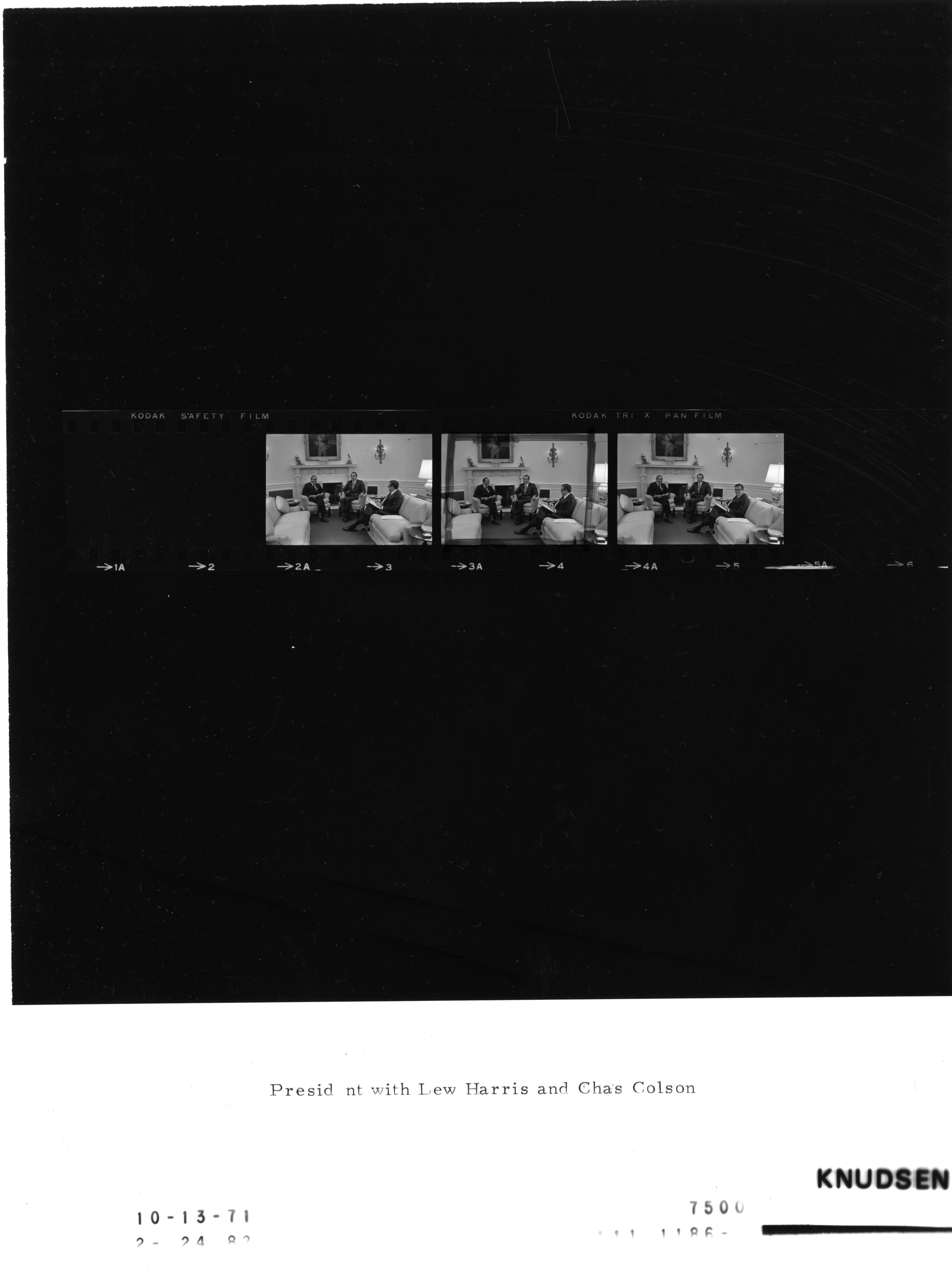
- Frame(s): WHPO-7500-, President Nixon seated informally with Charles Colson and pollster Louis Harris. 10/13/1971, Washington, D.C. White House, Oval Office. President Nixon, Charles W. Colson, Louis Harris.
Roll WHPO-7501 Photographer: Knudsen, Robert L. | Color or B&W: B&W
- Frame(s): WHPO-7501-06-09, President Nixon receiving ambassadorial credentials from Eduardo Romualdez, the Philippines. 10/13/1971, Washington, D.C. draped entrance to East Room, White House. President Nixon, Abdalla Suwesi, Eduardo Romualdez, Christophe Maidou, Francois Tchoungui, Jose Antonio de la Ossa, Carlos Lopez Guevara, Fernando Manfredo.
- Frame(s): WHPO-7501-10-11, President Nixon receiving ambassadorial credentials from Christophe Maidou, Central African Republic. 10/13/1971, Washington, D.C. draped entrance to East Room, White House. President Nixon, Abdalla Suwesi, Eduardo Romualdez, Christophe Maidou, Francois Tchoungui, Jose Antonio de la Ossa, Carlos Lopez Guevara, Fernando Manfredo.
- Frame(s): WHPO-7501-12-16, President Nixon receiving ambassadorial credentials from Francois Tchoungui, Cameroon; Panamanian Treaty Negotiators. 10/13/1971, Washington, D.C. draped entrance to East Room, White House. President Nixon, Abdalla Suwesi, Eduardo Romualdez, Christophe Maidou, Francois Tchoungui, Jose Antonio de la Ossa, Carlos Lopez Guevara, Fernando Manfredo.
- Frame(s): WHPO-7501-24-26, Ceremonial troops along a driveway in honor of arriving ambassadors. 10/13/1971, Washington, D.C. White House driveway. ceremonial troops.
- Frame(s): WHPO-7501-2-5, President Nixon receiving ambassadorial credentials from Abdalla Suwesi, Libya. 10/13/1971, Washington, D.C. draped entrance to East Room, White House. President Nixon, Abdalla Suwesi, Eduardo Romualdez, Christophe Maidou, Francois Tchoungui, Jose Antonio de la Ossa, Carlos Lopez Guevara, Fernando Manfredo.
Roll WHPO-7502 Photographer: Kightlinger, Jack | Color or B&W: B&W
- Frame(s): WHPO-7502-02-03, Pat Nixon sitting with Virginia Sherwood and John Lynch of ABC, and unidentified women. 10/13/1971, Washington, D.C. White House, Yellow Oval Room. Pat Nixon, Virginia Sherwood, John Lynch, unidentified women.
- Frame(s): WHPO-7502-05, President Nixon and Pat Nixon talking with attorney Goldthwaite Door. 10/13/1971, Washington, D.C. White House, Residence. President Nixon, Pat Nixon, Goldthwaite H. Door.
- Frame(s): WHPO-7502-05-08, President Nixon and Pat Nixon talking with attorney Goldthwaite Door. 10/13/1971, Washington, D.C. White House, Residence. President Nixon, Pat Nixon, Goldthwaite H. Door.
Roll WHPO-7503 Photographer: Knudsen, Robert L. | Color or B&W: B&W
- Frame(s): WHPO-7503-01A-12A, No negatives - contact sheet only., Construction in the Red Room. 10/13/1971, Washington, D.C. White House, Red Room.
Roll WHPO-7504 Photographer: Schumaker, Byron | Color or B&W: Color
- Frame(s): WHPO-7504-02-36A, No negatives - contact sheet and selected prints only., Decorative architectural details in White House. 10/13/1971, Washington, D.C. White House.
- Frame(s): WHPO-7504-03, Close-up up of White House coverlet fabric showing lion and the name "Olive M. Brewster - 1842.". 10/13/1971, Washington, D.C. White House. Fabric, Olive Brewster, Lion.
- Frame(s): WHPO-7504-12, Close-up of embroidery at the White House. 10/13/1971, Washington, D.C. White House. Emroidery.
- Frame(s): WHPO-7504-14, Old Mill scene in needlepoint at White House. 10/13/1971, Washington, D.C. White House. Old Mill, Needlepoint.
- Frame(s): WHPO-7504-20, Close-up of George Washington chair needlepoint pattern in the White House Queen's Room. 10/13/1971, Washington, D.C. Queen's Room, White House. George Washington chair, Needlepoint.
- Frame(s): WHPO-7504-25, 29, Close-up of State Dining Room screen. 10/13/1971, Washington, D.C. State Dining Room, White House. State Dining Room, Screen.
Roll WHPO-7505 Photographer: Schumaker, Byron | Color or B&W: Color
- Frame(s): WHPO-7505-01-04, No negatives - contact sheet only., Decorative architectural details in White House. 10/13/1971, Washington, D.C. White House.
The White House Communications Agency Sound Recordings Collection contains public statements that took place between 1969 and 1974. Visit the finding aid to learn more.
G - Cabinet Officer Briefings
- WHCA-SR-G-141
Briefing by Secretary of Commerce maurice Stans, with Ronald Ziegler, Mr. Wiley, and Mr. Jenkins. (10/13/1971, Press Center)
Runtime: 29:45:00
Production credits: Audio feed supplied by WHCA; Recorded by RSM (initials of WHCA engineer)
Original Format: 1/4-inch reel-to-reel audiotape. Original source type: Original.
P - Formal Presidential Remarks
- WHCA-SR-P-711009
Remarks by President Nixon to Citizens for a New Prosperity. (10/13/1971)
Runtime: 8:23
Original Format: 1/4-inch reel-to-reel audiotape. Original source type: Original.
The White House Communications Agency Videotape Collection contains “off-the-air” recordings of televised programs produced between 1968 and 1974. Visit the finding aid to learn more.
- WHCA-4724
"Today Show" excerpt. Lt. Col. Anthony Herbert, 1st Lt. R. Randolf, 2nd Lt. John McDough.
Daphne Productions and Roland & Jaffee Productions
Runtime: 00:10:53 - WHCA-4725
"Panorama".
ALL NETWORKS
Runtime: 00:57:24 - WHCA-4726
"The Mike Douglas Show".
ALL NETWORKS
Runtime: 01:29:52 - WHCA-4727
"Book Beat"; "ABC Special on the Economy" AND "PBS Special on the Cost Of Living Council". "BB": on Lt. William Laws Calley trial and involvement in the My Lai masacre in Vietnam
CBS
Runtime: 01:30:02 - WHCA-4730
Weekly News Summary, Tape II.
CBS
Runtime: 01:37:20
10. Smith/Jarriel: President Nixon's Supreme Court possible appointees. Time Code Start: 24:25. Keywords: law officials, judges, justices, courts, trials, investigations, nominees. Network: ABC.
11. Smith/Millek: Firebase Pace incident (FSB). Time Code Start: 26:16. Keywords: fire support base, firebases, temporary military encampments, artillery air strike coordination center, Vietnam War. Network: ABC.
12. Smith/Bergnam: Secretary of Defense Laird to go to Vietnam; Proxmire on C-5. Time Code Start: 29:11. Keywords: military, cabinet, advisors, travel, trips. Network: ABC.
13. Smith: Hodgson on wage/price freeze. Time Code Start: 32:05. Keywords: economy, economics, budgets, finances, recession, inflation, money, wages, costs, employment, employees, salaries, salary, payments, freezes, controls. Network: ABC.
14. Smith/Reynolds: McGovern on the road. Time Code Start: 32:55. Keywords: Presidential elections, campaigns, campaigning, candidates. Network: ABC.
15. Chancellor/Goralski: Secretary of Defense Laird and Russian missile and sub threat. Time Code Start: 36:25. Keywords: military, cabinet, advisors, missiles, aircraft, tests, artillery, weapons, war, Soviet Union, USSR. Network: NBC.
16. Chancellor: The Mansfield Ammendment. Time Code Start: 39:46. Keywords: Military Authorization Act, ammendments, Armed Forces, military, research projects. Network: NBC.
17. Brinkley: The last soldiers in Vietnam. Time Code Start: 40;26. Keywords: Vietnam War. Network: NBC.
18. Chancellor/Valeriani: The Chinas and the United Nations (U.N.) (People's Republic of China). Time Code Start: 42:28. Keywords: organization of nations, intergovernmental alliance, People's Republic of China, Taiwanese. Network: NBC.
19. Chancellor: Supreme Court Justice potential nominees; economic Phase II comments. Time Code Start: 45:07. Keywords: law officials, judges, justices, courts, trials, investigations, nominees, economy, economics, budgets, finances, recession, inflation, money, wages, costs, unemployment, prices, reports. Network: NBC.
20. Duke: Mrs. Harris is Democratic Party Credentials Chairman. Time Code Start: 46:32. Keywords: Democrats, women, leaders, political parties. Network: NBC.
21. Chancellor: Senator Ervin hearings on Freedom of the Press. Time Code Start: 48:49. Keywords: Senators, interviews, media, newspapers, magazines, publications, civil rights, constitutional rights, First Amendment, Sheild Laws. Network: NBC.
22. Chancellor: President Nixon involved in land sale (Charles Bebe Rebozo). Time Code Start: 49:32. Keywords: Presidents, friends, banks, executives, real estate, land, transactions, investigations. Network: NBC.
23. Cronkite/Schoumacher: Mrs. Harris is Democratic National Convention Credentials Chairman. Time Code Start: 50:01. Keywords: Democrats, women, leaders, political parties. Network: CBS.
24. Cronkite/Schieffer: Secretary of Defense Laird on balance of power (Laird). Time Code Start: 53:15. Keywords: cabinet, advisors, foreign relations, Armed Forces, military, defense, International military capabilities, national security, defense systems, budgets, costs, expenditures. Network: CBS.
25. Surtis: Sgt. Sexton, ex-POW, returns home; Secretary of Defense Laird comments on his lost letter of two years ago. Time Code Start: 56:15. Keywords: cabinet, advisors, Vietnam War, Vietnam Prisoner of War, releases. Network: CBS.
26. Cronkite/Plante: The war in Vietnam; pacification. Time Code Start: 59:10. Keywords: Vietnam War. Network: CBS.
27. Cronkite: President Nixon promoted a Florida land sale?. Time Code Start: 63:25. Keywords: Presidents, land, sales, real estate. Network: CBS.
28. Cronkite: Freedom of the press hearings. Time Code Start: 64:06. Keywords: media, newspapers, magazines, publications, civil rights, constitutional rights, First Amendment. Network: CBS.
Context (External Sources)
The Vanderbilt Television News Archive is the world's most extensive and complete archive of television news. They have been recording, preserving and providing access to television news broadcasts of the national networks since August 5, 1968.
Wikipedia is a free encyclopedia that anyone can edit.