
Introduction
This almanac page for Wednesday, November 8, 1972, pulls together various records created by the federal government and links to additional resources which can provide context about the events of the day.
Previous Date: Tuesday, November 7, 1972
Next Date: Thursday, November 9, 1972
Schedule and Public Documents
The Daily Diary files represent a consolidated record of the President's activities. Visit the finding aid to learn more.
The President's day began at The White House - Washington, D. C.
The Weekly Compilation of Presidential Documents made available transcripts of the President's news conferences; messages to Congress; public speeches, remarks, and statements; and other Presidential materials released by the White House.
Digitized versions can be found at HathiTrust.
Each Public Papers of the Presidents volume contains the papers and speeches of the President of the United States that were issued by the White House Office of the Press Secretary during the time period specified by the volume. The material is presented in chronological order, and the dates shown in the headings are the dates of the documents or events. In instances when the release date differs from the date of the document itself, that fact is shown in the text note.
To ensure accuracy, remarks have been checked against audio recordings (when available) and signed documents have been checked against the original, unless otherwise noted. Editors have provided text notes and cross references for purposes of identification or clarity.
The Federal Register is the official daily publication for rules, proposed rules, and notices of federal agencies and organizations, as well as executive orders and other Presidential documents.
Archival Holdings
Any selection of archival documents will necessarily be partial. You should use the documents and folders identified below as a starting place, but consult the linked collection finding aids and folder title lists and the collections themselves for context. Many documents to be found this way do not lend themselves to association with specific dates, but are essential to a complete understanding of the material.
Selective document listing
President's Office Files
The President's Office Files consists of materials drawn together by the Special Files Unit from several administrative subdivisions within the White House Office. It is the handwriting and sensitive papers sent to the Staff Secretary that now comprise much of the President's Office Files. Visit the finding aid to learn more.
- News Summaries, Annotated News Summaries, Box 41, Nov. 1972 [4 of 4] [Note: Due to the way News Summary products were compiled, you should also consult nearby days for potentially relevant materials.]
- Election Nite Coverage, November 7-8, 1972
- President's Daily Schedule, Box 102, [President's Daily Schedule, Oct.-Dec. 1972] [2 of 2]
- The President's Schedule, Wednesday - November 8, 1972
The H. R. Haldeman Diaries consists of seven handwritten diaries, 36 dictated diaries recorded as sound recordings, and two handwritten audio cassette tape subject logs. The diaries and logs reflect H. R. Haldeman’s candid personal record and reflections on events, issues, and people encountered during his service in the Nixon White House. As administrative assistant to the President and Chief of Staff, Haldeman attended and participated in public events and private meetings covering the entire scope of issues in which the Nixon White House engaged in during the years 1969-1973. Visit the finding aid to learn more.
- Transcript of diary entry (PDF)
Wednesday, November 8.
The President was in early this morning. I didn't get in till a little later. He was pouring over the vote analysis, and later he talked to Harry Dent about getting out the line about what the President had done for candidates. He was concerned about how we handled the low vote turnout. Wanted to be sure that we established the records-- of number of states, the record plurality or majority, what was LBJ's. Wanted to make sure that we started pissing on the Party, before they piss on us. Hit them with bad candidates, bad organization, and so on. Ziegler bounced in and said that he was going to announce Haig, and was going to announce the Cabinet and staff meetings. And the President told him to tell them that the meetings are not to discuss anything, the purpose is to initiate a series of discussions over the next 30 days, with regard to the second term and the planning.
The President and I then went into the staff meeting. He opened the thing by saying -- making reference to fact that last night had been an election night -- that he had gotten a lot more sleep than he was accustomed to getting in his elections. That there were to be no vacations, we need to get the organization set in place for the next term, concentrate on the budget, reorganizing the staff and Departments. That he intends a very significant reorganization of the White House staff, and he will discuss that later with the people concerned. At the moment he wants them to know that he's very proud of this staff-- that they're accused of a lot of things, and maybe the most frequent accusation is that they are efficient, and to that we should plead guilty. They are also loyal, and they've gotten a lot done. And we will continue to have problems with the Congress, but we have more influence now, because of the majority. Everyone will have suggestions on how to improve his own office, there’s no sacred cows. We should tear up the pea patch in the organization of Cabinet and the agencies and so on. As far as your plans are concerned, we'll each of you individually, we'll work them out after thorough discussion and try to develop the best place for everybody. After the Eisenhower midterm victory, we didn't change things enough. Maybe a president shouldn't serve more than four years, but I'm not ready to raise that question yet. And then he went into his Disraeli story about the exhausted volcano. He said that didn't apply to the individuals, but it does apply to the entity, and a responsible leader has to be sure that we don't fall into that-- it’s the responsibility of the leader to be sure we don’t fall into that situation. We can't climb to the top and look down into the embers, we've got to still shoot some sparks, vitality and strength, and that we get some of that from new people, both in the Cabinet and here in the staff. So this is not a case where we say good-bye and start all over, but we do say thank you --we want your views, want to know what you’d like to do. Whatever you decide these are the members of the first team, you all helped to make possible what happened. Needless to say, the staff was ecstatic.
I stayed on after the President left and covered the specific details of how we're handling the transition period, while he went and opened the Cabinet meeting. He spoke to the Cabinet for about an hour, and again I went in after he had left and followed up on the details of getting them all to submit their resignations, and having their Departmental meetings, etcetera, to work out the follow-up on that.
I had a call in to Connally, and he was ecstatic, especially pleased that Texas was going to go over a million. He had a few ideas on staff people that he wants us to consider, although he said most of his people weren't looking for jobs. I made the point that we wanted them, in order to get some good Democratic representation in the new Administration structure, not just to pay them off.
On the plane to Florida this afternoon, the President got into the whole media reaction and line thing. He wants Ziegler to put a total embargo on Time and Newsweek, there's to be no background to Sidey regarding election night or anything else at any time. He wants total discipline on the press, they're to be used as enemies, not played for help. Wants the story out that a private poll among the White House press showed that 80 out of 89 supported McGovern. He told me to tell Henry that it's OK to talk to Evans and Novak, but not to the other people. He made the point that most second terms have been disasters and that someone should write this, because he's determined that his won't be. He wants to get a leak out, that we'll have a major shake-up at State and Defense. He feels that we need to get across the points that he’s outlined earlier on the election analysis. Bebe had a big crowd at Homestead, and another one at Key Biscayne when the chopper landed, and that ended the "Day After".
End of November 8. - Original audio recording (MP3)
The National Archives Catalog is the online portal to the records held at the National Archives, and information about those records. It is the main way of describing our holdings and also provides access to electronic records and digitized versions of our holdings.
The Catalog searches across multiple National Archives resources at once, including archival descriptions, digitized and electronic records, authority records, and web pages from Archives.gov and the Presidential Libraries. The Catalog also allows users to contribute to digitized historical records through tagging and transcription.
Nixon Library Holdings
All National Archives Units
National Security Documents
The President's Daily Brief is the primary vehicle for summarizing the day-to-day sensitive intelligence and analysis, as well as late-breaking reports, for the White House on current and future national security issues. Read "The President's Daily Brief: Delivering Intelligence to Nixon and Ford" to learn more.
The Foreign Relations of the United States series presents the official documentary historical record of major U.S. foreign policy decisions and significant diplomatic activity. Visit the State Department website for more information.
Vol. V, United Nations, 1969-1972
Special Meetings of the Security Council
142. Telegram From the Embassy in France to the Department of State, Paris, November 8, 1972, 1752Z
Source: National Archives, RG 59, Central Files 1970–73, UN 3 SC. Confidential. Repeated to USUN.
Vol. IX, Vietnam, October 1972-January 1973
Paris Negotiations Collapse, October 24-December 13, 1972
95. Summary of Conclusions of a Washington Special Actions Group Meeting, Washington, November 8, 1972, 2:08-3:20 p.m.
Source: National Archives, Nixon Presidential Materials, NSC Files, NSC Institutional Files (H-Files), Box H–117, Washington Special Actions Group, WSAG Minutes (Originals) 7–27–72 to 9–20–73. Top Secret; Sensitive. The meeting took place in the White House Situation Room. The minutes are attached.
96. Letter From President Nixon to South Vietnamese President Thieu, Washington, November 8, 1972
Source: National Archives, Nixon Presidential Materials, NSC Files, Box 996, Alexander M. Haig Chronological File, Haig Chron, November 1–16, 1972. No classification marking. Haig delivered this letter to Thieu when they met on November 10 (see Document 97). The letter is reproduced in Hung and Schecter, The Palace File, pp. 383–384.
Vol. XV, Soviet Union, June 1972-August 1974
Economic Normalization and Soviet Jewish Emigration, September-December 1972
67. Transcript of Telephone Conversation Between the President’s Assistant for National Security Affairs (Kissinger) and Soviet Ambassador Dobrynin, Washington, November 8, 1972, 9:55 a.m.
Source: National Archives, Nixon Presidential Materials, NSC Files, Kissinger Telephone Conversations (Telcons), Box 27, Chronological File. No classification marking. Blank underscores are omissions in the original.
Vol. XXXIII, SALT II, 1972-1980
SALT II, 1972-1980
4. Memorandum From the President’s Assistant for National Security Affairs (Kissinger) to President Nixon, Washington, November 8, 1972
Source: National Archives, Nixon Presidential Materials, NSC Files, Box 888, SALT, SALT TWO–I–(Geneva), Nov. 21, 1972–March 1973. Secret. A note on the first page indicates that the President saw the memorandum.
Vol. E-7, Documents on South Asia, 1969-1972
U.S. Relations with India and Pakistan, 1972
311. Memorandum From Harold Saunders and John Holdridge of the National Security Council Staff to the President’s Assistant for National Security Affairs (Kissinger), Washington, November 8, 1972
In apparent response to what he found to be a disappointing decision by the U.S. on his request for PL–480 wheat, Pakistani President Bhutto decided to recognize the Governments of North Korea and North Vietnam, and was considering recognition of the Sihanouk Government in Cambodia. He also withdrew Pakistan from SEATO.
Source: National Archives, Nixon Presidential Materials, NSC Files, Box 628, Country Files, Middle East, Pakistan, Vol. X, Sept 72–Oct 73. Secret. Sent for action. Hoskinson initialed for Saunders. Telegram 9038 from Islamabad, November 8, reported that Pakistan had recognized North Korea and North Vietnam and was considering recognition of the Sihanouk Government in Cambodia. (Ibid.) Kissinger checked the approval line. A handwritten notation in the margin next to the approval line, in Richard Kennedy’s hand, reads: “Kennedy to call in Amb Khan per telcon with HAK 11/9/72.”
The Kissinger telephone conversation transcripts consist of approximately 20,000 pages of transcripts of Kissinger’s telephone conversations during his tenure as Assistant to the President for National Security Affairs (1969-1974) and Secretary of State (1973-1974) during the administration of President Richard Nixon. Visit the finding aid for more information.
Digitized versions can be found in the National Archives Catalog.
Audiovisual Holdings
Visit the White House Tapes finding aid to learn about the taping system's operation and archival processing.
Cabinet Room
Old Executive Office Building
- 388-1; Unknown between 12:54 a.m. & 1:00 a.m.; Nixon, Richard M. (President); [Unknown person(s)]
- 388-2; Unknown between 12:54 a.m. & 1:00 a.m.; Nixon, Richard M. (President); [Unknown person(s)]
- 388-3; Unknown between 12:54 a.m. & 1:00 a.m.; Nixon, Richard M. (President); Sanchez, Manolo; White House operator; Sanchez, Manolo; Haldeman, H. R. ("Bob")
- 388-4; 1:00 a.m. - 3:00 a.m.; Nixon, Richard M. (President); Haldeman, H. R. ("Bob"); [Unknown person(s)]; White House operator; Colson, Charles W.; Sanchez, Manolo
- 388-5; Unknown between 1:59 a.m. & 2:00 p.m.; Nixon, Richard M. (President); [Unknown person(s)]
- 388-6; 2:00 p.m. - 2:00 p.m.; Nixon, Richard M. (President); White House operator
- 388-7; Unknown between 2:00 p.m. & 2:05 p.m.; Nixon, Richard M. (President); [Unknown person(s)]
- 388-8; Unknown between 2:05 p.m. & 3:28 p.m.; Nixon, Richard M. (President); Colson, Charles W.; [Unknown person(s)]; Butterfield, Alexander P.; White House operator; Bull, Stephen B.; Finch, Robert H.; Sanchez, Manolo
- 388-9; Unknown between 3:11 p.m. & 3:28 p.m.; Nixon, Richard M. (President); Kissinger, Henry A.
- 388-10; Unknown between 3:11 p.m. & 3:28 p.m.; Nixon, Richard M. (President); Sanchez, Manolo
- 388-11; Unknown between 3:11 p.m. & 3:28 p.m.; Nixon, Richard M. (President); White House operator
- 388-12; 3:28 p.m. - 3:30 p.m.; Nixon, Richard M. (President); Colson, Charles W.
- 388-13; Unknown between 3:30 p.m. & 3:31 p.m.; Nixon, Richard M. (President); White House operator
- 388-14; Unknown between 3:30 p.m. & 3:31 p.m.; Nixon, Richard M. (President); Colson, Charles W.
- 388-15; Unknown between 3:30 p.m. & 3:31 p.m.; Nixon, Richard M. (President); Acker, Marjorie P.
- 388-16; Unknown between 3:30 p.m. & 3:32 p.m.; Nixon, Richard M. (President); White House operator
- 388-17; 3:30 p.m. - 3:37 p.m.; Nixon, Richard M. (President); Kissinger, Henry A.; Haig, Alexander M., Jr.; Colson, Charles W.; White House operator; Butterfield, Alexander P.
Oval Office
- 813-1; Unknown between 8:17 a.m. & 9:14 a.m.; Nixon, Richard M. (President); Bull, Stephen B.
- 813-2; Unknown between 8:17 a.m. & 9:14 a.m.; Nixon, Richard M. (President); Bull, Stephen B.
- 813-3; Unknown between 8:17 a.m. & 9:14 a.m.; Nixon, Richard M. (President); Bull, Stephen B.
- 813-4; Unknown between 8:17 a.m. & 9:14 a.m.; Nixon, Richard M. (President); Bull, Stephen B.
- 813-5; Unknown between 8:17 a.m. & 9:14 a.m.; Nixon, Richard M. (President); Bull, Stephen B.
- 813-6; Unknown between 8:17 a.m. & 9:14 a.m.; Nixon, Richard M. (President); Sanchez, Manolo
- 813-7; Unknown between 8:17 a.m. & 9:14 a.m.; Nixon, Richard M. (President); Bull, Stephen B.
- 813-8; Unknown between 8:17 a.m. & 9:14 a.m.; Nixon, Richard M. (President); White House operator
- 813-9; 9:14 a.m. - 9:14 a.m.; Nixon, Richard M. (President); White House operator
- 813-10; Unknown between 9:14 a.m. & 9:16 a.m.; Nixon, Richard M. (President); Bull, Stephen B.
- 813-11; Unknown between 9:14 a.m. & 9:16 a.m.; Nixon, Richard M. (President); White House operator
- 813-12; 9:16 a.m. - 9:29 a.m.; Nixon, Richard M. (President); Dent, Harry S.
- 813-13; Unknown between 9:31 a.m. & 9:48 a.m.; Nixon, Richard M. (President); Butterfield, Alexander P.; Bull, Stephen B.
- 813-14; 9:48 a.m. - 9:51 a.m.; Nixon, Richard M. (President); Butterfield, Alexander P.
- 813-15; Unknown between 9:51 a.m. & 9:54 a.m.; Nixon, Richard M. (President); Butterfield, Alexander P.
- 813-16; Unknown between 9:54 a.m. & 10:10 a.m.; Bull, Stephen B.; [Unknown person(s)]
- 813-17; Unknown between 9:54 a.m. & 10:10 a.m.; [Unknown person(s)]
- 813-18; Unknown between 10:10 a.m. & 10:16 a.m.; Nixon, Richard M. (President); Bull, Stephen B.
- 813-19; Unknown between 10:10 a.m. & 10:16 a.m.; Nixon, Richard M. (President); Bull, Stephen B.
- 813-20; 10:16 a.m. - 10:53 a.m.; Nixon, Richard M. (President); Haldeman, H. R. ("Bob"); [Unknown person(s)]; Ziegler, Ronald L.; Woods, Rose Mary
- 813-21; 10:53 a.m. - 10:53 a.m.; Nixon, Richard M. (President); Haldeman, H. R. ("Bob")
- 813-22; Unknown between 10:53 a.m. & 11:05 a.m.; [Unknown person(s)]
- 813-23; 11:58 a.m. - 11:59 a.m.; Nixon, Richard M. (President); Haldeman, H. R. ("Bob")
- 813-24; Unknown between 11:59 a.m. & 12:03 p.m.; Nixon, Richard M. (President); [Unknown person(s)]
- 813-25; Unknown between 11:59 a.m. & 12:03 p.m.; Nixon, Richard M. (President); [Unknown person(s)]
- 813-26; Unknown between 11:59 a.m. & 12:03 p.m.; Nixon, Richard M. (President); Sanchez, Manolo
- 813-27; Unknown between 11:59 a.m. & 12:03 p.m.; Nixon, Richard M. (President); Bull, Stephen B.; Acker, Marjorie P.
- 813-28; 12:03 p.m. - 12:12 p.m.; Nixon, Richard M. (President); Colson, Charles W.; Ziegler, Ronald L.; Higby, Lawrence M.
- 813-29; Unknown between 12:15 p.m. & 11:59 p.m.; United States Secret Service agents
- 813-30; Unknown between 8:17 a.m. & 9:14 a.m.; Nixon, Richard M. (President); Sanchez, Manolo
- 813-31; Unknown between 10:53 a.m. & 11:05 a.m.; Nixon, Richard M. (President); United States Secret Service agents
- 813-32; Unknown between 10:53 a.m. & 11:05 a.m.; United States Secret Service agents
- 813-33; Unknown between 11:05 a.m. & 11:08 a.m.; Nixon, Richard M. (President); Bull, Stephen B.
White House Telephone
- 33-53; Unknown between 12:54 a.m. & 1:00 a.m.; Sanchez, Manolo; White House operator
- 33-54; Unknown between 12:54 a.m. & 1:00 a.m.; Nixon, Richard M. (President); White House operator
- 33-55; Unknown between 12:54 a.m. & 1:00 a.m.; Nixon, Richard M. (President); White House operator
- 33-56; Unknown between 1:00 a.m. & 1:10 a.m.; Nixon, Richard M. (President); Rizzo, Frank L.
- 33-57; Unknown between 1:10 a.m. & 1:12 a.m.; Nixon, Richard M. (President); White House operator
- 33-58; 1:10 a.m. - 1:12 a.m.; Nixon, Richard M. (President); White House operator
- 33-59; 1:12 a.m. - 1:16 a.m.; Nixon, Richard M. (President); Rockefeller, Nelson A.
- 33-60; Unknown between 1:16 a.m. & 1:28 a.m.; Nixon, Richard M. (President); White House operator; Kissinger, Henry A.
- 33-61; Unknown between 1:30 a.m. & 1:31 a.m.; Nixon, Richard M. (President); Haldeman, H. R. ("Bob")
- 33-62; 1:31 a.m. - 1:35 a.m.; Nixon, Richard M. (President); Humphrey, Hubert H.
- 33-63; Unknown between 1:35 a.m. & 3:00 a.m.; Sanchez, Manolo; White House operator; [Unknown person(s)]
- 33-64; Unknown between 1:35 a.m. & 3:00 a.m.; Sanchez, Manolo; White House operator; [Unknown person(s)]
- 33-65; Unknown between 1:35 a.m. & 3:00 a.m.; Colson, Charles W.; White House operator; Haldeman, H. R. ("Bob"); [Unknown person(s)]
- 33-66; Unknown between 8:17 a.m. & 9:14 a.m.; Nixon, Richard M. (President); White House operator
- 33-67; 9:14 a.m. - 9:14 a.m.; Nixon, Richard M. (President); White House operator
- 33-68; Unknown between 9:14 a.m. & 9:16 a.m.; Nixon, Richard M. (President); White House operator
- 33-69; 9:16 a.m. - 9:29 a.m.; Nixon, Richard M. (President); Dent, Harry S.
- 33-70; 2:00 p.m. - 2:00 p.m.; Nixon, Richard M. (President); White House operator
- 33-71; Unknown between 2:15 p.m. & 2:18 p.m.; Nixon, Richard M. (President); White House operator
- 33-72; Unknown between 2:18 p.m. & 2:35 p.m.; Nixon, Richard M. (President); White House operator
- 33-73; 3:08 p.m. - 3:11 p.m.; Nixon, Richard M. (President); Heath, Edward R. G.
- 33-74; Unknown between 3:11 p.m. & 3:28 p.m.; Nixon, Richard M. (President); White House operator
- 33-75; 3:28 p.m. - 3:30 p.m.; Nixon, Richard M. (President); Colson, Charles W.
- 33-76; Unknown between 3:30 p.m. & 3:31 p.m.; Nixon, Richard M. (President); White House operator
- 33-77; Unknown between 3:30 p.m. & 3:31 p.m.; Nixon, Richard M. (President); Colson, Charles W.
- 33-78; Unknown between 3:30 p.m. & 3:32 p.m.; Nixon, Richard M. (President); White House operator
- 33-79; 3:32 p.m. - 3:32 p.m.; Nixon, Richard M. (President); White House operator
The White House Photo Office collection consists of photographic coverage of President Richard Nixon meeting with prominent social, political, and cultural personalities; speaking engagements and news conferences of the President and various high-ranking members of the White House staff and Cabinet; Presidential domestic and foreign travel, including Presidential vacations; social events and entertainment involving the First Family, including entertainers present; official portraits of the President, First Family, and high-ranking members of the Nixon administration; the 1969 and 1973 Inaugurals; the President’s 1972 Presidential election campaign appearances (including speeches) and other official activities of the White House staff and the President’s Cabinet from January 20, 1969 until August 9, 1974 at the White House and the Old Executive Office Building; other locations in Washington, DC, such as The Mall; and the Presidential retreats in Camp David, Maryland, Key Biscayne, Florida, and San Clemente, California. Visit the finding aid to learn more.
Roll WHPO-D0954 Photographer: Schumacher, Karl | Color or B&W: B&W
- Frame(s): WHPO-D0954-, Vice President Agnew, Judy Agnew, family members, and others awaiting the election results. 11/8/1972, Washington, D.C. room, Shoreham Hotel. Spiro Agnew, Judy Agnew, Agnew family members, unidentified persons.
Roll WHPO-D0955 Photographer: Schumacher, Karl | Color or B&W: Color
- Frame(s): WHPO-D0955-, Re-Election celebration party. The Nixons and Agnews on the speaker's platform at the victory party. 11/8/1972, Washington, D.C. Regency Ballroom, Shoreham Hotel. President Nixon, Pat Nixon, Agnew, Judy Agnew, Agnew family members, Nixon family members, crowd.
- Frame(s): WHPO-D0955-17, Re-Election celebration party. (seen from rear of stage) President Nixon stands with Vice President Agnew on the speaker's platform at the Shoreham Hotel victory party. 11/8/1972, Washington, D.C. Regency Ballroom, Shoreham Hotel. President Nixon, Pat Nixon.
Roll WHPO-D0956 Photographer: Knudsen, Robert L. | Color or B&W: Color
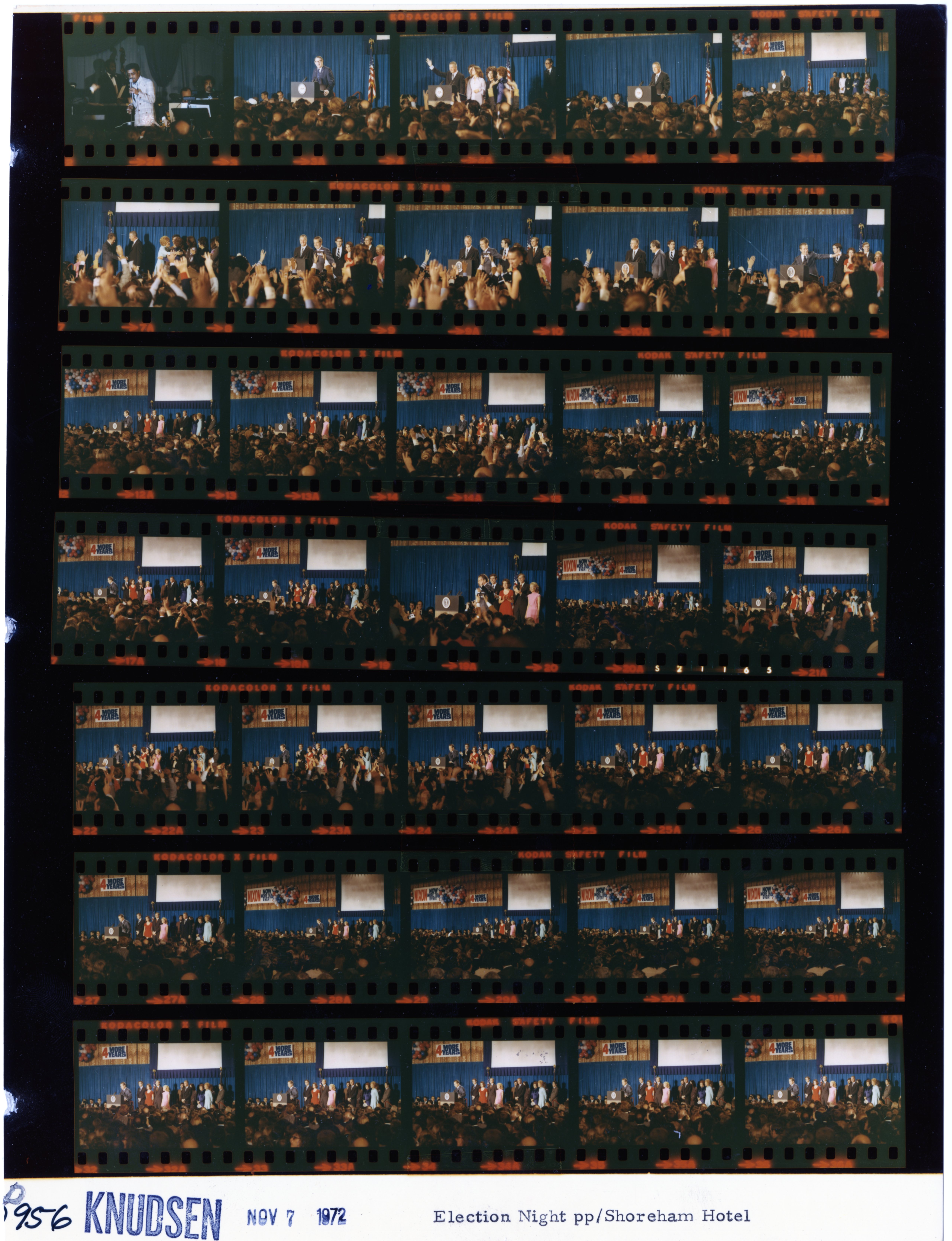
- Frame(s): WHPO-D0956-, President Nixon, Pat Nixon, the Nixon family, Spiro Agnew and Judy Agnew on the speaker's platform at the election victory party in Washington, D.C. Shoreham Hotel. 11/8/1972, Washington, D.C. Regency Ballroom, Shoreham Hotel. President Nixon, Pat Nixon, Spiro Agnew, Judy Agnew, Agnew family members, Nixon family members, Sammy Davis, Jr., MacGregor, Bob Dole, crowd.
- Frame(s): WHPO-D0956-, Sammy Davis, Jr., on the bandstand and Clark MacGregor at the podium on the speaker's platform at President Nixon's election victory party. 11/8/1972, Washington, D.C. Regency Ballroom, Shoreham Hotel. President Nixon, Pat Nixon, Spiro Agnew, Judy Agnew, Agnew family members, Nixon family members, Sammy Davis, Jr., MacGregor, crowd.
- Frame(s): WHPO-D0956-08A, President Nixon,Spiro Agnew, Julie Nixon Eisenhower, David Eisenhower, Tricia Nixon Cox, and Edward Cox on the speaker's platform at the election victory party in Washington, D.C. Shoreham Hotel. 11/8/1972, Washington, D.C. Regency Ballroom, Shoreham Hotel. President Nixon, Spiro Agnew, Julie Nixon Eisenhower, David Eisenhower, Tricia Nixon Cox, Edward Cox, crowd.
- Frame(s): WHPO-D0956-14A, President Nixon, Pat Nixon, Spiro Agnew, Judy Agnew, Julie Nixon Eisenhower, David Eisenhower, Tricia Nixon Cox, and Edward Cox on the speaker's platform at the election victory party in Washington, D.C. Shoreham Hotel. 11/8/1972, Washington, D.C. Regency Ballroom, Shoreham Hotel. President Nixon, Pat Nixon, Spiro Agnew, Judy Agnew, Agnew family members, Julie Nixon Eisenhower, David Eisenhower, Tricia Nixon Cox, Edward Cox, Sammy Davis, Jr., MacGregor, Bob Dole, crowd.
Roll WHPO-D0957 Photographer: Knudsen, Robert L. | Color or B&W: Color
- Frame(s): WHPO-D0957-07A, President Nixon, Pat Nixon, Vice President Agnew and Judy Agnew on the speaker's platform at the Regency Ballsroom election victory party. 11/8/1972, Washington, D.C. Regency Ballroom, Shoreham Hotel. President Nixon, Pat Nixon, Sprio Agnew, Judy Agnew, Agnew family members, Julie Nixon Eisenhower, David Eisenhower, Tricia Nixon Cox, Edward Cox, Crowd.
Roll WHPO-D0958 Photographer: Royer | Color or B&W: Color
- Frame(s): WHPO-D0958-, President Nixon, Pat Nixon, Spiro Agnew and Judy Agnew on the speaker's platform at the election victory party. 11/8/1972, Washington, D.C. Regency Ballroom, Shoreham Hotel. President Nixon, Pat Nixon, Spiro Agnew, Judy Agnew, Agnew family members, Nixon family members, crowd.
Roll WHPO-D0959 Photographer: Royer | Color or B&W: Color
- Frame(s): WHPO-D0959-06A-13A, Unidentified persons in a room. Actor singer Sammy Davis, Jr., joining the group. 11/8/1972, Washington, D.C. room, Regency Ballroom, Shoreham Hotel. President Nixon, Pat Nixon, Spiro Agnew, Judy Agnew, Agnew family members, Nixon family members, Sammy Davis., Jr., unidentified persons, crowd.
- Frame(s): WHPO-D0959-06A-13A, the Nixons and the Agnews on the speaker's platform at the victory party. 11/8/1972, Washington, D.C. room, Regency Ballroom, Shoreham Hotel. President Nixon, Pat Nixon, Spiro Agnew, Judy Agnew, Agnew family members, Nixon family members, Sammy Davis., Jr., unidentified persons, crowd.
Roll WHPO-D0960 Photographer: Moore, Robert (Supervisor/Director, WHPO Photographic Laboratory) | Color or B&W: Color
- Frame(s): WHPO-D0960-, The Regency Ballroom election night celebration. John Ehrlichman portraits. Clark MacGregor standing at the podium. The Agnew family on the dais and Agnew speaking from the podium. 11/8/1972, Washington, D.C. Regency Ballroom, Shoreham Hotel. Agnew, Judy Agnew, Agnew family, Ehrlichman, MacGregor, unidentified man, audience.
Roll WHPO-D0961 Photographer: Moore, Robert (Supervisor/Director, WHPO Photographic Laboratory) | Color or B&W: Color
- Frame(s): WHPO-D0961-, Election night party shots. Vice President Agnew and Judy Agnew with their family on the dais. President Nixon and Pat Nixon coming onto the dais and being joined by their family. President Nixon addressing the audience. 11/8/1972, Washington, D.C. Regency Ballroom, Shoreham Hotel. President Nixon, Pat Nixon, Nixon family, ASpiro Agnew, Judy Agnew, Agnew family, audience.
Roll WHPO-D0962 Photographer: Moore, Robert (Supervisor/Director, WHPO Photographic Laboratory) | Color or B&W: Color
- Frame(s): WHPO-D0962-, The election night victory party audience and guests. Vice President Spiro Agnew, Judy Agnew, President Nixon and family members on the dais. 11/8/1972, Washington, D.C. Regency Ballroom, Shoreham Hotel. President Nixon, Pat Nixon, Nixon family, Spiro Agnew, Judy Agnew, Agnew family, audience.
Roll WHPO-D0963 Photographer: Kightlinger, Jack | Color or B&W: Color
- Frame(s): WHPO-D0963-, The Regency Ballroom election victory party. President Nixon, Pat Nixon, Vice President Agnew and Judy Agnew on the speaker's platform at the Regency Ballsroom election victory party. 11/8/1972, Washington, D.C. Regency Ballroom, Shoreham Hotel. President Nixon, Pat Nixon, Nixon family, Spiro Agnew, Judy Agnew, Agnew family, Sammy Davis, Jr., MacGregor, audience.
Roll WHPO-D0964 Photographer: Kightlinger, Jack | Color or B&W: Color
- Frame(s): WHPO-D0964-04-06, Unidentified persons in a hotel room. 11/8/1972, Washington, D.C. Shoreham Hotel, room. unidentified persons.
- Frame(s): WHPO-D0964-07, President Nixon, Pat Nixon, Vice President Agnew and Judy Agnew with their families at the podium. 11/8/1972, Washington, D.C. Shoreham Hotel, Regency Ballroom. President Nixon, Pat Nixon, Nixon family, Spiro Agnew, Judy Agnew, Agnew family.
- Frame(s): WHPO-D0964-08-16, President Nixon, Pat Nixon, Vice President Agnew and Judy Agnew with their families standing on the dais. 11/8/1972, Washington, D.C. Shoreham Hotel, Regency Ballroom. President Nixon, Pat Nixon, Nixon family, Spiro Agnew, Judy Agnew, Agnew family.
Roll WHPO-D0965 Photographer: Atkins, Oliver | Color or B&W: Color
- Frame(s): WHPO-D0965-, President Nixon, Pat Nixon, Vice President Agnew, and Judy Agnew standing together on the dais, later joined by their families. 11/8/1972, Washington, D.C. Regency Ballroom, Shoreham Hotel. President Nixon, Pat Nixon, Nixon family, Spiro Agnew,, Judy Agnew, Agnew family.
Roll WHPO-D0966 Photographer: Atkins, Oliver | Color or B&W: Color
- Frame(s): WHPO-D0966-, President Nixon, Vice President Agnew, and their families on Election night. 11/8/1972, Washington, D.C. Regency Ballroom, Shoreham Hotel. President Nixon, Pat Nixon, Tricia Nixon cox, Ed Cox, Julie Eisenhower, David Eisenhower, Spiro Agnew, Judy Agnew, Agnew family.
- Frame(s): WHPO-D0966-11, Pat Nixon and Judy Agnew standing with their families on Election night. 11/8/1972, Washington, D.C. Regency Ballroom, Shoreham Hotel. Spiro Agnew, Judy Agnew, Pat Nixon, unidentified family members.
- Frame(s): WHPO-D0966-14, Edward Cox, Tricia Nixon Cox, David Esisenhower, Julie Nixon Eisenhower, and their familiy on Election night. 11/8/1972, Washington, D.C. Regency Ballroom, Shoreham Hotel. Edward Cox, Tricia Nixon Cox, David Esisenhower, Julie Nixon Eisenhower.
- Frame(s): WHPO-D0966-15, President Nixon and Vice President Agnew, stand with the nixon children and their husbands on Election night. 11/8/1972, Washington, D.C. Regency Ballroom, Shoreham Hotel. President Nixon, Pat nixon, Edward Cox, Tricia Nixon Cox, David Esisenhower, Julie Nixon Eisenhower.
Roll WHPO-D0972 Photographer: Royer | Color or B&W: B&W
- Frame(s): WHPO-D0972-, Unidentified persons presenting various gifts, including a sheet cake, to a White House staff person. 11/8/1972, Washington, D.C. North Portico driveway, White House. White House staffer, unidentified persons.
Roll WHPO-D0973 Photographer: Atkins, Oliver | Color or B&W: B&W
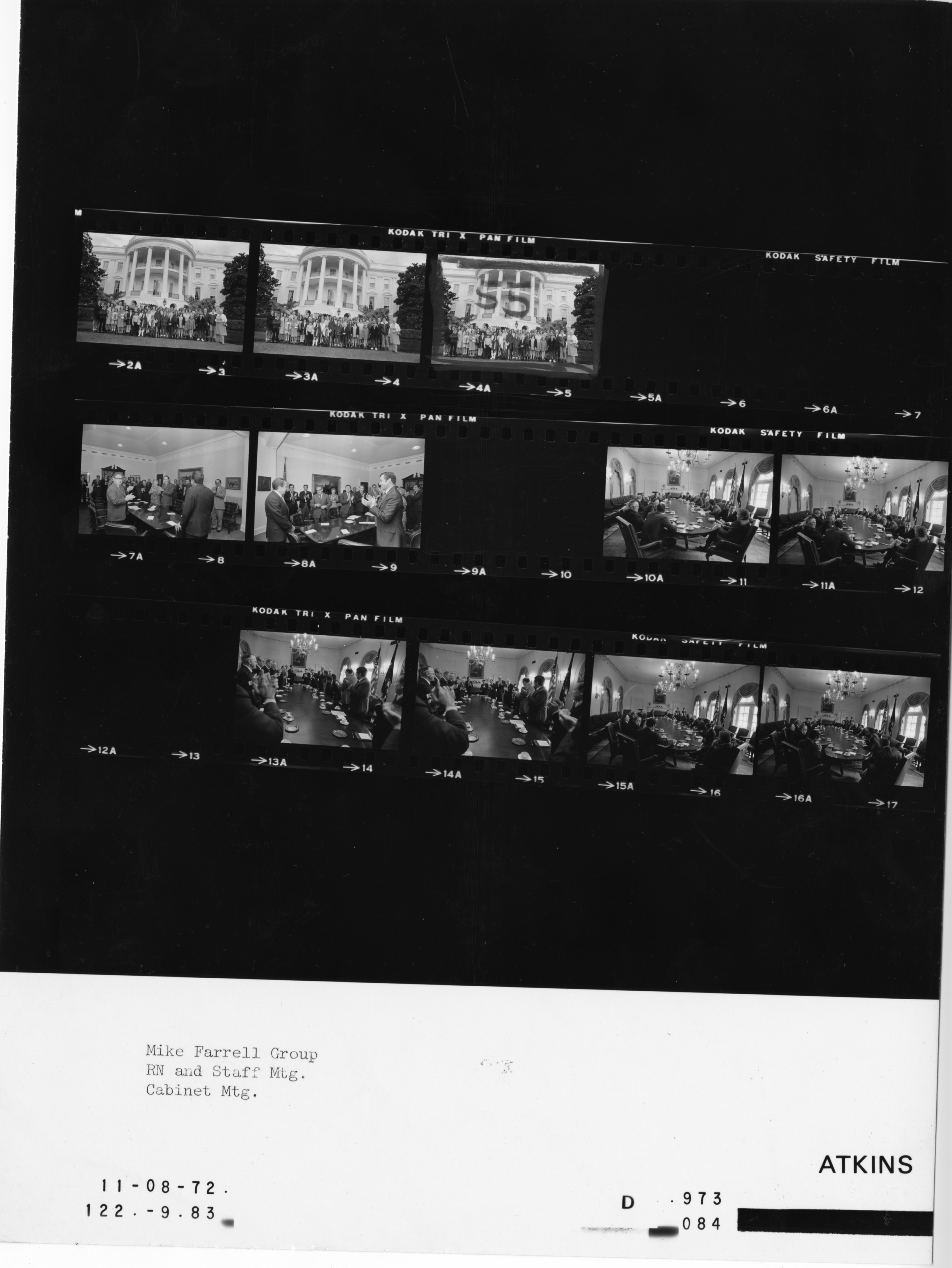
- Frame(s): WHPO-D0973-03-05, Mike Farrell with a group of men, women, and children. 11/8/1972, Washington, D.C. White House, South Lawn. President Nixon, senior staff members, Cabinet members, Farrell, unidentified men, women, and children.
- Frame(s): WHPO-D0973-08, President Nixon is greeted and applauded by senior staff members after his re-election. 11/8/1972, Washington, D.C. White House, Roosevelt Room. President Nixon, Henry Kissinger, Herb Stein, H.R. Haldeman, John Dean, Ron Ziegler, senior staff members, Cabinet members, Farrell, Rose Mary Woods, Charles Colson.
- Frame(s): WHPO-D0973-09, President Nixon is greeted and applauded by senior staff members after his re-election. 11/8/1972, Washington, D.C. White House, Roosevelt Room. President Nixon, Henry Kissinger, Herb Stein, H.R. Haldeman, John Dean, Ron Ziegler, senior staff members, Cabinet members, Farrell, Rose Mary Woods, Charles Colson.
- Frame(s): WHPO-D0973-11-17, President Nixon is greeted by Cabinet members at the conference table after his re-election. 11/8/1972, Washington, D.C. White House, Cabinet Room. President Nixon, senior staff members, Cabinet members, Farrell, unidentified men, women, and children.
- Frame(s): WHPO-D0973-15, President Nixon is greeted by Cabinet members at the conference table after his re-election. 11/8/1972, Washington, D.C. White House, Cabinet Room. The President, Vice President Spiro T. Agnew, Secretary of State William P. Rogers, Secretary of the Treasury George P. Shultz, Secretary of Defense Melvin R. Laird, Attorney General Richard G. Kleindienst, Secretary of the Interior Rogers C.B. Morton, Secretary of Agriculture Earl L. Butz, Secretary of Commerce Peter. G. Peterson, Secretary of Labor James D. Hodgson, Secretary of HEW Elliot L. Richardson, Secretary of HUD George W. Romney, Secretary of Transportation John A. Volpe, Director of OMB Caspar W. Weinberger, Counsellor Robert H. Finch, Counsellor Donald Rumsfeld, George Bush, Ambassador from the U.S. to the U.N,David M. Kennedy, Ambassador at Large.
Roll WHPO-D0978 Photographer: Knudsen, Robert L. | Color or B&W: B&W
- Frame(s): WHPO-D0978-, President Nixon and Pat Nixon greet children and supporters upon their arrival in Key Biscayne. 11/8/1972, Key Biscayne, Florida helipad, Key Biscayne Compound. President Nixon, Pat Nixon, crowd.
- Frame(s): WHPO-D0978-09, President Nixon greets children and supporters upon his arrival in Key Biscayne. 11/8/1972, Key Biscayne, Florida helipad, Key Biscayne Compound. President Nixon, crowd.
The White House Communications Agency Sound Recordings Collection contains public statements that took place between 1969 and 1974. Visit the finding aid to learn more.
B - Vice-Presidential (Agnew and Ford)
- WHCA-SR-B-237
Remarks in accepting re-election-The Shoreham Hotel, Wash., DC. (11/8/1972)
Runtime: 9:00
Keywords: Presidential campaigns, Presidential elections, 1972 Presidential campaign, 1972 Presidential election
Original Format: 1/4-inch reel-to-reel audiotape. Original source type: Original.
L - White House Press Office Briefings
- WHCA-SR-L-054
Press briefing by Ronald Ziegler. (11/8/1972, White House Press Lobby)
Keywords: Press conferences, news conferences, interviews, media, press secretary
Original Format: 1/4-inch reel-to-reel audiotape. Original source type: Original.
P - Formal Presidential Remarks
- WHCA-SR-P-721115
Remarks by President Nixon at a victory party at Shoreham Hotel, with remarks by Vice President Agnew. (11/8/1972, Shoreham Hotel)
Runtime: 0:28:23
Keywords: Presidential campaigns, Presidential elections, 1972 Presidential campaign, 1972 Presidential election
Production credits: Audio feed (probably pool feed) supplied by ABC (tape case), CBS (log book); Recorded by RES (initials of WHCA engineer)
Original Format: 1/4-inch reel-to-reel audiotape. Original source type: Original.
The White House Communications Agency Videotape Collection contains “off-the-air” recordings of televised programs produced between 1968 and 1974. Visit the finding aid to learn more.
- WHCA-5906
1972 Presidential Election Coverage.
CBS
Runtime: 01:02:28 - WHCA-5907
1972 Presidential Election Coverage. Robert Brown.
Undetermined
Runtime: 01:32:05 - WHCA-5908
1972 Presidential Election Coverage.
Post-Newsweek Stations, Inc.
Runtime: 00:33:52 - WHCA-5909
1972 Presidential Election Coverage.
NBC
Runtime: 00:35:23 - WHCA-5910
1972 Presidential Election Coverage. Sargent Shriver.
ABC
Runtime: 00:35:18 - WHCA-5911
"A Public Affair: Election '72".
CBS
Runtime: 01:00:11 - WHCA-5912
1972 Presidential Election Special.
ABC
Runtime: 01:00:46 - WHCA-5913
McGovern Campaign TV Spots.
Undetermined
Runtime: 00:30:26 - WHCA-5914
Nixon Spots.
McGovern for President Committee; Television Committee to Re-Elect the President
Runtime: 00:33:26 - WHCA-5915
Connally Campaign TV Spots: Democrats for Nixon.
Undetermined
Runtime: 00:15:04 - WHCA-5916
McGovern Campaign TV Spots. Lawrence O'Brien, chairman of the Democratic National Committee.
PBS
Runtime: 00:32:20 - WHCA-5917
McGovern Campaign TV Spots.
NBC
Runtime: 00:30:10 - WHCA-5921
Weekly News Summary, Tape IV.
ALL NETWORKS
Runtime: 1:30
1. Smith/Jarriel: (President Nixon) has a landslide victory; cabinet changes. Time Code Start: 01:13. Keywords: Presidents, Presidential elections, campaigns, campaigning, primaries, candidates, voting, speeches. Network: ABC.
2. Reasoner/Reynolds: (McGovern) is going to Virgin Islands. Time Code Start: 03:22. Keywords: Presidential elections, campaigns, campaigning, candidates. Network: ABC.
3. Smith: Seats won and lost in Congress. Time Code Start: 07:25. Keywords: House of Representatives, elections. Network: ABC.
4. Reasoner/Kincaid: Effect of presidential election on Columbus, Ohio (A study of the people). Time Code Start: 10:08. Keywords: Presidents,. Network: ABC.
5. Smith/Clark: What does '76 hold for the parties with Senator Ted Kennedy. Time Code Start: 14:30. Keywords: Presidential elections, campaigns, campaigning, candidates. Network: ABC.
6. Reasoner: Where the votes came from. Time Code Start: 17:07. Keywords: Vote, voters, voting, Presidential elections, campaigns, campaigning, candidates, voting, registrations. Network: ABC.
7. Smith: Commentary on visions of this reporter during election returns. Time Code Start: 26:12. Keywords: elections, campaigns, campaigning, candidates. Network: ABC. - WHCA-5922
Weekly News Summary, Tape V.
ALL NETWORKS
Runtime: 00:59:00
1. Chancellor/Brinkley: Election results, why President Nixon won with such a majority. Time Code Start: 00:42. Keywords: Presidential elections, campaigns, campaigning, primaries, candidates, voting, results, statistics. Network: NBC.
2. Chancellor/Utley/Newman: Election analysis, Senate and House. Time Code Start: 03:50. Keywords: Presidential elections, campaigns, campaigning, candidates. Network: NBC.
3. Chancellor/Dancy/Valeriani: (McGovern) concession, (President Nixon) at Shorham; (McGovern) leaves South Dakota, (Nixon) leaves for Florida. Time Code Start: 09:10. Keywords: Presidents, travel, trips, Nixon trips, domestic, Presidential elections, campaigns, campaigning, primaries, candidates. Network: NBC.
4. Chancellor/Brinkley: The '76 presidential race, what second President Nixon administration might be like. Time Code Start: 24:25. Keywords: Presidents, Presidential elections, campaigns, campaigning, primaries, candidates, voting, speeches. Network: NBC.
5. Cronkite/Pierpoint/Morton/Schieffer: Election results, shakeup in President Nixon's staff, (McGovern) leaves South Daokta. Time Code Start: 30:44. Keywords: Presidents, staff, officals, resignations, firings, Presidential elections, campaigns, campaigning, primaries, candidates, voting, results, statistics. Network: CBS.
6. Cronkite/Quint/Kalb: Saigon, Vietnam happy that President Nixon won (South Vietnam's President Thieu); General Haig goes to Saigon, Vietnam. Time Code Start: 45:00. Keywords: South Vietnam, Presidents, speeches, statements, Vietnam War. Network: CBS.
7. Cronkite/Meyer: American Indians at Bureau of Indian Affairs (BIA). Time Code Start: 52:10. Keywords: American Indians, Native Americans, tribes, American Indian Movement, occupations, government agencies. Network: CBS.
8. Cronkite/Kilpatrick: Results on referendums in the states. Time Code Start: 54:50. Keywords: elections, voting. Network: CBS.
Context (External Sources)
The Vanderbilt Television News Archive is the world's most extensive and complete archive of television news. They have been recording, preserving and providing access to television news broadcasts of the national networks since August 5, 1968.
Wikipedia is a free encyclopedia that anyone can edit.