
Introduction
This almanac page for Monday, November 3, 1969, pulls together various records created by the federal government and links to additional resources which can provide context about the events of the day.
Previous Date: Sunday, November 2, 1969
Next Date: Tuesday, November 4, 1969
Schedule and Public Documents
The Daily Diary files represent a consolidated record of the President's activities. Visit the finding aid to learn more.
The President's day began at Camp David, Maryland
The Weekly Compilation of Presidential Documents made available transcripts of the President's news conferences; messages to Congress; public speeches, remarks, and statements; and other Presidential materials released by the White House.
Addresses and Remarks
- The War in Vietnam (5 Weekly Comp. Pres. Doc. 1546, November 3, 1969)
The President's Address to the Nation.
Reports to the President
- Railway Labor Dispute (5 Weekly Comp. Pres. Doc. 1556, November 3, 1969)
Announcement of Report of Emergency Board Investigating Disputes Between Railroads Represented by the National Railway Labor Conference and Certain Employees.
Nominations Submitted to the Senate
Does not include promotions of members of the Uniformed Services, nominations to the Service Academies, or nominations of Foreign Service Officers.
- LT. GEN. JOHN J. DAVIS, United States Army, of Kansas, to be an Assistant Director of the United States Arms Control and Disarmament Agency.
- GEORGE A. LOCKE, of Washington, to be United States Marshal for the Eastern District of Washington for the term of 4 years, vice James E. Atwood.
Each Public Papers of the Presidents volume contains the papers and speeches of the President of the United States that were issued by the White House Office of the Press Secretary during the time period specified by the volume. The material is presented in chronological order, and the dates shown in the headings are the dates of the documents or events. In instances when the release date differs from the date of the document itself, that fact is shown in the text note.
To ensure accuracy, remarks have been checked against audio recordings (when available) and signed documents have been checked against the original, unless otherwise noted. Editors have provided text notes and cross references for purposes of identification or clarity.
The Federal Register is the official daily publication for rules, proposed rules, and notices of federal agencies and organizations, as well as executive orders and other Presidential documents.
No Federal Register published on this date
The Congressional Record is the official daily record of the debates and proceedings of the U.S. Congress.
Archival Holdings
Any selection of archival documents will necessarily be partial. You should use the documents and folders identified below as a starting place, but consult the linked collection finding aids and folder title lists and the collections themselves for context. Many documents to be found this way do not lend themselves to association with specific dates, but are essential to a complete understanding of the material.
Selective document listing
President's Office Files
The President's Office Files consists of materials drawn together by the Special Files Unit from several administrative subdivisions within the White House Office. It is the handwriting and sensitive papers sent to the Staff Secretary that now comprise much of the President's Office Files. Visit the finding aid to learn more.
- President's Handwriting, Box 3, President's Handwriting, November 1 thru 15, 1969 [1 of 3]
- Toast; Lee Huebner and James Keogh to The President re: Suggested Toast -- Prince Philip. November 3, 1969. 4 pgs.
- Annotated News Summaries, Box 28, News Summaries - November 1969 [During this period, the Staff Secretary only removed pages from the News Summaries which contained President Nixon's handwriting, often leaving the document with no date. Although there are no specific documents with this date, you should also consult the full folder for the month.]
President's Personal File
The President's Personal File is essentially a President's secretary's file, kept by Rose Mary Woods, personal secretary to the President, for two purposes: (1) preserving for posterity a collection of documents particularly close to the President, whether because he dictated or annotated them, or because of the importance of the correspondent or the event concerned and (2) giving appropriate attention–letters of gratitude, invitations to White House social events, and the like–to members and important friends and supporters of the Nixon administration. This generalization does not describe all the varied materials of a file group which is essentially a miscellany, but it does identify the reason for the existence of the file group's core. Visit the finding aid to learn more.
- President's Speech File
The H. R. Haldeman Diaries consists of seven handwritten diaries, 36 dictated diaries recorded as sound recordings, and two handwritten audio cassette tape subject logs. The diaries and logs reflect H. R. Haldeman’s candid personal record and reflections on events, issues, and people encountered during his service in the Nixon White House. As administrative assistant to the President and Chief of Staff, Haldeman attended and participated in public events and private meetings covering the entire scope of issues in which the Nixon White House engaged in during the years 1969-1973. Visit the finding aid to learn more.
- Transcript of diary entry (PDF)
Monday, November 3.
The big day. President stayed at Camp David until 1:00. Arrived at White House and went right to EOB office for the whole afternoon. Called many times. Wanted Riland down, stuff regarding counterattack, changed Florida plans for the weekend, etc. Had me bring over the midday signing. Was intrigued with 20,000 signature telegram from Colorado, wanted to know how they did it. Several shifts in plans regarding makeup, etc. Called and ordered me to take personal responsibility for the Oval Office - keep everyone out, etc. Lot of questions regarding lighting, only one camera, etc.
Did a great job on the air - content superb, delivery very good, with a few fluffs. Commentary after was mixed. Worst were Marvin Kalb and Bill Lawrence. Both seemed to be stunned - apparently really expected a major move. After telecast, stayed very briefly for photos, then shot out and over to Residence.
Then started a long night of phone calls. From 10:15 to 1:15, he was on and off at least fifteen to twenty times. Started wanting to know what we were doing for all out counterattack (while nets were still commenting). Then asked for reactions - what did people around the office think? Then broader reaction. By 10:30, phones were ringing off the wall, all staff taking calls, and making checks around the country, and I reporting every few minutes to President whenever there was a new item. Got a lot of just ordinary people, and some bigshots. Then pressure about what is Klein doing to get reaction. Reports on editors around country. Then orders to get out wires and letters story in morning fast. Then the New York Times ad idea again. Then hit network management for biased reports. Then call Rogers and Laird, be sure they know about big reaction, shore them up. Then get reports from West (by now too late to call in East). Then a plea - if only do one thing get a hundred vicious dirty calls to New York Times and Washington Post about their editorials (even though no idea what they'll be).
We had fun pumping the line onto LA TV in the late hours. And big crisis about getting the telegrams in. Couldn't get the supply line unplugged. - Handwritten diary entry (JPG)
The National Archives Catalog is the online portal to the records held at the National Archives, and information about those records. It is the main way of describing our holdings and also provides access to electronic records and digitized versions of our holdings.
The Catalog searches across multiple National Archives resources at once, including archival descriptions, digitized and electronic records, authority records, and web pages from Archives.gov and the Presidential Libraries. The Catalog also allows users to contribute to digitized historical records through tagging and transcription.
Nixon Library Holdings
All National Archives Units
National Security Documents
The President's Daily Brief is the primary vehicle for summarizing the day-to-day sensitive intelligence and analysis, as well as late-breaking reports, for the White House on current and future national security issues. Read "The President's Daily Brief: Delivering Intelligence to Nixon and Ford" to learn more.
The Kissinger telephone conversation transcripts consist of approximately 20,000 pages of transcripts of Kissinger’s telephone conversations during his tenure as Assistant to the President for National Security Affairs (1969-1974) and Secretary of State (1973-1974) during the administration of President Richard Nixon. Visit the finding aid for more information.
Chronological File, Box 3, Folder November 1-10, 1969
- 9:30 AM, Joseph Kraft
- 9:50 AM, The President
- 10:45 AM, Governor Love
- 10:47 AM, Secretary Rogers
- 11:20 AM, The President
- 11:25 AM, Bill Moyers
- 12:10 PM, Governor Reagan
- 12:15 PM, Dean Acheson
- 12:38 PM, Sec. Laird
- 12:50 PM, Tom Johnson
- 1:37 PM, Humphrey
- 2:00 PM, The President
- 2:40 PM, Jay Lovestone
- 3:10 PM, Senator Jackson
- 3:50 PM, McNamara
- 4:12 PM, Sec. Rogers
- 7:25 PM, Secretary Rogers
- 7:50 PM, Senator Percy
- 9:17 PM, Peter Flanigan
- 10:22 PM, The President
- 10:45 PM, The President
- 10:37 PM, Gov. Rockefeller
- 10:59 AM, Dean Acheson
- 11:33 PM, The President
- Midnight, The President
- After Midnight, Stew Loory
Audiovisual Holdings
The White House Photo Office collection consists of photographic coverage of President Richard Nixon meeting with prominent social, political, and cultural personalities; speaking engagements and news conferences of the President and various high-ranking members of the White House staff and Cabinet; Presidential domestic and foreign travel, including Presidential vacations; social events and entertainment involving the First Family, including entertainers present; official portraits of the President, First Family, and high-ranking members of the Nixon administration; the 1969 and 1973 Inaugurals; the President’s 1972 Presidential election campaign appearances (including speeches) and other official activities of the White House staff and the President’s Cabinet from January 20, 1969 until August 9, 1974 at the White House and the Old Executive Office Building; other locations in Washington, DC, such as The Mall; and the Presidential retreats in Camp David, Maryland, Key Biscayne, Florida, and San Clemente, California. Visit the finding aid to learn more.
Roll WHPO-2324 Photographer: Schumacher, Karl | Color or B&W: B&W
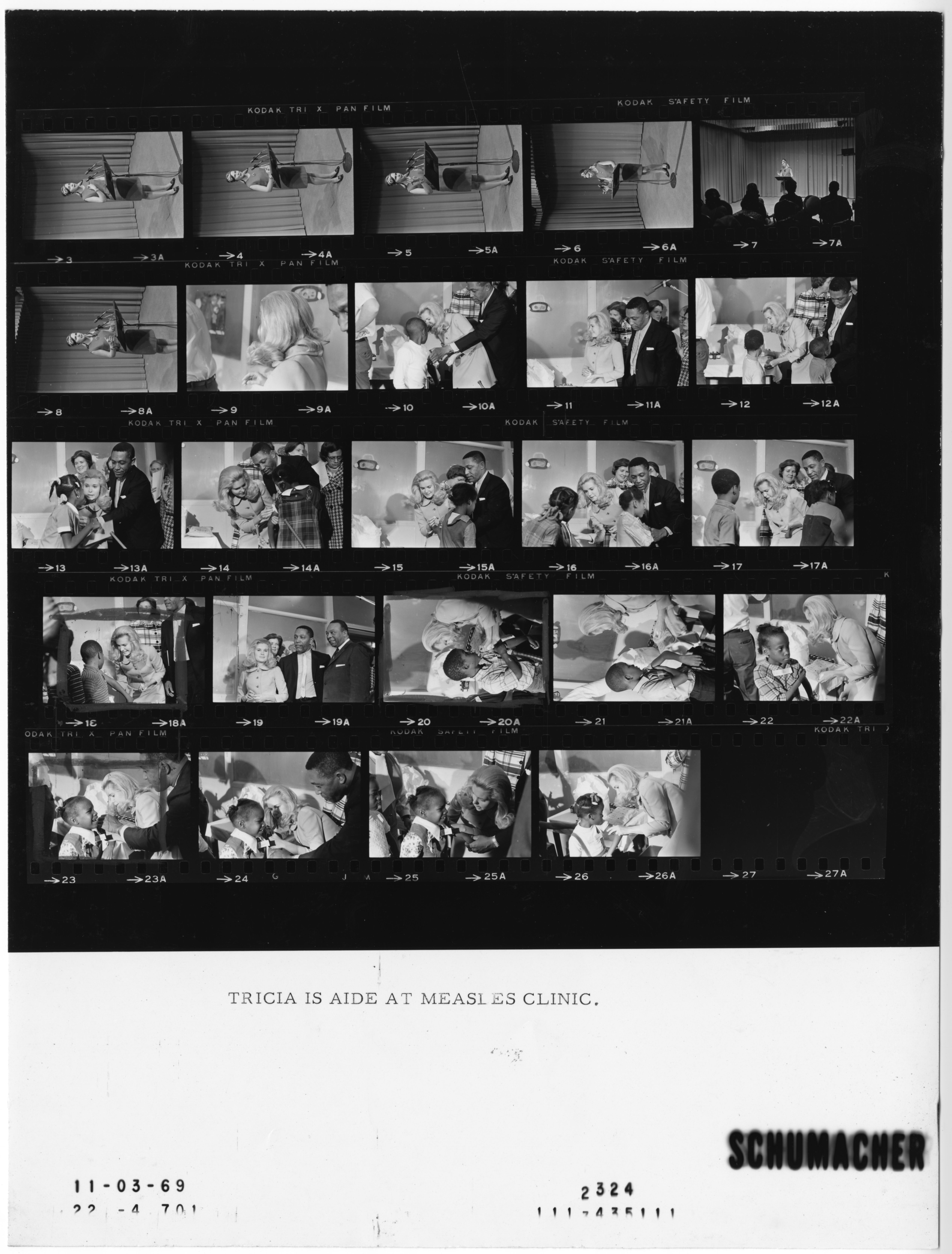
- Frame(s): WHPO-2324-03-08, Connie Stuart conducting a press briefing. 11/3/1969, Washington, D.C. Unknown. Connie Stuart.
- Frame(s): WHPO-2324-09-26, Tricia Nixon volunteering aid at a measles clinic. 11/3/1969, Unknown Unknown. Tricia Nixon.
- Frame(s): WHPO-2324-18, Tricia Nixon volunteering aid at a measles clinic. 11/3/1969, Unknown Unknown. Tricia Nixon.
Roll WHPO-2325 Photographer: Schumacher, Karl | Color or B&W: B&W
- Frame(s): WHPO-2325-02-11, Connie Stuart conducting a press briefing. 11/3/1969, Washington, D.C. Unknown. Connie Stuart, news reporters and photographers.
- Frame(s): WHPO-2325-14A, Barbara Walters, TV star of the Today Show and news reporter, standing with President Nixon and George W. Romney at the desk piled with telegrams and letter responses to his "silent majority" speech regarding Vietnam. 11/3/1969, Washington, D.C. White House, Oval Office. President Nixon, Barbara Walters, George Romney.
Roll WHPO-2326 Photographer: Schumacher, Karl | Color or B&W: B&W
- Frame(s): WHPO-2326-03-17, Tricia Nixon volunteering aid at a measles clinic. 11/3/1969, Unknown Unknown. Tricia Nixon.
Roll WHPO-2327 Photographer: unknown | Color or B&W: Color
- Frame(s): WHPO-2327-01, Portrait of Susan Eisenhower. 11/3/1969, Unknown Unknown. Susan Eisenhower.
Roll WHPO-2328 Photographer: Kightlinger, Jack | Color or B&W: B&W
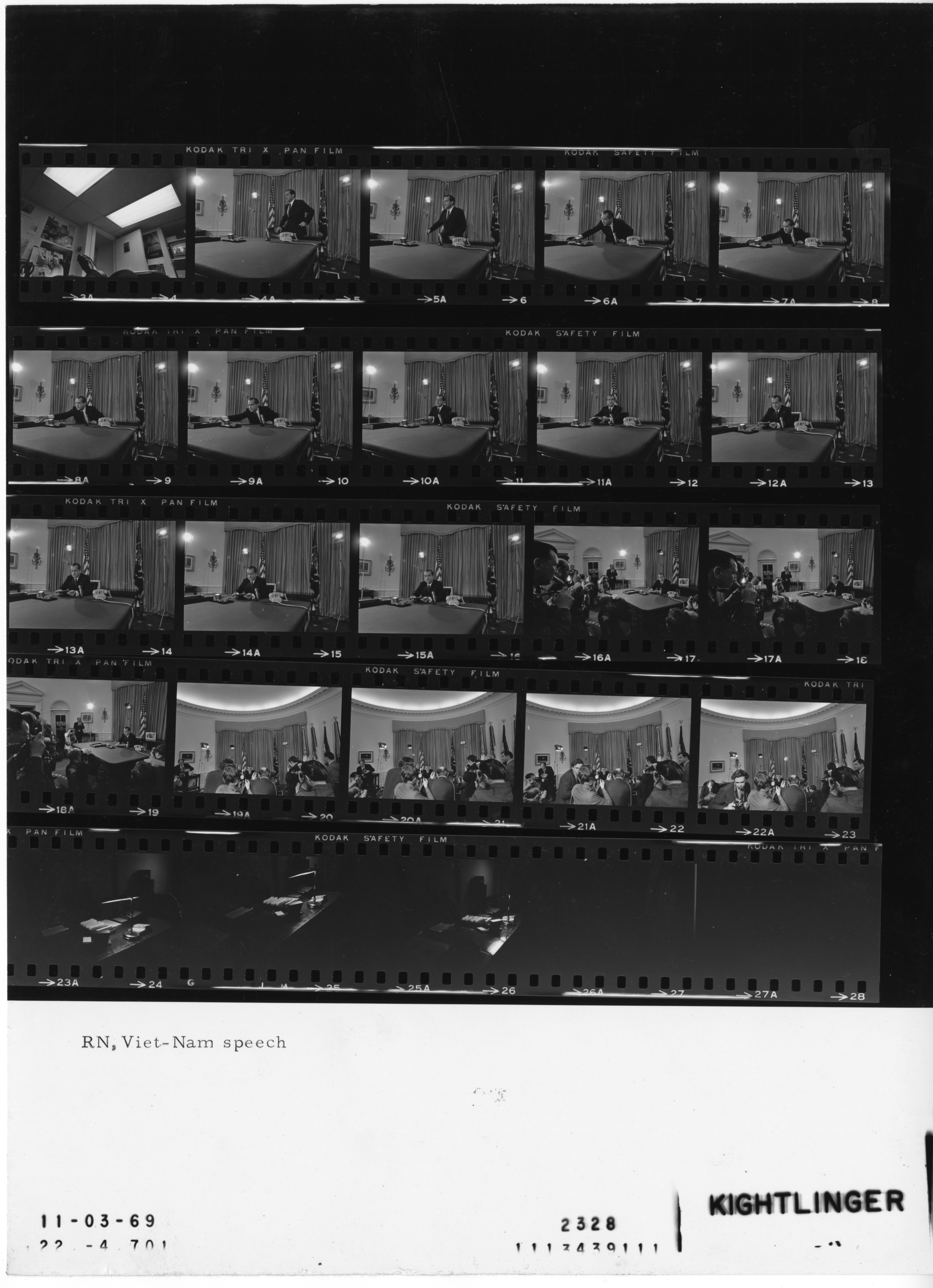
- Frame(s): WHPO-2328-03A-25A, President Nixon before broadcasting his "silent majority" speech on Vietnam via radio and television. 11/3/1969, Washington, D.C. White House, Oval Office. President Nixon.
Roll WHPO-2341 Photographer: Kightlinger, Jack | Color or B&W: B&W
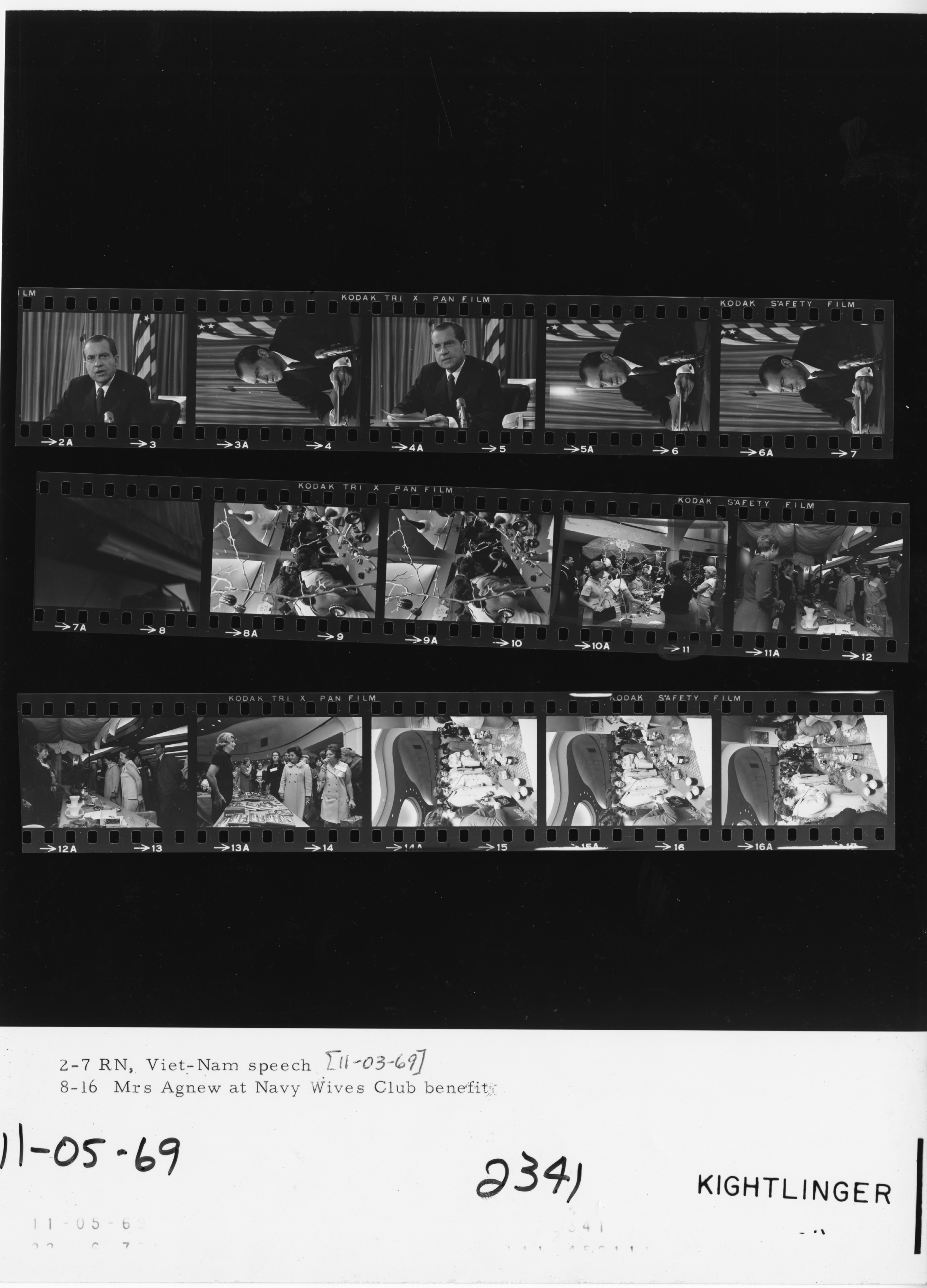
- Frame(s): WHPO-2341-03-07, President Nixon during his "silent majority" speech on Vietnam. 11/3/1969, Washington, D.C. White House, Oval Office. President Nixon.
The White House Communications Agency Sound Recordings Collection contains public statements that took place between 1969 and 1974. Visit the finding aid to learn more.
H - White House Staff Member Recordings
- WHCA-SR-H-087
Background briefing by Henry Kissinger and Ronald Ziegler. (11/3/1969, East Room, White House)
Runtime: 0:37:38
Keywords: Briefings, public briefings, statements to the press (see also Press conferences, news conferences, interviews, media)
Production credits: Audio feed supplied by "WHCA only"; Recorded by PHS (initials of WHCA engineer)
Original Format: 1/4-inch reel-to-reel audiotape. Original source type: Original.
P - Formal Presidential Remarks
- WHCA-SR-P-691101
President Richard Nixon Address to the Nation on the War in Vietnam. (11/3/1969, Oval Office, White House)
Runtime: 0:32:26
Production credits: CBS listed as providing "mult feed" (pool feed to other networks) but WHCA probably provided CBS with the feed
Original Format: 1/4-inch reel-to-reel audiotape. Original source type: Original.
The White House Communications Agency Videotape Collection contains “off-the-air” recordings of televised programs produced between 1968 and 1974. Visit the finding aid to learn more.
- WHCA-3485
President Nixon's Speech on Vietnam with Commentary AND partial recording of 6/4/1969 Remarks at USAF Academy commencement. THIS IS THE BEST COPY of the 11/3/1969 speech also known as the "SILENT MAJORITY SPEECH." Speech ends at 00:34:00. 6/4/1969 speech is probably a dub of WHCA 3349 (NBC broadcast)
ABC
Runtime: 01:00:48 - WHCA-3486
President Nixon's Speech on Vietnam with Commentary. aka "Silent Majority Speech"
NBC
Runtime: 01:03:47 - WHCA-3487
President Nixon's Speech on Vietnam with network commentary. aka "Silent Majority Speech" - NOTE: THIS IS NOT BEST QUALITY VERION - THE BEST QUALITY VERSION IS 3485. Mike Wallace, Tricia Nixon.
NBC
Runtime: 00:54:01 - WHCA-3499
Weekly News Summary.
All networks
Runtime: 01:05:26
1. Tricia Nixon with Washington, D.C. school children. Time Code Start: 00:12. Keywords: Presidents, families, family, women, children, students, not in Vanderbilt News archive, needs review. Network: NBC.
2. Preview of President Nixon's Vietnam speech. Time Code Start: 00:45. Keywords: Presidents, speeches, Laos, Cambodia, Vietnam War, organization of nations, intergovernmental alliance. Network: ABC.
Context (External Sources)
The Vanderbilt Television News Archive is the world's most extensive and complete archive of television news. They have been recording, preserving and providing access to television news broadcasts of the national networks since August 5, 1968.
Wikipedia is a free encyclopedia that anyone can edit.