
Introduction
This almanac page for Tuesday, November 28, 1972, pulls together various records created by the federal government and links to additional resources which can provide context about the events of the day.
Previous Date: Monday, November 27, 1972
Next Date: Wednesday, November 29, 1972
Schedule and Public Documents
The Daily Diary files represent a consolidated record of the President's activities. Visit the finding aid to learn more.
The President's day began at Camp David, Maryland
The Weekly Compilation of Presidential Documents made available transcripts of the President's news conferences; messages to Congress; public speeches, remarks, and statements; and other Presidential materials released by the White House.
Digitized versions can be found at HathiTrust.
The Federal Register is the official daily publication for rules, proposed rules, and notices of federal agencies and organizations, as well as executive orders and other Presidential documents.
Archival Holdings
Any selection of archival documents will necessarily be partial. You should use the documents and folders identified below as a starting place, but consult the linked collection finding aids and folder title lists and the collections themselves for context. Many documents to be found this way do not lend themselves to association with specific dates, but are essential to a complete understanding of the material.
Selective document listing
President's Office Files
The President's Office Files consists of materials drawn together by the Special Files Unit from several administrative subdivisions within the White House Office. It is the handwriting and sensitive papers sent to the Staff Secretary that now comprise much of the President's Office Files. Visit the finding aid to learn more.
- News Summaries, Unmarked News Summaries, Box 52, News Summaries - November 1972 [8 of 11] [Note: Due to the way News Summary products were compiled, you should also consult nearby days for potentially relevant materials.]
- News Summary, November 28, 1972, (Mon. nets, wires, columns, mags)
The H. R. Haldeman Diaries consists of seven handwritten diaries, 36 dictated diaries recorded as sound recordings, and two handwritten audio cassette tape subject logs. The diaries and logs reflect H. R. Haldeman’s candid personal record and reflections on events, issues, and people encountered during his service in the Nixon White House. As administrative assistant to the President and Chief of Staff, Haldeman attended and participated in public events and private meetings covering the entire scope of issues in which the Nixon White House engaged in during the years 1969-1973. Visit the finding aid to learn more.
- Transcript of diary entry (PDF)
Tuesday, November 28.
Camp David. President called me over at 7:30 this morning, wanted to go through a lot of miscellaneous things, particularly on White House staff. Wanted to be sure that Klein was included on the staff announcement list Saturday, saying that he's leaving February 1, but will be staying through the Inaugural. Said to use John Eisenhower to handle the Shultz deal, if we have any trouble with Mamie on it, convince her that we can close down that former President's house. Just wants to be sure we wrap up the Colson office. Tell Scali that we're considering another assignment for him, then use Stan Scott as a replacement for Bob Brown. Feels that Alex can't handle the East Wing or Rose Woods problems --and went into some examples-- so he wants Steve Bull to handle the East Wing from now on. Says we've got to strengthen Ziegler on the color stuff; for example when the President went to New York, says he needs a civilian aide for a trip like that, not military, and wants to use Steve Bull. Got into the Peterson problem again this morning; said that Shultz and Kissinger should sit down with him this afternoon and get it decided today. Peterson's ultimatum, in a sense, lays out a job that gives him Ambassador post with Cabinet rank, car, airplanes, and so on --based in Washington, DC. President says the Washington based deal is out of the question, the need is in Europe, not Washington. We don't need another second State Department here. They will not provide Cabinet rank, that it is the NATO and EEC job or nothing, period. In other words, he is to be told, one, there is no Cabinet rank; two, it's not in DC; three, it's very important for him to take it, but he's got to work it out there.
Got into some other personnel questions. He says he has some second thoughts on Brinegar, because if he doesn't want the Sub-Cabinet post, we shouldn't take him. He's too big for his britches, and we shouldn't let him blackmail us into a Cabinet job. Says if Peterson doesn't take the thing, we open both jobs and should put two different people in. For the Secretaries, he wants to put Bo Calloway in one post, and fill the other two with Poles or Italians from the Midwest. Wants Helms to move sooner, rather than waiting till March if he will. Helms called me this morning and said he would be delighted to take the Iran post. Wants me to tell Rogers that Irwin should not take Paris since he can't speak French. He wants two Labor leaders considered as Ambassadors. Wants Balzano and Rogers kept in the White House with the Director of Information Office. Also the black. First of all, says Rumsfeld should get the EEC rather than NATO because he wants to leave fairly soon. Then he said that Hodgson should go to NATO, and then he changed that to Hodgson going to the EEC and Rumsfeld to Geneva. Had some other ideas for NATO, such as Leo Churn, or possibly Pat Gray. He's also considering Pat Gray for ACTA. Thinks that Dunlap is okay for the Cost of Living Council, that we should put Counts at the FTC, but check Weinberger first, that wants to get more Labor leaders into other Departments. Wonders why Mitchell is down on Macomber at State.
Got intothe question of the FBI qualifications, says first, it's got to be the President's man. Second, not a crony. Third, a lawyer. Fourth, an administrator with political skill. Raised Abel Younger as a possibility. Wants me to make a quiet check as to whether he's tough enough. Shultz to call the EEC guy back, and use him here. Wants me to order Kissinger to Florida Saturday morning for a consultation before he leaves for Paris, also wants Connally to come down to meet with him in Florida, probably Thursday afternoon.
Got into the Kissinger problem some --wants me to talk to Haig about how to handle it, feels we probably have to bite the bullet sooner rather than later, because we have to get him under control. If Haig doesn't go with Kissinger to Paris, President wants to meet with him and discuss the problem. If he does go, he'll see him socially at some other time. He's very concerned about the Kissinger problem and is ordering him down to Florida just to show who's boss, primarily. He feels that we're at a point where we probably can't tolerate it much longer.
Got into a PR color thing. Said in New York there was a lot of good color stuff, and we should have gotten a better play on it, if someone had been there who understood color. Ziegler's plan of a microphone with transcripts won't do it; the guys who listen and take notes are much better. Ziegler is a cold, print, unemotional, tactical man. He doesn't have the sense or feel of the color things, unless it's elevated to hot news, such as the Israeli and Jews shaking hands, which anybody would get, but he misses the conversation with the schoolteachers or the guy at the Waldorf for 25 years. We have a weakness here, and we have to fill it --it can't be a Safire who's too cold; Andrews who's too flip and not quite it; Moore who's too slow although he feels it and understands it; Frank Dale who's not quick enough; it has to be a writer who can write fast. I suggested Bruce Herschensohn, who he doesn't know. We just don't have anyone in PR with a sense of it. Ehrlichman's judgment is no good, he reaches too far for the gimmicks.
Had his meeting with Dole today, which was absolutely incredible. President made his whole pitch of all the reasons why Dole should leave now, why it would be better for him and everything, and Dole said, well, if I came up here for the hanging, I at least want to say a word in my own defense. Then he went into a long harangue about his own position, that he had said he was staying and he, therefore, has to stay. That he feels it will ruin him in Kansas if it looks like he's kicked out, is totally oblivious to any suggestion that by handling it right, he can avoid it looking like he was kicked out. Came up with some suggestions for appointments, and that sort of thing. Art Fletcher as an Ambassador, a place for John Rollins, something for Robert Gadbury in Kansas. Said he had a problem raising money for his campaign if he were kicked out, and the President committed $300,000 in a special fundraising effort for him. Committed a three week trip to Europe or Asia for him in the late summer. Then at the end the President did mention George Bush as a possibility for the job, and Dole agreed that he would be great. After the meeting, we discussed the whole thing. He wants Ehrlichman to get hold of Bush right away and tell him for a couple of days to play as if his mind's not made up, that President will call him, because we have a delicate problem with Dole. Dole's problem is that we have to give him a face-saver. So we should let nature take its course for a little bit. Then he wants me to call Dole and say we've got great news, that Bush has agreed to take it, and start building from there.
We got into a flap on Malek today, because Fred decided he would not take the OMB Deputy and made another pitch for Secretary of Transportation. The President flatly turned it down, won't take the ultimatum, said he could have OEP or GSA, so I've got to call Fred back on that.
I made a number of phone calls. Had a long talk with Don Kendall to find out his recommendation on the best Southern businessman for Secretary of Commerce. He said Fred Dent was by far the best. Went through some others who were good, including Clements, who was really the top guy, but we've already got him. Said the only problem with Dent is that he's textile, which is a bad image if he's setting our trade policy, we have to make it clear that he's not. Kendall and I went through a lot of other things. Didn't have any ideas on AID, is worried about FTC, because we have been burnt so badly there, doesn't want us to put a young genius in there who wants to build a record. Same thing for CAB. I also discussed the Chapin problem with him, which I'll cover later. He felt Chapin would be an ideal guy for any company in the public affairs slot, and also said he'd be take him at Pepsi in a minute, if he wants to get into operations.
Talked to Connally, he's going to meet the President in Florida for the weekend. Talked to Rogers, and raised the point of Irwin not speaking French, and said he would be talking to Alex Johnson today. Talked to Mitchell early this morning. He said he talked to Dole. That Dole wasn't at all receptive to his pitch. He went through the pattern of the full-time Chairman-- the pitch on total advantage and all that, and Dole said, well, that's what we’ll have to kick around, up at Camp David with the President. He doesn't want the Committee to Re-elect kicking him out. Mitchell said, don't tell him it's Bush, he thinks he'll buy it, but he must work it out with President.
The President should say he wants him to stay through the Inaugural. He should laud him, say he wants to work together with him in the future, and all that, but be very firm. Mitchell thinks he laid a good base, but it will still take a fairly heavy pitch by the President. Mitchell was horrified by the thought of Ambrose for Deputy Attorney General, said he was the house guest of a gunrunner in Texas who was also a dope peddler. On the Bureau, he said that's the President's choice, that Kleindienst shouldn't get into it. That Jerry Wilson's lacking breadth and scope, he would be sunk in the Bureau, couldn't cope with the nuances, that we should go back to the drawing board on that. He said what about Arlen Specter, which is, of course, ridiculous. Said the two requisites are: first, you must be completely the President's man; second, he has to have the ability to handle the Bureau, which means a good politician and bureaucrat. Said Harry Dent had called him regarding wanting to be Counsel of the National Committee. Said Tom Evans is getting rambunctious, and Mitchell was calling him up for lunch to try and straighten that out.
Flanigan called with a number of items. He thinks we ought to combine the STR and CIEP to eliminate competition and overlap, handle the legislative problem of why we have the two separate agencies and to fit in with our streamlining idea and give impetus to our emphasis on foreign affairs. Also, he's concerned about his plan for moving the Department of Natural Resources to a Department of Energy and Natural Resources including the EEC, which he's been working on with Rog Morton. Also is worried about business contacts and business problem solving, who they look to in the White House. He says if the economic affairs guys in the EOB ought to be okay. Thinks the Regulatory Agencies should not go through Dean, because on policy matters they need to work with someone else. Said he'd talked to Casey, who is agonizing between Administration and Economics at the State Department. Flanigan argued he should take Administration, mainly because he has a candidate for Economics. Said Ross Perot doesn't want his appointment to the Academy Board of Visitors any more.
John Dean called, said Chapin appears to accept his fate. He thinks that I’ll concur and that he's re-thought his general stance and has asked Moore for Moore’s advice. Moore's still rocky on it, went over the potential list of things last night. Dean is clear on his recommendations, and there are no new problems this morning when they testified at Justice.
I had my meeting with Chapin this afternoon, which was a pretty horrible experience. I had to go through the whole thing with him. He basically does understand, I think, although it's very, very tough on him, and he broke down and cried at the end of the meeting, said that he couldn't face leaving, but would probably be able to do it. He's got a lot of ideas on job opportunities and so forth. And I think once he gets moving on it, he'll find that actually it's a good move for him. He wouldn't have been as well off to stay in, as he will be to get out.
Met with Ziegler for a long time after dinner tonight, to go over restructuring the press office. I think we've finally worked out a reasonably good plan. We'll try to get that into motion right away.
End of November 28. - Original audio recording (MP3)
The National Archives Catalog is the online portal to the records held at the National Archives, and information about those records. It is the main way of describing our holdings and also provides access to electronic records and digitized versions of our holdings.
The Catalog searches across multiple National Archives resources at once, including archival descriptions, digitized and electronic records, authority records, and web pages from Archives.gov and the Presidential Libraries. The Catalog also allows users to contribute to digitized historical records through tagging and transcription.
Nixon Library Holdings
All National Archives Units
National Security Documents
The President's Daily Brief is the primary vehicle for summarizing the day-to-day sensitive intelligence and analysis, as well as late-breaking reports, for the White House on current and future national security issues. Read "The President's Daily Brief: Delivering Intelligence to Nixon and Ford" to learn more.
The Foreign Relations of the United States series presents the official documentary historical record of major U.S. foreign policy decisions and significant diplomatic activity. Visit the State Department website for more information.
Vol. II, Organization and Management of U.S. Foreign Policy, 1969-1972
The Intelligence Community and the White House
288. Briefing Memorandum From the Director of the Bureau of Intelligence and Research (Cline) to the Deputy Secretary of State (Irwin), Washington, November 28, 1972
Source: Department of State, INR/IL Historical Files, NSCIC Documents, 1972–1974. Top Secret; Ruff; Zarf; Umbra; Handle via [codewords not declassified] Byeman Talent Keyhole Comint Channels Jointly. Drafted by Cline and Richard Curl (INR/DDC).
Vol. IV, Foreign Assistance, International Development, Trade Policies, 1969-1972
Foreign Assistance Policy, 1969-1972
101. Memorandum From Secretary of Defense Laird to President Nixon, Washington, November 28, 1972
Source: National Archives, Nixon Presidential Materials, NSC Files, Subject Files, Box 324, Foreign Aid, Volume II 1972. Secret. Attached to a January 4, 1973, memorandum from Kissinger to Laird informing him that the President had decided not to pursue Laird’s proposal to transfer security assistance to the Defense Department budget at that time.
Vol. V, United Nations, 1969-1972
Special Meetings of the Security Council
144. Telegram From the Mission to the United Nations to the Department of State, New York, November 28, 1972, 0001Z
Source: National Archives, RG 59, Central Files 1970–73, UN 3 SC. Limited Official Use. Repeated to Panama City.
Vol. IX, Vietnam, October 1972-January 1973
Paris Negotiations Collapse, October 24-December 13, 1972
128. Minutes of a Washington Special Actions Group Meeting, Washington, November 28, 1972, 11:11 am.-noon
Source: National Archives, Nixon Presidential Materials, NSC Files, NSC Institutional Files (H-Files), Box H–117, Washington Special Actions Group, WSAG Minutes (Originals) 7–27–72 to 9–20–73. Top Secret; Sensitive. The meeting took place in the White House Situation Room.
129. Memorandum From the President’s Assistant for National Security Affairs (Kissinger) to President Nixon, Washington, November 28, 1972
Source: National Archives, Nixon Presidential Materials, NSC Files, Box 192, Paris Talks/Meetings, Paris Talks [2 of 3]. Top Secret; Sensitive; Exclusively Eyes Only. A stamped notation on the first page reads: “The President has seen,” and Nixon handwrote the following words: “I know Communists (piece of paper or action of President) K + Haig speak for me—No delay in schedule. If not settled—aid is cut. 1. Agreement meets our realities 2. I need support 1) for aid— 2) for massive retaliation. Attacks on RN dangerous. This is a must. RN.”
Vol. E-2, Documents on Arms Control and Nonproliferation, 1969-1972
Conferences on Nuclear and World Disarmament and Soviet UN Initiative on Non-Use of Force
352. Telegram 215438 From the Department of State to the Mission to the United Nations, Washington, November 28, 1972, 2251Z
The telegram instructed the U.S. delegation to consult WEOs in the event that non-aligned nations table the non-use of force resolution and to inform the Soviet delegation of this decision.
Source: National Archives, RG 59, Central Files 1970–1973, DEF 18–6. Confidential; Priority. Drafted by Armitage (IO/UNP); cleared in NEA, ACDA, L/UNA, EUR/SOV, NEA/RA, DOD/ISA, and PM/DCA; and approved by De Palma (IO).
Vol. E-5, Part 2, Documents on North Africa, 1969-1972
Morocco
134. Analytical Summary, Washington, November 28, 1972
This 8 page summary examined the paper on U.S. Policy Toward Morocco produced in response to National Security Study Memorandum 160.
Source: National Archives, Nixon Presidential Materials, NSC Files, NSC Institutional Files (H-Files), Box H-66, National Security Study Memoranda, NSSM 160. Secret. The full NSSM 160 study, dated October 25, is not printed. (Ibid., NSC Files, Box 100, Senior Review Group Meeting, Morocco, NSSM 160) The Special NIE is printed as Document 132.
Vol. E-7, Documents on South Asia, 1969-1972
U.S. Relations with India and Pakistan, 1972
314. Letter From Indian Prime Minister Gandhi to President Nixon, New Delhi, November 28, 1972
Gandhi responded in kind to a letter from Nixon expressing his desire for improved relations.
Source: National Archives, Nixon Presidential Materials, NSC Files, Box 642, Country Files, Middle East, South Asia, Vol. IV. No classification marking. Gandhi sent Nixon a message of congratulations following his reelection. Nixon responded on November 19 with a letter to Gandhi in which he looked toward improved relations between the U.S. and India: “I hope our two countries can develop a sounder relationship based on understanding and respect for mutual interests.” (Ibid., Box 755, Presidential Correspondence File, India (1972)) Gandhi’s letter of November 28 was delivered to the White House by the Indian Embassy on December 5. The text was transmitted to New Delhi on December 6 in telegram 220565. (Ibid., RG 59, Central Files 1970–73, POL INDIA–US)
Vol. E-10, Documents on American Republics, 1969-1972
Panama
563. Intelligence Memorandum 2438/72, Washington, November 28, 1972., Washington, November 28, 1972
In this 2 page intelligence memorandum titled, “Panama 1973: The Year of the Treaty?” the Central Intelligence Agency concluded that the current round of Canal treaty talks had stalled mainly because President Torrijos had been unwilling to move from exploratory negotiations to bargaining on the issues to be resolved.
Source: Central Intelligence Agency, Office of Current Intelligence, Job 79–T00832A, Panama, 1973—The Year of the Treaty?. Secret; No Foreign Dissem.
The Kissinger telephone conversation transcripts consist of approximately 20,000 pages of transcripts of Kissinger’s telephone conversations during his tenure as Assistant to the President for National Security Affairs (1969-1974) and Secretary of State (1973-1974) during the administration of President Richard Nixon. Visit the finding aid for more information.
Digitized versions can be found in the National Archives Catalog.
Audiovisual Holdings
Visit the White House Tapes finding aid to learn about the taping system's operation and archival processing.
Camp David Hard Wire
- 231-12; Unknown between 7:50 a.m. & 12:14 p.m.; Nixon, Richard M. (President); Camp David Operator
- 231-13; Unknown between 7:50 a.m. & 12:14 p.m.; Nixon, Richard M. (President); Haldeman, H. R. ("Bob")
- 231-14; Unknown between 7:50 a.m. & 12:14 p.m.; Nixon, Richard M. (President); Camp David Operator
- 231-15; Unknown between 7:50 a.m. & 12:14 p.m.; Nixon, Richard M. (President); Rebozo, Charles G. ("Bebe")
- 231-16; 12:14 p.m. - 1:50 p.m.; Nixon, Richard M. (President); Haldeman, H. R. ("Bob"); Camp David Operator
- 231-17; Unknown between 4:26 p.m. & 4:40 p.m.; Haldeman, H. R. ("Bob"); Camp David Operator; Ehrlichman, John D.
- 232-1; Unknown between 6:50 p.m., 11/28 & 8:40 a.m., 10/15; Nixon, Richard M. (President); Sanchez, Manolo
- 232-2; Unknown between 6:50 p.m., 11/28 & 8:40 a.m., 10/15; Nixon, Richard M. (President); Sanchez, Manolo
- 232-3; Unknown between 6:50 p.m., 11/28 & 8:40 a.m., 10/15; Nixon, Richard M. (President); Sanchez, Manolo
- 232-15; Unknown between 6:50 p.m., 11/28 & 8:40 a.m., 10/30; Nixon, Richard M. (President); Sanchez, Manolo
Camp David Study Desk
- 183-6; Unknown between 12:14 p.m. & 1:50 p.m.; Camp David Operator; Haldeman, H. R. ("Bob")
- 183-7; Unknown between 4:26 p.m. & 4:40 p.m.; Haldeman, H. R. ("Bob"); Camp David Operator; Ehrlichman, John D.
Camp David Study Table
- 156-7; Unknown between 7:50 a.m. & 12:14 p.m.; Nixon, Richard M. (President); Camp David Operator
- 156-8; Unknown between 7:50 a.m. & 12:14 p.m.; Nixon, Richard M. (President); Haldeman, H. R. ("Bob")
- 156-9; Unknown between 7:50 a.m. & 12:14 p.m.; Nixon, Richard M. (President); Camp David Operator
- 156-10; Unknown between 7:50 a.m. & 12:14 p.m.; Nixon, Richard M. (President); Rebozo, Charles G. ("Bebe")
- 156-11; Unknown between 12:14 p.m. & 1:50 p.m.; Nixon, Richard M. (President); Camp David Operator
- 156-23; Unknown between 12:14 p.m., 11/28 & 10:10 a.m., 9/10; Nixon, Richard M. (President); Camp David Operator; Haldeman, H. R. ("Bob")
The White House Photo Office collection consists of photographic coverage of President Richard Nixon meeting with prominent social, political, and cultural personalities; speaking engagements and news conferences of the President and various high-ranking members of the White House staff and Cabinet; Presidential domestic and foreign travel, including Presidential vacations; social events and entertainment involving the First Family, including entertainers present; official portraits of the President, First Family, and high-ranking members of the Nixon administration; the 1969 and 1973 Inaugurals; the President’s 1972 Presidential election campaign appearances (including speeches) and other official activities of the White House staff and the President’s Cabinet from January 20, 1969 until August 9, 1974 at the White House and the Old Executive Office Building; other locations in Washington, DC, such as The Mall; and the Presidential retreats in Camp David, Maryland, Key Biscayne, Florida, and San Clemente, California. Visit the finding aid to learn more.
Roll WHPO-D1031 Photographer: Atkins, Oliver | Color or B&W: B&W
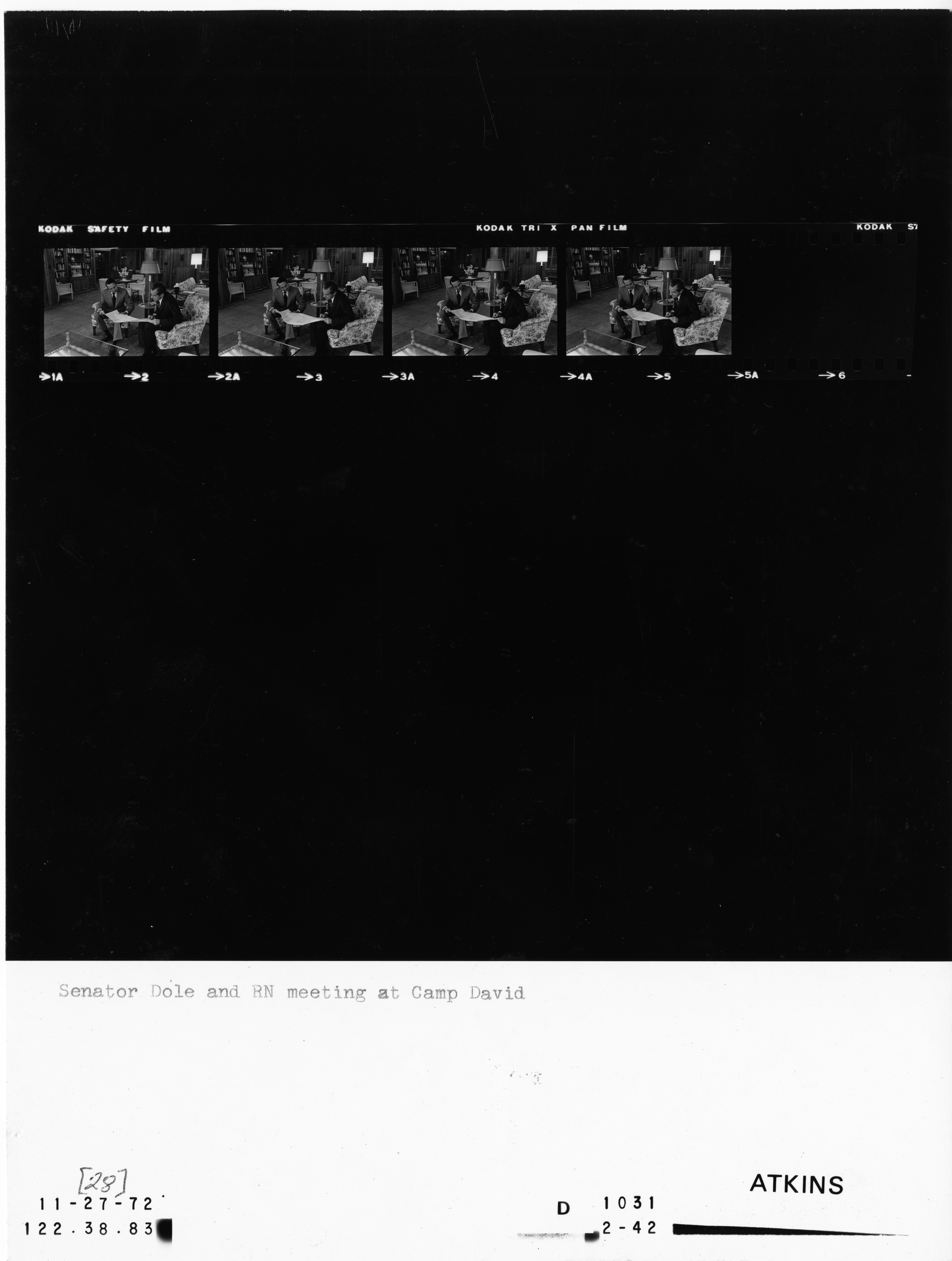
- Frame(s): WHPO-D1031-, President Nixon seated informally with Bob Dole. 11/28/1972, Camp David, Maryland living room, Aspen Lodge. President Nixon, Dole.
The White House Communications Agency Sound Recordings Collection contains public statements that took place between 1969 and 1974. Visit the finding aid to learn more.
H - White House Staff Member Recordings
- WHCA-SR-H-657
Remarks by John D. Ehrlichman regarding domestic policy and Senator George McGovern. (11/28/1972, [None listed])
Runtime: [Nonelisted]
Keywords: Presidential campaigns, Presidential elections, 1972 Presidential campaign, 1972 Presidential election
Production credits: Audio feed supplied by ABC; No WHCA engineer initials listed
Original Format: 1/4-inch reel-to-reel audiotape. Original source type: Original.
L - White House Press Office Briefings
- WHCA-SR-L-072
Press briefing by Ronald Ziegler. (11/28/1972, Camp David)
Runtime: 25:00:00
Keywords: Press conferences, news conferences, interviews, media, press secretary
Original Format: 1/4-inch reel-to-reel audiotape. Original source type: Original.
The White House Communications Agency Videotape Collection contains “off-the-air” recordings of televised programs produced between 1968 and 1974. Visit the finding aid to learn more.
- WHCA-5936
Weekly News Summary, Tape I.
ALL NETWORKS
Runtime: 1:30
28. Smith/Shoumacher/Zimmerman/Geer: Richardson, Office of Management and Budget Director Weinberger (OMB) and Ash in new cabinet; Secretary of Defense Laird says end of draft in 1973. Time Code Start: 65:01. Keywords: military, cabinet, advisors, conscription, laws, Vietnam War, speeches, statements, draft reform, draft evasion. Network: ABC.
29. Smith/Collins: Vietnam, Paris peace talks, etc.. Time Code Start: 70:20. Keywords: Paris Peace Talks, Vietnam War, treaty, treaties, negotiations. Network: ABC.
30. Smith/Wordham: Russian wheat deal. Time Code Start: 73:07. Keywords: U.S., American, Soviet Union, USSR, Russia, agriculture, food, crops, products, sales, agreements, business, imports, exports, trade, Federal Bureau of Investigations, government, organizations, crime. Network: ABC.
31. Smith: Commentary on IRA fanatics. Time Code Start: 76:08. Keywords: politics, organizations. Network: ABC.
32. Chancellor/Valeriani/Nessen: Richardson and Office of Management and Budget Director Weinberger (OMB) in new cabinet. Time Code Start: 78:00. Keywords: law officials, Presidents, cabinet, advisors, appointments. Network: NBC.
33. Chancellor/Jones: Paris peace talks and Vietnam war. Time Code Start: 82:20. Keywords: Paris Peace Talks, Vietnam War, treaty, treaties, negotiations. Network: NBC.
34. Cronkite/Rather: Changes in the cabinet. Time Code Start: 84:55. Keywords: Presidents, cabinet, advisors, appointments. Network: CBS.
35. Cronkite/Schieffer/Schorr: More on cabinet changes. Time Code Start: 86:45. Keywords: Presidents, cabinet, advisors, appointments. Network: CBS. - WHCA-5937
Weekly News Summary, Tape II.
ALL NETWORKS
Runtime: 01:15:49
1. Cronkite/Kalb: South Vietnam's President Thieu's representative arrives in Washington; Vietnam war. Time Code Start: 00:00. Keywords: South Vietnam, Presidents, speeches, statements, Vietnam War. Network: CBS.
2. Sevareid: Commentary on cabinet changes. Time Code Start: 01:52. Keywords: Presidents, cabinet, advisors, appointments. Network: CBS.
Context (External Sources)
The Vanderbilt Television News Archive is the world's most extensive and complete archive of television news. They have been recording, preserving and providing access to television news broadcasts of the national networks since August 5, 1968.
Wikipedia is a free encyclopedia that anyone can edit.