

Introduction
This almanac page for Saturday, November 25, 1972, pulls together various records created by the federal government and links to additional resources which can provide context about the events of the day.
Previous Date: Friday, November 24, 1972
Next Date: Sunday, November 26, 1972
Schedule and Public Documents
The Daily Diary files represent a consolidated record of the President's activities. Visit the finding aid to learn more.
The President's day began at Waldorf-Astoria Hotel, New York, New York
The Weekly Compilation of Presidential Documents made available transcripts of the President's news conferences; messages to Congress; public speeches, remarks, and statements; and other Presidential materials released by the White House.
Digitized versions can be found at HathiTrust.
The Federal Register is the official daily publication for rules, proposed rules, and notices of federal agencies and organizations, as well as executive orders and other Presidential documents.
Archival Holdings
Any selection of archival documents will necessarily be partial. You should use the documents and folders identified below as a starting place, but consult the linked collection finding aids and folder title lists and the collections themselves for context. Many documents to be found this way do not lend themselves to association with specific dates, but are essential to a complete understanding of the material.
Selective document listing
President's Office Files
The President's Office Files consists of materials drawn together by the Special Files Unit from several administrative subdivisions within the White House Office. It is the handwriting and sensitive papers sent to the Staff Secretary that now comprise much of the President's Office Files. Visit the finding aid to learn more.
- Annotated and Unmarked News Summaries [Note: Although there was no News Summary on this date, due to the way News Summary products were compiled, you should also consult nearby days for potentially relevant materials.]
The H. R. Haldeman Diaries consists of seven handwritten diaries, 36 dictated diaries recorded as sound recordings, and two handwritten audio cassette tape subject logs. The diaries and logs reflect H. R. Haldeman’s candid personal record and reflections on events, issues, and people encountered during his service in the Nixon White House. As administrative assistant to the President and Chief of Staff, Haldeman attended and participated in public events and private meetings covering the entire scope of issues in which the Nixon White House engaged in during the years 1969-1973. Visit the finding aid to learn more.
- Transcript of diary entry (PDF)
Saturday, November 25th. The day started with another wake-up call from Henry at 7:00 this morning from Paris, saying that they had another private meeting, no full-scale session. That he's going to come home, but they'll announce another meeting for Decem--, or a resumption for December 4. He says the other alternative was impossible; that we'd have a total public blow up with Saigon. That would be following the President's instructions to break off the, or to settle, and ram it down Saigon's throat. He said we couldn't do that at this point. He said Thieu's emissary is still coming to see the President. And Henry will go on to New York, arriving about 9:00 or 9:30 tonight, stay at the Waldorf and will meet with the President when he gets in. He was very disturbed, because the other side leaked a story that was very unhelpful, and he thinks we must not get into that.
The President called from New York, said he had a good day yesterday and today up there; that he had talked with Bush about his concerns. Bush had heard that Bob Wilson had decided to stay on. We need to put the heat on on that, twist Ford's arm on the point that he'll get no cooperation from the President if he keeps Wilson. Bush was also concerned about word he heard that Rietz was being put onto the Committee. The President said you've got to slim down the Committee, no hacks and so forth, so it would be very important for all of us to work with him. Someone should build up the youth thing in the RNC. George should understand the need for coming in with a new plan. We must not plan on using the President for big fund-raisers and stuff, let Agnew do that, the President will help in other ways.
He then got into the Kissinger problem; says Henry was, himself was, the one who raised the expectations on Paris results, especially that there needed only to be one more meeting. And, we still got no report on the South Vietnamese.
-------------------------------------------------------------------------------------------------------------------
DECLASSIFIED - E.O. 13526, Sect. 3.4: by MS, NARA, June 12, 2013
Audio Cassette 27, Side B, Withdrawn Item Number 11 [AC-27(B) Sel 10]
Duration: 11 seconds
The President feels we have to take the best that North Vietnam offers and stuff it down the South Vietnamese and that's it.
-------------------------------------------------------------------------------------------------------------------
End of November 25th. - Original audio recording (MP3)
The National Archives Catalog is the online portal to the records held at the National Archives, and information about those records. It is the main way of describing our holdings and also provides access to electronic records and digitized versions of our holdings.
The Catalog searches across multiple National Archives resources at once, including archival descriptions, digitized and electronic records, authority records, and web pages from Archives.gov and the Presidential Libraries. The Catalog also allows users to contribute to digitized historical records through tagging and transcription.
Nixon Library Holdings
All National Archives Units
National Security Documents
The President's Daily Brief is the primary vehicle for summarizing the day-to-day sensitive intelligence and analysis, as well as late-breaking reports, for the White House on current and future national security issues. Read "The President's Daily Brief: Delivering Intelligence to Nixon and Ford" to learn more.
The Foreign Relations of the United States series presents the official documentary historical record of major U.S. foreign policy decisions and significant diplomatic activity. Visit the State Department website for more information.
Vol. V, United Nations, 1969-1972
UN Finances and Reduction of the U.S. Assessment
205. Telegram From the Mission to the United Nations to the Department of State, New York, November 25, 1972, 0145Z
Source: National Archives, RG 59, Central Files 1970–73, UN 10–4. Confidential; Limdis.
Vol. IX, Vietnam, October 1972-January 1973
Paris Negotiations Collapse, October 24-December 13, 1972
126. Message From the President’s Assistant for National Security Affairs (Kissinger) to President Nixon, Paris, November 25, 1972, 2240Z
Source: National Archives, Nixon Presidential Materials, NSC Files, Kissinger Office Files, Box 26, HAK Trip Files, HAK Paris Trip Hakto, November 18–25, 1972. Top Secret; Sensitive; Exclusively Eyes Only. Sent via Haig and Kennedy. A stamped notation on the message reads: “The President has seen.”
Vol. XIX, Part 1, Korea, 1969-1972
Republic of Korea Troops in Vietnam and Force Modernization, April 1971-December 1972
169. Telegram From the Department of State to the Embassy in Korea, Washington, November 25, 1972, 0120Z
Source: National Archives, RG 59, Central Files 1970–73, POL 7 KOR S. Confidential; Exdis. Drafted by Kriebel and approved by Green and in S/S. Repeated to Tokyo.
Vol. XLII, Vietnam: The Kissinger-Le Duc Tho Negotiations
Breakdown of Negotiations, November 1972-December 1972
31. Memorandum of Conversation, Paris, November 25, 1972, 10:10 a.m.-12:10 p.m.
Source: National Archives, Nixon Presidential Materials, NSC Files, Box 858, For the President’s Files (Winston Lord)—China Trip/Vietnam Negotiations, Sensitive, Camp David, Vol. XXI, Minutes of Meetings. Top Secret; Sensitive; Exclusively Eyes Only. The meeting took place at 11 Rue Darthé, Choisy-le-Roi.
The meeting this day made no progress. The sides remained far apart on the few remaining issues separating them. In fact, as Kissinger told Nixon, he had purposely set up the meeting as a private one, between Le Duc Tho and Xuan Thuy and himself and Haig, rather than a formal delegation-to-delegation negotiating session. During the meeting, as Kissinger informed Nixon: “I pressed home to him [Tho] that if we were to hold a regular business session today it was apparent from my discussions with him yesterday that we would have quickly reached an impasse. The result would be a breakdown in negotiations and a resumption of military activity, this time on a scale not heretofore contemplated.” Kissinger proposed a week’s delay in which each side would study the other’s positions and he would carry out necessary personal consultations in Washington, pushing the next meeting to December 4. Le Duc Tho, despite wanting an agreement then, reluctantly agreed to the delay. (Foreign Relations, 1969–1976, vol. IX, Vietnam, October 1972–January 1973, Document 126)
During this round of negotiations after his return from Saigon, Kissinger met nightly with the South Vietnamese Ambassadors to the United States and United Kingdom and the head of the South Vietnamese delegation to the plenary talks to brief them on his meeting earlier in the day with Le Duc Tho. In his memoir, Kissinger recalled: “Their instructions [from South Vietnamese President Thieu] were simple. They were authorized to accept Hanoi’s surrender on all the sixty-nine changes proposed by the inventive Nha [Hoang Duc Nha, confidant and close adviser to Thieu]. They had no authority to consider less or to discuss any compromise or to entertain any alternative language.” (Kissinger, White House Years, p. 1418) The key issue for the South Vietnamese was the presence of North Vietnamese troops. And because the South Vietnamese demanded the withdrawal of these troops before Thieu would sign a settlement, and because the North Vietnamese refused to consider this demand, or even to admit that North Vietnamese troops were in the South, Kissinger, as Nixon’s representative, found himself in an almost impossible position.
Kissinger, Haig, and Ambassador William Sullivan, a new and senior member of the U.S. negotiating team, met with the South Vietnamese diplomats on the evening of November 25. Kissinger read to them a message from President Nixon in which Nixon said that the October 8 agreement, with improvements added since, was the best the United States and South Vietnam would get and that if South Vietnam wished U.S. support in the future in the event North Vietnam violated the agreement, the South Vietnamese had to accept the less than perfect agreement. There was no chance at all, given the diminishing support in the U.S. Congress for the war, that he could continue the war; if South Vietnam wished to continue, it was on its own. After discussing the message with the South Vietnamese diplomats, joined at the meeting by Thieu’s special assistant from Saigon, Nguyen Phu Duc, Kissinger told the South Vietnamese they had to accept the cease-fire and the agreement he had negotiated, assuming he could get the North Vietnamese back to this point. “Your choice,” he said, “is to join with us ordestroy yourselves. These are facts.” Ambassador Sullivan added: “If you had driven out the North Vietnamese you would, of course, be in a different position in a ceasefire.” (Foreign Relations, 1969–1976, vol. IX, Vietnam, October 1972–January 1973, Document 125)
Kissinger reported to Nixon that the meeting had one good result: these senior South Vietnamese “are now seized with the realities of the situation.” However, he continued, “I seriously doubt that President Thieu himself has yet grasped the problem accurately.” (Ibid., Document 126)
The North Vietnamese understood well that the South Vietnamese were making it difficult for the United States to achieve a settlement and that this offered an opportunity for them. Le Duc Tho and Xuan Thuy, reporting on their November 25 meeting with Kissinger and Haig, informed the Politburo: “The U.S. is having problems with its puppets. We need to watch this and exploit this contradiction [conflict].” (Message from Le Duc Tho and Xuan Thuy to the Politburo, 25 November 1972, in Doan Duc, et al., compilers, Major Events: The Diplomatic Struggle and International Activities during the Resistance War Against the Americans to Save the Nation, 1954–1975, volume 4, p. 351)
Vol. E-13, Documents on China, 1969-1972
169. Memorandum of Conversation, Paris, November 25, 1972, 12:35-1:30 a.m., Paris, November 25, 1972, 12:35-1:30 a.m.
President’s Assistant for National Security Affairs Kissinger linked the normalization of relations with North Vietnam to the normalization of relations between the U.S. and China. He also asked PRC Ambassador to France Huang Chen to convince Hanoi to withdraw its troops from South Vietnam.
Source: National Archives, Nixon Presidential Materials, NSC Files, Box 850, President’s File-China Trip, China Exchanges, Oct 24, 1972-Dec 31, 1972. Top Secret; Sensitive; Exclusively Eyes Only. The meeting was held at the PRC Embassy in Paris.
The Kissinger telephone conversation transcripts consist of approximately 20,000 pages of transcripts of Kissinger’s telephone conversations during his tenure as Assistant to the President for National Security Affairs (1969-1974) and Secretary of State (1973-1974) during the administration of President Richard Nixon. Visit the finding aid for more information.
Digitized versions can be found in the National Archives Catalog.
Audiovisual Holdings
The White House Photo Office collection consists of photographic coverage of President Richard Nixon meeting with prominent social, political, and cultural personalities; speaking engagements and news conferences of the President and various high-ranking members of the White House staff and Cabinet; Presidential domestic and foreign travel, including Presidential vacations; social events and entertainment involving the First Family, including entertainers present; official portraits of the President, First Family, and high-ranking members of the Nixon administration; the 1969 and 1973 Inaugurals; the President’s 1972 Presidential election campaign appearances (including speeches) and other official activities of the White House staff and the President’s Cabinet from January 20, 1969 until August 9, 1974 at the White House and the Old Executive Office Building; other locations in Washington, DC, such as The Mall; and the Presidential retreats in Camp David, Maryland, Key Biscayne, Florida, and San Clemente, California. Visit the finding aid to learn more.
Roll WHPO-D1023 Photographer: Knudsen, Robert L. | Color or B&W: Color
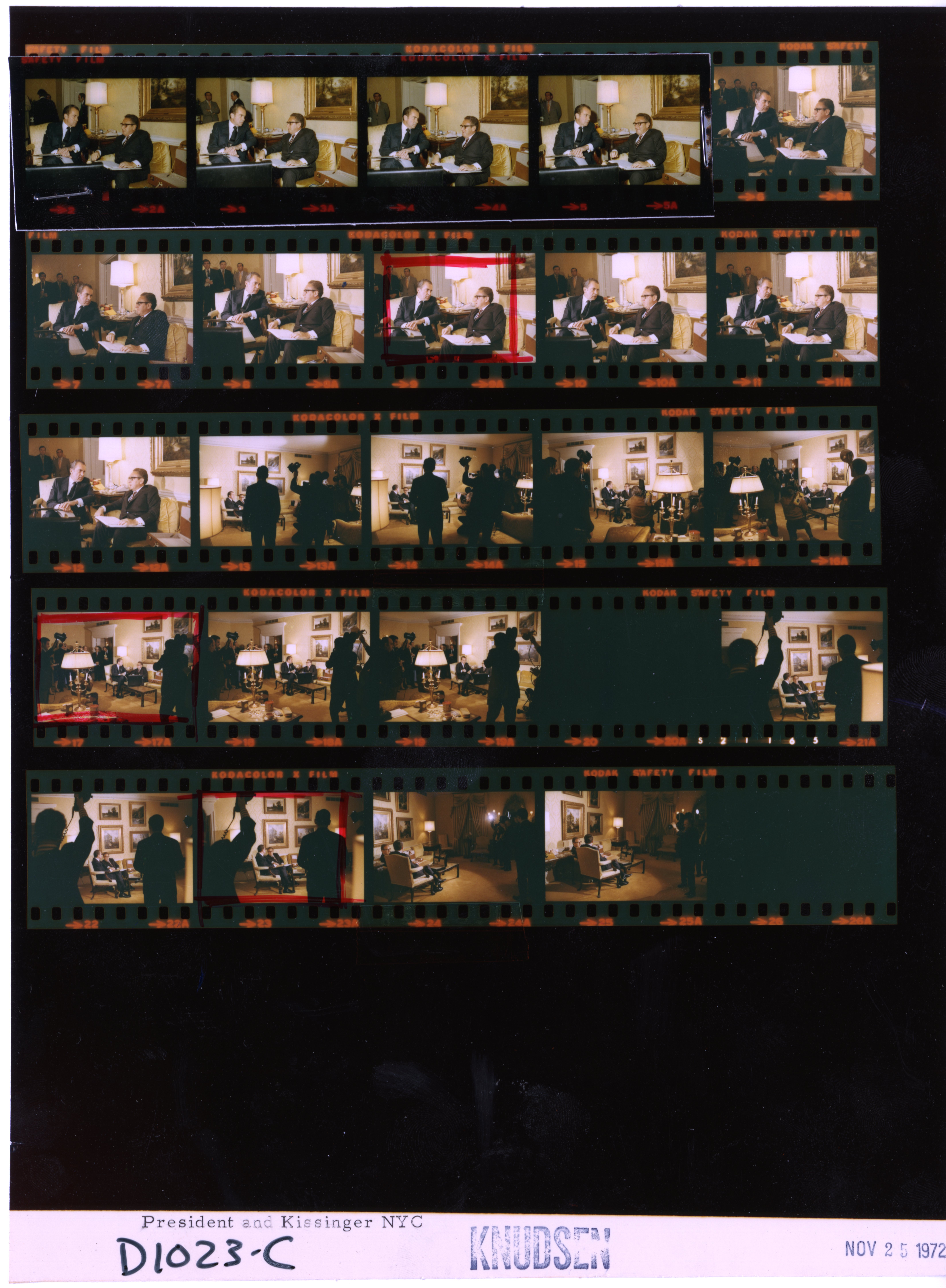
- Frame(s): WHPO-D1023-02-12, President Nixon and National Security Advisor Henry Kissinger seated in a hotel suite during a meeting, while unidentified men stand against a wall in the background. 11/25/1972, New York City, New York Presidential Suite, Waldorf-Astoria Hotel. President Nixon, Henry Kissinger, Jack Brennan, Bebe Rebozo, unidentified men.
- Frame(s): WHPO-D1023-09A, President Nixon and National Security Advisor Henry Kissinger seated in a hotel suite during a meeting, while unidentified men stand against a wall in the background. 11/25/1972, New York City, New York Presidential Suite, Waldorf-Astoria Hotel. President Nixon, Henry Kissinger, unidentified men.
- Frame(s): WHPO-D1023-13-25, President Nixon and National Security Advisor Henry Kissinger seated in a hotel suite during a meeting, while Press photographers take pictures of them. 11/25/1972, New York City, New York Presidential Suite, Waldorf-Astoria Hotel. President Nixon, Henry Kissinger, unidentified Press reporters and photographers.
The White House Communications Agency Sound Recordings Collection contains public statements that took place between 1969 and 1974. Visit the finding aid to learn more.
K - Informal Presidential Remarks
- WHCA-SR-K-032B-21
Remarks while window shopping-New York City, NY. (11/25/1972)
Original Format: 1/4-inch reel-to-reel audiotape. Original source type: Original. - WHCA-SR-K-032B-22
Stroll in New York City & Press briefing by Ronald Ziegler, Baron Rm., Waldorf, NY City, NY. (11/25/1972)
Keywords: Press conferences, news conferences, interviews, media, press secretary
Original Format: 1/4-inch reel-to-reel audiotape. Original source type: Original.
L - White House Press Office Briefings
- WHCA-SR-L-068
Press briefing by Ronald Ziegler in the Waldorf Astoria. (11/25/1972, Waldorf Astoria)
Keywords: Press conferences, news conferences, interviews, media, press secretary
Original Format: 1/4-inch reel-to-reel audiotape. Original source type: Original. - WHCA-SR-L-069
Press briefing in the Waldorf Astoria. (11/25/1972, Baron Room, Waldorf Astoria)
Keywords: Press conferences, news conferences, interviews, media
Original Format: 1/4-inch reel-to-reel audiotape. Original source type: Original. - WHCA-SR-L-070
Press briefing by Ronald Ziegler in New York. (11/25/1972, New York)
Runtime: 7:00
Keywords: Press conferences, news conferences, interviews, media, press secretary
Original Format: 1/4-inch reel-to-reel audiotape. Original source type: Original.
P - Formal Presidential Remarks
- WHCA-SR-P-721117
Remarks by President Nixon in NYC. (11/25/1972)
Runtime: 7:23
Original Format: 1/4-inch reel-to-reel audiotape. Original source type: Original.
The White House Communications Agency Videotape Collection contains “off-the-air” recordings of televised programs produced between 1968 and 1974. Visit the finding aid to learn more.
- WHCA-5933
"Agronsky & Company".
ABC
Runtime: 00:28:40 - WHCA-5936
Weekly News Summary, Tape I.
ALL NETWORKS
Runtime: 1:30
11. Utley/Dobyns: Paris peace talks are bogged down; Ziegler comments from New York. Time Code Start: 20:45. Keywords: Paris Peace Talks, Vietnam War, treaty, treaties, negotiations. Network: NBC.
12. Utley/Cochran: President Nixon in New York. Time Code Start: 25:06. Keywords: Presidents, travel, trips, Nixon trips, domesic. Network: NBC.
13. Rather/Parisher: Paris peace talks bogged down. Time Code Start: 27:44. Keywords: Paris Peace Talks, Vietnam War, treaty, treaties, negotiations. Network: CBS.
14. Pierpoint: Comment from Ziegler in New York. Time Code Start: 31:10. Keywords: media, press conferences, news conferences, interviews. Network: CBS.
15. Kalb: Report from State Department on Paris peace talk demands [Time correct?]. Time Code Start: 31:10. Keywords: Paris Peace Talks, Vietnam War, treaty, treaties, negotiations. Network: CBS.
16. Rather/Walker: President Nixon in Rockefeller Square (New York City). Time Code Start: 32:26. Keywords: Presidents, travel, trips, Nixon trips, domesic. Network: CBS.
17. Kilpatrick: More on Navy racial problems. Time Code Start: 33:51. Keywords: Armed Forces, Navy, Marines, ships, racial, racism, desegregation, racism, racial profiling, racial discrimination, civil rights, African Americans. Network: CBS.
Context (External Sources)
The Vanderbilt Television News Archive is the world's most extensive and complete archive of television news. They have been recording, preserving and providing access to television news broadcasts of the national networks since August 5, 1968.
Wikipedia is a free encyclopedia that anyone can edit.