
Introduction
This almanac page for Saturday, November 20, 1971, pulls together various records created by the federal government and links to additional resources which can provide context about the events of the day.
Previous Date: Friday, November 19, 1971
Next Date: Sunday, November 21, 1971
Schedule and Public Documents
The Daily Diary files represent a consolidated record of the President's activities. Visit the finding aid to learn more.
The President's day began at The White House - Washington, D. C.
The Weekly Compilation of Presidential Documents made available transcripts of the President's news conferences; messages to Congress; public speeches, remarks, and statements; and other Presidential materials released by the White House.
Digitized versions can be found at HathiTrust.
Each Public Papers of the Presidents volume contains the papers and speeches of the President of the United States that were issued by the White House Office of the Press Secretary during the time period specified by the volume. The material is presented in chronological order, and the dates shown in the headings are the dates of the documents or events. In instances when the release date differs from the date of the document itself, that fact is shown in the text note.
To ensure accuracy, remarks have been checked against audio recordings (when available) and signed documents have been checked against the original, unless otherwise noted. Editors have provided text notes and cross references for purposes of identification or clarity.
The Federal Register is the official daily publication for rules, proposed rules, and notices of federal agencies and organizations, as well as executive orders and other Presidential documents.
The Congressional Record is the official daily record of the debates and proceedings of the U.S. Congress.
Archival Holdings
Any selection of archival documents will necessarily be partial. You should use the documents and folders identified below as a starting place, but consult the linked collection finding aids and folder title lists and the collections themselves for context. Many documents to be found this way do not lend themselves to association with specific dates, but are essential to a complete understanding of the material.
Selective document listing
President's Office Files
The President's Office Files consists of materials drawn together by the Special Files Unit from several administrative subdivisions within the White House Office. It is the handwriting and sensitive papers sent to the Staff Secretary that now comprise much of the President's Office Files. Visit the finding aid to learn more.
- News Summaries, Annotated News Summaries, Box 32, November 24-30, 1971 [1 of 4] [Note: Due to the way News Summary products were compiled, you should also consult nearby days for potentially relevant materials.]
- News Summary, November 20, 1971, (Friday telecasts, wires, columns, mags)
- President's Daily Schedule, Box 102, [President's Daily Schedule, Sept.-Dec. 1971] [2 of 3]
- The President's Schedule, Saturday - November 20, 1971
The H. R. Haldeman Diaries consists of seven handwritten diaries, 36 dictated diaries recorded as sound recordings, and two handwritten audio cassette tape subject logs. The diaries and logs reflect H. R. Haldeman’s candid personal record and reflections on events, issues, and people encountered during his service in the Nixon White House. As administrative assistant to the President and Chief of Staff, Haldeman attended and participated in public events and private meetings covering the entire scope of issues in which the Nixon White House engaged in during the years 1969-1973. Visit the finding aid to learn more.
- Transcript of diary entry (PDF)
Saturday, November 20.
President was in to the office early this morning, and cranking away again on AF of L reaction. He was pretty distressed with The New York Times coverage, which was all he had seen. We gave him the report on the networks, and that didn't seem to help very much, and he still feels we’ve missed the point. I had set up a 9:00 meeting with Scali, Moore, and Colson, but the President had Colson and me in to his office, and so that got in the way of the meeting. He had a phone conversation with Shultz, discussing what our plans would be if labor walks out of the Pay Board, which Shultz thinks they're going to do, and he-- the President emphasized the need to have a contingency plan ready to go, just as we have in the foreign areas. He sort of summed it up, saying that on balance, as of now, this is first thing this morning, on balance as of now it comes out the wrong way: more emphasis on the rebuff by the labor people than on the President's courage. The point is that we have to override the cool reception story and change it to a "labor is rude to a courageous President."
The New York Times head and lede are absolutely the wrong thing from our viewpoint. He was also concerned, as am I, that no one used the old prosperity line, where he compared what was wrong with the old prosperity and that it was based on more, which is an ideal thing for speaker's materials. He felt Meany should be hit today on his rude conduct, that we should have a plan for keeping this going, especially the courage line. Suggested signs down at Miami, hitting the labor people for being rude, crude, vulgar and boorish. Also talked about a poll with Colson, and I went ahead and had our poll setup to include questions on the reaction to this thing and see if we can get some kind of reading over the weekend.
He pushed as we went on during the day trying to get some of these things cranked up, and I think we did a lot of talking without much result. One interesting thing that developed as the morning went on was that there was-- there were, by 10:00, over 400, nearly 500 telegrams, all of them favorable to the President and all of them quite emotional and strong in their approach. Obviously he wanted that "wires and phone call" story picked up.
He was particularly worried by the AP story. Thought it had been badly handled by Cormier and couldn't understand it, because UPI's story was really pretty good. He was also concerned about the line that some of them are pushing, that he was rattled and nervous, and that kind of thing. One break that all of us felt was monumentally valuable to us is that the executive board raised Meany's pay from $70,000 to $90,000, and we had a lot of discussion on how, and/or whether, to take advantage of that. Ehrlichman called from Utah, not knowing about all the rest of this stuff, but feeling very strongly that the President should go on TV, call on Meany and the others to renounce their pay raise. He feels that the President should take a vigorous out-front tactic on this. That the editorial-- our idea of getting a lot of editorials against it that sort of thing was devious and indirect, that we need a clear attack by the President on the individuals. He also made the point that we should be sure that someone gets pictures of Meany at the racetrack, playing golf and getting in and out of his limousine down there. We should set them up as the "bloated barons of labor." The President should be vigorous, untypical, un-politic, forget-- and fight the labor leaders. He thinks we shouldn't put out the wires about the people responding, because we should play the line that the President's not responding to public opinion, but instead he's doing what's right. Just to slam the labor people. None of the rest of us shared that view, at least at the outset, and so we'll probably hold up on that approach.
Just before leaving for Camp David, the President had Julie, Dave Parker, Rose and me in to discuss Julie's schedule planning. Both he and she seem to be quite enthusiastic about what we've accomplished to date along that line and had a good session discussing it.
Also he called me as soon as he got to Camp David, because he had read on the way up there a memo from Clark MacGregor regarding the Campaign Spending Bill. Was trying to get Mitchell because he's concerned they wanted the President to signal that he would veto it and put out a Presidential statement, make some phone calls, etcetera. He felt that Mitchell and Connally should work on this and that the President should not get into it: that all the other action should be taken, but they shouldn't get him in. Mitchell called me later and had talked with the President. He agreed with the President, and that's the basis on which we'll now go ahead.
Back to the labor thing. He wanted to be sure we got out the point that he went there not to win friends. In fact, he had said to his staff ahead of time to forget about that, that Meany will be sure that they give him a cool reception. That these are not union members, who would give us a good reception, they're union leaders, and they won't. So we'll be speaking to the country and not to this convention when we go down there.
He called later in the afternoon to comment on the UCLA-SC football game, saying the Bruins were really holding on and playing in a spirited way, that SC was really loaded with talent. Game ended up a tie.
He said he'd been looking at the telegrams and was really quite excited about them. Read me quite a few of them, and they really are strong and emotional, very much of the flavor of the November 3rd reaction. Also Sindlinger had reported to Colson that his polling reaction today on this is the biggest thing since Calley. So he thinks we've really got something going now, which is exactly the point I had been trying to make, from right after the speech yesterday on. He feels now that we've come to three conclusions: number one: that we can't make peace with the labor unions; number two: that the Pay Board must be tough and not back down to them; and number three: that it'll be very hard to do-- make the Hoffa move right now, under these circumstances.
End of November 20. - Original audio recording (MP3)
The National Archives Catalog is the online portal to the records held at the National Archives, and information about those records. It is the main way of describing our holdings and also provides access to electronic records and digitized versions of our holdings.
The Catalog searches across multiple National Archives resources at once, including archival descriptions, digitized and electronic records, authority records, and web pages from Archives.gov and the Presidential Libraries. The Catalog also allows users to contribute to digitized historical records through tagging and transcription.
Nixon Library Holdings
All National Archives Units
National Security Documents
The President's Daily Brief is the primary vehicle for summarizing the day-to-day sensitive intelligence and analysis, as well as late-breaking reports, for the White House on current and future national security issues. Read "The President's Daily Brief: Delivering Intelligence to Nixon and Ford" to learn more.
The Foreign Relations of the United States series presents the official documentary historical record of major U.S. foreign policy decisions and significant diplomatic activity. Visit the State Department website for more information.
Vol. IV, Foreign Assistance, International Development, Trade Policies, 1969-1972
East-West Trade, 1969-1972
349. Telegram From the Embassy in the Soviet Union to the Department of State, Moscow, November 20, 1971, 1330Z
Source: National Archives, RG 59, S/S Files: Lot 73 D 153, Morning Summaries, August 25-December 31, 1971. Secret; Exdis.
Vol. V, United Nations, 1969-1972
Chinese Representation in the United Nations
446. Telegram From the Mission to the United Nations to the Department of State, New York, November 20, 1971, 0227Z
Source: National Archives, RG 59, Central Files 1970–73, UN 22–2 CHICOM. Confidential. Repeated to Taipei, Tokyo, and Hong Kong.
Vol. VII, Vietnam, July 1970-January 1972
Military and Diplomatic Stalemate, October 11, 1971-January 26, 1972
278. Conversation Between President Nixon and his Assistant for National Security Affairs (Kissinger), Washington, November 20, 1971
Source: National Archives, Nixon Presidential Materials, White House Tapes, Oval Office, Conversation 621–18. No classification marking. The transcript was prepared by the editors specifically for this volume. This exchange was part of a larger conversation from 8:45 to 10:45 a.m.
Vol. XI, South Asia Crisis, 1971
South Asia Crisis, 1971
193. Memorandum From the Presidentʼs Assistant for National Security Affairs (Kissinger) to President Nixon, Washington, November 20, 1971
Source: National Archives, Nixon Presidential Materials, NSC Files, Box 37, Presidentʼs Daily Briefs. Top Secret; Sensitive; Codeword. A stamp on the memorandum indicates the President saw it.
Vol. E-10, Documents on American Republics, 1969-1972
Nicaragua
510. Telegram 2682 From the Embassy in Nicaragua to the Department of State, November 20, 1971, 1713Z., November 20, 1971, 1713Z
Nicaraguan Archbishop Miguel Obando y Bravo publicly indicated his intention to abstain from the scheduled 1972 Constituent Assembly elections. Nicaragua’s leading opposition newspaper, La Prensa, “welcomed the Archbishop’s apparent support for its position that voters should abstain because the Kupia Kumi and its elections are a farce.”
Source: National Archives, RG 59, Central Files 1970–73, POL 15–7 NIC. Confidential. Repeated to Guatemala, San José, San Salvador, Tegucigalpa, and USCINCSO for POLAD. In Airgram A–134, November 24, the Embassy reported that the opposition Partido Social Cristiano (PSC) had begun a petition campaign to force the Liberal and Conservative Parties to allow it to participate in the coming elections. (Ibid., POL 12 NIC)
Vol. E-13, Documents on China, 1969-1972
63. Memorandum for the Record, Paris, November 20, 1971, 11:30 a.m., Paris, November 20, 1971, 11:30 a.m.
Military Attaché Walters met with Chinese Ambassador to France Huang Chen in order to deliver the messages Haig had transmitted the previous day. Huang provided Walters with a Chinese written message concerning a potential meeting between Ambassador to the United Nations Huang Hua and Kissinger in New York.
Source: Library of Congress, Manuscript Division, Kissinger Papers, Geopolitical Files-China, Chron, 1 September-29 December, 1971. Secret; Sensitive; Exclusively Eyes Only. Drafted by Walters. The meeting was held at the Chinese Embassy. Attached is the English-language version of the Chinese message, with the handwritten notation: “11/20/71.”
The Kissinger telephone conversation transcripts consist of approximately 20,000 pages of transcripts of Kissinger’s telephone conversations during his tenure as Assistant to the President for National Security Affairs (1969-1974) and Secretary of State (1973-1974) during the administration of President Richard Nixon. Visit the finding aid for more information.
Digitized versions can be found in the National Archives Catalog.
Audiovisual Holdings
Visit the White House Tapes finding aid to learn about the taping system's operation and archival processing.
Oval Office
- 621-10; Unknown between 8:09 a.m. & 8:37 a.m.; Nixon, Richard M. (President); Sanchez, Manolo
- 621-11; Unknown between 8:09 a.m. & 8:37 a.m.; Nixon, Richard M. (President)
- 621-12; Unknown between 8:09 a.m. & 8:37 a.m.; Nixon, Richard M. (President); Colson, Charles W.
- 621-13; Unknown between 8:09 a.m. & 8:37 a.m.; Nixon, Richard M. (President); White House operator
- 621-14; Unknown between 8:09 a.m. & 8:37 a.m.; Nixon, Richard M. (President); Bull, Stephen B.; White House operator
- 621-15; Unknown between 8:37 a.m. & 8:45 a.m.; Nixon, Richard M. (President); Bull, Stephen B.
- 621-16; Unknown between 8:37 a.m. & 8:45 a.m.; Nixon, Richard M. (President); [Unknown person(s)]
- 621-17; Unknown between 8:37 a.m. & 8:45 a.m.; Nixon, Richard M. (President); White House operator
- 621-18; 8:45 a.m. - 10:45 a.m.; Nixon, Richard M. (President); Shultz, George P.; Haldeman, H. R. ("Bob"); Kissinger, Henry A.; Colson, Charles W.; Woods, Rose Mary; White House operator; Bull, Stephen B.; Connally, John B.
- 621-19; Unknown between 10:45 a.m. & 10:50 a.m.; Nixon, Richard M. (President); White House operator
- 621-20; Unknown between 10:45 a.m. & 10:50 a.m.; Nixon, Richard M. (President); Bull, Stephen B.
- 621-21; Unknown between 10:45 a.m. & 10:50 a.m.; Nixon, Richard M. (President); White House operator
- 621-22; Unknown between 10:45 a.m. & 10:50 a.m.; Nixon, Richard M. (President); Bull, Stephen B.
- 621-23; Unknown between 10:45 a.m. & 10:50 a.m.; Nixon, Richard M. (President); White House operator
- 621-24; Unknown between 10:45 a.m. & 10:50 a.m.; Nixon, Richard M. (President); White House operator
- 621-25; Unknown between 10:45 a.m. & 10:50 a.m.; Nixon, Richard M. (President); Butterfield, Alexander P.
- 621-26; 10:50 a.m. - 10:51 a.m.; Nixon, Richard M. (President); Eisenhower, Julie Nixon
- 621-27; 10:52 a.m. - 10:54 a.m.; Nixon, Richard M. (President); Halpern, Seymour
- 621-28; Unknown between 10:57 a.m. & 11:10 a.m.; Nixon, Richard M. (President); Cox, Tricia Nixon; Bull, Stephen B.; Eisenhower, Julie Nixon; Woods, Rose Mary; Bible, Alan
- 621-29; Unknown between 11:05 a.m. & 11:10 a.m.; Nixon, Richard M. (President); Eisenhower, Julie Nixon; Woods, Rose Mary
- 621-30; Unknown between 11:10 a.m. & 11:13 a.m.; Nixon, Richard M. (President); Bull, Stephen B.
- 621-31; 11:13 a.m. - 12:00 p.m.; Nixon, Richard M. (President); Haldeman, H. R. ("Bob"); Eisenhower, Julie Nixon; Parker, David N.; [Unknown person(s)]; Woods, Rose Mary; Bull, Stephen B.; Butterfield, Alexander P.
White House Telephone
- 15-55; Unknown between 8:09 a.m. & 8:37 a.m.; Nixon, Richard M. (President); White House operator
- 15-56; 8:37 a.m. - 8:37 a.m.; Nixon, Richard M. (President); White House operator; Bull, Stephen B.
- 15-57; Unknown between 8:37 p.m. & 8:45 p.m.; Nixon, Richard M. (President); White House operator
- 15-58; 8:45 a.m. - 8:54 a.m.; Nixon, Richard M. (President); White House operator; Shultz, George P.
- 15-59; Unknown between 10:02 a.m. & 10:23 a.m.; Kissinger, Henry A.; White House operator
- 15-60; 10:23 a.m. - 10:23 a.m.; Nixon, Richard M. (President); White House operator
- 15-61; Unknown between 10:23 a.m. & 10:24 a.m.; White House operator; Kissinger, Henry A.
- 15-62; Unknown between 10:23 a.m. & 10:24 a.m.; Nixon, Richard M. (President); White House operator
- 15-63; 10:24 a.m. - 10:27 a.m.; Nixon, Richard M. (President); White House operator; Connally, John B.
- 15-64; Unknown between 10:27 a.m. & 10:45 a.m.; Nixon, Richard M. (President); White House operator
- 15-65; Unknown between 10:45 a.m. & 10:50 a.m.; Nixon, Richard M. (President); White House operator
- 15-66; Unknown between 10:45 a.m. & 10:50 a.m.; Nixon, Richard M. (President); White House operator
- 15-67; Unknown between 10:45 a.m. & 10:50 a.m.; Nixon, Richard M. (President); White House operator
- 15-68; Unknown between 10:45 a.m. & 10:50 a.m.; Nixon, Richard M. (President); White House operator
- 15-69; 10:50 a.m. - 10:51 a.m.; Nixon, Richard M. (President); Eisenhower, Julie Nixon
- 15-70; 10:52 a.m. - 10:54 a.m.; Nixon, Richard M. (President); White House operator; Halpern, Seymour
- 15-71; 10:57 a.m. - 11:01 a.m.; Nixon, Richard M. (President); White House operator; Cox, Tricia Nixon; Bull, Stephen B.; Eisenhower, Julie Nixon
- 15-72; 11:02 a.m. - 11:05 a.m.; Nixon, Richard M. (President); Bible, Alan
The White House Photo Office collection consists of photographic coverage of President Richard Nixon meeting with prominent social, political, and cultural personalities; speaking engagements and news conferences of the President and various high-ranking members of the White House staff and Cabinet; Presidential domestic and foreign travel, including Presidential vacations; social events and entertainment involving the First Family, including entertainers present; official portraits of the President, First Family, and high-ranking members of the Nixon administration; the 1969 and 1973 Inaugurals; the President’s 1972 Presidential election campaign appearances (including speeches) and other official activities of the White House staff and the President’s Cabinet from January 20, 1969 until August 9, 1974 at the White House and the Old Executive Office Building; other locations in Washington, DC, such as The Mall; and the Presidential retreats in Camp David, Maryland, Key Biscayne, Florida, and San Clemente, California. Visit the finding aid to learn more.
Roll WHPO-7837 Photographer: Knudsen, Robert L. | Color or B&W: B&W
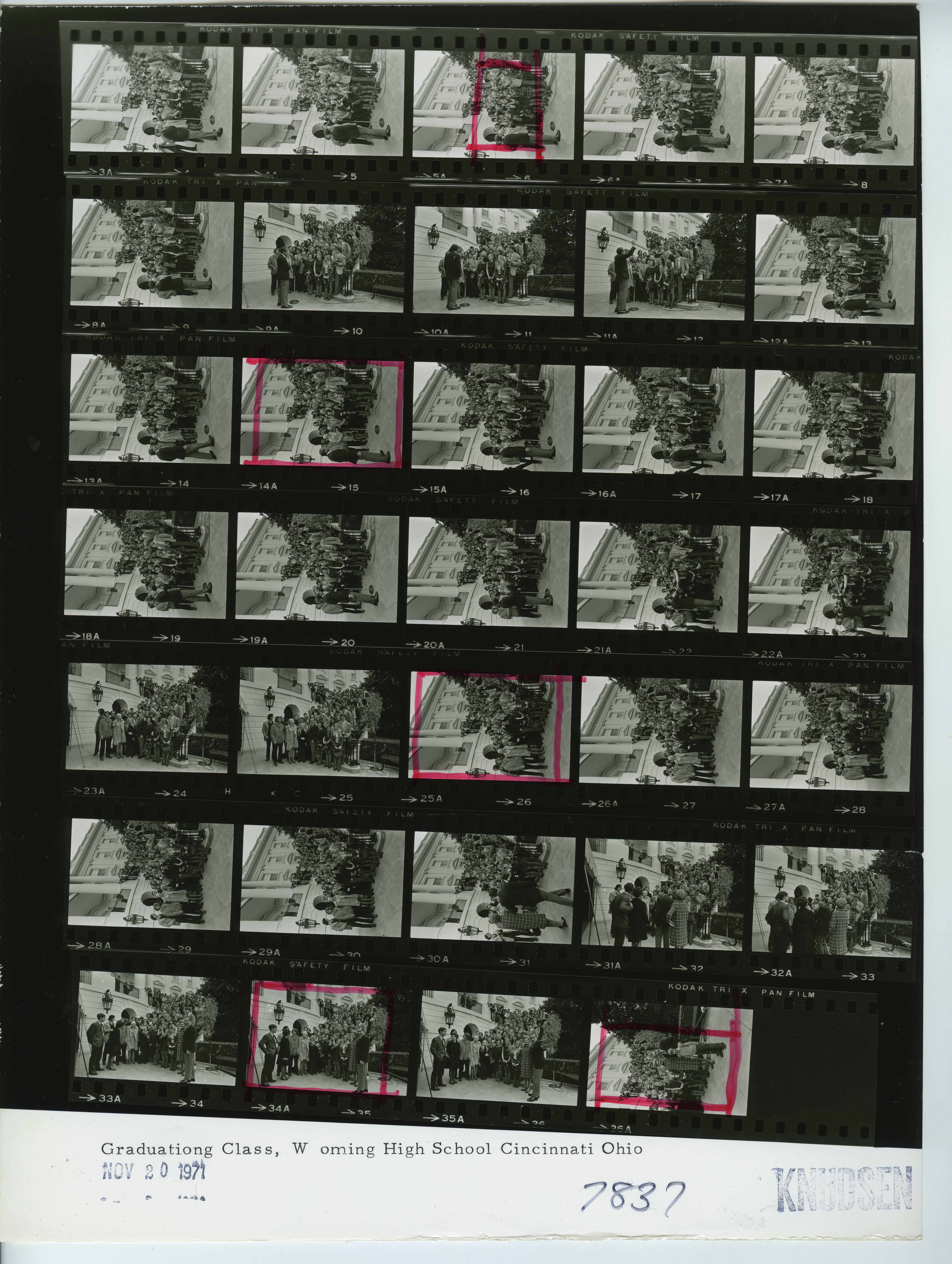
- Frame(s): WHPO-7837-03A-36A, President Nixon speaking with the graduating class of Wyoming High School from Cincinnati, Ohio, while they stand in a group on the Diplomatic Entrance Steps for a portrait. 11/20/1971, Washington, D.C. White House, Diplomatic Entrance steps. President Nixon, Julie Nixon Eisenhower, David Eisenhower, large group of Ohio high school seniors, adults.
Roll WHPO-7841 Photographer: Schumacher, Karl | Color or B&W: B&W
- Frame(s): WHPO-7841-05-09, President Nixon, head and shoulders, with a student with a camera in the background, talking with graduating seniors from Wyoming High School, Cincinnati, Ohio (not pictured). 11/20/1971, Washington, D.C. White House, Diplomatic Entrance steps. President Nixon, Ohio high school seniors, adults.
- Frame(s): WHPO-7841-08, Profile of President Nixon at the microphone, talking with graduating seniors from Wyoming High School, Cincinnati, Ohio (not pictured). 11/20/1971, Washington, D.C. White House, Diplomatic Entrance steps. President Nixon.
- Frame(s): WHPO-7841-10-23, President Nixon talking with graduating seniors from Wyoming High School, Cincinnati, Ohio. 11/20/1971, Washington, D.C. White House, Diplomatic Entrance steps. President Nixon, Ohio high school seniors, unidentified adults.
- Frame(s): WHPO-7841-12, President Nixon talking with graduating seniors from Wyoming High School, Cincinnati, Ohio. 11/20/1971, Washington, D.C. White House, Diplomatic Entrance steps. President Nixon, Ohio high school seniors, unidentified adults.
- Frame(s): WHPO-7841-24, Head and shoulders portrait of President Nixon preparing to board a helicopter, bound for Camp David. 11/20/1971, Washington, D.C. White House, South Lawn. President Nixon.
- Frame(s): WHPO-7841-24-31, President Nixon preparing to board a helicopter, bound for Camp David. 11/20/1971, Washington, D.C. White House, South Lawn. President Nixon, Ohio high school seniors, adults.
The White House Communications Agency Sound Recordings Collection contains public statements that took place between 1969 and 1974. Visit the finding aid to learn more.
P - Formal Presidential Remarks
- WHCA-SR-P-711116
Remarks by President Nixon to high school students. (11/20/1971)
Runtime: 8:35
Original Format: 1/4-inch reel-to-reel audiotape. Original source type: Original.
The White House Communications Agency Videotape Collection contains “off-the-air” recordings of televised programs produced between 1968 and 1974. Visit the finding aid to learn more.
- WHCA-4834
Weekly News Summary, Tape I.
ALL NETWORKS
Runtime: 1:30
17. Utley/Lewis: Army of the Republic of Viet Nam (ARVN) forces leading into Cambodia. Time Code Start: 40:17. Keywords: Cambodia, Vietnam War, South Vietnamese Army (SVA), military, troops. Network: NBC.
18. Utley/Duke/Delaney/Bell: Phase II coal miners get pay raise and railroad workers (rail workers) want pay raise. Time Code Start: 42:59. Keywords: coal mining, miners, mine workers, strikes, employees, railroads, trains, cabinet, advisors, wage and price controls, freezes, prices, costs, increases, decreases, economy, economics, budgets, finances, recession, inflation, money. Network: NBC.
19. Utley/Briggs: Agriculture and the administration. Time Code Start: 48:35. Keywords: food, agricultural products, crops, farming, bills, laws, proposals. Network: NBC.
20. Utley/Brinkley: Airplanes that cost too much and then don't work. Time Code Start: 51:24. Keywords: aviation, aircraft, damages, manufacturing, costs. Network: NBC.
21. Utley: President Nixon with Cincinnatti, Ohio school kids at the White House. Time Code Start: 56:41. Keywords: Presidents, students, children, youth, visits. Network: NBC.
22. Mudd/Shaw: Phase II, Connally and the Pay Board. Time Code Start: 59:10. Keywords: wage and price controls, freezes, prices, costs, increases, decreases, economy, economics, budgets, finances, recession, inflation, money. Network: CBS.
23. Mudd: President Nixon's reception back to the White House after trip to Miami, Florida. Time Code Start: 62:05. Keywords: elections, campaigns, campaigning, primaries, candidates, voting, speeches. Network: CBS.
24. Mudd: Sam Yorty in New Hampshire. Time Code Start: 63:03. Keywords: Mayors, Presidential elections, campaigns, campaigning, candidates. Network: CBS.
25. Mudd/Walker: The black vote in the Presidential election. Time Code Start: 65:00. Keywords: Vote, voters, voting, Presidential elections, candidates, campaigns, campaigning, voting, African Americans. Network: CBS.
26. Mudd/Serafin: Anti-abortion rally in Washington, D.C.. Time Code Start: 66:19. Keywords: demonstrations, rally, protesters, demonstraters, demonstrators, anti-abortion, birth. Network: CBS.
27. Mudd: Middle East conflict. Time Code Start: 67:24. Keywords: Middle East, Mideast, war. Network: CBS.
28. Mudd: [Blood in Cambodia]?. Time Code Start: 68:20. Keywords: Cambodia, Vietnam War, needs review, not listed in Vanderbildt News archive. Network: CBS.
Context (External Sources)
The Vanderbilt Television News Archive is the world's most extensive and complete archive of television news. They have been recording, preserving and providing access to television news broadcasts of the national networks since August 5, 1968.
Wikipedia is a free encyclopedia that anyone can edit.