
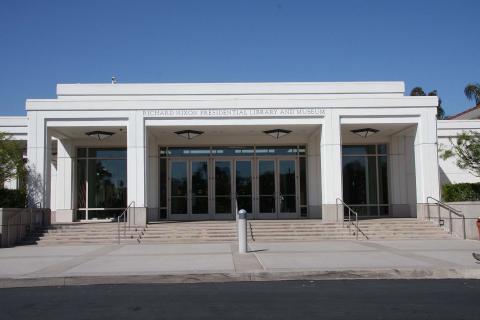
Introduction
This almanac page for Monday, November 1, 1971, pulls together various records created by the federal government and links to additional resources which can provide context about the events of the day.
Previous Date: Sunday, October 31, 1971
Next Date: Tuesday, November 2, 1971
Schedule and Public Documents
The Daily Diary files represent a consolidated record of the President's activities. Visit the finding aid to learn more.
The President's day began at The White House - Washington, D. C.
The Weekly Compilation of Presidential Documents made available transcripts of the President's news conferences; messages to Congress; public speeches, remarks, and statements; and other Presidential materials released by the White House.
Digitized versions can be found at HathiTrust.
The Federal Register is the official daily publication for rules, proposed rules, and notices of federal agencies and organizations, as well as executive orders and other Presidential documents.
No Federal Register published on this date
The Congressional Record is the official daily record of the debates and proceedings of the U.S. Congress.
Archival Holdings
Any selection of archival documents will necessarily be partial. You should use the documents and folders identified below as a starting place, but consult the linked collection finding aids and folder title lists and the collections themselves for context. Many documents to be found this way do not lend themselves to association with specific dates, but are essential to a complete understanding of the material.
Selective document listing
President's Office Files
The President's Office Files consists of materials drawn together by the Special Files Unit from several administrative subdivisions within the White House Office. It is the handwriting and sensitive papers sent to the Staff Secretary that now comprise much of the President's Office Files. Visit the finding aid to learn more.
- News Summaries, Annotated News Summaries, Box 31, News Summaries - November 1-15, 1971 [1 of 5] [Note: Due to the way News Summary products were compiled, you should also consult nearby days for potentially relevant materials.]
- Weekend News Review, November 1, 1971
The H. R. Haldeman Diaries consists of seven handwritten diaries, 36 dictated diaries recorded as sound recordings, and two handwritten audio cassette tape subject logs. The diaries and logs reflect H. R. Haldeman’s candid personal record and reflections on events, issues, and people encountered during his service in the Nixon White House. As administrative assistant to the President and Chief of Staff, Haldeman attended and participated in public events and private meetings covering the entire scope of issues in which the Nixon White House engaged in during the years 1969-1973. Visit the finding aid to learn more.
- Transcript of diary entry (PDF)
Monday, November 1st. The President had no schedule today except for a meeting with Laird at 4:00. So I spent the entire morning in the office with him going over a whole series of things, during which he had Alex in and out part of the time, Henry in and out, and Ziegler in and out.
The principal item of discussion today was the foreign aid problem again. We covered it in the staff meeting, getting into the problem of who's handling it, because it can't be left just to MacGregor. There are a lot of potential PR problems, and there's a strong feeling it could become a landmark question, and concern that AID is making their own deals. In the staff meeting, MacGregor reviewed the history, making the point that we have had a steadily shrinking small margin in the House for foreign aid over the last few years, and then we were faced with the Senate Foreign Relations Committee bill which had many bad amendments tacked on. And we fought to kill each of those, and lost support each time we did. Also the change in the composition of the Senate itself in last year's elections cost us seven supporters of foreign aid. We could only have avoided the adverse vote by starting months ago with separate packages and generated support for each of them, and that wasn't feasible, at least at that time. The feeling now is that Fulbright will go for all the economic aid sections and no military aid except for Israel. Our plan is to go for a continuing resolution. Hopefully for 120 days.
Kissinger argued strongly that we should go on the attack, that we should defend the President's initiatives. Maintain that we must strengthen the free world, that Congress is dismantling our basis for doing so. We shouldn't defend the military aid versus economic aid. We should just hit Congress for trying to wreck our foreign policy, for their capricious partisan reasons. We should not play the game of saving the good parts. We should pitch for a return to sanity and end to mischief making. Don't say what comes after the continuing resolution; just attack Congress. They screwed it up. Agree that no one likes foreign aid, but it's essential that we have it now.
Kissinger set up a meeting of all the Cabinet agencies, and so on, at 11:30 today, and reported to the President first on that. Saying that he's got to get them coordinated because he's found that, for instance, Hanna is work, has been working over the weekend with Javits on trying to save the humanitarian items and drop the military, whereas our foreign policy requires the military. The President said that now we should separate out the military part of it and send that through Armed Services. That it had been a mistake all along to run the whole thing through the Foreign Relations Committee. Henry also said he has George Ball pulling a group of establishment types together. Henry again made the point to the President that we should go on the attack. That our program is designed to keep the free world strong, the Senate has irresponsibly knocked it off. We should get the Senate on the defensive for thwarting the President's foreign policy, while he's planning his trip to Moscow, Peking, etcetera.
Also we should try to mobilize the establishment, if we can keep them on the military aid, not just the humanity. The problem is we have to give them a plan. The question is whether we can get Mahon to go on the 120 day continuing resolution. The President sent me out to check, at this point, with MacGregor, to see whether that was the case. MacGregor reported that Mahon was adamant on the continuing resolution, that he would run it only to the sine day, die adjournment and will not go beyond. Gerry Ford and Carl Albert agree with him, because they feel this puts maximum pressure on the Senate. Then, if necessary, we can extend the continuing resolution in December just before adjournment. They won't go now, though, for the 120 days, because that takes the heat off the Senate. They're going to try to get the Rules Committee to order a rule that they can consider the money bill before the authorization on foreign aid, the same as they plan to do on the Defense money bill. They think it would be good to show prompt action on a foreign aid money bill.
On the PR side, the President commented that it's inevitable that we take a whacking, and that there's a clear lesson here: that we will never change the media's minds. They only support us when we're so far ahead of them that they can do nothing else. He commented that the only answer to an attack is to take the offensive.
Ziegler came in. The President gave him some guidance on the foreign aid thing, saying to express confidence that the responsible members will prevail. We will not agree to any compromise, this is a balanced program. It will not succeed if the balance is destroyed. Military aid is essential to help others help themselves. Cambodia is a prime example. Ziegler then went out, and the President made the comment that, about the double standard that the press applies in all things and used the example of Tito versus Franco. Both of them are oppressive dictators, but everybody just glowed over the great success and friendship of the Tito visit, whereas they sneered at Franco under the same circumstances. The point being that Tito is a Communist and therefore can be praised, whereas Franco is a Fascist and must be condemned.
George Shultz came up with a theory at the staff meeting this morning, and re-expanded it at our Monday meeting, dinner meeting this evening, that there are a lot of deep currents beginning to flow now. That we have cut a lot of our basic moorings and we don't know exactly where we're headed. For instance, there's opposition building to a controlled economy, or the idea of one, and to the loss of foreign aid, and to the China seat. He thinks we should lay out all these and look at them as a tableau and consider the whole picture, not just the pieces. He thinks the President has unleashed a lot of new forces, so that every little nuance now becomes important, and we must be very careful regarding their reaction. Thus it's a very difficult time and delicate time. He comments that the President tends more than anyone to play the whole mosaic, while the others play the specific little items with which they're personally concerned.
Henry responded to that tonight by saying that he agreed, and saying that we have three basic problems that enter into this question: first is the Vietnam War, second is the hatred of Nixon by the establishment and the media, and third is the lack of creative support within the government itself, the bureaucracy and the Departments. The White House has the capability of cutting loose and knocking down established procedures and institutions, but we don't have the depth to build up new creative plans without the help of the Departments, and so on. Henry also at dinner tonight got into an analysis of the loss of the UN China vote making his theory...
-------------------------------------------------------------------------------------------------------------------
DECLASSIFIED - E.O. 13526, Sect. 3.4: by MS, NARA, June 12, 2013
Audio Cassette 15, Side A, Withdrawn Item Number 20 [AC-15(A) Sel 14]
Duration: 37 seconds
...very strongly that he was shafted by the State Department on purpose. That they could have easily delayed the vote for a week or so, and that would have enabled him to get back from China, and us to build our strength. He also feels that State purposefully made a big fuss out of their battle in order to try and get credit, and then had the vote, so that Henry would get the blame if it went wrong. He feels that we could have had the vote, if we had worked on Botswana land and Guyana, and people like that rather than the more prestigious big nations where we made a lot of stir, but didn't pick up any votes.
------------------------------------------------------------------------------------------------------------------
He's quite bitter about that whole thing.
The President had Alex and Ehrlichman in this morning to discuss plans for a political Cabinet meeting on Friday of this week. He doesn't want to have it with either the President or Connally there. He'll open the meeting and then leave. And he wants to have a carefully planned meeting, where we've decided in advance what we want the Cabinet officers to do and how we want to have it come out. He wants Ehrlichman to say at the Cabinet meeting that we've taken a bad rap on our positive accomplishments in the domestic field and on what we've proposed. So they should prepare, on a tightly reasoned, simple basis, a paper for each Department on what that Department's done. These must be available right after Christmas in terms of a three-year report of the Cabinet officer's stewardship of his Department, and then we'll release them one after the other and find ways to get them promoted. He feels we need to hit the Cabinet officers on the need to start to attack and get into the tough politics. John made the point that they need to hear that they should be released from their reticence to attack and to defend the President. We need to convince them they can amount to something if they get in and fight. We should, of course, exclude Defense and State from this, but then praise Bush which will give them a subtle message.
The President says to have the Vice President preside, but the AG should lead the discussion and have the agenda. He also should use Scali to tell the Cabinet officers that they have to attack to make news, and as a positive guy, to charge them up. Let him sell the Colson arguments, because you can't use Chuck because of the Mitchell problem. Also get Rumsfeld to program some spark into it. Scali should take Connally as an example. Make the point that he's not popular with the press, but he's highly effective. Also perhaps use the Vice President as an example. He says something, and they know, therefore, what he stands for. Others might do likewise.
The President got in with Henry to the plans for his meeting with Rogers tomorrow. First, he wants to program him to go out to the press and attack the Senate on the foreign aid vote.
Second, he wants to get in his head in setting up the Latin America trip, the idea of going to Brasilia for a meeting with all the heads of governments. Third...
-------------------------------------------------------------------------------------------------------------------
DECLASSIFIED - E.O. 13526, Sect. 3.4: by MS, NARA, June 12, 2013
Audio Cassette 15, Side A, Withdrawn Item Number 21 [AC-15(A) Sel 15]
Duration: 12 seconds
...he wants to tell him that Le Duc Tho will be in Paris on the 20th and that there will be a meeting with Henry at that time. And also that Tito told the President that the Russians are talking to North Vietnam.
------------------------------------------------------------------------------------------------------------------
The President feels he has to do this to get Rogers off the wicket of the November 15 announcement, because Rogers is pushing for making that the statement of the end of the war. The President feels on the November 15 thing, that we have to make that announcement as early as we can, but we have to wait until after the continuing resolution has passed, if that's possible. He plans to say that we'll withdraw 40,000 in two months, and then hold off on the end of the draft announcement until January. He may split the 40,000 and say 25,000 will be home before Christmas.
He got into quite a few discussions of personnel today. For instance, the problem of the AG and whether we can let him leave to run the campaign. He talked about the problem of Kleindienst succeeding, feeling that we can't get him confirmed, so maybe the thing to do is leave Mitchell at Justice and have Kleindienst come out and run the campaign under Mitchell's guidance. Or leave them both at Justice and let Mitchell run the campaign from there, or maybe have Mitchell take a leave of absence, or as a final alternative, to have someone else run the campaign. He discussed Elliot Richardson and made the point that he would be an outstanding Chief Justice, and that, since he's now got the two conservatives set for the Court, he would be willing to go to a middle-of-the-road guy; and if anything should happen to Burger, he wants to keep Richardson in mind, because he thinks he would be a towering, historic Chief Justice. He also got into the Hoover question. The President feels we have to delay the removal now because of the Mitchell question and the Princeton hearings on the FBI and all the other matters that are pending. The President's feeling is that we just let it go and announce sometime next year that Hoover will be resigning after the election and after his successor has qualified. That will put the heat on for Nixon's reelection to make sure he's the one that appoints the successor.
We talked about NATO. Kennedy apparently has said that he'll take it only up to the time of the Summit, which is not satisfactory. So the President now feels maybe we should go with a foreign service Ambassador who knows the track, rather than trying to train someone new in a rather complex thing at this point.
He said, regarding the State of the Union that he may not deliver a State of the Union to the Congress himself this year, because it's not worth getting into the battle on equal time, and so forth. That instead, he may go on television the night before from his office.
Continued on the other side.
[End of tape reel AC-15(A)]
[Begin of tape reel AC-15(B)]
Continuation of Monday, November 1. We’re talking about a plan for the State of the Union. The President feels that, by not going up to the Hill, he can avoid letting the camera picking up the Kennedy's reaction, etcetera. He feels this is not the year to go up there, because they'll be so political, and he's better off to do it under his own terms.
Colson talked to the President this afternoon about Dole's attitude. Says that he thinks Dole is under an emotional depression and is taking a very negative attitude on all these things, so the President feels I should set up a weekly session on politics to get the guys in to discuss this. Keep the people upbeat, and so on.
We had a meeting this afternoon with the Attorney General and Shultz regarding the Hoffa question. Mitchell raised the point that the time probably has come for the President to exercise executive clemency. He suggests burying this in the Christmas list in a batch of 250 or so. The President was trying to get at the point of how you position it. He said that we have to figure who's going to take us on it: first, the people who don't like labor leaders, and second, Teddy Kennedy, because of Bobby. The question is what our political benefit is, and what is in the balance. The inevitable charge will be that this is done for political support. The line the President would use is that he's met the normal requirements for release and there should not be discrimination against him because he's a labor leader. He also raised the question of how McClellan will take it. In the same meeting, the question came up of the Wage Price Board and what our options are if Meany should decide at some point to walk out, which it's quite likely that he'll do. He told Shultz to get a contingency plan ready for this. And we discussed that further at the Monday night dinner this evening.
End of November 1st. - Original audio recording (MP3)
The National Archives Catalog is the online portal to the records held at the National Archives, and information about those records. It is the main way of describing our holdings and also provides access to electronic records and digitized versions of our holdings.
The Catalog searches across multiple National Archives resources at once, including archival descriptions, digitized and electronic records, authority records, and web pages from Archives.gov and the Presidential Libraries. The Catalog also allows users to contribute to digitized historical records through tagging and transcription.
Nixon Library Holdings
All National Archives Units
National Security Documents
The President's Daily Brief is the primary vehicle for summarizing the day-to-day sensitive intelligence and analysis, as well as late-breaking reports, for the White House on current and future national security issues. Read "The President's Daily Brief: Delivering Intelligence to Nixon and Ford" to learn more.
The Foreign Relations of the United States series presents the official documentary historical record of major U.S. foreign policy decisions and significant diplomatic activity. Visit the State Department website for more information.
Vol. II, Organization and Management of U.S. Foreign Policy, 1969-1972
The Intelligence Community and the White House
240. Letter From President Nixon to Director of Central Intelligence Helms, Washington, November 1, 1971
Source: Central Intelligence Agency, Executive Registry Files, Job 80–M01048A, Box 15, Folder 5, Ex Dir/Comptroller (Colby) Files, Intelligence Community. Secret.
Vol. III, Foreign Economic Policy; International Monetary Policy, 1969-1972
International Monetary Policy, 1969-1972
188. Information Memorandum From Robert Hormats of the National Security Council Staff to the President’s Assistant for National Security Affairs (Kissinger), Washington, November 1, 1971
Source: National Archives, Nixon Presidential Materials, NSC Files, Agency Files, Box 268, Office of Management and Budget. Confidential. Initialed by Haig. A stamped notation on the memorandum reads: “HAK has seen.”
Vol. IV, Foreign Assistance, International Development, Trade Policies, 1969-1972
Foreign Assistance Policy, 1969-1972
71. Note From the President’s Deputy Assistant for National Security Affairs (Haig) to the President’s Assistant for National Security Affairs (Kissinger), Washington, November 1, 1971
Source: National Archives, Nixon Presidential Materials, NSC Files, Agency Files, Box 195, AID 1/1/71-12/21/71. No classification marking. Concurred in by MacGregor and Kissinger.
Vol. VII, Vietnam, July 1970-January 1972
Military and Diplomatic Stalemate, October 11, 1971-January 26, 1972
274. Memorandum From the President’s Assistant for National Security Affairs (Kissinger) to President Nixon, Washington, November 1, 1971
Source: National Archives, Nixon Presidential Materials, NSC Files, Box 1035, Files for the President, China Materials, China, HAK’s October 1971 Visit. Top Secret; Sensitive; Exclusively Eyes Only. Sent for information. The memorandum is unsigned and no specific date is indicated. It is printed in full in Foreign Relations, 1969–1976, volume XVII, China, 1969–1972, Document 164.
Vol. XVII, China, 1969-1972
China, October 1971-February 1972
164. Memorandum From the President’s Assistant for National Security Affairs (Kissinger) to President Nixon, Washington, November 1, 1971
Source: National Archives, Nixon Presidential Materials, NSC Files, Box 1035, Files for the President—China Material, China, HAK’s October 1971 Visit. Top Secret; Sensitive; Exclusively Eyes Only. Sent for information. Dated “11/71.” This text is 45 pages long; a 32-page version is ibid., RG 59, S/S Files: Lot 73 D 443, Personal Papers of William P. Rogers, China. This version is edited much the same way as Kissinger’s report on his July 1971 visit to the PRC (see footnote 1, Document 144) and also lacks references to progress toward a Sino-American communiqué.
Vol. XXXIV, National Security Policy, 1969-1972
The Defense Budget and U.S. National Security Policy
201. Conversation Among President Nixon, Secretary of Defense Laird, and the President’s Assistant for National Security Affairs (Kissinger), Washington, November 1, 1971
Source: National Archives, Nixon Presidential Materials, White House Tapes, Recording of Conversation among Nixon, Laird, and Kissinger, Executive Office Building, Conversation No. 302–32. No classification marking. The editor transcribed the portion of the tape recording printed here specifically for this volume. The transcript is part of a larger conversation that occurred from 2:54 to 4 p.m. (Ibid., White House Central Files, President’s Daily Diary)
Vol. E-1, Documents on Global Issues, 1969-1972
U.S. Policy Towards International Production and Trafficking in Illegal Drugs
211. Circular Airgram CA-4945 from the Department of State to all NEA Diplomatic and Consular Posts, Washington, November 1, 1971
The Bureau of Near Eastern and South Asian Affairs circulated a concept paper with proposals for an anti-narcotics program for the region.
Source: National Archives, RG 59, Central Files 1970-73, SOC 11-5. Limited Official Use. Drafted by James H. Broughton (NEA/RA) on October 28, cleared by Davies, and approved by Stanley D. Schiff (NEA/RA).
Vol. E-16, Documents on Chile, 1969-1973
Cool and Correct: The U.S. Response to the Allende Administration, November 5, 1970-December 31, 1972
89. Airgram From the Embassy in Chile to the Department of State, Santiago, November 1, 1971
Summary: This airgram summarized the Chilean Constitutional Reform Law for the nationalization of the major copper mines, providing a detailed analysis of the terms of the original bill, its subsequent congressional modifications, and the President’s determination of the “excess profits” provision. It concluded that Allende’s government had consciously applied a particularly harsh interpretation of the law to U.S. companies.
Source: National Archives, RG 59, Central Files 1970–73, INCO–COPPER CHILE. Limited Official Use. Drafted by Kessler on October 19. Sent with the notation to pass to OPIC.
The Kissinger telephone conversation transcripts consist of approximately 20,000 pages of transcripts of Kissinger’s telephone conversations during his tenure as Assistant to the President for National Security Affairs (1969-1974) and Secretary of State (1973-1974) during the administration of President Richard Nixon. Visit the finding aid for more information.
Digitized versions can be found in the National Archives Catalog.
Audiovisual Holdings
The White House Tapes are sound recordings of President Richard Nixon's telephone conversations and of meetings held in the Oval Office and the Cabinet Room in the White House, the President's office in the Old Executive Office Building (OEOB), the Lincoln Sitting Room in the residence section of the White House, and several locations at the Presidential retreat at Camp David, Maryland. These recordings document many of the major events and decisions of the Nixon Administration from February 16, 1971 to July 18, 1973. Visit the White House Tapes finding aid to learn about the taping system's operation and archival processing.
Old Executive Office Building
- 302-19; Unknown between 1:46 p.m. & 2:29 p.m.; Nixon, Richard M. (President); [Unknown person(s)]
- 302-20; Unknown between 1:46 p.m. & 2:29 p.m.; Nixon, Richard M. (President); Sanchez, Manolo
- 302-21; Unknown between 1:46 p.m. & 2:29 p.m.; Nixon, Richard M. (President); Sanchez, Manolo
- 302-22; Unknown between 1:46 p.m. & 2:29 p.m.; Nixon, Richard M. (President); Sanchez, Manolo
- 302-23; Unknown between 1:46 p.m. & 2:29 p.m.; Nixon, Richard M. (President); [Unknown person(s)]
- 302-24; Unknown between 1:46 p.m. & 2:29 p.m.; Nixon, Richard M. (President); Woods, Rose Mary
- 302-25; Unknown between 1:46 p.m. & 2:29 p.m.; Nixon, Richard M. (President); Kissinger, Henry A.
- 302-26; Unknown between 1:46 p.m. & 2:29 p.m.; Nixon, Richard M. (President); White House operator
- 302-27; 2:29 p.m. - 2:30 p.m.; Nixon, Richard M. (President); Nixon, Thelma C. ("Pat") (Ryan)
- 302-28; Unknown between 2:30 p.m. & 2:47 p.m.; Nixon, Richard M. (President); Sanchez, Manolo
- 302-29; Unknown between 2:30 p.m. & 2:47 p.m.; Nixon, Richard M. (President); Haldeman, H. R. ("Bob")
- 302-30; Unknown between 2:30 p.m. & 2:47 p.m.; Nixon, Richard M. (President); White House operator
- 302-31; 2:47 p.m. - 2:49 p.m.; Nixon, Richard M. (President); Ziegler, Ronald L.
- 302-32; 2:54 p.m. - 4:04 p.m.; Nixon, Richard M. (President); Kissinger, Henry A.; Laird, Melvin R.; Bull, Stephen B.; White House operator; Ziegler, Ronald L.
Oval Office
- 608-4; Unknown between 8:03 a.m. & 9:25 a.m.; Nixon, Richard M. (President); Colson, Charles W.; Bull, Stephen B.; Haldeman, H. R. ("Bob")
- 609-14; Unknown between 8:03 a.m. & 9:25 a.m.; Nixon, Richard M. (President); Acker, Marjorie P.
- 609-15; Unknown between 8:03 a.m. & 9:25 a.m.; Nixon, Richard M. (President); [Unknown person(s)]
- 609-16; Unknown between 8:03 a.m. & 9:25 a.m.; Nixon, Richard M. (President); Woods, Rose Mary
- 609-17; 9:25 a.m. - 1:30 p.m.; Nixon, Richard M. (President); Haldeman, H. R. ("Bob"); Kissinger, Henry A.; Ehrlichman, John D.; Butterfield, Alexander P.; Ziegler, Ronald L.
- 610-1; 4:04 p.m. - 5:08 p.m.; Nixon, Richard M. (President); Kissinger, Henry A.
- 610-2; 5:08 p.m. - 5:08 p.m.; Nixon, Richard M. (President); [Unknown person(s)]
- 610-3; Unknown between 5:08 p.m. & 11:59 p.m.; United States Secret Service agents
White House Telephone
- 13-52; 1:30 p.m. - 1:30 p.m.; Nixon, Richard M. (President); White House operator
- 13-53; Unknown between 1:46 p.m. & 2:29 p.m.; Nixon, Richard M. (President); White House operator
- 13-54; 2:29 p.m. - 2:30 p.m.; Nixon, Richard M. (President); Nixon, Thelma C. ("Pat") (Ryan)
- 13-55; Unknown between 2:30 p.m. & 2:47 p.m.; Nixon, Richard M. (President); White House operator
- 13-56; 2:47 p.m. - 2:49 p.m.; Nixon, Richard M. (President); Ziegler, Ronald L.
- 13-57; Unknown between 2:55 p.m. & 3:55 p.m.; Nixon, Richard M. (President); White House operator
- 13-58; 3:55 p.m. - 3:56 p.m.; Kissinger, Henry A.; Ziegler, Ronald L.
- 13-59; Unknown between 5:18 p.m. & 5:34 p.m.; Nixon, Richard M. (President); White House operator
- 13-60; 7:42 p.m. - 8:03 p.m.; Nixon, Richard M. (President); Colson, Charles W.
- 13-61; Unknown between 8:03 p.m. & 8:12 p.m.; Nixon, Richard M. (President); White House operator
- 13-62; 8:12 p.m. - 8:17 p.m.; Nixon, Richard M. (President); Kissinger, Henry A.
The White House Photo Office collection consists of photographic coverage of President Richard Nixon meeting with prominent social, political, and cultural personalities; speaking engagements and news conferences of the President and various high-ranking members of the White House staff and Cabinet; Presidential domestic and foreign travel, including Presidential vacations; social events and entertainment involving the First Family, including entertainers present; official portraits of the President, First Family, and high-ranking members of the Nixon administration; the 1969 and 1973 Inaugurals; the President’s 1972 Presidential election campaign appearances (including speeches) and other official activities of the White House staff and the President’s Cabinet from January 20, 1969 until August 9, 1974 at the White House and the Old Executive Office Building; other locations in Washington, DC, such as The Mall; and the Presidential retreats in Camp David, Maryland, Key Biscayne, Florida, and San Clemente, California. Visit the finding aid to learn more.
Roll WHPO-7703 Photographer: Schumacher, Karl | Color or B&W: B&W
- Frame(s): WHPO-7703-01A-10A, Harry Dent receiving a gift presentation from unidentified men. 11/1/1971, Washington, D.C. unknown. Harry Dent, unidentified men.
- Frame(s): WHPO-7703-12A-13A, Unidentified men eating at a table. 11/1/1971, Washington, D.C. unknown. unidentified men.
Roll WHPO-7704 Photographer: Schumacher, Karl | Color or B&W: B&W
- Frame(s): WHPO-7704-05A-10A, John Nidecker with disabled young people group. 11/1/1971, Washington, D.C. White House, East Room. John Nidecker, unidentified young people.
- Frame(s): WHPO-7704-11A-14A, 16A-17A, Ground Floor Corridor. 11/1/1971, Washington, D.C. White House, Ground Floor Corridor.
- Frame(s): WHPO-7704-15A, Unidentified man in front of displayed China. 11/1/1971, Washington, D.C. White House, China Room. unidentified man.
Roll WHPO-7707 Photographer: Knudsen, Robert L. | Color or B&W: B&W
- Frame(s): WHPO-7707-02-19, President Nixon walking down the stairs of the Executive Office Builiding (EOB) to the White House with Henry Kissinger and Secretary of Defense Melvin R. Laird. 11/1/1971, Washington, D.C. Executive Office Building (EOB), exterior. President Nixon, Henry Kissinger, Melvin Laird.
- Frame(s): WHPO-7707-07A, President Nixon walking down the stairs of the Executive Office Builiding (EOB) to the White House with Henry Kissinger and Secretary of Defense Melvin R. Laird. 11/1/1971, Washington, D.C. Executive Office Building (EOB), exterior. President Nixon, Henry Kissinger, Melvin Laird.
Roll WHPO-7708 Photographer: Knudsen, Robert L. | Color or B&W: B&W
- Frame(s): WHPO-7708-02-04, President Nixon sitting at his desk with Robert Kunzig, Administrator of GSA, and Fred Malek. 11/1/1971, Washington, D.C. White House, Oval Office. President Nixon, Robert Kunzig, Fred Malek.
The White House Communications Agency Sound Recordings Collection contains public statements that took place between 1969 and 1974. Visit the finding aid to learn more.
E - Secretary of Defense Briefings
- WHCA-SR-E-025
Press briefing by Sec. Def. Melvin Laird at "Press Center". (11/1/1971, Press Center)
Runtime: 22:00
Production credits: Audio feed supplied by WHCA; Recorded by RRS (Bob Schroder, WHCA engineer)
Original Format: 1/4-inch reel-to-reel audiotape. Original source type: Original.
The White House Communications Agency Videotape Collection contains “off-the-air” recordings of televised programs produced between 1968 and 1974. Visit the finding aid to learn more.
- WHCA-4770
United Nations Vote and Reactions from: "CBS Evening News", "CBS Morning News", and the "Today" Show Also includes spots from tape supplied by Al Snyder. 30M: AFL-CIO President George Meany.
WETA, WETA Public Affairs
Runtime: 1:00 - WHCA-4778
Weekly News Summary, Tape I.
ALL NETWORKS
Runtime: 01:36:29
16. Smith/Jarriel: U.S. foreign aid policy discussed by Secretary of Defense Laird (President Nixon, Kissinger) and Senator Scott, Senator Fulbright. Clark on Capitol Hill reaction. Time Code Start: 37:13. Keywords: bills, laws, financial aid, funding, reactions, cabinet, advisors, media, interviews, statements. Network: ABC.
17. Smith: Commentary on happiness with Foreign Aid Bill defeat in light of history. Time Code Start: 41:19. Keywords: bills, laws, voting, Senators, financial aid, funding, committees, vetoes, reactions. Network: ABC.
18. Chancellor/Duke: Reactions to defeat of Foreign Aid Bill in Senate vote (Senator Fulbright, Senator Scott, Senator Church). Time Code Start: 42:59. Keywords: bills, laws, voting, Senators, financial aid, funding. Network: NBC.
19. Chancellor/Bourgholtzer: Yugoslavian President Tito visits aircraft factory in California. Time Code Start: 45:47. Keywords: Presidents, travel, trips, aviation industry, manufacturing, planes. Network: NBC.
20. Chancellor/Lord: Allied troop levels lowering. Time Code Start: 47:19. Keywords: Vietnam War, Armed Forces, mlitary, troops, decreases, withdrawals. Network: NBC.
21. Cronkite/Kalb/Rather: Reactions to defeated Foreign Aid Bill (President Nixon, Kissinger, Secretary of Defense Laird, Senator Fulbright, Senator Church, Senator Scott, Senator Javitz). Time Code Start: 49:21. Keywords: bills, laws, voting, Senators, financial aid, funding, committees, vetoes. Network: CBS.
22. Cronkite: Red China flag at United Nations (U.N.). Time Code Start: 53:19. Keywords: organization of nations, intergovernmental alliance, People's Republic of China, voting, admissions. Network: CBS.
23. Cronkite: White House and American Bar Association (ABA) argue over procedure of releasing names of Supreme Court nominees. Time Code Start: 53:46. Keywords: law officials, lawyers, attorneys, organizations, regulations, justices, nominations. Network: CBS.
24. Cronkite/Sevareid: Commentary on U.S. foreign aid policy. Time Code Start: 54:32. Keywords: bills, laws, financial aid, funding. Network: CBS.
Context (External Sources)
The Vanderbilt Television News Archive is the world's most extensive and complete archive of television news. They have been recording, preserving and providing access to television news broadcasts of the national networks since August 5, 1968.
Wikipedia is a free encyclopedia that anyone can edit.