
Introduction
This almanac page for Thursday, May 3, 1973, pulls together various records created by the federal government and links to additional resources which can provide context about the events of the day.
Previous Date: Wednesday, May 2, 1973
Next Date: Friday, May 4, 1973
Schedule and Public Documents
The Daily Diary files represent a consolidated record of the President's activities. Visit the finding aid to learn more.
The President's day began at The White House - Washington, D. C.
The Weekly Compilation of Presidential Documents made available transcripts of the President's news conferences; messages to Congress; public speeches, remarks, and statements; and other Presidential materials released by the White House.
Digitized versions can be found at HathiTrust.
Each Public Papers of the Presidents volume contains the papers and speeches of the President of the United States that were issued by the White House Office of the Press Secretary during the time period specified by the volume. The material is presented in chronological order, and the dates shown in the headings are the dates of the documents or events. In instances when the release date differs from the date of the document itself, that fact is shown in the text note.
To ensure accuracy, remarks have been checked against audio recordings (when available) and signed documents have been checked against the original, unless otherwise noted. Editors have provided text notes and cross references for purposes of identification or clarity.
The Federal Register is the official daily publication for rules, proposed rules, and notices of federal agencies and organizations, as well as executive orders and other Presidential documents.
The Congressional Record is the official daily record of the debates and proceedings of the U.S. Congress.
Archival Holdings
Any selection of archival documents will necessarily be partial. You should use the documents and folders identified below as a starting place, but consult the linked collection finding aids and folder title lists and the collections themselves for context. Many documents to be found this way do not lend themselves to association with specific dates, but are essential to a complete understanding of the material.
Selective document listing
President's Office Files
The President's Office Files consists of materials drawn together by the Special Files Unit from several administrative subdivisions within the White House Office. It is the handwriting and sensitive papers sent to the Staff Secretary that now comprise much of the President's Office Files. Visit the finding aid to learn more.
- News Summaries, Unmarked News Summaries, Box 55, News Summaries - May 1-16, 1973 [3 of 8] [Note: Due to the way News Summary products were compiled, you should also consult nearby days for potentially relevant materials.]
- News Summary, May 3, 1973, (Wed. nets, wires, columns)
President's Personal File
The President's Personal File is essentially a President's secretary's file, kept by Rose Mary Woods, personal secretary to the President, for two purposes: (1) preserving for posterity a collection of documents particularly close to the President, whether because he dictated or annotated them, or because of the importance of the correspondent or the event concerned and (2) giving appropriate attention–letters of gratitude, invitations to White House social events, and the like–to members and important friends and supporters of the Nixon administration. This generalization does not describe all the varied materials of a file group which is essentially a miscellany, but it does identify the reason for the existence of the file group's core. Visit the finding aid to learn more.
- President's Speech File
The National Archives Catalog is the online portal to the records held at the National Archives, and information about those records. It is the main way of describing our holdings and also provides access to electronic records and digitized versions of our holdings.
The Catalog searches across multiple National Archives resources at once, including archival descriptions, digitized and electronic records, authority records, and web pages from Archives.gov and the Presidential Libraries. The Catalog also allows users to contribute to digitized historical records through tagging and transcription.
Nixon Library Holdings
All National Archives Units
National Security Documents
The President's Daily Brief is the primary vehicle for summarizing the day-to-day sensitive intelligence and analysis, as well as late-breaking reports, for the White House on current and future national security issues. Read "The President's Daily Brief: Delivering Intelligence to Nixon and Ford" to learn more.
The Foreign Relations of the United States series presents the official documentary historical record of major U.S. foreign policy decisions and significant diplomatic activity. Visit the State Department website for more information.
Vol. XV, Soviet Union, June 1972-August 1974
Kissinger's Pre-Summit Trip to Moscow, May 1973
102. Letter From Soviet General Secretary Brezhnev to President Nixon, Moscow, May 3, 1973
Source: National Archives, Nixon Presidential Materials, NSC Files, Kissinger Office Files, Box 68, Country Files—Europe—USSR, Dobrynin/Kissinger, Vol. 17. No classification marking. A handwritten notation at the top of the page reads: “Handed to HAK by Vorontsov, 7:15 pm, May 3, 1973.”
103. National Security Decision Memorandum 215, Washington, May 3, 1973
Source: National Archives, Nixon Presidential Materials, NSC Files, NSC Institutional Files (H-Files), Box H–208, NSDM 151–NSDM 200, Originals. Secret. Copies were sent to the Director of Central Intelligence and the Chairman of the JCS. Sonnenfeldt forwarded the draft NSDM to Kissinger on April 30 for his signature. (Ibid., Box H–239, Policy Papers, NSDM 215 [2 of 2])
Vol. XVIII, China, 1973-1976
Kissinger's Visits to Beijing and the Establishment of the Liaison Offices, January 1973-May 1973
30. Conversation Between President Nixon and the Chief-Designate of the Liaison Office in China (Bruce), Washington, May 3, 1973
Source: National Archives, Nixon Presidential Materials, White House Tapes, Conversation No. 911–9. No classification marking. The editor transcribed the portions of the conversation printed here specifically for this volume. According to the President’s Daily Diary, Nixon spoke with Bruce in the Oval Office from 9:48 until 10:12 a.m. (Ibid., White House Central Files)
31. Memorandum From Robert D. Hormats and Richard H. Solomon of the National Security Council Staff to the President’s Assistant for National Security Affairs (Kissinger), Washington, May 3, 1973
Source: National Archives, Nixon Presidential Materials, NSC Files, Box 527, Country Files, Far East, People’s Republic of China, Vol. 7, May-Jul 9, 1973. Secret. Sent for action.
Vol. XXV, Arab-Israeli Crisis and War, 1973
Arab-Israeli Crisis and War, 1973
51. Memorandum of Conversation, Washington, May 3, 1973, 6:30-7:15 p.m.
Source: National Archives, Nixon Presidential Materials, NSC Files, Kissinger Office Files, Box 135, Country Files, Middle East, Rabin/Dinitz Sensitive Memcons, 1973. Top Secret; Sensitive; Exclusively Eyes Only. The meeting took place in the Map Room at the White House.
Vol. XXXIII, SALT II, 1972-1980
SALT II, 1972-1980
23. National Security Decision Memorandum 213, Washington, May 3, 1973
Source: National Archives, Nixon Presidential Materials, NSC Institutional Files (H–Files), Box H–208, National Security Decision Memoranda, NSDM 201–NSDM 250, Originals. Top Secret; Sensitive. Copies were sent to the Chairman of the Joint Chiefs of Staff and the Director of Central Intelligence.
Vol. XXXVI, Energy Crisis, 1969-1974
March 8-October 5, 1973
182. Memorandum From James H. Critchfield, Special Assistant to the Deputy Director of Operations, Central Intelligence Agency, to Director of Central Intelligence Schlesinger, Washington, May 3, 1973
Source: Central Intelligence Agency, Executive Registry Files, Job 80–M01048A, Box 4. Secret; Sensitive. Sent through the Acting Deputy Director for Operations.
Vol. XXXVIII, Part 1, Foundations of Foreign Policy, 1973-1976
Foundations of Foreign Policy, 1973-1976
9. President Nixon’s Fourth Annual Report to the Congress on U.S. Foreign Policy, Washington, May 3, 1973
Source: Public Papers: Nixon, 1973, pp. 348–518. The report was issued by the White House in a 234-page booklet entitled “U.S. Foreign Policy for the 1970’s: Shaping a Durable Peace; A Report to Congress by Richard Nixon, President of the United States, May 3, 1973.” Under a November 16, 1972, covering memorandum, Rogers forwarded to Kissinger a paper entitled “Themes and Textual Suggestions for the President’s Annual Review of American Foreign Policy.” (National Archives, Nixon Presidential Materials, NSC Files, Subject Files, Box 328, The President’s Annual Review of Foreign Policy 1972 (Agency Submissions) Vol I)
10. Conversation Between President Nixon and Ambassador David K.E. Bruce, Washington, May 3, 1973
Source: National Archives, Nixon Presidential Materials, White House Tapes, Conversation 911–9. No classification marking. The editor transcribed the portion of the conversation printed here specifically for this volume. According to the President’s Daily Diary, Bruce and Nixon met in the White House Oval Office from 9:48 until 10:12 a.m. (Ibid., White House Central Files) Appointed on March 15 as Chief of the new U.S. Liaison Office, Bruce presented his credentials in Beijing on May 14.
Vol. E-8, Documents on South Asia, 1973-1976
India-Pakistan 1
126. Telegram 3585 From the Embassy in Pakistan to the Department of State, Islamabad, May 3, 1973, 0605Z
The Embassy assessed Pakistan’s domestic political situation as more stable following its government’s passage of a new constitution on April 10.
Source: National Archives, RG 59, Central Files 1970–73, POL 15–1 PAK. Confidential. It was repeated to Kabul, Karachi, Lahore, New Delhi, and Tehran. The Embassy had reported on the ratification process in telegrams 2903, April 10 (Ibid.), 2993, April 12, (Ibid., Central Foreign Policy Files), and 3017, April 13, (Ibid., Central Files 1970–73, POL 15–5 PAK) all from Islamabad.
Vol. E-9, Part 2, Documents on the Middle East Region, 1973-1976
Saudi Arabia
87. Memorandum From Harold H. Saunders and William B. Quandt of the National Security Council Staff to the President’s Assistant for National Security Affairs (Kissinger), Washington, May 3, 1973
Summary: The NSC asked for Kissinger’s decision on whether to provide, in principle, the F–4 Phantom jet fighter/bomber to Saudi Arabia and Kuwait.
Source: National Archives, Nixon Presidential Materials, NSC Files, Box 647, Country Files, Middle East, Middle East (General) Volume 9, 1972–74. Secret; Sent for action. On May 17, Kissinger approved, in principle only, the sale of the F–4 to Saudi Arabia with no decision on Kuwait. At the top of the memorandum Kissinger wrote “Brent: Send forward Thursday [May 17].” He also then wrote “OK.” Prince Sultan requested approval for the sale on April 24 in meetings with CINCEUR General Andrew Goodpaster, as reported in telegram 304 from Dhahran, April 25. (Ibid., Box 630, Country Files, Middle East, Saudi Arabia, Volume III, September 1, 1971—April 1973) Ambassador Thacher informed Acting Minister of Defense Prince Turki of the decision on May 18. (Ibid.)
Vol. E-12, Documents on East and Southeast Asia, 1973-1976
Pacific Islands
305. Memorandum From the President’s Assistant for National Security Affairs (Kissinger) to President Nixon, Washington, May 3, 1973., Washington, May 3, 1973
Kissinger reported on the Under Secretaries Committee’s proposed instructions to Williams and asked Nixon to decide on the U.S. negotiating position toward Tinian.
Source: Ford Library, National Security Adviser, NSC East Asian and Pacific Affairs Staff: Files, (1969) 1973–1977, Box 36, Marianas (Working Files) [7]. Secret. Sent for action. The President initialed his approval of the first recommendation, which concerned the acquisition of Tinian, and the second recommendation, which approved the positions advocated by the USC. Tab A, draft instructions to Williams, is not attached. Tab B, the April 13 memorandum from Rush, the Chairman of the USC, to the President, is at National Archives, Nixon Presidential Materials, NSC Institutional Files (H-Files), Box H-276, Under Secretaries Decision Memorandums, U/DM 98 [1 of 5]. Tab C, a report from the DOS Political Advisor in the TTPI, is not attached.
Thailand and Burma
369. Memorandum From the President’s Assistant for National Security Affairs (Kissinger) to Secretary of Defense Richardson, Washington, May 3, 1973., Washington, May 3, 1973
Kissinger endorsed the Department of Defense’s request to maintain Thai Special Guerrilla Units after their withdrawal from Laos.
Source: National Archives, Nixon Presidential Materials, NSC Files, Box 565, Country Files, Far East, Thailand, Volume 10, 1973–. Secret; Sensitive. Richards’s memorandum of April 6 is attached but not published.
Vol. E-15, Part 2, Documents on Western Europe, 1973-1976, Second, Revised Edition
Western Europe Regional, 1973-1976
13. National Security Decision Memorandum 214, Washington, May 3, 1973
Summary: The President specified the guidelines that would govern the U.S. negotiating approach to the balance of payments offset and burden-sharing negotiations.
Source: National Archives, Nixon Presidential Materials, NSC Files, NSC Institutional Files (H-Files), Box H–239, Policy Papers, NSDM–214. Confidential. Copies were sent to the DCI, the Chairman of the JCS, and the President’s Assistant for International Economic Affairs. After reviewing a draft of this NSDM sent to him by Odeen on April 30, Kissinger directed: “Get something that authorizes deferral of actual negs [negotiations] till fall. Discussed with Brandt.” (Memorandum from Odeen to Kissinger, April 30; ibid.) For a memorandum of conversation recording Brandt’s May 1 discussion with Nixon and Kissinger in Washington, see Document 265. For a summary analysis of the study prepared in response to NSSM 170, see Document 11. For further documentation on the U.S.–FRG bilateral offset issue, see the West German compilation in this volume.
The Kissinger telephone conversation transcripts consist of approximately 20,000 pages of transcripts of Kissinger’s telephone conversations during his tenure as Assistant to the President for National Security Affairs (1969-1974) and Secretary of State (1973-1974) during the administration of President Richard Nixon. Visit the finding aid for more information.
Digitized versions can be found in the National Archives Catalog.
Audiovisual Holdings
Visit the White House Tapes finding aid to learn about the taping system's operation and archival processing.
Oval Office
- 911-1; 8:27 a.m. - 8:50 a.m.; Nixon, Richard M. (President); Kissinger, Henry A.; [Unknown person(s)]
- 911-2; 8:51 a.m. - 9:09 a.m.; Nixon, Richard M. (President); Kleindienst, Richard G.
- 911-3; Unknown between 9:09 a.m. & 9:11 a.m.; Nixon, Richard M. (President); Bull, Stephen B.
- 911-4; 9:11 a.m. - 9:30 a.m.; Nixon, Richard M. (President); Packard, David; Bull, Stephen B.
- 911-5; Unknown between 9:30 a.m. & 9:31 a.m.; Nixon, Richard M. (President); [Unknown person(s)]
- 911-6; 9:31 a.m. - 9:36 a.m.; Nixon, Richard M. (President); Kissinger, Henry A.
- 911-7; Unknown between 9:36 a.m. & 9:48 a.m.; Nixon, Richard M. (President); Bull, Stephen B.
- 911-8; Unknown between 9:36 a.m. & 9:48 a.m.; Nixon, Richard M. (President); [Unknown person(s)]
- 911-9; 9:48 a.m. - 10:12 a.m.; Nixon, Richard M. (President); Bruce, David K. E.; White House photographer; Members of the press; [Unknown person(s)]
- 911-10; Unknown between 10:12 a.m. & 10:13 a.m.; Nixon, Richard M. (President); White House operator
- 911-11; 10:13 a.m. - 10:21 a.m.; Nixon, Richard M. (President); Rogers, William P.
- 911-12; Unknown between 10:21 a.m. & 10:30 a.m.; Nixon, Richard M. (President); Kissinger, Henry A.
- 911-13; Unknown between 10:21 a.m. & 10:30 a.m.; Nixon, Richard M. (President); [Unknown person(s)]
- 911-14; Unknown between 10:21 a.m. & 10:30 a.m.; Nixon, Richard M. (President); Bull, Stephen B.
- 911-15; Unknown between 10:21 a.m. & 10:30 a.m.; Nixon, Richard M. (President); [Unknown person(s)]
- 911-16; 10:30 a.m. - 11:01 a.m.; Nixon, Richard M. (President); Ziegler, Ronald L.; [Unknown person(s)]
- 911-17; Unknown between 11:01 a.m. & 11:03 a.m.; Nixon, Richard M. (President); [Unknown person(s)]
- 911-18; 11:03 a.m. - 11:10 a.m.; Nixon, Richard M. (President); Brock, William; Baker, Howard H., Jr.; McMahan, Ronald; Waldon, C. E.; Beard, J. W.; Cheeseman, Robert; Reese, Jack; Wright, Alan; Moon, Kitty; Moore, Horace N.; Moore, Horace N. (Mrs.); Timmons, William E.; Friedersdorf, Max L.; Atkins, Oliver F. ("Ollie")
- 911-19; Unknown between 11:10 a.m. & 11:11 a.m.; Nixon, Richard M. (President); [Unknown person(s)]
- 911-20; 11:11 a.m. - 11:14 a.m.; Nixon, Richard M. (President); Foley, Thomas S.; Heerensperger, David J.; Sterr, William, Jr.; Sterr, William, Sr.; Lucero, James; Hewlett, Frank; Timmons, William E.; Friedersdorf, Max L.; White House photographer
- 911-21; 11:16 a.m. - 11:18 a.m.; Nixon, Richard M. (President); Devine, Samuel L.; Mnich, William; Timmons, William E.; Friedersdorf, Max L.; Atkins, Oliver F. ("Ollie")
- 911-22; Unknown between 11:18 a.m. & 11:19 a.m.; Nixon, Richard M. (President); [Unknown person(s)]
- 911-23; 11:19 a.m. - 11:24 a.m.; Nixon, Richard M. (President); Goldwater, Barry M.; Timmons, William E.; Friedersdorf, Max L.; White House photographer
- 911-24; 11:25 a.m. - 11:28 a.m.; Nixon, Richard M. (President); Derwinski, Edward J.; Liang, Mabel; Liang, Yuan; Liang, Yuan (Mrs.); Timmons, William E.; Friedersdorf, Max L.; White House photographer
- 911-25; Unknown between 11:28 a.m. & 11:30 a.m.; Nixon, Richard M. (President); [Unknown person(s)]
- 911-26; Unknown between 11:28 a.m. & 11:59 a.m.; Nixon, Richard M. (President); Bull, Stephen B.; Garment, Leonard; [Unknown person(s)]
- 911-27; 11:59 a.m. - 12:05 p.m.; Nixon, Richard M. (President); Helms, Jesse A.; Adams, C. Morris; Maxwell, Richard; Hawkins, John; Bencini, William; Martin, Barbara; Herring, Harold; Murrow, Coolidge C.; Timmons, William E.; Friedersdorf, Max L.; Atkins, Oliver F. ("Ollie")
- 911-28; 12:05 p.m. - 12:05 p.m.; Nixon, Richard M. (President); Bull, Stephen B.
- 911-29; Unknown between 12:13 p.m. & 12:15 p.m.; Nixon, Richard M. (President); [Unknown person(s)]
- 911-30; Unknown between 12:15 p.m. & 12:18 p.m.; Nixon, Richard M. (President); [Unknown person(s)]
- 911-31; 12:18 p.m. - 12:24 p.m.; Nixon, Richard M. (President); Kissinger, Henry A.; Haig, Alexander M., Jr.
- 911-32; 12:24 p.m. - 12:40 p.m.; Nixon, Richard M. (President); Shultz, George P.; [Unknown person(s)]
- 911-33; 12:40 p.m. - 12:52 p.m.; Nixon, Richard M. (President); Garment, Leonard
- 911-34; Unknown between 12:52 p.m. & 11:59 p.m.; United States Secret Service agents
White House Telephone
The White House Photo Office collection consists of photographic coverage of President Richard Nixon meeting with prominent social, political, and cultural personalities; speaking engagements and news conferences of the President and various high-ranking members of the White House staff and Cabinet; Presidential domestic and foreign travel, including Presidential vacations; social events and entertainment involving the First Family, including entertainers present; official portraits of the President, First Family, and high-ranking members of the Nixon administration; the 1969 and 1973 Inaugurals; the President’s 1972 Presidential election campaign appearances (including speeches) and other official activities of the White House staff and the President’s Cabinet from January 20, 1969 until August 9, 1974 at the White House and the Old Executive Office Building; other locations in Washington, DC, such as The Mall; and the Presidential retreats in Camp David, Maryland, Key Biscayne, Florida, and San Clemente, California. Visit the finding aid to learn more.
Roll WHPO-E0741 Photographer: Atkins, Oliver | Color or B&W: B&W
- Frame(s): WHPO-E0741-03-06, President Nixon with David Packard and Ambassador David Bruce. 5/3/1973, Washington, D.C. White House, Oval Office. President Nixon, David Packard, David Bruce.
Roll WHPO-E0742 Photographer: Atkins, Oliver | Color or B&W: B&W
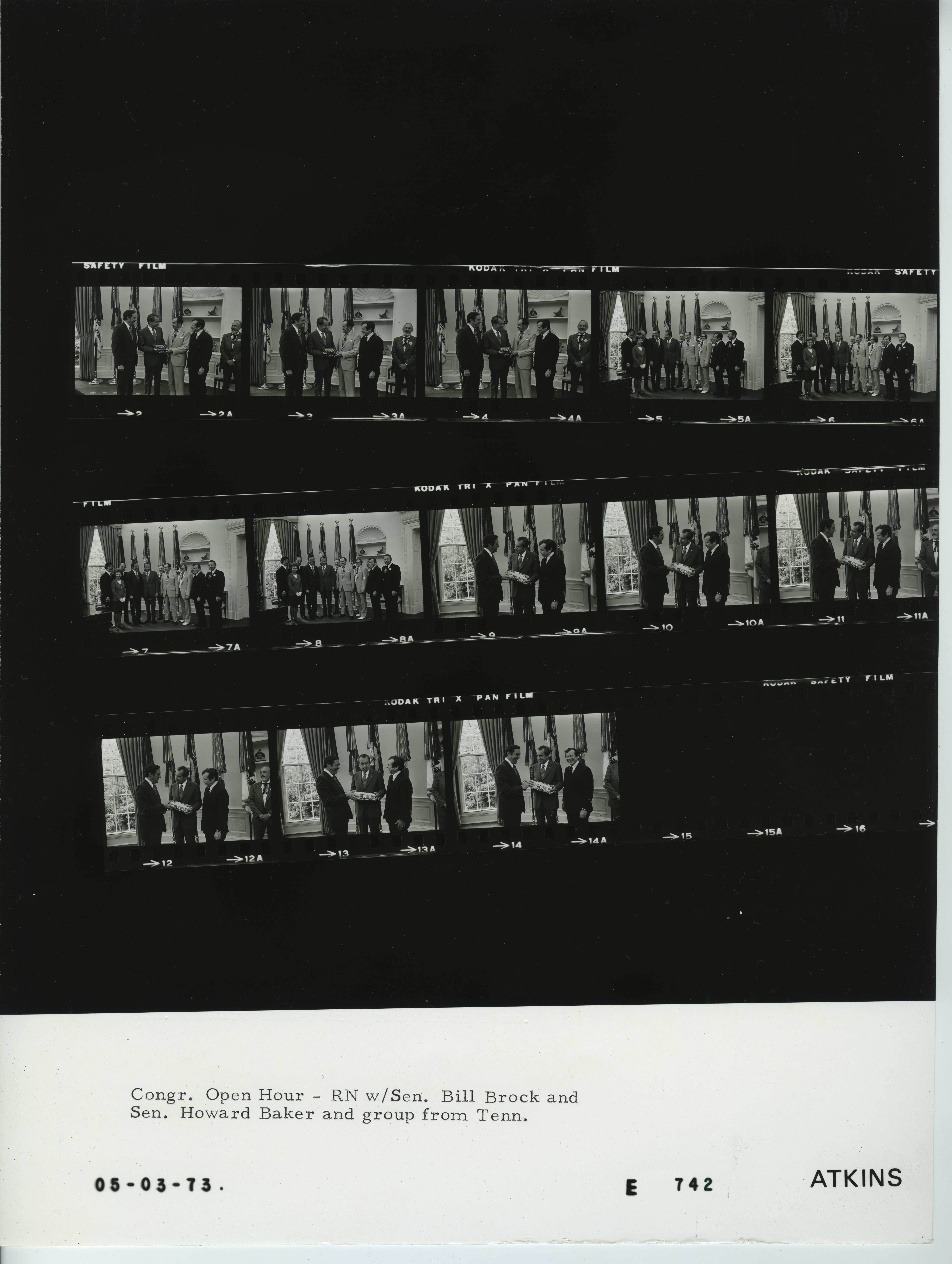
- Frame(s): WHPO-E0742-, Congressmen Open Hour. President Nixon standing in the Oval office with a Tennessee delegation to give the President a centennial coin from Martin, Tennessee, and appreciation letters from elementary school students from Bethel Springs, Tennessee, regarding the end of the Vietnam war. 5/3/1973, Washington, D.C. White House, Oval Office. President Nixon, Senator William E. Brock III (R-Tennessee), Senator Howard H. Baker, Jr. (R-Tennessee), Delegation members.
- Frame(s): WHPO-E0742-14, Congressmen Open Hour. President Nixon standing in the Oval office with Tennessee Senators Bill Brock and Howard Baker. 5/3/1973, Washington, D.C. White House, Oval Office. President Nixon, Senator William E. Brock III (R-Tennessee), Senator Howard H. Baker, Jr. (R-Tennessee).
Roll WHPO-E0743 Photographer: Atkins, Oliver | Color or B&W: B&W
- Frame(s): WHPO-E0743-, Congressmen Open Hour. President Nixon and Tom Foley and President Cup Regatta group. 5/3/1973, Washington, D.C. White House, Oval Office.
Roll WHPO-E0744 Photographer: Atkins, Oliver | Color or B&W: B&W
- Frame(s): WHPO-E0744-, Congressmen Open Hour. President Nixon with Congressman Sam Divine. 5/3/1973, Washington, D.C. White House, Oval Office.
Roll WHPO-E0745 Photographer: Atkins, Oliver | Color or B&W: B&W
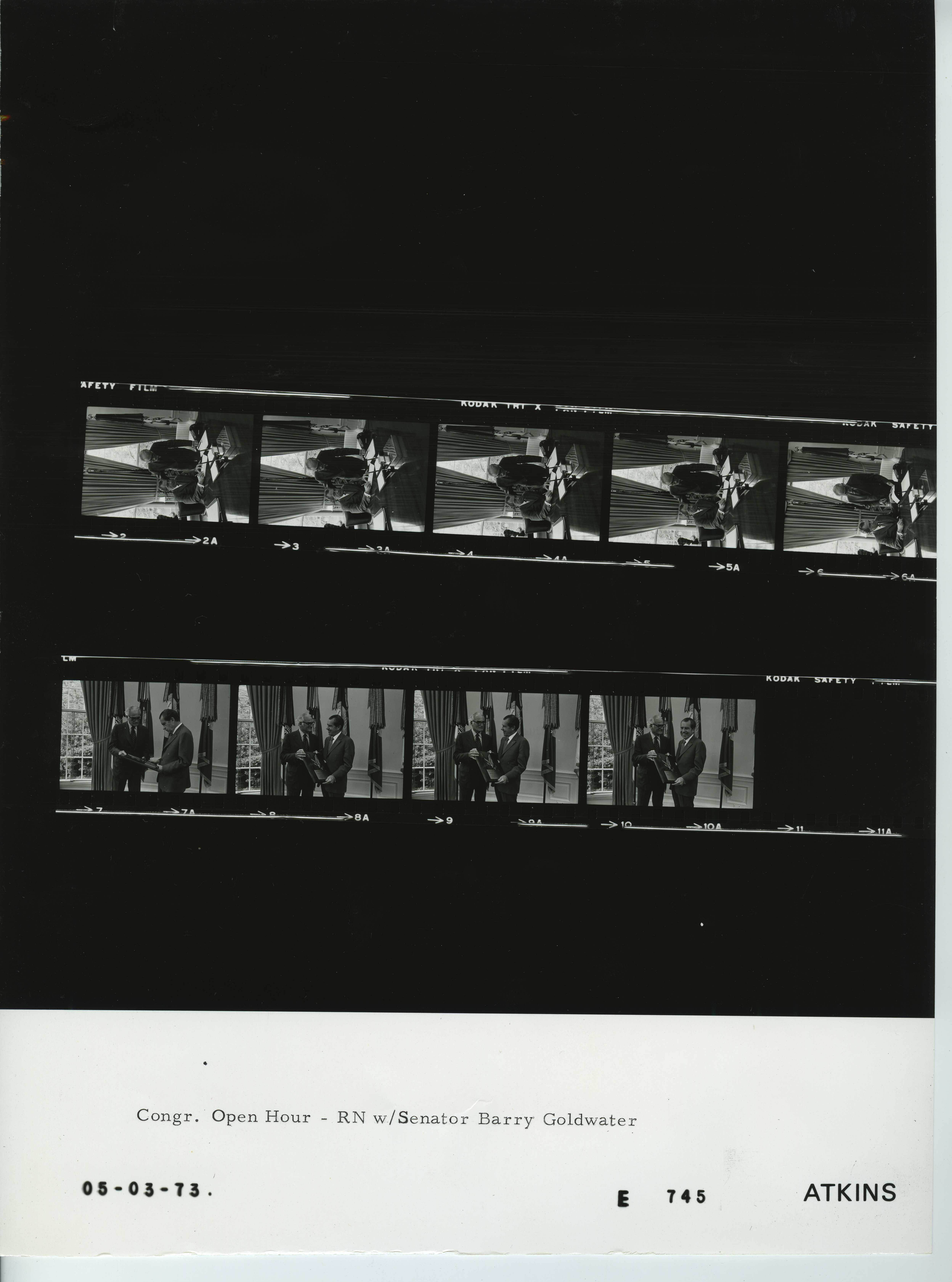
- Frame(s): WHPO-E0745-, President Nixon in the Oval Office desk during a meeting with Arizona Senator Barry Goldwater. 5/3/1973, Washington D.C. White House, Oval Office. President Nixon, Senator Barry Goldwater.
- Frame(s): WHPO-E0745-05, President Nixon seated at his Oval Office desk signing a letter designating Arizona Senator Barry Goldwater as the President's Personal Representative to the 1973 Paris Air Show, while Goldwater stands nearby. 5/3/1973, Washington D.C. White House, Oval Office. President Nixon, Senator Barry Goldwater.
- Frame(s): WHPO-E0745-08A, President Nixon standing with Senator Barry Goldwater in the Oval Office while both hold a large gift plaque, featuring an embossed eagle. (possibly the Capt. Eddie Rickenbacker Americanism Award in appreciation of the President's efforts to achieve peace.). 5/3/1973, Washington D.C. White House, Oval Office. President Nixon, Senator Barry Goldwater.
Roll WHPO-E0746 Photographer: Atkins, Oliver | Color or B&W: B&W
- Frame(s): WHPO-E0746-, Congressmen Open Hour. President Nixon with Congressman Ed Derwinski. 5/3/1973, Washington, D.C. White House Oval Office.
Roll WHPO-E0747 Photographer: Moore, Robert (Supervisor/Director, WHPO Photographic Laboratory) | Color or B&W: B&W
- Frame(s): WHPO-E0747-, Vice President Agnew with Prime Minister Daganescu. 5/3/1973, Washington, D.C. unkown. Spiro Agner.
Roll WHPO-E0748 Photographer: Parish, William | Color or B&W: B&W
- Frame(s): WHPO-E0748-, Stan Scott and Alabama's V.I.P.'s. 5/3/1973, unkown unknown.
Roll WHPO-E0749 Photographer: Parish, William | Color or B&W: B&W
- Frame(s): WHPO-E0749-, Vice President Agnew with Prime Minister Promiscue of Romania. 5/3/1973, unkown unkown. Spiro Agnew.
Roll WHPO-E0750 Photographer: Parish, William | Color or B&W: Color
- Frame(s): WHPO-E0750-, Julie Eisenhower meeting with President's Committee on Handicapped. 5/3/1973, Washington, D.C.
Roll WHPO-E0751 Photographer: Parish, William | Color or B&W: Color
- Frame(s): WHPO-E0751-, Julie Eisenhower meeting with President's Committee on Handicapped. 5/3/1973, Washington, D.C.
Roll WHPO-E0752 Photographer: Knudsen, Robert L. | Color or B&W: Color
- Frame(s): WHPO-E0752-, Julie Eisenhower presents awards to the blind. 5/3/1973, Washington, D.C. White House, Diplomatic Reception Room.
- Frame(s): WHPO-E0752-10, Julie Eisenhower talking before presenting awards to the blind. 5/3/1973, Washington, D.C. White House, Diplomatic Reception Room. Julie Eisenhower, unidentified persons.
- Frame(s): WHPO-E0752-13, Julie Eisenhower presents awards to the blind. 5/3/1973, Washington, D.C. White House, Diplomatic Reception Room. Julie Eisenhower, unidentified persons.
Roll WHPO-E0753 Photographer: Atkins, Oliver | Color or B&W: B&W
- Frame(s): WHPO-E0753-, Congressional Open Hour. President Nixon with Senator Jesse Helms. 5/3/1973, Washington, D.C. White House, Oval Office.
Roll WHPO-E0754 Photographer: | Color or B&W:
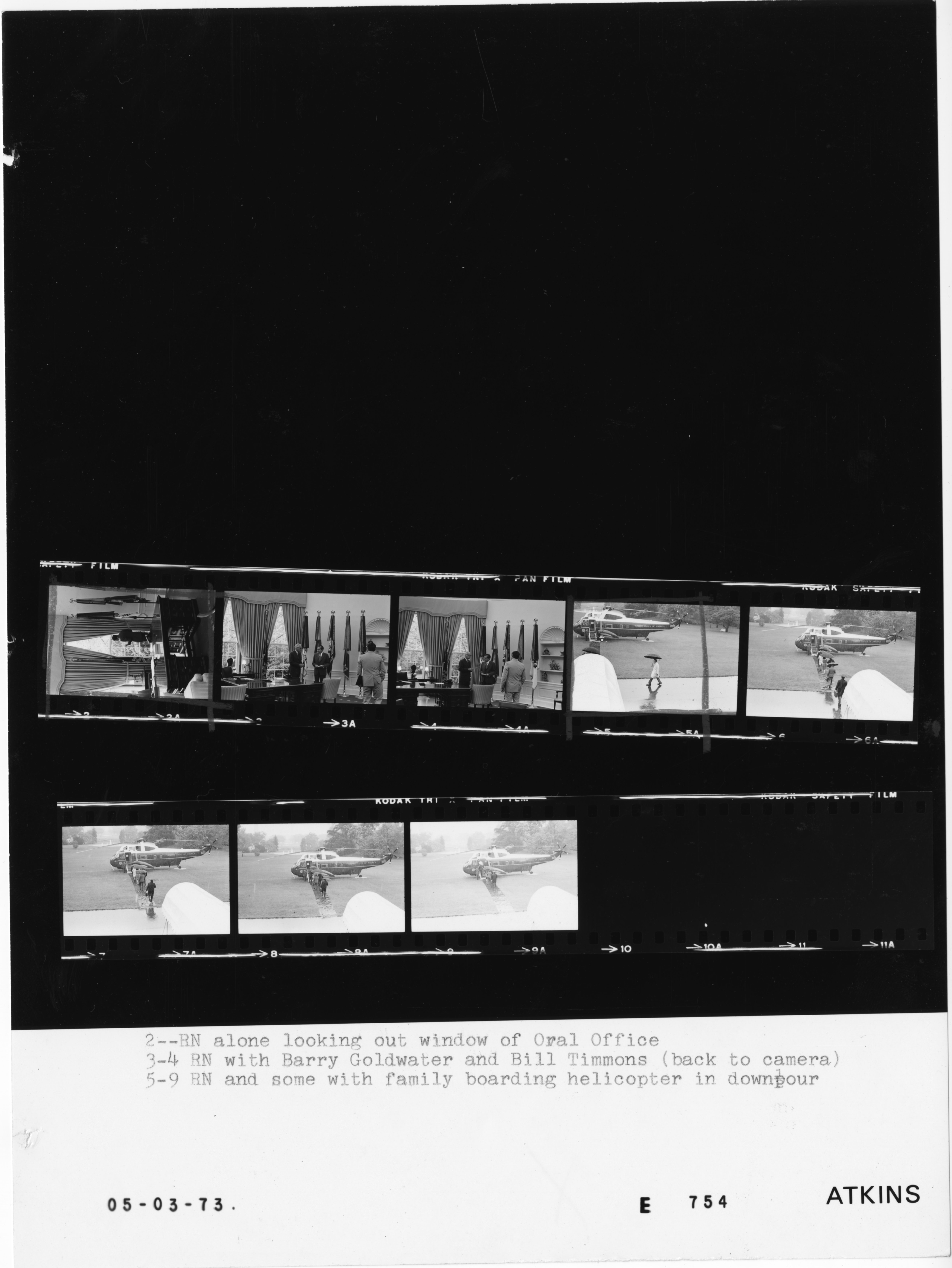
- Frame(s): WHPO-E0754-02A, President Nixon standing in the Oval office alone near his desk looking out window. 5/3/1973, Washington, D.C. White House, Oval Office. President Nixon.
- Frame(s): WHPO-E0754-03A-04A, President Nixon in the Oval office during a meeting with Barry Goldwater and Bill Timmons when the President presented Senator Goldwater with a letter designating him as the President's Personal Representative to the 1973 Paris Air Show. 5/3/1973, Washington, D.C. White House, Oval Office. President Nixon, Barry Goldwater, William Timmons.
- Frame(s): WHPO-E0754-05A, President Nixon, wearing his trench coat and carrying an umbrella, walks to the presidential helicopter in the rain. 5/3/1973, Washington, D.C. White House, South Grounds. President Nixon.
- Frame(s): WHPO-E0754-06A-09A, Members of President Nixon's family and staff carry umbrellas while walking to board the presidential helicopter in the rain. Pictured are: Julie Nixon Eisenhower, Rose Mary Woods, Paul Keyes, Steve Bull, Ron Ziegler, Maj. Gen. Dr. Walter R. Tkach The President's Physician and Maj. Jack Brennan military aide. 5/3/1973, Washington, D.C. White House, South Grounds. President Nixon, Julie Nixon Eisenhower, Rose Mary Woods, Paul W. Keyes, Stephen B. Bull, Ronald L. Ziegler, Maj. Gen. Walter R. Tkach, Maj. John V. Brennan.
Roll WHPO-E0755 Photographer: Knudsen, Robert L. | Color or B&W: B&W
- Frame(s): WHPO-E0755-, President Nixon signing the Foreign Policy Report. 5/3/1973, Washington, D.C. White House.
Roll WHPO-E0772 Photographer: Kightlinger, Jack | Color or B&W: Color
- Frame(s): WHPO-E0772-, President Nixon arrives at Key Biscayne, Florida. 5/3/1973, Key Biscayne, FL
The White House Communications Agency Sound Recordings Collection contains public statements that took place between 1969 and 1974. Visit the finding aid to learn more.
K - Informal Presidential Remarks
- WHCA-SR-K-058
Photo opportunity/Amb. David Bruce-Oval Office. (5/3/1973)
Original Format: 1/4-inch reel-to-reel audiotape. Original source type: Original. - WHCA-SR-K-059
Photo opportunity/HAK and his staff-Cabinet Rm. (5/3/1973)
Runtime: 3:09
Original Format: 1/4-inch reel-to-reel audiotape. Original source type: Original.
P - Formal Presidential Remarks
- WHCA-SR-P-730504
Radio broadcast on foreign policy. (5/3/1973)
Runtime: 7:27
Original Format: 1/4-inch reel-to-reel audiotape. Original source type: Original.
S - White House Press Office Briefings (continuation of the L-series)
- WHCA-SR-S-095
Press briefing by Henry A. Kissinger. (5/3/1973, White House Press Lobby)
Runtime: 59:10:00
Keywords: Press conferences, news conferences, interviews, media
Production credits: Audio feed supplied by WHCA; Recorded by MJP (initials of WHCA engineer)
Original Format: 1/4-inch reel-to-reel audiotape. Original source type: Original.
The White House Communications Agency Videotape Collection contains “off-the-air” recordings of televised programs produced between 1968 and 1974. Visit the finding aid to learn more.
- WHCA-6263
Weekly News Summary, Tape I. Excerpts of evening network news broadcasts from the week of 4/27/73 to 5/03/73
ALL NETWORKS
Runtime: 01:06:08 - WHCA-6265
Weekly News Summary, Tape III. Excerpts of evening network news broadcasts from the week of 4/27/73 to 5/03/73
ALL NETWORKS
Runtime: 1:30 - WHCA-6266
Weekly News Summary, Tape IV. Excerpts of evening network news broadcasts from the week of 4/27/73 to 5/03/73
Post-Newsweek Stations, Inc.
Runtime: 01:06:03
Context (External Sources)
The Vanderbilt Television News Archive is the world's most extensive and complete archive of television news. They have been recording, preserving and providing access to television news broadcasts of the national networks since August 5, 1968.
Wikipedia is a free encyclopedia that anyone can edit.