

Introduction
This almanac page for Friday, May 28, 1971, pulls together various records created by the federal government and links to additional resources which can provide context about the events of the day.
Previous Date: Thursday, May 27, 1971
Next Date: Saturday, May 29, 1971
Schedule and Public Documents
The Daily Diary files represent a consolidated record of the President's activities. Visit the finding aid to learn more.
The President's day began at The White House - Washington, D. C.
The Weekly Compilation of Presidential Documents made available transcripts of the President's news conferences; messages to Congress; public speeches, remarks, and statements; and other Presidential materials released by the White House.
Digitized versions can be found at HathiTrust.
Each Public Papers of the Presidents volume contains the papers and speeches of the President of the United States that were issued by the White House Office of the Press Secretary during the time period specified by the volume. The material is presented in chronological order, and the dates shown in the headings are the dates of the documents or events. In instances when the release date differs from the date of the document itself, that fact is shown in the text note.
To ensure accuracy, remarks have been checked against audio recordings (when available) and signed documents have been checked against the original, unless otherwise noted. Editors have provided text notes and cross references for purposes of identification or clarity.
The Federal Register is the official daily publication for rules, proposed rules, and notices of federal agencies and organizations, as well as executive orders and other Presidential documents.
Archival Holdings
Any selection of archival documents will necessarily be partial. You should use the documents and folders identified below as a starting place, but consult the linked collection finding aids and folder title lists and the collections themselves for context. Many documents to be found this way do not lend themselves to association with specific dates, but are essential to a complete understanding of the material.
Selective document listing
President's Office Files
The President's Office Files consists of materials drawn together by the Special Files Unit from several administrative subdivisions within the White House Office. It is the handwriting and sensitive papers sent to the Staff Secretary that now comprise much of the President's Office Files. Visit the finding aid to learn more.
- Annotated News Summaries, Box 30, News Summaries - May 1971 [1 of 4]
- Annotated News Summaries, Box 30, News Summaries - May 1971 [2 of 4] [During this period, the Staff Secretary only removed pages from the News Summaries which contained President Nixon's handwriting, often leaving the document with no date. In addition to the individual document(s) listed below, you should also consult the full folder for the month.]
- [5/28/71]
- Annotated News Summaries, Box 30, News Summaries - May 1971 [3 of 4]
- [5/28/71]
- Annotated News Summaries, Box 30, News Summaries - May 1971 [4 of 4]
- [5/28/71]
- President's Daily Schedule, Box 101, [President's Daily Schedule, Mar.-May 1971] [3 of 3]
- The President's Schedule, Friday - May 28, 1971
The H. R. Haldeman Diaries consists of seven handwritten diaries, 36 dictated diaries recorded as sound recordings, and two handwritten audio cassette tape subject logs. The diaries and logs reflect H. R. Haldeman’s candid personal record and reflections on events, issues, and people encountered during his service in the Nixon White House. As administrative assistant to the President and Chief of Staff, Haldeman attended and participated in public events and private meetings covering the entire scope of issues in which the Nixon White House engaged in during the years 1969-1973. Visit the finding aid to learn more.
- Transcript of diary entry (PDF)
Friday, May 28.
The President got into a discussion of the general political situation the first thing this morning. He wanted to track down whoever had done the attack on Julie's new teaching job, to see whether there was a partisan source to it. That led him to thinking that we should put permanent tails and coverage on Teddy and Muskie and Hubert on all the personal stuff, to cover the kinds of things that they hit us on in '62: personal, finances, family, and so forth. He wants Ziegler I mean-- Nofziger, Mollenhoff and those people to be riding on that kind of a thing.
We had some talk about the conservative problem again, and he reiterated his hope that Ehrlichman could announce Marty Anderson's affiliation and perhaps some other big name conservative to appease the people on that. He called J. Edgar Hoover and talked with him about his plans to get into the police killings, and particularly emphasized that he wanted a position that clearly answered Senator Williams' attack on this subject. Then Kissinger came in, and we had some discussion of the Harris and Gallup Polls on admission of Communist China, which has now shifted to popular opinion favoring admission, where it's always been disapproval up to now. That led into a considerable discussion of the whole China situation, and Henry's foreign policy planning in general and the question really of what position we should take regarding China. It's now apparent, that from a domestic political viewpoint we can go ahead with admission without any problems; somehow we've got to determine what approach we take to Chiang Kai-Shek.
Henry's all set for his trip this weekend and is urging the President to give him three weeks for a reply, which will still get one in before we go to Midway to meet with Thieu on the 28th. The President emphasized that all foreign policy initiatives are going to have to be completed by July, 1972, because after that there will be a Democratic nominee and they'll insist that he be taken along on any trips and brought in on any discussions. The ideal scenario still would be to get the Vietnam thing settled this summer; have a Summit this fall and wrap up the first SALT agreement; announce China-- a China visit and have it in March or so of next year. Whether we can pull this off or not is-- remains to be seen.
This afternoon he got into some discussion of speeches he wants to give, as we were working on a general future schedule. He's still trying to work out a way to go up to New England to stay at Jack Dreyfus' place in Maine and then stop in New Hampshire on the way back. Maybe we can work in Rochester on the same swing, since we have to go up there sometime in the near future. He wants to do a major speech on the old goals idea that Pete Peterson's been developing, either on TV or through a forum, and he wants to do an economic speech on the wage price spiral, and then a speech-- a major speech on drugs, which he wants Art Linkletter to work on the input for. He's pushing for getting going on all of these as soon as he can.
Late this afternoon, we had a long session with John Mitchell on politics. Discussed the general overall situation and then got into some specifics on California, Ohio, Illinois, and Florida. He made it very clear that, if at all possible, he doesn't want to enter into the primaries in any way, shape, or form; and he questioned the technique of having Taft as a substitute and whether we want to have stand-ins in other states. The problem, of course, is that some states require the candidate to go on whether you agree or not, and those we can't avoid. He agreed with Len Firestone as the Chairman in California. We talked some about a change in the Secretary of Agriculture, perhaps bringing Louis Nunn into that post. Most of it was the usual sort of general discussion, and no major decisions were reached.
End of May 28. - Original audio recording (MP3)
The National Archives Catalog is the online portal to the records held at the National Archives, and information about those records. It is the main way of describing our holdings and also provides access to electronic records and digitized versions of our holdings.
The Catalog searches across multiple National Archives resources at once, including archival descriptions, digitized and electronic records, authority records, and web pages from Archives.gov and the Presidential Libraries. The Catalog also allows users to contribute to digitized historical records through tagging and transcription.
Nixon Library Holdings
All National Archives Units
National Security Documents
The President's Daily Brief is the primary vehicle for summarizing the day-to-day sensitive intelligence and analysis, as well as late-breaking reports, for the White House on current and future national security issues. Read "The President's Daily Brief: Delivering Intelligence to Nixon and Ford" to learn more.
The Foreign Relations of the United States series presents the official documentary historical record of major U.S. foreign policy decisions and significant diplomatic activity. Visit the State Department website for more information.
Vol. VII, Vietnam, July 1970-January 1972
The Consequences of Operation Lan Som 719 and the Search for a Settlement, April 8-October 6, 1971
206. Memorandum From the President’s Assistant for National Security Affairs (Kissinger) to President Nixon, Washington, May 28, 1971
Source: National Archives, Nixon Presidential Materials, NSC Files, Box 853, For the President’s Files—Lord, Vietnam Negotiations, Sensitive, Camp David Vol. VII. Top Secret; Sensitive; Exclusively Eyes Only. Sent for action.
Vol. XI, South Asia Crisis, 1971
South Asia Crisis, 1971
62. Letter From President Nixon to Indian Prime Minister Gandhi, Washington, May 28, 1971
Source: National Archives, Nixon Presidential Materials, NSC Files, Box 755, Presidential Correspondence File, India (1971). No classification marking. The text of the letter was transmitted to New Delhi on May 28 in telegram 95110 for delivery to Prime Minister Gandhi. (Ibid., RG 59, Central Files 1970–73, POL 15–1 US/NIXON)
63. Letter From President Nixon to Pakistani President Yahya, Washington, May 28, 1971
Source: National Archives, Nixon Presidential Materials, NSC Files, Box 755, Presidential Correspondence File, Pakistan (1971). No classification marking. Transmitted to Islamabad on May 28 in telegram 95111 for delivery to President Yahya. (Ibid., RG 59, Central Files 1970–73, POL 15–1 US/NIXON)
Vol. XIII, Soviet Union, October 1970-October 1971
"One of Two Routes": Soviet-American Relations and Kissinger's Secret Trip to China, April 23-July 18, 1971
243. Conversation Among President Nixon, the President’s Assistant for National Security Affairs (Kissinger), and the White House Chief of Staff (Haldeman), Washington, May 28, 1971
Source: National Archives, Nixon Presidential Materials, White House Tapes, Conversation 505–18. No classification marking. The editors transcribed the portions of the tape recording printed here specifically for this volume. According to his Record of Schedule, Kissinger met Nixon in the Oval Office from 9:50 to 11 a.m. (Library of Congress, Manuscript Division, Kissinger Papers, Box 438, Miscellany, 1968–76)
244. Transcript of a Telephone Conversation Between the President’s Assistant for National Security Affairs (Kissinger) and the Soviet Ambassador (Dobrynin), Washington, May 28, 1971, 11 a.m.
Source: National Archives, Nixon Presidential Materials, Henry Kissinger Telephone Conversation Transcripts, Box 27, Dobrynin File. No classification marking.
245. Memorandum From Helmut Sonnenfeldt of the National Security Council Staff to the President’s Assistant for National Security Affairs (Kissinger), Washington, May 28, 1971
Source: National Archives, Nixon Presidential Materials, NSC Files, Kissinger Office Files, Box 128, Country Files, Latin America, Cuba [2]. Secret; Sensitive. Sent for information.
246. Transcript of a Telephone Conversation Between the President’s Assistant for National Security Affairs (Kissinger) and Director of Central Intelligence Helms, Washington, May 28, 1971, 5:50 p.m.
Source: National Archives, Nixon Presidential Materials, Henry Kissinger Telephone Conversation Transcripts, Box 10, Chronological File. No classification marking.
247. Transcript of a Telephone Conversation Between the President’s Assistant for National Security Affairs (Kissinger) and the Soviet Ambassador (Dobrynin), Washington, May 28, 1971, 6:05 p.m.
Source: National Archives, Nixon Presidential Materials, Henry Kissinger Telephone Conversation Transcripts, Box 27, Dobrynin File. No classification marking.
248. Transcript of a Telephone Conversation Between Secretary of Commerce Stans and the President’s Assistant for National Security Affairs (Kissinger), Washington, May 28, 1971, 6:25 p.m.
Source: National Archives, Nixon Presidential Materials, Henry Kissinger Telephone Conversation Transcripts, Box 10, Chronological File. No classification marking.
Vol. XX, Southeast Asia, 1969-1972
Thailand
120. Letter From the Ambassador to Thailand (Unger) to the Under Secretary of State for Political Affairs (Johnson), Bangkok, May 28, 1971
Source: Department of State, INR Historical Files, Thailand, 1972–1975. Secret; Eyes Only; Nodis; Special Handling.
121. Telegram From the Embassy in Thailand to the Consulate in Hong Kong, Bangkok, May 28, 1971, 1131Z
Source: National Archives, RG 59, Central Files 1970–73, POL
Vol. XXXII, SALT I, 1969-1972
From SALT Announcement to Summit Announcement, May 27-October 12, 1971
162. Memorandum From Helmut Sonnenfeldt of the National Security Council Staff to the President’s Assistant for National Security Affairs (Kissinger), Washington, May 28, 1971
Source: National Archives, Nixon Presidential Materials, NSC Files, Box 881, SALT, SALT talks (Helsinki), Vol. XV, May 1–July 1971. Secret. Sent for information. Kissinger initialed the memorandum indicating that he saw it.
Vol. XL, Germany and Berlin, 1969-1972
Germany and Berlin, 1969-1972
243. Conversation Between President Nixon and the President’s Assistant for National Security Affairs (Kissinger), Washington, May 28, 1971
Source: National Archives, Nixon Presidential Materials, White House Tapes, Recording of Conversation Between Nixon and Kissinger, May 28, 1971, Time Unknown, Oval Office, Conversation 505–18. No classification marking. According to his Daily Diary, Nixon met with Kissinger in the Oval Office from 9:50 to 11 a.m. The editor transcribed the portions of the conversation printed here specifically for this volume. The time of the conversation, which was held in the Oval Office, is taken from Kissinger’s Record of Schedule. (Library of Congress, Manuscript Division, Kissinger Papers, Box 438, Miscellany, 1968–76) Haldeman, who briefly commented during the conversation, entered the Oval Office at 10:23 a.m. (National Archives, Nixon Presidential Materials, White House Central Files, President’s Daily Diary)
244. Message From the Ambassador to Germany (Rush) to the President’s Assistant for National Security Affairs (Kissinger), Bonn, May 28, 1971
Source: National Archives, Nixon Presidential Materials, NSC Files, Kissinger Office Files, Box 59, Country Files, Europe, Ambassador Rush, Berlin, Vol. 1. Top Secret; Sensitive; Exclusively Eyes Only. The message was sent through the special Navy channel in Frankfurt; no time of transmission or receipt appears on the message.
Vol. E-1, Documents on Global Issues, 1969-1972
U.S. Policy Towards International Production and Trafficking in Illegal Drugs
190. Memorandum From Director of Central Intelligence Helms to the President’s Assistant for National Security Affairs (Kissinger), Washington, May 28, 1971
Helms sent Kissinger information on how the CIA planned to distribute sensitive intelligence on narcotics in Southeast Asia.
Source: National Archives, Nixon Presidential Materials, NSC Files, Box 358, Subject Files, Narcotics IV. Secret; Sensitive. Copies were sent to Rogers, Laird, Mitchell, Moorer, Sullivan, Ingersoll, and Rossides. The attachment is Secret; No Foreign Dissem; Controlled Dissem Abroad; Background Use Only.
Oceans Policy
393. Circular Airgram CA-2554 From the Department of State to All Diplomatic Posts, Washington, May 28, 1971, 1104Z
The Department transmitted a summary and analysis of the March 1971 meeting of the Seabeds Committee, which served as the Law of the Sea Preparatory Committee.
Source: National Archives, RG 59, Central Files 1970-73, POL 33-8. Confidential. Drafted by Pitman and McIntyre on May 5; cleared by McKernan, Herz, Oxman, EUR/CAN, ARA/LA/APA, AF/I, EA/RA, and NEA/RA; provided for information to Defense, Interior, and NOAA; and approved by Stevenson.
Vol. E-4, Documents on Iran and Iraq, 1969-1972
Iran 1971
129. Letter From President Nixon to the Shah of Iran, Washington, May 28, 1971
Nixon replied to the Shah that a peace settlement must be the work primarily of the Arabs and the Israelis, although the United States was working with both sides within the Jarring mission framework.
Source: National Archives, Nixon Presidential Materials, NSC Files, Box 755, Presidential Correspondence, Iran, M.R. Pahlavi, Shah of Iran Correspondence. No classification marking. In Telegram 1885 from Tehran, April 13, Ambassador MacArthur discussed with Zahedi the Shah’s first letter, countering that although Washington was making great efforts, the United States was not in a position to impose a solution on Israel, which would only harden Tel Aviv’s stance. When MacArthur added that Israel had strong domestic opposition to placate, Zahedi responded that the United States also had domestic political concerns to consider in the matter. (Ibid., Box 1268, Saunders Files, Middle East Negotiations, Iran 1/1/71–5/31/71.)
Vol. E-10, Documents on American Republics, 1969-1972
Cuba
238. Memorandum From Tom Latimer of the National Security Council Staff to the President’s Assistant for National Security Affairs (Kissinger), Washington, May 28, 1971., Washington, May 28, 1971
A U–2 overflight of Cuba revealed that a nuclear powered cruise missile submarine had tied up to a Soviet tender, in Antilla, Cuba.
Source: National Archives, Nixon Presidential Materials, NSC Files, Box 782, Country Files, Latin America, Soviet Naval Activity in Cuban Waters, Vol. II, Cienfuegos. Secret.239. Memorandum From Helmut Sonnenfeldt of the National Security Council Staff to the President’s Assistant for National Security Affairs (Kissinger), Washington, May 28, 1971., Washington, May 28, 1971
National Security Council staff member Sonnenfeldt provided analysis on the issue of the Soviet nuclear powered cruise missile submarine, which was moored to a tender in Cuba.
Source: National Archives, Nixon Presidential Materials, NSC Files, Box 782, Country Files, Latin America, Soviet Naval Activity in Cuban Waters, Vol. II, Cienfuegos. Secret; Sensitive. Sent for information. In a May 29 memorandum to Haig, Jon Howe stated, “Unless we are willing to go to the mat to force Soviet withdrawal of the ship, it may be better to take the Soviet move in stride publicly and play it in low key.” (Ibid., Box 781, Country Files, Cuba, Vol. III, 1971)
The Kissinger telephone conversation transcripts consist of approximately 20,000 pages of transcripts of Kissinger’s telephone conversations during his tenure as Assistant to the President for National Security Affairs (1969-1974) and Secretary of State (1973-1974) during the administration of President Richard Nixon. Visit the finding aid for more information.
Digitized versions can be found in the National Archives Catalog.
Audiovisual Holdings
The White House Tapes are sound recordings of President Richard Nixon's telephone conversations and of meetings held in the Oval Office and the Cabinet Room in the White House, the President's office in the Old Executive Office Building (OEOB), the Lincoln Sitting Room in the residence section of the White House, and several locations at the Presidential retreat at Camp David, Maryland. These recordings document many of the major events and decisions of the Nixon Administration from February 16, 1971 to July 18, 1973. Visit the White House Tapes finding aid to learn about the taping system's operation and archival processing.
Old Executive Office Building
- 254-1; Unknown between 1:18 p.m. & 2:39 p.m.; Nixon, Richard M. (President); Sanchez, Manolo
- 254-2; Unknown between 1:18 p.m. & 2:39 p.m.; Nixon, Richard M. (President); Sanchez, Manolo
- 254-3; Unknown between 1:18 p.m. & 3:00 p.m.; Nixon, Richard M. (President); Sanchez, Manolo
- 254-4; 3:00 p.m. - 5:01 p.m.; Nixon, Richard M. (President); Ehrlichman, John D.; Shultz, George P.; Sanchez, Manolo; White House operator; Bull, Stephen B.; Peterson, Peter G.; White House photographer; Butterfield, Alexander P.
Oval Office
- 505-15; Unknown between 8:47 a.m. & 9:08 a.m.; Nixon, Richard M. (President); Haldeman, H. R. ("Bob")
- 505-16; Unknown between 8:47 a.m. & 9:08 a.m.; Nixon, Richard M. (President); [Unknown person(s)]
- 505-17; 9:08 a.m. - 9:12 a.m.; Nixon, Richard M. (President); Rogers, William P.
- 505-18; Unknown between 9:12 a.m. & 11:04 a.m.; Nixon, Richard M. (President); Haldeman, H. R. ("Bob"); White House operator; [Unknown person(s)]; Hoover, J. Edgar; Ziegler, Ronald L.; Ehrlichman, John D.; Kissinger, Henry A.; Mills, Wilbur D.; Bull, Stephen B.
- 505-19; 11:04 a.m. - 11:17 a.m.; Nixon, Richard M. (President); Ferre, Luis A.; Trigo, Rosario Benigno; Whitaker, John C.
- 505-20; 11:19 a.m. - 11:32 a.m.; Nixon, Richard M. (President); Hess, Stephen; Zigler, Edward (Dr.); Cole, Kenneth R., Jr.; White House photographer
- 505-21; Unknown between 11:43 a.m. & 12:08 p.m.; Nixon, Richard M. (President); Ronne, Torben; Kissinger, Henry A.
- 506-1; 11:43 a.m. - 12:08 p.m.; Nixon, Richard M. (President); Ronne, Torben; Kissinger, Henry A.
- 506-2; 12:09 p.m. - 12:13 p.m.; Nixon, Richard M. (President); Suffridge, James; Housewright, James; McGuire, William; Colson, Charles W.; White House photographer; Bull, Stephen B.
- 506-3; Unknown between 12:13 p.m. & 12:14 p.m.; Nixon, Richard M. (President); Bull, Stephen B.
- 506-4; 12:14 p.m. - 12:18 p.m.; Nixon, Richard M. (President); Heinz, H. John, III; Dent, Harry S.; White House photographer
- 506-5; Unknown between 12:18 p.m. & 12:20 p.m.; Nixon, Richard M. (President); [Unknown person(s)]
- 506-6; Unknown between 12:18 p.m. & 12:20 p.m.; Nixon, Richard M. (President); White House operator
- 506-7; 12:20 p.m. - 12:21 p.m.; Nixon, Richard M. (President); Eisenhower, Julie Nixon
- 506-8; 12:22 p.m. - 12:33 p.m.; Nixon, Richard M. (President); Kissinger, Henry A.
- 506-9; Unknown between 12:33 p.m. & 12:40 p.m.; Nixon, Richard M. (President); Sanchez, Manolo
- 506-10; 12:40 p.m. - 1:17 p.m.; Nixon, Richard M. (President); Haldeman, H. R. ("Bob"); Sanchez, Manolo
- 506-11; 5:05 p.m. - 5:08 p.m.; Nixon, Richard M. (President); Ehrlichman, John D.; Butterfield, Alexander P.; Bull, Stephen B.
- 506-12; 5:10 p.m. - 5:12 p.m.; Nixon, Richard M. (President); Butterfield, Alexander P.
- 506-13; 5:27 p.m. - 6:50 p.m.; Nixon, Richard M. (President); Kissinger, Henry A.; [Unknown person(s)]; Woods, Rose Mary; Haldeman, H. R. ("Bob"); Mitchell, John N.; White House operator; Butterfield, Alexander P.
- 506-14; Unknown between 6:50 p.m. & 11:59 p.m.; United States Secret Service agents
White House Telephone
- 3-165; Unknown between 8:47 a.m. & 9:08 a.m.; Nixon, Richard M. (President); White House operator
- 3-166; 9:08 a.m. - 9:12 a.m.; Nixon, Richard M. (President); Rogers, William P.
- 3-167; Unknown between 9:16 a.m. & 9:34 a.m.; Nixon, Richard M. (President); White House operator
- 3-168; Unknown between 9:16 a.m. & 9:34 a.m.; Nixon, Richard M. (President); White House operator
- 3-169; 9:34 a.m. - 9:43 a.m.; Nixon, Richard M. (President); Hoover, J. Edgar
- 3-170; 9:45 a.m. - 9:49 a.m.; Nixon, Richard M. (President); Ehrlichman, John D.
- 3-171; Unknown between 9:49 a.m. & 11:03 a.m.; Nixon, Richard M. (President); White House operator
- 3-172; 11:03 a.m. - 11:04 a.m.; Nixon, Richard M. (President); Andrews, John K., Jr.
- 3-173; Unknown between 11:04 a.m. & 12:20 p.m.; White House operator; [Unknown person(s)]
- 3-174; Unknown between 11:04 a.m. & 12:20 p.m.; Nixon, Richard M. (President); White House operator
- 3-175; 12:20 p.m. - 12:21 p.m.; Nixon, Richard M. (President); Eisenhower, Julie Nixon; Eisenhower, [Dwight] David, II
- 3-176; Unknown between 12:21 p.m. & 2:39 p.m.; Nixon, Richard M. (President); White House operator
- 3-177; 2:39 p.m. - 2:39 p.m.; Nixon, Richard M. (President); White House operator
- 3-178; 2:50 p.m. - 3:07 p.m.; Nixon, Richard M. (President); Rogers, William P.
- 3-179; Unknown between 3:00 p.m. & 3:10 p.m.; Nixon, Richard M. (President); White House operator
- 3-180; 3:10 p.m. - 3:11 p.m.; Nixon, Richard M. (President); Bull, Stephen B.
- 3-181; Unknown between 3:48 p.m. & 4:51 p.m.; Nixon, Richard M. (President); White House operator; [Unknown person(s)]
- 3-182; 4:51 p.m. - 4:52 p.m.; Nixon, Richard M. (President); Butterfield, Alexander P.
- 3-183; Unknown between 5:45 p.m. & 5:51 p.m.; Nixon, Richard M. (President); White House operator; Haldeman, H. R. ("Bob")
- 3-184; 5:51 p.m. - 5:52 p.m.; Nixon, Richard M. (President); Woods, Rose Mary; Haldeman, H. R. ("Bob")
- 3-185; Unknown between 6:50 p.m. & 8:11 p.m.; Nixon, Richard M. (President); White House operator
- 3-186; 8:11 p.m. - 8:12 p.m.; Nixon, Richard M. (President); Cox, Tricia Nixon
- 3-187; Unknown between 8:12 p.m. & 8:13 p.m.; Nixon, Richard M. (President); White House operator
- 3-188; 8:13 p.m. - 8:13 p.m.; Nixon, Richard M. (President); White House operator
The White House Photo Office collection consists of photographic coverage of President Richard Nixon meeting with prominent social, political, and cultural personalities; speaking engagements and news conferences of the President and various high-ranking members of the White House staff and Cabinet; Presidential domestic and foreign travel, including Presidential vacations; social events and entertainment involving the First Family, including entertainers present; official portraits of the President, First Family, and high-ranking members of the Nixon administration; the 1969 and 1973 Inaugurals; the President’s 1972 Presidential election campaign appearances (including speeches) and other official activities of the White House staff and the President’s Cabinet from January 20, 1969 until August 9, 1974 at the White House and the Old Executive Office Building; other locations in Washington, DC, such as The Mall; and the Presidential retreats in Camp David, Maryland, Key Biscayne, Florida, and San Clemente, California. Visit the finding aid to learn more.
Roll WHPO-6414 Photographer: Schumacher, Karl | Color or B&W: Color
- Frame(s): WHPO-6414-, Dwight Chapin with schoolchildren. 5/28/1971, Washington, D.C. White House, South Grounds. Dwight Chapin, children.
Roll WHPO-6417 Photographer: Atkins, Oliver | Color or B&W: B&W
- Frame(s): WHPO-6417-, President Nixon standing in the Oval Office with Secretary of the Interior Rogers Morton and Congressman William Mills (R-Maryland), the victor in a special congressional election to fill Morton's vacancy. 5/28/1971, Washington, D.C. White House, Oval Office. President Nixon, William Mills, Rogers Morton.
- Frame(s): WHPO-6417-10A, President Nixon standing in the Oval Office with Secretary of the Interior Rogers Morton and Congressman William Mills (R-Maryland), the victor in a special congressional election to fill Morton's vacancy. 5/28/1971, Washington, D.C. White House, Oval Office. President Nixon, William Mills, Rogers Morton.
Roll WHPO-6418 Photographer: Schumacher, Karl | Color or B&W: B&W
- Frame(s): WHPO-6418-, An unidentified man receiving a service award. 5/28/1971, Washington, D.C. unknown. unidentified men and women.
Roll WHPO-6419 Photographer: Atkins, Oliver | Color or B&W: B&W
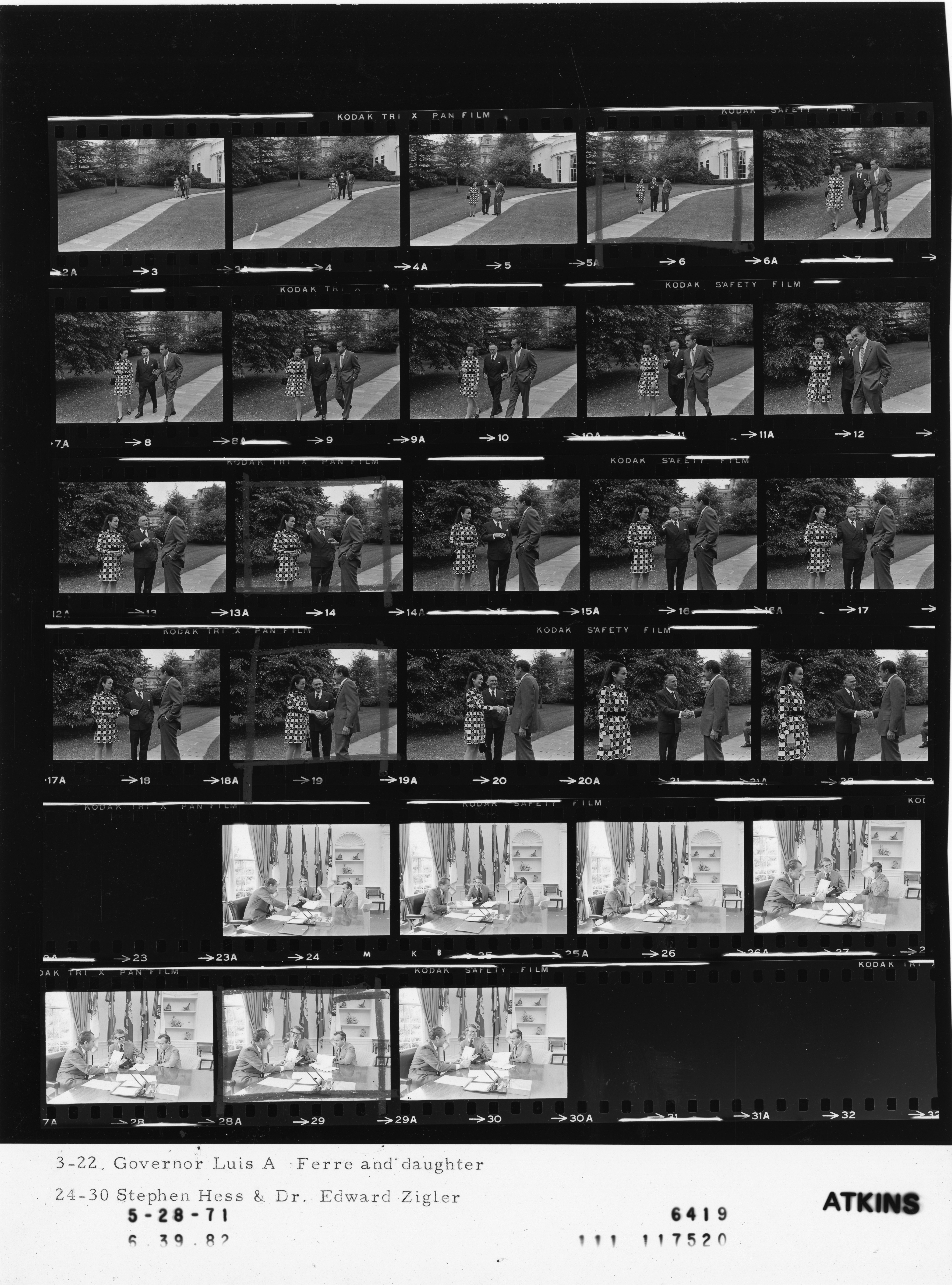
- Frame(s): WHPO-6419-03-22, President Nixon escorting Governor of Puerto Rico Luis Ferre and his daughter Rosario Trigo to their limousine. 5/28/1971, Washington, D.C. White House, South Lawn. President Nixon, Luis Ferre, Mrs. Rosario Trigo.
- Frame(s): WHPO-6419-20, President Nixon escorting Governor of Puerto Rico Luis Ferre and his daughter Rosario Trigo to their limousine. 5/28/1971, Washington, D.C. White House, South Lawn. President Nixon, Luis Ferre, Rosario Trigo.
- Frame(s): WHPO-6419-24-30, President Nixon with Stephen Hess and Dr. Edward Zigler. 5/28/1971, Washington, D.C. White House, Oval Office. President Nixon, Stephen Hess, Edward Zigler.
Roll WHPO-6420 Photographer: Kightlinger, Jack | Color or B&W: Color
- Frame(s): WHPO-6420-, President Nixon standing with officers of the Retail Clerks International Association. 5/28/1971, Washington, D.C. White House, Oval Office. President Nixon, James Suffridge, James Housewright, William McGuire.
Roll WHPO-6421 Photographer: Atkins, Oliver | Color or B&W: B&W
- Frame(s): WHPO-6421-02-07, President Nixon standing with officers of the Retail Clerks International Association. 5/28/1971, Washington, D.C. White House, Oval Office. President Nixon, James Suffridge, James Housewright, William McGuire, Jack Heintz.
- Frame(s): WHPO-6421-11-17, President Nixon with Congressman Jack Heintz. 5/28/1971, Washington, D.C. White House, Oval Office. President Nixon, James Suffridge, James Housewright, William McGuire, Jack Heintz.
Roll WHPO-6422 Photographer: Atkins, Oliver | Color or B&W: B&W
- Frame(s): WHPO-6422-, President Nixon and Pat Nixon seated at his desk with Danish Ambassador to the United States Torben Ronne. 5/28/1971, Washington, D.C. White House, Oval Office. President Nixon, Torben Ronne.
Roll WHPO-6425 Photographer: Kightlinger, Jack | Color or B&W: Color
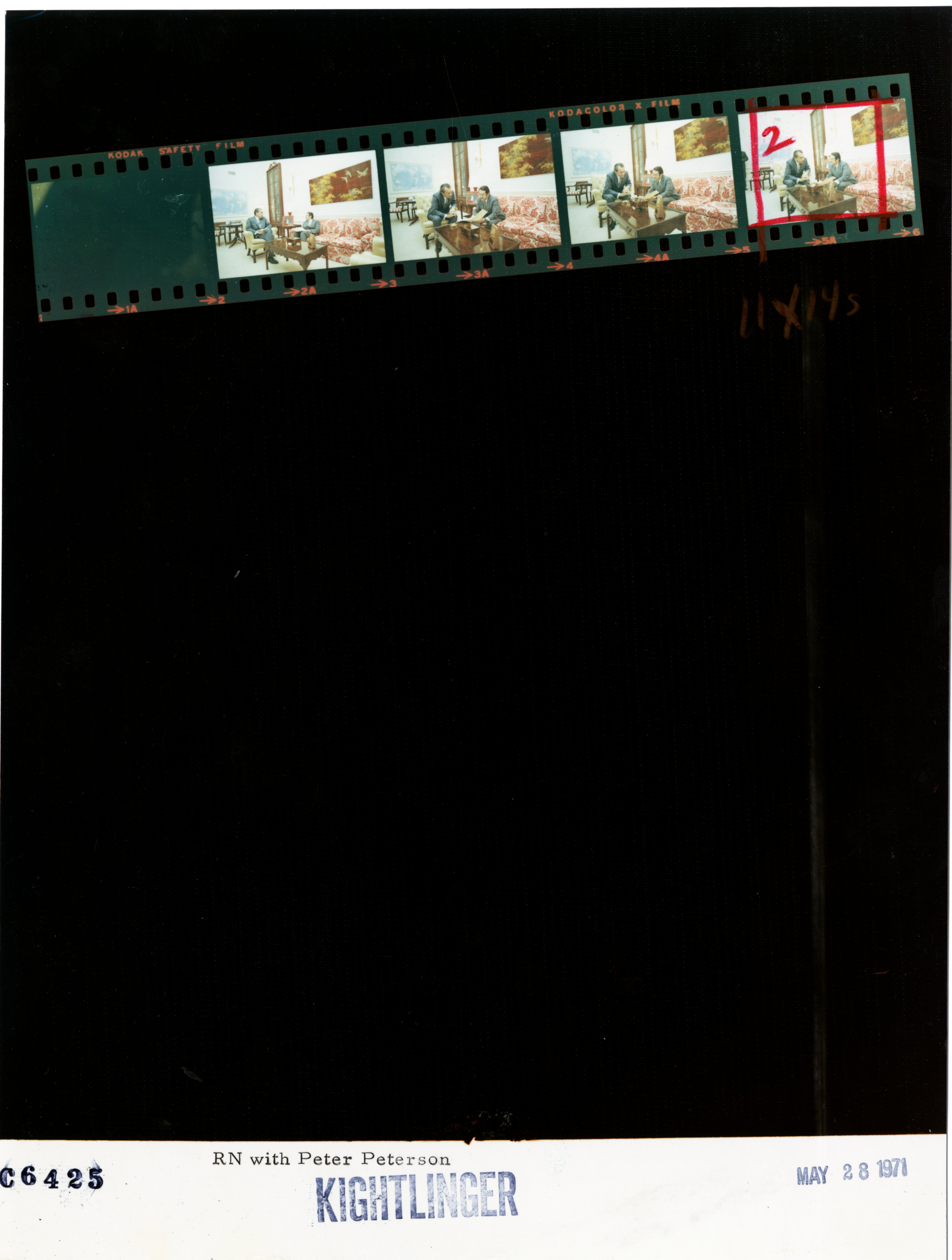
- Frame(s): WHPO-6425-, President Nixon seated informally during a meeting with Peter Peterson in the President's Executive Office Building (EOB) office. 5/28/1971, Washington, D.C. Presidential Office, Executive Office Building (EOB). President Nixon, Peter G. Peterson.
- Frame(s): WHPO-6425-03A, President Nixon seated informally during a meeting with Peter Peterson in the President's Executive Office Building (EOB) office. 5/28/1971, Washington, D.C. Presidential Office, Executive Office Building (EOB). President Nixon, Peter G. Peterson.
Roll WHPO-6430 Photographer: Atkins, Oliver | Color or B&W: B&W
- Frame(s): WHPO-6430-, Herb Klein posing for closeup portraits. 5/28/1971, Washington, D.C. unknown. Herbert Klein.
- Frame(s): WHPO-6430-04A, Portrait study of Herbert Klein. 5/28/1971, Washington, D.C. unknown. Herbert Klein.
Roll WHPO-6431 Photographer: Atkins, Oliver | Color or B&W: B&W
- Frame(s): WHPO-6431-, President Nixon in his Executive Office Building (EOB) office with assistant Peter Peterson. 5/28/1971, Washington, D.C. Presidential Office, Executive Office Building (EOB). President Nixon, Peter Peterson.
- Frame(s): WHPO-6431-02, President Nixon in his Executive Office Building (EOB) office with assistant Peter Peterson. 5/28/1971, Washington, D.C. Presidential Office, Executive Office Building (EOB). President Nixon, Peter Peterson.
Roll WHPO-6432 Photographer: Kightlinger, Jack | Color or B&W: B&W
- Frame(s): WHPO-6432-08-16, John Davies receiving a book from the Philippines. 5/28/1971, Washington, D.C. White House Grounds. John Davies, unidentified woman and men.
Roll WHPO-6434 Photographer: Atkins, Oliver | Color or B&W: B&W
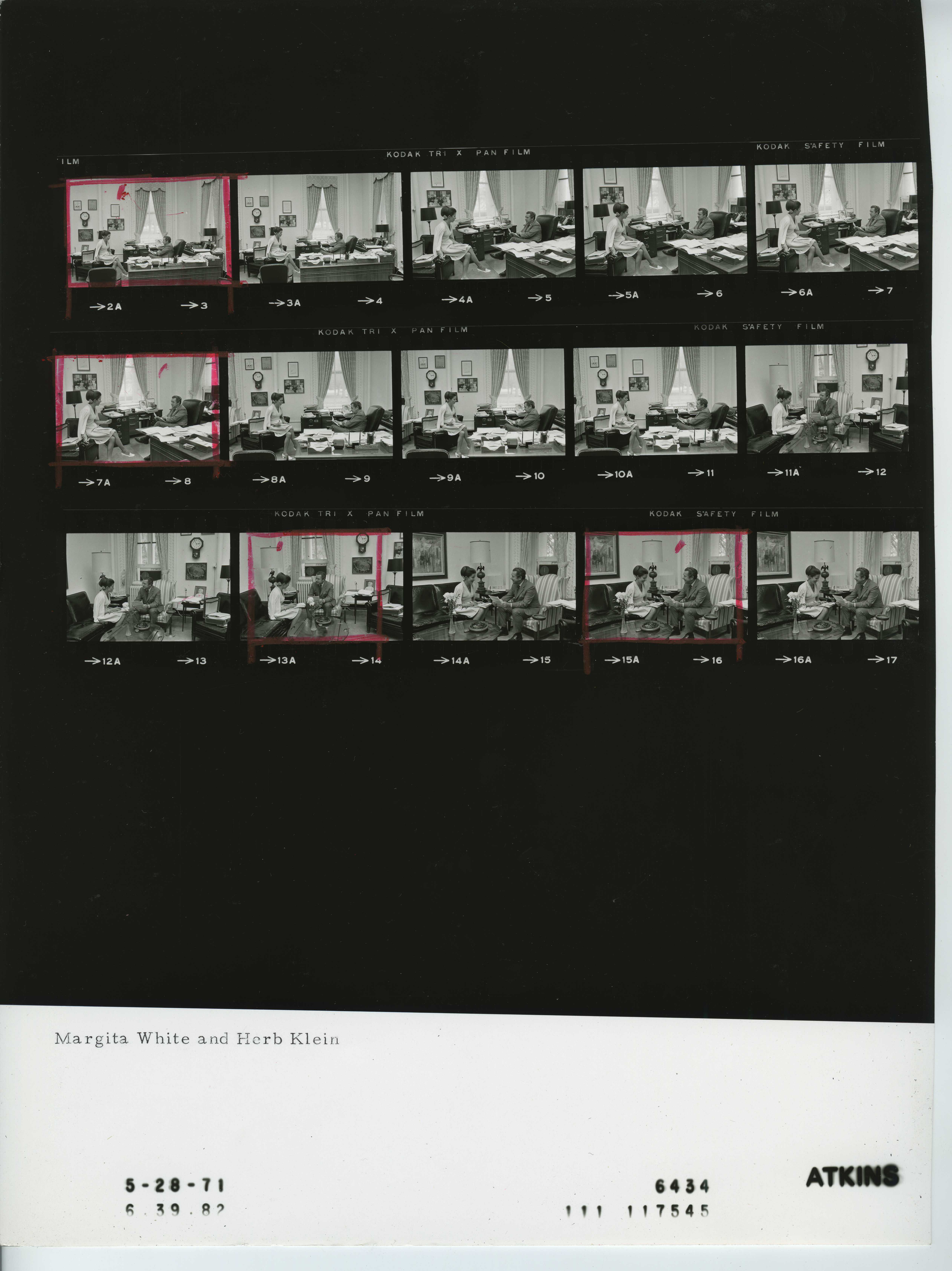
- Frame(s): WHPO-6434-, Herb Klein with Margita White. 5/28/1971, Washington, D.C. unknown. Herb Klein, Margita White.
The White House Communications Agency Sound Recordings Collection contains public statements that took place between 1969 and 1974. Visit the finding aid to learn more.
D - First Family
- WHCA-SR-D-008
Tricia Nixon's remarks introducing the DC Youth Symphony. [see J-126]. (5/28/1970, South Lawn, The White House)
Runtime: 4:00
Production credits: Audio feed supplied by WHCA; Recorded by LRR (initials of WHCA engineer)
Original Format: 1/4-inch reel-to-reel audiotape. Original source type: Original.
J - Entertainment at the White House
- WHCA-SR-J-126
DC Youth Symphony [see D-8]. (5/28/1970)
Runtime: 32:00:00
Keywords: Musician, musicians, music, celebrities, performance, classical music
Original Format: 1/4-inch reel-to-reel audiotape. Original source type: Original.
P - Formal Presidential Remarks
- WHCA-SR-P-700515
Remarks by President Nixon at the Presentation of Portraits of James and Dolley Madison. (5/28/1970)
Runtime: 1:39
Original Format: 1/4-inch reel-to-reel audiotape. Original source type: Original. - WHCA-SR-P-700516
Remarks by President Nixon at the Billy Graham Crusade in Knoxville, Tennessee, with remarks by Billy Graham, Dr. E. B. Hill, Dr. John Williams and a performances by Ethel Waters and George Beverly Shea. (5/28/1970, Neyland Stadium, Knoxville, Tennessee)
Runtime: 1:16:55
Keywords: Music, performance, student demonstration, protest, rally, rallies, youth
Production credits: Audio feed supplied by WHCA; Recorded by JAD (initials of WHCA engineer)
Original Format: 1/4-inch reel-to-reel audiotape. Original source type: Original.
The White House Communications Agency Videotape Collection contains “off-the-air” recordings of televised programs produced between 1968 and 1974. Visit the finding aid to learn more.
- WHCA-4397
Dolf Droge Tape I, "Conservative View".
ALL NETWORKS
Runtime: 00:58:58 - WHCA-4398
"The Dick Cavett Show" :Drs. Arthur Galston & Eaton Signor, Mort Sahl. Huey Newton, Black Panther leader; Dr. John Morsell, of the NAACP.
Group W Productions
Runtime: 01:10:58 - WHCA-4398A
Network News Excerpts on Vietnam Drug Problem [Weekly News Summary]. Robert Finch, Goralski, McGee, John Chancellor, Harry Reasoner, Sam Donaldson.
All networks
Runtime: 00:34:07
6. McGee/Goralski: Defense Department to set up drug addict aid programs (Roger Kelley, Assistant Secretary of Defense). Time Code Start: 15:36. Keywords: pharmaceuticals, medicines, drugs, drug abuse, narcotics, heroin, marijuana, alcohol, alcoholism, addicts, addiction, prevention, programs. Network: NBC. - WHCA-4414
Weekly News Summary, Tape I.
ALL NETWORKS
Runtime: 1:30
1. Reasoner/Donaldson: Hard drug use by servicemen in Vietnam prompts Congressmen to investigate, saying if government can't do something about it in 2 months that they should bring everyone home. South Vietnamese say crackdown on heroin and other drugs is g. Time Code Start: 00:00:00. Keywords: Vietnam War, military, troops, drugs, illegal, drug abuse, narcotics, heroin, addicts, addiction, programs, investigations. Network: ABC.
2. Reasoner: Commentary. In early years of Cold War people perceived the Soviet Union as monolithic villain of shrewdness in carrying out its evil policies. Every international thing they did worked while the US stumbled. Editor of Harper's John Fischer arti. Time Code Start: 00:03:07. Keywords: Soviet Union, Russia, USSR, politics, public opinions, Middle East, Mideast, foreign aid. Network: ABC.
3. Brinkley/Burrington/Nolan: US and Russia finishes SALT talk about reducing spending on military hardware in Vienna. To meet in July in Helsinki for a 4 month or longer session. Talks focused on defensive missile, or ABM, agreement but still to make progre. Time Code Start: 00:05:02. Keywords: SALT, S.A.L.T., Strategic Arms Limitation Talks, Russia, Soviet Union, USSR, Cold War, détente, military. Network: NBC.
4. Brinkley: The Defense Ministers of NATO are meeting in Brussels and discussing the Russian suggestion that both sides take some of their military forces out of Europe. American Defense Secretary Laird said European countries were relying too much on Ameri. Time Code Start: 00:08:46. Keywords: N.A.T.O., North Atlantic Treaty Organization, Europe, military, meetings, officials. Network: NBC.
5. McGee/Hager: The connection between NATO's defense problems and the condition of the US Dollar was demonstrated at the International Banking Conference where the Secretary stated the US economy no longer dominated the free world as they have spent so much. Time Code Start: 00:09:17. Keywords: N.A.T.O., North Atlantic Treaty Organization, Europe, military, meetings, officials, foreign aid, financial crisis. Network: NBC.
6. McGee/Goralski: Deputy Defense Secretary David Packard ordered the Pentagon to draw up a plan within a week for the treatment of military drug addicts. Ordered Assistant Secretary of Defense Rodger Kelly to head the planning work, who said that right now . Time Code Start: 00:11:43. Keywords: Vietnam War, military, troops, drugs, illegal, drug abuse, narcotics, heroin, addicts, addiction, programs, investigations. Network: NBC.
7. Brinkley: The Kennedy Center for the Performing Arts is not finished, but they opened it the night before for a fundraiser of the whose "who's whos". David Eisenhower and Julie Nixon in attendance, plus Kennedys.. Time Code Start: 00:13:33. Keywords: Theaters, openings, fundraising, events, celebrities, Presidents, families. Network: NBC.
8. Cronkite/Schieffer: Relatives of American prisoners of war demonstrated in Paris for release of loved ones. Different group of women gathered in Washington D.C. today for appeal for immediate action, want President Nixon to declare all ground and air forc. Time Code Start: 00:15:55. Keywords: Vietnam Prisoner of War, Missing in Action, POW, MIA, Vietnam War, military, families, demonstrations, rallys, protesters, demonstraters, demonstrators, anti-war, women, mail, letters. Network: CBS.
9. Cronkite: Heroin addiction among servicemen in South Vietnam prompts Defense Department to start program to identify and help addicts. Classified it as "Urgent" and called for pilot program to be submitted by next Friday.. Time Code Start: 00:18:41. Keywords: Vietnam War, military, troops, drugs, illegal, drug abuse, narcotics, heroin, addicts, addiction, programs. Network: CBS.
10. Cronkite: Heavy fighting continued among 3 fronts in the Indo-China war, most notably around the village of Snuol in Eastern Cambodia. Killed 219 Communists, lost 8 Americans. South Vietnamese forces said they beat back 2 attacks.. Time Code Start: 00:19:00. Keywords: Vietnam War, Indochina War, Cambodia, battles, killed in action, KIA, fatalities, casualties. Network: CBS.
11. Cronkite/Collingwood: Fourth round of SALT ended in Vienna, and will soon pick up again in Helsinki. Soviet Ambassador met at US Embassy for the final meeting of the Vienna phase of SALT talks. Soviet US agreement to press forward from now on with simulta. Time Code Start: 00:18:33. Keywords: SALT, S.A.L.T., Strategic Arms Limitation Talks, Russia, Soviet Union, USSR, Cold War, détente. Network: CBS.
12. Cronkite/Sevareid: Commentary. Plants are blooming around them and Congress is "just holding their own." He will go on vacation. The general period looks normal, so confused and contradictory. President Nixon doing well on most world peace problems, not s. Time Code Start: 00:22:03. Keywords: Presidents, elections, campaigns, campaigning, People's Republic of China, politics, organization of nations, intergovernmental alliance, exclusions. Network: CBS.
Context (External Sources)
The Vanderbilt Television News Archive is the world's most extensive and complete archive of television news. They have been recording, preserving and providing access to television news broadcasts of the national networks since August 5, 1968.
Wikipedia is a free encyclopedia that anyone can edit.