
Introduction
This almanac page for Thursday, May 11, 1972, pulls together various records created by the federal government and links to additional resources which can provide context about the events of the day.
Previous Date: Wednesday, May 10, 1972
Next Date: Friday, May 12, 1972
Schedule and Public Documents
The Daily Diary files represent a consolidated record of the President's activities. Visit the finding aid to learn more.
The President's day began at The White House - Washington, D. C.
The Weekly Compilation of Presidential Documents made available transcripts of the President's news conferences; messages to Congress; public speeches, remarks, and statements; and other Presidential materials released by the White House.
Digitized versions can be found at HathiTrust.
Each Public Papers of the Presidents volume contains the papers and speeches of the President of the United States that were issued by the White House Office of the Press Secretary during the time period specified by the volume. The material is presented in chronological order, and the dates shown in the headings are the dates of the documents or events. In instances when the release date differs from the date of the document itself, that fact is shown in the text note.
To ensure accuracy, remarks have been checked against audio recordings (when available) and signed documents have been checked against the original, unless otherwise noted. Editors have provided text notes and cross references for purposes of identification or clarity.
The Federal Register is the official daily publication for rules, proposed rules, and notices of federal agencies and organizations, as well as executive orders and other Presidential documents.
The Congressional Record is the official daily record of the debates and proceedings of the U.S. Congress.
Archival Holdings
Any selection of archival documents will necessarily be partial. You should use the documents and folders identified below as a starting place, but consult the linked collection finding aids and folder title lists and the collections themselves for context. Many documents to be found this way do not lend themselves to association with specific dates, but are essential to a complete understanding of the material.
Selective document listing
President's Office Files
The President's Office Files consists of materials drawn together by the Special Files Unit from several administrative subdivisions within the White House Office. It is the handwriting and sensitive papers sent to the Staff Secretary that now comprise much of the President's Office Files. Visit the finding aid to learn more.
- News Summaries, Unmarked News Summaries, Box 49, News Summaries - May 1972 [6 of 13] [Note: Due to the way News Summary products were compiled, you should also consult nearby days for potentially relevant materials.]
- News Summary, May 11, 1972, (Wed. nets, wires, papers)
- News Summaries, Unmarked News Summaries, Box 49, News Summaries - May 1972 [9 of 13]
- Special Report: American Lives/American Honor: The Vietnam Dilemma, ABC-TV, 8-9 pm. May 11, 1972
- President's Daily Schedule, Box 102, [President's Daily Schedule, Apr.-July 1972] [2 of 3]
- The President's Schedule, Thursday - May 11, 1972
The H. R. Haldeman Diaries consists of seven handwritten diaries, 36 dictated diaries recorded as sound recordings, and two handwritten audio cassette tape subject logs. The diaries and logs reflect H. R. Haldeman’s candid personal record and reflections on events, issues, and people encountered during his service in the Nixon White House. As administrative assistant to the President and Chief of Staff, Haldeman attended and participated in public events and private meetings covering the entire scope of issues in which the Nixon White House engaged in during the years 1969-1973. Visit the finding aid to learn more.
- Transcript of diary entry (PDF)
Thursday, May 11.
Still going on reaction, got some pretty good positive stuff. Some concern now in our political group, on the potential problem of being charged with the Vietnam sellout. Rogers called me this morning and said he felt that he and Henry should talk to the President today or tomorrow to show that Rogers is not cut out because of the simple story that said Connally was the strong man in making the decision and all. Also he has to do the Business Council on Saturday and testify on Monday and Tuesday. He was thinking of having a press conference tomorrow on the response from the Soviets. We did have a message back from them that was much milder than was expected. They protested the blockade and all that sort of stuff, but didn't demand any action in any kind of way that concerned our people.
We set up the Rogers meeting. The President had me sit in and we didn't really accomplish much. The President told Rogers not to have a press conference this week, emphasize that we have to turn off all of our PR apparatus on any comment on the Soviet answer or any interpretation of the Soviet attitude. Rogers was concerned about the incidents at sea, negotiations with the Russians, and the President said to get some position papers to him. He got an extension—the Soviets have an ultimatum—we have to have a decision tonight before they extend it over the weekend. Regarding the Hill action, the President said we should put out a firm line this weekend: do nothing to weaken the possibility of winning; that is, don't do anything that'll cut South Vietnamese morale, so there should be no Congressional action until Monday, and we should discontinue any speculation that we would give in on a resolution, even if it were fairly favorable.
The general feeling now, even on Henry's part, is that the Summit is going to be on rather than off, and so there's a new level of optimism on that point. The general attack is going well, the President's mood seems to be very good, although he's tired. He left at about 4:30 after the Rogers meeting for Camp David with Bebe. He had him up last night to go out for dinner on the boat and to stay up over the weekend. Apparently he's going to stay up at Camp David, at least I assume so.
End of May 11. - Original audio recording (MP3)
The National Archives Catalog is the online portal to the records held at the National Archives, and information about those records. It is the main way of describing our holdings and also provides access to electronic records and digitized versions of our holdings.
The Catalog searches across multiple National Archives resources at once, including archival descriptions, digitized and electronic records, authority records, and web pages from Archives.gov and the Presidential Libraries. The Catalog also allows users to contribute to digitized historical records through tagging and transcription.
Nixon Library Holdings
All National Archives Units
National Security Documents
The President's Daily Brief is the primary vehicle for summarizing the day-to-day sensitive intelligence and analysis, as well as late-breaking reports, for the White House on current and future national security issues. Read "The President's Daily Brief: Delivering Intelligence to Nixon and Ford" to learn more.
The Foreign Relations of the United States series presents the official documentary historical record of major U.S. foreign policy decisions and significant diplomatic activity. Visit the State Department website for more information.
Vol. IV, Foreign Assistance, International Development, Trade Policies, 1969-1972
Trade and Commerce, 1969-1972
273. Information Memorandum From the President’s Assistant for International Economic Affairs (Flanigan) to President Nixon, Washington, May 11, 1972
Source: National Archives, Nixon Presidential Materials, NSC Files, Subject Files, Box 402, Trade, Volume V 1/72-4/7/73. Confidential.
Vol. VIII, Vietnam, January-October 1972
The North Vietnamese Offensive Falters, Negotiations Resume, May 8-July 18, 1972
146. Minutes of a Washington Special Actions Group Meeting, Washington, May 11, 1972, 11:21-11:59 a.m.
Source: National Archives, Nixon Presidential Materials, NSC Files, NSC Institutional Files (H-Files), Box H–116, Washington Special Actions Group, WSAG Minutes (Originals) 1–3–72 to 7–24–72. Top Secret; Sensitive. The meeting took place in the White House Situation Room. All brackets, except those that indicate the omission of material, are in the original.
Vol. XIV, Soviet Union, October 1971-May 1972
Summit in the Balance: U.S.-Soviet Relations and the Decision to Mine Haiphong, April 26-May 12, 1972
214. Memorandum of Conversation, Washington, May 11, 1972, 1:15 p.m.
Source: National Archives, Nixon Presidential Materials, NSC Files, Box 494, President’s Trip Files, Dobrynin/Kissinger, 1972, Vol. 2. Top Secret; Sensitive; Exclusively Eyes Only.
215. Memorandum for the President’s Files From the President’s Assistant and Director of the Council on International Economic Policy (Flanigan), Washington, May 11, 1972, 10:08-11:01 a.m.
Source: National Archives, Nixon Presidential Materials, White House Special Files, President’s Office Files, Box 88, Memoranda for the President, Beginning May 7, 1972. Secret. The time of the meeting and the fact that members of the press and an unnamed White House photographer were present for short periods are in the President’s Daily Diary. (Ibid., White House Central Files) An undated memorandum for the President’s files outlines the key points for the President to make during his meeting. (Ibid., White House Special Files, President’s Office Files, Box 88, Memoranda for the President, Beginning May 7, 1972) Kissinger’s May 11 memorandum to the President provided a background briefing for the meeting. (Ibid., NSC Files, Box 719, Country Files, Europe, USSR, Vol. XXII, May 1972) A May 11 memorandum from Peterson to Nixon contained talking points. (Ibid.) Kissinger briefly describes the meeting in his memoirs. (White House Years, p. 1194) A recording of this meeting is ibid., White House Tapes, Oval Office, Conversation No. 723–5. Kissinger’s comments to Nixon immediately following this meeting also appear on a tape recording. (Ibid., Conversation No. 723–7)
216. Minutes of Washington Special Actions Group Meeting, Washington, May 11, 1972, 11:21-11:59 a.m.
Source: National Archives, Nixon Presidential Materials, NSC Files, NSC Institutional Files (H-Files), Box H–116, WSAG Minutes, Originals. Sensitive. Transmitted to Kissinger under cover of an attached May 11 memorandum from Davis.
217. Conversation Among President Nixon, his Assistant for National Security Affairs (Kissinger), White House Chief of Staff (Haldeman), and Secretary of State Rogers, Washington, May 11, 1972
Source: National Archives, Nixon Presidential Materials, White House Tapes, Oval Office, Conversation No. 723–16. No classification marking. According to his Daily Diary, Nixon met with Kissinger, Haldeman, and Rogers in the Oval Office from 3:51 to 4:44 p.m. The editors transcribed the portion of the conversation printed here specifically for this volume. In his diary Haldeman recorded that Rogers asked for this meeting to show that he “is not cut out” of decisions in Vietnam. “We set up the Rogers meeting. The P had me sit in and we didn’t really accomplish much. The P told Rogers not to have a press conference this week, emphasize that we have to turn off all of our PR apparatus on any comment on the Soviet answer or any interpretation of the Soviet attitude.” Haldeman continued: “The general feeling now, even on Henry’s part, is that the Summit is going to be on rather than off, and so there’s a level of optimism on that part.” (The Haldeman Diaries: Multimedia Edition)
Vol. XIX, Part 1, Korea, 1969-1972
Republic of Korea Troops in Vietnam and Force Modernization, April 1971-December 1972
139. National Intelligence Estimate, Washington, May 11, 1972
Source: Central Intelligence Agency, ODDI Registry of NIEs and SNIEs, Job 79–R01012A. Secret. The Central Intelligence Agency and the intelligence organizations of the Departments of State and Defense, the NSA, and the Atomic Energy Commission participated in the preparation of this estimate. The Director of Central Intelligence submitted this estimate with the concurrence of all members of the USIB with the exception of the representatives of the FBI and the Department of Treasury who abstained on the grounds that it was outside their jurisdiction. Another copy of this NIE is in the National Archives, Nixon Presidential Materials, NSC Files, Box 361, Subject Files, National Intelligence Estimates, Part 3.
Vol. XXIV, Middle East Region and Arabian Peninsula, 1969-1972; Jordan, September 1970
The Two Yemens
189. Paper Prepared by Samuel Hoskinson and Harold Saunders of the National Security Council Staff, Washington, May 11, 1972
Source: National Archives, Nixon Presidential Materials, NSC Files, Box 1287, Saunders Files, Saudi Arabia. Secret. A typed notation reads: “For HAK.” This paper was not included in the President’s Friday (May 12) briefing. (Ibid., Box 41, President’s Daily Briefing Files, May 1–May 16, 1972)
Vol. E-4, Documents on Iran and Iraq, 1969-1972
Iran 1972
191. Telegram 2774 From the Embassy in Iran to the Department of State, Tehran, May 11, 1972, 1230Z
The Embassy offered guidance on whether the President should raise the issue of narcotics during his Iranian visit.
Source: National Archives, RG 59, Central Files 1970–73, SOC 11–5 IRAN. Confidential; Exdis. Repeated to Kabul, Ankara, and Islamabad.
Vol. E-7, Documents on South Asia, 1969-1972
U.S. Relations with India and Pakistan, 1972
261. Telegram 83263 From the Department of State to the Embassy in India, Washington, May 11, 1972, 2350Z
Ambassador Keating was instructed to propose consultations to produce a mutually agreed reduction of U.S. AID staff members in India, taking into account U.S. and Indian priorities for various programs.
Source: National Archives, RG 59, Central Files 1970–73, AID (US) INDIA. Secret; Priority; Nodis. Eyes only for Ambassador from Hannah and Sisco. Drafted by Schneider and by Williams and Hannah; cleared by Van Hollen, Sisco, Williams, and Hannah; and approved by Irwin.
Vol. E-10, Documents on American Republics, 1969-1972
Panama
559. Special National Intelligence Estimate 84–72, Washington, May 11, 1972., Washington, May 11, 1972
In this 3 page intelligence estimate, the Central Intelligence Agency discussed the political stance and probable negotiating position of the Torrijos regime regarding the Canal. In addition, the Agency analyzed different threats to the Canal, and the possible reaction of the Panamanian Government to those threats under a new treaty relationship.
Source: National Archives, Nixon Presidential Materials, NSC Files, Box 361, Subject Files, National Intelligence Estimates, Part 3. Secret.
Vol. E-16, Documents on Chile, 1969-1973
Cool and Correct: The U.S. Response to the Allende Administration, November 5, 1970-December 31, 1972
111. Memorandum for the 40 Committee, Washington, May 11, 1972
Summary: This memorandum examined the elections held at the University of Chile in April 1972. The contest was “an event of national importance” as the election showdown between the Marxist and non-Marxist forces indicated a political shift away from Allende.
Source: National Security Council, Nixon Intelligence Files, Subject Files, Chile, 1971–72. Secret; Sensitive; Eyes Only. A notation on the first page indicates that the memorandum was distributed to the principals of the 40 Committee on May 12. A covering memorandum states, “Paper distributed to all principals. Not forwarded to HAK but read by Bill Jorden. All principals notified that paper being filed 5/22/72. Will not be a minute item.”
The Kissinger telephone conversation transcripts consist of approximately 20,000 pages of transcripts of Kissinger’s telephone conversations during his tenure as Assistant to the President for National Security Affairs (1969-1974) and Secretary of State (1973-1974) during the administration of President Richard Nixon. Visit the finding aid for more information.
Digitized versions can be found in the National Archives Catalog.
Audiovisual Holdings
Visit the White House Tapes finding aid to learn about the taping system's operation and archival processing.
Old Executive Office Building
- 338-37; Unknown between 11:22 a.m. & 11:32 a.m.; Nixon, Richard M. (President); White House operator
- 338-38; Unknown between 11:32 a.m. & 11:33 a.m.; Nixon, Richard M. (President); Colson, Charles W.
- 338-39; Unknown between 11:34 a.m. & 11:35 a.m.; Nixon, Richard M. (President); Cox, Tricia Nixon
- 338-40; Unknown between 11:35 a.m. & 11:43 a.m.; Nixon, Richard M. (President); Haldeman, H. R. ("Bob")
- 338-41; 11:43 a.m. - 12:40 p.m.; Nixon, Richard M. (President); Colson, Charles W.; Haldeman, H. R. ("Bob"); White House operator; Scott, Hugh; Griffin, Robert P.; [Unknown person(s)]
- 338-42; Unknown between 12:04 p.m. & 12:51 p.m.; Nixon, Richard M. (President); Kissinger, Henry A.; Haldeman, H. R. ("Bob"); [Unknown person(s)]
- 338-43; Unknown between 1:29 p.m. & 1:50 p.m.; Nixon, Richard M. (President); [Unknown person(s)]
- 338-44; Unknown between 1:29 p.m. & 1:50 p.m.; Nixon, Richard M. (President); [Unknown person(s)]
Oval Office
- 723-1; 10:03 a.m. - 10:04 a.m.; Nixon, Richard M. (President); Kissinger, Henry A.
- 723-2; Unknown between 10:04 a.m. & 10:06 a.m.; Nixon, Richard M. (President); Bull, Stephen B.
- 723-3; 10:06 a.m. - 10:07 a.m.; Nixon, Richard M. (President); Ziegler, Ronald L.
- 723-4; Unknown between 10:07 a.m. & 10:08 a.m.; Nixon, Richard M. (President); Bull, Stephen B.
- 723-5; 10:08 a.m. - 11:01 a.m.; Nixon, Richard M. (President); Patolichev, Nikolai S.; Dobrynin, Anatoliy F.; Peterson, Peter G.; Kissinger, Henry A.; Flanigan, Peter M.; White House photographer
- 723-6; Unknown between 11:01 a.m. & 11:02 a.m.; Nixon, Richard M. (President); Butterfield, Alexander P.
- 723-7; 11:02 a.m. - 11:21 a.m.; Nixon, Richard M. (President); Ziegler, Ronald L.; [Unknown person(s)]; Kissinger, Henry A.
- 723-8; Unknown between 11:21 a.m. & 11:22 a.m.; Nixon, Richard M. (President); [Unknown person(s)]
- 723-9; Unknown between 3:03 p.m. & 3:09 p.m.; Nixon, Richard M. (President); [Unknown person(s)]
- 723-10; 3:09 p.m. - 3:24 p.m.; Nixon, Richard M. (President); Kissinger, Henry A.; [Unknown person(s)]
- 723-11; Unknown between 3:24 p.m. & 3:25 p.m.; Nixon, Richard M. (President); Bull, Stephen B.
- 723-12; 3:25 p.m. - 3:39 p.m.; Nixon, Richard M. (President); Haldeman, H. R. ("Bob")
- 723-13; Unknown between 3:39 p.m. & 3:40 p.m.; Nixon, Richard M. (President); Nixon, Thelma C. ("Pat") (Ryan)
- 723-14; Unknown between 3:40 p.m. & 3:45 p.m.; Nixon, Richard M. (President); Butterfield, Alexander P.
- 723-15; 3:45 p.m. - 3:51 p.m.; Nixon, Richard M. (President); Woods, Rose Mary; Bull, Stephen B.
- 723-16; 3:51 p.m. - 4:44 p.m.; Nixon, Richard M. (President); Rogers, William P.; Kissinger, Henry A.; Haldeman, H. R. ("Bob"); Butterfield, Alexander P.
- 723-17; 3:39 p.m. - 3:39 p.m.; Nixon, Richard M. (President); White House operator
White House Telephone
- 24-71; Unknown between 11:22 a.m. & 11:32 a.m.; Nixon, Richard M. (President); White House operator
- 24-72; Unknown between 11:22 a.m. & 11:32 a.m.; Nixon, Richard M. (President); White House operator
- 24-73; 11:32 a.m. - 11:33 a.m.; Nixon, Richard M. (President); Colson, Charles W.
- 24-74; 11:34 a.m. - 11:35 a.m.; Nixon, Richard M. (President); Cox, Tricia Nixon
- 24-75; Unknown between 11:43 a.m. & 11:49 a.m.; Nixon, Richard M. (President); White House operator
- 24-76; 11:49 a.m. - 11:51 a.m.; Nixon, Richard M. (President); Scott, Hugh
- 24-77; Unknown between 11:51 a.m. & 11:56 a.m.; Nixon, Richard M. (President); White House operator
- 24-78; 11:56 a.m. - 11:57 a.m.; Nixon, Richard M. (President); Griffin, Robert P.
- 24-79; 3:39 p.m. - 3:39 p.m.; Nixon, Richard M. (President); White House operator
- 24-80; 3:39 p.m. - 3:40 p.m.; Nixon, Richard M. (President); Nixon, Thelma C. ("Pat") (Ryan)
The White House Photo Office collection consists of photographic coverage of President Richard Nixon meeting with prominent social, political, and cultural personalities; speaking engagements and news conferences of the President and various high-ranking members of the White House staff and Cabinet; Presidential domestic and foreign travel, including Presidential vacations; social events and entertainment involving the First Family, including entertainers present; official portraits of the President, First Family, and high-ranking members of the Nixon administration; the 1969 and 1973 Inaugurals; the President’s 1972 Presidential election campaign appearances (including speeches) and other official activities of the White House staff and the President’s Cabinet from January 20, 1969 until August 9, 1974 at the White House and the Old Executive Office Building; other locations in Washington, DC, such as The Mall; and the Presidential retreats in Camp David, Maryland, Key Biscayne, Florida, and San Clemente, California. Visit the finding aid to learn more.
Roll WHPO-9054 Photographer: Atkins, Oliver | Color or B&W: B&W
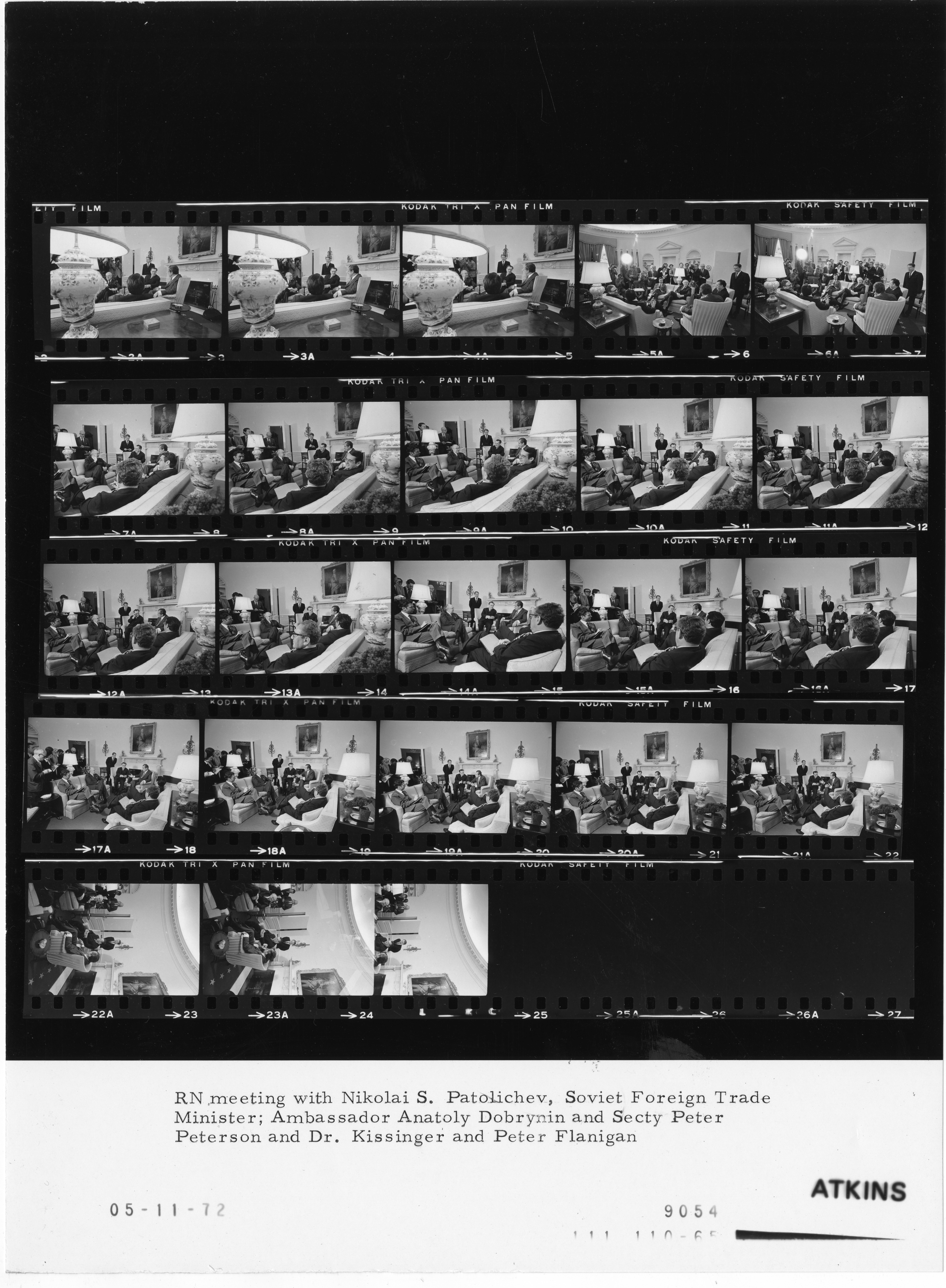
- Frame(s): WHPO-9054-, President Nixon seated informally with Russian foreign Trade Minister Nikolai Patolichev, Russian Ambassador Anatoly Dobrynin, and others. 5/11/1972, Washington, D.C. White House, Oval Office. President Nixon, Nikola Patolichev, Anatoly Dobrynin, Kissinger, Peter Peterson, Peter Flanigan.
Roll WHPO-9055 Photographer: Moore, Robert (Supervisor/Director, WHPO Photographic Laboratory) | Color or B&W: B&W
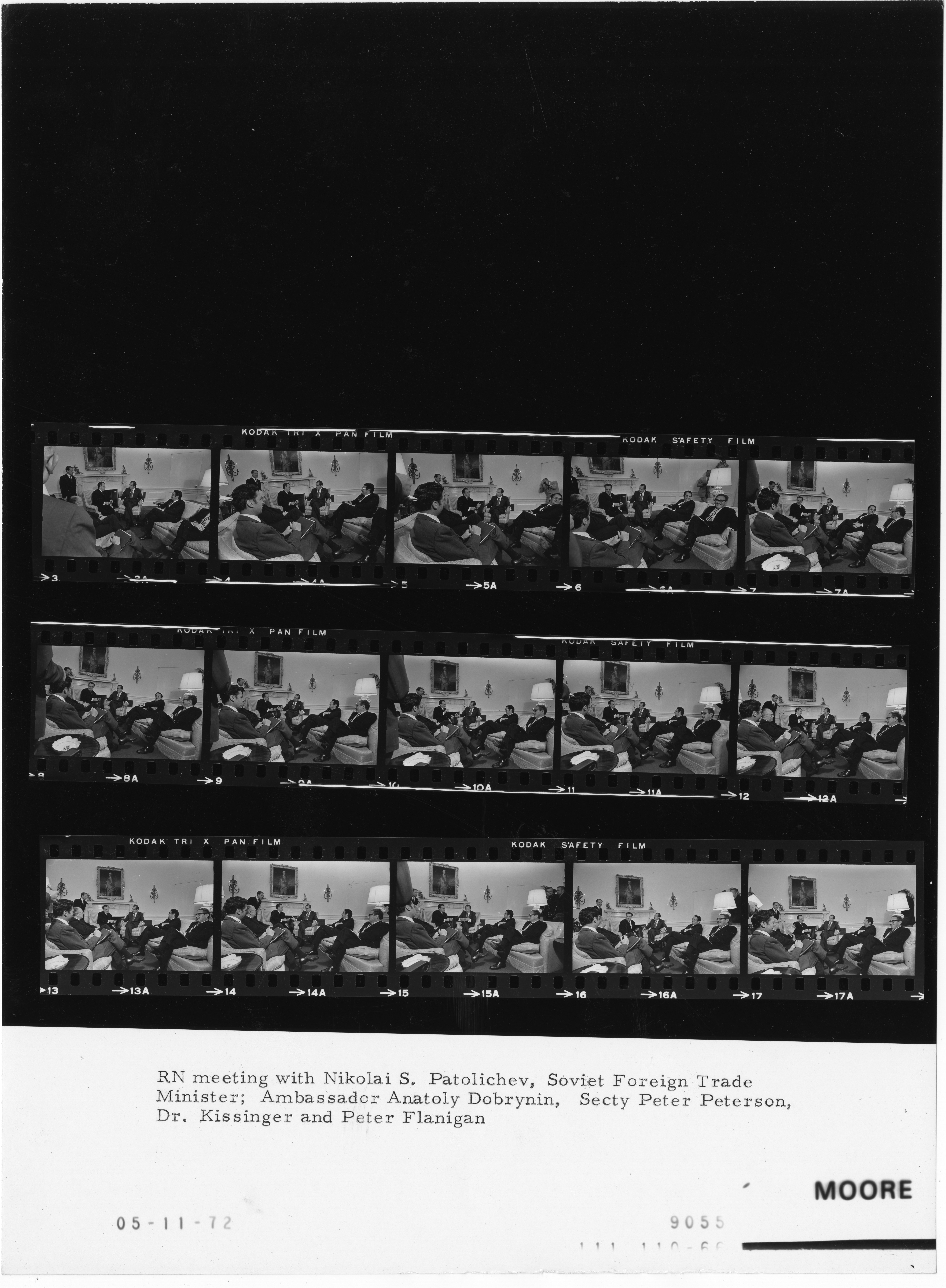
- Frame(s): WHPO-9055-, President Nixon seated informally with Russian Foreign Trade Minister Nikolai Patolichev, Russian Ambassador Anatoly Dobrynin, and others. 5/11/1972, Washington, D.C. White House, Oval Office. President Nixon, Nikolai Patolichev, Anatoly Dobrynin, Kissinger, Peter Peterson, Peter Flanigan.
Roll WHPO-9057 Photographer: JLC | Color or B&W: Color
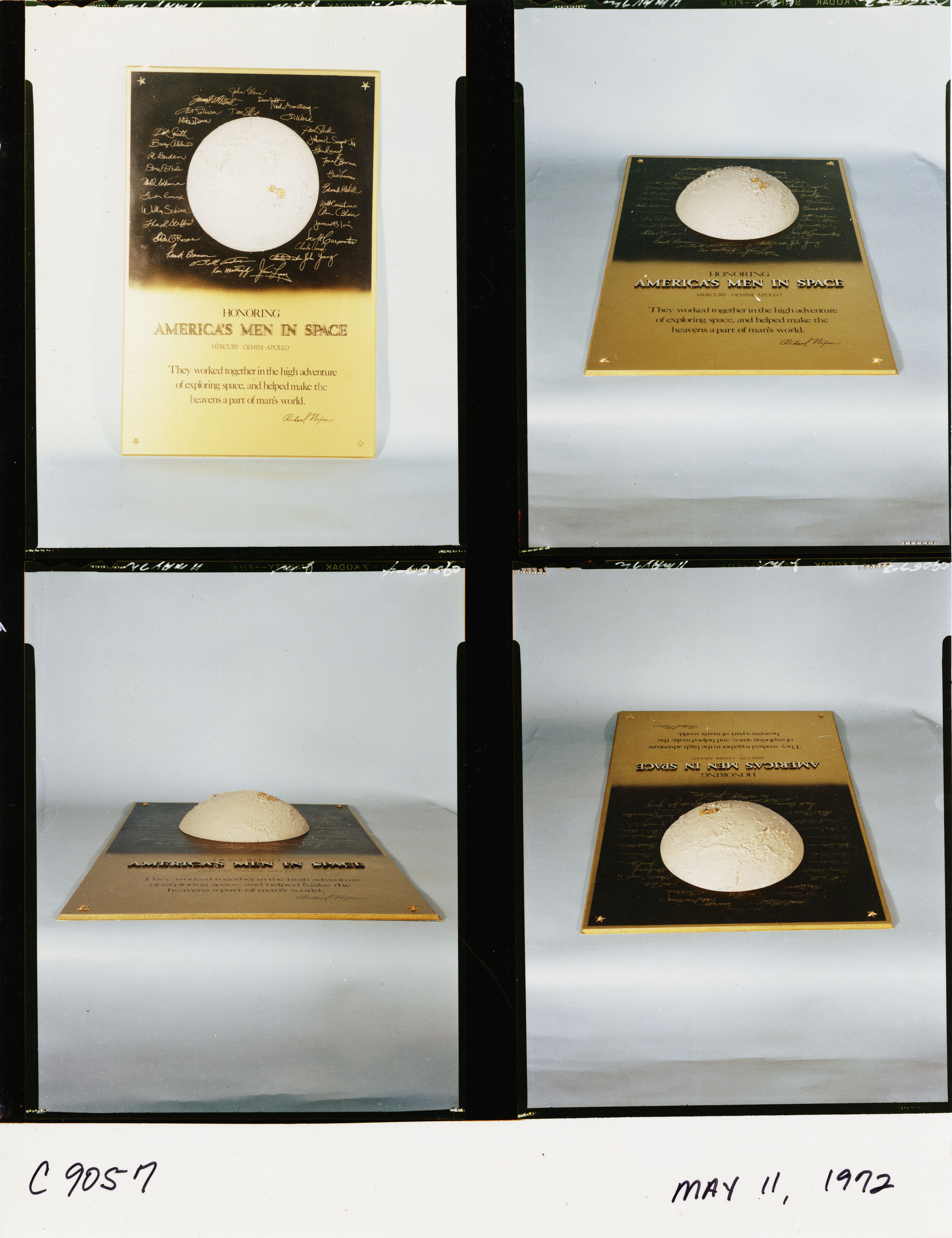
- Frame(s): WHPO-9057-, Photos of a plaque honoring America's Men in Space. 5/11/1972, Washington, D.C. unknown.
The White House Communications Agency Sound Recordings Collection contains public statements that took place between 1969 and 1974. Visit the finding aid to learn more.
H - White House Staff Member Recordings
- WHCA-SR-H-568
Briefing by General Scowcroft. (5/11/1972, Family Theater, White House)
Runtime: 1:07:00
Keywords: Briefings, public briefings, statements to the press (see also Press conferences, news conferences, interviews, media)
Production credits: Audio feed supplied by WHCA; Recorded by JMC (initials of WHCA engineer)
Original Format: 1/4-inch reel-to-reel audiotape. Original source type: Original.
The White House Communications Agency Videotape Collection contains “off-the-air” recordings of televised programs produced between 1968 and 1974. Visit the finding aid to learn more.
- WHCA-5358
"McCaffrey at Large".
CBS
Runtime: 00:32:09 - WHCA-5359
"Thirty Minutes".
ABC
Runtime: 00:30:37 - WHCA-5360
ABC Special: "American Lives, American Honor".
NBC
Runtime: 00:59:19 - WHCA-5363
Weekly News Summary, Tape III.
ALL NETWORKS
Runtime: 01:33:00
23. Reasoner/Chapman: Mines activated, Russian response. Time Code Start: 55:12. Keywords: Soviet Union, Russia, USSR, Navy, Naval mines, oceans, weapons, mine fields, bombs, explosives. Network: ABC.
24. Smith/Jarriel: Summit Meeting?. Time Code Start: 57:00. Keywords: summits, meetings. Network: ABC.
25. Smith/Geer: Mines (Admiral Zumwalt). Time Code Start: 59:04. Keywords: military, officials, Admirals, Navy, Naval mines, oceans, weapons, mine fields, bombs, explosives. Network: ABC.
26. Reasoner/Tuckner: Hanoi film clip on U.S. bombing. Time Code Start: 60:55. Keywords: Vietnam War, bombings. Network: ABC.
27. Smith/Tomlinson: Demonstrations against the Vietnam war. Time Code Start: 62:30. Keywords: demonstrations, rally, protests, protesters, demonstraters, demonstrators, Vietnam War, anti-war. Network: ABC.
28. Reasoner/Bennett: Vietnam; An Loc. Time Code Start: 65:03. Keywords: Vietnam War. Network: ABC.
29. Smith/Shoumacher: Vietnam; Hue. Time Code Start: 67:44. Keywords: Vietnam War. Network: ABC.
30. Smith: Commentary on Vietnam terror. Time Code Start: 69:30. Keywords: Vietnam War, militants, bombings, violence, sabotage, shootings, kidnappings, death, assassinations, terrorism. Network: ABC.
31. Chancellor/Valeriani: Vietnam; Russian ambassador meets with President Nixon at White House. Time Code Start: 70:10. Keywords: Soviet Union, Russia, USSR. Network: NBC.
32. Brinkley: President Nixon peace offer. Time Code Start: 75:00. Keywords: Presidents, Vietnam War, treaty, treaties, negotiations. Network: NBC.
33. Chancellor/Paxton/Goralski: Vietnam; An Loc. Time Code Start: 77:00. Keywords: North Vietnamese Army, NVA, Vietnam War. Network: NBC.
34. Chancellor/Briggs/Graham: Demonstrations- Minnesota (McCarthy), Washington D.C. (Dole, Thurmond, Senator Ted Kennedy). Time Code Start: 81:04. Keywords: demonstrations, rally, protests, protesters, demonstraters, demonstrators, Vietnam War, anti-war. Network: NBC.
35. Chancellor/Kiker: Maryland and Michigan Primaries next week; Governor George Wallace favored, urges votes for him to stop busing, busing for racial integration angers Michigan citizens,. Time Code Start: 86:00. Keywords: Senators, Governors, Presidential elections, campaigns, primaries, candidates, issues, desegregation, racism, racial profiling, racial discrimination, civil rights, African Americans. Network: NBC.
36. Kuralt/Pierpoint/Kalb/Schieffer: Moscow comment; Russians meet with President Nixon; harbor mining (Admiral Zumwalt). Time Code Start: 88:39. Keywords: Soviet Union, Russia, USSR. Network: CBS. - WHCA-5364
Weekly News Summary, Tape IV.
ALL NETWORKS
Runtime: 0:12
1. Kuralt/Pappas/Chung: Demonstrations- Madison, Wisconsin and Washington, D.C. (Senator Ted Kennedy, Dole). Time Code Start: 00:00. Keywords: demonstrations, rally, protests, protesters, demonstraters, demonstrators, Vietnam War, anti-war. Network: CBS.
2. Kuralt/Webster: Vietnam; An Loc. Time Code Start: 02:45. Keywords: Vietnam War. Network: CBS.
3. Kuralt/Cronkite: The primaries; delegate counts; California primary. Time Code Start: 05:25. Keywords: Presidential elections, campaigns, campaigning, candidates, primaries, voting, conventions, delegations, delegates. Network: CBS.
Context (External Sources)
The Vanderbilt Television News Archive is the world's most extensive and complete archive of television news. They have been recording, preserving and providing access to television news broadcasts of the national networks since August 5, 1968.
Wikipedia is a free encyclopedia that anyone can edit.