
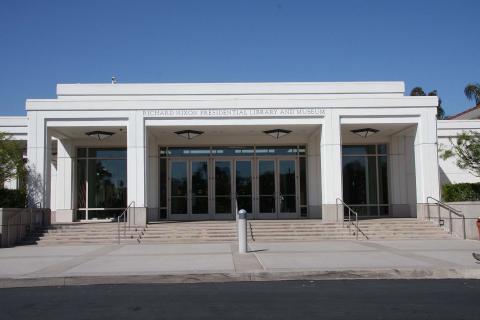
Introduction
This almanac page for Monday, March 6, 1972, pulls together various records created by the federal government and links to additional resources which can provide context about the events of the day.
Previous Date: Sunday, March 5, 1972
Next Date: Tuesday, March 7, 1972
Schedule and Public Documents
The Daily Diary files represent a consolidated record of the President's activities. Visit the finding aid to learn more.
The President's day began at The White House - Washington, D. C.
The Weekly Compilation of Presidential Documents made available transcripts of the President's news conferences; messages to Congress; public speeches, remarks, and statements; and other Presidential materials released by the White House.
Digitized versions can be found at HathiTrust.
The Federal Register is the official daily publication for rules, proposed rules, and notices of federal agencies and organizations, as well as executive orders and other Presidential documents.
No Federal Register published on this date
The Congressional Record is the official daily record of the debates and proceedings of the U.S. Congress.
Decided
Archival Holdings
Any selection of archival documents will necessarily be partial. You should use the documents and folders identified below as a starting place, but consult the linked collection finding aids and folder title lists and the collections themselves for context. Many documents to be found this way do not lend themselves to association with specific dates, but are essential to a complete understanding of the material.
Selective document listing
President's Office Files
The President's Office Files consists of materials drawn together by the Special Files Unit from several administrative subdivisions within the White House Office. It is the handwriting and sensitive papers sent to the Staff Secretary that now comprise much of the President's Office Files. Visit the finding aid to learn more.
- News Summaries, Annotated News Summaries, Box 34, March 1-10, 1972 [1 of 2] [Note: Due to the way News Summary products were compiled, you should also consult nearby days for potentially relevant materials.]
- Weekend News Review, March 6, 1972
- President's Daily Schedule, Box 102, [President's Daily Schedule, Jan.-Mar. 1972] [2 of 3]
- The President's Schedule, Monday - March 6, 1972
The H. R. Haldeman Diaries consists of seven handwritten diaries, 36 dictated diaries recorded as sound recordings, and two handwritten audio cassette tape subject logs. The diaries and logs reflect H. R. Haldeman’s candid personal record and reflections on events, issues, and people encountered during his service in the Nixon White House. As administrative assistant to the President and Chief of Staff, Haldeman attended and participated in public events and private meetings covering the entire scope of issues in which the Nixon White House engaged in during the years 1969-1973. Visit the finding aid to learn more.
- Transcript of diary entry (PDF)
Monday, March 6.
Big item today, starting the staff meeting and going through the day, is the ITT case and Kleindienst. At the staff meeting, Flanigan opened the subject because the press had been laying for him on his doorstep this morning when he left the house. He wants to talk to the press or issue a statement to prove his innocent-- innocence. MacGregor says no, he should stay out of it. We all agreed we need someone to manage the whole project, that at this point we don't have anybody really on top of it. Later, the President said that Ziegler should knock down the idea that the President was going to spend the night at the Sheraton. We should get out first: that the ITT settlement, that it's too tough from their viewpoint. Two, that the statement-- the settlement had no relation to the Sheraton offer. Three, regarding Flanigan, we should let Justice handle it, and get the whole thing away from the White House. President was concerned about what's at the root of all this, where did the story start, who leaked the memo, who was it written to, and so forth. We don't seem to have the answers on any of that. He wants to be sure that Colson keeps a low profile on this, that there are no statements from the White House, that we refer everything to the Justice Department. He felt that we should try to get a good statement from Justice by the Attorney General regarding the case, before the Thursday press conference, so the President can stand on it and that it can be elevated to the Presidential level. He wants to get it all said beforehand, in other words.
Later in the day he had Rose in, and she reminded us that Dita Beard, the gal who wrote the memo that started all this, and who talked to Jack Anderson, is the tough, profane character who was Ted Rogers' secretary in the '60 campaign.
Later in the day, Ehrlichman talked to Mitchell, and he said that he would not make a statement, didn't feel he should, before he testified. And suggested instead that the President should simply respond, saying that he was glad that Kleindienst wanted to clear this whole thing up, and had asked for the special hearing. As long as we've got the thing and are paying for it, we might as well get some credit for it.
First thing this morning President talked to me about Buchanan, said that he had a question regarding my plan of attack on it. Instead, wanted me to tell him that the President understands completely what his problem is and that we'll work it out, but we'd like to make the date April 1, so that we have time to get things in order. Then on my own, I should say that I feel he should work in the campaign, that there's a wide open spot as director of the answer desk, and so on. President feels there's a problem with the attitude in the entire staff, in putting their personal prejudices above the common good here. I then talked to Buchanan, and it turned out that-- I opened with the President's view but then Buchanan said he had thought the whole thing through, that he had now realized that he had expressed his view to me, to Mitch-- to Kissinger, Rogers, Haig, and through me to the President, and that there was no need for him to express it any more publicly than that and that he would do the cause more good by being inside than being outside, and therefore he decided he should stay on. When I reported this back to the President, it was clear that he wasn't particularly pleased that Buchanan was staying. At that point, he was pretty well ready for Pat to go on his way.
The President raised the question regarding the primaries, said that Mitchell should get out the line that Manchester Union-Leader is the closest paper to the state, and we'll accept their poll, which shows Nixon at 55 percent, and we'll be very satisfied with that result. President says he thinks-- said at that time that he thinks McCloskey could get 20 percent and Ashbrook about 10 percent.
Later in the day, Ehrlichman asked him how he thought New Hampshire was going to come out, and his prediction was that Muskie would get 54 percent, because he'd pick up some rank-and-file sympathy, and get a little more than the polls say he will. McGovern will get 22, not do as well as the polls say. Mills should get five. Yorty five, Hartke three, and then Nixon and Teddy Kennedy will get some write-ins. On our side, he said he'll get 65 to 68, McCloskey 20 to 22, and Ashbrook about ten.
President had his big busing meeting this morning with the Cabinet committee, and apparently it went pretty well. He's been thinking through the whole thing. He wants to be sure that Ehrlichman and Price understand that we don't want to make an issue on busing, what we want is action, and that's what we must say in our statement, that we can easily make the issue by going for the constitutional amendment, but it would have no chance of passing, and busing would continue for millions of children: what we're trying to get instead is results. He and Ehrlichman agreed after the meeting that there just isn't any solution to the thing: but that our blacks will stay aboard anyway, again that we should emphasize we want action not the issues. The President agrees we're doing the right thing in not going for the amendment.
A little later, in talking with Ziegler, Ron recommended that they should not put the statement out on the day of the Florida primary, but should wait till serve-- several days later, and not worry about the thing being tied to the primary. Ron doesn't think that will make any difference.
President saw Romney this afternoon and he went through his idea about how he wants to set up a national thing like the "Citizens for Michigan", which would be sort of along the line of Gardner's "Common Cause", to solve the problems of cities, and so forth, but he and the President agreed that he should wait and do it after the election, start getting ready for it now.
End of March 6. - Original audio recording (MP3)
The National Archives Catalog is the online portal to the records held at the National Archives, and information about those records. It is the main way of describing our holdings and also provides access to electronic records and digitized versions of our holdings.
The Catalog searches across multiple National Archives resources at once, including archival descriptions, digitized and electronic records, authority records, and web pages from Archives.gov and the Presidential Libraries. The Catalog also allows users to contribute to digitized historical records through tagging and transcription.
Nixon Library Holdings
All National Archives Units
National Security Documents
The President's Daily Brief is the primary vehicle for summarizing the day-to-day sensitive intelligence and analysis, as well as late-breaking reports, for the White House on current and future national security issues. Read "The President's Daily Brief: Delivering Intelligence to Nixon and Ford" to learn more.
The Foreign Relations of the United States series presents the official documentary historical record of major U.S. foreign policy decisions and significant diplomatic activity. Visit the State Department website for more information.
Vol. IV, Foreign Assistance, International Development, Trade Policies, 1969-1972
Foreign Assistance Policy, 1969-1972
86. Memorandum From the Under Secretary of State (Irwin) to the President’s Assistant for National Security Affairs (Kissinger), Washington, March 6, 1972
Source: National Archives, Nixon Presidential Materials, NSC Files, Subject Files, Box 324, Foreign Aid, Volume II 1972. Confidential. Attached to a March 20 memorandum from Kissinger to Irwin informing him that he and Shultz agreed that the allocations along the lines of Irwin’s March 6 memorandum were “the most effective and least disruptive means of adjusting to the funding limits in the appropriations bill.”
Vol. XVII, China, 1969-1972
China, March-December 1972
206. Memorandum From President Nixon to Secretary of State Rogers, Secretary of Defense Laird, and the President’s Assistant for National Security Affairs (Kissinger), Washington, March 6, 1972
Source: National Archives, Nixon Presidential Materials, NSC Files, Box 1036, Files for the President—China Material, China—General—February 27–March 31, 1972. Secret; Eyes Only.
207. Conversation Among President Nixon, his Assistant for National Security Affairs (Kissinger), and the Ambassador of the Republic of China (Shen), Washington, March 6, 1972, 4-5:04 p.m.
Source: National Archives, Nixon Presidential Materials, White House Tapes, Oval Office, Conversation No. 678–4. No classification marking. The editor transcribed the portion of the conversation printed here specifically for this volume.
Vol. XXXII, SALT I, 1969-1972
Narrowing the Issues, October 19, 1971-April 18, 1972
234. Memorandum From the Chairman of the Joint Chiefs of Staff (Moorer) to Secretary of Defense Laird, Washington, March 6, 1972
Source: National Archives, RG 218, Records of the Joint Chiefs of Staff, Moorer, 388.3, SALT, January–June 1972. Top Secret; Sensitive. The memorandum was sent as an enclosure to memorandum CM–1606–72, March 6, which informed Kissinger and members of the Verification Panel, Rush, Irwin, Helms, Smith, and Acting Attorney General Kleindienst that it expressed the views of the JCS for use in NSC and Verification Panel deliberations.
Vol. E-5, Part 1, Documents on Sub-Saharan Africa, 1969-1972
U.S.-African Policy
19. Memorandum of Conversation, Washington, March 6, 1972
Assistant Secretary of State for African Affairs David Newsom told the British during talks on Soviet influence and activities in Africa that there had been a significant lack of Soviet success. The Sovietsʼ best position was in Somalia, but they had failed to advance in Nigeria and Ghana while losing ground in Uganda. Newsom saw a possible new cold war in Africa between the Soviets and the Chinese.
Source: National Archives, RG 59, Central Files 1970–73, POL AFR–USSR. Confidential. Drafted by Hal W. Pattison (AF/PPS) on March 10.20. Memorandum of Conversation, Washington, March 6, 1972
During U.S.-British talks on Chinese activities and influence in Africa, there was general agreement that Chinese activities merited attention but there was no real cause for concern since the Chinese were expected to achieve only limited success, similar to the Soviets.
Source: National Archives, RG 59, Central Files 1970–73, POL AFR-Chicom. Confidential. Drafted by Pattison.
Vol. E-7, Documents on South Asia, 1969-1972
Bangladesh, December 1971-December 1972
408. Memorandum From Secretary of State Rogers to President Nixon, Washington, March 6, 1972
Rogers recommended the United States recognize Bangladesh on or about March 25.
Source: National Archives, Nixon Presidential Materials, NSC Files, NSC Institutional Files (H-Files), Box H–064, SRG Meeting, South Asia, 4/17/72. Secret; Nodis. Saunders sent this memorandum to Kissinger on March 16 under a covering memorandum in which he endorsed Rogers’ recommendation. (Ibid., NSC Files, Box 591, Country Files, Middle East, Bangladesh) The attached draft messages to China and Pakistan are published in approved final form as Documents 414 and 415.
Vol. E-13, Documents on China, 1969-1972
110. Memorandum of Conversation, New York, March 6, 1972, 7:15-8:20 p.m., New York, March 6, 1972, 7:15-8:20 p.m.
Chinese Ambassador to the United Nations Huang Hua raised several subjects with Commander Howe including the Chinese agreement to disclosure of the Paris channel, invitations to House Majority Leader Hale Boggs (D-Louisiana) and House Minority Leader Gerald Ford (R-Michigan) to visit China, security issues surrounding the death of a member of the Chinese delegation from nicotine poisoning-which the Chinese believed to be caused by foul play-and the problem of securing adequate facilities for the Chinese mission to the UN. He appealed for President’s Assistant for National Security Affairs Kissinger’s assistance in the ensuing investigation by the New York Police Department.
Source: National Archives, Nixon Presidential Materials, NSC Files, Box 849, President’s File-China Trip, China Exchanges, March 1, 1972-June 24, 1972. Top Secret; Sensitive; Exclusively Eyes Only. Transmitted by Haig to Kissinger under a March 7 covering note. Attached is a message from the Chinese Government discussing the prospective visit of Boggs and Ford; Document 109. Howe indicates that the meeting was held at “our special meeting place in New York City.” For additional information about the death of the delegation member, see Documents 113 and 114.
The Kissinger telephone conversation transcripts consist of approximately 20,000 pages of transcripts of Kissinger’s telephone conversations during his tenure as Assistant to the President for National Security Affairs (1969-1974) and Secretary of State (1973-1974) during the administration of President Richard Nixon. Visit the finding aid for more information.
Digitized versions can be found in the National Archives Catalog.
Audiovisual Holdings
Visit the White House Tapes finding aid to learn about the taping system's operation and archival processing.
Cabinet Room
Oval Office
- 677-1; Unknown between 7:30 a.m. & 8:38 a.m.; Nixon, Richard M. (President); Woods, Rose Mary
- 677-2; Unknown between 7:30 a.m. & 8:38 a.m.; Nixon, Richard M. (President); Bull, Stephen B.
- 677-3; Unknown between 7:30 a.m. & 8:38 a.m.; Nixon, Richard M. (President); [Unknown person(s)]
- 677-4; 8:38 a.m. - 9:08 a.m.; Nixon, Richard M. (President); Kissinger, Henry A.; Sanchez, Manolo
- 677-5; 9:12 a.m. - 10:30 a.m.; Nixon, Richard M. (President); Butterfield, Alexander P.; Haldeman, H. R. ("Bob"); Sanchez, Manolo; Bull, Stephen B.; Morgan, Edward L.; Ehrlichman, John D.
- 677-6; Unknown between 10:30 a.m. & 12:28 p.m.; Nixon, Richard M. (President); [Unknown person(s)]
- 677-7; Unknown between 10:30 a.m. & 12:28 p.m.; Nixon, Richard M. (President); [Unknown person(s)]
- 677-8; Unknown between 10:30 a.m. & 12:28 p.m.; Nixon, Richard M. (President); [Unknown person(s)]
- 677-9; 12:28 p.m. - 12:31 p.m.; Nixon, Richard M. (President); Bull, Stephen B.
- 677-10; 12:31 p.m. - 1:28 p.m.; Nixon, Richard M. (President); Haldeman, H. R. ("Bob"); Ehrlichman, John D.; Butterfield, Alexander P.
- 677-11; Unknown between 1:28 p.m. & 1:38 p.m.; Nixon, Richard M. (President); [Unknown person(s)]
- 677-12; Unknown between 1:28 p.m. & 1:38 p.m.; Nixon, Richard M. (President); Haldeman, H. R. ("Bob")
- 677-13; Unknown between 1:28 p.m. & 1:38 p.m.; Nixon, Richard M. (President); Kissinger, Henry A.
- 677-14; Unknown between 1:28 p.m. & 1:38 p.m.; Nixon, Richard M. (President); Haldeman, H. R. ("Bob")
- 677-15; Unknown between 1:28 p.m. & 1:38 p.m.; Nixon, Richard M. (President); [Unknown person(s)]
- 677-16; Unknown between 1:28 p.m. & 1:38 p.m.; Nixon, Richard M. (President)
- 677-17; Unknown between 1:28 p.m. & 1:38 p.m.; Nixon, Richard M. (President); Kissinger, Henry A.
- 677-18; Unknown between 1:28 p.m. & 1:38 p.m.; Nixon, Richard M. (President)
- 677-19; 1:38 p.m. - 1:40 p.m.; Nixon, Richard M. (President); Woods, Rose Mary
- 677-20; 1:40 p.m. - 2:13 p.m.; Nixon, Richard M. (President); Haldeman, H. R. ("Bob"); Woods, Rose Mary
- 678-1; 3:00 p.m. - 3:58 p.m.; Nixon, Richard M. (President); Romney, George W.; Sanchez, Manolo
- 678-2; Unknown between 3:58 p.m. & 4:00 p.m.; Nixon, Richard M. (President); Butterfield, Alexander P.
- 678-3; 4:00 p.m. - 4:00 p.m.; Nixon, Richard M. (President); White House operator
- 678-4; 4:00 p.m. - 5:04 p.m.; Nixon, Richard M. (President); Haldeman, H. R. ("Bob"); [Unknown person(s)]; Woods, Rose Mary; Brumley, Jayne; Bull, Stephen B.; Ziegler, Ronald L.; Kissinger, Henry A.; Shen, James C. H.
- 678-5; 5:05 p.m. - 5:10 p.m.; Nixon, Richard M. (President); Butterfield, Alexander P.
- 678-6; Unknown between 5:10 p.m. & 5:15 p.m.; Nixon, Richard M. (President); Ehrlichman, John D.
- 678-7; 5:15 p.m. - 6:59 p.m.; Nixon, Richard M. (President); Haldeman, H. R. ("Bob"); Ehrlichman, John D.; Bull, Stephen B.; Kissinger, Henry A.
- 678-8; Unknown between 6:59 p.m., 3/6 & 7:54 a.m., 1/28; United States Secret Service agents
White House Telephone
- 21-1; 4:00 p.m. - 4:00 p.m.; Nixon, Richard M. (President); White House operator
- 21-2; 4:12 p.m. - 4:13 p.m.; Nixon, Richard M. (President); Brumley, Jayne
- 21-3; Unknown between 4:13 p.m. & 7:14 p.m.; Nixon, Richard M. (President); White House operator
- 21-4; 7:14 p.m. - 7:15 p.m.; Nixon, Richard M. (President); Kissinger, Henry A.
- 21-5; Unknown between 7:15 p.m. & 7:36 p.m.; Nixon, Richard M. (President); White House operator
- 21-6; 7:36 p.m. - 8:02 p.m.; Nixon, Richard M. (President); Colson, Charles W.
- 21-7; 8:23 p.m. - 8:28 p.m.; Nixon, Richard M. (President); Kissinger, Henry A.
The White House Photo Office collection consists of photographic coverage of President Richard Nixon meeting with prominent social, political, and cultural personalities; speaking engagements and news conferences of the President and various high-ranking members of the White House staff and Cabinet; Presidential domestic and foreign travel, including Presidential vacations; social events and entertainment involving the First Family, including entertainers present; official portraits of the President, First Family, and high-ranking members of the Nixon administration; the 1969 and 1973 Inaugurals; the President’s 1972 Presidential election campaign appearances (including speeches) and other official activities of the White House staff and the President’s Cabinet from January 20, 1969 until August 9, 1974 at the White House and the Old Executive Office Building; other locations in Washington, DC, such as The Mall; and the Presidential retreats in Camp David, Maryland, Key Biscayne, Florida, and San Clemente, California. Visit the finding aid to learn more.
Roll WHPO-8661 Photographer: Schumacher, Karl | Color or B&W: B&W
- Frame(s): WHPO-8661-, President Nixon meeting with members of the Cabinet Committee on Education and members of the Council of Black Appointees. 3/6/1972, Washington, D.C. White House, Cabinet Room. President Nixon, Samuel C. Jackson, Chairman (Assistant Secretary of BUD), William H. Brown III, Vice Chairman (Special Assistant), Norman B. Houston, Secretary (Deputy Assistant Secretary of HEW), Samuel J. Simmons, Treasurer (Assistant Secretary of BUD) Louis P. ""Pat"" Gray, Assistant Attorney General '(Civil Division), Secretary of HEW Elliot L. Richardson, George P. Shultz, Director of the OMB, Kenneth Dam, Assistant Director of the OMB, Paul O'Neill, Assistant Director of the OMB, John D. Ehrlichman, Edward L. Morgan, Deputy Assistant , Domestic Council, Dana Mead, Staff Assistant, Domestic Council James Clawson, Staff Assistant, Domestic Council Clark MacGregor, Counsel Ronald L. Ziegler, Press Secretary.
Roll WHPO-8662 Photographer: Schumacher, Karl | Color or B&W: B&W
- Frame(s): WHPO-8662-, President Nixon meeting with members of the President's Commission on School Finance and of the Special Panel on Financing Non-Public Education. 3/6/1972, Washington, D.C. White House, Cabinet Room. President Nixon, Spiro T. Agnew, Secretary of the Treasury John B. Connally, Secretary of HEW Elliot L. Richardson, Sidney P. Marland, U.S. Commissioner of Education, John D. Ehrlichman, Assistant, Roy Morey, Staff Assistant, Domestic Council, Lewis A. Engman, Assistant Director, Domestic Council, Edward L, Morgan, Deputy Assistant (Domestic Council), Ronald L. Ziegler, Press Secretary Mary T. Brooks, Director of the Bureau of the Mint William G. Colman, President of the Montgomery County, Maryland School Board Hilda A. Davis, Professor of Education at Wilmington College, John B. Davis, Jr., Superintendent of Minneapolis Schools John H. Fischer, President of Teachers t College, Columbia University Dorothy M. Ford, Career Education Consultant, Los Angeles County Norman Francis, President of Xavier University Eugene Gonzales, Deputy Superintendent, California Department of Education David H. Kurtzman, Secretary of Education, Pennsylvania William E. McManus, Director of Catholic Education, Chicago Duane Mattheis, Deputy Commissioner of Education Wendell H. Pierce, Executive Director of the Education Commission of the States, William G. Saltonstall, Principal Emeritus, Phillips Exeter Academy, W.B. Thompson, Superintendent of Greenville, Mississippi Schools, Ivan E. Zylstra, Administrator of Government Relations, National Union of Christian Schools, Grand Rapids, Michigan. Norman Karsh, Executive Director Clint Pace.
Roll WHPO-8669 Photographer: Schumacher, Karl | Color or B&W: B&W
- Frame(s): WHPO-8669-, Henry Kissinger speaking to an unidentified group of men seated at the conference table. 3/6/1972, Washington, D.C. White House, Roosevelt Room. Henry Kissinger, unidentified men.
Roll WHPO-8673 Photographer: Schumacher, Karl | Color or B&W: B&W
- Frame(s): WHPO-8673-02-16, Vice President Agnew, George Shultz and an unidentified man playing tennis. 3/6/1972, Washington, D.C. gymnasium, Georgetown University. Spiro Agnew, Shultz, unidentified man, officials, audience.
Roll WHPO-8674 Photographer: Schumacher, Karl | Color or B&W: B&W
- Frame(s): WHPO-8674-02-06, Vice President Agnew, George Shultz, and other men after a tennis game. Vice President Agnew speaking to the press reporters and photographers. 3/6/1972, Washington, D.C. Vice Presidential Office, Executive Office Building. Spiro Agnew, Al Flora, unidentified man.
- Frame(s): WHPO-8674-08-14, Vice President Agnew receiving award plaques from Al Flora and an unidentified man. 3/6/1972, Washington, D.C. Vice Presidential Office, Executive Office Building. Spiro Agnew, Al Flora, unidentified man.
The White House Communications Agency Sound Recordings Collection contains public statements that took place between 1969 and 1974. Visit the finding aid to learn more.
H - White House Staff Member Recordings
- WHCA-SR-H-528
Press briefing by Neil McElroy regarding public school financing. (3/6/1972, Press Center, White House)
Runtime: 55:00:00
Keywords: Press conferences, news conferences, interviews, media
Production credits: Audio feed supplied by WHCA; Recorded by BAC (initials of WHCA engineer)
Original Format: 1/4-inch reel-to-reel audiotape. Original source type: Original.
The White House Communications Agency Videotape Collection contains “off-the-air” recordings of televised programs produced between 1968 and 1974. Visit the finding aid to learn more.
- WHCA-5164
"New Hampshire Primary Democratic Debate".
NBC
Runtime: 1:30 - WHCA-5165
"Today" Show. FTN: U.S. Senator Robert Dole (R-KA); "MTP": Rev. Daniel Berrigan.
CBS, NBC
Runtime: 00:36:37 - WHCA-5166
"Dinah's Place".
ABC
Runtime: 00:29:26 - WHCA-5180
Weekly News Summary, Tape I.
ALL NETWORKS
Runtime: 01:35:42
25. Smith/Jarriel: School busing. Time Code Start: 73:05. Keywords: bills, laws, legislation, desegregation, racism, racial discrimination, African Americans, schools, students, transportation, reports. Network: ABC.
26. Smith/Reynolds/Matney/Tomlinson/Sherwood: New Hampshire with Senator Muskie, Senator McGovern, Hartke, Representative Mills, Sam Yorty, Representative Ashbrook, Representative McCloskey. Time Code Start: 76:17. Keywords: Presidential elections, campaigns, campaigning, candidates. Network: ABC.
27. Smith: Commentary on Attorney General Mitchell. Time Code Start: 82:17. Keywords: cabinet, advisors, law officials,. Network: ABC.
28. Chancellor/Duke/Bourgholtzer: International Telephone & Telegraph (ITT Corporation). Time Code Start: 84:10. Keywords: International Telephone & Telegraph, communications, world, corporations, conglomerates, campaign funding, investigations. Network: NBC.
29. Chancellor/Kiker: Decision 1972, New Hampshire, television debate (Senator Muskie, Senator McGovern). Time Code Start: 89:33. Keywords: Presidential elections, campaigns, campaigning, candidates, debates, televised, television broadcasts. Network: NBC. - WHCA-5181
Weekly News Summary, Tape II.
ALL NETWORKS
Runtime: 01:34:54
1. Brinkley: Primaries. Time Code Start: 00:00. Keywords: Presidential elections, campaigns, campaigning, candidates, primaries, voting, affects. Network: NBC.
2. Chancellor/Stern: Berrigan trial (Harrisburg 7). Time Code Start: 03:23. Keywords: Protests, militants, bombings, violence, sabotage, shootings, kidnappings, courts, trials, investigations, prosecutions. Network: NBC.
3. Chancellor: Bangladesh leader speaks out against President Nixon. Time Code Start: 05:25. Keywords: Presidents, South Asian, leaders, speeches, criticisms. Network: NBC.
4. Chancellor : Primaries, a schedule. Time Code Start: 07:51. Keywords: Presidential elections, campaigns, campaigning, candidates, primaries, voting. Network: NBC.
5. Collingwood/Stawser/Threlkeld: International Telephone & Telegraph (ITT Corporation). Time Code Start: 09:05. Keywords: International Telephone & Telegraph, communications, world, corporations, conglomerates, campaign funding, investigations. Network: CBS.
6. Collingwood/Wallace: New Hampshire, Senator Muskie and Senator McGovern work hard(?). Time Code Start: 14:18. Keywords: Senators, Presidential elections, campaigns, primaries, candidates. Network: CBS.
7. Collingwood: President Nixon considers school taxes, busing. Time Code Start: 21:55. Keywords: Presidents, bills, laws, legislation, desegregation, racism, racial discrimination, African Americans, schools, students, transportation, vehicles. Network: CBS.
Context (External Sources)
The Vanderbilt Television News Archive is the world's most extensive and complete archive of television news. They have been recording, preserving and providing access to television news broadcasts of the national networks since August 5, 1968.
Wikipedia is a free encyclopedia that anyone can edit.