
Introduction
This almanac page for Friday, March 26, 1971, pulls together various records created by the federal government and links to additional resources which can provide context about the events of the day.
Previous Date: Thursday, March 25, 1971
Next Date: Saturday, March 27, 1971
Schedule and Public Documents
The Daily Diary files represent a consolidated record of the President's activities. Visit the finding aid to learn more.
The President's day began at The White House - Washington, D. C.
The Weekly Compilation of Presidential Documents made available transcripts of the President's news conferences; messages to Congress; public speeches, remarks, and statements; and other Presidential materials released by the White House.
Digitized versions can be found at HathiTrust.
The Federal Register is the official daily publication for rules, proposed rules, and notices of federal agencies and organizations, as well as executive orders and other Presidential documents.
Archival Holdings
Any selection of archival documents will necessarily be partial. You should use the documents and folders identified below as a starting place, but consult the linked collection finding aids and folder title lists and the collections themselves for context. Many documents to be found this way do not lend themselves to association with specific dates, but are essential to a complete understanding of the material.
Selective document listing
President's Office Files
The President's Office Files consists of materials drawn together by the Special Files Unit from several administrative subdivisions within the White House Office. It is the handwriting and sensitive papers sent to the Staff Secretary that now comprise much of the President's Office Files. Visit the finding aid to learn more.
- Annotated News Summaries, Box 30, News Summaries - March 1971 [1 of 2]
- Annotated News Summaries, Box 30, News Summaries - March 1971 [2 of 2] [During this period, the Staff Secretary only removed pages from the News Summaries which contained President Nixon's handwriting, often leaving the document with no date. Although there are no specific documents with this date, you should also consult the full folder for the month.]
- President's Daily Schedule, Box 101, [President's Daily Schedule, Mar.-May 1971] [1 of 3]
- The President's Schedule, Friday - March 26, 1971
The H. R. Haldeman Diaries consists of seven handwritten diaries, 36 dictated diaries recorded as sound recordings, and two handwritten audio cassette tape subject logs. The diaries and logs reflect H. R. Haldeman’s candid personal record and reflections on events, issues, and people encountered during his service in the Nixon White House. As administrative assistant to the President and Chief of Staff, Haldeman attended and participated in public events and private meetings covering the entire scope of issues in which the Nixon White House engaged in during the years 1969-1973. Visit the finding aid to learn more.
- Transcript of diary entry (PDF)
Monday, correction, it's Friday, March 26th. A pretty well loaded day in Washington before departing for San Clemente. Starting with breakfast for Albert, Boggs, and Ford, at which the President really laid out the line on the question of Congressional resolutions limiting the President's powers as Commander-in-Chief or requiring a withdrawal by a date certain. He hit them very hard on this and made the point very specifically that if the Congress in any way tied his hands and, as a result of that, we had to bug out of Vietnam, losing American lives, or the Thieu government fell and Vietnam went to the Communists, he would have no choice but to go directly to the people in his campaign next year, taking on the Congress and blaming them for this situation. And, he convinced them, according to MacGregor, that he would do exactly this.
He then had a Cabinet meeting on the subject of construction industry wage problems, and so on, that the Romney rump group had been meeting on. This was to call their bluff and give them all a chance to talk on the subject, which apparently was accomplished. There was a flap on a scheduled meeting with a selected group of the Officers of the Justinian Society—a group of Italian judges. Apparently, during the Cabinet meeting, Volpe sent the President a note saying it was a shame that he wasn't going to meet with all the members of the group who were here touring the White House, instead of just the executive committee, and that it would be a great political mistake to handle it the way it had been worked out. As a result of this end run, Volpe succeeded in getting the President to meet with most of the group in a chat in the Roosevelt Room, and then as the President was about to leave that, Volpe hit him again, and said, aren't you going to shake hands with everybody? The President fortunately said no, and left.
He then had a few remarks at a conference of religious leaders on the drug problem, which he felt did him and the cause no particular good.
We had a break today on the construction industry problem, and specifically Davis-Bacon and it now appears we'll be able to reinstate Davis-Bacon by executive order on Monday, and to get a wage price panel in effect in the construction industry, which is what we wanted to begin with. This can be a major breakthrough and a darn good news story to start out the week in San Clemente.
Coming out on Air Force One, the President had a very long talk with Chet Holifield, who we brought out for the ride, and probably accomplished some good there for the long haul. In any event, he made the effort. After we got here, he told Henry that he wanted him and me to come over to talk with him at the house.
-------------------------------------------------------------------------------------------------------------------
DECLASSIFIED - E.O. 13526, Sect. 3.4: by MS, NARA, June 12, 2013
Audio Cassette 6, Side A, Withdrawn Item Number 6 [AC-6(A) Sel 2]
Duration: 23 seconds
After Henry made his phone call to Dobrynin, which he had to do, he had talked to Dobrynin earlier and felt that he had a darn good start on a SALT breakthrough with one question still remaining in that their proposal required a settlement of ABM before going to offensive weapons, where we insist on the two being done concurrently.
-------------------------------------------------------------------------------------------------------------------
So after Henry completed his call we went over to the President's house. He was up in the study with only one light on, the fire burning and the record player, or tape player going very loudly. He turned off the tape, and we sat down, and...
-------------------------------------------------------------------------------------------------------------------
DECLASSIFIED - E.O. 13526, Sect. 3.4: by MS, NARA, June 12, 2013
Audio Cassette 6, Side A, Withdrawn Item Number 7 [AC-6(A) Sel 3]
Duration: 25 seconds
...Henry reviewed the Dobrynin call, which he was extremely pleased about because Dobrynin had backed off the condition and agreed to simultaneous decisions on an offensive weapons and ABM. This eliminates the last barrier and it now appears we can go ahead with a SALT settlement.
-------------------------------------------------------------------------------------------------------------------
That, of course, in turn leads to going ahead with the fall summit meeting and may also help in getting Berlin settled. In addition to that, the President now agrees with Henry's long-held view that there is a remote possibility of a settlement on Vietnam with Hanoi, probably partly as a result of Laos. The President clearly has sort of a mystic feeling about the Laotian thing, and says so. He's not sure what it is or why, but he has the feeling that there may be more involved here than has so far met the eye.
He then got into the point that he had called us in for, which was to say that he'd been giving a lot of thought to our whole strategic situation at the present time, and specifically as it related to our schedule here in California. His decision was that there would be no press conference this week, that it doesn't serve our purpose at this time to have one. There's nothing that he wants to say, and no advantage to making any news that might come up at such a conference. He then referred back to Bill Rogers and the at the time of the fund speech, when Rogers had made the point to him then that he should not have a press conference, but should let the enemy run its course, and then go out on his own terms and make his own case. He feels that's the case now, that we're down, they're kicking us, and that it's a good time to let them go ahead and do it until we have a positive, upbeat story, and then we should move hard and fast to sell it. In other words, the basic rule is that we should never go to the press except when we're up; we've got nothing to gain now. The only argument for a press conference is for the benefit of the press, but we should have press conferences only when it serves our purposes. Both Henry and I agreed with this view, and so there was no argument.
He also feels then, that Ziegler should announce on Thursday or Friday that he will be making the troop announcement on the 7th, rather than waiting until the 15th, using the rationale that he's committed to making it by the 15th, and since Congress will be gone at the time, he wanted to make it at the close of this Congressional session before the recess. The mood he has is a, is a very mystic one, he's not highly optimistic, but certainly not down in the dumps, and has a feeling that something is happening or is about to happen. I think he's right, in the sense that I think we've bottomed out now on most of our bad stuff, and that we'll have a pretty good balance of the year ahead of us as we get at least some of these foreign policy developments, and as the economy makes some positive progress, which it almost inevitably is going to do between now and the end of the year.
End of March 26th. - Original audio recording (MP3)
The National Archives Catalog is the online portal to the records held at the National Archives, and information about those records. It is the main way of describing our holdings and also provides access to electronic records and digitized versions of our holdings.
The Catalog searches across multiple National Archives resources at once, including archival descriptions, digitized and electronic records, authority records, and web pages from Archives.gov and the Presidential Libraries. The Catalog also allows users to contribute to digitized historical records through tagging and transcription.
Nixon Library Holdings
All National Archives Units
National Security Documents
The President's Daily Brief is the primary vehicle for summarizing the day-to-day sensitive intelligence and analysis, as well as late-breaking reports, for the White House on current and future national security issues. Read "The President's Daily Brief: Delivering Intelligence to Nixon and Ford" to learn more.
The Foreign Relations of the United States series presents the official documentary historical record of major U.S. foreign policy decisions and significant diplomatic activity. Visit the State Department website for more information.
Vol. V, United Nations, 1969-1972
Appointment of UN Development Program Administrator
255. Memorandum From Marshall Wright of the National Security Council Staff to the President’s Assistant for National Security Affairs (Kissinger), Washington, March 26, 1971
Source: National Archives, Nixon Presidential Materials, NSC Files, Box 300, Agency Files, USUN, Vol. VI. Secret. Sent for action. An attached March 27 memorandum from Haig to Kissinger contains notes that indicate that Kissinger agreed to call Rogers and Flanigan, which was done by April 1.
Vol. VII, Vietnam, July 1970-January 1972
Operational Lam Son 719, February 8-April 7, 1971
167. Summary of Conclusions of a Meeting of the Washington Special Actions Group, Washington, March 26, 1971, 10:09-11:29 a.m.
Source: National Archives, Nixon Presidential Materials, NSC Files, NSC Institutional Files (H-Files), Box H–115, WSAG Meetings Minutes, Originals, 1971. Top Secret; Nodis. The meeting took place in the Situation Room of the White House. Part II is Document 168.
168. Summary of Conclusions of a Meeting of the Washington Special Actions Group, Washington, March 26, 1971, 10:09-11:29 a.m.
Source: National Archives, Nixon Presidential Materials, NSC Files, NSC Institutional Files (H-Files), Box H–115, WSAG Meetings Minutes, Originals, 1971. Top Secret; Nodis. The meeting took place in the Situation Room of the White House. Part I is Document 167.
169. Memorandum for the President’s File by the President’s Deputy Assistant for National Security Affairs (Haig), Washington, March 26, 1971, 4 p.m.
Source: National Archives, Nixon Presidential Materials, NSC Files, Box 997, Haig Chronological Files, Haig Memcons, 12/70–12/71, 3 of 3. Top Secret; Nodis.
Vol. XI, South Asia Crisis, 1971
South Asia Crisis, 1971
10. Memorandum From the Presidentʼs Assistant for National Security Affairs (Kissinger) to President Nixon, Washington, March 26, 1971
Source: National Archives, Nixon Presidential Materials, NSC Files, Box 625, Country Files, Middle East, Pakistan, Vol. IV, 1 Mar 71–15 May 71. Secret; Nodis. Sent for information. A handwritten notation on the memorandum indicates the President saw it.
11. Minutes of Washington Special Actions Group Meeting, Washington, March 26, 1971, 3:03-3:32 p.m.
Source: National Archives, Nixon Presidential Materials, NSC Files, NSC Institutional Files (H-Files), Box H–115, WSAG Minutes, Originals, 1971. Top Secret;Nodis. No drafting information appears on the minutes. The meeting was held in the White House Situation Room. A briefer record of the meeting was prepared in OASD/ISA by James Noyes. (Washington National Records Center, OSD Files, FRC 330 76 0197, Box 74, Pakistan 092 (Jan–Jul) 1971)
Vol. XIII, Soviet Union, October 1970-October 1971
"A Key Point in Our Relationship": Backchannel Talks on SALT, Berlin, and the Summit
157. Letter From Secretary of State Rogers to Soviet Foreign Minister Gromyko, Washington, March 26, 1971
Source: National Archives, RG 59, Central Files 1970–73, POL US–USSR. Secret; Nodis. Rogers called Kissinger at 1:05 p.m. on March 25 to discuss whether to send Gromyko a letter: “K: On first thought, it might not be a bad idea. Gives them an excuse if they want to come back with something. Not that they need an excuse. R: Assuming this is true, and it might be, he [Dobrynin] said that in the [Party] Congress, if it appears there is great hostility developing, it could be a setback, but, if it showed friendly contact, it might be helpful.” (Ibid., Nixon Presidential Materials, Henry Kissinger Telephone Conversation Transcripts, Box 9, Chronological File) Sonnenfeldt suggested several revisions to the draft letter on March 25, which Kissinger relayed to Rogers by telephone the next morning. (Ibid., NSC Files, Box 491, President’s Trip Files, Dobrynin/Kissinger, 1971, Vol. 5 [part 2]; and ibid., Henry Kisinger Telephone Conversation Transcripts, Box 9, Chronological File) A handwritten note on the letter indicates that it was “hand delivered to Ambassador by the Secretary.” See Document 158.
159. Transcript of a Telephone Conversation Between the President’s Assistant for National Security Affairs (Kissinger) and the Soviet Ambassador (Dobrynin), Washington, March 26, 1971, 3:32 p.m.
Source: National Archives, Nixon Presidential Materials, Henry Kissinger Telephone Conversation Transcripts, Box 27, Dobrynin File. No classification marking.
160. Transcript of a Telephone Conversation Between the President’s Assistant for National Security Affairs (Kissinger) and the Soviet Ambassador (Dobrynin), Washington, March 26, 1971, 4:23 p.m.
Source: National Archives, Nixon Presidential Materials, Henry Kissinger Telephone Conversation Transcripts, Box 27, Dobrynin File. No classification marking. A typed note indicates that the call took place “after receipt of note delivered by Sokolov to Colonel Kennedy.”
161. Transcript of a Telephone Conversation Between the President’s Assistant for National Security Affairs (Kissinger) and the Soviet Ambassador (Dobrynin), March 26, 1971, 8:20 p.m., PST
Source: National Archives, Nixon Presidential Materials, Henry Kissinger Telephone Conversation Transcripts, Box 27, Dobrynin File. No classification marking. Kissinger was in San Clemente; Dobrynin was in Washington.
Vol. XXXII, SALT I, 1969-1972
From Stalemate to Breakthrough, August 24, 1970-May 20, 1971
143. Transcript of Telephone Conversation Between the President’s Assistant for National Security Affairs (Kissinger) and the Soviet Ambassador (Dobrynin), March 26, 1971, 8:20 p.m. PST
Source: National Archives, Nixon Presidential Materials, NSC Files, Kissinger Office Files, Box 78, Country Files, Europe, USSR, SALT. No classification marking. Kissinger was in San Clemente, California; Dobrynin was in Washington.
Vol. E-1, Documents on Global Issues, 1969-1972
International Cooperation in Space, 1969-1972
261. Memorandum for the Record, Washington, March 26, 1971
Extract of a memorandum of a discussion between the President’s Assistant for National Security Affairs Kissinger and the President’s Science Adviser David on post-Apollo program cooperation with the Europeans.
Source: National Archives, Nixon Presidential Materials, NSC Files, Box 270, Agency Files, OST, Vol. III. Secret. No drafting information appears on the memorandum.
Vol. E-10, Documents on American Republics, 1969-1972
Colombia
162. Memorandum From the President’s Assistant for National Security Affairs (Kissinger) to President Nixon, Washington, March 26, 1971., Washington, March 26, 1971
President’s Assistant for National Security Affairs Kissinger explained the proposed 1971 Colombia aid program and recommended approval.
Source: National Archives, Nixon Presidential Materials, NSC Files, Box 512, Country Files, Far East, Cambodia vol. XII, February 1–June 30, 1971. Confidential. Kissinger initialed for Nixon on April 1. Attached but not published are Tabs A and B. Tab A is Secretary Rogers’ March 3 request and Tab B is a March 19 memorandum from OMB Director Schultz to Nixon. In an April 6 memorandum, Kissinger informed Rogers of the President’s approval. (Ibid.) For Nixon’s reaction to the Peterson Report, see Foreign Relations, 1969–1976, volume IV, Foreign Assistance, International Development, Trade Policies, 1969–1972, Document 128. For Nixon’s September 15, 1970 message, see Public Papers: Nixon, 1970, pp. 745–756.
The Kissinger telephone conversation transcripts consist of approximately 20,000 pages of transcripts of Kissinger’s telephone conversations during his tenure as Assistant to the President for National Security Affairs (1969-1974) and Secretary of State (1973-1974) during the administration of President Richard Nixon. Visit the finding aid for more information.
Digitized versions can be found in the National Archives Catalog.
Audiovisual Holdings
The White House Tapes are sound recordings of President Richard Nixon's telephone conversations and of meetings held in the Oval Office and the Cabinet Room in the White House, the President's office in the Old Executive Office Building (OEOB), the Lincoln Sitting Room in the residence section of the White House, and several locations at the Presidential retreat at Camp David, Maryland. These recordings document many of the major events and decisions of the Nixon Administration from February 16, 1971 to July 18, 1973. Visit the White House Tapes finding aid to learn about the taping system's operation and archival processing.
Cabinet Room
Oval Office
- 474-1; 9:40 a.m. - 9:55 a.m.; Nixon, Richard M. (President); Kissinger, Henry A.; Bull, Stephen B.
- 474-2; 9:55 a.m. - 10:00 a.m.; Nixon, Richard M. (President); Ehrlichman, John D.
- 474-3; Unknown between 10:00 a.m. & 11:12 a.m.; Yates, Nellie L.; [Unknown person(s)]
- 474-4; 11:15 a.m. - 11:17 a.m.; Nixon, Richard M. (President); Bull, Stephen B.
- 474-5; Unknown between 11:17 a.m. & 11:22 a.m.; Nixon, Richard M. (President); Bull, Stephen B.; Butterfield, Alexander P.
- 474-6; Unknown between 11:22 a.m. & 11:35 a.m.; Nixon, Richard M. (President); Bull, Stephen B.
- 474-7; Unknown between 11:22 a.m. & 2:54 p.m.; Nixon, Richard M. (President); Justinian Society
- 474-8; Unknown between 4:09 p.m. & 4:53 p.m.; Nixon, Richard M. (President); Laird, Melvin R.; Moorer, Thomas H. (Adm.); Packard, David; Kissinger, Henry A.; Haig, Alexander M., Jr.; Connally, John B.
- 474-9; Unknown between 4:53 p.m. & 4:55 p.m.; Nixon, Richard M. (President); White House operator
- 474-10; Unknown between 4:53 p.m. & 4:55 p.m.; Nixon, Richard M. (President); [Unknown person(s)]
- 474-11; Unknown between 4:53 p.m. & 4:55 p.m.; Nixon, Richard M. (President); [Unknown person(s)]
- 474-12; 4:55 p.m. - 4:59 p.m.; Nixon, Richard M. (President); Mitchell, John N.
- 474-13; 4:59 p.m. - 5:04 p.m.; Nixon, Richard M. (President); Shultz, George P.
The White House Photo Office collection consists of photographic coverage of President Richard Nixon meeting with prominent social, political, and cultural personalities; speaking engagements and news conferences of the President and various high-ranking members of the White House staff and Cabinet; Presidential domestic and foreign travel, including Presidential vacations; social events and entertainment involving the First Family, including entertainers present; official portraits of the President, First Family, and high-ranking members of the Nixon administration; the 1969 and 1973 Inaugurals; the President’s 1972 Presidential election campaign appearances (including speeches) and other official activities of the White House staff and the President’s Cabinet from January 20, 1969 until August 9, 1974 at the White House and the Old Executive Office Building; other locations in Washington, DC, such as The Mall; and the Presidential retreats in Camp David, Maryland, Key Biscayne, Florida, and San Clemente, California. Visit the finding aid to learn more.
Roll WHPO-5941 Photographer: Atkins, Oliver | Color or B&W: Color
- Frame(s): WHPO-5941-09-12, President Nixon attending a Cabinet meeting. 3/26/1971, Washington, D.C. White House, Cabinet Room. President Nixon, William Rogers, John Connally, Melvyn Laird, John Mitchell, Rogers Morton, Clifford Hardin, Maurice Stans, James Hodgson, George Romney, John Volpe, David Kennedy, George Shultz, Robert Finch, George Bush, James W. Hargrove, other cabinet members, staff, aides.
- Frame(s): WHPO-5941-10, President Nixon attending a Cabinet meeting. 3/26/1971, Washington, D.C. White House, Cabinet Room. President Nixon, William Rogers, John Connally, Melvyn Laird, John Mitchell, Rogers Morton, Clifford Hardin, Maurice Stans, James Hodgson, George Romney, John Volpe, David Kennedy, George Shultz, Robert Finch, George Bush, other cabinet members, staff, aides.
Roll WHPO-5942 Photographer: unknown | Color or B&W: Color
- Frame(s): WHPO-5942-02, Head and shoulders engagement portrait of Tricia Nixon and Edward Cox. 3/26/1971, Washington, D.C. unknown. Tricia Nixon, Edward Cox.
Roll WHPO-5943 Photographer: Knudsen, Robert L. | Color or B&W: B&W
- Frame(s): WHPO-5943-02A-15A, President Nixon attending a Cabinet meeting. 3/26/1971, Washington, D.C. White House, Cabinet Room. President Nixon, William Rogers, John Connally, Melvyn Laird, John Mitchell, Rogers Morton, Clifford Hardin, Maurice Stans, James Hodgson, George Romney, John Volpe, David Kennedy, George Shultz, Robert Finch, George Bush, other cabinet members, staff, aides.
- Frame(s): WHPO-5943-09A, President Nixon attending a Cabinet meeting. 3/26/1971, Washington, D.C. White House, Cabinet Room. President Nixon, William Rogers, John Connally, Melvyn Laird, John Mitchell, Rogers Morton, Clifford Hardin, Maurice Stans, James Hodgson, George Romney, John Volpe, David Kennedy, George Shultz, Robert Finch, George Bush, James W. Hargrove, other cabinet members, staff, aides.
Roll WHPO-5944 Photographer: Atkins, Oliver | Color or B&W: B&W
- Frame(s): WHPO-5944-03-04, President Nixon receiving a framed certificate from members of the Justinian Society. 3/26/1971, Washington, D.C. White House, Roosevelt Room. President Nixon, Justinian Society members.
Roll WHPO-5945 Photographer: Schumacher, Karl | Color or B&W: Color
- Frame(s): WHPO-5945-01-11, The Rose Garden, viewed from the White House West Wing. 3/26/1971, Washington, D.C. White House, Rose Garden.
- Frame(s): WHPO-5945-05, The White House West Wing Rose Garden view, with alight dusting of snow on top of hedges and flower border barriers. 3/26/1971, Washington, D.C. White House, Rose Garden.
Roll WHPO-5946 Photographer: Schumacher, Karl | Color or B&W: Color
- Frame(s): WHPO-5946-04-08, West Wing Reception Room. 3/26/1971, Washington, D.C. White House, West Wing Reception Room.
Roll WHPO-5947 Photographer: Schumacher, Karl | Color or B&W: B&W
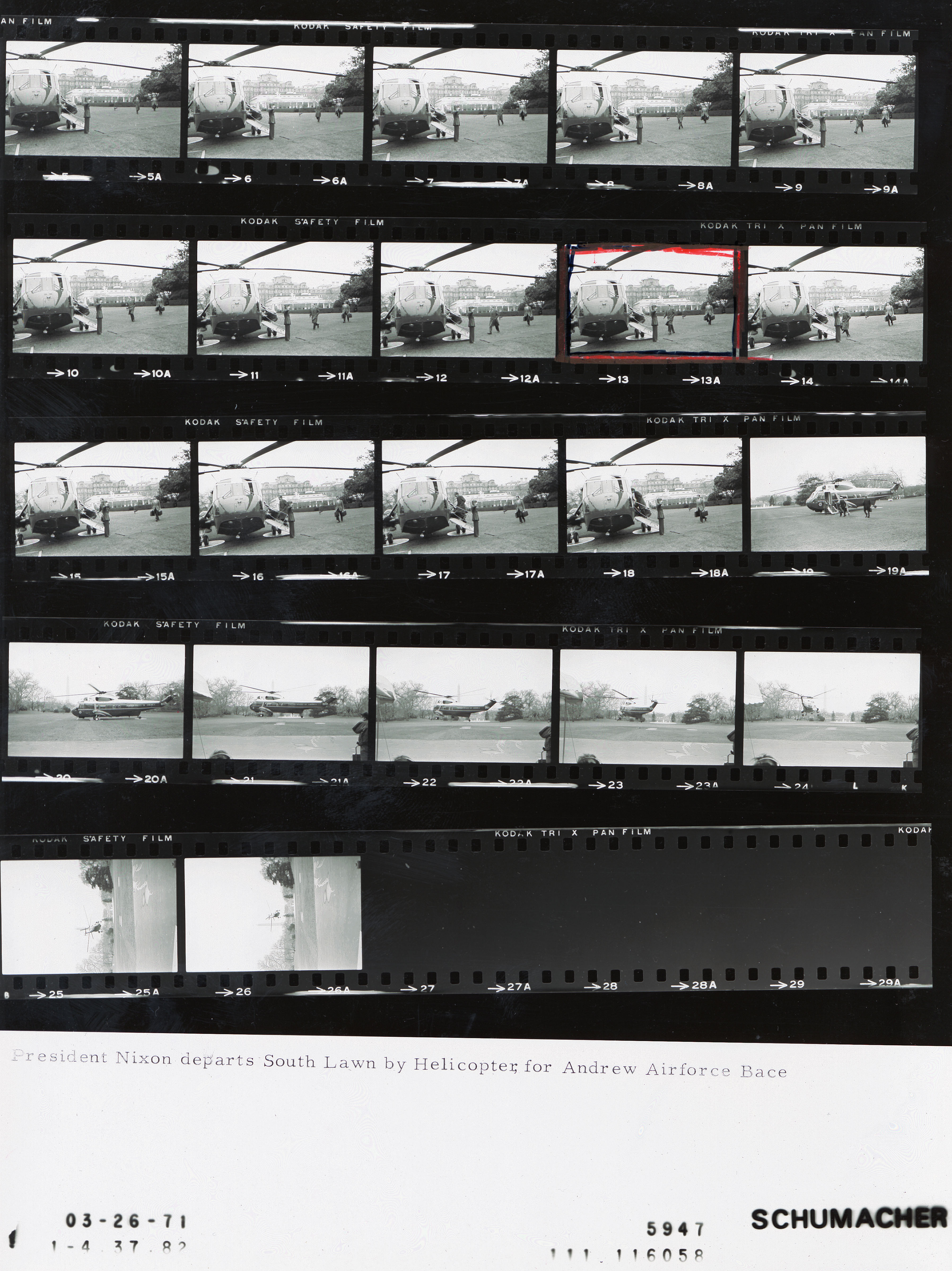
- Frame(s): WHPO-5947-05-26, President Nixon departing by helicopter for Andrews Air Force Base. 3/26/1971, Washington, D.C. White House, Helipad. President Nixon, aides.
Roll WHPO-5948 Photographer: Atkins, Oliver | Color or B&W: B&W
- Frame(s): WHPO-5948-03-10, President Nixon and Pat Nixon being greeted upon arrival. 3/26/1971, Santa Ana, California El Toro Marine Corps Air Station. President Nixon, Pat Nixon, unidentified man, aides, crowd.
- Frame(s): WHPO-5948-11-15, President Nixon greeting the crowd. 3/26/1971, Santa Ana, California El Toro Marine Corps Air Station. President Nixon, Pat Nixon, unidentified man, aides, crowd.
The White House Communications Agency Sound Recordings Collection contains public statements that took place between 1969 and 1974. Visit the finding aid to learn more.
F - Secretary of State Briefings
- WHCA-SR-F-014
Briefing by Sec. Rogers. (3/26/1971, State Department)
Runtime: 40:00:00
Production credits: Audio feed supplied by State Department; Recorded by JLS (initials of WHCA engineer)
Original Format: 1/4-inch reel-to-reel audiotape. Original source type: Original.
P - Formal Presidential Remarks
- WHCA-SR-P-710329
Remarks by President Nixon to religious leaders at White House Conference on Drug Abuse. (3/26/1971)
Runtime: 15:54
Keywords: drugs, drug abuse, narcotics, heroin, marijuana, addicts, addiction, prevention, programs
Original Format: 1/4-inch reel-to-reel audiotape. Original source type: Original.
The White House Communications Agency Videotape Collection contains “off-the-air” recordings of televised programs produced between 1968 and 1974. Visit the finding aid to learn more.
- WHCA-4239
"The Dick Cavett Show". folk singer Judy Collins, actress and anti-Vietnam War activist Jane Fonda, Anthony Burgess and John Marchi
ALL NETWORKS
Runtime: 01:29:30 - WHCA-4242
Weekly News Summary, Tape II.
ALL NETWORKS
Runtime: 01:34:00
29. Smith/Downs: President Nixon's proposals for wage restraints. Time Code Start: 76:25. Keywords: Presidents, reinstatements, construction workers, labor, salaries, money, wages, costs, jobs, unemployment, wage freezes. Network: ABC.
30. Smith/Sherwood: Black Caucus and the visit with President Nixon. Time Code Start: 77:80. Keywords: African Americans, leaders, Congressional Black Caucus, Presidents, meetings. Network: ABC.
31. Reasoner/Farmer: Indochina War. Time Code Start: 80:58. Keywords: Laos, Cambodia, Vietnam War. Network: ABC.
32. Brinkley/Lewis: Indochina War; North Vietnam massing troops, artillery in DMZ; bases at Khe Sanh and Dong Ha shelled in South Vietnam; GIs fear North Vietnam commando raids. Time Code Start: 84:43. Keywords: Vietnam War, miliary, troops, air bases. Network: NBC.
33. McGee/Rich: Drilling for Oil in South Vietnam. Time Code Start: 87:45. Keywords: Vietnam War, energy, petroleum, drilling, oil supply, oil supplies. Network: NBC.
34. McGee: Black Caucus and the visit with President Nixon. Time Code Start: 90:37. Keywords: African Americans, leaders, Congressional Black Caucus, Presidents, meetings. Network: NBC. - WHCA-4243
Weekly News Summary, Tape III.
ALL NETWORKS
Runtime: 0:30
1. Cronkite/Meyer: President Nixon's Proposals for wage restraints. Time Code Start: 00:00. Keywords: Presidents, reinstatements, construction workers, labor, salaries, money, wages, costs, jobs, unemployment, wage freezes. Network: CBS.
2. Cronkite/Duvall: Indochina War. Time Code Start: 02:44. Keywords: Laos, Cambodia, Vietnam War. Network: CBS.
3. Cronkite/Kalb: Paris Peace Talks (Secretary of State Rogers). Time Code Start: 05:18. Keywords: cabinet, advisors, Paris Peace Talks, Vietnam War, treaty, treaties, negotiations. Network: CBS.
4. Cronkite/McLaughlin: Democratic Policy Committee. Time Code Start: 06:53. Keywords: political parties, Democrats, Democratic Party. Network: CBS.
Context (External Sources)
The Vanderbilt Television News Archive is the world's most extensive and complete archive of television news. They have been recording, preserving and providing access to television news broadcasts of the national networks since August 5, 1968.
Wikipedia is a free encyclopedia that anyone can edit.