
Introduction
This almanac page for Monday, March 19, 1973, pulls together various records created by the federal government and links to additional resources which can provide context about the events of the day.
Previous Date: Sunday, March 18, 1973
Next Date: Tuesday, March 20, 1973
Schedule and Public Documents
The Daily Diary files represent a consolidated record of the President's activities. Visit the finding aid to learn more.
The President's day began at Camp David, Maryland
The Weekly Compilation of Presidential Documents made available transcripts of the President's news conferences; messages to Congress; public speeches, remarks, and statements; and other Presidential materials released by the White House.
Digitized versions can be found at HathiTrust.
Each Public Papers of the Presidents volume contains the papers and speeches of the President of the United States that were issued by the White House Office of the Press Secretary during the time period specified by the volume. The material is presented in chronological order, and the dates shown in the headings are the dates of the documents or events. In instances when the release date differs from the date of the document itself, that fact is shown in the text note.
To ensure accuracy, remarks have been checked against audio recordings (when available) and signed documents have been checked against the original, unless otherwise noted. Editors have provided text notes and cross references for purposes of identification or clarity.
The Federal Register is the official daily publication for rules, proposed rules, and notices of federal agencies and organizations, as well as executive orders and other Presidential documents.
The Congressional Record is the official daily record of the debates and proceedings of the U.S. Congress.
Archival Holdings
Any selection of archival documents will necessarily be partial. You should use the documents and folders identified below as a starting place, but consult the linked collection finding aids and folder title lists and the collections themselves for context. Many documents to be found this way do not lend themselves to association with specific dates, but are essential to a complete understanding of the material.
Selective document listing
President's Office Files
The President's Office Files consists of materials drawn together by the Special Files Unit from several administrative subdivisions within the White House Office. It is the handwriting and sensitive papers sent to the Staff Secretary that now comprise much of the President's Office Files. Visit the finding aid to learn more.
- News Summaries, Annotated News Summaries, Box 44, [Mar. 14-19, 1973] [4 of 4] [Note: Due to the way News Summary products were compiled, you should also consult nearby days for potentially relevant materials.]
- Weekend News Review, March 19, 1973
- Digest of Recent News Comment
- News Summaries, Unmarked News Summaries, Box 54, News Summaries - Feb. & March 1973 [4 of 9]
- "The Long War: Congress Vs The President", CBS Special Report - 10-11 Monday, March 19, 1973
The H. R. Haldeman Diaries consists of seven handwritten diaries, 36 dictated diaries recorded as sound recordings, and two handwritten audio cassette tape subject logs. The diaries and logs reflect H. R. Haldeman’s candid personal record and reflections on events, issues, and people encountered during his service in the Nixon White House. As administrative assistant to the President and Chief of Staff, Haldeman attended and participated in public events and private meetings covering the entire scope of issues in which the Nixon White House engaged in during the years 1969-1973. Visit the finding aid to learn more.
- Transcript of diary entry (PDF)
Monday, March 19.
The President came back from Camp David this morning. Called me in as soon as he got back for a couple of hours. He had no schedule for today, so after our meeting he went over to the EOB and then called me over again for another three hours this afternoon on just general minor items. He got into trip and schedule plans. Was concerned about the plans for the Shah and the African, the Soviets, Braun, and Tanaka visits to us and wants to work in his African trip in mid-May, considering a stop in Paris for two days on the way back, so as to put some substance in an otherwise public relations type trip. Do this rather than having Pompidou here. Got into a long discussion on "Evenings at the White House" this morning. The plan for how often we ought to do them. How we ought to carry them out, the youth evening, youth church service, then had Rose in this afternoon going over the same thing again. Wants to get entertainment lined up for them, that sort of thing. Wants to get ahold of Flynn right away, the POW leader, and set the date for the POW dinner. Got into a lot of stuff about having dinners before State Dinners and for those who come to the after dinner entertainment. How the entertainment ought to be handled, how to bring the guests up, which groups of people to bring to which things, all that sort of stuff. A lot of PR, political weighing.
Got into the Ervin questions with Ziegler, because Ervin was on TV yesterday saying he would have White House staff people who refused to testify arrested, and try to force the issue that way. The President told Ron he thought it was too early to draw the sword on Ervin's political circus. Instead he should reiterate the President's position regarding the separation of powers. But emphasize that this is not a case of refusal to cooperate or to furnish information, as Presidents in the past have done. Ours is a policy of complete cooperation. Ron should go on the attack regarding our total cooperation. Hit the sensational statements regarding forcing White House aides have obscured the central fact that we have cooperated and will continue to. On IT&T, told Ron to say "no comment". He feels we need someone like Ron on top of the PR to really keep working full time in getting our digs in.
Got into some of the arrangements on the POW briefing. Whether to have the wives or not, whether to do it in the Defense or State. Then got into the Thieu question. Wants to avoid his coming to DC if we can. Try to talk the Vice President out of that, but Haig and I agreed later that that can't be done. He also wanted Haig to get Sir Robert Thompson in to see the President. Then he changed his mind and said Haig should talk to him and say the President was so impressed with his book that he thinks he should write a sequel. He feels from his talk with Haig last week that the problem now is that Kissinger's trying to cover his left flank and is a little confused on all these things. Wants me to talk to Safire and get our story out on Vietnam. Point out the truth regarding Kissinger panicking on Cambodia, Laos, and Pakistan while the President always had to buck him up. Show him Kissinger's frenetic messages from Paris and tell him that side of the story. Also building Haig as the unsung hero, like a rock in all of this.
He obviously doesn't have any particular purpose driving him at the moment and he's sort of bouncing around covering all these loose ends. Partly trying to decide whether to do his State of the Union thing as an address to Congress and address to the nation on night time TV or just to go for the evening press conference. No decision made on that. He was going to work on it this afternoon, but called Rose and me over on the schedule stuff instead. Hopefully he will get to that decision in the next couple of days.
End of March 19. - Original audio recording (MP3)
The National Archives Catalog is the online portal to the records held at the National Archives, and information about those records. It is the main way of describing our holdings and also provides access to electronic records and digitized versions of our holdings.
The Catalog searches across multiple National Archives resources at once, including archival descriptions, digitized and electronic records, authority records, and web pages from Archives.gov and the Presidential Libraries. The Catalog also allows users to contribute to digitized historical records through tagging and transcription.
Nixon Library Holdings
All National Archives Units
National Security Documents
The President's Daily Brief is the primary vehicle for summarizing the day-to-day sensitive intelligence and analysis, as well as late-breaking reports, for the White House on current and future national security issues. Read "The President's Daily Brief: Delivering Intelligence to Nixon and Ford" to learn more.
The Foreign Relations of the United States series presents the official documentary historical record of major U.S. foreign policy decisions and significant diplomatic activity. Visit the State Department website for more information.
Vol. XXII, Panama, 1973-1976
Panama, 1973-1976
6. Telegram From the Embassy in Panama to the Department of State, Panama City, March 19, 1973, 0307Z
Source: National Archives, Nixon Presidential Materials, NSC Files, Box 791, Country Files, Latin America, Panama, Vol. 3, January 1972–August 1974. Secret; Immediate; Nodis.
Vol. XXVII, Iran; Iraq, 1973-1976
Iran, January-August 1973
11. Telegram From the Embassy in Iran to the Department of State, Tehran, March 19, 1973, 0438Z
Source: National Archives, RG 59, Central Foreign Policy Files, [no film number]. Confidential.
Vol. XXXI, Foreign Economic Policy, 1973-1976
The End of Fixed Exchange Rates, January-March 1973
37. Telegram From the Department of State to the Mission to the European Community, Washington, March 19, 1973, 2106Z
Source: National Archives, RG 59, Central Foreign Policy Files. Secret; Limdis. Drafted by William Dutton (Bureau of European Affairs, Office of OECD, European Community and Atlantic Political-Economic Affairs) and approved by Dutton and James Nelson (EUR/CE).
Vol. XXXVI, Energy Crisis, 1969-1974
March 8-October 5, 1973
174. Memorandum From the President’s Special Consultant for Energy (DiBona) to the President’s Assistant for National Security Affairs (Kissinger), Washington, March 19, 1973
Source: National Archives, Nixon Presidential Materials, White House Central Files, Staff Member and Office Files, Energy Policy Office, Box 22, Charles J. DiBona Subject Files, Committee Memos. No classification marking. Printed from an uninitialed copy.
Vol. E-9, Part 2, Documents on the Middle East Region, 1973-1976
Oman and the Yemens
195. Memorandum from Director of Central Intelligence Schlesinger to the President’s Assistant for National Security Affairs (Kissinger), Washington, March 19, 1973
[Source: Central Intelligence Agency, Executive Registry Files, Job 80M01066A, Box 14, Folder S–34. Secret; [handling restriction not declassified]. 3 pages not declassified.]
Vol. E-11, Part 2, Documents on South America, 1973-1976
Peru
282. Memorandum From the Acting Assistant Secretary of Defense for International Security Affairs (Eagleburger) to Secretary of Defense Richardson, Washington, March 19, 1973
Summary: Eagleburger informed Richardson of the broad outlines of the U.S. Government’s policy towards Peru. He requested approval for presidential waivers of congressionally-mandated withholding of FMS for Peru and an SRG meeting if the waivers were denied.
Source: Washington National Records Center, OSD Files: FRC 330–78 0001, Peru 1973. Secret. Richardson approved the actions on March 20. NSSM 158 is published in Foreign Relations, 1969–1976, vol. E–10, Documents on American Republics, 1969–1972, as Document 637. National Security Decision Memorandum 11 and 19 are ibid., Documents 593 and 607, respectively. Attached but not published at Tab A is a February 23 telegram from Belcher to the Secretary of State; at Tab B is Belcher’s undated overview to the FY 1974–75 CASP for Peru; at Tab C is a March 8 Memorandum for the Record from LeBailly; at Tab D is a February 20 telegram from Belcher to the Secretary of State; and at Tab E is a undated draft letter to Crimmins from Eagleburger. On April 14, Eagleburger informed Richardson that he had sent the letter to Crimmins on March 22, and that a request for a Presidential Determination issuing the waiver to the Pelly Amendment was being processed at the Department. (Ibid.) No SRG meeting on Peru was held.
Vol. E-14, Part 2, Documents on Arms Control and Nonproliferation, 1973-1976
4. Telegram 47705 From the Department of State to the Mission to the International Atomic Energy Administration in Vienna, Washington, March 19, 1973, 2142Z
Summary: The Department communicated Rogers’s instructions to the U.S. delegation to the IAEA regarding discussions with the Soviets of a comprehensive test ban.
Source: National Archives, RG 59, Central Foreign Policy File, [no film number]. Confidential. Drafted and approved by William Givan (ACDA/IR). Repeated to Ottawa. Telegrams 798, 854, and 919 from Geneva are ibid., Central Files 1970–73, DEF 18–6. For the August 1972 working paper see Documents on Disarmaments, 1972, pp. 590–611.
Vol. E-16, Documents on Chile, 1969-1973
"That Chilean Guy May Have Some Problems": The Downfall of Salvador Allende, January-September 1973
131. Memorandum From the Director of Operations Policy, Bureau of Intelligence and Research (Gardner) to the Deputy Director for Coordination, Bureau of Intelligence and Research (McAfee), Washington, March 19, 1973
Summary: This account of a discussion between Department of State and Central Intelligence Agency officials focused on recent discussions between CIA officials and Senator Church and staffers of the Senate Subcommittee on Multinational Corporations. Church and the Senate Subcommittee were investigating ITT activities in Chile.
Source: National Archives, RG 59, INR Files, Lot 94D565, James Gardner Chronological File. Secret.
The Kissinger telephone conversation transcripts consist of approximately 20,000 pages of transcripts of Kissinger’s telephone conversations during his tenure as Assistant to the President for National Security Affairs (1969-1974) and Secretary of State (1973-1974) during the administration of President Richard Nixon. Visit the finding aid for more information.
Digitized versions can be found in the National Archives Catalog.
Audiovisual Holdings
Visit the White House Tapes finding aid to learn about the taping system's operation and archival processing.
Old Executive Office Building
- 420-12; Unknown between 12:35 p.m. & 1:28 p.m.; Nixon, Richard M. (President); Sanchez, Manolo
- 420-13; Unknown between 12:35 p.m. & 1:28 p.m.; Nixon, Richard M. (President); Sanchez, Manolo
- 420-14; Unknown between 12:35 p.m. & 1:28 p.m.; Nixon, Richard M. (President); [Unknown person(s)]
- 420-15; Unknown between 12:35 p.m. & 1:28 p.m.; Nixon, Richard M. (President); White House operator
- 420-16; Unknown between 12:35 p.m. & 1:28 p.m.; Nixon, Richard M. (President); Sanchez, Manolo
- 420-17; 1:28 p.m. - 1:31 p.m.; Nixon, Richard M. (President); Ziegler, Ronald L.
- 420-18; Unknown between 1:38 p.m. & 2:37 p.m.; Nixon, Richard M. (President); Sanchez, Manolo
- 420-19; Unknown between 1:38 p.m. & 2:37 p.m.; Nixon, Richard M. (President); Woods, Rose Mary
- 420-20; 2:37 p.m. - 4:55 p.m.; Nixon, Richard M. (President); Haldeman, H. R. ("Bob"); Woods, Rose Mary
- 420-21; 4:59 p.m. - 4:59 p.m.; Nixon, Richard M. (President); White House operator
- 420-22; Unknown between 4:59 p.m. & 5:03 p.m.; Nixon, Richard M. (President); Ehrlichman, John D.
- 420-23; Unknown between 4:59 p.m. & 5:03 p.m.; Nixon, Richard M. (President); White House operator
- 420-24; Unknown between 5:03 p.m. & 5:41 p.m.; Nixon, Richard M. (President); Dean, John W., III; Moore, Richard A.; Stennis, John C.
- 420-25; Unknown between 1:38 p.m. & 2:37 p.m.; Nixon, Richard M. (President); Sanchez, Manolo
Oval Office
- 883-1; Unknown between 10:14 a.m. & 10:22 a.m.; Nixon, Richard M. (President); White House operator
- 883-2; Unknown between 10:14 a.m. & 10:22 a.m.; Nixon, Richard M. (President); [Unknown person(s)]
- 883-3; 10:22 a.m. - 10:23 a.m.; Nixon, Richard M. (President); Cox, Tricia Nixon
- 883-4; Unknown between 10:23 a.m. & 10:30 a.m.; Nixon, Richard M. (President); [Unknown person(s)]
- 883-5; 10:30 a.m. - 12:34 p.m.; Nixon, Richard M. (President); Haldeman, H. R. ("Bob"); Ziegler, Ronald L.; [Unknown person(s)]
- 883-6; Unknown between 12:34 p.m. & 11:59 p.m.; [Unknown person(s)]
White House Telephone
- 37-151; Unknown between 10:14 a.m. & 10:22 a.m.; Nixon, Richard M. (President); White House operator
- 37-152; 10:22 a.m. - 10:23 a.m.; Nixon, Richard M. (President); Cox, Tricia Nixon
- 37-153; Unknown between 12:35 p.m. & 1:28 p.m.; Nixon, Richard M. (President); White House operator
- 37-154; 1:28 p.m. - 1:31 p.m.; Nixon, Richard M. (President); Ziegler, Ronald L.
- 37-155; 4:59 p.m. - 4:59 p.m.; Nixon, Richard M. (President); White House operator
- 37-156; Unknown between 4:59 p.m. & 5:03 p.m.; Nixon, Richard M. (President); White House operator
- 37-157; 5:05 p.m. - 5:07 p.m.; Nixon, Richard M. (President); Stennis, John C.
- 37-158; Unknown between 5:07 p.m. & 5:54 p.m.; Nixon, Richard M. (President); White House operator
- 37-159; 5:54 p.m. - 5:55 p.m.; Nixon, Richard M. (President); Bull, Stephen B.; Ehrlichman, John D.
- 37-160; Unknown between 5:55 p.m. & 8:34 p.m.; Nixon, Richard M. (President); White House operator
- 37-161; Unknown between 5:55 p.m. & 8:34 p.m.; Nixon, Richard M. (President); White House operator
- 37-162; 8:34 p.m. - 8:58 p.m.; Nixon, Richard M. (President); Colson, Charles W.
The White House Photo Office collection consists of photographic coverage of President Richard Nixon meeting with prominent social, political, and cultural personalities; speaking engagements and news conferences of the President and various high-ranking members of the White House staff and Cabinet; Presidential domestic and foreign travel, including Presidential vacations; social events and entertainment involving the First Family, including entertainers present; official portraits of the President, First Family, and high-ranking members of the Nixon administration; the 1969 and 1973 Inaugurals; the President’s 1972 Presidential election campaign appearances (including speeches) and other official activities of the White House staff and the President’s Cabinet from January 20, 1969 until August 9, 1974 at the White House and the Old Executive Office Building; other locations in Washington, DC, such as The Mall; and the Presidential retreats in Camp David, Maryland, Key Biscayne, Florida, and San Clemente, California. Visit the finding aid to learn more.
Roll WHPO-E0474 Photographer: Atkins, Oliver | Color or B&W: Color
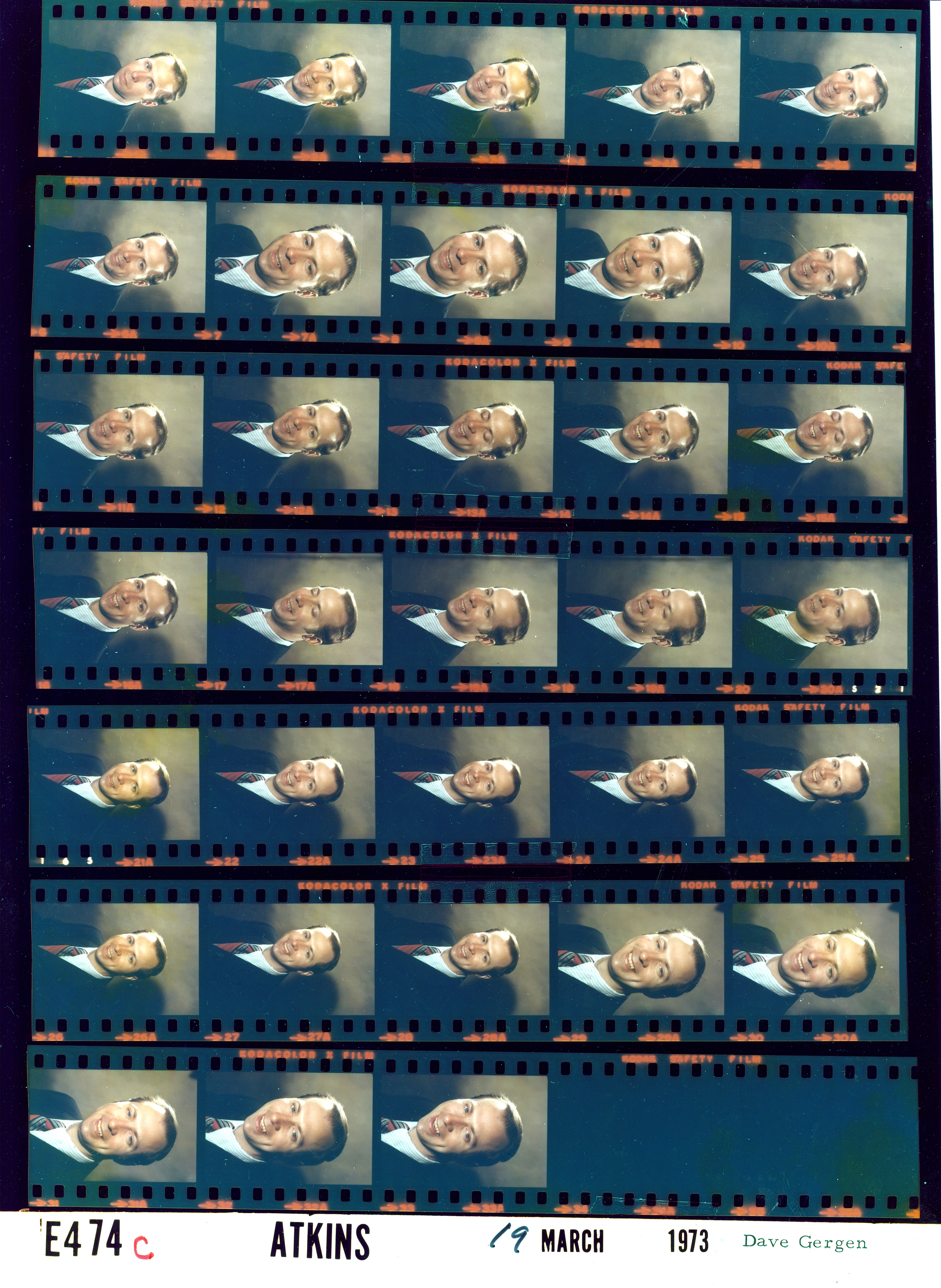
- Frame(s): WHPO-E0474-, David Gergen portraits. 3/19/1973, Washington, D.C. unknown. David Gergen.
Roll WHPO-E0476 Photographer: Schumacher, Karl | Color or B&W: B&W
- Frame(s): WHPO-E0476-, David Gergen portraits. 3/19/1973, Washington, D.C. unknown. David Gergen.
The White House Communications Agency Sound Recordings Collection contains public statements that took place between 1969 and 1974. Visit the finding aid to learn more.
S - White House Press Office Briefings (continuation of the L-series)
- WHCA-SR-S-026
Briefing by Ronald Ziegler. (3/19/1973, White House Press Lobby)
Runtime: 37:00:00
Keywords: Briefings, public briefings, statements to the press (see also Press conferences, news conferences, interviews, media)
Production credits: Audio feed supplied by WHCA; Recorded by GET (initials of WHCA engineer)
Original Format: 1/4-inch reel-to-reel audiotape. Original source type: Original.
The White House Communications Agency Videotape Collection contains “off-the-air” recordings of televised programs produced between 1968 and 1974. Visit the finding aid to learn more.
- WHCA-6187
The Long War.
CBS
Runtime: 1:00 - WHCA-6193
Weekly News Summary, 16-22 Mar 73, Tape I.
ALL NETWORKS
Runtime: 01:27:00
32. Smith/Koppel: Saigon, Vietnam may break ceasefire; inflation tapering off. Time Code Start: 79:03. Keywords: Vietnam War, ceasefires, economy, economics, budgets, finances, recession, inflation, money, wages, costs, unemployment, prices. Network: ABC.
33. Reasoner/Collins: POWs. Time Code Start: 81:04. Keywords: Vietnam War, Vietnam Prisoner of War. Network: ABC.
34. Reasoner/Chaplan: Dollar value. Time Code Start: 83:27. Keywords: economy, economics, budgets, finances, recession, inflation, money, currency, monetary values, exchange rates, decreases, wages, costs, increases. Network: ABC.
35. Reasoner/Miller: Wounded Knee (American Indians). Time Code Start: 85:40. Keywords: American Indians, Native Americans, tribes, American Indian Movement, occupations. Network: ABC. - WHCA-6194
Weekly News Summary, 16-22 Mar 73, Tape II.
ALL NETWORKS
Runtime: 01:00:37
1. Smith: Commentary on better news. Time Code Start: 00:00. Keywords: media, radio, television, TV, media, newspapers, the press. Network: ABC.
2. Chancellor/Dobbins: Ceasefire may be broken; Paris Talks. Time Code Start: 02:08. Keywords: Paris Peace Talks, Vietnam War, treaty, treaties, negotiations, ceasefires. Network: NBC.
3. Chancellor/Biondi: POWs. Time Code Start: 04:07. Keywords: Vietnam War, Vietnam Prisoner of War. Network: NBC.
4. Chancellor/Duke: International Telephone & Telegraph (ITT Corporation) and the administration. Time Code Start: 06:23. Keywords: International Telephone & Telegraph, communications, world, corporations, conglomerates, campaign funding, investigations, hearings. Network: NBC.
5. Chancellor/Hager: Value of the dollar in Germany. Time Code Start: 08:07. Keywords: West Germany, economy, economics, budgets, finances, recession, inflation, money, currency, monetary values, exchange rates, decreases, wages, costs, increases. Network: NBC.
6. Mudd/Shean/McLaughlin: Value of the dollar. Time Code Start: 10:40. Keywords: economy, economics, budgets, finances, recession, inflation, money, currency, monetary values, exchange rates, decreases, wages, costs, increases. Network: CBS.
7. Mudd/Rabel: Meat prices. Time Code Start: 14:57. Keywords: food, meats, animal products, markets, retail stores, prices, costs, increases, shortages. Network: CBS.
8. Mudd/Dean: POWs. Time Code Start: 17:32. Keywords: Vietnam War, Vietnam Prisoner of War. Network: CBS.
9. Mudd/Herman: International Telephone & Telegraph (ITT Corporation). Time Code Start: 20:44. Keywords: International Telephone & Telegraph, communications, world, corporations, conglomerates, campaign funding, investigations, hearings. Network: CBS.
10. Sevareid: Commentary on President Nixon crime proposal. Time Code Start: 22:52. Keywords: bills, laws, House of Representatives, anti-crime, offences, offenses, infractions, criminals, criminality, law breaking. Network: CBS.
Context (External Sources)
The Vanderbilt Television News Archive is the world's most extensive and complete archive of television news. They have been recording, preserving and providing access to television news broadcasts of the national networks since August 5, 1968.
Wikipedia is a free encyclopedia that anyone can edit.